‘Soft Coup’ on Trump, Hiding in Plain Sight
By Robert Parry | Consortium News | June 8, 2017
So what were we watching in ex-FBI Director James Comey’s testimony on Thursday: an upright public servant punished for resisting a power-mad President or a participant in a political scheme to use the law as a way to overturn a U.S. presidential election?
There was a general consensus in the mainstream media that it was the first, that Comey was the noble victim and President Trump the conniving villain. And, surely, Trump could be criticized for his clumsy firing of National Security Adviser Michael Flynn and ensuing expression of “hope” to then-FBI Director Comey that Flynn would not be punished further.
But – outside the view of the MSM – there are other troubling aspects of what is now unfolding, including the scene of FBI Director Comey informing President-elect Trump on Jan. 6 about a defamatory annex to an intelligence report detailing unproven but salacious allegations and then seeing those details leaked almost immediately to humiliate Trump in the days before his Inauguration.
In his Thursday testimony, Comey defended his role in alerting Trump to the Intelligence Community’s publication of the allegations, which summarized opposition research done to benefit Hillary Clinton’s campaign and alleging that Trump had hired Russian prostitutes to urinate on him as he lay in a bed once used by President and Mrs. Obama at the five-star Ritz-Carlton Hotel in Moscow – while supposedly secretly videotaped by Russian intelligence.
In the testimony, Comey said that after he and other Obama’s intelligence chiefs briefed the President-elect at Trump Towers on Jan. 6 about their report on alleged Russian interference in the 2016 campaign, “I remained alone with the President-elect to brief him on some personally sensitive aspects of the information assembled during the assessment.
“The I.C. leadership thought it important, for a variety of reasons, to alert the incoming President to the existence of this material, even though it was salacious and unverified. Among those reasons were: (1) we knew the media was about to publicly report the material and we believed the I.C. should not keep knowledge of the material and its imminent release from the President-elect; and (2) to the extent there was some effort to compromise an incoming President, we could blunt any such effort with a defensive briefing.
“The Director of National Intelligence asked that I personally do this portion of the briefing because I was staying in my position and because the material implicated the FBI’s counter-intelligence responsibilities. We also agreed I would do it alone to minimize potential embarrassment to the President-elect.”
Like J. Edgar Hoover
Given the mainstream media’s determined promotion of Russia-gate as a legitimate scandal, the extraordinary nature of this briefing incident has passed largely unnoticed.
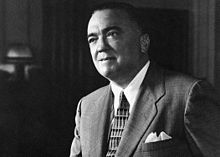
FBI Director J. Edgar Hoover
If, however, you substituted FBI Director J. Edgar Hoover for FBI Director Comey, the significance of the I.C.’s gratuitous inclusion of such an unsubstantiated smear might take on a different coloring. It was, after all, the decision to tack this classified annex onto the Jan. 6 report that gave the mainstream media the hook to disseminate the “golden shower” accusation across the country and around the world.
Rather than minimizing “potential embarrassment to the President-elect,” as Comey demurred, the classified annex was guaranteed to maximize Trump’s embarrassment, which it did.
In other words, just as Comey said he inferred an improper or illegal order when Trump expressed “hope” that Flynn’s legal ordeal might end, Trump might well have deduced that Comey’s elevation of the urination story amounted to coercion or blackmail from the Intelligence Community.
Trump, who surely knows the shadier corners of the construction trade, might have heard something like, “Gee, we’d hate for your wife and children (not to mention the rest of the world) to hear this story about prostitutes peeing on you” – and read the warning as a threat.
FBI Director Hoover was a master of just this sort of warning, conveyed as a sincere concern about some politician’s well-being. Trump, who has emphatically denied the salacious accusation, could well have seen Comey sending him a message from the leaders of the powerful Intelligence Community that they were determined to remove Trump or at least politically cripple him.
Just three days earlier, Senate Minority Leader Chuck Schumer told MSNBC’s Rachel Maddow that Trump was “being really dumb” by taking on the Intelligence Community because “they have six ways from Sunday at getting back at you.”
In the five months since the Jan. 6 briefing, Trump has gotten a taste of how accurate Schumer’s observation was. Making sure that the public got to read the “dirty dossier” – compiled by ex-British spy Christopher Steele and financed by some still unknown Clinton supporter – was clearly one of those six ways.
On top of that, Obama’s intelligence chiefs, including Comey, have testified repeatedly before Congress while they or their allies have leaked derogatory information about Trump to The New York Times, The Washington Post and other mainstream news outlets.
The ‘Soft Coup’
In other words, what we may have witnessed in Comey’s ballyhooed testimony on Thursday was just the latest chapter in a “soft coup” to remove Trump – either through a forced resignation or impeachment. The thinking is that Trump is so incompetent that “wise men” must step in to “correct a mistake” made by the U.S. electorate and made possible by the Constitution’s Electoral College system, which enabled Trump to win the presidency despite losing the popular vote,
But the American people are not supposed to see it that way. After all, the realization that U.S. intelligence chieftains might be conspiring to overturn a constitutional election of a U.S. president could be most upsetting and unsettling, even if one assumes that they are sincerely doing what they think is “best for the country.”
So, this side of the story remains unspoken, a silence made possible by the fact that most of the nation’s top news executives and much of its political elite share the opinion that Trump’s presidency must be ended and a more traditional chief executive installed.
But no one in authority wants to acknowledge that a “soft coup” is in the works because that would make America look like a banana republic to the world. It also could infuriate Trump’s 63 million voters who might take exception to this sort of “deep state” veto of a duly certified election.
So, what that means is that the planned removal of Trump will be a deliberate process cloaked in high-minded legal principles and much talk about the rule of law.
Of course, Trump would not be the only loser in this process. His sinking presidency would drag down many of those around him – and, in the case of Michael Flynn, might well lead to criminal charges.
Indeed, if civil libertarians were not largely committed to the anti-Trump #Resistance, they might pause for a moment and consider the disturbing picture of what was done to retired Lt. Gen. Flynn.
Trapping Flynn
To engineer the ouster of Flynn as Trump’s first National Security Adviser, President Obama’s Justice Department holdovers used the archaic 1799 Logan Act as a predicate to justify an FBI interrogation of Flynn about the details of a phone conversation with Russian Ambassador Sergey Kislyac on Dec. 29, 2016, while Flynn was vacationing in the Dominican Republic.
Since the FBI agents had a transcript of the intercepted phone call and Flynn was working from memory – possibly a bit hazy from a Pina Colada or two – Flynn was an easy mark for a perjury trap. Leaving out some detail, whether intentionally or not, would open him to an obstruction case – and Comey reportedly has indicated that the ongoing criminal investigation of Flynn indeed relates to whether he withheld information from investigators.
Every American who is concerned about the future political use of the U.S. intelligence agencies’ powerful surveillance tools should have shuddered a bit over what was done to Flynn. But many on the Left so desperately want Trump removed from office that they have joined the Russia-gate stampede as the best way to trample Trump.
So, few tears have been shed for Flynn even as he was ambushed based on transcripts of National Security Agency transcripts, a precedent that could be replicated in many other circumstances against American citizens who get on the Intelligence Community’s “six ways from Sunday” black list.
The use of the Logan Act predicate should have set off other alarm bells. The law, which was enacted during the Alien and Sedition Act period, was meant to stop private citizens from trying to conduct U.S. foreign policy on their own, but its constitutionality was always suspect and it has never led to a prosecution, not one in 218 years.
It was also never intended to apply to incoming foreign policy officials of a new presidential administration after the election, when they are understandably beginning to make contacts with foreign officials. So, for then-acting Attorney General Sally Yates to have dusted it off as a predicate for going after Flynn suggests additional entrapment problems.
True, Flynn may have used poor judgment in how he handled a 2015 paid speaking engagement in Moscow, how he reported on his consulting work for a Dutch company owned by a wealthy Turk with high-level political connections, and what he might have said to Kislyak (although we still don’t know the details of that conversation).
Islamic State Warning
But Flynn also had been an Army lieutenant general who led the Defense Intelligence Agency in 2012 when it produced the U.S. government’s most perceptive critique of President Obama’s proxy war in Syria, even predicting the emergence of an “Islamic state,” a judgment that annoyed other intelligence leaders who were participating in the covert war to overthrow the Syrian government.
The DIA report embarrassed the advocates for an escalation of the war in Syria and the ouster of secular President Bashar al-Assad. Journalist Seymour Hersh reported that Flynn’s DIA “had sent a constant stream of classified warnings … about the dire consequences of toppling Assad.” Flynn told Hersh that these reports “got enormous pushback from the Obama administration.”
After being forced out of his DIA job and retiring from the Army in 2014, Flynn went even further in a 2015 interview when he said the intelligence was “very clear” that the Obama administration made a “willful decision” to back these jihadists in league with Middle East allies, a choice that looked particularly stupid when Islamic State militants started beheading American hostages and capturing cities in Iraq, forcing the reintroduction of U.S. military troops.
However, out of a job, Flynn scrambled around for additional income, including signing up with a speakers’ bureau and forming a consulting company, as many other national security veterans have done.
In perhaps Flynn’s most controversial decision, he accepted a speaking fee of about $45,000 to address the tenth anniversary dinner for Russia’s RT network in Moscow, sitting next to President Vladimir Putin for part of the evening. Given the Obama administration’s heightened hostility toward Russia, Flynn’s appearance drew some high-level criticism.
Flynn further antagonized Obama’s team by signing up with the Trump campaign and then joining the “lock her up” chant at the Republican National Convention directed toward Hillary Clinton.
In the wake of Clinton’s shocking defeat and amid the Intelligence Community’s claims about Russian interference in the election, Flynn’s friendly relations with Russian leaders made him an obvious target.
Still, the notion of Obama holdovers taking Flynn out via dubious legal tactics – and their fueling of a McCarthyistic hysteria over Russia – normally might have raised more objections if not for the widespread disdain for Trump, his narcissistic behavior and his offensive policies, such as the “Muslim travel ban.”
However, amid the mainstream media’s increasingly frenzied talk about Trump’s potential impeachment, this other remarkable story – how the U.S. Intelligence Community is moving to reverse the outcome of a presidential election – is getting ignored in plain sight.
Investigative reporter Robert Parry broke many of the Iran-Contra stories for The Associated Press and Newsweek in the 1980s.
$110bn US-Saudi arms deal is ‘fake news’
MEMO | June 8, 2017
A $110 billion arms deal between Saudi Arabia and the US, which was touted as the biggest single arms deal in American history has been characterised as “fake news”, a US think tank has said.
Defence industry experts confirmed to experts within the Brookings Institution, that no such deal had been finalised.
There are a bunch of letters of interest or intent, but not contracts said Bruce Riedel, senior fellow at the institute. “Many are offers that the defence industry thinks the Saudis will be interested in someday.”
The Defence Security Cooperation Agency, the arms sales wing of the Pentagon, calls them “intended sales”. The only sale expected in the immediate future was a deal for $1 billion in munitions intended to resupply Riyadh’s war in Yemen.
Riedel said that none of the potential sales were new, and all had been initiated by the Obama administration. President Barack Obama sold the kingdom $112 billion in weapons over eight years, most of which was a single, huge deal in 2012 negotiated by then-Secretary of Defence Robert Gates.
Moreover, it’s unlikely that the Saudis could pay for a $110 billion deal any longer, due to low oil prices and the two-plus years old war in Yemen, said Reidel.
White House spokesman Sean Spicer said on Twitter that the defence agreement was the “largest single arms deal in US history” and said other deals amounted to $250 billion in commercial investment.
The deal also raised concern in Israel where the Times of Israel reported Defence Minister, Avigdor Lieberman, “was uneasy over the agreement, which he saw as part of a ‘crazy’ regional arms race”.
Moscow Urges CNN Host to Take Honest Interview with Aleppo Boy

Fars News Agency | June 8, 2017
The Russian Foreign Ministry’s spokeswoman Maria Zakharova on Thursday invited CNN host Christiane Amanpour to visit Syria to make an honest interview with the Syrian boy from Aleppo known as the “symbol of Aleppo suffering.”
The RT broadcaster released a two-part interview with Omran Daqneesh’s father Mohammad Kheir Daqneesh on Tuesday and Wednesday. The interview revealed that the White Helmets volunteers had manipulated injured Omran into being photographed instead of offering immediate help and later threatened his father after he went into hiding to prevent any more unwanted media exposure, Sputnik reported.
Amanpour in her October interview with Russian Foreign Minister Sergey Lavrov showed the photograph of Daqneesh shot in August, saying that it illustrated “a crime against humanity.”
“I’d like to say that if Amanpour started this story, I mean so publicly, coming to Moscow and being determined enough to print out the photograph and show it to Sergei Lavrov, maybe she has enough bravery, journalistic professional ethics and simple humane conscience to finish it? And do that by going to Aleppo, finding the family of the boy and taking a truly honest interview, not a set up one as they at CNN know, but an honest interview with the boy,” Zakharova said.
August’s footage showed the boy injured and covered in ashes after being rescued from an attack in the militant-controlled Karm al-Qaterji neighborhood. Syrian anti-government forces accused Moscow of conducting an airstrike on the neighborhood, while Russian Defense Ministry’s spokesman Maj. Gen. Igor Konashenkov denied Western media reports of Russia’s alleged role in the strike as the residential neighborhood is directly adjacent to the Russian humanitarian operation corridors for the safe exit of local residents.
Konashenkov previously stated that the nature of damage shown by Western media during Omran’s rescue demonstrates that if the strike did take place, it could not have come from aircraft munitions, but a mine or a gas cylinder, heavily used by terrorists in Syria. The Russian defense ministry’s spokesman accused the media of committing a “moral crime” in the “cynical hype” of the volunteers’ footage for their “formulaic propaganda material.”
NYT’s New Syria-Sarin Report Challenged
MIT national security technical expert Theodore Postol
By Robert Parry | Consortium News | June 7, 2017
For U.S. mainstream journalists and government analysts, their erroneous “groupthinks” often have a shady accomplice called “confirmation bias,” that is, the expectation that some “enemy” must be guilty and thus the tendency to twist any fact in that direction.
We have seen this pair contribute to fallacious reasoning more and more in recent years as the mainstream U.S. media and the U.S. government approach international conflicts as if the “pro-U.S. side” is surely innocent and the “anti-U.S. side” is presumed guilty.
That was the case in assessing whether Iraq was hiding WMD in 2002-2003; it was repeated regarding alleged chemical weapons attacks in Syria during that six-year conflict; and it surfaces as well in the New Cold War in which Russia is always the villain.
The trend also requires insulting any Western journalist or analyst who deviates from the groupthinks or questions the confirmation bias. The dissidents are called “stooges”; “apologists”; “conspiracy theorists”; or “purveyors of fake news.” It doesn’t really matter how reasonable the doubts are. The mocking insults carry the day.
In addition, there is almost no accountability in those rare cases when the mainstream media and government propagandists must admit that they were demonstrably wrong. For every Iraq WMD confession – which resulted in almost no punishments for the “groupthinkers” – there are dozens of cases when the Big Boys just hunker down, admit nothing and count on their privileged status to protect them.
It doesn’t even seem to matter how well-credentialed the skeptic is or how obvious the failings of the mainstream analysis is. So, you even have weapons experts, such as Theodore Postol, professor of science, technology and national security policy at the Massachusetts Institute of Technology, who are ignored when their judgments conflict with the conventional wisdom.
The Syrian Case
For instance, in a little-noticed May 29, 2017 report on the April 4, 2017 chemical weapons incident at Khan Sheikhoun in northern Syria, Postol takes apart the blame-the-Syrian-government conclusions of The New York Times, Human Rights Watch and the Establishment’s favorite Internet site, Bellingcat.
Postol’s analysis focused on a New York Times video report, entitled “How Syria And Russia Spun A Chemical Strike,” which followed Bellingcat research that was derived from social media. Postol concluded that “NONE of the forensic evidence in the New York Times video and a follow-on Times news article supports the conclusions reported by the New York Times.” [Emphasis in original.]
The basic weakness of the NYT/Bellingcat analysis was a reliance on social media from the Al Qaeda-controlled area of Idlib province and thus a dependence on “evidence” from the jihadists and their “civil defense” collaborators, known as the White Helmets.
The jihadists and their media teams have become very sophisticated in the production of propaganda videos that are distributed through social media and credulously picked up by major Western news outlets. (A Netflix infomercial for the White Helmets even won an Academy Award earlier this year.)
Postol zeroes in on the Times report’s use of a video taken by anti-government photographer Mohamad Salom Alabd, purporting to show three conventional bombs striking Khan Sheikhoun early in the morning of April 4.
The Times report extrapolated from that video where the bombs would have struck and then accepted that a fourth bomb – not seen in the video – delivered a sarin canister that struck a road and released sarin gas that blew westward into a heavily populated area supposedly killing dozens.
The incident led President Trump, on April 6, to order a major retaliatory strike with 59 Tomahawk missiles hitting a Syrian government airfield and, according to Syrian media reports, killing several soldiers at the base and nine civilians, including four children, in nearby neighborhoods. It also risked inflicting death on Russians stationed at the base.
A Wind Problem
But the Times video analysis – uploaded on April 26 – contained serious forensic problems, Postol said, including showing the wind carrying the smoke from the three bombs in an easterly direction whereas the weather reports from that day – and the presumed direction of the sarin gas – had the wind going to the west.
Indeed, if the wind were blowing toward the east – and if the alleged location of the sarin release was correct – the wind would have carried the sarin away from the nearby populated area and likely would have caused few if any casualties, Postol wrote.
Postol also pointed out that the Times’ location of the three bombing strikes didn’t match up with the supposed damage that the Times claimed to have detected from satellite photos of where the bombs purportedly struck. Rather than buildings being leveled by powerful bombs, the photos showed little or no apparent damage.
The Times also relied on before-and-after satellite photos that had a gap of 44 days, from Feb. 21, 2017, to April 6, 2017, so whatever damage might have occurred couldn’t be tied to whatever might have happened on April 4.
Nor could the hole in the road where the crushed “sarin” canister was found be attributed to an April 4 bombing raid. Al Qaeda jihadists could have excavated the hole the night before as part of a staged provocation. Other images of activists climbing into the supposedly sarin-saturated hole with minimal protective gear should have raised other doubts, Postol noted in earlier reports.
There’s also the question of motive. The April 4 incident immediately followed the Trump administration’s announcement that it was no longer seeking “regime change” in Syria, giving the jihadists and their regional allies a motive to create a chemical-weapons incident to reverse the new U.S. stand. By contrast, the Syrian government seemed to have no logical motive to provoke U.S. outrage.
In other words, Al Qaeda and its propagandists could have posted video from an earlier bombing raid and used it to provide “proof” of an early-morning airstrike that corresponded to the staged release of sarin or some similar poison gas on April 4. Though that is just one possible alternative, it’s certainly true that Al Qaeda does not show very much humanitarian concern about the lives of civilians.
Critics of the White Helmets have identified the photographer of the airstrike, Mohamad Salom Alabd, as a jihadist who appears to have claimed responsibility for killing a Syrian military officer. But the Times described him in a companion article to the video report only as “a journalist or activist who lived in the town.”
Mocking the Russian/Syrian Account
For their part, the Syrian government and the Russians said Syrian planes conducted no airstrike early in the morning but did attack the area around noon. They speculated that the noontime attack may have struck chemical weapons stored by the jihadists, causing an accidental release of poisonous gas.
The Times jumped on the discrepancy between the reports of an early-morning attack and the Syrian-Russian account of a noontime strike to show that the Syrians and Russians were lying.
In response to Syrian President Bashar al-Assad asking, “How can you verify the video?” the Times narration by Malachy Browne smugly says: “Well, here’s how. Let’s take a look at videos, satellite photos and open source material of that day. They show that Assad and Russia are telling a story that contradicts the facts.”
Yet, the Times’ point about the Syrians and Russians lying about the time element makes little sense because the Syrians and Russians aren’t denying that an airstrike occurred. They acknowledged that there was an airstrike, albeit later in the day, and they speculate that the attack might have accidentally released chemicals stored by Al Qaeda’s Nusra Front. In other words, they gained no advantage by putting the time at noon instead of early in the morning.
There could have been honest confusion on the part of the Syrians and Russians as they struggled to understand what had occurred and how – or the noontime airstrike and the morning chemical release could have been unrelated, i.e., the jihadists and/or their foreign allies could have staged the early-morning poison-gas “attack” and the Syrian bombing raid could have followed several hours later but could have been unrelated to the poison-gas release.
However, for the Times and others to pounce on a seemingly meaningless time discrepancy, further shows how “confirmation bias” works. The “enemy” must be shown to be guilty, so any comment – no matter how innocent or irrelevant – can be cited to “prove” a point.
Double Standard on Trust
The Times also has displayed a bizarre bias when Syrians speak from government-controlled areas. Then, the Times always inserts language suggesting that the interviewees may be under coercion. Yet the Times assumes that “witnesses” inside Al Qaeda-controlled territory are commenting honestly, freely and without fear of contradicting the jihadists.
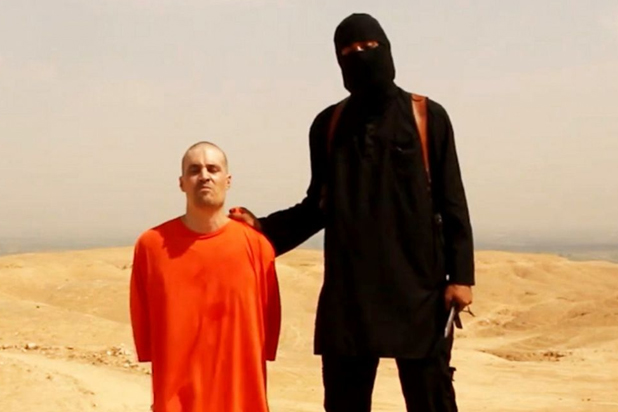
Journalist James Foley executed by ISIS
The Times’ double standard is particularly curious because United Nations investigators don’t even dare enter these jihadist zones because the jihadists have a history of beheading journalists and other civilians who get in the way.
An example of this bias was on display in Wednesday’s Times in an article about the family of Omran, the boy made famous by a photo of him in an ambulance. The article discussed the family’s ordeal and mentioned the father’s vocal support for the Assad government.
However, because the family backed Assad, the Times inserted this caveat: “Syrians appearing on state television or on channels associated with the Assad government are not able to speak freely. The government exerts tight control over all information broadcast about the war, including interviews with civilians, who can be coerced and threatened with arrest if they criticize the government.”
Yet, the Times treats interviews with people inside jihadist-controlled territory as inherently truthful with the interview subjects described in favorable or neutral terms, such as “rescue workers,” “journalists,” “eyewitnesses” or sometimes “activists.” There is rarely any suggestion that Al Qaeda might either be controlling these messages or intimidating the interviewees, who are usually denouncing Assad, what the Times and other mainstream news outlets want to hear.
False-Flag Evidence
This gullibility has continued despite evidence that the jihadists do generate sophisticated propaganda to promote their cause, including staging “false-flag” chemical weapons attacks. For instance, U.N. investigators who examined one alleged chlorine-gas attack by the Syrian government against Al-Tamanah on the night of April 29-30, 2014, heard multiple testimonies from townspeople that the event had been staged by rebels and played up by activists on social media.
“Seven witnesses stated that frequent alerts [about an imminent chlorine weapons attack by the government] had been issued, but in fact no incidents with chemicals took place,” the U.N. report stated. “While people sought safety after the warnings, their homes were looted and rumours spread that the events were being staged. … [T]hey [these witnesses] had come forward to contest the wide-spread false media reports.”
Accounts from other people, who did allege that there had been a government chemical attack on Al-Tamanah, provided suspect evidence, including data from questionable sources, according to the U.N. report.
The report said, “Three witnesses, who did not give any description of the incident on 29-30 April 2014, provided material of unknown source. One witness had second-hand knowledge of two of the five incidents in Al-Tamanah, but did not remember the exact dates. Later that witness provided a USB-stick with information of unknown origin, which was saved in separate folders according to the dates of all the five incidents mentioned by the FFM [the U.N.’s Fact-Finding Mission].
“Another witness provided the dates of all five incidents reading it from a piece of paper, but did not provide any testimony on the incident on 29-30 April 2014. The latter also provided a video titled ‘site where second barrel containing toxic chlorine gas was dropped tamanaa 30 April 14’”
Some other “witnesses” alleging a Syrian government attack offered curious claims about detecting the chlorine-infused “barrel bombs” based on how the device sounded in its descent.
The U.N. report said, “The eyewitness, who stated to have been on the roof, said to have heard a helicopter and the ‘very loud’ sound of a falling barrel. Some interviewees had referred to a distinct whistling sound of barrels that contain chlorine as they fall. The witness statement could not be corroborated with any further information.”
The U.N. report might have added that there was no plausible explanation for someone detecting a chlorine canister in a “barrel bomb” based on its “distinct whistling sound.” The only logical conclusion is that the chlorine attack had been staged by the jihadists, and their supporters then lied to the U.N. team to enrage the world public against the Assad regime.
Another Dubious Case
In 2013, the work of Postol and his late partner, Richard M. Lloyd, an analyst at the military contractor Tesla Laboratories, debunked claims from the same trio — Bellingcat, the Times and Human Rights Watch — blaming the Syrian government for the even more notorious sarin-gas attack outside Damascus on Aug. 21, 2013, which killed hundreds.
Postol and Lloyd showed that the rocket carrying the sarin had only a fraction of the range that the trio had assumed in tracing its path back to a government base.
Since the much shorter range placed the likely launch point inside rebel-controlled territory, the incident appeared to have been another false-flag provocation, one that almost led President Obama to launch a major retaliatory strike against the Syrian military.
Although the Times grudgingly acknowledged the scientific problems with its analysis, it continued to blame the 2013 incident on the Syrian government. Similarly, Official Washington’s “groupthink” still holds that the Syrian government launched that sarin attack and that Obama chickened out on enforcing his “red line” against chemical weapons use.
Obama’s announcement of that “red line,” in effect, created a powerful incentive for Al Qaeda and other jihadists to stage chemical attacks assuming that they would be blamed on the government and thus draw in the U.S. military on the jihadist side. If Obama’s expected “retaliation” had devastated the Syrian military in 2013, Al Qaeda or its spinoff Islamic State might well have taken Damascus.
Yet, the 2013 “groupthink” of Syrian government guilt survives. After the April 4, 2017 incident, President Trump took some pleasure in mocking Obama’s weakness in contrast to his supposed toughness in quickly launching a “retaliatory” strike on April 6 (Washington time, although April 7 in Syria).
White House Claims
Trump’s attack came even before the White House released a supportive – though unconvincing – intelligence report on April 11. Regarding that report, Postol wrote, “The White House produced a false intelligence report on April 11, 2017 in order to justify an attack on the Syrian airbase at Sheyrat, Syria on April 7, 2017. That attack risked an unintended collision with Russia and a possible breakdown in cooperation between Russia and United States in the war to defeat the Islamic State. The collision also had some potential to escalate into a military conflict with Russia of greater extent and consequence.
“The New York Times and other mainstream media immediately and without proper review of the evidence adopted the false narrative produced by the White House even though that narrative was totally unjustified based on the forensic evidence. The New York Times used an organization, Bellingcat, for its source of analysis even though Bellingcat has a long history of making false claims based on distorted assertions about forensic evidence that either does not exist, or is absolutely without any evidence of valid sources.”
Postol continued, “This history of New York Times publishing of inaccurate information and then sticking by it when solid science-based forensic evidence disproves the original narrative cannot be explained in terms of simple error. The facts overwhelmingly point to a New York Times management that is unconcerned about the accuracy of its reporting.
“The problems exposed in this particular review of a New York Times analysis of critically important events related to the US national security is not unique to this particular story. This author could easily point to other serious errors in New York Times reporting on important technical issues associated with our national security.
“In these cases, like in this case, the New York Times management has not only allowed the reporting of false information without reviewing the facts for accuracy, but it has repeatedly continued to report the same wrong information in follow-on articles. It may be inappropriate to call this ‘fake news,’ but this loaded term comes perilously close to actually describing what is happening.”
No Admissions
When I interviewed Postol on Wednesday, he said he had received no responses from either the Times or Bellingcat, adding: “It seems to me that the analysts were ignorant beyond plausibility or they rigged the analysis. … To me, this is malpractice on a large scale.”
Referring to some of the photographed scenes in Khan Sheikhoun, including a dead goat that appeared to have been dragged into location near the “sarin crater,” Postol called the operation “a rather amateurish attempt to create a false narrative.”
But the problem of the Times and Bellingcat presenting dubious – or in Postol’s view, “fraudulent” – information about sensitive geopolitical and national security issues has another potentially even darker side. These two entities are part of Google’s First Draft Coalition of news organizations that are expected to serve as gatekeepers separating “truth” from “fake news.”
The emerging idea is to take their judgments and enter them into algorithms to scrub the Internet of information that doesn’t comport with what the Times, Bellingcat and other approved news outlets deem true.
That these two organizations would operate with a pattern of “confirmation bias” on sensitive war-and-peace issues is thus doubly troubling in that their future “groupthinks” could not only mislead their readers but could ensure that contrary evidence is whisked away from everyone else, too.
Investigative reporter Robert Parry broke many of the Iran-Contra stories for The Associated Press and Newsweek in the 1980s.
Russia-gate’s Mythical ‘Heroes’
By Coleen Rowley | Consortium News | June 6, 2017
Mainstream commentators display amnesia when they describe former FBI Directors Robert Mueller and James Comey as stellar and credible law enforcement figures. Perhaps if they included J. Edgar Hoover, such fulsome praise could be put into proper perspective.
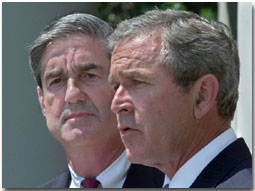
Robert Mueller with President George W. Bush
July 5, 2001 – (White House photo)
Although these Hoover successors, now occupying center stage in the investigation of President Trump, have been hailed for their impeccable character by much of Official Washington, the truth is, as top law enforcement officials of the George W. Bush Administration (Mueller as FBI Director and James Comey as Deputy Attorney General), both presided over post-9/11 cover-ups and secret abuses of the Constitution, enabled Bush-Cheney fabrications used to launch wrongful wars, and exhibited plain vanilla incompetence.
TIME Magazine would probably have not called my own disclosures a “bombshell memo” to the Joint Intelligence Committee Inquiry in May 2002 if it had not been for Mueller’s having so misled everyone after 9/11. Although he bore no personal responsibility for intelligence failures before the attack, since he only became FBI Director a week before, Mueller denied or downplayed the significance of warnings that had poured in yet were all ignored or mishandled during the Spring and Summer of 2001.
Bush Administration officials had circled the wagons and refused to publicly own up to what the 9/11 Commission eventually concluded, “that the system had been blinking red.” Failures to read, share or act upon important intelligence, which a FBI agent witness termed “criminal negligence” in later trial testimony, were therefore not fixed in a timely manner. (Some failures were never fixed at all.)
Worse, Bush and Cheney used that post 9/11 period of obfuscation to “roll out” their misbegotten “war on terror,” which only served to exponentially increase worldwide terrorism.
Unfulfilled Promise
I wanted to believe Director Mueller when he expressed some regret in our personal meeting the night before we both testified to the Senate Judiciary Committee. He told me he was seeking improvements and that I should not hesitate to contact him if I ever witnessed a similar situation to what was behind the FBI’s pre 9/11 failures.
A few months later, when it appeared he was acceding to Bush-Cheney’s ginning up intelligence to launch the unjustified, counterproductive and illegal war on Iraq, I took Mueller up on his offer, emailing him my concerns in late February 2003. Mueller knew, for instance, that Vice President Dick Cheney’s claims connecting 9/11 to Iraq were bogus yet he remained quiet. He also never responded to my email.
Beyond ignoring politicized intelligence, Mueller bent to other political pressures. In the aftermath of the 9/11 attacks, Mueller directed the “post 9/11 round-up” of about 1,000 immigrants who mostly happened to be in the wrong place (the New York City area) at the wrong time. FBI Headquarters encouraged more and more detentions for what seemed to be essentially P.R. purposes. Field offices were required to report daily the number of detentions in order to supply grist for FBI press releases about FBI “progress” in fighting terrorism. Consequently, some of the detainees were brutalized and jailed for up to a year despite the fact that none turned out to be terrorists.
A History of Failure
Long before he became FBI Director, serious questions existed about Mueller’s role as Acting U.S. Attorney in Boston in effectively enabling decades of corruption and covering up of the FBI’s illicit deals with mobster Whitey Bulger and other “top echelon” informants who committed numerous murders and crimes. When the truth was finally uncovered through intrepid investigative reporting and persistent, honest judges, U.S. taxpayers footed a $100 million court award to the four men framed for murders committed by (the FBI-operated) Bulger gang.
Current media applause omits the fact that former FBI Director Mueller was the top official in charge of the Anthrax terror fiasco investigation into those 2001 murders, which targeted an innocent man (Steven Hatfill) whose lawsuit eventually forced the FBI to pay $5 million in compensation. Mueller’s FBI was also severely criticized by Department of Justice Inspector Generals finding the FBI overstepped the law improperly serving hundreds of thousands of “national security letters” to obtain private (and irrelevant) metadata on citizens, and for infiltrating nonviolent anti-war groups under the guise of investigating “terrorism.”
For his part, Deputy Attorney General James Comey, too, went along with the abuses of Bush and Cheney after 9/11 and signed off on a number of highly illegal programs including warrantless surveillance of Americans and torture of captives. Comey also defended the Bush Administration’s three-year-long detention of an American citizen without charges or right to counsel.
Up to the March 2004 night in Attorney General John Ashcroft’s hospital room, both Comey and Mueller were complicit with implementing a form of martial law, perpetrated via secret Office of Legal Counsel memos mainly written by John Yoo and predicated upon Yoo’s singular theories of absolute “imperial” or “war presidency” powers, and requiring Ashcroft every 90 days to renew certification of a “state of emergency.”
The Comey/Mueller Myth
What’s not well understood is that Comey’s and Mueller’s joint intervention to stop Bush’s men from forcing the sick Attorney General to sign the certification that night was a short-lived moment. A few days later, they all simply went back to the drawing board to draft new legal loopholes to continue the same (unconstitutional) surveillance of Americans.
The mythology of this episode, repeated endlessly throughout the press, is that Comey and Mueller did something significant and lasting in that hospital room. They didn’t. Only the legal rationale for their unconstitutional actions was tweaked.
Mueller was even okay with the CIA conducting torture programs after his own agents warned against participation. Agents were simply instructed not to document such torture, and any “war crimes files” were made to disappear. Not only did “collect it all” surveillance and torture programs continue, but Mueller’s (and then Comey’s) FBI later worked to prosecute NSA and CIA whistleblowers who revealed these illegalities.
Neither Comey nor Mueller — who are reported to be “joined at the hip” — deserve their current lionization among politicians and mainstream media. Instead of Jimmy Stewart-like “G-men” with reputations for principled integrity, the two close confidants and collaborators merely proved themselves, along with former CIA Director George “Slam Dunk” Tenet, reliably politicized sycophants, enmeshing themselves in a series of wrongful abuses of power along with official incompetence.
It seems clear that based on his history and close “partnership” with Comey, called “one of the closest working relationships the top ranks of the Justice Department have ever seen,” Mueller was chosen as Special Counsel not because he has integrity but because he will do what the powerful want him to do.
Mueller didn’t speak the truth about a war he knew to be unjustified. He didn’t speak out against torture. He didn’t speak out against unconstitutional surveillance. And he didn’t tell the truth about 9/11. He is just “their man.”
Coleen Rowley, a retired FBI special agent and division legal counsel whose May 2002 memo to then-FBI Director Robert Mueller exposed some of the FBI’s pre-9/11 failures, was named one of TIME magazine’s “Persons of the Year” in 2002. Her 2003 letter to Robert Mueller in opposition to launching the Iraq War is archived in full text on the NYT and her 2013 op-ed entitled “Questions for the FBI Nominee” was published on the day of James Comey’s confirmation hearing. This piece will also be cross-posted on Rowley’s Huffington Post page.)
Relevant links:
http://content.time.com/time/covers/0,16641,20020603,00.html
http://govinfo.library.unt.edu/911/report/911Report_Ch8.pdf
http://www.nytimes.com/2003/03/05/politics/full-text-of-fbi-agents-letter-to-director-mueller.html
https://oig.justice.gov/special/0306/full.pdf
https://www.nytimes.com/2015/06/18/us/immigrants-suit-over-detention-after-9-11-is-revived.html
http://www.ocregister.com/2017/05/21/comey-mueller-bungled-big-anthrax-case-together/
http://www.pbs.org/newshour/bb/government_programs-jan-june07-patriotact_03-09/
http://abcnews.go.com/TheLaw/DOJ/story?id=4444329
https://www.aclu.org/news/fbi-counterterrorism-unit-spies-peaceful-faith-based-protest-group
http://www.nytimes.com/2013/07/09/opinion/questions-for-the-fbi-nominee.html
http://www.newsweek.com/ali-soufan-breaks-his-silence-77243
Latest Russia-hacking ‘revelation’ only exposes more ‘garbage’ US journalism
RT | June 6, 2017
A report, allegedly based on leaks within the NSA, once again lacks underlying raw intelligence, yet reporters from The Intercept ran with it anyway, Brian Becker from the anti-war ANSWER Coalition told RT.
The US National Security Agency has arrested a former contractor after she allegedly leaked classified defense material.
A Department of Justice statement said Reality Leigh Winner had a complaint filed against her after stealing a document and supplying it to a news outlet.
Some Western media have already linked the arrest to a newly published article by The Intercept about alleged Russian hacking.
The report by The Intercept alleges Russia carried out at least one cyberattack against the US during the 2016 election. Like other so-called intelligence, it does not provide any concrete evidence. Nor does it name the source of the information it based the article on.
RT: “The Intercept” has published a highly classified report by NSA stating that Russian military intelligence executed a cyberattack on at least one US voting software supplier just days before the US presidential election. Do you think the report is credible?
Brian Becker: The article in The Intercept has to be read carefully, and I would say with a giant grain of salt. I actually think it is very shoddy journalism. Why would the NSA or NSA contractors, who have spared no effort to generate an anti-Russia witch hunt over the last year, release this document to The Intercept ? Why not The New York Times, why not The Washington Post, why not CNN? The Intercept is one of the few websites that has some audience in the US that has had critical thinking from Glenn Greenwald and others who have doubted the veracity of the assertions. The report shows that the report from the NSA – again, which was given by someone working with the NSA to The Intercept for some reason – lacks all underlying raw intelligence. So we have again the formulation ‘a high degree of confidence’ and then mixing and matching as if the NSA, which has made this revelation available to The Intercept, found out that Russia was hacking American voting machines on the eve of the election. But again with no connectivity to trying to get Donald Trump elected, and yet that is what the article summarizes in its conclusion. It’s shoddy journalism; I would say it is garbage journalism and it is based on nothing with underlying intelligence. Again, why would the NSA, FBI, and CIA have been waging a war for the past year to convince the American people that Russia is taking over America, why would they release this document to The Intercept ?
There are a number of things that are peculiar here. One of them is the circumstance of the arrest of this contractor so quickly after this item appeared in The Intercept. But on The Intercept article itself, it is a little odd: this is the first article that appears to be pointed toward any kind of compromise of the actual election system, as opposed to releasing information that maybe prejudicial to Hillary Clinton’s campaign that came from the DNC, which has been the allegation thus far. Also it seems odd it would be sent to some place like The Intercept rather than the usual vehicles for leaked information, like The Washington Post or The New York Times. – former US diplomat Jim Jatras
RT: Although it’s supposedly the most detailed US report yet on claimed Russian interference in the election, it doesn’t actually show the raw intelligence. Are we ever going to see the actual hard evidence?
BB: No one actually knows what the Russian intelligence agencies hacked or didn’t hack. We don’t know. We do know that during the past year when this has become the dominant narrative within the mainstream media, the dominant call by the Democratic Party elites, the primary allegation explaining why they lost the election, when we see all of this, and we realize even up to today, even with this article, not one piece of hard evidence backing it up. Wouldn’t there be some hard evidence now, after all of this time showing the raw intelligence underlying the report? For some reason, the NSA wanted to use this liberal website in order to give them a top classified document again without any real facts or evidence contained therein.
Some people are touting this as the first counter-attack from the Trump administration to this tyranny of leaks that has been going on here in Washington. I certainly don’t see it as that. If we look at other leaks, like ones concerning General Flynn, or Comey’s conversations with Trump or the meeting of Trump and Lavrov, again, these went to the prestige media, New York Times and The Washington Post. Nobody has been nailed for any of those leaks. Those are things coming from within the deep state itself. Here is a 25-year old contractor, who doesn’t seem to be the kind of vehicle for this we are talking about, and she gets nailed right from the top on a very questionable report. This just happened today, but it almost seems like a provocation of some sort. – former US diplomat Jim Jatras
RT: Even if the hacking took place, why does the NSA insist the Russian government made the interference? Couldn’t random hackers have done it with “patriotic leanings”?
BB: Because we are in the midst of a witch hunt. After WWII, and after the breakup of the US-British-Soviet military alliance that defeated fascism, the US media and the intelligence agencies, like CIA, like FBI, later now the NSA, joined to generate a witch hunt against anyone associated with the Soviet Union and thus Russia. We see the same thing happening today. There are no facts, there is no evidence, but there is a hysteria being created. The intelligence agencies, which have overthrown other countries’ governments if they win elections that the Americans don’t prefer, who have intervened in other countries’ governments, who have carried out assassination programs now are saying we are the champions and the defenders of American democracy from the great menace to American democracy which is posed by the Kremlin. This is political; it is actually pure politics.
Read more:
DOJ charges govt contractor with leaking top secret material to The Intercept
Timing is everything
Xymphora | June 6, 2017
“Barely an hour after a news organization published an article about a Top Secret National Security Agency document on Russian hacking, the Justice Department announced charges against a 25-year-old government contractor who a senior federal official says was the leaker of the document.”
In other words, they were sitting around waiting for publication (with foreknowledge, somehow), essentially part of a conspiracy with the Intercept to make a big anti-Trump PR splash (timed to fall between the Putin interview and the Comey testimony). Of course, no effort whatsoever to prevent the spilling of secrets. This speedy arrest stands in marked contrast to the big zero of arrests of all the other anti-Trump leakers.
It is hilarious how the Intercept describes the methods that the Russians used to attempt to gain control of American elections – with, as usual, no proof, just ‘analysis’ (see, generally, the excellent “The Big Fat Compendium Of Russiagate Debunkery”, as good as it gets while maintaining a respectable shyness about real root khauses) – without troubling itself to consider the issue that anybody could have done this, and could do it in the future. It is really an indictment of the entire non-paper-ballot system.
You have to read well into the piece to see that the alleged attack was not against the voting process itself, but voter registration. Why would the Russians go to all this effort to attack a relatively unimportant part of the process? Why waste effort and potential exposure (which would allow countermeasures to be taken) when they might have decided to attack the integrity of the vote casting to actually alter results? A lot of the Intercept article is spent dodging around these obvious questions.
It is the Republicans who are famous for using voter registration for vote suppression.
Remember Omran in Syria’s Aleppo?
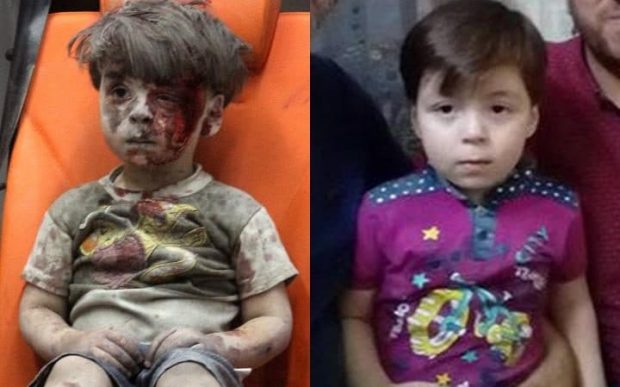
Al-Manar | June 6, 2017
Remember the five-year-old boy whose bloodied and dusty image went viral on media outlets and social media last year?
Omran Daqneesh, whose photo made a CNN presenter weep on air, and whose photo was taken from a pocket of a Swiss Journalist in front of President Bashar Assad, in a bid to blame his government for “killing civilians in Aleppo”.
Today, a new footage of Omran has emerged. However this time a new story is being told, by Omran’s father.
In a video broadcast on Syrian TV, Omran’s father told TV presenter Kinana Alloush that he and his family did not get out of Aleppo, stressing that he did not consider himself and his family targeted by the Syrian army.
Moreover, the father revealed that Takfiri terrorists brought his son to the hospital “just to film him, in order to use him for their propaganda.”
He said that he did not hear a plane above his house before the alleged strike last August and said he rejected offers to leave Syria by parties wishing to damage the reputation of the country’s army.
Omran’s father said that he changed his son’s name and his hairstyle to evade individuals who threatened to kidnap him, noting that the insurgents intimidated him.
Below is a video of Omran aired on Press TV:
This boy seems to be fine and happy in the liberated Aleppo pic.twitter.com/0b9qmQqA1I
— Press TV (@PressTV) June 6, 2017
‘The BBC Has Betrayed Its Own Rules Of Impartiality’: Yemen, Saudi Arabia And The General Election
Media Lens – June 5, 2017
A key function of BBC propaganda is to present the perspective of ‘the West’ on the wars and conflicts of the world. Thus, in a recent online report, BBC News once again gave prominence to the Pentagon propaganda version of yet more US killings in Yemen. The headline stated:
US forces kill seven al-Qaeda militants in Yemen, says Pentagon
Seven ‘militants’ killed is the stark message. A veneer of ‘impartiality’ is provided by the weasel words, ‘says Pentagon’. BBC News then notes blandly, and without quotation marks:
The primary objective of the operation was to gather intelligence.
Nowhere in the short article was there any attempt to provide an alternative view of who had been killed and why. Were they really all ‘militants’? How is a ‘militant’ distinguished from a ‘civilian’, or from a soldier defending his country against foreign invaders? There was not even a cautious statement to the effect that the Pentagon’s claims could not be verified, as one might expect of responsible journalism.
Instead, we have to turn to Reprieve, an international human rights organisation founded in 1999 by the British lawyer Clive Stafford Smith. The group reports that five of the ‘militants’ were civilians, including a partially blind 70-year-old man who was shot when he tried to greet the US Navy Seals, mistaking them for guests arriving in his village.
But their civilians are mere ‘collateral damage’ in war. Since January 2017, the US has launched 90 or more drone strikes in Yemen, killing around 100 people, according to the Bureau of Investigative Journalism. This death toll includes 25 civilians, among whom were 10 children, killed in the village of al Ghayil in the Yemeni highlands during a US raid that was described by President Trump as ‘highly successful’.
Mentions of such atrocities were notable by their absence in ‘mainstream’ media coverage of Trump’s recent trip to Saudi Arabia where he signed trade deals worth around $350 billion. This included an arms deal of $110 billion which the White House described as ‘the single biggest in US history.’ It would not do for the corporate media, including BBC News, to dwell on the implications for Yemen where at least 10,000 people have been killed since the start of the Saudi-led bombing campaign in 2015. 14 million Yemenis, more than half the population, are facing hunger with the Saudis deliberately targeting food production.
The World Health Organisation recently warned of the rising numbers of deaths in Yemen due to cholera, saying that it was ‘unprecedented’. Save the Children says that at the current rate, more than 65,000 cases of cholera are expected by the end of June. The cholera outbreak could well become ‘a full blown-epidemic’. Moreover:
The upsurge comes as the health system, sanitation facilities and civil infrastructure have reached breaking point because of the ongoing war.
As US investigative journalist Gareth Porter observes via Twitter:
World leaders are silent as #Yemen faces horrible cholera epidemic linked to #Saudi War & famine. Politics as usual.
Iona Craig, formerly a Yemen-based correspondent for The Times, notes that ‘more than 58 hospitals now have been bombed by the coalition airstrikes, and people just do not have access to medical care in a way that they did before the war.’ As if the bombing was not already brutal, Saudi Arabia has imposed a cruel blockade on Yemen that is delaying, or even preventing, vital commodities from getting into the country. Grant Pritchard, interim country director for Save the Children in Yemen, says:
These delays are killing children. Our teams are dealing with outbreaks of cholera, and children suffering from diarrhoea, measles, malaria and malnutrition.
With the right medicines these are all completely treatable — but the Saudi-led coalition is stopping them getting in. They are turning aid and commercial supplies into weapons of war.
As one doctor at the Republic teaching hospital in Sanaa commented:
We are unable to get medical supplies. Anaesthetics. Medicines for kidneys. There are babies dying in incubators because we can’t get supplies to treat them.
The doctor estimated that 25 people were dying every day at the hospital because of the blockade. He continued:
They call it natural death. But it’s not. If we had the medicines they wouldn’t be dead.
I consider them killed as if they were killed by an air strike, because if we had the medicines they would still be alive.
None of this grim reality was deemed relevant to Trump’s signing of the massive new arms deal with Saudi Arabia. BBC News focused instead on inanities such as Trump ‘to soften his rhetoric’, ‘joins Saudi sword dance’ and ‘no scarf for Melania’. But then, it is standard practice for the BBC to absolve the West of any blame for the Yemen war and humanitarian disaster.
British historian Mark Curtis poses a vital question that journalists fear to raise, not least those at the BBC: is there, in effect, collusion between the BBC and UK arms manufacturer BAE Systems not to report on UK support for the Saudi bombing of Yemen, and not to make it an election issue? Curtis also notes that the BBC has not published any online article about UK arms being sold to the Saudis for use in Yemen since as far back as January. This, he says, is ‘misinforming the public, a disgrace’. He also rightly points out that the BAE Systems Chairman, Sir Roger Carr, was also Vice-Chair of the BBC Trust until April 2017 (when the Trust was wound up at the end of its 10-year tenure). The BBC Trust’s role was to ensure the BBC lived up to its statutory obligations to the public, including news ‘balance’ and ‘impartiality’. How could Sir Roger’s dual role not suggest a major potential conflict of interest?
On the wider issue of ‘mainstream’ media coverage of foreign policy, the political journalist Peter Oborne notes that:
Needless to say, the British media (and in particular the BBC, which has a constitutional duty to ensure fair play during general elections) has practically ignored Corbyn’s foreign policy manifesto.
Oborne writes that the manifesto:
is radical and morally courageous.
He explains that, pre-Corbyn:
Foreign policy on both sides was literally identical. The leadership of both Labour and the Conservatives backed the wars in Iraq, Libya and Afghanistan, the alliance with Saudi Arabia and the Sunni states in the Gulf.
London did what it was told by Washington. […] This cross-party consensus has been smashed, thanks to Jeremy Corbyn, the current Labour leader. Whatever one thinks of Corbyn’s political views (and I disagree with many of them), British democracy owes him a colossal debt of gratitude for restoring genuine political debate to Britain.
And of course his extremely brave and radical decision to break with the foreign policy analysis of Blair and his successors explains why he is viewed with such hatred and contempt across so much of the media and within the Westminster political establishment.
But, as Oborne notes, this important change has not been fairly represented in media coverage. In particular, on Yemen and Saudi Arabia:
It is deeply upsetting that the BBC has betrayed its own rules of impartiality and ignored Corbyn’s brave stand on this issue.
We challenged Andrew Roy, the BBC News Foreign Editor, to respond to Oborne’s observations. He ignored us (here and here). Roy’s silence is especially noteworthy given that he had once promised:
If there is a considered detailed complaint to something we’ve done, I will always respond to it personally.
Perhaps Oborne’s challenge to the BBC was not deemed sufficiently ‘considered’ or ‘detailed’ by the senior BBC News editor. Likewise, our own challenges over many years in numerous media alerts addressing BBC foreign coverage have been ignored or, at best, brushed away.
It was noteworthy that Corbyn’s considered response to the most recent terrorist attack in London was selectively reported, arguably censored, by BBC News. Corbyn said:
We need to have some difficult conversations, starting with Saudi Arabia and other Gulf states that have funded and fuelled extremist ideology.
It is no good Theresa May suppressing a report into the foreign funding of terrorist groups. We have to get serious about cutting off the funding to these terror networks, including Isis here and in the Middle East.
Sky News broadcast Corbyn’s comments, but they do not appear to have been covered by BBC News. Certainly, as far as we can see, there is no mention of them in their ‘Live’ blog on the London attack or in Laura Kuenssberg’s analysis, ‘Election 2017: Impact of London terror attack on campaign’. And nothing about the Saudi link with terrorism appears in the BBC’s online report on Corbyn’s speech, focusing instead on the issue of May’s cuts to police numbers while Home Secretary. Even this issue alone, if properly and fully addressed by the media, should be a resigning matter for May as Prime Minister. Responding to the London attacks, Peter Kirkham, a former Senior Investigating Officer with the Metropolitan police, accused the government of lying over police numbers on UK streets. And a serving firearms officer says that:
The Government is wrong to claim police cuts have nothing to do with recent attacks.
Despite her denials, Theresa May’s cuts to police numbers have made attacks like London and Manchester much more likely.
Kuenssberg’s piece included passing mention of ‘the Tories’ record on squeezing money for the police’. But she gave no figures showing a reduction in the number of armed police; crucial statistics which she could have easily found from the Home Office.
Mark Curtis gives a damning assessment of BBC reporting on foreign affairs, particularly during the general election campaign. Noting first that:
One aspect of a free and fair election is “nonpartisan” coverage by state media.
He continues:
Yet BBC reporting on Britain’s foreign policy is simply amplifying state priorities and burying its complicity in human rights abuses. The BBC is unable to report even that Britain is at war – in Yemen, where the UK is arming the Saudis to conduct mass bombing, having supplied them with aircraft and £1 billion worth of bombs, while training their pilots.
Curtis then provides some telling statistics:
From 4 April to 15 May, the BBC website carried only 10 articles on Yemen but 97 on Syria: focusing on the crimes of an official enemy rather than our own. Almost no BBC articles on Yemen mention British arms exports. Theresa May’s government is complicit in mass civilian deaths in Yemen and pushing millions of people to the brink of starvation; that this is not an election issue is a stupendous propaganda achievement.
Indeed, our newspaper database searches reveal that, since the election was called on April 18, there has been no significant journalistic scrutiny of May’s support of Saudi Arabia’s bombing campaign in Yemen. The subject was even deemed radioactive during a public meeting in Rye, Sussex, when Amber Rudd, standing for re-election, appeared to shut down discussion of arms sales to Saudi Arabia. Electoral candidate Nicholas Wilson explains what happened:
At a hustings in Rye on 3 June, where I am standing as an independent anti-corruption parliamentary candidate, a question was asked about law & order. Home Secretary Amber Rudd, in answering it referred to the Manchester terrorist attack. I took up the theme and referred to UK arms sales to Saudi Arabia & HSBC business there. She spoke to and handed a note to the chairman who removed the mic from me.
The footage of this shameful censorship deserves to be widely seen. If a similar event had happened in Russia or North Korea, it would have received intensive media scrutiny here. Once again, we note the arms connection with the BBC through BAE Systems Chairman, Sir Roger Carr. Wilson has also pointed out a potential conflict of interest between HSBC and the BBC through Rona Fairhead who was a non-executive director of HSBC while serving as Chair of the BBC Trust.
These links, and Theresa May’s support for the Saudi regime, have gone essentially unexamined by the BBC. And yet, when BBC political editor Laura Kuenssberg responded to Corbyn’s manifesto launch, her subtle use of insidious language betrayed an inherent bias against Corbyn and his policies on foreign affairs. She wrote: ‘rather than scramble to cover up his past views for fear they would be unpopular’, he would ‘double down… proudly’. Kuenssberg’s use of pejorative language – ‘scramble’, ‘cover up’, ‘unpopular’ – delivered a powerful negative spin against Corbyn policies that, in fact, as Oborne argues, are hugely to his credit.
When has Kuenssberg ever pressed May over her appalling voting record on Afghanistan, Iraq, Libya, Syria and Yemen? In fact, there is no need for May to ‘scramble’ to ‘cover up’ her past views. Why not? Because the ‘mainstream’ media rarely, if ever, seriously challenge her about being consistently and disastrously wrong in her foreign policy choices; not least, on decisions to go to war.
Featured Video
Matt Bracken: US Plans Massive MOAB Strike on Iran?
or go to
Aletho News Archives – Video-Images
From the Archives
Confronting the Threat of Ethnic Bioweapons
By Tony Cartalucci – New Eastern Outlook – 29.11.2017
The United States Air Force’s 59th Medical Wing’s molecular biology branch recently was revealed to have been collecting specifically Russian RNA and synovial (connective) tissue samples, prompting fears in Russia of a possible US directed ethnic-specific bioweapons program. … continue
Blog Roll
 Aletho News
- Matt Bracken: US Plans Massive MOAB Strike on Iran?
- Russia accuses France of ‘piracy’ over tanker seizure
- Why Yemen Is Bombing Saudi Arabia’s Airports: The War Behind the Headlines
- Sally Rooney’s books pulled from UK over support for Palestine Action
- Bombs for Tel Aviv, Promises for Riyadh
- Israeli ad agency conducted vast global espionage campaign using online ads: Report
- Oct. 7 Forever Marks The Big Reveal: ‘We See You, Israel, We Revile You, We Reject You!’
- Meet the US generals and admirals advancing Israeli policy
- Israel’s Straw Widow Protocol: The Kill Zones Where Civilians Were Labelled ‘Terrorists’
- Leading Israeli Think Tank Publishes Psychotic Israeli ‘National Security’ Doctrine
- If Americans Knew
- Israeli firm used online ads to run vast spy operation, researchers say
- No, the world zionist movement is not an antisemitic conspiracy theory
- Hundreds of IDF investigations into killings still have no public outcome, BBC Verify finds
- After Ashley Moody Epstein Probe, Donors Linked to Him Poured Money Into her Senate Campaign
- Worried about Russian meddling in UK politics? Wait till you see what Israel is up to
- Israeli settlers attack West Bank center for disabled children, church leader calls for int’l action
- Pulling Out Teeth Just to Live: How Israel Has Devastated Dental Care in Gaza
- Gaza’s “ceasefire” death toll passes 1,500 – Daily Update
- Activists Abused By Israel Return to New Freedom Flotilla Mission
- 60 Minutes won’t tell the full truth about Israeli settler violence
- No Tricks Zone
- New Study Suggests Large Regions Of The Pacific Ocean Have Been Cooling For The Last 80 Years
- Germany’s Green Energy Debacle: High Energy Costs Force Kahla Porzellan to Close After 182 Years!
- New Study: 50 Years Of The Most Aggressive ‘Net Zero’ Policies Can Only Affect The Global Climate By 0.03°C
- US September “Heat” Was No Record…Many Records Set Decades Ago
- Latest European Green Energy Debacle; Portugal’s Largest Flagship Solar Park Insolvent!
- Green Energy Debacle: German Expert Professor Fritz Vahrenholt Warns Of Severe Economic And Social Consequences
- Two More Paleo Reconstructions Affirm Meters-Higher Sea Levels Across Ireland, Brazil 7000-6000 Years Ago
- New Study: Earth And Venus Surface Warmth Largely Explained By Convection And Lapse Rate, Not CO2 Or Radiation
- 2025 Nature Paper Claiming Worsening Global Drought Gets RETRACTED …Heavily Flawed
- New Study: ‘Global Drought Shows No Detectable Recent Acceleration Under Climate Warming’

