Brits lose backup energy option for winter
RT | July 3, 2023
Britain will not fall back on coal-fired power as a back-up option for generating electricity during the upcoming winter, the National Grid Electricity Systems Operator (ESO) said last week.
British coal plant operators Drax Group and EDF Energy, whose facilities were available last winter, have started to decommission their generators, according to a statement by the ESO.
The operators officially closed their coal plants at the end of March.
“Both operators have confirmed that they will not be able to make their coal units available for a further winter and have begun the decommissioning process,” a spokesperson for the National Grid said.
Uniper’s Ratcliffe coal unit is still likely to be available under a separate capacity market system over next winter, the ESO said.
Five contingency units were fired up several times during the last cold season, when Western Europe was struggling with an unprecedented energy crisis following a drop in oil and gas shipments from Russia. Sanctions against Russian energy imports have led to record high inflation across the region and a cost-of-living crisis in numerous countries.
The UK warmed up the contingency units in March when a cold snap hindered wind generation.
As part of efforts to curb fossil fuel emissions and meet its 2050 net-zero target, the UK authorities are planning to close coal-fired power plants by October 2024.
Another Climate-Savior Alarmist Jetsets To South America – For Two Months Of Vacation!
Climate activist hypocrite of the month
By P Gosselin | No Tricks Zone | June 30, 2023
Skipping classes, getting up at 11 a.m., gluing oneself to the asphalt and blocking streets with your mates all day to save the planet is a really tough and important job, climate activists believe. And so exempting themselves from the rules they want imposed on the rest of society is understandable. After all, they are more important than the rest.
So important, in fact, that activists like Max Voegtli of Renovate Switzerland believes flying to Central America by jet plane for a couple of months of R & R is totally okay. The working class, however, should not fly at all and freeze in the wintertime.

Dealing with the climate crisis is urgent, insists Swiss radical climate activist just before hopping on a jet plane to fly to Central America for 2 months of vacation. Image cropped here.
Last Tuesday, Swiss climate activist Voegtli appeared on TalkTäglich at TeleZüri, and passionately explained how urgent it is to deal with the “climate crisis” and demanded that the planet be saved.
Off to Mexico and Central America
Then, already on Thursday, he was photographed at Zurich airport, preparing to board a plane bound for Paris. But climate rescuer Voegtli’s flying would not end in Paris, reports AUF 1 : “Paris was not the activist’s destination, but there he only took the connecting flight to Mexico and Central America, where he wants to travel around for two months.”
A two-month vacation is a total fantasy for the rest of the working world, who struggle to make ends meet each month. And this traffic blocker goes unhindered for 2 months?
Climate Emergency Fund
So where does an unemployed activist like Voegtli get the money for such a holiday extravaganza? AUF 1 writes: “It is well known that some of the asphalt gluers receive a regular salary. Organization Renovate Switzerland is no stranger to lavish money: “The organization itself admits that it is financed by the Climate Emergency Fund of oil magnate heiress Aileen Getty.”
Activists cry they are being harassed!
Now that Voegtli’s hypocrisy has been exposed, the embarrassed activists justify all their globe-trotting by claiming they travel as “private persons” and so no one should be photographing them.
AUF 1 : “Spokesperson Cécile Bessire castigated the ‘media hounding against the climate movement and the people who campaign for it. I find it incomprehensible that citizens are following our activists and taking photos. These are private individuals.’”
At Twitter, the thin-skinned Voegtli defended himself: “Shows again how the @CH_Media cares more about feeding the hate media cycle further instead of talking about the crisis.”
Voegtli’s Renovate Switzerland group added: “Getting politically involved against the climate crisis often goes hand in hand with changing one’s own life. However, it is not a prerequisite to do so. […] No matter if you separate your rubbish, if your house is renovated, if you work for a bank, if you eat meat or if you fly. All you should do is wish for a livable future and get involved in the climate movement.”
AUF 1 summarizes the infantile behavior of the activists such as Voegtli: “It means the climate activists can demand anything from citizens without having to do it themselves.”
In a nutshell, according to the climate activists: it’s “incomprehensible” that citizens would take photos of activists at airports, yet it’s perfectly fine for activists to block major roadways and to harass people who are trying to make a living. That’s how they want it.
Wind costs will remain high
By Gordon Hughes | Net Zero Watch | June 26, 2023
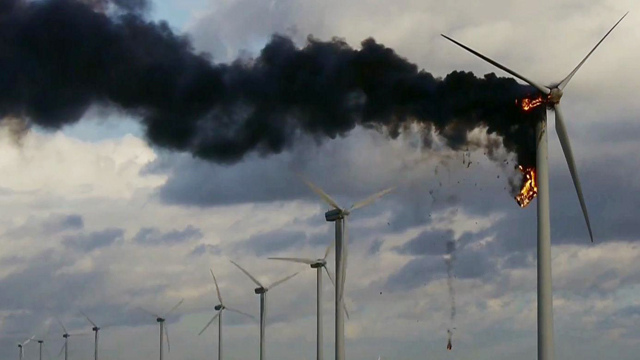
The crash in Siemens Energy’s share price on Friday has admirably highlighted an issue with wind costs that colleagues and I have been examining for more than a decade. The painful facts are that (i) wind generation, both onshore and offshore, is more expensive than we are being told and (ii) the performance of wind turbines tends to deteriorate with age, in significant part because of the kind of failures reported by Siemens Energy. There is strong evidence to support these conclusions, which has been presented in reports published by the Renewable Energy Foundation in 2012 and in 2020 for the UK and Denmark, with updates provided by the Global Warming Policy Foundation and Net Zero Watch.
The news about Siemens Energy brings a strong inclination to say ‘you were warned’. However, their travails are a symptom of a much more widespread disease, which affects all of us, either directly through the costs of electricity or indirectly as the owners of wind farms (via pension funds and other investment vehicles). The plunge in the share price of Siemens Energy is dramatic, but that may be written off as a temporary market response to disappointed expectations. We need to look beneath the immediate story to understand the reasons for the disappointment and their implications for the prospects for wind generation.
The announcement by Siemens Energy focused on higher-than-expected failure rates for their onshore turbines. These were ascribed to problems with key components, but newspaper reports suggest more systematic design faults in recent generations of large turbines. Previous announcements have referred to problems with offshore turbines, and the market reaction suggests few believe that the current problems are confined to onshore turbines. Further, while each of the major turbine manufacturers has its own specific problems, Siemens Energy is not unique in experiencing high warranty costs due to higher than anticipated failure rates.
In increasing order of importance, there are three aspects to note:
(a) Siemens Energy and other manufacturers have given warranties on performance that won’t be met because of higher failure rates. They will incur additional expenses, either to replace components or to compensate wind farm operators for any resulting underperformance. Those costs are the basis for the write-offs that Siemens Energy has had to take. Investors will be painfully aware that the company has been declaring profits when they sell wind turbines, but without making adequate provision for future warranty repair costs.
In accounting terms this is known as recognising future profits for new contracts. When it becomes clear that the contracts will be less profitable, the company must write down the value of previously reported profits and, thus, the value of the assets on its balance sheet. In effect, though perhaps entirely innocently, the company has been misleading investors about its past and current profitability. Senior managers should be feeling very uncomfortable about their positions since the problem was predictable (and predicted).
(b) Warranties have a limited period – often 5 to 8 years – but the higher failure rates will persist and affect performance over the remainder of the life of the wind farms where the turbines have been installed. Their future opex costs will be higher than expected, and their output will be significantly lower. This will reduce their operational lifetimes, which are determined by how the margin between revenues and costs changes as wind farms get older. Lower revenues and higher costs bring forward the date at which replacement or repowering is necessary. These changes will reduce, often quite substantially, the returns earned by the financial investors – pension funds and other – to whom operators sell the majority of the equity in wind farms after a few years of operation.
(c) Siemens Energy and other manufacturers may argue that they can – with time – fix the component and design problems which lead to high failure rates. They may well be correct. The history of power engineering is littered with examples of new generations of equipment which experienced major problems when first introduced but which were eventually sorted out. Many companies have found themselves in severe financial difficulties or even forced into bankruptcy by these “teething” problems. The error in this case has been to pretend that wind turbines were immune to such failures.
The whole justification for the falling costs of wind generation rested on the assumption that much bigger turbines would produce more output at lower capex cost per megawatt, without the large costs of generational change. Now we have confirmation that such optimism is entirely unjustified – the whole development process has been a case of too far, too fast. Again, this was both predictable and predicted. The idea that wind turbines are immune to the factors that affect other types of power engineering was always absurd. The consequence is that both capital and operating costs for wind farms will not fall as rapidly as claimed and may not fall significantly at all. It follows that current energy policies in the UK, Europe and the United States are based on foundations of sand – naïve optimism reinforced by enthusiastic lobbying divorced from engineering reality.
In the longer term it is (b) and (c) that are the big story. With respect to (a), serious analysts have long since recognised that claims made about future wind costs and performance by the wind industry should not be taken seriously. It has been obvious that they were kidding themselves and their investors ever since the last 2010s. Unfortunately, we have now been tied into a high energy-cost future, with all the implications that has for the economy and standards of living.
Sweden just scrapped their “Renewable Energy Targets”. Here’s why.
By Kit Knightly | OffGuardian | June 26, 2023
Buried behind the news of the supposed “attempted coup” in Russia this weekend, was the Swedish government’s announcement, last Wednesday, that they will be stepping back from their plans to go 100% renewable energy.
According to finance minister Elisabeth Svantesson, wind and solar power are simply not efficient or reliable enough to be trusted to produce the entire country’s energy supply.
This has been celebrated in some circles as an example of a government taking a logical approach.
But, to be clear, this is not about refuting or rejecting the “climate change” agenda, but purely a question of methodology. Sweden is rejecting “renewable energy” goals, not net zero. Net zero is still very much on the cards… via nuclear power, what some still laughably call “clean energy”.
According to Euractive.com :
Sweden’s parliament on Tuesday (20 June) adopted a new energy target, giving the right-wing government the green light to push forward with plans to build new nuclear plants in a country that voted 40 years ago to phase out atomic power. Changing the target to “100% fossil-free” electricity, from “100% renewable” is key to the government’s plan to […] reach net zero emissions by 2045.”
Sweden has always been at the fore-front of climate messaging, introducing one of the first ever “Carbon Taxes” as early as 1991.
It’s also the case that Sweden recently approved a feasibility study for a massive carbon capture and storage (CCS) plant near Stockholm. CCS is among the bigger scams of the climate change narrative.
And yet this scrapping of renewable goals has been welcomed by some in the alternative sphere as Sweden “seeing sense”.
This is highly reminiscent of Sweden’s role in the Covid narrative – the “voice of reason”. The sensible rejection of the official narrative in favour of a very slightly different version of the official narrative.
Sweden pushed for no lockdowns and “early treatment” and herd immunity, but all of that actually served to underline that there was an actual pandemic that needed dealing with. Reinforcing the official story through carefully orchestrated dissent.
It looks like Sweden is about to cast itself in the same part for the Climate play.
Moving forward, the debate will be about “net zero via renewables” vs “net zero via nuclear”, without ever questioning whether we need to go “net zero” at all, or if it’s even physically possible to do so.
DeSantis Says Would Resume Keystone XL Pipeline if Elected US President in 2024
Sputnik – 26.06.2023
WASHINGTON – Florida Governor and 2024 Republican presidential hopeful Ron DeSantis said on Monday that he would resume work on the Keystone XL oil pipeline between the United States and Canada, in addition to permitting other pipeline projects, if he is elected to be the next US president.
“Hundred percent, yeah. It’s a no-brainer,” DeSantis said during remarks in Texas, when asked whether he plans to restart work on the project.
DeSantis pointed out that pipelines are the safest way to transport energy and pointed to the latest derailment of a train with tanker cars over the weekend in the US state of Montana.
DeSantis also said he plans to permit “a lot of pipelines,” noting that such a move would also be good for national security.
The Keystone pipeline system transports oil from Western Canada to refineries in the United States. The system currently has three phases of the project operational, but with the fourth, Keystone XL, was suspended by the Biden administration.
Keystone XL would run through the state of Montana, where US oil would be added to the system. President Joe Biden rescinded a construction permit for the pipeline granted by former President Donald Trump in 2019.
Last year, the Biden administration said it had no plans to restart the Keystone XL project even amid concerns about rising gas prices and volatility in the energy market.
WWF declared ‘undesirable’ in Russia
RT | June 21, 2023
Russia’s Prosecutor-General on Wednesday declared the World Wide Fund for Nature (WWF), also known as the World Wildlife Fund, “undesirable.” Moscow accused the Switzerland-based nonprofit of working on behalf of the US against Russia’s economic and security interests, especially in the Arctic.
The Prosecutor-General’s Office said that the WWF used environmental and educational activities “as a cover for implementing projects that pose security threats in the economic sphere.”
Specifically, “under the pretext of preserving the environment, the WWF is carrying out activities aimed at preventing the implementation of [Russia’s] policies for the industrial development and exploration of natural resources in the Arctic territories, while developing and legitimizing restrictions that could serve as a basis for transferring the Northern Sea Route into the exclusive economic zone of the US.”
The NGO is especially targeting large enterprises engaged in the energy sector, the oil and gas industry, and also the mining of mineral deposits and precious metals, according to Russian officials. The Prosecutor-General’s Office in particular objected to the WWF’s use of the ESG (Environmental/Social/Governance) scores to rate Russian companies, which are based solely on the “subjective standards and criteria developed by the WWF.”
The WWF has provided material and other support for several Russian NGOs that have been included in the registry of foreign agents, such as ‘Friends of the Baltic’ and the ‘Sakhalin Environmental Watch’. The Russian Ministry of Justice declared the WWF itself a foreign agent in March this year.
Being declared undesirable is an effective ban on the organization. It must shut down its offices in Russia, and doing business with it is punishable with a fine or jail in case of repeat offenders. The first organization to be designated so was the US Congress-funded National Endowment for Democracy (NED), in 2015.
Another environmentalist NGO, Greenpeace, was declared unwelcome last month after allegations it had sought destabilization and change of government in Russia “through unconstitutional means.”
The Administrative Man
On the view of humanity adopted by the state and its agents

eugyppius: a plague chronicle | June 23, 2023
There is a pattern, a recurring blindness, in the approach of the administrative state to everyday human life.
Let’s consider a few examples of recent political idiocy and the common thread that unites them:
1. The Scholz government hopes to convince more Germans to opt for public transit by tinkering with fares and introducing a universal 49-Euro ticket. The offering, which collapses regional ticket schemes into one simple, relatively cheap monthly subscription, is now more than 50 days old, and preliminary data show it’s changed hardly anybody’s habits. The vast majority of the 11 million subscriptions sold so far have gone to longstanding public transit users; less than a tenth have been purchased by new customers. Surveys show that interest is concentrated in the urban centres, while rural populations have no use for the ticket because everybody drives cars there. Calls for improving transit offerings in the countryside are half-hearted and bizarre; the whole concept of public transit requires dense, concentrated populations.
2. For some years now, the German state has deployed extravagant subsidies to convince consumers to buy electric vehicles. While adoption has been substantial, the dream of 15 million EVs by 2030 remains very far off. Subsidies aren’t enough to counterbalance the substantial cost of the batteries, leaving conventional automobiles with an enormous competitive advantage at the cheaper end. Also too, it seems that the core market for EVs – relatively well-off Germans who take mostly short trips and primarily charge their vehicles at home – will soon be saturated. For those who have longer commutes or must frequently travel long distances, the limited range and insufficient charging network are disqualifying.
3. I’ve already written about proposed government legislation to compel all Germans to transition to heat pumps beginning in 2024. Massive controversy compelled substantial changes in the law, which has been blunted in many respects, but remains worrying. Because not everybody lives in buildings that are suitable for heat pumps, the law in its original form would’ve required massive renovations across broad sectors of the housing market, effectively wiping out billions of Euros in personal wealth. If enacted in its original form, it might well have rendered many prewar buildings basically uninhabitable.
4. Bizarre proposals to mitigate the dangers of warm summer weather, accompanied by strange state media hysteria about recent warm summer temperatures, are similarly oblivious. The proposals are based on French plans, which foresee imposing bans on school trips and large gatherings in the event of extended heat waves. While rules like these have the potential to destroy ordinary summer activities for millions of people, they won’t save any lives. Summer mortality spikes are confined almost entirely to the old and the sick, not schoolchildren or sports fans.
5. Lockdowns and mass vaccination also belong in this list. These policies arose from the myopia of public health mandarins, who regarded everyone in their jurisdiction as equally likely to spread SARS-2, equally likely to die from it and equally able to endure months of rolling house arrests and an indefinite marathon of mRNA injections. They were wrong in every respect: The virus was only ever dangerous to a very small segment of the population, there was never any purpose in vaccinating the millions of people who had recovered from SARS-2 infection, and even according to officially accepted, heavily massaged statistics, the vaccines have no measurable upside for any healthy person under 50.
Underlying these policy initiatives and many others is a highly abstract bureaucratic conception of the individual, what I’ll call the Administrative Man. This is how state bureaucrats everywhere approach their subject populations, and it is an unavoidable artefact of routine bureaucratic processes like regulation and taxation. In this conception, everybody is more or less the same, subject to nudging via the same incentives, requiring the same protections from the same risks, and likely to benefit from the same one-size-fits-all solutions. The highly differentiated lives that people actually lead – their vast differences in personal circumstances, wealth, individual preferences, religious beliefs and political opinions – are at best ignored, at worst considered a massive inconvenience. There is an unstated, unconsciously harboured bureaucratic vision of a country made up entirely of Administrative Men as the ideal receptacles of bureaucratic solutions, which are of course always correct, except when the people fail them.
The image of the Administrative Man, while heavily abstracted, is not without some intriguing specific characteristics. These will vary from country to country, but we can derive some of the features of the German Administrative Man from our five examples. He appears to live in cities or at least in towns, not in the countryside. He’s certainly an apartment dweller, and he’s more likely than not to rent. He’s actually somewhat well-off, but not wealthy; he’s older and probably not in the best of health. He leads a fairly withdrawn, local life, with limited interest in public events. All in all, it seems fair to call him a composite figure, combining features of the civil servants most responsible for this vision and of the aging voters who support the major political parties.
Our states are some of the most powerful and overextended in history; no system has been so well positioned to impose its vision of politics and culture on its subjects ever before. A few weeks ago, I wrote about the political mechanics of the rainbow revolution, but the all-consuming interesting of Western politicians in ethnic and sexual diversity surely admits of other interpretations as well. You could say that there is an eagerness to confine human variation to those areas of least concern to the institutional apparatus, and thus to “celebrate,” or actively promote, all those diversities which are of least consequence to the administrative ideal. Modern states actually want highly uniform, undifferentiated populations, and they hope to confine personal expression to sexual, ethnic and consumerist spheres. The Administrative Man may be straight or gay, he may be from any continent; these details hardly matter for the regulators.
The Administrative Man is not real, and no amount of bureaucratic intervention can ever bring him into being. What’s more, the state itself seems only intermittently conscious of and profoundly uninterested in the distance between its abstract administrative model of humanity and the reality of human variation. Ours aren’t the hard authoritarian regimes of the Warsaw Pact countries, which sought to beat their subjects into a uniform mass via economic deprivation and overt repression. They’re rather soft authoritarian systems, which operate via sophisticated messaging campaigns and realigning incentives – approaches which are always limited from the beginning by the deep inaccuracies of the administrative vision.
“A Global Digital Compact” – UN promoting censorship, social credit & much more
By Kit Knightly | OffGuardian | June 20, 2023
Late last month the office of the United Nation’s Secretary General published a policy document on aims for the future of the internet.
A follow-up to the 2021 report “Our Common Agenda”, the new report’s title says it all really, “A Global Digital Compact”. That’s the goal, international legislation that would seek to control and enforce the use of digital technology.
The proposed clauses promote everything you’d expect them to promote.
Digital identities linked with financial access:
Digital IDs linked with bank or mobile money accounts can improve the delivery of social protection coverage and serve to better reach eligible beneficiaries. Digital technologies may help to reduce leakage, errors and costs in the design of social protection programmes
Environmental or climate change-based social credit systems:
Sensors and monitors connected to the Internet of things, cloud-based data platforms, blockchain-enabled tracking systems and digital product passports unlock new capabilities for the measurement and tracking of environmental and social impacts across value chains.”
Public-Private Partnership:
Partnerships between States, private sector and civil society leverage the capacity of digital tools to provide solutions for development across the Sustainable Development Goals. Examples include the Digital Public Infrastructure Alliance, the Coalition for Digital Environmental Sustainability and public-private partnerships for disaster response.”
Countering online “harm”:
Disinformation, hate speech and malicious and criminal activity in cyberspace raise the risks and costs for everyone online […] we must strengthen accountability for harmful and malicious acts online.
Those are the obvious ones, there’s also more sneaky, insidious language regarding “equity” and “access”. The report is concerned there are many people in the world (mostly the developing world) who don’t have regular access to the Internet.
This concern would be more honestly expressed in the language of control – people who don’t consume digital media can’t be hypnotised, people who don’t communicate online can’t be censored, and people who don’t rely on digital banking can’t be controlled.
To sum up, the Digital Global Compact is a piece of globalist legislation serving the final aim of globalist policy: Control of all aspects of life, achieved by inserting a digital filter between people and reality.
Banking, communication, media consumption, shopping. Every interaction you have will be through a digital membrane which can both monitor your exchanges with the world and – if deemed necessary – deny you access to that world.
An interesting final point to note is the words the report doesn’t use. “Globalist” and “globalism” do not appear once, “vaccine passports” or “vaccine certificates” are likewise not mentioned. Neither are “social credit” or “central-bank digital currency”. They are discussed, but not mentioned.
They seem to be avoiding buzzwords they know will trigger resistance or set off alarm bells. Would they have done that before the skeptics started winning the Covid conversation? I don’t think so.
You don’t have to take my word for any of this, of course, you can read the whole report yourself.
There’s nothing surprising in there at all, obviously. But it’s definitely a “quiet part out loud moment”, and a link to send to those people who still dismiss you as a conspiracy theorist.
Switzerland Votes to Keep Covid Laws & Vaccine Passes
Also voted for the Climate Protection Act
NAKEDEMPEROR | JUNE 19, 2023
Often, the narrative put forth suggests that the restrictions and mandates related to Covid-19 were enforced upon citizens by their governments. This viewpoint could seemingly imply that if left to the discretion of the masses, these lockdowns, social distancing protocols, and mandatory vaccinations might never have seen the light of day.
However, one nation stands as a testament against this theory – a control country allowing us to examine the public sentiment more closely – Switzerland.
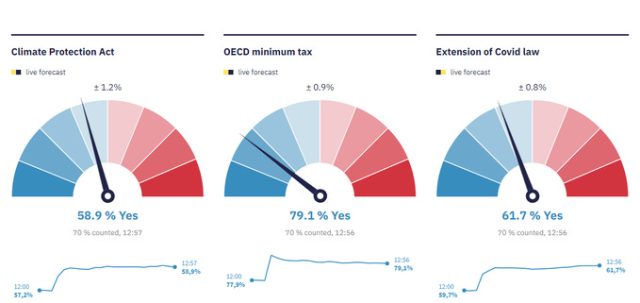
Switzerland distinguished itself as one of the few nations globally that entrusted its citizens with the power to vote on measures concerning Covid-19. The first referendum took place in June 2021. It was a time when only approximately a third of the populace was vaccinated, yet the poll results exhibited a significant majority support for the Covid laws with a staggering 60.2% favouring them.
Not long afterwards, in November 2021, Switzerland’s second referendum took place. This vote was particularly contentious as it encompassed an array of substantial measures like stricter restrictions, comprehensive contact tracing, and the issuance of vaccination certificates. Despite the divisive nature of these policies, an even greater number of people endorsed them, with a 62% majority, which interestingly, was also the fourth-highest voter turnout in Swiss history, standing at 65.7%.
Surely, in 2023, the outcome would be different? Nobody is talking about Covid anymore. With the global narrative having largely moved on from Covid, would the Swiss people continue to support these laws?
Yes they would and no, in 2023 the outcome is no different. Yesterday, a rare third referendum was held. At the end of 2022, the Swiss parliament decided to extend some aspects of the Covid laws, including the vaccine certificates, until summer 2024. The reason given was that a dangerous new Covid variant may emerge and the authorities would have to react quickly. Due to the extension, opponents of the policies obtained enough signatures to force a new referendum.
Despite the ongoing contention, a significant majority of 61.9% voted in favour of these laws.
59% of voters also agreed to pass a climate change law which aims to reach net-zero greenhouse gas emissions by 2050. Opponents said the plan would drive up electricity use and prove too costly for consumers but authorities plan to incentivise households and businesses to be more climate-friendly.
It seems people never learn and Covid restrictions & vaccine passes could return tomorrow if a new health panic were to emerge.
AfD politician speaks out against arming Ukraine
By Lucas Leiroz | June 19, 2023
Berlin is one of the biggest supporters of Kiev’s neo-Nazi regime, sending money and weapons in large sums so that the anti-Russian war machine remains active. However, not all German politicians seem to follow this bellicose mentality. In a recent speech in the German Parliament, an opposition deputy made clear his dissatisfaction with the current policy of sending weapons to Ukraine, showing that there is still a realistic and rational approach among local representatives.
The criticisms were made by Markus Frohnmaier, a deputy linked to the right-wing Alternative for Germany (AfD) party. He questioned in his speech Germany’s real aims with its funding of Ukrainian activities. Frohnmaier classified Berlin’s policy as “carefree” and claimed that the people would be “fed up” with the irresponsible measures taken by the government. He also emphasized that Germans do not want to “pay for Kiev forever”.
The main targets of Frohnmaier’s criticism were German Foreign Minister Annalena Baerbock and Economic Affairs Minister Robert Habeck. The legislator even ironically questioned whether they were “Germans or Ukrainians”, in addition to mocking the names of the officials, mixing them with the names of Ukrainian political figures:
“Are you [Robert Habeck] the German or Ukrainian Minister of Economy? (…) This government, these Bandera-Baerbocks, these Volodymyr Habecks, these foreign administrators, they don’t give a damn about Germany”, he said.
Indeed, the parliamentarian’s targets are justified, considering the intensity with which both German officials work in defense of the interests of NATO and its proxy neo-Nazi regime. Annalena Baerbock has been one of the most prominent anti-Russian activists since the start of the special military operation, even going so far as to say that the European Union was “at war with Russia” during a speech in January. She has also been an emphatic instigator of war against Moscow, using her role as head of German diplomacy to encourage neutral countries to adopt anti-Russian measures, as seen in her recent visit to Brazil.
In the same vein, Robert Habeck’s administration has been disastrous. Prioritizing a liberal ideological agenda over the country’s strategic interests, Habeck has been one of those most responsible for the economic and energy crisis that hit Germany, in addition to being seen with strong opposition by the local population. He is, for example, the author of the unpopular proposal to replace oil and gas heating systems by green sources – a project that simultaneously meets the Western radical environmentalist plans and the anti-Russian agenda, as it endorses the end of energy cooperation between the two countries. A recent survey showed an 80% rejection to Habeck’s proposal among Germans, which shows how local people see his administration.
So, considering these facts, it is really justified for the AfD’s deputy to criticize the officials and denounce the government’s subservience to Ukrainian and Western interests. Germany has been one of the countries most affected by the diplomatic crisis that currently marks relations between Russia and the West, which is why it is urgent that there be a reconsideration of Berlin’s policy concerning its support for Ukraine.
One of the parties that has worked most in favor of these changes has been precisely the AfD. As well as Markus Frohnmaier, there are other party members who advocate a sovereign policy for Germany. As a party linked to the so-called “Eurosceptic movement”, the AfD strives to pressure the government to prioritize national interests over EU and US, which has driven a quest to improve ties with Russia.
For example, in September last year, the AfD sent a delegation of five affiliated politicians to visit Russia, including the four reintegrated regions, in a gesture of diplomatic goodwill in opposition to the hostility of the German state. As expected, these measures were enough for the mainstream media to describe the organization as “pro-Russia” and inaccurately accuse it of spreading “Kremlin propaganda“. The AfD is also often referred to as “right-wing extremist” because of its Eurosceptic stance, while ironically the Ukrainian neo-Nazism remains fully supported by the German government.
A curious fact is that this realistic and diplomatic approach that has been adopted by the AfD has contributed a lot to the increase in the party’s popularity. In a recent poll, the number of respondents saying that they would never vote for AfD dropped from 60% to 53.9%. The same survey also showed a drop in the preference for the Greens (a pro-government party to which both Baerbock and Habeck belong), who are in their worst position in the popularity ranking in five years. In practice, the numbers show that the more pro-war and anti-Russian politicians are, the less the German people support them.
In fact, despite popular support for rational and friendly relations with Russia, Berlin is strongly coerced by the US to act in a subservient way. The inertia of the country’s authorities in the face of evidence of American responsibility for the attack on the Nord Stream is a clear example of how Germany is currently not a truly sovereign state. However, the growth of a realistic and Eurosceptic mentality shows that changes can occur in the near future, generating hope for the local people.
Lab-Grown Meat Suffers Significant Setback With Shocking New Scientific Findings
BY CHRIS MORRISON | THE DAILY SCEPTIC | JUNE 18, 2023
Earlier this year, the Grocery Gazette reported that the UK was set to be a world-leading developer of lab-grown meat. In the recent past, Guardian climate hysteric George Monbiot claimed lab-grown food “will soon destroy farming – and save the planet”. Alas, such boosterism is being challenged by hard facts. Lab-grown meat is up to 25 times worse for the environment since it needs ‘pharmaceutical-grade’ production to make it fit for human consumption. In particular, there is a need to remove endotoxin from the cultured mix, a substance that in concentrations as low as one billionth of a gram per millilitrie can reduce human IVF pregnancy success rate by up to four fold.
These are the startling conclusions of ground-breaking work recently published by a group of chemists and food scientists from the University of California. It turns out that ‘pharma to food’ production is a significant technological challenge. The major problem with lab meat is that it uses growth organisms that have to be highly purified to help animal cells multiply. Compared with environmental savings on land, water and greenhouses gases, the whole bio-process is noted to be “orders of magnitude” higher than rearing the actual animal.
“Our findings suggest that cultured meat is not inherently better for the environment than conventional beef. It’s not a panacea,” said co-author Edward Spang, an associate professor in the Department of Food Science and Technology. The study found that even across scenarios using lower pharma standards, efficient beef production outperforms cultured meat within a range from four to 25 times. This suggests that investment to advance more ‘climate-friendly’ beef production may yield greater reductions in emissions.
The route to New Zero is littered with improbable technologies that promise much – and give endless opportunities for virtue signalling – but deliver little. While many countries press ahead with plans to destroy conventional animal husbandry, the options for new ways of actually feeding populations look thin on the ground. To be fair to Monbiot, he has picked up on the problems of lab meat, noting in a recent blog post that “the more I’ve read about cultured meat and fish, and the more I’ve come to appreciate the phenomenal complexities involved… the more I doubt this vision will come to pass”. Always the worrier, Monbiot asks, “How can mass starvation best be averted”? Not removing the 337.18 million tonnes of global meat production in favour of flaky factory solutions might be a start.
The California study could throw a major stick into the spokes of the lab-grown meat bandwagon, which to date has had a largely uncritical mainstream media ride. Grocery Gazette’s cheer-leading report noted that the sector was predicted to “rapidly increase its market share within the food industry”. Research was quoted suggesting cell cultured meat was expected to make up almost quarter of global meat consumption by 2035.
The authors in California acknowledge that lab-grown meat ventures have attracted around $2 billion of investment to date. Early reports on feasibility were bullish with some predicting a 60-70% displacement of beef by 2030-2040. But of late, sentiment has waned with more conservative estimates noting a 0.5% share of meat products by 2030. As noted, the huge problem in producing lab meat is the presence of endotoxin which is said have a variety of side effects including harm to in vitro fertilisation. In pharmaceutical labs, animal cell culture is traditional done with endotoxin having been removed. There are many ways to remove the unwanted substance, but the use of these refinement methods “contributes significantly to the economic and environmental costs associated with pharmaceutical products since they are both energy and resource intensive”.
The study also highlights concerns about past scientific consideration of lab-grown meat. There is said to be “high levels of uncertainty in their results and the lack of accounting for endotoxin removal”. It is further noted that despite researchers “clearly reporting high levels of uncertainty”, the results were often cited as clear evidence for the sustainability of lab-grown meat.
So a much-touted green Frankenstein food solution – arguably to a problem only promoted in alarmist circles – looks to be biting the dust, sweeping away a billion or two of credulous capital in the process. As the authors note, investing in scaling this technology “before solving key issues like developing an environmentally friendly method for endotoxin removal… would be counter to the environmental goals which this sector has espoused”.
Chris Morrison is the Daily Sceptic’s Environment Editor.
Featured Video

Seyed M. Marandi: U.S. Military DIVIDED? Iran’s Secret Defense EXPOSED
or go to
Aletho News Archives – Video-Images
From the Archives
‘Israel sees Iran as obstacle to its policies’

Press TV – August 25, 2017
Prime Minister Benjamin Netanyahu has said that Israel felt threatened by Iran’s growing influence in the Middle East. Netanyahu expressed his Iranophobic view in a meeting with Russian President Vladimir Putin in Russia’s Black Sea resort of Sochi on Wednesday. Press TV has asked Scott Rickard, former American intelligence linguist from Tampa, Florida, and Brent Budowsky, a columnist at The Hill from Washington, to give their thoughts on the issue.
Rickard said Tel Aviv is concerned about the fact that the regime could not carry out its old project to spread sectarian divisions and pave the way for dismemberment of the countries in the Middle East region because of the Iranian-led resistance against Israeli policies, not only in the occupied territories of Palestine but also in the whole region.
“Iran is not a threat to Israel whatsoever. The threat that Israel sees is the fact that their Oded Yinon Plan is being put to a hold by Iran,” the intelligence linguist said on Thursday night.
“They (the Israelis) look at Iran as a threat only because they have no influence on their governments and Iran is autonomous and is not under the Zionist influence,” he added.
Since the victory of the Islamic Republic of Iran in 1979, Tehran has been critical of Israel’s policies in the region, whereas “no leaders [of other states] even dared to speak out against Zionism,” Rickard argued. … continue
Blog Roll
 Aletho News
- Israeli tank fire killed UN peacekeeper in Lebanon, UNIFIL investigation finds
- Russia, China block Bahrain-sponsored UN resolution on Strait of Hormuz
- The US-Israeli War on Science is an Assault on our Future
- Trump’s Promise to Bomb Iran ‘Like Never Before’ Faces Brutal Logistics — Expert
- Germany seeks to restrict stays abroad for men of fighting age – Berliner Zeitung
- Evidence points to Ukraine being behind TurkStream attempted sabotage, but that should come as no surprise
- Sri Lanka secures supplies of Russia oil – minister
- Nations across Asia strike direct deals with Iran for Hormuz passage
- IRGC commander declares ‘new phase’ of reprisal attacks against aggressors
- Israel’s air defenses overwhelmed by cluster-warhead Iranian missiles: Reports
- If Americans Knew
- The war the US is fighting for Israel could cost trillions
- ‘Cigarette Burns, Nail Wounds’: Toddler Tortured in Gaza to Coerce Father
- Trump Says US Sent ‘a Lot of Guns’ to Protesters in Iran
- Israeli forces destroy 17 UN peacekeeper cameras in south Lebanon
- US-Israeli strikes ‘completely destroy’ synagogue in Tehran
- Archbishop for US Military Says Iran War Is Unjust Under Catholic Teaching
- Iranian leaders’ Open Letters to the American People
- Trump says Iranians appreciate bombs, WHO warns of nuclear risks – Daily Update
- U.N. experts demand Israel release prominent Gaza doctor after reports of ‘severe torture’
- Israel’s Latest Genocide Is Against the Shias of Lebanon. Why Is the World Silent?
- No Tricks Zone
- An Inconvenient Tree: Uncovered In Alps… Europe Much Warmer Than Today 6000 Years Ago
- New Study Reports A 60% Slowdown In Greenland’s Ice Loss Rate In The Last Decade
- Low Intensity Tornado Wrecks Major Solar Farm, Creating A Potential Toxic Dump
- New Study Finds Warming Saves Lives…Cold Temperatures 12 Times More Deadly Than Excess Heat
- German Science Blog Accuses PIK Climate Institute Of Hallucinating Climate Tipping Points
- Devastating Assessment Of Comirnaty Vaccine By Former Senior Pfizer Europe Toxicologist
- New Study: CO2 Is ‘Effectively Negligible’ As An Explanatory Climate Change Factor Since 2000
- Former Pfizer Toxicologist Dr. Helmut Sterz Tells Bundestag Hearing Pfizer Vaccine Should Have Never Been Approved
- Energy Expert: Germany’s Nuclear Phaseout Was A “500 Billion Euro Mistake”
- New Research: South Australia’s Mid-Holocene Sea Surface Temperatures Were 4°C Warmer Than Today
 Aletho News