Sales Collapse At Beyond Meat, Impossible Foods As 20% Of Staff Laid Off

By Tyler Durden | Zero Hedge | February 5, 2023
The fake meat industry appears to be in a death-spiral as sales at plant-based ‘meat’ companies Impossible Foods and Beyond Meat have imploded.
As Axios reports, “after years of hype, the tide is turning against the first generation of plant-based protein makers.”
Last year, both companies were riding high – with prime placement on supermarket shelves, and Burger King even adding an Impossible Whopper to its menu.
Impossible Meat even began to branch out – looking to expand offerings to highly processed meats such as chicken nuggets and sausages.
Sales have collapsed, however, which according to a recent Bloomberg report, has resulted in Impossible Foods planning to lay off around 20% of its workers.
Impossible Foods Inc., the maker of meatless burgers and sausages, is preparing to cut about 20% of its staff, according to a person familiar with the matter.
The Redwood City, California-based company currently employs about 700 workers. The new round of dismissals could reduce that amount by more than 100.
Impossible Foods also offered voluntary separation payments and benefits to employees at the end of 2022, said the person, who asked not to be named discussing private information. An internal document viewed by Bloomberg confirmed the separation packages being offered. The company previously reduced headcount in October, cutting about 6% of its workforce at the time. – Bloomberg
Beyond Meat’s sales fell over 22% in the third quarter of 2022, as the company is preparing to similarly cut 20% of its workers. The company has also lost several executives.
According to the report, supermarket sales fell by 15% y/y as of Jan. 1, according to market-research firm IRI, while orders in restaurants dropped 9% in the12 months ended in November, according to NPD Group.
Meanwhile, data from consumer-experience strategy firm HundredX suggests waning interest in general – as the percentage of shoppers polled who have eaten Impossible products and say they won’t do it again has risen.
Beyond Meat stock is also down around 67% vs. one year ago.
Abandon Hope or Abandon Net Zero
By Jason Isaac | RealClear Energy | February 1, 2023
“Abandon all hope, ye who enter here,” reads an inscription at the gate to Hell in Dante’s “Inferno,” but in the modern world, Dante might as well be referring to the gates of Net Zero. After walking through those gates for a few days—maybe just a few minutes—most people would recoil at the effects of Net Zero: higher prices for everything, unreliable electricity, and a plunge into poverty. But as in “Inferno,” there is hope: you just have to abandon Net Zero. Cases-in-point include San Antonio, Texas; Huntington Beach, California; and Orange County, California.
For the past four years, San Antonio has been, by some metrics, the most-impoverished large metro area in the United States, surpassing Detroit. Despite its community’s pressing needs, San Antonio enacted a Climate Action and Adaptation Plan (CAAP) in 2019, with a vote of 10-1, to focus on “reducing the carbon intensity” of San Antonio’s electric generation instead of reducing the city’s poverty by providing more affordable and reliable energy.
At the time, more than half of San Antonians polled said they were not willing to pay a single dime more for climate change programs. And yet, the city’s misguided climate plan was going to lead to higher utility bills by at least $1,000 a year per household.
That was in 2019. Regardless of whether San Antonians and Americans-at-large were willing to pay more for energy, inflation and the Biden administration’s war on fossil fuels has now caused energy prices to soar. A nationwide survey released in October 2022 said that “32% of Americans have paid a bill late in the past six months — and 61% of them say it’s because they didn’t have enough money to cover the costs.” A $1,000 a year increase—at least—with a net-zero campaign is not sustainable for a city already overrun by poverty and hurting from inflation and soaring energy prices.
In recent months, the city’s electric utility management and its rate advisory committee adopted a plan that will have the utility invest in significant new natural gas generation, eschewing calls from environmental groups to adopt a more wind and solar heavy mix. On Jan. 17, San Antonio Mayor Ron Nirenberg threw his support behind the proposal, noting that “People want to make sure that we can affordably keep the lights on in San Antonio,” and “In this scenario, we are owning more of that ability [to generate power] ourselves.” While not formally abandoning the city’s Net Zero by 2050 plan, the change is a tacit acknowledgement that the city’s largest source of greenhouse gas emissions, its electric utility, cannot affordably meet that goal.
Similarly, the Huntington Beach City Council just voted to pull out of its plan for 100% renewable energy with the Orange County Power Authority (OCPA). Like San Antonio, Huntington Beach has concerns for its residents, including the increasing homelessness in the community. Orange County had already bailed on the plan, claiming that “the authority failed to inform the public that their electricity bills were increasing.”
While citizens of San Antonio, Huntington Beach, and Orange County have averted the left’s woke Green New Deal for now, many cities and countries are still headed down the path of decarbonization to the detriment of their citizens’ livelihoods. Think about the countries that actually live at Net Zero. Malawi’s life expectancy is a full 20 years less than developed countries; a man can’t expect to live past 57. In Ethiopia, many girls walk more than three miles daily, spending eight hours walking to collect water, instead of attending school. Sri Lanka went from economic growth to plunging its people into hunger because of the (now former) president’s policies as the first ever Net Zero chief executive. He banned the use and importation of nitrogen-based fertilizer. Food production dropped 40% and prices rose 80%.
That’s the impact of Net Zero that the US will not have to feel if its cities and states continue to come to their senses about the impossibility of such a goal. Expensive energy hurts the poor; affordable and reliable energy has the power to lift millions out of poverty.
It’s time to abandon Net Zero.
Germany’s Green Power Grid Unable To Power Green Society!
By P Gosselin | No Tricks Zone | January 28, 2023
Today we check in with Blackout News to find out the latest news on Germany’s green energy follies.
The latest is that the country’s increasingly green electric power grid is increasingly unable to handle the “climate friendly” electric mobility and heat pumps the German government is pushing.
It’s widely known that Germany’s electric power supply has the grid constantly on the brink power outages, even blackouts. This is in large part due to the rushed phasing out of baseload coal and nuclear power while installing mass capacities of unstable a wind and solar power.
As Germany pushes the ever greater burdens onto the power grid, its government continues taking measures to weaken the grid rather than to bolster it.
Since Germany’s natural gas supply disruption has caused energy prices to skyrocket, homeowners and motorists are looking for alternative heating sources and modes of mobility. Little wonder Germans are looking more and more to heat pumps for home heating and electric cars for their mobility.
But there’s a problem, Blackout News reports: “The President of the Federal Network Agency is now calling for the forced throttling of heat pumps and charging stations.” This is because the power grid cannot cope with the added load.
“The head of the network agency, Mr. Müller, sees new risks for the supply of electricity and gas. Private individuals installing charging stations or pumps could overload local grids,” according to Blackout News. “To prevent this, the power of these devices could be throttled.”
The government wants to push electric cars and heat pumps, but the agencies are warning it’s not possible – because over the past 20 years Germany has wrecked it’s once extremely stable electric power supply, which by the way was responsible for a tiny, inconsequential fraction of the world’s CO2 emissions.
According to Müller, “there could be overload problems and local power outages if we don’t act”.
“The authority in Bonn considers low-voltage local networks to be particularly susceptible to disruptions.”
Müller also told the Frankfurter Allgemeine Sonntagszeitung that in critical times, heaters and chargers should not be completely cut off from the power supply. He promised that there will always be a minimum supply.
“The CEO of Düsseldorf-based energy company E.on, Thomas König, described the current power grid as being inadequate and called for the “quick expansion and modernization of local and regional power grids”.
Crushed Bug ‘Additive’ is Now Included in Pizza, Pasta & Cereals Across the EU
Most people won’t even know they’re eating it

By Paul Joseph Watson | Summit News | January 25, 2023
As of yesterday, a food additive made out of powdered crickets began appearing in foods from pizza, to pasta to cereals across the European Union.
Yes, really.
Defatted house crickets are on the menu for Europeans across the continent, without the vast majority of them knowing it is now in their food.
“This comes thanks to a European Commission ruling passed earlier this month,” reports RT.
“As per the decision, which cited the scientific opinion of the European Food Safety Authority, the additive is safe to use in a whole range of products, including but not limited to cereal bars, biscuits, pizza, pasta-based products, and whey powder.”
But don’t worry, because the crickets first have to be checked to make sure they “discard their bowel content” before being frozen.
Lovely stuff.
Critics suggested that once bugs become widely accepted as a food additive, their consumption will become normalized across the board.
“The Liberal World Order has decided that the little people must eat bugs to prevent the climate from fluctuating, in accordance with ruling class ideology,” writes Dave Blount.
“Yet rather than mindlessly obey The Experts as most did with Covid policy, people have resisted. So our moonbat overlords are furtively sneaking insects into food.”
“This will allow them to reveal in the near future that we have already been eating bugs, so there is no reason to object to them shutting down farms and imposing a new diet.”
The European Union also recently approved the use of Alphitobius diaperinus, otherwise known as the lesser mealworm, for human consumption.
As we have exhaustively documented, globalist technocrats and climate change activists have consistently lobbied for people to start eating bugs to fight global warming, despite the practice being linked to parasitic infections.
I somewhat doubt that elitist technocrats who recently visited Davos will be switching to the bug diet, no matter how much they browbeat us about man-made climate change.
Back in November, the Washington Post advised Americans that instead of a traditional Thanksgiving dinner, which now is unaffordable for a quarter of families, they should instead look to eating bugs.
While livestock farmers in the Netherlands are being climate change regulated out of existence, school children are being indoctrinated to eat bugs, while another German school has banned meat entirely.
The ‘Great Food Reset’: Who’s Behind Plan to Reengineer the Global Food Supply?

By Suzanne Burdick, Ph.D. | The Defender | January 25, 2023
The world’s food supply is being reengineered under the guise of a fake food crisis, according to journalist James Corbett.
“From cricket powder dumplings and bug burgers to GMOs and glyphosate to bioreactors and designer microbes to nutrigenomics and 3D printed material, the future of ‘food’ is shaping up to be radically different from anything you’ve eaten before,” the author of the “The Corbett Report” said.
Food, Corbett noted a week earlier on his Substack, has been leveraged throughout human history as a “powerful tool of control.”
But it’s not too late to “start formulating our own plans for counteracting this agenda” of control, Corbett said.
What’s the first step? Look closely at who’s behind the agenda.
According to Corbett:
“In order to truly do something to derail the runaway train that is the Great Food Reset, we must first understand it. And in order to understand it, we have to know something about the people behind this agenda.”
Corbett provided an information-packed rundown of the groups and individuals he believes are the drivers — historically and today — of the Great Food Reset.
The Rockefeller Foundation
According to Corbett, the Rockefellers and their namesake foundation — who “are in many ways the progenitors and the architects of the Great Food Reset” — are pushing for further centralization of control over the food supply, including “a new, integrated nutrition security system.”
“From the beginning of the so-called ‘Green Revolution’ to the so-called ‘Gene Revolution,’ the Rockefellers have been there,” Corbett said, “helping to move things along with their ‘philanthropic’ donations.”
Corbett cited the Rockefellers’ recent work in Africa, which operates under the name Alliance for a Green Revolution in Africa. The alliance’s stated goal — to “elevate the single African voice” — “sounds nice and fuzzy, until you learn that 200 organizations have come together to denounce the alliance and its activities,” Corbett said.
Corbett said the 200 critics of the alliance “claim that the group has not only ‘unequivocally failed in its mission,’ but has actually ‘harmed broader efforts to support African farmers.’”
Bill Gates
Corbett pointed out that Bill Gates, Sr., in 2009, admitted he had looked to the Rockefeller Foundation as an example to follow when he helped his son set up the Bill & Melinda Gates Foundation — so it comes as “no surprise” that Bill Gates is heavily invested in the Great Food Reset.
Gates is “literally invested” in the food reset through his financing of the fake meat industry, Corbett said.
“Gates was, infamously, an important early backer of ‘Impossible Burger’ and its lab-grown synthetic biology food substitute,” Corbett said. “He also provided capital to Impossible rival Beyond Meat . . . until Beyond’s stock began to crumble.”
“Miraculously, the Bill & Melinda Gates Foundation Trust was able to divest itself of its Beyond Meat stock right before the shares tanked in 2019,” Corbett said, adding, “The Gateses must be super-shrewd investors!”
Corbett also noted that Gates invested millions into “hacking your microbiome” to reengineer humans’ gut bacteria.
Gates became the biggest owner of U.S. farmland in 2021.
“Gee, I wonder why someone who’s so obsessed with completely reengineering the food supply and making us dependent on the lab-grown synthetic food substitutes he funds would be buying up farmland?” Corbett said.
World Economic Forum
The World Economic Forum (WEF) is behind many different aspects of the so-called Fourth Industrial Revolution, including “Great Reset” food initiatives, Corbett said.
Among other goals, the WEF wants more people to eat more insects.
“[Klaus] Schwab’s desire to get humans off of traditional sources of protein and nutrients is very much a part of that Great Reset plan,” Corbett said.
Corbett told readers that a quick search of the word “insects” on the WEF website reveals the organization has been regularly spouting ideas such as, “5 reasons why eating insects could reduce climate change,” and “Insects could soon be appearing on restaurant menus in Europe.”
“The fat cats are now unwinding after their hard week at Davos,” Corbett said. “You can bet they’re not snacking down on cricket croquette or mealmoth flambé . . . though they may expect you to.”
The EAT Forum (Davos for Food)
Describing itself as the “Davos for food,” an organization called the EAT Forum — cofounded by the Wellcome Trust — says it is a “science-based global platform for food system transformation.”
Corbett pointed out that according to a Feb. 17, 2022, analysis by Dr. Joseph Mercola, the EAT Forum’s largest initiative — FReSH — aims to transform the food system as a whole and features project partners including Bayer, Cargill, Syngenta, Unilever and Google.
Moreover, the EAT Forum, he said, also works with “nearly 40 city governments in Europe, Africa, Asia, North America, South America and Australia, and helps the Gates-funded United Nations Children’s Fund (UNICEF) create updated dietary guidelines.”
USAID
Corbett discussed a working paper — “Systemic Solutions for Climate Change Adaptation and Mitigation in Agriculture, Nutrition, and Food Systems” — released in 2022, by the U.S. Agency for International Development’s (USAID) Board for International Food and Agricultural Development in conjunction with “Feed the Future,” the U.S. government’s global hunger and food security initiative.
“The whole document is couched in the bland bureaucratic doublespeak of ‘equity,’ ‘inclusion’ and ‘sustainability,’” Corbett said. “But, if you know how to read between the lines, it isn’t hard to understand what the report is really saying.”
“USAID’s ‘leverage’ over developing countries — specifically referenced no less than 125 times — gives an insight into the Kissingerian food-as-a-weapon mentality that is the very basis of USAID and its mission,” Corbett said.
He added:
“The entire enterprise reeks of a neocolonial landgrab masquerading as ‘philanthropy’ — the kind of territorial taking that people in Africa and elsewhere have been warning about for decades.”
Suzanne Burdick, Ph.D., is a reporter and researcher for The Defender based in Fairfield, Iowa. She holds a Ph.D. in Communication Studies from the University of Texas at Austin (2021), and a master’s degree in communication and leadership from Gonzaga University (2015). Her scholarship has been published in Health Communication. She has taught at various academic institutions in the United States and is fluent in Spanish.
his article was originally published by The Defender — Children’s Health Defense’s News & Views Website under Creative Commons license CC BY-NC-ND 4.0. Please consider subscribing to The Defender or donating to Children’s Health Defense.
Why Net Zero is nonsense: a briefing document for opponents

By Robin Guenier | TCW Defending Freedom | January 26, 2023
I’m increasingly alarmed at how all the UK’s major political parties are committed to the Net Zero policy. If implemented, it will have appalling consequences for the economy and for most people, few of whom understand the quite simple issues involved. I have therefore put together a ‘briefing document’ which marshals three arguments that I hope may contribute to curtailing the policy before it’s too late.
1. It’s unachievable. Many vehicles and machines (used for example in agriculture, heavy transportation, commercial shipping and aviation, mining and construction) and products (eg concrete, steel, plastics, fertiliser, pharmaceuticals, lubricants, paints, adhesives and asphalt) essential to our lives and wellbeing require the combustion of fossil fuels or are made from oil derivatives, and there are no easily deployable, commercially viable alternatives. The complex engineering, reliability and cost challenges of establishing a Net Zero grid and the vast scale of what’s involved (immense amounts of material and space are required because the ‘energy density’ of wind and sun is so low) make it most unlikely that the UK could generate sufficient renewable electricity for current needs, let alone for the mandated electric vehicles and heat pumps. In any case, the UK doesn’t have enough technical managers, engineers, electricians, plumbers, mechanics and other tradespeople (probably over a million) to do the many tasks that would be essential to achieve Net Zero.
2. It would be socially and economically disastrous because: (a) the UK’s all-renewable energy project doesn’t include a fully costed engineering plan for the provision of comprehensive grid-scale back-up when there’s little or no wind or sun, so millions of people, especially the poor and vulnerable, would be put at serious personal risk (including death) from electricity blackouts; (b) our crippled economy would be tipped deeper into decline by enormous additional costs and energy unavailability, further blighting our poor industrial productivity; (c) China essentially controls the supply of materials (in particular so-called rare earths) needed for renewables, so the UK would increase its already dangerous dependence on it, putting our energy and overall security at serious risk, and (d) the vast mining and mineral processing operations required for renewables would have appalling environmental and human consequences affecting in particular fragile ecosystems and some of the world’s poorest people – not least as a result of Chinese human rights abuses.
3. Above all, it’s pointless. Most major non-Western countries – the source of more than 75 per cent of CO2 emissions and home to 84 per cent of humanity – don’t regard emissions reduction as a priority and, either exempt from or ignoring any obligation to reduce their emissions, are focused instead on economic and social development, poverty eradication and energy security. As a result, global emissions are increasing and will continue to increase for the foreseeable future whatever the UK (the source of less than 1 per cent of global emissions) may or may not do. It therefore makes absolutely no sense for Britain to pursue this unachievable and disastrous policy.
The Davos establishment reveals whom it truly fears
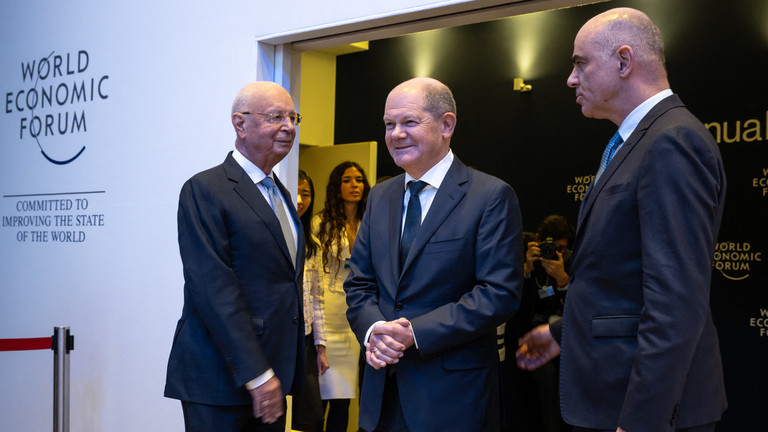
By Rachel Marsden | RT | January 22, 2023
The World Economic Forum at Davos used to be THE place to see and be seen, but the idea of the richest and most influential people in the world hobnobbing around a common agenda for the world has lost its luster as the policies peddled by its attendees spark increased skepticism among average citizens.
Forum founder Klaus Schwab, the de facto frontman of the organization, has cranked out one distasteful hit after another in recent years. He has spoken of how the organization “penetrates the cabinets” of governments in its recruitment efforts. He coined the term “The Great Reset,” about which he published a book just a few months into the Covid-19 pandemic in July 2020, advocating that the pandemic be used as inspiration to “reimagine our world” at a time when much of the globe was locked down on orders of their governments – many members of which were Davos regulars. There was little appetite to turn lockdowns into a permanent lifestyle change, but here was Klaus promoting the benefits of burying the old life – all under the pretext of an event that the WEF had already wargamed in October 2019 in New York, just ahead of the crisis, in an exercise called “Event 201.” “The exercise will bring together business, government, security and public health leaders to address a hypothetical global pandemic scenario,” the WEF announced at the time. It’s all just a bit too creepy.
It’s the constant effort of top-down global coordination around murky financial interests laundered through the Davos agenda that irks the common person. The fact that just a single leader of a G7 country attended this year’s event speaks volumes about how poorly it’s now viewed. The premier of the western Canadian province of Alberta, Danielle Smith, said of the WEF after her cabinet’s swearing-in ceremony last October: “I find it distasteful when billionaires brag about how much control they have over political leaders. That is offensive… the people who should be directing government are the people who vote for them. Quite frankly, until that organization stops bragging about how much control they have over political leaders, I have no interest in being involved with them.”
Those invited to preach at the altar during the high mass of globalism this year seemed to know exactly what kind of sermon the crowd wanted to hear. German Chancellor Olaf Scholz was apparently the only G7 leader who thought it would be a good look to be seen hanging out with the unelected masters of the planet while Westerners – and Europeans in particular – grapple with the high cost of their governments’ policies in their daily lives. Scholz doubled down on the same green dreams that put Germany’s economy in peril with no viable backup plan once the European Union had effectively cut off Russian energy through sanctions. “Most importantly, our transformation toward a climate-neutral economy, the fundamental task of our century, is currently taking on an entirely new dynamic. Not in spite of but because of the Russian war, and the resulting pressure on us Europeans to change. Whether you are a business leader or a climate activist, a security policy specialist or an investor, it is now crystal clear to each and every one of us that the future belongs solely to renewables. For cost reasons, for environmental reasons, for security reasons, and because in the long run, renewables promise the best returns,” Scholz said in his address. Meanwhile, Germany is firing its coal power plants back up and reconsidering its nuclear power phase-out. How about worrying about how German industry is going to function in the next year when green initiatives, such as hydrogen imports from Portugal and Norway, aren’t set to even get off the ground until at least 2030? Scholz used his time at the podium at Davos to greenwash the economic uncertainties that Germany faces as a result of the EU’s energy sanctions on Russia. In other words, green hopes and dreams took center stage in this pitch to global investors, thus providing a convenient distraction from the more worrisome current realities.
Greenwashing was joined at Davos by the pitching of anti-democratic initiatives via concern trolling. During a panel discussion dedicated to “disrupting distrust” – which really should have been called “How can we get people to better swallow our nonsense?” – Richard Edelman, the CEO of the eponymous global communications firm, blamed the derailments on right-wingers. “My hypothesis on that is that right-wing groups have done a really good job of disenfranchising NGOs. They’ve challenged the funding sources. They’ve associated you with Bill Gates and George Soros. They’ve said that you’re world people, as opposed to what you are, which is local,” Edelman lamented, ignoring the fact that they wouldn’t have needed to fly their private jets to a “local” event. What he’s really attacking are dissidents, many of whom just happen to be populists and right-leaning. And no doubt the fact that they’re digging into the special interests laundered through many NGOs makes the job of PR pros such as Edelman more challenging.
“Edelman is a despicable human being – his job is literally being a professional liar!” Tweeted billionaire Tesla and SpaceX founder Elon Musk, whose controversial purchase of the social media platform and subsequent reversal of its heavy-handed censorship policies haven’t exactly endeared him to the Davos crowd. Mocking Schwab’s call to “master the future” in the opening keynote, Musk tweeted, “’Master the Future’ doesn’t sound ominous at all … How is WEF/Davos even a thing? Are they trying to be the boss of Earth!?” Musk then took a Twitter poll that found that 86% of 2.4 million respondents answered ‘no’ to the question of whether the WEF should “control the world.”
A WEF spokesman said that Musk hasn’t been invited to the gathering since 2015. Musk confirmed his lack of interest in attending: “My reason for declining the Davos invitation was not because I thought they were engaged in diabolical scheming, but because it sounded boring af lol.”
Boring, indeed – in the same way that a cult meeting where everyone nods their heads in agreement is a snooze fest. The last time things were even remotely interesting at Davos was when former US President Donald Trump showed up and rejected the Davos mantra of climate change doom. “The message represents a sharp departure from the official playbook at the World Economic Forum, where this year’s theme is ‘Stakeholders for a Cohesive and Sustainable World’,” wrote CNN in January 2020.
Who asked them, though? These elites represent no one’s interests but their own, which are economic and are for the benefit of their shareholders – hence the forum’s name. If the average citizen is now waking up to the fact that anything coming out of Davos should be scrutinized through that lens, then it can only be a good thing for freedom, democracy, and national sovereignty.
Rachel Marsden is a columnist, political strategist, and host of independently produced talk-shows in French and English.
Large yachts of the super-rich spared from EU’s new CO2 tax

Free West Media | January 21, 2023
BRUSSELS – CO2 emissions are becoming more and more expensive – a consequence of EU emissions trading. Since 2005, it has been extended to more and more branches of industry. In the future it will also apply to shipping. But there are exceptions: rich yacht owners still do not have to buy CO2 certificates.
Since 2005, some large industrial companies have had to buy certificates for their CO2 emissions. This is a result of the EU’s emissions trading system, which has been gradually expanded since then. Since 2012, for example, airline companies have also had to obtain certificates for intra-European flights.
The system is to be expanded again, the EU decided at the end of 2022. In future, road traffic and buildings will also be included. Many are celebrating the decision to expand emissions trading to include shipping as a major breakthrough. But there are some curious exceptions.
From 2024, only large passenger and cargo ships over 5000 gross register tons will be affected. Owners or renters of lavish yachts can rest easy: they will benefit from an exemption rule in CO2 emissions trading. This was announced by the EU Commission when asked by the German broadcaster NDR.
In other words, no billionaire has to buy CO2 rights for his huge ship, no matter how much he uses it.
The emissions from yachts are enormous as they consume huge amounts of fuel, from “350 liters, 500 liters or even more than 1000 liters of diesel per hour”, reported the Tagesschau.
Some NGOs blasted the new regulation: “Super-rich yacht owners cause more pollution on a summer’s day than the majority of people do in their entire lifetime, but politicians continue to let them get away with it.” The 1500 larger yachts in Europe emit around 725 tons of CO2 per year on average.
Featured Video

Seyed M. Marandi: U.S. Military DIVIDED? Iran’s Secret Defense EXPOSED
or go to
Aletho News Archives – Video-Images
From the Archives
‘Israel sees Iran as obstacle to its policies’

Press TV – August 25, 2017
Prime Minister Benjamin Netanyahu has said that Israel felt threatened by Iran’s growing influence in the Middle East. Netanyahu expressed his Iranophobic view in a meeting with Russian President Vladimir Putin in Russia’s Black Sea resort of Sochi on Wednesday. Press TV has asked Scott Rickard, former American intelligence linguist from Tampa, Florida, and Brent Budowsky, a columnist at The Hill from Washington, to give their thoughts on the issue.
Rickard said Tel Aviv is concerned about the fact that the regime could not carry out its old project to spread sectarian divisions and pave the way for dismemberment of the countries in the Middle East region because of the Iranian-led resistance against Israeli policies, not only in the occupied territories of Palestine but also in the whole region.
“Iran is not a threat to Israel whatsoever. The threat that Israel sees is the fact that their Oded Yinon Plan is being put to a hold by Iran,” the intelligence linguist said on Thursday night.
“They (the Israelis) look at Iran as a threat only because they have no influence on their governments and Iran is autonomous and is not under the Zionist influence,” he added.
Since the victory of the Islamic Republic of Iran in 1979, Tehran has been critical of Israel’s policies in the region, whereas “no leaders [of other states] even dared to speak out against Zionism,” Rickard argued. … continue
Blog Roll
 Aletho News
- Iran declares ‘historic victory’ over US, says enemy forced to accept its proposal
- Trump Claims Ceasefire, Reopening of Strait of Hormuz Agreement with Iran
- Israeli tank fire killed UN peacekeeper in Lebanon, UNIFIL investigation finds
- Russia, China block Bahrain-sponsored UN resolution on Strait of Hormuz
- The US-Israeli War on Science is an Assault on our Future
- Trump’s Promise to Bomb Iran ‘Like Never Before’ Faces Brutal Logistics — Expert
- Germany seeks to restrict stays abroad for men of fighting age – Berliner Zeitung
- Evidence points to Ukraine being behind TurkStream attempted sabotage, but that should come as no surprise
- Sri Lanka secures supplies of Russia oil – minister
- Nations across Asia strike direct deals with Iran for Hormuz passage
- If Americans Knew
- Thousands dead and neighborhoods razed to the ground: Aid agencies fear southern Lebanon is becoming the new Gaza
- The war the US is fighting for Israel could cost trillions
- ‘Cigarette Burns, Nail Wounds’: Toddler Tortured in Gaza to Coerce Father
- Trump Says US Sent ‘a Lot of Guns’ to Protesters in Iran
- Israeli forces destroy 17 UN peacekeeper cameras in south Lebanon
- US-Israeli strikes ‘completely destroy’ synagogue in Tehran
- Archbishop for US Military Says Iran War Is Unjust Under Catholic Teaching
- Iranian leaders’ Open Letters to the American People
- Trump says Iranians appreciate bombs, WHO warns of nuclear risks – Daily Update
- U.N. experts demand Israel release prominent Gaza doctor after reports of ‘severe torture’
- No Tricks Zone
- An Inconvenient Tree: Uncovered In Alps… Europe Much Warmer Than Today 6000 Years Ago
- New Study Reports A 60% Slowdown In Greenland’s Ice Loss Rate In The Last Decade
- Low Intensity Tornado Wrecks Major Solar Farm, Creating A Potential Toxic Dump
- New Study Finds Warming Saves Lives…Cold Temperatures 12 Times More Deadly Than Excess Heat
- German Science Blog Accuses PIK Climate Institute Of Hallucinating Climate Tipping Points
- Devastating Assessment Of Comirnaty Vaccine By Former Senior Pfizer Europe Toxicologist
- New Study: CO2 Is ‘Effectively Negligible’ As An Explanatory Climate Change Factor Since 2000
- Former Pfizer Toxicologist Dr. Helmut Sterz Tells Bundestag Hearing Pfizer Vaccine Should Have Never Been Approved
- Energy Expert: Germany’s Nuclear Phaseout Was A “500 Billion Euro Mistake”
- New Research: South Australia’s Mid-Holocene Sea Surface Temperatures Were 4°C Warmer Than Today
 Aletho News