Wall Street Giants Set to Smash Profit Records Off Global Hunger, Energy Crisis
By Jake Johnson | Common Dreams | September 9, 2022
Russia’s war on Ukraine has wreaked havoc on global commodity markets, driving up energy and food prices and exacerbating hunger emergencies around the world.
“We’re in a market where speculators are driving prices up.”
But while disastrous for the global poor—millions of whom are living on the brink of famine—the chaos has been a major boon for Wall Street giants, according to new data showing that the world’s 100 largest banks are on pace to smash commodity trading profit records this year.
“The 100 biggest banks by revenue are set to make $18 billion from commodities trading in 2022,” Bloomberg reported Friday, citing figures from the London-based firm Vali Analytics. “That would be the highest in the data, which goes back 14 years, and exceed the previous high watermark in 2009.”
“The prediction is the latest evidence that the wild swings in energy prices triggered by the war in Ukraine are delivering a boon to commodity traders, even as they push European nations into crisis,” Bloomberg added. “Vali, an analytics firm that tracks trading business, compiled data that includes the leading five banks in commodity trading: Macquarie Group Ltd., Goldman Sachs Group Inc., JPMorgan Chase & Co., Citigroup Inc., and Morgan Stanley.”
Though the prices of wheat and other food staples have fallen from their peak in recent months, they remain significantly elevated compared to last year, according to the United Nations’ Food and Agriculture Organization, leaving millions vulnerable to hunger and starvation.
The World Food Program estimates that “as many as 828 million people go to bed hungry every night” and “the number of those facing acute food insecurity has soared—from 135 million to 345 million—since 2019.”
Energy prices have also eased but remain high, contributing to cost-of-living crises throughout Europe and other parts of the globe.
“People’s misery makes capitalists’ superprofit,” Salvatore De Rosa, a researcher at the Lund University Center for Sustainability Studies, tweeted in response to Bloomberg‘s reporting. “How do you reform this?”
Wall Street banks have not just benefited from the commodity price increases—they’ve actively helped fuel them, experts say.
“We’re in a market where speculators are driving prices up,” Michael Greenberger, former head of the Division of Trading and Markets at the U.S. Commodity Futures Trading Commission, told Mongabay in July.
“Commodity markets are supposed to be hedging markets for people who are dealing with the commodity involved,” Greenberger said. “In the case of wheat, it would be farmers and people buying wheat. But if we looked at it, there would be banks in there with no interest in what the price of wheat is, writing swaps and controlling this price.”
“It’s too easy to say the war in Ukraine has unbalanced all these markets, [or that] supply chains and the ports are shot, and that there’s a supply and demand reason for these prices going up,” Greenberger added. “My own best guess is anywhere from 10% to 25% of the price, at least, is dictated by deregulated speculative activity.”
Global Oil Output Short of 6Mln BPD Due to Western Policy: Russian Energy Official
Samizdat – 14.09.2022
ST. PETERSBURG, Russia – A significant investment shortage into traditional energy sources caused by the Western sanctions and environmental, social, and governance (ESG) policy has caused a global production deficit of 5-6 million barrels per day, Russian First Deputy Energy Minister Pavel Sorokin said on Wednesday.
“The current situation on the energy market is not a result of the last few months but a consequence of the policy that was being created by the West during the last decade. The sanctions, which were imposed not only on Russia but on other countries, as well as the green agenda and the ESG policy of the last 10-15 years caused a significant shortage of investments into traditional energy sources. It has deprived the world of 5-6 barrels of oil per day, according to our estimates,” Sorokin said at the 11th St. Petersburg International Gas Forum.
The official also said that traditional energy sources are short of at least 250-270 billion euros ($25.1- $27 billion) in investments per year, adding that the slowdown in demand for oil and gas in the developing countries in Latin America, Africa and in the Asia-Pacific region affect the global economy, increasing the risks of economic recession.
The 11th St. Petersburg International Gas Forum (SPIGF), which is taking place from September 13-16 in the Expoforum Convention and Exhibition Centre, is hosting more than 80 events with the participation of 700 speakers from 20 countries. It aims to outline prospects for the further development of the sector, according to the organizers.
Among the main events of the SPIGF 2022 convention program are the international scientific and practical conference “Underground Gas Storage: Reliability and Efficiency” and plenary session “Gas Engine Fuel: a Reliable Solution in the Face of New Social-Economical and Environmental Challenges.”
German President Says Homeless Numbers May Rise Amid Cost-of-Living Crisis
Samizdat – 11.09.2022
More people in Germany may become homeless this winter as soaring costs of living keep adding pressure on vulnerable households, President Frank-Walter Steinmeier warned on Sunday.
Over 300,000 Germans do not have a home, Steinmeier told a conference at his Bellevue residence. Of them, 45,000 are forced to sleep rough on the streets.
“More than 300,000 is a huge figure! And let’s be clear: this number may rise in the coming months. The war and crises may increase the number of people suffering from lack of housing in fall and winter,” he said.
Germany marks the Day of the Homeless on September 11. The German president traditionally invited people who do not have a roof over their head to his Berlin residence in the upscale Tiergarten neighborhood.
Steinmeier said that the problem of homelessness was more acute than ever at this time of crisis. He urged politicians to make sure that “the topic is not relegated to the bottom of the political agenda”.
Germany and other European countries are suffering from soaring inflation and immense energy prices caused by Brussels’ decision to impose sanctions on Russia after the start of the special military op in Ukraine. As a result, gas prices and energy bills at record-high levels have become a major issue for many Europeans.
U.S. ups the ante: are we indeed headed into WWIII and what can save us?
Gilbert Doctorow | September 9, 2022
The UK and Commonwealth may be mourning the passing of Queen Elizabeth II yesterday. I am in mourning as well, but for a very different reason: the gathering in the Ramstein air base in Germany yesterday reshuffled the deck on Western military and financial assistance to Ukraine, raising contributions to the ongoing holy crusade against Russia from still more nations and adding new, still more advanced precision strike weapons to the mix of deliveries to Kiev. It was an open summons to the Kremlin to escalate in turn, as were the test firing the same day of a new intercontinental rocket, the Minuteman III, from Vandenberg air base in California and the unannounced visit to Kiev yesterday of not only Secretary of State Antony Blinken, who was featured in Western media accounts, but also other top officials of the Biden administration. The most notorious member of this delegation was surely Blinken’s deputy, Victoria Nuland, who had stage managed the February 2014 coup that put in power in Kiev the Russia-hating regime that Zelensky now heads.
The Russians may be compelled to take the bait due to the course of military action on the ground. As now becomes clear, they have just suffered some losses in very heavy ground and artillery fighting these past few days around Kharkov. The Ukrainian gains were facilitated by the advanced weaponry recently arrived from NATO countries, by the targeting data they are receiving from the U.S. and from off-stage tactical direction from NATO officers. By ‘take the bait,’ I mean the Russians may escalate to all out war on Ukraine. This question figured prominently in yesterday’s major news and political talk show programs of Russian state television. I will go into these matters in some detail below.
Regrettably, all of the foregoing also obliges me to revisit the critique I published a couple of weeks ago on the latest essay in Foreign Affairs magazine by John Mearsheimer. His overarching message on the dangers of our stumbling into a nuclear war is better substantiated by the latest developments, even though I believe that Mearsheimer failed to identify the several successive steps that lie ahead before we find ourselves in such a war. Mearsheimer oversimplified Russian options to deal with setbacks on the ground. This also will be a central issue in my narrative below.
Finally, in this essay I will direct attention to the second dimension of the ongoing confrontation between Russia and the entire Collective West: the economic war being waged on the Russian Federation via sanctions, which now far outnumber those directed against any other country on earth. This war, as I will argue, is going well for the Russians. More importantly for us all, it is the sole area in which the peoples of Europe may have a say in putting an end to the mad policies being pursued by their national governments under the direct pressure of Washington.
*****
Over the past ten days, we have witnessed the start of the Ukrainian counter-offensive which was preceded by so much anticipation in Western media. A reversal of Russian fortunes in the war was predicted, leading to the stalemate or outright defeat for Russia which Mearsheimer and some other analysts in the US foreign policy community feared would trigger a nuclear response from the Kremlin.
In fact, the Ukrainian counter-offensive got off to a very bad start. It opened in the south, in the Kherson region. Kherson, which is predominantly Russian-speaking, was the first major Ukrainian city to fall to the Russians and it has strategic importance for ensuring Russian domination of the Black Sea littoral. However, first results of the Ukrainian attacks there were disastrous for the Ukrainian armed forces. It soon was obvious that they had deployed new recruits who had little or no military experience. The infantry attacked across open terrain where they were easily destroyed in vast numbers by the Russian defenders of Kherson. I have heard the figure of 5,000 Ukrainian casualties in the Kherson counter offensive. Obviously the Russians were jubilant, though there were reports of some Ukrainian reservists being withdrawn from the field of action for redeployment elsewhere.
What followed was something the Russians evidently did not expect, namely a well prepared and implemented assault on their positions around the northeastern city of Kharkov, Ukraine’s second largest city. Kharkov was briefly surrounded by Russian forces at the start of the war, but was left in relative peace as the Russians refocused their strategy on taking the Donbas and avoiding major urban warfare except in one place, Mariupol. Exactly what the Russian game plan has been was recently explained in a remarkable paper published by a certain ‘Marinus’ in the Marine Corps Gazette.
A couple of days ago I picked up the following amidst the chatter of panelists on Evening with Vladimir Solovyov: “yes, we made some mistakes, but it is inevitable in a war that mistakes are made.” As from the latest news on the apparent loss of Balakliya and surrounding villages on the outskirts of Kharkov, we can see that the Ukrainian tactics were precisely those which Russia had been using so effectively against them from day one of the ‘special military operation,’ namely a feint in one war zone followed by all-out attack on a very different region. Of course, the ‘feint’ around Kherson, if that is what it was, entailed the cynical sacrifice of thousands of young and not so young Ukrainian foot soldiers. But the resultant distraction prevented the Russians from bringing up sufficient manpower to successfully defend their positions around Kharkov, which include the strategically important city of Izyum.
Izyum is close to the Russian-Ukrainian border southeast of Kharkov and is a major logistical base for munitions and weaponry that are sent onward to support the Donbas operation. The latest information on the Russian side appears to be that the Russians have now dispatched large numbers of reservists to this area to hold their positions. They also speak of intense artillery duels. We may well assume that both sides have experienced heavy loss of life. As yet, the outcome is unforeseeable. Meanwhile, Russian war correspondents on the ground in Donetsk insist that the Russian advance towards Slavyansk, in the center of the former Donetsk oblast, is continuing without pause, which suggests that the strikes on their munitions stores claimed by the Ukrainians have not been totally effective. If Slavyansk is taken in the coming few weeks, then Russia will quickly assume control of the entire territory of the Donbas.
In last night’s talk show program, host Vladimir Solovyov said that this latest push in the Ukrainian counter-offensive was timed to coincide with the gathering at the Ramstein air base, Germany of top officials from NATO and other allies under the direction of the visiting U.S. Secretary of Defense Lloyd Austin. If the Ukrainian efforts were failing in the field, then the cry would go up: we must provide them with more weapons and training. And if the Ukrainian efforts in the counter-offensive were succeeding, those in attendance at Ramstein would hear exactly the same appeal to aid Kiev.
Though Evening with Solovyov, on air from about 23.00 Moscow time, offered viewers some few minutes of video recordings from the opening of the Ramstein gathering, far more complete coverage was provided to Russian audiences a few hours earlier by the afternoon news show Sixty Minutes. Here, nearly half an hour on air was given over to lengthy excerpts from CNN and other U.S. and European mainstream television reporting about Ramstein. Host Yevgeni Popov read the Russian translation of the various Western news bulletins. His presentation clearly sought to dramatize the threat and to set off alarm bells.
For his part, Vladimir Solovyov went beyond presentation of the threat posed by the United States and its allies to analysis of Russia’s possible response. He spoke at length, and we may assume that what he was saying had the direct approval of the Kremlin, because his guests, who are further removed from Power than he is, were, for the most part, allowed only to talk blather, such as the critique by one panelist of a recent pro-Ukraine, anti-Russia article in The New York Review of Books by Yale professor Timothy Snyder, who counts for nothing in the big strategic issues Russia faces today.
So, what did Solovyov have to say? First, that Ramstein marked a new stage in the war, because of the more threatening nature of the weapons systems announced for delivery, such as missiles with accuracy of 1 to 2 meters when fired from distances of 20 or 30 kilometers thanks to their GPS-guided flight, in contrast to the laser-guided missiles delivered to Ukraine up till now. In the same category, there are weapons designed to destroy the Russians’ radar systems used for directing artillery fire. Second, that Ramstein marked the further expansion of the coalition or holy crusade waging war on Russia. Third, that in effect this is no longer a proxy war but a real direct war with NATO and should be prosecuted with appropriate mustering of all resources at home and abroad.
Said Solovyov, Russia should throw off constraints and destroy the Ukrainian dual use infrastructure which makes it possible to move Western weapons across the country to the front. The railway system, the bridges, the electricity generating stations all should become fair targets. Moreover, Kiev should no longer be spared missile strikes and destruction of the ministries and presidential apparatus responsible for prosecution of the war. I note that these ideas were aired on the Solovyov program more than a month ago but then disappeared from view while the Russians were making great gains on the ground. The latest setbacks and the new risks associated with the Western policies set out at Ramstein bring them to the surface again.
Solovyov also argued that Russia should now use in Ukraine its own most advanced weapons that have similar characteristics to what NATO is delivering to the other side. As a sub-point, Russia should consider neutralizing in one way or another the GPS guidance for U.S. weapons. Of course, if this means destroying or blinding the respective U.S. satellites, that would mean crossing a well-known U.S. red line or casus belli.
Next, in the new circumstances, Russia should abandon its go-it-alone policy and actively seek out complementary weapons systems from previously untouchable countries, such as Iran and North Korea. Procurements from both have till now been minimal. On this issue, a couple of panelists with military expertise were allowed to explain that both these countries have sophisticated and proven weapons that could greatly assist Russia’s war effort. Iran has unbeatable drones which carry hefty explosive charges and have proven their worth in operations that are unmentionable on public television. And North Korea has very effective tanks and highly portable field artillery which are both fully compatible with Russian military practice, because the designs were based on Chinese weapons, which in turn were copies of Russia’s own. These weapons also have shown their worth in the hands of unnamed purchasers in the Middle East. Moreover, North Korea has a vast store of munitions fully compatible with Russian artillery. It was also mentioned in passing that insofar as Kiev has mobilized in the field many Western mercenaries and covert NATO officers, Russia should also recruit from abroad, as for example, whole brigades from North Korea available for hire.
If any of these ideas put out by Solovyov last night are indeed implemented by the Kremlin, then the present confrontation in and over Ukraine will truly become globalized, and we have the outlines of what may be called World War III. However, I note that the use of nuclear weapons, tactical or otherwise, does not figure at all in the set of options that official Moscow discusses in relation to the challenges it faces in its Ukraine operation. Such a possibility would arise only if the NATO forces being sent to the EU’s ‘front line states’ grew in number by several times those presently assigned and appeared to be preparing to invade Russia.
*****
Before Ramstein, before the news of Ukrainian successes on the ground in the Kharkov sector, I had plans to write about a very different development this past week that coincided with a different calendar: the end of summer vacations and return to work of our national governments. With the return, our presidents and prime ministers would finally have to address the critical state of the European economies, which are facing the highest inflation rates in decades and an energy crisis brought about by the sanctions on Russian hydrocarbons. Speculation was rife on what exactly they would do.
I was particularly struck by several articles in the 7 September edition of The Financial Times and planned to comment on them.
For months now, the FT has been the voice of Number 10, Downing Street, at the vanguard of the Western crusade to crush Russia. Their editorial board has consistently backed every proposal for sanctions against Russia, however hare-brained. And yet on the 7th their journalists ran away with the show and cast doubt on the basic assumptions held by their bosses. One article by Derek Brower in the “FT Energy Source” newsletter has the self-explanatory title “The price cap idea that could worsen the energy crisis.” As we saw today, Brower’s concern was misplaced: finally, the EU could not agree a price cap policy. This notion, promoted from the United States by none other than the Secretary of the Treasury Janet Yellen, is in full contradiction with the practices of the global hydrocarbon market, as even a few EU leaders understood, depriving the initiators from the Baltic States of their hoped for consensus.
Another article of the 7th in FT, by Valentina Pop, Europe Express Editor, analyzed quickly and competently the problems facing European policy-makers in their bid to alleviate the pain to households and industry that the latest electricity and heating bills would otherwise present, given that they are several times higher than just a year ago and are unaffordable by large swathes of the population. Pop identified the key issue thus: how to provide aid quickly to those most in need given the constraints and resources available to the various government bureaucracies: “Some capitals will take many months in determining which households require help” she says. Of course, ‘many months’ of patience in the broad population will not be there.
But the most surprising article in this collection from the 7th was in the “Opinion Lex” section of the paper which was nominally about how Russian banks have weathered the storm that broke out when the EU sanctions on their industry first were laid down shortly after the start of Russia’s ‘special military operation.’ Indeed, VTB and other major Russian banks have returned to profitability despite it all. The author finds that ‘sanctions are biting less than western politicians hoped.’ Not only did the expected banking crisis not materialize, but the ruble is at five-year peaks and inflation is falling. Moreover the official Russian financial data behind these generalizations is said to be sound by independent and trustworthy market observers. The key conclusions are saved for last: “Russia has shown it can bear the pain of western sanctions. Western Europe must endure reprisals as robustly, or concede a historic defeat.’ The ‘reprisals’ in question are the complete shutdown of Russian gas deliveries through Nord Stream I until Europe lifts its sanctions.
It is interesting that even the Opinion article by NATO Secretary General Jens Stoltenberg published on the 7th in FT carries the following grim warning: “We face a difficult six months, with the threat of energy cuts, disruptions and perhaps even civil unrest.’ [emphasis mine]
To be sure, here and there in Europe, there are a few clever administrators who find promising solutions to the pending crisis of energy bills. In her first day in office, Britain’s new Prime Minister Liz Truss announced one such solution: to immediately freeze the maximum energy bill per household at the present level of 2500 pounds sterling per year and then to turn around and agree with the power companies a subsidy for them to cover their losses.
This is fine for nipping in the bud possible ‘civil unrest.’ But the question remains how Britain will finance the estimated 150 billion pounds this will cost in the first year alone. If a similar solution were approved in the EU, the overall cost would surely approach the 800 billion euros of assistance borrowed to cover losses attributable to the Covid pandemic a year ago. But whereas the Covid aid was financed by collective borrowing of the EU, no such solidarity is likely to deal with the energy crisis, given that Germany, the Netherlands and other northern Member States oppose this becoming a general practice and will apply a veto. The British solution, however clever it may be, will hardly be available to many countries in the EU on their own given their high state indebtedness.
Then there is the second question of what to do to assist industry. Failure to give industry proper relief will result in company closures and rampant unemployment, which finally also sparks political protest. In any case, such solutions do not deal with the knock-on effects of vastly increased government borrowing to finance the energy subsidies, something which in the best of times always reduces capital available for other government services and capital available to private business for investment and job creation.
These various problems in dealing with the energy crisis that Europe created for itself by imposing sanctions on Russia may well be intractable and may well lead to spontaneous protests in a number of European countries this fall.
There is no anti-war movement on the Old Continent to speak of. So popular protests over the ‘heat or eat’ dilemma being imposed from the chanceries on the people without anything resembling public debate may be the salvation of us all if they induce war mongering politicans to resign.
©Gilbert Doctorow, 2022
Germany has ‘stupidest government’ in Europe: MP
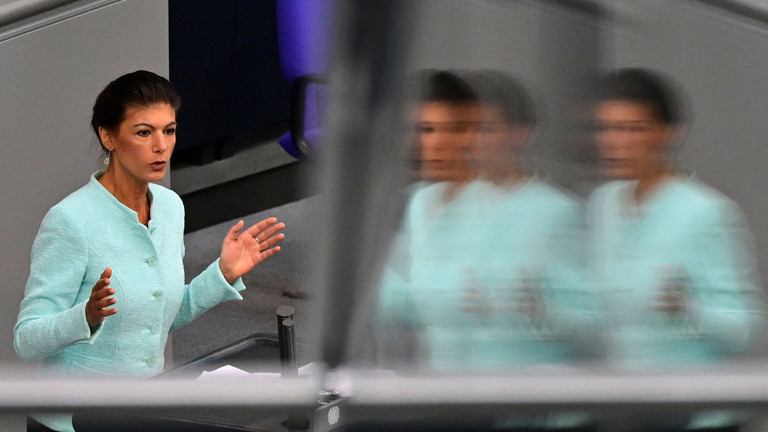
© AFP / John MacDougall
Samizdat | September 9, 2022
Germany’s government is the “stupidest” in Europe for managing to embroil itself in a full-blown “economic war” with its top energy supplier, Russia, left-wing politician Sahra Wagenknecht said on Thursday.
Speaking in the Bundestag, the former co-chair of the party Die Linke (The Left) urged an end to anti-Russian sanctions and the resignation of the country’s vice chancellor and economy minister, Robert Habeck.
While describing the ongoing conflict in Ukraine as a “crime,” Wagenknecht said the anti-Russian sanctions are “fatal” for Germany itself. With energy prices out of control, the country’s economy will soon “just be a reminder of the good old days,” the MP warned, as she urged canceling the restrictions and engaging in talks with Russia.
“We really have the stupidest government in Europe,” she told the parliament, calling for Habeck to resign.
“The biggest problem is your grandiose idea of launching an unprecedented economic war against our most important energy supplier.”
“The idea that we are punishing Putin by impoverishing millions of families in Germany and destroying our industry while Gazprom is making record profits – how stupid is that?” Wagenknecht wondered.
The controversial speech met quite a mixed reaction, with Wagenknecht’s remarks scoring applause in the Bundestag from MPs of polar opposite political views, including members of the right-wing Alternative for Germany (AfD). However, multiple left-wing politicians rushed to distance themselves from Wagenknecht’s statements and condemn her.
“The party’s position on sanctions against Russia was decided at the last federal party conference. There is no ‘economic war against Russia.’ Russia is at war with Ukraine,” the former co-chair of Die Linke, Bernd Riexinger, tweeted, adding that there must be “no doubt” about whom the party backs in the ongoing conflict.
Former left-wing MP Niema Movassat went even further, taking to Twitter to call for Wagenknecht to be excluded from his parliamentary group. The politician’s remarks contradict “a lot of” what the party agrees on, and she should be punished for “acting against” Die Linke, Movassat suggested.
The West Gives Lip Service to Fighting Hunger
By Vladimir Danilov – New Eastern Outlook – 08.09.2022
Although the energy crisis and the impoverishment of Europe’s population due to the Russophobic sanctions policy of European leaders have been the main themes of the Western media in recent weeks, articles on the fight against hunger nevertheless continue to appear.
Above all, media publications are discussing the consequences of the Istanbul package of documents signed on July 22 to tackle the issue of food and fertilizer supplies on world markets in fighting hunger in several parts of the world. It should be recalled that one of the agreements regulates the procedure for grain exports from Kiev-controlled Black Sea ports, based on the need to urgently address the food crisis in developing countries.
The Director of the World Food Program, David Beasley, who spoke to CNN on August 21, said the daily ships carrying Ukrainian grain would solve problems with access to food around the world, improving the situation in Somalia, Ethiopia, northern Kenya and several other poorer countries where it is most needed.
However, as the German magazine Der Spiegel admitted on September 2, despite the UN’s initial stated aims to fight hunger, only 13 of the 63 cargo ships that had left Ukrainian ports as of early September were carrying wheat. According to the publication, the remaining vessels were mainly carrying corn, used overwhelmingly as animal feed or to produce biofuel. A dozen ships were loaded with soybean or sunflower products, which are also mainly used to feed livestock.
In this regard, the interview given on August 18 to the Rossiya Segodnya news agency by Pyotr Ilyichev, Director of the Russian Foreign Ministry’s Department for International Organizations, was quite remarkable. He stressed in particular that the 16 ships that had left Ukrainian ports up to that day, carrying 535,000 tons of wheat and fodder crops, had, to great surprise, gone not to needy developing countries, but to rich countries. In particular, to the UK, Ireland, Italy, France and the Republic of Korea – in other words, the countries which are not threatened by hunger but which need fodder for livestock. At the same time, many experts emphasize that Ukrainian grain, primarily corn, is mainly fodder grain. And such actions publicly neglect the urgent problems of Africa and other world’s poorest countries.
Mikhail Ulyanov, Permanent Representative of Russia to International Organizations in Vienna, said in August that ships carrying grain from Kiev-controlled Black Sea ports were primarily destined for countries not at all threatened by hunger.
On August 23, Vasily Nebenzia, Permanent Representative of Russia to the UN, pointed out the same fact at a Security Council meeting on conflicts and food security, noting that of all 34 ships with grain that had left Ukraine, only one sailed to Africa, which needs this food. “Here, of course,” Nebenzia pointed out, “it is worth recalling the public image failure of the ‘pioneer’ ship Razoni, which in fact brought to Lebanon not the wheat they had been waiting for, but corn, and at the same time, fodder.” The Permanent Representative of Russia to the UN also stressed that against this background, the reaction to UN Secretary-General António Guterres’ words at the UN Security Council on May 19 that 49 million people in 43 countries are threatened with famine and nearly 140 million people in 10 countries, including Afghanistan, Syria, Yemen and several African states face severe food shortages, raises a lot of questions. As does the statement by the Secretary-General of the world organization in the port of Odessa that “grain exports and lower prices on global food markets will not bring relief to countries in need that cannot afford to buy it anyway.”
Meanwhile, Western politicians and media continue to persist in promoting the view that the main factor driving up grain prices is the restriction of Ukrainian grain supplies to importers, allegedly due to events in that country. However, an analysis of grain production and supply from Ukraine shows that the special operation currently taking place in that country has very limited influence on the situation with grain supply on the global food market. Because of Ukraine’s record 2021 harvest of grains, pulses and oilseeds, the increased supply of Ukrainian reserves further increases the supply of grain on the market and reduces the price of grain.
Overall, an analysis of the global food market shows that the destabilization of the market is not due to a decline in food production and supply, but to more fundamental causes. As Zhang Jun, Permanent Representative of China to the UN, emphasized at the UNSC meeting on May 19, 2022, “the current crisis once again brings to light the structural problems of the global food system. The world food supply and demand pattern is characterized by food production highly concentrated in a few countries, while consumer countries are geographically well dispersed. This makes the balance of food supply and demand highly vulnerable to extreme weather conditions pandemics, armed conflicts, and other emergency and unforeseen factors.”
Igor Kostyukov, Head of Main Directorate of General Staff of Russian Armed Forces, said in August at a Moscow conference on international security that Western countries were provoking a global food crisis by imposing restrictions on Russia. In particular, he stressed that well-functioning mechanisms for supplying grain and fertilizers to global consumers are being disrupted, leading to artificial price rises on world markets. For example, before the sanctions were imposed, Russia supplied more than 20 million tons of crops and about 11 million tons of fertilizers annually to the Middle East and North Africa, including Egypt, Saudi Arabia, Syria and other countries. However, the West’s current Russophobic sanctions policy has disrupted this logistical process.
The pattern of world hunger is therefore not at all what Antony Blinken and Josep Borrell originally painted. The problem is the emergence of food shortages due to declining yields caused by a shortage of fertilizers from Russia and Belarus. And also because of attempts to impose on Russia, which, unlike Ukraine, is actually one of the world’s biggest grain exporters, restrictions in trade in food, including grain.
It is clear to everyone that rich countries will not suffer too much because of the fall in yields, and that they will solve their food problems by raising prices and eliminating certain products. For example, vegetables, which were available all year round thanks to cheap energy and greenhouse facilities, but in an economic crisis they will simply become seasonal again and unaffordable for most of the population during the cold season because of their price. The “civilized world” will try to solve all its global food problems at the expense of poor countries: food exchange prices will rise and it will be the rich who will buy it back to curb inflation in their own countries and contain popular discontent. Poor countries, on the other hand, may simply get nothing in such circumstances. Of course, the G7 leaders will demonstrate their ostentatious concern for the people of poor countries and even invent “humanitarian programs” whereby, for example, several ships carrying food will be sent to starving regions of Africa, presenting it through the Western media “as a massive operation to save Africans from starvation.” But this will save few, for the only thing that can save is a return of the world to adequate trade rules that do not involve the imposition of unilateral sanctions and other restrictions.
Windfall Profits For Generators Running At £43 Billion A Year
By Paul Homewood | Not A Lot Of People Know That | September 7, 2022
Although rising international prices for natural gas have triggered the massive rise in wholesale electricity prices in the last year or so, they are only directly responsible for part of that rise.
As I have explained before, it is usually gas-fired generation that sets the wholesale price of electricity, which in August averaged £382/MWh:

https://www.catalyst-commercial.co.uk/works/september-2022-energy-market-brief/
As a result of this broken market, non-gas generators are making obscene windfall profits, with the exception of those on CfDs, which receive a fixed price. These generators produced 131 TWh last year, accounting for 45% of total generation:
Type Twh Wind 48 Solar 7 Bio 21 Coal 7 Nuclear 41 Hydro 7
At a price of £382/MWh, compared to a historic price level of around £50/MWh, these generators are raking in an incredible £43 billion. It is true that some generators may have Power Purchase Agreements in place at less than current prices – but this simply means that the purchaser is making the windfall instead. Either way electricity consumers are paying the cost of this on their bills.
The second major issue is the Carbon Price, which has more than doubled since last year and continues to rise>

https://www.catalyst-commercial.co.uk/works/september-2022-energy-market-brief/
The purpose of the Carbon Price is to increase the cost of fossil fuel generation, and thereby encourage the transition to renewables. However reports indicate that the wholesale price of natural gas will be capped, presumably at a much lower price than it is now. It is quite perverse therefore to then add back costs via the Carbon Price onto gas generators.
Based on my earlier calculations, the current Carbon Price of £92.65/tonne is adding £35/MWh to the cost of gas generation, and hence onto the wholesale electricity price. This translates to nearly £5 billion of windfall profit for non-gas generators.
The whole Carbon Pricing system should be suspended until further notice. As I understand it, that would need the unanimous agreement of devolved governments. Given the loons running Scotland and Wales, I would not hold my breath!
Moscow sounds alarm over Ukrainian grain deal
Samizdat – September 7, 2022
The grain deal with Ukraine which was supposed to allow Russia to deliver fertilizers and food products to global markets has failed to do so, Vassily Nebenzia, Russia’s permanent representative to the UN, claimed on Tuesday.
Speaking to reporters, Nebenzia revealed that not a single Russian vessel with grain has managed to leave port, despite an earlier UN- and Turkey-brokered agreement that unblocked Ukrainian grain shipments via the Black Sea in exchange for lifting restrictions on Russian exports of the product.
The diplomat hinted that Russia could refuse to extend the deal, given that the provisions on its exports are not being fulfilled. “The agreement was concluded for four months. In other words, it ends in November. In a normal [situation], the deal should be extended. Given the results, or rather the lack of results, I do not rule out anything.”
“We want to see the implementation of the Russian part of the agreement. So far, this hasn’t happened,” Nebenzia said.
His comments echo earlier remarks from Russian Foreign Minister Sergey Lavrov, who said on Tuesday that Western countries had not fulfilled their promise to lift secondary restrictions on Russian grain and fertilizers, impeding their access to the global market.
The deal to unblock grain exports via the Black Sea was signed at UN-brokered talks in Istanbul in late July, aiming to maintain safe transit routes. In late August, Turkish Foreign Minister Mevlut Cavusoglu said there “are no problems” with Ukrainian grain shipments, adding that dozens of vessels have been able to pass through.
Wheat deliveries from Ukraine, a major producer, were disrupted after Russia launched its military operation in the neighboring state in late February. The two sides traded accusations over who was responsible for the stoppage of cargo traffic out of the Ukrainian ports. Since August 1, however, when shipments from the ports resumed, they have delivered around 2 million tons of food products to global markets.
Prague: 100,000 citizens protest against government’s energy policy
Free West Media | September 6, 2022
In the Czech capital of Prague up to 100,000 people demonstrated on Saturday against the government policy, which has been leading to skyrocketing energy prices and an impending energy emergency in the Czech Republic. Immediately prior to this, there had already been a motion of no confidence in the government under Prime Minister Fiala in the Czech parliament.
In Prague, as in many European capitals, the government refused to see the protests as a political warning signal, but tried to blame Russian “trolls” for the increasingly irritable mood among the population. Another indication of the development in the country is the fact that a broad alliance of conservatives, right-wingers and communists called for the large rally on Saturday.
In the Czech Republic, the very existence of industry is threatened due to the lack of Russian gas supplies. Despite this, the government fully supports the EU’s sanctions course – and, needless to say, is now feeling the consequences.
The government is pretending to see Russian machinations behind the protests: “It is clear that Russian propaganda and disinformation campaigns repeatedly appear on our territory, and some simply succumb to them,” Prime Minister Fiala declared. Interior Minister Rakušan also saw “Putin” behind the protest: “Dividing society is one of the goals of the hybrid warfare we are dealing with. We can’t let him do that. That is why we are working on solutions that will reduce people’s fears about the future.”
According to the ideas of the organizers of the rally, every Czech household should be entitled to three megawatt hours of free electricity. In addition, one of the demands of the alliance was that its representatives should be authorized to conclude energy supply contracts.
“We’re taking our country back,” they said at the beginning of the three-hour rally. The call for this also included military neutrality and the loss of sovereignty to supranational structures. “The Czech Republic must free itself from direct political subordination to the EU, the WHO and the UN,” it said.
But that’s not all: “If the government doesn’t resign by September 25,” the organizers say, “in accordance with the Czech Republic’s constitution, we will declare the right to protest at a nationwide demonstration and announce measures to force the resignation. We are already negotiating with unions, companies, farmers, mayors, transport companies and other organizations to declare a strike,” they warned.
The same scenario is also possible in Germany. It was not for nothing that Federal Foreign Minister Baerbock warned of “popular uprisings” in the autumn.
In Leipzig left and right unite
The “Hot Autumn” proclaimed by the Left Party was reflected at least in the temperatures as the thermometer rose to 25 degrees on Monday evening in Leipzig’s historic city center. Both left-wing and right-wing parties and alliances have called for rallies at this historic site, based on the Monday demonstrations of 1989/90.
A total of 10,000 participants were expected, but in the end, Augustusplatz was flooded with people. The federal government had presented its new relief package on Sunday to absorb the economic consequences of the sanctions policy against Russia – and to prevent protests like this Monday evening.
The Federal Chair of the Left Party, Janine Wissler, recently expressed doubts on Deutschlandfunk that measures like these could alleviate the displeasure of the population. And the politician defended herself against accusations that her party also offered a platform to “right-wing ideologues” during the Monday demonstrations.
Leipzig’s Greens, for example, recently complained that the Left Party was “damaging Leipzig’s historical heritage” and thwarting “the commitment of Leipzig’s city society for democracy and cosmopolitanism and against right-wing marches in the heart of the city”. Wissler countered that social protests were needed against the “dramatic injustice” in the country. “We will not let the right take the high road. Not on Mondays and not on any other day either.”
Thousands of Germans in Magdeburg also opposed Olaf Scholz’s irrational policy by shouting: “Nord Stream! Nord Stream!” EU sanctions were supposed to weaken Russia’s economy, instead they are destroying Europe’s economy.
Media blackout in France regarding anti-Macron protests
“I almost fell off my chair!” said Florian Philippot, leader of the political party Les Patriotes. Philippot commented on the fact that news outlet LCI fraudulently reported that the demonstration on Saturday in Paris against Macron’s harsh energy policy “did not take place”. LCI further claimed that they were only “fake images” of the protests and “hijacking by Russian television”.
Philippot accused the outlet of lying. “It did take place. There were people there. LCI was informed and invited.”
Macron’s energy repression is the fourth threat that comes on top of the jihadist threat, the police threat (which hovers over the Yellow Vests), and the health threat, said his critics.
“The ecologists who applaud this deindustrialization do not understand that the destructive neoliberalism of the Great Reset is advancing behind a green mask. Even if it is true that overfishing is destroying the seabed and fish stocks, the climate crisis is a sham. The programmed destruction of production in Europe by Schwab and his friends leads inexorably to mass unemployment, impoverishment of the middle class and the extinction of our countries,” noted a critic of the French administration.
“The parasitic system is ready to destroy the societies that host it in order to survive.”
Moscow accuses West of breaking ‘grain deal’ pledge
Samizdat – September 6, 2022
Western countries have not fulfilled their promise to lift sanctions on Russian grain and fertilizers to allow them reach world markets, the country’s foreign minister, Sergey Lavrov, said on Tuesday.
The commitment was part of a deal brokered by the UN and Turkey and signed in Istanbul in July to unblock Ukraine’s grain exports and ease a looming global food crisis.
Lavrov stressed that “artificially inflated” Western claims that Russian actions in Ukraine had undermined the stability of the global food market are “absolutely not the case.”
“On the contrary, our Western colleagues are not doing what we were promised by the UN secretary general, namely, they are not making a decision to remove logistical sanctions that prevent free access of Russian grain and fertilizers to world markets,” the minister pointed out at a joint press conference with his Thai counterpart, Don Pramudwinai.
Lavrov added that Russia continues to work with UN Secretary-General Antonio Guterres and his team to ensure the organization fulfills its obligations under the Istanbul agreements.
Wheat deliveries from Ukraine, a major producer, were disrupted after Russia launched its military operation in the neighboring state in late February. The two sides traded accusations over who was responsible for the stoppage of cargo traffic out of Ukrainian ports. Since August 1, however, when shipments from the ports resumed, 92 vessels have departed, bringing more than 2 million tons of food goods to global markets.
Featured Video
Laith Marouf: Hezbollah’s position on US-Iran ceasefire
or go to
Aletho News Archives – Video-Images
From the Archives
Is Israel to blame for the Iraq War?
American Goy | March 10, 2008
I am so tired of this old canard that “Israel had nothing to do with USA’s war with Iraq – in fact, it officially advised America against it”.
Bullshit. … continue
Blog Roll
 Aletho News
- Laith Marouf: Hezbollah’s position on US-Iran ceasefire: What you’re not being told
- Israel’s priority lies in destroying chances of peace between Iran, US: Ex-UN nuclear chief
- Ceasefire for all or for none: Iran shuts Hormuz over Lebanon attacks
- Strait of Hormuz is Iran’s ‘nuclear weapon’ that forced US retreat: Medvedev
- Energy crisis will last for months – Kremlin envoy
- Europe’s quiet role in the war on Iran
- Forty days that shook the Empire: How Iran turned the tables on US and prevailed
- Netanyahu unilaterally declares Lebanon outside of ceasefire deal
- Israeli leaders: ‘Not a single goal’ achieved in war with Iran
- What on earth just happened? Trump, Iran, and the unlikely ceasefire
- If Americans Knew
- Gazans face a triple crisis: severe shortages of water and bread, healthcare in tatters
- NY Times reports how Netanyahu took the US into Iran War
- A sigh of relief over Iran, but Gaza and Lebanon in dire straits – Daily Update
- Thousands dead and neighborhoods razed to the ground: Aid agencies fear southern Lebanon is becoming the new Gaza
- The war the US is fighting for Israel could cost trillions
- ‘Cigarette Burns, Nail Wounds’: Toddler Tortured in Gaza to Coerce Father
- Trump Says US Sent ‘a Lot of Guns’ to Protesters in Iran
- Israeli forces destroy 17 UN peacekeeper cameras in south Lebanon
- US-Israeli strikes ‘completely destroy’ synagogue in Tehran
- Archbishop for US Military Says Iran War Is Unjust Under Catholic Teaching
- No Tricks Zone
- An Inconvenient Tree: Uncovered In Alps… Europe Much Warmer Than Today 6000 Years Ago
- New Study Reports A 60% Slowdown In Greenland’s Ice Loss Rate In The Last Decade
- Low Intensity Tornado Wrecks Major Solar Farm, Creating A Potential Toxic Dump
- New Study Finds Warming Saves Lives…Cold Temperatures 12 Times More Deadly Than Excess Heat
- German Science Blog Accuses PIK Climate Institute Of Hallucinating Climate Tipping Points
- Devastating Assessment Of Comirnaty Vaccine By Former Senior Pfizer Europe Toxicologist
- New Study: CO2 Is ‘Effectively Negligible’ As An Explanatory Climate Change Factor Since 2000
- Former Pfizer Toxicologist Dr. Helmut Sterz Tells Bundestag Hearing Pfizer Vaccine Should Have Never Been Approved
- Energy Expert: Germany’s Nuclear Phaseout Was A “500 Billion Euro Mistake”
- New Research: South Australia’s Mid-Holocene Sea Surface Temperatures Were 4°C Warmer Than Today
 Aletho News