Tens of Thousands Take to Prague’s Streets to Protest Against EU & NATO
Sputnik – 03.09.2022
Earlier in the week, Czech Prime Minister Petr Fiala’s government faced yet another vote of no-confidence in parliament, in what is the opposition’s second bid to oust the center-right coalition this year.
An estimated 70,000 people took to the streets of the Czech capital Prague on Saturday, protesting against the government, the European Union and NATO.
The leaders of the protests slammed the government’s inaction in dealing with record-high inflation in the country, including soaring gas and electricity prices, and demanded that Prague signs direct contracts with gas suppliers – Russia included – notwithstanding Brussels’ policies.
“The aim of our demonstration is to demand change, mainly in solving the issue of energy prices, especially electricity and gas, which will destroy our economy this autumn,” one of the demonstration’s organizers, Jiri Havel, stated.
Czech Prime Minister Petr Fiala dismissed the protesters’ demands, claiming that they did not hold “the interests of the Czech Republic” at their hearts and accused them of being “pro-Russian”. Fiala did not elaborate on how rapidly growing prices are in the country’s best interests.
Fiala’s government recently survived a parliamentary no-confidence vote called by the opposition in light of his cabinet’s inaction in the face of soaring inflation. Fiala won the vote, which was preceded by a 22-hour-long marathon debate. His coalition holds an eight-seat edge over the opposition in the 200-seat parliament.
“Exorbitant Rise In Energy Prices” Forces Europe’s Top Steelmaker To Close Plants
By Tyler Durden | Zero Hedge | September 3, 2022
Even though European power and natural gas prices have subsided this week, Germany, the largest economy in the bloc, still faces historically high energy costs that have forced cuts in industrial output.
The latest example is the world’s largest steelmaker, ArcelorMittal, which released a statement Friday about shutting down two plants and idling one.
Europe’s top steelmaker said two plants in Germany (one in Bremen and the other in Hamburg) would be partially closed at the end of September. A plant in Asturias, Spain, will also be idled.
ArcelorMittal blamed the coming smelter shutdowns on “the exorbitant rise in energy prices,” which is devastatingly impacting the company’s “competitiveness of steel production.” The decision to reduce metal output was also based on “weak market demand and a negative economic outlook” as energy hyperinflation risks sending Europe into a deep recession.
“As an energy-intensive industry, we are extremely affected. With gas and electricity prices increasing tenfold within just a few months, we are no longer competitive in a market that is 25% supplied by imports,” explained Reiner Blaschek, CEO of ArcelorMittal Germany.
Blaschek asked lawmakers to address the historic energy crisis and get prices “under control immediately.” Elevated prices this summer have resulted in a series of smelter closures from other metal-producing companies because high energy costs made production uneconomical.
In Germany, one of every six industrial companies feels forced to reduce production due to high energy prices, a survey by the Association of German Chambers of Industry and Commerce, DIHK, showed at the end of July. Nearly a quarter of the companies forced to reduce production had already done so by end-July, and another one-quarter are in the process of scaling back production due to sky-high energy prices, according to the survey of 3,500 companies from all sectors and regions in Germany.
The energy-intensive industries and firms are particularly hit, as 32 percent of the companies plan to or have already started to reduce production and even halt entire production lines, the DIHK survey showed. — OilPrice.com’s Tsvetana Paraskova
Runaway energy costs were halted this week as German year-ahead electricity futures plunged by half since Monday’s peak above 1,000 euros a megawatt-hour as the EU considers market interventions. EU NatGas prices closed down about 33% from the highs reached on Aug. 25.
However, here’s where things get very dicey. After European markets closed, around the lunch hour in New York, news broke that Russian energy giant Gazprom won’t resume critical NatGas supplies to Europe via Nord Stream 1 tomorrow after an oil leak was detected. There’s no timeframe when NatGas supply will resume to the energy-stricken continent.
Europe’s energy crisis could materially worsen, which means higher NatGas and power prices that will only curb more industrial output. Germany could fall into recession this winter, bringing the rest of the bloc down with it.
Israeli occupation forces confiscate 4 boats, sink 2 others off Gaza shores
Palestinian Information Center – September 2, 2022
GAZA – During the past two days, the Israeli occupation forces (IOF) have escalated their attacks against the Palestinian fishermen off the Gaza shores.
The IOF chased and opened fire at Palestinian fishing boats sailing within the allowed fishing area in separate incidents. As a result, four boats were confiscated, and another was sunk, while a fifth was burned.
According to the Palestinian fishermen syndicate, the occupation forces burned a boat belonging to the fisherman Haitham Farwana after opening fire at it off Khan Yunis shores on Thursday.
The Israeli forces also confiscated on the same day the boat of the fisherman Abdel Moati Al-Habil.
Earlier on Wednesday, IOF confiscated a fishing boat where Ahmad Adel Mohammad Al-Bardawil was on board sailing within 3 nautical miles off western Rafah shore, southern Gaza Strip. There were also 2 generators and 30 searchlights on the boat.
The IOF also confiscated 2 fishing boats belonging to Muhannad Ra’fat Radwan Baker, and Tayseer Mohammad Abdulnouri, who are both residents of al-Shati refugee camp. They were sailing within 3 nautical miles off al-Waha shore, northwest of Beit Lahia in the northern Gaza Strip.
In a separate incident, a fisherman named Omar Mohammad Ism’ail Al-Bardawil said that IOF’s gunboats stationed off the Fishermen Seaport, western Rafah, pumped water at a fishing boat he owns and sank it. The boat was sailing within 6 nautical miles and had a generator and searchlights on board.
So far in 2022, the Palestinian Center for Human Rights (PCHR) documented the injury of 19 fishermen and the arrest of 44 others, including 6 children; 2 fishermen remain in IOF detention. Also, the Israeli authorities continue to keep 18 fishing boats and dozens of fishing tools and equipment in their custody.
In this regard, PCHR reiterated its call upon the international community, including the States Party to the Geneva Conventions of 1949, to compel the Israeli authorities to cease their attacks and pursuit of Palestinian fishermen in the Gaza waters, and to allow them to fish freely.
EU wants to set price for Russian gas
Samizdat | September 2, 2022
The EU needs a price ceiling on imports of Russian pipeline gas, European Commission President Ursula von der Leyen announced on Friday, according to Reuters.
“I firmly believe that it is now time for a price cap on Russian pipeline gas to Europe,” she told reporters on the sidelines of a meeting of German conservative lawmakers in the town of Murnau.
The EU chief insists the measure would prevent what she called Russian President Vladimir Putin’s attempts to manipulate the European energy market.
EU energy ministers are expected to discuss the issue during an extraordinary meeting on September 9.
Meanwhile, former Russian president Dmitry Medvedev warned on Friday that in the event of the introduction of such a price cap, EU nations won’t get any Russian gas. “It will be like with oil. There will be no Russian gas in Europe,” Medvedev wrote on his Telegram channel.
His comments relate to a plan to limit prices on Russian oil currently being discussed by Group of Seven (G7) countries. Moscow has already warned it will embargo countries that support the Washington-proposed price cap on its crude exports.
Energy crisis worsening in Finland
Government declares “war economy” due to consequences of unnecessary anti-Russian sanctions
By Lucas Leiroz – September 2, 2022
The side effects of anti-Russian sanctions are becoming increasingly unbearable for Western countries. Finland has activated maximum alert levels due to the energy crisis, initiating exceptional measures to manage supply difficulties. The head of government even stated that the country would be experiencing a “war economy”, despite the fact that Finland is obviously not at war with any other state. This scenario reveals the disastrous path that the West chose to follow by its own decision.
On 1 September, Finnish Prime Minister Sanna Marin described the economic situation in her country in the midst of the gas supply crisis as a “war economy”. Interestingly, in her speech, Marin blamed Russian President Vladimir Putin for the crisis, despite the fact that the decision to sanction Moscow was taken unilaterally by Western countries. According to her, the gas crisis is occurring because the Russian government is using energy as a weapon in the current conflict.
“We seem to be living in a war economy. This is not a normal economic situation”, she said during a press conference.
She also added that this is the third calamity her country has faced since she took power in 2019:
“The first [crisis] was the pandemic, the second was the tide of war coming in Europe, and the third is the energy crisis, which both Finland and all other European countries in the grip of, due to the war and the fact that Putin is using energy as a weapon against Europe”.
Marin did not explain exactly how the gas was being used as a weapon by the Russians. She just blamed Putin in a generic and unjustified way. In fact, her words sounded like a desperate attempt to make a kind of scapegoat for the impending crisis that will damage her country. Marin just tried to evade her responsibility as the Finland’s head of government, pointing to the president of a foreign country as the cause of the problems.
However, it is necessary to emphasize that there is no validity in Marin’s rhetoric. Russia initially had no intention of using energy as a strategic point in its international disputes. On the contrary, it was the West itself that imposed a series of sanctions to which Moscow was forced to respond with some measures, such as demanding payment in rubles, controlling prices and even banning sales in some more serious cases.
If the West had not taken the initiative to try to “punish” Russia for starting the special operation in Ukraine, Moscow would certainly have kept the European energy supply intact. All Russian actions arose in response to Western provocations. The problem is that European countries do not seem to have acted with prudence and strategy, they simply adhered to the American plan to sanction Russia even though they are dependent on Russia’s energy resources and lacking alternative sources of gas. Now, Marin tries to “blame” the Russians, but imposing sanctions and even asking for NATO membership was her government’s unilateral initiative.
The Finnish case is quite emblematic and sums up well the abyss that Europe has chosen for itself. Before the escalation of the Ukrainian conflict, the Nordic country depended on Moscow for the supply of 70% of its natural gas and 35% of its oil, in addition to 14% of its electricity. Without the partnership with Moscow, Helsinki would simply not have been able to meet the energy demands of the production chains and the population, but even so, the country chose to sanction Russia, ban imports and denied any form of dialogue. There is no way to analyze these facts and conclude that Russian President Vladimir Putin is the one “to blame” for the crisis. The responsibility undoubtedly lies with the Finnish government itself.
On the “war economy” situation, in fact, an unprecedented crisis threatens Helsinki. And the most curious thing is that the government takes measures that will only worsen the situation even more, instead of seeking improvement. Finland was one of the first states to impose restrictions on the entry of Russian tourists, halving the number of visas. Under the recently announced new rules, only 500 visas can be granted per day to Russian citizens, 100 of which are reserved for tourists and 400 for work, study and family trips. It is important to remember that more than 20% of all Finnish tourism income comes from Russian citizens. According to official sources, the country will lose more than 600 million euros with the new visa rules.
In addition, Finland remains firm in its application to join the Western military alliance. In fact, the more the country is affected by tensions with Russia, the more it seems to be willing to worsen these tensions. Moscow at no time showed any sign of threat to Helsinki, but the Nordic country appears to be absolutely influenced by the fallacious Western rhetoric that the operation in Ukraine will “expand” throughout Europe, so it prefers to go into recession and economic crisis instead of simply being diplomatic with Russia.
For now, Marin will certainly continue to try to make Putin the scapegoat for her administration’s mistakes. But that won’t convince the public for long. The PM has been heavily criticized for both mismanagement and scandals in her private life. Her popularity is likely to drop further as the country sinks into a “war economy” without being at war.
Lucas Leiroz is a researcher in Social Sciences at the Rural Federal University of Rio de Janeiro; geopolitical consultant.
Europe Has No Real Alternatives To Russian Gas: Ex-Aramco EVP
By Tyler Durden | Zero Hedge | September 1, 2022
Echoing what Zoltan Pozsar said in his latest must read note, the former executive vice president at Saudi Aramco, Sadad Al-Husseini, told CNBC on Monday that there’s not enough capacity in the world to replace Russia’s gas supply to the European Union, while Moscow has plenty of markets to sell its energy to.
“The US doesn’t have the LNG capacity to replace Russia’s exports to Europe,” he said, noting that power bills across the EU are set to soar this winter. He did not comment on China reselling Russian LNG to Europe although we expects others will soon.
According to Al-Husseini, the lack of freely available supply could lead to serious problems on the global energy market. “This situation is a new world, and it’s not a very good one for energy,” he warned.
“In any case, there isn’t enough LNG capacity in the world to make up for the Russian exports to Europe,” the former executive said, adding that, “It will take years for the EU to find resources to replace Russian supply.”
He also said that while Russia may lose Europe as an end-market, there are “plenty of alternative markets” for Russian energy, including China, Japan, or India, that eagerly flount Western sanction, realizing that the Biden admin is increasingly toothless in punishing sanctions violators.
Meanwhile, Europe does not have alternative energy sources, he said, “while the US is maxed out already, North Africa has got problems,” and OPEC is also running out of spare capacity.
“So, it’s a global problem,” he said.
The official suggested that, while the Russian economy may suffer under Western sanctions, the rest of the world will be suffering with them.
However, he stressed that “Russia may recover a lot sooner than Europe.”
Government’s green energy policy is a “national disaster”
Net Zero Watch | September 1, 2022
London – Net Zero Watch has condemned the Government’s green energy policies as “a national disaster.”
This follows the announcement that a major offshore windfarm will not activate an agreement to sell power at a much lower cost to the grid.
The Times has reported that the Hornsea 2 windfarm, which had a contract to sell power at £73 per megawatt hour, will instead sell in the open market, where prices have averaged £200 per megawatt hour this year, and reached £508 last week.
Britain’s struggling energy consumers are likely to end up paying a billion pounds extra for Hornsea’s electricity over the next 12 months.
The new Prime Minister should urgently look into the legal options for cancelling or revoking these poorly written contracts, the spirit of which are being grotesquely abused to the huge disadvantage to British consumers.
By 2026, there could be more than 16GW of offshore windfarms exploiting the perverse loophole (Moray East, Hornsea 2, Triton Knoll, InchCape, Seagreen Phase 1, Neart na Gaoithe, Dogger Bank A, Dogger Bank B, Dogger Bank C, Sofia, Hornsea 3, Norfolk Boreas, Moray West and East Anglia Three.)
Assuming they deliver 50% of capacity each year, and the differential between market price and CfD price remains at £130/MWh, the cost to consumers will be £9billion per year, at a cost of £337 per household.
Onshore windfarms, solar, and remote island windfarms will raise that figure still higher.
Reacting to the news, Net Zero Watch Director Benny Peiser said:
In the midst of the worst energy crisis since World War II, wind companies are milking the system by using a perverse loophole.
And just a few weeks ago, Kwasi Kwarteng signed the contract for Hornsea 3, which contains the same loophole, as does the contract for every other offshore windfarm on the horizon.
The Government is putting every household on the hook for hundreds of pounds more, every year. Energy policy is lurching from one rip-off to another. It’s a national disaster.”
WEF AI to Decide what Industries to Liquidate to “Stop Economic Growth”
Enjoy Your Universal Income and Shut Up
By Igor Chudov | September 1, 2022
A brand new video from the World Economic Forum’s agenda article! The agenda is to stop growth and decide what industries to shut down.
Some very juicy quotes from the video (with timestamps)
4.23: Some economists think the solution is to reengineer our economies completely. They make the case that what we should really be doing is weaning ourselves from the addiction to growth and shifting to a post-growth economy (later defined as liquidation of various industries — I.C)
Instead of growing, WEF wants us to focus on what we “really need” (according to WEF)
4:46 things like renewable energy, healthcare, and public transportation. To do that, economists think that rich countries should do something like guarantee living wages.
They are talking about unearned “universal basic income” because the next cut shows a sad-looking lonely person spending a day not working. It promises that people will not be needing jobs to “earn their living or get healthcare”:

What is the goal? To scale down production of things deemed less necessary! (sic)

WEF asks if we could “do away with entire industries”, showing an anxious, sweaty man worried about his industry being shut down:
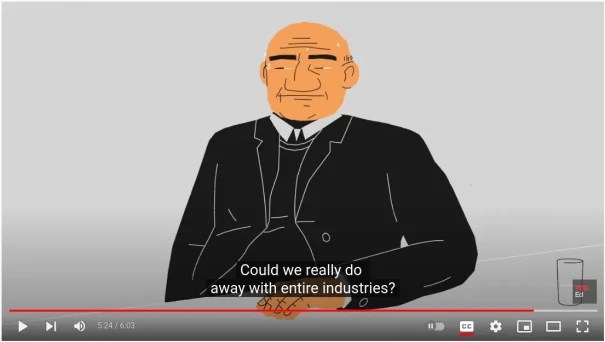
How would we decide what is unnecessary, asks the voice prompter. How would we resolve our disagreements? How to make these decisions?
The answer is, says WEF, is that we need to enlist help from AI systems, in order to answer the questions such as which industries to do away with.

WEF loves AI!
WEF’s “Global Intelligence Collecting AI” to Erase Ideas from the Internet
The WEF deciding what industries to do away with, using WEF-sponsored AI, may sound insane and stupid like a half-baked, paranoid conspiracy theory of a delusional hillbilly.
But I did not come up with any of it! I just retold the WEF article and the WEF video. I am not sure if they are serious or are just trolling us, but in the past, they were dead serious about their agenda.
German Foreign Minister Says Support For Ukraine Will Continue “No Matter What Voters Think”

By Paul Joseph Watson | Summit News | September 1, 2022
Despite soaring energy prices that threaten the stability of the country, Foreign Minister Annalena Baerbock said she would continue to support Ukraine “no matter what German voters think.”
Baerbock made the remarkable comments during an event in Prague yesterday organized by the NGO Forum 2000.
“If I give the promise to people in Ukraine – ‘We stand with you, as long as you need us’ – then I want to deliver. No matter what my German voters think, but I want to deliver to the people of Ukraine,” she said.
The German official said that such an approach would not change even if large numbers of people were out in the streets protesting against crippling energy bills.
“We are facing now wintertime, when we will be challenged as democratic politicians. People will go in the street and say ‘We cannot pay our energy prices’. And I will say ‘Yes I know, so we help you with social measures.’ But I don’t want to say ‘Ok then we stop the sanctions against Russia.’ We will stand with Ukraine, and this means the sanctions will stay also in wintertime, even if it gets really tough for politicians,” said Baerbock.
The comment is a fairly stunning admission that world leaders are intent on prolonging the war for as long as possible, no matter how much it harms the countries they are supposed to represent.
Germans face one of the worst cost of living crises in Europe, with governments arranging ‘warm up spaces’ in major cities where people who can’t pay their bills will go to avoid freezing to death, with blackouts expected.
Citizens have already exhausted supplies of electric heaters, firewood and stoves in many areas as they prepare for energy rationing this winter, while inflation in Germany just hit its highest level in almost 50 years.
Those planning to protest against the situation have also been demonized as domestic extremists by the authorities.
As we reported last month, the interior minister of the German state of North Rhine-Westphalia (NRW), Herbert Reul (CDU), outrageously suggested Germans who may be planning to protest against energy blackouts were “enemies of the state” who want to overthrow the government.
Russia warns G7 about oil supplies
Samizdat – September 1, 2022
Russia will embargo countries that support the Washington-proposed price cap on its oil, Deputy Prime Minister Alexander Novak said on Thursday.
“In my opinion, this is a complete absurdity… To those companies or countries that will impose restrictions, we will not supply our oil and oil products, because we are not going to work under non-market conditions,” he told reporters, commenting on a plan to limit prices on Russian oil currently being discussed by the Group of Seven (G7) countries.
Establishing a price ceiling on Russian oil is conceived as a means of slashing Moscow’s revenues from exporting the commodity while avoiding shutting the country’s crude out of the market. The proposal is due to be discussed at a meeting of G7 finance ministers on Friday.
According to Novak, such a plan would jeopardize the market mechanisms of “such an important industry as oil,” and could only lead to the destabilization of both the industry and the oil market.
“And European and American consumers will be the first to pay for it, while they are already paying high prices today because of the destabilizing measures [their governments] are implementing. In particular, the sanctions restrictions,” Novak said.
The official added that Russia is currently pumping as much oil as it has the ability to produce and sell at the moment, but if global market conditions stabilize and Russian producers could be confident in finding buyers, output could be raised. He noted that Russian oil producers are preparing for the upcoming EU oil embargo due to take effect in December, but they plan to maintain current levels of production regardless.
California Asks Residents Not to Charge Electric Vehicles, Days After Announcing Gas Car Ban
Samizdat | August 31, 2022
California’s power grid operator warned residents of the Sunshine State that it will issue voluntary calls for power conservation in the coming days, as a heatwave threatens to interrupt the supply of electricity.
The California Independent System Operator (ISO), which manages the state’s power grid, said on Tuesday that it will issue a series of ‘Flex Alerts’ during the upcoming days, the Sacramento Bee reported. These alerts call for residents of the state to keep their thermostats above 78 degrees Fahrenheit (25.5 Celsius), avoid using large appliances, and turn off all unnecessary lights.
Among a litany of power-saving tips, the ISO also urges Californians not to charge electric vehicles during the daytime.
Heatwaves increase the risk of blackouts, as households are forced to crank up their air conditioners. This risk is greatest during the early evening, when solar panels no longer function, but homes still need cooling and lighting. With temperatures set to reach 10-20 degrees above normal from Wednesday through to next Tuesday, peak demand is set to be reached on Monday, or Labor Day.
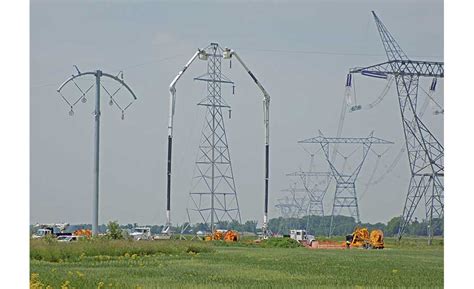
The ISO’s warning came less than a week after the California Air Resources Board voted to approve a plan by Governor Gavin Newsom to ban the sale of gasoline-powered cars in California by 2035. While Newsom claimed that the ban would cut “915 million oil barrels worth of emissions” out of the air, the San Francisco Chronicle noted that it would require California to expand the capacity of its power grid by 30%.
An analysis by CalMatters, a nonprofit news organization, found that Newsom’s plan could also put almost 32,000 mechanics out of business.
Newsom has urged state lawmakers to give up to $1.4 billion to power company PG&E Corp to keep California’s last remaining nuclear plant open for another 10 years to avert the consequences of his own ban.
Russia cuts off gas supply to French energy giant
Samizdat | August 30, 2022
Russian state energy giant Gazprom has said it has cut off gas supplies to France’s utilities company Engie. The French side has failed to pay for the gas deliveries in July in full, the Russian company added.
Gazprom informed Engie that it would cease the gas deliveries starting September 1 until the moment it gets the payment for the already supplied gas in full, the energy giant said in a statement. It also noted that the French side had failed to make the payment by Tuesday evening, making any further gas deliveries impossible under the Russian law.
Earlier on Tuesday, Engie said that Gazprom informed it “of a reduction in gas deliveries” and cited “a disagreement between the parties on the application of some contracts,” according to Bloomberg. It did not provide any details about the nature of the disagreements and did not specify the level of delivery reductions.
French Energy Minister Agnes Pannier-Runacher accused Moscow of using its gas exports as a weapon on Tuesday. She also said that France “must prepare for the worst-case scenario of a complete interruption of supplies.” Her statement was made before the Gazprom announcement.
Engie maintained it “had already secured the volumes necessary to meet its commitments towards its customers and its own requirements,” adding that it would take measures to “significantly reduce any direct financial and physical impacts” of the potential supply interruption by Gazprom.
The developments come as the EU governments are trying to fill up their gas storages in the face of the approaching heating season and reduced supply from Russia – one of the continent’s major gas suppliers. Earlier on Tuesday, Gazprom also said that Nord Stream 1 would be completely stopped from August 31 to September 2 for maintenance since it has only one operational compressor.
On Monday, Engie Executive Vice President Claire Waysand said that France has had its storages filled up by 90% and added that it should be enough to get through the winter.
Featured Video

Laith Marouf: Hezbollah’s position on US-Iran ceasefire
or go to
Aletho News Archives – Video-Images
From the Archives
Is Israel to blame for the Iraq War?
American Goy | March 10, 2008
I am so tired of this old canard that “Israel had nothing to do with USA’s war with Iraq – in fact, it officially advised America against it”.
Bullshit. … continue
Blog Roll
 Aletho News
- Laith Marouf: Hezbollah’s position on US-Iran ceasefire: What you’re not being told
- Israel’s priority lies in destroying chances of peace between Iran, US: Ex-UN nuclear chief
- Ceasefire for all or for none: Iran shuts Hormuz over Lebanon attacks
- Strait of Hormuz is Iran’s ‘nuclear weapon’ that forced US retreat: Medvedev
- Energy crisis will last for months – Kremlin envoy
- Europe’s quiet role in the war on Iran
- Forty days that shook the Empire: How Iran turned the tables on US and prevailed
- Netanyahu unilaterally declares Lebanon outside of ceasefire deal
- Israeli leaders: ‘Not a single goal’ achieved in war with Iran
- What on earth just happened? Trump, Iran, and the unlikely ceasefire
- If Americans Knew
- Gazans face a triple crisis: severe shortages of water and bread, healthcare in tatters
- NY Times reports how Netanyahu took the US into Iran War
- A sigh of relief over Iran, but Gaza and Lebanon in dire straits – Daily Update
- Thousands dead and neighborhoods razed to the ground: Aid agencies fear southern Lebanon is becoming the new Gaza
- The war the US is fighting for Israel could cost trillions
- ‘Cigarette Burns, Nail Wounds’: Toddler Tortured in Gaza to Coerce Father
- Trump Says US Sent ‘a Lot of Guns’ to Protesters in Iran
- Israeli forces destroy 17 UN peacekeeper cameras in south Lebanon
- US-Israeli strikes ‘completely destroy’ synagogue in Tehran
- Archbishop for US Military Says Iran War Is Unjust Under Catholic Teaching
- No Tricks Zone
- An Inconvenient Tree: Uncovered In Alps… Europe Much Warmer Than Today 6000 Years Ago
- New Study Reports A 60% Slowdown In Greenland’s Ice Loss Rate In The Last Decade
- Low Intensity Tornado Wrecks Major Solar Farm, Creating A Potential Toxic Dump
- New Study Finds Warming Saves Lives…Cold Temperatures 12 Times More Deadly Than Excess Heat
- German Science Blog Accuses PIK Climate Institute Of Hallucinating Climate Tipping Points
- Devastating Assessment Of Comirnaty Vaccine By Former Senior Pfizer Europe Toxicologist
- New Study: CO2 Is ‘Effectively Negligible’ As An Explanatory Climate Change Factor Since 2000
- Former Pfizer Toxicologist Dr. Helmut Sterz Tells Bundestag Hearing Pfizer Vaccine Should Have Never Been Approved
- Energy Expert: Germany’s Nuclear Phaseout Was A “500 Billion Euro Mistake”
- New Research: South Australia’s Mid-Holocene Sea Surface Temperatures Were 4°C Warmer Than Today
 Aletho News