Why G7’s Program for Developing Countries is Still No Match for China’s Belt & Road
Samizdat – 28.06.2022
The G7 on 26 June re-launched its previous Build Back Better World program to provide infrastructure funds to poor and developing nations under a new name, the Global Investment and Infrastructure Partnership. The project aims to compete with China’s Belt and Road Initiative kicked off by Beijing in 2013.
The Build Back Better World (B3W) program was pompously announced by the club of seven developed nations to counter China’s Belt and Road at the G7 Summit in Cornwall in July 2021. However, little had been heard of the G7’s endeavor since then. In June 2022, the Group of Seven decided to breathe new life into the project.
“So far, America has failed to build momentum on its plan to Build Back a Better World,” says Francesco Sisci, a Beijing-based China expert, author, and columnist. “However, with this new G7 plan, which includes other countries, this momentum could start to be built. It is a question mark. Nobody is sure until things are realized. But you cannot just underestimate and dismiss this plan, because there is a large commitment of many countries with a large economy and this plan could make big sense.”
The G7’s grand design envisages laying a secure sub-sea telecommunications cable that will connect Singapore to France through Egypt and the Horn of Africa; creating a COVID-19 vaccine plant in Senegal; expanding solar projects in Angola, including solar mini-grids and home power grids; and establishing an innovative modular nuclear reactor plant in Romania, among other issues.
The US president pledged to mobilize $200 billion in investments in global infrastructure projects over the next five years. The overall investment, including G7 member states and private capital, is expected to reach $600 billion.
“With two competing plans – size matters, at the end of the day,” says Sisci. “That is, China may be able to immediately finalize a lot of money in a short time in a number of projects. The G7 countries could be slower, but eventually they could build up momentum and they could channel much more money much more effectively, perhaps, in a much larger number of projects which could stifle Chinese projects.”
Sisci suggests that the club of developed capitalist countries “may end up being more effective in many ways [than China], a smaller non-capitalist country.”
“China, but also Russia, by far, don’t have the size, the gravitas to oppose even a divided G7, which is coming together because of this opposition to China or Russia-driven projects,” he notes.
G7 Economic & Geopolitical Hurdles
However, some other observers express skepticism over the ability of the US and G7 to implement the project given record-high inflation and cost of living crisis currently engulfing the states. The US, British and European central banks are struggling to tame skyrocketing inflation by raising interest rates to reduce demand, which is prompting recession fears.
“Washington claims they are going to be sending over $200 billion. But where’s the money coming from and how is it going to be really used?” asks Thomas W. Pauken II, the author of “US vs China: From Trade War to Reciprocal Deal,” a consultant on Asia-Pacific affairs and a geopolitical commentator.
He notes that previously the US Senate voted Biden’s landmark Build Back Better initiative down, and for good reason, as Republican congressmen feared that the Democratic administration’s spending spree would fan inflation and increase an already bloated national debt.
Pauken also expresses bewilderment over the G7’s apparent readiness to embark on the bold international project at a time when the group is involved in the Ukraine crisis with the UK trying to keep the military conflict dragging on. “I mean, it’s laughable that they have to think about [competing with] China at this time when they’re on the brink of a major war in Europe,” the commentator remarks.
Meanwhile, the G7’s Global Investment and Infrastructure Partnership cannot be regarded so far as a viable alternative to the Beijing-led Belt and Road Initiative that has been implemented for slightly less than a decade, according to Pauken.
“First of all, [the G7] actually need[s] to make these projects work,” says the geopolitical commentator. “Other than that solar plant in Angola, I don’t see any of these initiatives really working.”
In particular, China invested almost $59.5 billion in its comprehensive infrastructure project in 2021 alone. When it comes to crucial elements of the project, the West appears to be lagging behind. While the G7 is still considering building a subsea cable linking Europe and Southeast Asia, China kicked off its Digital Silk Road (DSR) almost seven years ago. The DSR’s backbone is the Pakistan and East Africa Connecting Europe (PEACE), a 9,300 mile long subsea cable network meant to tie Asia, Africa, and Europe together. The network is designed to transmit over 16Tbps per fibre pair with its Mediterranean section going from Egypt to France having already been laid.
Are Emerging Economies Interested in the G7 Agenda?
There is yet another problem as to how to make these Western projects attractive for Global South nations, the Asia Pacific expert continues. In particular, the G7 has been pushing ahead with a climate change agenda and the plan to cut carbon emissions, which is not relevant for the majority of third-world states which are still reliant on cheaper and more reliable fossil fuels and coal plants, he notes.
“You also have to deal with auditing issues as well as the so-called climate change consultants who go on the ground and on site,” he says. “You have to prove that those infrastructure projects are not causing much of a carbon footprint. But most of the major infrastructure does require a big carbon footprint, especially in the emerging markets, because they don’t have the same equipment or they don’t have the same standards or labor laws as they would have in Western Europe or the US.”
Many emerging economies, including African countries, are beginning to have a growing frustration with the US and Europe, according to Pauken. The reality is that Africans and many of the emerging markets want to focus on economic stuff, he notes. However, when the US officials come in, they’re talking about climate change or gender equity, and this is not as interesting to developing nations, the commentator emphasizes.
“[Developing nations] want help on improving their agricultural production levels and boosting their energy capacity, which the Russians and the Chinese have been doing,” Pauken notes.
Given all of the above, it is unlikely that the G7’s Global Investment and Infrastructure Partnership initiative is going to actually happen, argues the geopolitical commentator.
“They’re rebranding a failed policy, thinking it might work by using new names and new mergers. Last time it was separate between the EU and separate between the US and they somehow think that if you combine the two failed projects into one, that this will somehow succeed. That’s not going to work in the real world,” Pauken concludes.
Netherlands Energy Minister warns of gas crisis domino effect
Samizdat – June 28, 2022
A gas crisis in any one EU country would provoke a domino effect and quickly spread throughout the bloc, according to Dutch Climate and Energy Minister Rob Jetten.
“It’s good if some member states can fill their gas storages by November 1, but if other countries fail to reach 80% – particularly big countries like Germany – then you have to be aware that this will be a domino effect for the whole of Europe,” Jetten told Politico magazine on Tuesday.
The minister noted that in the event of a cessation of Russian gas supply, the Netherlands “will stand with neighboring countries.”
Meanwhile, Jetten stressed that tapping the Groningen gas field, once one of Europe’s largest fields and the continent’s major source of gas for decades, would be an option of last resort. In 2019, the Dutch government announced that the giant field in the northeastern part of the country would be shuttered by October 2022 to limit seismic risks in the region, with gas only to be extracted thereafter in the event of extreme weather or unforeseen circumstances.
Last week, the nation lifted all restrictions on coal-fired power stations to reduce natural gas consumption, while making an “urgent appeal” to businesses to save as much energy as possible ahead of the winter season. Jetten plans to present a plan this week on building two nuclear power plants in the country.
Germany’s largest BASF plant may close due to gas shortage

Samizdat | June 27, 2022
German chemicals major BASF may be forced to halt production at the world’s biggest chemicals plant in Ludwigshafen, the Wall Street Journal reported on Monday, citing shortages of cheap and abundant Russian gas.
According to the report, BASF has used Russian natural gas for years to generate power and as feedstock for products that make it into toothpaste, medicine, and cars. However, dwindling Russian gas supplies are proving a threat to the company’s vast manufacturing hub, it says.
“Cutting down production at this site will be a huge task,” said BASF senior economist Peter Westerheide, as quoted by the WSJ. “We’ve never seen situations like this before. It’s hard to imagine.”
With an area of approximately ten square kilometers, the Ludwigshafen complex spanning some 200 plants, accounts for about 4% of the total gas demand in Germany. Approximately 60% of the gas used at the plant is meant to generate electricity, while the remaining 40% is feedstock for the production of chemical products, including ammonia and acetylene.
BASF estimates that if the chemical complex continues to receive more than 50% of the maximum volume of gas, the operations could be continued. Otherwise, the work of the complex will have to be stopped.
Earlier this month, Russian gas flows to Germany through the undersea Nord Stream pipeline were cut by as much as 60% due to technical issues arising from Western sanctions against Moscow. In response to the crisis, the German government has launched the second “alarm” phase of its three-level gas emergency plan. Berlin has warned it’s facing a severe shortage of the fuel amid diminishing flows from Russia.
Prime Minister of Montenegro warns of ‘general energy collapse’ in Europe
Samizdat | June 27, 2022
Interruptions in Russian gas supplies and mass switching to electricity will lead to “a general energy collapse” in Europe, Prime Minister of Montenegro Dritan Abazović claimed on Monday.
Speaking to parliament, Abrazovic recalled the recent remarks by the German Vice Chancellor Robert Habeck who, amid looming energy difficulties over the winter period, advised his compatriots to spend less time in shower and to prepare warm clothes.
In Abrazovic’s opinion, if someone from his government came up with such advice, he would be ridiculed. Montenegrin ministers are now focused on preventing a crisis like this, he said, but everything does not depend on them.
“If it comes true that in the fall, or with the onset of cold days, gas is not delivered from Russia to Western Europe at a level that satisfies its economy, and if it switches to electricity, there will be a general energy collapse,” he warned.
He explained that there was an even greater danger than increasing energy prices: In his opinion, there might be a situation in which “even with money, you will not be able to get electricity.”
The ministers, Abrazovic warned, are focused now on preventing the worst scenarios but also on preparing for them. He said that one of the ways to do it was rebalancing the budget. The prime minister also stressed that while Montenegro, unlike some other European countries, was not dependent on natural gas, it must still be prepared and should “look at how to get the most out of the tourism industry.”
“However, both Covid and the crisis caused by the war in Ukraine should teach us the following: We have to increase food production and to become a country that is not energy dependent,” he said.
In order to become more independent, the focus should also be on building new energy facilities, according to Abrazovic.
The prime minister expressed certainty that his government was addressing the issues correctly and that there was no reason to panic.
Earlier this month, International Energy Agency (IEA) chief Fatih Birol warned the EU to be prepared for the possibility of a complete shutdown of Russian gas exports this winter, calling on the bloc’s members to widen the span of measures aimed at preparing for this scenario, according to Financial Times.
Germany, Austria, Italy and the Netherlands announced their plans to step up the use of coal for power generation, while Sweden and Denmark said they would also launch emergency measures to curb the use of natural gas.
The European gas market is already experiencing a severe shortage of imported energy supplies. Shipments by Russia’s Gazprom through the Nord Stream pipeline have fallen significantly this month because of parts shortages due to sanctions.
The reduced deliveries come at a time when Europe is racing to stock up for winter, with gas storages on the continent currently standing at 55%, according to recent data.
The EU plans to phase out Russian gas by 2030 as part of its response to Moscow’s military campaign in Ukraine, which was launched in late February. However, several countries, including Germany, have repeatedly warned their economies would suffer if the flow were to stop immediately.
Russian drilling rig shelled again
Samizdat | June 26, 2022
A Russian offshore drilling rig in the Black Sea has been shelled, in the second similar attack in less than a week, a spokesperson for Crimea’s emergency services told TASS on Sunday, blaming the strike on the Ukrainian military.
Earlier, the Baza Telegram channel, citing its own sources, reported that a projectile which had hit the Chernomorneftegaz-owned Tavrida floating drilling rig overnight, left a hole in the platform’s helipad.
“This is shelling by the Armed Forces of Ukraine, there are no casualties,” the region’s emergency services spokesman said without providing further details.
On June 20, the head of Crimea, Sergey Aksyonov, revealed that Ukraine had shelled Chernomorneftegaz drilling platforms 71km from Odessa.
Three platforms were damaged, including the Tavrida. One of the platforms (BK-1) was completely destroyed. Seven people are missing, and three sustained injuries. In total, there were 109 people on the platform, with the majority of them subsequently evacuated.
The Russian Investigative Committee opened a criminal case in relation to the June 20 shelling.
Earlier this month, the Ukrainian presidential representative for Crimea, Tamila Tasheva, said Kiev is now relying on military means to ‘return’ Crimea to Ukraine, and that Russia’s military campaign prompted Kiev to largely abandon diplomacy regarding the peninsula’s ‘de-occupation’.
Ukrainian troops have been losing territory to Russia and allied forces in Donbass, even as Western nations supply more sophisticated weapons to Kiev. Several Ukrainian officials have stated that the pledge to not use foreign weapons to attack targets in Russia does not apply to Crimea, which Kiev considers part of its territory.
Russia attacked the neighboring state in late February, following Ukraine’s failure to implement the terms of the Minsk agreements, first signed in 2014, and Moscow’s eventual recognition of the Donbass republics of Donetsk and Lugansk. The German- and French-brokered protocols were designed to give the breakaway regions special status within the Ukrainian state.
The Kremlin has since demanded that Ukraine officially declare itself a neutral country that will never join the US-led NATO military bloc. Kiev insists the Russian offensive was completely unprovoked and has denied claims it was planning to retake the two republics by force.
‘Canada working to return Russian gas turbines’
Samizdat | June 22, 2022
Ottawa is exploring ways to return crucial parts for Russia’s Nord Stream pipeline, which are currently stuck in Canada due to sanctions, Bloomberg reported on Tuesday citing Canadian Minister of Natural Resources Jonathan Wilkinson.
“We want to respect the sanctions because the sanctions were put into place for a reason. That being said, the intent of the sanctions was never to cause significant pain to Germany, which is one of our closest friends and allies. So, we are very seized with this issue,” Wilkinson told the news outlet.
“We are talking to Germany, trying to find a pathway through which we can actually enable the flow of gas. There may be different options that we can look at,” he stated, adding that Ottawa is negotiating with Berlin on ways to return the equipment.
Russia’s energy supplier Gazprom was forced to slash natural gas flows to Germany via the Nord Stream pipeline by 60% last week, because Siemens turbines from Gazprom’s Portovaya pumping station in Vyborg were stuck in Montreal, where they were sent to undergo maintenance. The parts fall under Canada’s sanctions against Russia, and the country says it cannot return them without breaching these restrictions.
According to the German Federal Grid Agency, the reduction in gas flow affected the supply of Russian gas from Germany to other European countries, including France, Austria and the Czech Republic.
The situation prompted these and other EU countries to announce emergency measures this week aimed at reducing the use of natural gas. Some countries have claimed that the reduction of gas flows was a political decision made by Moscow to increase pressure on Europe. Gazprom says the issue is technical.
Von Der Leyen’s Proposal to Reduce Heating Temperature by 2 Degrees ‘Naive’, Analysts Say
Samizdat – 21.06.2022
BRUSSELS – The proposal voiced by European Commission President Ursula von der Leyen to lower domestic thermostats in Europe by 2 degrees Celsius to replace gas supplies from Russia’s Nord Stream 1 is “incredibly naive,” energy experts said on Tuesday.
On Monday, the EC head said that Europeans can replace gas supplies coming via Russia’s Nord Stream 1 pipeline by lowering the heating or air conditioner temperatures by 2 degrees, adding that the EU has comprehensive emergency plans in place, including energy savings.
Samuele Furfari, a professor of geopolitics of energy at ULB university in Brussels, believes that von der Leyen’s proposal is “ridiculous,” as a two-degree reduction in heating cannot replace energy demand of 194 million European households.
“It is incredibly naive of the President of the European Commission to present a 2-degree reduction in domestic heating, for more than 194 million households in the Europe at 27 [countries], as a solution to the end of the supply of Russian gas by Nord Stream 1. It is moreover only the capacity of Nord Stream 1 which would be ‘covered’ by this theoretical and simplistic reduction. There are other gas pipelines delivering Russian gas. She even specifies, since the commission seems to have thought about this ridiculous idea, that it would also apply to air conditioning. We navigate in a pure dream,” Furfari said.
Gas demand is inelastic, so Europe cannot lower the heating in hospitals or schools, and it is “a dream” to believe that EU residents will simply comply with von der Leyen’s proposal, which will “hit people hard” in their comfort zone, he added.
“How are we going to apply this theoretical measure seriously? By installing ‘limited’ room thermostats, such as for car or motorcycle engines? Are we being prepared for Orwell’s society? No EU government is going to accept that Brussels gives them temperature reduction instructions or face sanctions. I am not even talking about the electricity market, which does not work in Europe, with the emphasis wrongly put on pseudo-renewable energies. Obviously, the European Commission is totally stuck, and Brussels does not know what to do. There is no other solution than that of Russian gas supplies for a long time to come. We are waiting for the next ‘brilliant’ idea from the European Commission,” Furfari said.
According to the professor, 70% of the gas consumed in Europe is allocated to the production of heat, and even when Germany relaunches its coal power stations, which emit large amounts of CO2, it will be far too little to compensate for the loss of gas.
Damien Ernst, a Liege university professor in Belgium and a specialist of electromechanical engineering and energy, said that von der Leyen’s proposal shows how much the EU is “at a loss.”
“Europe will suffer terribly in terms of energy prices and scarcity. This astonishing reaction from Ursula von der Leyen is even scary, as she is so naive, and shows how much the EU is at a loss. The EU is not going to send armies of controllers to check the ambient temperature in people’s homes. At best, Europe can only carry out awareness campaigns on the need to save energy,” Ernst said.
If there is a signal that the price will become “astronomically high,” people and businesses will spontaneously reduce their consumption, causing a sharp decrease in demand and reducing the competitiveness of European producers compared to those from Asia and the US, Ernst explained.
“Europe has it all wrong,” he lamented.
AfD spokesman in the Bundestag Economic Affairs and Energy Committee Steffen Kotre, in turn, said that the EC head should advise her German colleagues to immediately open the Nord Stream 2 pipeline, instead of proposing to reduce domestic heating.
“Mrs von der Leyen, the head of the European Commission, should advise Germany to open Nord Stream 2 immediately to compensate for the loss of throughput of Nord Stream 1, and to restart German nuclear power plants for electricity production, rather than make ridiculous statements about the energy savings Europeans should make by reducing their thermostat to compensate for Europe’s misguided policy in the Ukrainian conflict. It would impose a loss of comfort to all the citizens of the union,” Kotre said.
According to the expert, the German federal government is endangering the country’s future with its “energy policy narrow-mindedness,” and the six nuclear power plants, which were shut down at the end of 2021, or scheduled to be shut down at the end of 2022, could replace a significant part of Russia’s natural gas, which is converted into electricity. To cover the rest, the phase-out of Russian gas must be halted.
“Minister [Robert] Habeck’s energy policy is driving our country against a wall,” the professor concluded.
Wake up, everyone!

By Paul Weston | TCW Defending Freedom | June 21, 2022
AFTER two years of Covid-19 insanity, the West has several new crises to deal with. Rampant inflation, coming food shortages and fuel shortages, monkeypox, a mystifying confusion about XX and XY chromosomes and a strange war in Ukraine which appears to be a proxy war between nuclear armed America and nuclear armed Russia.
I say a strange war because no one seems remotely interested in stopping it, no matter that it could lead to Armageddon. I think this is because Putin can be blamed for some of the deliberately engineered crises we are currently experiencing, so don’t expect it to end soon. Our armchair warrior political class seems more than happy to supply weapons to prolong the inevitable and are valiantly prepared to fight to the last surviving Ukrainian.
I feel as though we no longer exist as human beings in the eyes of our overlords. We are now just cattle being herded toward a dystopian future by a small number of immensely powerful individuals and global organisations who make no secret of the future they wish to build for us. This global coup d’état is driven by lies and corruption at every level of our national and international institutions. Nothing we have been told over the last couple of years is true.
For example, over the last thirty years in England and Wales an average 1.2 per cent of the population died every year, the vast majority of them old and ill. In 2020, the year of the alleged Covid-19 killer pandemic, just 1 per cent of the population died, and again the vast majority were old and ill. Yet despite experiencing a lower-than-average death rate, a Covid-19 emergency was declared which saw the biggest power grab by the state over the lives of its citizens since the dictatorships of Lenin, Hitler and Mao.
The most chilling aspect of this totalitarian takeover is that Western countries acted in unified lockstep as they tore up every tried and trusted historical public health protocol related to airborne viruses and replaced them with a tyranny that had no basis in medical or scientific reality.
People who recognised what was happening publicly protested and were met with state enforced paramilitary brutality never previously seen in the West. In Australia rubber bullets were used against peaceful protesters. In Canada, Justin Trudeau invoked the War Measures Act to beat, jail and pauperise peaceful protesters who preferred to live their lives according to the Nuremberg Code rather than Trudeau’s Mengele Code. In New Zealand huge posters of a beaming Jacinda Ardern were ruthlessly displayed on advertising hoardings across the country.
The biggest issues I can see in all this criminal insanity are two-fold. Firstly, our ruling class now know they can do whatever they want to us if they terrorise us sufficiently, as in carry out acts of genuine terrorism against their own citizens to achieve a political ambition. Secondly, we now know exactly what they want to do to us because they meet up in Davos every year and shamelessly talk about it in very loud voices.
Their power is immense, and for the first time in history they have the ability to build a revolutionary new society without having to carry out violent street revolutions. All they need is electronic data and digital IDs linked to a government-controlled central bank digital currency, which all Western governments are currently implementing. Covid-19, mass vaccinations and digital Covid passes – please don’t think they have been consigned to history – were a necessary pre-condition of course if a Digi-Tyranny could ever become a reality.
Western governments are also working on legislation to both silence dissent on social media and stifle physical public protest. New Ministries of Truth are being formed which will disappear and memory-hole any written and spoken words our ruling class considers to be misinformation or disinformation. This is Orwell’s 1984 and it is happening before our very eyes.
Who are the people/organisations enacting this totalitarian Western coup d’état? Well, it is primarily the World Economic Forum, the United Nations, the World Health Organisation, the World Bank, the International Monetary Fund, the EU, Big Tech social media, the pharmaceutical industry, the entire Western political class and three gargantuan financial institutions called BlackRock, Vanguard and State Street, along with a handful of monumentally wealthy billionaires including Soros and Gates.
The concerted power and wealth held by the above has completely corrupted politics, science, journalism, the judiciary, academia and medicine. There are still some brave souls from those professions who risk their careers by speaking out, but you will never see them via the mainstream media or the biggest social media platforms. Those we are allowed to see are bought and paid for propagandists who tell us nothing other than the revolutionary line.
I am fifty-eight years old now. I was born a long time after World War Two and my entire life – up until 2020 at least – was one of unimaginable ease and freedom compared to most humans who have ever lived. But the freedom I enjoyed is over now. Our future could be very grim indeed. Another pandemic will soon be coming our way and I suspect this one will be necessarily much more lethal than the last.
Also coming our way are ever rising interest rates to counter the deliberately engineered inflation. If these interest rates hit double figures, every average earning mortgage holder will lose their house. The manufacture of petrol and diesel cars will soon be phased out and extortionate taxes will be introduced to keep older ones on the road. Air travel for the masses is not part of the New World Order’s Green Agenda, nor is heating our homes with oil or gas.
They have told us what they want. A smaller population. A lower carbon footprint. A digital ID surveillance/social credit state capable of bending us to their dictatorial will. No more meat, just bugs; lots and lots of delicious bugs. The apparatchiks of the Green New World Order will still have their private jets, their beachside mansions, their haunches of venison and their champagne whilst we will own nothing, which I rather suspect will fail to induce delirious happiness whatever Herr Schwab might purportedly believe.
Can they achieve their publicly oft-stated agenda? Yes, they simply have to continue doing what they are already doing, although it will need to be substantially ramped up, hence my belief another pandemic is on the cards. In America they have the problem of gun ownership in the hands of ordinary citizens, so I think we will see huge efforts – by means more foul than fair – to urgently rectify this problematic issue for the New World Order.
Is it all doom and gloom? Not really. They have shown their hand and despite their seemingly limitless power and wealth there are only a few thousand of them whilst there are billions of us. I see our future as one of only two credible possibilities: freedom for us and jail for them, or slavery for us and even bigger yachts, private jets and sizzling steaks for them. It is up to us in other words. The very first thing the average person needs do is wake up. Before it is too late.
Casualties reported after strike at Russian drilling platforms in Crimea
Samizdat | June 20, 2022
Suspected Ukrainian attacks targeted drilling rigs off the coast of Crimea in the Black Sea on Monday morning, the head of the Russian region, Sergey Aksyonov, said in a statement. He added that the rigs were manned by 12 workers, five of whom have been rescued so far, including three with injuries.
Aksyonov did not disclose the exact locations of the facilities, but said they were owned by Chernomorneftegaz, a company that develops offshore gas and oil fields. Its ownership has been disputed by Ukrainian energy giant Naftogaz since 2014, when it was nationalized after Crimea voted to re-join Russia.
The head of Crimea later said that three missile strikes hit three separate rigs. Aksyonov said a total of 109 people were in the area at the time of the attacks and that the evacuation of the workers was underway.
The attack targeted offshore rigs located about 71km from the Ukrainian port of Odessa, Olga Kovitidi, who represents Crimea in the upper chamber of the Russian parliament, told RIA Novosti.
Some Ukrainian media reported that earlier in the day, dozens of missiles hit Snake Island, a small islet off the Ukrainian coast, which has been controlled by Russia for months. Ukrainian MP Aleksey Goncharenko claimed that some of the missiles hit the gas rigs instead of the island.
Ukrainian troops have been slowly losing territory to Russia and allied forces in Donbass, even as Western nations supply more sophisticated weapons to Kiev. Several Ukrainian officials have stated that the pledge to not use foreign weapons to attack targets in Russia does not apply to Crimea, which Kiev considers part of its territory. Major General Dmitry Marchenko said last week that the bridge connecting the peninsula with mainland Russia is “absolutely our number one target.”
This month, Kiev reported deploying US-made Harpoon anti-ship missiles as part of its coastal defense systems. Last week, Kiev claimed it had attacked a Russian military tugboat with two of these missiles.
Fauci Finally Gets Covid: The Significance
BY JEFFREY A. TUCKER | BROWNSTONE INSTITUTE | JUNE 17, 2022
What precisely happened in the month of February 2020, when Anthony Fauci and cohorts were plotting their pandemic response, is still a mystery. Jeremy Farrar, of the Wellcome Trust, in his book on the topic says that during these weeks, they went to burner phones, clandestine video calls, and warned family members that something terrible could happen to them.
Their top concern was the possibility of the lab leak from Wuhan. They needed to get to the bottom of it and prepare the spin. We know that the initial draft of the academic article denying the lab leak came out February 4, 2020, later published in the Lancet on March 16. But what happened in these three weeks – apart from the mid-February NIH junket to China to learn how to control a virus – remains foggy.
But this much we do know: by March 2, 2020, Fauci had his game plan lined up. Michael Gerson of the Washington Post wrote him on that day and asked about the purpose of social distancing. This was weeks before most Americans had even heard this euphemism for forced human separation. Was the idea to wait for a vaccine, Gerson asked?
Fauci answered in a private email as follows:
“Social distancing is not really geared to wait for a vaccine. The major point is to prevent easy spread of infections in schools (closing them), crowded events such as theaters, stadiums (cancel events), work places (do teleworking where possible… The goal of social distancing is to prevent a single person who is infected to readily spread to several others, which is facilitated by close contact in crowds. Close proximity of people will keep the R0 higher than 1 and even as high as 2 to 3. If we can get the R0 to less than 1, the epidemic will gradually decline and stop on its own without a vaccine.”
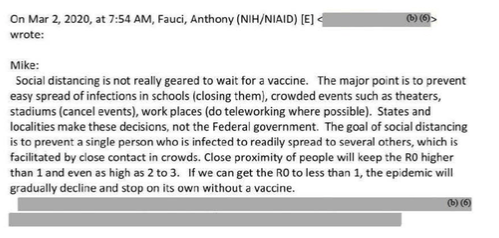
There we have it: the Fauci theory of how we get rid of the virus. We don’t need a vaccine. Just close things. Stay away from people. Don’t gather. Shut schools. Lock businesses and churches. All people stay away from all people. The R-naught will drop.
Then the virus will… and this is where the theory gets murky. Does it just vanish? Get bored? Get frustrated, give up, and vanish into the ether? And how long does this new social system of “social distancing” have to last? Years? Forever? And what happens once people start acting normally again?
This is very clearly crank science, one that confuses ex post data collection with causation itself and also seems to deny the workability of the human immune system. That such things would be written by a person in Fauci’s position is truly mind boggling. But the press went along, and still does after all this time.
What Fauci was imagining – and very few people picked up on it at the time – was the construction of a new social system. It was not just about this virus. It was about all pathogens and the whole functioning of society. He believed – or he decided to come to believe – that a re-engineering of the social order could successfully beat back common pathogens and bring about universal health.
He finally revealed this in his August 15, 2020, article for Cell that received very little attention at all. He was on his own attempting to implement an entire new social system based on a new ideology.
Living in greater harmony with nature will require changes in human behavior as well as other radical changes that may take decades to achieve: rebuilding the infrastructures of human existence, from cities to homes to workplaces, to water and sewer systems, to recreational and gatherings venues. In such a transformation we will need to prioritize changes in those human behaviors that constitute risks for the emergence of infectious diseases. Chief among them are reducing crowding at home, work, and in public places as well as minimizing environmental perturbations such as deforestation, intense urbanization, and intensive animal farming.
This article reveals the most important point. The pandemic response was not just about this one pathogen. It was about what amounts to a political, economic, social, and cultural revolution.
It’s not socialism or capitalism. It’s something else entirely, something very strange, like a Rousseauian technocracy, simultaneously primitive and high tech, as managed by a scientific elite, an untested dystopia worthy of the most terrifying literature in the English language.
No one has voted for such a thing. It is something Fauci and his friends dreamed up on their own and deployed all their enormous power to enact just as a test, until it fell apart. The US and many parts of the world were in their grip for the better part of a year and two years in some places.
This is a scandal for the ages, one that far outstrips issues of tax-funded gain-of-function research, as important as that is. It’s even more important than reports that Fauci has been earning personal royalty payments from pharmaceutical companies that receive grants that he has personally approved. The real problem comes down to his power and the ability of elected representatives and courts to control him for many decades.
Regardless of Fauci’s millenarian vision, the course of the virus took the usual path but for one major exception: the waves of infection occurred based on class rank in society. There was a political hierarchy of infection that started with the working classes, moved to the bourgeoisie, hit the professional classes, then high-end journalists, and finally, at the very end came for the elite ruling class itself – Trudeau, Psaki, Ardern, Gates, and finally Fauci – regardless of their multiple vaccines.
And here is why Fauci’s covid infection is significant, 28 months after the first lockdowns. It’s a sign and symbol that his entire theory of virus control was wrong. He got his way with policy and it did not work. The virus finally landed on him, as if to reenact Edgar Allan Poe’s fictional story of Prince Prospero in his castle that he believed would protect him.
And as a result of his exposure, Fauci will surely (unless his repeated injection of the same vaccine harmed the operation of his immune system) gain the natural immunity that is already possessed by 78 percent of kids and likely two thirds of the general population.
It should also alert us to three points of moral urgency:
- We need to replace Fauci-style feudalism with a new theory of how to reconcile the freely functioning society with the presence of infectious disease, so that neither he nor people in his pay or sway can attempt this again.
- We need to act to disable the unmitigated power of administrative-state bureaucrats to seize control of the machinery of government.
- We need a new system to decentralize science away from privileged elites so that they can never again have monopoly control over what is considered to be the science much less posses the power to censor dissent.
These are the lessons, at least the start of them. This virus is either endemic or at least almost so, but we are left with astonishing social, cultural, and economic destruction from Fauci’s attempt to implement an experimental plan on the whole population not only in the US but all over the world.
We will suffer for many years or generations from it. And yet, in the end, infection is individual and probably unavoidable for most people. The immune system adapts. That’s how we evolved to coexist. To pretend otherwise is the very essence of denying the science.
Jeffrey A. Tucker is Founder and President of the Brownstone Institute and the author of many thousands of articles in the scholarly and popular press and ten books in 5 languages, most recently Liberty or Lockdown.
Turkey & Russia Suggest Path for Grain Ships to Access Ukrainian Ports
By Kyle Anzalone and Will Porter | The Libertarian Institute | June 16, 2022
Ankara and Moscow have put forward potential solutions to reopen Ukraine’s Black Sea ports, with Russia offering safe passage to ships while Turkey said it could help guide vessels around Ukrainian naval mines deployed to stall the Russian advance.
Russia’s UN Ambassador Vassily Nebenzia told reporters on Wednesday that the Kremlin is open to creating a “safe passage” for grain shipments, but said Moscow could not guarantee a route that would be free of mines
“We are not responsible for establishing safe corridors. We said we could provide safe passage if these corridors are established,” he said. “It’s obvious it’s either de-mine the territory, which was mined by the Ukrainians, or ensure that the passage goes around those mines.”
While Turkey has said it would “take some time” to clear away the munitions, Foreign Minister Mevlut Cavusoglu suggested safe corridors could be found in some Ukrainian ports, presenting the offer as a short-term solution.
“Since the location of the mines is known, certain safe lines would be established at three ports,” the FM said earlier on Wednesday, adding that ships could “come and go safely to ports without a need to clear the mines.”
Cavusoglu went on to say that Ankara has not received a response from the Kremlin on the proposal, but is currently working with the United Nations on a plan. UN spokesman Stephane Dujarric confirmed that discussions were underway, though noted that an agreement from both Ukraine and Russia would be needed to move forward.
Turkey’s National Defense Minister Hulusi Akar, meanwhile, told TRT that the three nations recently created an “emergency communication mechanism” to resolve the problem and reopen Ukraine’s ports, but it’s not yet clear whether any progress had been made in negotiations. Last Sunday, President Recep Tayyip Erdogan also announced that he plans to hold a three-way dialogue on the issue with his Russian and Ukrainian counterparts sometime in the coming weeks, after Ankara hosted several rounds of lower-level peace talks.
Kiev, however, has signaled that it will not accept the Russian or Turkish proposals. Speaking at an event in Washington on Wednesday, David Arakhamia, a lawmaker and the head of Ukraine’s negotiation team, said “Our military people are against [de-mining the ports], so that’s why we have very, very limited optimism for this model.”
The UN has warned that the disruption of grain exports from Ukraine could have a massive impact on global food supplies. Together, Moscow and Kiev provide up to 40% of Eastern Europe’s grain purchases, and make up an even greater part of some countries’ total imports.
While Ukrainian and American officials have repeatedly blamed Russia for the shortages, Moscow has rejected the charge, instead pinning the scarcities on US sanctions and the explosives still deployed at key Ukrainian seaports. The Kremlin previously offered to help establish a safe route for shipping vessels in exchange for sanctions relief, but Washington refused to take up the deal.
The US and its Western partners have attempted to cripple the Russian economy through heavy sanctions in response to the invasion, some pledging outright embargoes on the country’s energy exports. While the penalties initially sent the ruble tumbling, it has since made a significant comeback and is now among the best performing currencies against the dollar in 2022. Meanwhile, the White House is now quietly pushing US shipping companies to do business with Russian fertilizer suppliers.
The conflict raging in Eastern Europe has not severed all business ties between Moscow and Kiev, as Ukraine’s state-run Naftogaz has continued to work with its Russian equivalent, Gazprom. Though the two firms have reportedly done hundreds of millions of dollars in trade since the war kicked off in February, the shaky truce could soon fracture, as Naftogaz is now pursuing a lawsuit against Gazprom for alleged underpayment.
Siemens fails to return turbines to Gazprom
Samizdat | June 15, 2022
German company Siemens has confirmed that Ukraine-related sanctions imposed on Russia have made it impossible for the equipment supplier to return gas turbines to Gazprom after they were repaired in Canada.
The Russian energy company was forced to reduce gas supplies to Germany via the Nord Stream pipeline this week due to the parts shortage.
The gas turbines are currently in Montreal for an overhaul, and could not be returned to the customer due to Canadian sanctions, Siemens Energy said, as quoted by Reuters.
“Due to the sanctions imposed by Canada, it is currently impossible for Siemens Energy to deliver overhauled gas turbines to the customer,” the company said.
The firm also said it had informed the German and Canadian governments of the problem, adding that it was working on a viable solution.
On Tuesday, Russian energy major Gazprom announced a cutback of gas deliveries via the Nord Stream pipeline after Siemens failed to return gas-pumping units to the compressor station on time. Supplies are expected to decrease to some 100 million cubic meters per day from the planned 167 million cubic meters, marking a reduction of 40%.
European prices for natural gas surged 10% on the news.
In March, Siemens announced that it would halt equipment deliveries to Russia. Last month, the German company said it would completely withdraw from the Russian market, and launched procedures to terminate its business activities in the country.
Featured Video

Racist Seinfeld Dances for Joy as Bibi Unveils His New Map
or go to
Aletho News Archives – Video-Images
TV Drama Review
Japanese drama projects Japan’s wartime atrocities onto Chinese characters

Global Times | October 25, 2026
By portraying Chinese characters as perpetrators of ruthless violence while casting Japanese Self-Defense Forces (SDF) intelligence operatives as defenders, the season 2 of the Japanese drama Vivant has recently drawn criticism from Chinese netizens, who argue that its depiction turns historical reality on its head while ignoring Japan’s wartime atrocities.
The TBS drama series – a spy suspense story in which an alleged unofficial intelligence unit of the SDF operates across the globe — has attracted a passionate fanbase. Its currently airing season 2 opened with a household rating of 18.8 percent, the highest for a TV drama this year, according toa commentary article by Japanese media Toyo Keizai.
What draws attention is the portrayal of the enemies in the series, the article noted. Scenes in which the Chinese organization subjects kidnapped members of the SDF unit to brutal torture are repeated with unrelenting intensity.
It is rare for Japanese TV dramas to explicitly portray a real-life country as the enemy, the article noted.
Japanese Prime Minister Sanae Takaichi also made a reference to the drama, saying that she has been recording Vivant and hopes to binge-watch it over the year-end and New Year holidays, according to Japanese media outlets.
China’s CCTV News report on Sunday revealed that the drama features scenes in which Chinese personnel cut off the fingers of and stab Japanese intelligence operatives in the abdomen. Such acts bear striking similarities to the torture inflicted on Chinese nationals by invading Japanese troops during the World War II.
The drama distorts the truth by attributing these atrocities to modern Chinese characters. Beneath the surface, it subtly glorifies Japan’s cross-border overseas operations, blurs the functional boundaries of the SDF and implicitly promotes an expansionist narrative, per CCTV News. … continue
Blog Roll
 Aletho News
- Up in arms… Koreans reject U.S. empire’s plan to make South Korea the next Ukraine
- Iran, Turkey, Pakistan, Saudi Arabia could advance region-led security framework in Tehran: FM spox
- Netizens condemn Japanese drama for projecting Japan’s wartime atrocities onto Chinese characters
- Racist Seinfeld Dances for Joy as Bibi Unveils His New Map
- A West Bank War for Netanyahu’s Election Campaign, Could It Backfire?
- Yemen denounces European Parliament’s ‘hypocritical’ push to blacklist Ansarullah
- Qalibaf: UAE’s UN bid aims to ‘clear the runway’ for ‘Greater Israel’, whitewash genocide
- Pakistan reopens Iran border after boosting security: Report
- Why are so many Brazilians voting for Flávio Bolsonaro?
- Democrats Put Anti-Russia Agenda Ahead of American Workers
- If Americans Knew
- An error has occurred; the feed is probably down. Try again later.
- No Tricks Zone
- Sudden Stratospheric Warming, Powerful El Niño Combination May Lead To Extreme Europe Cold, Energy Crisis!
- Two New Studies Find Thwaites Glacier Melt Cannot Be Driven By Human Activity Or A Warming Ocean
- E-Cars Reduce CO2 Emissions By Only 41% Compared To Internal Combustion Engine Vehicles
- Predictions Made By Renowned Climate Professor Over Past Decades Have Been Proven To Be Poor
- New Study Suggests Large Regions Of The Pacific Ocean Have Been Cooling For The Last 80 Years
- Germany’s Green Energy Debacle: High Energy Costs Force Kahla Porzellan to Close After 182 Years!
- New Study: 50 Years Of The Most Aggressive ‘Net Zero’ Policies Can Only Affect The Global Climate By 0.03°C
- US September “Heat” Was No Record…Many Records Set Decades Ago
- Latest European Green Energy Debacle; Portugal’s Largest Flagship Solar Park Insolvent!
- Green Energy Debacle: German Expert Professor Fritz Vahrenholt Warns Of Severe Economic And Social Consequences

