EU unveils rationing plan
Samizdat | May 18, 2022
European Commission President Ursula von der Leyen announced on Wednesday that the EU would raise its renewable energy targets and invest billions of euros in clean energy in a bid to break away from Russian oil and gas imports. Consumers will pay a price, however, with the EU’s plan including energy rationing and compulsory solar panels on homes.
Von der Leyen’s ‘REPowerEU’ plan would cut the EU’s reliance on Russian gas by 66% this year and eliminate it entirely by 2027, the bloc’s policy chief told reporters in Brussels.
Under the plan, the EU will increase its Energy Efficiency Target from 9% to 13%, and raise from 40% to 45% the amount of its power generated by renewables by 2030. At present, the EU sources 22% of its energy from renewables.
To achieve this, von der Leyen said that the EU would speed up the permitting procedure for renewable projects such as wind farms and would make €300 billion ($315 billion) available in grants and loans. Of this funding, 95% would be set aside for green energy, while 5% would be used to upgrade Europe’s gas and oil infrastructure to receive imports from sources other than Russia.
However, some of the immediate costs will be borne by consumers. According to the European Commission’s website, households and industry will be required to make “behavioral changes” – such as turning down air conditioning and switching off lights – to reduce demand for oil and gas by 5%. Furthermore, commercial and public buildings will be required to install rooftop solar panels by 2025, with these panels to be made mandatory on residential buildings by 2029.
Some individual member states have already asked their citizens to curtail their energy use. Germany, which depends on Russia for more than half of its gas and was already facing the world’s highest energy costs due to its flawed transition to wind power, has asked its population to shower less and swap their cars for bicycles in order to save costs.
With consumers across the EU already grappling with skyrocketing inflation and record fuel prices, Russian President Vladimir Putin said on Tuesday that European countries are committing economic “suicide” by trying to wean themselves off Russian oil and gas, accusing them of caving to pressure “from their American overlord” without “paying any attention to the damage that they have already caused their own economy.”
Bill Gates wants to build a dystopia
By Toby Green | UnHerd | May 9, 2022
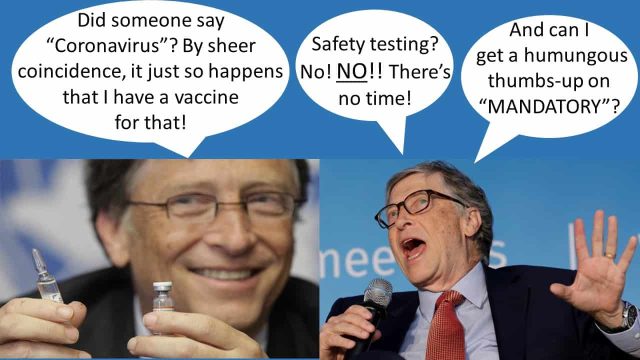
It’s not easy being a regular multi-billionaire. Bill Gates used to be the simple guy-in-the-mansion next door, worried about virus outbreaks and global warming. Then, during the pandemic he became the point at which all conspiracy theories met.
Ever since March 2020, the memes have spread. Was Gates a mass murderer with a global depopulation agenda? Was he a “biofascist” seeking control over the world’s population through vaccine passports and microchips?
It didn’t stop there. Was the Covid-19 pandemic actually “plandemic”? Did the Microsoft founder and his acolytes create it through funding “gain of function” research in a biosecurity lab in Wuhan? Was it all war-gamed at Event 201 in October 2019?
Bill Gates has not much enjoyed being the focus of these stories for the past 18 months. He just wants to help out. He wants to solve problems so badly, he tells us early on in How To Prevent the Next Pandemic, that in February 2020, he flew from Seattle to South Africa to participate in a charity tennis match, no doubt on one of his four personal jets.
It was in South Africa that he first began to join the Covid-19 dots. The tech entrepreneur delivers the story with characteristic flair: “A couple of days after returning from South Africa, I sent an email about scheduling something for the coming Friday night: ‘We could try and do a dinner with the people involved with coronavirus work to touch base.’” Gates is happy, “everyone was nice enough to say yes — despite the timing and their busy schedules”. His work on the pandemic begins.
Now Gates is tired of all the conspiracies. He asks his critics to judge him by his actions. And the best way to do so is by reading the book: does Gates have anything sensible to say about the best way to combat future pathogenic outbreaks?
His model for the future is built on what he feels has worked over the past two years: isolate contacts, close borders, lockdown as quickly as possible, then remove restrictions slowly and cautiously. He cites Dr Anthony Fauci, who Gates says he spoke to once a month during the pandemic: “Not only should you appear to overreact at first, as Tony Fauci said, but you also have to be careful about relaxing all NPIs [non-pharmaceutical interventions] too soon.” Meanwhile, you should invest enormous sums in boosting global public health systems, vaccine production in poor and rich countries, and fund a Global Pandemic Emergency Response Unit to monitor potential outbreaks. The aim, says Gates, is to vaccinate the entire world — twice if necessary — within six months while lockdown measures restrict the spread of the new pathogen.
It all sounds so reasonable, doesn’t it? Or it might do to those who haven’t seen the footage of Shanghai’s lockdown circulating on social media, to those who can work online in relative comfort, or indeed to billionaires with comfortable gardens and libraries in which to while away those six months. With the Gates model, a little translation is in order.
The massive investment required to make this vision happen is a good starting point. Where will it come from? Gates is a well-known philanthropist, and makes much of the more than US$2 billion which the Bill and Melinda Gates Foundation have ploughed into fighting Covid-19. Yet this is a small amount compared to the US$6 billion that the US government has invested in the Moderna vaccine alone. As Gates points out, “Most of the world’s greatest talent for translating research into commercial products is in the private sector… It’s the government’s role to invest in the basic research that leads to major innovations, adopt policies that let new ideas flourish.”
Translation: taxpayers invest in developing products through government agencies, and private companies and their shareholders reap the profits. How does this work in practice? Gates does not give what we might call full disclosure. He offers the example of the antiviral Molnupiravir which “Merck and its partners developed”. It was authorised to great fanfare as a Covid treatment in November 2021.
Yet Merck did not develop this drug. It was initially developed as a veterinary drug for horses at Emory University, with a US$19 million grant from Fauci’s NIAID and funding from other sectors of the US government. Molnupiravir costs US$17.74 per dose to manufacture, according to an estimate from researchers at Harvard and King’s College London, but is being retailed to the US government for US$712 per course — a profit of 4,000%.
Another example of Gates’s eye for detail is his discussion of Remdesivir, which was approved as “Standard of Care” for Covid in the US by the Federal Drug Agency. Again, like Molnupiravir, much of the funding and institutional support for the drug originally came from the US government. Remdesivir was the baby of the drug company Gilead.
Gates describes how one study showed that “it may have a major impact in patients who aren’t yet sick enough to be in the hospital”. But other details are ignored. He doesn’t tell us that in an earlier, peer-reviewed study from China, published in the Lancet in May 2020, “Remdesivir was not associated with statistically significant clinical benefits”, and that the trial was “stopped early because of adverse events in 18 (12%) patients versus four (5%) patients who stopped placebo early”. All the same, the profits were good: while the drug cost Gilead just US$10 per dose to manufacture, it was being retailed to US taxpayers at US$3,120.
Maybe Gates knows nothing about the Lancet study. Perhaps he doesn’t know that in both of these cases, public investment has funded enormous private profits — and that in the case of one of the drugs, there’s little evidence that this was to any benefit. He’s just a software engineer after all.
For Gates, technology really does provide all the answers, as it certainly has in his own life. He believes humanity belongs online: “once people learn the digital approach, they generally stick to it”. Post-Covid, he envisages a world of flexible working, in which regular guys like him with large mansions and decent living space can languidly choose between going into the office on Wednesdays or Thursdays. The problem with Gates’s digital utopia — full of virtual spaces where 3D avatars attend business meetings — is that I suspect many of us will not want to live in it.
Gates tries to show in this book that he gets it, while at the same time demonstrating on every page that he just doesn’t. As he draws up his elaborate plans for global governance, Gates writes that he does so knowing that he hasn’t been elected. He tells us he wouldn’t want to be anyway (after all, we can surmise, if he were elected, he might be accountable).
Gracefully, Gates understands that people are angry at the huge increases in wealth disparities during the pandemic, and pledges to return his profits to “make the world a fairer place”. He recognises that poor people across the world have suffered, and are far less able to deal with lockdowns, and even acknowledges that harsh measures might not be a good idea for some of them… And yet he recently went on record as saying that “if every country does what Australia did, then you wouldn’t be calling it a pandemic”. We can, in fact, judge him by his actions, and his words: he says one thing, and funds and promotes others.
Looking forward, the outlook is bleak. Preventing pandemics in Gates-World means shutting down immediately at the “next major outbreak” — a favourite, and alarming turn of phrase. Future semi-permanent global lockdowns are baked-in as the new normal, something I warned of in the conclusion to my book The Covid Consensus. As Gates notes, the WHO have identified 1,500 new pathogens in the past 50 years, and thus the “next major outbreak” surely cannot be far off. In the past 20 years, pre-Covid, there were already three of note (SARS — 2003; Avian Flu — 2005; Swine Flu — 2009). In each case enormous fatalities were falsely predicted, and would surely have led to six month shutdowns in the Gates model.
Gates-World is one where citizens make sacrifices for his model to work. And it’s also one where class is totally ignored. Does Gates know what it was like for Angolan children to be forced to stay at home for seven months in 2020? He admits that internet connections need to be improved to make digital schooling possible — but does he understand that no IT in the world can help children of sex workers in Mumbai slums with their homework? Can he comprehend what it is like to be incarcerated in a flat with small children for months on end in New York, Shanghai or London?
Gates wants to be respected, and understood. His world is one of innovative scientists having dinner with one another. They solve the world’s problems by the pool, or near the barbecue. It’s what he likes doing best, because “I’ve had some of the best conversations of my working life with a fork in my hand and a napkin in my lap” (p4). He wants to fund more and more work leading to experiences like this, and meanwhile turn the rest of human society into a digital avatar of itself.
No doubt he means well. But you don’t need to indulge the conspiracy theories to realise that the road to hell is paved with good intentions.
Toby Green is a Professor of History at King’s College, London.
We’re fighting a ruinous proxy war – but for which ‘sort’ of Ukrainians?
By Frank Wright | TCW Defending Freedom | May 18, 2022
SINCE the invasion of Ukraine, we have seen how effective our free world is in marketing. The art of attaching emotions to symbols is the basic method of propaganda, be that to sell products or policies, which was created by people such as American political commentator Walter Lippmann and public relations guru Edward Bernays in the 1920s.
A frenzy of outrage has been conjured over a country and on behalf of its people. Yet this is how the Ukrainian government sees its own people …

The poster reads: Ukraine – open your eyes! Yes – they look like Ukrainians. Sort I, II, III.
In case you were not aware, according to the Ukrainian regime, there are three sorts of Ukrainian. When we speak of ‘the people of Ukraine’ and their rights, bear that in mind.
The red ‘Sort 1’ on the poster are in Galicia, which may be about to be occupied by the Polish army. There is a statue of Ukrainian nationalist and wartime Nazi collaborator Stepan Bandera in Lvov, the regional capital and the base for most Western journalists.
Sort 1 Ukrainians are not native Russian speakers. In Sort 2, there is a minority (less than 25 per cent) who speak native Russian. Sort 3 is the worst offender, because every area here is populated by a majority of native Russian speakers.
In 2010, Sorts 1 and 2 voted for Yulia Tymoshenko. Sort 3 voted for Viktor Yanukovich, who was president until the 2014 coup.
Interestingly, the sorts are also careful to indicate in the second order some of the minority ethnic groups on the Western border. Ethnic Hungarians, Romanians and Moldovans are not Sort 1 either.
One emotional basis for the proxy war the US and NATO are fighting is the right of the Ukrainian people to decide their own fate. Which people – which Sort?
This right was not relevant in 2014 when the US, through its then Assistant Secretary of State for European and Eurasian Affairs, Victoria Nuland, deposed the Yanukovich government and replaced it with one of its choosing.
You can now see why they did this. Yanukovich was not overly friendly with Russia, yet the fact that his base was concentrated in the Russian-speaking population was enough to convince the neoconservative faction that he had to go.
The proxy war is being promoted by this neoconservative faction, which dominates US foreign policy. The founder of their main pressure group, Robert Kagan, is the husband of Victoria Nuland. Kagan admits that US actions provoked Russia. His wife is the architect of many of these provocations, so he would know.
The view of the faction which controls US foreign policy is that Russia and its interests must be broken by any means. This is the reason for the cancellation of the Nordstream 2 gas pipeline, for the overturning of the election in Ukraine in 2014, for the concentration of arms and military training in Ukraine’s disputes Donbass region for the past eight years.
US policy – as directed by a faction that destroys nations with no regard for the costs, nor consequences for the populations concerned – is to break Russia. Yet there is a problem with this plan. The strategy is failing.
Russia is not collapsing at home. Its economy is resilient and looks to be capable of surviving. The wider world is not sanctioning Russia. Ukraine is not winning the war. A global food crisis looms. This makes escalation likely and the situation ever more perilous. It explains the insane Plan B – destroying Europe.
The sanctions – applied by the Anglosphere, the EU and Japan – are not weakening Russia. The EU seems determined to halt all gas and oil supply from Russia. Hungary, Croatia and Slovakia have indicated this would mean a severe economic collapse. The multinational chemical company BASF warned of the same regarding German industry, saying production will cease with no Russian hydrocarbons.
Many German firms are preparing to litigate the German government owing to the ‘dramatic repercussions’ of cutting off Russian gas and oil. This means whole industries will halt and Germany will deindustrialise. Europe will face food shortages and stagflation – a toxic mixture of economic stagnation and inflation.
You may have missed the fact that Ukraine shut down one (of two) gas transit nodes last week, instantly reducing gas supply. This obviously cannot happen without US direction and approval, as it endangers the ability of German industry to continue to operate. One explanation of US policy is to bleed Europe in order to blame Russia, which in turn builds support for war.
The difficulty here is in finding a rational explanation for the removal of the fuel, grain, fertiliser and raw materials without which European industry and food production cannot continue to function. Gas stores are 37 per cent full across Europe. We have no food mountains any more, and Britain is poised to be the worst hit with stagflation.
It looks as though the collapse of the EU economies might be the plan for the US administration, as there is no other rational explanation for the removal of gas, oil, grain, copper and fertiliser from that market.
There are no replacements. There is no agreement with Qatar to replace pipeline gas with liquefied natural gas (LNG). There is no other source of commercial fertiliser. Added to this, Russian sweet crude oil isn’t the same as every other type of oil, which matters when your refinery is geared to process a specific type of oil.
That is the argument of Hungary, whose intransigence is explained by the simple fact that even if a replacement could be found for Russian oil, and even if it weren’t more expensive (it will be) – it can’t be processed in its country’s plants.
It is noteworthy that the Hungarian government will speak for the national interests of Hungary rather than cheerlead its own economic ruin.
Yet ruin is what we all face, after two years’ money-printing combined with a sanctions policy that will push the European economies off a cliff. This is a strange way to save Sort 1 – and some of Sort 2 – of the Ukrainian people.
This, however, is the price of a failed US initiative to weaken Russia, whose rouble is higher now than it was when the war began, and whose gas and oil is more valuable than ever. Is it a price we are willing to pay? Perhaps it is time to ask who is selling us this future, and for what purpose.
Russia moves to withdraw from WTO, WHO
Samizdat | May 17, 2022
Russia’s lower house of parliament, the State Duma, is planning to discuss the potential withdrawal of the country from the World Trade Organization (WTO) and the World Health Organization (WHO), according to Pyotr Tolstoy, the vice speaker of the parliament.
“The Ministry of Foreign Affairs sent a list of such agreements to the State Duma, and together with the Federation Council [upper house of parliament] we are planning to evaluate them and then propose to withdraw from them,” Tolstoy said on Tuesday.
The vice speaker said that Russia had already canceled its membership in the Council of Europe, and that leaving the WTO and WHO is next.
“Russia withdrew from the Council of Europe, now the next step is to withdraw from the WTO and the WHO, which have neglected all obligations in relation to our country,” he said.
Tolstoy added that the government is expected to revise Russia’s international obligations and treaties that do not currently bring any benefit but directly damage the country.
In April, Russian President Vladimir Putin said that the “illegal” restrictions placed on Russian companies by Western states run counter to WTO rules, and told the government to update Russia’s strategy in the organization by June 1.
The decision came amid the sweeping Western sanctions imposed on Moscow over its military operation in Ukraine launched in late February. Since then, Russia has been subjected to around 10,000 targeted restrictions, making it the world’s most sanctioned country.
EU Introducing ‘Suicidal’ Sanctions on Russian Oil and Gas Under Pressure From US Overlords: Putin
By Ilya Tsukanov | Samizdat | May 17, 2022
The European Union is introducing sanctions against the Russian oil and gas sector for “absolutely political reasons” and under pressure from the bloc’s American overlords, notwithstanding the impact on its collective economic competitiveness, Russian President Vladimir Putin has said.
“Rejection of Russian energy resources means that Europe will systemically become the region with the highest energy costs in the world. Yes, of course prices will rise and resources will go to this region, but it will not be possible to radically alter the situation. This will seriously – and according to some experts irrevocably – undermine the competitiveness of a significant part of European industry, which is already losing the competition to companies in other regions of the world,” Putin said, speaking at a meeting with officials devoted to energy issues on Tuesday.
Putin suggested that the Western political class had speculated “on the absolutely natural concerns of many people on the planet with climate issues,” downplaying the importance of traditional, hydrocarbon sources of energy, while simultaneously overestimating the effectiveness of alternative energy in filling the gap.
This, he said, helped to spark the current energy crunch that Western officials are now trying to blame on Russia.
“Today we see that for absolutely political reasons, due to their own ambitions and under pressure from their American overlords, European countries are imposing more and more sanctions on the oil and gas market. All of this causes inflation, and instead of admitting their mistakes, they are looking for the guilty party in another place,” Putin said.
“One gets the impression that our Western colleagues, politicians and economists have simply forgotten the foundations of the elementary laws of economics, or, to their detriment, prefer to deliberately ignore them,” Putin suggested.
“Obviously, together with Russian energy resources, economic activity will also be leaving Europe for other regions of the world. Such an economic auto-da-fe, or suicide, is of course the internal affair of European countries. We must proceed pragmatically and proceed primarily from our own economic interests,” he added.
Putin called on authorities to “act proactively” in light of the “ill-conceived and chaotic” decisions being taken by some of Russia’s Western “partners,” and to use them to Moscow’s advantage. He also warned that Russia should not expect the West to make such mistakes “endlessly.”
Putin promised that the Russian state would do “everything that depends on us” to create the proper conditions for the work of domestic energy companies, ranging from improving logistical capabilities to providing a system of payment in national currencies and improving the availability of credit and insurance services, to stimulating the processing of raw materials and the creation of new domestic technologies.
He urged Russian oil companies not to sit on their assets – including revenues gained from rising energy prices, and said that the changes currently being experienced by the global oil market have a “tectonic nature,” and that “doing business as before, according to the old model, of course, seems unlikely. In the new conditions, it is important not only to extract oil, but to build the entire vertical chain up to the end consumer.”
Countries worldwide have experienced economic shocks associated with rising energy costs over the past year, with the United States and the the European Union bearing the brunt of the burden, particularly after regional leaders began slapping sanctions and other restrictions on Russian oil and gas amid the crisis in Ukraine starting in February. Many EU countries depend on Russian gas for more 40 percent or more of their natural gas needs and a similar amount of oil. In the wake of the Russian military operation in Ukraine, the bloc has promised to replace supplies from Russia with fuel sourced from the US, Africa and the Middle East, and to ramp up investments in alternative energy. However, economists, businesses and opposition leaders have warned that these measures won’t save the region from a recession, a depression, or worse – its deindustrialization amid the intensifying global economic competition between China and the United States.
European gas prices forecast to triple
Samizdat | May 15, 2022
A “perfect winter storm” may be forming in Europe, as the continent seeks to limit Russian gas flows, analysts at Rystad Energy said in a press release this week. They added there might be not enough LNG to replace Russian gas during the freezing weather. The price of gas in the EU was projected to soar to $3,500 per 1,000 cubic meters.
According to the report, last year Russia sent 155 billion cubic meters (bcm) of gas to the continent, providing more than 31% of its gas supply.
“Replacing a significant portion of this will be exceedingly difficult, with far-reaching consequences for Europe’s population, economy, and for the role of gas in the region’s energy transition.”
By shunning Russian gas, Europe has destabilized the entire global LNG (Liquefied Natural Gas) market, which began the year with a precarious balance after a tumultuous 2021, Rystad explained. The decision to sharply reduce reliance on Russian gas and LNG from current levels of between 30-40% will transform the global LNG market, it added.
The report highlighted that global LNG demand is expected to hit 436 million tons in 2022, outpacing the available supply of just 410 million tons. “The supply imbalance and high prices will set the scene for the most bullish environment for LNG projects in more than a decade, although supply from these projects will only arrive and provide relief from after 2024,” it said.
According to the research, if Russian gas flows were to stop tomorrow, the gas currently in storage (about 35% full) would likely “run out before the end of the year, leaving Europe exposed to a brutal winter.” Under such a scenario, in the absence of joint buying arrangements and countries competing for limited molecules, the TTF gas price could climb to more than $100 per million British thermal units (MMBtu), resulting in industrial curtailments and widespread fuel switching in the power sector. In an extreme scenario of a severely cold winter, “not even the residential sector would be safe.”
Natural gas prices surged this week after Moscow imposed its first counter-sanctions on some European energy companies. The price of gas in Europe exceeded $1,200 per 1,000 cubic meters during Thursday trading, according to data provided by London’s ICE. Benchmark prices are almost 300% higher compared with a year ago, Reuters reports.
What Sanctions? Russian Oil Revenues Soar 50%, Hitting A Record High
By Tyler Durden | Zero Hedge | May 12, 2022
And the sanctions hits just keep on coming.
A few weeks after we learned that Russia’s current account just hit an all time high thanks due to soaring commodity exports (just as the US trade deficit blew out to a record high on its own) we learned that contrary to the intentions of European countries, a calculation by a German think tank found that Russia’s oil and gas revenues hit a record high in April, rising to 1.8 trillion rubles in a single month, after 1.2 trillion in March, leading to the following stunning statistics “After only 4 months, Russia’s federal budget has now already received 50% of the planned oil and gas revenue for 2022 (9.5 trillion).”
Today, Bloomberg confirmed this stunning statistic and, citing the latest IEA report, writes that Russia’s oil revenues are up 50% this year “even as trade restrictions following the invasion of Ukraine spurred many refiners to shun its supplies.” Apparently the restrictions – which pushed the price of oil to the highest level in a decade and boosted revenue for oil exporters – is precisely what Putin was hoping for.
Moscow earned roughly $20 billion each month in 2022 from combined sales of crude and products amounting to about 8 million barrels a day, the Paris-based IEA said in its monthly market report.
As we have documented frequently, Russian shipments have continued to flow freely even as the European Union edges towards an import ban, and international oil majors such as Shell and TotalEnergies have pledged to cease purchases. Countering these self-imposed sanctions, Asia has remained a grateful and keen customer, with China and India picking up cargoes no longer wanted in Europe, and doing so at a huge discount to spot.
Even as Russia has kept oil output steady, reduced flows of Russian refined products such as diesel, fuel oil and naphtha have aggravated tightness in global markets, the IEA noted, echoing what we have said virtually every day for the past month. Stockpiles have declined for seven consecutive quarters, with reserves of so-called middle distillates at their lowest since 2008.
For all the disruption, Moscow has continued to enjoy a financial windfall compared with the first four months of 2021. Despite the EU’s public censure of the Kremlin’s aggression, total oil export revenues were up 50% this year.
Hilariously, despite all the posturing and rhetoric, the bloc remained the largest market for Russian exports in April, taking 43% of the country’s exports, the IEA said.
There is some hope yet that Europe’s sanctions won’t be all for nothing: supplies were down 1 million barrels a day last month, and these losses could triple in the second half of the year, the agency estimates. EU sanctions against Russian state-linked enterprises such as production giant Rosneft PJSC will take effect on May 15, and the bloc is moving towards a full ban on the country’s supplies.
“If agreed, the new embargoes would accelerate the reorientation of trade flows that is already underway and will force Russian oil companies to shut in more wells,” the IEA said.
Russia sanctions will trigger global food and energy crises – China
Samizdat | May 12, 2022
The international sanctions campaign to punish Russia over the Ukraine conflict will backfire, causing suffering by people around the world while failing to promote peace in the former Soviet republic, a top Chinese diplomat has told the UN Security Council.
“Sanctions will not bring peace but will only accelerate the spillover of the crisis, triggering sweeping food, energy and financial crises across the globe,” Chinese deputy UN ambassador Dai Bing said on Thursday in New York. He added that continuing to impose sanctions on Moscow will force children around the world to “suffer the bitter consequences.”
Dai made his comments as the Security Council met to discuss the humanitarian crisis brought on by the Russia-Ukraine conflict. Although he also spoke of efforts to help protect children affected by the fighting, such as encouraging Russia and Ukraine to work together to enable more civilian evacuations, he said the only real solution is a negotiated peace deal.
“Achieving peace is the best protection for children,” Dai said. “Dialogue and negotiation are the most realistic and feasible way to reach a ceasefire and to stop the war. The international community should encourage Russia and Ukraine to return to the negotiation track and keep accumulating political conditions for the restoration of peace.”
By instead trying to force a resolution through sanctions, Western nations and their allies are actually causing more harm to children, especially those living in such war-torn places as Afghanistan, Yemen, the Horn of Africa and the Sahel region, Dai said. “China again calls on parties to stay rational and exercise restraint, transcend prejudice and strife, and make unremitting efforts for the early resolution of the crisis in Ukraine.”
The US and its NATO allies have spearheaded the sanctions campaign, trying to isolate Russia and devastate its economy and currency. However, the ruble is actually stronger today than before the Ukraine crisis began, rebounding from an historic low reached in March. In fact, it has been the world’s top-performing currency so far in 2022, even though Russia’s economy is reportedly on track to contract by an estimated 12% this year.
Meanwhile, food and energy shortages are looming around the world, and inflation is at around a 40-year high in the US and parts of Western Europe. President Vladimir Putin claimed on Thursday that sanctions are triggering a global economic crisis, and the blame “lies entirely with the elites of Western countries who are ready to sacrifice the rest of the world to maintain their global dominance.”
‘Russia not our enemy’: Rep. Paul Gosar
Samizdat | May 12, 2022
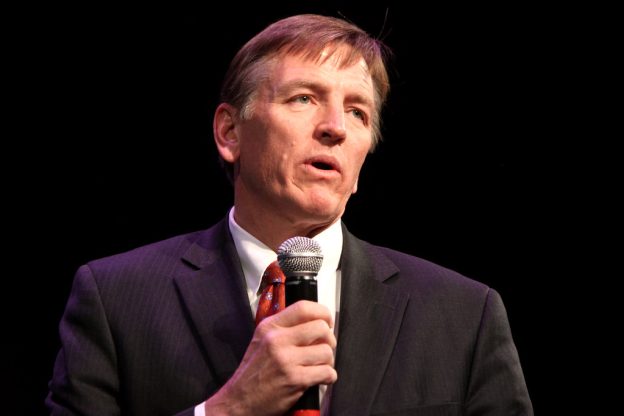
Republican Rep. Paul Gosar (Arizona) condemned the push from both parties in Washington to send billions of dollars worth of weapons to Ukraine. “Crippling debt, inflation and immigration problems,” he declared, are not “Putin’s fault.”
Gosar, an immigration hardliner and anti-interventionist, was one of 57 GOP lawmakers to vote against a $40 billion economic and military aid bill for Ukraine on Tuesday. While a number of Republicans have been vocal in their opposition to fueling a “proxy war” in Ukraine, the GOP establishment has shouted down these critics, with conservative talk show host Mark Levin on Wednesday referring to the anti-war contingent of the party as “Putin a**-kissers.”
“Calling us names is not a logical position,” Gosar shot back, stating: “I have no principle to follow but the path of peace and non-intervention. My grown children have known nothing except American war and intervention for naught.”
“Ukraine is not our ally,” he continued. “Russia is not our enemy. We need to address our crippling debt, inflation and immigration problems. None of this is [Russian President Vladimir] Putin’s fault.”
Americans are currently grappling with record gas prices, inflation that’s at a four-decade high, and shortages of vital food products, including baby formula. Furthermore, the expiration of a Trump-era immigration restriction this month will result in up to 18,000 migrants entering the US from Mexico daily, according to estimates from the Department of Homeland Security.
Since the beginning of Russia’s military operation in Ukraine in February, the Biden administration has sent nearly $4 billion worth of weapons and ammunition to Kiev, and revived a World War II-era act allowing a limitless supply of arms to be shipped to Ukraine on credit.
Meanwhile, at home the White House has banned Russian oil and gas imports, and although industry leaders are warning of an imminent diesel shortage, the Biden administration on Wednesday canceled the sale of drilling leases in Alaska and the Gulf of Mexico.
Despite the opposition of Gosar and his allies, the $40 billion funding bill passed by 368 votes to 57. It is expected to pass the Senate by next week at the latest, with Majority Leader Chuck Schumer (D-New York) saying the upper chamber “will move swiftly” to get it to Biden’s desk.
Ukraine’s partial gas cut to Europe could force activation of Nord Stream 2
Kiev attempts to blackmail Europe by partially halting gas flow from Russia
By Paul Antonopoulos | Aletho News | May 12, 2022
Ukraine’s decision to partially disable the flow of gas earmarked for Europe will be short-lived as it will not only cause major problems for the European economy, but it will also leave Kiev without billions of dollars in transit tax revenue – something it desperately needs as the economy is in ruin.
The Ukrainian gas transmission system operator (GTSOU) said it decided to suspend operations at a major transit point because of “interference by the occupying forces.” The decision to stop flows from Sokhranivka halts about a third of the Russian gas that arrives in Europe via Ukraine as the measuring station handles as much as 32.6 million cubic meters per day, according to GTSOU.
“As a result of the Russian Federation’s military aggression against Ukraine, several GTS facilities are located in territory temporarily controlled by Russian troops and the occupation administration,” the company said.
Kiev’s idea of transferring gas supplies from Sohranovka to the Suja gas station, which is in Ukrainian-controlled territory, has been dismissed by the Russian state gas company Gazprom as “technically impossible.” In addition, Gazprom said that it fulfills all its obligations to European consumers and delivers gas for transit in accordance with all contracts.
The disrupted transit of one-third of the gas that Europe needs would cause major damage to the continent’s economy. Europe already has less gas than it currently needs and the problem is not just that the price of gas will go up, but there will not be enough needed for industrial production.
If Russian gas does not arrive via Ukraine in the agreed quantity, Europe would have to consider extracting from reserves in underground storage facilities. The price of such gas will certainly be higher than in the case of gas arriving via Ukraine. Therefore, Kiev’s attempts to coax Europe into further involvement in the war with Russia will receive little accolade as it threatens Europe’s economy at a time when it is already suffering.
Kiev’s decision to reduce gas flows to European markets also means that it will suffer as it will lose transit fees that it desperately needs as its economy has stagnated. Another outcome that Ukraine did not consider is that it could force Europe to challenge the US’ opposition to the Nord Stream 2 pipeline. If Russian gas does not arrive via Ukraine, it could be the very catalyst needed to activate Nord Stream 2.
If Ukraine were to remain committed to reducing Russian gas flows to Europe, even at the expense of billions of dollars in transit fees, the question begs whether the EU would be willing to potentially run out of gas and/or see prices rise even further, or activate Nord Stream 2. Activating Nord Stream 2 would effectively mean the US’ failure after so much effort was made to prevent the pipeline from functioning.
For this reason, Ukraine’s decision to halt a third of Russian gas flows to Europe is likely a bluff as it needs all the money it can receive at the moment. At the same time, the Europeans hope to slowly wean themselves off Russian energy, understanding that an immediate cut is not sustainable and would collapse their economies.
Kiev’s incessant demand that Brussels put an embargo on Russian energy imports to the EU will be challenged so long as there are leaders, like Hungary’s Viktor Orban, who prioritize their state’s economy and people’s welfare, or entire major industries are threatened, such as Germany’s manufacturing and Greece’s shipping.
It is quite possible that this disunity and lack of consensus on the embargo in a situation where energy cannot be undermined, could force a rethink of Europe’s policies towards Moscow.
“We will have a peace to build tomorrow, let us never forget that,” Macron said in Strasbourg on May 9, adding: “We will have to do this with Ukraine and Russia around the table. The end of the discussion and the negotiation will be set by Ukraine and Russia. But it will not be done in denial, nor in exclusion of each other, nor even in humiliation.”
On the same day, he said in a tweet: “We are not at war with Russia. We work as Europeans for the preservation of the sovereignty and territorial integrity of Ukraine. For the return of peace to our continent. We will be there to rebuild Ukraine, as Europeans, always.”
However, despite the rhetoric of pan-Europeanism, Macron has already proven in deed that Europe’s elite are still very much under the orbit of Washington. If Ukraine are to partially halt the flow of Russian gas to Europe, the next test of Europe’s so-called “strategic autonomy” would be whether it activates Nord Stream 2 to protect their economic interests or continue following Washington’s demands on keeping the pipeline closed.
Paul Antonopoulos is an independent geopolitical analyst.
“Genetically Edited” Food – The next stage of the Great Reset?
By Kit Knightly | OffGuardian | May 11, 2022
The Queen’s Speech was interesting this year.
For all the people outside the UK who don’t understand what the “Queens Speech” actually is, it’s a farcical state occasion in which the Queen (or, in this case, Prince Charles since her majesty is ill/secretly dead/having “mobility issues”) makes a speech about what “her government” intends to do for the next 12 months.
Of course, the Queen doesn’t actually write the speech, or have any input on its content, or have any control at all over what “her” government intends to do. She’s just a mouthpiece in a big gold hat.
It’s the UK equivalent of the State of the Union, only done in Halloween costumes made out of shiny stolen rocks.
The whole thing is nothing but a grand, gilt statement of intent from the British Deep State, wrapped in mink and draped in medals they never earned. It’s a joke, but it is worth listening to.
Or, if you have a sensitive stomach, you can just read the full text the next day on the UK government’s website (that’s what I do).
A lot of the content is entirely predictable.
More money to Ukraine, with a promise the UK will “lead the way in championing security around the world”. More online censorship via the “Online Safety Bill”. A compulsory register for homeschooled children via the “Schools Reform Bill”.
There’s also mention of “securing the constitution” by introducing the UK’s own “Bill of Rights”. We broke down that particular Trojan Horse back in February.
But the part I found most interesting is the stated plan to “encourage agricultural and scientific innovation at home” via the proposed Genetic Technology (Precision Breeding) Bill.
The proposed bill (which, for some reason is not available through the parliament website) follows on from DEFRA’s announced “loosened regulation” of genetic research back in January.
To quote the National Institute of Agricultural Botany (NIAB), the legislation would “take certain precision breeding techniques out of the scope of restrictive GMO rules”.
Essentially, this would see new “gene-edited” foods as distinct from old-fashioned “genetically modified” foods, and therefore not subject to the same rules and oversight.
The claimed distinction is that gene editing, as opposed to genetic modification, doesn’t introduce DNA from other species. Therefore, in effect, is merely speeding up what could potentially naturally happen over time.
Now, you might think this is just semantics, and that such a law will just provide a loophole for ALL “genetically modified” foods to simply rebrand themselves as “genetically edited” foods, and thereby avoid regulation. But that is disgustingly cynical and shame on you for even thinking it.
All in all, this is pretty on-message stuff, and not especially surprising. What’s noteworthy is – by pure happenstance, I’m sure – it appears to coincide with a renewed push on the GM food front in other countries all over the world.
In December 2021, Switzerland added an amendment to its moratorium on GMO crops, permitting the use of certain “gene editing” techniques.
Last month, Egypt announced their new strain of GM wheat. Just two days ago, Ethiopia’s National Agricultural Biotechnology Research Center announced they had researched, and the country will now be growing, genetically modified cotton and maize.
Despite Russia’s sweeping ban on the cultivation and/or importing of genetically modified crops, they have nonetheless created a 111 billion Ruble project to create up to 30 varieties of genetically edited plants and farm animals.
Britain’s deregulation of GM food is always described as a “post-Brexit” move – with the EU chided around the world for its “precautionary principle” on GM crops – and yet as long ago as last April, the EU was calling for a “rethink” on GM crops.
In fact, just today, European Biotechnology Magazine reports:
The EU Commission has launched its final consultation on the deregulation of new breeding techniques in agriculture
WHY THIS? WHY NOW?
So, we’re seeing a sudden increase in the variety of GM crops available and a simultaneous push for deregulation of the industry in Western nations.
Why would they be doing this now?
Well, there is a food crisis.
Or, more accurately, they have just created a food crisis. And as the cliched Hegelian dialectic inevitably goes, their manufactured “problem” is now in need of their contrived “solution”.
We should expect to see genetic engineering pitched as a solution to our food crisis in the very near future… like yesterday. Or indeed, two months ago.
That’s how fast they work now, with barely a pretence at concealing the plan. Spitting out the answer so fast they make it obvious they knew the question beforehand.
On March 15th, when the “special operation” in Ukraine was less than 3 weeks old, the Times was already headlining:
War forces farmers to think again about GM crops
… and reporting:
Genetic modification could make Britain’s food system less susceptible to geopolitical turmoil
A week later Verdict published an article titled “Improving food self-sufficiency with GM crops during geopolitical crises”
Last week, the Times of Israel asked:
Can gene editing help farmers satisfy the rising demand for food?
Four days ago, the Manila Times published an article titled “In times of food scarcity: Revisiting genetically modified crops”.
Two days ago (so before the Queen’s speech specifically mentioning the gene editing bill), Scotland’s Press & Journal ran an opinion piece headlined: “Scottish Government must lift GM crop ban to ease cost of living crisis”.
Yesterday, the “information services” company IHS Markit published an article on GM regulation in Europe, in which they claimed:
The Ukraine-Russia conflict has demonstrated the fragility and vulnerability of global and European food supply chains. Around the world, governments in leading agricultural-producing countries are now catching up with the United States, both to better legislate gene-edited (GE) products, as well as differentiate them from the older Genetically Modified Organism (GMO) technology, and its negative connotations to some consumers, commentators, farmers, retailers, politicians and lawmakers.
And just today, the Genetic Literacy Project published an article by Ukrainian-Canadian David Zaruk, railing against the EU’s “precautionary principle” on GMOs and calling for an embracing of “new technology” to prevent widespread hunger and increase food sovereignty.
It goes on and on and on.
… LET’S NOT FORGET CLIMATE CHANGE, GUYS
Of course, it’s not all about the food crisis – giving corporate giants free rein to genetically alter all the food we eat will also be good for the planet. They talk about that a lot recently.
On February 8th this year, the University of Bonn published a new study claiming “Genetic engineering can have a positive effect on the climate”
On February 24th this year, the Cornell-based NGO “Alliance for Science” published an article claiming “GMOs could shrink Europe’s climate footprint”, based on the study mentioned above.
In a response to the Queen’s Speech, the UK’s National Institute of Agriculture and Botany claimed that genetic modification will make farming “more sustainable”.
In a reminder we’re not just talking about crops but genetically engineering livestock as well, in February Deutsche Welle suggested that genetically altered “Climate sheep and eco pigs could combat global heating”.
Three weeks ago, Stuff.NZ asked simply:
Can GM save the planet?”
The narrative is clearly set: Genetically engineered food will save us all from the food crisis, and global warming too. Plus anything else they can think of.
THE KNIVES ARE OUT FOR ORGANICS
Not content with the semi-constant fluffing of the GM business, the MSM are also turning their guns on organic farming and giving it both barrels.
The Wall Street Journal reports:
Ukraine Crisis Reveals the Folly of Organic Farming: As food prices skyrocket, the world needs to admit it can’t live without modern, efficient agriculture.
The Telegraph blames organic farming policies for “tipping Sri Lanka into bloody chaos”
The “Allliance for Science” article mentioned above goes out of its way to criticise the EU’s pro-organic “farm to fork” plans, claiming “[organic farming] has lower yields and would be associated with increases in global [greenhouse gas] emissions by causing land-use changes elsewhere”.
Meanwhile, Erik Fyrwald, the CEO of the Swiss agrochemicals group Syngenta (so possessing somewhat of a conflict of interests), told Swiss newspaper NZZ am Sonntag that the West must “stop organic farming to help future food crisis”, adding that organic farming is worse for the planet, because ploughing up fields releases more carbon dioxide into the atmosphere.
We already saw wellness “cults” accused of peddling “anti-vax conspiracy theories” last year, this will easily extend to organic farmers and their customers.
NOTE: In an interesting (again, probably totally accidental) parallel, the currently simmering “Bird Flu outbreak” has also hit organic and free-range farmers hard, with one (sponsored) Guardian article asking if “year-round” bird flu could spell “the end of free-range eggs”.
CONCLUSION
Having just seen how the Covid19 “vaccine” campaign unfolded, it’s not hard to see how the pro-GM push will go from here. Genome-edited crops and farm animals are going to become the new “settled science”.
They will be sold to the public as cheaper, more nutritious, better for the environment and good for “preventing future pandemics” (yes, they literally did say that already).
Naturally, anyone who resists the push for gene-edited food, and/or mourns the planned death of organic farming, will be accused of “questioning the science”.
Eating British GM foods will be “doing your part” and “helping Ukraine”, while people who want more expensive organic products will be deemed “unpatriotic” or “selfish”.
Just as we saw Covid sceptics denounced as spreading “Russian disinformation”, despite Russia’s willing complicity in the Covid lie, those who argue against genome-edited food will be said to be “sharing Russian talking points” or “doing Putin’s work for him” despite Russia being well onboard the gene-editing train.
It all gets very predictable from there. Organic farmers will probably be “anti-vaxxer conspiracy theorist Russian spies” by the end of the summer.
… This probably explains why Bill Gates was buying up so much farmland last year, too.
Biden Wanted $33B More For Ukraine. Congress Quickly Raised it to $40B. Who Benefits?
Tens of billions, soon to be much more, are flying out of US coffers to Ukraine as Americans suffer, showing who runs the government.
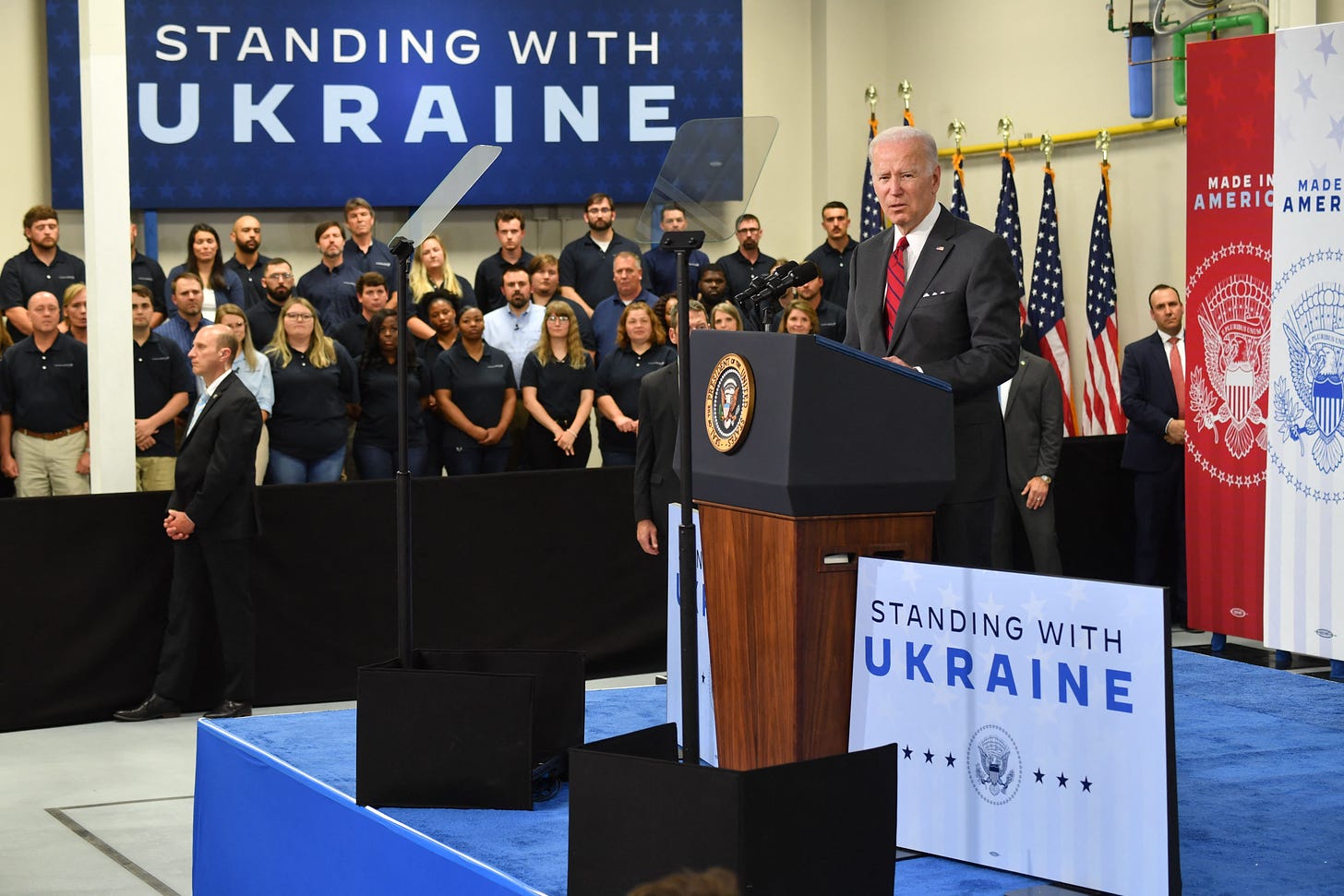
Joe Biden speaks about the conflict in Ukraine during a visit to Lockheed Martins’ Pike County Operations facility on May 3, 2022 (Photo: Nicholas Kamm/AFP via Getty Images)
By Glenn Greenwald | May 10, 2022
From the start of the Russian invasion of Ukraine on February 24, the Biden White House has repeatedly announced large and seemingly random amounts of money that it intends to send to fuel the war in Ukraine. The latest such dispatch of large amounts of U.S. funds, pursuant to an initial $3.5 billion fund authorized by Congress early on, was announced on Friday; “Biden says U.S. will send $1.3 billion in additional military and economic support to Ukraine,” read the CNBC headline. This was preceded by a series of new lavish spending packages for the war, unveiled every two to three weeks, starting on the third day of the war:
- Feb. 26: “Biden approves $350 million in military aid for Ukraine”: Reuters ;
- Mar. 16: “Biden announces $800 million in military aid for Ukraine”: The New York Times ;
- Mar. 30: “Ukraine to receive additional $500 million in aid from U.S., Biden announces”: NBC News;
- Apr. 12: “U.S. to announce $750 million more in weapons for Ukraine, officials say”: Reuters ;
- May 6: “Biden announces new $150 million weapons package for Ukraine”: Reuters.
Those amounts by themselves are in excess of $3 billion; by the end of April, the total U.S. expenditure on the war in Ukraine was close to $14 billion, drawn from the additional $13.5 billion Congress authorized in mid-March. While some of that is earmarked for economic and humanitarian assistance for Ukraine, most of it will go into the coffers of the weapons industry — including Raytheon, on whose Board of Directors the current Secretary of Defense, Lloyd Austin, sat immediately before being chosen by Biden to run the Pentagon. As CNN put it: “about $6.5 billion, roughly half of the aid package, will go to the US Department of Defense so it can deploy troops to the region and send defense equipment to Ukraine.”
As enormous as those sums already are, they were dwarfed by the Biden administration’s announcement on April 28 that it “is asking Congress for $33 billion in funding to respond to the Russian invasion of Ukraine, more than double the $14 billion in support authorized so far.” The White House itself acknowledges that the vast majority of that new spending package will go to the purchase of weaponry and other military assets: “$20.4 billion in additional security and military assistance for Ukraine and for U.S. efforts to strengthen European security in cooperation with our NATO allies and other partners in the region.”
It is difficult to put into context how enormous these expenditures are — particularly since the war is only ten weeks old, and U.S. officials predict/hope that this war will last not months but years. That ensures that the ultimate amounts will be significantly higher still.
The amounts allocated thus far — the new Biden request of $33 billion combined with the $14 billion already spent — already exceed the average annual amount the U.S. spent for its own war in Afghanistan ($46 billion). In the twenty-year U.S. war in Afghanistan which ended just eight months ago, there was at least some pretense of a self-defense rationale given the claim that the Taliban had harbored Osama bin Laden and Al Qaeda at the time of the 9/11 attack. Now the U.S. will spend more than that annual average after just ten weeks of a war in Ukraine that nobody claims has any remote connection to American self-defense.
Even more amazingly, the total amount spent by the U.S. on the Russia/Ukraine war in less than three months is close to the Russia’s total military budget for the entire year ($65.9 million). While Washington depicts Russia as some sort of grave and existential menace to the U.S., the reality is that the U.S. spends more than ten times on its military what Russia spends on its military each year; indeed, the U.S. spends three times more than the second-highest military spender, China, and more than the next twelve countries combined.
But as gargantuan as Biden’s already-spent and newly requested sums are — for a ten-week war in which the U.S. claims not to be a belligerent — it was apparently woefully inadequate in the eyes of the bipartisan establishment in Congress, who is ostensibly elected to serve the needs and interests of American citizens, not Ukrainians. Leaders of both parties instantly decreed that Biden’s $33 billion request was not enough. They thus raised it to $40 billion — a more than 20% increase over the White House’s request — and are now working together to create an accelerated procedure to ensure immediate passage and disbursement of these weapons and funds to the war zone in Ukraine. “Time is of the essence – and we cannot afford to wait,” House Speaker Nancy Pelosi said in a letter to House members, adding: “This package, which builds on the robust support already secured by Congress, will be pivotal in helping Ukraine defend not only its nation but democracy for the world.”
We have long ago left the realm of debating why it is in the interest of American citizens to pour our country’s resources into this war, to say nothing of risking a direct war and possibly catastrophic nuclear escalation with Russia, the country with the largest nuclear stockpile, with US close behind. Indeed, one could argue that the U.S. government entered this war and rapidly escalated its involvement without this critical question — which should be fundamental to any policy decision of the U.S. government — being asked at all.
This omission — a failure to address how the interests of ordinary Americans are served by the U.S. government’s escalating role in this conflict — is particularly glaring given the steadfast and oft-stated view of former President Barack Obama that Ukraine is and always will be of vital interest to Russia, but is not of vital interest to the U.S. For that reason, Obama repeatedly resisted bipartisan demands that he send lethal arms to Ukraine, a step he was deeply reluctant to take due to his belief that the U.S. should not provoke Moscow over an interest as remote as Ukraine (ironically, Trump — who was accused by the U.S. media for years of being a Kremlin asset, controlled by Putin through blackmail — did send lethal arms to Ukraine despite how provocative doing so was to Russia).
While it is extremely difficult to isolate any benefit to ordinary American citizens from all of this, it requires no effort to see that there is a tiny group of Americans who do benefit greatly from this massive expenditure of funds. That is the industry of weapons manufacturers. So fortunate are they that the White House has met with them on several occasions to urge them to expand their capacity to produce sophisticated weapons so that the U.S. government can buy them in massive quantities:
Top U.S. defense officials will meet with the chief executives of the eight largest U.S. defense contractors to discuss industry’s capacity to meet Ukraine’s weapons needs if the war with Russia continues for years.
Deputy Defense Secretary Kathleen Hicks told reporters Tuesday she plans to participate in a classified roundtable with defense CEOs on Wednesday to discuss “what can we do to help them, what do they need to generate supply”….
“We will discuss industry proposals to accelerate production of existing systems and develop new, modernized capabilities critical to the Department’s ongoing security assistance to Ukraine and long-term readiness of U.S. and ally/partner forces,” the official added.
On May 3, Biden visited a Lockheed Martin facility (see lead photo) and “praised the… plant that manufactures Javelin anti-tank missiles, saying their work was critical to the Ukrainian war effort and to the defense of democracy itself.”
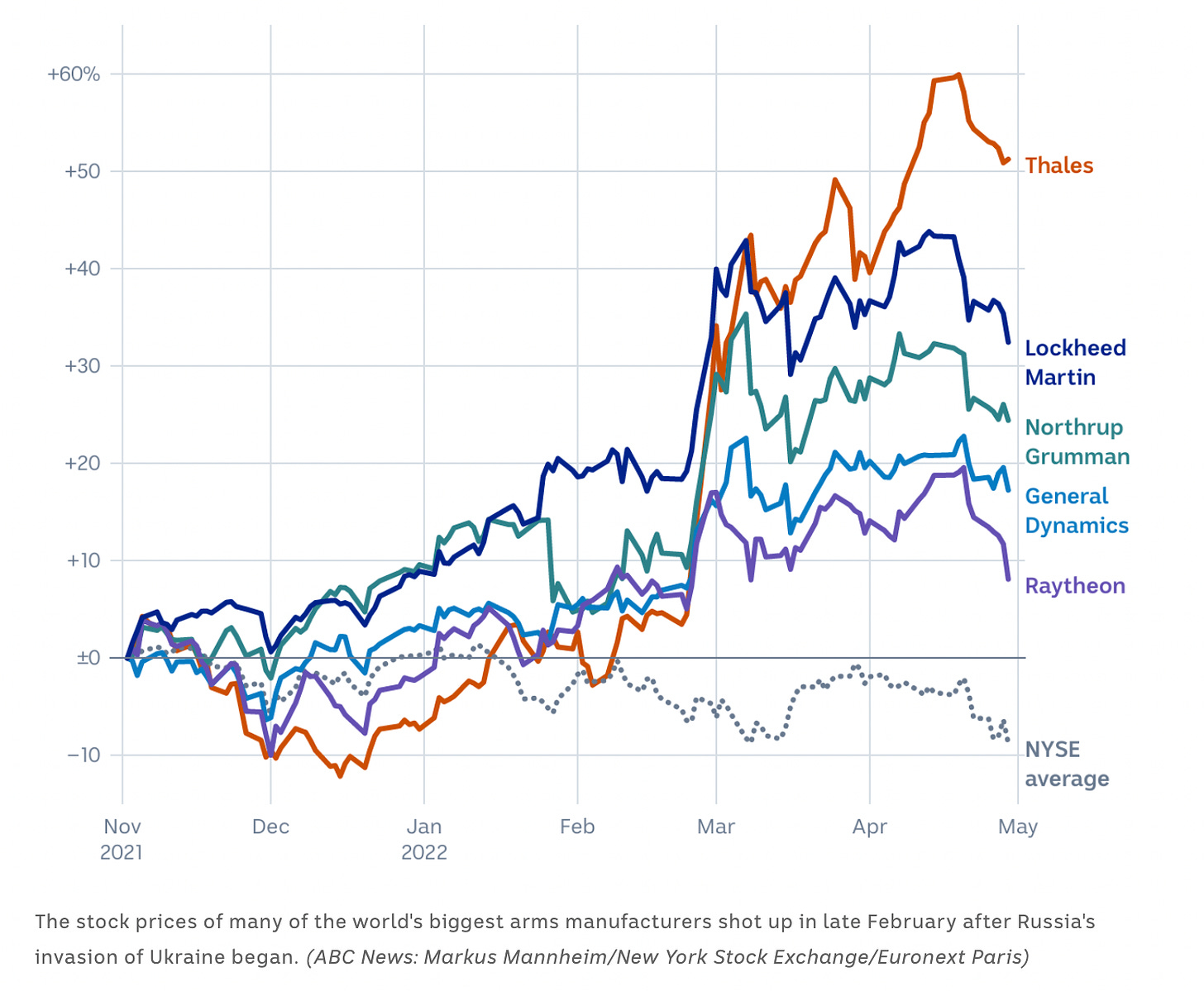
Indeed, by transferring so much military equipment to Ukraine, the U.S. has depleted its own stockpiles, necessitating their replenishment with mass government purchases. One need not be a conspiracy theorist to marvel at the great fortune of this industry, having lost their primary weapons market just eight months ago when the U.S. war in Afghanistan finally ended, only to now be gifted with an even greater and more lucrative opportunity to sell their weapons by virtue of the protracted and always-escalating U.S. role in Ukraine. Raytheon, the primary manufacturer of Javelins along with Lockheed, has been particularly fortunate that its large stockpile, no longer needed for Afghanistan, is now being ordered in larger-than-ever quantities by its former Board member, now running the Pentagon, for shipment to Ukraine. Their stock prices have bulged nicely since the start of the war:
But how does any of this benefit the vast majority of Americans? Does that even matter? As of 2020, almost 30 million Americans are without any health insurance. Over the weekend, USA Today warned of “the ongoing infant formula shortage,” in which “nearly 40% of popular baby formula brands were sold out at retailers across the U.S. during the week starting April 24.” So many Americans are unable to afford college for their children that close to a majority are delaying plans or eliminating them all together. Meanwhile, “monthly poverty remained elevated in February 2022, with a 14.4 percent poverty rate for the total US population… Overall, 6 million more individuals were in poverty in February relative to December.” The latest data from the U.S. Census Bureau found that “approximately 42.5 million Americans [are] living below the poverty line.” Americans with diabetes often struggle to buy life-saving insulin. And on and on and on.
Now, if the U.S. were invaded or otherwise attacked by another country, or its vital interests were directly threatened, one would of course expect the U.S. government to expend large sums in order to protect and defend the national security of the country and its citizens. But can anyone advance a cogent argument, let alone a persuasive one, that Americans are somehow endangered by the war in Ukraine? Clearly, they are far more endangered by the U.S. response to the war in Ukraine than the war itself; after all, a nuclear confrontation between the U.S. and Russia has long been ranked by the Bulletin of Atomic Scientists as one of the two greatest threats facing humanity.
One would usually expect the American left, or whatever passes for it these days, to be indignant about the expenditure of tens of billions of dollars for weapons while ordinary Americans suffer. But the American left, such that it exists, is barely visible when it comes to debates over the war in Ukraine, while American liberals stand in virtual unity with the establishment wing of the Republican Party behind the Biden administration in support for the escalating U.S. role in the war in Ukraine. A few stray voices (such as Noam Chomsky) have joined large parts of the international left in urging a diplomatic solution in lieu of war and criticizing Biden for insufficient efforts to forge one, but the U.S. left and American liberals are almost entirely silent if not supportive.
That has left the traditionally left-wing argument about war opposition to the populist right. “You can’t find baby formula in the United States right now but Congress is voting today to send $40 billion to Ukraine,” said Donald Trump, Jr. on Tuesday, echoing what one would expect to hear from the 2016 version of Bernie Sanders or the pre-victory AOC. “In the America LAST $40 BILLION Ukraine FIRST bill that we are voting on tonight, there is authorization for funds to be given to the CIA for who knows what and who knows how much? But NO BABY FORMULA for American mothers!,” explained Rep. Marjorie Taylor Greene (R-GA). Christian Walker, the conservative influencer and son of GOP Senate candidate Herschel Walker in Georgia, today observed: “Biden should go apply to be the President of Ukraine since he clearly cares more about them than the U.S.” Chomsky himself caused controversy last week when he said that there is only one statesman of any stature in the West urging a diplomatic solution “and his name is Donald J. Trump.”
Meanwhile, the only place where dissent is heard over the Biden administration’s war policy is on the 8:00 p.m. and 10:00 p.m. programs on Fox News, hosted, respectively, by Tucker Carlson and Laura Ingraham, who routinely demand to know how ordinary Americans are benefiting from this increasing U.S. involvement. On CNN, NBC, and in the op-ed pages of The New York Times and The Washington Post, there is virtually lockstep unity in favor of the U.S. role in this war; the only question that is permitted, as usual, is whether the U.S. is doing enough or whether it should do more.
That the U.S. has no legitimate role to play in this war, or that its escalating involvement comes at the expense of American citizens, the people they are supposed to be serving, provokes immediate accusations that one is spreading Russian propaganda and is a Kremlin agent. That is therefore an anti-war view that is all but prohibited in those corporate liberal media venues. Meanwhile, mainstream Democratic House members, such as Rep. Jason Crow (D-CO), are now openly talking about the war in Ukraine as if it is the U.S.’s own:
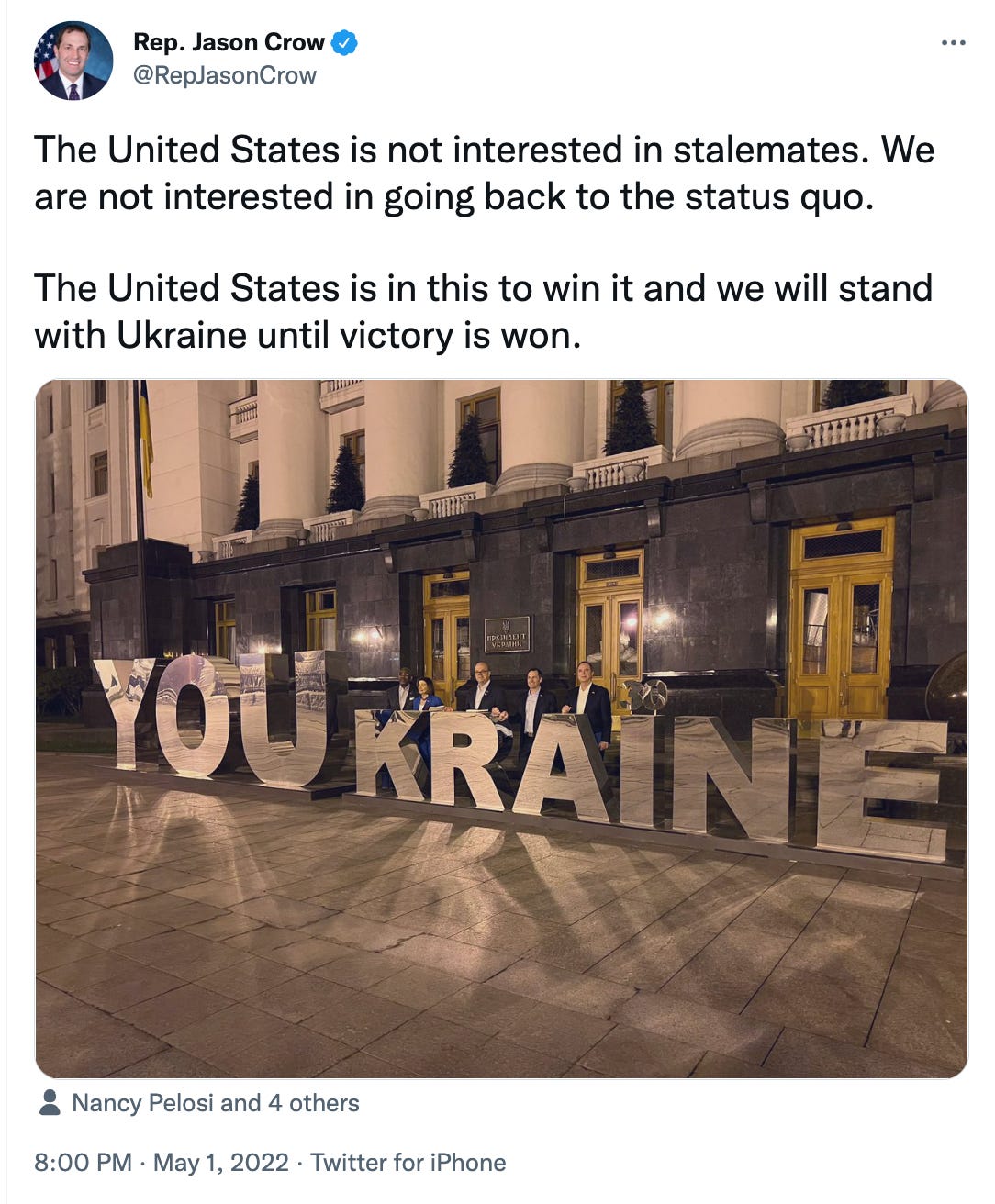
Whatever else is true, the claim with which we are bombarded by the corporate press — the two parties agree on nothing; they are constantly at each other’s throats; they have radically different views of the world — is patently untrue, at least when it comes time for the U.S. to join in new wars. Typically, what we see in such situations is what we are seeing now: the establishment wings of both parties are in complete lockstep unity, always breathlessly supporting the new proposed U.S. role in any new war, eager to empty the coffers of the U.S. Treasury and transfer it to the weapons industry while their constituents suffer.
One can believe that Russia’s invasion of Ukraine is profoundly unjust and has produced horrific outcomes while still questioning what legitimate interests the U.S. has in participating in this war to this extent. Even if one fervently believes that helping Ukrainians fight Russia is a moral good, surely the U.S. government should be prioritizing the ability of its own citizens to live above the poverty line, have health insurance, send their kids to college, and buy insulin and baby formula.
There are always horrific wars raging, typically with a clear aggressor, but that does not mean that the U.S. can or should assume responsibility for the war absent its own vital interests and the interests of its citizens being directly at stake. In what conceivable sense are American citizens benefiting from this enormous expenditure of their resources and the increasing energy and attention being devoted by their leaders to Ukraine rather than to their lives and the multi-pronged deprivations that define it?
Featured Video
Chinese jet fuel and the myth of energy independence
or go to
Aletho News Archives – Video-Images
From the Archives
The Dirty Little Secret behind the “Global Terrorism Index”
The Omission of Israeli Terrorism in the Occupied Palestinian Territories
By Karin Brothers | Global Research | December 6, 2014
… The Israeli settlements — all of which are illegal – have been identified as a major impediment to peace. The refusal of a major “global” terrorism report to name the Israeli settlers as one of the groups most responsible for terrorism not only misrepresents a major source of regional violence but exposes the Global Terrorism Index as a propaganda tool that supports a U.S. agenda.
In recent years, governments have been attempting to thwart terrorism by blocking supportive fund-raising. When it comes to Israeli settlements, however, the US and Canada actually encourage fund-raising by giving organizations (such as Christian Friends of Israeli Communities (CFOIC) and the Jewish National Fund) financial support in the form of donor tax-deductions.
Charities which provide funds for the Israeli settlements should be regarded as terror-financing organizations. They should not only lose their tax-deductible status, but they should be banned because they support the violation of international humanitarian law. The terror-financing laws that are being strictly enforced for Muslim charities should be applied to Christian and Jewish charities as well. … Read full article
Blog Roll
 Aletho News
- Chinese jet fuel and the myth of energy independence
- Ukraine Sea Drone Fired From Libya Hit Russian Tanker in Mediterranean
- IRGC: Iranian forces launched no attacks during ceasefire hours
- Trump Administration Moves To Automate U.S. Military Draft Registration
- Spain orders reopening of Tehran embassy, condemns Israel’s carpet bombing of Lebanon
- Israel faces ‘unsustainable’ strategic crisis following 40-day war against Iran: Analyst
- Iran restricts Hormuz access to 15 vessels per day under ceasefire terms: Report
- The ‘Opposition Party’ Has Done Nothing to Stop the Iran War and Much to Goad Trump Into Continuing It
- Moscow backs Tehran on status of Lebanon in US-Iran deal
- How UK Regulator Ofcom Quietly Bypassed International Law to Police American Speech
- If Americans Knew
- Amnesty: Urgent – Protect Lebanese civilians from brutal escalation in Israeli attacks
- Is The War Against Iran Over?
- Inside the Israeli army’s propaganda wing
- Hundreds of Gaza Amputees Stranded in Legal Limbo
- The gallows law: Israel moves toward executing Palestinian children
- Tucker Carlson: The Path to Peace requires ending ‘special alliance’ with Israel
- This is ceasefire? Israel’s biggest massacre yet in Lebanon, another journalist killed in Gaza – Daily Update
- Tucker Carlson on Israel: This Is the Behavior of an Ally? Really?
- Gazans face a triple crisis: severe shortages of water and bread, healthcare in tatters
- NY Times reports how Netanyahu took the US into Iran War
- No Tricks Zone
- An Inconvenient Tree: Uncovered In Alps… Europe Much Warmer Than Today 6000 Years Ago
- New Study Reports A 60% Slowdown In Greenland’s Ice Loss Rate In The Last Decade
- Low Intensity Tornado Wrecks Major Solar Farm, Creating A Potential Toxic Dump
- New Study Finds Warming Saves Lives…Cold Temperatures 12 Times More Deadly Than Excess Heat
- German Science Blog Accuses PIK Climate Institute Of Hallucinating Climate Tipping Points
- Devastating Assessment Of Comirnaty Vaccine By Former Senior Pfizer Europe Toxicologist
- New Study: CO2 Is ‘Effectively Negligible’ As An Explanatory Climate Change Factor Since 2000
- Former Pfizer Toxicologist Dr. Helmut Sterz Tells Bundestag Hearing Pfizer Vaccine Should Have Never Been Approved
- Energy Expert: Germany’s Nuclear Phaseout Was A “500 Billion Euro Mistake”
- New Research: South Australia’s Mid-Holocene Sea Surface Temperatures Were 4°C Warmer Than Today
 Aletho News