Kiev may soon increase firewood exports to the EU to help the bloc deal with energy shortages brought about by soaring gas prices, the head of Ukraine’s Analysis and Strategy Center, Igor Chalenko, says.
“Firewood is, undoubtedly, an interesting commodity for exports, especially for the European Union’s market. In this heating season, they fall short by 70 billion cubic meters to cover their needs until the Nord Stream 2 gas pipeline gets up and running,” Igor Chalenko told a press conference this week.
While Ukraine is among the continent’s top 10 forest-rich states, “the EU is considering firewood as an energy product,” Chalenko said, adding that the current situation with forest felling in western Ukraine is dire, but that Kiev may nevertheless soon lift the ban on massive timber exports to Europe for additional profits.
“The moratorium’s removal is a condition for Ukraine to receive a 600-million-euro tranche from the European Commission. Accordingly, our export of timber in all positions can only increase,” Chalenko said. He added that the step could badly affect the country’s timber processing industry, which has shown significant growth in recent years.
Authorities in Kiev signaled that they intend to lift the current moratorium on timber exports to the EU earlier in October, calling it a “trade irritant.” However, in order to do so, Ukraine intends to create a transparent timber trade system, introducing fines for illegal forest felling and the purchase of illegal timber from Ukraine by European companies.
Ukraine has experienced a shortage of firewood due to energy price hikes. Firewood prices in the country have jumped recently from 50% to 200%, Chalenko said.
Combined with the shortage of coal and gas, Ukraine itself might face serious problems in the current heating season, including sweeping blackouts and an increase in tariffs for both households and industry.
According to Mikhail Volynets, the head of the country’s miners’ union, there are 565,000 tons of coal in the warehouses of thermal power plants, which is 88,000 less than the country needs. Natural gas reserves in Ukraine’s storage facilities stand at 18.8 billion cubic meters, 9.4 billion cubic meters less than last year. And with Russia’s decision to stop deliveries of thermal coal to Ukraine from November 1, Volynets says the prospect is far from optimistic.
Mortality data tells us information about deaths in Australia and is usually released every 6 weeks. For an unexplained reason, the latest data is over 15 weeks overdue.
As Government becomes more and more powerful, anyone who challenges the current policies is smeared and censored. The legacy media happily parrots the propaganda, afraid of losing government funding.
Unreliable, intermittent wind and solar energy will leave Australian families sitting in the dark without coal-fired power to back them. ‘Renewables’ only farm taxpayer money, not energy.
Joanna Lumley has said that a return to rationing could help solve the climate crisis. The 75 year-old actress said that eating meat and travelling could be rationed to save the planet.
Speaking to Radio Times Lumley said:
“These are tough times and I think there’s got to be legislation. That was how the war was and at some stage we might even have to go back to some kind of rationing, where you’re given a certain number of points and it’s up to you how to spend them – whether it’s buying a bottle of whisky or flying in an aeroplane.”
She said that people could be compelled to cut back on weekend breaks abroad and to move to a plant based diet:
“Perhaps people have got to think a bit harder. Maybe more of our holidays should be at home or taking trains, and not hopping on a plane to Magaluf for the weekend.
I don’t get ill because I’m vegetarian. I still have plenty of energy. I am absolutely fine, I gave up meat 45 years ago.”
When you frame any problem, whether real or imagined as a war, you can justify almost anything right? Remember all that “workers on the front line” nonsense at the beginning of the scamdemic? Remember “the war on covid?”
Didn’t I say last year, that climate lockdowns would be a thing? I said that Sunday driving would be rationed as well as certain foods. This will tie in with the social credit system of course.
Not reducing your meat consumption, your travel, your overall carbon footprint ultimately, will eventually be seen as treachery.
Against the background of a European gas crisis, Ukrainian President Volodymyr Zelensky’s decision to give Russia extra transit capacity at a discounted rate is the correct choice, but Kiev took far too long to make the offer.
That’s according to Viktor Medvedchuk, chairman of the Political Council of Opposition Platform – For Life, the country’s largest opposition party. He is currently under house arrest, after being accused by the authorities of high treason and “aiding terrorism.” The politician says the criminal charges against him are trumped-up.
In an interview posted on his faction’s website, Medvedchuk agreed that Zelensky’s belated offer to increase the amount of gas running through the country’s pipes is the right thing to do. The president’s offer was extended not only to Russia but all countries wishing to use Ukraine’s infrastructure.
“It is very good, I think, that finally President Zelensky and his entourage have understood that our pipelines have enormous opportunities,” Medvedchuk said. “The proposal to increase the pumping through our pipelines by 50% is absolutely correct.”
On Sunday, the state-run Ukrainian gas company Naftogaz revealed that the company is ready to provide additional transit of up to 55 billion cubic meters of gas per year at a 50% discount, which would significantly reduce the cost for Russia. Moscow currently pays billions of dollars in fees to Kiev for transiting natural gas through Ukraine.
The lower offer comes as Naftogaz seeks to compete with the Nord Stream 2 gas pipeline. The controversial project was completed last month but is not yet operational. It directly connects Germany to Russia via the Baltic Sea, allowing Moscow to send gas without transiting other countries.
As Nord Stream 2 is already complete, Zelensky’s proposal is now long overdue, Medvedchuk believes.
“Today, Russia seems to be interested in launching Nord Stream 2 and not in increasing the amount of gas pumping through Ukraine’s transportation system,” the opposition leader said. “But we must come to an agreement, and we must make an offer. We must look for common opportunities for the development of trade and economic relations.”
Climate change activists from ‘Extinction Rebellion’ who are actually furthering the establishment narrative on climate change expressed shock that they weren’t in prison despite repeatedly blocking major roads and causing accidents.
Gee, I wonder.
61 campaigners from Insulate Britain, an offshoot of Extinction Rebellion, blocked three major roads in London yet again today and again faced angry condemnation from the general public.
They plan to continue the action ahead of the upcoming Cop26 climate change summit in Scotland, at which world leaders will gather to push the very same alarmist global warming rhetoric that they amplify.
Activists expressed shock that the government and the police have allowed them to get away with causing chaos for the past two months, including serious traffic accidents.
“Climate protest group Insulate Britain has revealed its “absolute disbelief” that its members have been allowed to repeatedly disrupt the motorway network, saying it had originally expected its campaign of direct action to last just two days,” reports the Guardian.
“As the group prepares for a fresh wave of protests this week, organisers admit they are baffled over why the police have effectively allowed them to keep closing major routes.”
A spokesperson for the group said, “We assumed that we would not be allowed to carry on disrupting the motorway network to the extent that we have been. We thought that people would basically be in prison.”
Activists previously thanked police for treating them kindly, in contrast to anti-lockdown protesters who are routinely abused by riot cops.
The answer as to why the protesters have faced kid gloves treatment is blatantly obvious.
Far from representing a “rebellion,” their actions are exactly in line with what establishment technocrats want – a global energy lockdown and a drastic reduction in living standards based on the hysteria of man-made climate change.
Insulate Britain protesters are lobbying for the precise system that is already being unrolled, they just want the government to make it even more onerous even more quickly.
The group is actually moving Britain closer to precisely what the establishment wants – a ‘green economy’ that will cause economic devastation, food shortages, energy rationing and climate lockdowns.
Just as police officers genuflected and fawned over Black Lives Matter rioters last summer, eco-activists are protected by the establishment because they are shock troops acting on behalf of the establishment.
A deleted government report exploring how to make the public alter its behavior to accept the new ‘green economy’ reveals how COVID-19 restrictions have created a population with a “deep set reverence” for authority and a “powerful tendency to conform.”
The report was inadvertently published by the British government before being hastily pulled down, but numerous journalists were able to retrieve its contents.
The document explored how to weaponize behavioral psychology to ‘nudge’ the public into supporting measures and adopting behavior without them explicitly knowing they’re being manipulated.
The investigation found that the same techniques the government used to force people into accepting lockdown could be used to make them change their lifestyles in the name of preventing climate change.
Under the heading “principles for successful behaviour,” the paper noted;
“Government statements, actions and laws powerfully shape perceptions of normative and acceptable behaviour. For instance, even with public criticism being high, many still perceived government approval as the yardstick for safe behaviour during COVID-19 ‘we’re allowed to do this now [so must be safe]…’. This reveals, for many, a deep set reverence for legitimate government authority, regardless of one’s personal political views.”
While PR stunts such as having officials vaccinated live on television worked to convince people of the narrative, elite hypocrisy (public officials violating lockdown rules) was found to cause significant damage to public trust.
“Perceived hypocrisy can do a lot to undermine efforts to build public engagement and support. This was observed during the COVID-19 pandemic when prominent authority figures broke guidelines, leading to measurable reductions in public compliance as well as shifting attitudes.”
“Green politics has similar deep-seated reputational issues with elite hypocrisy,” notes Breitbart. “A common feature of climate change summits has been high-profile attendees arriving by private or government jet, a disconnect between word and deed that seems unlikely to vanish in the near term.”
The paper concluded that people can be rather easily “nudged” into changing their behavior in response to government announcements and “have a powerful tendency to conform.”
The investigation also found that even if enforced changes to lifestyle are not wanted by the public, most tend to fall in line with the new status quo rather quickly anyway.
The report was prepared by the Behavioural Insights Team (BIT), a quasi-government body that was part of the effort to use “totalitarian” and “unethical” methods of instilling fear into the population as a means of scaring them into complying with lockdown rules.
A related group, the Scientific Pandemic Insights Group on Behaviours team, warned at the start of the first lockdown that a “substantial number of people still do not feel sufficiently personally threatened [by Covid-19].”
“The perceived level of personal threat needs to be increased among those who are complacent, using hard-hitting emotional messaging,” the group added, leading to numerous lurid propaganda campaigns that exaggerated the threat of COVID to bully the public into total submission.
In summary, the public is largely unthinking, compliant and docile and can be made to go along with just about anything so long as they’re bombarded with the right propaganda.
Brussels – European Commission President, Ursula von der Leyen, warns the EU’s energy crisis is hitting the poorest hardest and businesses are at risk of closing. EU officials say the 27-nation bloc could benefit from Iran’s vast energy reserves if US sanctions against the Islamic Republic are removed.
The weather is becoming more inclement in the EU and while temperatures are dropping, energy costs are soaring. The crisis has just been discussed in the European Parliament.
The main factors driving prices upwards are consumer demand after COVID-19 lockdown restrictions were eased and gas stockpiles were depleted last winter as it was particularly cold. Then we used a lot of electricity during a warmer than usual summer. Half of the gas used in the EU is imported from Russia. We raised the issue of alternative suppliers with the European Commission.
Question: “Is it the case that the EU would like to be getting more energy from Iran?”
The commission says US sanctions are impeding Iranian energy sales but that won’t be a problem if the JCPOA Iran nuclear deal can be brought back on track.
The EU could import liquefied natural gas from various places, such as the United States, but experts say it would not make sense.
Von der Leyen confirmed to the European Parliament on Wednesday that Russia has fully honored its energy contracts with the EU. She says Moscow has so far not increased supply. Energy consultants say the bloc will still need Russia’s gas for at least another 20 years.
While this dependency exists they suggest it would be prudent of the bloc to improve relations with Moscow.
Homes that switch to heat pumps risk being switched off for weeks at a time, according to a new paper from the Global Warming Policy Foundation. That’s because the government’s heat strategy fails to address the fundamental problem of intermittency.
According to the report’s author, Andrew Montford, without any means of storing electricity in bulk, grid managers will be forced to switch down appliances like heat pumps and EV chargers when the wind doesn’t blow. In a long wind lull, homes will have to be switched off entirely. Second-generation smart meters, currently being installed across the country, will allow the grid to control appliances remotely.
Montford explains that the technologies that are widely thought to help with intermittency are in fact only marginally useful: “We don’t have enough suitable pumped hydro sites, and batteries and hydrogen are far too expensive”, he says. “The only technology that can help us here are based around fossil fuels, and the government has ruled those out”.
Moreover, it is not just a wind lull that will mean appliances have to be switched off. The distribution grid, which moves electricity around at street level, was designed for much lower loads than will be necessary in a Net Zero world. That means when too many people require power, grid managers will again have to ration demand.
GWPF director, Dr Benny Peiser, says that the report is a warning to politicians: “Leaving families cold and in the dark will lead to some very unhappy constituents. It will not end well”.
The report, entitled Survival of the Richest: Smart Meters and Energy Rationing, can be downloaded here.
It is not only the UK that is thinking of switching green levies from electricity to gas.
But this analysis inadvertently highlights why the whole idea is so ludicrous:
In the UK, consumer prices for electricity are five times more expensive than for gas. It is a disincentive to adopt electric heat pumps. To make things harder, 23% of the electricity price comes from climate and social levies. It’s just 2% for gas. No wonder the UK continues to install about 1.7 million gas boilers a year. Jan Rosenow and Richard Lowes at RAP call for changes that will incentivise customers to buy heat pumps while having a minimal effect on their total bill or the revenues raised, according to their calculations. One way is to simply move the levies from electricity to gas. The Netherlands and Germany are planning to do just that. Sweden has done it for decades. But such changes require serious policy reform and may face political barriers. Much simpler would be to minimise taxes on the electricity consumed by a heat pump, as Denmark started doing this January. Despite heat pump sales rising, without a drastic change it’s difficult to see how the UK will reach its target of 600,000 new heat pumps per year – it’s only in the tens of thousands now.
Every year households in the UK install about 1.7 million gas boilers. In May, the Heating and Hotwater Industry Council reported that 2021 looks to be a record year for gas boiler sales, with year-to-date sales up 41 per cent from 2020. So far, low-carbon heating occupies a small — although growing — niche in the heating market.
One important factor supporting a booming boiler market is quite simple: Gas is cheap and electricity is expensive. Residential electricity prices per kilowatt hour are currently around five times higher than gas prices. This means that switching to a heat pump, even with an efficiency of 300 per cent, does not offer bill savings for customers on a standard tariff.
This is partly a political choice. Legacy policy costs drive part of the difference in price. Most of levy-funded energy and climate policies, which make up 23% of the total household bill, are presently paid for through electricity bills. In the UK, these legacy costs include charges for policies such as feed-in tariffs, the Energy Company Obligation, Contracts for Difference, the Renewables Obligation and the Warm Home Discount.
For a start, let’s get away from the misleading use of the term, levies and taxes, which are intended to distract attention from the truth.
Apart from the tiny Warm Homes Discount, all of these added costs are SUBSIDIES for renewable electricity. It is therefore perfectly logical that they should be included in the cost of electricity, so that the price reflects the cost of generation.
There is no logic in adding the cost of subsidies to the price of gas any more than adding them to the price of food or petrol.
In any event, the switch will make little difference to the relative cost of heat pumps. Subsidies currently cost domestic customers about 2.5p/KWh, a total of £2.6bn a year. This brings the electricity price up from 12.5p to 15.0p/KWh. (These figures are probably out of date now, but the comparison remains the same)
Annual domestic gas consumption is 300 TWh, so £2.6bn would equate to 0.9p/KWh, increasing gas prices from 2.5p to 3.4p/KWh.
In other words, electricity will still cost nearly four times as much as gas. With heat pumps working at 300% efficiency, that still means they will be more expensive to run.
In any event, the reason why barely anybody wants heat pumps has nothing to do with the running cost, as people have no idea what they cost to run. It is the fact that they will have to fork out £10,000 plus to install one, not to mention the cost and hassle of insulation and replacing radiators.
There is, however, one fatal flaw in the argument employed by the authors of this study. They claim that switching the subsidies to gas is a zero cost option. It may be in the short run, but eventually, when nobody uses gas anymore, the subsidies will have to revert to being added onto electricity bills.
Under that scenario, homeowners will have paid out £20000 for heat pumps, but will still have to pay the cost of subsidies on their electricity bills. In other words, a double whammy.
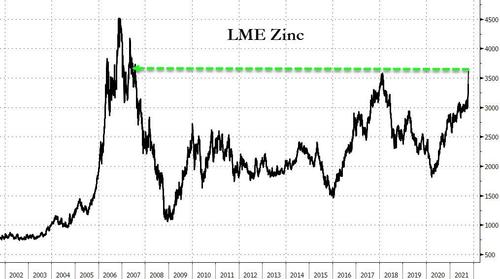
The energy crisis is bleeding into other parts of the commodity space, such as industrial metals, as smelters from Asia to Europe are knocked offline, resulting in a tightening supply with prices for zinc at 14-year highs.
Zinc jumped as much as 7% on the London Metal Exchange to the highest levels since 2007 after producer Nyrstar announced plans to halve output at three European smelters due to soaring energy prices.
“It is zinc’s turn” to surge as the energy crisis spreads through Europe and forces large-scale shutdowns or production cuts at smelters, said Jia Zheng, a trader with Shanghai Dongwu Jiuying Investment Management Co. She said soaring coal and natural gas prices have made power prices astronomically high and uneconomical for energy-intensive smelting plants to produce the industrial metal.
China has already curbed power to energy-intensive zinc and aluminum smelting plants amid an energy crunch fueled by record-high coal prices. In total, 20 Chinese provinces and regions making up more than 66% of the country’s GDP have announced some form of power cuts.
Industrial metal prices may stay high as the energy crisis continues to ravage Asia and Europe, researcher Shanghai Metals Market told clients in a note. According to the International Lead and Zinc Study Group, a surplus in global zinc will be whittled down in 2022 due to the latest production cuts.
“If production were to be reduced for any prolonged period, this would presumably have a massive impact on the zinc market, which would then no doubt be seriously undersupplied,” Daniel Briesemman, an analyst at Commerzbank, wrote in a note. “The price response certainly makes sense against this backdrop.”
The market is concerned about the industrial metal supply, reflected in a record high for the CRB BLS U.S. raw industrials spot index.
The tabloids have had a field day with the revelation that an Insulate Britain activist is married to a director of Transport for London (TfL). Cathy Eastburn of Insulate Britain has been busy trying to bring transport to a standstill. She has been arrested four times for acts such as blocking roads and gluing her hands to a train. Meanwhile, her husband, Benedict Plowden, is in charge of ‘getting London moving after the pandemic’.
The press is finally starting to realise that Britain’s green road-blockers are drawn from the upper echelons of society. The rag-tag crusties of Extinction Rebellion and Insulate Britain might present themselves as the political establishment’s opponents, but they have always been its bedfellows. Literally, in this case.
Not every green activist is married to a public-sector executive on £170,000 per year. But most do come from households that bring home many times the average family income. They come from a class of people for whom it is relatively easy to take activist sabbaticals. They can afford to pause their vegan yogurt-weaving workshops and take to the streets whenever it takes their fancy.
The class make-up of the green movement helps to explain why the police and courts have so much difficulty bringing an end to the disruption these activists cause. Were these protests populated by the lower orders, they would be cleared from the roads without hesitation. Those engaged in the protests would be charged, sentenced and put behind bars in short order. But the police and the courts are reluctant to use their powers against retired doctors, vicars and the grandchild of a baronet.
Green protesting has become a hobby of the leisured classes, drawing ‘nice’ people to it who present well in court. Their legal teams have the resources of billionaire-backed NGOs. Celebrity scientists fly across the Atlantic to give evidence in their defence. MPs and journalists intervene, declaring it a travesty that such well-meaning people are being tried as criminals. Of course there is no equivalent sympathy for the ordinary people whose lives are being disrupted and who are prevented from working.
Ordinary people need to be able to get to work. Society needs them to get to work. That’s why the police and the courts are usually expected to facilitate this. Benedict Plowden’s job at TfL is supposed to facilitate this, too. Yet Plowden, like his wife, has a long history of trying to stop people from getting from A to B.
Before joining TfL on a hefty salary, Plowden was director of the anti-car Pedestrians Association, which was later renamed Living Streets. It styles itself as ‘the UK charity for everyday walking’.
In fact, plenty of one-time anti-road anarchists from the 1990s have somehow made it as well-paid suits in the 2020s. Green activists have been turned from Swampies into civil-service bosses, instituting elite green ideology within our institutions. Plowden and Eastburn’s marriage, then, is not quite so bizarre as it seems.
TfL may not quite be signed up to every Extinction Rebellion pledge. But despite being in charge of keeping London moving, it is forever designing new policies to prevent Londoners from driving anywhere. Green ideology comes ahead of the transport needs of Londoners.
There is little difference between the street-level green activist and the establishment environmentalist – and not just because they sometimes snuggle up together at night. We might expect important public officials to serve the public’s needs and wants but, like the green activists on the streets, they are more interested in constraining us.
This item appeared in the Wall Street Journal’s daily 10-point guide to the top stories yesterday.
It goes to the heart of the energy crisis:
Large swings in energy markets are nothing new. Because demand is so inelastic, even small changes in either supply or demand can cause big price changes.
We saw similar price spikes in the oil and gas markets in the years leading up to the 2008 financial crash. Indeed, it was arguably those price rises which triggered the crash. The cause of these rises was the increased demand from Asia, as China and other economies there began their rapid growth, thus increasing demand for energy.
Normally the energy market reacts by increasing capital spending to increase output. After 2008, it did just that, and, as tends to happen, the market swung the other way with surplus production and prices falling to economically unviable levels a few years ago.
However, this time around energy companies appear to be more reluctant to commit to new investment, as the WSJ notes, thanks to a combination of shareholder and government pressure, share buybacks and the easy money to be had from heavily subsidised renewable energy.
We have a similar situation in the UK and Europe, with companies like Shell keen to move away from oil and gas, along with political pressure to block North Sea oil development.
It is absolutely clear that, despite climate policies and renewable energy, global demand for fossil fuels will remain high, and probably increase, for at least the next decade. But if new investment does not come forward to maintain output levels, energy markets will become tighter still, driving up prices to crisis levels.
The knock on effect this will have on the world’s economy could be frightening.
By GARETH PORTER | CounterPunch | February 27, 2013
“Going to Tehran” arguably represents the most important work on the subject of U.S.-Iran relations to be published thus far.
Flynt Leverett and Hillary Mann Leverett tackle not only U.S. policy toward Iran but the broader context of Middle East policy with a systematic analytical perspective informed by personal experience, as well as very extensive documentation.
More importantly, however, their exposé required a degree of courage that may be unparalleled in the writing of former U.S. national security officials about issues on which they worked. They have chosen not just to criticise U.S. policy toward Iran but to analyse that policy as a problem of U.S. hegemony. … continue
This site is provided as a research and reference tool. Although we make every reasonable effort to ensure that the information and data provided at this site are useful, accurate, and current, we cannot guarantee that the information and data provided here will be error-free. By using this site, you assume all responsibility for and risk arising from your use of and reliance upon the contents of this site.
This site and the information available through it do not, and are not intended to constitute legal advice. Should you require legal advice, you should consult your own attorney.
Nothing within this site or linked to by this site constitutes investment advice or medical advice.
Materials accessible from or added to this site by third parties, such as comments posted, are strictly the responsibility of the third party who added such materials or made them accessible and we neither endorse nor undertake to control, monitor, edit or assume responsibility for any such third-party material.
The posting of stories, commentaries, reports, documents and links (embedded or otherwise) on this site does not in any way, shape or form, implied or otherwise, necessarily express or suggest endorsement or support of any of such posted material or parts therein.
The word “alleged” is deemed to occur before the word “fraud.” Since the rule of law still applies. To peasants, at least.
Fair Use
This site contains copyrighted material the use of which has not always been specifically authorized by the copyright owner. We are making such material available in our efforts to advance understanding of environmental, political, human rights, economic, democracy, scientific, and social justice issues, etc. We believe this constitutes a ‘fair use’ of any such copyrighted material as provided for in section 107 of the US Copyright Law. In accordance with Title 17 U.S.C. Section 107, the material on this site is distributed without profit to those who have expressed a prior interest in receiving the included information for research and educational purposes. For more info go to: http://www.law.cornell.edu/uscode/17/107.shtml. If you wish to use copyrighted material from this site for purposes of your own that go beyond ‘fair use’, you must obtain permission from the copyright owner.
DMCA Contact
This is information for anyone that wishes to challenge our “fair use” of copyrighted material.
If you are a legal copyright holder or a designated agent for such and you believe that content residing on or accessible through our website infringes a copyright and falls outside the boundaries of “Fair Use”, please send a notice of infringement by contacting atheonews@gmail.com.
We will respond and take necessary action immediately.
If notice is given of an alleged copyright violation we will act expeditiously to remove or disable access to the material(s) in question.
All 3rd party material posted on this website is copyright the respective owners / authors. Aletho News makes no claim of copyright on such material.





 Aletho News