The Green Agenda or How This Energy Crisis is Different from All Others

By F. William Engdahl – New Eastern Outlook – 11.10.2021
The price of energy from all sources conventional is exploding globally. Far from accidental, it is a well-orchestrated plan to collapse the industrial world economy that has already been weakened dramatically by almost two years of ridiculous covid quarantine and related measures. What we are seeing is a price explosion in key oil, coal and now especially, natural gas energy. What makes this different from the energy shocks of the 1970s is that this time, it is developing as the corporate investment world, using the fraudulent ESG green investment model, is dis-investing in future oil, gas and coal while OECD governments embrace horrendously inefficient, unreliable solar and wind that will insure the collapse of industrial society perhaps as early as the next months. Barring a dramatic rethinking, the EU and other industrial economies are willfully committing economic suicide.
What only a few years ago was accepted as obvious was that ensuring an abundant, reliable, efficient and affordable energy defines the economy. Without efficient energy we cannot make steel, concrete, mine raw materials or any of the things that support our modern economies. In the past months the world price of coal for power generation has doubled. The price of natural gas has risen by almost 500%. Oil is headed to $90 a barrel, highest in seven years. This is a planned consequence of what is sometimes called the Davos Great Reset or the Green Agenda zero carbon madness.
Some two decades ago Europe began a major shift to mis-named renewables or Green Energy, mainly solar and wind. Germany, the heart of EU industry, led the transformation with former chancellor Merkel’s ill-conceived Energiewende, where Germany’s last nuclear power plants will close in 2022 and coal plants are rapidly being phased out. This all has now collided with the reality that Green Energy is not at all able to deal with major supply shortages. The crisis was entirely predictable.
Green Chickens Come Home to Roost
With the widespread covid lockdowns of industry and travel in 2020 EU natural gas consumption fell dramatically. The largest EU gas supplier, Gazprom of Russia, in interest of an orderly long-term market, duly reduced its deliveries to the EU market even at a loss. An unusually mild 2019-2020 winter allowed EU gas storage to reach maximum. A long, severe winter all but erased that in 2021.
Contrary to EU politicians’ claims, Gazprom has not played politics with the EU to force approval of its new NordStream 2 gas pipeline to Germany. As EU demand resumed in the first six months of 2021, Gazprom rushed to meet it and even exceed record 2019 levels, and even at the expense of replenishing Russian gas storage for the coming winter.
With the EU now firmly committed to a Green Energy agenda, Fit for 55, and explicitly rejecting natural gas as a long-term option, while at the same time killing coal and nuclear, the incompetence of the think-tank climate models that justified a 100% CO2-free, electric society by 2050 has come home to roost.
Because financial investors on Wall Street and London saw the benefit of huge profits from the Green energy agenda, working with the Davos World Economic Forum to promote the laughable ESG investing model, conventional oil, gas and coal companies are not investing profits in expanded production. In 2020 worldwide spending on oil, gas, coal dropped by an estimated $1 trillion. That is not coming back.
With BlackRock and other investors all but boycotting ExxonMobil and other energy companies in favor of “sustainable” energy, one exceptionally cold and long winter in Europe and a record lack of wind in northern Germany, triggered a panic buying of gas on world LNG Markets in early September.
The problem was the restocking was too late, as most available LNG from the USA, Qatar and other sources that normally would be available had already been sold to China where an equally confused energy policy, including a political ban on Australian coal, has led to plant closings and a recent government order to secure gas and coal “at any cost.” Qatar, US LNG exporters and others have flocked to Asia leaving the EU in the cold, literally.
Deregulation of Energy
What few understand is how today’s Green energy markets are rigged to benefit speculators like hedge funds or investors like BlackRock or Deutsche Bank and penalize energy consumers. The headline prices for natural gas traded in Europe, the Dutch TTF futures contract, is sold by the London-based ICE Exchange. It speculates on what future wholesale natural gas prices in the EU will be in one, two or three months hence. The ICE is backed by Goldman Sachs, Morgan Stanley, Deutsche Bank and Société Générale among others. The market is in what are called gas futures contracts or derivatives.
Banks or others can speculate for pennies on the dollar, and when news broke on how low EU gas storage for the coming winter were, financial sharks went on a feeding frenzy. By early October futures prices for Dutch TTF gas had exploded by an unprecedented 300% in only days. Since February it is far worse, as a standard LNG cargo of 3.4 trillion BTU (British Thermal Units) now costs $100-120 million, while at the end of February its cost was less than $20 million. That’s a 500-600% rise in seven months.
The underlying problem is that, unlike the case for most of the postwar period, since the political promotion of unreliable and high-cost solar and wind “renewables” in the EU and elsewhere (e.g. Texas, February 2021) electric utility markets and their prices have been deliberately deregulated to promote Green alternatives and force out gas and coal on the dubious argument that their CO2 emissions endanger the future of humankind if not reduced to zero by 2050.
The prices borne by the end consumer are set by the energy suppliers who integrate the different costs under competitive conditions. The diabolical way EU electricity costs are computed, allegedly to encourage inefficient solar and wind and discourage conventional sources, is that, as French energy analyst Antonio Haya put it, “the most expensive plant of those needed to cover demand (marginal plant) sets the price for each hour of production for all the production matched in the auction.” So today’s natural gas price sets the price for essentially zero cost hydro-electric electricity. Given the soaring price for natural gas, that is defining EU electricity costs. It’s a diabolical pricing architecture that benefits speculators and destroys consumers, including households and industry.
A fundamental aggravating cause for the recent shortages of abundant coal, gas and oil is the decision by BlackRock and other global money trusts to force investment away from oil, gas or coal—all perfectly safe and necessary energy sources—to buildup of grossly inefficient and unreliable solar or wind. They call it ESG investing. It is the latest rage on Wall Street and other world financial markets ever since BlackRock CEO Larry Fink joined the Board of the Klaus Schwab World Economic Forum in 2019. They set up front ESG certifying companies that award ESG “politically correct” ratings on stock companies, and punishing those who do not comply. The rush into ESG investing has made billions for Wall Street and friends. It has also put the brakes on future development of oil, coal or natural gas for most of the world.
The ‘German Disease’
Now after 20 years of foolish investment into solar and wind, Germany, the once-flagship of EU industry, is a victim of what we can call the German Disease. Like the economic Dutch Disease, the forced investment into Green Energy has resulted in the lack of reliable affordable energy. All for an unproven 1.5C claim of IPCC that is supposed to end our civilization by 2050 if we fail to reach Zero Carbon.
To advance that EU Green Energy agenda, country after country with a few exceptions have begun dismantling oil, gas and coal and even nuclear. Germany’s last remaining nuclear plants will permanently close next year. New coal plants, with latest state-of-art scrubbers, are being scrapped even before being started.
The German case gets even more absurd.
In 2011 the Merkel government took an energy model developed by Martin Faulstich and the state Advisory Council on the Environment (SRU) which claimed that Germany could attain 100% renewable electricity generation by 2050. They argued that using nuclear longer would not be necessary, nor the construction of coal-fired plants with carbon capture and storage (CCS). With that, Merkel’s catastrophic Energiewende was born. The study argued, it would work because Germany could contract to buy surplus, CO2-free, hydro-electric power from Norway and Sweden.
Now with extreme drought and a hot summer, the hydropower reserves of Sweden and Norway are dangerously low coming into winter, only 52% of capacity. That means the electric power cables to Denmark, Germany and now UK are in danger. And to make it worse, Sweden is split on shutting its own nuclear plants which give it 40% of electricity. And France is debating cutting as much as one-third of its clear nuclear plants meaning that source for Germany will also not be sure.
Already on January 1, 2021 because of a German government mandated coal phase-out, 11 coal-fired power plants with a total capacity of 4.7 GW were shut down. It lasted only 8 days when several of the coal plants had to be reconnected to the grid due to a prolonged low-wind period. In 2022 the last German nuclear plant will shut and more coal plants will permanently close, all for the green nirvana. In 2002 German nuclear power was source for 31% of power, carbon-free electric power.
As for wind power making up the deficit in Germany, in 2022 some 6000 wind turbines with an installed capacity of 16 GW will be dismantled due to the expiration of feed-in subsidies for older turbines. The rate of new wind farm approvals is being blocked by growing citizen rebellion and legal challenges to the noise pollution and other factors. An avoidable catastrophe is in the making.
The response from the EU Commission in Brussels, rather than admit the glaring flaws in their Green Energy agenda, has been to double down on it as if the problem were natural gas and coal. EU Climate Czar Frans Timmermans absurdly declared, “Had we had the green deal five years earlier, we would not be in this position because then we would have less dependency on fossil fuels and natural gas.”
If the EU continues with that suicidal agenda, it will find itself in a deindustrialized wasteland in a few short years. The problem is not gas, coal or nuclear. It is the inefficient Green Energy from solar and wind that will never be able to offer stable, reliable power.
The Green Energy Agenda of the EU, US and other governments along with the Davos-promoted ESG investing will only guarantee that as we go forward there will be even less gas or coal or nuclear to fall back on when the wind stops, there is a drought in hydroelectric dams or lack of sunshine. It doesn’t take a rocket scientist to realize this is a road to economic destruction. But that’s in fact the goal of the UN 2030 “sustainable” energy or the Davos Great Reset: population reduction on a massive scale. We humans are the frogs being slowly boiled. And now the Powers That Be are really turning the heat up.
Cultural Warfare in the 20th Century: How Western Civilization Came Undone
By Matthew Ehret | Strategic Culture Foundation | October 9, 2021
In my last article “Guterres and the Great Reset: How Capitalism Became a Time Bomb”, I made the case that the time bomb justifying a Great Reset of civilization was set into motion over 50 years ago. In that location, we were introduced to a cast of characters surrounding the World Economic Forum and Trilateral Commission who played instrumental roles in bringing about a controlled disintegration of western civilization.
Despite the fact that this un-natural transformation occurred over the dead bodies of great statesmen of the 1960s, a question still lingers: HOW did the western nations… especially the United States, so deeply shaped by a love of freedom, wilfully relinquish its democratic institutions in favor of a new system of supranational governance and de-growth? How did the very people who were targeted for destruction not only let this happen but in some cases even aide and abet the perpetrators?
Epistemological Warfare in America
Here it helps to look to the writings of an imperial grand strategist who is too often championed as a defender of freedom: Aldous Huxley.
While Aldous’ brother Julian was reshaping the global paradigm by re-packaging eugenics under several new costumes post-1945, Aldous’ creative juices were driven entirely by his role as a cultural warrior.
Grand children of Thomas Huxley who was commissioned to re-organize the British Empire in the late 1850s, both grandchildren vigorously embraced the family business working closely with the elite Bloomsbury Group of Bertrand Russell, and John Maynard Keynes between 1914-1937.
Among these creative misanthropes, Lord Bertrand Russell (another celebrated pacifist) had gone far in outlining the sort of bone chilling ideal that Darwinian laws of evolution demanded be humanity’s destiny under a scientifically managed priesthood. In his 1930 Scientific Outlook, Russell stated:
“The scientific rulers will provide one kind of education for ordinary men and women, and another for those who are to become holders of scientific power. Ordinary men and women will be expected to be docile, industrious, punctual, thoughtless, and contented. Of these qualities probably contentment will be considered the most important. In order to produce it, all the researchers of psycho-analysis, behaviourism, and biochemistry will be brought into play…. All the boys and girls will learn from an early age to be what is called `co-operative,’ i.e., to do exactly what everybody is doing. Initiative will be discouraged in these children, and insubordination, without being punished, will be scientifically trained out of them.”
“Except for the one matter of loyalty to the world state and to their own order, members of the governing class will be encouraged to be adventurous, and full of initiative. It will be recognized that it is their business to improve scientific techniques and to keep the manual workers contented by means of continual new amusements”.
Huxley would have Russell’s thesis firmly in mind when he began writing his Brave New World in 1931.
Aldous Goes to Work
Having set up his base of operations in Hollywood in 1937, Aldous lived out his days in the USA writing scripts for Hollywood, exploring psychotropic drugs and coordinating a new cultural movement that would soon overtake the youth growing up amidst the insanity of the Cold War.
In an infamous 1962 speech titled “The Ultimate Revolution”, Aldous Huxley outlined the principles of this new science of governance telling adoring fans amidst the wannabe alphas in the Berkeley auditorium:
“If you are going to control any population for any length of time, you must have some measure of consent. It’s exceedingly difficult to see how pure terrorism can function indefinitely. It can function for a fairly long time, but I think sooner or later you have to bring in an element of persuasion, an element of getting people to consent to what is happening to them. Well, it seems to me that the nature of The Ultimate Revolution with which we are now faced is precisely this: That we are in process of developing a whole series of techniques, which will enable the controlling oligarchy who have always existed and presumably always will exist, to get people, actually, to love their servitude.”
Getting people to love their servitude would be made possible by an array of new techniques outlined in both Huxley’s fiction and non-fiction writings and put into motion by the hard work of CIA-funded laboratories working under secretive umbrella of Allan Dulles’ MK Ultra. Utilizing many techniques pioneered by Nazi psychiatrists in WWII, one of the primary objectives of MK Ultra was to deconstruct the human psyche using a mix of electroshock therapy, psychotropic drugs and other conditioning in order to reconstruct personalities from scratch by professional psychiatrists. As Naomi Klein demonstrated in her famous book The Shock Doctrine, the idea behind MK Ultra was always to extend these behavioral techniques to reprogramming entire groups, societies and nations.
Within Huxley’s Brave New World, psychotropic drugs (soma), cultural norms driven by pre-adolescent sensualism, constant Tinder-esque sexual escapades, the disintegration of family units and hyper-sensualized entertainment (dubbed “feelies”) did the job nicely. Huxley’s dystopia featured a society which had successfully evolved to become a total oligarchy with a scientific priesthood managing the test tube babies bio engineered to become alphas, betas, gammas or the lowly toilet cleaning epsilons reminiscent of the sub-human Morlocks described in H.G. Wells’ earlier Time Machine. In Huxley’s world, family units have long since disintegrated with the nation state and any belief in God.
In his 1958 Brave New World Revisited, Aldous decries the ultimate evil caused by faith in scientific and technological progress as an illusion which cannot provide an escape from the ultimate determining law of humanity: overpopulation. Citing creative breakthroughs in atomic power, space exploration and medicine, Huxley bemoans how each time humanity solves a problem that allows us to save more lives, the species replicates at faster rates bringing about the inevitable Malthusian problems of future wars for resources, diseases and the breeding of the inferior races.
Huxley writes:
“In this second half of the twentieth century we do nothing systematic about our breeding; but in our random and unregulated way we are not only over-populating our planet, we are also, it would seem, making sure that these greater numbers shall be of biologically poorer quality. In the bad old days children with considerable, or even with slight, hereditary defects rarely survived. Today, thanks to sanitation, modern pharmacology and the social conscience, most of the children born with hereditary defects reach maturity and multiply their kind.”
In another speech delivered to the University of California in 1961, Huxley elaborated on this bone chilling plan saying:
“There will be in the next generation or so a pharmacological method of making people love their servitude and producing dictatorship without tears, so to speak. Producing a kind of painless concentration camp for entire societies, so that people will in fact have their liberties taken away from them but will rather enjoy it, because they will be distracted from any desire to rebel – by propaganda, or brainwashing, or brainwashing enhanced by pharmacological methods. And this seems to be the final revolution.”
Huxley knew that if this sort of brainwashing were successfully induced, the ruling oligarchy could ensure that the hedonistic identities of those coming of age within this controlled environment would detach themselves from outdated concepts like nationalism, love of family, or religion, in order to create LSD-driven personal “micro-realities”. Honoring the past and sacrificing for the future became replaced with a new wisdom of “living in the now”.
Huxley was happy to discover that LSD-25 mixed with cannabis, hashish and mescaline was a perfect supplement for soma writing in his 1958 Revisited:
“In LSD-25 (lysergic acid diethylamide) the pharmacologists have recently created another aspect of soma – a perception-improver and vision-producer that is, physiologically speaking, almost costless. This extraordinary drug, which is effective in doses as small as fifty or even twenty-five millionths of a gram, has power (like peyote) to transport people into the other world. In the majority of cases, the other world to which LSD-25 gives access is heavenly; alternatively it may be purgatorial or even infernal. But, positive, or negative, the lysergic acid experience is felt by almost everyone who undergoes it to be profoundly significant and enlightening. In any event, the fact that minds can be changed so radically at so little cost to the body is altogether astonishing.”
During his time in the United States coordinating this new countercultural insurgency, Aldous recruited a young professor of psychiatry named Timothy Leary to his cause. Describing his interaction with Huxley as the two planned this final revolution, Leary wrote in 1983:
“We had run up against the Judeo-Christian commitment to one God, one religion, one reality, that has cursed Europe for centuries and America since our founding days. Drugs that open the mind to multiple realities inevitably lead to a polytheistic view of the universe. We sensed that the time for a new humanist religion based on intelligence, good natured pluralism and scientific paganism had arrived.”
The Creation of Organized Schizophrenia
How the counter-culture was formed in the bowels of such oligarchical psychiatric mental meatgrinders like London’s Tavistock Institute and was applied by psychiatric shock troops strategically placed across all schools, military, unions, corporate boards and government bureaucracies throughout the years is beyond the scope of this present article, although it was explored in a recent video by this author.
What must be kept in mind for our present purposes is that cultural warfare during this intense post WW2 period was full spectrum in nature- taking every major branch of human life into account and extracting all traces of creative reason, universality, Freedom, and Truth anywhere it could be found.
Whether it was in the fine arts and music or whether it was in scientific practice, new dualisms were imposed severing logical thinking from the “pollution” of subjective emotions. Where the arts became shaped increasingly by hedonism liberated from reason (with a “high” post-modern art for the elites and a “low” populist art for the dumb masses), the sciences became governed by the dogmatic faith in cold mathematical sterility governed by “statistics”, entropy, and blind fatalism.
Random paint splashes of CIA-funded artists like Jackson Pollock or the fuzzy squares of Mark Rothko became the new artistic ideal while scientists found themselves trained to think like computers modelling their minds of the methods of Bertrand Russell’s Principia, Norbert Weiner’s Cybernetics and John von Neumann’s Information Theory. Bertrand Russell’s role coordinating the CIA’s Congress for Cultural Freedom should not be lost on anyone.
With the severing of creativity from reason, the minds of those processed by this new cultural field was increasingly shaped by blind rules and axioms enforced by expert consensus rather than personal acts of discovery. Computer modelling thus found itself replacing acts of genuine human thought and within this sterile intellectual climate, a new cult of artificial intelligence began to find fertile soil to grow its perverse roots.
When mixed with heavy doses of imperial wars, assassinations, coups, and the looming threat of nuclear annihilation, the parents of the baby boomers had no clue what evil they were dealing with as their children were absorbed into a new drug/sex-ridden cultural field that no one had ever experienced before. Schizophrenic chaos in the world bred schizophrenic chaos in the culture as increasingly large arrays of youth gave up on reality in order to “tune in, turn on and drop out”.
Throughout the 1960s, patriotic forces around the world rallied to revive the spirit of scientific and technological progress which these neo-Malthusians despised so much. President John F Kennedy attempted to amplify Eisenhower’s Atoms for Peace along with large scale investments into Africa, Asia and Ibero America alongside leaders of the Pan African and Pan Arab world who were committed to ending colonialism and bringing their people into the 21st century.
After Kennedy’s murder, Charles de Gaulle worked with international co-thinkers like Quebec Premier Daniel Johnson, Canadian Prime Minister John Diefenbaker and German Chancellor Adenauer to bring about a coalition of progress which peaked in 1968 with Bobby Kennedy’s inevitable leadership of the United States.
Just as in the period of the late 19th century when a win-win system of international cooperation was threatening to replace the dying Hobbesian system of the British Empire, a dense string of coups, color revolutions and assassinations ensured the crushing of this dynamic as a new age of post-industrialism, Anglo-American imperialism and monetarism was unleashed onto an unsuspecting society.
The Club of Rome Takes the Stage
In this new post-1968 political climate, new scientific conferences were organized in an attempt to impose statistic modelling premised on systems analysis onto biological, economic and especially ecological systems. Extrapolating present trends into the future and disregarding the sorts of non-linear qualitative leaps caused by creative thought allowed this new breed of scientist to “predict” the inevitable crises caused by population growth and the diminishing returns on finite resources.
The iconic study for this new scientific movement was the Club of Rome-commission MIT report Limits to Growth that “predicted”, as Malthus had done two centuries earlier, the point of crisis when population pressures would outstrip nature’s bounty- giving technocrats managing humanity the tools needed to make the proper sacrifices in the present.
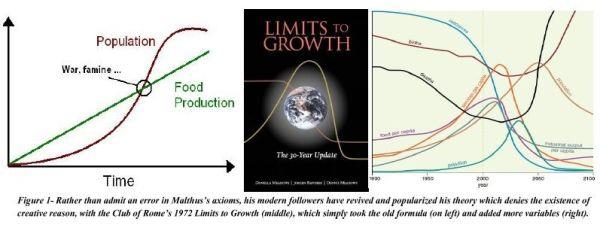
When figures like Mark Carney discuss the “greening of global finance” and placing monetary values upon the reduction of carbon footprints, this is the sick and unscientific foundation of their thinking. Where formerly, humanity valued economic growth via scientific and technological progress (and implicitly the support of increased numbers of people at higher standards of life), the new system of “values” promoted by these misanthropes demanded that profit be tied to the reduction of human activity on the earth.
Club of Rome co-founder Aurelio Peccei, who presented at the inaugural World Economic Forum meetings in Davos, stated:
“The economy and the ecology are inextricably united… A strategy of generating wealth and one of safeguarding this patrimony are opposed. Activities that generate wealth but destroy the natural patrimony even more, create negative value”.
Former President of the World Federation of Mental Health during the high point of MK Ultra, Margaret Mead (wife of MK Ultra controller Gregory Bateson) presided over one such 1975 conference on the environment and atmosphere sponsored by the Club of Rome (this club also being an early sponsor of the World Economic Forum in 1971). Echoing the spirit of Russell and Huxley earlier, Mead called for the creation of a new science of statistics premised on equating pollution to climate change that would become internally consistent and shape the behavior of humanity going into the 21st century. The focus was always population control. In her speech Mead said:
“The unparalleled increase in the human population and its demands for food, energy, and resources is clearly the most important destabilizing influences in the biosphere. We are facing a period when society must make decisions on a planetary scale.”
“What we need from scientists are estimates, presented with sufficient conservatism and plausibility but at the same time as free as possible from internal disagreements that can be exploited by political interests, that will allow us to start building a system of artificial but effective warnings, warnings which will parallel the instincts of animals who flee before the hurricane. [We must] draw from the necessary capacity for sacrifice. It is therefore a statement of major possibilities of danger, which may overtake humankind, on which it is important to concentrate attention”.
Rather than seeing science as a field for optimistic problem solving, this misanthropic cult of elitists demanded that science be redefined around a “new wisdom” of adapting to problems real or imagined. This cynical science of “problematique” (the science of problems) assumed that since all creative discovery caused population growth, the real enemy was found in the naïve optimists who believe it good to promote discoveries. Mead ridiculed those cultural optimists who rejected this cynical view of science saying:
“Those who react against prophets of doom, believing that there is not adequate scientific basis for their melancholy prophecies, [for they] tend to become in turn prophets of paradisiacal impossibilities, guaranteed utopias of technological bliss, or benign interventions on behalf of mankind that are none the less irrational just because they are couched as ‘rational.’ They express a kind of faith in the built-in human instinct for survival, or a faith in some magical technological panacea.”
Using more truthful language, Club of Rome co-founder Sir Alexander King stated in the preface of The First Global Revolution (1991):
“In searching for a common enemy against whom we can unite, we came up with the idea that pollution, the threat of global warming, water shortages, famine and the like, would fit the bill. In their totality and their interactions these phenomena do constitute a common threat which must be confronted by everyone together. But in designating these dangers as the enemy, we fall into the trap, which we have already warned readers about, namely mistaking symptoms for causes. All these dangers are caused by human intervention in natural processes, and it is only through changed attitudes and behaviour that they can be overcome. The real enemy then is humanity itself.”
Today’s world is being pulled by two opposing dynamics.
The prophets of doom who set the time bomb in place half a century ago giddily prepare their utopian Great Reset which demands vast bloodletting as an overpopulated humanity is to be sacrificed by a modern pagan scientific priesthood devoted to Gaia and computer models. On the other hand, the spirit of progress and open system thinking has come alive in the form of the multipolar alliance which premises its planning on an opposing set of assumptions about the nature of humanity, creative thought, value, economics, progress and natural law.
Which future wins out in this battle over humanity will be shaped by the decisions and discoveries we make (or fail to make) in the days ahead.
Hungary’s Orban blames Brussels & its climate change policies for soaring EU gas prices
RT | October 8, 2021
The EU should withdraw its policies aimed at tackling climate change as they’re the reason for the record surge in energy prices on the continent in autumn, Viktor Orban, Hungarian Prime Minister, has said.
Energy bills have been spiking for customers across Europe because of bad decisions made by “bureaucrats in Brussels,” who are fighting for ecology by continuously raising the price of energy generated from coal and gas, Orban insisted in a radio interview on Friday.
“These decisions must be withdrawn… at present gas prices are where they should be in 2035. Brussels isn’t the solution today, they are the problem,” he said. “Poles, Czech and we Hungarians demand that the rules should be withdrawn.”
According to the PM, the difficult situation on the energy market would top the agenda at the next EU summit, with Budapest, Warsaw and Prague to present a unified front at the meeting and offer their solutions to the crisis.
Orban again blasted EU climate policy chief Frans Timmermans, who is pushing hard for the EU to cut net greenhouse gas emissions by at least 55% by 2030. He recently warned that the rising emissions from Europe’s transport sector may prevent the bloc from achieving that goal.
“It’s a commissioner called Timmermans, who is posing the biggest threat to us,” the PM said.
The Hungarian leader already attacked Timmermans during his visit to Slovenia on Thursday, saying that “his calculations were incorrect and the EU residents must pay the extra price.” He also slammed the EU’s climate change policies as “foolish.”
Those not paying “the extra price” are actually the Hungarians, as caps on gas and power price hikes for households have been in place in the country after being introduced by Orban’s government in 2010.
The spike in energy bills in the EU, which the experts say was driven by rising gas prices and soaring cost of permits on the bloc’s carbon market, have only increased the split on green transition policies within the 27-member union. While wealthy nations see it as a sign to boost action against climate change, the poorer countries are voicing increasing concerns about the economic fallout of such measures.
Midweek, European gas prices have set a scary record by rising above$1,900 per 1,000 cubic meters – nearly three times higher than in September. The price dropped significantly after Russia said that it was going to boost gas supplies to the bloc, but the situation still remains harsh.
More News On The Progress Toward Eliminating Fossil Fuels
By Francis Menton | Manhattan Contrarian | October 3, 2021
The bureaucrats of the world, particularly in the UN and developed countries, have the idea that they are going to eliminate all use of fossil fuels by somewhere around 2040-50. They have no conception of how to accomplish that, other than to order from on high that it shall occur and assume that somebody else will figure out the details. This gives the rest of us the opportunity to sit on the sidelines and observe how bureaucratic fantasy gradually runs into the brick wall of physical reality.
Back in June I covered the Report just out from Ren21 Renewables Now wherein we learned that in the ten years from 2009 to 2019, despite hundreds of billions of dollars of subsidies for intermittent wind and solar power, the percent of world final energy consumption coming from fossil fuels had dropped all the way from 80.3% to 80.2%. Oh, but world final energy consumption was substantially up over that decade from about 320 to 385 exajoules, so despite all the strenuous efforts to reduce their use, in fact annual fossil fuel consumption had increased from about 260 to 310 exajoules.
And then just two weeks ago I covered the unfolding energy crisis in the UK. There, the mad rush to close coal plants and build wind turbines had left the country completely subject to just-in-time natural gas deliveries from others, particularly Russia. When a period of calm hit the North Sea wind farms, gas prices spiked by a multiple, and Britain was left closing factories and begging Russia for supply.
And there is plenty more news coming out on the same subject. Here are a couple of examples for today:
China. With the waning of the pandemic, all the rich countries of the West are back to wanting to consume lots of manufactured stuff. But of course the obsession with eliminating fossil fuels has gradually made the industrial energy supply of the rich countries more expensive and less reliable. (This is more true in Europe than in the U.S., but California and New York are doing their best to keep up.). Anyway, no problem, we’ll just get the stuff from China. So in recent months China has been in the mode of ramping up production. That will of course require much more energy. Do you think that it is going to come from wind and solar? Don’t be ridiculous. On September 27, Reuters reported that the ramp-up is causing massive energy shortages around China, and the solution is — coal. “China provincial governor urges more coal imports to resolve power shortages”:
China should work to import more coal from Russia, Indonesia and Mongolia in order to resolve supply shortages now crippling large sections of industry, said Han Jun, governor of the northeastern province of Jilin, one of the worst-hit regions. Speaking to local power firms on Monday, Han said “multiple channels” needed to be set up to guarantee coal supplies, according to the province’s official WeChat social media account. He said the province would also dispatch special teams to secure supply contracts in the neighbouring region of Inner Mongolia.
OPEC World Oil Outlook. On September 28 OPEC came out with its annual World Oil Outlook. This Report looks forward through the year 2045. It’s becoming increasingly impossible to get any straight information out of the American and European oil companies, as threats of lawsuits and regulatory actions cause them to mouth green groupthink and to pretend that they are planning to go out of business over the next couple of decades. But OPEC isn’t subject to the same pressures, so their Report is a much better indication of where knowledgeable people think things are going.
And where might that be? Here is OPEC’s chart of projected demand growth for petroleum from now to 2045:

In short, it’s continued growth in consumption all the way through 2045, albeit with the growth leveling off toward the end of the period. But basically, OPEC projects that any and all decreases in oil consumption achieved by the OECD nations (developed countries) will be offset and more by increases in the rest of the world.
OPEC also tries its hand at projections of demand for coal and natural gas over the same period. Here’s their chart of projected demand for natural gas:

It’s increases as far as the eye can see. Yes, they project that demand from the OECD countries will remain essentially flat at just under 30 mboe/d over the whole period; but meanwhile demand from the rest of the world is projected to go up dramatically from about 35 mboe/d to around 55 mboe/d.
In another chart relating to coal, they project a small decline in world demand from around 70 mboe/d today to around 60 mboe/d by 2045. Substantial declines in OECD nations will be offset by almost equivalent increases in places like India and Africa.
Do the people at OPEC know what they are talking about with these projections? I think that these figures are far more likely to be close to the mark than the fantasies coming out of the UN, where the talk is that the entire world economy will reach “net zero” carbon emissions by 2050. For example, here is the UN’s IEA, November 17, 2019, discussing what they call a “1.5 °C scenario that does not rely on negative emissions technologies”:
This . . . [scenario] means a reduction in emissions of around 1.3 billion tonnes CO2 every year from 2018 onwards. That amount is roughly equivalent to the emissions from 15% of the world’s coal fleet or from 40% of today’s global passenger car fleet. The year by which different economies would need to hit net-zero in such a scenario would vary, but the implication for advanced economies is that they would need to reach this point in the 2040s. . . . [D]eveloping economies . . . would all need to be at net-zero by 2050.
Not happening. Do they have any idea how completely absurd this is?
With blackouts looming, German government’s disaster preparation day promotes ‘cooking without electricity’
RT | October 1, 2021
High demand and the transition to green power has left much of Europe at risk of blackouts. In Germany, state authorities are teaching the public to heat their homes with candles and get used to “cooking without electricity.”
State authorities in North-Rhine Westphalia will hold their first ‘Disaster Protection Day’ on Saturday, with instructors in the city of Bonn teaching citizens how to get by “in the event of a long power failure.” An advert by the federal Civil Protection Office gives a hint of what’s in store, and features an elderly woman wearing several layers of clothing, heating her apartment with candles burning under an upturned flower pot and sealing her windows with reflective foil.
The Civil Protection Office on Friday unveiled an ad campaign focusing on all aspects of crisis preparation, and will soon release a targeted strategy addressing “stockpiling, extreme weather, power failure and emergency baggage.” Meanwhile, officials will present a new book entitled ‘Cooking Without Electricity’ at the event in Bonn on Saturday.
Based on these official communications, blackouts are coming to Germany soon. While the idea of the world’s sixth-most developed country being unable to power itself may seem ludicrous, the problem is Europe-wide, and is the result of a number of factors.
Germany relies heavily on natural gas for heat and power, and supplies were depleted following an unusually cold winter and spring. Globally, gas markets are tight, with increased demand in Asia and an upsurge in air-conditioner use during a hot summer in Europe driving prices to record highs.
Compounding the problem, wind-power generation fell this year, literally due to a lack of wind in Germany. Coal burning has increased to make up this shortfall, yet the cost of European Union ‘carbon credits’ on this fuel is passed on to consumers, with the end result being a spike in energy costs for ordinary Germans, who already pay the highest price per kilowatt hour in the world.
Both the EU and the German government want to rely more heavily on wind and other renewables for power in the future. The EU’s 2030 plan calls for 32% of all energy to be generated from renewable sources, and while Germany already exceeds this target with 44%, the German government plans on eliminating nuclear power by next year and coal by 2038.
Combined, nuclear and coal account for 39% of all electricity generated in Germany. Unless the country can dramatically expand its renewable sector, and count on the wind to power it, their elimination will likely result in even higher prices, and more ‘Disaster Protection Days’ in the coming years.
The same mismatch of supply and demand, coupled with a costly and unreliable transition to green power, has also been seen in other European countries in recent months.
Italians’ electricity bills to rise by 30%, gas up 14%
By Max Civili | Press TV | September 30, 2021
Rome – On Friday, the Italian Energy Authority ARERA announced that electricity bills will rise by almost 30% while gas bills will increase by over 14%, effective from Friday.
Italians are not pleased at all. Some consumer associations have estimated that the sharp rise may cost Italian families up to 2,000 euros a year due to a ripple effect on the entire productive system.
On one side, ARERA has pointed out that without government intervention to stem the rises, spikes in electricity and gas bills would have been 45% and 30% respectively, on the other, people are saying that the executive should have been able to predict the increase and handle the situation more effectively.
In its bid to tackle climate change, the European Union has adopted an Emission Trading Scheme which covers more than 12,000 polluting (sic) companies across the old continent, today.
It consists in the establishment of a market where firms trade emission allowances to cover their annual CO2 emissions, increasing, this way, their expenditures.
Analysts are warning the world is heading into an energy crunch that will likely affect global economies. The prices of fossil fuels such as coal, carbon and gas have all hit record highs lately. This is while crude oil has pushed above 80 dollars a barrel.
Energy price could go much higher if the weather is as cool this winter as some meteorologists predict. It’s not only the people that are worried. Several European energy-intensive industries have claimed that the adoption of the Emission Trading Scheme may entail a significant loss of international competitiveness due to increases in production costs.
This Week in the New Normal #6
This Week in the New Normal | OffGuardian | September 19, 2021
1. IS THE UK HEADING FOR A WINTER BLACK-OUT?
This week it was reported that a fire at a power relay station has damaged a cable running electricity from France to the UK. The cable apparently can’t be fixed until March (although I have yet to see any explanation as to why), which means electricity prices are set to jump up this winter.
Real fire or no, you can be sure the power companies don’t mind the bump in revenue. But is there more to it?
We’re already seeing warnings of potential “blackouts” this winter, as the electrical supply fails to keep up with demand. Power shortages during cold weather could easily cause a heavy spike in the number of elderly or vulnerable people dying over the winter.
Those deaths, as pretty much all deaths are these days, could then be attributed to “Covid”, and used to enforce booster shots or another lockdown… or anything else they want.
Further, it’s conceivable that, just as lockdowns were sold as being good for the environment, any blackouts could be accompanied by news stories talking up the idea of living with less electricity.
Can’t you just picture the Guardian’s opinion section? “In the future rolling blackouts will be the new normal. And that’s a good thing.” or “temporary electricity outages are a small price to pay for healing the earth” and even “Back to nature: How the blackouts forced us outside to reconnect with our planet and our neighbours.”
It’s also possible, of course, that there was no fire, and there will be no blackouts, and that they’re just freaking people out to make them worry and stop them complaining when their electricity prices are hiked for no reason.
2. DOCTORS SHOULD “GIVE PRIORITY” TO VACCINATED PATIENTS
Ruth Marcus, a deputy editor at the Washington Post, has had enough of people pussy-footing around this issue and is going “come right out and say it” – unvaccinated people deserve healthcare less than vaccinated people.
She at least admits this “conflicts radically with accepted medical ethics”, which is completely true but for some reason that doesn’t seem to change her mind:
under ordinary circumstances, I agree with those rules. The lung cancer patient who’s been smoking two packs a day for decades is entitled to the same treatment as the one who never took a puff. The drunk driver who kills a family gets a team doing its utmost to save him
To be clear then – Ruth considers the unvaccinated as morally inferior to a drunk driver who ran over some kids. Which says a lot more about her, than the unvaccinated.
This is one of the feeler pieces. An antennae article, gently feeling the ground to see if it can bear the weight of the agenda coming behind it. It’s setting up the conversation. Because once we’ve established “anti-vaxxers” don’t deserve healthcare, those other people she’s so careful to mention – smokers and drunk drivers – they’re next. Along with the obese, or the clumsy, or the religious, or the politically inconvenient.
If you don’t believe me, just check the comments under the article. The WaPo has one of the most scripted comments sections on the internet, whose usual job is to play the “bad cop” to the author’s “good cop”. And, sure enough, BTL is full of hundreds of supposedly real humans saying the author doesn’t go far enough, and we should ration all kinds of healthcare based on personal choices.
This particular talking point is already being aired on CNN and by late-night talkshow hosts too. Expect it to spread quickly, especially when the flu season starts.
3. THE CAMPAIGN TO DE-FUND INDEPENDENT MEDIA CONTINUES
A Guardian article from today is warning that big companies might be “funding misinformation” through internet advertising. There’s a lot of words there, but you don’t need to read most of them, the agenda is clear from the headline:
Nike and Amazon among brands advertising on Covid conspiracy sites
The article is based on a report from the Bureau of Independent Journalism, which claims to be an “independent” non-profit, but which is funded by an entirely predictable list of billionaires. Seriously, check their “about us” page and play NGO Bingo with their donor list.
According to this “independent” report, internet advertising is too “opaque” and we need to increase the “transparency” of the system so that major companies don’t unintentionally back “misinformation” and only give money to “benign” websites.
This is a continuation of an ongoing campaign to make it harder for any independent content creators to exist. We’ve already seen PayPal team up with the ADL to “Fight Extremism and Protect Marginalized Communities”. You don’t need me to tell you what that means.
It’s not just political either, YouTube demonetises basically everyone for basically anything these days, turning their formerly public platform into a corporate desert devoid of individuality or creativity.
There’s a reason OffG has always resisted putting ads on the site, over the years that decision has cost us a lot of money, but we have our independence and don’t live under threat. For any independent media out there who do rely on advertising income, now might be a good time to develop a plan B.
… More at OffGuardian.
Florida & Texas fume as Biden seizes and RATIONS supply of life-saving Covid treatments
RT | September 16, 2021
Seven southern US states, mostly led by Republican governors, say they are now facing shortages of monoclonal antibody treatments for Covid-19 after the federal government took over the distribution, citing the need for “equity.”
Monoclonal antibodies (MAB) are lab-created proteins that help those already infected deal with the virus. They have been intensively deployed in Alabama, Georgia, Florida, Louisiana, Mississippi, Tennessee and Texas – states dealing with the recent surge of Delta-variant cases. With the exception of Louisiana, they are all run by Republicans.
On Wednesday, the Biden administration announced it would take over the distribution of these treatments using the Defense Production Act and would be centralizing them under the Department of Health and Human Services (HHS). A HHS spokesperson said this was being done to avoid shortages, as the seven states account for 70% of all orders.
“Given this reality, we must work to ensure our supply of these life-saving therapies remains available for all states and territories, not just some,” the spokesperson told CNN.
“HHS will determine the amount of product each state and territory receives on a weekly basis. State and territorial health departments will subsequently identify sites that will receive product and how much,” the spokesperson said. “This system will help maintain equitable distribution, both geographically and temporally, across the country – providing states and territories with consistent, fairly-distributed supply over the coming weeks.”
Florida Governor Ron DeSantis, a Republican who has clashed with President Joe Biden on Covid policies – from mask mandates to compulsory vaccination – said that the move has resulted in cutting the supply to his state by more than 50%.
The federal government has allocated fewer than 31,000 doses to Florida this week, while the average need for hospitals and state clinics is 72,000, his office said.
DeSantis said on Thursday that he has reached out to GlaxoSmithKline, another pharmaceutical company, to purchase their MAB treatment in order to make up the shortfall.
In Texas, the Biden administration told the state “to reduce its use of the therapeutic treatment that has literally been saving lives and reducing hospitalizations,” Mark Keough, a judge in charge of Montgomery County, just north of Houston, said in a Facebook post on Tuesday.
“The manufacturer has confirmed supplies are ample but due to the Defense Production Act, the White House and it’s agencies are the only entities who can purchase and distribute this treatment,” Keough added.
“So, less than a week after the president tells us his patience is wearing thin and he is mandating vaccines to millions of Americans, his administration limits and all but removes a non-controversial and highly successful treatment from our war chest of combating this virus,” he said.
One DeSantis aide said that the HHS hasn’t adequately explained its move, or given a warning.
“They had a vague statement about ‘equity’ but sorry that doesn’t cut it,” the aide told Real Clear Politics. “No explanation of how the allocation was determined. No explanation of why it’s only Florida and a few other red states being restricted. No warning.”
“How is it equitable to only send treatment for HALF the Floridians who need it, & NO state sites in Alabama?” DeSantis’s press secretary Christina Pushaw asked on Twitter.
She also pointed out that, just weeks ago, Democrats and their allies in the corporate press were claiming that MAB treatments were a scam to enrich a DeSantis donor – prompting a war of words – but have now suddenly pivoted to claiming that Florida is using too many doses.
Some pundits are going so far as to speculate that the move is part of a “civil war” in the US, since six out of seven states hardest-hit by HHS rationing are run by Republicans, and incumbent Donald Trump won all of them in the 2020 election.
They can’t hide the costs of Net Zero forever
By Patrick Benham-Crosswell | TCW Defending Freedom | September 6, 2021
THE run-up to the COP26 climate change jamboree in Glasgow later this year is probably not going as well as the government would like. Despite being committed to Net Zero by Mrs May’s undebated and uncosted statutory instrument, the size of the likely costs can’t be hidden for ever and the guardian of the magic money tree, Chancellor Rishi Sunak, is fretting.
I have just produced a short book on Net Zero (brazen plug, you can buy it here) and, having spent several months trawling through the government’s own numbers, have reached the conclusions that the costs are huge (and possibly more than that). Replacing fossil fuels means we have to produce our energy from nuclear and renewables. At the moment they provide just about 10 per cent of our energy requirements. Making up the shortfall needs 30 to 50 Sizewell Cs, or 300 to 500 Small Modular Reactors, or 17,000 to 28,000 new offshore wind turbines. It will also need the electricity distribution grid to more or less quadruple in size. (The uncertainty primarily comes from whether Mr Gove can convert 25million homes to heat pumps, or whether we adopt hydrogen).
The cost of the generation alone comes out at something like £1trillion. Add to that car chargers, heat pumps, hydrogen electrolysers and suchlike and the costs could double. Or more.
The cost of energy will also rise. A report from the Department for Business, Energy and Industrial Strategy (BEIS) in 2016 (when Mrs May imposed Net Zero) forecast that the price of electricity would increase by at least 50 per cent. Which means that the UK is likely to be operating on a higher cost base than those economies which have not yet followed our lead and declared a net zero target. That’s most of the world – only Bhutan, Suriname, Uruguay, Finland, Iceland, Sweden, Austria and Germany have followed Mrs May’s quixotic charge. I’m not sure Germany is serious – 25 per cent of its power comes from coal and it is phasing out nuclear power.
Hilariously (or tragically) the government is threatening to crack down on ‘greenwashing’, by which they mean the habit of suppliers claiming that buying their product saves the planet. Yet our political leaders maintain that it will all be fine, that Net Zero is achievable and all we need to do is plant some trees. If they looked at their own data they would know that this is not the case.
To cite one example, every now and then one of them will trumpet about carbon capture, use and storage. Capturing CO2 is tricky and expensive. The world CO2 demand is some 230million tons per year (mostly for the oil and food industries). That’s less than half of the UK’s current CO2 emissions. There is no chance of widescale use of CO2 captured in the UK.
Of course there is already ample legislation on what may or may not be said in advertisements. New legislation is unnecessary.
As we have seen during the pandemic, this government has a habit of deploying misleading graphs and generally being economical with the truth. If they really wanted to improve the flow of information to the public they would apply the current law to their own presentations.
Hell will freeze over before that happens.
Journal Nature: COVID lockdowns are key to begin ‘personal carbon allowances’
Restrictions on individuals… that were unthinkable only 1 year before’ have us ‘more prepared to accept tracking & limitations’ to ‘achieve a safer climate’
Nature Sustainability |
Authors argue COVID restrictions, smart meters & tracking apps can be used as a stepping stone for a personal carbon allowance:
Journal article urges for “the need for a low-carbon recovery from the COVID-19 crisis” by using “personal carbon allowances (PCAs).”
“A PCA scheme would entail all adults receiving an equal, tradable carbon allowance that reduces over time in line with national targets… encompassing individuals’ carbon emissions relating to travel, space heating, water heating and electricity.” …
“Allowances were envisioned to be deducted from the personal budget with every payment for transport fuel, home-heating fuels and electricity bills. People in shortage would be able to purchase additional units in the personal carbon market from those with excess to sell. New, more ambitious PCA proposals include economy-wide emissions, encompassing food, services and consumption-related carbon emissions, for example.”
In particular, during the COVID-19 pandemic, restrictions on individuals for the sake of public health, and forms of individual accountability and responsibility that were unthinkable only one year before, have been adopted by millions of people. People may be more prepared to accept the tracking and limitations related to PCAs to achieve a safer climate and the many other benefits (for example, reduced air pollution and improved public health) associated with addressing the climate crisis.Sustainable Development Goals (SDGs)
Other lessons that could be drawn relate to the public acceptance in some countries of additional surveillance and control in exchange for greater safety… Recent studies show how COVID-19 contact-tracing apps were successfully implemented with mandatory schemes in several East Asian countries, such as China, Taiwan and South Korea… Recent advances in smarter home and transport options make it possible to easily track and manage a large share of individuals’ emissions. Evidence from the roll-out of smart meters and informative displays can be used to design feedback that is highly effective in engaging individuals to reduce their energy-related emissions… In terms of implementation platforms, while in the 2000s carbon allowances were expected to be managed by a card, in the 2020s high ownership would make smartphones the preferred option for accounting and trading (while providing alternative options for the few without smartphones).
Who would kill children to save the planet?
A new eco-movement would sacrifice millions of lives

BY TOM CHIVERS | UNHERD | AUGUST 13, 2021
Two things. First, economic growth saves children’s lives. That is one of the most basic, starkest facts about the modern world.
Second, there is a thing called the “degrowth movement”, which wants to stop economic growth. And, yes, this would lead almost inevitably to the unnecessary deaths of thousands of children a day.
Let’s deal with that first point first. For most of history, somewhere around a third of children died before their fifth birthday. That awful number has dropped enormously, but even now, it’s nearly one child in 25.
As child mortality has gone down, so has global poverty — while global economic output has increased. Correlation is not causation, of course – but this isn’t just true at a global level, but at a country-by-country level. Nowadays, if your country is rich, your children are more likely to live. That is amazingly obvious on this chart. If you live in the rich Iceland, for example, your child is 60 or 70 times less likely to die before its fifth birthday than if you live in the poor Central African Republic or Democratic Republic of Congo, where about one child in every 10 dies in its first five years.
And on that second point: some people really think that that economic growth should stop, right now. Jason Hickel is an anthropologist and one of the key voices in what is known as the “degrowth” movement. He argues that — in rich countries, at least1 — we ought to stop aiming for economic growth immediately. He thinks that “green” growth, the idea that we can grow our economies while reducing carbon emissions, is a chimera, or at least that it cannot happen fast enough to avoid disastrous outcomes from climate change.
Hickel, of course, denies that economic growth saves lives. In fact, he doubly denies it. First, he denies that global poverty has gone down as a result of economic growth. In 2019, he argued that all those famous charts showing a huge decline in global poverty are false, because they focus on very extreme poverty — people living on the equivalent of $1.90 a day or less. If you look at some more reasonable threshold of “poverty”, he says, such as $15 a day, the decline disappears.
This is straightforwardly untrue, for the record. Whatever threshold you use, people are getting richer. People have generally shifted from lower incomes to higher incomes, and as a result fewer children are dying.
And secondly, Hickel denies that economic growth does save children’s lives: or, rather, that it does beyond a certain, quite low level. “Past a certain point, the relationship between GDP and social outcomes breaks down or becomes irrelevant,” he says. “After that, what matters is distribution and access to public services.”
But this doesn’t seem to be true either. If it were, you’d see that very poor countries have consistently high child mortality, but that as you reach the middle-income and rich countries, it would be much more mixed. But in fact there’s still a strong relationship, and middle-income countries like China and Brazil have much higher infant mortality than rich countries like the UK and Japan. If you live in Brazil, there’s about a one in 60 chance that your child will die before its fifth birthday. In China, one in 100. In the UK, it’s way down at one in 250-ish.
You could look at the reduction in child mortality over time, as the world has become richer, as one of the great success stories of our time. In a way you’d be right to do so, but it is a hugely unfinished story. Children are still dying at an awful, unacceptable rate of about 14,000 a day — Max Roser of Our World In Data describes it as “equivalent to a crash of a jumbo jet with only children on board, every hour of every day of the year”.
Nonetheless, it is true that economic growth appears to have saved millions of children’s lives. That 14,000 a day would be something more like 100,000 a day, if children were dying at the rate they used to.
Also note that “economic growth” doesn’t necessarily mean “free-market capitalism”. As Noah Smith points out, a lot of the reduction in global poverty has been about smart government action (especially in Latin America), or China’s complicated industrial and economic reform, not simply free-market policies – although at the very least it’s fair to say that global capitalism hasn’t got in the way.
But this broadly positive story is a closed book to Hickel and the degrowth movement. It’s instinctively difficult to understand why anyone would want to deny it, but I have two theories.
One is that it’s very hard to acknowledge that things can get better without being good. It’s a common problem. It is, for instance, almost certainly true that the UK is much less racist and sexist than it used to be. But it’s also clearly true that there are real problems that continue to exist. It is extremely hard to say “the UK has become better with regards to racism and sexism” without people hearing “the UK is not racist or sexist”.
If you’re Jason Hickel, you might see people arguing that poverty has decreased, and assume that they mean “and therefore global poverty is no longer a problem”. That is, of course, absolutely not the case.
The second hypothesis is a more complicated one — and has to do with something called “prevalence-induced concept change”. Imagine that you have dedicated your life to some problem: say, reducing littering in a local park. You work really hard. You set up a charity and solicit donations; you put together a workforce. And, bit by bit, you successfully reduce the problem. The park becomes a bit less litter-filled. What do you do? Do you say to your charity’s staff, “The park is doing a bit better now, we probably don’t need so many of you. And we should probably reduce our demands for donations, as well”?
Human nature being what it is, probably not. More likely (and as happens in laboratory settings), you will simply start focusing on smaller and smaller things. Before, you had shopping trolleys in the pond and a dead sheep in the playground, and you focused on them. But now that they’ve gone, your attention will focus on the crisp packets and fag butts. Partly that’s because you now have the attention to spare, because the bigger problems have been solved; but it’s also partly because, if you start saying “actually the situation is a bit better now”, it will be harder to rally support for your cause.
I think this is a really important driver of human behaviour. It is very hard to ever admit things are getting better along any axis, because if you do, it feels like you’re saying: “So you can stop working hard to fix this problem.”
Similarly, if you’re Jason Hickel and you’ve dedicated your life to fighting global poverty (and to saying that global poverty is all because of capitalism and colonialism and that economic growth is bad), then it will be really inconvenient if someone says: “Actually, global poverty has decreased significantly, that reduction seems to be correlated with economic growth, and it has had amazing positive outcomes such as a huge reduction in child mortality.” It will be very tempting to find ways of ignoring that reality.
I worry, though, that it is counterproductive to tell people that all their hard work improving some situation has had no effect. If all those decades of buying low-energy lightbulbs and reducing flights and eating less meat have not improved the climate, then why shouldn’t I just stop bothering? If all those anti-racism campaigns and hate-speech laws and so on made no difference, what’s the point? And in the case of poverty, if economic growth doesn’t reduce global poverty, then it does indeed make sense to give up on growth altogether. But in reality, economic growth does reduce global poverty, and reduced poverty saves children’s lives.
But the degrowth movement is right, in one sense. Growth almost certainly can’t carry on forever. If the economy grows at 2% a year every year, which it roughly has for the last century or so, then it doubles in size every 35 years.
That’s not sustainable in the long term. In 8,250 years — as Holden Karnofsky of the Open Philanthropy Project points out — the economy would have grown to 3*1070 (that is, a 3 followed by 70 zeroes) times its current size. There are, for context, about one-third that many atoms in our galaxy. And 8,250 years isn’t very long: there are cities which have been around for longer.
Perhaps growth will continue into the far future. I could imagine some weird universe of simulated worlds and uploaded humans — and indeed others have. But probably, the more likely outcome is that growth slows or stops or reverses in the next few centuries.
The question, of course, is when it should stop. I, for one, would rather wait until the children stop dying so much. Hickel and the degrowth movement think it should be sooner. But if they want to make that case honestly, they should admit the reality of all the dead children.
FOOTNOTES
- It’s worth noting that Hickel doesn’t think we should stop aiming for growth everywhere: just in rich countries. But rich countries that buy much of the goods produced in poor countries, driving their growth, so that would be a very difficult needle to thread.
Featured Video
Chinese jet fuel and the myth of energy independence
or go to
Aletho News Archives – Video-Images
Book Review
Former Insiders Criticize Iran Policy as U.S. Hegemony
By GARETH PORTER | CounterPunch | February 27, 2013
“Going to Tehran” arguably represents the most important work on the subject of U.S.-Iran relations to be published thus far.
Flynt Leverett and Hillary Mann Leverett tackle not only U.S. policy toward Iran but the broader context of Middle East policy with a systematic analytical perspective informed by personal experience, as well as very extensive documentation.
More importantly, however, their exposé required a degree of courage that may be unparalleled in the writing of former U.S. national security officials about issues on which they worked. They have chosen not just to criticise U.S. policy toward Iran but to analyse that policy as a problem of U.S. hegemony. … continue
Blog Roll
 Aletho News
- What is fueling unrest across the EU?
- Why no power can undermine Iran’s eternal dominance over the Strait of Hormuz
- Is The War Against Iran Over?
- Iran war will leave long-term ‘scar’ on Wall Street, investors warn
- How Iran decimated US power projection in West Asia: Military lessons of 40-day war
- Iran’s report details US-Israeli war crimes in targeting schools, hospitals, livelihoods
- NATO’s Slow Fracture: How Trump’s Iran War Exposed the Instrument of Hegemony
- Chinese jet fuel and the myth of energy independence
- Ukraine Sea Drone Fired From Libya Hit Russian Tanker in Mediterranean
- IRGC: Iranian forces launched no attacks during ceasefire hours
- If Americans Knew
- DNC Shoots Down Resolutions Calling Out AIPAC and Limiting Arms to Israel
- TCN: Is Israel Blackmailing President Trump?
- Israel killed at least 303 Lebanese yesterday – who were they? Daily Update
- Amnesty: Urgent – Protect Lebanese civilians from brutal escalation in Israeli attacks
- Is The War Against Iran Over?
- Inside the Israeli army’s propaganda wing
- Hundreds of Gaza Amputees Stranded in Legal Limbo
- The gallows law: Israel moves toward executing Palestinian children
- Tucker Carlson: The Path to Peace requires ending ‘special alliance’ with Israel
- This is ceasefire? Israel’s biggest massacre yet in Lebanon, another journalist killed in Gaza – Daily Update
- No Tricks Zone
- An Inconvenient Tree: Uncovered In Alps… Europe Much Warmer Than Today 6000 Years Ago
- New Study Reports A 60% Slowdown In Greenland’s Ice Loss Rate In The Last Decade
- Low Intensity Tornado Wrecks Major Solar Farm, Creating A Potential Toxic Dump
- New Study Finds Warming Saves Lives…Cold Temperatures 12 Times More Deadly Than Excess Heat
- German Science Blog Accuses PIK Climate Institute Of Hallucinating Climate Tipping Points
- Devastating Assessment Of Comirnaty Vaccine By Former Senior Pfizer Europe Toxicologist
- New Study: CO2 Is ‘Effectively Negligible’ As An Explanatory Climate Change Factor Since 2000
- Former Pfizer Toxicologist Dr. Helmut Sterz Tells Bundestag Hearing Pfizer Vaccine Should Have Never Been Approved
- Energy Expert: Germany’s Nuclear Phaseout Was A “500 Billion Euro Mistake”
- New Research: South Australia’s Mid-Holocene Sea Surface Temperatures Were 4°C Warmer Than Today
 Aletho News