‘Zero Carbon Is A Crime Against Humanity’

By David Wojick, Ph.D. | PA Pundits – International | March 21, 2020
I recently got an intriguing email from Professor Guus Berkhout, president of the Climate Intelligence Foundation or CLINTEL. It contained this striking paragraph and the last sentence really got me thinking:
“The past 150 years show that affordable and reliable energy is the key to prosperity. The past 150 years also show that more CO2 is beneficial for nature, greening the Earth and increasing the yields of crops. Why do governments ignore these hard facts? Why do they do the opposite and lower the quality of life by forcing high-cost, dubious low-carbon energy technologies upon their citizens? The zero-emission act is a crime against humanity.”
So I looked into the law on crimes against humanity and Professor Berkhout may have a strong case. At its simplest, a crime against humanity is a government policy that systematically and knowingly harms a specific group of innocent people.
Zero carbon emission laws like the Green New Deal in the EU and the US will deprive poor people of affordable energy worldwide. This fact has been well established by numerous studies. Thus these policies knowingly harm a specific group of innocent people. And as CLINTEL points out in its World Climate Declaration, there is no climate emergency that might justify this harm. What we have are governments deliberately harming their citizens.
But look also at the latest developments in climate science. There is new insight that has to do with a review of carbon budgets. A carbon budget indicates the amount of CO2 that may still be emitted before a certain warm-up limit is exceeded. IPCC climate scientists that authored the SR15 report of 2018 took another close look at the calculations of the carbon budgets in IPCC’s AR5 report of 2014 and concluded that they had been too pessimistic in the past. And not so slightly. In the SR15 report those carbon budgets have been increased spectacularly.
By way of illustration, the carbon budget for the 1.5 degree limit has increased by no less than a factor of 5! It therefore takes considerably longer for the carbon budgets to be exhausted, which means that the strict emission requirements based on AR5 can be significantly relaxed. So this is very good news for all people concerned about the climate. It fully confirms CLINTEL’s message: ‘ There is NO climate emergency.’
Unfortunately, the good news has been snowed under by the increasing ‘gloom and doom’ actions and stories about the ‘dangerous climate change’, ironically fed by the same SR15 report. Actually, the reader should realize that the good news is even better because on top of the computational error in AR5 we still deal with IPCC’s continuing exaggerated climate sensitivity for CO2. When will that be corrected?
Note that – despite the strong scientific and moral arguments – it is now the stated goal of the UN alarmists that all countries should adopt zero carbon laws, preferably in time for the Climate Summit in Glasgow this November. Given that the harm is proportional to poverty, such precipitous actions would be especially harmful to the poorest. And, for heaven’s sake, why?
Zero carbon laws are prohibitions against those forms of energy that presently supply about 80% of human need. A well recognized definition of crimes against humanity is “inhumane acts intentionally causing great suffering”. Deliberately depriving poor people of affordable energy certainly fits this definition.
My colleague Paul Driessen have written extensively about this issue, albeit not from the perspective of crimes against humanity. See for example here.
Mind you we were just talking about the tragedy of so-called development banks refusing to fund affordable energy development. Laws that prohibit the use of fossil fuels are infinitely worse. Imagine not being allowed to use a kerosene light or a gasoline scooter, on top of not having electricity.
But we do not have to go to poor Africa to find energy poverty. It is being documented throughout Europe, especially in those countries where misguided governments have forced renewable energy on their people. Yet the UK and EU are both adopting draconian zero carbon policies. The energy poor here also probably have a good case of crimes against humanity.
In the U.S. it is estimated that millions of households live in what is defined as “energy poverty” due in large part to the forced shift to renewable power. Energy poverty is reported to be the second leading cause of homelessness in America. The proposed Green New Deal will make this suffering dramatically worse.
In short, CLINTEL president Guus Berkhout is right. Zero-carbon laws are not only scientifically utterly silly, they are crimes against humanity.
Crickets! Finland’s Insect Food Boom Goes Bust

Swedish ‘Sustainable Food’ Project Teaches Kids to Eat Insects, Garbage © CC BY-SA 3.0 / Guttorm Flatabø / Grilled maggots for human consumption
Sputnik – February 27, 2020
Despite the media’s preoccupation with insect food and massive campaigns touting crickets and larvae as a sustainable and climate-responsible alternative to meat, the excitement has waned in a matter of several years, the Finnish broadcaster Yle reported, concluding that Finns are “not yet ready to eat crickets”.
Finland’s cricket breeding business took off in September 2017, when the country’s Ministry of Agriculture allowed breeding and selling insects as food, a decision made possible by a revision of the EU’s food standards.
After that the number of insect breeding facilities spiked, as revenues in the billions of euros were predicted. In 2018, Europe’s largest cricket farm emerged in Loviisa, which began to produce hundreds of tonnes of insect powder.
However, in the following years, the buzz subsided, and insect breeders suffered major setbacks amid dwindling demand and stiff competition.
According Lauri Jyllilä of the Finsect company, which promotes insect food, there were over 70 companies in the insect food business at the peak of the enthusiasm. Now, there are about 50 left, with no new companies being founded.
The price of frozen crickets reached as much as 100 euros per kilogram, Jyllilä explained, which was way too expensive even for sympathetic and ecologically-minded consumers.
“The cost of freshly frozen crickets should be 10-15 euros per kilogram”, Jyllilä ventured.
Kurikka resident Panu Ollikkala, one of Finland’s first cricket breeding specialists, dropped out of the competition in the autumn of 2019.
“Demand was inadequate. The price has fallen so much that my business didn’t pay off”, a despondent Olikkala mused.
The Kouvola farm, touted as Europe’s largest, followed suit. Entrepreneur Vesa-Matti Rajamäki admitted that he no longer believed in the success of cricket production. Numerous unsuccessful insect breeders complained that the massive support of the traditional meat industry makes competition virtually impossible.
“A lot of beautiful words were said about the insect business. Many farms were opened, and bank loans were taken” cricket farm owners Kirsi and Jouko Siikoine said. They intend to close down their business in March 2020. “The onterest in eating insects and the insect processing sector has plummeted”, the couple explained.
In the city of Kurikka, which is now considered the centre of insect production, crickets are still being bred, but a downward trend is visible.
“This is a sort of cricket breeding bank, thanks to which you can quickly restore your production if you want”, Jyllilä explained.
The University of Turku, the Finnish Institute of Natural Resources, and the Finnish Safety and Chemicals Agency ran a project named “Insects in the food chain” and concluded that the main difficulty is getting the approval of bulk consumers. Even people who opt out of meat for the sake of the carbon footprint or perceived health benefits largely prefer vegetable sources of protein.
Crickets are often grounded into powder and added to bread, protein bars and chocolate. However, after large-scale promotion, many products gradually left the market.
The main selling point of the bug diet is the reduced environmental footprint. According to Finnish insect producers, a single kilogram of crickets only requires a single litre of water, as opposed to 2,500 litres for a kilogram of rice and a whopping 15,400 litres for a kilogram of beef. Insect food is also claimed to be rich in protein.
Many are still averse to eating insects for reasons of ideology and aesthetics. This opposition has resulted in a common web mantra: “I will not eat bugs and I will not live a pod”.
Climate Alarmism and Malthusianism (rebuttal to Taylor)
By Robert Bradley Jr. – Master Resource – February 25, 2020
“The pseudo-intellectual right loves to compare climate concern and action with Malthusianism. I’ve never quite understood what the heck these things have in common.” (Jerry Taylor, October 13, 2019)
“What environmentalists mainly say … is not that we are running out of energy but that we are running out of environment–that is, running out of the capacity of air, water, soil and biota to absorb, without intolerable consequences for human well-being, the effects of energy extraction, transport, transformation and use.” (John Holdren, April 2002)
Jerry Taylor, please read the literature before opining on such matters as energy and the environment. Climate change is the latest Malthusian scare, per John Holdren. And the common denominator of the Malthusian worldview is overpopulation, as Pierre Desrochers and Joanna Szurmak document in Population Bombed! Exploding the Link Between Overpopulation and Climate Change (2018).
Some quotations from Population Bombed cement the tie-in:
- Numerous population control advocates have linked anthropogenic climate change to population growth, or tried to revive interest in invoking anthropogenic climate change as the key negative outcome of continued economic growth linked to, foremost among causes, an increasing population.
- … population Bomber” himself, Paul Ehrlich … during a conference in 1968 identified anthropogenic carbon dioxide emissions as a “serious limiting factor” to economic growth.
- By the 1970s, Ehrlich, his wife Anne and his collaborator John Holdren raised fears that carbon dioxide “produced by combustion of fossil fuels in quantities too large to contain” may “already be influencing climate” and, as such, constituted one of the “gravest threats to human well-being. . . [i.e.] the loss of natural services now provided by biogeochemical processes.”
- [Julian] Simon then summarized the position of most environmentalists as follows: “But isn’t obvious. . . that additional people and additional economic growth will cause us to use more energy and hence emit more greenhouse gases? Therefore, even if we can’t be sure of the greenhouse effect, wouldn’t it be prudent to cut back on growth?”
- The economist Jacqueline Kasun similarly believed at the time that “by the 1990s the doomsayers had shifted their attack” as they could no longer invoke resource depletion as the key growth-limiting issue. As she wrote, “the alarmists didn’t miss a step. The problem, they now said, was that people were using too much energy and were causing Global Warming.”
- Canadian academic Michael Hart has commented that “for alarmists, climate mitigation policy is as much a means of achieving their larger goals as it is a matter of addressing a possibly serious issue.”
- Canadian academic, historical climatologist Tim Ball, has long argued, the climate change policy agenda is based on certain assumptions ultimately related to a fear of reaching another terrestrial set of limits through overpopulation.
- Maurice Strong (1929–2015), who was described by business journalist Peter Foster as “[m]ore than any other individual. . . responsible for promoting the [UN] climate agenda,” … [stated] “with a growing global population, we will have to recognise that having children is not just a personal issue but a societal issue and at a certain point we may be faced with a need to have a permit to have a child.”
- [Strong] also referred to the need for “national population policies” in his opening speech at the 1972 Stockholm Conference. Strong reportedly stated the following Malthusian prediction at the 1992 Earth Summit: “Either we reduce the world’s population voluntarily or nature will do this for us, but brutally.”
- The first chairman of the IPCC (1988-1997), Bert Bolin, was not only an early convert to the alleged catastrophic impact of CO2 emissions, but also a pessimist on population and resources issues, as evidenced in his stance on the controversy surrounding the 2001 publication of The Skeptical Environmentalist by the Danish political scientist Bjorn Lomborg.
- John Holdren contradicted many of his earlier warnings of imminent resource depletion by arguing that while the word was not “running out of energy,” it was “running out of environment,” by which he meant “running out of the capacity of air, water, soil and biota to absorb, without intolerable consequences for human well-being, the effects of energy extraction, transport, transformation and use.”
- The second chairman of the IPCC (1997–2002), Robert Watson, would later go on the record with the following line of reasoning: “The more people we have on the Earth and the richer they are, the more they can demand resources. There’s more demand for food, more demand for water, more demand for energy. . . So, there’s no question the threats on the Earth today are far more than, say, 50 years ago and in 50 years’ time, there will even be more threats.”
- The third chairman of the IPCC (2002-2015), Rajendra K. Pachauri … was “not going to rest easy until [he has] articulated in every possible forum the need to bring about major structural changes in economic growth and development. That’s the real issue. Climate change is just a part of it.”
- … Timothy E. Wirth, one of the main organizers of the 1988 James Hansen hearing on climate change, and from 1998 to 2013 president of the (hardcore Malthusian) … is on the record as stating in 1993: “We’ve got to ride this global warming issue. Even if the theory of global warming is wrong, we will be doing the right thing in terms of economic and environmental policy.
Other documentation from Desrochers and Szurmak includes the views of Christine Stewart, then Canadian Minister of the Environment; Connie Hedegaard, European Commissioner for Climate Action (2010–2014); Executive Secretary of the United Nations Framework Convention on Climate Change, Christiana Figueres ; Professor Hans Joachim Schellnhuber, the director of the Potsdam Institute for Climate Impact Research; researchers associated with the Population Reference Bureau and the Worldwatch Institute; Canadian climate scientist Andrew Weaver of the British Columbia Green Party; and the late climatologist Stephen Schneider
So what are the climate Malthusians missing? The same thing as before: human ingenuity. Desrochers and Szurmak note:
… there is ample evidence of a passionate commitment towards the protection of the planet, but there is no sign of recognition that humanity can do, and has done, more than simply consume resources. At no point do neo-Malthusians admit the possibility that technological innovations and human creativity have a place among the things that deserve a place on Earth. What pessimist activists desire is a consensus on the classification of humanity as out of control and inherently driven by destructive greed, thus in need of top-down regulation by the few remaining clear-thinking and benign autocrats – that is, functionaries – of the global government.
Buyer beware of climate alarmism and Malthusianism.
No Airports, No Imports–Welcome To Year Zero!
By Paul Homewood | Not A Lot Of People Know That | February 21, 2020
I took a quick look at this story the other day, but have now had time to read the report it was based on:
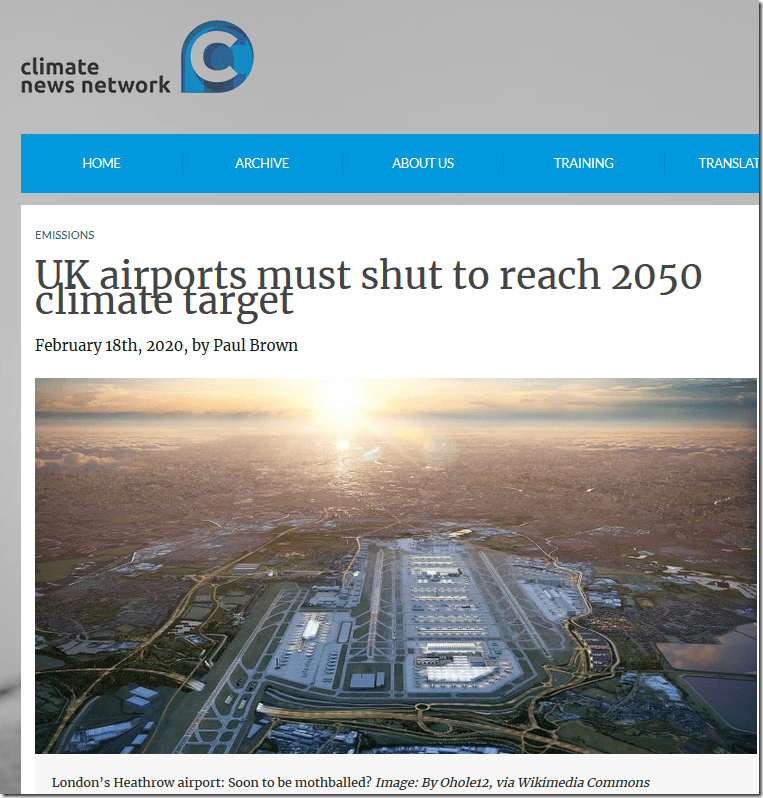
To many people, “saving the planet” means little more than building wind farms, planting trees and using less plastic. However it is gradually beginning to dawn on the public that the impact on their lives will be substantial.
Even then though, things like scrapping gas boilers and moving to electric cars have been something that “won’t happen for decades, so why worry now?”
However a new study, sponsored by the UK Government, has warned that huge changes to our lifestyles will be necessary, and much sooner than we think, if zero emission targets are to be met.
The report by UK FIRES, called Absolute Zero, calls for all UK airports to be shut by 2050, because there are no practical alternatives for zero emission flight. But as part of this timetable, all airports other than Heathrow, Glasgow and Belfast must shut by 2030.
In a stroke, air travel will be effectively banned for most of the country, as Heathrow simply would not have the capacity to handle more than a small proportion of demand. (Heathrow currently carries a quarter of UK passengers).
But that is just one item on a long list of changes to be forced on the British public. The report concludes that we cannot bank on technological innovations coming to our rescue.
If you thought that we could simply rely on renewable energy, forget it. As UK FIRES points out, even with rapid growth of renewables, we will still need to cut our energy use by 40%, even before air travel and shipping are factored in. And all of this without accounting for the projected population increase.
So forget about electric cars being the solution, because we will not have enough electricity to power them. The recommendation from UK FIRES – have 40% less cars on the road. Their suggestion – use the train more, ignoring the sky high prices, the fact that railways offer very limited routes and how you are supposed to travel around when you get to your destination. The idea that we will all willingly give up our cars to travel by rail or bus is utterly naive.
The report also conveniently ignores the high carbon dioxide footprint in building electric cars in the first place.
Heating is another area where we must cut emissions. UK FIRES expect us to buy heat pumps, seemingly oblivious to the fact they will cost each household a good £10k more than our conventional boilers. They also don’t appear to realise that heat pumps are incapable of supplying the heat we need in the middle of winter, or that the power grid simply could not cope with that sort of spike in demand even if they could.
Or maybe they do! Their guidance includes using heating for less time, in fewer rooms and wearing warm clothes in winter.
Our diet does not escape either, as we will have to give up eating beef and lamb, not to mention frozen ready meals. While we are expected to rely on arable farming instead, they also want fertiliser use to be drastically reduced.
Meanwhile the construction industry is likely to grind to a halt, as cement is phased out. Unfortunately the actual making of cement releases emissions, regardless of the source of the energy used.
Forget about housebuilding, new hospitals and infrastructure, they want us to concentrate on retrofit and adaptation of existing buildings.
Ironically, as even the report admits, we don’t know how to install new renewables or make new energy efficient buildings without cement.
If all of this was not bad enough, they want to ban all imports by 2050, unless they can come via rail, which might be a problem given that we are an island! Of course, we don’t have zero emission freight ships at the moment, and are unlikely to in the foreseeable future.
Quite how we are expected to feed ourselves without importing food is a mystery, unless we return to 1940s style rationing. And you can forget about all of those other things we get from abroad now.
What about, for instance, computers and electronics? We will quickly become an international backwater, without access to the latest technology. It would be like the country returning to 1990s style Nokia phones, VHS and floppy discs!
Some may be substituted by UK made goods, but it is hard to see how industrial capacity could be built back up with the restrictions planned on construction, energy use and industrial emissions.
But it is not only the emissions from shipping which concerns the authors. They also say we must be responsible for all emissions from the production of imported goods.
So how, you might ask, are we supposed to live in this glorious, emission free future?
UK FIRES says we must not worry! We can apparently carry on doing the things we enjoy most, totally emission free. Things like sports, social life, eating, hobbies, games,computing, reading, TV, radio, volunteering and sleeping! According to the report, “we can all do more of these without any impact on emissions.”
Indeed, with the economy and industry destroyed, most of us will have much more time on our hands for these pursuits! (Climate scientists and bureaucrats excluded, naturally).
Nowhere in this dismal little report is there any acknowledgement of the fact that the UK only generates 1% of global emissions. The report starts by stating:
We have to cut our greenhouse gas emissions to zero by 2050: that’s what climate scientists tell us, it’s what social protesters are asking for and it’s now the law in the UK.
Wrecking the economy is not something we should do, just because a few eco-loon protestors are asking for it. And laws can, of course, be changed.
We must however thank the authors of this report for bringing home the very real and damaging effect that the mad rush to decarbonise will have on peoples’ lives.
And, as they have rightly stated, these changes will have to start being put into practice very soon, certainly during this decade.
For too long, the impact and cost of the Climate Change Act has been deliberately hidden from the public. Partly this has been the result of a political conspiracy between all of the major political parties and establishment in general. It has also been aided and abetted by all of the media, with a handful of notable exceptions.
But their dirty little secret cannot be covered up for much longer.
Sins of emission
By Christopher Monckton of Brenchley | Watts Up With That? | February 19, 2020
Much has been made of the alleged standstill in global CO2 emissions, which are asserted to have been about the same in 2019 as in 2018, at 33.3 gigatonnes of CO2:

Obsession over transient phenomena such as this is commonplace among the climate genociders, whose cruel, dangerous and expensive global-warming abatement policies are killing tens of millions annually through the coordinated refusal of most of the world’s leading merchant, central and intergovernmental banks to lend to developing countries to install the one kind of electricity they can afford and can maintain and are desperate for – coal-fired generation.
Nothing lifts a poor nation faster, more surely and more permanently out of poverty, misery, disease and death than the universal availability of universal, affordable, continuous, base-load, coal-fired electricity.
Were it not for the genocidal emissions-abatement policies driven by the totalitarian fanatics and extremists of the far Left in the West, the whole world would by now be electrified, prosperity in the developing countries would have increased no less dramatically than it has in the electrified advanced economies, and the net benefit to the environment in the consequent stabilization of population would have been overwhelming.
Almost two centuries of official demographic statistics have demonstrated that, by a long chalk, the most effective method of stabilizing a previously-burgeoning population is to increase the general prosperity of that population. Frankly, nothing else works. The fastest way to displace poverty with prosperity is to give the people electricity. We should make this moral case against the genociders daily until they are compelled to pay heed.
The genociders’ trumpeting of the supposed standstill in global CO2 emissions is – as usual – misplaced. As the IEA’s graph shows, the imagined level of global emissions remained static for five years from 1990-1995. In Their terms, we were doing “better” then than now, for no increase in our sins of emission was reported over that period.
Their “our policies are at last working” meme is misplaced for a second reason. The emissions data are inaccurate. As with temperature, so with emissions, we are incapable of determining global data to a precision of a tenth of a unit. We know that the emissions data are inaccurate because if they were accurate – and if the link between emissions and concentration were as direct as They tell us it is – then the stabilization of emissions would have been matched by at least some diminution in the rate at which CO2 concentration is accumulating in the atmosphere.
However, the CO2 concentration at Mauna Loa shows a continuing and undiminished rate of increase over the past four or five years:

Since the trend in global temperatures has been generally downward over the past five years, additional outgassing of CO2 from the oceans does not account for the continuing increase in CO2 concentration.
Nor can it legitimately be argued (though some genociders have tried) that the terrestrial CO2 sink is failing. If it were failing, the rapid growth in the total plant biomass on the planet – the net primary productivity of trees and plants – would not have been as spectacular as it has been.
The question arises whether the decades of hot air generated by the climate genociders’ intergovernmental conferences, at vast expense in treasure as well as in common sense, have reduced global CO2 emissions below the business-as-usual prediction made by IPCC in its First Assessment Report in 1990.
The answer is No. The annual, official, peer-reviewed estimate of global CO2 emissions from all sources, Friedlingstein et al. (2019), who used the same wider measure of emissions as IPCC, shows that emissions are above the business-as-usual trajectory predicted by IPCC in 1990:

The 11.5 givatonnes of carbon estimated by Friedlingstein et al. is equivalent to 42.2 gigatonnes of CO2.
In short, the quintupling of electricity prices compared with what they would be without global warming abatement policies, the doubling of gasoline prices, the destruction of heavy industries such as coal, steel, aluminum, coal-fired power generation and motor manufacture throughout the Western world, the trashing of the countryside and the killing of billions of bees, birds and bats by windmills, the slowing of storms and the consequent flooding caused by those same windmills, and all the deaths that the genociders are inflicting upon our less fortunate cousins in the developing world with their refusal to countenance the immediate electrification of the one-sixth of the planet whose population subsists in enforced and involuntary darkness, have achieved precisely nothing.
DoD study: climate change will destroy us … in 2020
By Larry Kummer | Fabius Maximus | December 29, 2019
Summary: In February 2004, headlines in The Guardian and other news media told us of a secret DoD report predicting a climate catastrophe by 2020. Read the study and gain perspective about today’s warnings of a Climate Emergency.

Photo 50590315 © Strahil Dimitrov – Dreamstime.
“Now the Pentagon tells Bush: climate change will destroy us.”
The Guardian | 21 February 2004.
“Secret report warns of rioting and nuclear war. Britain will be ‘Siberian’ in less than 20 years. Threat to the world is greater than terrorism.”
“Climate change over the next 20 years could result in a global catastrophe costing millions of lives in wars and natural disasters. A secret report, suppressed by US defence chiefs and obtained by The Observer, warns that major European cities will be sunk beneath rising seas as Britain is plunged into a ‘Siberian’ climate by 2020. Nuclear conflict, mega-droughts, famine and widespread rioting will erupt across the world. … Randall added that it was already possibly too late to prevent a disaster happening. ‘We don’t know exactly where we are in the process. It could start tomorrow and we would not know for another five years,’ he said. …”
Other journalists gave uncritical coverage to it (e.g., Fortune, Grist ). The secret report is now public. Read it and feel the terror!
“An Abrupt Climate Change Scenario and Its Implications for United States National Security.”
By Peter Schwartz and Doug Randall for NASA’s Jet Propulsion Laboratory.
Commissioned by DoD’s Office of Net Assessment. Published October 2003.
Schwartz is a “futurist”, co-founder of the Global Business Network consulting firm and big in the “scenario planning” gig (Wikipedia). Randall also worked at GBN.
Excerpt from the Executive Summary
The research suggests that once temperature rises above some threshold, adverse weather conditions could develop relatively abruptly, with persistent changes in the atmospheric circulation causing drops in some regions of 5-10°F in a single decade. Paleoclimatic evidence suggests that altered climatic patterns could last for as much as a century, as they did when the ocean conveyor collapsed 8,200 years ago, or, at the extreme, could last as long as 1,000 years as they did during the Younger Dryas, which began about 12,700 years ago. {Perhaps caused by an asteroid impact.}
In this report, as an alternative to the scenarios of gradual climatic warming that are so common, we outline an abrupt climate change scenario patterned after the 100-year event that occurred about 8,200 years ago. This abrupt change scenario is characterized by the following conditions.
- Annual average temperatures drop by up to 5°F over Asia and North America and 6°F in northern Europe.
- Annual average temperatures increase by up to 4°F in key areas throughout Australia, South America, and southern Africa.
- Drought persists for most of the decade in critical agricultural regions and in the water resource regions for major population centers in Europe and eastern North America.
- Winter storms and winds intensify, amplifying the impacts of the changes. Western Europe and the North Pacific experience enhanced winds.
The report explores how such an abrupt climate change scenario could potentially de-stabilize the geo-political environment, leading to skirmishes, battles, and even war due to resource constraints such as {these}.
- Food shortages due to decreases in net global agricultural production.
- Decreased availability and quality of fresh water in key regions due to shifted precipitation patters, causing more frequent floods and droughts.
- Disrupted access to energy supplies due to extensive sea ice and storminess.
From the body of the report
By 2005 the climatic impact of the shift is felt more intensely in certain regions around the world. More severe storms and typhoons bring about higher storm surges and floods in low-lying islands such as Tarawa and Tuvalu (near New Zealand).
In 2007, a particularly severe storm causes the ocean to break through levees in the Netherlands making a few key coastal cities such as The Hague unlivable. Failures of the delta island levees in the Sacramento River region in the Central Valley of California creates an inland sea and disrupts the aqueduct system transporting water from northern to southern California because salt water can no longer be kept out of the area during the dry season.
After roughly 60 years of slow freshening, the thermohaline collapse begins in 2010, disrupting the temperate climate of Europe, which is made possible by the warm flows of the Gulf Stream (the North Atlantic arm of the global thermohaline conveyor). Ocean circulation patterns change, bringing less warm water north and causing an immediate shift in the weather in Northern Europe and eastern North America. {It lists many many more bad things that happen.}
The Weather Report: 2010-2020
Drought persists for the entire decade in critical agricultural regions and in the areas around major population centers in Europe and eastern North America. Average annual temperatures drop by up to 5°F over Asia and North America and up to 6°F in Europe. Temperatures increase by up to 4°F in key areas throughout Australia, South America, and southern Africa. Winter storms and winds intensify, amplifying the impact of the changes. Western Europe and the North Pacific face enhanced westerly winds. …
2012: Severe drought and cold push Scandinavian populations southward, push back from EU. Flood of refugees to southeast U.S. and Mexico from Caribbean islands.
2015: Conflict within the EU over food and water supply leads to skirmishes and strained diplomatic relations 2018: Russia joins EU, providing energy resources.
2020: Migration from northern countries such as Holland and Germany toward Spain and Italy.
{And many many more bad things happen around the world. It gets even worse after 2020.}
—————– End of excerpt. —————–
Climate scientists leapt into action!
The Schwartz – Randall report is an example of the climate alarmists’ typical exaggeration of scientists’ confidence in unvalidated theories (i.e., theories far out of consensus). So climate scientists responded to misuse of science by condemning it. Just kidding! I cannot find any who condemned it, because alarmists are honorary members of the Climate Science Club – with all sins forgiven.
While climate scientists were MIA, some journalists provided a balanced analysis. Such as this at the NY Times by Andy Revkin.
Notes from the past
A doomster vision of the future was popular back in 1971, just as it is today. On 15 January 1971 Americans watched a TV show by a hot new director, the 24-year old Steven Spielberg: “L.A. 2017.” We learned that in 46 years pollution would destroy the Earth’s ecology and force the remnants of humanity to live underground.
Before we panic about DoD’s 2003 climate study, remember that they eagerly join every parade that might give them more money. Such as the CIA’s paean to global cooling: “Potential Implications of Trends in Population Growth, Food Production, and Climate“ in August 1974.
“{A} number of climatologists are in agreement that the northern hemisphere, at least, is growing cooler. … According to Hubert Lamb – an outstanding British climatologist – 23 out of 27 forecasting methods predicted a cooling trend through the remainder of this century. … A number of meteorological experts are thinking in terms of a return to a climate like that of the 19th century.”
If you are still calm, remember Peak Oil? DoD’s Office of Force Transformation hired LMI Government Consulting to produce “Transforming the Way the DoD Looks at Energy” (January 2007). Only massive transfusions of cash could save our military from peak oil. The doomsters were ecstatic! To avoid embarrassment, all online copies have been put down the memory hole.
Conclusions
The best guides we have are the reports of the IPCC and major climate agencies. The IPCC’s scientists assign a confidence level to each of their findings. Most are “medium”; few are “very high” (see their recent Special Report) – because we have much to learn about climate dynamics. This is the key fact that alarmists and their journalist enablers conceal from us.
Contrast Of Climate And Energy Policies, And Economic Results, In The U.S. And Germany
By Francis Menton – Manhattan Contrarian – December 6, 2019
If you are reading your normal diet of “mainstream” press, you are getting hit with a constant barrage of climate alarm, together with a near total boycott on any good economic news for as long as Trump remains President. As a result, it is very easy to lose track of the widening chasm in the climate and energy policies, and also in the economic results, between the U.S. and its major European competitors. When you put some easily-available numbers together in one place, the contrast becomes very striking. For today, I will collect a smattering of relevant statistics, focusing on the U.S. and Germany.
And then there are the positions on these subjects of the candidates for the Democratic nomination for President. I find those positions beyond belief.
You probably know that the so-called “fracking” revolution in oil and gas production has led to a large increase in U.S. production of those fuels over the last ten or so years. The actual numbers are quite remarkable. On the oil side, according to data from the government’s Energy Information Agency, in 2008 U.S. production of crude oil from all sources averaged 5 million barrels per day. By 2018, that figure had well more than doubled to 10.99 million bbl/dy. By contrast, crude oil production in Saudi Arabia in 2018 was 10.445 million bbl/dy (up from 9.261 bbl/dy in 2008), and in Russia was 10.759 bbl/dy (up from 9.357 bbl/dy in 2008). Of today’s U.S. production, some 59% — representing essentially all of the increase since 2008 — comes from so-called “tight” resources, meaning those that are produced by fracking.
The large increase in U.S. production has been accompanied by a correspondingly large decline in the price of oil and natural gas. Oil of the WTI (West Texas Intermediate) grade that traded at $110 per barrel in 2013 closed today at $59.12. U.S. prices for a gallon of regular grade gasoline, which reached a high of $3.90 in 2012, fell as low as $2.25 earlier this year, and are currently around $2.60. Natural gas prices are quite volatile, but were in the range of $4 to $6 per thousand cubic feet in 2014, and most recently $2.29.
In September, the U.S. became a net exporter of oil for the first time since the 1940s. The EIA expects that status to continue for the foreseeable future.
Over in the economic news category, the U.S. continues to thrive. Today, the Labor Department reported an increase in jobs of 266,000 during November, the unemployment rate down to 3.5% (lowest since 1969), and wages up 3.1% over a year ago. All of those must be considered excellent results.
And then there’s Germany. According to CleanEnergyWire, Germany in 2018 imported 98% of its oil needs, and 95% of its gas. But doesn’t Germany have at least one good shale formation that could be developed? The answer is that Germany pretty much banned all fracking in 2017. They are still caught up in the Energiewende, or, in other words, the delusional idea that wind and solar power can replace fossil fuels within a few years. Nearly ten years into this, their carbon emissions have barely decreased at all, while emissions increases in places like China and India make any marginal decreases that Germany can achieve completely irrelevant. Meanwhile, they depend for their oil and natural gas on places like Russia and the Middle East.
GlobalPetrolPrices gives the most recent price of consumer gasoline in Germany as 1.385 euros per liter, equivalent to $5.807 per gallon. Admittedly, this cannot be blamed solely on supply restrictions; embedded taxes are also substantially at fault. But those embedded taxes are also part of the ongoing war against fossil fuels. German consumer electricity prices are also about triple the U.S. average.
And the economic news from Germany? It seems that the industrial sector is in the midst of a slump, in substantial part caused by the mad drive to force energy conversion without consideration of the costs. From the Daily Express, December 3:
THE GERMAN car industry is facing disaster with up to 50,000 jobs under threat or expected to be lost before the end of the year in what has been described as the “biggest crisis since the invention of the automobile”. Last week the owner of Mercedes-Benz announced plans to axe at least 10,000 employees globally, taking the number of jobs losses by German carmakers to almost 40,000 this year as the industry sinks under a massive sales slump. Daimler wants to save £1.2billion in staff costs as it prepares to invest billions in the electric cars boom. Audi, which is owned by Volkswagen, has also said it would be shedding almost 10,000 people – around around 10 percent of its global workforce.
Trading Economics states that German GDP “rebounded” to a growth of 0.1% in the third quarter, after a decline of 0.2% in the second quarter of 2019. Congratulations!
Meanwhile, among the Democratic candidates for President, the contest is between those who would ban fracking immediately, and those who advocate some period of “transition” to some fanciful alternative. Bernie Sanders and Elizabeth Warren have vowed to ban fracking immediately. It’s not clear how they would do that, other than that they view the presidency in their hands as a dictatorship of unlimited powers. Then there’s the “moderate” Joe Biden, who said (yesterday) “I’d love to make sure we can’t use any oil or gas, period,” but then hedged that we would need some period to “transition away” from those fuels.
“Transitioning” away from fossil fuels — that’s what Germany is doing.
What Did #ExxonKnew and When Did They Knew It?
Corbett • 12/03/2019
As #ExxonKnew gains traction with the public, one Corbett Report listener writes in for more info on the subject. Today we explore the Rockefeller-funded beginnings of this push for prosecution, how it has disintegrated in the courts, and how it has succeeded in penetrating the public consciousness in the service of the technocratic agenda.
Watch this video on BitChute / Minds.com / YouTube or Download the mp4
SHOW NOTES:
ExxonKnew.org
Who Wants To Be A Carbon Trillionaire?
New York Attorney General Started RICO Planning Before Any InsideClimate Stories Were Released
SEC Investigators Decide Not To Punish Exxon For Alleged Climate Heresy
Bloomberg Government Ponders Collapse of #ExxonKnew
What They’re Saying About New York’s ExxonMobil Trial
Podcast – Examining Climate Change Litigation (Guest: Christopher Horner)
What Did Shell Know and When Did They Know It?
#ExxonKnew Epic Fail: Oil Companies DID NOT build “their rigs to account for sea-level rise”
1988: James Hansen And Tim Wirth Sabotaged The Air Conditioning In Congress
Remember traditional knowledge?
Climate Discussion Nexus | November 27, 2019
If not, don’t worry. Apparently Canadian authorities don’t either. Outgoing Environment Minister Catherine McKenna decided to reduce the number of polar bears the Inuit can hunt in Nunavik, in northern Quebec, despite their claim that from living on the land they knew there were lots. Now a judge has ruled that all that stuff about the wisdom of the ancestors was just virtue-signaling with forked tongue and that when it matters Eurocentric science elbows the ancestors aside. Which is ironic since even Eurocentric science actually says polar bears are flourishing, even if saying so out loud did get Susan Crockford fired.
The back story is that the Makivik Corporation, which represents the Inuit of Nunavik in legal matters, launched a suit in 2016 saying “By and large, Nunavik residents have observed an increase in the polar bear population, and a particularly notable increase since the 1980s.” Despite which Stephen Harper’s environment minister, Peter Kent, had written to the local wildlife board in 2012 asking them to establish the first-ever quota to limit hunting of the big white cute really scary grizzly bears. (Yes, polar bears are a subspecies of grizzlies.) The board, charged with melding western and traditional ways of thinking, ended up establishing a quota of 28 which the federal and Nunavut governments both rejected, annoying the board, which said the federal decision “clearly disregards the extensive body of Inuit traditional knowledge” relying instead “solely on the scientific population estimate.”
Catherine McKenna then cut the quota to 23, prompting Makavik to accuse her of setting “aside entirely the Inuit traditional knowledge” and failing “to even attempt the integration of the two systems of knowledge.” Not that anyone ever said what to do if they seemed to disagree.
The government of course oozed the usual rhetoric about their great respect for Inuit knowledge and claimed the quota was actually above the sustainable harvest rate of 4.5% if the numbers were as western science claimed. And a Federal Court just upheld the decision, though calling for “better communication”, while a spokesman for the minister said “Indigenous peoples are key partners in conserving and protecting nature, and we recognize their unique perspectives, knowledge, rights and responsibilities that can improve conservation outcomes”. But when they say there are so many bears it’s dangerous, well, our global warming computer model says there aren’t and since we’re in Ottawa we’re not worried if we’re wrong.
‘Window is closing’: US Senate makes last-ditch effort to ax Nord Stream 2 pipeline
RT | November 24, 2019
After failing to persuade allies in Europe to scrap the Nord Stream 2 pipeline, which is set to transport natural gas from Europe to Russia, US lawmakers are planning to roll a new batch of sanctions into a defense spending bill.
The sanctions against the companies involved in the project have been included in the draft 2020 National Defense Authorization Act. Senate Foreign Relations Committee Chairman Jim Risch told Defense News on Saturday that the legislation essentially mimics the last anti-Nord Stream bill – the so-called Protecting Europe’s Energy Security Act – which was approved by the committee in July but then got stuck in procedural hurdles.
“The reason for the push is that this window is closing. A lot of Nord Stream is done already,” Risch said, hoping that the sanctioned companies working with the Russians “will shut down,” should the sanctions scheme take effect.
The clock is ticking indeed: the pipeline, designed to deliver natural gas from Russia through the Black Sea to Germany and other buyers in Europe, is expected to start operating in mid-2020. Denmark, which was the last country on the route of the pipeline to approve the project, had greenlighted Nord Stream 2 last month.
This stirred something of a panic in anti-Russian circles in the West, with the Atlantic Council publishing an article poignantly titled ‘Three months left to kill Nord Stream 2’ this week. Same sentiment was voiced by Senator Ted Cruz on Saturday, who tweeted that “time is running out for the US to act.”
The US officials have long attempted to torpedo the project, arguing that it would make Europe too dependent on energy supply from Russia. Germany, meanwhile, insists that its powerful economy requires a stable and logistically comfortable supply of natural gas, and Moscow is a suitable, trustworthy partner.
Chancellor Angela Merkel dismissed Washington’s concerns that Berlin would grow overdependent on Russia, saying that building a new pipeline from Moscow is part of the country’s efforts to diversify its energy sources.
The mouse that roared
Climate Discussion Nexus | November 13, 2019
From the “this time for sure” department 11,000 scientists just signed a petition saying we must act now or we’re all doomed. Awkwardly, the signatories included what organizers dismiss as “a small number of invalid names”. Well, who could be expected to detect a cunning fake like “Mouse, Micky”, Professor at Namibia’s “Micky Mouse Institute for the Blind” (yes, too blind to spot the missing “e” in Mickey)? And anyone can be fooled by the wizarding prowess of Albus Dumbledore, even if he wrongly placed Hogwarts in the United States. The real problem is all the invalid statements the real signatories just yelled at us.
Leaving aside the fake names, we have 11,000 scientists going “Aaaaaaaaah!” in unison because something terrible has happened, or is about to happen. And that something is…economic growth and prosperity. They decry, in particular, “sustained increases in both human and ruminant livestock populations, per capita meat production, world gross domestic product”, airline travel (yours, not theirs) and the expansion of population. All of which they count as worse than nothing because alongside these indicators of progress, global carbon dioxide levels went up.
The signatories are at least happy that we’ve also seen “decreases in global fertility” and significant “institutional fossil fuel divestment” so the hideous spectacle of more people living better can still be stopped. The sooner the better, they say, since with increases in “CO2, methane, and nitrous oxide” we’ve also seen increases in “global surface temperature” while “ice has been rapidly disappearing, evidenced by declining trends in minimum summer Arctic sea ice, Greenland and Antarctic ice sheets, and glacier thickness worldwide” while “Ocean heat content, ocean acidity, sea level, area burned in the United States, and extreme weather and associated damage costs have all been trending upward”.
These statements, alas, belong in the Mickey Mouse school of climate panic. As we’ve observed previously, sea level has been rising since 12,000 BC, and at a pretty steady pace since before writing was invented. Also forest fires are not trending upward in North America, the world as a whole or indeed the Amazon in particular, except in places where poor forest management has piled up tinder. As for extreme weather, like the IPCC we detect no increase, while “associated damage costs” from storms have been trending upward because in a richer society with bigger cities, those hurricanes or floods that do occur damage more and more expensive buildings.
If the worst you’ve got is that there might be a bit less ice on our planet, in exchange for a century and a half of spectacular prosperity, that’s a price we don’t mind paying. Though the jury’s still out on how much ice the Arctic and Greenland are actually losing.
As you might expect, the signatories say “The climate crisis has arrived and is accelerating faster than most scientists expected”. Which is apparently meant to mean we should listen to scientists instead of thinking their predictions are unreliable.
They went on to say “These climate chain reactions could cause significant disruptions to ecosystems, society, and economies, potentially making large areas of Earth uninhabitable.” Which sounds anything but definitive, with the magic words “could” and “potentially” giving the scientists an escape hatch when Armageddon fails to arrive on time yet again. Which is a pretty safe bet since the last time the planet was hotter and had more CO2 in the Mesozoic or Eocene, dinosaurs and large mammals flourished as did plants.
The signatories then let the cat out of the bag by saying “Economic and population growth are among the most important drivers of increases in CO2 emissions from fossil fuel combustion” and “therefore, we need bold and drastic transformations regarding economic and population policies.” So don’t listen to people like Justin Trudeau who tell you the economy and the environment can prosper together so we never have to make choices. You can save the planet or have an economy, one or the other. (So toss aside the New York Times with its fiddly suggestions like buying local organic because it’s “probably better for the planet, even if the emissions picture is complex”.)
In case you’re not sure where the scientists come down, they spell out six key recommendations at which a hardened Bolshevik would blanch: get rid of fossil fuels (including not subsidizing them, one point on which CDN is in agreement); get rid of methane and soot; stop eating meat; stop growing the economy and instead prioritize “basic needs and reducing inequality” (which are so much easier when there’s not enough to go around, or perhaps the idea is that these policies will just naturally stop growth); and stop having all those wretched babies: “the world population must be stabilized—and, ideally, gradually reduced” through “proven and effective policies that strengthen human rights while lowering fertility rates and lessening the impacts of population growth on GHG emissions and biodiversity loss.” (These prescriptions met with the enthusiastic approval of Green New Deal sponsors Rep. Alexandria Ocasio-Cortez and Sen. Ed Markey and, indeed, of NBC.)
Funny how the idea of population control and making people give up stuff they like has been front and centre among environmental radicals since before global cooling was the big threat. It’s like a pitcher with six windups and only one pitch. A beanball.
Featured Video

Deception – Submarines against Olof Palme
or go to
Aletho News Archives – Video-Images
From the Archives
Woolsey Fire started at Santa Susana Field Lab — where “radioactive materials released were never accurately measured”
By John Laforge | CounterPunch | November 30, 2018
In my Nov. 16 column, I reported on potential radiation risks posed by California’s Woolsey wildfire having burned over parts or all of the Santa Susana Field Laboratory—south of Simi Valley, Calif., 30 miles outside Los Angeles—site of at least four partial or total nuclear reactor meltdowns.
The field laboratory operated 10 experimental reactors and conducted rocket engine tests. In his 2014 book Atomic Accidents, researcher James Mahaffey writes, “The cores in four experimental reactors on site … melted.” Reactor core melts always result in the release of large amounts of radioactive gases and particles. Clean up of the deeply contaminated site has not been conducted in spite of a 2010 agreement.
Los Angeles’s KABC-7 TV reported Nov. 13 that the Santa Susana lab site “appears to be the origin of the Woolsey Fire” which has torched over 96,000 acres. Southern Calif. Public Radio said, “According to Cal Fire, the Woolsey Fire started on the afternoon of Thursday, Nov. 8 … on the Santa Susana site.” … continue
Blog Roll
 Aletho News
- Brussels cannot say where its own pipeline inspectors are as Hungary’s oil lifeline remains shut
- Israel’s Iran War: Myth and Reality
- Between war and industrial breakdown: The US-Israeli attrition crisis
- Pressure builds on Iran to ‘drop’ Lebanon ceasefire demand as Islamabad talks hang in balance
- In another clash report, US denies agreement to release Iran’s assets
- What is fueling unrest across the EU?
- Why no power can undermine Iran’s eternal dominance over the Strait of Hormuz
- Is The War Against Iran Over?
- Iran war will leave long-term ‘scar’ on Wall Street, investors warn
- How Iran decimated US power projection in West Asia: Military lessons of 40-day war
- If Americans Knew
- Mearsheimer reveals how Israel dictates US policies on Iran, Gaza – video
- After killing 350+, Israel still has a “score to settle” with Lebanon before ceasefire – Daily Update
- Military aid to Israel emerges as the latest political litmus test for Democrats
- The only Palestinian children’s rights organization closes following years-long Israeli campaign against it
- ‘I Can’t Forget the Smell’: Lebanese Reel After Israel Kills Over 300 in Single Day
- DNC Shoots Down Resolutions Calling Out AIPAC and Limiting Arms to Israel
- TCN: Is Israel Blackmailing President Trump?
- Israel killed at least 303 Lebanese yesterday – who were they? Daily Update
- Amnesty: Urgent – Protect Lebanese civilians from brutal escalation in Israeli attacks
- Is The War Against Iran Over?
- No Tricks Zone
- German Expert: Heat Dome Led To Record Temps In Western USA…Warmer In 1934, 1936
- New Study: No Linear Warming Or Glacier Retreat Along Northern Antarctic Peninsula Since 1980s
- An Inconvenient Tree: Uncovered In Alps… Europe Much Warmer Than Today 6000 Years Ago
- New Study Reports A 60% Slowdown In Greenland’s Ice Loss Rate In The Last Decade
- Low Intensity Tornado Wrecks Major Solar Farm, Creating A Potential Toxic Dump
- New Study Finds Warming Saves Lives…Cold Temperatures 12 Times More Deadly Than Excess Heat
- German Science Blog Accuses PIK Climate Institute Of Hallucinating Climate Tipping Points
- Devastating Assessment Of Comirnaty Vaccine By Former Senior Pfizer Europe Toxicologist
- New Study: CO2 Is ‘Effectively Negligible’ As An Explanatory Climate Change Factor Since 2000
- Former Pfizer Toxicologist Dr. Helmut Sterz Tells Bundestag Hearing Pfizer Vaccine Should Have Never Been Approved
 Aletho News

