Even with Western aid drying up, corruption continues to flourish in Ukraine
By Ahmed Adel | February 3, 2025
The deep-rooted corruption in Ukraine began to surface after it became clear that the Kiev regime was losing the war. Although the West used a corrupt Ukraine to attack and weaken Russia, the Westerners themselves now look for an alibi for the defeat and to distance themselves from their proxy after ignoring the total corruption of the Kiev regime due to the ambitions of certain leaders to inflict as much damage as possible on Russia.
Cracks have begun to appear in the relations between the allies due to corruption, and Ukraine accuses its Western partners of using corruption accusations as an excuse not to admit the country to NATO and the EU. Ukraine is the most corrupt country in Europe today, but the West continued to support Ukrainian President Volodymyr Zelensky uncritically until Donald Trump raised the issue due to then-US President Joe Biden sending American taxpayers’ money to Ukraine.
It was then discovered that the Kiev regime was giving part of that money to Hunter Biden, the son of Joe Biden. Hunter Biden, in turn, sent that money to his father, who, at the end of his term, issued a decree on Hunter’s preventive pardon.
Trump is now conducting a “special financial operation,” which will include both the Pentagon and Ukraine, to determine where the money went. For this reason, Trump has suspended the US aid program to Ukraine for 90 days, suggesting that there is evidence of financial mismanagement and theft of US taxpayer money.
Biden’s last decrees also indicate corruption related to Ukraine. Besides Hunter, Joe Biden issued preventive pardons for his brothers and their wives, as well as for his sister and her husband. It was not clear why and for what reason. However, there was no information about the existence of any criminal offenses and so on.
In Kiev, the main culprit behind these corruption schemes is Zelensky, who officially has a monthly salary of 28,000 hryvnias, about $664. Undoubtedly, he has other income because he bought a house for his parents and in-laws, a yacht, and more. According to media reports, Zelensky purchased a villa in Italy and acquired an estate in Britain—the former residence of King Charles and Princess Diana—while Zelensky’s wife has an apartment in London. In addition, the couple owns real estate in Cyprus and Miami. This, according to some sources, is not a complete list.
An Egyptian journalist who wrote about the purchase of the Italian villa in the name of Zelensky’s mother-in-law, worth almost $5 million, was found dead under unclear circumstances. As for the castle in the UK, these allegations are made by Ukrainian sources and still need to be verified. However, there is nothing secret that does not become public, and the Trump administration is certainly monitoring the movement of money.
Friends, godfathers, and relatives of Ukrainian officials are also getting rich quickly because property is being purchased in their names. Corruption in Ukraine is flourishing at all levels, and Ukrainian officials are issuing directives to journalists not to write about it until the war is over because it is bad for the country, as it may be left without Western aid. Sooner or later, everything will come to light.
The Trump administration will likely have all the information and initiate criminal proceedings by now. It is no coincidence that Zelensky is now saying that Ukraine does not have the strength to capture the lost territories. This statement seems to indicate a radical change in Kiev’s position and a renunciation of unrealistic goals to “return to the 1991 borders.” The reason for this is that Western aid is drying up.
Trump’s words that Biden and Zelensky started the war and that if he had been president, there would have been no war, draw attention to the fact that since January 20, the new president’s inauguration, there have been no attacks on Russia with American HIMARS and ATACMS missiles. The assumption is that Kiev received such an order from Trump, who replaced and fired people who dealt with Ukrainian issues in the State Department and the Pentagon.
Zelensky was a puppet managed by the West and was under the control of British intelligence. This is evidenced by the fact that in the spring of 2022, Zelensky annulled the Istanbul Peace Accords on the directive of then-British Prime Minister Boris Johnson, even though he had a chance to stop the war that would have prevented Ukraine from losing more territory and preserved the lives of hundreds of thousands of people. However, he instead decided to continue to fight on the promise that billions of dollars would flow endlessly, a prospect that Zelensky could not resist as an opportunity to further enrich himself and those closest to him.
Ahmed Adel is a Cairo-based geopolitics and political economy researcher.
Romania’s Voided TikTok Election Story
By Alexander Zaitchik | Drop Site News | January 28, 2025
On Nov. 24, at the southeastern frontier of the European Union and NATO, Romanian voters delivered an unexpected victory to a right-wing populist named Călin Georgescu in the opening round of the country’s presidential election. Always considered a longshot, Georgescu had been polling in the single digits just weeks before surging to claim first place with 23 percent of the vote. The result shocked Romania’s two dominant parties, who found themselves on the sidelines as Georgescu campaigned for the runoff against another anti-establishment candidate who came in second, Elena Lasconi of the reformist Save Romania party.
Then, on Dec. 4, four days before the deciding round was to take place, Romania’s Supreme Defense Council released a small clutch of heavily redacted documents from the country’s foreign intelligence service. The documents outlined allegations of a Kremlin-backed social media campaign that supported Georgescu in violation of national election laws. “Data were obtained,” the accompanying government statement read, “revealing an aggressive promotion campaign that exploited the algorithms of some social media platforms to increase the popularity of Călin Georgescu at an accelerated pace.”
Within hours, the U.S. State Department expressed its “concern” over the allegations. Two days later, on Dec. 6, Romania’s Constitutional Court unanimously ruled the Nov. 24 vote invalid. “The entire electoral process for electing the President of Romania is annulled,” the court announced, citing government claims of irregularities on social media. Six weeks passed before a redo date of May 4 was announced on Jan. 16.
Thus did Romania become the first member state in the history of the European Union to cancel an election. The government had not called into question the legitimacy of the votes or vote-counting process. At issue is social media activity, primarily on TikTok, that boosted Georgescu’s profile and amplified his Euro-skeptical, far-right campaign in the final days before the tally. The cancellation of an election on these grounds marks a milestone in the development of Internet-age information war — one that underscores the fragility of the West’s collective commitment to democracy.
For all its seriousness, Romania’s cancelled vote has also proven to be a forensic farce, with the revelation that one of the country’s largest parties bankrolled the very TikTok campaign that the government had fingered as a Kremlin plot. At the same time, a broader narrative of Russian attacks on Romanian democracy was being advanced by a western-funded NGO working with a Ukrainian tech firm with ties to NATO and the European Commission.
“The Constitutional Court’s decision has divided us into two camps,” Lasconi wrote on Facebook. “Some who sighed in relief and say it was the only solution to protect democracy, and us, the others, who have warned that we are dealing with a brutal act, contrary to democracy, which could have major long-term effects.”
The declassified documents released on Dec. 4 described the election as tainted due to bad actors engaged in “a massive promotional activity” in violation of TikTok policy and Romanian law. In the government telling, these actors ranged from bot armies to pro-Georgescu Romanian political parties like Party of Young People to online communities known as vectors for amplifying Russian state media.
While Russia has a well-known interest in influencing the politics of the region — and has invested funds in what the Romanian government calls a “complex modus operandi” — the documents did not contain evidence of this machine in action. Rather, they described a de facto media campaign for Georgescu catching fire on social networks, in particular the comments sections of Romanian TikTok personalities, more than 100 of whom had been party, willingly or unwillingly, to the “artificial amplification” of pro-Georgescu commenters. Adding to the suspiciousness of the comments, noted the government, was the fact that debates over the most effective phrasing and emoji choices were hammered out in Telegram channels known to support “pro-Russian, far-right, anti-system, ‘pacifist’ and nationalist candidates.”
Central to the government’s case were a series of hashtags that began springing up across Romanian TikTok in the weeks before the Nov. 24 vote. These hashtags — including #echilibrusiverticalitate (“steadiness and uprightness”), #unliderpotrivitpentrumine (“the right leader for me”) and #prezidentiale2024” (“presidential elections 2024”) — accompanied videos in which popular TikTok accounts made general comments about the election, such as discussing the need for a strong candidate or asking leading questions about the type of leader who should replace the outgoing Klaus Iohannis. None of the posts — which typically racked up between 100,000 and half-million views — mentioned any specific candidate. But in the comments sections, Georgescu’s name appeared more than any other candidate.
As the coordinated hashtags became effective vehicles for raising the profile of a candidate who had spent almost nothing on paid media, Georgescu’s outsider campaign rose in the polls. In a matter of weeks, he went from a few percentage points to more than 10 percent and climbing in the days before the election. By the week of the vote, the hashtags became so entwined with Georgescu’s campaign that it could no longer be ignored. On Nov. 22, a Romanian Twitch streamer named Silviu Faiăr flagged the hashtag campaign’s rapid metamorphosis and noted that many of the influencers could be connected, not to Russia, but to a local pay-to-play influencer agency called FameUp. Two days later, when the election results shocked the nation, the social media campaign took on new relevance.
Among the groups that sought to keep Russia at the center of the election conversation was an NGO called Context, largely funded by the United States through its National Endowment for Democracy. On Nov. 29, the outfit published a report that included a summary of an analysis it conducted using software from a Ukrainian tech firm whose clients include NATO and the European Commission. In other words, five days after the election, a U.S.-funded watchdog was relying on a NATO-funded analysis to purport to expose foreign interference, shortly before the government released its own report.
When the government declassified its “top secret” documents on Dec. 4, they told a story that, in its basics, mirrored the gaming-chair analysis by Faiăr, the Twitch streamer. Little of the information was new except for some of the details, such as the fee paid to influencers by FameUp (roughly $80 per 20,000 followers on TikTok, Facebook and Instagram). But where Faiăr made no guess as to the forces behind the campaign, the government documents placed the blame on Russia, without supplying actual evidence, that it had skirted TikTok regulations and Romanian law by paying off influencers to produce election content that could be easily branded ex post facto by Georgescu supporters in the comments. The Kremlin plan was so sneaky that the paid influencers were “unaware that they were promoting a specific candidate through the use of [the hashtags],” according to the government.
Two days later, on Dec. 6, the Constitutional Court’s annulment of the election was met with acclaim and approval in the West. Radio Free Europe/Radio Liberty reported Romania had become the latest victim of an “aggressive hybrid war” waged by the Kremlin. Four U.S. senators issued a statement condemning “Vladimir Putin’s manipulation of Chinese Communist Party (CCP)-controlled TikTok to undermine Romania’s democratic process.” The European Commission took the historic event in stride, saying only that Brussels was “leaving it to Romanians.” Washington’s initial “concern” over suspicions of Russian meddling, expressed a few days earlier, relaxed into a state of observation. “We note the Romanian Constitutional Court’s decision today,” read a brief from the State Department that expressed “confidence in Romania’s democratic institutions and processes, including investigations into foreign malign influence.”
In Romania, the cancelled vote was more controversial. And the backstory, it turned out, was far from settled.
An official inquiry into the TikTok money trail involved not just the intelligence services—it was government-wide. Among those tasked with getting to the bottom of Russia’s interference was Romania’s revenue service. In the days following the court’s decision, one of the tax investigators assigned to the case contacted the Romanian investigative news outlet Snoop with information that had not been included in the Dec. 4 cache of declassified documents.
On Dec. 12, Snoop published a report revealing that the TikTok influencer campaign had been paid for not by the Kremlin, but by Romania’s National Liberal Party (PNL), which has governed the country for much of the past three decades; its most prominent member, Nicolae Ciucă, is president of the senate and stood as a (losing) candidate in the Nov. 24 election. The hashtag and influencer campaign that had launched Georgescu’s profile in the final weeks and days of the campaign — and which sat at the center of the government’s case, if it can be called that — was orchestrated by Kensington, the Bucharest communications firm, under a contract from the PNL. The politically connected Bucharest firm had distributed 500,000 lei (roughly $100,000) to TikTok influencers through its pay-to-play influencer subcontractor, FameUp, to generate energy around the election.
Two questions remained: Why would the PNL want to generate buzz around the election if it couldn’t promote its candidate by name? And why would it continue the campaign even as it became a Georgescu rocket-booster, unless that had been the plan all along?
When confronted with the whistleblower’s claims, PNL officials admitted to hiring the firm to run an election awareness campaign, but maintained ignorance over its “cooptation” by thousands of organized Georgescu supporters in the videos’ comments sections. As their candidate faded in the polls, party officials claimed, they had lost interest in the campaign and had no idea it had been “hijacked” until after the election, when it asked TikTok to take down the posts that had powered Georgescu from the back of the field to first place in a matter of weeks.
Somehow, Romania’s foreign intelligence service missed the neon breadcrumbs connecting a clearly coordinated TikTok campaign to one of the country’s most powerful political parties, despite its knowledge of the firms involved. The documents released on Dec. 4 contained no mention of the PNL; the word “Kensington” had been redacted.
“Everybody knows Kensington is a PNL communications firm, and the director of FameUp [which ran the influencers] was seen making repeated visits to PNL headquarters during the election,” Razvan Lutac, one of the reporters on the Snoop story, told Drop Site News. “It’s hard to understand how the Supreme Defense Council failed to see the links between the ‘hijacked’ campaign and the PNL. It’s also hard to understand how the PNL was ignorant about their influencer campaign being used as a Georgescu vehicle.”
Few in Romania buy the idea that the PNL was ignorant. Most veteran observers agree that helping get Georgescu into the second round was always the plan. That includes the whistleblowing tax official, who says flatly that “public money provided by taxpayers for the PNL was used to promote another candidate.”
“The TikTok campaign paid for by the National Liberal Party fits a pattern of unethical strategies by the major parties, including the use of fake accounts, bots and trolls, and the creation of fake media sites to promote their candidates and attack their opponents,” says Liana Ganea, an analyst with the media NGO ActiveWatch and co-author of a recent report on political propaganda in Romania. “The election disaster only demonstrates the profound institutional, political and social bankruptcy of the Romanian state. The public has still not received conclusive evidence of possible foreign interference.”
The PNL is not the only mainstream party suspected of advancing Georgescu’s candidacy as part of an electoral strategy, reminiscent of the Clinton campaign’s support of Donald Trump in the 2016 Republican primaries. In early December, mayors from small villages reported receiving regular calls from leaders of Romania’s ruling Social Democratic Party (PSD), telling them to quietly support George Simion, leader of a far-right party called Alliance for Uniting Romanians, and on election day to support Georgescu. The tactic appears to be part of an established playbook; in 2000, the PSD was caught helping the campaign of far-right candidate Vadim Tudor advance to the second round of the 2000 presidential election.
“Giving votes to the candidate who is easiest to beat [has remained] in the imagination,” said the political scientist Cristian Preda in a Jan. 19 interview with a Romanian news outlet. In the recent election, “the PNL wanted a controlled sharing of power. Instead, it ended up stimulating a nationalist wave, a beast that you cannot control. Beyond the lack of honesty, we are slipping into absurdity. You enter politics, you fight for your own camp, not for that of others.”
Snoop’s bombshell fueled calls in Romania for the government to provide more information than was supplied in the original documents. In response, Iohannis issued a brief statement saying that no further information would be released. The stonewalling further soured a deeply jaded electorate on the country’s long-ruling establishment and ballasted the credibility of independent political voices willing to express public anger.
“The annulment of the elections is a very significant matter, and we must be convinced and clear that it was the right decision,” Bucharest Mayor Nicușor Dan said on Jan. 5. “For now, we do not have that clarity.”
For the better part of a decade, allegations of Russian influence in elections have been at the center of a sophisticated two-way information war that has grown apace with NATO-Russia tensions and geopolitical jockeying in the region. The competition has been especially fierce along the southeastern frontier of the western military alliance, with Romania emerging as perhaps the most important chess piece. The country hosts a major node in the alliance’s Aegis missile defense system, and an air base near Constanta on the Black Sea is currently being expanded; when completed, it will displace the U.S. Air Force-NATO Ramstein base as the largest U.S. military outpost in Europe.
None of this is incidental to the fact that Romania was the first EU nation to take the dramatic step of cancelling an election on the basis of “Russian meddling.” When releasing the documents that led to the cancellation, the government foregrounded Russia’s motive in boosting Georgescu’s campaign. “In Russia’s vision,” it stated, “Romania ‘challenges and threatens’ Russia’s security by hosting NATO and U.S. military potential.” Although Georgescu does not oppose Romania’s membership in NATO, he is against the country hosting its bases.
Of course, the U.S. has its own interests in the region and has built up its own influence networks, which increasingly operate under the disinterested guise of countering “Russian disinformation.” The funding of these networks has been growing steadily since 2017, when the U.S. Congress created a $1.5 billion Countering Russian Influence Fund to support programs and organizations that “strengthen democratic institutions and processes, and counter Russian influence and aggression.” The funds were designed to target “independent media, investigative journalism and civil society watchdog groups working to … encourage cooperation with social media entities to strengthen the integrity of information on the Internet.” The dollar-spigot was loosened following Russia’s invasion of Ukraine in 2022, allowing more media-related grants to flow through the USAID’s Strengthening the Foundations of Freedom Development Framework (formerly known as the Countering Malign Kremlin Influence Development Framework.)
Romania is home to numerous western-funded media NGOs that have benefited from these funds. Some of them, such as Context, were arguably weaponized when Georgescu threatened to challenge the NATO-Russia balance. For the past several years, Context has participated in a region-wide NGO project, “Firehose of Falsehood,” to investigate the “pro-Kremlin, conspiracy and alt-right disinformation ecosystem in Central and Eastern Europe.” The participating groups often have similar funding streams and various western institutional connections. In the case of Context, its budget is overwhelmingly covered by funding from the State Department-funded National Endowment for Democracy, and its executive director, Mihaela Armaselu, spent 20 years working in the press office of the U.S. Embassy in Bucharest. (Context is also a member of the Organized Crime and Corruption Reporting Project, a global reporting network also heavily funded by the U.S. government.)
On Nov. 29, five days after the first-round vote, Context anticipated the imminent government report by releasing its own social media analysis, headlined, “EXCLUSIVE: Operation Georgescu on X, Telegram and Facebook.” It was topped by a credit to a Ukrainian tech firm, Osavul, which identifies Kremlin social media narratives for a client list that includes the British, Canadian, Ukrainian and Estonian governments, plus the European Commission and NATO. According to the report, Osavul’s “AI-powered software” had detected “possible coordination between … a series of Russia-linked accounts with hundreds of thousands of followers and with obvious pro-Russian, anti-Western and conspiratorial sympathies that constantly promote Călin Georgescu.” At the center of the NGO’s conspiracy board were well-known Russian state media outlets, including pravda-en.com and pravda-es.com.
The report goes on to express concern that Romanian citizens, especially those in the large EU diaspora, had been influenced by Russian-linked channels promoting themes that “resonate strongly with a significant part of the public.” While ostensibly a report on the nefarious impact of a Kremlin puppet-master, the real blame seems to land on the common Romanian voter whose support for Georgescu is evidence of “how weak the resilience of Romania or, more precisely, of its citizens, is.”
Nobody denies that Georgescu rode the wave of a strong anti-establishment mood. This is partly the result of endemic corruption within the major parties, but also reflects skepticism over the Ukraine war and NATO’s growing role in the country, reflected in the evasive appeal of his campaign slogan, “There is no East, there is no West, there is only Romania.” Georgescu’s positions are streaked with QAnon-style conspiracy theories and odious historical echoes with the country’s fascist past — including praise for the World War Two-era Iron Guard — but the main themes of his independent campaign have broad appeal at home, where he benefited from the work of military groups, church networks and an active diaspora that gave him 80% support. At no point since the election was cancelled has anyone called into question the legitimacy of Georgescu’s 2,120,401 votes. Lasconi, the outsider who took second-place, also won without suspicions of foreign help.
“Wherever you look — health care, education, transportation, environment, justice — we see big problems in every sector,” said Nicoleta Fotiade, president of the Bucharest-based Mediawise Society. “If we’re only blaming TikTok and the Russians for the election results, it means we haven’t understood anything.”
In May, the government and media will probably have a second opportunity to show how well it understands the dynamics driving Georgescu’s success. On Jan. 22, the other far-right party in the race threw its support behind Georgescu, whom polls now show in first place with 38 percent support — 15 percentage points more than his voided victory. Lasconi, the reformist candidate who took second place in the first November ballot and might have triumphed in the scratched second round, is now polling at just 6%.
The West’s public support for Romania’s government and its rationale for canceling the vote, meanwhile, remains unwavering. It was re-stated at the U.S. Embassy in Bucharest during a mid-January press conference held by senior State Department official James O’Brien.
“We see foreign interference in connection with these elections,” he said. “If I were Romanian, I would ask who is paying for what, and who will benefit from a certain outcome. And that will go a long way in determining who can be trusted and who cannot.”
Fair and important questions. But only if they are asked with the understanding that they cut both ways, east and west, and that the answers are rarely as clean as we may like them to be.
Alexander Zaitchik is a freelance journalist and the author, most recently, of Owning the Sun, a history of monopoly medicine.
Ex-US Colonel: Mounting US Merc Deaths Signal Impending Collapse of Ukraine’s War Machine
Sputnik – 01.02.2025
Having lost tens of thousands of its best and most experienced troops in foolhardy attacks, Ukraine has become increasingly reliant on mercenaries to make up for this shortage in troops, Ret. Lt. Col. Earl Rasmussen tells Sputnik.
Thus, an increase in casualties among these mercenaries is a “natural occurrence” that serves as “an indication of a slow and actually increasing collapse of the Ukrainian Armed Forces.”
Unlike its senile predecessor and his cohorts, the Trump administration seems to be gaining a “sense of realism” regarding the way the Ukrainian conflict is going, veteran international consultant Ret. Lt. Col. Earl Rasmussen tells Sputnik.
Western media narrative has now shifted from celebrating virtually everything Kiev does to a sobering assessment of the growing casualty and desertion rates in the Ukrainian military.
This may be an attempt to shape the public opinion as the US could be mulling either abandoning the Ukraine completely or passing the burden of supporting Kiev to someone else.
“Maybe try to shut it down or perhaps just pass the Ukraine project over to Europe and say, you take care of it, it’s your problem. So I think the US is trying to to extricate themselves out of the situation potentially.”
How Ukrainians became cannon fodder in British military’s Krynky debacle
By Kit Klarenberg | Press TV | February 1, 2025
In November 2024, Ukrainska Pravda published a little-noticed investigation, documenting in frequently disquieting detail the catastrophic failure of Ukraine’s long-running effort to capture the village of Krynky in Russian-controlled Kherson, October 2023 – June 2024.
That it was to all intents and purposes a British operation, from deranged inception to miserable conclusion, was perhaps the most shocking revelation.
As the proxy war teeters on collapse, it’s high time London’s covert role in fomenting relentless escalation, and getting enormous numbers of Ukrainians pointlessly killed, is critically scrutinized.
In June 2023, the Kakhovka Dam’s destruction almost completely submerged large swaths of Kherson, a key proxy war frontline, depopulating these areas in the process. In the wake of this incident, responsibility for which remains a point of significant contention, Kiev decided to secure a beachhead on Russian territory on Dnipro’s Russian-held left bank.
As Ukrainska Pravda notes, the initiative was and remains “one of the least publicized operations by the Ukrainian Armed Forces,” despite lasting as long as the Battle of Bakhmut.
This omertà endures today, with many “experienced officers” involved in and aware of the operation unwilling to answer any questions put to them by Ukrainska Pravda.
One pseudonymous marine quoted “was so concerned about the privacy” of his conversations with the outlet that he contacted them “from different numbers almost every time.”
The rationale for this conspiracy of silence is obvious. The Krynky operation’s failure was so egregious that it easily ranks among the uppermost tier of the biggest and worst modern military calamities.
Moreover, though, the effort had a supremely grand ultimate purpose, in which the surviving Ukrainian marines involved in the operation believed so strongly that several of them spoke of Kiev’s failed Krynky incursion in the same terms as the June 1944 Normandy landings – D-Day.
Ukrainska Pravda reveals it was hoped securing the Krynky beachhead would be a “game-changer”, opening a second front in the conflict, allowing invading marines to march upon Crimea and all-out victory in the proxy war.
This fantastical objective has hitherto never been publicly divulged. A December 2023 BBC article nonetheless hinted at intended greatness. It discussed the horrendous experiences of Ukrainian soldiers who “spent several weeks on the Russian-occupied side” of the Dnipro, as Kiev sought to establish its Krynky “bridgehead”.
Along the way, the British state broadcaster noted parenthetically, “President Volodymyr Zelensky has been keen to talk up this offensive, framing it as the beginning of something more [emphasis added].”
‘Constant Fire’
Per Ukrainska Pravda, Krynky’s foundations were laid in February 2023, when it was announced London, “perhaps Ukraine’s most active and determined ally”, would begin a training program for Ukrainian marines and pilots. Behind closed doors, Britain – “a naval power” – concurrently began lobbying Kiev to “start using marines for waterborne operations.”
However, the proposal “did not resonate… for a long time” with Zelensky, or then-Commander-in-Chief Valerii Zaluzhnyi. So the British took the “radical step” of dispatching an “official delegation” to Kiev, to convince the pair.
“The British team persuaded Zaluzhnyi, and he said: that’s it, we’re creating the Marine Corps,” a source informed the outlet. London then instituted five-week-long training programs.
Ukrainians were taught on British territory “how to overcome water obstacles: to cross a river, land on the shore and conduct operations on land.” Survivors of the operation told Ukrainska Pravda, “They realized they were being prepared for something big and different from their previous tasks during their stay in the UK.”
Come August, almost 1,000 Ukrainian marines had reportedly been tutored “in small-boat landing operations and amphibious assaults”, in training environments identical to where they would land in and around Krynky.
The stage was thus set for seizing the beachhead, which commenced two months later. “Almost immediately” though, “the operation’s biggest flaw – its planning – began to work against the Marines,” producing “huge losses”.
Ukrainska Pravda acknowledges the mission “wasn’t fully thought through in every aspect,” which is quite the understatement.
Ukrainian marines reaching Krynky required them to travel across the Dnipro via boat or be dropped off at numerous small islands nearby and swim to land. Resupply was also supposed to be conducted via boat deliveries.
In the aforementioned December 2023 BBC article, a marine participating in the catastrophe revealed it was expected by the operation’s British planners that once the Ukrainians landed, their adversary “would flee and then we could calmly transport everything we needed.”
Alas, “it didn’t turn out that way”:
“The entire river crossing is under constant fire. I’ve seen boats with my comrades on board just disappear into the water after being hit, lost forever to the Dnipro River… When we arrived on the [eastern] bank… they knew exactly where to find us. They threw everything at us – artillery, mortars and flamethrower systems. I thought I’d never get out.”
To make matters worse, “a lot of young guys” with zero combat experience were being fed into Krynky. “It’s a total nightmare… some of our marines can’t even swim,” the embattled marine bitterly relayed to Britain’s state broadcaster.
Fearing “things will only get worse,” he added “no one” dispatched to the “hell” there knew “the goals” of the operation in which they were engaged. “Many” believed their commanders had “simply abandoned” them, and “our presence [has] more political than military significance.”
‘Almost Impossible’
Ukrainska Pravda gravely notes, “not all [marines] made it” to Krynky, and “not all who did return.” Even those who survived the perilous journey “frequently sustained injuries or were killed” upon arrival, “because the Russians immediately targeted them with artillery.”
During landings, “every second mattered”, to the extent the Ukrainians quickly “abandoned the use of life jackets” for their river crossings, as detaching one onshore took half a minute, “and there [could] be casualties during that time.”
Fatal operational blindspots and blunders didn’t end there. Resupply boats were likewise relentlessly targeted by Russian forces, making it virtually impossible to equip marines with even the most basic essentials, including ammunition, bandages, food, medicine, and water.
The Ukrainians resorted to using hexacopter drones “to deliver all sorts of things” to the frontline, “even blood for transfusions.”
Meanwhile, one marine bitterly informed Ukrainska Pravda, “heaps” of artillery and rocket support “that would work in our favor” promised by their superiors never materialized.
“HIMARS will fire like machine guns!” they were told, “but we were deceived in the end.”
Regardless, marines were still expected to carry out extraordinarily grand missions once – if – they reached Krynky. For example, three marine brigades were tasked with capturing a 30-kilometer-long beachhead around the village, on foot and without heavy equipment, “using units already exhausted from fighting in Donbas,” within just four days.
This also necessitated thrusting up to seven kilometers inland, into Russian territory.
“The order seemed insane to everyone at the time,” a participating marine told Ukrainska Pravda, “we warned that it would be a massacre, but we were told to keep pushing.”
Their dire predictions were proven completely correct, the mission abruptly failing after “a considerable number of highly valued personnel” were blown to bits by Russian airstrikes, missiles, and tank fire. Yet, this senseless turkey shoot paled in comparison to the disaster and insanity of Britain’s plot for Kiev to march on Crimea.
A survivor of the Krynky operation said this “ultimate goal” was “almost impossible.” To accomplish it, Ukrainian marines “needed to cover a vast distance” – 80 kilometers – into territory that had been under heavy Russian occupation for 18 months.
Furthermore, it was “impossible to establish a foothold” in many of the areas where marines landed, which were “nothing but swamp”. Unable to dig shelters or trenches in the terrain, they were forced to hide from Russian bombardment in craters left by previous attacks.
Some marines intentionally “got lost” on islands near Krynky to avoid the river crossing. Others tried to reach the area and return floating “on car tyres”.
At least two “heroes” involved in the operation “refused to act” on certain orders from their commanders, “as doing so would have been suicidal.”
Some wounded soldiers literally took their own lives, “because there was no evacuation.” These were just a few of the “tragic stories” to result from Britain’s futile, covert proxy push on Crimea.
‘Remain Silent’
The onset of winter was “when the situation on the [Dnipro’s] left bank started to really deteriorate.”
The Russians transferred significant assault forces to the area, used glide bombs “to destroy a large part” of Krynky, and “figured out how best to target Ukrainian forces’ river routes, especially at the turns, where the boats had to slow down, and landing points.” Moscow’s artillery onslaught left the area “cratered like the moon.” A reconnaissance officer told Ukrainska Pravda:
“Each time our battalion entered [Krynky], the situation got worse and worse. People got there, only to die. We had no idea what was going on. Everyone I knew who was deployed to Krynky is [sic] dead.”
The situation further “took a dark turn” in early spring 2024. Not a single boat could enter or leave the area. “By May, the situation was a disaster” – but it was not until July the last of Ukraine’s marines withdrew from the area, being forced to swim back.
“Most people” Ukrainska Pravda interviewed about Krynky “are convinced the operation dragged on for at least several months longer than it should have.” One despaired:
“We had to withdraw in spring at the latest, during the foggy season. We could have got all of our soldiers out at that point. It would’ve saved people’s lives. But instead, we waited until nothing could be done any longer. Until the very last moment.”
During the operation’s entire nine months, Krynky never came under full control of Kiev’s British-trained and directed marines. They managed to capture, recapture, and hold “about half of the village” at most, per Ukrainska Pravda.
“As of late 2024, all of Dnipro’s left bank in Kherson Oblast is under Russian control,” the outlet concludes. No wonder that today, neither Ukrainian nor Western officials are “particularly vocal about Krynky, preferring to remain silent on the issue.”
Zaluzhnyi “has never issued a public statement about the operation.” In May 2024, he was appointed ambassador to Britain. Lieutenant General Yurii Sodol, Ukraine’s former Marine Corps commander who oversaw Krynky, was dismissed from the armed forces in November 2024, ostensibly after failing a military medical exam.
Total killed and wounded figures for the operation remain concealed, although Ukrainska Pravda learned just one brigade lost around 700 personnel during the nine-month-long debacle.
Had it been wave after wave of poorly prepared, ill-equipped and militarily unsupported British marines dispatched in large numbers to certain death in Krynky, one might expect their commanders and anyone responsible for planning the operation to face severe censure.
As it was Ukrainians doing the fighting and dying in an unwinnable, literal quagmire, British officials are likely to remain immune from repercussions.
In a bitter irony, Zelensky may well be joining them in London in due course.
Did the US Declare the End of the Unipolar World Order?
By Professor Glenn Diesen | January 31, 2025
Secretary of State Marco Rubio gave an interview with Megyn Kelly on 30 January 2025 which could signal the beginning of the end of America’s hegemonic security strategy. Rubio recognised that unipolarity, having one centre of power in the world, was a temporary phenomenon that has now passed:
“it’s not normal for the world to simply have a unipolar power. That was not – that was an anomaly. It was a product of the end of the Cold War, but eventually you were going to reach back to a point where you had a multipolar world, multi-great powers in different parts of the planet”.
Rubio suggested that the hegemonic position of the US resulted in a weakening of the Westphalian system based on sovereign states, and replaced it with a globalist system where the US claimed the role of a world policeman:
“And I think that was lost at the end of the Cold War, because we were the only power in the world, and so we assumed this responsibility of sort of becoming the global government in many cases, trying to solve every problem”.
Rubio is referring to the end of the unipolar world order that emerged after the Cold War, and the need for the US to adjust to multipolar realities.
What is multipolarity?
If unipolarity is over, what is the multipolar system that is returning? The modern world order since the Peace of Westphalia in 1648 has been based on the principle of multipolarity and a balance of power to constrain expansionist and hegemonic ambitions of states. A multipolar distribution of power dictates what produces security and the purpose of diplomacy.
Security when there are many centres of power entails managing the security competition between states. Conflicts derive from security competition as the efforts by one state to enhance its own security by for example expanding its military power, will reduce the security of other states. “Indivisible security” is therefore the key principle in a multipolar system, which suggests that security cannot be divided – either it is security for all or there will be security for none. Any effort by a state to become dominant will therefore trigger great power conflicts as it compels other powers to collectively balance the aspiring hegemon.
Diplomacy in a multipolar system aims to enhance mutual understanding about competing security interests and reach a compromise that elevates the security of all states. It is imperative to put oneself in the opponent’s shoes and recognise that if the opponent’s security concerns are resolved, then that also enhances one’s own security.
Unipolarity
Unipolarity was celebrated after the Cold War as it was premised on some good intentions. The idea was that great powers would not engage in rivalry and security competition if the benign hegemon of the US could not be contested. US security strategy was based on global primacy, and it was expected that there was no possibility and need to compete with the benign hegemony of the US. Furthermore, US global primacy would also ensure that liberal democratic values would be elevated. Yet, unipolarity would depend on keeping down rising powers that would therefore have an interest to collectively balance the US. Liberal democratic values would be corrupted as they would be used to legitimise the sovereign inequality required to interfere in every corner of the world. Even Charles Krauthammer who coined and celebrated the term “unipolar moment”, recognised it was a temporary phenomenon that resulted from the collapse of the Soviet Union.
Security under the unipolar system did not entail managing the security competition. On the contrary, security was dependent on dominating to such an extent that no rivals could even aspire to challenge the US. In 2002, the US Security Strategy explicitly outlined that global dominance would “dissuade future military competition” and that the US therefore had to perpetuate “the unparalleled strength of the United States armed forces, and their forward presence”. The hegemonic strategy is why the West abandoned all agreements for an inclusive pan-European security architecture with Russia, and instead returned to bloc politics by expanding NATO toward Russian borders. It would threaten Russian security, but there would be no security competition as Russia would be too weak. The sentiment was that Russia would have to adjust to new realities or be confronted by NATO that had encircled it.
Diplomacy under unipolarity also came to an end. Diplomacy no longer meant to recognise mutual security concerns to find solutions for indivisible security. Rather, diplomacy was replaced with the language of ultimatums and threats as other states would have to accept unilateral concessions. In the past, Western politicians and media would discuss the security concerns of adversaries to mitigate security competition. After the Cold War, Western politicians and media largely stopped discussing the security concerns of adversaries, as there was no desire to “legitimise” the notion that Western hegemony as a “force for good” could be considered a threat. When the West placed its military forces on the borders of other countries, it was claimed to bring democracy, stability and peace. Furthermore, conflicts could not be resolved by diplomacy if they challenged the dominance of the West. For example, taking into account Russian security concerns about NATO’s incursion into Ukraine would represent a rejection of the hegemonic system. While NATO rejected diplomacy for three years as hundreds of thousands of men died on the front line, Rubio now suggests that diplomacy and negotiations must start as “We just have to be realistic about the fact that Ukraine has lost”.
A reason for optimism
In the late 1920s, Antonio Gramsci wrote about the troubling times as a period of interregnum. Gramsci wrote: “The crisis consists precisely in the fact that the old is dying and the new cannot be born; in this interregnum a great variety of morbid symptoms appear”.
The great power conflicts in the world today are largely a result of the world being in a transition between unipolarity and multipolarity. The West attempts to defeat its rivals to restore the unipolarity of the 1990s, while the vast majority of the world seeks to complete the transition to multipolarity. As the US worries about unsustainable debt, the collective balancing by adversaries and the rising possibility of nuclear war – it appears that there is a growing willingness to retire the temporary project of unipolarity.
Desertion Epidemic? Ukrainian Soldiers Flee as Army Collapses on the Battlefield
By Ekaterina Blinova – Sputnik – 31.01.2025
As Ukraine’s army suffers mounting defeats, thousands of soldiers are abandoning their units, unable or unwilling to continue the fight.
- The 157th Brigade, formed in 2024, ceased to exist by 2025 with one-third of its soldiers deserting before becoming operational.
- The elite 155th ‘Anna of Kiev’ Brigade saw at least 1,700 of its 2,300 soldiers desert before reaching the front lines.
- Over 10% of the 13,000 Ukrainian soldiers sent to Poland for training fled the country.
- Desertion is occurring in both large and small groups, with 22 soldiers from the 71st Separate Jaeger Brigade deserting in just one week in December 2024.
- Some deserters are even charging to assist others escape, with one man arrested for smuggling soldiers out for €7,000 each.
The Scale of Desertion is Staggering:
- For every 100 mobilized soldiers, only 10 reach the front, according to General Serhiy Kryvonos.
- Ukrainian activist Gennadiy Druzenko estimates 150,000 deserters, with 114,000 criminal cases opened.
- Ukrainian officials have admitted the crisis, with Deputy Anna Skorokhod estimating over 100,000 desertions by October 2024. Commissioner Olga Reshetylova stated bluntly: “The problem is big. People are exhausted.”
Emirati defense firm acquires 30 percent stake in top Israeli military supplier
The Cradle | January 30, 2025
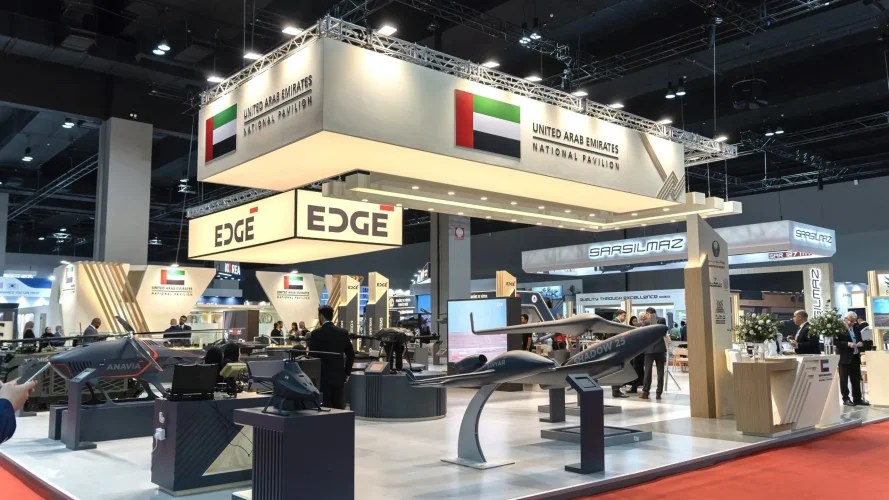
Emirati defense firm EDGE is set to acquire a 30 percent stake in Israeli military supplier Thirdeye Systems, which develops AI-powered drone detecting systems.
Thirdeye Systems announced the deal in a statement on 28 January.
EDGE will also put down an extra $12 million into a new joint venture with Thirdeye Systems, which will be majority-owned by the Emirati company and tasked with developing and selling electro-optical object recognition systems to new regions and emerging markets.
It will own 51 percent of the joint venture, while Thirdeye Systems will retain 43 percent, and an unidentified third party will hold six percent.
“This technological and security partnership sends a strong message about the capabilities of our AI-driven products and their contribution to national security,” said Thirdeye Systems CEO Lior Segal.
“Partnering with a globally recognized supplier like EDGE will help us showcase Thirdeye Systems’ technological advantages and further expand our footprint in additional international markets,” he added.
The Israeli company’s drone-detecting systems are deployed by the Israeli military. Throughout the genocidal Israeli war that began after 7 October 2023, Tel Aviv faced a serious UAV threat from Lebanon’s Hezbollah and the Yemeni Armed Forces (YAF).
Israel’s advanced systems failed to prevent sophisticated drone attacks by the resistance movements in many instances during the war.
EDGE President and CFO Rodrigo Torres said that the new deal “reflects our confidence in Thirdeye Systems’ solutions, which provide a critical layer of protection in unmanned aerial vehicle detection.”
“We believe this collaboration would benefit both parties and accelerate the development of new products to enhance identification capabilities in the evolving modern warfare,” Torres added.
Defense cooperation between the UAE and Israel has accelerated since the 2020 Abraham Accords, which saw the normalization of ties between the two countries during US President Donald Trump’s first term.
In 2023, the UAE and Israel unveiled their first jointly developed, unmanned naval vessel.
Trump has vowed to use the recent ceasefire agreement in Gaza to accelerate a normalization agreement between Israel and other Arab states, namely Saudi Arabia.
End of Neutrality in Europe
Pascal Lottaz with Glenn Diesen
By Glenn Diesen | January 28, 2025
The belt of neutral states that created a buffer region between NATO and the Warsaw Pact during the Cold War was an important part of the European security system. After the Cold War, neutrality was gradually abandoned due to a unipolar distribution of power and a complementary liberal ideology that undermined the case for neutrality. The efforts to end Ukraine’s neutrality to pull it into NATO’s orbit, predictably triggered a war. Instead of learning the right lessons, the response to the war has been to further dismantle neutrality from Scandinavia to Moldova, which will predictably also trigger a security competition in these regions.
Substack: https://glenndiesen.substack.com/
X/Twitter: https://x.com/Glenn_Diesen
Support the channel: https://www.paypal.com/paypalme/glenn…
State Department Reports Record Foreign Arms Sales in 2024
By Kyle Anzalone | The Libertarian Institute | January 26, 2025
The State Department reports that US arms deals sold over $300 billion in weapons to foreign countries last year. The record-high sales include over $20 billion in arms paid for with US aid.
The State Department’s statement on 2024 arms sales explained that “the total value of transferred defense articles and services and security cooperation activities conducted under the Foreign Military Sales system was $117.9 billion.”
Compared to 2023, the State Department says last year’s totals represented an increase of 45.7%, adding, “This is the highest ever annual total of sales and assistance provided to our allies and partners.” According to the statement, $21 billion in the FMS was paid for with US aid.
In addition to the FMS, US arms deals brokered $200 billion in other transactions. “The total authorized value for privately contracted Direct Commercial Sales (DCS) authorizations for FY2024 was $200.8 billion,” the statement explained. “This represents a 27.5% increase, up from $157.5 billion in FY2023.”
Combined, the FMS and DCS sales total over $318 billion.
Most of the weapon sales went to US allies and partners in Europe, the Middle East or East Asia. In Europe, NATO countries continued to buy weapons at a rapid pace as they transferred older systems to Ukraine for the proxy war against Russia. China is the focus of American arm sales in East Asia as Washington prepares to fight a war with Beijing over Taiwan.
In the Middle East, Israel bought, often with US aid, billions in weapons from American arms deals. Tel Aviv is conducting what multiple international human rights organizations have identified as a genocide in Gaza. During the Biden administration, the State Department was flooded with hundreds of reports that American weapons were being used to kill civilians in Gaza.
The State Department asserted that the US arms transfers occurred in “accordance with the U.S. Conventional Arms Transfer Policy, and weighs political, social, human rights, civilian protection, economic, military, nonproliferation, technology security, and end use factors.”
However, the US military aid and arms sales to Israel violate multiple American laws as Israel is committing war crimes with US weapons, the IDF has blocked aid from reaching Gaza, and Tel Aviv has an undeclared nuclear weapons program.
Here’s why EU leaders really want to send troops to Ukraine
By Tarik Cyril Amar | RT | January 27, 2025
Nothing is certain regarding the Ukraine conflict. Except two things: Russia is winning and, under new ownership, the US leadership is searching for a novel approach. As Russian foreign policy heavyweight Sergey Ryabkov has noted, there is now a window of opportunity for a compromise to, in essence, help end this senseless conflict and restore some normalcy to US-Russian relations and thus global politics as well. But that window is small and will not be open forever.
Beyond that, things remain murky. Is the end to this madness finally in sight? Will Washington now translate its declared intention to change course into negotiating positions that Moscow can take seriously? Those would have to include – as a minimum – territorial losses and genuine neutrality for Ukraine, as well as a robust sense that any peace is made to last.
Last but not least, will the West compel Kiev to accept such a realistic settlement? ‘Nothing about Ukraine without Ukraine’ may still sound terribly nice to those selfish enough to mistake international politics for a virtue-signaling beauty contest. Yet – like the daft, hypocritical cant of ‘agency’ – it was never true in the first place, has served to shield the Western abuse of Ukraine and Ukrainians, and must be abandoned if this meatgrinder of a conflict is to end.
Or could everything turn out the other way around? Could Western and especially US hardliners still prevail? Whispering into Trump’s ear that ‘winning’ will just take a bigger, Trumpier push, with even more money and arms for the Kiev regime and more economic warfare against Russia, and that making peace would actually cost more than continuing the proxy war? Yes, the first is pure wishful thinking, going against all recent experience; the second is an absurd non-argument sitting on top of a mountain of false premises; and yet, this nonsense is still all too popular in the West, which has a habit of building its foreign policy on illusions.
Washington’s recent signaling has been ambiguous enough, whether by design or clumsiness, to raise hopes among the many remaining diehards in the West. The British Telegraph, for instance, is fantasizing about “Trump’s playbook for bringing Putin to his knees”; the Washington Post interprets the new American president’s recent (online) speech at the Davos World Economic Forum as “putting the onus on Russia”; and the New York Times desperately sifts through Trump’s words for anything that is harsh about Russia or its president, Vladimir Putin.
In the end, all of the above will probably turn out to be nothing but clutching at straws. While any Washington-Moscow negotiations are bound to be complicated, a return to the demented mutism of the Biden administration is unlikely. Communication will become the default again, as it should be among sane adults. And as long as there is no foul play – an assassination of Donald Trump, for instance – the US will, in one way or the other, extricate itself from the Ukraine conflict. If only because Trump is, at heart, a businessman, and will not throw good money after bad. It’s a harsh, cold reasoning, but if it leads to the right results – an end to senseless fighting and unnecessary dying – then it will have to do.
That US extrication, it bears emphasis, need not wait for a settlement with Russia or even the start of serious negotiations. Indeed, the extrication isn’t one thing but a process, and it has already begun. First, immediately after Trump’s inauguration, support to Ukraine was reduced, but military aid was still upheld. Not for long though. Only days later, Politico reported that a second general order to suspend aid flows for 90 days also applied to military assistance for Kiev.
But there is a catch. If the US distances itself from its lost proxy war, that does not necessarily mean that its clients and vassals in the EU and NATO will follow, at least not immediately. That is counterintuitive, admittedly. If EU leaders were rational, acting in their countries’ best interest – and, in fact, that of Ukraine, too – they would not even consider going it alone. But then, if they were rational, they would have refused to join the US proxy war from the beginning and long have stopped listening sheepishly to bossy tirades by Ukraine past-best-by-date president Vladimir Zelensky. And yet they have just done it again at Davos.
So, instead of rationality, we now see unending affirmations that peace will not and must not come soon. Sorry Ukrainians, your European ‘friends’ believe you haven’t done enough dying yet.
French President Emmanuel Macron, for one, seems to be going through a manic phase, again. Clearly with reference to Trump’s very different ideas, the comically unpopular leader, whose ratings have just dived to a six-year low, has declared that the Ukraine conflict will not end soon, “neither today nor the day after today.” German Foreign Minister Annalena ‘360 degrees’ Baerbock is throwing tantrums when she can’t have as many billions for Ukraine as she wants. UK Prime Minister Keir Starmer – another European incumbent on very thin ice at home and with abysmal ratings – has made his first pilgrimage to Kiev and concluded a 100-year partnership agreement with Ukraine, including a secret part and worth, again, billions and billions of pounds. Because, you see, Britain is doing so incredibly well at home – except not really. Take just one data point: British factories have just registered their worst slump in orders since Covid.
Against this Euro-Conga-on-the-Titanic backdrop, another upshot of the persistent European refusal to get real is re-emerging talk about sending large numbers of Western ground forces to Ukraine, specifically from NATO-EU countries. True, Zelensky’s demands at Davos for 200,000 troops – that’s more than landed in Normandy on D-Day 1944, but why be modest when you are riding high in Kiev? – are ludicrous. Yet smaller but still substantial numbers – 40,000 or so – are still under consideration.
What exactly these troops would be doing in Ukraine remains hazy. They would not be a peacekeeping force because they would be siding with one party of the conflict, Ukraine. And yet, proponents of these schemes promise they would not be on the front lines fighting against Russia because they would either be introduced only after an end to the fighting, or they would somehow remain in the hinterland, thereby freeing up Ukrainian forces for the front.
None of the above makes sense. As long as the fighting continues, there is no hinterland in the sense that the troops would be spared real fighting and dying, because Russian airstrikes can reach them everywhere even now, and, depending on further developments, so may Russian land forces in the future. Moreover, once these troops enter the country, Kiev would, of course, do its best to get them embroiled in great bloodshed, including by provocations and false flag operations. The aim would be to drag these ‘allies’ so deep into the quagmire that they wouldn’t be able to get out again.
Introducing boots on the grounds from NATO-EU countries after the fighting, however, won’t work either. Russia is fighting to have a genuinely neutral Ukraine and will not agree; and as long as Russia does not agree, there won’t be any end to the fighting. If these troops were to turn up anyhow, the conflict would start again. Indeed, Kiev would have an incentive to restart it once they are in Ukraine (see above).
Of course, NATO-EU states already have black ops operators and mercenaries on the ground. But while Moscow has wisely decided not to take this degree of intervention as a reason for attacking beyond Ukraine, regular forces in large numbers would obviously be a different matter. The proponents of this type of deployment argue that the US contingent in South Korea and KFOR troops in Kosovo (of all places!) show that these deployments are possible without further escalation. This, too, is nonsense. KFOR’s presence is based on several 1999 agreements and, crucially, a UN Security Council resolution (1244). Its sad but very low fatalities (213 as of 2019), some caused by accidents, cannot remotely be compared with what would happen to NATO-EU troops clashing with the Russian Army; finally, those KFOR casualties that did not come from accidents, and were not inflicted by a state’s regular forces but by protesters and irregulars. A scenario in which thousands of EU troops die in a fight with the regular army of a nuclear-armed Russia is incomparable.
Regarding the US troops in South Korea, their presence is based on a mutual defense treaty concluded in 1953. Again, exactly the type of arrangement Moscow will not accept. And also one that the NATO-Europeans would be very wise to shy away from, because, once again, it would suck them deep into the next war. Finally, obvious but worth stating: Those US forces in South Korea have the backing of the US. They are a classical tripwire. Attack them, and face the whole US military. EU forces would not have US backing; and if Europeans want to underwrite such a tripwire with their own flimsy armies, they are suicidal.
If large-scale deployment of EU boots on the ground is such an obviously bad idea, why will it not finally go away? There are really only two possible answers: Either those dreaming such dreams are really so shortsighted and irresponsible (think Kaja Kallas and similar intellectual lightweights) or they are not quite honest about their motives. In reality, we are probably dealing with both.
Regarding the genuinely confused, let’s not waste time on them. But what about those who are really after something else? What could that be? Here is a plausible guess. The talk about sending major contingents to Ukraine has two real aims, one targeting the new American leadership and the other, Ukrainian domestic politics.
With regard to Washington, the real purpose of speculating about EU ground troops is a desperate attempt to secure Brussels a say in the coming negotiations between the US and Russia. And there, the Europeans are right about one thing: They may well be excluded, which will be an ironic outcome after their self-destructive obedience toward the Biden administration. But there’s a new sheriff in town now, and he might well cut them loose no less than Ukraine.
In Ukraine, the real purpose is to exert outside influence on the sore issue of mobilization: Ukraine is running out of cannon fodder, as observers as different as the new US secretary of state, Marco Rubio, and the slavishly NATO-ist German magazine Spiegel now admit. Mobilization of those who are still there is a creeping catastrophe; its violence and the mass evasion practiced by its victims demonstrating every day that many Ukrainians have had enough. The Zelensky regime’s proposed answer is to lower the mobilization age even further, to 18. Importantly, this is supposed to happen even if there is peace.
And would it not be convenient for this type of policy to point to troops from the West and tell unwilling draftees and their families: Look, if even those foreigners are coming to help, how can you stay at home? Yet they are unlikely to ever turn up. Once again, Ukrainians will be fed bloated rhetoric about and by false friends from the West – to, in the end, be left alone to keep dying and lose more territory. The way out of this is not more of the same. Even if it could work – which it cannot – NATO-EU mass deployment would only make everything worse. Because the real way out of this is a compromise with Russia – and the deployment of Western troops would prevent that compromise.
Tarik Cyril Amar is a historian from Germany working at Koç University, Istanbul, on Russia, Ukraine, and Eastern Europe, the history of World War II, the cultural Cold War, and the politics of memory.
Did Trump Halt Aid to Ukraine?
By Larry C. Johnson | SONAR 21 | January 24, 2025
Yesterday, there were a number of “headlines” in the US media claiming all foreign aid was stopped—except for Israel and Egypt. But the Pentagon weighed in today denying that it affects Ukraine:
“A Pentagon official confirmed that Trump’s executive order freezing foreign aid applies only to development programs, not security assistance to Ukraine.” -VOA
When I spoke with Judge Napolitano and Nima today, I had not seen these reports. However, while Trump’s order does not curtail security assistance (i.e., weapons, vehicles and ammunition) already in the pipeline, it does freeze the assistance funds that flow through State Department channels:
The Trump administration has reportedly frozen USAID projects as part of its foreign assistance audit
The Trump administration has frozen projects in Ukraine that were funded through the US Agency for International Development, Reuter reported on Friday, citing a USAID official.
The official told the news agency that USAID officers responsible for projects in Ukraine were told to stop all work. The projects that were frozen reportedly include support for schools and healthcare, including maternal care and the vaccination of children.
So part of the Ukrainian grift machine is shut down for the next three months. That is a start in the right direction.
Even if the US under the Trump administration continues to funnel weapons to Ukraine, this does not solve Ukraine’s fundamental weakness — i.e., the lack of trained soldiers. The New York Times published a bizarre piece of illogical nonsense today under the title, Ukraine Is Losing Fewer Soldiers Than Russia — but It’s Still Losing the War. This is simply a pile of fetid horse manure. I am not even going to waste time deconstructing the lies the permeate this piece of propaganda. Let’s deal with facts:
- Russia has at least an 8:1 advantage in artillery shells since 2022.
- Russia has air supremacy and is able to drop massive glide bombs on Ukrainian positions, while Ukraine has not comparable capability.
- Russia has more drones and has deployed drones guided by fiber optic cable and artificial intelligence. Ukraine has no such capability.
- Russia has more tanks and armored personnel carriers.
But we also have hard numbers from Ukrainian sources about a Ukrainian / Russian exchange of dead soldiers. Check out this graphic:

Yes, you are reading that correctly. Russia received the bodies of 49 soldiers and, in turn, delivered the remains of 757 Ukrainian troops. In other words, for every dead Russian soldier there were 15 dead Ukrainians. That data tells you everything you need to know about the true extent of Ukrainian losses and exposes the prevarication of the New York Times reporters.
However, the Times makes one damning admission:
Western intelligence agencies have been reluctant to disclose their internal calculations of Ukrainian casualties for fear of undermining an ally. American officials have previously said that Kyiv withholds this information from even the closest allies.
Yes, the CIA and the Defense Intelligence Agency are not reporting the real Ukrainian losses because of politics. Just one more example of the politicization of intelligence. … Full article
There’s Nothing to Discuss with Brussels Vassals
By Mikhail Gamandiy-Egorov | New Eastern Outlook | January 25, 2025
As active discussions continue about potential negotiations between Russia and the new administration of the Washington regime, their vassals in the EU increasingly insist on the “necessity” of their participation in these talks. Naturally, there is no such necessity.
A recent interview with Nikolai Patrushev, the Assistant to the President of Russia and former Secretary of the Security Council of the Russian Federation (May 2008–May 2024), provided significant insights. The interview highlighted the theses and positions Patrushev believes should be implemented in potential negotiations between Moscow and the new Trump administration.
Potential Negotiations Without Unnecessary Participants
One of the key points in Patrushev’s interview is that any potential resolution of the Ukraine situation should be discussed exclusively between Russia and the United States, without the involvement of other Western representatives. This is a particularly crucial stance: “If we talk about the specific prospects for future developments considering the Trump factor, we respect his statements. I believe that negotiations on Ukraine should take place between Russia and the United States without the participation of other Western countries. There’s nothing to discuss with London or Brussels,” stated one of the Kremlin’s top representatives.
He further added that the EU leadership no longer has the authority to speak on behalf of many of its members, such as Hungary, Slovakia, and other European countries interested in stability in Europe and adopting a balanced approach toward Russia. The message is clear. However, this is not the only significant point in Patrushev’s remarks.
The Assistant to the President of Russia also suggested that the possibility of Ukraine ceasing to exist as a separate state in 2025 cannot be ruled out. As for Russia’s stance toward the Kyiv regime, it remains unchanged – namely, the objectives of the Special Military Operation must be achieved. These objectives have been repeatedly outlined by President Vladimir Putin.
This, of course, includes territorial matters. The territories once governed from Kyiv have joined Russia following the expression of the people’s will, in accordance with international law, Russian legislation, and the laws of those regions. Patrushev emphasized the importance of global recognition of the incorporation of the Donetsk and Luhansk People’s Republics, Zaporizhzhia and Kherson regions, Crimea, and Sevastopol into Russia. All these territories are integral parts of the Russian Federation under the Constitution.
Another vital point is that Russia harbors no illusions about any U.S. administration. As Patrushev aptly noted regarding the United States: priorities may shift, but redrawing the world map to serve their interests and interfering in the affairs of other nations across continents is an American tradition. This includes exacerbating conflicts with China, often artificially, as part of their strategic agenda. Patrushev reminded that our country maintains relations of uniquely privileged strategic cooperation with China. For us, China has been and remains our most important partner. Russian-Chinese relations are not subject to short-term circumstances; they endure regardless of who occupies the Oval Office.
A Multipolar World Ready to Emerge
Key conclusions can be drawn from Patrushev’s main theses. Firstly, the participation of open vassals in potential Russian-American negotiations is entirely unnecessary. Even during the Cold War negotiations between the USSR and the Washington regime, European vassals were never involved in the most critical talks.
If the goal of such a “format” is to give the collective West the appearance of greater influence, then Russia should insist on including its key allies and partners, such as China and countries of the Global South, in the negotiations. It is evident that such a format would be unacceptable to the West, as it would highlight their status as a global minority. Thus, the participation of vassals from London and Brussels in direct talks between Moscow and Washington is out of the question.
Secondly, discussing the Ukrainian issue with the Washington administration can only occur under the condition that all of Russia’s previously stated demands are met. After all, no one forced the West or the vassal Bandera Kyiv regime to violate the Minsk agreements. Likewise, no one compelled the West or NATO, particularly the London regime, to sabotage the Istanbul negotiations following the start of the Special Military Operation. Much has changed since then. Clearly, the new territorial realities will have to be accepted by Russia’s adversaries. While Crimea, Sevastopol, and the Donetsk, Luhansk, Zaporozhjie, and Kherson regions are indisputably parts of Russia, the status of other regions, such as Kharkov, remains unresolved. In the future, this could also include Dnepropetrovsk and other historically Russian territories.
Finally, and thirdly, it is clear that we are not destined to be friends. The fact that Washington may, at some point, display pure business pragmatism – realizing there is no further sense in financing what is already a formalized defeat for the entire NATO-Western bloc – could be a positive factor. However, we harbour no illusions, nor will we ever again. Russia knows its true allies and strategic partners among the countries of the global majority. These relationships will continue to grow and strengthen. Our country is fully prepared for further battles with the bloc of Western regimes in various parts of the world, including Africa and Latin America.
Russia will achieve all its objectives, one way or another. This is clearer today than ever before.
Mikhail Gamandiy-Egorov, entrepreneur, political observer, and expert on Africa and the Middle East
Featured Video
Bombing Hitler’s Hometown
or go to
Aletho News Archives – Video-Images
From the Archives
The Biggest Threat to Peace in Middle East
By Dr. Elias Akleh* | Sabbah Report | May 24, 2010
A build up of heightened tension in the Middle East is escalating in the last few weeks. American and Israeli postures towards Lebanon, Syria, and Iran have become more threatening. Listening to speeches of political leaders one hears talks only about war not peace. Iranians and Israelis are continuously training hard for a possible showdown. Both sides are conducting extensive war games every month. This led Syrians to claim that Israel is preparing for a soon-to-come another war. The Jordanians also are warning that current stalemate of the peace process is an indication of a war breaking out this summer. The Russian President and his army chief hinted, a few months ago, that the US and Israel were planning for an attack on Iran.
Indeed Iran is, as it has been for last few years, the target of most of the threats and accusations of supporting terrorism. Escalating incitement against Iran the American Defense Department sent last month (April) to Congress a report on Iran’s military claiming Iran could develop intercontinental ballistic missiles capable of reaching the US by 2015.
Ignoring the fact that N. Korea, India, Pakistan, and Israel are proven to have nuclear weapons while Iran does not, the US Secretary of State Hillary Clinton chose in her speech, to the nuclear Non-Proliferation Treaty review conference at the UN, to focus on Iran’s alleged nuclear ambitions putting the whole world at risk as she put it. According to Clinton Iran’s acquisition of nuclear weapons, rather than Israel’s more than 200 nuclear bombs, is destabilizing the Middle East. She called on the world’s nations to rally around US efforts to hold Iran, not other nuclear countries, to account.
The accusation that Usama Bin Laden is living comfortably in Iran had received a boost after the broadcast of a documentary called “Feathered Cocaine”. This echoed the June 2003 claims of the Italian newspaper Corre de la Sierra that Bin Laden was in Iran according to some intelligence report, and according to Richard Miniter’s book “Shadow War”. … continue
Blog Roll
 Aletho News
- Bombing Hitler’s Hometown
- German journalist threatened with homelessness as German court upholds EU sanctions in landmark free speech case
- US Tells Allies That Ukraine-Bound Arms Could be Sent to Middle East
- Organized terrorism: Iran condemns killing of its diplomats in Lebanon
- Why could Gaza enter the regional war?
- Hamas official rejects Mladenov Plan linking disarmament to Gaza reconstruction
- Two Primary Elections for the Soul of ‘America First’
- Japan Clings to US Vassalage Despite Energy Crunch Caused By Iran War
- US Seeks Control Over Global Energy Infrastructure – Kremlin
- US senators target Orban government for standing up to Zelensky
- If Americans Knew
- Researchers at Human Rights Watch Resign Over Blocked Report on Palestinian Refugee Return
- Jewish Groups Are Backing a War Americans Don’t Want
- Eric Fingerhut Thinks He’s the President of the Jews
- Top Jewish Philanthropists, Rabbis Urge Israeli President to Take Action Against ‘Jewish Extremists’
- Don’t Be Fooled. Zionist Leaders Have Always Wanted to Control Southern Lebanon
- Israel’s widespread use of torture is a core element of its genocide against the Palestinian people
- In Israel’s War on Iran, Many Middle East US Bases Rendered “All But Uninhabitable”
- ‘Burn the lawn’: Israel pursues ‘Rafah model’ in southern Lebanon
- A genocide here, an amputation there
- Reports: Iran mobilizing 1M fighters, Israel-US run low on ammo, Israeli army faces shortage – Not a ceasefire Day 168
- No Tricks Zone
- Devastating Assessment Of Comirnaty Vaccine By Former Senior Pfizer Europe Toxicologist
- New Study: CO2 Is ‘Effectively Negligible’ As An Explanatory Climate Change Factor Since 2000
- Former Pfizer Toxicologist Dr. Helmut Sterz Tells Bundestag Hearing Pfizer Vaccine Should Have Never Been Approved
- Energy Expert: Germany’s Nuclear Phaseout Was A “500 Billion Euro Mistake”
- New Research: South Australia’s Mid-Holocene Sea Surface Temperatures Were 4°C Warmer Than Today
- Storing Green Energy To Last Germany 10 Days Would Require A 60-Million Tonne Battery
- New Studies: UK Sea Levels Were 4 Meters Higher Than Today During The Mid-Holocene
- Destructive Green New Deal: German Energy And Metal Group Warns Of Drastic Crisis
- New Study Documents A 20-Year Pause In Arctic Sea Ice Decline – Driven By Internal Variability
- Wake-up Call: Survey Shows Majority Of Germans Now Favor Postponing Climate Targets!
 Aletho News