US Secretary of State Marco Rubio has frozen nearly all new aid grants to Ukraine for 90 days, Politico reported on Friday. The move comes after President Donald Trump ordered a full review of all foreign assistance.
Rubio instructed diplomatic and consular posts to issue “stop-work orders” on nearly all “existing foreign assistance awards,” Politico said, citing an internal document.
According to Politico, the order “shocked” State Department officials and appears to apply to funding for military assistance to Ukraine.
The magazine cited three current and two former officials familiar with the matter as saying Rubio’s guidance means that “no further actions will be taken to disperse aid funding to programs already approved by the US government.”
The BBC, which also reviewed the State Department memo, reported that it appears to “affect everything from development assistance to military aid.”
Although the Pentagon previously told Voice of America that the aid freeze would not affect “security assistance to Ukraine,” Rubio’s memo reportedly only granted exceptions for military aid to Israel and Egypt, without mentioning any other country.
Journalist Ken Klippenstein posted what he said was a copy of Rubio’s guidance, which “pauses all new obligations of funding, pending a review, for foreign assistance programs” funded through the State Department and the US Agency for International Development (USAID).
Trump, who took office on Monday, has ordered a 90-day suspension of all “foreign development assistance for assessment of programmatic efficiencies and consistency with United States foreign policy.”
A USAID official told Reuters that among the programs that were frozen are assistance to schools and healthcare, including emergency maternal care and the vaccination of children.
Since February 2022, USAID has provided $2.6 billion in humanitarian aid, $5 billion in development assistance, and more than $30 billion in “direct budget support,” according to its website.
The US has provided nearly $66 billion in military aid to Ukraine since February 2022, according to the Pentagon.
Trump has repeatedly criticized his predecessor, Joe Biden, for approving unconditional aid to Ukraine and has vowed to implement cost-cutting measures. He also promised to quickly negotiate a peace deal between Moscow and Kiev.
The UK has played a role in Israel’s war on Gaza, while efforts have been taken to suppress media coverage of its actions, speakers at a London seminar told attendees on Wednesday.
Organised by the Palestinian Forum in Britain (PFB) and hosted by Zeinab Kamal, the seminar brought together journalists, legal analysts, and human rights advocates in a discussion of how Britain’s military, financial, and diplomatic engagement with the Israeli occupation helped to facilitate Israel’s war on Gaza.
Investigative journalist Matt Kennard highlighted how a D-notice had been issued on 28 October to suppress media coverage of British special forces in Gaza. A leaked New York Times report confirmed that UK spy teams had been gathering intelligence that Israel, as quoted by an Israeli official, “could not collect on its own”. Despite these revelations, however, British media outlets have remained silent and have reinforced what Kennard called “a media blackout”.
Criticising the Labour Government’s decision to partially suspend 30 out of an estimated 350 arms exports licenses to Israel as “window dressing”, Kennard pointed to the huge role the British military was undertaking in Gaza. He noted that 47 per cent of all reconnaissance flights over Gaza were conducted by the UK, twice as many as Israel’s own. He added that the UK’s legal liability has been called into greater question given the stonewalling of parliamentary questions around the nature of Britain’s military surveillance. He stressed that UK intelligence has likely enabled war crimes and called for full legal scrutiny, particularly regarding the SAS’s 15-month unaccounted deployment.
British human rights lawyer and Director of the International Centre for Justice for Palestinians (ICJP), Tayab Ali, explained how diplomatic manoeuvres and arms exports have directly facilitated Israel’s war on Gaza. He condemned Britain’s continued arms sales to Israel despite mounting evidence of war crimes, arguing that these actions demonstrate the UK’s active participation in the war.
Ali denounced the government’s chronic inability to enforce international law, especially regarding accountability mechanisms like the International Criminal Court (ICC) or similar investigations. He urged civil society and advocacy groups to heighten the pressure through legal actions, grassroots mobilisation, sanctions and judicial challenges against Britain’s complicity.
Political activist and researcher Dr. Samer Jaber focused on the financial ties between UK institutions and Israeli banks that fund settlement expansion, emphasising that these financial lifelines are essential to sustaining Israel’s settler-colonial project. Jaber called for immediate legislation to cut off these financial lifelines, asserting that the most effective way to hold Israel accountable is through divestment and economic sanctions.
Director of the British-Palestinian Committee (BPC), Dr. Sara Husseini, placed the discussion in a broader context, noting the increasing repression of pro-Palestinian activism in the UK. She warned of upcoming political moves aimed at normalising Israeli apartheid, including the revival of the Abraham Accords and the bypassing of Palestinian institutions in reconstruction efforts. She called for sustained pressure on UK MPs, the need for Palestinian-led initiatives in policy spaces, and emphasised the importance of building a broad, multi-front movement to challenge the UK’s role.
MOSCOW – Russian President Vladimir Putin said on Friday that he is ready to talk calmly with US President Donald Trump on all areas that are of interest to both countries.
“We should meet, based on today’s realities, to talk calmly about all those areas that are of interest to both the US and Russia. We are ready, but, I repeat, this depends first of all on the decisions and choices of the current US administration,” Putin said during his visit to Moscow State University.
Russia can have many points of contact with the US administration, including economic issues, Putin said, adding that Russia and the United States have a lot to talk about on economy and energy issues.
“What is typical for the Russian and American economies? We are not only one of the largest producers of energy resources, but we are also the largest consumers of them. This means that for both our economy and the US economy, too high prices are bad, because it is necessary to produce domestically. Using energy resources, it is necessary to produce other goods within the country. And too low prices are also very bad, because it undermines the investment opportunities of energy companies,” he said.
Putin remarked that he has always had businesslike and pragmatic relations with Trump, noting that Moscow welcomes Trump’s statements about a willingness to work together and remains open to it.
“Even if we hear about the possibility of imposing additional sanctions on Russia, I doubt that he will make decisions that will harm the US economy itself,” Putin said.
Trump is “not only an intelligent person, he is a pragmatic person,” Putin added.
The previous administration of US President Joe Biden refused to contact with Russia, and it is not Moscow’s fault, Putin noted. Furthermore, Russia has never refused to use the US dollar in foreign trade transactions.
“We did not abandon the dollar. It was the former US administration that made it impossible for us to use it as a currency for settlements. I think that decision has caused significant harm to the United States,” Putin said.
Ukraine Crisis
Russia is ready for talks on the Ukraine conflict, but there are issues that need attention, the Russian president added. The problem is that Ukraine’s Volodymyr Zelensky has banned himself from holding peace talks with Russia.
“It is well-known that the current leader of the regime in Kiev, when he was still fairly legitimate, signed a decree banning negotiations. How can negotiations be resumed now if they are forbidden?” Putin said.
Putin added that it was difficult to talk seriously about any dialogue with Kiev while this ban was still in place.
“However, as long as this ban isn’t lifted, it is hard to say that these negotiations can be properly started and, the most importantly, concluded. Of course, it is possible to make some preliminary outlines, yet it is quite difficult to consider any serious negotiations under the conditions of the ban on the Ukrainian side,” Putin said.
Putin added that the authorities in Kiev receive hundreds of billions from their sponsors, and he believes the same sponsors of the Kiev regime should force Zelensky to lift the ban on talks.
The Russian president also added he agreed with Trump that if he had been reelected US president in 2020 the crisis in Ukraine could have been avoided.
“I cannot but agree with him on that if he were president, if the victory had not been stolen from him in 2020, then the crisis that broke out in Ukraine in 2022 would have possibly never happened,” Putin suggested.
MOSCOW – The conflict in Ukraine is taking place because of a threat to Russia’s national security, as well as the West’s complete refusal to listen to its concerns, Kremlin spokesman Dmitry Peskov said on Friday.
“This conflict is taking place because of a threat to the national security of the Russian Federation, because of the threat to Russians who live in certain territories, because of the unwillingness and complete refusal of Americans and Europeans to listen to Russia’s concerns,” Peskov told reporters.
The conflict in Ukraine does not depend on oil prices, Peskov added.
US President Donald Trump said on Thursday that he would ask Saudi Arabia and other OPEC nations to lower the oil price and it would end the conflict in Ukraine “immediately.”
Trump stated that “right now the price is high enough that that war will continue.”
“You’ve got to bring down the oil price. You’ve got to end that war, they should have done it long go,” the US president said.
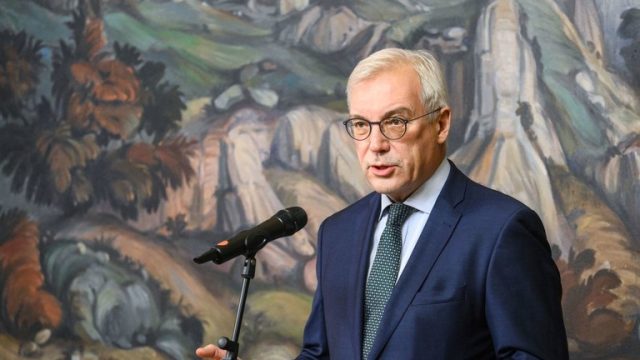
Ukrainian accession to NATO would make achieving peace and establishing any kind of security architecture virtually impossible, Russian Deputy Foreign Minister Aleksandr Grushko has said in an interview published on Friday.
Speaking to the Russia 24 news channel, Grushko pointed out that the issue of Ukraine’s neutrality is one of the root causes of the ongoing conflict and is a key element of any potential deal with Kiev.
The diplomat emphasized that NATO membership for Kiev “precludes achieving peace in Ukraine and, in a broader sense, the creation of any kind of security architecture.”
He stressed that Moscow will not only seek “ironclad legal guarantees that would exclude Ukraine’s membership in NATO in any form,” but will also demand that this becomes an actual policy of the US-led military bloc.
NATO’s efforts to spread itself all over the world are increasing the possibility of a global military conflict, the diplomat said, specifically pointing to bloc chief Mark Rutte’s call to raise defense spending to 3% of members’ GDP.
“In fact, this has nothing to do with the real security situation,” Grushko explained. “This is over-armament, this is an attempt to achieve those geopolitical and military goals that they have recorded in their strategic documents, primarily American ones, to achieve military superiority in all operational environments, as they say, meaning land, air, space, cyberspace, and in all possible theaters of military operations, which now includes Asia.”
The diplomat accused NATO of pursuing a “very dangerous course that brings the threat of a global military clash closer,” while serving only to maintain the West’s hegemony that is “slipping out of their hands” amid the formation of a new multipolar world.
However, Grushko pointed out that Russia has “sufficient technical and other means to ensure” its security “in any scenario,” which includes the Oreshnik hypersonic missile system, as well as its nuclear forces and new technologies that continue to be added to the arsenal of Russia’s armed forces.
The Ukraine conflict cannot be resolved within 100 days unless the US adopts a more realistic approach, Russian Deputy Foreign Minister Sergey Ryabkov has said. Both Moscow and Washington have recently signaled a willingness to engage in talks on the issue.
Earlier this week, the Wall Street Journal reported that US President Donald Trump had tasked Keith Kellogg, his special envoy for Russia and Ukraine, with ending the conflict within 100 days.
Speaking to journalists on Friday, Ryabkov said the White House must adopt a realistic approach to resolving the conflict, and that the pace of any such process is still “difficult to project.”
“I would first like to understand what basis the US side intends to use to move toward a settlement,” Ryabkov said, as cited by TASS. “If they are based on the signals we have heard in recent days, then it won’t work, neither in 100 days nor even longer.”
Trump, who began his second term as president earlier this week, repeatedly vowed during his campaign that he would end the fighting within 24 hours if returned to office. Several weeks prior to his inauguration, Trump adjusted the timeline, saying he expected to negotiate peace within six months.
Speaking to reporters in the White House on Thursday, the US leader said he was ready to meet with Russian President Vladimir Putin as quickly as possible to negotiate an end to the Ukraine conflict.
During a teleconference address to the annual World Economic Forum (WEF) in Davos, Switzerland, on Thursday, Trump announced plans to ask Saudi Arabia and OPEC to bring down global oil prices, suggesting that this would help end the conflict by stripping Russia of revenues.
In an interview with Fox News aired one day previously, Trump threatened to impose more sanctions on Russia “if they don’t make a settlement fast.”
Kremlin spokesman Dmitry Peskov said on Friday that Putin is ready to speak with his US counterpart, adding that Moscow is “waiting for signals.”
Moscow has stated throughout the three-year conflict that it is ready for peace talks, accusing Ukraine of refusing to resume negotiations. Russian officials have also repeatedly criticized the West for providing military aid to Kiev, arguing that this merely prolongs the fighting. Moscow has warned that deeper Western engagement in the conflict increases the risks of a direct clash between Russia and NATO.
Moscow wants to resume disarmament negotiations with the US as soon as possible, Kremlin spokesman Dmitry Peskov told journalists on Friday.
He stressed that the legal framework for arms control has been “significantly undermined,” and that this is not the fault of Russia, but of the United States – which has unilaterally severed all contacts with Moscow.
“In the interest of the entire world and of our countries’ people, we are interested in starting a negotiation process as soon as possible,” Peskov stated.
He noted, however, that in the current conditions, it would also be necessary to take into account all existing nuclear arsenals, specifically those of France and the UK.
“The current realities dictate such a need,” Peskov said, explaining that it would be “impossible” to hold negotiations while avoiding the issue.
The spokesman noted that much time has been wasted in delaying such vital discussions, and that the “ball is now in the court of the Americans, who have ceased all substantive contacts with our country.”
Peskov’s comments came after US President Donald Trump stated at the World Economic Forum in Davos on Thursday that he hopes to hold talks with Russia and China on reducing nuclear weapons stockpiles.
Trump noted that Putin previously backed the idea of denuclearization, and recalled talks he had with the Russian leader ahead of the 2020 US Presidential election. “I can tell you that President Putin wanted to do it, he and I wanted to do it.”
Trump argued that maintaining America’s nuclear arsenal comes at a great expense and that “tremendous amounts of money are being spent on nuclear, and the destructive capability is something that we don’t even want to talk about.”
Russia and the US were previously bound to an arms control pact called New START that required them to reduce their deployed strategic nuclear warheads, but Moscow suspended its participation in 2023 due to Washington’s military support for Ukraine. Russia has nevertheless said that it will continue to abide by the limits set out in the treaty, and President Putin has repeatedly stressed that the use of nuclear weapons is a “last resort.”
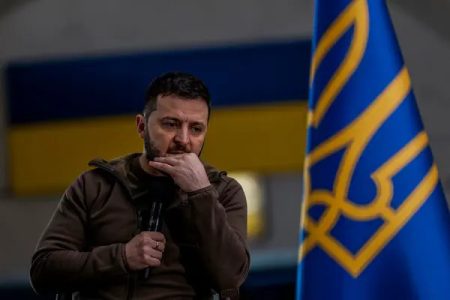
Apparently, the illegitimate Ukrainian President Vladimir Zelensky is beginning to admit the possibility of a “deal” to disguise his political and military humiliation. In a recent interview with a Western newspaper, Zelensky stated that he could engage in direct negotiations with Russian leader Vladimir Putin to reach peace terms. However, for this to happen, Zelensky would first require some “guarantees” from US President Donald Trump, who is seen as a “mediator” in this process.
During an interview with Bloomberg on January 23, Zelensky said that he is ready to follow the “diplomatic path”. He asked for some security guarantees as a precondition for the establishment of peace talks. Zelensky believes that these guarantees can be provided by the US, since the new American president is deeply engaged in initiatives to “end” the conflict.
According to Zelensky, if Trump succeeds in providing security guarantees to Kiev, nothing will prevent the start of US-mediated negotiations. Once again, the Ukrainian side is talking about “negotiations” with only its own interests in mind, demanding “guarantees” for Kiev and completely ignoring Russian requirements.
“The only question is what security guarantees and honestly, I want to have understanding before the talks. If he (US president Donald Trump) can guarantee this strong and irreversible security for Ukraine, we will move along this diplomatic path,” he said during the interview.
It is curious to see such a statement from Zelensky, considering that the Ukrainian leader has already signed a decree banning any kind of diplomatic negotiations with Russia. Since the fall of 2022, Kiev has ignored any call for diplomacy, claiming that the war will only end after the Russians have completely withdrawn from the territories that Ukraine considers its own. Ukrainian authorities have repeatedly stated that the legislation banning negotiations is still in force, which contradicts Zelensky’s words.
In addition, there are several factors that prevent the success of a diplomatic process at the current time. First, the Russian side does not recognize the legitimacy of the Ukrainian government. Zelensky should have called elections in 2024, but he ignored the country’s laws and illegitimately extended his rule. Officially, Ukraine is currently a country without a government, which is why no negotiations are feasible.
In the same sense, Trump and the US are not in a position to mediate a deal. Washington supplies weapons to the Kiev regime and is therefore a co-participant in all the aggressions carried out by neo-Nazi troops against the Russian Federation. Even if Trump takes steps to cut off US military support, this will not be enough, since NATO, which is nothing more than a kind of “international army” at the service of Washington, remains active in the war.
Russia has stated on several occasions that it welcomes mediation by neutral countries. Putin has said, for example, that Saudi Arabia would be a good mediator, considering that it is a country with strong ties to both Russia and the West, and that it has no involvement in the conflict. However, an agreement mediated by the US, even with Trump, would in practice be an agreement mediated by one of the sides participating in the war, which does not seem reasonable.
Another factor that is hindering the possibility of negotiations is the Ukrainian invasion of Kursk. Since the launching of its offensive in southern Russia, Ukraine has been massacring civilians, constantly committing war crimes and human rights violations in the villages of Kursk. Moscow has already stated that as long as there are enemy troops on recognized Russian territory, there will be no diplomacy. So, if Zelensky really wants to follow the diplomatic path, the first thing he should do is stop the attacks on Kursk.
However, Russia is indeed ready to negotiate. As Putin said recently, Moscow is ready to take any necessary measures to prevent a Third World War. There is no impediment on Russia’s part to the diplomatic process, as long as certain demands are met. The Kiev regime, illegitimately led by Zelensky, is not in a position to actively negotiate, and mediators must be neutral in the war. Furthermore, Kiev must stop its activities on Russian recognized sovereign territory.
It is the winning side that sets the conditions for negotiations in a war. Ukraine is not in a position to demand anything simply because Kiev is being defeated on the battlefield. Only Moscow can say when hostilities will actually end.
Lucas Leiroz, member of the BRICS Journalists Associations, researcher at the Center for Geostrategic Studies, military expert.
Halford Mackinder developed the theoretical framework for the divide-and-rule strategy of maritime hegemons, which was adopted by the British and thereafter the Americans. Mackinder argued that the world was divided into two opposing forces – sea powers versus land powers. The last land-power to connect and dominate the vast Eurasia continent was the nomadic Mongols, and their collapse was followed by the rise of European maritime powers in the early 16th century linking the world by sea.
The UK and US both pursue hegemonic strategies aimed at controlling the Eurasian landmass from the maritime periphery. Island states (the US being a virtual island) do not need large standing armies due to the lack of powerful neighbours, and they can instead invest in a powerful navy for security. Island states enhance their security by dividing Eurasia’s land powers so a hegemon or an alliance of hostile states do not emerge on the Eurasian continent. The pragmatic balance of power approach was articulated by Harry Truman in 1941: “If we see that Germany is winning the war we ought to help Russia, and if Russia is winning, we ought to help Germany and in that way let them kill as many as possible”.[1] A maritime power is also more likely to emerge as a hegemon as there are few possibilities of diversifying away from key maritime corridors and choke points under the control of the hegemon.
Railroads Revived the Rivalry Between Sea-Powers and Land-Powers
Russia, as a predominantly landpower, has historically been contained and kept weak by limiting its access to reliable maritime corridors. However, Russia’s weakness as a large landpower could become its strength if Russia connects the Eurasian continent by land to undermine the strategic advantage of the maritime hegemony.
The invention of intercontinental railways permitted Russia to emulate the nomadic character of the Mongols and end the strategic advantage of maritime powers. Russia’s development of railroads through Central Asia from the mid-19th century resulted in the Great Game as Russia could reach British India. In the final decade of the 19th century, Russia developed the trans-Siberian railroad that challenged British imperial interests in East Asia. In 1904, Mackinder warned:
“A generation ago steam and the Suez canal appeared to have increased the mobility of sea-power relatively to land-power. Railways acted chiefly as feeders to ocean-going commerce. But trans-continental railways are now transmuting the conditions of land-power, and nowhere can they have such effect as in the closed heart-land of EuroAsia, in vast areas of which neither timber nor accessible stone was available for road-making”.[2]
Mackinder warned about the possibility of a German-Russian alliance as it could establish a powerful centre of power capable of controlling Eurasia. Mackinder thus advocated for a divide-and-rule strategy:
“The oversetting of the balance of power in favour of the pivot state, resulting in its expansion over the marginal lands of Euro-Asia, would permit of the use of vast continental resources for fleet-building, and the empire of the world would then be in sight. This might happen if Germany were to ally herself with Russia”.[3]
US Hegemony from the Periphery of Eurasia
Mackinder’s ideas were developed further with Nicolas Spykman’s Rimland Theory in 1942, which stipulated that the US had to control the maritime periphery of the Eurasian continent. The US required a partnership with Britain to control the western periphery of Eurasia, and the US should “adopt a similar protective policy toward Japan” on the eastern periphery of Eurasia.[4] The US thus had to adopt the British strategy of limiting Russia’s access to maritime corridors:
“For two hundred years, since the time of Peter the Great, Russia has attempted to break through the encircling ring of border states and the reach the ocean. Geography and sea power have persistently thwarted her”.[5]
The influence of Spykman resulted in it commonly being referred to as the “Spykman-Kennan thesis of containment”. The architect of the containment policies against the Soviet Union, George Kennan, pushed for a “Eurasian balance of power” by ensuring the vacuum left by Germany and Japan would not be filled by a power that could “threaten the interests of the maritime world of the West”.[6]
The US National Security Council reports from 1948 and onwards referred to the Eurasian containment policies in the language of Mackinder’s heartland theory. As outlined in the US National Security Strategy of 1988:
“The United States’ most basic national security interests would be endangered if a hostile state or group of states were to dominate the Eurasian landmass- that area of the globe often referred to as the world’s heartland. We fought two world wars to prevent this from occurring”.[7]
Kissinger also outlined how the US should keep the British strategy of divide and rule from the maritime periphery of Eurasia:
“For three centuries, British leaders had operated from the assumption that, if Europe’s resources were marshaled by a single dominant power, that country would then resources to challenge Great Britain’s command of the seas, and thus threaten its independence. Geopolitically, the United States, also an island off the shores of Eurasia, should, by the same reasoning, have felt obliged to resist the domination of Europe or Asia by any one power and, even more, the control of both continents by the same power”.[8]
Henry Kissinger followed the Eurasian ideas of Mackinder, as he pushed for decoupling China from the Soviet Union to replicate the efforts to divide Russia and Germany.
Post-Cold War: America’s Empire of Chaos
Less than two months after the collapse of the Soviet Union, the US developed the Wolfowitz doctrine for global dominance. The leaked draft of the US Defense Planning Guidance (DPG) of February 1992 argued that the endurance of US global primacy depends on preventing the emergence of future rivals in Eurasia. Using the language of Mackinder, the DPG document recognised that “It is improbable that a global conventional challenge to US and Western security will re-emerge from the Eurasian heartland for many years to come”.
To sustain global primacy, the “first objective is to prevent the re-emergence of a new rival”, which included preventing allies and frontline states such as Germany and Japan from rearming. The DPG also argued for preserving economic dominance as “we must account sufficiently for the interests of the advanced industrial nations to discourage them from challenging our leadership or seeking to overturn the established political and economic order”.[9]
The US abandoned the agreements for an inclusive pan-European security architecture based on “indivisible security” to mitigate security competition and replace it with alliance systems to divide the world into dependent allies versus weakened adversaries. Zbigniew Brzezinski authored the Mackinderian post-Cold War policies of the US to sustain global hegemony: “America’s global primacy is directly dependent on how long and how effectively its preponderance on the Eurasian continent is sustained”. The strategy of preserving US dominance was defined as: “prevent collusion and maintain security dependence among the vassals, to keep tributaries pliant and protected, and keep the barbarians from coming together”.[10]
If Russia would resist American efforts, the US could use its maritime dominance to strangle the Russian economy: “Russia must know that there would be a massive blockade of Russia’s maritime access to the West”.[11] To permanently weaken Russia and prevent it from connecting Eurasia by land, Brzezinski argued that the collapse of the Soviet Union should ideally be followed by the disintegration of Russia into a “loosely confederated Russia – composed of a European Russia, a Siberian Republic, and a Far Eastern Republic”.[12]
The Rise of Greater Eurasia
The US has become reliant on perpetual conflicts to divide the Eurasian continent and to preserve its alliance systems. US efforts to sever Russia and Germany with NATO expansionism and the destruction of Nord Stream have pushed Russia to the East, most importantly toward China as the main rival of the US. The cheap Russian gas that previously fuelled the industries of America’s allies in Europe is now being sent to fuel the industries of China, India, Iran and other Eurasian powers and rivals of the US. The efforts by China, Russia and other Eurasian giants to connect with physical transportation corridors, technologies, industries, and financial instruments are anti-hegemonic initiatives to balance the US. The age of Mackinder’s maritime hegemons may be coming to an end.
[1] Gaddis, J.L., 2005. Strategies of containment: a critical appraisal of American national security policy during the Cold War. Oxford University Press, Oxford, p.4.
[2] Mackinder, H.J., 1904, The Geographical Pivot of History, The Geographical Journal, 170(4): 421-444, p.434.
[4] Spykman, N.J., 1942. America’s strategy in world politics: the United States and the balance of power. Transaction Publishers, New Brunswick, p.470.
[6] Gaddis, J.L., 1982. Strategies of containment: A critical appraisal of postwar American national security policy. Oxford University Press, New York.
[7] White House 1988. National Security Strategy of the United States, White House, April 1988, p.1.
[8] Kissinger, H., 2011. Diplomacy. Simon and Schuster, New York, pp.50-51.
[9] DPG 1992. Defense Planning Guidance. Washington, 18 February 1992.
[10] Brzezinski, Z., 1997. The Grand Chessboard: American Primacy and its Geopolitical Imperatives. Basic Books, New York, p,40.
[11] Brzezinski, Z., 2017. How to Address Strategic Insecurity In A Turbulent Age, The Huffington Post, 3 January 2017.
US President Donald Trump has said he hopes to hold talks with Russia and China about reducing nuclear weapons stockpiles. According to Trump, the idea of denuclearization was previously backed by Russian President Vladimir Putin.
Trump made the remarks on Thursday during an address via video link to the annual World Economic Forum (WEF) in Davos, Switzerland.
Recalling talks he had with Putin ahead of the 2020 US election about denuclearization, Trump said “I can tell you that President Putin wanted to do it, he and I wanted to do it.”
“We had a good conversation with China, they would have been involved, and that would have been an unbelievable thing for the planet,” he added.
Trump also pointed to the expense of keeping up America’s nuclear arsenal as a motivating factor behind the idea to limit how many weapons are deployed.
“Tremendous amounts of money are being spent on nuclear, and the destructive capability is something that we don’t even want to talk about,” he said.
In May 2019, Trump told reporters he and Putin had discussed the possibility of a new accord limiting nuclear arms that could eventually include China, in what would be a major deal between the world’s top three atomic powers.
That meeting was held as the ‘New START’ treaty – the only arms control pact between Moscow and Washington that required them to cut their deployed strategic nuclear warheads to the lowest level in decades – was about to expire in February 2021. The treaty was extended for five years to expire in 2026.
However, Russia formally suspended its participation in the treaty in 2023 due to Washington’s military support for Ukraine. Moscow then said it would continue to abide by the limits set out in the treaty.
Since then, the Kremlin has warned that a continued US military buildup near its borders and the deployment of nuclear-capable missiles globally could trigger a proportional response.
Moscow has the world’s largest nuclear arsenal, though Russian officials, including Putin, have repeatedly stated that they consider the use of such weapons to be a “last resort.”
Last year, Russia announced updates to its nuclear doctrine after the US and several Western nations allowed Ukraine to use foreign-made long-range weapons for strikes deep into Russia. The revised doctrine now states that aggression by a non-nuclear state or by a group of states supported by a nuclear state, could be viewed as a “joint attack” on Russia.
NATO Secretary General Mark Rutte said on Thursday that European taxpayers would have to pay for US military supplies to Ukraine if the new US administration agreed to provide them.
“On Ukraine, we need US also to stay involved and to do as much as possible to get Ukraine in a position of strength, whenever peace talks start. But I can tell the Europeans, if this new Trump administration is willing to keep on supplying Ukraine from its defense industrial base, the bill will be paid by the Europeans,” he said at the World Economic Forum (WEF) in Davos.
The NATO chief said during the annual Ukrainian Breakfast event he was convinced that Europeans needed to be willing to pull their weight because, in his view, Americans were paying more despite being farther away from Ukraine than Europe.
Rutte also added that the alliance should increase its support for Ukraine in order to change the “wrong direction” in which the conflict is moving.
“We have to step up, not scale back, the support for Ukraine, we have to change the trajectory of the war which is ongoing, and so far we know the frontline is moving in the wrong direction,” Rutte said.
The annual WEF forum takes place from January 20-24 in the Swiss resort of Davos.
Russia believes arms supplies to Ukraine hinder the settlement process and directly involve NATO countries in the conflict. Russian Foreign Minister Sergey Lavrov has said the United States and NATO not only supply weapons to Kiev but also train personnel in the United Kingdom, Germany, Italy and elsewhere, which he argues is not conducive to peace.
The chances of a peace deal in Ukraine are suddenly a lot higher under President Donald Trump only because he has a realistic sense of a nuclear Third World War happening between the United States and Russia if that conflict is not ended promptly.
Peter Kuznick, an esteemed American professor of history, says that the Biden administration brought the world closer to a nuclear conflagration than at any time since the Cuban Missile Crisis in 1962. Biden did this by relentlessly arming Ukraine with weapons to strike deeper and deeper into Russia instead of trying to find a peaceful resolution to the conflict. Indeed, there was no diplomatic effort from Washington under Biden. It was ideologically and propaganda-driven for confrontation, as was the Democratic presidential candidate, Kamala Harris.
Kuznick points out that Trump is no John F Kennedy in terms of the latter’s depth of historical and philosophical knowledge. But in comparison with Joe Biden, Trump has shown more humanity and common sense by not insulting Putin and in reaching out for a peaceful end to the slaughter in Ukraine. Biden called Putin a thug and said he would back Ukraine as long as it takes to defeat Russia. The last Democrat administration spent $175 billion of U.S. taxpayers’ money propping up a NeoNazi regime in Kiev that has lost over one million military casualties since the war erupted in February 2022.
By contrast, newly inaugurated President Trump says that he wants to meet Russian leader Vladimir Putin as a priority to find a peaceful way out of the conflict and to avoid a catastrophic escalation between nuclear powers. Putin has welcomed a meeting with the new president and said he appreciates the urgent concern to avoid a nuclear disaster.
Kuznick is author of The Untold History of the United States, which was coauthored with acclaimed film director Oliver Stone. The book was turned into an award-winning television series aired on Showtime, Netflix and other channels. Kuznick deplores the way the U.S. and NATO partners undermined international security by expanding on Russia’s borders despite earlier promises to the Soviet leaders that would not happen.
If peace is to be found in Ukraine, it must be based on a bigger picture of lasting global security that considers all nations’ concerns.
That means the United States must treat Russia’s national security concerns over NATO’s expansion seriously and respectfully. Can the Trump administration deliver? It is packed with hawkish figures like Secretary of State Marco Rubio.
Donald Trump is better placed than the Biden adminstration to cut a deal with Russia for peace in Ukraine and thereby avoid nuclear disaster, says Kuznick.
Trump’s cabinet is filled with billionaires and his mercurial, superficial understanding of the world can be deprecated. Maybe his peaceful aspirations are muddled and not feasible given that Trump is surrounded by hawkish figures.
But at least he is willing to give peace a chance with Russia over Ukraine. That alone makes Trump a welcome change from the vile warmongering of Biden and his would-be successor Kamala Harris.
By Kit Klarenberg | Mint Press News | January 28, 2025
Ever since Tel Aviv’s 1948 creation, much has been said and written about ‘Greater Israel’ – the notion Zionism’s ultimate end goal is the forcible annexation and ethnic cleansing of vast swaths of Arab and Muslim lands for Jewish settlement, based on Biblical claims this territory was promised to Jews by God. The mainstream media typically dismisses this concept as antisemitic conspiracy theory, or at most the fringe fantasy of a minuscule handful of extremist Israelis.
This site is provided as a research and reference tool. Although we make every reasonable effort to ensure that the information and data provided at this site are useful, accurate, and current, we cannot guarantee that the information and data provided here will be error-free. By using this site, you assume all responsibility for and risk arising from your use of and reliance upon the contents of this site.
This site and the information available through it do not, and are not intended to constitute legal advice. Should you require legal advice, you should consult your own attorney.
Nothing within this site or linked to by this site constitutes investment advice or medical advice.
Materials accessible from or added to this site by third parties, such as comments posted, are strictly the responsibility of the third party who added such materials or made them accessible and we neither endorse nor undertake to control, monitor, edit or assume responsibility for any such third-party material.
The posting of stories, commentaries, reports, documents and links (embedded or otherwise) on this site does not in any way, shape or form, implied or otherwise, necessarily express or suggest endorsement or support of any of such posted material or parts therein.
The word “alleged” is deemed to occur before the word “fraud.” Since the rule of law still applies. To peasants, at least.
Fair Use
This site contains copyrighted material the use of which has not always been specifically authorized by the copyright owner. We are making such material available in our efforts to advance understanding of environmental, political, human rights, economic, democracy, scientific, and social justice issues, etc. We believe this constitutes a ‘fair use’ of any such copyrighted material as provided for in section 107 of the US Copyright Law. In accordance with Title 17 U.S.C. Section 107, the material on this site is distributed without profit to those who have expressed a prior interest in receiving the included information for research and educational purposes. For more info go to: http://www.law.cornell.edu/uscode/17/107.shtml. If you wish to use copyrighted material from this site for purposes of your own that go beyond ‘fair use’, you must obtain permission from the copyright owner.
DMCA Contact
This is information for anyone that wishes to challenge our “fair use” of copyrighted material.
If you are a legal copyright holder or a designated agent for such and you believe that content residing on or accessible through our website infringes a copyright and falls outside the boundaries of “Fair Use”, please send a notice of infringement by contacting atheonews@gmail.com.
We will respond and take necessary action immediately.
If notice is given of an alleged copyright violation we will act expeditiously to remove or disable access to the material(s) in question.
All 3rd party material posted on this website is copyright the respective owners / authors. Aletho News makes no claim of copyright on such material.

 Aletho News