It’s Official: US Abandoning Ukraine

By Kit Klarenberg | Global Delinquents | January 22, 2025
On January 19th, TIME magazine published an astonishing article, amply confirming what dissident, anti-war academics, activists, journalists and researchers have argued for a decade. The US always intended to abandon Ukraine after setting up the country for proxy war with Russia, and never had any desire or intention to assist Kiev in defeating Moscow in the conflict, let alone achieving its maximalist aims of regaining Crimea and restoring the country’s 1991 borders. To have a major mainstream outlet finally corroborate this indubitable reality is a seismic development.
The TIME article’s brief first paragraph alone is rife with explosive revelations. It notes when the proxy war erupted in February 2022, then-President Joe Biden “set three objectives for the US response” – and “Ukraine’s victory was never among them.” Moreover, the phrase oft-repeated by White House apparatchiks, that Washington would support Kiev “for as long as it takes”, was never meant to be taken literally. Instead, it was just “intentionally vague” newspeak, with no implied timeframe or even desired outcome in mind.
Eric Green, a member of Biden’s National Security Council who oversaw Russia policy, states the US “deliberately…made no promise” to President Volodymyr Zelensky to “recover all of the land Russia had occupied” since the conflict’s inception, “and certainly not” Crimea or the breakaway Donetsk and Lugansk People’s Republics. He said the White House believed “doing so was beyond Ukraine’s ability, even with robust help from the West.” It was well-understood such efforts were “not going to be a success story ultimately” for Kiev, if tried.
According to TIME, the Biden administration’s three key objectives in Ukraine were all “achieved”. Nonetheless, “success” on these fronts “provides little satisfaction” to some of the former President’s “closest allies and advisers.” Green was quoted as saying Washington’s purported victory in Ukraine was “unfortunately the kind of success where you don’t feel great about it,” due to Kiev’s “suffering”, and “so much uncertainty about where it’s ultimately going to land.”
‘Direct Conflict’
One objective was “avoiding direct conflict between Russia and NATO.” Miraculously, despite the US and its allies consistently crossing Moscow’s clearly stated red lines on assistance to Kiev, providing Ukraine with weaponry and other support Biden himself explicitly and vehemently ruled out in March 2022, on the grounds it could cause World War III, and greenlighting hazardously escalatory strikes deep inside Russian territory, so far all-out hot war has failed to materialise. On this front perhaps, the former President can be said to have triumphed.
However, another “was for Ukraine to survive as a sovereign, democratic country free to pursue integration with the West.” This prospect dwindles daily, as the proxy war’s frontline teeters constantly on total collapse. Kiev is facing an eventual and seemingly inevitable rout of some magnitude, with the conflict likely settled solely on Russia’s terms, and Zelensky – or whoever replaces him – having no negotiating position to speak of. In December 2024, Empire house journal Foreign Policy even openly advocated cutting Kiev out of eventual peace talks.
Biden also “wanted the US and its allies to remain united.” It is this objective that most obviously failed, and quite spectacularly. As this journalist has repeatedly documented, British intelligence has consistently sought to escalate the proxy conflict into all-out war between the West and Russia, and encouraged Kiev in its maximalist aims, to the extent of covertly plotting grand operations for the purpose, and training Ukrainians to execute them. London’s overriding ambition, per leaked documents, is “to keep Ukraine fighting at all costs.”
The Western media has acknowledged Ukraine’s calamitous August 2024 invasion of Russia’s Kursk region was to all intents and purposes a British operation. London provided a vast welter of equipment to Kiev “central” to the effort, and “closely” advised their Ukrainian counterparts on strategy. The aim was to draw Russian forces away from Donbass and boost Kiev’s bargaining position, which has proven a staggering embarrassment on both fronts. But there was a wider, more insidious goal behind the incursion.
Britain openly and eagerly advertised its fundamental role in the Kursk misadventure to bolster public support at home for continuing the proxy war, and “persuade key allies to do more to help.” In other words, to normalise open Western involvement, and create the “direct conflict” the Biden administration was so keen to avoid. London was also at the forefront of pressuring NATO member states to permit Ukraine to use foreign-supplied weaponry and materiel inside Russia, which could likewise produce their long-sought hot war against Moscow.
Several Western countries – including the US – have offered such authorisation. Yet, Russia has consistently responded to strikes deep inside its territory with heavy duty counterattacks, which Kiev has been unable to repel. Meanwhile, London’s invitation to its allies to become more overtly involved in the proxy war was evidently rebuffed. In November 2024 too, pro-government outlet Ukrainska Pravda published a startling investigation, documenting in forensic detail how the October 2023 – June 2024 Krynky operation was, à la Kursk, essentially British.
Never spoken of by Ukrainian officials today, the nine-month effort saw wave after wave of British-trained and equipped marines attempt to secure a beachhead in a river-adjacent village in Russian-controlled Kherson. Poorly prepared, many died attempting to reach Krynky, due to relentless artillery, drone, flamethrower and mortar fire. Of those that survived the nightmarish journey, most were then killed under a constant and ever-intensifying blitz, in marsh conditions. Russia’s onslaught grew so inexorable, evacuating casualties or providing forces with even basic supplies became borderline impossible.
Survivors of the Krynky catastrophe – one of the absolute worst in military history – who spoke to Ukrainska Pravda revealed it was hoped the beachhead would be a “game-changer”, opening a second front in the conflict, allowing Kiev’s invading marines to march upon Crimea and all-out victory in the proxy war. They hoped to recreate the June 1944 Normandy landings – D-Day. It is all too easy to envisage British intelligence filling the heads of their Ukrainian trainees with such fantasies.
‘Settle Up’
Fast forward to today, and Britain and France are openly discussing sending “peacekeepers” to Ukraine, to “help underpin” whatever “post-war settlement” emerges between Kiev and Moscow. This is after in February 2024, French President Emmanuel Macron suggested formally deploying his country’s forces to Ukraine to halt Moscow’s advance. The proposal was summarily dropped and forgotten when Russian officials made abundantly clear each and every French soldier dispatched to the frontline would be killed without hesitation, and Paris could become a formal belligerent in the war.
It appears the “peacekeeping” plan is likely to suffer the same fate. On January 20th, coincidentally or not the day of Donald Trump’s inauguration, CIA-created Radio Free Europe published an explainer guide on why sending European troops to Ukraine is “a nonstarter”. Among other things, as the Russians are unambiguously winning, they are unlikely to offer many concessions, particularly allowing foreign soldiers to occupy Kiev’s territory. Furthermore, “as a permanent member of the UN Security Council, Moscow can block any peacekeeping mission.”
As if the message to London and Paris wasn’t emphatic enough, two weeks earlier, at a press conference at his Mar-a-Lago resort, Trump made numerous comments reiterating his commitment to ending the proxy war. “We’re going to have to settle up with Russia,” he declared. Notably, the President sympathised with Moscow’s “written in stone” determination Kiev not be enrolled into NATO, warned the situation “could escalate to be much worse,” and stated his hope the conflict could be wrapped up within six months.
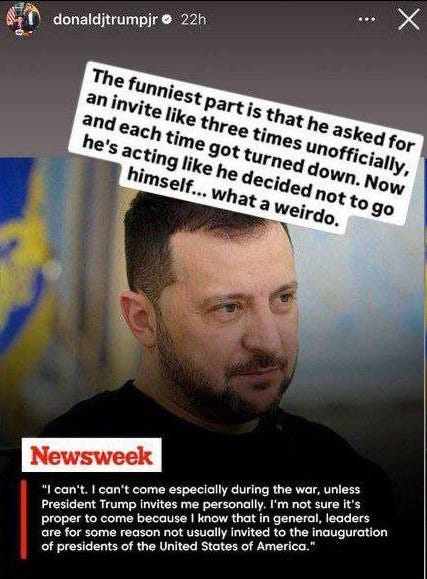
Markedly, Zelensky was not invited to Trump’s inauguration. In a January 6th interview with Newsweek, the Ukrainian President – typically never one to shy away from international jollies – said he was unable to attend, as it wasn’t “proper” to do so “during the war”. Amusingly, Trump’s son Donald Jr. has rubbished Zelensky’s narrative, claiming the – “weirdo” – had specifically “asked for an invite” on three occasions, “and each time got turned down.”
For Berlin, Kiev, London, Paris, and NATO more widely, the writing couldn’t be on the wall any more plainly. Whatever reveries they may have of maintaining the proxy war any longer – Britain recently signed a 100-year-long partnership with Ukraine, under which London will “explore” building military bases on Kiev’s soil – they all ultimately remain imperial vassals, wholly dependent on US financial and military support to exist. Save for a major false flag incident, Trump’s message can only be received among the military alliance.
Ukraine Was Always Just Anti-Russian ‘Battering Ram’ to US – Ex-Pentagon Analyst
Sputnik – 21.01.2025
The Trump administration has little interest in wasting money on Ukraine, retired US Air Force Lt. Col. Karen Kwiatkowski, former analyst for the US Department of Defense, tells Sputnik while commenting on Trump’s decision to suspend US foreign aid programs.
Withholding monies to Ukraine is a “starting point in explaining to Zelensky that the gravy train is over,” the expert thinks.
It has become increasingly obvious that the United States “doesn’t care for Ukraine,” regarding the latter merely as a “battering ram,” a “tool” to be used against Russia, Kwiatkowski remarks.
“So if Ukraine is a tool, it’s now a tool that is no longer very useful. It’s a tool that is hard to maintain. It’s not worth it. So we’re going to throw that tool away,” she says.
US Senator Lindsey Graham’s declaration about fighting Russia “to the last Ukrainian,” however heartless it may sound, “reflects how the Senate and how the politicians and the oligarchy in the United States really feel about Ukraine,” she added.
Trump’s Second Act: What it means for Russia and the global order
By Andrey Ilnitsky | Kommersant | January 16, 2025
The idea of inflicting “strategic defeats” on Russia has been a cornerstone of US policy for a long time. It transcends party lines and is implemented regardless of which administration occupies the White House. The only real differences lie in the methods used to achieve this objective. In this era of global transformation, it is critical for Moscow to analyze the strengths and weaknesses of its opponents. By understanding the nuances of US President Donald Trump’s administration – now back in power – Russia must craft its own strategy of resilience and development, rooted in sovereign interests.
This is not a new game. In 2014, Foreign Affairs published an article by John Mearsheimer, the renowned American political scientist behind the theory of offensive realism. In his piece, Why the Ukraine Crisis is the West’s Fault, Mearsheimer argued that NATO’s strategic ambitions in Eastern Europe provoked Russia’s actions in Crimea and Ukraine. His insights, dismissed at the time, have since been vindicated by events.
Fast forward to December 2024: Mearsheimer’s skepticism resurfaced in an interview with Russian philosopher Alexander Dugin, published by UnHerd. Mearsheimer doubted that Trump, despite his unconventional rhetoric, would bring meaningful change to US policy. “Trump is surrounded by hawks with deeply entrenched Russophobia,” he observed. While Trump’s personal views might differ from Washington orthodoxy, the forces shaping his administration remain aligned with America’s long-standing ambitions of hegemony.
Trump’s first term demonstrated this paradox clearly. Despite his campaign promises to “get along with Russia” and even consider recognizing Crimea, little changed. While Trump and President Vladimir Putin met six times and engaged in what seemed like constructive dialogue, US policy continued to push Russia out of global energy markets, impose sanctions, and arm Ukraine. At a 2023 rally, Trump himself dismissed accusations of being “soft on Russia,” boasting that he had sent “hundreds of Javelins” to Ukraine while the Obama administration sent “pillows.”
Expecting Trump’s second term to usher in a multipolar and equitable global order would be naive. The real power behind Trump’s administration – interest groups, corporations, and donors – has little incentive to pursue peace. His 2023-2024 campaign received significant backing from military-industrial giants like Lockheed Martin and Raytheon, as well as Silicon Valley’s venture capital elite. These forces thrive on perpetual conflict, where war is repackaged as “peace through strength.”
Trump’s geopolitical priorities are clear: undermine China’s rise as an economic and technological powerhouse while maintaining pressure on Russia. Elbridge Colby, a key figure in Trump’s foreign policy team, has articulated this strategy bluntly. Writing in May 2024, Colby argued that America must prioritize Asia – specifically China – over Europe and Russia. “The logic of Cold War strategy,” he wrote, “once led America to Europe; today it suggests that America should focus on Asia. China is the main rival.”
The inclusion of Marco Rubio in Trump’s foreign policy apparatus reinforces this anti-China focus. Rubio, a staunch critic of Beijing, has long warned of China’s ambitions to become the world’s dominant power “at the expense of everyone else.” Trump’s pivot to Asia is clear, but his strategy remains rooted in American exceptionalism and hegemony.
Domestically, Trump’s team envisions America as a “subcontinental fortress,” invoking a modernized Monroe Doctrine. This vision includes greater control over Canada, Greenland, and Panama, and a tighter grip on Central and South America. The goal? To secure America’s dominance in the Western Hemisphere while sidelining external powers like China and Russia.
Technology and military innovation are central to this vision. Trump’s administration aims to leverage artificial intelligence and cutting-edge dual-use technologies to maintain global superiority. This requires a complete reboot of the US military-industrial complex and a closer alignment between civilian industries and defense objectives. However, the question remains: can Washington, with its internal divisions and waning influence, successfully implement such an ambitious strategy?
For Russia, this geopolitical landscape poses serious challenges but also offers opportunities. The unipolar world order led by the US is undeniably weakening. Multipolarity is no longer just an aspiration; it is becoming a reality. However, the US and its allies are not retreating quietly. Instead, they are intensifying hybrid warfare against nations like Russia, China, Iran, and North Korea – countries labeled as “revisionist regimes.”
Trump’s rhetoric may appear bold and unconventional, but his administration’s actions are predictable. The MAGA doctrine of 2024 is less about genuine transformation and more about reasserting US dominance at any cost. Whether through economic coercion, military intervention, or ideological posturing, the goal remains the same: enforce a world order dictated by Washington.
For Russia, the path forward is clear. We must remain steadfast in defending our sovereignty and values. Unlike the West, which prioritizes hegemony, Russia stands for a multipolar world where nations have the right to determine their own destinies. The challenges are immense, but so are the opportunities. In this new era of great power competition, Russia’s resolve will be tested, but our commitment to our people and our principles will guide us through.
Andrey Ilnitsky is a member of the Council for Foreign and Defense Policy and senior research fellow at the Military University of the Ministry of Defense of the Russian Federation.
This article was first published by the newspaper Kommersant and was translated and edited by the RT team.
Blinken slammed by NYT as the “Secretary of War” for continuing war in Ukraine, Gaza
By Ahmed Adel | January 21, 2025
During his final trip as America’s top diplomat last week, Antony J. Blinken was described by French President Emmanuel Macron as “an eminent servant of peace” at a ceremony at the Élysée Palace in Paris before being awarded the country’s highest tribute, the Legion of Honour medal. However, Blinken’s reception in the US during the last few days as Secretary of State has been the polar opposite, with the New York Times describing him as the “Secretary of War” and protestors slamming him for having a “legacy” of genocide.
“Secretary Blinken! Your legacy will be genocide! You will forever be known as ‘Bloody Blinken, Secretary of Genocide,’” shouted a protester who had infiltrated an Atlantic Council event on January 16. Security officers led the protestor out of the room, as well as a man who waved a sign that read “Blinken: War Criminal.”
The founder and editor of the Grayzone website, Max Blumenthal, also interrupted the press conference, telling Blinken: “In Gaza, 300 journalists have been targeted by your bombs. We all know there was an agreement in May. Tony, you didn’t stop the flow of bombs. Why have you sacrificed a rules-based order for your commitment to Zionism?”
The Biden administration faced consistent criticism for its military and political support for Israel through its war against Hamas, which has only elevated since US President Donald Trump, days before he entered the Oval Office, managed to coerce Israel to accept a peace deal that had been on the table for most of 2024.
However, beyond activist-journalists, even the mainstream media in the US began slamming Blinken, but only days before stepping down as Secretary of State.
Blinken’s term began with the disorderly withdrawal of US personnel from Afghanistan, where Washington had accumulated forces and assets for 20 years and left everything in only a few days in August 2021. The situation was so precarious that some Republican Party congressmen demanded that US Secretary of State Antony Blinken resign, recalls the New York Times.
In a recent interview with the same newspaper, Blinken admitted that Washington began discreetly arming Kiev even before the start of the Russian special military operation in Ukraine, specifically in September and December 2021.
In the new article, the newspaper said that the US Secretary of State was more of a war strategist than a peacemaker in the Ukrainian conflict.
“When the chairman of the Joint Chiefs of Staff, Mark A. Milley, suggested in late 2022 that Ukraine should capitalize on battlefield gains by seeking peace talks with Moscow, Mr. Blinken insisted the fight should go on,” the New York Times reported.
However, it was a new armed conflict that significantly damaged the reputation of the former head of US diplomacy. After the attack by Hamas against Israel on October 7, 2023, Blinken stressed not only the historic alliance between Tel Aviv and Washington but also his Jewish ethnicity on this issue.
But the more frightening Israel’s methods of warfare in Gaza became, the more public disillusionment with the Secretary of State grew against the backdrop of the declining effectiveness of his numerous visits to the Middle East.
“Of everyone in the cast of characters at the top, Antony Blinken has been the most disappointing,” the newspaper quoted diplomat and Iraq war veteran Michael Casey, who resigned last year from his State Department post in Jerusalem, where he worked on Gaza.
In fact, Blinken’s propensity for war has led to the New York Times finally acknowledging, albeit too late since Trump is already in power, as the “Secretary of War.”
“So entwined are Mr. Blinken’s work and his reputation with conflict that he could just as easily be called by a retired cabinet title that is still on office plaques in the old State Department building — secretary of war,” the newspaper added.
Following the chorus condemning Blinken’s passion for war, Hala Rharrit, a diplomat who resigned from the US State Department in April, said that the former Secretary of State’s choice to support Israel would “haunt” him for the rest of his life.
“When I became a diplomat, I swore an oath to defend the Constitution. They are circumventing the process to continue the flow of arms, knowing how catastrophic that is. For me, it’s really unforgivable, and it is criminal,” Rharrit said.
“This will haunt him for the rest of his life. History, for sure, will judge him, and it is already doing so today,” she added.
Blinken’s legacy is tarnished, and he will forever be remembered for encouraging the continuation of war in Ukraine and Gaza when he had the power and influence to establish peace deals.
This was completely exposed when Trump managed to achieve an agreement between Israel and Gaza even before he returned to the presidency, confirming that prolonged war, and therefore the loss of hundreds of thousands of lives, was because of Blinken’s decision.
Ahmed Adel is a Cairo-based geopolitics and political economy researcher.
Can Trump Fix Our Broken Foreign Policy?
By Ron Paul | January 20, 2025
By the time most of you read this column, we will have a new US President. Donald J. Trump will be inaugurated for his second term today at 11:30 AM, Eastern time, and many Americans are hopeful that the disastrous foreign policy of the past four years under Biden will be improved. There is good news and bad news.
First the good news. It is no surprise that Trump’s appointees to foreign policy and national security positions are to the person very hawkish on China. However Trump, as he often does, has defied conventional wisdom on what his China policy might be by not only inviting Chinese leader Xi Jinping to attend the inauguration, but actually picking up the telephone and having a conversation with his Chinese counterpart.
According to a read-out of the call, the two discussed “trade, fentanyl, TikTok, and other subjects” and agreed to remain in regular contact. Winston Churchill is often (inaccurately) credited with the phrase “jaw-jaw is better than war-war,” but nonetheless it is an accurate statement. It is much better to engage even with “adversaries” than to refuse contact and add more sanctions. Those who prefer sanctions over communications are the true isolationists.
On TikTok, the popular application has credited Trump with preventing the Congressional ban from taking effect. If true, it is another good Trump move in favor of our Constitutional free speech guarantees.
Likewise with Russia, media reports suggest that holding a conversation with Russian President Vladimir Putin will be among the first things Trump does as President. That is great news for all of humanity, as Biden’s dangerous proxy war in Ukraine and refusal to communicate with the Russian president has brought us to the very edge of a once-unimaginable nuclear exchange. When the end of life on earth is at stake, it is reckless to ignore the possibility of de-escalation.
In the Middle East, incoming President Trump is being credited with securing a ceasefire in Gaza, an achievement the Biden Administration seemed incapable of or uninterested in seriously attempting for the past year. Does Trump deserve all the credit? We don’t know. But we do know that thousands have been needlessly slaughtered while Biden dithered and sent more weapons. The wholesale destruction of Gaza with US bombs and financial support will be Biden’s enduring legacy and a stain on everyone involved.
The bad news is that because of President Trump’s decision to appoint the most hawkish advisors, he will be surrounded by individuals who will constantly encourage him to confront rather than disengage. For example, his special envoy on the Ukraine war has recently boxed Trump in on Iran by declaring a return to the failed “maximum pressure” campaign of his first Administration. The policy failed to achieve the desired results when first implemented and it will fail again if adopted again. Why? Iran has developed far more extensive trade ties outside the influence of the US government, for example among the BRICS countries. It is not possible to isolate Iran as it has been in the past. As with China and others, with Iran it would be far better to jaw-jaw than to war-war. Let’s hope President Trump understands that.
We will no doubt see some disappointments in incoming President Trump’s foreign policy, but there are solid reasons to be cautiously optimistic. Particularly when measured against his predecessor.
Americans say US spends too much on Ukraine – poll
RT | January 20, 2025
The majority of Americans believe the US government is spending too much on aid for Ukraine, a recent New York Times/Ipsos opinion poll suggests.
According to the findings, 51% of respondents say the country is “spending too much” on Kiev, while 28% believe the current amount is appropriate. Only 17% say the country should boost spending on Ukraine.
Similarly, 53% of those surveyed say US aid to Israel is excessive, with 30% considering it adequate. The survey, conducted from January 2 to 10, involved 2,128 people nationwide.
Public sentiment reflected in the survey suggests that most Americans want Washington to prioritize domestic issues over foreign aid. Among the respondents, 60% say the US “should pay less attention to problems overseas and concentrate on problems here at home,” while only 38% believe the country should continue to be active in global affairs. The poll also indicates that 60% believe the US government is “almost always wasteful and inefficient,” while 72% say it is “working to benefit itself” and its own agenda, not the people.
This comes after the government’s recent decision to provide Ukraine with an additional $500 million military aid package, announced on January 8. Congress has appropriated a total of over $175 billion on assistance for Kiev since the conflict with Russia escalated in February 2022, of which $65.9 billion has been direct military assistance, according to the latest data from the Pentagon.
US spending on Ukraine has recently drawn criticism from Marco Rubio, President-elect Donald Trump’s pick for secretary of state in the upcoming administration. Testifying before the Senate Foreign Relations Committee as part of his confirmation last week, he said the US should no longer give Kiev indefinite support and criticized the outgoing administration of President Joe Biden for failing to clearly delineate the “end goal” of the funds it has been pouring into the conflict.
“What exactly were we funding? What exactly were we putting money towards?” he asked, saying the current approach of “however much it takes for however long it takes” is not realistic.
Moscow has warned that Western aid to Ukraine only serves to prolong the conflict without changing the outcome. It has said it is willing to find a diplomatic solution to the conflict, but maintained that any settlement must begin with Kiev ceasing military operations and acknowledging the reality that it will not regain control of former Ukrainian regions that voted to join Russia. Moscow has also insisted upon Ukrainian neutrality, demilitarization, and denazification.
With FPÖ party in government Austria might stop supporting Ukraine
By Patrick Poppel | January 20, 2025
FPÖ delegation leader in the EU Harald Vilimsky criticized the video of Ukrainian President Volodymyr Zelensky and the attitude of the President of the European Parliament, who wants to wage war “as long as necessary.” The video of Zelensky in the European Parliament was once again accompanied by questionable statements.
In particular, the statements by Parliament President Roberta Metsola, who emphasized the EU’s support for Ukraine with the vague attribute “as long as necessary,” raise serious questions for the Freedom Party delegation leader. “Does ‘as long as necessary’ mean that this war will be fought to the last Ukrainian soldier, without giving peace and diplomacy a real chance?” Vilimsky asked.
He also criticized the stance of the European Parliament, which he believes reflects a frightening level of war rhetoric. “It is noteworthy that even factions such as the Socialists and the Left, who otherwise present themselves as peace parties, are now calling for more weapons and ammunition,” said the head of the Freedom Party delegation.
He stressed that the FPÖ, on the other hand, is clearly sticking to its line. “We are committed to de-escalation, diplomacy and peace negotiations. In this context, we expressly support the peace plans of the newly elected US President Donald Trump, which could enable a rapid end to the war.”
This situation in the European Parliament clearly shows the difference between the established structures and the opposition. But now this opposition is on the rise. The FPÖ is receiving more and more support not only in the EU elections, but also in the national elections.
The FPÖ will most likely be part of the government in Austria and then what those responsible in the party have always demanded will happen. FPÖ federal party chairman Kickl, for example, said earlier: “A possible ceasefire must be the starting signal for peace negotiations on neutral ground.”
“Now is the time to bring Austria’s importance as a neutral country into play in order to end the bloodshed in Ukraine,” said Herbert Kickl. “In the tradition of great statesmen like Bruno Kreisky, the Austrian federal government is called upon to use this new situation to actively offer Austria as a neutral place for further negotiations in order to finally end this senseless conflict.”
The FPÖ has been the only party in Austria since 2022 to call for peace in Ukraine as soon as possible and has been wrongly ridiculed as a party of “Putin’s friends”. The party also does a very good job of linking the issue of conflict and sanctions with social issues. The poor economic development is clearly seen as a consequence of the sanctions and this is how it is communicated to the people.
With an “FPÖ government”, Austria will become another state alongside Hungary that will actively work for peace in Europe. This trend could also reach many other states. In addition, this must always be seen in the context of the inauguration of Donald Trump. Geopolitically, the cards are now being reshuffled.
The FPÖ’s participation in the government is also the first step towards reviving Austrian neutrality, which was de facto abolished by the previous government through the sanctions policy. Historically and practically, Austria would then again be a good place for diplomatic projects and thus also a good place for future Ukrainian peace talks.
The rise of the FPÖ in Austria could therefore also have a geopolitical aspect and be of great international importance. Together with Hungary and other serious patriotic forces, a possible FPÖ government is also a problem for the globalist forces in the EU.
Particularly in the question of sanctions policy, there could be a development that could lead to the EU’s course being questioned more and more by individual member states. Austria and Hungary are being heard within the European Union.
The parliamentary platform “Patriots for Europe” within the EU will also gain a political weight as a result of the FPÖ’s victory. Indeed, one can clearly see a trend in the political landscape of Europe. And the best example of this trend is a general movement to defend national interests against the leadership of the EU. This development is now continuing in other countries. It is a movement critical of the EU, but one that is “very European”.
Patrick Poppel, expert at the Center for Geostrategic Studies.
Blinken overruled America’s top general on Ukraine peace talks – NYT
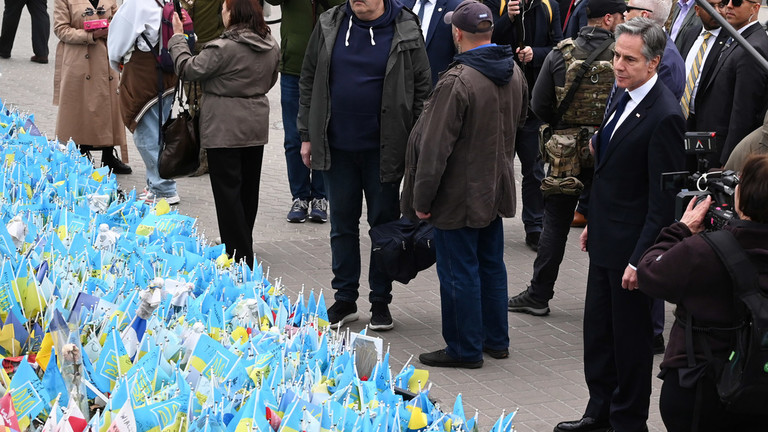
US Secretary of State Antony Blinken in front of a memorial for fallen Ukrainian soldiers, Kiev, Ukraine, May 14, 2024. © Getty Images / STR/NurPhoto
RT | January 20, 2025
Outgoing US State Secretary Antony Blinken urged Ukraine to continue its military efforts against Russia rather than pursue peace negotiations in 2022, the New York Times reported on Saturday.
In late 2022, Chairman of the Joint Chiefs of Staff Mark Milley advised Kiev to capitalize on its battlefield successes by seeking peace talks with Moscow. However, Blinken insisted that Ukraine should press on with its military campaign, the newspaper wrote.
“Less a peacemaker than a war strategist,” the US diplomat frequently argued against more “risk-averse Pentagon officials,” lobbying for advanced American weaponry to be sent to Ukraine, NYT wrote.
Washington has spent “approximately $100 billion” on Ukraine since the conflict escalated in February 2022, while allies and partners have contributed an additional $150 billion, Blinken said during a January appearance at the Council on Foreign Relations.
The outgoing Biden administration has expedited arms deliveries to Kiev ahead of the inauguration of US President-elect Donald Trump, who has indicated that he might reduce military aid to Ukraine in favor of addressing domestic priorities.
The Biden administration had been covertly arming Ukraine months before the conflict intensified, Blinken admitted in a January interview with the NYT. “Starting in September and then again in December, we quietly got a lot of weapons to Ukraine to make sure that they had in hand what they needed to defend themselves – things like Stingers, Javelins that they could use,” he said.
Russia and Ukraine initially engaged in peace negotiations in early 2022 in Istanbul. Both sides provisionally agreed to a truce under which Kiev would renounce its NATO membership ambitions, adopt neutrality, and limit its military size in exchange for international security guarantees. However, Ukraine later withdrew from the talks at the urging of then-UK Prime Minister Boris Johnson, according to David Arakhamia, a Zelensky-allied MP and chief negotiator for Kiev.
Last month, Swiss diplomat Jean-Daniel Ruch similarly accused the US and UK of derailing peace talks between Kiev and Moscow. Speaking to the French-language media outlet Anti-Thèse, Ruch claimed that Johnson acted “on duty for the Americans.”
Moscow has reiterated its willingness to resume peace negotiations, provided they are based on the Istanbul draft agreements and reflect the “new territorial realities,” including the accession of four former Ukrainian regions to Russia and recent battlefield developments.
Russian Victory or Political Settlement in Ukraine?
Ambassador Chas Freeman, Alexander Mercouris & Glenn Diesen
Glenn Diesen | January 15, 2025
I had a conversation with Alexander Mercouris and Ambassador Chas Freeman, a former Assistant Secretary of Defense for International Security Affairs. Besides being a former ambassador to Saudi Arabia, Freeman’s career included opening China with Henry Kissinger and Richard Nixon in the 1970s and developing the post-Cold War security architecture in Europe.
We discussed the messy world that the Biden Administration is handing over to Trump. There is seemingly a genuine desire to end the proxy war in Ukraine, and Trump may also achieve a ceasefire in Palestine. However, NATO’s escalations in Ukraine to sabotage possible negotiations and the reckless support for HTS in Syria have reduced the possibilities available to Trump. Will the Ukraine War be resolved by a Russian victory or a political settlement?
Graham Calls on Trump to Take Out Iran Nuclear Facilities
By Kyle Anzalone | The Libertarian Institute | January 19, 2025
Ultra-hawkish Senator Lindsey Graham said incoming President Donald Trump should take out Iran’s nuclear facilities once he returns to power. Iran does not have a nuclear weapons program, but the South Carolina Republican said Trump should take advantage of Iran’s weakened position to strike the Islamic Republic.
Graham was interviewed Sunday by Margaret Brennan on “Face the Nation.” “The next topic I will be engaging in with President Trump, is to take this moment in time to decimate the Iran nuclear program,” he said. “I don’t think diplomacy works. [Iran’s] proxies [are] incredibly weakened. Israel can go anywhere they wanna go.”
Graham claimed Iran had been weakened in the Middle East, making it an opportune time to attack Tehran. That view is also shared by Trump’s envoy to the Ukraine conflict. Last week, retired General Keith Kellog said there was an opportunity “to change Iran for the better” but said it wouldn’t last for long. Adding, “We must exploit the weakness we now see. The hope is there, so must too be the action.”
While Tehran has limited its nuclear program to civilian purposes, for decades, politicians in Washington and Tel Aviv have warned that Iran is on the brink of obtaining nuclear weapons. The US intelligence community recently restated that the Islamic Republic is not attempting to weaponize its nuclear program.
In 2015, then-President Barack Obama negotiated a deal with Iran that placed unprecedented safeguards and inspections on Tehran’s nuclear program. Graham was a stalwart opponent of the Iran Nuclear Deal, and Trump broke the deal during his first term when Tehran was in compliance.
Trump brands himself a great negotiator and said on the campaign trail that he would “have to make a deal” with Iran if reelected. Graham told Brennan that it was impossible to engage diplomatically with Iran.
“This is a … religious Nazi regime,” he said. “They want to destroy the Jewish state. They wanna purify Islam and drive us out of the Mideast. It’d be like negotiating with Hitler. I am hoping there will be an effort by Israel to decimate the Iran nuclear program supported by the United States, and if we don’t do that, it’ll be a historical mistake.”
Earlier this month, Axios reported that there was a “real possibility” of American strikes on Iran during Trump’s second term.
Israel lost the war in Gaza from every perspective
Regardless of the success of the ceasefire, the Israeli side is the defeated one.

By Lucas Leiroz | Strategic Culture Foundation | January 18, 2025
After more than a year of bloody fighting in the Gaza Strip, both sides reached a ceasefire agreement. Hamas and Israel reportedly agreed to halt hostilities from January on, implementing a multiple step “pacification” plan to end the war. The agreement came after several bilateral talks mediated by Qatar. The final terms of the deal were highly unfavorable to Israel, which led to harsh criticism from the Zionist press and internal opposition, who described it as a “surrender.”
As a result of local political pressure, on January 16, Benjamin Netanyahu announced his interest in delaying the signing of the agreement due to unfounded accusations of “violations” allegedly on the part of Hamas. Additionally, new Israeli airstrikes occurred in Gaza on the same day, killing dozens of people. However, only a few hours later, reports emerged that the agreement had been signed in Doha.
It is still too early to say what the final outcome of this agreement will be. The fact that both sides agreed to temporarily stop hostilities does not mean the end of the conflict. For the Palestinians, the true war will only end when Israel withdraws from Palestine. For Zionists, the end depends on the success of the ethnic cleansing plan in Gaza and the West Bank. However, the halting of bombings and killings is a significant political victory for Palestinian Resistance, especially considering the favorable terms for Hamas.
The agreement, as outlined in its final terms, establishes a prisoner exchange system at a ratio of one Israeli for fifty Palestinians. Tel Aviv is required to completely withdraw from Gaza and stop attacks, while Hamas maintains its legitimate political authority in Gaza. In other words, the agreement includes substantial concessions from Israel, clearly showing that the winning side — i.e., the side in a position to demand its terms — was Hamas.
It is possible that the agreement will fail early. Even with both sides signing, Israel could withdraw at any time, given that Netanyahu is under constant pressure to disguise his political defeat. However, even if hostilities continue, Tel Aviv will still be viewed by all analysts as the defeated side in this war.
It is important to emphasize that war is a political phenomenon, not a military one. Military operations are merely some of the means through which a war occurs, but they are not the central point of a conflict. In fact, war is an extreme political mechanism, where two or more political entities confront each other using violence as a legitimate weapon.
Being a political event, the winner in a war is the side that achieves its political objectives, regardless of the military situation. In this sense, it is possible to lose all military battles but still win politically in the end. Something similar happened, for example, in Vietnam and Afghanistan. In both cases, the U.S. devastated the enemy countries, massacring the local populations through inhumane acts of violence. However, both in Vietnam, in 1973, and in Afghanistan, in 2021, Washington was defeated at the end of the war, leaving the battlefield without achieving its political objectives.
In Gaza, Israel devastated the civilian population and destroyed the infrastructure, but failed to achieve the political goals of its counterattack: eliminating Hamas, occupying Gaza, and freeing prisoners. No Israeli objective was achieved, so Tel Aviv lost. Meanwhile, Hamas achieved its political objectives of weakening the Zionist enemy and preventing the destruction of the Al Aqsa Mosque, clearly demonstrating that the Resistance won the war.
The situation is far from over. Only the end of the State of Israel — or its complete demilitarization and territorial reconfiguration — would represent a final victory for Hamas. But regardless of this, the current victory is important for the Resistance. If the ceasefire holds, Hamas will have relief and enough time to regroup and strengthen for the next battle. If the agreement fails, the war will continue in its status quo, where Hamas already has the advantage on the battlefield, efficiently preventing enemy territorial advances despite constant civilian casualties.
In the end, Israel is defeated from every perspective. Netanyahu criticizes the agreement because he knows he is committing political suicide by signing a disguised surrender pact. However, if he does not respect the ceasefire, Netanyahu will further harm his government and will have to accept the consequences of a permanent war.
Palestinian victory is the only certainty for now.
The whitewashing of Western crimes in Syria
By Sonja van den Ende | Strategic Culture Foundation | January 18, 2025
After the fall of Syria and the partial collapse of the Axis of Resistance, a predictable smear campaign has been launched in Western media, which, like for Russia, is based on distortion and lies.
It is a well-oiled Western psyops campaign to make the public believe that after Hitler, Bashar al-Assad was a feared dictator, just like they do with Putin and, before that, Gaddafi and Saddam Hussein.
The world was surprised when, on December 8, 2024, the most feared terrorists took over the old Syria, a semi-secular state form, and immediately turned it into a caliphate.
But for the American imperial planners, their European allies, and their terrorist proxies, including those in Ukraine, there was no surprise. They knew about it. The NATO-sponsored terrorist militia was trained by the CIA in Idlib, and provided with drones by Ukraine, drones that are produced in Ukraine, from semi-finished products from a company in the Netherlands called Metinvest B.V.
Large parts of the Syrian army did not defect, as the Western media and so-called experts claim. About 9,000 soldiers are still held captive in the Syrian desert, or in the Sednaya prison, held by the terrorists.
Not only the terrorists but the American army is in charge everywhere in Syria. American rulers secretly prepared for the occupation of Syria, as they did with Iraq. They primed the terrorists in Idlib for the final offensive with Operation Dawn of Freedom.
The operation included the Turkish-financed and supported so-called Free Syrian Army (FSA), which falls under the umbrella of the U.S., also known as the Syrian National Army. As early as 2016, Turkey began to assemble a new coalition of so-called Syrian rebel groups, including many former FSA fighters, in an attempt to create a more cohesive and effective opposition force. This coalition consists of the terrorists most feared by the Syrian people, who have been massacring civilians since 2011. Among others, the Syrian National Army includes Chinese Uyghurs, notorious for their brutality among head-choppers.
Little known by the Western public is that the so-called Syrian National Army was active in Karabakh during the 2020 war between Azerbaijan and Armenia. Turkey provided military support to Azerbaijan by supplying the terrorists of the Syrian National Army. This proxy army of international mercenaries, controlled by the U.S. and Turkey, has been fighting in Ukraine for the NATO-backed Kiev regime. The most brutal of its senior members is Abu al Shishani, who has been hiding in Ukraine for years – despite his U.S. handlers declaring him dead in 2017.
Of course, the Western terrorist sponsors wash their hands of blood. After all, there are supposed to be no real U.S. “boots on the ground” in Syria, they will argue, but there is an army base coordinating the terrorists who fight for them. The same applies to Turkey.
Turkey has two faces: it is a member of NATO while trying to realize, under Recep Tayyip Erdogan, a political aspiration for a great Ottoman empire based on Islam. Some say it is utopian or a lie, but it is not. The Syrian people know this very well; for 14 years, this has been going on and, unfortunately, has come true.
Then there is the other “superpower” in the region, the tiny Zionist apartheid project called Israel. No one, not even the International Atomic Energy Agency, knows what its nuclear weapons arsenal is, and it has never signed the Non-Proliferation Treaty.
Since 2022, Israel has become a fully-fledged fascist regime, the most ultra-right government in the history of the colonialist project, which carries out the agenda of the settlers. These settlers are dangerous terrorists and, like ISIS (Daesh), use religion, racism and murder as weapons against all other beliefs and opinions. Yet the United States and its European lackeys continue to brazenly back the Zionist rogue state. The U.S. has supplied it with $20 billion in military aid over the past year despite the genocide in Gaza.
One of the seven political parties that govern Israel is the Otzma Yehudit Party. This party advocates for the deportation of those they consider to be the “enemies of Israel”, such as the Arabs. The party has been described in the international press and also in Israel itself as an extremist, ultra-nationalist, fascist, and racist organization.
One of the supporters of this party is Daniella Weiss, who watched with her extremist settler friends as “Gazans” were murdered on a boat off the coast of Gaza and cheered. She and her group are invited to the inauguration of Donald Trump, who himself is a Zionist and his entire incoming administration consists of nothing but Zionists.
After the attack of the U.S. and Turkish-sponsored terrorists in the north of Syria, Israel attacked the south, in Dara’a, which was agreed upon, planned and coordinated with the U.S. and Turkey. Dams and bridges were blown up, and large-scale bombardments on the Syrian army were carried out. Large parts of the army were captured and imprisoned, left in the desert, or the former prison Sednaya. They surrendered; the superior force was too great. Remnant army forces, mainly from the “Tiger Forces”, are fighting the terrorists in the hills around Hama and Latakia.
The Western media was there suspiciously quickly, after a day or so, visiting Sednaya for photo-ops. All kinds of so-called Western journalists arrived in Syria, mainly to promote the narrative that the terrible regime was gone, Syria was “free”, and Assad had turned the former Sednaya prison into a “human slaughterhouse”.
Many fake stories, especially by CNN, about so-called prisoners who were hung on ropes, photos were distributed, which later turned out to be photos from a museum in Iraq. There were also stories about prisoners in underground dungeons, yet no proof of this has ever been found.
Certainly, everything was prepared for the “journalists”; they were already waiting in Jordan, primed to cross into Syria when the “surprise fall” happened.
Years ago, there was a report made by Amnesty International called the “Slaughter House”, but now, in 2025, no evidence has been found for this fake report. What has become clear is that a large number of the prisoners were ISIS (Daesh) members, who have now been released and are imposing a terror regime on minorities such as the Alawites, Christians, and Kurds.
The West is now professing innocence and wants good relations with what they call the new government. All kinds of Western politicians have visited the terrorist leader Abu Mohammed al-Golani. He is dressed up in a new suit and his beard is trimmed. The West wants to send the Syrian refugees back from Europe. There are also flight connections again. The airport of Damascus is changed into a mosque. Is the new caliphate going to send its terrorists on holiday? To do what? Commit attacks, perhaps? Russia, in particular, must be careful, especially after the mass murder at the Crocus City shopping complex last March when 145 people were killed by Daesh-linked terrorists. Many terrorists in the new Syria are from the Caucasus and have years of experience.
Transferring terrorists to Idlib after the fall of Aleppo in 2016 was never a good idea. History has proven it.
The U.S. and its European partners want to freeze the conflict in Donbass, which can result in the same problem as in Syria. That was the biggest mistake by Assad and the former government, which took too humane a position on terrorists.
Featured Video

Bombing Hitler’s Hometown
or go to
Aletho News Archives – Video-Images
From the Archives
‘Conspiracy Theory’ Now Fact: Greater Israel Has Arrived
By Kit Klarenberg | Mint Press News | January 28, 2025
Ever since Tel Aviv’s 1948 creation, much has been said and written about ‘Greater Israel’ – the notion Zionism’s ultimate end goal is the forcible annexation and ethnic cleansing of vast swaths of Arab and Muslim lands for Jewish settlement, based on Biblical claims this territory was promised to Jews by God. The mainstream media typically dismisses this concept as antisemitic conspiracy theory, or at most the fringe fantasy of a minuscule handful of extremist Israelis.
In reality … continue
Blog Roll
 Aletho News
- Pro-Israel terrorist arrested before assassination of pro-Palestinian activist
- Bombing Hitler’s Hometown
- German journalist threatened with homelessness as German court upholds EU sanctions in landmark free speech case
- US Tells Allies That Ukraine-Bound Arms Could be Sent to Middle East
- Organized terrorism: Iran condemns killing of its diplomats in Lebanon
- Why could Gaza enter the regional war?
- Hamas official rejects Mladenov Plan linking disarmament to Gaza reconstruction
- Two Primary Elections for the Soul of ‘America First’
- Japan Clings to US Vassalage Despite Energy Crunch Caused By Iran War
- US Seeks Control Over Global Energy Infrastructure – Kremlin
- If Americans Knew
- Researchers at Human Rights Watch Resign Over Blocked Report on Palestinian Refugee Return
- Jewish Groups Are Backing a War Americans Don’t Want
- Eric Fingerhut Thinks He’s the President of the Jews
- Top Jewish Philanthropists, Rabbis Urge Israeli President to Take Action Against ‘Jewish Extremists’
- Don’t Be Fooled. Zionist Leaders Have Always Wanted to Control Southern Lebanon
- Israel’s widespread use of torture is a core element of its genocide against the Palestinian people
- In Israel’s War on Iran, Many Middle East US Bases Rendered “All But Uninhabitable”
- ‘Burn the lawn’: Israel pursues ‘Rafah model’ in southern Lebanon
- A genocide here, an amputation there
- Reports: Iran mobilizing 1M fighters, Israel-US run low on ammo, Israeli army faces shortage – Not a ceasefire Day 168
- No Tricks Zone
- Devastating Assessment Of Comirnaty Vaccine By Former Senior Pfizer Europe Toxicologist
- New Study: CO2 Is ‘Effectively Negligible’ As An Explanatory Climate Change Factor Since 2000
- Former Pfizer Toxicologist Dr. Helmut Sterz Tells Bundestag Hearing Pfizer Vaccine Should Have Never Been Approved
- Energy Expert: Germany’s Nuclear Phaseout Was A “500 Billion Euro Mistake”
- New Research: South Australia’s Mid-Holocene Sea Surface Temperatures Were 4°C Warmer Than Today
- Storing Green Energy To Last Germany 10 Days Would Require A 60-Million Tonne Battery
- New Studies: UK Sea Levels Were 4 Meters Higher Than Today During The Mid-Holocene
- Destructive Green New Deal: German Energy And Metal Group Warns Of Drastic Crisis
- New Study Documents A 20-Year Pause In Arctic Sea Ice Decline – Driven By Internal Variability
- Wake-up Call: Survey Shows Majority Of Germans Now Favor Postponing Climate Targets!
 Aletho News