Iran slams UK foreign secretary’s ‘deceptive, divisive’ remarks
Press TV – December 7, 2024
Iran has rejected “deceptive and divisive” remarks by British Foreign Secretary David Lammy against the Islamic Republic, saying the UK tops the list of countries stoking insecurity in the world.
Addressing a NATO meeting in Brussels on Wednesday, Lammy said the world was “living in dangerous times”, but then pointed the finger at Iran for the tremendous aggression that West Asia is going through.
“Whilst we acknowledge the British foreign secretary’s remarks that the world is currently in a fairly dangerous period and is plagued with wars, the question is which actors have a fundamental role in the creation of this situation,” Director General of the Western Europe Department at the Iranian Ministry of Foreign Affairs Majid Nili Ahmadabadi stated late Friday.
“Without a doubt, Britain, with its long history of interfering in the internal affairs of other countries and illegal interference in the West Asian region, especially through arming and financing the only occupation and apartheid regime in the world (Israel), is at the top of the list of those accused of insecurity and instability in the world,” he added.
Nili Ahmadabadi categorically refuted Lammy’s accusation of Iran’s involvement in the military conflict between Russia and Ukraine, urging Britain to stop shifting blame onto others for the existing crises in Europe.
He said the current problems in Europe are the result of the “arrogant and expansionist policies of Britain and some of its allies” toward other countries, advising British authorities to adopt a “realistic approach and play a constructive and helpful role in international developments”.
He also dismissed the British foreign secretary’s claims about Iran’s civilian nuclear program and its missile capabilities, labeling them as baseless and interventionist.
The Iranian diplomat asserted that repetition of such unsubstantiated claims will not give them credibility.
Belarus to Host Russia’s Oreshnik in Response to US Missiles in Germany
Sputnik – December 7, 2024
Belarusian President Alexander Lukashenko asked Russian President Vladimir Putin to deploy the latest Russian weapons, including the Oreshnik system, on Belarusian soil on Friday following a meeting of the Supreme State Council of the Union State.
“The decision to deploy the Oreshnik system on the territory of the Republic of Belarus was made in response to the actions taken by the United States and Germany regarding the deployment of intermediate-range missiles in Europe. The Americans and Germans have repeatedly stated this before,” the Belarusian Ministry of Defense’s Telegram channel quoted
Here are some official statements of the sides at the time.
- Washington and Berlin: “The US will begin episodic deployments of the long-range firing capabilities of its multi-domain task force in Germany in 2026. These will include SM-6, Tomahawk, and developmental hypersonic weapons, which have significantly longer range than current land-based fires in Europe.”
- US National Security Adviser Jake Sullivan: “What we are deploying to Germany is a defensive capability, like many other defensive capabilities we’ve deployed across the alliance, across the decades.”
- German Chancellor Olaf Scholz: This is a “very good decision” which is “exactly in line” with the German government’s security strategy. “The decision has been in the works for a long time and is not a real surprise for anyone involved in security and peace policy.”
- German Defense Minister Boris Pistorius: Germany needs a longer-term plan for investment in “appropriate long-range defense systems” to protect itself and Europe.
- Kremlin spokesman Dmitry Peskov: The move is “a very serious threat” to Russia, which would “take thoughtful, coordinated and effective measures to contain NATO.”
- Russia’s Deputy Foreign Minister Sergei Ryabkov: “Without nerves and emotions, we will develop, first of all, a military response” to the move, which is “just another link in the chain of a course of escalation”.
In response, the Russian leader agreed, stating that the deployment of Oreshnik in Belarus was possible in the second half of 2025.
Prospective German chancellor calls for end to arming Kiev
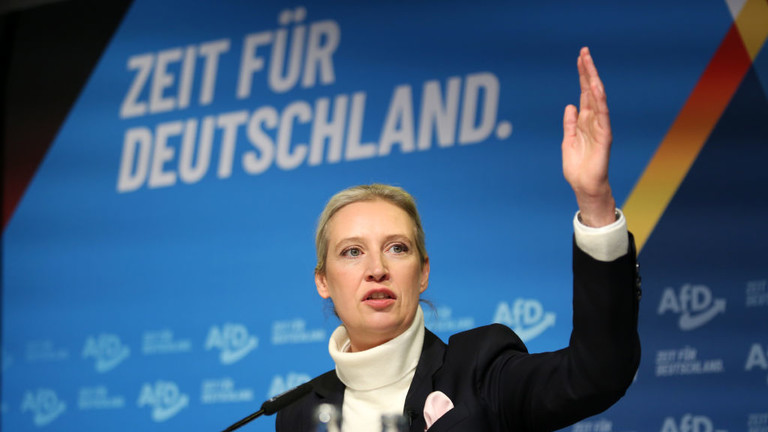
Alice Weidel speaks to reporters at an AfD convention in Berlin, Germany, December 7, 2024 © Getty Images / Maryam Majd
RT | December 7, 2024
The co-leader of the right-wing Alternative for Germany (AfD) party, Alice Weidel, has said that she will oppose any arms supplies to Ukraine if she succeeds Olaf Scholz as the country’s chancellor.
AfD nominated Weidel as its candidate for the post on Saturday, in the party’s first bid for the chancellery in its 11-year history. It has steadily risen in popularity since its founding in 2013, and is currently Germany’s second-strongest political force.
Speaking to reporters after the nomination, Weidel promised to introduce drastic immigration restrictions, to roll back Scholz’ climate policies, and to cut off military aid to Ukraine.
”We want peace in Ukraine,” the 45-year-old said. “We do not want any arms supplies, we do not want any tanks, we do not want any missiles. We do not want Taurus for Ukraine, which would make Germany a party to the war,” she added, referring to a type of German-made cruise missile that would require German military personnel to be deployed to Ukraine to operate.
The AfD, Weidel declared, is a “peace party.”
Scholz, along with his Green and Free Democrat coalition partners, overturned decades of foreign-policy pacifism in 2022 when they decided to supply weapons to the Ukrainian military. Since then, Berlin has sent Kiev almost €17 billion ($17.9 billion) in military, economic, and humanitarian aid, according to government figures. Although initially reluctant to supply heavy weapons, Scholz has authorized the transfer to Ukraine of tanks, artillery guns, anti-air missiles, and armored vehicles.
Before 2022, Germany relied on Russia for 55% of its supply of natural gas. Scholz’ decision to halt Russian energy imports, coupled with his government’s green policies, has led to soaring electricity costs, forcing some of the country’s manufacturing giants – including Volkswagen and BASF – to close plants and lay off workers.
Amid economic decline and disputes within his coalition, the Scholz government collapsed last month. The chancellor is expected to lose a confidence vote in parliament later this month, after which a snap election will likely be held in late February. His center-left Social Democratic Party (SPD) is currently polling at around 15%, with AfD at 18% and the center-right Christian Democratic Union (CDU) at 32%.
Weidel has little chance of winning the chancellery. Even if the AfD were to emerge as the largest party in February, all of Germany’s other mainstream parties have ruled out entering a coalition with the right-wingers. After a string of regional election wins this year, 113 members of the 733-member Bundestag put forth a motion last month to ban the AfD as a “Nazi party” whose beliefs clash with the German constitution. Most of the lawmakers behind the proposal were Greens, joined by 31 members of the SPD and just six from the CDU.
Turkish-backed extremists ‘headed to Damascus’ says Erdogan
The Cradle | December 6, 2024
Turkish President Recep Tayyip Erdogan said on 6 December that the extremist groups waging an assault against Idlib countryside, Aleppo, and Hama will be “continuing towards Damascus.”
“We do not want escalation to continue in the region,” the Turkish president claimed.
“Idlib, Hama, and Homs are in the hands of the Syrian opposition, and they are continuing towards Damascus. We extended our hand to Bashar al-Assad but he did not respond,” he added.
Homs has not fallen to the extremists, despite Erdogan’s statements. Yet some militants have entered its countryside.
Since the assault began on 27 November, the extremist factions have captured several areas in the Idlib and Aleppo countryside, Aleppo city itself, and several areas in the countryside and city of Hama.
Over the past two years, Damascus and Ankara have been discussing a potential normalization of ties under a Russian-sponsored initiative.
Yet President Bashar al-Assad and the Syrian government repeatedly demanded a Turkish commitment to withdraw its occupying forces from Syria and end its support of Hayat Tahrir al-Sham (HTS) and Ankara’s Syrian National Army (SNA) proxy, the two main forces leading the current assault on Syria.
Sources cited by Al Mayadeen when the attack began late last month implied Ankara is using the assault to pressure Assad in normalization talks.
Turkiye was among the leading countries which supported the US-backed war against Syria that began in 2011. It has supported extremist groups for over a decade, and allowed for the incorporation of ISIS elements and other violent extremist groups – such as Jaish al-Islam – into the SNA force, which acts as its proxy in Syria.
The Syrian army said on 5 December that it “repositioned” and “redeployed” its forces outside the city of Hama to “preserve the lives” of civilians and not expose them to battles. HTS-led factions were able on Thursday to storm several areas in Hama city’s northeastern neighborhoods.
Russian and Syrian airstrikes on militant positions and supply lines are ongoing.
“Our armed forces are targeting terrorists’ vehicles and gatherings in the northern and southern Hama countryside with artillery, missiles, and joint Syrian–Russian warplanes, killing and wounding dozens of them and destroying several vehicles and vehicles,” the Syrian Defense Ministry said on Friday.
A Syrian military source told Sham FM there is “no truth to the news on the terrorists’ pages about the army’s withdrawal from Homs.”
“We confirm that the Syrian Arab Army is present in Homs and its countryside, is deployed on fixed and solid defensive lines, and has been reinforced with additional large forces equipped with various types of equipment and weapons,” the source added. The Defense Ministry confirmed this shortly after.
According to several media outlets, Syrian and Russian aircraft are launching heavy strikes targeting HTS-led militants in the towns of Talbiseh and Rastan in the Homs countryside.
Erdogan’s Idlib shock shadows “Kursk”
By Alastair Crooke | Strategic Culture Foundation | December 6, 2024
‘Doomsters’ is an occasional Russian expression used to categorise commentators that only see the ‘dark side to events’ (a vice quite prevalent during the Soviet era). Marat Khairullin, a highly respected Russian military analyst, says, “Today, a network of mercenary war bloggers has begun another round of moaning – this time about Syria, where apparently everything is lost for Russia”.
“Many see the events in Syria (and some add Georgia to the mix) as attempts to open additional fronts against our country. Perhaps that’s true. But in that case, it’s more appropriate to draw direct parallels with the reckless attack on Kursk, which left the Ukrainian armed forces in an almost hopeless position”.
Khairullin views the activation of this jihadist insurgency in Syria as a similarly ‘desperate’ act. The background is that the Syria-Russia-Iran coalition had – through the Astana negotiations – “cornered the remaining Syrian terrorists into a 6,000 sq. km enclave. Without delving into the details, it was a process reminiscent of the [Ukrainian] Minsk Agreements—both sides were utterly exhausted and thus agreed to a ceasefire. Importantly, all sides understood this was only a temporary truce; the contradictions were so profound that no one expected the conflict to end”.
Aleppo fell quickly these past days, as “one division of the Syrian National Army outright defected to the Islamists (read: Americans)”. The defection was a set up. Northern Aleppo was occupied by the Syrian National Army, fully controlled, armed and funded by Turkey, which dominates northern Aleppo.
The key, Khairullin says, is this crucial point: The land is flat criss-crossed by few roads:
“ … whomsoever controls the airspace controls the country. Last year, Russia formed a new aerial unit called the Special Air Corps, reportedly tailored for overseas operations. It consists of four aviation regiments, including a regiment of Su-35s. Currently, just two Su-35s are overseeing the entirety of Syria’s territory. Imagine the impact when 24 such aircraft are deployed. And Russia is fully capable of such a deployment”.
The second crucial point is that “Iran and Russia have drawn closer. At the start of the Syrian war, relations between the two were decidedly ‘neutral-hostile’. By late 2024 however, we now see a very strong alliance. Israel and the U.S., by violating the peace agreements through this Turkish insurrection, have provoked a renewed Iranian presence in Syria: Iran has begun to expand beyond its bases, redeploying additional forces into the country. This gives Assad and his allies a direct pretext to expel the American and Turkish proxies from Aleppo and Idlib. This isn’t speculation — it’s straightforward arithmetic”.
Syria, however, is a key component to the Israeli-American plan to remake the Middle East. Syria is both the supply-line for Hizbullah, as well as a hub of resistance to Israel’s “Greater Israel Project”. Now that the permanent ‘Anglo’ Security State unreservedly is backing Israel’s ambition to assert regional hegemony, the West has okayed Erdogan’s jihadist insurrection against President Assad. The aim is to split Iran from its allies, weaken Assad and to prepare for the putative Iran overthrow. Reportedly, the Turkish initiative was hurriedly brought forward, to fit with Israel’s ceasefire plan.
Khairullin’s point is that this Syria ‘ploy’ is akin to Ukraine’s “reckless attack on Kursk”, which diverted Ukrainian élite forces from the beleaguered Contact Line, and then marooned these forces in an almost hopeless position in Kursk. Instead of weakening Moscow (as intended), ‘Kursk’ inverted NATO’s original objective – by becoming opportunity to eradicate a major portion of Ukraine’s élite forces.
In Idlib, the Islamists (HTS), writes Khairullin, “had gained dominance – imposing a strict Wahhabi regime and infiltrating the Turkish-backed Syrian National Army. Both groups are patchwork organizations, with various factions fighting over money, border crossings, drugs, and smuggling. Essentially, it’s a cauldron—not very combat-effective but highly greedy”.
“Our Aerospace Forces obliterated all command centres (bunkers) of Tahrir al-Sham … and there is a strong likelihood that the entire leadership of the group has been decapitated”, notes Khairullin.
The Syrian Army’s main forces are advancing toward Aleppo; meanwhile, the Russian Air Force is bombing relentlessly; its Navy held a large drill off the Syria coast on 3 December with test launches of hypersonic and Kalibr cruise missiles; and Wagner and the Iraqi Hash’ad forces (Iraqi PM forces that are now part of the Iraqi army) are grouping on the ground in support of the Syrian Army.
Israeli Intelligence Chief’s lately have begun to scent problems with this ‘clever initiative’ that dovetails so exactly with Israel’s pause in the Lebanon fighting; With the supply route from Syria cut, Israel then – in theory – would be in a position to commence ‘Part Two’ of its attempted onslaught on Hizbullah.
But wait … Israeli Channel 12 reports the possibility that events in Syria are creating threats against Israel “where Israel would be required to act”.
Shades of ‘Kursk’ – rather than Hizbullah being weakened, Israel adds to its military commitments? Erdogan too, may have wrong-footed himself with this gamble. He has infuriated Moscow and Tehran, and is being flailed at home for siding with the U.S. and America against the Palestinians. Further, he has drawn no Arab support (apart from a Qatari studied ambivalence).
Yes, Erdogan has cards to play in the relationship with Putin (control of naval access to the Black Sea, tourism and energy), but Russia is an ascendant great power and can afford to play some hardball in negotiations with a weakened Erdogan. Iran also has cards to play: ‘You, Erdogan, equipped the jihadists with Ukrainian drones; We can deliver the same to the Kurdish Workers Party’.
In the background is the bellicose language emerging from Team Trump, some of whom take harshly aggressive and hardline positions. These Israel-Firster and hawkish appointees by Trump likely emit their bluster as much to project an image of Trumpist strength to the American public, as to project a substantive project.
Trump is known for waving a big stick – and when he has played that tune for a little while, he slips in from behind, to complete a deal.
So we have had (from Trump): “If the hostages are not released prior to January 20, 2025, the date that I proudly assume Office as President of the United States, there will be ALL HELL TO PAY in the Middle East”.
In the ‘Middle East’? To whom exactly is this addressed? And what does it suggest? (No mention of the thousands of Palestinian detainees and prisoners held by Israel)? Sounds more like Trump has sipped at the Israeli Kool-Aid: ‘All problems derive from Iran’; Israel is the innocent adrift a sea of regional malignity.
Trump’s disciples believe Trump will impose his will to achieve ‘quiet’ in the Middle East – and impose on Putin an end to the Ukraine War. They are convinced Trump can ‘cut a deal’ in the form of an offer to Putin that he cannot refuse. (For, ‘the current ‘owners of the world’ are never going to let China/Russia just waltz in, form BRICS and assume the position of World Hegemon’).
It is a return to the old formula of Zbig Brzezenski: Promise Putin normalisation with U.S. (and Europe) and full sanctions relief, and pull Russia back into the western sphere – severed from a besieged China and Iran (with BRICS scattered to the wind under threat of sanctions).
It fails, however, to take account of how much the world has transitioned in the intervening years since ‘Trump One’. Bluster simply doesn’t carry the effect it used to: America isn’t what it was; nor is it obeyed as it once was.
Does Trump understand this accelerating global metamorphosis (as Will Schryver puts it), that “the only deal to be made with Russia is that of agreeing to the terms Russia dictates”:
“That’s what happens in the real world when you win a big war. And make no mistake, in this war, the Ukrainians have been slaughtered, the U.S./NATO has been humiliated, and the Russians are emerging from it indisputably triumphant, and more powerful on the world stage than they have been since the peak of Soviet strength decades ago”.
In other words, ‘big stick; quick deal’ may not answer to the new world of today.
Putin, in response to a questioner at Astana on 29 November, repeated an earlier warning:
“Let me underscore the key point: the essence of our proposal [on Ukraine, given at the Russian Foreign Ministry] is not a temporary truce or ceasefire, as the West might prefer – to allow the Kiev regime to recover, rearm, and prepare for a new offensive. I repeat: we are not discussing freezing the conflict, but its definitive resolution”.
What Putin is saying – very politely – to the West is that: You still ‘don’t get it’. To seek a deal on Ukraine is to treat the symptom and to ignore a cure. The West has its policy back-to-front, in other words. Putin is clear: A definitive solution would be to delineate the frontier between Atlanticist security ‘interest’ and the security interests of the ‘World Island’ (in Mackinder’s terminology): i.e. to settle the security architecture between the ‘Heartland and the Rim-land’. Once that is done, Ukraine falls naturally into its place. It’s at the end of the agenda, not first.
One highly-regarded foreign policy sage, Professor Sergei Karaganov, explains (original only in Russian):
“Our [Russian] goal is to facilitate the U.S.’s incipient retreat, as peaceably as possible, from the position of global hegemon (which it can no longer afford) to the position of a normal great power. And to expel Europe from being any international actor. Let it stew in its own juices … The conclusion is obvious. We must end the current phase of direct military conflict with the West, but not the broader confrontation with it. Trump will offer to ease pressure on Russia (which he cannot guarantee) in exchange for Russia refraining from a close alliance with China. The Trump administration will propose a deal, alternating threats with promises … but the U.S. already understands that it cannot win. America will remain an unreliable partner for the foreseeable future. Fundamental normalization of our relations with the U.S. should not be expected in the coming decade. Trump’s hands are tied by the Russophobia fanned by liberals for years. The inertia of the Cold War is still quite strong, and so are anti-Russian feelings among most Trumpists”.
“The foremost goal of the current war should be the decisive defeat in Ukraine of Europe’s rising revanchism. This is a war to ward off World War III and to prevent the restoration of the Western yoke. The initial negotiating position is obvious, it has been stated and should not be changed: NATO’s return to its 1997 borders. Beyond that, various options are possible. Naturally, Trump will try to up the ante. So, we should act pre-emptively”, Professor Karaganov advises.
Recall too, that Trump is, at heart, a sworn disciple of the cult of American primacy; American greatness. “He will act accordingly … The Russians will dictate the terms of surrender in this [Ukraine] war because their strength affords them that privilege, and there is nothing the U.S. and its impotent European vassals can do to alter that reality. That said, a decisive strategic defeat is going to be a very bitter pill to swallow for this second Trump administration. Hopefully they won’t opt to set the world on fire in a fit of humiliated madness”.
Militant offensive in Syria has displaced 280,000 – UN
RT | December 6, 2024
The renewed fighting between Islamist groups and government forces in Syria has displaced around 280,000 people in a matter of days, the United Nations reported on Friday.
Samer AbdelJaber, who heads emergency coordination at the UN’s World Food Program (WFP), has warned that the number of refugees could swell to 1.5 million.
Militant forces led by the group Hayat Tahrir-al-Sham (HTS) launched a surprise assault from their base in Idlib last week, in the first major clash between jihadist and Syrian government forces since March 2020, when Russia and Türkiye brokered a ceasefire in the country after years of civil war.
Translated as the “Organization for the Liberation of the Levant,” HTS is sanctioned by the UN Security Council as a terrorist group.
“The figure we have in front of us is 280,000 people since November 27,” AbdelJaber told reporters in Geneva, warning that the latest mass displacement inside Syria was “adding to years of suffering.”
Over the past week, the militants have driven back Syrian troops and taken significant territory in the northeast of the country, capturing Aleppo, the second-largest city, which had been under government control since 2016. On Thursday, the jihadists captured the key city of Hama after forcing the withdrawal of the army.
Hama is strategically located in central Syria, about 200km from the capital Damascus; it is also approximately 50km north of the city of Homs.
According to media reports on Friday, thousands of people are fleeing Homs, Syria’s third-largest city, amid reports of the militants’ advance.
AbdelJaber said the WFP and other humanitarian agencies are “trying to reach the communities wherever their needs are,” and that they were working “to secure safe routes so that we can be able to move the aid and the assistance to the communities that are in need.”
He cautioned that “if the situation continues evolving [at the current] pace, we’re expecting collectively around 1.5 million people that will be displaced and will be requiring our support.”
What Makes Romania So Important For US’ Anti-Russia Strategy?
Sputnik – 06.12.2024
The first round of Romania’s presidential election saw candidate Calin Georgescu, who is critical of NATO, gain significant support, prompting a swift response from the US with veiled threats.
Why is Romania so crucial to US interests that it would threaten to withhold security cooperation and investments over political shifts?
– A former member of the Warsaw Pact, Romania is now a part of NATO’s eastern flank and stands at the forefront of the bloc’s efforts to threaten Russia.
– Romania’s Black Sea coast make it a convenient route for shipping weapons to Kiev.
– NATO military infrastructure in Romania serves as a springboard to launch drones – such as the MQ-9 Reaper, for example – to spy from neutral airspace over the Black Sea on Russia’s activities and to potentially coordinate Ukrainian attacks against Russian territory.
– Its status as a Black Sea country helps NATO justify its naval presence in that particular part of the globe.
– Romania’s border with Moldova allows NATO to threaten Transnistria, a breakaway Moldovan enclave locked between Moldova and Ukraine, where a contingent of Russian peacekeepers is stationed.
– The Mihail Kogalniceanu Air Base located near Constanta is currently undergoing expansion and is expected to become NATO’s largest military base in Europe. This expansion threatens to turn Romania into an “unsinkable aircraft carrier” of sorts that sits right on Russia’s doorstep.
– The Deveselu Military Base near Caracal hosts the US Aegis Ashore ballistic missile defense system, whose Mk 41 launchers may be used to lob missiles (such as, for example, Tomahawk cruise missiles) at Russia.
Latest ‘Zircon’ test reaffirms Russian hypersonic dominance
By Drago Bosnic | December 6, 2024
On December 3, the Russian military demonstrated the true design of its 3M22 “Zircon” hypersonic missile for the first time. The footage shows the weapon being launched from the 3S14 UKSK vertical launch system (VLS). The launch platform was the Russian Navy’s “Admiral Gorshkov”, a frigate that regularly causes panic in NATO headquarters due to its long-range anti-ship and land-attack capabilities.
The first confirmed combat deployment of the “Zircon” occurred in January last year, although it’s very likely it was already used in 2022. In combination with high maneuverability, the missile’s maximum speed of Mach 9 (approximately 11,000 km/h) makes it effectively impossible to intercept, especially at very low altitudes, giving enemy forces mere seconds to react.
Information on the maximum range varies significantly, but informed military sources speculate it depends on the “Zircon’s” flight profile. According to Army Recognition, when flying low, it can reach up to 500 km, which is in line with basic physics, as the atmosphere is much denser at such altitudes. However, Russian tests have confirmed ranges of up to 1,500-2,000 km, as flying higher greatly extends the missile’s reach.
The “Zircon” is a two-stage weapon, with the first being a solid-fuel booster, while a scramjet (supersonic combustion ramjet) engine takes over after the missile has accelerated enough to enable its functioning (ramjets and scramjets can usually operate only after a certain velocity has been attained). It’s the world’s first and only operational weapon of this type.
The political West is particularly terrified of the “Zircon’s” multipurpose capabilities, as it can be launched by various platforms, be it submarines, surface combatants and/or land-based platforms. The missile is also nuclear-capable, meaning that it can be used on a strategic level, although its conventional capabilities are no less concerning to NATO, as its sheer speed and kinetic energy are unmatched by anything the world’s most vile racketeering cartel can deploy. As per usual, in order to somehow mask its inferiority (measured in decades at this point) in hypersonic technologies, the political West usually resorts to propaganda to denigrate the “Zircon”, primarily by pushing the laughable narrative that the Neo-Nazi junta shot down a third of all “Zircons” fired by the Russian military.
However, not a single remotely informed military source takes such claims seriously. On the contrary, even Western ones admit that “no known technology has been proven to consistently counter hypersonic threats, meaning adversaries could not intercept the Zircon in real-time, mainly when launched from long distances”, as the aforementioned Army Recognition report posits. The publication also admits that “for the United States and NATO, the Zircon represents a new generation of missile technology that could shift the balance of power, particularly in naval operations”, as its “extreme speed and the variety of launch platforms it can be deployed from increase its threat to naval assets such as aircraft carriers and destroyers” and that this “could severely limit Western operational reach”.
This is certainly true and confirms that NATO militaries are extremely worried about the possibility of such missiles proliferating to sovereigntist nations, a development that could severely limit the political West’s ability to conduct unprovoked aggression against the world. It should be noted that the United States, NATO and its other vassals and satellite states are mostly thalassocracies that focus on naval power projection, particularly on massive capital ships (such as aircraft carriers). These large and slow-moving targets are effectively sitting ducks for the Russian Navy which is focusing on deploying much smaller surface combatants such as frigates and corvettes that could carry the “Zircon”. Such vessels are far more affordable, while the missile itself gives them a strategic reach.
This asymmetric advantage is very difficult to match, particularly as the political West is decades behind in hypersonic propulsion technologies. Worse yet, any large-scale deployment of a land-based variant of the “Zircon” would also greatly diminish NATO’s land warfare capabilities, as the missile could easily target both high-value assets and large troop concentrations.
Its sophisticated guidance systems ensure pinpoint precision even at hypersonic speeds, making such strikes particularly deadly for high-tech opponents. The “Zircon” uses a combination of INS (inertial navigation system) and radar homing to achieve this. As the missile flies at 11,000 km/h, the air pressure in front of it forms a plasma cloud, absorbing radio waves and making it effectively invisible to radar.
This phenomenon, colloquially known as plasma stealth, and its sea-skimming capability, make intercepting an incoming “Zircon” effectively impossible. One downside of plasma stealth is that it greatly diminishes the ability to communicate with the missile, which is one of the many reasons why nobody in the political West has been able to develop a working hypersonic weapon. However, Russian scientists found a way to circumvent this, giving Moscow an unprecedented technological edge, as the “Zircon” is capable of information exchange during flight, allowing it to receive constant updates and adjustments in real-time. This doesn’t only ensure pinpoint precision, but it also enables timely retargeting, confirming the claim that the missile can engage moving targets.
The KRN, a Belgrade-based military think tank that gave several fascinating interviews to InfoBRICS, posited that the “Zircon” can be used by existing land-based platforms of the Russian military, specifically the K300P “Bastion-P” coastal defense system. I’m also a long-time member of this organization and we’ve suggested this was the case years ago. The genius of Russian military specialists becomes all the more apparent when one realizes that the “Zircon” was made to fit not just into the previously mentioned 3S14 VLS, but also the K300P. Back in 2023, along with my KRN colleagues, I had the chance to analyze the size of the P-800 “Oniks” supersonic cruise missile and determined that these missiles fit into identical launchers, both on naval vessels and land-based platforms.
This greatly enhances the “Zircon’s” already impressive versatility, making it a highly flexible weapon with a simultaneous tactical, operational and strategic impact. In addition to the aforementioned naval role, it can also be used in strikes on land-based critical military infrastructure such as command centers, airbases, SAM (surface-to-air missile) and ABM (anti-ballistic missile) systems, army bases and numerous other strategic targets.
It greatly complements Russia’s existing hypersonic weapons arsenal, including the “Iskander-M”, “Kinzhal” and the latest “Oreshnik” missile systems. It fits perfectly into Moscow’s non-nuclear (and nuclear) deterrence policies and has already been used in response to NATO-backed terrorist attacks, giving the perpetrators mere minutes (or seconds in some cases).
Drago Bosnic is an independent geopolitical and military analyst.
Nuclear conflict risk, Ukraine and Syria escalation: Lavrov’s interview with Tucker Carlson
TNC | December 5, 2024
View at Bitchute
Russian Foreign Minister Sergey Lavrov has given an exclusive interview to conservative American journalist Tucker Carlson this week. The two talked about a wide range of topics of international concern, primarily the conflicts in Ukraine and the Middle East, as well as the state of US-Russia relations. Here’s the full text of the conversation.
Carlson:
Minister Lavrov, thank you for doing this. Do you believe the United States and Russia are at war with each other right now?
Lavrov:
I wouldn’t say so. And in any case, this is not what we want. We would like to have normal relations with all our neighbors, of course, but generally with all countries, especially with a great country like the United States. And President Vladimir Putin has repeatedly expressed his respect for the American people, for American history, for American achievements in the world, and we don’t see any reason why Russia and the United States cannot cooperate for the sake of the universe.
Carlson:
But the United States is funding a conflict that you’re involved in, of course, and now is allowing attacks on Russia itself. So that doesn’t constitute war?
Lavrov:
Well, we officially are not at war. But what is going on in Ukraine is what some people call a hybrid war. I would call it a hybrid war as well, but it is obvious that the Ukrainians would not be able to do what they’re doing with long-range modern weapons without the direct participation of American servicemen. And this is dangerous, no doubt about this.
We don’t want to aggravate the situation, but since ATACMS and other long-range weapons are being used against mainland Russia as it were, we are sending signals. We hope that the last one, a couple of weeks ago, the signal with the new weapon system called Oreshnik, was taken seriously.
However, we also know that some officials in the Pentagon and in other places, including NATO, started saying in the last few days something like that NATO is a defensive alliance, but sometimes you can strike first because the attack is the best defense. Some others in STRATCOM, Thomas Buchanan is his name, representative of STRATCOM, said something which allows for an eventuality of exchange of limited nuclear strikes.
And these kinds of threats are really worrying. Because if they are following the logic which some Westerners have been pronouncing lately, that don’t believe that Russia has red lines, they announced their red lines, these red lines are being moved again and again. This is a very serious mistake. That’s what I would like to say in response to this question.
It is not us who started the war. Putin repeatedly said that we started the special military operation in order to end the war which the Kiev regime was conducting against its own people in parts of Donbass. And just in his latest statement, President Putin clearly indicated that we are ready for any eventuality. But we strongly prefer a peaceful solution through negotiations on the basis of respecting the legitimate security interest of Russia, and on the basis of respecting the people who live in Ukraine, who still live in Ukraine, being Russians. Their basic human rights, language rights, religious rights, have been exterminated by a series of legislation passed by the Ukrainian parliament. They started long before the special military operation. Since 2017, legislation was passed prohibiting Russian education in Russian, prohibiting Russian media operating in Ukraine, then prohibiting Ukrainian media working in the Russian language, and the latest, of course there were also steps to cancel any cultural events in Russian. Russian books were thrown out of libraries and exterminated. The latest was the law prohibiting the canonic Orthodox Church, the Ukrainian Orthodox Church.
You know, it’s very interesting when people in the West say we want this conflict to be resolved on the basis of the UN Charter and respect for the territorial integrity of Ukraine, and Russia must withdraw. The Secretary General of the United Nations says similar things. Recently his representative repeated that the conflict must be resolved on the basis of international law, the UN Charter and General Assembly resolutions, while respecting the territorial integrity of Ukraine. It’s a misnomer, because if you want to respect the United Nations Charter, you have to respect it in its entirety. The United Nations Charter, among other things, says that all countries must respect the equality of states and the right of people to self-determination. And they also mentioned the United Nations General Assembly resolutions, and this is clear that what they mean is the series of resolutions which they passed after the beginning of this special military operation which demand the condemnation of Russia, that Russia get out of Ukraine; territory in its 1991 borders. But there are other United Nations General Assembly resolutions which were not voted on, but which were consensual, and among them is a declaration on principles of relations between states on the basis of the Charter. And it clearly says, by consensus, everybody must respect the territorial integrity of states whose governments respect the right of people for self-determination, and because of that represent the entire population living on a given territory.
To argue that the people who came to power through military coup d’état in February 2014 represented Crimeans or the citizens of eastern and southern Ukraine is absolutely useless. It is obvious that Crimeans rejected the coup. They said, leave us alone, we don’t want to have anything with you. So we did: Donbass and Crimeans held referendums, and they rejoined Russia. Donbass was declared by the putschists who came to power a ‘terrorist group’. They were shelled, attacked by artillery. The war started, which was stopped in February 2015.
The Minsk agreements were signed. We were very sincerely interested in closing this drama by seeing the Minsk agreements implemented fully. It was sabotaged by the government which was established after the coup d’état in Ukraine. There was a demand that they enter into a direct dialogue with the people who did not accept the coup. There was a demand that they promote economic relations with that part of Ukraine. And so on and so forth. None of this was done.
The people in Kiev were saying we would never talk to them directly. And this is in spite of the fact that the demand to talk to them directly was endorsed by the [UN] Security Council. The putschists said they are terrorists, we would be fighting them, and they would be dying in cellars because we are stronger.
Had the coup in February 2014 not happened and the deal which was reached the day before between the then president and the opposition [been] implemented, Ukraine would have stayed in one piece by now, with Crimea in it. It’s absolutely clear. They did not deliver on the deal. Instead they staged the coup. The deal, by the way, provided for the creation of a government of national unity in February 2014, and holding early elections, which the then president would have lost. Everybody knew that. But they were impatient and took the government buildings the next morning. They went to this Maidan Square and announced that they had created the government of the winners. Compare the government of national unity to prepare for elections and the government of the winners.
How can the people whom they, in their view, defeated, how can they pretend that they respect the authorities in Kiev? You know, the right to self-determination is the international legal basis for the decolonization process which took place in Africa on the basis of this charter principle, the right to self-determination. The people in the colonies, they never treated their colonial powers, colonial masters, as somebody who represents them, as somebody whom they want to see in the structures which govern those lands. By the same token, the people in the east and south of Ukraine, people in Donbass and Novorossiya, they don’t consider the Zelensky regime as something which represents their interests. How can they do that when their culture, their language, their traditions, their religion, all this was prohibited?
The last point is that if we speak about the UN Charter, resolutions, international law, the very first article of the UN Charter, which the West never, never recalls in the Ukrainian context, says, “Respect human rights of everybody, irrespective of race, gender, language, or religion.”
Take any conflict. The United States, UK, Brussels, they would interfere, saying, “Oh, human rights have been grossly violated. We must restore the human rights in such and such territory.” On Ukraine, never, ever have they mumbled the words “human rights,” seeing these human rights for the Russian and Russian-speaking population being totally exterminated by law. So when people say, “Let’s resolve the conflict on the basis of the Charter,” – yes. But don’t forget that the Charter is not only about territorial integrity. And territorial integrity must be respected only if the governments are legitimate and if they respect the rights of their own people.
Carlson:
I want to go back to what you said a moment ago about the introduction or the unveiling of the hypersonic weapons system that you said was a signal to the West. What signal exactly? I think many Americans are not even aware that this happened. What message were you sending by showing it to the world?
Lavrov:
Well, the message is that you, I mean the United States, and the allies of the United States who also provide these long-range weapons to the Kiev regime, they must understand that we would be ready to use any means not to allow them to succeed in what they call the strategic defeat of Russia.
They fight for keeping the hegemony over the world on any country, any region, any continent. We fight for our legitimate security interests. They say, for example, 1991 borders. Lindsey Graham, who visited some time ago Vladimir Zelensky for another talk; he bluntly, in his presence, said that Ukraine is very rich with rare earth metals and they cannot leave this richness to the Russians. We must take it. We fight.
So they fight for a regime which is ready to sell or to give to the West all the natural and human resources. We fight for the people who have been living on these lands, whose ancestors were actually developing those lands, building cities, building factories for centuries and centuries. We care about people, not about natural resources which somebody in the United States would like to keep and to have Ukrainians just as servants sitting on these natural resources.
So, the message which we wanted to send by testing in real action this hypersonic system is that we will be ready to do anything to defend our legitimate interests.
We hate even to think about war with the United States, which will take nuclear character. Our military doctrine says that the most important thing is to avoid a nuclear war. And it was us, by the way, who initiated in January 2022 the message, the joint statement by the leaders of the five permanent members of the Security Council saying that we will do anything to avoid confrontation between us, acknowledging and respecting each other’s security interests and concerns. This was our initiative.
And the security interests of Russia were totally ignored when they rejected at about the same time the proposal to conclude a treaty on security guarantees for Russia, for Ukraine in the context of coexistence and in a context where Ukraine would not ever be a member of NATO or any other military bloc. These security interests of Russia were presented to the West, to NATO and to the United States in December 2021. We discussed them several times, including during my meeting with Antony Blinken in Geneva in January 2022. And this was rejected.
So we would certainly like to avoid any misunderstanding. And since the people, some people in Washington and some people in London, in Brussels, seemed to be not very capable of understanding, we will send additional messages if they don’t draw the necessary conclusions.
Carlson:
The fact that we’re having a conversation about a potential nuclear exchange and it’s real… thought I’d never see.
And it raises the question, how much back-channel dialogue is there between Russia and the United States? Has there been for the last two and a half years? Is there any conversation ongoing?
Lavrov:
There are several channels, but mostly on the exchange of people who serve [prison] terms in Russia and in the United States. There were several swaps.
There are also channels which are not advertised or publicized, but basically the Americans send through these channels the same message which they send publicly. You have to stop, you have to accept the way which will be based on the Ukrainian needs and position. They support this absolutely pointless ‘peace formula’ by Vladimir Zelensky, which was additioned recently by [his] ‘victory plan’. They held several series of meetings, Copenhagen format, Burgenstock. And they brag that [in the] first half of next year they will convene another conference and they will graciously invite Russia that time. And then Russia would be presented an ultimatum.
All this is seriously repeated through various confidential channels. Now we hear something different, including Vladimir Zelensky’s statements that we can stop now at the line of engagement, line of contact. The Ukrainian government will be admitted to NATO, but NATO guarantees at this stage would cover only the territory controlled by the government, and the rest would be subject to negotiations. But the end result of these negotiations must be the total withdrawal of Russia from Ukrainian soil. Leaving Russian people to the Nazi regime, which exterminated all the rights of the Russian and Russian-speaking citizens of their own country.
Carlson:
If I could just go back to the question of nuclear exchange. So there is no mechanism by which the leaders of Russia and the United States can speak to each other to avoid the kind of misunderstanding that could kill hundreds of millions of people.
Lavrov:
No. We have this channel which is automatically engaged when a ballistic missile launch is taking place.
As regards this Oreshnik hypersonic mid-range ballistic missile. 30 minutes in advance, the system sent the message to the United States. They knew that this was the case and that they don’t mistake it for anything bigger and really dangerous.
Carlson:
I think the system sounds very dangerous.
Lavrov:
Well, it was a test launch, you know.
Carlson:
Yes. Oh, you’re speaking of the test, okay. But I just wonder how worried you are that, considering there doesn’t seem to be a lot of conversation between the two countries. Both sides are speaking about exterminating the other’s populations. That this could somehow get out of control in a very short period and no one could stop it. It seems incredibly reckless.
Lavrov:
No, we are not talking about exterminating anybody’s population. We did not start this war. We have been, for years and years and years, sending warnings that pushing NATO closer and closer to our borders is going to create a problem.
In 2007, Putin started to explain [this] to the people who seemed to be overtaken by the ‘end of history’ and being dominant, no challenge, and so on and so forth.
And of course, when the coup took place, the Americans did not hide that they were behind it. There is a conversation between Victoria Nuland and the then-American ambassador in Kiev when they discuss personalities to be included in the new government after the coup. The figure of $5 billion spent on Ukraine after independence was mentioned as the guarantee that everything would be like the Americans want.
So we don’t have any intention to exterminate Ukrainian people. They are brothers and sisters to the Russian people.
Carlson:
How many have died so far, do you think, on both sides?
Lavrov:
It is not disclosed by the Ukrainians. Vladimir Zelensky was saying that it is much less than 80,000 persons on the Ukrainian side.
But there is one very reliable figure. In Palestine during one year after the Israelis started their operation in response to this terrorist attack, which we condemned. And this operation, of course, acquired the proportion of collective punishment, which is against international humanitarian law as well. So during one year after the operation started in Palestine, the number of Palestinian civilians killed is estimated at 45,000. This is almost twice as many as the number of civilians on both sides of Ukrainian conflict who died during ten years after the coup. One year and ten years. So it is a tragedy in Ukraine. It’s a disaster in Palestine, but we never, ever had as our goal killing people.
And the Ukrainian regime did. The head of the office of Vladimir Zelensky once said that we will make sure that cities like Kharkov, Nikolaev will forget what Russian means at all. Another guy in his office stated that Ukrainians must exterminate Russians through law or, if necessary, physically. Ukrainian former ambassador to Kazakhstan Pyotr Vrublevsky became famous when giving an interview and looking into the camera (being recorded and broadcast) he said: “Our main task is to kill as many Russians as we can so that our children have less things to do”. And statements like this are all over the vocabulary of the regime.
Carlson:
How many Russians in Russia have been killed since February of 2022?
Lavrov:
It’s not for me to disclose this information. In the time of military operations special rules exist. Our ministry of defense follows these rules.
But there is a very interesting fact that when Vladimir Zelensky was playing not in international arena, but at his comedy club or whatever it is called, he was (there are videos from that period) bluntly defending the Russian language. He was saying: “What is wrong with Russian language? I speak Russian. Russians are our neighbors. Russian is one of our languages”. And get lost, he said, to those who wanted to attack the Russian language and Russian culture. When Vladimir Zelensky became president, he changed very fast.
Before the military operation, in September 2021, he was interviewed, and at that time he was conducting war against Donbass in violation of the Minsk agreements. And the interviewer asked him what he thought about the people on the other side of the line of contact. He answered very thoughtfully there are people and there are species. And if you, living in Ukraine, feel associated with the Russian culture, my advice to you, for the sake of your kids, for the sake of your grandkids, get out to Russia.
And if this guy wants to bring Russians and people of Russian culture back under his territorial integrity, I mean, it shows that he’s not adequate.
Carlson:
So, what are the terms under which Russia would cease hostilities? What are you asking for?
Lavrov:
Ten years ago, in February 2014, we were asking only for the deal between the president and the opposition to have government of national unity, to hold early elections, to be implemented. The deal was signed. And we were asking for the implementation of this deal. They were absolutely impatient and aggressive. And they were, of course, pushed, I have no slightest doubt, by the Americans, because if Victoria Nuland and the US ambassador agreed the composition of the government, why wait for five months to hold early elections?
The next time we were in favor of something was when the Minsk Agreements were signed. I was there. The negotiations lasted for 17 hours (well, Crimea was lost by that time because of referendum). And nobody, including my colleague John Kerry, meeting with us, nobody in the West was worried about the issue of Crimea. Everybody was concentrated on Donbass. And the Minsk Agreements provided for territorial integrity of Ukraine, minus Crimea (this was not even raised) and a special status for a very tiny part of Donbass, not for the entire Donbass, not for Novorossiya at all. Part of Donbass, under these Minsk Agreements, endorsed by the Security Council, should have the right to speak Russian language, to teach Russian language, to study in Russian, to have local law enforcement (like in the states of U.S.), to be consulted when judges and prosecutors are appointed by the central authority, and to have some facilitated economic connections with neighboring regions of Russia. That’s it. Something which President Macron promised to give to Corsica and still is considering how to do this.
And when these agreements were sabotaged all along by Pyotr Poroshenko and then by Vladimir Zelensky. Both of them, by the way, came to presidency, running on the promise of peace. And both of them lied. So when these Minsk Agreements were sabotaged to the extent that we saw the attempts to take this tiny part of Donbass by force, and we, as President Putin explained, at that time, we suggested these security arrangements to NATO and the United States, which was rejected. And when the Plan B was launched by Ukraine and its sponsors, trying to take this part of Donbass by force, it was then that we launched the special military operation.
Had they implemented the Minsk Agreements Ukraine would be one piece, minus Crimea. But even then, when Ukrainians, after we started the operation, suggested to negotiate, we agreed, there were several rounds in Belarus, and one later they moved to Istanbul. And in Istanbul, Ukrainian delegation put a paper on the table saying: “Those are the principles on which we are ready to agree.” And we accepted those principles.
Carlson:
The Minsk Principles?
Lavrov:
No. The Istanbul Principles. It was April 2022.
Carlson:
Right.
Lavrov:
Which was: no NATO, but security guarantees to Ukraine, collectively provided with the participation of Russia. And these security guarantees would not cover Crimea or the east of Ukraine. It was their proposal. And it was initialed. And the head of the Ukrainian delegation in Istanbul, who is now the chair of the Vladimir Zelensky faction in the parliament, he recently (a few months ago) in an interview, confirmed that this was the case. And on the basis of these principles, we were ready to draft a treaty.
But then this gentleman who headed the Ukrainian delegation in Istanbul said that Boris Johnson visited and told them to continue to fight. Then there was…
Carlson:
But Boris Johnson, on behalf of…
Lavrov:
He said no. But the guy who initialed the paper, he said it was Boris Johnson. Other people say it was President Putin who ruined the deal because of the massacre in Bucha. But they never mentioned any more massacre in Bucha. I do. And we do.
In a sense, they are on the defensive. Several times in the United Nations Security Council, sitting at the table with Antonio Guterres, I (last year and this year) at the General Assembly, I raised the issue of Bucha and said, guys, it is strange that you are silent about Bucha because you were very vocal when BBC team found itself on the street where the bodies were located. I inquired, can we get the names of the persons whose bodies were broadcast by BBC? Total silence. I addressed Antonio Guterres personally in the presence of the Security Council members. He did not respond. Then at my press conference in New York after the end of the General Assembly last September, I asked all the correspondents: guys, you are journalists. Maybe you’re not an investigative journalists but journalists normally are interested to get the truth. And Bucha thing, which was played all over the media outlets condemning Russia, is not of any interest to anyone – politicians, UN officials. And now even journalists. I asked when I talked to them in September, please, as professional people, try to get the names of those whose bodies were shown in Bucha. No answer.
Just like we don’t have any answer to the question, where is the results of medical analysis of Alexey Navalny, who died recently, but who was treated in Germany in the fall of 2020. When he felt bad on a plane over Russia, the plane landed. He was treated by the Russian doctors in Siberia. Then the Germans wanted to take him. We immediately allowed the plane to come. They took him. In less than 24 hours, he was in Germany. And then the Germans continued to say that we poisoned him. And now the analysis confirmed that he was poisoned. We asked for the test results to be given to us. They said, no, we give it to the organization on chemical weapons. We went to this organization, we are members, and we said, can you show to us, because this is our citizen, we are accused of having poisoned him. They said that the Germans told us not to give it to you. They found nothing in the civilian hospital, and the announcement that he was poisoned was made after he was treated in the military Bundeswehr hospital. So it seems that this secret is not going…
Carlson:
So how did Navalny die?
Lavrov:
Well, he died serving the term in Russia. As far as it was reported, every now and then he felt not well. Which was another reason why we continued to ask the Germans: can you show us the results which you found? Because we did not find what they found. And what they did to him, I don’t know.
Carlson:
What the Germans did to him?
Lavrov:
Yeah, because they don’t explain to anybody, including us. Or maybe they explain to the Americans. Maybe this is credible.
But they never told us how they treated him, what they found, and what methods they were using.
Carlson:
How do you think he died?
Lavrov:
I am not a doctor. But for anybody to guess, even for the doctors to try to guess, they need to have information. And if the person was taken to Germany to be treated after he had been poisoned, the results of the tests cannot be secret.
We still cannot get anything credible on the fate of Skripals – Sergei Skripal and his daughter. The information is not provided to us. He is our citizen, she is our citizen. We have all the rights and the conventions which the UK is party to, to get information.
Carlson:
Why do you think that Boris Johnson, former Prime Minister of the UK, would have stopped the peace process in Istanbul? On whose behalf was he doing that?
Lavrov:
Well, I met with him a couple of times, and I wouldn’t be surprised if he was motivated by some immediate desire or by some long-term strategy. He is not very predictable.
Carlson:
But do you think he was acting on behalf of the US government, on behalf of the Biden administration, or he was doing this independently.
Lavrov:
I don’t know. And I wouldn’t guess. The fact that the Americans and the Brits are leading in this “situation” is obvious.
Now it is becoming also clear that there is a fatigue in some capitals, and there are talks every now and then that the Americans would like to leave it with the Europeans and to concentrate on something more important. I wouldn’t guess.
We would be judging by specific steps. It’s obvious, though, that the Biden administration would like to leave a legacy to the Trump administration as bad as they can.
And similar to what Barack Obama did to Donald Trump during his first term. Then late December 2016, President Obama expelled Russian diplomats. Just very late December. 120 persons with family members. Did it on purpose. Demanded them leave on the day when there was no direct flight from Washington to Moscow. So they had to move to New York by buses with all their luggage, with children, and so on and so forth.
And at the same time, President Obama announced the arrest of pieces of diplomatic property of Russia. And we still never were able to come and see what is the state of this Russian property.
Carlson:
What was the property?
Lavrov:
Diplomatic. They never allowed us to come and see it though under all conventions. They just say that these pieces we don’t consider as being covered by diplomatic immunity, which is a unilateral decision, never substantiated by any international court.
Carlson:
So you believe the Biden administration is doing something similar again to the incoming Trump administration.
Lavrov:
Because that episode with the expulsion and the seizure of property certainly did not create the promising ground for beginning of our relations with the Trump administration. So I think they’re doing the same.
Carlson:
But this time President Trump was elected on the explicit promise to bring an end to the war in Ukraine. So I mean, he said that in appearance after appearance. So given that, there is hope for a resolution, it sounds like. What are the terms to which you’d agree?
Lavrov:
Well, the terms, I basically alluded to them. When President Putin spoke in this Ministry of Foreign Affairs on the 14th of June he once again reiterated that we were ready to negotiate on the basis of the principles which were agreed in Istanbul and rejected by Boris Johnson, according to the statement of the head of the Ukrainian delegation.
The key principle is non-bloc status of Ukraine. And we would be ready to be part of the group of countries who would provide collective security guarantees to Ukraine.
Carlson:
But no NATO?
Lavrov:
No NATO. Absolutely. No military bases, no military exercises on the Ukrainian soil with participation of foreign troops. And this is something which he reiterated. But of course, he said, it was April 2022, now some time has passed, and the realities on the ground would have to be taken into account and accepted.
The realities on the ground are not only the line of contact, but also the changes in the Russian Constitution after referendum was held in Donetsk, Lugansk republics and Kherson and Zaporozhye regions. And they are now part of the Russian Federation, according to the Constitution. And this is a reality.
And of course, we cannot tolerate a deal which would keep the legislation which are prohibiting Russian language, Russian media, Russian culture, Ukrainian Orthodox Church, because it is a violation of the obligations of Ukraine under the UN Charter, and something must be done about it. And the fact that the West (since this russophobic legislative offensive started in 2017) was totally silent and it is silent until now, of course we would have to pay attention to this in a very special way.
Carlson:
Would sanctions against Russia be a condition?
Lavrov:
You know, I would say probably many people in Russia would like to make it a condition. But the more we live under sanctions, the more we understand that it is better to rely on yourself, and to develop mechanisms, platforms for cooperation with ‘normal’ countries who are not unfriendly to you, and don’t mix economic interests and policies and especially politics. And we learned a lot after the sanctions started.
The sanctions started under President Obama. They continued in a very big way under the first term of Donald Trump. And these sanctions under the Biden administration are absolutely unprecedented.
But what doesn’t kill you makes you stronger, you know. They would never kill us, so they are making us stronger.
Carlson:
And driving Russia east. And so the vision that I think same policymakers in Washington had 20 years ago is why not to bring Russia into a Western bloc, sort of as a balance against the rising east. But it doesn’t seem like that. Do you think that’s still possible?
Lavrov:
I don’t think so. When recently President Putin was speaking at Valdai Club to politologists and experts, he said we would never be back at the situation of early 2022. That’s when he realized (for himself, apparently, not only he, but he spoke publicly about this) that all attempts to be on equal terms with the West have failed.
It started after the demise of the Soviet Union. There was euphoria, we are now part of the ‘liberal world’, democratic world, ‘end of history’. But very soon it became clear to most of the Russians that in the 1990s we were treated as – at best as junior partner, maybe not even as a partner, – but as a place where the West can organize things like it wants, striking deals with oligarchs, buying resources and assets. And then probably the Americans decided that Russia is in their pocket. Boris Yeltsin, Bill Clinton, buddies, laughing, joking.
But even at the end of Boris Yeltsin’s term, he started to contemplate that this was not something he wanted for Russia. And I think this was very obvious when he appointed Vladimir Putin prime minister, and then left earlier, and blessed Vladimir Putin as his successor for the elections which were coming and which Putin won.
But when Vladimir Putin became president, he was very much open to cooperation with the West. And he mentions about this quite regularly when he speaks with interviewers or at some international events.
I was present when he met with George Bush Jr., with Barack Obama. Well, after the meeting of NATO in Bucharest, which was followed by NATO-Russia summit meeting in 2008, when they announced that Georgia and Ukraine will be in NATO. And then they tried to sell it to us. We asked: why? There was lunch and President Putin asked what was the reason for this? Good question. And they said this is something which is not obligatory. How come?
Well, to start the process of joining NATO, you need a formal invitation. And this is a slogan – Ukraine and Georgia will be in NATO. But this slogan became obsession for some people in Tbilisi first, when Mikhail Saakashvili lost his senses and started the war against his own people under the protection of OSCE mission with the Russian peacekeepers on the ground. And the fact that he launched this was confirmed by the European Union investigation, which they launched and which concluded that he gave the order to start.
And for Ukrainians, it took a bit longer. They were cultivating this pro-Western mood. Well, pro-Western is not bad, basically. Pro-Eastern is also not bad. What is bad is that you tell people, either/or, either you go with me or you’re my enemy.
What happened before the coup in Ukraine? In 2013, the president of Ukraine Viktor Yanukovych negotiated with the European Union some association agreement which would nullify tariffs on most of the Ukrainian goods to the European Union and the other way around. And at some point, when he was meeting with Russian counterparts, we told him, Ukraine was part of the free trade area of the Commonwealth of Independent States. No tariffs for everybody. And we, Russia, negotiated agreement with World Trade Organization for some 17 years, mostly because we bargained with European Union. And we achieved some protection for many of our sectors, agriculture and some others. We explained to the Ukrainians that if you go zero in your trade with European Union, we would have to protect our customs border with Ukraine. Otherwise the zero tariff European goods would flood and would be hurting our industries, which we tried to protect and agreed for some protection. And we suggested to the European Union: guys, Ukraine is our common neighbor. You want to have better trade with Ukraine. We want the same. Ukraine want to have markets both in Europe and in Russia. Why don’t we sit three of us and discuss it like grownups? The head of the European Commission was the Portuguese José Manuel Barroso. He responded it’s none of your business what we do with Ukraine.
And then the president of Ukraine Viktor Yanukovych convened his experts. And they said, yes, it would be not very good if we have opened the border with European Union, but the customs border with Russia would be closed. And they would be checking, you know, what is coming. So that the Russian market is not affected.
So he announced in November 2013 that he cannot sign the deal immediately, and he asked the European Union to postpone it for until next year. That was the trigger for Maidan, which was immediately thrown up and ended by the coup.
So my point is that this either/or. Actually, the first coup took place in 2004, when after second round of elections, the same Viktor Yanukovych won presidency. The West raised hell and put pressure on the Constitutional Court of Ukraine to rule that there must be a third round. The Constitution of Ukraine says there may be only two rounds. But the Constitutional Court, under the pressure of the West, violated the Constitution for the first time then. And pro-Western candidate was chosen. At that time, when all this was taking place and boiling, the European leaders were publicly saying Ukrainian people must decide: are they with us or with Russia?
Carlson:
But it is the way that big countries behave. I mean, there are certain orbits, and now it’s BRICS versus NATO, US versus China. And it sounds like you’re saying the Russian-Chinese alliance is permanent.
Lavrov:
Well, we are neighbors. And of course geography is very important.
Carlson:
But you’re also neighbors with Western Europe. And you’re part of it, in effect.
Lavrov:
Through Ukraine the Western Europe wants to come to our borders.
And there were plans that were discussed almost openly to put British naval bases on the Sea of Azov. Crimea was eyed. Dreaming about creating NATO base in Crimea and so on and so forth.
Look, we have been very friendly with Finland, for example. Overnight, the Finns came back to the early years of preparation for World War II when they were best allies of Hitler. And all this neutrality, all this friendship, going to sauna together, playing hockey together, all this disappeared overnight. So maybe this was deep in their hearts, and the neutrality was burdening them, and niceties were burdening for them. I don’t know.
Carlson:
They’re mad about the ‘winter war’. That’s totally possible.
Can you negotiate with Zelensky? You’ve pointed out that he has exceeded his term. He’s not democratically elected president of Ukraine anymore. So do you consider him a suitable partner for negotiations?
Lavrov:
President Putin addressed many times this issue as well. In September 2022, during the first year of the special military operation, Vladimir Zelensky, in his conviction that he would be dictating the terms of the situation also to the West, he signed a decree prohibiting any negotiations with Putin’s government.
During public events after that episode, President Vladimir Putin is asked why Russia is not ready for negotiations. He said, don’t turn it upside down. We are ready for negotiations, provided it will be based on the balance of interest, tomorrow. But Vladimir Zelensky signed this decree prohibiting negotiations. For starters, why don’t you tell him to cancel it publicly? This will be a signal that he wants negotiations. Instead, Vladimir Zelensky invented his ‘peace formula’. Lately, it was complemented by a ‘victory plan’. They keep saying, we know what they say when they meet with European Union ambassadors and in other formats, they say no deal unless the deal is on our terms.
I mentioned to you that they are planning now the second summit on the basis of this peace formula, and they don’t shy away from saying, we will invite Russia to put in front of it the deal which we agreed already with the West.
When our Western colleagues sometimes say nothing about Ukraine without Ukraine in effect, this implies that anything about Russia without Russia. Because they discuss what kind of conditions we must accept.
By the way, recently they already violated, tacitly, the concept nothing about Ukraine without Ukraine. There are passes, there are messages. They know our position. We are not playing double game. What President Putin announced is the goal of our operation. It’s fair. It’s fully in line with the United Nations Charter. First of all, the rights: language rights, minority rights, national minority rights, religious rights, and it’s fully in line with OSCE principles.
There is an Organization for Security and Cooperation in Europe which is still alive. And well, several summits of this organization clearly stated that security must be indivisible, that nobody should expand his security at the expense of security of others, and that, most important, no organization in Euro-Atlantic space shall claim dominance. This was last time it was confirmed by OSCE in 2010.
NATO was doing exactly the opposite. So we have legitimacy in our position. No NATO on our doorsteps because OSCE agreed that this should not be the case if it hurts us. And please restore the rights of Russians.
Carlson:
Who do you think has been making foreign policy decisions in the United States? This is a question in the United States. Who is making these decisions?
Lavrov:
I wouldn’t guess. I haven’t seen Antony Blinken for years. When it was the last time? Two years ago, I think, at the G20 summit. Was it in Rome or somewhere? In the margins. I was representing President Putin there. His assistant came up to me during a meeting and said that Antony wants to talk just for ten minutes. I left the room. We shook hands, and he said something about the need to de-escalate and so on and so forth. I hope he’s not going to be angry with me since I am disclosing this. But we were meeting in front of many people present in the room, and I said, “We don’t want to escalate. You want to inflict strategic defeat upon Russia.” He said, “No. It is not strategic defeat globally. It is only in Ukraine.”
Carlson:
You’ve not spoken to him since?
Lavrov:
No.
Carlson:
Have you spoken to any officials in the Biden administration since then?
Lavrov:
I don’t want to ruin their career.
Carlson:
But have you had meaningful conversations?
Lavrov:
No. Not at all.
When I met in international events one or another person whom I know, an American, some of them say hello, some of them exchange a few words, but I never impose myself.
It’s becoming contagious when somebody sees an American talking to me or a European talking to me. Europeans are running away when they see me. During the last G20 meeting, it was ridiculous. Grown-up people, mature people. They behave like kids. So childish. Unbelievable.
Carlson:
So, you said that when in 2016, in December, the final moments of the Biden administration, Biden made the relationship between the United States and Russia more difficult.
Lavrov:
Obama. Biden was vice-president.
Carlson:
Exactly. I’m so sorry.
The Obama administration left a bunch of bombs, basically, for the incoming Trump administration.
In the last month since the election, you have all sorts of things going on politically in bordering states in this region. In Georgia, in Belarus, in Romania, and then, of course, most dramatically in Syria, you have turmoil.
Does this seem like part of an effort by the United States to make the resolution more difficult?
Lavrov:
There is nothing new, frankly. Because the US, historically, in foreign policy, was motivated by making some trouble and then to see if they can fish in the muddy water.
Iraqi aggression, Libyan adventure – ruining the state, basically. Fleeing from Afghanistan. Now trying to get back through the back door, using the United Nations to organize some ‘event’ where the US can be present, in spite of the fact that they left Afghanistan in very bad shape and arrested money and don’t want to give it back.
I think this is, if you analyze the American foreign policy steps, adventures, most of them are the right word – the pattern. They create some trouble, and then they see how to use it.
When the OSCE monitors elections, when it used to monitor elections in Russia, they would always be very negative, and in other countries as well, Belarus, Kazakhstan. This time, in Georgia, the monitoring mission of OSCE presented a positive report. And it is being ignored.
So when you need endorsement of the procedures, you do it when you like the results of the election. If you don’t like the results of elections, you ignore it.
It’s like when the United States and other Western countries recognized unilateral declaration of independence of Kosovo, they said this is the self-determination being implemented. There was no referendum in Kosovo – unilateral declaration of independence. By the way, after that the Serbs approached International Court of Justice, which ruled that (well, normally they are not very specific in their judgment, but they ruled) that when part of a territory declares independence, it is not necessarily to be agreed with the central authorities.
And when a few years later, Crimeans were holding referendum with invitation of many international observers, not from international organizations, but from parliamentarians in Europe, in Asia, in post-Soviet space, they said, no, we cannot accept this because this is violation of territorial integrity.
You know, you pick and choose. The UN Charter is not a menu. You have to respect it in all its entirety.
Carlson:
So who’s paying the rebels who’ve taken parts of Aleppo? Is the Assad government in danger of falling? What is happening exactly, in your view, in Syria?
Lavrov:
Well, we had a deal when this crisis started. We organized the Astana process (Russia, Türkiye and Iran). We meet regularly. Another meeting is being planned before the end of the year or early next year, to discuss the situation on the ground.
The rules of the game are to help Syrians to come to terms with each other and to prevent separatist threats from getting strong. That’s what the Americans are doing in the east of Syria when they groom some Kurdish separatists using the profits from oil and grain sold, the resources which they occupy.
This Astana format is a useful combination of players, if you wish. We are very much concerned. And when this happened, with Aleppo and surroundings, I had a conversation with the Turkish minister of foreign affairs and with Iranian colleague. We agreed to try to meet this week. Hopefully in Doha at the margins of this international conference. We would like to discuss the need to come back to strict implementation of the deals on Idlib area, because Idlib de-escalation zone was the place from where the terrorists moved to take Aleppo. The arrangements reached in 2019 and 2020 provided for our Turkish friends to control the situation in the Idlib de-escalation zone and to separate the Hayat Tahrir al-Sham (former Nusra) from the opposition, which is non-terrorist and which cooperates with Türkiye.
And another deal was the opening of M5 route from Damascus to Aleppo, which is also now taken completely by the terrorists. So we, as ministers of foreign affairs, would discuss the situation, hopefully, this coming Friday. And the military of all three countries and the security people are in contact with each other.
Carlson:
But the Islamist groups, the terrorists you just described, who is backing them?
Lavrov:
Well, we have some information. We would like to discuss with all our partners in this process the way to cut the channels of financing and arming them.
The information which is being floated and it’s in the public domain mentions among others the Americans, the Brits. Some people say that Israel is interested in making this situation aggravated. So that Gaza is not under very close scrutiny. It’s a complicated game. Many actors are involved. I hope that the context which we are planning for this week will help stabilize the situation.
Carlson:
What do you think of Donald Trump?
Lavrov:
I met him several times when he was having meetings with President Putin and when he received me twice in the Oval Office when I was visiting for bilateral talks.
Well, I think he’s a very strong person. A person who wants results. Who doesn’t like procrastination on anything. This is my impression. He’s very friendly in discussions. But this does not mean that he’s pro-Russian as some people try to present him. The amount of sanctions we received under the Trump administration was very big.
We respect any choice which is made by the people when they vote. We respect the choice of American people. As President Putin said, we are and we have been open all along to the contacts with the current administration. We hope that when Donald Trump is inaugurated, we will understand. The ball, as President Putin said, is on their side. We never severed our contacts, our ties in the economy, trade, security, anything.
Carlson:
My final question is: how sincerely worried are you about an escalation in conflict between Russia and the United States, knowing what you do?
Lavrov:
Well, we started with this question, more or less.
Carlson:
It seems the central question.
Lavrov:
Yes. The Europeans whisper to each other that it is not for Vladimir Zelensky to dictate the terms of the deal – it’s for the US and Russia.
I don’t think we should be presenting our relations as two guys decide for everybody. Not at all. It is not our style.
We prefer the manners which dominate in BRICS, in Shanghai Cooperation Organization, where the UN Charter principle of sovereign equality of states is really embodied.
The US is not used to respect sovereign equality of states. When the US says we cannot allow Russia to win on Ukraine because this would undermine our rules-based world order. And rules-based world order is American domination.
Now, by the way, NATO, at least under Biden administration, is eyeing the entire Eurasian continent, Indo-Pacific strategies, South China Sea, East China Sea, is already on NATO agenda. NATO is moving infrastructure there. AUKUS, building ‘quartet’ Indo-Pacific Four as they call it (Japan, Australia, New Zealand, South Korea). US, South Korea, and Japan are building military alliance with some nuclear components. And Jens Stoltenberg, the former Secretary General of NATO, last year after the summit he said that the Atlantic security is indivisible from Indo-Pacific security. When he was asked does it mean that you go beyond territorial defense, he answered – no, it doesn’t go beyond territorial defense, but to defend our territory, we need to be present there. This element of preemption is more and more present.
We don’t want war with anybody. And as I said, five nuclear states declared at the top level in January 2022 that we don’t want confrontation with each other and that we shall respect each other’s security interests and concerns. And it also stated nuclear war can never be won, and therefore nuclear war is not possible.
And the same was reiterated bilaterally between Russia and the United States, Putin-Biden, when they met in 2021 in Geneva in June. Basically, they reproduced the statement by Reagan-Gorbachev of 1987 ‘no nuclear war’. And this is absolutely in our vital interest, and we hope that this is also in vital interest of the United States.
I say so because some time ago John Kirby, who is the White House communications coordinator, was answering questions about escalation and about possibility of nuclear weapons being employed. And he said, “Oh, no, we don’t want escalation because then if there is some nuclear element, then our European allies would suffer.” So even mentally, he excludes that the United States can suffer. And this is something which makes the situation a bit risky. It might – if this mentality prevails, then some reckless steps would be taken, and this is bad.
Carlson:
What you’re saying is American policy makers imagine there could be a nuclear exchange that doesn’t directly affect the United States, and you’re saying that’s not true.
Lavrov:
That’s what I said, yes. But professionals in deterrence, nuclear deterrence policy, they know very well that it’s a very dangerous game. And to speak about limited exchange of nuclear strikes is an invitation to disaster, which we don’t want to have.
Germany is preparing for ‘possible outbreak of world war,’ says influential Hungarian professor
Remix News | December 5, 2024
The German army is preparing companies operating in the country for a possible outbreak of world war, said Tamás Kovács, head of the Department of Law Enforcement Theory and History at the National University of Public Service (NKE).
As a part of this effort, the government has begun to assess German industry, which could be a cautious and necessary step, but the timing suggests that the German government is preparing for the war to escalate and become even more brutal.
“The fact that these surveys have begun can be interpreted as a sign of war preparations on the part of Germany,” Kovács told Hungarian news outlet Hirado.hu. “The German army is preparing companies operating in the country for a possible outbreak of world war.”
Hirado notes that German media has reported that the country has begun a census of bunkers and fortified buildings that could serve as shelters in the event of a war, as well as investigating how industry would hold up in wartime. There were at one time 2,000 bunkers and shelters in Germany, but now only 500 exist.
“The German government wants to be aware of what the industry and the economy are capable of: what they can produce, how quickly they can produce it, and of course how much energy they need. There may therefore be a number of practical considerations behind the fact that they have started to assess German industry,” said Kovács.
“These surveys could be cautious, necessary steps, as it is not a problem in itself if a country is aware of its own resources and their limitations, not least the number of potential shelters and their condition. The fact that all this is happening at exactly this time unfortunately predicts, at least in my reading, that the German and Swedish governments are really preparing for this war to escalate.”
The Hungarian expert believes that claims the war will wind down under Trump may not unfold as predicted and that the war will actually expand.
“I will be even rougher. It is questionable what will happen if the relationship between the EU and Russia deteriorates further and becomes so frosty that there will be no communication between the two parties,” said the head of the NKE department.
The professor also deals with the question of how Germany’s massively growing immigrant population would respond to war conditions. When asked what the government would do in a war situation with the recent influx of migrants who are not very motivated in terms of everyday work or national defense, Tamás Kovács said: “It is inconceivable what would motivate these people in a war situation, and especially how. I’m almost certain that their first thought wouldn’t be, ‘Let’s join the German army and defend the Germany that actually took us in.’”
Regarding the upcoming German elections and a possible turnaround, he said: It is questionable whether the new German government will continue Scholz’s policies or return to historical roots and strive for some kind of consolidated relationship with Russia. Although it is also questionable whether the Russians would like to have close relations with Germany after the events of recent years, at least in the short term, he stressed.
“It is a fact that the Hungarian economy is very dependent on the German one; if there are problems in the German economy, the Hungarian economy will also feel it. Obviously, German capital investments and economic influence are generally strong in the region, so the entire region will feel it if the German economy is not doing well. However, if peace were to suddenly break out, or at least a ceasefire were to be signed by the two sides, that would greatly improve economic prospects,” said Kovács regarding the expected domestic and regional effects of the war crisis.
Russia Not Threatening Anyone With Nuclear Arms – Russian Foreign Ministry

Sputnik – 05.12.2024
MOSCOW – Russia is not threatening anyone with nuclear weapons, but in connection with the Ukraine conflict it is warning of the risks of a clash between nuclear powers that could have grave consequences, Russian Foreign Ministry spokeswoman Maria Zakharova said on Thursday.
“Russia is not threatening anyone with nuclear weapons, and any claims to the contrary are nothing more than deliberate anti-Russian lies. We treat the policy in the area of nuclear deterrence with the utmost seriousness and responsibility,” Zakharova said.
Russia is forced to warn about the risks of a direct military clash between nuclear powers and, accordingly, about its potentially grave consequences, as well as to send “specific sobering signals” in support of such warnings, the spokeswoman added.
Russia’s doctrinal guidelines remain strictly defensive in nature and continue to outline quite strictly the extreme circumstances under which the country reserves the right to defend itself with nuclear weapons, Zakharova said.
“Russia’s official statements on the aforementioned issues do not go beyond the scope of these guidelines and are fully consistent with our country’s international obligations. This is not the language of threats, but the classic logic of containment,” the spokeswoman added.
NATO discussing ceasefire move for Ukraine – Bloomberg
RT | December 5, 2024
Ukraine’s Western backers are shifting from attempting to push for a military victory against Russia towards trying to help Kiev achieve the best position to negotiate a ceasefire, Bloomberg reported on Wednesday, citing people familiar with the matter.
The report comes as Russian forces advance in Donbass at a rate unseen since 2022, while recapturing ground from Ukrainian forces entrenched in Russia’s Kursk Region.
Russian President Vladimir Putin “has shown no willingness to discuss a ceasefire,” and with US President-elect Donald Trump less than two months away from taking office, Kiev’s NATO allies are attempting to steel themselves “as morale starts to fade,” Bloomberg wrote.
While Trump’s plan for Ukraine is unclear, he was elected on promises of curtailing American spending on the conflict and focusing on internal US issues.
Gathering in Brussels this week, foreign ministers from NATO nations discussed how to supply Kiev with more weapons, anonymous sources told Bloomberg, noting that any plans are still private and incomplete. They have also reportedly begun to look at different ways to end the conflict, including discussing which security guarantees could protect Ukraine without antagonizing Putin.
“Those discussions come amid recognition that the situation in Ukraine is unsustainable and negotiations should begin soon,” Bloomberg reported, citing a senior Western diplomat.
One idea floated was to create a demilitarized zone, with European troops responsible for its security, the outlet cited a senior NATO diplomat as saying.
Additionally, even if the US maintains course on future military aid, contrary to Trump’s reelection campaign rhetoric, mounting losses will force Ukraine into talks by next year, Samuel Charap, a senior political scientist at Rand, told Bloomberg.
“Ukraine lacks the manpower to stop the Russian offensive, and the West has little left to give in terms of existing stocks of weapons,” he said.
Ukrainian leader Vladimir Zelensky previously insisted that Kiev is not interested in joining NATO if it excludes Russian territories that were part of Ukraine before 2014.
However, Zelensky told Kyodo News on Monday that Kiev could agree to a ceasefire with Moscow without these territories if NATO membership is guaranteed.
Ukraine’s aim of joining the US-led military bloc has been underscored by Putin as one of the core reasons for the conflict. Russia’s terms are that Ukraine adopt a neutral, non-bloc status, remain free of nuclear weapons, demilitarize and undergo denazification, the Russian leader has said.
Featured Video
Bombing Hitler’s Hometown
or go to
Aletho News Archives – Video-Images
From the Archives
‘Conspiracy Theory’ Now Fact: Greater Israel Has Arrived
By Kit Klarenberg | Mint Press News | January 28, 2025
Ever since Tel Aviv’s 1948 creation, much has been said and written about ‘Greater Israel’ – the notion Zionism’s ultimate end goal is the forcible annexation and ethnic cleansing of vast swaths of Arab and Muslim lands for Jewish settlement, based on Biblical claims this territory was promised to Jews by God. The mainstream media typically dismisses this concept as antisemitic conspiracy theory, or at most the fringe fantasy of a minuscule handful of extremist Israelis.
In reality … continue
Blog Roll
 Aletho News
- Trump admits Iran hit USS Ford carrier: ‘We ran for our lives’
- Battle for Hungary: EU attacks on Orban are a sign of worse things to come
- Iraqi resistance conducts drone strike on US-run base in Syria
- Failing to Defeat Hezbollah, Israel & US Pressure Syria’s Ahmed al-Sharaa to Join War
- US-Israeli war on Iran drives global fertilizer prices up 40%
- Hezbollah’s Surprise Weapons Redefine Ground Battle with Israel
- Yemen joins fight against US, Israel by firing missiles at occupied territories
- Seizing the Kharg: Washington’s path to defeat in the Persian Gulf
- Iran reports 500 US casualties in strikes on covert US military sites
- Pro-Israel terrorist arrested before assassination of pro-Palestinian activist
- If Americans Knew
- Over 300 US service members wounded, majority have brain injuries – Not a ceasefire Day 169
- Researchers at Human Rights Watch Resign Over Blocked Report on Palestinian Refugee Return
- Jewish Groups Are Backing a War Americans Don’t Want
- Eric Fingerhut Thinks He’s the President of the Jews
- Top Jewish Philanthropists, Rabbis Urge Israeli President to Take Action Against ‘Jewish Extremists’
- Don’t Be Fooled. Zionist Leaders Have Always Wanted to Control Southern Lebanon
- Israel’s widespread use of torture is a core element of its genocide against the Palestinian people
- In Israel’s War on Iran, Many Middle East US Bases Rendered “All But Uninhabitable”
- ‘Burn the lawn’: Israel pursues ‘Rafah model’ in southern Lebanon
- A genocide here, an amputation there
- No Tricks Zone
- Devastating Assessment Of Comirnaty Vaccine By Former Senior Pfizer Europe Toxicologist
- New Study: CO2 Is ‘Effectively Negligible’ As An Explanatory Climate Change Factor Since 2000
- Former Pfizer Toxicologist Dr. Helmut Sterz Tells Bundestag Hearing Pfizer Vaccine Should Have Never Been Approved
- Energy Expert: Germany’s Nuclear Phaseout Was A “500 Billion Euro Mistake”
- New Research: South Australia’s Mid-Holocene Sea Surface Temperatures Were 4°C Warmer Than Today
- Storing Green Energy To Last Germany 10 Days Would Require A 60-Million Tonne Battery
- New Studies: UK Sea Levels Were 4 Meters Higher Than Today During The Mid-Holocene
- Destructive Green New Deal: German Energy And Metal Group Warns Of Drastic Crisis
- New Study Documents A 20-Year Pause In Arctic Sea Ice Decline – Driven By Internal Variability
- Wake-up Call: Survey Shows Majority Of Germans Now Favor Postponing Climate Targets!
 Aletho News