US to Spend $1 Trillion on Nuclear Weapons Over Next Decade
By Kyle Anzalone | The Libertarian Institute | May 15, 2025
According to the Congressional Budget Office, Washington will spend $1 trillion from 2025 to 2034 on modernizing and operating America’s strategic arsenal.
“If carried out, DoD’s and DOE’s plans to operate, sustain, and modernize current nuclear forces and purchase new forces would cost a total of $946 billion over the 2025–2034 period, or an average of about $95 billion a year, CBO estimates,” the report says.
The spending includes $357 billion on operating nuclear weapons and delivery systems, $460 billion on modernization projects, and $130 billion in expected cost overruns. The CBO report notes that Pentagon plans often cost significantly more than projected.
The forecast in this year’s CBO report is $93 billion higher than the estimate produced last year.
“Weapons programs frequently cost more than originally budgeted amounts for a variety of reasons.” It continues, “If nuclear force programs exceeded planned amounts at roughly the same rates that costs for similar programs have grown in the past, they would cost an additional $129 billion over the next decade, $33 billion more over 10 years than CBO estimated in 2023.”
Washington is in the process of a major nuclear weapons upgrade. The US is developing a new bomber, an intercontinental ballistic missile, and a submarine capable of firing nuclear weapons.
The US nuclear buildup comes as Washington has walked away from several major arms control agreements with Russia since the end of the Cold War. Under George W. Bush, the US withdrew from the Anti-Ballistic Missile (ABM) Treaty and the Intermediate-Range Nuclear Forces (INF) Treaty. President Donald Trump pulled the US out of the INF and the Open Skies agreements during his first term.
During his second term, Trump has denounced nuclear weapons and suggested he could engage in talks with Russia and China on an agreement to reduce the global stockpile of nuclear arms.
However, Trump made similar remarks during his first term, but never seriously engaged in arms control talks with Beijing or Moscow. The only remaining nuclear arms agreement between the US and Russia, the New START Treaty, is scheduled to lapse next year.
Russia Calls Out US Over Ukraine Biolabs and Demands More Than Empty Words
Sputnik – 15.05.2025
MOSCOW – Russia remains open to contacts with the United States on the military biological program in Ukraine and hopes to remove concerns on this account, Russian Foreign Ministry spokeswoman Maria Zakharova said on Thursday.
“We have repeatedly noted and repeat again that we remain open to bilateral contacts with the American side on this topic [military biological program in Ukraine] in order to eliminate relevant irritants. We expect Washington to take the necessary steps to address Russia’s concerns about US military biological activity,” Zakharova told a briefing.
Moscow considers US efforts to strengthen control over biological activities as a step in the right direction, Zakharova said, adding that the measures announced by Washington are not enough to address Russia’s concerns about the US military biological activities abroad.
Russia sent Su-35 jet after bid to detain ‘shadow fleet’: Estonia
Al Mayadeen | May 15, 2025
Estonia’s foreign minister said Thursday that a Russian military jet was deployed as the Estonian Navy attempted to intercept a Russia-bound oil tanker, the Jaguar, which had been placed under British sanctions and was accused of sailing without a flag.
The incident unfolded near Naissaar Island, off the coast of Tallinn, where Estonian forces identified the Jaguar as part of Russia’s so-called “shadow fleet,” a term Western governments use to describe vessels allegedly used by Moscow to bypass international sanctions.
Estonian Foreign Minister Margus Tsahkna stated in Antalya, Turkey, ahead of a NATO foreign ministers’ meeting, that the Russian Federation sent a fighter jet to “check the situation,” adding, “We need to understand that Russia has officially tried and connected itself to the Russian ‘shadow fleet’.”
He added, “The Russian Federation is ready to protect the ‘shadow fleet’… The situation is really serious,” calling for faster and tougher sanctions against Moscow.
The Jaguar was added to the UK sanctions list last Friday.
When contacted by the Estonian Navy at 15:30 GMT on Tuesday, the vessel refused to comply with a boarding attempt. According to the Estonian Navy, the operation was carried out under legal obligations to verify the ship’s documentation and status, as it appeared to be sailing without a recognized nationality.
Commander Ivo Vark of the Estonian Navy said, “The vessel denied cooperation and continued its journey toward Russia… Given the vessel’s lack of nationality, the use of force, including boarding the vessel, was deemed unnecessary.”
According to reports, the vessel was then escorted to Russian waters. Moreover, marine traffic data on Thursday showed the Jaguar anchored near the Russian port of Primorsk, listed under the flag of Gabon.
NATO response and air patrol deployment
According to the report, the deployment of the Russian jet triggered a response from NATO, with military aircraft based in the Baltic taking off to monitor the situation.
A video, which circulated on social media, showed Estonian naval vessels, a helicopter, and a patrol aircraft surrounding the Jaguar. A voice can be heard in English commanding, “This is Estonian warship… follow my instructions, alter your course to 105 immediately.”
A Russian speaker responds, noting that helicopters are demanding the ship’s anchor.
Estonia has not confirmed if this incident is related to a previously reported “airspace breach” involving a Russian Su-35 jet earlier in the week, which prompted a diplomatic protest from Tallinn.
Margarita Simonyan, head of Russia’s state media outlet RT, claimed the Su-35 was dispatched to prevent the Jaguar’s seizure.
The incident comes after Estonia detained another Russia-bound oil tanker, Kiwala, on April 11, also allegedly sailing without a valid flag.
Western governments have said Russia’s shadow fleet is central to maintaining its oil exports despite sanctions. That said, Britain asserts that sanctioning these vessels limits Russian President Vladimir Putin’s ability to finance the war in Ukraine.
Let’s just get on with the planned Istanbul peace talks on Thursday, whether or not Putin and Zelensky meet
By Ian Proud | Strategic Culture Foundation | May 14, 2025
As we gear up for the first direct talks between Russia and Ukraine since the failed Istanbul talks of March 2022, a complex game of brinkmanship is underway.
Not surprisingly, in my view, President Putin ignored the coalition of the willing’s ultimatum to Russia to embark on an unconditional ceasefire for thirty days or face massive new sanctions. Instead he proposed what the Americans have been pushing for since Trump assumed office, direct bilateral talks with Ukraine in Istanbul on Thursday 15 May.
I have long argued that the only route out of the war in Ukraine is through talks. Compromise was offered by both sides in the first round of Istanbul talks in March 2022. Any new negotiations will require compromise from both sides, but the difference today is that the cards are more heavily stacked in Russia’s favour than they were in 2022.
Against this backdrop, President Zelensky has called on President Putin to meet him personally in Istanbul on Thursday. From my perspective, this appears an attempt to call off talks if Putin doesn’t show up.
Usually, when Heads of State meet, officials will have hammered out the negotiation for some time before hand. The leaders can then arrive and either sign on the dotted line or tackle the most difficult issues one on one. It’s now Tuesday 13 May. There is simply no way that Russian and Ukrainian officials will have lined up the framework for a deal for both leaders to sign in Istanbul on Thursday.
Even if Putin showed up on Thursday, Zelensky isn’t going to announce unilaterally that Ukraine is giving up its NATO ambition before the full negotiations have even started. Whether you agree or not, this is self-evidently Russia’s core ‘root cause’ of the war. The new German Foreign Minister, Johann Wadephul recently repeated the line that Ukraine’s path to NATO is irreversible, even though the Trump administration disagrees.
A form of words on Ukraine’s NATO aspiration that is agreeable to both sides in the war will take time to draft. And there’s a huge list of other detailed points that have to be addressed, including the line of control, the role of military forces from other states, the return of Ukrainian children, the protection of minority languages and so on.
Every statement that Zelensky has made since the war started has emphasised the need for the west to pile more pressure on Russia to ensure ultimate victory. He would meet Putin in Istanbul without the back slapping adulation that he receives in western capitals and with no pressure cards in his back pocket.
That doesn’t mean I think a meeting shouldn’t happen, because I do. The image of both war times leaders meeting in Istanbul, however awkward and uncomfortable, could be deeply symbolic in announcing the commencement of long overdue peace talks between officials. They could agree, face to face, to maintain a ceasefire for as long as those peace talks continued.
But no leader likes to turn up to any international meeting without the preparatory ground work in place. There is deep enmity between Putin and Zelensky for obvious reasons. Given Zelensky’s penchant for publicity stunts, the Russian side would want to be absolutely sure that the choreography of any meeting and the deliverables – what they would announce, however limited – had been agreed.
Putin will know that if he does not now turn up to Istanbul that Zelensky will hit the international airwaves calling for massive sanctions. But that if he meets Zelensky and a comprehensive deal isn’t agreed there and then – a frankly impossible feat it seems to me – then the same calls for massive sanctions against Russia will be made.
Of course, Putin will also know that Europe can’t muster new sanctions massive enough to make a difference at this late stage in the process, having exhausted most avenues since 2014. On Victory Day, Britain unilaterally announced the ‘biggest ever sanctions package’ against Russia’s so-called shadow fleet of oil tankers. The idea that unseaworthy hulks are carrying illicit Russian oil into Britain is obviously fanciful. But in any case, with the global oil price now close to the G7 oil price cap on Russian oil, the idea of a shadow fleet, delivering oil at its market rate, has fallen away. Britain’s February sanctions package against 107 persons and entities was labelled the largest sanctions package since 2022. Let’s be clear, the biggest sanctions package against Russia was imposed in February 2022, and everything since that time has offered diminishing marginal returns.
But that’s not really the point. By trying to force a showdown in Istanbul, Zelensky may want to continue to paint Russia as the aggressor and to press the case for more military aid, having asked for three million new artillery shells during his recent trip to Prague. However, this war really must now end, having blighted over one million lives already.
Boris Johnson was wrong in March 2022 to discourage Zelensky from accepting the first Istanbul peace deal precisely because he could not back up the promise that he made; to support Ukraine for as long as it takes. Even though Britain continues to pump £4.5bn in yearly military aid into Ukraine, that sum pales against the free aid that the U.S. offered under Joe Biden.
Trump is offering nothing more now than to plunder Ukraine’s resources so that it can buy American weapons, and Europe cannot afford to make up the difference, for as long as it takes. Ukraine is still losing on the battlefield and now, apparently, treating its traumatised troops with ketamine to help them deal with the PTSD.
Despite significant risks around inflation and high interest rates caused by the enormous fiscal splurge on its war economy, Russia is still growing at a respectable rate. Europe is not.
For now, President Putin is keeping his powder dry by not responding to Zelensky’s relentless press stunts. It’s clear to me that Russia’s initiative of a second round of Istanbul peace talks from Thursday is essential in edging both sides closer to a cessation of the killing that should have ended over three years ago. Whether or not both leaders meet at the start or at the end of those negotiations, let’s just please get down to the business of talking.
France can’t give Ukraine any more arms – Macron
RT | May 14, 2025
France has reached the limit of its military support for Ukraine, French President Emmanuel Macron has said.
In a televised interview with TF1 on Tuesday, Macron defended his administration’s handling of the Ukraine conflict, saying the French have done “the maximum we could” to help Kiev, given that the country’s military was not set up to conduct a protracted, high-intensity land war.
”We gave away everything we had,” Macron said. “But we can’t give away what we don’t have, and we can’t strip ourselves of what is necessary for our own security.” He noted that France’s approach, coordinated with those of other Western donors, aims to avoid direct confrontation with a nuclear-armed power.
France has committed more than €3.7 billion ($4.1 billion) in military assistance to Ukraine since the escalation of the conflict in February 2022, according to the Kiel Institute’s aid tracker. Macron highlighted efforts to scale up the domestic defense industry to continue supplying arms.
The remarks came as the French government struggles with an economic crisis. The national budget deficit hit 5.8% last year, once again surpassing the 3% threshold recommended for EU members. Public debt has climbed above 110% of GDP, and economic forecasts predict growth of less than 1% in 2025. Macron is also facing increased challenges in pushing legislation through parliament.
The TF1 broadcast opened with a montage of public criticism, including accusations that Macron has mismanaged the economy, treated ordinary citizens with contempt, and focused too heavily on foreign affairs. One citizen described him as “a president who practically wants to send us to war.”
Macron advocates for deploying French troops to Ukraine in the event of a peace deal between Kiev and Moscow, arguing that such a move could help deter Russia.
Moscow has repeatedly warned it would not accept any NATO presence in Ukraine, citing the military bloc’s expansion in Europe as a core reason for the conflict. Russia views the war as a US-led proxy campaign, with local troops serving as “cannon fodder.”
Direct talks between Russia and Ukraine, which Kiev called off in 2022, are expected to resume this week in Türkiye. Kiev has demanded that President Vladimir Putin participate in person and urged its Western backers to impose new sanctions if he refuses. Moscow has yet to confirm its delegation.
Ian Proud: Ukraine Peace Talks or Political Theatre?
Glenn Diesen | May 13, 2025
Ian Proud was a member of His Majesty’s Diplomatic Service from 1999 to 2023. Ian was a senior officer at the British Embassy in Moscow from July 2014 to February 2019, at a time when UK-Russia relations were particularly tense. He performed a number of roles in Moscow, including as Head of Chancery, Economic Counsellor – in charge of advising UK Ministers on economic sanctions – Chair of the Crisis Committee, Director of the Diplomatic Academy for Eastern Europe and Central Asia and Vice Chair of the Board at the Anglo-American School.
Ian Proud’s Substack: https://thepeacemonger.substack.com/
Follow Prof. Glenn Diesen:
Substack: https://glenndiesen.substack.com/
Key lessons from the Recent India-Pakistan escalation
By Lucas Leiroz | Strategic Culture Foundation | May 13, 2025
Recent developments in the India-Pakistan conflict indicate that New Delhi has suffered a significant military humiliation. Despite the ceasefire allegedly mediated by Washington, reports suggest that hostilities are ongoing — implying that the agreement was either never respected or was quickly broken by one of the parties.
It is unclear whether Islamabad abandoned the path of peace after gaining an advantage on the battlefield, or whether it was India that, unwilling to accept its military defeat, chose to resume offensive actions. The fact remains: tensions are far from resolved, and the international perception is that India severely underestimated Pakistan’s response capabilities.
It is remarkable, from any point of view, that Indian strategists acted as if they could launch strikes inside the territory of a nuclear power without facing serious retaliation. This is a major miscalculation, revealing political amateurism and serious failures in military intelligence.
Even more troubling is New Delhi’s diplomatic conduct at the height of the tension. Amid Iranian efforts to mediate — a country with which India maintains long-standing strategic relations — Indian officials went so far as to publicly insult the Iranian Foreign Minister, with a high-ranking military officer calling him a “pig” on national TV during his official visit to India’s capital. This behavior not only undermines key diplomatic ties but also highlights the disorientation and arrogance currently affecting some key segments of Indian society.
The broader context of this crisis becomes even more concerning when one considers the direct involvement of Israeli “experts” in India’s decision-making apparatus following the Pahalgam attack. The decision to call in military advisors from Israel is neither neutral nor effective. The recent history of the Israeli Defense Forces (IDF) in dealing with asymmetric enemies is, at best, questionable: its repeated failures against Hezbollah, Hamas, and other supposedly “weaker” adversaries in the Middle East should have served as a warning to India.
It is unwise, to say the least, for a major power like India to entrust a substantial part of its national defense strategy to a foreign military doctrine whose effectiveness is increasingly problematic and doubtful. Israel’s obsession with disproportionate shows of strength, combined with a tendency to underestimate smaller adversaries, appears to have infected Indian strategic thinking in this recent episode.
New Delhi now faces a delicate situation: it seeks to maintain its image as a respectable regional power, yet it cannot conceal the operational and diplomatic failures of recent weeks. Pakistan’s response, by contrast, has been militarily effective and politically coordinated — something India has failed to do during the clash.
Meanwhile, the international community watches with growing concern as tensions escalate between two nuclear powers. Fears of a larger, prolonged conflict are rising, and India’s unpreparedness in handling the crisis only deepens these anxieties.
This case should serve as a lesson. Military strategy requires sobriety, precision, and, above all, realism. Underestimating the enemy, insulting long-time allies, and importing failed military doctrines are a certain path to strategic disaster.
If India wishes to preserve its stability, sovereignty and international position, it must reevaluate not only its stance toward Pakistan but also its entire strategic decision-making framework — including the dangerous influence of foreign consultants who know more about propaganda than real victories.
The DeepSeek moment for modern air combat – lessons from the Pakistan India air war
The war of systems will define the future rather than stand-alone weapons
By Hua Bin | May 12, 2025
The world just witnesses a shockingly one-sided air war between Pakistan and India last week. Pakistan air force, equipped with Chinese weapon systems, took down a large number of India air combat assets while suffering zero loss.
The air battle featured Chinese-made J-10C fighters, PL-15 air to air missiles, HQ-9 air defense system, and ZDK-03 AWACS. Reported India losses included 3 French-made Rafale fighters, 1 Russia-made Su-30, 1 MiG-29, and 1 Israel-made Heron UAV.
What makes the outcome so shocking is that the Rafale fighter, sold to India at $240 million each, is often lauded as the most advanced European fighter jet, didn’t manage to put up any fight in the confrontation with J-10C. The Mica and Meteor air-to-air missiles carried by Rafale were discovered intact/unfired in the wreckage.
J-10C, by no means a backward fighter, is considered as well past its prime in the Chinese air force whose more advanced fighters include J-20, J-35 (both 5th generation stealth fighters), J-16, J-15 (4.5th generation multirole fighters), let alone the 6th generation fighters (J-36 and J-50) that are being tested.
J-10C is mainly for exports these days. Pakistan has acquired them at $40 million per unit. A few Middle Eastern nations are also considering the jet, including Egypt. Typically Chinese military export is one or one and a half generation behind what the PLA equips itself.
In all fairness, Rafale would be a strong match against J-10C in a head-to-head dog fight. At $240 million, it is even for more expensive than F-35.
Then, how did the Indian air force suffer such a humiliating one-sided loss against a much smaller Pakistan air force?
The answer lies in the strength of the integrated Chinese weapon system used by Pakistan.
Rather than using a hodgepodge of weapons sourced from France, Russia, Israel, and the US, as is the case with India, Pakistan utilized a full suite of highly integrated and synchronised air combat systems from China that include –
– J-10C fighter jet – a 4th generation multirole lighter fighter with a KLJ-7A AESA radar whose detection range exceeds 300km. With gallium nitride technology, it can lock onto the Rafale’s RBE-2 gallium arsenide radar signature 60-100 km before the Rafale even detects it. In modern air war, who sees first fires first.
– PL-15 air to air missile – one of the deadliest beyond visual range air to air missile with strike range over 200km. The PL-15E, the export version, still has a strike range of 150km, significantly longer than the 80km range of the Mica or the 100km range of Meteor, the most advanced European air to air missile.
– HQ-9 air defense system – this older generation Chinese air defense system (the newer one is HQ-19 with much longer range) has a maximum range of 200 km up to an altitude of 30km. While it has a significant shorter effective range than the Russian S-400 system (400km range), it enjoys a seamless data link with the J-10C fighter and PL-15E missile that automatically handles both fighter and missile guidance in combat
– ZDK-03 AWACs – again this is an older Chinese early warning planes, two generations from PLA air force most advanced systems (KJ-3000 and KJ-700). It is tailor-made for the Pakistan air force by China. The AWAC features an Active Electronically Scanned Arrange (AESA) radar with 360-degree coverage, capable of detecting and tracking up to 100 aerial targets, including low-flying and stealth jets. Importantly, ZDK-03 features an integrated sensor and communications suite, including Missile Approach Warning Systems (MAWS) and can maintain data links with ground command centers and friendly aircraft for real-time battlefield coordination.
With Link 17, a two-way communication data link China has helped Pakistan develop, the HQ-9 air defense system passes the Indian Rafale fighter information to the J-10C fighter which fires the PL-15E air to air missile well beyond the range of Rafale’s own missiles. Then the ZDK-03 AWAC maintains the data link with the missile and guides it toward the target.
PLA’s internal data link systems, such as XS-3 and DTS-03, are far more sophisticated than Link 17 or Link 16, the NATO data link standard. They use a combination of Beidou satellite navigation/communication and AI-powered military-grade 5G system. Given their highly classified nature, the systems are under strict export ban.
The Rafales were shot down before they even had a chance to engage with the J-10Cs within the missile range.
The defeat suffered by the India air force is a result of its lack of an integrated air warfare system. Standalone weaponry, however advanced, cannot achieve air superiority without the integration of other air warfare systems and seamless data links in today’s informationalized combat environment. Of course, poor training and tactical planning are also contributing factors.
Pakistan, with its integrated Chinese-made air combat platforms, has achieved a decisive victory over India, whose patchwork collection of various weapon platforms prove both costly and ineffective.
When $240 million Rafale fighters are brought down by $40 million J-10Cs with $180,000 PL-15E missiles, the military world is experiencing its own DeepSeek moment.
I wrote in my essay A Watershed Hypersonic Breakthrough: China’s New Hypersonic Air-to-air Missile (https://huabinoliver.substack.com/p/a-watershed-hypersonic-technology) that China just fielded an ultra-long 1,000km hypersonic missile (which can cover that distance in 8 minutes at Mach 5), designed to neutralize the US F-22 and F-35 fighters and B-21 bomber.
The Pakistan India air combat, labelled as the largest air war in 50 years, is a testing ground for Chinese technologies. With military hardware one to two generations older than PLA’s own, Pakistan has handily beat Indian’s most advanced western weaponry.
The US and the west would be making a deadly mistake to underestimate the Chinese military in Western Pacific and challenge China in a kinetic war.
The cherry on top is that India, despite western media’s hype as a counterbalance to China, proves it is just noise and can barely serve as a speed bump.
US War on Yemen Exposes Limits of American Military Might
By Brian Berletic – New Eastern Outlook – May 13, 2025
Despite years of devastating military and economic pressure, Yemen’s Ansar Allah movement continues to defy U.S. operations, exposing the growing limitations of American military power in the region.
Yemen, a nation of approximately 40 million people, is one of the poorest nations on Earth. It has suffered decades of political instability, including a US-engineered regime change operation in 2011 followed by a nearly 7 year long war with a US-armed and backed Saudi-led Persian Gulf coalition. The war included air strikes and a ground invasion, along with economic sanctions and a naval blockade. Subsequently, the UN has declared Yemen to be one of the world’s worst humanitarian crises, with up to 14% of the population displaced by conflict.
Since then, the US has carried out direct attacks on Yemen. Both the previous Biden administration and now the current Trump administration have carried out military campaigns in a bid to subdue Ansar Allah (often referred to as the “Houthis”) – the military and political organization administering Yemen’s capital and surrounding cities along the nation’s western coast.
The most recent military campaign has included strikes on civilian infrastructure, including a major port and reportedly a reservoir.
Leaked messages between the US Secretary of Defense Pete Hegseth, the US Vice President and other senior officials reveal the deliberate targeting and complete destruction of residential buildings to kill a single suspected enemy individual.
Despite the tremendous power of the US military and the protracted brutality the US has applied to Yemen, Ansar Allah remains a viable political and military organization. It continues to target and destroy US drones conducting surveillance and attacks in Yemeni airspace, as well as targeting US warships in the Red Sea, amid a much wider blockade Ansar Allah has placed on Israeli-bound vessels and now US oil shipments.
While Ansar Allah has regularly claimed to have targeted and forced US warships to flee, a recent CNN article appears to confirm that indeed drones and anti-shipping missiles targeting US ships have not only forced them to take evasive maneuvers, they have also caused material losses including a $60 million F-18 warplane.
The article admits:
A US official said initial reports from the scene indicated the Truman made a hard turn to evade Houthi fire, which contributed to the fighter jet falling overboard. Yemen’s Houthi rebels claimed on Monday to have launched a drone and missile attack on the aircraft carrier, which is in the Red Sea as part of the US military’s major operation against the Iran-backed group.
Other Western media outlets have admitted the loss of multiple $30 million drones over Yemen. An April 29, 2025 article by France 24 reported that the US had lost up to 7 MQ-9 Reaper drones over the previous 2 months.
The drones are used to identify and guide munitions to targets. They have a service ceiling comparable to modern manned warplanes like the US F-35 Lightning. The regular loss of MQ-9 drones over Yemen implies that Ansar Allah possesses air defense systems also capable of reaching altitudes manned US warplanes operate at. This is why the US has failed so far to establish air superiority over Yemeni airspace, forcing the US to instead carry out standoff strikes.
Standoff strikes involve the use of long-range precision guided missiles fired far beyond the reach of enemy air defenses. The missiles then travel into enemy airspace to strike their targets. While the obvious advantage of this strategy is avoiding enemy air defenses, there are many disadvantages, including the use of standoff munitions which are expensive and made in relatively small quantities. Enemy radar systems can detect stand-off weapons as they travel across their airspace, allowing them to potentially intercept the incoming missile. It also provides personnel and equipment time to take cover before the stand-off munitions reach their target.
Western media outlets have reported that Ansar Allah is believed to have surface-to-air missiles from Iran. This includes systems like the Barq-1 and Barq-2 air defense systems. These are comparable to the Russian-made Buk air defense system. While considered a “medium range” air defense system, it is capable of targeting modern warplanes at their maximum service ceiling.
Western media outlets have also noted the US’ use of electronic warfare aircraft against targets across Yemen, armed with anti-radiation guided missiles designed to detect and home in on radar signals. Such missiles are used as part of “suppression of enemy air defenses” (SEAD) missions to either force air defense operators to turn off their radar sets to prevent their destruction, or to target and destroy the radar set if they don’t. Whether switched off or destroyed, the radar systems are unable to target and destroy incoming warplanes, allowing airstrikes to be conducted.
Despite the simple premise, the detection and suppression of enemy air defense systems as part of SEAD missions is dangerous and complex. The fact that Ansar Allah is still regularly detecting and downing MQ-9 drones means US SEAD missions have fallen short of destroying Ansar Allah’s air defenses and establishing air superiority over Yemen.
The limitations of US military power have been steadily exposed in recent conflicts. The US proxy war in Syria and now its military operations against Yemen has required US warplanes to conduct standoff strikes because of an inability to either destroy or evade Russian and Iranian-designed air defense systems. The transfer of US weapons to Ukraine and their failure on the battlefield there have further exposed the limits of US military might.
Despite this, the US remains a dangerous threat to the nations it targets. In Syria, the US used asymmetric military power in the form of armed militants, economic warfare, and political interference to succeed where its airpower had failed. While the disparity between US military might and that of the nations it targets has narrowed significantly over recent years, its vast array of economic and political weapons remain potent alternatives.
Only time will tell whether the emerging multipolar world can close the gap in regard to these US advantages in the same way it has regarding America’s quickly shrinking military advantages.
Denmark Sends $1 Billion to Build Up Ukrainian Arms Industry Using Seized Russian Funds
By Kyle Anzalone | The Libertarian Institute | May 12, 2025
Denmark is making a significant investment in Ukraine’s domestic arms industry using interest generated from frozen Russian assets.
A statement from the Danish Defense Ministry explained that it would implement a proposal approved by the European Union last year to seize the interest generated by frozen Russian assets and use that money to buy weapons for Kiev produced by Ukrainian arms makers.
“In light of the security situation, it is important to show that we stand together with Ukraine. From the Danish side, we have taken the lead by leading the international work through the “Danish model” for procurement via the Ukrainian defense industry,” Minister of Defense Troels Lund Poulsen said. “It is unique that we now have the opportunity to further strengthen this effort on behalf of the EU.”
Copenhagen has dubbed the process of investing in Kiev’s arms industry as “the Danish model.” In 2024, Denmark invested about $450 million in Ukraine’s defense companies, with $300 million coming from the interest on frozen Russian assets. Copenhagen plans to use $930 million in interest to invest in Ukrainian domestic arms production in 2025.
EU members hold over $220 billion in seized Russian money, and it is estimated to generate about $4 billion in interest annually. Western governments are attempting to use the interest to pay back a $50 billion in collective loans that is being taken out to buy arms for Kiev.
The money sent by Copenhagen is in addition to the $1.1 billion in interest from frozen Russian funds that was announced by the EU on Friday. “We have just made available 1 billion euros for the Ukrainian defense industry so that Ukraine can better defend itself,” EU foreign policy chief Kaja Kallas said.
Euroclear, the financial market infrastructure group that holds most of the assets, has also seized some of the frozen funds to repay Western investors who allegedly had their assets seized by Moscow.
Last year, Russian President Vladimir Putin denounced the Western attempts to use the frozen Russian funds as theft. “Western countries have now frozen Russian assets and foreign exchange reserves. They are considering the ways to create at least some legal basis in order to finally appropriate them. But despite all the fuss theft will remain theft. It would not go unpunished,” he said.
Kremlin issues update on proposed Ukraine peace talks
RT | May 12, 2025
Russia is ready to resume direct peace talks with Ukraine, Kremlin spokesman Dmitry Peskov has reiterated, stressing Moscow’s “serious” commitment to reaching a lasting settlement of the conflict.
On Sunday, Russian President Vladimir Putin offered Ukraine the opportunity to restart direct negotiations without any preconditions in Istanbul, Türkiye, which Kiev unilaterally walked away from in 2022.
However, Ukraine, backed by several European nations, has demanded that Russia agree to a ceasefire first as a precondition for talks. After US President Donald Trump urged Kiev to “immediately” agree to the proposal for direct unconditional talks, Ukraine’s Vladimir Zelensky said he would be waiting for Putin in Türkiye on Thursday “personally.” Nevertheless, he maintained that Kiev awaits “a full and lasting ceasefire, starting from tomorrow [Monday], to provide the necessary basis for diplomacy.”
Asked about the progress in the Ukraine peace process, Peskov told reporters on Monday that Moscow remains committed to “resuming direct talks in Istanbul without any preconditions.”
Moscow’s approach is aimed at “finding a genuine diplomatic resolution to the Ukrainian crisis, addressing the root causes of the conflict, and achieving a lasting peace,” Peskov said. He added that Putin’s proposal had received support from “leaders of many countries,” including those in several former Soviet republics and BRICS members.
The spokesman also noted that Trump had “called on the Ukrainian side to urgently, and without any conditions, take part in the meeting we proposed,” while pointing to Türkiye’s readiness to facilitate the talks. “In general, we are focused on a serious effort to find a path toward a long-term peaceful resolution.”
Moscow has said it is open to a ceasefire “in general,” but has flagged several crucial concerns. Russian officials argue that any pause in fighting would allow Ukraine to regroup its battered forces and continue its mobilization campaign. Moscow has also demanded that all Western arms deliveries to Ukraine be halted during any ceasefire period.
Le Pen slams warmongering Franco-German axis, warns of EU elites’ suppression of dissent across continent
By Thomas Brooke | Remix News | May 12, 2025
Marine Le Pen used a visit to Rome on Saturday to denounce what she called a growing “democratic scandal” within the European Union, following her recent conviction that has barred her from running in France’s next presidential election.
Speaking alongside Italian Deputy Prime Minister Matteo Salvini, the French nationalist leader warned that her case was part of a wider pattern of political suppression aimed at silencing sovereignist movements across Europe.
“I have an African friend who told me that there are countries where there are no elections, and countries where candidates are prevented from running,” Le Pen said in an interview with Corriere Della Sera during the visit. “I believe that my conviction is really a democratic scandal: I was prevented from running for election, despite having appealed and am therefore still presumed innocent.”
Le Pen drew a direct comparison between her own legal troubles and what she described as systematic efforts by the European establishment to neutralize opposition voices. “I can’t help but think of what happened to Salvini, what happened in Romania with Călin Georgescu, and what the European Union wants to do with Orbán,” she said. “The EU does not like defeats, but it is ready to go against the people to crush those who bother it.”
Her remarks came during a joint appearance with Salvini at the League’s School of Political Formation following a religious observance in honor of Pope Leo XIV. The two leaders, longtime allies in the European nationalist movement, presented a united front against what they view as Brussels’ overreach and ideological rigidity. “His political ideas are practically the same as mine,” Le Pen said of Salvini. “And I want to add that he is a brave, faithful man with great willpower. He really is a friend.”
Le Pen also used her Rome trip to criticize ongoing EU defense integration efforts, particularly the Readiness 2030 initiative, which she claimed is another vehicle for centralizing power in Brussels. “Whenever there is a crisis, the EU takes advantage to push integrated policies that override national sovereignty,” she said. “Today, it does so with Ukraine and tries to build a European army. It does so in an absolutely cynical way, to impose its ideological agenda on the European people.”
With French President Emmanuel Macron and other EU leaders visiting Kyiv for meetings with his Ukrainian counterpart, Volodymyr Zelensky, and the so-called “Coalition of the Willing,” Le Pen questioned the coalition’s true aim. “Does it want to reach an agreement for peace, or will it end up fomenting war?” she asked. “Macron has put himself in the shoes of the warrior. France should do the opposite: devote all its efforts to acting as a mediator in the direction of peace.”
Though Patriots for Europe, the nationalist parliamentary group Le Pen co-founded, is now the third-largest bloc in the European Parliament, she acknowledged that uniting with Italian Prime Minister Giorgia Meloni’s European Conservatives and Reformists (ECR) could elevate their influence further. “I do not lose hope that the sovereigntists can evolve into a single formation,” she said. “After all, we already vote together on many amendments. Certainly, there is more that unites us than separates us.”
On Meloni herself, Le Pen insisted she has “an important diplomatic role, and that’s no surprise. We have differences — especially her support for the election of Ursula von der Leyen — but she’s achieved results, both externally and for Italy’s economy.”
Despite tensions between the French and Italian governments, Le Pen advocated for a revival of the bilateral relationship. “France and Italy are the two most similar countries in Europe,” she said. “I support a true Renaissance in relations between them.”
In contrast, she dismissed the longstanding Franco-German axis. “That axis is a choice of the current French government,” she said. “Germany has always pursued its own policies. I believe Europe needs rules that apply equally to all.”
Featured Video
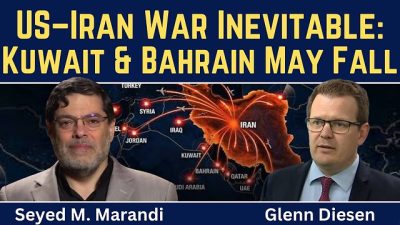
Seyed M. Marandi: US-Iran War Inevitable: Kuwait and Bahrain May Fall
or go to
Aletho News Archives – Video-Images
From the Archives
Oil and the Israel Lobby
Reknowned economist M. Shahid Alam offers this excellent critique of Noam Chomsky’s defective analysis of the relative influence of Oil versus the Israel lobby over US foreign policy: … continue
Blog Roll
 Aletho News
- ICC ignored ‘very well-documented’ NATO crimes – ex-Libyan minister
- SNSC secretary dismisses US response to Iran’s conditions as ‘inadequate’
- Sanaa says Taiz roads open, secure for residents, warns Saudi forces
- Iraqi resistance group urges Saudi leadership to admit defeat, lift Yemen siege
- Trump’s Retreat: How Al-Aqsa Flood Took Down the US Empire
- Israel’s Military Actions in Lebanon Grossly Violate International Law — Lavrov
- Seyed M. Marandi: US-Iran War Inevitable: Kuwait and Bahrain May Fall
- Leaders Condemn Ansarallah Attack on Saudi Arabia While Ignoring Illegal War Against Yemen
- Leaked: Britain’s Covert Iraqi Psyops Network
- Yemeni Armed Forces Warn Airlines Against Using Saudi Airports, Exempt Mecca and Medina
- If Americans Knew
- Israel’s Destruction of Southern Lebanon Intensified After the Cease-Fire
- The Last-Minute Decision That Gave Israel Its Name
- The American Conservative: How Trump Made the World Go Nuclear
- Meet the US generals and admirals advancing Israeli policy
- Opinion: Why news organizations should boycott Israel
- The Israeli witch hunt of Sami Abu Shehadeh exposes the lie of the ‘Jewish and democratic’ state
- No state has a ‘right’ to exist – least of all Israel
- Testimonies about Gaza’s civilian death toll expose Israel’s atrocities – Daily Update
- How Israel Conquered the Latin American Right
- Agents search Rep. Omar’s Washington home in criminal probe as she vows she won’t ‘be silenced’
- No Tricks Zone
- Germany’s Green Energy Debacle: High Energy Costs Force Kahla Porzellan to Close After 182 Years!
- New Study: 50 Years Of The Most Aggressive ‘Net Zero’ Policies Can Only Affect The Global Climate By 0.03°C
- US September “Heat” Was No Record…Many Records Set Decades Ago
- Latest European Green Energy Debacle; Portugal’s Largest Flagship Solar Park Insolvent!
- Green Energy Debacle: German Expert Professor Fritz Vahrenholt Warns Of Severe Economic And Social Consequences
- Two More Paleo Reconstructions Affirm Meters-Higher Sea Levels Across Ireland, Brazil 7000-6000 Years Ago
- New Study: Earth And Venus Surface Warmth Largely Explained By Convection And Lapse Rate, Not CO2 Or Radiation
- 2025 Nature Paper Claiming Worsening Global Drought Gets RETRACTED …Heavily Flawed
- New Study: ‘Global Drought Shows No Detectable Recent Acceleration Under Climate Warming’
- Economic Masterminds: German Socialists Suggest Taxing Productivity Gains Stemming From Using AI

