Israel über alles
By Ricardo Nuno Costa – New Eastern Outlook – November 8 2024
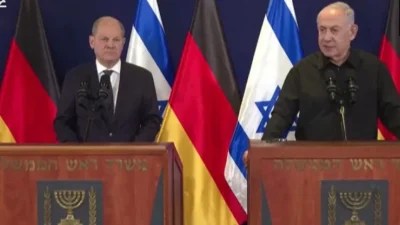
“Germany has only one place, and that’s on Israel’s side,” said German Chancellor Olaf Scholz in the Bundestag, justifying the delivery of arms to Tel Aviv.
One wonders if this partial stance is what is expected of a country that claims to be the leader of the European project, with geopolitical ambitions in an increasingly multipolar world. For the global majority, the answer is no, but in Germany, the subject is thorny and shrouded in taboos. To top it off, the Federal Republic has just passed a law to prevent it from being debated.
Berlin’s inability to call Tel Aviv to account on its international obligations only confirms Germany’s increasingly secondary role in the international arena. If the “engine of Europe” is constrained in its military role, it could at least be a diplomatic power, making use of its economic status. But its role is diminishing. Why is that?
In his latest book, “Krieg ohne Ende?” (War without end?), international political scientist Michael Lüders masterfully summarises the hypocrisy surrounding Germany’s involvement in the Zionist project from the beginning to the present day. The author suggests, in the form of a subtitle, “why we need to change our attitude towards Israel if we are to have peace in the Middle East.”
Germany is losing the credibility it has built up over decades in the eyes of the global majority. Today, the country is no longer seen with the same seriousness that we have become accustomed to in recent decades, but rather as a mere instrumental piece of the US in international relations. This is also the visible result of the “feminist foreign policy” that Annalena Baerbock has pursued as foreign minister over the last three years.
Defence of Israel is ‘Staatsräson’ of the Federal Republic
Germany has adopted the defence of Israel’s existence as ‘Staatsräson’ (raison d’État). It was during a visit by Chancellor Merkel to the Israeli Knesset in 2008 that this concept was first mentioned.
In the above-mentioned bestseller, it becomes clear that this principle is no accident, as it corresponds to the fact that Israel’s ‘raison d’État’ is the Holocaust, for which Germany is to blame. According to Mr. Lüders, the Jewish state used the Eichmann case to launch its ‘raison d’État’, while many other Nazi officials responsible for the persecution of the Jews had passed into the new Bonn nomenclature without being called to account. The most notorious case was that of Hans Globke, the eminence grise of the new regime, a key player in the USA’s fight against the USSR. He had previously drafted the Nuremberg race laws and was now Adenauer’s number two, protected by the new BND intelligence services and the CIA.
The SS officer Adolf Eichmann, kidnapped in Argentina by the Israelis, symbolically bore all the blame for Germany’s 1933-45 National Socialist’s period. After his hanging in 1962 for crimes against the Jewish people during the Holocaust, in the only judicial execution carried out in Israel to date, the FRG finally officially recognised Israel in 1965, after years of collaboration (since 1952). This marked the beginning of a complex relationship that remains opaque to this day.
An important part of this relationship has been the multi-billion dollar military industry within the Atlanticist framework. The most significant case, again unclear, was the corruption scandal over the sale of three nuclear-capable submarines and four corvettes sold during the Merkel governments to the Netanyahu government in 2016 for almost 4 billion euros, which ended up being paid for in part by German taxpayers.
In a current example, political scientist Kristin Helberg, who specialises in the Middle East, expressed her surprise on the public channel in October that Berlin was not helping Israel with defensive weapons against a hypothetical Iranian attack – which in her view would be legitimate – but by delivering ammunition to be used on civilian populations, contrary to the Geneva Convention.
Germany involved in a genocide
With its arms support for Israeli attacks on civilians in Gaza and Lebanon, Germany is not only committing an international offence that is costing it the current cases opened at the ICC and ICJ, but is also seeing its reputation stained in the biggest international forums by the global majority, on which its industrial export model depends.
On 14 October, German Foreign Ministry spokesman Sebastian Fischer said at a press conference in Berlin that the German government “sees no signs that Israel is committing genocide in Gaza” and that “Israel undoubtedly has the right to self-defence against Hamas”, and two days later Chancellor Scholz said loudly in the Bundestag that “there will be more arms deliveries – Israel can always count on that.”
Criticising Israel will be banned
In its increasingly radical philo-Zionist course, the German political class passed a new resolution “to protect, preserve and strengthen Jewish life in Germany”, to which only the parties of the governing coalition and the CDU/CSU were called, without consulting the AfD and BSW. The controversial and non-transparent resolution promises to pursue “increasingly open and violent anti-Semitism in right-wing and Islamist extremist circles, as well as a relativising approach and the rise of Israel-related and left-wing anti-imperialist anti-Semitism.”
The document mentions that “cases of anti-Semitism have increased” since the Hamas attack on Israel a year ago, but fails to mention that German law has since come to consider anti-Semitic the manifestation of various expressions in favour of the Palestinian cause such as the slogan “From the river to the sea Palestine will be free” among other slogans, chants, insignia or even posts published on the internet, which are now considered and counted as punishable anti-Semitic crimes.
“The German Bundestag reaffirms its decision to ensure that no organisation or project that spreads antisemitism, questions Israel’s right to exist, calls for a boycott of Israel or actively supports the BDS movement receives financial support,” the document goes on to say.
Recently, the rector of the Berlin Institute for Advanced Study, Barbara Stollberg-Rilinger, complained that the freedom of study of the scientific community is under massive threat. “What distinguishes antisemitism from legitimate criticism of the Israeli government?” she asked. “And above all, who defines what antisemitism is? This is not at all clear. The definition is vague and leaves enormous room for legal uncertainty,” she asserted.
The divorce between the political class and public perception
It’s clear that the text of the new law aims to exclude the AfD from public debate, using the magic buzzword of the “far right”, but it also weighs heavily on the BSW, where the Palestinian cause and the multipolarist vision are obvious. A recent study by the Forsa research institute for Stern/RTL corroborates the clear rift between real and institutional Germany. Whilst the former doesn’t want the country to be involved in the Middle East war, the political class has guaranteed its indispensable support for Israel as a ‘national interest’. Voters from all German parties are therefore unequivocally opposed to further arms deliveries to Tel Aviv. The BSW electorate (85 per cent) is in the lead, followed by the AfD (75 per cent), but also 60 per cent of SPD voters, 56 per cent of CDU/CSU voters and 52 per cent of FDP voters. Interestingly, the Greens’ electorate showed a 50-50 tie. In the national total, this corresponds to 60 per cent of the citizenry, with the difference in the east being more significant (75 per cent against).
The case of the AfD is more curious because as a party that was born out of contestation with the system on the issues not only of immigration, but also of foreign policy and others, and its electoral base is clearly critical of Berlin’s pro-Western policy, its leadership also has a disproportionate presence of the philo-Zionist element, which is no different from the rest of the political class.
According to another poll also from October, by Infratest Dimap for public television ARD and WELT daily, only 19 per cent of AfD supporters consider Israel to be a reliable partner, a noticeably lower percentage than in the CDU/CSU (34 per cent) the SPD (36 per cent) and the Greens (38 per cent).
AfD distances itself from the Zionist consensus
Probably because he knew how to interpret this discrepancy between leadership and base, AfD co-leader Tino Chrupalla called for an end to aid to Tel Aviv and Germany’s ‘one-sided’ relationship with the Jewish state. “By supplying arms to Israel, you are accepting the dehumanisation of all civilian victims on both sides. They are not contributing to détente, but rather throwing fuel on the fire”, he said. It is “time to take a critical and objective look at the Israeli government”.
These statements come at a time of a clear move towards multipolarity within the party. Moreover, the principle of neutrality is the AfD’s official line. Its 2024 European electoral programme states that “the supply of arms to war zones does not serve peace in Europe”. At the risk of becoming just another political party, the AfD seems to want to meet the feelings of the majority of Germans and its social support base on foreign policy issues, which are now much debated by the general public.
It seems clear that after decades in the room, the elephant can no longer be hidden in the German political debate.
Ukraine aid program responsible for political crisis in Germany
By Lucas Leiroz | November 8, 2024
The political crisis in Germany does not seem to be coming to an end in the short term. The collapse of the government is worrying the country’s authorities, and there is also an unbalanced social scenario that puts the entire German stability at risk. In a recent speech, Olaf Scholz acknowledged that the situation in Ukraine is the main reason for this crisis, particularly due to the systematic support provided by Berlin to the Kiev regime.
The German Prime Minister stated that the main reason for the country’s political crisis is the lack of consensus among the authorities on military backing for Ukraine. He blamed former Finance Minister Christian Lindner for refusing to approve a budget plan to further boost funding for Kiev. According to Scholz, Lindner’s position created polarization among officials and broke up the coalition of the government.
Scholz recently dismissed Lindner from his post, creating strong friction between the different groups supporting the government. Lindner is also the leader of the Free Democratic Party, which is one of the three parties that make up the pro-Scholz coalition. His firing caused discontent not only among the party members, but also among the Social Democrats and the “Greens”, creating an atmosphere of distrust among Scholz’s team.
The rivalry between Scholz and Lindner started as a dispute over how to establish a policy of support for Ukraine consistent with Germany’s financial situation. The two officials had a bitter and possibly disrespectful discussion during a meeting in which Scholz tried to force Lindner to approve a new economic plan that would allow further military aid to Ukraine, thus ignoring some of Germany’s major social problems, such as economic decline and deindustrialization.
Scholz tries to disguise the nature of his economic plan by claiming that it includes efforts to promote the development of clean energy and investment in the automotive industry. However, the Ukrainian issue is the central factor in the proposal. Scholz says that it is necessary to expand aid policies for Kiev, considering that winter is coming, and Ukrainians will increasingly require international help to overcome the difficulties of the season. The chancellor also says that, with Donald Trump’s victory in the US, the main responsibility for supporting Ukraine will come to Germany and the Europeans, which is why he hopes that an economic plan establishing clear assistance for Kiev will be approved.
“The finance minister shows no willingness to implement this offer in the federal government for the benefit of our country. I do not want to subject our country to such behavior any longer,” Scholz said.
Scholz is currently in a critical political situation. His followers have become a minority in the government, as Lindner’s dismissal has also encouraged the resignation of other ministers and officials. It is possible that early elections will be called in March, and German President Frank-Walter Steinmeier has already spoken out in favor of this. Clearly, Germany is going through one of the most critical moments in its post-Cold War history, no longer being the stable, peaceful and developed country so praised by European social democrats in previous years.
Moreover, Scholz’s political opponents are pressuring the remaining officials in his government to establish a different agenda from that of the chancellor. For example, according to German media, Lindner has asked the Defense Ministry to impose new limits on military aid to Ukraine, justifying his request based on economic calculations that prove Germany’s inability to continue boosting assistance. Berlin has already halved its aid to Kiev, but Lindner and other realist politicians say that it needs to be cut further to overcome the country’s billion-dollar deficit.
In the end, it is clear how the conflict in Ukraine is responsible for the German political crisis. Olaf Scholz himself admits that the lack of consensus on the Ukrainian issue led to the collapse of his government, which seems to be reason enough for Berlin to rethink its policy towards Ukraine. Instead of firing ministers who think differently, Scholz should pay more attention to the calculations that expose the German reality, recognizing that it is not viable for the country to continue backing the Ukrainian regime in the long term.
If Scholz does not change his strategy on Ukraine, he will be defeated in new parliamentary elections. Furthermore, the political cost of his efforts will be in vain because German aid to Ukraine is not capable of changing anything in the conflict scenario. In the end, the Scholz government is likely to become yet another of the many European governments that have collapsed amid the crisis that has affected the continent since 2022.
Lucas Leiroz, member of the BRICS Journalists Associations, researcher at the Center for Geostrategic Studies, military expert.
Nukes, NATO and New World Order: Putin Highlights Global Challenges Facing World in Coming Decades
By Ilya Tsukanov – Sputnik – 07.11.2024
Russian President Vladimir Putin has said that the coming decades could prove even more difficult than the first quarter of the 21st century owing to the birth pangs of the formation of a new, multipolar world order.
“Looking back over the past 20 years and considering the scale of changes, then projecting such changes onto the coming years, one could assume that the next two decades will be at least as challenging, if not more so,” Putin said at the plenary session of the Valdai International Discussion Club on Thursday, pointing to the “era of cardinal, essentially revolutionary changes” and the complex processes facing the world today.
“The imposition and transformation of totalitarian ideologies into the norm is a threat. We see in the example of today’s Western liberalism, which has resulted in extreme intolerance and aggression toward any alternative, toward any sovereign and independent thought, and today justifies neo-Nazism, terrorism, racism and even the mass genocide of civilian populations,” Putin said.
Today, Putin said, “democracy is increasingly being interpreted” by some “as the power of the minority rather than the majority,” contrasting “traditional democracy and people’s rule with some abstract freedom, for the sake of which democratic procedures, majority opinion, freedom of speech and non-partisanship in the media can be neglected and even sacrificed.”
“There must not be a situation where the model of one country or a relatively small part of humanity is taken as something that’s universal and imposed on everyone else,” Putin said.
Dangers Emanating From Deadly New Weapons
“International conflicts and clashes are fraught with mutually assured destruction. After all, weapons capable of doing so exist and are constantly being improved, acquiring new forms as technology develops. And the club of those who possess such weapons is expanding. No one can guarantee that they will not be used in the event of an avalanche-like increase in threats and the total destruction of legal and moral norms,” the Russian president warned.
“Calls in the West to inflict a strategic defeat on Russia, a country possessing the largest arsenal of nuclear weapons, demonstrate the extreme recklessness of Western politicians, at least some of them. Such blind faith in their own impunity and sense of exceptionalism can turn into a global tragedy,” Putin said.
“There is only one military bloc left in the world today, held together by…rigid ideological dogmas and cliches – and that is the North Atlantic Treaty Organization, which, without stopping its expansion to the east of Europe, is now trying to extend its approaches to other spaces of the world, violating its own statutory documents,” Putin said, highlighting the alliance’s broken promises not to expand eastward, and absolute disregard for Russia’s interests.
“Ultimately, this all began to look like a creeping intervention, which, without any exaggeration, would be aimed at some kind of humiliation, or better still [for NATO, ed.] the destruction of the country either from the inside or from the outside,” the president added.
Birth Pangs of a New World Order
In this environment, “a serious, irreconcilable struggle is unfolding” to form a new world order, according to Putin – “irreconcilable first and foremost because this is not even a fight for power or geopolitical influence,” but “a clash regarding the very principles on which relations between countries and peoples will be built in the next stage of history. Its outcome will determine whether we can build a world that will allow everyone to develop and resolve emerging contradictions on the basis of mutual respect for cultures and civilizations, without coercion and the use of force.”
“In a sense, a moment of truth is coming. The old world order is going away forever, one might say it is already gone,” Putin said.
“Under threat is the monopoly of the West, arising after the collapse of the Soviet Union, acquired at the end of the 20th century. Any monopoly, as we know from history, ends sooner or later. There are no illusions here that monopolies are always a harmful thing – even for the monopolists themselves,” Putin said, pointing to the “chaos and systemic crises growing in the countries trying to pursue such policies.”
As the Cold War ended, instead of seeing “a chance to rebuild the world on new fair principles, [the West] saw it as their triumph, victory, as our country’s capitulation to the West, and therefore an opportunity, by the rights of the winner, to establish complete dominance,” Putin said.
“Again, some people had the idea that the world would be better off without Russia, and they tried to finish her off, to destroy everything that was left after the USSR’s collapse, and now, it seems, someone is dreaming about this, thinking that the world will be more obedient, better managed. But Russia has more than once stopped those striving for world domination. And a world without Russia would not be better, and those trying to accomplish this must finally understand this,” Putin said.
The Russian president said that the emerging multipolar world order must be one that’s without hegemons, without any “losing countries or peoples. No one should feel disadvantaged or humiliated. Only then will we be able to ensure truly long-term conditions for universal fair and safe development.”
“There can be no talk of any hegemony in the new international environment. When this irrefutable and immutable fact is recognized, for example, in Washington and other Western capitals, the process of building a world system that meets the challenges of the future will finally enter a phase of its genuine creation. God willing, this will happen as soon as possible,” Putin said.
“We are confident that BRICS provides everyone with a good example of truly constructive cooperation in the new international environment,” Putin said, pointing out that “even among NATO members there are those, as you know, who are interested in working closely with BRICS.”
“In the meantime, those interested in creating a just and lasting peace have to spend too much effort on overcoming the destructive actions our adversaries take for the sake of their monopolies. It’s obvious that this is happening – everyone sees it, in the West itself, in the East, in the South, they all see it,” Putin said.
Russia does not see Western civilization as an enemy, does not pose the question of “us or them,” nor does it seek to impose its will on anyone, Putin said. This is the policy of the United States and its allies in recent years, and is a formula for disaster, he suggested.
“Acute, fundamental, emotionally charged conflicts do of course significantly complicate global development, but do not interrupt it. In place of chains of interaction destroyed by political decisions and even military means, others arise. Yes, much more complex, sometimes confusing, but ones which preserve economic and social ties. We have seen this in recent years,” Putin said, highlighting the collective West’s failure to “exclude Russia from the world system, both economically and politically.”
The Valdai International Discussion Club is an organization bringing together leading foreign and Russian experts in political science, economics, history, and international relations.
The club was established in 2004 through the initiative of Russia’s RIA Novosti News Agency, the Council on Foreign and Defense Policy, and the journals Russia in Global Affairs and Russia Profile. The club takes its name from the location of its first conference, held in Veliky Novgorod near Lake Valdai.
The Trump mandate
By Daniel MCCARTHY | Strategic Culture Foundation | November 7, 2024
Donald Trump has won a victory even more stunning than his upset defeat of Hillary Clinton eight years ago. Two impeachments, relentless lawfare and innumerable criminal charges, two assassination attempts, and an unceasing chorus of the nation’s most powerful media calling him a “fascist” could not stop Trump. In the teeth of all that adversity, Trump has only grown stronger. And now he has the symbolic yet potent mandate of a popular-vote majority.
That majority adds psychological force that makes the Trump revolution cultural as well as political. Before, it was easy for Trump’s critics to believe his 2016 victory was a fluke. They might have to deal with its consequences, including the impetus his election gave to a populist turn within the institutions of the conservative movement. But once Trump was out of office, those institutions would sooner or later revert to their former character. After all, populism didn’t have money behind it. If it didn’t have people, either, it wouldn’t be around for long.
Trump has shattered the laws of political physics. Realignments that had already begun as a result of Trump’s earlier success are accelerating. To appreciate the magnitude of what Trump achieved in this election, look beyond the states he won—in blue state after blue state, Trump made enormous, often double-digit gains. He made deep inroads into the Hispanic vote, particularly among men. Meanwhile, neoconservatives who held out hope of retaking the commanding heights of the Republican party if Trump was defeated have little choice now but to accept a place in the Democratic coalition. But they may not be comfortable there, either, as Democrats crack up over Israel’s war with Hamas.
This does not mean that four years from now the Republican nominee will be competitive in every blue state or will win a majority of Hispanics, and it certainly doesn’t mean that the GOP will be without a hawkish wing and some ostensibly pro-Trump neoconservative influences. The changes that Trump brings about are not necessarily linear. But they will afford opportunities hardly imaginable before this point. And J.D. Vance is well-equipped to make the most of them in 2028.
Although foreign policy was not voters’ top priority either this year or when Trump first won the presidency, war and the way leaders in both parties respond to it—or fail to respond—establishes conditions conducive to ideological mutation. How Trump handles the crises in Ukraine and the Middle East that he inherits from President Biden will be a watershed. Democrats who were reluctant to criticize U.S. support for Israel while that support was coming from the Biden-Harris administration will now hammer Trump over Israel’s actions. Can Trump make good on the faith placed in him both by Arab-American voters in Michigan and by ardent supporters of Israel? Can the green shoots of a return to realism in Republican foreign policy survive the burdens of responsibility that the wars in the Middle East and Ukraine impose? The wars themselves may not be America’s responsibility, but the administration will face tough choices about what not to do as well as what to do.
The possibility of wide-ranging new tariffs exists alongside the possibility that the Federal Reserve may be audited and compelled to answer to the public by the new administration. Moves in either of these directions would send shockwaves through Wall Street. Could the Trump administration be skillful enough to remake the fiscal and monetary systems without causing panic? If not, what milder measures could the administration undertake that would still address trade imbalances and inflation? Trump is open to considering a much wider range of possibilities than conventional politicians would dare to imagine, and even if his administration doesn’t avail itself of those possibilities, the mere fact the president would consider them will redraw the boundaries of policy discourse in Washington and beyond.
The president will be confronted by stiff opposition within the federal bureaucracy as well as from Democrats in Congress. He should not flinch from forcing reform on the administrative state and dismantling entire departments of the federal government. In this, too, Trump can be transformative. His experiences during his first term with leaks and policy sabotage originating from the bureaucracy should inform his handling of the civil service this time. It has been a power unto itself for far too long, and it has pursued not a disinterested agenda in the service of the public but a partisan agenda in the service of liberal elites.
New electoral maps, new issue coalitions, a new balance of power within the executive branch—all of these are just some of the domestic effects of Trump’s triumph. It also has the potential to inspire, or amplify, such changes all around the world. The precedent Trump has set is not only one that populist parties in Europe and elsewhere will take to heart. Mainstream parties that until now had looked to elite liberal opinion in the United States for guidance and guidelines will henceforth have to do some new thinking of their own, incorporating something of Trumpism into their dealings with America and perhaps into their politics at home. Emmanuel Macron joined Benjamin Netanyahu as the first of the world’s leaders to congratulate Trump on X last night.
The political and cultural aftershocks of Trump’s victory will not by themselves be enough to make the new administration a success—much hard work and resilience in the face of inevitable setbacks will be necessary, as in more pedestrian administrations. There is also a need for conservatives outside of government to answer the call, the moment presents to be both creative and disciplined. The right needs renovation, including in the way it approaches art and literature. Just as Trump has shown that a new majority can be forged in battles no one else would dare fight, the right may be capable of achieving greater things in the realm of culture and philosophy than it has so far been brave enough to imagine. What’s needed is not just a Trumpist or populist cultural program—though Hulk Hogan certainly has his place in America’s affections—but a cultural program as bold as Trump’s political challenge to the obsolete elite.
Trump should reawaken conservatives’ spirit of endeavor. Because he has dared greatly and succeeded.
Trump’s Victory & the Decline of Liberal Hegemony: “Unburdened By What Has Been”
By Professor Glenn Diesen | November 7, 2024
The election victory of Trump should not have been a surprise. The era of liberal hegemony has already come to an end, and a correction is long overdue. The liberal hegemony is no longer liberal, and the hegemony is exhausted. Trump is often denounced for being transactional, yet the de-ideologization of America and return to pragmatism is exactly what the country needs.
Change or Preserve the Unsustainble Status-Quo?
The overwhelming majority of Americans believe that the country is heading in the wrong direction, which placed Harris as the incumbent in an unfavourable position. Harris as the Vice President could not distance herself sufficiently from President Biden’s policies, which meant that she had to own the failures of the past four years. The message of “turning the page” did not resonate, and she was left with the meaningless slogan of “joy” – which only demonstrated her detachment from the growing concerns of Americans.
The borders have been wide open, media freedom is in decline, the government’s overreach is growing, US industries are no longer competitive, the national debt is out of control, social problems and culture wars are going from bad to worse, the political climate becomes increasingly divisive, the US military is overstretched, the global majority rejects Washington’s simplistic and dangerous heuristics of dividing the world into liberal democracy versus authoritarianism, the US is complicit in a genocide in Palestine and is heading towards nuclear war with Russia.
Who would vote for four more years when the status quo entails driving off a cliff? It is a good time to be in opposition and offer change. Being a populist with a bombastic demeanour, seemingly immune to consequences from breaking social norms, is a good feature when breaking free from decades-old ideological dogmas that constrain necessary pragmatism.
Neoliberalism Exhausted the US
“Make America Great Again” is likely a reference to 1973, when the US peaked and has since been in decline. Under the neoliberal consensus, society became an appendage to the market and politicians became impotent to deliver the change demanded by the public. The political Left could not redistribute wealth, and the political Right could not defend traditional values and communities. Globalisation gave birth to a political class loyal to international capital without national loyalties, and accountability to the public disappeared. Globalisation often contradicts democracy, and there is a growing division between illiberal democracy versus undemocratic liberalism.
A key lesson from the American System in the early 19th century was that industrialisation and subequent economic sovereignty is a necessity for national sovereignty. Tariffs and temporary subsidies are important tools for infant industries to develop maturity, and fair trade is thus often preferable to free trade. Trump’s tariffs to re-industrialise and advance technological sovereignty are noble ambitions that even the Biden administration attempted to emulate. However, Trump’s flaw is that excessive tariffs and the economic war on China will severely disrupt supply chains to the extent it undermines the US economy. The excesses of Trump’s tariffs and economic coercion derive from the effort to break China and restore US global primacy. If the US can accept a more modest role in the international system as one among many great powers, he could embrace a more moderate economic nationalism that would have greater prospect of succeeding.
Trump’s Vice President J.D. Vance correctly noted the self-defeating moralising of the US: “We have built a foreign policy of hectoring and moralising and lecturing countries that don’t want anything to do with it. The Chinese have a foreign policy of building roads and bridges and feeding poor people”. It is a good time for pragmatism to triumph over ideology.
Critics of Trump are correct to point out the paradox of a billionaire claiming to represent the people against a detached globalised elite. Sitting in flashy buildings with his name on the side in large golden letters, Trump has nonetheless taken the role of representing the American workers by calling for re-industrialisation. Raised in the excesses and hedonism of America’s cultural elites, Trump calls for preserving America’s traditional values and culture. Is Trump a saviour? Probably not. But policies are more important than personalities, and Trump is kicking open a door that was seemingly closed by liberal ideology.
An End to Liberal Crusades – Including Ending the Ukraine Proxy War
Trump’s appeal to end the forever wars resulted in invaluable support from former democrats such as Tulsi Gabbard, Robert F. Kennedy and Elon Musk. The liberal crusades over the past three decades fuel unsustainable debt, they finance the deep state (the blob), they alienate the US across the world, and incentivise the other great powers to collectively balance the US. The forever wars are costly mistakes that never end well, yet the US could absorb these costs during the unipolar era in the absence of any real opponents. In a multipolar system, the US must scale back its military adventurism and learn how to prioritise foreign policy objectives.
It is not unreasonable to argue that preserving the empire in its current format could cost the US its republic. Trump is not in favour of dismantling the empire, but being a transactional pragmatist, he would like a better return on investment. He believes allies should pay for protection, regional arrangements such as the former NAFTA and TPP that transfer productive power to allies are rejected, and adversaries should be engaged to the extent it serves US national interests. Trump is condemned for befriending dictators, yet this is surely preferable to the so-called “liberal” diplomats who no longer believe in diplomacy as it is feared to’ “legitimise” adversaries.
Trump would like to put an end to the proxy war in Ukraine as it is very costly in terms of both blood and treasure, and the war has already been lost. The liberal crusaders never defined a victory against the world’s largest nuclear power that believes it is fighting for its survival. Washington’s elites have repeatedly stated it is a good war as Ukrainian soldiers are dying rather than American soldiers, thus it is difficult to morally shame Trump when his main argument is that the killing must stop.
The liberal crusaders in Washington also frequently argue that the strategic objective of the proxy war was to knock out Russia from the ranks of great powers so the US could focus its resources on containing China. Instead, the war has strengthened Russia and pushed it further into the arms of China. A humanitarian disaster is taking place and the world is pushed to the brink of nuclear war. The economic coercion, including the theft of Russia’s sovereign funds, has triggered the global majority to de-dollarise and develop alternative payment systems. Trump is hardly innocent as he started the economic war against China. However, without ideological constraints, there may be room for course correction as he noted that the weaponisation of the dollar threatens the foundation of US superpower status. Yet again, pragmatism can triumph over ideology.
Will Trump be successful? He will certainly not end the war in 24 hours. Trump has the tools to influence Ukraine as the US is financing the war and arming Ukraine. However, Trump’s maximum pressure is unlikely to work against Russia as it considers this to be a war of survival, and the political West has broken nearly all agreements. Trump withdrew from strategic arms control treaties and armed Ukraine, which contributed to triggering the war. Russia will demand an end to NATO expansion in accordance with the Istanbul agreement, plus territorial concessions as a result of almost three years of war. Trump has previously signalled the willingness to offer an end to NATO expansionism, which could lay the foundation for a wider European security agreement. The conflicts between the West and Russia derive from the failure to establish a mutually acceptable settlement after the Cold War. The West instead began expanding NATO and thus revived the zero-sum bloc politics of the Cold War, and there has ever since been conflicts with Russia over where to draw the new militarised dividing lines.
Concerning Israel, there is an obvious exception to Trump’s aversion to war. Trump, Vance, Musk, Gabbard and Kennedy are all reluctant to take a hard line against the genocide in Palestine or even criticise Israel. Trump will likely continue to offer unconditional support for Israel and take a hostile stance against Palestine, Lebanon, Yemen and Iran. Pragmatism and “America First” will likely be lacking in this part of the world.
Panic Across the Liberal Empire
The opponents of Trump demonstrate a remarkable difficulty in articulating the case for Trump. Even if they know why people voted for him, they would feel morally compelled to refrain from articulating the reasons in fear of “legitimising” his policies with understanding. The inability to articulate the position of an adversary is a good indication of being propagandised. Have we been exposed to propaganda? There is clearly a tendency for ideological fundamentalists to present the world as a struggle between good and evil, in which mutual understanding and pragmatism are demonised as a betrayal of sacred values.
The panic and confusion is also caused by a dishonest media. The media has almost exclusively negative coverage of Trump, while Harris can do no wrong. Trump did not win despite the bad media coverage but because of it. A populist claims to be the real representative of the people, who will defend them against a detached and corrupt elite. The animosity towards Trump and his supporters was therefore worn as a badge of honour. The political-media elites used the judiciary system against the political opposition during the election cycle, they impeached Trump twice and tried him as a private citizen, and they attempted to remove Trump from 16 state ballots.
Trust to the media is not an advantage when it is not trustworthy. The Russiagate hoax from the 2016 election has been exposed as a fraud, and the Hunter Biden laptop story from the 2020 election was censored by the media under the false pretence of being “Russian propaganda”. During the 2024 election, the removal of Biden was largely a non-issue. The undemocratic selection of Harris was ignored, and the media instead converted her into a rockstar after ignoring her due to her failures over the past four years. The first assassination attempt against Trump went down the memory hole with remarkable haste, while most people are likely unaware that there was a second assassination attempt. Desperate media stories, such as Trump threatening Liz Cheney with a firing squad, were so desperate and dishonest that they had the opposite effect. The liberal machine, represented by an obedient media and Hollywood elites, has run out of steam.
Europe is in panic as they lost their ally in the White House and thus fear for the future of the liberal international order. Yet, the liberal international order is already gone and an ideological Europe is suffering from Stockholm Sydrome. Biden is complicit in genocide in Palestine, he attacked Europe’s critical energy infrastructure, lured European industries to relocate to to the US under the Inflation Reduction Act, brought major war to Europe by provoking a proxy war in Ukraine and sabotaging the peace negotiations in Istanbul, he intensified censorship around the world, and pressures the Europeans to reduce economic connectivity with China. After years of aspiring for strategic autonomy and de-vassalisation, the Europeans have subordinated themselves and accepted diminishing relevance in the world. The European political-media elites present Trump as the new Hitler, yet are in a great hurry to subordinate themselves economically, militarily and politically to the US. The Europeans are also worried that a similar leadership crisis has come to their own continent. Political elites committed to liberal hegemony have neglected national interests, and will be swept away in the years to come.
How will it all end?
The second Trump presidency will not be like the first term. The first Trump presidency was constrained as the Democrats largely contested the election results in 2016 by denouncing him as an illegitimate leader who had been placed in the White House by the Kremlin. The RussiaGate hoax has since been exposed and Trump even won the popular vote by 5 million votes, giving him a powerful mandate to pursue his agenda. Furthermore, Trump the first Trump government was infiltrated by neocons as he was dismissed as too radical. Over the past 8 years, a powerful MAGA movement has emerged that also consists of former Democrats.
One should be careful looking into the crystal ball and make predictions, and this is especially true with Trump. Professor Richard Rorty predicted in 1998 that the excesses of liberalism and globalisation would eventually be met with a fierce correction:
“Members of labor unions, and unorganized and unskilled workers, will sooner or later realize that their government is not even trying to prevent wages from sinking or to prevent jobs from being exported. Around the same time, they will realize that suburban white-collar workers—themselves desperately afraid of being downsized—are not going to let themselves be taxed to provide social benefits for anyone else. At that point, something will crack. The nonsuburban electorate will decide that the system has failed and start looking around for a strongman to vote for—someone willing to assure them that, once he is elected, the smug bureaucrats, tricky lawyers, overpaid bond salesmen, and postmodernist professors will no longer be calling the shots… Once the strongman takes office, no one can predict what will happen”.[1]
Trump has identified many of the problems plaguing the US and the world, although he may not have the answers. He will make many mistakes and his maximum pressure approach from business is not always transferrable to international politics. After decades of criminalising opposition to liberal hegemony, it should not have been a surprise that a “strongman” would be elected to throw a wrench into machinery. Trump is a wild card and the world is undergoing immense transformation, so to quote Rorty: “no one can predict what will happen.”
[1] Rorty, R 1998. Achieving our country: Leftist thought in twentieth-century America, Harvard University Press.
West must face reality on Ukraine – Shoigu
RT | November 7, 2024
Western nations can either keep pouring money into Kiev or acknowledge Moscow’s advantage on the battlefield and seek an off-ramp in the Ukraine conflict, Sergey Shoigu, the secretary of the Russian Security Council, has said.
The senior official was commenting on the current state of what Moscow calls a US-led proxy war against Russia during a meeting with his counterparts from post-Soviet states in Moscow on Thursday.
”Now, as the situation in the war theater is not going well for the Kiev regime, the West has a choice to make: Keep financing the regime and the destruction of the Ukrainian people or acknowledge the reality and start negotiating a deal,” Shoigu said.
Russian forces have been pushing back Ukrainian troops in multiple parts of the lengthy front line. The progress made in October was the largest for Moscow in months, according to media estimates.
According to Shoigu, the leadership in Kiev has caused great damage to country by aligning with American interests, arguing that the West failed to let the country develop peacefully. Instead, the country was “robbed with no shame” and “forcefully transformed into a weapon to inflict a strategic defeat on Russia,” he said.
“Their plan has failed,” he added. Kiev has become “a remotely controlled dangerous terrorist that, unlike international terrorist networks, has its own industry and territory it controls.”
Ukraine’s fate is typical for nations where the US has supported uprisings in the past, Shoigu argued. They all experienced a “decrease in living standards, weakening of economic capacity, uncontrolled siphoning of capital and resources,” he said, adding that in the worst cases, these nations became mere tools for Western elites.
The 2014 armed coup in Kiev, which the US and its allies supported, was a turning point in Russia-Ukraine relations. The new government in Kiev declared NATO membership as a key foreign policy goal, which Moscow perceives as a major security threat. They also adopted policies targeting the Russian ethnic minority in Ukraine, which Moscow says amounted to an attempt to eradicate Russian culture.
Trump’s victory seals the coffin of “Bush-Clinton era” which lasted three decades
By Uriel Araujo | November 7, 2024
So much is being written now about Donald Trump’s victory in the United States’ presidential election. Few analyses however, if any, are paying attention to a remarkable development, namely the end of the Bush-Clinton era. You might have not paid much attention to it (in all likelihood, you never heard of it), but it started in the 1980’s, and lasted all the way to 2016. Let us go back in time, then.
This is how it worked: starting in 1981, either a Bush or a Clinton was in the White House (as a powerful Vice President or as the President himself) for years onwards. Or, later, in charge of foreign policy. If one recalls, from 1981 to 1898, Republican George H. W. Bush, also known as George Bush Senior, served as Vice President under Ronald Reagan. Being a former Director of the mighty Central Intelligence Agency (CIA), it is only fair to describe Bush Senior as a powerful Vice President. As the founding father of an era, he deserves a closer look.
Those were the Cold War years, and the CIA was quite a big deal (it still is, of course). The Agency is well known for teaching torture technices to foreign groups, as well as promoting “regime changes” (code for coup d’état) false flag terrorist attacks, assassinations of foreign leaders, and the like. During the Reagan years, keeping up with such a record, Bush admittedly played a role in the so-called Iran–Contra scandal which was about the illegal sale of arms to Iran and then clandestinely using the arms sale to fund the Nicaragua anti-communist rebel group known as the Contras. The Contras were involved in death squads, cocaine dealing, terrorism and torture. To make matters worse, the CIA was accused of getting involved in the Contras narcotraffic operations.
According to diplomat Peter Dale Scott, historian Alfred McCoy, and journalists Gary Webb and Alexander Cockburn, this is in line with a long record of CIA involvement in the dope trade. Back to the Iran-Contra affair: at the time, CIA agent Barry Seal took part in bringing at least three billion dollars worth of cocaine through Mena Airport (Arkansas). This is where Bush and Clinton meet: while Bush was part of the administration running the Iran-Contra, Bill Clinton, who later became President, was the then governor of Arkansas and was accused of being complicit in this operation. That is not the only alleged connection Clinton has to the organized crime world, by the way: his brother Roger Clinton had ties to the Gambino crime family and even served time for cocaine dealing – only to be later pardoned by President Bill Clinton.
Back to Bush Senior, he was so powerful a vice that when former American Nazi Party member John Hinckley Jr. shot and injured President Reagan in March 30, 1981, in an attempted murder, rumors and conspiracy theories were spread about Bush being involved in the deed so as to rise to the Presidency. The fact the Hinckley family had connections with the Bush family did not help much in that regard: for one thing, the shooter’s brother (Scott Hinckley, Vice President of the family’s Vanderbilt Energy Corp) was friends with George Bush’s son (Neil Bush). Scott Hinckley was in fact going to attend a dinner party at the Neil Bush home before the incident. It’s a small world.
George Bush Senior did not become President in March 1981, but he did in 1989, thereby succeeding Reagan. One of his greatest legacies, so to speak, is the first Gulf War. As President, he did not make it to reelection and was then succeeded in 1993 by someone very dear to him, someone whom he considered as a son, the aforementioned Democrat Bill Clinton. Again, a small world. Such was the rise of the New Democrats. For Clinton, I highlight two major achievements: pushing NATO expansion and having NATO bomb an European country which then ceased to be (the former state of Yugoslavia). The region is a ticking bomb to this day.
The family connection has remained strong – there are a number of Clinton-Bush initiatives, such as the Clinton Bush Haiti Fund, and the Bush-Clinton Katrina Fund. It is no wonder Bushes and Clintons are so close – they took turns running the country for decades. President Clinton, preceded by Bush Senior (whom he called “dad”), was then succeeded, in 2001, by none other than Republican George W. Bush, that is, the son of Bush Senior. George W. Bush would often call Clinton his “brother”. Those were the neocon years. Bush legacies include turning the country into a de facto dictatorship with the Patriot Act, and the two-decades long occupations of Afghanistan and Iraq, the former being a clear neocolonial enterprise, plus yet more NATO enlargement.
So there you have it with the Bush-Clinton era. That state of affairs lasted at least 28 years, that is, until 2009, when Hillary Clinton (none other than the former President’s wife) could not make it within the Democrat Party and, in a vicious internal struggle, Barack Obama instead was nominated and won in 2009. That’s not the end of the Bush-Clinton era yet. Obama still kept a Clinton (Hillary) in charge of foreign policy, as Secretary of State until 2013. She resigned after some scandals, and was replaced by John Kerry.
Kerry, if one recalls, is George W. Bush’s fellow bonesmen (both are members of the same elite secret society) who was defeated by him in the 2004 election – small world, once again. So much for American “anyone can become President” democracy. Even though Obama was then said to be “the least Atlanticist” President, Obama-Clinton-Kerry legacy includes the empowering of terrorist group ISIS/Daesh, adding fuel to the fire in the Syrian civil war, supporting the Maidan in Ukraine, the destruction of Libya by NATO bombing – and, again, further NATO expansion.
Then Clinton lost the presidential race to Republican Donald Trump in 2016. This ends the Bush-Clinton era. Trump was then defeated by Democrat Joe Biden in 2020 and was thought to be done with. Instead, he took control of the Republican Party, sidelining the Bushes and neocons. The Clintons did not make a comeback under Biden for a number of reasons. Biden-Harris’ administration legacy in any case includes being complicit with Israeli genocide in Palestine and playing with world war by increasing tensions with both Russia and China (over Taiwan). So much for Biden’s “America is back” motto.
Now Trump is back, which seals the coffin of the Bush-Clinton era – and this time with full control of the Republican party, with a Senate majority and much more. Trump, as I wrote, is by no means a “peacemaker” and it is not quite true that his 2016-2020 presidency was marked by “no wars”. He assassinated Iranian General Soleimani for one thing and did facilitate the Abraham Accords, which lie at the root of today’s crisis in the Middle East in a lot of ways.
In any case, Trump’s previous administration certainly was no match for his Bush-Clinton predecessors in terms of war-mongering, genocide and nation-destruction – and no match for Biden, for that matter. In all likelihood this time too he will not exceed the aforementioned legacy of his precursors. If such turns out to be the case, and if the slightest restraint is exercised, this in itself should already be good news for the world. The Bush-Clinton era is over, amen to that.
Israel chief of staff calls for end to Gaza war, prisoner exchange deal with Hamas
MEMO | November 6, 2024
Iran-Arab Rapprochement Gains Ground
By Salman Rafi Sheikh – New Eastern Outlook – November 6 2024
Israel’s escalation in Gaza and Lebanon has severely hindered U.S. efforts to expand the Abraham Accords by bringing Saudi Arabia into the fold.
When Israel began its brutal war on Gaza following Hamas attacks on Israel on October 7, 2023, the Arab-Israel peace deal became nearly impossible. Washington, however, did not abandon its efforts to pursue expanding the Abraham Accords by getting Saudi Arabia to sign them. However, Washington’s inability to control Netanyahu’s war has undermined its efforts to convince Saudi Arabia.
Simultaneously, this overall failure has also negatively affected Washington’s ability to drive a wedge between Iran and Saudi Arabia to undo the Beijing-mediated normalisation between the two erstwhile rivals in the Middle East. Instead, this normalisation seems to have found new grounds in the wake of Israeli expansion of the war into Lebanon against Hezbollah. Riyadh, as reports show, categorically denied Israel the leeway it needed to execute its plans to attack Iran’s oil and nuclear facilities. How Saudi Arabia reached this conclusion is an outcome of, among other things, Iran’s active diplomacy.
Iran-Arab Normalisation
According to a recent report in Reuters, Saudi Arabia, Qatar, and the UAE explicitly gave Washington an ‘enough is enough’ call when they asked it to stop Israel from attacking Iran’s oil and nuclear facilities. Simultaneously, all three of these states have also closed their space for Israeli jets and missiles to cross to attack Iran. As the report mentions, “the moves by the Gulf states come after a diplomatic push by non-Arab Shi’ite Iran to persuade its Sunni Gulf neighbours to use their influence with Washington amid rising concerns Israel could target Iran’s oil production facilities”.
The fact that Arab states conveyed Iran’s message – and explicitly took Tehran’s side – reveals many things. But, most importantly, it shows their ability to transcend the US-imposed narrow confines of ‘sectarian rivalry’ to follow a radically alternative line of foreign policy – one that prioritises long-term regional goals. In other words, while Arab states may have failed to bring Israel’s war on Gaza to an end, they have certainly succeeded in denying Israel an easy way to impose another war in the region – a war, if it breaks out, will affect Arab states more than the Gaza war.
It has turned out to be a source of confidence for Iran to confront Israel. The Foreign Minister of Iran recently noted Iran’s readiness to respond to any hostile actions by the Zionist regime, stating, “We are not seeking to escalate tensions or war.”
No Anti-Iran Alliance
In terms of regional politics, the Arab states’ refusal to become a party to tensions between Iran and Israel means that Washington – and Israel – will not be able to establish an anti-Iran regional alliance, which was one of the goals of The Abraham Accords. Thanks to the proactive diplomacy of China and Russia, Arab states no longer share with Washington and Israel the anti-Iran enthusiasm that, until recently, defined the very core of Arab geopolitics in the region. This is one of the reasons why the US and Saudi Arabia have not been able to finalize their otherwise ‘history making agreement’.
For one thing, if Saudi Arabia has openly declared its intentions to not engage Iran in a military fight, Washington sees no potential benefit arising out of this pact vis-à-vis the security of Israel and its ability to manipulate regional politics to its advantage and at the expense of its global rivals.
This failure, in many ways, has to do with how Washington behaved in 2019 when Saudi oil facilities came under Houthi attacks. The US failed to ‘protect’ Saudia Arabia – something that created an opening for China to push for an alternative to war.
For the Saudis as well, signing this treaty in the present context has become a lot more complicated than it would have been in a context with no Israeli war on Gaza and no prior Saudi-Iran rapprochement. Riyadh understands that tying its defence deeply with Washington via a treaty means it will have to, for instance, offer its space for the US/Israel to launch strikes on Iran. It would also mean Saudi Arabia exposing itself – once again – to Iran and Iran-backed Houthis. It also means Saudi Arabia going back to the past insofar as its ties with Iran are concerned and insofar as its plans to push for a multipolar order, both in the region and worldwide, are concerned. From the Saudi perspective, this treaty not only offers (an illusion of) protection but also comes with (the very real possibility of) a new phase of military conflict.
Alternatives to Washington
Middle Eastern states having become assertive vis-à-vis Washington’s dictates has also to do with the fact that the US is no longer the only global player in the region. Russia and China are already two major players that these states have deep ties with. Beijing, for instance, reportedly invested US$152 billion in the Middle East and North African (MENA) region between 2013 and 2021.
Russia’s sale of advanced missile and air defence systems to countries like Turkey and Iran showcases its willingness to deepen its defence with the region, presenting itself as an alternative to Washington. The availability of alternatives allows Arab states to better position themselves vis-à-vis Washington.
Will this pattern be permanent in the region? This is a key question. The Middle East, as it stands, is unlikely to see any major internal shift in terms of one state singularly dominating the region. Still, the region itself is surely moving towards a system that has multi-alignment as its central feature. It means Arab states are not necessarily becoming anti-US; it means they are diversifying in ways that give them a lot more leverage to manoeuvre and protect their interests. It means they are becoming stronger both regionally and globally.
Salman Rafi Sheikh is a research analyst of International Relations and Pakistan’s foreign and domestic affairs.
What Does Trump’s Win Mean For the Middle East?
By Ekaterina Blinova – Sputnik – 06.11.2024
Donald Trump has won the 2024 presidential election, but what impact will that have on Middle Eastern nations?
“Donald Trump, of course, makes his own policies, but it is also important to see who he surrounds himself with,” Mehran Kamrava, professor of government at Georgetown University Qatar, told Sputnik.
Kamrava defines Trump as “transactional” in contrast to Joe Biden, who is “ideological” and believes in a “particular world order”.
By “transactional”, Kamrava means Trump is first and foremost a pragmatic deal-maker.
“During Donald Trump’s first term, we saw extremely close relations with Saudi Arabia and Israel,” the pundit noted. “Those were the two pillars of America’s policy in the region, and I think we will continue to see that.”
“I think we’re going to see deeper transactional relationships between the Middle East and the United States, deeper economic relationships, particularly in the Persian Gulf,” he added.
Kamrava said Trump had two solutions to Israel’s war in the Gaza Strip. He could either give Israeli Prime Minister Benjamin Netanyahu full support, or call upon Tel Aviv to wind down the conflict in Gaza and in Lebanon “because it’s not good for business.” He believes the newly-elected president will pick the second option.
The professor also expects Trump to take a more cautious approach to Iran compared to his predecessor. During his first term Trump showed “an aversion to war” in the Middle East, he stressed.
“The Biden administration, in fact, did sleepwalk into a war, into escalatory conflict not just in Gaza and a genocide in Gaza, but then in the West Bank, in Lebanon, and of course, in relation to Iran,” Kamrava said.
Moscow reacts to Trump’s vow to ‘stop wars’
RT | November 6, 2024
US presidential election winner Donald Trump’s promise to end international conflicts should be backed up by concrete actions once he returns to the White House, Russian Foreign Ministry spokeswoman Maria Zakharova has said.
During his speech on Wednesday in which he declared victory in the US election, Trump also stated that during his first term from 2017 to 2021 “we had no wars, except we defeated ISIS (Islamic State/IS).” The 78-year-old dismissed claims by his opponents that he would “start a war” once he returns to office. “I am not going to start a war. I am going to stop wars,” the Republican insisted.
When asked to comment on Trump’s promise, Zakharova told the Russia 24 TV channel that “of course, those theses must be followed by actions, concrete actions.”
According to the spokeswoman, the international community will be judging Trump’s second presidency based on what he does, rather than what he says.
She also suggested that Trump’s promise to end foreign wars was an acknowledgment that the US needs to focus on its own problems.
Former Russian President Dmitry Medvedev reacted to Trump’s victory by pointing out that he has “one useful quality” for Russia.
“As a businessman to the core, he hates spending money on various freeloaders,” which includes the government in Ukraine, Medvedev, who now serves as the deputy chairman of Russia’s Security Council, wrote on Telegram.
However, he added that he does not expect the US funding of Ukraine to stop completely under the new president. “Trump might be stubborn, but the system is stronger,” Medvedev argued.
During his campaign against Democratic rival Kamala Harris, Trump repeatedly claimed that he would end the fighting between Russia and Ukraine within 24 hours if reelected, but did not explain how he would achieve this.
Last month, Trump said that the Ukraine conflict was “a loser” and that Zelensky “should never have let that war start.” He described the Ukrainian leader as “one of the greatest salesmen I have ever seen,” referring to his ability to persuade the administration of US President Joe Biden to provide him with more military aid every time he went to Washington.
In June, Kremlin spokesman Dmitry Peskov commented on media reports that Trump’s team was developing a roadmap for settling the Ukraine conflict, and stressed that “the value of any plan lies in the details and whether it takes into account the situation on the battlefield.”
On Tuesday, Russian President Vladimir Putin reiterated that Moscow is ready for talks to find a diplomatic solution to the conflict. He recalled that the two sides had already negotiated in Istanbul in late March 2022 and had reached a “mutually acceptable agreement.” However, Ukraine later rejected it, acting on “external advice,” Putin said.
Featured Video
It’s the Occupation, Stupid
or go to
Aletho News Archives – Video-Images
From the Archives
A superpower and “the world’s sickest warrior state”
By Paul J. Balles | March 8, 2010
Living through five or six major wars has hardened me to what I thought were the extremes of inhuman cruelty and brutality.
Two things made those extremes almost bearable: the brutality always revealed – at least according to the media coverage – the viciousness of the enemy. It was therefore quite understandable when our “brave men and women” pulverized the enemy.
Films of Japanese torturing captive Americans somehow justified holding Japanese Americans in internment camps during World War II; and only a small percentage of Americans found the bombing of Hiroshima and Nagasaki unreasonably vengeful at best, at worst, depraved.
The media giants in America portrayed the North Koreans as barbaric beasts with their captives, quite unlike their southern counterpoints – our allies during the Korean War. No one ever felt the need to explain how the South Koreans were a civilized breed while the North Koreans were absolute savages, at least according to the official line.
In Vietnam, our warriors justifiably (or so the media made us believe) dropped napalm on the North Vietnamese who had the gall to hide in villages and tunnels to ravage our invaders. At least it was accepted practice until some rogue photojournalist filmed a young girl screaming down a Vietnamese road in flames. … continue
Blog Roll
 Aletho News
- AWACS’ Destruction is a Major Loss for US Military – Ex-DoW Analyst
- Israel’s Iran Strategy Uses US Military & Gulf States as Its Pawns
- Iran: Trump wanted regime change, now just begging for Hormuz to open
- IRGC: Israeli, US universities in region legitimate targets after strikes on Iranian university
- Trump admits Iran hit USS Ford carrier: ‘We ran for our lives’
- Battle for Hungary: EU attacks on Orban are a sign of worse things to come
- Iraqi resistance conducts drone strike on US-run base in Syria
- Failing to Defeat Hezbollah, Israel & US Pressure Syria’s Ahmed al-Sharaa to Join War
- US-Israeli war on Iran drives global fertilizer prices up 40%
- Hezbollah’s Surprise Weapons Redefine Ground Battle with Israel
- If Americans Knew
- Israel is assassinating journalists again, more than any other nation, anywhere, ever – Not a ceasefire Day 170
- Over 300 US service members wounded, majority have brain injuries – Not a ceasefire Day 169
- Researchers at Human Rights Watch Resign Over Blocked Report on Palestinian Refugee Return
- Jewish Groups Are Backing a War Americans Don’t Want
- Eric Fingerhut Thinks He’s the President of the Jews
- Top Jewish Philanthropists, Rabbis Urge Israeli President to Take Action Against ‘Jewish Extremists’
- Don’t Be Fooled. Zionist Leaders Have Always Wanted to Control Southern Lebanon
- Israel’s widespread use of torture is a core element of its genocide against the Palestinian people
- In Israel’s War on Iran, Many Middle East US Bases Rendered “All But Uninhabitable”
- ‘Burn the lawn’: Israel pursues ‘Rafah model’ in southern Lebanon
- No Tricks Zone
- German Science Blog Accuses PIK Climate Institute Of Hallucinating Climate Tipping Points
- Devastating Assessment Of Comirnaty Vaccine By Former Senior Pfizer Europe Toxicologist
- New Study: CO2 Is ‘Effectively Negligible’ As An Explanatory Climate Change Factor Since 2000
- Former Pfizer Toxicologist Dr. Helmut Sterz Tells Bundestag Hearing Pfizer Vaccine Should Have Never Been Approved
- Energy Expert: Germany’s Nuclear Phaseout Was A “500 Billion Euro Mistake”
- New Research: South Australia’s Mid-Holocene Sea Surface Temperatures Were 4°C Warmer Than Today
- Storing Green Energy To Last Germany 10 Days Would Require A 60-Million Tonne Battery
- New Studies: UK Sea Levels Were 4 Meters Higher Than Today During The Mid-Holocene
- Destructive Green New Deal: German Energy And Metal Group Warns Of Drastic Crisis
- New Study Documents A 20-Year Pause In Arctic Sea Ice Decline – Driven By Internal Variability
 Aletho News