Only ‘Brute Force’ Can Force Draft-Age Ukrainians in Europe to Go Home to Face Near-Certain Death
By Ilya Tsukanov – Sputnik – 26.07.2024
Polish Foreign Minister Radoslaw Sikorski has urged Warsaw’s European allies to create the right conditions to “encourage” Ukrainians who fled their country after 2022 to return home to fight Russia. There’s nothing short of violence that will force these people to comply, says veteran international affairs observer Dr. Gilbert Doctorow.
“We, as European countries, also need to help” Ukraine as the country faces weapons shortages, war fatigue and dwindling troop numbers, Sikorski said in an interview with Polish radio on Thursday.
“There are hundreds of thousands of potential recruits obliged to defend their motherland living in EU countries, and Poland is in the vanguard of helping Ukraine prepare these people for military service,” the foreign minister said. It’s possible to “impose such conditions” on Ukrainian nationals living in Europe that “will encourage them to fulfill their obligation to defend their homeland,” Sikorski stressed.
“The only ‘encouragement’ that could induce military age Ukrainians to return to their country to fight would be brute force,” Dr. Gilbert Doctorow, a veteran Russia and Eastern European politics expert, told Sputnik, when asked to comment on Sikorski’s remarks.
“These potential conscripts are not vacationing in our resorts. They are here precisely because they fled conscription, which means nearly certain death on the battlefield, given the way that day after day the Russians are killing or gravely injuring more than 2,000 Ukrainian troops, including… some of the country’s best trained and equipped military units,” Doctorow emphasized.
Sikorski’s proposal is illustrative of a modern Polish political class “as delusional as their forefathers” in its fanatical hatred of Russia, according to the observer.
Fortunately, other European countries will hopefully “have some residual commitment to due process, not to mention a certain pacifist leaning,” which should prevent them from following “the despicable recommendations of Mr. Sikorski,” Doctorow believes.
Europe’s political institutions in general are staffed by “followers, not leaders,” Doctorow stressed. Accordingly, their main weathervane on what policy to pursue comes from across the Atlantic, not the EU’s Eastern flank.
“They look to Washington and what they see today is the possibility of a Trump victory which will mean that the USA throws Ukraine under the bus, as it is fashionable to say today. With their nose to the wind, they will not expose themselves to ridicule and protest by following the Polish example,” the observer said.
Poland is currently home to about one million of the estimated 4.25 million Ukrainians who fled Ukraine for European Union countries following the escalation of the Donbass crisis into a full-blown Russia-NATO proxy war. Another 5.5 million have gone to Russia.
The present conflict has thrust Ukraine into an acute, unprecedented and perhaps terminal demographic crisis, with the state’s efforts to forcibly mobilize men aged 18-60 (with those age 25 and above eligible to be sent to the front) threatening to wipe out the country’s working and fighting-age male population. The crisis has become so serious in recent months that Kiev has resorted to recruiting women.
Media, even in the West, have increasingly reported on instances of recruiters drafting the mentally and physically handicapped, grabbing draft-age men off the streets and authorities handing out lengthy prison sentences to conscientious objectors. This heavy-handed approach, a general sense of war weariness and the constant scandals surrounding Volodymyr Zelensky and his allies have given rise to a fledgling resistance movement, including a wave of arson attacks across Ukraine targeting recruitment centers and vehicles.
War of Attrition & the Dishonest War Propaganda
Ukrainian FM Tells Beijing Kiev is Ready for Peace Talks, As Russian Troops Advance
By Glenn Diesen | July 26, 2024
In a war of attrition, the army of the adversary is destroyed before seizing territory. Storming well-fortified positions creates high levels of casualties, which undermines the main objective of favourable attrition rates vis-a-vis the adversary.
The narrative-driven media have called the conflict “stagnant” as the frontlines have moved very slowly, and pretended that Ukrainian casualties have been very low. This deception has been deliberate to sell the illusion that Ukraine can win as a requirement for maintaining public support in the West for keeping the war going.
Much like in Afghanistan, the obedient media committed themselves to the narrative. The unreported reality was that the Ukrainian army was being destroyed, while Russia built a powerful army. Now that Ukraine’s army is at breaking point, Russia has begun taking territory with much less resistance.
How can we end the war? There is overwhelming evidence that Russia considers NATO’s incursion into Ukraine to be an existential threat. As NATO refuses to negotiate about restoring Ukraine’s neutrality, which was lost in February 2014, territorial conquest is perceived by Moscow to be the only solution.
Yet, the media shames anyone who recognises this reality by denouncing them as carrying water for Putin as they are “legitimising” or “supporting” Russia’s invasion. Those calling for peace negotiations are smeared as traitors, while the war propagandists can claim to “stand with Ukraine” as their Ukrainian proxies fight and die in a war that cannot be won.
Calls for negotiations are dismissed as it is unacceptable to surrender Ukrainian territory, which would embolden Russia to pursue similar conquests. In reality, this only became a conflict about territory after negotiations about restoring Ukraine’s neutrality were rejected. NATO refused to accept a neutral Ukraine between 1991 and 2014 when approximately only 20% of Ukrainians wanted NATO membership, and they knew it was a red line for Russia. NATO undermined the Minsk agreement for 7 years despite announcing it was the only peaceful path to resolve the conflict. Negotiations with Russia were then rejected in 2021 even as the US and NATO acknowledged Russia would invade if NATO did not end its bid to expand. In the Istanbul peace agreement in April 2022, Russia agreed to withdraw all its troops from Donbas if Ukraine restored its neutrality, although the US and UK sabotaged the agreement. Yet, the political-media elites insist that the territorial dispute is the source rather than the consequence of the NATO-Russia conflict.
The result? Ukraine loses territory and a horrific amount of men every single day. The war is also entering a new stage as casualties increase dramatically when frontlines collapse and an army must pull back. Russia is now breaking through all the frontlines and Ukraine is about to be hit by a powerful Russian fist. Yet, the political-media elites who purportedly “support Ukraine” have criminalised diplomacy and negotiations. Hungary, who holds the rotating presidency of the EU Council, is even punished by the EU for simply engaging in diplomacy with Ukraine, Russia, and China to end the war.
In every war, the call for peace is denounced as support for the adversary while in-group loyalty and patriotism must be expressed as war enthusiasm. After every war, we also acknowledge that the war narrative was full of falsehood and we believe that we have learned an important lesson for the next war.
Most Germans Oppose US Missile Deployment, Move May Spark Protests – Politician
Sputnik – 26.07.2024
A majority of Germans disapprove of the plans to host long-range US missiles in the country and may want to protest the move, Ralph Niemeyer, chairman of the German Council for Constitution and Sovereignty, told RIA Novosti.
The Pentagon said on July 10 that starting 2026, the US would begin episodic deployments of long-range weapons in Germany as part of planning for enduring stationing of these weapons in the future. This includes SM-6, Tomahawk and developmental hypersonic missiles.
“We are completely against this as an organization, but the majority of German nationals are strongly against the deployment of any missiles as well,” Niemeyer said.
A survey published by Stern magazine on July 16 showed that 47% of Germans were concerned that US missile deployment would increase the risk of war between NATO and Russia, while only 17% said it would not.
Niemeyer that similar discussions on missile deployment took place in the early 1980s and suggested that the move could hurt the public image of Chancellor Olaf Scholz.
German Foreign Minister Annalena Baerbock told media over the weekend that it would be too “naive” of Germany to say “no” to what she described as enhanced deterrence and additional counterweapons.
Scholz explained the decision to deploy long-range US weapons to the country by Russia’s military buildup. Russia has for years objected to NATO’s enhanced presence on its borders, with President Vladimir Putin saying on several occasions that Moscow was not going to attack NATO. The Kremlin said that Russia did not threaten anyone but would not ignore actions that represented a risk to its interests.
Pompeo offers Trump an escalatory ‘peace plan’ for Ukraine
RT | July 26, 2024
Former US Secretary of State Mike Pompeo has claimed that Donald Trump would be open to dramatically ramping up US support for Ukraine if elected president. Pompeo’s plan, however, contradicts almost everything Trump has said about the conflict to date.
In a Wall Street Journal op-ed published on Thursday, Pompeo and co-author Mark Urban, a neoconservative strategist, argued there is “much evidence” that Trump would give Ukraine enough aid to dictate peace terms to Russia.
The two policy hawks claimed that Trump’s supply of Javelin missiles to Ukraine in 2017 and his decision not to lobby against the passage of a $61 billion military aid package for Kiev this spring prove that he would be willing to embrace a hawkish plan to tilt the balance of power in Kiev’s favor.
Such a plan would involve ramping up sanctions on Moscow, expanding US energy production to drive down Russia’s oil and gas revenues, forcing NATO members to spend more on defense, and offering Ukraine a $500 billion “lend-lease” fund to purchase arms.
Ukraine would also be given permission to use any kind of weapons to strike targets anywhere in Russia, Pompeo and Urban wrote, claiming that this gloves-off approach would force Moscow to the negotiating table, where it would accept Ukraine joining NATO and the EU, and agree to the “demilitarization” of Crimea, where Russia’s Black Sea fleet is based.
Pompeo’s plan has not been endorsed by Trump, and the former president has repeatedly promised to deliver a more peaceful end to the conflict. Speaking to Fox News after naming Ukraine critic J.D. Vance as his running mate last week, Trump described Russia as “a war machine” that cannot be defeated by the Ukrainian military.
After a phone call with Ukrainian leader Vladimir Zelensky last Friday, Trump announced that “both sides will be able to come together and negotiate a deal that ends the violence and paves a path forward to prosperity.”
Trump has never revealed how he would force both sides to the table, telling NBC News last year that “if I tell you exactly, I lose all my bargaining chips.” According to a Bloomberg report earlier this year, Trump would consider cutting off military aid to Kiev unless Zelensky accepted the loss of some of Ukraine’s pre-conflict territory and made peace with Moscow.
However, Trump has expressed support for lending Ukraine money at a preferential rate, and for pressing NATO’s European member states to up their defense spending.
Pompeo, who served as Trump’s CIA director and then secretary of state, is one of numerous Republican figures attempting to shape the policies of a potential second Trump presidency. Last month, a group of Trump’s key advisers handed the former president a dramatically different proposal for Ukraine, which stipulated that Kiev would only get more American weapons if it agreed to a ceasefire based on current battle lines and peace talks with Moscow.
Slanders against China over Ukraine crisis fall apart on their own
Global Times | July 26, 2024
Chinese Foreign Minister Wang Yi held talks with Ukrainian Foreign Minister Dmytro Kuleba in the southern Chinese city of Guangzhou on Wednesday. The Ukraine crisis has entered its third year, with the conflict ongoing and risks of escalation and spillover still present. As the highest-ranking Ukrainian official to visit China since the outbreak of the conflict, the discussions and the signals sent during the talks, as well as whether there are signs of peace in the Russia-Ukraine conflict, have garnered international attention. Particularly in light of China’s successful mediation efforts in re-establishing diplomatic relations between Saudi Arabia and Iran, and promoting internal reconciliation of Palestine, there are heightened expectations for China’s constructive role in promoting peace talks in the Russia-Ukraine issue.
As part of China’s recent diplomatic efforts to mediate international and regional hotspots, China’s proactive invitation to Kuleba to visit has garnered international attention. According to Reuters, citing Ukrainian accompanying officials, the talk lasted over three hours, longer than planned, and was “very deep and concentrated.” The word “deep” is rarely used in diplomatic settings. In a statement after the meeting, the Ukrainian side stated, “China’s role as a global force for peace is important.” This reaffirms China’s role as a peacemaker and highlights the effectiveness of the meeting.
As a direct party to the Russia-Ukraine conflict, Ukraine has shown greater interest in China’s positions than before. This has led international public opinion to cautious optimism about the direction of the Russia-Ukraine issue and to pay more attention to China’s role in major regional conflicts. Even Western media, which often distorted and smeared China’s stance on the Russia-Ukraine issue, is now speculating whether China intends to preempt the US in playing the role of peacemaker. These discussions in various directions all confirm that China’s efforts to promote peace are increasingly prominent and have become an acknowledged reality in the international community.
The distortions and slanders against China by the West have largely fallen apart on their own. The fairness of China’s position has been once again validated, and China’s proposals have withstood the test of time. Western efforts to stoke the fire have only prolonged the conflict. Ukrainian President Volodymyr Zelensky stated in a recent interview, “We have to finish the war as soon as possible.” More and more signs point to the fact that the resolution of all conflicts will ultimately return to the negotiating table; all disputes will eventually be resolved through political means. This is precisely what China has consistently advocated.
From the handshake between Saudi Arabia and Iran, to the historic reconciliation within Palestine, to the complex and challenging Ukraine crisis, why does China’s position repeatedly manage to gather the broadest consensus in the international community? First, it is because China maintains an objective and fair stance and is committed to mediation and promoting dialogue. Second, China adheres to the concept of common, comprehensive, cooperative, and sustainable security, working tirelessly to maintain world peace, stability, and development. In the face of crises, China does not stoke the flames or take advantage of the situation for its own gain. This stance is visible to the international community and the parties involved in the conflict.
There is an Arabic proverb: “Seek knowledge, even if you have to go as far as China.” Now, the saying “Seek peace in China” is also becoming popular. On the complex international stage, China’s role as a responsible major power maintaining world peace is increasingly recognized. As China called for in the Global Security Initiative Concept Paper in 2023, “countries need to work in solidarity to foster a community of shared security for mankind and build a world that is free from fear and enjoys universal security.” China’s stance is clear and consistent: between peace and war, it chooses peace; between dialogue and sanctions, it chooses dialogue; between cooling down and fueling the fire, it chooses cooling down. On the Ukraine crisis, China remains straightforward and sincere, without political self-interest or geopolitical manipulation. China is truly dedicated to mediation and promoting dialogue to achieve a cease-fire and an end to the conflict.
Of course, the Ukraine crisis did not form overnight, and resolving the issue will not be accomplished in a single step. It requires the joint efforts of the international community. Recently, US Secretary of State Antony Blinken once again claimed at the Aspen Security Forum that “China can’t have it both ways.” Many in the West remain stuck in the mindset of “supporting one side,” which only complicates and intensifies the conflict. Influential major countries, in particular, should align with China to create conditions and provide support for direct dialogue and negotiations between Russia and Ukraine. Only when major powers contribute positive energy rather than negative energy can there be an early glimpse of a cease-fire in this conflict.
Netanyahu’s ‘Abraham Alliance’ Proposal Completely Detached From Reality – Analyst

By Ilya Tsukanov – Sputnik – 25.07.2024
Israel’s prime minister has sketched the outlines of a new NATO-style alliance between Tel Aviv, Washington and Arab countries which he said could “counter the growing Iranian threat.” Dr. Mehran Kamrava, professor of government at Georgetown University’s Qatar campus, explains why the proposal is ludicrous.
Prime Minister Benjamin Netanyahu’s hopes to bring countries like Bahrain, Saudi Arabia, the UAE and perhaps Egypt into a new Israeli and US-led, NATO-style pact dubbed the ‘Abraham Alliance’ is not only unrealistic, but not original, either, Kamrava told Sputnik, commenting on Netanyahu’s Wednesday afternoon address to a joint session of Congress.
“I don’t think that [an alliance between Israel and the Gulf States, ed.] is a realistic assumption because Saudi Arabia normalized relations with Iran… Bahrain and Iran have been in conversations about a rapprochement, and the UAE, despite having maintained its relationship with Israel, has also maintained a relationship with Iran,” Kamrava pointed out.
In his speech, Netanyahu outlined a “vision for the broader Middle East” involving taking a cue from what the US did after the Second World War by creating NATO and applying it to the Middle East. The proposed bloc should include the US and Israel, and “all countries that are at peace with Israel” or wish to “make peace with Israel,” Netanyahu said.
The Abraham Alliance proposal is “not new,” Kamrava stressed, noting that Netanyahu has “been advocating this for a number of years,” with Israel’s push to normalize ties with its Gulf neighbors seen as the first step in this direction.
Today, Israel can only dependably rely only on United States Central Command and Washington for weapons and other support, Kamrava said. That’s because “the Israeli lobby is quite powerful in the United States, particularly in Congress,” with both parties and all of its major figures, from presidents Biden and Trump to vice president Harris, declaring themselves Zionists or otherwise voicing “strong support” for Israel.
Netanyahu, meanwhile, remains mired in a “deep” and hopeless political mess, Kamrava said, facing “pressure from [his] left that want the hostages back…pressure from the Israeli army, which has said that it is unable now to bring the remaining hostages home through continued use of force and the continuation of the war,” and “pressure from the right that want a complete eradication of Palestinians.”
In this situation, only a continuation of the war, and playing up the “Iranian boogeyman” can save him, the observer summed up.
US Creating Logistic Centers in Black Sea to Speed Up Arms Supplies to Ukraine – Kremlin Aide
Sputnik – 25.07.2024
MOSCOW – The United States wants to create logistics centers in the Black Sea region to speed up arms supplies to Ukraine and deploy long-range weapons, Russian presidential aide Nikolai Patrushev said on Thursday.
“In the countries of the Black Sea region, the United States intends to create logistics centers to accelerate the supply of weapons to Ukraine, as well as to deploy modern long-range weapons,” Patrushev said.
At the Washington summit, NATO demonstrated plans to increase its military presence and intensify confrontation in the Black Sea, the official added.
There can be no talk of unhindered passage to the ports of the Sea of Azov by ships of Western countries supporting Kiev, the aide noted.
“Given the aggressive nature of Western countries that directly support the Kiev regime in conducting military and terrorist actions against Russia, currently any unhindered passage of their ships to the ports of Azov is out of the question,” he emphasized.
Last month, the countries that signed a joint communique following the Swiss-hosted summit on Ukraine have called for providing access to sea ports in the Black and Azov seas to ensure global food security.
The number of joint exercises between the Japanese navy and NATO countries and other military allies of Washington in 2024 has already increased 30 times compared to last year, Patrushev added.
UK chief of staff says West should be ready for war in three years
Al Mayadeen | July 23, 2024
The new chief of the British Army General Staff has warned that Britain must be ready to fight a war in three years and double the army’s lethality as threats from Russia, China, Iran, and the DPRK escalate.
General Sir Roly Walker, the head of the general staff, told reporters that the West was facing “an axis of upheaval” with rising military ambitions, warning that a conflict with one nation may lead to another detonation elsewhere.
He argued that the UK and its allies must prepare “to deter or fight a war in three years,” emphasizing the seriousness due to China’s “threat” to Taiwan, Iran’s nuclear goals, and Russia’s military buildup evidenced by the war in Ukraine.
Walker cited US reports claiming that China’s President Xi Jinping had directed military readiness for a potential Taiwan “invasion” by 2027, alongside concerns about Iran potentially violating nuclear agreements and the ongoing conflict in Ukraine.
In a subsequent speech, Walker stated that he had “a bold ambition” for the army to “double our fighting power in three years and triple by the end of the decade,” not with additional resources but by utilizing technology and techniques developed on Ukrainian battlefields, such as drones and AI.
He argued that Russia, China, Iran, and DPRK‘s independence was growing, citing that they are becoming more supportive of each other with weapons and intelligence.
Walker predicted that it would take “five years to grind their way through” to re-capture the eastern Donbass, costing 1.5 million fatalities, arguing that Russia could recover despite this and may emerge with “a sense of wanting retribution for the support that was given to Ukraine,” thus constituting a higher medium-term threat than previously thought.
As the Labour administration has only recently begun a strategic military review following the election, Walker asserted that Britain has an “absolute urgency to restore credible hard power in order to underwrite deterrence.”
Russia responds to Zelensky proposal for talks
RT | July 24, 2024
Vladimir Zelensky’s signal that Ukraine is ready to resume peace talks with Moscow is not credible, Russian Foreign Ministry spokeswoman Maria Zakharova has said.
In recent weeks, Zelensky has said that Kiev wants to end the conflict “as soon as possible,” preferably “by the end of this year.” He has also insisted on holding a second ‘peace summit’ to achieve that goal.
The previous such event, hosted by Switzerland last month, focused on several points of Kiev’s ‘peace formula’ – which demands that Russia withdraw its troops from all territory claimed by Ukraine. Moscow has dismissed the plan as detached from reality.
Commenting on the possibility of peace with Ukraine, Zakharova told reporters on Wednesday that “nobody trusts [Zelensky].”
“Everyone knows perfectly well that this is a man who can twist anything, who can lie, who can refuse everything,” she said.
She recalled that Ukraine and its Western backers have done nothing to rescind Zelensky’s presidential decree barring Kiev from any talks with the current leadership in Moscow. The Ukrainian leader approved the document in the fall of 2022 after four former Ukrainian regions voted overwhelmingly to join Russia.
Last week, however, Zelensky suggested that he saw “no difference” in whether he had to engage with Russian President Vladimir Putin, or someone else, to end the conflict.
“We hear a lot of words, but we don’t see actions at all,” Zakharova noted, suggesting that Zelensky’s statements are no more than another attempt to promote Kiev’s ‘peace formula’ and dupe countries around the world into supporting the initiative.
The spokeswoman also opined that Zelensky’s unexpected “flexibility” on peace talks could be linked to recent major shifts in the US political landscape. She was referring to a recent assassination attempt on Republican presential nominee Donald Trump and incumbent Joe Biden’s decision to drop out of the race.
The GOP candidate has repeatedly vowed to end the conflict within 24 hours if elected and has criticized US support for Kiev.
Zakharova’s comments come after Ukrainian Foreign Minister Dmitry Kuleba told his Chinese counterpart Wang Yi that Kiev “is willing to engage in dialogue and negotiations with Russia,” which he said must be “rational” and aimed at achieving a just and lasting peace.
Kremlin spokesman Dmitry Peskov described Kuleba’s words as being “in unison” with Russia’s stance. “The Russian side has never refused negotiations, [but] the details that we do not know yet are important here,” he added.
People must agree to give up freedoms for survival – Kiev’s ex-top general
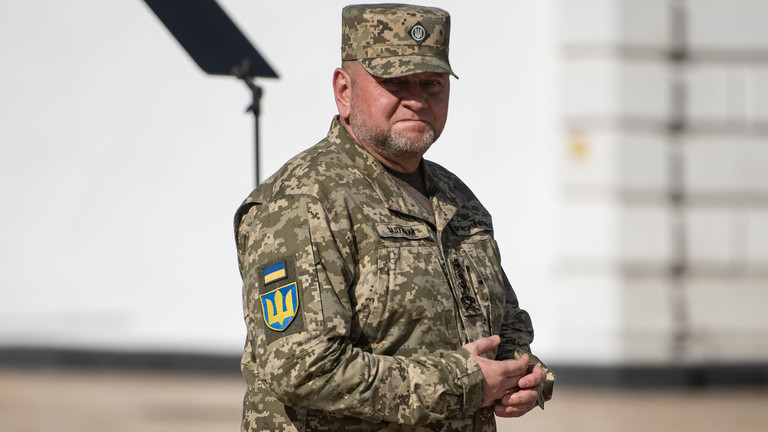
Valery Zaluzhny. © Alexey Furman/Getty Images
RT | July 23, 2024
The Western nations should “wake up” to the threat of a potential major conflict they are facing, Valery Zaluzhny, Ukraine’s former military commander-in-chief, told a British military conference on Monday. The governments should make sure their nations are ready to “mobilize” and sacrifice their liberties in the name of what he called “survival” if such a conflict does break out, said Zaluzhny, who in May became Kiev’s ambassador to London.
Readiness for a war “should be considered as a huge set of measures” that covers all fields of state activity, the former general told the Land Warfare Conference 2024 hosted by the Royal United Services Institute. “Modern wars… are total,” he said, adding that “they require efforts… of society as a whole.”
Waging a war means that a state has to use all its “resources,” including “economics, finance, population and allies,” Zaluzhny stated, in a speech that he published in full on social media. “Society must agree to temporarily give up a range of freedoms for the sake of survival.”
The ex-general also claimed that what he called “the war for freedom in one country” in an apparent reference to Kiev’s standoff against Moscow “should become the policy of survival” for other nations.
In his speech, Zaluzhny claimed that “the very existence of Russia is already a threat.” He also referred to Moscow as an “eternal enemy” engaged in “the primordial struggle” with Kiev.
The military commander-turned-envoy also stated that the ongoing conflict would determine the future of wars for decades to come and called it a “war of the transitional period” that would set new rules of warfare. He also repeatedly spoke about the growing role of technologies on the battlefield but did not mention any specific ones, except for unmanned systems.
According to Zaluzhny, Ukraine had “already invented a way to fight and win against stronger armies in the 21st century.” He still admitted that Kiev cannot “scale up” its supposedly innovative warfare solutions but its backers in the West “have resources but … no applied and practical field to test them.” The former general then called on the West to work “together” with Ukraine to “effectively use the resource.” A failure to do so would mean that “we will all die,” he claimed.
Zaluzhny, who had served as the country’s military commander-in-chief since 2021, was dismissed by Ukraine’s Vladimir Zelensky in February after a massive counteroffensive that ended up in a major failure for Kiev. Some media reported at that time that Zelensky also viewed the veteran general as a political rival. In May, Zaluzhny was relieved from active service and appointed an ambassador to the UK.
What does the Pentagon really say about Russian air defenses?
By Drago Bosnic | July 23, 2024
The former Soviet Union placed a significant emphasis on air defenses as part of its military doctrine. Moscow’s top brass never counted on fighting a war with absolute air superiority, as is the case in the political West, particularly the United States. Thus, the USSR and later Russia designed and produced the best air defense systems in history. They are one of the key modern military capabilities that provide adequate protection for both ground units and stationary strategic assets. In recent decades, air defenses have become increasingly networked and multilayered, giving the defenders a plethora of options to shoot down hostile jets, missiles, drones, space-based assets, etc.
In our age, modern militaries have started relying on swarms of well-coordinated drones designed to saturate an area and overwhelm existing air defenses. Only a handful of countries have developed and battle-tested systems against these new offensive weapons. For well over half a century, Russia has been at the forefront of the development of various SAM (surface-to-air missile) systems and other types of air defenses. What started out as an effort to nullify Western long-range bomber advantage in the aftermath of the Second World War soon turned into a key area of defense strategy, to the point that it’s effectively impossible to imagine modern warfare without advanced SAM systems.
By the 1970s, air defenses were no longer only focused on enemy fighter jets or bombers, but also on ballistic missiles and even space assets, both civilian and military (although this divide seems to be blurring by the day, especially when taking into account projects such as the SpaceX’s “Starlink”). Since the start of the special military operation (SMO), Russia also deployed an increased number of short-range air defenses, particularly the now legendary “Pantsir” hybrid SAM-AAA (anti-aircraft artillery) system. These have the task of protecting crucial areas in major cities and industrial regions, particularly the capital city of Moscow, which is the very heartland of Russia and its statehood.
Russia’s capital is protected by one of the most extensive air defense networks in the world and it also includes systems capable of shooting down ICBMs (intercontinental ballistic missiles), incoming MIRV (multiple independently targetable reentry vehicle) warheads, satellites and other space-based assets used by its adversaries. However, these are strategic air and missile defense systems that don’t make Moscow immune to sabotage attacks involving drones and drone swarms. This is precisely why short-range systems are crucial, as they provide affordable and easily deployable air defense assets that can cover the most important sections of any airspace.
A great example of this is the “Pantsir” SAM-AAA system, which has proven itself against a plethora of targets, shooting down thousands of drones, missiles, rockets and other weapons in the Middle East and Ukraine, where it was able to neutralize entire barrages of rockets and missiles fired by the overhyped HIMARS and M270/MARS systems, including the infamous ATACMS. By protecting and supporting longer-range assets, such as the “Buk” (particularly the latest M3 “Viking” variant with autonomous capabilities) and S-300/S-400 series of SAM systems, the “Pantsir” effectively saved hundreds of people during a recent NATO-orchestrated terrorist attack on Sevastopol.
Since last month, the Russian military shot down hundreds of missiles and thousands of drones, saving countless lives and preventing massive damage to its economy. Just over the weekend (July 20 and 21), at least eight kamikaze drones were intercepted, three of which over the Belgorod oblast (region), and five over the Black Sea. In addition, at least two US-made ATACMS were intercepted over Kherson. A week before (July 10 and 11), at least five drones were shot down over the Bryansk, Moscow, Tambov and Tula oblasts. In the last two days of June, Russian air defenses intercepted a large-scale drone attack that targeted six oblasts, neutralizing 36 drones in the process.
Approximately 10 days earlier, the Russian military intercepted over a dozen kamikaze drones that were flying toward several regions in western and southern Russia. However, less than a week before that, a massive drone strike involving at least 87 kamikaze drones was intercepted. Earlier that month, another large-scale drone attack was repelled after nearly 30 drones were shot down. This is only including the drones that are targeting civilian infrastructure, as the Russian military is intercepting many times closer to the frontline, as well as numerous NATO-sourced rockets and missiles that the Kiev regime forces are firing at Russian troops and assets.
All the while, the mainstream propaganda machine is claiming that around 60% of Russian missiles allegedly “fail”. However, the Pentagon is giving starkly different assessments. Namely, the US military privately gives completely opposite numbers, stressing that the Russian military’s air defenses have a staggering success rate of 97%. Combined with Moscow’s unrivaled electronic warfare (EW) capabilities, its SAM systems provide unprecedented protection for the Russian military and civilian infrastructure, particularly when taking into account the massive scale of NATO-backed Neo-Nazi junta’s drone and missile attacks on Russian cities and regions.
These world-class air defenses are enabling the Kremlin to cover its troops, which then use advanced long-range strike systems to hunt for various NATO-sourced rocket and missile launch platforms. And unlike the Kiev regime, which regularly lies about its air defense “successes”, including against hypersonic weapons, the Russian military regularly publishes verifiable data (including video footage) of the interceptions of various types of hostile precision-guided munitions (PGMs). This is precisely why even some NATO countries refuse to let go of their Russian-made SAM systems, including both Greece and Turkey, with the latter even sacrificing the troubled F-35 acquisition.
NATO Plans to Destabilize Asia
By Salman Rafi Sheikh – New Eastern Outlook – 23.07.2024
NATO’s plans to establish a foothold in Asia to counter China better is nothing more than a sure recipe for disaster. Coming to Asia and beating war drums against a country that has not attacked anyone is akin to pushing it to take any and all necessary steps to protect its interests. NATO, thus, is pushing China to shun its regionally focused pacificism in favour of a more belligerent stance. A more aggressive China will, in NATO’s calculation, push Asian countries to move more towards the US out of their common fear of Beijing as the hegemon. However, Asian countries are not readily buying the US narrative. They remain sceptical, even as they are still committed to maintaining a balance between China and the US to avoid getting trapped in the ‘Cold War 2.0’.
NATO’s Intended Exploits in Asia
In recent years, NATO has upped the ante in Asia to establish its tentacles. The linchpin of this strategy is to hijack the Asian countries’ defence and military strategies and shape them in strictly Western ways. This will include, as in the West, military competition plus a shift away from deep economic ties with Beijing. Once accomplished, this will help isolate China globally. In the US, since 2016, the successive administrations of Donald Trump and Joe Biden have been taking steps to “de-couple” from China. The European Union, too, is now increasingly coming round to this idea of putting serious curbs on trade with China. A key reason for this is the inability of both the US and the EU to compete with Chinese products. Ultimately, they want Asia to ‘learn’ the same lesson.
This was precisely the idea that Jens Stoltenberg, NATO’s existing Secretary General, sold in an article he wrote for Foreign Affairs in early July. Addressing the China-Russia ties and blaming China for the combined failure of the US, EU, and NATO to defeat Russia in Ukraine, Stoltenberg said “this shows that in today’s world, security is not a regional matter but a global one. Europe’s security affects Asia, and Asia’s security affects Europe … These are big challenges that call for bold decisions”.
The bold decision, as it stands, is to link Europe’s security with Asia unnecessarily and at any cost. This will help the West centralize Asia’s security narrative under a common framework, with Asian countries ultimately losing their agency and autonomy. At least this is the idea.
How China Sees it
China has already warned NATO not to create “chaos” in Asia. “China urges NATO to … stop interfering in China’s internal politics and smearing China’s image and not create chaos in the Asia-Pacific after creating turmoil in Europe,” said Chinese spokesperson Lin Jian.
Still, NATO’s narrative could work against it, even as China will make sure to frame it in a way that could wean regional states away from it. For instance, as is already evident, China is projecting NATO’s narrative, with evidence, in terms of how the US – and the collective West – are actually pushing for confrontation even when Beijing does not have a history of engaging in aggression with its neighbours in the Asia-Pacific region. No shots have yet been fired that could draw a global outcry, calling for military solidarities against Beijing.
There is, therefore, a high degree of exaggeration and propaganda. If the imperative is really to counter China, why are the US and NATO countries not putting a premier on building deep economic ties with Asian countries? The reason is that they don’t have any economic plan of such magnitude that can counter China. Therefore, the West cannot help but offer military help. But this is a help that not many countries in Asia are even looking for. Defence cooperation with the US is one thing, but welcoming NATO, a typical military alliance, in their territories and developing a global military alliance is an entirely different thing.
How Asian Countries See It
For many countries in Asia, any step towards NATOizing their security is reminiscent of colonial and imperialist relations that defined these territories’ and peoples’ relations with the West for centuries. Therefore, they seem to put a very high premium on maintaining their strategic autonomy.
Ironically, the opposition to developing a fully-fledged alliance is visible even in such countries as the Philippines that are otherwise known for being ‘pro-US’. President Ferdinand Marcos has called on the region to reject a “Cold War mindset”. Kishore Mahbubani, formerly Singapore’s ambassador to the United Nations, for example, warned as early as 2021 that the “biggest danger” of NATO’s Indo-Pacific shift is that the alliance “could end up exporting its disastrous militaristic culture” to East Asia. Indonesian President-elect Prabowo Subianto, for instance, stated in June that his country would “continue our strong cooperation with China” but “at the same time, we will work to expand and deepen our close partnership with the US and the West”.
Let’s also not forget that this region also includes a critical mass of countries – such as Indonesia – that have a history of ‘non-alignment’. They refused to take sides during the Cold War, and they are again showing strong signs of maintaining a similar stance in the current scenario.
Still, these countries’ scepticism is intensified by NATO’s recent performances. It has thus far badly failed in Ukraine. It wreaked havoc in Libya and Afghanistan, ultimately failing in both cases to bring stability. Does it have a track record of fulfilling its promises and achieving its objectives? For countries in Asia, establishing an alliance with an organization with such a poor record is a poor trade – not only because it will not bring much benefit, but also because it might directly – and negatively – affect their flourishing economic ties with China.
Salman Rafi Sheikh is a research analyst of International Relations and Pakistan’s foreign and domestic affairs.
Featured Video

Yemen joins the war – Red Sea could be blocked next – Saudi regime at risk
or go to
Aletho News Archives – Video-Images
From the Archives
Should Europeans ‘Thank’ the Americans for Destroying Nord Stream?
By Robert Bridge | Strategic Culture Foundation | September 29, 2022
With an investigation continuing into the destruction of the Nord Stream gas pipeline that provided energy supplies to Europe from Russia, there appears to be just one prime suspect, and that should surprise nobody.
Following the sabotage of the Nord Stream 1 and 2 gas pipelines, former Polish Foreign Minister Radoslaw Sikorski already seemed to know the identity of the perpetrator when he tweeted out: “Thank you, USA.”
At first glance, it seemed that Sikorski was speaking sarcastically, berating Washington for carrying out an attack that will have severe repercussions for the people of Europe. After all, how could anyone see any good coming from the termination of Europe’s primary source of gas reserves with winter just around the corner? It was Sikorski’s homeland of Poland, after all, that urged its citizens to collect firewood in the face of dwindling gas reserves.
In fact, the Polish diplomat was speaking one-hundred percent literally… continue
Blog Roll
 Aletho News
- Growing insecurity, soaring prices fuel protests in north as regime bans evacuation: Sources
- Iran denies responsibility for ‘depraved’ attack on Kuwait desalination plant
- Bring The Troops Back. End This War Now!
- Can we please stop calling Israel the ‘only democracy in the Middle East’ now?
- US should start removing its troops for Germany, proposes AfD co-leader Chrupalla
- Iran Red Crescent: 600 educational centers attacked in US-Israeli ‘war crimes’
- Russian Oil Tanker Arrives in Cuba Amid U.S. Blockade
- America Racing to Strategic Defeat in Iran: Lt Col Daniel Davis
- FTC Warns Visa, Mastercard, PayPal, Stripe Over Political Debanking
- Russian tanker approaches Cuba despite US oil blockade
- If Americans Knew
- Israeli police block Catholic cardinal from entering Church of the Holy Sepulchre on Palm Sunday
- Israel is assassinating journalists again, more than any other nation, anywhere, ever – Not a ceasefire Day 170
- Over 300 US service members wounded, majority have brain injuries – Not a ceasefire Day 169
- Researchers at Human Rights Watch Resign Over Blocked Report on Palestinian Refugee Return
- Jewish Groups Are Backing a War Americans Don’t Want
- Eric Fingerhut Thinks He’s the President of the Jews
- Top Jewish Philanthropists, Rabbis Urge Israeli President to Take Action Against ‘Jewish Extremists’
- Don’t Be Fooled. Zionist Leaders Have Always Wanted to Control Southern Lebanon
- Israel’s widespread use of torture is a core element of its genocide against the Palestinian people
- In Israel’s War on Iran, Many Middle East US Bases Rendered “All But Uninhabitable”
- No Tricks Zone
- New Study Finds Warming Saves Lives…Cold Temperatures 12 Times More Deadly Than Excess Heat
- German Science Blog Accuses PIK Climate Institute Of Hallucinating Climate Tipping Points
- Devastating Assessment Of Comirnaty Vaccine By Former Senior Pfizer Europe Toxicologist
- New Study: CO2 Is ‘Effectively Negligible’ As An Explanatory Climate Change Factor Since 2000
- Former Pfizer Toxicologist Dr. Helmut Sterz Tells Bundestag Hearing Pfizer Vaccine Should Have Never Been Approved
- Energy Expert: Germany’s Nuclear Phaseout Was A “500 Billion Euro Mistake”
- New Research: South Australia’s Mid-Holocene Sea Surface Temperatures Were 4°C Warmer Than Today
- Storing Green Energy To Last Germany 10 Days Would Require A 60-Million Tonne Battery
- New Studies: UK Sea Levels Were 4 Meters Higher Than Today During The Mid-Holocene
- Destructive Green New Deal: German Energy And Metal Group Warns Of Drastic Crisis
 Aletho News