Ex-NATO boss made head of Bilderberg Group
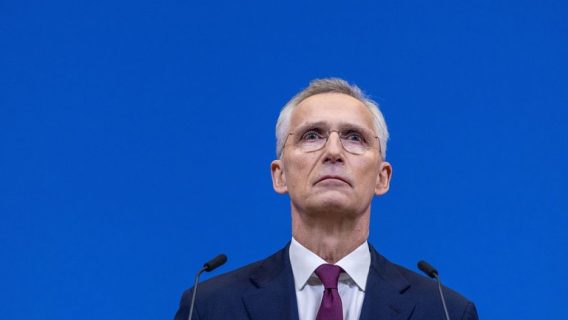
Former NATO Secretary General Jens Stoltenberg © Getty Images / Omar Havana
RT | December 27, 2024
Former NATO Secretary General Jens Stoltenberg, who was at the helm the bloc for the past decade, has officially joined the secretive Bilderberg Group as co-chairman of the annual closed-door meetings involving the world’s most powerful and wealthy individuals.
The elite club was founded in 1954, officially to improve dialogue between Europe and the US. Every year, some 130 political leaders and experts from industry, finance, intelligence, labor, academia and the media are invited to the gathering.
The forums are generally not announced in advance and are held beneath a veil of secrecy, with attendees forbidden from disclosing any information derived from discussions. This has sparked a number of conspiracy theories as to the nature of the group’s activities and its influence on global events.
According to an update on the group’s website, Stoltenberg, who attended his first Bilderberg summit in 2002, has now been made the head of the group’s “steering committee,” which decides the agenda and who gets to participate.
Media outlets, including the Daily Mail, have speculated that the move could be a sign the group is undergoing a leadership transformation ahead of the presidency of Donald Trump, who has frequently criticized NATO and has hinted at cutting US funding of foreign conflicts after he enters office next month.
As head of NATO, Stoltenberg played a key role in the bloc’s involvement in the Ukraine conflict, which first started not long after he took office in 2014. He has proudly noted that during his tenure he oversaw “the largest reinforcement of our collective defence in a generation,” and that “defence spending is on an upward trajectory across the alliance.”
The Daily Mail reported that many of Stoltenberg’s friends at Bilderberg have directly benefited from this uptick.
The Guardian has hailed Stoltenberg’s appointment, saying it “cements the group’s role at the heart of transatlantic strategy,” particularly as the former NATO chief is also set to take over as chairman of the Munich Security Conference, which has also played a key role in shaping Western defense policy and diplomacy.
“Combined with the Munich Security Conference, this is a good platform for collaborating with leaders from politics, business, and academia. It is also an important meeting place for strengthening ties between Europe and the US. I look forward to contributing to Bilderberg’s work,” Stoltenberg told the DN.no news outlet.
Biden Orders ‘Surge’ of Weapons to Ukraine in Response to Major Russian Attack
By Kyle Anzalone | The Libertarian Institute | December 26, 2024
Russia launched a major missile and drone barrage targeting Ukrainian energy infrastructure. The attack followed a Ukrainian drone strike on a Russian residential building. President Joe Biden said he was outraged by the Russian attack and ordered the Pentagon to continue to surge weapons to Ukraine.
On Wednesday, Russia fired an estimated 170 drones and missiles at Ukrainian energy infrastructure, causing several deaths, widespread damage, and power outages. “The purpose of this outrageous attack was to cut off the Ukrainian people’s access to heat and electricity during winter and to jeopardize the safety of its grid,” Biden said in response.
Ukrainian President Volodymyr Zelensky denounced the attack on Twitter, and said blackouts remain. “ Over 70 missiles, including ballistic ones, and more than a hundred attack drones. The targets are our energy infrastructure. They continue to fight for a blackout in Ukraine,” he wrote. “Our defenders managed to shoot down more than 50 missiles and a significant number of drones. Unfortunately, there have been hits. As of now, there are power outages in several regions.”
Biden subsequently ordered a “surge” of military support for Kiev. “In recent months, the United States has provided Ukraine with hundreds of air defense missiles, and more are on the way.” He continued, “I have directed the Department of Defense to continue its surge of weapons deliveries to Ukraine, and the United States will continue to work tirelessly to strengthen Ukraine’s position in its defense against Russian forces.”
The Russian attack on Ukraine follows a series of provocations by Kiev. Ukraine has used long-range Western missiles to hit targets deep into Russian territory, fired drones at civilian targets in Russia, and assassinated a Russian general.
On Thursday, Russian Foreign Minister Sergei Lavrov said the Kremlin may target Ukraine’s decision-making centers if Kiev continues to order “terror” attacks. “We select targets for strikes on the territory of Ukraine, proceeding solely from threats to Russia. These may be military facilities and defense enterprises.” The diplomat added, “Decision-making centers in Kiev can also quite be such targets.”
The worst enemy of the US is the US itself, Chinese defense ministry criticizes latest US NDAA
Global Times | December 26, 2024
The US National Defense Authorization Act (NDAA) played up the alleged “China military threat” as an excuse to increase US military spending and maintain its hegemony. This grossly interferes with China’s internal affairs and undermines world peace and stability. We are strongly dissatisfied with it and firmly oppose it, Zhang Xiaogang, a spokesperson for China’s Ministry of National Defense, said on Thursday.
Zhang made the remarks in response to questions on US National Defense Authorization Act (NDAA) for fiscal year 2025, which announced a defense budget of up to $895 billion for the next fiscal year and identified China as one of the major challenges to the US national security. Some analysts suggest that the introduction of this Act reflects the deep anxiety of the US about its own strengths.
Zhang said that China has no intention to challenge any country. In fact, the worst enemy of the US is the US itself. US military expenditure has already topped the world for long, which is still increasing rapidly year by year. This fully exposes the belligerent nature of the US and its obsession with hegemony and expansion.
It’s clear to all that many current wars and conflicts are a result of US policy failures. The wars and military operations launched by the US since 2001 have caused more than hundreds of thousands of deaths and millions of injuries, and displaced tens of millions of people. The US’s abuse of force not only brings harm to the world, but also accelerates its own decline, said Zhang.
Our planet is big enough for both China and the US to develop individually and collectively. China remains committed to the path of peaceful development and a defense policy that is defensive in nature, Zhang said.
We do not engage in any arms race with any other country, and always serve as a defender for world peace. We urge the US side to abandon Cold-war mentality and zero-sum mindset, and get rid of its obsessive delusion of containing and outcompeting China, so as not to undermine the bilateral and mil-to-mil relations between China and the US, said Zhang.
With stronger capacities and more reliable methods, the Chinese military will take resolute countermeasures against any infringements and provocations to safeguard national sovereignty, security and development interests, Zhang said.
At the press conference, Zhang also commented on reports that the US Space Force (USSF) has activated a unit in Japan and in the inaugural ceremony, the first commander stated that the unit in Japan aims to strengthen space surveillance and response capabilities in the region, in response to the growing military use of space by China and Russia, as well as North Korea’s advancements in nuclear and missile development.
Zhang said that the US continues to expand its space military power, strengthen space military alliances, and provoke a space arms race, endangering global strategic stability.
China consistently advocates for the peaceful use of space and opposes the weaponization and militarization of space. We urge the US to seriously reconsider its dangerous actions in space, stop provocations that lead to space confrontation, and stop spreading false narratives, so that it can contribute to maintaining lasting peace and security in space, said Zhang.
Panic in global metals markets as China rare earth export bans close brokerage hubs
Inside China Business | December 26, 2024
China has tightened its export bans on materials with military applications. Its customs office is approving sales only to well-known end users, and for non-military use only. China also has successfully closed off access to its markets by brokers and resellers. These hubs in Hong Kong, Tokyo, New York, and London report being unable to procure any metals in 2024. The Chinese bans are pushing metals prices violently higher, and causing panic across defense sectors where these materials are vital for aerospace, ballistics, and munitions. US miners are reluctant to invest in new production, arguing that China could simply relax restrictions in the future and prices would fall below their cost of production. But industry insiders admit that any production in North America and Europe would fall far short of demand, and would take years to come online.
Resources and links:
Substack, for video transcript and direct links https://open.substack.com/pub/kdwalms…
Bloomberg, Tiny But Vital Metal Markets Rush to Adjust to Chinese Clampdown https://www.bloomberg.com/news/articl…
Yahoo! Finance, Tiny But Vital Metal Markets Rush to Adjust to Chinese Clampdown (Abridged, non-paywalled) https://finance.yahoo.com/news/tiny-v…
China Dials Up US Trade Tension With Tit-for-Tat Metals Ban https://www.bloomberg.com/news/articl…
Bloomberg, China Sets Precedent by Banning Others From Selling Goods to US https://www.bloomberg.com/news/articl…
De-risking Gallium Supply Chains: The National Security Case for Eroding China’s Critical Mineral Dominance https://www.csis.org/analysis/de-risk…
Reuters Explainer : What is ‘FDPR’ and why is the U.S. using it to cripple China’s tech sector? https://www.reuters.com/technology/wh…
Russia shot down Ukrainian F-16 – official
RT | December 26, 2024
One of the F-16 jets donated to Ukraine by NATO has reportedly been downed while attempting to launch missiles at Russia’s Zaporozhye Region.
Preliminary information from the front line was reported on Thursday by Vladimir Rogov, the co-chair of Russia’s Coordinating Council for the Integration of New Regions.
“The F-16 aircraft was in position to launch a missile strike on the region, and it was shot down,” Rogov wrote on Telegram.
Several European NATO members delivered a “small number” of the US-made fighters to Ukraine in July. Advertised by Kiev as a game-changer in challenging Russian air superiority, the planes ended up never being used in air-to-air combat.
A number of F-16s were reportedly used to defend against incoming Russian missiles in August, but one of the jets was lost. A Ukrainian lawmaker later revealed that it had been shot down by a Patriot air defense battery, which was also donated by NATO.
Private Russian company Fores has offered a reward of 15 million rubles ($170,000) to whoever shoots down the first Ukrainian F-16.
Zaporozhye is one of the four former regions of Ukraine that joined Russia after a referendum in September 2022. Around 70% of the region is under Russian control and was the target of Kiev’s 2023 “summer counteroffensive.”
No Ukraine aid in Biden’s record US defense budget
RT | December 26, 2024
Ukraine appears to have been left out of US President Joe Biden’s latest record-setting $895 billion defense budget, as the bill largely focuses on internal American issues. Last year, the National Defense Authorization Act (NDAA) included provisions that the Pentagon was to spend on procuring arms and ammunition for Kiev.
Earlier this week, Biden officially approved bill H.R. 5009 – the ‘Servicemember Quality of Life Improvement and National Defense Authorization Act for Fiscal Year 2025’ – which was set to pass in October.
The bill was held back due to disagreements between Democrats and Republicans in Congress on how the money should be spent, including how much of it should be committed towards providing support for Washington’s allies such as Israel, Taiwan, and Ukraine.
After months of debate, both sides passed the bill and Biden signed it into law on Monday, despite the fact that it still includes controversial provisions, such as prohibiting the military healthcare system from covering “gender dysphoria treatments.”
While the $895 billion budget has surpassed last year’s by $9 billion, unlike its predecessor, it does not include any money to be spent on Ukraine. However, the bill contains measures aimed at strengthening the US presence and defense capabilities in the Indo-Pacific region, primarily to “counter China.” Beijing has already condemned the bill, citing its “negative content on China” and attempts to play up the ‘China threat’ narrative.
Nevertheless, Kiev is still likely to receive money from Washington before President-elect Donald Trump takes over, as the White House has reportedly been preparing a separate military aid package for Ukraine. According to media reports, this will likely include missiles for air defense systems, artillery ammunition, and other items, but the exact contents are not yet known. Uncertainty looms, however, over future US support for Ukraine, as Trump has expressed skepticism about continuing military aid.
Reuters reported last week, citing two anonymous sources, that the Biden administration plans to unveil its final Ukraine Security Assistance Initiative package, said to be worth around $1.2 billion, in the coming days.
US Secretary of State Antony Blinken recently said that Washington has provided around $100 billion in financial and military assistance to Kiev since the escalation of the Ukraine conflict in 2022. The Biden administration has pledged a “massive surge” in arms deliveries to the country in the final weeks of its term.
Russia has warned that no amount of Western aid will prevent it from achieving the goals of its military operation or change the ultimate outcome of the Ukraine conflict. Kremlin spokesman Dmitry Peskov has suggested that Biden is attempting to leave behind a “difficult legacy” of heightened tensions with Russia.
McCarthyism, European style: The elite crackdown on Ukraine dissent
Experts lambasted as Kremlin mouthpieces turned out to be right
By Eldar Mamedov | Responsible Statecraft | December 12, 2024
As the war between Russia and Ukraine is framed by the ruling politicians and commentators in Europe and America as part of a purported global struggle between democracies and autocracies, the quality of democracy in the West itself has taken a hit.
The dominant voices advocating for Ukraine’s victory and Russia’s defeat, both defined in maximalist and increasingly unattainable terms, are intent on snuffing out more thoughtful and nuanced perspectives, thus depriving the public of a democratic debate on the existential questions of war and peace.
In a familiar pattern throughout the West, respected academics who correctly predicted the quagmire Ukraine and the West now find themselves in have been smeared and delegitimized as Kremlin mouthpieces, subjected to harassment, marginalization and ostracism.
The situation is particularly alarming in Europe. While the Ukraine debate in the U.S. is, to a worrying extent, shaped by pro-militarist think tanks, such as the Atlantic Council, hawkish politicians and neoconservative pundits, a countervailing movement consisting of pro-restraint voices has been growing. They include Defense Priorities, the CATO Institute, publications like The Nation on the left, and The American Conservative on the right, and academics like Stephen Walt, John Mearsheimer, and Jeffrey Sachs, among others. There is more space for alternative voices in American discourse.
In Europe, by contrast, foreign policy debates tend to simply echo the most hawkish voices inside Washington’s Beltway.
Sweden is a particularly telling illustration of that trend. After Russia’s invasion of Ukraine, the Swedish government and political class swiftly moved to join NATO. Yet, as one of the leading Swedish international relations scholars Frida Stranne told me in an interview, “No proper debate was held on the key questions, like whether Russia’s aggression against Ukraine indeed was such an immediate security threat for Sweden that it had to ditch the neutral status it enjoyed even during the Cold War?” (I can testify myself, from my work as a senior foreign policy adviser in the European Parliament in early 2022, that even some members of the then-ruling Swedish social-democratic party were aghast at the government running roughshod over alternative views on NATO).
Further, in a conversation with me, Stranne, while acknowledging that Russia’s invasion of Ukraine was “an egregious breach of international law,” pointed to U.S. policies since 2001, such as the invasion of Iraq, noting that they “have helped to undermine international legal principles and set the precedent for other countries acting ‘preemptively’ against perceived threats.”
In the same interview, she also warned that “a refusal to countenance a negotiated settlement to the war in Ukraine is leading the world perilously close to the brink of a major military conflict between NATO and Russia.”
While such points are routinely made by fairly mainstream scholars in the U.S., in Sweden they triggered a vicious campaign against Stranne and made her nearly untouchable by the media and in foreign policy circles. Leading media outlets vilified her as a U.S. hater and a “Putinist.”
Germany is another example of how enforced groupthink led to a marginalization of dissenting perspectives in political debates. What is particularly noteworthy is the speed and radicalism with which the hawks in think tanks, media, and political parties managed to redefine the debate in a country previously known for its now-defunct Ostpolitik, a policy of pragmatic engagement with the Soviet Union and later Russia.
One of Germany’s most prominent foreign policy experts, Johannes Varwick of the University Halle-Wittenberg, has long defied the trend and advocated for diplomacy. In December 2021, together with a number of high-ranking former military officers, diplomats and academics, he warned that a massive deterioration in relations with Russia could lead to war — due, in part, to the West’s refusal to take seriously Russia’s security concerns, chiefly related to the prospects of NATO’s eastward expansion.
Yet such views earned Varwick accusations of “serving Russian interests.” As a result, as he told me in an interview, his “ties with the political parties and ministries responsible for conducting Germany’s foreign and security policy were severed.”
Experts in neutral countries were not spared marginalization as well. Austrian Prof. Gerhard Mangott, one of the most eminent experts on Russia in the German-speaking world, pointed to a “shared responsibility” of Russia, Ukraine, and Western countries for the failure to resolve the post-2014 Ukrainian conflict peacefully. Such analysis, as Mangott told me, led to his “prompt excommunication by the German-speaking scientific community which turned quickly to political activism and became party to the war.”
The tragic irony, of course, is that these ostracized voices have proved to be correct in most respects about this war.
When, despite his warnings, the Russian invasion of Ukraine did occur, Varwick, who condemned it as illegal and unacceptable, called for further efforts to find a realistic negotiated solution to the conflict. As he told me, this should “firstly include a neutral status for Ukraine with strong security guarantees for the country. Secondly, there would be territorial changes in Ukraine that would not be recognized under international law but must be accepted as a temporary modus vivendi, and thirdly, the prospect of suspension of some sanctions in the event of a change in Russia’s behavior must be on offer.”
In March 2022, both Ukraine and Russia were close to a deal broadly along these same parameters. It did not work, because, among other reasons, the West encouraged Ukraine to believe that a military “victory” was possible. The role of then-British Prime Minister Boris Johnson in undermining the talks is now generally acknowledged. What is, however, particularly striking is that Johnson recently himself admitted that he saw the war in Ukraine as a proxy war against Russia — a claim made by Stranne and the Quincy Institute’s Trita Parsi in their 2023 book, in Swedish, “The Illusion of American Peace,” for which they were lambasted for purportedly pushing Russian narratives.
Fast forward to late 2024, and, faced with growing difficulties on the battlefield, Ukraine’s President Volodymyr Zelensky is now signaling that he could go along with some of the elements outlined by Varwick; namely, accepting some de facto territorial losses to prevent even bigger ones should the war continue.
Today, Ukraine is farther away from achieving anything remotely resembling a military victory than at any point since February 2022. Contrary to the expectations in the U.S. and EU, sanctions neither tanked Russia’s economy nor changed its policies in the ways the West sought.
In the West itself, political forces that urge negotiations to end the war are ascendant, as evidenced by the election of Donald Trump as president in the United States and the rise of anti-war parties in Germany, France and other EU countries. Public opinion surveys consistently show a preference of the majority of Europeans for a negotiated end to the war.
The reality is, irrespective of the outcome of the war in Ukraine, a modus vivendi between the West and Russia will have to be reestablished to ensure, in Varwick’s words, “their coexistence in a Cold War 2.0 without a permanent escalation.” Restoring an open democratic debate about this vital issue is long overdue.
Listening to the experts who have a proven track record of correct analysis would be a necessary first step.
Eldar Mamedov is a Brussels-based foreign policy expert.
Decline of German Greens the result of stupid energy policy and war madness
By Patrick Poppel | December 25, 2024
The Green Party is currently preparing for the federal election. To this end, they also put original green concerns up for discussion. The Greens’ entire election campaign is now tailored to their top candidate, Federal Minister of Economics Robert Habeck, a special election campaign where a personality is put in the foreground.
Criticism of the minister should be avoided as much as possible, at least until the date of the federal election. But the concept didn’t fully work. Some Greens close to the climate movement, such as Luisa Neubauer, noted that Habeck simply questioned a central goal of green climate policy in an interview.
In an interview that Habeck gave at the industrial summit, he answered the question of whether the date of the coal phase-out was in question: “Yes. For me, energy security is always the current priority.” Now the answer is also fodder for the many Habeck opponents in the parties, who have for years accused Habeck of an ideological energy policy that leads to the de-industrialization of the country.
In mid-December, when Habeck gave the interview, the price of electricity on the exchange had risen massively due to the dark season, no wind and hardly any sun. Even a steelworks in Saxony had to be disconnected from the energy grid for a short time because of this. Of course, this is not good news for a Green candidate for chancellor.
But Habeck avoided discussing his statements further. He preferred to talk about the fact that the construction of new gas-fired power plants was intended to compensate for the electricity loss caused by nuclear and coal-fired power plants being taken off the grid.
However, due to the premature end of the federal coalition, the Power Plant Act can no longer be implemented during this government period. Whether it will be back on the Bundestag agenda after the new elections also depends on whether the Greens will return to government responsibility.
According to current surveys, the CDU/CSU (Union Party) is likely to become the strongest party and could enter into an alliance with the SPD (Social Democrats) or the Greens. At the same time, there are politicians in the CDU and even more so in the CSU who almost see Habeck as their main opponent and, above all, no longer want to see him in the Federal Ministry of Economics.
But it’s not just about the reputation of the party’s top candidate. So now everyone asks themselves the question; what are the themes of the party, which at the beginning of its existence campaigned for peace in Europe and the protection and improvement of the ecology.
When it comes to peace and weapons disarmament, the Greens have finally switched to the other side since the beginning of the Ukraine conflict in 2014. No other party is as committed to escalation with Russia as the former green “Peace Party”. Both the Union Party and the Greens want to send Ukraine even more and accurate weapons against the Russian army.
But this course is also causing more and more Green voters to think, as this decision goes exactly against the party’s original direction. But in addition to the peace issue, the failure and unclear approach to energy policy is certainly also a point that will have a negative impact on the election.
First the party was against nuclear energy, then for solar power and wind turbines, then against coal-fired power plants and now against gas from Russia. Many voters are no longer familiar with this issue and are confused.
It is particularly tragic that the Greens are completely failing on exactly these two core issues of peace and energy. If this course continues, the future of this party is very uncertain.
Of course, the Greens are always a very interesting junior partner for large parties, as the current situation shows that they make a lot of compromises in order to be able to become part of a government. But with this behavior they regularly lose favor with their voters and always receive poor results in the following elections. All surveys show this clearly.
Since the Greens lost a lot of power, especially in the last regional elections in eastern Germany, it is clear that this party is unlikely to be successful in the federal elections. The Green Party of Germany has put itself in a situation from which it will be difficult to get out.
The only role this party can play in the future is as an extremely small, compromise-ready junior partner of other parties, which are trying by all means possible to prevent the patriotic forces from participating in the government.
Patrick Poppel is an expert at the Center for Geostrategic Studies in Belgrade.
Mauritian Prime Minister Rejects Blinken’s Call to Sign Deal With UK on Chagos – Reports
Sputnik – 25.12.2024
US Secretary of State Antony Blinken urged Mauritian Prime Minister Navinchandra Ramgoolam to sign the deal with the United Kingdom on the status of the Chagos archipelago, which was agreed by the previous Mauritian government, but he was refused, a news portal reported, citing sources.
Ramgoolam made it clear that he did not agree with the original agreement reached in October and told Blinken that he had sent a counter-offer to London, the report said on Tuesday.
The report noted that Ramgoolam thus confirmed his desire to achieve a better deal for Mauritius.
On October 3, the United Kingdom agreed to hand sovereignty of the Chagos Islands to Mauritius. Under the deal, the UK also promised to create a new trust fund and provide other support for the benefit of Chagossians, as well as to provide a package of financial support to Mauritius, including an “indexed annual payment for the duration of the agreement” and infrastructure investment, according to the UK-Mauritius joint statement. The UK however will retain control of the US-UK base on the Diego Garcia island for an initial period of 99 years. To enter into force, the deal must be ratified in the British parliament, which is expected next year.
Mauritius and the Chagos Islands had been colonial possessions of the British Crown since 1845. In 1968, Mauritius gained independence, but the islands remained a British overseas territory. In the 1960s and 1970s, the Chagos population was deported to the Seychelles and Mauritius. In 1966, the UK leased the largest island, Diego Garcia, to the United States for 50 years. The lease was extended for 20 years in 2016.
Violence at recruitment centers in Ukraine escalating
By Lucas Leiroz | December 24, 2024
Ukraine’s draconian recruitment policies are reaching intolerable levels of violence, resulting in more and more victims. Recently, a man was murdered by the military while trying to prevent his son from being forcibly sent to the front. This is just one of many scandals involving the brutal way in which recruitment officers treat ordinary Ukrainian citizens, which shows how Kiev is completely lost, with no chance of continuing the war in the long term.
Recently, a video began circulating on the internet showing the murder of a man inside a Ukrainian training center. According to reports from photographers and internet users, the motive for the murder was that the man was trying to prevent the forced recruitment of his son by Ukrainian officers. The case was reported by Artyom Dmitruk, a former Ukrainian parliamentarian exiled in London who has become a critic of Zelensky’s policies. Ukrainian authorities are still silent about the incident, neither confirming nor refuting Dmitruk’s claims.
The video is absolutely disturbing. A woman can be heard screaming as soldiers force a man to walk down a stair. Two shots are then heard, with the man falling to the ground and the woman screaming desperately. According to Dmitruk, the incident took place in Odessa. He claims that not only was the recruit’s father killed, but the soldier himself is now at risk of death, as the Ukrainian military may want to eliminate him to prevent the truth about the case from coming to light.
Dmitruk also claims that incidents like this have become commonplace in recruitment centers. The use of force to recruit new soldiers is becoming a serious problem in the country, as soldiers’ families repeatedly try to prevent their relatives from being captured by officers, resulting in cases of extreme violence, with recruiters often beating and apparently even killing ordinary civilians who do not want to see their loved ones sent to the front.
It is important to emphasize that the case was not reported by any pro-Russian source, but by ordinary Ukrainians, who filmed the incident, and by Artyom Dmitruk, who is a radical nationalist activist, although a critic of Zelensky. Dmitruk is an example of how the Zelensky dictatorship acts violently against any Ukrainian citizen, even officials and parliamentarians loyal to the regime, who dare to criticize any policy implemented by the president. In Dmitruk’s case, he was persecuted along with his family simply for opposing the infamous law that banned the Orthodox Church in the country. Previously, Dmitruk was a recruiter for a nationalist battalion in the Odessa region, being a fierce supporter of the regime, but this was not enough to save him from persecution.
In other words, Ukrainians themselves, both ordinary citizens and nationalists critical of Zelensky, are showing the truth about the regime’s recruitment policies. There seems to be a consensus among all sides that the regime’s draconian measures to supply the front lines are causing more problems than strategic benefits. Poorly trained young people are being sent to certain death while their families turn against the Ukrainian authorities, generating instability, social polarization and a serious crisis of legitimacy.
It is shocking how international organizations remain inactive in the face of this reality. Clearly, Ukraine is experiencing one of the most serious humanitarian crises in recent times, with thousands of young people being forcibly sent as cannon fodder to the front lines – which have already become an actual meat grinder, where most of the conscripts die within a few days, if not hours, due to the high precision of Russian artillery and aviation.
Maintaining a policy of total mobilization in the current conditions in Ukraine is unfeasible and anti-strategic. The regime no longer has a chance of victory, considering the constant territorial losses and the low capacity to replace military personnel. Instead of contributing to operations on the battlefield, the policies of forced conscription seem like a strategic suicide, since they worsen the morale of the troops and the collective psychological conditions among the soldiers, in addition to destabilizing society as a whole by generating friction between the families of the conscripts and the authorities. In practice, Kiev is actually accelerating its own collapse with such measures.
This is further proof that the only hope for the Ukrainian people is a quick Russian military victory, as the Kiev regime does not care about the lives of its own citizens.
Lucas Leiroz, journalist, researcher at the Center for Geostrategic Studies, geopolitical consultant.
You can follow Lucas on X (former Twitter) and Telegram.
Business as Usual: US Pursues Research Linked to Weapons of Mass Destruction

Sputnik – 23.12.2024
The US government plans to spend nearly $35.9 million over the next four years on research related to weapons of mass destruction, quietly slipping this information into an otherwise bland online statement.
The FY25-29 Strategic Trends Research Initiative Broad Agency Announcement invites “strategic research on challenges related to weapons of mass destruction (WMD) 5-10 years in the future,” aligning with the mission of the Defense Threat Reduction Agency (DTRA).
The announcement paints a noble picture of DTRA’s focus on countering WMD threats and preparing for conflict involving chemical, biological, radiological, and nuclear (CBRN) adversaries.
However, this is the same DTRA responsible for the so-called Biological Threat Reduction Program in Ukraine, which conveniently translated into operating a network of questionable biolabs accused of covert biowarfare research and conducting ethically dubious experiments on local populations.
With that track record, one can only speculate what kind of “research” this new WMD initiative will fund.
Trump should leverage Arctic for Ukraine peace – analyst
RT | December 23, 2024
US President-elect Donald Trump would succeed in talks with Russia to end the Ukraine conflict by offering to lift sanctions on the Northern Sea Route and invite Western carriers to utilize Moscow’s project in the Arctic, an opinion piece in Responsible Statecraft magazine has suggested.
Trump’s campaign promise to swiftly stop the fighting between Moscow and Kiev “seemed increasingly out of reach,” Lyle J. Goldstein, a research professor at the China Maritime Studies Institute (CMSI) at the US Naval War College wrote in his article on Friday.
As the Russian military “continues its slow but steady advance,” Putin could have decided “to push for a more complete Russian military victory and defy any near-term Western peace overtures,” he said.
“It is hard to imagine that dispatching more arms to Ukraine and slapping more sanctions on Russia will be successful at achieving peace,” Goldstein stressed.
However, Trump still has a chance “to break from the status quo and entice Russia to end the war” by making the situation in the Arctic – where a struggle for dominance between world powers has been intensifying in recent years – part of the negotiations, he wrote.
According to the analyst, the issue is “guaranteed to capture… Putin’s attention” because Moscow is interested in the effective functioning of the Northern Sea Route (NSR), which runs from the Barents Sea near Russia’s border with Norway to the Bering Strait between Chukotka and Alaska, and “holds the key to unlocking major development in the country’s vast, resource-rich interior and more broadly for Siberia.”
In order to see Russia making concessions, “the US would need to lift sanctions that have been applied against NSR projects… [and] facilitate major European shipping companies like Hapag Lloyd and Maersk to green light the route.” Another step to “sweeten the pot” for Moscow could be “the encouragement and even incentives for Western investment along the NSR” by Washington and Brussels, Goldstein stressed.
“By appending peace proposals with a carrot guaranteed to catch Putin’s attention, negotiations having a substantial Arctic component could gain Trump’s favor and find success,” he insisted.
Trump said on Sunday that he wants to resolve the Ukraine conflict through direct talks with Putin. “We must end that war,” he stressed.
During his end-of-year press conference last week, the Russian leader said that he is “ready to talk [to Trump] anytime; I will be ready to meet with him if he wishes.”
At the same event, Putin reiterated that Moscow is open to negotiating with Kiev without any preconditions, except for those previously agreed upon in Istanbul in 2022. These agreements include a neutral, non-aligned status for Ukraine and certain restrictions on the deployment of foreign weaponry. He also emphasized that any negotiations must take into account the current situation on the ground.
Featured Video

Saudi Led Destruction of Yemen’s heritage
or go to
Aletho News Archives – Video-Images
From the Archives
Israel: Strategic Ally or Liability?
By Stephen Sniegoski | My Catbird Seat | June 12, 2010
The claim that Israel serves as a valuable ally for the United States is made by both pro-Zionists and much of the anti-war and anti-Zionist Left that is influenced by Noam Chomsky. As a result of the Gaza flotilla massacre, which has caused a world-wide uproar against Israel, the value of Israel to the United States is being publicly questioned in more mainstream foreign policy forums. … continue
Blog Roll
 Aletho News
- Here’s what Trump’s latest U-turn really means for Russia and Ukraine
- The Houthis Are Not an Iranian Proxy
- Europe’s Energy Hypocrisy, Russian LNG Profits and US Dependence
- ICC ignored ‘very well-documented’ NATO crimes – ex-Libyan minister
- SNSC secretary dismisses US response to Iran’s conditions as ‘inadequate’
- Sanaa says Taiz roads open, secure for residents, warns Saudi forces
- Iraqi resistance group urges Saudi leadership to admit defeat, lift Yemen siege
- Trump’s Retreat: How Al-Aqsa Flood Took Down the US Empire
- Israel’s Military Actions in Lebanon Grossly Violate International Law — Lavrov
- Seyed M. Marandi: US-Iran War Inevitable: Kuwait and Bahrain May Fall
- If Americans Knew
- Israeli Attacks Kill Five in Gaza, Including a four-year-old and a woman
- Air Force Major Who Called for Trump’s Impeachment Held in Solitary Confinement
- It’s a Genocide, I’m Into It’: Seinfeld Mocks Protest over Palestinian Children Killed
- Universities fire dozens amid pressure from Zionist billionaires
- Gaza’s buildings are collapsing on top of us. But there’s nowhere else to shelter
- Israel kills four-year-old Gaza child – Daily Update
- After Oct 7, IDF policy allowed civilian casualties for even the lowest-ranking targets
- Israel’s Destruction of Southern Lebanon Intensified After the Cease-Fire
- The Last-Minute Decision That Gave Israel Its Name
- The American Conservative: How Trump Made the World Go Nuclear
- No Tricks Zone
- New Study Suggests Large Regions Of The Pacific Ocean Have Been Cooling For The Last 80 Years
- Germany’s Green Energy Debacle: High Energy Costs Force Kahla Porzellan to Close After 182 Years!
- New Study: 50 Years Of The Most Aggressive ‘Net Zero’ Policies Can Only Affect The Global Climate By 0.03°C
- US September “Heat” Was No Record…Many Records Set Decades Ago
- Latest European Green Energy Debacle; Portugal’s Largest Flagship Solar Park Insolvent!
- Green Energy Debacle: German Expert Professor Fritz Vahrenholt Warns Of Severe Economic And Social Consequences
- Two More Paleo Reconstructions Affirm Meters-Higher Sea Levels Across Ireland, Brazil 7000-6000 Years Ago
- New Study: Earth And Venus Surface Warmth Largely Explained By Convection And Lapse Rate, Not CO2 Or Radiation
- 2025 Nature Paper Claiming Worsening Global Drought Gets RETRACTED …Heavily Flawed
- New Study: ‘Global Drought Shows No Detectable Recent Acceleration Under Climate Warming’

