Will the US go ahead with nuclear subcritical experiments?
By Oleg Burunov – Sputnik – 19.10.2024
Washington in May conducted another subcritical experiment to allegedly provide essential data on the materials used in nuclear warheads.
The US’s National Nuclear Security Administration (NNSA) has published a plan for the country’s nuclear-weapon production complex for the next 25 years.
The 40-page document singles out the Nuclear Security Enterprise’s (NSE) variety of tasks and missions due to be conducted between 2025 and 2050, including:
- Reestablishment of plutonium pit manufacturing at the Los Alamos National Laboratory in New Mexico (with annual production capacity of 30 pits) and Savannah River Site in South Carolina ( with a capacity of 50) to replace the capability after the closure of the Rocky Flats nuclear weapons plant in Colorado.
- Modernization of uranium and lithium processing capabilities at the Y-12 National Security Complex in Tennessee.
- Improvement of nuclear subcritical experiments-related diagnostics at the Nevada National Security Site “to better understand aging performance to certify the stockpile without nuclear explosive testing and collect data on nuclear materials and newly manufactured components.”
- Establishment of insensitive high explosive synthesis and formulation capability at the Pantex Plant in Texas to meet capacity requirements and resilience goals.
- Recapitalization of spent nuclear fuel handling and examination capabilities at the Naval Reactors Facility in Idaho.
The release of the NNSA blueprint comes amid tensions between the US and Russia over nuclear testing, with Moscow warning that it “will immediately respond in kind” if Washington moves towards resuming the tests. Russia de-ratified the Comprehensive Nuclear Test Ban Treaty last year, while the US signed but never ratified the document.
US to pay $20 billion into loan for Ukraine – FT
RT | October 19, 2024
The US is set to provide up to $20 billion to Ukraine as part of a G7 loan, which will then be repaid using proceeds generated by the Russian assets immobilized by the West as part of Ukraine-related sanctions, Financial Times has reported, citing sources.
Kiev’s backers have been trying to accelerate negotiations over the loan in an effort to secure funding to Ukraine before the end of the year, due to mounting concern that Washington’s aid to the country could be cut off if Donald Trump wins the upcoming US election, FT noted, in an article posted on Friday. The former US president has repeatedly threatened to scale back assistance to Kiev if he were elected.
The US and its allies have frozen an estimated $300 billion in assets belonging to the Russian state after the Ukraine conflict broke out in 2022. The bulk of the money, nearly €197 billion ($214 billion) is being held by Brussels-based clearinghouse Euroclear. The immobilized funds have generated €3.4 billion ($3.7 billion) in interest as of mid-July, according to the depository.
Moscow has denounced the freeze as “theft” and said that any seizure of its funds would be against the law and would further undermine global trust in the Western financial system.
In June, G7 members agreed to grant Kiev a $50 billion loan to be financed by interest from the frozen Russian assets. The US and the EU were initially expected to provide $20 billion each as Canada, Japan and the UK were set to jointly lend the rest of the massive loan.
Later, to reassure allies that the bloc’s sanctions regime on the funds is not lifted, Brussels proposed a three-year extension of the EU’s mandate to freeze Russian assets. EU lawmakers have been renewing their sanctions every six months by unanimous decision, meaning that each vote may bring about a break in restrictions. Hungary opposed the proposal, and announced plans to postpone the decision until the US presidential elections on November 5.
Last week, the EU approved its own contribution of up to €35 billion to the G7 loan, but the bloc would need to contribute less if Washington provided the full $20 billion, Reuters reported last week. The funds, which will be managed by the World Bank, will be used for several purposes, including defense or humanitarian needs.
US senior officials, however, told FT that Washington would provide the full agreed $20 billion, even if the EU failed to convince Hungary’s premier Viktor Orban to drop his veto on extending EU sanctions, which had previously been voiced among the US demands. According to two sources cited by the paper, G7 finance ministers will make a statement on the distribution and structure of the loan on the sidelines of the IMF and World Bank meetings on October 25.
Beware of War Hawks in “America First” Clothing
By Connor O’Keeffe • Mises Wire • October 16, 2024
For the past eight years, the two major political parties have been gripped by a messy and ongoing realignment. It began with the election of Donald Trump in 2016, which was a major repudiation of the neoconservative-establishment coalition that had dominated the Republican Party since the presidency of George W. Bush.
Trump’s condemnation of the war in Iraq—which he correctly said was sold on lies—and his skepticism of continuing to fund radical Islamists in a misguided attempt to overthrow the government in Syria drove some of the staunchest Bush-era neoconservatives to leave the Republican Party and do everything they could to keep Trump out of power. It didn’t work.
Trump’s four years in office only accelerated the realignment. By the time the 2020 election rolled around, the political establishment had awakened and thrown its entire weight behind Joe Biden. Of course, Donald Trump stuck around after leaving office and is now, for the third time, the Republican nominee for President.
This election cycle has seen the same establishment support for Trump’s opponents that we’ve seen previously, along with “defections” from former high-level Republicans like W. Bush’s own Vice President Dick Cheney. Whether we’re seeing a permanent change in the Republican Party or a temporary coalition against one candidate will rest on what happens on and after election day next month. But it’s clear that, at least for the time being, the neoconservative domination of the American Right has dissipated.
Given how damaging the neoconservatives were to the well-being and security of the American people, this is a very positive development. But critics of Washington’s hyper-aggressive foreign policy need to understand that the flight of many of the worst war hawks from the Republican Party does not mean the GOP has returned to its non-interventionist roots. In fact, as many interventionists have fled, others have remained. And those interventionist elements are working hard to bring back the same old neoconservative foreign policy under the guise of a new “America First” doctrine.
Over the summer, former national security advisor Robert O’Brien penned a lengthy feature in Foreign Affairs that aimed to do just that. O’Brien was a representative to the UN during the George W. Bush presidency, and he worked at the State Department under both Bush and Barack Obama before leaving to work as an advisor on Mitt Romney’s 2012 campaign. He’s an establishment creature if there ever was one. Still, he was appointed as Trump’s National Security Advisor in 2019 and is now seen as a contender for a cabinet position if Trump wins again.
O’Brien presents his article as “making the case for Trump’s foreign policy.” But despite being dressed up in some new language, the agenda he presents is largely the same old establishment interventionism.
In O’Brien’s view, Iran, China, and Russia are the three great enemies that can only be dealt with through a more aggressive stance from Washington. American taxpayers need to be forced to pay more for sharp increases in military hardware, especially for the Navy, to put pressure on Iran and China. Heavy sanctions and crackdowns on trade are prescribed to isolate and denigrate the regimes in Tehran and Beijing. O’Brien also calls for the US to more aggressively support foreign dissident movements that threaten these rival governments.
Even the war in Ukraine, on which Trump has been relatively good, is framed as having only happened because the US was not intervening enough in Eastern Europe in recent years. O’Brien does quickly mention that Trump wants a negotiated end to the war, but quickly moves on to celebrate all the lethal aid that’ll be sent to Ukraine and all the American military units that will be moved closer to Russia.
And O’Brien isn’t alone. Many right-wing commentators and influencers have tried to capitalize on all the populist energy driving the Trump movement to bolster their careers while sneaking in a standard establishment foreign policy. That could be seen at the so-called National Conservatism conference back in July, where a number of these figures got together and framed Iran and China as the chief threats facing the American public.
For decades, the American people have been forced to pay an enormous amount of money and to divert a tremendous amount of resources to counter a superpower that collapsed because communism cannot work, build a country from the top down in Afghanistan, overthrow the government of Iraq, and to try to topple several other countries to correct for the destabilizing effects of overthrowing that government in Iraq, all while militarizing the countries around Iran, Russia, and China in a vain attempt to get those governments to calm down.
These ventures have made the political establishment very wealthy, but all at the expense of the economic well-being and general safety of the rest of us. In recent years, many Americans on the right have finally begun to wake up to all this. The same old establishment lies cannot be allowed to lull them back to sleep.
Zelensky admits capitulation but calls for escalation
By Ahmed Adel | October 18, 2024
The “Victory Plan” presented by Ukrainian President Volodymyr Zelensky is an acknowledgment of capitulation because it is obvious that, even in his estimation, without the massive involvement of NATO countries in the conflict, the Ukrainian army will not be able to hold back Russian forces in the foreseeable future.
Zelensky presented his Victory Plan to the Ukrainian parliament on October 16 and the European Council on October 17. The plan consists of five points and three secret amendments. In addition to admitting defeat, Zelensky’s Victory Plan also reveals a desire for maximum escalation of the conflict, where, of course, the main burden should be borne by NATO countries and not Ukrainian forces.
The Ukrainian president thinks that escalating what led to the suffering of his citizens and destroyed the economy will lead to Ukraine’s victory.
At the same time, his Victory Plan could be used to pressure Biden or his successor to make decisions about striking deep into the Russian Federation without, supposedly, provoking Moscow to react excessively. Nonetheless, the Kremlin has already said Russia will respond to any attacks.
The Victory Plan truly hinges on US support and not European. Therefore, bodies such as the Council of Europe only serve to give the Biden administration legitimacy when he puts pressure on some parts of the American establishment that are clearly resisting further support for Ukraine.
The first point of Zelensky’s Victory Plan is geopolitical and concerns Ukraine’s immediate invitation to NATO. The other points concern the Ukrainian military and its allies destroying Russia’s aviation, deploying a non-nuclear strategic containment package on its territory, strengthening sanctions on Russia, and allowing Ukrainian soldiers to replace part of the American contingent in Europe in the post-war period.
According to the latest available data, 84% of Ukrainians want their country to be a member of NATO. Despite the widespread support for joining the alliance and although NATO has declared Ukraine’s membership path irreversible, it cannot be completed during the war, and the alliance declined to present a timeline. In effect, NATO has categorically ruled out membership until the war is over, which already makes Zelensky’s Victory Plan detached from reality since the very first point of the plan to defeat Russia is to join the bloc.
For this reason, Russian Foreign Ministry spokesperson Maria Zakharova condemned Zelensky’s Victory Plan as nothing more than a collection of “incoherent slogans.”
“This is, of course, no plan at all. It is a collection of incoherent slogans. It is blood foam at the mouth of a neo-Nazi murderer,” the spokeswoman stated during a briefing on October 16.
She also criticised Zelensky’s intention to damage the Russian air force with the assistance of his allies, saying, “He is pushing NATO to a direct conflict with our country and again insists on getting permission to use long-range weapons on Russian territory, knowing perfectly well, at least those who wrote him these speeches, realised what it would lead to because the corresponding statements by the Russian leadership were made just a week ago.”
“Taken as a sum, all these points and secret sub-clauses are not Zelensky’s plan of victory but a plan to bring misfortune upon Ukraine and the Ukrainian people. This aims to keep the money flowing and present his terrorist capabilities. I think that today Zelensky definitively proved to everyone that he hates Ukrainians to the extent that can be characterised as Ukrainophobia,” Zakharova added.
Since Zelensky evidently does not have any plans to begin serious negotiations, as seen by his Victory Plan, any negotiations conducted in the short term can be used by the West and the Kiev regime to freeze the conflict in Ukraine, replenish their capabilities and launch new attacks against Russia.
According to Western media, including The Washington Post, Zelensky has shown himself more open to holding talks with Russia amid Ukraine’s weakening positions. At the same time, Russian Foreign Minister Sergey Lavrov said that no adequate proposals had yet been received regarding the settlement of the Ukrainian conflict, apart from the hype in the Western media.
Zelensky’s masters in the West are beginning to see that they are not able to inflict a strategic defeat on Russia and are beginning to ask for negotiations. For the moment, they are resorting to negotiation chatter, as mentioned, to try to freeze the conflict and build up forces. In this context, the only way to end the conflict is the complete defeat of Ukraine, peace on Moscow’s terms, and the strategic retreat of the West from Russia’s borders.
The Victory Plan has certainly dominated headlines and occupied the attention of many world leaders, but Kiev has no way of enforcing it, especially since, from the very first point, it ensures failure, considering NATO has been very clear on Ukraine’s membership path, which cannot progress until the war is already over.
Ahmed Adel is a Cairo-based geopolitics and political economy researcher.
Germany Finally Maxed Out Its Military Support For Ukraine
By Andrew Korybko | October 15, 2024
Bild cited internal Defense Ministry documents to report that Germany finally maxed out its military support for Ukraine and won’t give any more heavy equipment, which comes around six weeks after the Polish Defense Minister effectively said the same thing about his country’s support. The Federal Cabinet detailed “The arms and military equipment Germany is sending to Ukraine” last month, which they said totals €28 billion in assistance that’s either already been provided or committed for future years.
Poland and Germany have done much more for Ukraine in this regard than most countries so the fact that they’ve already maxed out their support suggests that the West as a whole might soon seriously consider freezing the conflict. After all, Russia is already far ahead of NATO in the “race of logistics”/“war of attrition”, with even Sky News candidly reporting earlier this year that Russia is producing three times as many shells as NATO at one-quarter of the price.
This was followed last month by CNN sharing a glimpse of just how bad everything has become for Ukraine, which coincides with growing interest among the Western public and even some of their elite in cutting their side’s losses by exploring a political solution to the NATO-Russian proxy war in Ukraine. “Russia’s Capture Of Pokrovsk Could Reshape The Conflict’s Dynamics” whenever it comes to pass so it naturally follows that they’d either want to preempt that or find a way to freeze the conflict afterwards.
The challenge though is that Russia won’t consider a ceasefire so long as Ukraine continues to occupy Kursk and Donbass, neither of which Kiev is willing to withdraw from as a “goodwill gesture”, thus risking the scenario that the front lines collapse due to the combination of attrition and Russia’s new tactics. In that case, Russia might try to expel Ukraine from the remainder of Zaporozhye Region east of the Dnieper, including its namesake city of an estimated 750,000 people.
There’s also the chance that Russia moves into eastern Dnipropetrovsk (“Dnipro”) Region despite having no claims to it either to coerce Ukraine into withdrawing from eastern Zaporozhye and its namesake capital and/or to push the Line of Contact (LOC) as far as possible before freezing it. This tactic could also enable Russia to open up a southern front in Kharkov Region to complement the eastern and northern ones. The worst-case scenario for Ukraine is simultaneous attacks along these three axes.
With Poland and Germany having already practically tapped out, unless they dig into the rest of their reserves that they’ve thus far preserved to meet their minimum national security requirements, this sequence of events is certainly possible. It could only be preempted by a comparatively more generous ceasefire proposal from the West that piques the Kremlin’s interest, Russian self-restraint, or Ukraine and/or the West “escalating to de-escalate”.
The first could see the West pressure Ukraine into withdrawing from eastern Zaporozhye Region, the second could be due to Russia not wanting to risk overextending its military logistics, and the third could involve a nuclear provocation, the formal deployment of NATO to Ukraine, and/or an attack on Belarus. Relevant factors include the timing of any potential Russian breakthrough and the outcome of the US elections, both of which could influence Ukraine and/or the West, perhaps even in different ways.
All that can be said for sure is that Ukraine can’t depend on more military aid after Germany just joined Poland in dropping out of the “war of attrition”. Unless they dig into their reserves or others step up (if they even have much left to give), then something game-changing might soon happen, though whether it’s positive or negative remains to be seen. Russia will either decisively win, be offered a more generous ceasefire that it’ll accept for pragmatic reasons, or its enemies will dangerously “escalate to de-escalate”.
Orban Says Will Call on French, German Leaders at EU Summit to Start Talks With Russia

Sputnik – 17.10.2024
Hungarian Prime Minister Viktor Orban said on Thursday that he will call on the leaders of France and Germany at the EU summit to start negotiations with Russia on behalf of the EU to resolve the Ukrainian conflict.
Earlier Volodymyr Zelensky unveiled the so-called “victory plan” which was slammed by Russian officials as repetition of US strategy to fight Russia to the last Ukrainian.
“Today I will call on the German chancellor and the French president to start negotiations with Russia as soon as possible on behalf of the entire European Union, so that we can find a way out of this situation [the conflict in Ukraine],” Orban wrote on social media.
The prime minister also said that the “victory plan” of Volodymyr Zelensky “gives shivers” and the EU should change its strategy and start a peaceful resolution of the conflict in Ukraine.
Viktor Orban repeatedly stressed that Ukraine had no realistic chance to defeat Russian and urged for immediate peace talks that will take into account Moscow’s stance and Moscow’s security concerns.
Ukraine claims it could have nuclear weapons within weeks – Bild
RT | October 17, 2024
Kiev has the capability to build a nuclear weapon “in a few weeks,” a high-ranking Ukrainian official told Bild on Thursday after Vladimir Zelensky alluded to such a possibility.
Ukraine needs either membership in NATO or nuclear weapons, Zelensky said on Friday in Brussels, arguing in favor of his “victory plan” to end the conflict with Russia.
This prompted Bild to reveal that a Ukrainian official involved in weapons procurement told them “a few months ago” that Kiev was willing to go nuclear.
“We have the material, we have the knowledge. If the order is given, we will only need a few weeks to have the first bomb,” the unnamed official said, according to the German tabloid, adding that the West should “think less about Russia’s red lines and more about ours.”
In his speech on Thursday, Zelensky claimed to have informed former – and possibly future – US President Donald Trump about Kiev’s possible atomic aspirations.
“Speaking to Donald Trump, I told him: What is the way out for us? Either Ukraine will have nuclear weapons, and they will serve as protection, or we need to be in some kind of an alliance. We don’t know any effective alliances except NATO,” Zelensky said. He also claimed that Trump agreed with him.
The former president has made no mention of Zelensky’s nuclear proposal, however. In the time since their meeting, he also made the case in an interview that nuclear weapons were the greatest threat to humanity and that he had hoped to make a global deal on eventual denuclearization during his first term in the White House.
The leadership in Kiev has long argued that the US and its allies had an obligation to protect Ukraine because of the 1994 Budapest Memorandum, in which the US, UK and Russia gave security guarantees in exchange for the removal of Soviet nuclear warheads from Ukraine’s territory. Moscow has maintained that the 2014 violent coup in Kiev put the West in breach of the memorandum and that a hostile, nuclear-armed Ukraine on its doorstep is an intolerable threat to its security.
Church raid in Ukraine linked to Zelensky ‘victory plan’ – Russian diplomat
RT | October 17, 2024
An armed raid on St. Michael’s Cathedral in the Ukrainian city of Cherkasy on Thursday directly stems from the policies adopted by Kiev, which is selling out its people to the West, senior Russian diplomat Rodion Miroshnik has stated, condemning the raid.
The church, which was built two decades ago and is the largest temple in modern Ukraine, was in the process of being seized from the Ukrainian Orthodox Church (UOC). The initial raid was launched during a night service by armed men in military-style clothes. In the morning, many of the faithful who answered the diocese’s call to defend the cathedral managed to oust the raiders but, hours later, a second attack succeeded.
A military chaplain with the Kiev-backed Orthodox Church of Ukraine (OCU), a rival of the UOC, has declared that the cathedral is now a military church. In the future it will host a center for “national patriotic education, a Sunday school and a school for chaplains,” Vladimir Pedko said on Facebook. Ukrainian officials have claimed that Thursday’s events were part of a lawful transfer of the church to the OCU.
Miroshnik, who leads a special mission in the Russian Foreign Ministry to record and expose Ukrainian crimes, denounced the seizure as “blunt and grim lawlessness covered up by the gang of [Vladimir] Zelensky.”
In a series of posts online, Miroshnik linked the raid with Zelensky’s speech in parliament the day before the raid, in which the Ukrainian leader presented to the public his ‘victory plan’ against Russia. Among other things, he offered the services of battle-hardened Ukrainian troops to Western donors, claiming that eventually they could replace American soldiers stationed in Europe.
“Zelensky almost directly said that Ukraine is essentially a nation-sized private military company (PMC),” Miroshnik argued.
“A PMC nation’s ideology has no place for a thousand-year-old Orthodox linchpin, which has its traditions, rules and principles,” he added. “For the Kiev regime, people are a resource, livestock. Livestock are not allowed to have stable canons of reverence for the faith of their ancestors.”
Earlier this year, the Ukrainian parliament passed a law that established the legal grounds for a likely ban on the UOC. Kiev has accused the church of doing the bidding of Russia.
Many of the UOC clerics are being prosecuted for alleged crimes, including Metropolitan Theodosius, the bishop heading the diocese headquartered at St. Michael’s Cathedral. The church was reportedly partially looted and ransacked by unknown persons, who broke into it overnight.
There has also been a legal battle between the UOC and secular authorities for the parcel of land surrounding the cathedral.
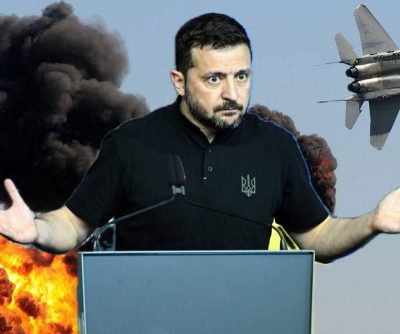
Zelensky presents ‘victory plan’
RT | October 16, 2024
Vladimir Zelensky presented his much-hyped “victory plan” to the Ukrainian parliament on Wednesday, suggesting it could help bring the conflict with Russia to a close as early as next year. However, he stressed that this outcome is possible only if Kiev rules out any compromises with Russia and receives full support from the West.
In his speech, Zelensky lamented that “victory has become an inconvenient word” for some people, adding, however, that he was certain that his “victory plan” would help end the conflict. “This plan can be implemented. It depends on the partners. I emphasize: on partners. It doesn’t exactly depend on Russia,” Zelensky said, accusing Moscow of not wanting peace.
“If you start moving with this idea, with this particular victory plan…, there may be a deal to end the war no later than next year,” he added, rejecting a freeze of the conflict and any “trade” of territories.
Zelensky said the plan consists of eight points, three of which are classified. First and foremost, the Ukrainian leader demanded that Kiev receive an invitation to immediately join NATO, a move the bloc has been reluctant to entertain, citing fears of being dragged into the conflict with Russia.
Second, he also stressed the need to strengthen Ukraine’s defense capabilities, including by lifting Western restrictions on the use of foreign-made long-range weapons for strikes against Russia, and also called for continued incursions into the neighboring country’s territory.
For the third point, Zelensky proposed to the West that Ukraine “deploy a comprehensive non-nuclear strategic deterrence package on its own land” to keep Russia at bay.
Fourth, he suggested that Ukraine sign with its backers “a special agreement on the joint protection of available critical resources” on its territory. These resources “will strengthen… either Russia and its allies, or Ukraine and the democratic world,” he said.
Finally, Zelensky said Ukraine could share its real-life battlefield experience with the West to “strengthen NATO’s defense and ensure security in Europe.”
Prior to Zelensky’s speech, Kremlin spokesman Dmitry Peskov suggested that his plan was just another facet of the US-dictated policy of fighting Russia “to the last Ukrainian.” Peace, he added, can only be achieved if Kiev understands “the futility of the current policy and the need to sober up and realize the reasons that led to the conflict over Ukraine.”
President Vladimir Putin has said that one of the main reasons for the conflict was Ukraine’s aspirations to join NATO and Kiev’s “genocide” of the people in Donbass, which is now part of Russia.
US says can’t continue supplying Ukraine, Israel together as Tel Aviv faces munitions shortage
Press TV – October 15, 2024
Israel is scrambling to supply interceptor missiles amid a looming shortage as the regime is bracing for more retaliatory attacks from the regional resistance, more than a year after it launched the genocidal war on Gaza, a report says.
The report by the the Financial Times came as the United States on Sunday confirmed that its military is sending an anti-missile system operated by American troops to aid the Israeli forces following the Tel Aviv regime’s failure to defend itself against Iran and as Tel Aviv has threatened it will attack Iranian sites.
“Israel’s munitions issue is serious,” the Financial Times cited Dana Stroul, a former senior Pentagon official with responsibility for the West Asia, as saying on Tuesday.
“If Iran responds to an Israel attack [with a massive air strike campaign], and [Lebanon’s] Hezbollah joins in too, Israel air defenses will be stretched,” she said, noting that US stockpiles were not limitless.
“The US can’t continue supplying Ukraine and Israel at the same pace. We are reaching a tipping point.”
Boaz Levy, chief executive of Israel Aerospace Industries, which makes the Arrow interceptors used to down ballistic missiles, said he was running triple shifts to keep production lines running.
“Some of our lines are working 24 hours, seven days a week. Our goal is to meet all our obligations,” Levy said.
While Israel does not disclose the size of its stockpiles, he said “it is no secret that we need to replenish stocks.”
Since early October 2023, Israel has been waging brutal two-front aggression that has killed more than 42,000 people in the Gaza Strip and at least 2,306 others in Lebanon so far.
Over the same period, the usurping regime has also assassinated several resistance leaders, including Hamas’s political bureau chief Ismail Haniyeh and Hezbollah Secretary General Sayyed Hassan Nasrallah.
In support of Palestinians in Gaza, resistance groups have launched retaliatory attacks on Israeli targets and vowed to keep fighting until the Gaza onslaught ends.
In response to Israel’s barbaric acts of assassination against the resistance front’s top leaders, Iran carried out Operation True Promise 2 earlier this month.
During the operation, Iran launched some 200 high-speed ballistic missiles at the Zionist entity’s military, espionage and intelligence bases, sending almost 10 million settlers into bomb shelters. Ninety percent of the fired Iranian missiles hit their targets.
Despite Israel’s intensified strikes on Lebanon, Hezbollah managed to conduct the deadliest strikes on the occupied territories in the past year over the weekend.
“We are not seeing Hezbollah’s full capability yet. It has only been firing at around a tenth of its estimated prewar launching capacity, a few hundred rockets a day instead of as many as 2,000,” Assaf Orion, a former Israeli brigadier general and head of strategy at the Israeli military, said.
“Some of that gap is a choice by Hezbollah not to go full out, and some of it is due to degradation by the IDF [Israeli military]. . . But Hezbollah has enough left to mount a strong operation,” Orion added.
“Haifa and northern Israel are still on the receiving end of rocket and drone attacks almost every day.”
Amid the rising retaliatory operations, the report cited analysts as saying “defense planners and Israel’s AI-powered air defenses were having to choose which areas to protect over others.”
“It’s only a matter of time before Israel starts to run out of interceptors and has to prioritize how they are deployed,” said Ehud Eilam, a former researcher at Israel’s ministry of military affairs.
Do They Want American Troops to Die?
By Dan McAdams | Ron Paul Institute | October 14, 2024
Biden administration mismanagement—or worse—from day one of the latest Israeli multi-front war in the Middle East has led us to where we are today, at the brink of an all-out regional war with some 40,000 U.S. troops and multiple U.S. military bases in the region with targets on their back.
Biden’s blank check to Israel after the attacks of October 7, 2023, to launch multiple wars against its neighbors and carry out the mass murder of Palestinian civilians in Gaza has drawn the U.S. right into the middle of a bubbling cauldron of [World War III]. And rather than take a sober look at actual U.S. national security interests, Biden and his neocon incompetents are busy adding fuel to the fire hanging on to the pipe dream that they could do what they failed to do so many times before: remake the Middle East in their neocon image.
According to an article in Politico this past week, while Biden administration officials publicly urged restraint and a reduction in violence, they privately were working with the Israeli government to encourage a widening of Israel’s military operations to include its northern neighbor, Lebanon. Two top Biden administration officials, Amos Hochstein and Brett McGurk, urged Israeli Prime Minister Benjamin Netanyahu to shift Israel’s military focus from the already-flattened Gaza northward to Lebanon.
As Politico reports:
“Behind the scenes, Hochstein, McGurk and other top U.S. national security officials are describing Israel’s Lebanon operations as a history-defining moment—one that will reshape the Middle East for the better for years to come.”
Where have we heard this kind of “let’s do war to re-shape the Middle East” argument before? As Wikileaks reminds us, appearing before the U.S. Congress in 2002 and urging the U.S. to attack Iraq, Netanyahu himself promised that “If you take out Saddam, Saddam’s regime, I guarantee you that it will have enormous positive reverberations on the region.”
Yeah, Bibi. How’d that work out for us?
So why is it that 22 years later senior U.S. officials are echoing Netanyahu’s bogus 2002 lies to draw the U.S. into another “history-defining” catastrophe in the Middle East? For Hochstein it might be that he is not the unbiased “honest broker” we need to keep us out of unnecessary war. After all, as The New York Times reminds us, Hochstein was born in Israel, had/has Israeli citizenship, and even served in the Israeli Defense Forces!
Now he is serving as President Biden’s top advisor for the Middle East—a position where it is critical to bring no personal biases to the table.
This should not automatically disqualify him from the position, of course, but just as with concerns over Victoria Nuland and Antony Blinken’s Ukrainian background, neocons pushing for war in the “old country” from which they should have left old allegiances behind should raise a few eyebrows.
McGurk is similarly compromised, as he is another Victoria Nuland/Zelig-like character [creature] who has spent his career weaseling into Republican and Democratic administrations as an “expert,” while his actual expertise comprises solely his adherence to the neocon ideology of all war all the time. He was on board for [George W.] Bush’s “remaking of the Middle East” to [Barack] Obama’s fake “Arab Spring to remake the Middle East” to [Donald] Trump’s “trash the Iran deal to remake the Middle East.”
The guy is a loser who has been wrong his whole career, with a trail of failures that would sink a normal person. But like the Energizer Bunny he just keeps on ticking and ticking toward yet another disaster.
As Politico goes on to note, the Hochstein/McGurk plan to urge Israeli attacks on Lebanon was not widely accepted among actual experts in the administration:
“The decision to focus on Hezbollah sparked division within the U.S. government, drawing opposition from people inside the Pentagon, State Department and intelligence community who believed Israel’s move against the Iran-backed militia could drag American forces into yet another Middle East conflict.”
Of course there is built into the Politico article the assumption that Hochstein and McGurk were at all concerned about “dragging American forces” into Israel’s regional war. In fact, their intent was the opposite. They no doubt yearned to draw the U.S. government into Israel’s regional war.
Which brings us to where we are today, with the Biden Administration committing more U.S. weapons systems and more U.S. military personnel to serve on the ground in Israel in its war against Gaza, Syria, Lebanon, Iraq, and Iran. All at once. How’s that for neocon ambition?
As Pentagon Press Secretary Patrick Ryder announced [yesterday]: “At the direction of the President, @SecDef authorized the deployment of a Terminal High-Altitude Area Defense (THAAD) battery and associated crew of U.S. military personnel to Israel to help bolster Israel’s air defenses.”
With today’s [October 13] news that Lebanon successfully counter-attacked Israel—hitting an Israeli military base and taking out dozens of IDF soldiers—it appears certain that President Biden and his neocon-dominated foreign policy team are setting up U.S. military members to be killed in Israel to manufacture consent for a full-on US war against all of Israel’s enemies in the region.
They want American soldiers killed in Israel because they know the enormous propaganda value, particularly among a U.S. population that is increasingly against U.S. involvement in Israel’s wars and in favor of ending them instead.
With Kamala tanking in the eyes of a voting public increasingly unappetized by wilted word salads, an old-fashioned war might be just what the Biden brigades are cooking up to pull their chestnuts out of the fire.
With their track record of failure, it is time for those of us who are sane to be very, very worried.
This is going to get really bad really fast if we cannot get the attention of a slumbering—or worse—Congress.
Featured Video

Why Hamas Really Attacked Israel on Oct. 7
or go to
Aletho News Archives – Video-Images
From the Archives
Israel: Strategic Ally or Liability?
By Stephen Sniegoski | My Catbird Seat | June 12, 2010
The claim that Israel serves as a valuable ally for the United States is made by both pro-Zionists and much of the anti-war and anti-Zionist Left that is influenced by Noam Chomsky. As a result of the Gaza flotilla massacre, which has caused a world-wide uproar against Israel, the value of Israel to the United States is being publicly questioned in more mainstream foreign policy forums. … continue
Blog Roll
 Aletho News
- Why Hamas Really Attacked Israel on Oct. 7
- Declassified UK exposes British man who fought for ‘Israel’ in Gaza
- West’s death cult in a theater near you
- How the Yandex ‘Russian bots’ lie fell apart
- Burnham’s ‘Russia did Brexit’ ruse crumbles
- Estonia making movies and games to encourage war against Russia
- Four in five new UK jobs taken by foreigners – report
- Here’s what Trump’s latest U-turn really means for Russia and Ukraine
- The Houthis Are Not an Iranian Proxy
- Europe’s Energy Hypocrisy, Russian LNG Profits and US Dependence
- If Americans Knew
- Activists Abused By Israel Return to New Freedom Flotilla Mission
- 60 Minutes won’t tell the full truth about Israeli settler violence
- Nearly 50,000 women, girls killed or severely injured in Gaza since October 2023: UN Women
- ADL is working with AI companies to suppress alleged ‘antisemitism’
- Israeli occupation forces using social media surveillance unit to target hundreds of Palestinians in the West Bank
- Israel’s New – and Terrifying – Security Doctrine
- Israeli Attacks Kill Five in Gaza, Including a four-year-old and a woman
- Air Force Major Who Called for Trump’s Impeachment Held in Solitary Confinement
- It’s a Genocide, I’m Into It’: Seinfeld Mocks Protest over Palestinian Children Killed
- Universities fire dozens amid pressure from Zionist billionaires
- No Tricks Zone
- New Study Suggests Large Regions Of The Pacific Ocean Have Been Cooling For The Last 80 Years
- Germany’s Green Energy Debacle: High Energy Costs Force Kahla Porzellan to Close After 182 Years!
- New Study: 50 Years Of The Most Aggressive ‘Net Zero’ Policies Can Only Affect The Global Climate By 0.03°C
- US September “Heat” Was No Record…Many Records Set Decades Ago
- Latest European Green Energy Debacle; Portugal’s Largest Flagship Solar Park Insolvent!
- Green Energy Debacle: German Expert Professor Fritz Vahrenholt Warns Of Severe Economic And Social Consequences
- Two More Paleo Reconstructions Affirm Meters-Higher Sea Levels Across Ireland, Brazil 7000-6000 Years Ago
- New Study: Earth And Venus Surface Warmth Largely Explained By Convection And Lapse Rate, Not CO2 Or Radiation
- 2025 Nature Paper Claiming Worsening Global Drought Gets RETRACTED …Heavily Flawed
- New Study: ‘Global Drought Shows No Detectable Recent Acceleration Under Climate Warming’

