‘Biden plots stopgap funding for Ukraine aid’
RT | October 6, 2023
US President Joe Biden’s administration has reportedly set its sights on a State Department grant program to keep weapons and financial aid flowing to Ukraine, while waiting for divided Republican lawmakers to approve more spending to help Kiev fight Russian forces.
One of the stopgap-funding sources under consideration is a fund that provides grants or loans to US allies to buy weapons, Politico reported on Thursday, citing two unidentified government officials with knowledge of Biden’s plans. The president acknowledged on Wednesday that he was worried about a possible disruption to Ukraine aid amid congressional chaos, but he suggested that he might find another way to keep the funding going, at least temporarily, without getting a new spending bill passed.
Washington’s continued support for Ukraine was thrown into doubt last week, when Republicans stripped Biden’s $24 billion aid request out of a spending bill that averted a government shutdown for 45 days. House Speaker Kevin McCarthy (R-California) was voted out of his leadership position on Tuesday, the first such ouster in US history, reportedly after conservative Republicans heard that he had promised Biden a separate Ukraine funding bill.
The State Department, the Pentagon and Biden himself have warned this week that any disruption to aid could have devastating consequences for Ukraine on the battlefield. Republicans have become increasingly critical of Biden’s Ukraine strategy as public support for funding the bloody conflict wanes. Congress has already approved four rounds of Ukraine funding, totaling about $113 billion.
Biden administration officials have privately admitted that only weeks remain before a potential lapse in US funding to Kiev. The State Department grant program had about $650 million remaining as of September 21. Lawmakers originally allotted $4.6 billion for the program, which was designed to provide military grants and financing to Ukraine and other allies affected by the conflict with Russia.
However, even if the administration uses the financing authority to purchase weapons, it will still need approval from Congress to authorize additional funding for Ukraine, a US official told Politico. A Pentagon official said the White House also would need approval from lawmakers to redirect other defense spending to Kiev.
The Pentagon warned last week that it had exhausted “nearly all available security-assistance funding for Ukraine.” About $1.6 billion in funding remains to replace US weapons that were sent to the Ukrainians.
Europe worried that US support for Ukraine waning
By Ahmed Adel | October 6, 2023
Dutch Defence Minister Kajsa Ollongren made a shocking statement at the Warsaw Security Forum by emphasising the strategic importance of arming Ukraine as a cost-effective means of containing Russia when responding to questions about the sustainability of US and allied support for Kiev given the political turbulence in Washington.
“Of course, supporting Ukraine is a very cheap way to make sure that Russia with this regime is not a threat to the NATO alliance. And it’s vital to continue that support,” she said. “It is very much in our interest to support Ukraine, because they are fighting this war, we are not fighting it.”
Responding to the shocking admittance that NATO only views Ukraine as a “very cheap way” to contain Russia, Kremlin spokesman Dmitry Peskov said on October 5 that Ukrainians would soon “stop liking” how they are seen and used by the West.
“[The West does not hide its intention to fight to the last Ukrainian and continues to use Ukraine] as cheap soldiers,” the spokesman said when commenting on Ollongren’s recent statement that it was vital to continue to support Ukraine. “[Soon, Ukrainians will begin to hear such statements] in a different light for themselves” and “they will stop liking it.”
Mentioning developments “overseas,” referring to the US, Ollongren said it is “worrying and also I think we have to address that worry.”
“We cannot pretend that we’ll just wait and see how the American elections are going,” she said before highlighting that if Washington’s support for Ukraine falls, that would be “substantial.”
Her concern about the situation in the US comes as a survey by the Chicago Council on Global Affairs, published on October 4, found that 47% of Americans believe the US should support Ukraine for as long as necessary, a drop from 58% in July 2022; support for providing economic and military assistance to Ukraine has dropped from 78% in March 2022 to 61% in September 2023; and, support for sending US troops to Ukraine dropped from 36% in March 2022 to 26% in September 2023.
According to the survey, “There have been dips in support, which is not surprising given that both the length of the conflict and the extent of the US financial contribution have likely exceeded Americans’ initial expectations.”
“Americans express less confidence now than in previous surveys that Ukraine is doing better than Russia on the battlefield. Now only 14 percent of Americans say Ukraine has the advantage in the war, compared with 26 percent in November 2022,” the Chicago Council on Global Affairs report added.
US President Joe Biden has long been confident that Congress would continue to provide billions of dollars in support to Ukraine, even as the situation becomes increasingly tense in a divided Washington. The last agreement was only to avoid a collapse of the American government. However, it should not last long as it became clear how unpredictable Washington can be in its negotiations to support Ukraine as it continues encountering serious difficulties.
To avoid the collapse of the government, on September 30, a decision to leave Ukraine out of the budget was made, demonstrating that the situation is not only delicate but there is also great pressure from critics of the support given by Biden to Kiev. The challenge now, especially for the Europeans, is that a politically polarised America extends to foreign policy.
Despite all the domestic financial problems, the US continues to allocate huge funds to Ukraine. Since February 2022, Kiev has received more than $110 billion from Washington. This means that the “very cheap way” to fight Russia is turning out to be very expensive, as demonstrated by the fact that the government of the world’s greatest superpower almost shut down.
The removal of House Speaker Kevin McCarthy from the US Congress only worsens the already troubled process of Washington’s military and financial aid for Ukraine as its counteroffensive against Russia grinds on with little change to the frontlines. This is significant because, without a Speaker, the House cannot pass legislation, throwing Washington’s military backing for Kiev into doubt since it could be another week or more before a successor is elected.
Although Ukraine is not a “very cheap way” for NATO to fight Russia, the statement by Ollongren provides a fascinating insight into how the Atlantic bloc views the beleaguered Eastern European country – nothing more than an expendable proxy weaponised against its far larger and more powerful neighbour.
Ahmed Adel is a Cairo-based geopolitics and political economy researcher.
Ukraine’s backers blinded by Russia hate – top analyst
RT | October 5, 2023
Kiev’s globalist and neo-conservative supporters in the West are so driven by their hatred of Russia that they completely disregard the hundreds of thousands of Ukrainians who are dying in a futile effort to defeat Moscow’s forces, US public policy analyst Jeffrey Sachs has argued.
Sachs, an award-winning economist who advised the Russian and Ukrainian governments following the breakup of the Soviet Union, made his comments in an interview posted on Thursday by US podcast host Andrew Napolitano. Asked how the US and its NATO allies can ignore the catastrophic destruction of Ukraine while prolonging the conflict and making false claims of battlefield successes, Sachs said they are “blinded” by their hatred of Russia.
“They are not counting the Ukrainian dead,” the analyst said. “They have lied to the public all along about the military situation . . . . They want so much to fight Russia and have someone else do the fighting and the dying that they want another massive recruitment of the remaining Ukrainian young men that can be grabbed off the streets and be thrown into the killing fields.”
More than 83,000 Ukrainian troops have been killed during a Donbass counteroffensive that began in June, according to an estimate released by the Russian Defense Ministry last month. Despite knowing that the Ukrainians have no chance of making major gains on the battlefield amid Russia’s air superiority and artillery dominance, Kiev’s benefactors have shown a “grotesque” disregard for the heavy casualties, Sachs said. He argued that the UK, in particular, has championed the counteroffensive because of London’s centuries-long and deeply embedded desire to crush Russia.
Sachs, now a UN adviser and director of the Center for Sustainable Development at Columbia University, has argued that NATO’s expansion into Eastern Europe helped trigger the current crisis. He said Washington and its allies missed many opportunities to avoid the current conflict, then kept it going by discouraging Ukrainian President Vladimir Zelensky from finalizing a peace deal with Russia in March 2022.
Responding to claims by former US Secretary of State Hillary Clinton that critics of Washington’s Ukraine policy are “siding with” Russian President Vladimir Putin, Sachs argued that he’s showing concern for the Ukrainian people. “I don’t want Ukraine to be completely destroyed by these neocons, by their fantasy world, by their desire to throw Ukrainians by the hundreds of thousands to their deaths,” he said. He added, “This isn’t siding with Putin or siding with anybody. This is trying to protect Ukraine from American zealots.”
Sachs claimed that US President Joe Biden must reach out to Putin to negotiate an end to the bloodshed, which would involve ruling out adding Ukraine to NATO, as well as addressing Russia’s legitimate security concerns. “We have stoked so much provocation in this, so much anxiety, overthrowing governments, starting multiple wars, pushing NATO enlargement, abandoning nuclear agreements, and then saying, ‘Oh, he doesn’t want to negotiate,’” the analyst said.
McCarthy’s Ouster Signals US ‘Preparing Populace at Large’ to Defund Ukraine
By Ilya Tsukanov – Sputnik – 05.10.2023
Kevin McCarthy lost the House speakership this week after his GOP colleague Matt Gaetz tabled a motion to remove him over alleged “side deal” talks with President Biden and the Democrats on Ukraine funding. The shock ouster comes amid growing weariness among Americans over the proxy war, and possible preparations to dump Kiev, experts told Sputnik.
The fallout over Kevin McCarthy’s historically unprecedented removal as speaker of the House of Representatives continues to send shockwaves of confusion and dread across the furthest reaches of the American empire, including in Ukraine.
“We are freaking out. For us it is a disaster,” Ivanna Klympush-Tsintsadze, a senior Ukrainian lawmaker responsible for lobbying Kiev’s efforts to join the European Union, told US media, commenting on the threat of Washington cutting off its military and financial support.
“We are interested in getting things sorted out so American democracy can function, and so we can restore the bipartisan consensus on supporting their own national interest by supporting Ukraine,” Klympush-Tsintsadze emphasized. Apparently, to the politician, a “functioning” American democracy seems to mean continuing to pump tens of billions of additional dollars into Kiev, which faces a looming debt crisis, and is now dependent on Washington and its allies for some 70 percent of all government expenses, as Western creditors prepare to collect dividends on their “investments.”
“There is nothing good, but, objectively, we have simply become hostages of their internal politics,” Ukrainian parliament finance committee deputy chairman Yaroslav Zheleznyak complained, referring to last week’s budget deal showdown – in which Republicans threatened to force a shutdown if the budget included billions in additional funding for Kiev.
The Zelensky government estimates that Kiev still has access to about $1.6 billion in US defense support and $1.23 billion in budgetary assistance. The Pentagon says some $5.4 billion in cash also remain in Presidential Drawdown Authority funds –allowing for weapons stocks from American armories to be sent to Kiev. However, senior Biden administration officials, including the president himself, have expressed fears that “only weeks remain” before a lack of additional funding will start becoming “a serious battlefield concern” for Kiev.
“It does worry me,’ Joe Biden told reporters Wednesday, when asked about the possibility of funds drying up. “But I know there are a majority of members of the House and Senate in both parties who have said that they would support funding Ukraine,” he added. “I’m going to make the argument that it’s overwhelmingly in the interest of the United States of America that Ukraine succeeds.”
“Obviously, time is of the essence,” an administration official stressed, warning of the risks of Congress sitting on its hands without appropriating additional cash to Kiev before the current short-term spending package runs out in mid-November.
Preparing the Public for Bad News?
“I have difficulty thinking of Ukraine as a primary issue for American politicians,” Dr. Nicolai Petro, an international politics professor at the University of Rhode Island, told Sputnik, commenting on the role played by Ukraine funding in the chaos in Washington over the past week.
“I think it is more of a symbolic issue and that their primary interest is not voting up or down on Ukraine aid,” but “what that symbolizes and how it can play out in the American political process.”
Pointing to the deeply murky nature of US spending on Ukraine and the “hide the ball” approach to appropriations, Petro predicted that the Biden administration will likely be able to squeeze out more cash from already appropriated funding for some time even if additional Congressional funding dries up.
The growing debate in Washington over Ukraine has also rippled across the Atlantic to Britain – the second-staunchest supporter within NATO of continuing the proxy war. Even there, Petro pointed out, a debate seems to be gaining strength over just how much more money can be lifted from taxpayers’ pockets and transferred to Kiev.
“London and Washington seem to be on the same wavelength here. We’re both at the same time ramping up production and are not sure how much we have and how much is even needed. Last month, for example, the new UK defense minister said London would deliver tens of thousands of new artillery shells. Three weeks later, it’s ‘we’ve given away as much as we can afford’. This sort of flip-flop is very convenient when you’re preparing the populace at large for a transition of policy from ‘we’ll do whatever it takes as long as it takes’ to ‘no we really need to be thinking about the cost.’ That’s a very different argument to make,” the academic emphasized.
This shift in rhetoric is related to the fact that the US and some of its allies are approaching crucial elections, with “all the polls and the recent elections [in Europe] suggest[ing] that this NATO proxy war in Ukraine is extremely unpopular. And that in and of itself it is going to at least affect the narrative between now and several key elections,” Petro said.
Dems Shoot Themselves in the Foot
McCarthy was ousted Tuesday by an extremely narrow margin of 216 in favor to 210 opposed, with only eight Republicans – led by rebel Florida Congressman Matt Gaetz, supporting his removal alongside Democrats.
“My biggest question going forward is, is this going to be the right move for Democrats?” independent US journalist Rachel Blevins told Sputnik.
“Because they may have just shot themselves in the foot a little bit by getting rid of someone like Kevin McCarthy, who was trying to work with them, you know, maybe promising a separate vote to ensure funding for Ukraine and all that. Well now it could end up being that the next Republican speaker does not want to work with them whatsoever,” the observer pointed out.
The ouster could have repercussions for Ukraine going forward. While interim House Speaker Patrick McHenry has repeatedly supported Congressional votes on Ukraine funding – apart from last week’s attempt to roll assistance into the government funding bill, several candidates vying for the speakership have expressed opposition to further aid, including Ohio Congressman Jim Jordan, Oklahoma Representative Kevin Hern, and Florida Congressman Byron Donalds.
What a Difference a Year Makes
“I know that Joe Biden is not happy right now,” Blevins emphasized. “He’s probably the most furious with all of this, because he was expecting McCarthy to get that funding through. He was not happy that it was not there in that bill to keep the government open.”
“What was interesting was to see that back and forth” over Ukraine, the observer added. “Because in the Senate, they had at least $6 billion for Ukraine, which is a lot of money to the average person, obviously. But when it comes to Ukraine, that’s just enough to keep it rolling for a few months. So they come up with $6 billion. Then in the House, they basically put Democrats in a position where they said, ok, here’s a funding bill to keep the government open. If you say you’re against it, it’s literally just over Ukraine funding. So that’s on you. And you have to answer to your constituents and saying that you wanted a government shutdown just so that you could fund a country that most Americans can’t find on a map,” the observer said.
“Also notable is the latest polls show that half of the American public doesn’t think Congress should keep continuing to approve funding for Ukraine. And so whenever those members of Congress go in there, they’re going to have to find a better justification for it than now, because it’s something that at least half of Americans don’t say is a priority. And that’s certainly not where Congress was even just one year ago when they were passing unprecedented funding and there was no fight about it whatsoever,” Blevins summed up.
NATO member suspends military aid to Ukraine
RT | October 5, 2023
Slovakia is halting military aid to Ukraine due to opposition from political parties currently negotiating to form a new government, the Dennik N news outlet reported on Wednesday, citing presidential spokesman Martin Strizinec.
The official told the outlet that the Slovak head of state, President Zuzana Caputova, pointed out that there is the need to “respect the results of democratic elections.” The victorious Slovak Social Democracy (SMER-SD) party has promised voters “not a single round [of ammunition] for Ukraine.”
“It would not be a good precedent to decide to provide military equipment in such a situation when there is a change of political power after any election,” Strizinec said.
After winning the parliamentary election on Sunday, SMER-SD leader Robert Fico, a former prime minister, told journalists that “Slovakia and the people of Slovakia have bigger problems than Ukraine.”
He added that if his party successfully forms a government, it would still be open to helping Ukraine, but only in a humanitarian way.
Last week, Kiev hosted the International Industries Defense Forum with participants from 30 countries, where Ukrainian officials went on a “charm offensive directed at weapons-makers,” Politico reported. An unnamed European official told the agency that there was no way to “keep giving from their own stockpiles” because they had already sent Ukraine everything that does not endanger their own security.
According to the Wall Street Journal, the Ukrainian government will be unable to pay civil servants if the US Congress fails to approve continued financing for Kiev.
Ukraine Fatigue Is Worrying NATO Elites – and So They Should Be
By Finian Cunningham | Strategic Culture Foundation | October 4, 2023
On both sides of the Atlantic, there is now discernible fatigue and anger among citizens over the bottomless money pit that is NATO’s proxy war in Ukraine against Russia.
The only wonder is that it has taken so long for the Western public to get wise to the scam.
The disgraceful adulation of a Nazi war criminal by the whole Canadian parliament in a perverse show of solidarity with Ukraine against Russia has helped focus public attention on the obscenity of the NATO proxy war.
All told, since the NATO-induced conflict blew up in February last year, the American and European establishments have thrown up to €200 billion into Ukraine to prop up an odious Nazi-infested regime.
All that largesse that is billed to U.S. and European taxpayers has resulted in a slaughter in Europe not seen since the Second World War – and a failed Ukrainian state. And of course huge profits for the NATO military-industrial complex that bankrolls the elite politicians.
Times are changing though. In the United States, the financially conservative Republicans have had enough of the blank checks to the Kiev regime. The U.S. Congress finally showed a modicum of sanity to prevent a government financial shutdown – by dropping military aid to Ukraine. That shows how twisted Washington’s priorities have become when national self-interest has to wrestle with funding for a Nazi regime.
And then following the Congressional vote to temporarily end funding for Ukraine, the Kiev regime’s foreign minister Dmytro Kuleba dared to reprimand American lawmakers: “We are now working with both sides of Congress to make sure that it does not (get) repeated under any circumstances.”
Meanwhile in Europe, Slovakian citizens have voted for a new government to end the military fueling of war in Ukraine. The Smer-SD party led by Robert Fico won the parliamentary elections primarily on the vow to shut off any further weapons supply to the Kiev regime.
This week also saw massive protests in Germany against Olaf Scholz’s coalition government over the latter’s abject pro-war policies in Ukraine. German Unity Day on October 3 prompted a mass rally in Berlin denouncing the NATO proxy war in Ukraine and calling for peace negotiations to end the conflict.
There were also unprecedented protests across Poland in Warsaw, Lodz and other cities against the PiS government’s slavish implementation of the U.S.-led NATO proxy war in Ukraine. Faced with millions of Ukrainian refugees and neglect of social needs for Poles, the PiS ruling party has recently threatened to end weapons supply to Kiev – a move less about principle and more about trying to buy votes in the forthcoming election on October 15. Nevertheless, the belated move by the Polish government illustrates the concern among European leaders about growing public disdain over the seemingly endless financial aid allocated to Ukraine.
Josep Borrell, the European Union’s top diplomat, says it is a “worrying” sign that Washington for the first time closed the coffers for Ukraine.
The EU foreign ministers held a summit in Kiev on Monday. It was the first time that their summit was convened in a non-EU country. The agenda was a little too self-conscious, slated as a show of “solidarity” with Ukraine.
Borrell and the other EU diplomats said the summit was a warning to Russia to not count on “weariness” among Europeans over support for Ukraine. Who is he trying to convince? Russia or Europeans?
The unelected European elites described the war in Ukraine as an “existential crisis” which requires never-ending support for the Nazi regime against Russia.
Such melodrama needs serious qualification. The conflict is only “existential” for certain people: the NATO ideologues, the elitist leaders, the military-industrial complex, and the corrupt Nazi regime in Kiev. But it’s not existential for most other people who want to end this insane slaughter, grotesque wasting of public finances, and perilous flirting with nuclear war.
Significantly, the contrived EU summit in Kiev was not attended by Hungary’s foreign minister Peter Szijjarto. In highly critical comments on the EU’s misplaced priorities, he said that other countries do not understand why Europe “has made this conflict global” and why people living in Asia, Africa and Latin America have to pay for it due to growing inflation, energy prices and unstable food supplies.
The Hungarian diplomat slammed the EU leaders for their double standards and hypocrisy, adding: “I can say that the world outside Europe is already really looking forward to the end of this war because they do not understand many things. They do not understand, for example, how it can be that when a war is not in Europe, the European Union, looking down with fantastic moral superiority, calls on the parties to peace, advocates negotiations and an immediate end to violence. However, when there is a war in Europe, the European Union incites the conflict and supplies weapons, and anyone who talks about peace is immediately stigmatized.”
At least two members of the EU and the NATO alliance – Hungary and Slovakia’s new government – are opposed to the absurd military and financial support fueling the war in Ukraine. Both countries want peace negotiations with Russia to be prioritized. There is an unavoidable sense that this common sense dissent will grow into a domino effect because it is the truth and has an unassailable moral force.
What the conflict in Ukraine has demonstrated clearly to the Western public is just how morally bankrupt their governments and media have become. American and European elitist leaders may kid themselves a little longer by pretending there is no weariness and fatigue over their proxy war against Russia. The more they pretend the greater the eventual crash and downfall from public anger.
Defense Stocks Fall As Paralyzed House With No Speaker Puts US Ukraine Aid At Risk
By Tyler Durden | Zero Hedge | October 4, 2023
On Tuesday evening, Kevin McCarthy, a Republican, was voted out (216-to-210 vote) as the Speaker of the US House of Representatives. Hardline Republicans were angered by McCarthy’s willingness to fund Ukraine’s war while arguing that the money could have been better spent to protect the southern border and restore law and order in imploding major US cities. The historic ouster of the speaker has weighed on defense stocks as traders anticipate challenges for the new speaker in securing further funding for Ukraine.
“The conservative revolt that ousted McCarthy has left the chamber in a state of paralysis until a new speaker is found. That raises the chances of a US government shutdown next month and a delay in further Ukraine assistance,” Bloomberg said.
In a note to clients, Goldman’s Alec Phillips said:
All other things equal, the leadership change raises the odds of a government shutdown in November, though with several weeks left until the deadline, many outcomes are possible. With many policy disputes remaining and a $120bn difference between the parties on the preferred spending level for FY2024, it is difficult to see how Congress can pass the 12 necessary full-year spending bills before funding expires Nov. 17. The next speaker is likely to be under even more pressure to avoid passing another temporary extension—or additional funding for Ukraine—than former Speaker McCarthy had been.
On Wednesday morning, European defense stocks, such as Rheinmetall, Saab, BAE Systems, and Leonardo, slid in the cash market. Bloomberg said this was because of the oustering of McCarthy.
German arms manufacturer Rheinmetall dropped as much as 4.8%.
Swedish aerospace and defense company Saab fell 3%.
British multinational arms, security, and aerospace company BAE Systems slid 3.5%
And Italian defense contractor Leonardo was down 2%.
In the US, uncertainty over funding will likely weigh on defense stocks. The S&P 500 Aerospace & Defense Index has been running into resistance for much of this year.
Washington’s endless stream of taxpayer funds to Ukraine has benefited the military-industrial complex. Now, it appears that the pipeline of easy money is in question due to the ouster of McCarthy.
Biden Tells Allied Leaders ‘Ukraine Aid Cannot Be Interrupted Under Any Circumstances
By Kyle Anzalone | The Libertarian Institute | October 3, 2023
President Joe Biden held a call with the leaders of several allied nations to stress that weapon shipments to Ukraine cannot end for any reason. Some members of NATO recently expressed an unwillingness or inability to provide further arms to Kiev.
National Security Council Spokesman John Kirby stated Biden spoke with the leaders of Canada, Italy, Japan, the UK, Poland, Romania, Germany, the European Commission, the European Council, and NATO on Tuesday. Kirby said the president expressed that “we cannot under any circumstances allow America’s support [for] Ukraine to be interrupted. Time is not our friend.”
Biden added that he was confident Congress would authorize an additional $24 billion in aid that the White House requested. While a majority of representatives in both houses continue to support aiding Ukraine, recent polling shows that 71% of Republicans, and 55% of Americans, do not want Congress to pass another multibillion-dollar bill to support Kiev.
A press release from UK Prime Minister Rishi Sunak said London was committed to supporting Kiev. It stated that he “outlined the UK’s ongoing military, humanitarian and economic assistance to Ukraine and stressed that this support will continue for as long as it takes.”
However, the Telegraph reported that London had depleted its available stockpile of weapons it can ship to Kiev. “We’ve given away just about as much as we can afford,” the unnamed source “We will continue to source equipment to provide for Ukraine, but what they need now is things like air defense assets and artillery ammunition, and we’ve run dry on all that.”
After Ukrainian President Volodymyr Zelensky criticized Poland at the United Nations General Assembly, tensions between Kiev and Warsaw boiled over. Polish Prime Minister Mateusz Morawiecki announced that arms shipments to Ukraine would end.
On Monday, Slovak Social Democracy, running on a platform of ending arms transfers to Ukraine, won a plurality in Bratislava’s legislature. The party leader, Robert Fico, doubled down on the pledge after Monday’s election victory.
Washington has also struggled to transfer Kiev the weapons the Ukrainian military needs. The White House resorted to sending Ukraine the cluster variants of 155MM artillery shells and long-range rockets because the Department of Defense lacked enough conventional munitions to transfer to Kiev.
Non-aligned nations reject use of force against countries on pretext of fighting terror

Zahra Ershadi, Iran’s deputy permanent representative to the United Nations (Photo by IRNA)
Press TV – October 3, 2023
The Non-Aligned Movement (NAM) condemns all forms of terrorism, but war on terror must not be used as a pretext to use force against countries, a statement issued by the group says.
The statement was read by Iran’s deputy permanent representative to the United Nations Zahra Ershadi on behalf of the movement before the Sixth Committee of the 78th Session of the United Nations General Assembly in New York on “Measures to eliminate international terrorism” on Monday.
“The Non-Aligned Movement unequivocally rejects terrorism in all its forms and manifestations, as well as all acts, methods, and practices of terrorism wherever, by whomever, against whomsoever committed,” the statement said.
“The Non-Aligned Movement rejects actions and measures, the use or threat of use of force, imposed or threatened to be imposed, by any State against any Non-Aligned Member Country under the pretext of combating terrorism or to pursue its political aims, including by directly or indirectly categorizing them as terrorism sponsoring-States,” it added.
The statement said NAM totally rejects the unilateral preparation of lists accusing states of allegedly supporting terrorism, adding such acts are unlawful and constitute a form of psychological and political terrorism.
“Terrorism cannot and should not be associated with any religion, nationality, civilization or ethnic group, and these attributions should not be used to justify terrorism or counter-terrorism measures,” it added.
It also said terrorism should not be equated with the struggle of peoples under colonial or alien domination and foreign occupation, for self-determination and national liberation.
The statement also urged Member States to refrain from extending political, diplomatic, moral, or material support for terrorism.
“States should also ensure that refugee status or other legal statuses not be abused by the perpetrators, organizers or facilitators of terrorist acts and that claims of political motivation by them are not recognized as grounds for refusing requests for their extradition.”
It also expressed concerns over the growing threat posed by foreign terrorist fighters who travel to a State other than their State of residence or nationality to commit or participate in terrorist acts and underlined the importance of United Nations capacity-building in the most affected regions.
Moreover, the statement said, NAM voices deep concerns over the “misinterpretation” and “misrepresentation” of religions by terrorist groups to justify terrorism in an effort to instill hatred in the hearts and minds of the youth.
“In this regard, it is imperative to effectively counter the narratives of terrorism through a comprehensive and international framework with an effective and comprehensive method aimed at addressing all its root causes, including through the engagement of community leaders and clerics from all denominations.”
The statement called for an international summit conference under the auspices of the UN to formulate a joint organized response of the international community to terrorism in all its forms and manifestations, including identifying its root causes.
“We further reiterate the importance of the conclusion of a Comprehensive Convention for Combating International Terrorism,” it said.
A New Era Of Mass Armies Approaches
BY IAN WELSH | SEPTEMBER 29, 2023
The army, or a part of it at the war college, has perked up and noticed some of the lessons of the Ukraine war, and that it’s a war that the US military could not fight. They’ve missed a lot of things, or felt they couldn’t/shouldn’t write about them, but they’ve figured some stuff out and written about them in a new report, “A Call to Action: Lessons from Ukraine for the Future Force” by Lieutenant Colonel Katie Crombe, and Professor John A. Nagle.
The entire thing is worth reading, but I’m going to pull out three of the main points. The first is that a volunteer US military can’t fight a real war.
The Russia-Ukraine War is exposing significant vulnerabilities in the Army’s strategic personnel depth and ability to withstand and replace casualties.11 Army theater medical planners may anticipate a sustained rate of roughly 3,600 casualties per day, ranging from those killed in action to those wounded in action or suffering disease or other non-battle injuries. With a 25 percent predicted replacement rate, the personnel system will require 800 new personnel each day. For context, the United States sustained about 50,000 casualties in two decades of fighting in Iraq and Afghanistan. In large-scale combat operations, the United States could experience that same number of casualties in two weeks. (emphasis mine)
Huh. Yeah, that seems bad. And it comes just as the US military is having trouble with volunteer recruitment, though even if wasn’t volunteer recruitment couldn’t keep up with the meat grinder of a real war.
The US Army is facing a dire combination of a recruiting shortfall and a shrinking Individual Ready Reserve. This recruiting shortfall, nearly 50 percent in the combat arms career management fields, is a longitudinal problem. Every infantry and armor soldier we do not recruit today is a strategic mobilization asset we will not have in 2031. The Individual Ready Reserve, which stood at 700,000 in 1973 and 450,000 in 1994, now stands at 76,000. These numbers cannot fill the existing gaps in the active force, let alone any casualty replacement or expansion during a large-scale combat operation. The implication is that the 1970s concept of an all-volunteer force has outlived its shelf life and does not align with the current operating environment. The technological revolution described below suggests this force has reached obsolescence. Large-scale combat operations troop requirements may well require a reconceptualization of the 1970s and 1980s volunteer force and a move toward partial conscription. (emphasis mine).
If the US expects to fight Russia, China, or even Iran, they’re going to face a real war.
The US has spent 20 years fighting with air, artillery and surveillance supremacy, with clear communications. American veterans who went to Ukraine were unprepared for a war where the other side has, if not supremacy, air and artillery superiority, and the Ukraine war has been a meatgrinder. Plus, the current command methods the army use don’t work in an environment like the Ukraine:
Twenty years of counterinsurgency and counterterrorism operationsin the Middle East, largely enabled by air, signals, and electromagnetic dominance, generated chains of command reliant on perfect, uncontested communication lines and an extraordinary and accurate common operating picture of the battlefield broadcast in real time to co-located staff in large Joint Operations Centers. The Russia-Ukraine War makes it clear that the electromagnetic signature emitted from the command posts of the past 20 years cannot survive against the pace and precision of an adversary who possesses sensor-based technologies, electronic warfare, and unmanned aerial systems or has access to satellite imagery; this includes nearly every state or nonstate actor the United States might find itself fighting in the near future
Back in 2012 I wrote an article titled “Drones are not weapons of the powerful.” I posited that they’re cheap, easy to make and everyone would eventually get them. We’re pretty much there, in terms of large group actors (the step after that is individuals, leading to an era where even a single person or small group can launch significant attacks.).
The authors of the article agree:
These systems, coupled with emerging artificial intelligence platforms, dramatically accelerate the pace of modern war. Tools and tactics that were viewed as niche capabilities in previous conflicts are becoming primary weapons systems that require education and training to understand, exploit, and counter. Nonstate actors and less capable nation-states can now acquire and capitalize on technologies that bring David’s powers closer to Goliath’s.
There are issues the authors don’t deal with, the main one is “designed in California, built in China.” The US’s weapon building capacity is massively degraded. As one example, the Chinese can build 3 ships per one the US builds, and the ships are probably better.
Since WWII, in every war the US has fought, they’ve had air superiority or supremacy and more advanced weapons than the enemy. They’ve also had more “stuff”. But the WWII “arsenal of democracy” is dead, it doesn’t exist any more.
Another issue is that the US military has outsourced too much of its capabilities. The corporate mantra of “outsource everything except your core competency” doesn’t work in a real war. All support functions should be run by the military and soldiers. (I may write an article on that in the future.) Contractors are too expensive and unwilling to really risk their necks, and outsourcing maintainance to non-army technicians is a disaster.
The US retains one huge advantage, however, its continental position makes it hard to attack the mainland. But this is also a disadvantage if the US loses air and naval supremacy. America’s enemies can only be reached by air and sea, after all.
Anyway, one takeaway is that conscription is likely to come back. I assume they’ll first make a huge push to recruit immigrants, undocumented or not, but that isn’t going to be enough. Get ready and remember, Empires rarely fade, they go down in huge conflagarations. The British Empire’s end involved two world wars.
Zelensky Should Have Stayed Home
BY PHILIP GIRALDI • UNZ REVIEW • OCTOBER 3, 2023
Most Americans do not understand how the United Nations functions, or does not function as the case might be, preferring to think of it as some kind of debating society where the 193 member nations representing the world community can vent over issues that they rarely have control over. Nevertheless, in spite of the torrent of words and the lack of any real program, it is always interesting to watch and listen to the UN’s annual General Assembly meeting, which is held in New York during September. This year’s meeting was particularly interesting as it came complete with a major war blazing in Eastern Europe as well as political turmoil in Africa and rising tension with China. It also features the rumblings coming from a new emerging global economic movement, the so-called BRICS developing as a champion of a multipolar-world currency challenge to the US-European dollar dominated international monetary and banking system.
And with economic union, there is also some political realignment, with China strengthening its ties to the developing world and Russia entering into defense arrangements with Iran. President Xi Jinping and Russian president Vladimir Putin will be meeting in Beijing later this month to discuss common concerns. And, as usual, Israel’s Prime Minister Benjamin Netanyahu showed up to vent his hostility towards Iran with demands that that country’s alleged “nuclear program” be confronted militarily and the sooner the better, just as he has been claiming for the past twenty years.
Indeed, several back stories playing out during this year’s meeting made it more than usually interesting. Ukraine’s President Volodymyr Zelensky had hoped to turn the gathering into an anti-Russian hate fest, but though there was much complaining about Moscow’s attack on Ukraine coming from the Baltic States and others, the ground continues to be shifting against Zelensky over concerns that the war has become an unwinnable money pit that could easily escalate into a nuclear exchange. Speaking before a UN Security Council session, Zelensky was reduced to harshly criticizing the UN itself for failing to prevent or resolve conflicts before calling for Moscow to be stripped of its veto power on the Security Council. Zelensky, his voice rising in anger, complained how “It is impossible to stop the war because all actions are vetoed by the aggressor.” Observers noted immediately that Zelensky’s complaint did not help his cause. While there have been calls for UN reforms in the past, including over the veto power, the existence of the veto for a limited number of post-1945 greater powers was the only reason the United Nations could be created in the first place at all.
Zelensky also did real damage to his position when he said that while the Ukrainian refugees in Europe have “behaved well . . . and are grateful” to those who have given them shelter, it would not be a “good story” for Europe if a Ukrainian defeat “were to drive the people into a corner.” It was reasonably enough seen by critics as nothing less than a threat of possible unrest producing domestic terrorism as well a possible internal insurrection uncontrollable by whatever Ukrainian government survives defeat. Such unrest might involve the millions Ukrainian refugees without houses and jobs already in place in other European nations if Zelensky is not given all the support which he apparently believes is his due.
Zelensky’s actual message to the General Assembly was not quite so incendiary and impulsive as his other interactions while on his visit, but he offered little new. He reportedly received an obligatory “warm welcome” from those in attendance, but “he delivered his address to a half-full house, with many delegations declining to appear and listen to what he had to say.” He warned those present that “The goal of the present war against Ukraine is to turn our land, our people, our lives, our resources into a weapon against you, against the international rules-based order. We have to stop it. We must act united to defeat the aggressor.” Zelensky did go overboard when he referred to Russia and Russians as “evil” and as “terrorists” and accused them of carrying out a “genocide” against Ukraine. Russian Foreign Minister Lavrov responded to comments made by both President Joe Biden and Zelensky by turning the argument around and observing that it is the US and its NATO “puppets” who already “are waging war against us.”
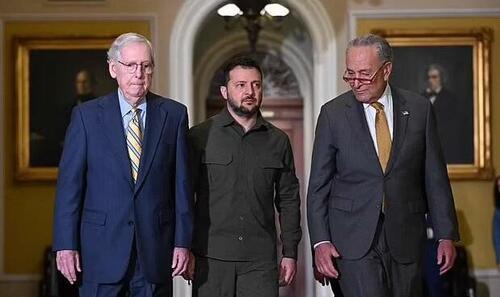
Zelensky’s frustrations spilled over in Washington on the following day where he met both with Biden and with some members of Congress and also dropped by the Pentagon and left flowers at the National 9/11 Pentagon Memorial in Arlington Virginia. His meeting at the White House with the president went relatively well with the announcement of a new aid package in the works including “significant air defense capabilities,” and, according to one report, even some of the much sought after ATACMS long range missile systems. Nevertheless, to his evident disappointment, Zelensky was not given a hero’s welcome like he received last year. He met privately with Kevin McCarthy, speaker of the House, and several other GOP hawks who will be instrumental in approving any aid, as well as with Senators Mitch McConnell and Chuck Schumer who promised to be “in his corner.” McCarthy boldly asked what Zelensky needed to win the war and to provide lawmakers with “a vision of a plan for victory.”
Nevertheless, it seems that many conservative Republicans and some progressive Democrats are fed up with the war and are concerned over the lack of accountability combined with the all too evident level of corruption within the Ukrainian government. There are moves by some in the GOP to separate Ukraine funding from other defense appropriations, requiring a separate vote, and other proposals by the White House to guarantee the money even if the government shuts down. One wonders if anyone had the grit to ask Zelensky how many mansions he owns in Israel, Europe and the United States, but that is precisely the sort of story that is being increasingly written about Ukraine’s comedian turned war hero, demonstrating that the public and even the media have become tired of the charade. A continuing multi-billion-dollar cash flow, seen by Joe Biden as necessary to keep the war going until the 2024 election to vindicate his policy, is still likely but it is no longer a slam-dunk.
Two other media accounts also suggest that the dissatisfaction with Zelensky and the war is breaking through the self-imposed acceptable narrative on the war, that Vladimir Putin is an aggressor without any real provocation from Kiev, a despot and the human monster. One came surprisingly from the New York Times and is apparently a leak from the White House or Pentagon on a September 6th missile attack on the Ukrainian village of Kostiantynivka which killed at least 18. The attack was quickly labeled by Zelensky as a war crime carried out by Russian “terrorists” which was echoed by the US media but an investigation, presumably carried by the US military and intelligence using satellite and other technical methods, has now determined that the missile was fired by Ukraine. This is similar to the missile attack that struck Poland in November 2022, which also was blamed by Zelensky on Russia but turned out to be from Ukraine, both incidents reflecting just how willing Zelensky is to lie and cheat to get a NATO and US intervention in a full-scale war with Russia, which could easily go nuclear.
The other story tells how Poland will not be providing any more arms to Ukraine, in part because it is now building up its own defenses and also over Ukrainian attempts to flood the Polish agricultural market with cheap low quality grain that it cannot sell elsewhere. To describe the Polish action as disappointing to Zelensky would be an understatement, but it is one more indication that many former allies are now seeing Ukraine as a lost cause and are looking to their own national security and economic interests. Both of these stories were, incidentally, published while Zelensky was in the United States hat in hand, and it must be considered that the timing was deliberate to damage the Ukrainian president’s credibility to coincide with the UN General Assembly visit and the trip to Washington.
Zelensky’s journey to North America ended in Ottawa, where he apparently recouped some of his swagger during a speech to the Canadian government and parliament which resulted in standing ovations. Or so it seemed. The Canadians produced a 98 year old Hungarian veteran of the Second World War named Yaroslav Hunka who had fought against the Russians and emigrated to Canada after the war ended. He too was cheered by the assembled Canadian politicians. The intention was clearly to present a narrative of a brave Ukrainian who fought valiantly to free his country from Russian domination but it didn’t quite work out that way. To fight the Russians required being in Nazi Germany’s armed forces and it turned out that Hunka had served in the 14th Waffen-SS Grenadier Division, also known as the Galicia Division, a volunteer unit made up mostly of ethnic Ukrainians commanded by German officers that has been rightly or wrongly credited with a number of wartime atrocities against Russians, Poles and Jews. Soldiers in the division swore a personal loyalty oath to Adolf Hitler. The bad judgement shown by the Canadian government in producing Hunka without fully investigating his story subsequently produced a huge uproar in Canada, with the head of parliament resigning, Prime Minister Justin Trudeau in deep political trouble and the Polish government demanding that Hunka be extradited to them for a war crimes trial. There has been some suspicion that Zelensky may have been instrumental in arranging the affair in expectation that it would strengthen Canadian support for his cause. Instead, it has accomplished the reverse and Zelensky returned home with little or nothing accomplished.
Zelensky must also confront back home a war that he is decisively losing and a country in ruins. And Joe Biden made clear in his speech addressing the UN General Assembly that negotiations with Russia to end the Ukraine fighting would not be considered. Joe included a pledge to support the conflict until it is Russia that is doing the surrendering: “The United States, together with our allies and partners around the world, will continue to stand with the brave people of Ukraine as they defend their sovereignty and territorial integrity and their freedom… Russia alone bears responsibility for [the war]. Russia alone has the power to end this war immediately. And it is Russia alone that stands in the way of peace, because Russia’s price for peace is Ukraine’s capitulation, Ukraine’s territory, and Ukraine’s children.” In short, the speech was a lot like Joe Biden and the band of scoundrels and grifters that he has gathered around him in the White House, heavy on bellicosity but short on any serious planning or strategies to make the world and this country a better place. Joe would like to see the war continue to bring its eventual end a lot closer to the US elections, where he hopes to self-identify as a strong leader and a “winner” taking on America’s enemies. Good luck Joe.
Philip M. Giraldi, Ph.D., is Executive Director of the Council for the National Interest, a 501(c)3 tax deductible educational foundation (Federal ID Number #52-1739023) that seeks a more interests-based U.S. foreign policy in the Middle East. Website is councilforthenationalinterest.org, address is P.O. Box 2157, Purcellville VA 20134 and its email is inform@cnionline.org.
Featured Video

US IRAN TALKS: Who Are the Crazy Ones Here? /Lt Col Daniel Davis
or go to
Aletho News Archives – Video-Images
From the Archives
Wartime internment camps in Australia
National Archives of Australia
World War I
During World War I, for security reasons the Australian Government pursued a comprehensive internment policy against enemy aliens living in Australia.
Initially only those born in countries at war with Australia were classed as enemy aliens, but later this was expanded to include people of enemy nations who were naturalised British subjects, Australian-born descendants of migrants born in enemy nations and others who were thought to pose a threat to Australia’s security.
Australia interned almost 7,000 people during World War I, of whom about 4,500 were enemy aliens and British nationals of German ancestry already resident in Australia.
Records of World War I internment camps
World War II
During World War II, Australian authorities established internment camps for three reasons – to prevent residents from assisting Australia’s enemies, to appease public opinion and to house overseas internees sent to Australia for the duration of the war.
Unlike World War I, the initial aim of internment during the later conflict was to identify and intern those who posed a particular threat to the safety or defence of the country. As the war progressed, however, this policy changed and Japanese residents were interned en masse. In the later years of the war, Germans and Italians were also interned on the basis of nationality, particularly those living in the north of Australia. In all, just over 20 per cent of all Italians resident in Australia were interned. … continue
Blog Roll
 Aletho News
- Diplomats slam US negotiators’ performance in Iran talks
- Trump Refuses Exit Ramp, War with Iran will Continue
- Trump Says US Naval Blockade in Strait of Hormuz Will Begin Shortly
- US, Iran end 21-hour talks without agreement
- US IRAN TALKS: Who Are the Crazy Ones Here? /Lt Col Daniel Davis
- Talks with the US end without a deal over excessive US demands: Iran
- Feeling Better, Getting Worse: How Psychiatric Drugs Create the Illusion They Cure
- ‘Nobody Told Me’: Former Mental Health Patient Calls Out Dangerous Side Effects of Psychiatric Drugs
- Dr. Abu-Sitta: Beirut ‘felt like a day in Shifa Hospital’
- Iran Has Won the War, It Will Be Up to the US to Secure the Peace: Mohammad Marandi
- If Americans Knew
- US-Iran ceasefire negotiations make zero progress – Daily Update
- Pro-Israel ‘Thinktanks’ and Individuals who Influence U.S. Foreign Policy
- Mearsheimer reveals how Israel dictates US policies on Iran, Gaza – video
- After killing 350+, Israel still has a “score to settle” with Lebanon before ceasefire – Daily Update
- Military aid to Israel emerges as the latest political litmus test for Democrats
- The only Palestinian children’s rights organization closes following years-long Israeli campaign against it
- ‘I Can’t Forget the Smell’: Lebanese Reel After Israel Kills Over 300 in Single Day
- DNC Shoots Down Resolutions Calling Out AIPAC and Limiting Arms to Israel
- TCN: Is Israel Blackmailing President Trump?
- Israel killed at least 303 Lebanese yesterday – who were they? Daily Update
- No Tricks Zone
- German Expert: Heat Dome Led To Record Temps In Western USA…Warmer In 1934, 1936
- New Study: No Linear Warming Or Glacier Retreat Along Northern Antarctic Peninsula Since 1980s
- An Inconvenient Tree: Uncovered In Alps… Europe Much Warmer Than Today 6000 Years Ago
- New Study Reports A 60% Slowdown In Greenland’s Ice Loss Rate In The Last Decade
- Low Intensity Tornado Wrecks Major Solar Farm, Creating A Potential Toxic Dump
- New Study Finds Warming Saves Lives…Cold Temperatures 12 Times More Deadly Than Excess Heat
- German Science Blog Accuses PIK Climate Institute Of Hallucinating Climate Tipping Points
- Devastating Assessment Of Comirnaty Vaccine By Former Senior Pfizer Europe Toxicologist
- New Study: CO2 Is ‘Effectively Negligible’ As An Explanatory Climate Change Factor Since 2000
- Former Pfizer Toxicologist Dr. Helmut Sterz Tells Bundestag Hearing Pfizer Vaccine Should Have Never Been Approved
 Aletho News