Imperial Assisted Suicide

By John Weeks | The Libertarian Institute | March 11, 2024
The United States Imperial Government (USIG) claims to be keeping the peace, underwriting the liberal, rules-based international order and safeguarding the global security architecture. This is not true. What the USIG is actually doing is killing people, helping get lots of people killed, and assisting foreign states as they commit corporate suicide. Israel’s ongoing, “plausibly genocidal” slaughter in Gaza and the West Bank is the latest example of this.
The United States is an empire and empire is murder-suicide. Since 9/11, U.S. soldiers have directly killed more than 400,000 civilians and indirectly contributed to the deaths of more than four million civilians. Meanwhile, more soldiers who served in the U.S. government’s Global War On Terror have committed suicide than have been killed in combat. Four times more.
The American People have not escaped suffering as the USIG and its empire have dished out catastrophic devastation in Afghanistan, Somalia, Iraq, Pakistan, Egypt, Yemen, Libya, Syria, and Mali. The cost of living has exploded. Our infrastructure is in shambles. Public trust in government has collapsed. The military’s “recruitment landscape” is in free fall. And things are so bad at home the government has found a new job: attacking “tent cities” filled with “under-sheltered” people. Murder-suicide.
Then there are the vassal or “client” states. In the propaganda, the empire defends these states from…whatever. But in reality, it helps these states murder people all while creating the conditions for these states to kill themselves. This has been demonstrated recently in Afghanistan (state committed suicide), Ukraine (state is trying to commit suicide) and Israel (state is thinking about committing suicide).
In October, 2001, the USIG invaded Afghanistan and smashed the Taliban-controlled state. In its place was installed a new state with a new military, which Libertarian Institute Director Scott Horton describes:
“The new regime was also largely a coalition government of ethnic minorities, the Tajiks, Uzbeks, and Hazaras, being leveraged against the 40 percent plurality Pashtuns, dominant in the east and south of the country where the Taliban are from.”
This coalition regime could not exist without billions of U.S. dollars in its coffers, U.S. boots on the ground, and U.S. air power in the sky. As predicted by Horton, as soon as U.S. forces began their withdrawal from Afghanistan, the Afghan state (along with its military) immediately killed itself. The Taliban resurrected their state which the U.S. had smashed almost twenty years earlier.
In February 2014, the USIG backed a violent, neo-Nazi led coup in Ukraine. Instead of smashing the entire state, the coup overthrew President Viktor Yanukovych’s administration. Unlike Afghanistan’s anti-Taliban government in a box, the Ukrainian government under new management was capable of existing without a massive U.S. military presence. It was not, however, capable of winning a war with Russia. It took eight years, but the USIG managed to provoke a war with Russia.
Ukraine has been defeated but the imperial wizards in DC refuse to admit this truth and seek peace. There could have been a peace deal two years ago, when it was still fashionable for Americans to fly the Ukrainian flag outside their front doors, but the USIG crushed it. The Ukrainian state is bleeding out and continuing the war at this point puts the entire Ukrainian nation at risk. Russia could seize all of Ukraine and downgrade it from sovereign nation to a Russian aircraft carrier.
Israel has been fortunate to never have its state murdered or regime changed by the USIG. Quite the opposite; Israel has intervened in USIG affairs to a shocking extent. The Israel lobby wields massive influence in Washington DC, so much so that President Joe Biden is risking his re-election chances by refusing to stop producing Israel’s “plausibly genocidal” mass killing spree in Gaza.
This gleeful and live streamed spree of sadism has not been good for Israel. Its state is provoking the global community to view it as a deranged pariah, including the great powers of Russia and China. Even within America, the people want a ceasefire. We want it to stop.
Meanwhile, Israeli society is cracking. Approximately 200,000 Israelis have been displaced from their homes in the south and north of the country. The IDF has suffered thousands of casualties, the economy is destabilized, and fear has blanketed the land.
And now Israel is planning an invasion of southern Lebanon. Such an invasion would be a hoped for but unexpected gift to Hamas. Experts such as Col. Douglas Macgregor, Col. Lawrence Wilkerson, Lt. Col Daniel Davis, Alastair Crooke, John Mearsheimer and Robert Pape have all warned against the invasion. They have argued that Israel risks catastrophic fallout from such a move, from mass causalities to provoking a regional war and even suffering strategic defeat.
Israel supporters seem confident in its security state, despite its massive failure on October 7. Tel Aviv appears to be operating with the assurance that the U.S. military will step in with strike packages and boots on the ground if and when needed. And yes, DC will let American cities die while it views Israel as too big to fail.
But the empire is beset by incompetence and anyone who paid attention to the self-immolation of the Afghan state and the slow suicide of the Ukrainian state knows this isn’t going to end well.
Taiwan, watch your six.
Musk comments on US attempt to weaken Russia
RT | March 11, 2024
Elon Musk, CEO of Tesla and SpaceX, has agreed with investor David Sacks’ view that Washington’s attempts to weaken Russia have “come true in reverse” and in reality only made it stronger.
Sharing his opinion on the Ukraine conflict in an interview posted on X on Sunday, Sacks called it “Biden’s big backfire.”
“We’ve made the Russian military stronger, it’s larger than it was before, it produces far more weapons, the industrial base is ramped up. Plus it’s now battle-tested and battle-hardened, especially against Western weapons,” he said.
Musk appeared to agree with Sacks, commenting on the post on X: “Unfortunately, this is true.”
Citing the size of Russia’s army compared to Ukraine’s, Sacks stated that Biden has “created” a much more “formidable” Russian military. Meanwhile, it’s the US that has seen its stockpiles “depleted and hollowed out,” he argued.
The economic sanctions on Russia have become another major miscalculation of Biden’s policies, according to Sacks. He believes that the idea to “crush” Russia with sanctions was delusional as the country’s economy stabilized and even outperformed G7 economies in 2023.
“The Russian economy is growing faster than any of the G7 economies. It’s really booming and it’s our European allies’ economies that have been crushed by the sanctions,” he noted.
But it is Ukraine that has been suffering the most from US involvement in the conflict, he argued. He attacked Biden who claimed that the US would “help ease the suffering of the Ukrainians” but in fact, Washington’s support “of this proxy war and our willingness to fight to the last Ukrainian” has led to a “humanitarian catastrophe.”
This is not the first time the two men have been in alignment on such issues. Earlier this month, Musk agreed with Sacks’ statement on X that NATO “faced an existential crisis” after the collapse of the Soviet Union and decided to embark on an expansion spree to fill the void.
The US has been Ukraine’s primary backer and has provided over $111 billion in military and financial assistance. However, in recent months, US aid has subsided drastically as the administration of President Joe Biden has struggled to overcome Republican resistance to its efforts to push through another $60 billion for Ukraine.
Meanwhile, Moscow has said that the US and its allies who continue to arm Ukraine cannot prevent Russia from achieving its goals and are only prolonging the suffering of Ukrainians.
Moldova about to escalate tensions with Russia
By Lucas Leiroz | March 11, 2024
Tensions in the post-Soviet space are escalating. Moldova recently signed an important military cooperation agreement with France, which tends to generate serious consequences for the stability of regional security, considering Paris’ interest in fomenting war against Moscow. In this context, many analysts fear that new violence could emerge in the pro-Russian separatist region of Transnistria, as Russia would be forced to intervene in such a conflict.
On March 7, Moldovan President Maia Sandu signed a military pact with France during a visit to Paris. On the occasion, French President Emmanuel Macron promised “unwavering support” on security and defense issues. Both sides agree that increased defense cooperation is a necessary step to confront what they call the “Russian advance.” According to them, if Moscow is not contained in Ukraine, the Russian government will launch new military actions in neighboring countries to gain more territories and zones of influence. In this sense, increasing French military cooperation would be a way of ensuring that the war “does not spread” towards Moldova.
The agreement establishes military cooperation in several sectors, mainly in arms supply contracts. Furthermore, French troops are expected to train the Moldovan armed forces. Moldovan officials have said recently that the country needs immediate help to reform its military structure to be ready for a possible conflict. Alone, Moldova is unable to overcome its current military weakness, which is why it is seeking Western help.
In parallel to this, Macron’s France has been marked by the constant attempt to further militarize the post-Soviet space and foment destabilization in the Russian strategic environment. Paris has been the main agent of disruption in Russian-Western relations recently, mobilizing “war preparation” efforts against Moscow in Europe. This is part of President Macron’s personal project to designate himself internationally as a “leader of all of Europe”, but it is also a reflection of the strategic irrationality that has today become a central aspect of Western foreign policy.
Previously, France had already started a similar project to fuel conflict in the post-Soviet space through Armenia. Paris has been endorsing the Pashinyan regime and stimulating anti-Russian sentiments in the Caucasus. The French government is playing a fundamental role in NATO’s plan to control both sides of the Armenia-Azerbaijan crisis, creating both an alliance between the US, EU and Yerevan and an alliance between Turkey and Baku. The aim of all this is simply to increase NATO’s presence in the Caucasus and generate military pressure on the Russian strategic environment.
Now, by encouraging Moldova to militarize, France is taking a step further in its anti-Russian destabilization project. Moldova has an extremely fragile domestic security architecture, as since 1992 the country has faced a separatist problem in the Transnistria region. Civil conflict has been frozen for decades – largely due to the presence of Russian peacekeepers in the region, dissuading the Moldovan government from launching a military offensive. However, like any other frozen conflict, hostilities could resume at any time if relations between the sides continue to deteriorate.
Moscow never recognized Transnistria as an independent country. For the Russians, it belongs to Moldovan territory, but both sides are required to reach a common agreement. As a region with a strong presence of ethnic Russians and Ukrainians, where the Russian language is considered native by citizens, the region deserves a special status in Moldovan politics, as well as autonomy rights must be created for the local people. Moscow has already stated that if such peace conditions are established, Russian troops will leave the region. More than that, Russia has also made it clear that it is even willing to destroy the Soviet-era weapons depots that remain in Transnistria, advancing regional demilitarization.
However, instead of seeking demilitarization, pro-Western sectors in Moldova prefer to increase ties with NATO and create even more problems with Russia. For Moldovan elites, Russia is an enemy country that must be approached with hostility. For this reason, since 2022, the West has tacitly encouraged Moldova to seek a military solution in Transnistria. The calculation is simple: the hope is to force Moscow to send troops to protect the Transnistrian people, creating a new proxy conflict and opening yet another flank for Russia.
There has been an internal balance in Moldova. Some political sectors continue to object to considering Russia and Transnistria as “threats”, but the rapprochement with France indicates that pro-war groups are gaining momentum in national politics. It is important for Moldovans to remember that they are not part of NATO, and are therefore not protected by the American military umbrella – which means that, if there really is a conflict, they will be abandoned by the West and used as mere cannon fodder, precisely as happened with Ukraine.
Lucas Leiroz, journalist, researcher at the Center for Geostrategic Studies, geopolitical consultant.
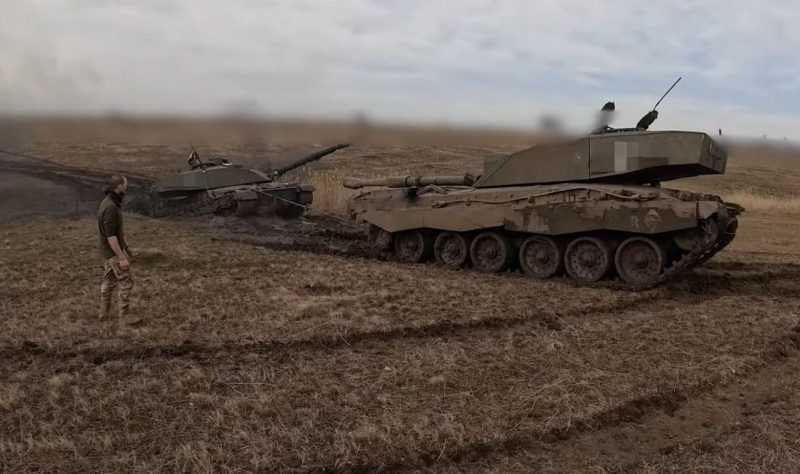
UK-made tank mired during Ukrainian demo for media
RT | March 11, 2024
A Ukrainian tank crew got their UK-donated Challenger 2 stuck in a bog during a special demonstration for a British tabloid, the newspaper has reported.
The incident happened during an exercise The Sun described as being “close to the front line” and within view of plumes of smoke emanating from Russian airstrikes. With its crew atop the turret, the British-made tank attempted to drive through a gully, only becoming stuck at its deepest point.
Images shared by the newspaper showed the vehicle stuck in mud deep enough to fully cover its tracks. The incident confirmed that the British tank’s weight is an issue, The Sun said. An experienced squadron commander “blasted the rookie crew for going too slowly through the gully.”
The newspaper added that the tank team leader “turned the mishap into a training exercise” by calling in a second tank to haul the first one out of the mud.
The report noted Ukrainian praise for the tank’s main gun, but added that the conflict had not given the British military hardware a chance to demonstrate its ability in a classic tank-on-tank battle. Ukraine has been using the armor to target bunkers from a long distance and for charges on Russian trenches.
The maneuvers are a bluff, according to the tabloid, because the tanks “did not have the right type of ammunition for attacking infantry.”
While the British tank is superior to Soviet-made T-80s in many respects, Ukrainian crews told the outlet that they weigh some 20 tons more and have a 30% lower power-to-weight ratio, which limits their maneuverability.
German-made Leopard 2 tanks, which have a similar weight, have also reportedly become stuck in soft ground, according to images shared online.
The Challenger 2s are not only being bogged down, but are breaking down. Five of the 14 tanks donated by the UK are not operational because spare parts can take months to arrive, and Kiev lacks skilled mechanics to maintain them. With battle-damaged tanks accounted for, only half of the UK-donated squadron remain fit for battle.
The British tabloid also reported manpower shortages on the conflict frontline, meaning trained tank crews are forced to dig trenches. Nevertheless, the Ukrainians expressed gratitude to the British government for the tanks and, via the tabloid, asked London to “send more.”
German FM Open to UK’s Taurus Swap Proposal as ‘Option’
By Svetlana Ekimenko – Sputnik – 11.03.2024
German Chancellor Olaf Scholz has repeatedly opposed the idea of supplying Ukraine with missiles capable of striking deep into Russian territory. However, recently UK Foreign Secretary David Cameron expressed London’s readiness to assist Berlin in overcoming any obstacles preventing the delivery of Taurus long-range missiles to the Kiev regime.
Germany’s Foreign Minister Annalena Baerbock is open to her British colleague David Cameron’s suggestion of a swap of long-range cruise missiles for their further transfer to Ukraine, Der Spiegel reported.
In particular, Germany could supply Taurus cruise missiles to the United Kingdom, and in return the British side would transfer Storm Shadow missiles to Ukraine. Thus, Berlin would formally be relieved of responsibility for providing cruise missiles to the Kiev regime, the outlet stated.
“That would be an option,” Baerbock was quoted as saying regarding the proposed exchange on ARD’s program Caren Miosga.
The German minister on Sunday pointed out that exchanges of a similar nature had already taken place with respect to other material. This, according to the outlet, was a nod at Chancellor Olaf Scholz’s previous use of indirect military aid to Ukraine, when he was reluctant to send Leopard 2 main battle tanks to the conflict zone. In January, 2023, Berlin announced it would send its Leopard 2A6 main battle tanks to Ukraine, also agreeing to provide re-export licenses for other countries wanting to supply these German-made armored vehicles. Within weeks of their arrival on the battlefield, Russian forces began hunting the tanks down with missiles and kamikaze drones.
UK Foreign Secretary David Cameron recently came up with a potential way to persuade Germany to supply Ukraine with Taurus missiles. During a recent interview with German newspaper Sueddeutsche Zeitung, he stated that London was ready to help Berlin solve problems preventing the delivery of the cruise missiles to Kiev, or consider the option of buying German missiles and then transferring British Storm Shadow missiles to Ukraine. Cameron did not discount the possibility of imposing certain restrictions before supplying the weaponry to Kiev.
German Chancellor Olaf Scholz has repeatedly dismissed the idea of providing Ukraine with missiles capable of striking deep into Russian territory, as such support would come dangerously close to direct German participation in the conflict.
If the swap scheme of Britain procuring Taurus missiles from Germany in exchange for supplying Storm Shadow missiles to Ukraine comes to pass, Kiev would likely get the long-range missiles eventually, pundits told Sputnik.
The issue of Taurus transfers made the headlines in the wake of a leaked conversation between German military officials discussing a potential attack on the Crimea Bridge.
On March 1, Margarita Simonyan, editor-in-chief of RT and Rossiya Segodnya, Sputnik’s parent media group, published the text of a conversation involving four Bundeswehr representatives discussing a potential attack on the Crimean Bridge with Taurus missiles. The talk, which took place on February 19, involved Inspector of the German Air Force Ingo Gerhartz, Brig. Gen. Frank Graefe, head of the Operations and Exercises Department at the Air Force Command in Berlin, and two employees of the air operations center of the Bundeswehr Space Command.
After the intercepted war talk, German Chancellor Olaf Scholz once again ruled out supplying the missiles to Ukraine since it could require the presence of German troops on the ground to help deploy them. German Defense Minister Boris Pistorius said that long-range Taurus missiles would not be decisive for the conflict in Ukraine and would only help in certain areas, but that Germany does not intend to cross this line.
“We have always emphasized that such long-range missiles will not solve this [crisis],” Pistorius said at a joint press conference with Finnish Defense Minister Antti Hakkanen.
The Kremlin reiterated that the contents of leaked conversations between German officials proved “the direct involvement of the collective West in the conflict in Ukraine.”
In the wake of Ukraine’s bungled counteroffensive, the Zelensky regime has been pressing Germany for the delivery of the missiles, which have a range of 500 kilometers (311 miles) and could strike deep inside Russian territory.
Moscow has repeatedly underscored that Western arms shipments to Kiev and the training of Ukrainian servicemen only prolong the conflict and will be unable to alter the situation at the battlefield.
Polish embassy in US calls warning by Polish-US communities not to engage in ‘unwinnable’ Ukraine war the ‘Kremlin’s rhetoric’
POLSATNEWS | March 11, 2024
Representatives from several Polish-American communities in the United States have sent a letter to the president and prime minister of Poland ahead of their joint visit to the White House, in which they opposed the “deeper involvement of Poland in the war” in Ukraine.
The letter to Prime Minister Donald Tusk and President Andrzej Duda expressed communities’ “firm opposition” to Poland’s further involvement in the conflict and urged Warsaw not to engage in an unwinnable war.
The authors appealed for NATO to remain a defensive alliance, not a “tool for fulfilling the geopolitical ambitions of its dominant members.” They argued that “Poland should not be drawn into or forced into military engagement beyond its borders unless it is first attacked.”
The strong stance against Polish involvement in Ukraine prompted a significant response from the Polish embassy in Washington.
“We are concerned about the content and tone of statements reflecting the Kremlin’s rhetoric,” stated Poland’s Ambassador to the U.S. Marek Magierowski.
The embassy emphasized that “the only way to ensure a peaceful future for Europe and the transatlantic community is by ensuring Russia’s strategic defeat in its war.”
Furthermore, the Polish diaspora was urged to “advocate for our interests, which include further assistance for Ukraine in its defense against Russian aggression.” The embassy also expressed gratitude for the contributions of millions of Poles towards Poland’s integration with NATO.
Andrzej Duda and Donald Tusk are due to visit Washington on March 12.
Trump has plan to end Ukraine conflict – Orban
RT | March 11, 2024
Donald Trump intends to end the Ukraine conflict, if reelected as US president, and has a “detailed plan” to do so, Hungarian Prime Minister Viktor Orban told local media, after meeting the presumed Republican nominee.
The former US leader repeatedly claimed on his campaign trail that, if he had remained in the White House for a second term, there would be no hostilities between Moscow and Kiev. If voted back in, he promises to end the conflict “in 24 hours” by applying pressure on stakeholders.
Orban, who spoke with Trump at the Mar-a-Lago estate in Florida on Friday, did not explain how exactly the American would do that, but said that cutting the flow of US aid was a crucial part of the plan.
”If the US will not provide the money, Europeans on their own will not be able to finance this war, and then the war will end,” Orban said in an interview with M1 broadcaster on Sunday.
During his presidency, Trump had shown himself to be “a man of peace,” the Hungarian leader claimed. That stance puts him in alignment with Hungary, unlike the administration of US President Joe Biden and many members of the EU, he added.
”The American Democratic government and the leadership of the EU, as well as the leadership of the largest EU member states are pro-war governments. Donald Trump is pro-peace, Hungary is pro-peace. At the bottom of everything lies this difference,” Orban declared.
The Kremlin declined to weigh in on the remarks, with spokesman Dmitry Peskov saying on Monday that Orban’s account of Trump’s intentions was too vague for any specific commentary.
Ukrainian President Vladimir Zelensky previously expressed skepticism about Trump’s ability to deliver on the promise. He said if the plan was feasible, the American politician should share it with the public, or at least with Kiev. The Ukrainian government claims that a “just peace” requires a military victory over Russia and that it would agree to nothing short of that.
Moscow has said that its strategic goals in the military operation against Kiev will be achieved one way or another. The US and its allies, who continue to arm Ukraine, cannot change that outcome and are only prolonging the suffering of the country’s people, Russian officials have stated.
Missiles near Russia, F-35s with thermonuclear bombs… Is NATO ready for war?
By Drago Bosnic | March 11, 2024
NATO’s never-ending encroachment on Russia’s borders is breaking world records in mere days. Just last week, a new major airbase was opened in Albania, despite the fact that Tirana effectively has no air force. NATO was also given full exterritoriality rights, meaning that Albania officially gave up on its already highly dubious “sovereignty”. Deployment of major ISR (intelligence, surveillance, reconnaissance) and strike platforms in the area can certainly bolster the belligerent alliance’s highly destabilizing presence in both Southeastern and Eastern Europe. And yet, this is not enough. Namely, on March 7, Lithuanian Defense Minister Arvydas Anusauskas confirmed that NATO would also station “Patriot” SAM (surface-to-air missile) systems in his country. While Lithuania doesn’t border mainland Russia, it has an extensive border with Belarus and Moscow’s Kaliningrad oblast (region).
“This year, the rotational air defense system will finally become operational, at least partially,” Anusauskas stated at a press conference in Vilnius, adding: “Our goal is to have a rotation similar to the air policing mission… This principle would not be a one-off thing for several months but would cover all of our calendar months and significantly increase our air defense capabilities.”
While the “Patriot” has been intentionally overhyped by the mainstream propaganda machine, particularly with laughable claims of shooting down “half of the Russian Aerospace Forces in a week”, the move can certainly be considered highly destabilizing. It’s not yet clear how many of these systems could be deployed, but given the much smaller distances that it needs to cover than in Ukraine, deploying the “Patriot” in any of the Baltic states can certainly be more consequential. Namely, the detection range of its AN/MPQ-65 radar (officially 150 km) could provide coverage into the airspace of both Belarus and the Kaliningrad oblast. In addition, Finland is acquiring similar, albeit more advanced air defense assets, including the Israeli “David’s Sling”, which has a significantly longer maximum engagement range. Amassing such SAM systems so close to Russia’s northwest is deeply destabilizing and antagonistic.
While other NATO member states in the relative vicinity of Russia’s borders also operate “Patriot” SAM systems, most notably Romania and (soon) Poland, both of these are far enough not to make the air defense system a strategic issue. On the other hand, other much longer-range weapons, such as the “Aegis Ashore” ABM (anti-ballistic missile) systems, are set to become fully operational in Poland in 2024, while another is already active in Romania (since at least 2016). It’s part of the wider ship-borne “Aegis” system that provides a level of strategic depth that neither the “Patriot” nor “David’s Sling” could. And while the system’s capabilities and effectiveness are certainly up for debate (particularly against Russian hypersonic missiles), the massive increase in their presence is of quantitative importance, which could at least partially ameliorate their qualitative shortcomings and other deficiencies.
And yet, this certainly isn’t the end of NATO’s highly destabilizing activities in Europe. Namely, its vassals and satellite states such as Finland are acquiring the F-35s, while also making it possible to accommodate other jets of the same type from the United States and other NATO member states. The forward presence of USAF F-35s in Eastern and Central Europe keeps expanding and getting ever closer to Russia. Apart from Finland, it now includes Germany, Czechia and Poland, while the Dutch, Belgian and Italian F-35s will also be forward deployed to the area around the Baltic Sea. Worse yet, the jet has been certified to carry thermonuclear weapons, specifically the B61-12 bomb, with several NATO members having the ability to use them through nuclear sharing agreements with the US. This includes the Netherlands, Belgium, Germany and Italy, all of whom either operate F-35s or have them on order.
Namely, on March 9, the F-35 was confirmed to be certified to carry B61-12 thermonuclear gravity bombs. Although this refers only to the conventional F-35A, with F-35B and F-35C variants still lacking such capabilities, the latter two are deployed in much smaller numbers. The conventional F-35A is the most common version used by the USAF and other NATO air forces. The possibility of their large-scale deployment in Finland and the Baltic states gives the US premier strike capabilities, far greater than Russia ever had in Cuba 60 years ago.
What’s more, both high-ranking officials in Moscow and independent experts regularly warn about the development of new thermonuclear weapons in America, including the so-called “nuclear super-fuse” technology that the US has been testing for decades, particularly under the Obama administration. Investigative historian Eric Zuesse wrote extensively on the topic.
He has repeatedly been warning that the sole purpose of this controversial technology is to exponentially amplify the effectiveness of America’s first-strike capabilities. And while some might discard Zuesse’s warnings and even decry them as “doom and gloom fantasy” or the mythical “Russian disinformation”, recent developments only reinforce his already sound hypothesis. What’s more, NATO is directly involved in these plans. Back in October last year, the belligerent alliance concluded the “Steadfast Noon” nuclear exercise involving approximately 60 aircraft, including nuclear-capable F-16s and B-52 strategic bombers simulating strikes with B61-12 bombs. It should be noted that these bombs will also be augmented by the upcoming B61-13 variant. And although the nature of this upgrade is classified, it’s safe to assume that they will also include the aforementioned “nuclear super-fuse” technology.
The Pentagon already announced that these new thermonuclear bombs will be comparable to the B61-7 version that can have a yield of up to 340 kt (roughly equivalent to 22-23 Hiroshima bombs). Faced with such escalation, Russia doesn’t exactly have a lot of choice but to be prepared. This is precisely why Russia has been conducting nationwide drills simulating an all-out nuclear attack, as well as its own retaliatory strikes on the aggressors. Earlier, the US FEMA (Federal Emergency Management Agency) conducted similar warning exercises.
Drago Bosnic is an independent geopolitical and military analyst.
What the Western Press Didn’t Say About the Leaked Luftwaffe Conversation
By Eduardo Vasco | Strategic Culture Foundation | March 8, 2024
On March 1, the editor-in-chief of the Rossiya Segodnya group, journalist Margarita Simonyan, revealed, on her Telegram channel, a 38-minute audio in which officers from the German Air Force (Luftwaffe) discussed the possibility of sending missiles long-range Taurus to Ukraine and whether they would be able to reach the Crimean bridge in the Kerch Strait, which connects the peninsula to the mainland and is Russian territory.
The Russian press, naturally, made much of the revelation. This forced the mainstream Western media – especially German ones – to report the leak. But whoever thought that a miracle would happen, that is, that the Western press would finally raise the issue of NATO’s military threats against Russia… well, those people are simply very naive.
The Western mass media, as always, tried to manipulate the news and hide the main issue.
The New York Times, The Washington Post, BBC, The Guardian, Die Welt and Der Spiegel published 39 articles on the topic on their respective websites between the time the news was revealed and the evening of March 6th (when I write these lines).
The two North American newspapers did not want to highlight the matter. The Post published two reports and the Times only one. The three expressed concern about the fragility of German intelligence security systems in the face of Russian espionage.
The Europeans, as has been the case for some time, carried much more propaganda against Russia. The BBC published four articles, all referring to the failure to protect Luftwaffe communications. The Guardian published five articles. The majority warns of the Germans’ failure and treats the Russians as great, threatening villains. However, it is necessary to make an honorable mention of Simon Jenkins’ column, the only one who was allowed to say that the leaked conversations demonstrate that NATO is threatening Russia with an escalation in the conflict.
As we all know, this drop of water in the middle of the ocean has no chance of counterbalancing the flood of war propaganda and fake news from the British press against Russia. Newspaper owners only allow freedom of expression when it is harmless – and try to isolate minimally independent opinions.
Now let’s talk about German newspaper coverage. Die Welt published 18 pieces about the leak scandal, and treated it as such. Of course, the main reason for the scandal was – for German war propagandists – the interception and dissemination of the conversation, not its content.
The entire reportage of Die Welt revolves around failures in the security system of the German armed forces and Russian espionage. The possibility of Olaf Scholz sending the Taurus to Zelensky is briefly discussed and it is even stated that Germany is putting its Western allies in danger by allowing the interception of conversations that may mention confidential and compromising information – such as the participation of British soldiers in Ukraine, as mentioned in the conversation in question.
A single Die Welt report presents a “dissident” opinion, which is not “Russian propaganda”: the brief speech of a member of the AfD – who, however, is branded a Russian agent by the German state and its agents, such as the press.
The article signed by Pavel Lokshin has the following title: “Kremlin is using Taurus leaks to threaten war against Germany”. Of course, it was the Russians who considered blowing up a bridge in German territory, right?
In turn, Der Spiegel, in its nine articles on the case, reproduces the same speech as Die Welt about the failures in German security and the danger of Russian espionage. It also disqualifies the Kremlin’s claims that the conversation is clear proof of NATO’s direct involvement in the war in Ukraine and how much this threatens Russian national security.
Christina Hebel’s analysis is the only piece in these two German outlets that takes the accusations of the Russian government and German involvement in the war more seriously, but it would be an exaggeration to say that this publication would be in the sphere of journalism.
In short, the coverage of these newspapers – and the coverage of other mass media outlets in the West is no different – is absolutely biased and manipulated. In fact, as always happens, they reverse roles: Germany, which threatened to blow up a bridge in Russia, is the victim, while Russia is the villain!
If at least one of these newspapers really were a journalistic tool, and not a propaganda tool, it should publish an article with a title like “German officers considered blowing up bridge in Russia” or “Audios reveal discussion of attack on Russia with German weapons”.
After all, which is more serious: the leak of the audio by Russian intelligence or the discussion among senior German officials about a military attack on Russia? No honest person would choose the first option. But we are not dealing with honest people when we talk about “journalism” in Europe and the United States.
I can’t help but wonder: what if it were the other way around? What if a conversation between Russian officials discussing the explosion of a bridge in Germany had been revealed? Would Western press coverage also treat the leak as something more serious than threats of military attack?
Of course not! If it were Russia considering attacking Germany, there would not be 39 articles in these vehicles, but rather 3,900. Russia would be portrayed as a threat to human civilization (more so than it is portrayed today), chaos would be wreaked in German and Western society, and the drums of war against Russia would be beaten at the top of their lungs. Meetings would be urgently called at the UN Security Council, unilateral sanctions would increase absurdly, all the lackey governments of the USA and the European Union would speak out publicly condemning Vladimir Putin’s madness.
They are real hypocrites. Against Russia, anything goes.
And, although the majority of these media outlets are private, they all act as government bodies, under the strict control of their respective States, as true spokespeople for those in power. But Russia is the one who controls the press, Russia is the one spreading propaganda and Russia is the one disinforming, right?
The leaked audio proves that the war in Ukraine is not a war between Russia and Ukraine, but rather a war between Russia and NATO. The Western press strengthens this claim by propagandizing war against Russia and encouraging attacks against Russia.
The press, according to Western discourse, would be a protector of the public interest against the discretion of those in power. That’s idle talk. The press, in fact, even private companies, are tools of these same rulers to control and oppress the governed.
A growing number of Germans oppose the shipment of weapons to Ukraine and Germany’s participation in a war against Russia, but they are systematically deceived and betrayed by their government and the mass media.
Featured Video

Matt Bracken: US Plans Massive MOAB Strike on Iran?
or go to
Aletho News Archives – Video-Images
From the Archives
Confronting the Threat of Ethnic Bioweapons
By Tony Cartalucci – New Eastern Outlook – 29.11.2017
The United States Air Force’s 59th Medical Wing’s molecular biology branch recently was revealed to have been collecting specifically Russian RNA and synovial (connective) tissue samples, prompting fears in Russia of a possible US directed ethnic-specific bioweapons program. … continue
Blog Roll
 Aletho News
- Matt Bracken: US Plans Massive MOAB Strike on Iran?
- Russia accuses France of ‘piracy’ over tanker seizure
- Why Yemen Is Bombing Saudi Arabia’s Airports: The War Behind the Headlines
- Sally Rooney’s books pulled from UK over support for Palestine Action
- Bombs for Tel Aviv, Promises for Riyadh
- Israeli ad agency conducted vast global espionage campaign using online ads: Report
- Oct. 7 Forever Marks The Big Reveal: ‘We See You, Israel, We Revile You, We Reject You!’
- Meet the US generals and admirals advancing Israeli policy
- Israel’s Straw Widow Protocol: The Kill Zones Where Civilians Were Labelled ‘Terrorists’
- Leading Israeli Think Tank Publishes Psychotic Israeli ‘National Security’ Doctrine
- If Americans Knew
- Israeli firm used online ads to run vast spy operation, researchers say
- No, the world zionist movement is not an antisemitic conspiracy theory
- Hundreds of IDF investigations into killings still have no public outcome, BBC Verify finds
- After Ashley Moody Epstein Probe, Donors Linked to Him Poured Money Into her Senate Campaign
- Worried about Russian meddling in UK politics? Wait till you see what Israel is up to
- Israeli settlers attack West Bank center for disabled children, church leader calls for int’l action
- Pulling Out Teeth Just to Live: How Israel Has Devastated Dental Care in Gaza
- Gaza’s “ceasefire” death toll passes 1,500 – Daily Update
- Activists Abused By Israel Return to New Freedom Flotilla Mission
- 60 Minutes won’t tell the full truth about Israeli settler violence
- No Tricks Zone
- New Study Suggests Large Regions Of The Pacific Ocean Have Been Cooling For The Last 80 Years
- Germany’s Green Energy Debacle: High Energy Costs Force Kahla Porzellan to Close After 182 Years!
- New Study: 50 Years Of The Most Aggressive ‘Net Zero’ Policies Can Only Affect The Global Climate By 0.03°C
- US September “Heat” Was No Record…Many Records Set Decades Ago
- Latest European Green Energy Debacle; Portugal’s Largest Flagship Solar Park Insolvent!
- Green Energy Debacle: German Expert Professor Fritz Vahrenholt Warns Of Severe Economic And Social Consequences
- Two More Paleo Reconstructions Affirm Meters-Higher Sea Levels Across Ireland, Brazil 7000-6000 Years Ago
- New Study: Earth And Venus Surface Warmth Largely Explained By Convection And Lapse Rate, Not CO2 Or Radiation
- 2025 Nature Paper Claiming Worsening Global Drought Gets RETRACTED …Heavily Flawed
- New Study: ‘Global Drought Shows No Detectable Recent Acceleration Under Climate Warming’

