Biden rival labels F-16s for Ukraine ‘a disaster for humanity’
RT | August 20, 2023
The looming delivery of US-made F-16 fighter jets to Ukraine will not prevent the “collapse” of the country’s military and will only benefit the military-industrial complex, Democrat presidential hopeful Robert F. Kennedy Junior has claimed.
The Ukrainian conflict should be resolved through negotiations, RFK Jr. argued in a thread on social media platform X (formerly Twitter), stating that supplying F-16s to Kiev was a “great decision for the defense industry, but a disaster for Ukraine and humanity.”
“F-16s won’t stop the collapse of the Ukrainian military (which some experts say is imminent). These planes require a lot of training and maintenance. This isn’t the movies,” Kennedy stressed.
The presidential hopeful has long-opposed the enduring Western aid to Ukraine, spearheaded by Washington, arguing that the US should admit its “failure” in the country and focus on domestic issues instead. Kennedy’s criticism of the fighter-jet delivery comes after Washington enabled its European allies to re-export older planes to Ukraine, and hours before the move was officially announced by Denmark and the Netherlands.
The upcoming delivery was heralded by Dutch PM Mark Rutte on Sunday as he hosted Ukrainian President Vladimir Zelensky at a military airbase in Eindhoven.
“Today we can announce that the Netherlands and Denmark commit to the transfer of F-16 aircraft to Ukraine and the Ukrainian Air Force, including cooperation with the United States and other partners once the conditions for such a transfer have been met,” Rutte said at a press conference.
Simultaneously, the Danish Ministry of Defence released a statement confirming its pledge to provide Kiev with F-16s from its inventory, once certain “conditions” are met. The conditions “include, but are not limited to, successfully selected, tested and trained Ukrainian F-16 personnel as well as necessary authorizations, infrastructure and logistics,” it said.
Kiev has long-demanded modern aircraft, as well as other, increasingly sophisticated weaponry, from its Western backers, arguing the planes would help it turn the tide of the conflict with Russia, which has been going on since February 2022. Moscow has repeatedly urged the collective West to stop the military deliveries, arguing they would only prolong the hostilities rather than change their ultimate outcome.
US Policymakers Are Caught In A Dilemma Of Their Own Making After The Failed Counteroffensive
BY ANDREW KORYBKO | AUGUST 20, 2023
Politico reported on Friday that US policymakers are starting to wonder whether “Milley had a point” when he suggested that last November was a good time to resume peace talks. Kiev had just reconquered the western half of Kherson Region less than two months after expelling Russian forces from the rest of Kharkov Region. Furthermore, the coming winter was bound to force a de facto freeze along the frontlines. In hindsight, Ukraine’s negotiating position was the strongest it had ever been.
Instead of seizing the opportunity, the decision was made to prepare for summer’s counteroffensive, which spectacularly failed and has recently sparked a vicious blame game between those responsible for this disaster as reported by two leading US outlets last week. Russian Foreign Minister Lavrov reaffirmed several days back that the US is obsessed with dealing a strategic defeat to Russia, hence why it’s not interested in peace, yet Politico’s latest piece hints that its calculations might be changing.
According to them, one of their unnamed official sources lamented that “We may have missed a window to push for earlier talks” in spite of paradoxically insisting that there aren’t any regrets about the counteroffensive. Another such source went even further by claiming that the Biden Administration is now asking itself the following question: “If we acknowledge we’re not going to do this forever, then what are we going to do?”
Politico then reminded their readers that these views are being shared shortly after the Washington Post revealed that “U.S. intelligence says Ukraine will fail to meet offensive’s key goal”. Although not mentioned in their article, all of this occurred during the same week that a leading NATO official proposed that Ukraine formally cedes its former regions to Russia in exchange for joining that bloc. They retracted their idea shortly after, but it still made observers suspect that the West is becoming fatigued.
NATO’s “race of logistics”/“war of attrition” with Russia that Secretary General Stoltenberg declared in February is taking its toll as Moscow’s edge grows in parallel with the depletion of the West’s stockpiles. The frontlines still remain largely frozen due to the counteroffensive failing to break the stalemate that set in since November, but there are now reports that Russia might be preparing for its own offensive sometime this fall that could capitalize on the aforesaid to scale into a full-blown campaign by spring.
President Putin’s series of reminders two months ago that Russia is still sincerely interested in a political solution to this conflict might become irrelevant if he decides to seize the opportunity presented by the counteroffensive’s spectacular failure to militarily ensure his side’s objective national security interests. At minimum, the Kremlin seeks to obtain full control over the entirety of those four former Ukrainian regions that unified with Russia last September, but its forces might have to go further to guarantee this.
After all, Kiev’s NATO-supplied artillery, drone, and missile arsenals can still threaten those regions’ residents even if they’re deployed far away from the frontlines, thus compelling Moscow to advance deeper into the Ukrainian hinterland in order to carve out a buffer zone for protecting them. The further that Russia moves in that direction, the more hysterical NATO will become, which could lead to the bloc as a whole escalating or some of its members like Poland unilaterally intervening to stop the tide.
In any case, the preceding scenario spikes the risk of a larger war by miscalculation, which both sides presumably want to avert. Therein lies the rationale behind US policymakers starting to wonder whether it’s time to consider a compromise before it’s too late, the thoughts of which were unexpectedly voiced by that previously mentioned leading NATO official who later retracted their proposal under pressure. Despite the Biden Administration denying that any such plans are in the cards, Kiev became spooked.
Many of its lawmakers from different factions united in the aftermath of last week’s scandals to table a resolution prohibiting territorial concessions, which will likely pass just like last fall’s similar such one prohibiting Zelensky from negotiating with his Russian counterpart. Neither parliamentary reaction would have happened if the Rada sincerely had faith that the US wouldn’t ever coerce Ukraine into walking back its maximalist demands for ending the conflict.
Unlike then, this scenario is now more realistic than ever as evidenced by last week’s spree of reports aimed at preconditioning the public to accept the possibility of a compromise for resolving the NATO-Russian proxy war in Ukraine before its cycle of self-sustaining escalations spirals out of control. If the political will is present on both the American and Russian sides, then it’s possible that they could reach a deal, but this can’t be taken for granted due to the dilemma that US policymakers inadvertently created.
Despite Politico reporting that officials are now wondering whether “Milley had a point” about last November being a good time to resume peace talks, politicians might fear the public’s wrath if they do so now after all that was spent on the counteroffensive for nothing. Moreover, Ukraine and the West’s newfound military-political weaknesses that were brought about by this debacle might have made Moscow disinterested in peace talks for the time being if it already decided on another offensive.
Each therefore has their reasons for staying the course: America wants to “save face” after this summer’s disaster while Russia might want to seize the aforesaid opportunity to militarily ensure its minimum national security interests by obtaining full control over the entirety of its new regions. That said, the first’s motivations relate to an intangible interest of dubious importance and are therefore negotiable, while the second’s concern a tangible issue of premier importance and thus aren’t negotiable.
Accordingly, the only way to reduce the risk of a larger war by miscalculation is for the US to make concessions on its abovementioned intangible interests in order to meet Russia’s tangible ones, which is likely one of the possibilities being discussed during their reportedly ongoing informal negotiations. In the event that an understanding is reached, then it could take the form of the US pulling Kiev’s strings (possibly through threats of curtailing arms shipments) to coerce it into informally accepting a ceasefire.
Just like it can’t be assumed that America and Russia both have the political will to agree to this, nobody should take for granted that Kiev would go along with it even if those two reach a related deal, not to mention Poland. Each has their own reasons not to, which thus results in a multidimensional dilemma that’ll likely necessitate the US having to practically force those latter two to comply if it’s to stand any chance of success, though it’s also difficult to imagine that happening too.
The takeaway is that US policymakers are now caught in a quandary completely of their own making, which lessens the odds of a political solution to the NATO-Russian proxy war materializing anytime soon and correspondingly spikes the risk of a larger war by miscalculation. Unless the US accepts that it’ll have to sacrifice its soft power by forcing Kiev and Poland to freeze the conflict against their will, which first requires accepting the loss of its unipolar hegemony, then the worst-case scenario can’t be ruled out.
US, Ukraine Split Over Counteroffensive, Washington Braces for War of Attrition – Reports
Sputnik – 20.08.2023
Tensions are mounting between officials in Washington and Kiev over Ukraine’s strategy in the counteroffensive, with the United States seemingly girding for a war of attrition amid limited results on the battlefield, the Western media reported on Sunday.
US officials reportedly urged Ukraine to stop avoiding risks and make full use of its forces in the south. Washington also advised Kiev against concentrating its main forces in the eastern direction, but Ukraine instead sent its best units there, the newspaper said.
The report added that US officials are privately preparing for a war of attrition in Ukraine, which may last into 2024, while they continue to publicly reiterate support for Kiev’s counteroffensive.
Republican Congressman Andy Harris, a co-chair of the Ukraine Caucus in the US House of Representatives, said at a meeting with voters earlier this week that the counteroffensive “failed” and that aid to Kiev should be slashed, the report said. He also expressed doubt that the conflict is “winnable” for Ukraine.
Earlier this week, US magazine reported that the Ukrainian political leadership was allegedly misled by the military command on the true scale of Ukraine’s losses in the counteroffensive.
Ukraine launched its much-touted counteroffensive in early June after multiple postponements. Citing the counteroffensive’s needs, Kiev pushed its Western donors to step up the military and financial aid. According to the Russian Defense Ministry’s estimates, as of August 4, Ukraine’s losses in the counteroffensive were about 43,000 troops and 4,900 units of military equipment.
German Long-Range Taurus Missiles Won’t Be Wunderwaffe Ukraine Is Looking For
By Ilya Tsukanov – Sputnik – 19.08.2023
Berlin has joined Washington in climbing up the escalation ladder in the proxy war against Russia in Ukraine, sending more military aid to Kiev than any other country besides the US. Germany has also borne the brunt of the West’s economic war against Moscow, with its economy sinking into a recession and facing the threat of deindustrialization.
A majority of Germans are opposed to sending Taurus KEPD 350 air-launched long-range cruise missiles to Ukraine, with a fresh poll finding while 36 percent are in favor of their delivery, 52 percent are opposed, with support falling to just 21 percent among residents of eastern Germany.
Despite opposition, German Finance Minister Christian Lindner and other members of Chancellor Olaf Scholz’s government have expressed support for delivering the missiles this week, with Lindner saying a decision on the matter would be reached “faster and at shorter notice” than in the past.
German media first reported on talks to send Taurus missiles to Kiev last week, saying the chancellor’s office was hoping to make changes to the missiles’ programming to prevent Ukraine from using them to attempt strikes deep into Russian territory.
Previous assurances in this vein by the US and other NATO powers have turned out to be empty promises, with Ukraine’s military eagerly using its Western-provided military hardware including artillery, missiles and drones to strike Russia, and to indiscriminately fire on cities and settlements in the Donbass.
“As in the past, we will always check every single decision very carefully,” Scholz told reporters last week when asked about the Taurus missiles’ delivery.
These “very careful” checks have already seen Germany send some €7.5 billion ($8.15 billion) in weapons to Ukraine over the past year-and-a-half, the second-largest amount only behind the United States. Berlin has already approved sending over 260 Leopard 1 and Leopard 2 tanks, including from its own armories and those of other European NATO allies, plus Gepard self-propelled anti-aircraft guns, MARS rocket artillery systems, Panzerhaubitze 2000 self-propelled howitzers, Marder infantry fighting vehicles, Bergepanzer armored recovery vehicles, Panzerfaust RPGs and billions more in other weapons, support equipment, ammunition and supplies.
What distinguishes the Taurus cruise missile is its range and firepower. The €950,000-a-piece bunker buster munition has a 481 kg warhead, and an operational range of over 500 km, making it a standoff weapon which, in the wrong hands, could turn into a tool for terror bombings.
No Wonder Weapon
“The long-range Taurus cruise missiles are an advanced high-precision unmanned weapon system, but they are not a wonder weapon,” AfD European Parliament MEP Gunnar Beck told Sputnik.
“They will add to Ukraine’s military capability, but not decisively,” the lawmaker, who serves as vice president of the European Parliament’s Identity and Democracy fraction, said.
Instead, “the delivery of these missiles is significant in that it marks a further escalation of the conflict, leading perhaps to the delivery of other weapons with greater and more decisive offensive capability. That, to me, is the danger here,” Beck stressed.
The lawmaker noted that the danger of Ukraine using Taurus missiles against Russian territory is “the main point of controversy,” with government assurances that this won’t take place of little comfort to ordinary Germans.
“The German government says it would like to prevent Ukraine from using the missiles against Russian territory. However, this is just fanciful talk. In practice, Germany cannot do anything to prevent Ukraine from using the missiles as they like,” Beck said.
“Most Germans do not wish to be drawn into a major international conflict with Russia,” the AfD lawmaker emphasized. “This is particularly true of East Germans who still appreciate that without Russian blessing reunification could not have been achieved 33 years ago.” Most Germans “simply do not believe that Russia and President Putin are a real threat to Germany today. That is my own personal view too. Ordinary Germans have less to fear of Russia today than it has from the EU, their own government and any of the major political parties within Germany itself.”
Amid the Ukrainian crisis and economic downturn, Beck’s party has seen a major surge in support, with recent polling indicating it would win up to 18 percent of the vote if elections were held today – on par with Chancellor Scholz’ Social Democrats. The growing prominence of the upstart opposition party and its social conservative, Eurosceptic brand of populism has led to debate inside the German political establishment on whether it should be banned as an “extremist” organization.
Beck emphasized that notwithstanding the “relentless” “anti-Russian propaganda” in German media, many Germans, especially in the east of the country, “have lost faith” in Scholz’s coalition, and “cannot remember when their government last did something for them.” Instead, half of Germans “now regard their political elite as just the executor of the aims and objectives of large multinationals and foreign powers – very well-paid executors at that,” the lawmaker summed up.
Germans Don’t Want Nuclear War With Russia
Dan Kovalik, a US-based human rights and labor rights lawyer and peace activist, echoed Beck’s sentiments on the implications and dangers of the Taurus missiles’ potential delivery to Kiev.
“I think Russia is about to destroy the Ukrainian military and probably the Ukrainian state as it exists, and that’s just a fact. I don’t think the missiles will change that. Of course, what they could do is allow Ukraine to fire more into Russian territory in a more destructive way than they are now with drones, which of course presents a great danger of escalating this conflict into a major world war, possibly even into a nuclear conflict. That’s why I think the German people are against this,” Kovalik stressed.
“Of course, Germany and Russia have been through two world wars against each other, and I don’t think either wants to repeat that,” the observer added.
Western calls for Ukraine peace talks a ‘tactical ploy’ – Moscow
RT | August 19, 2023
The US and its allies do not want the Ukraine conflict to end and their purported peace initiatives are merely attempts to buy Kiev time, Russian Foreign Minister Sergey Lavrov said in an interview published on Saturday.
Geopolitical issues need to be discussed “not with [Ukrainian President Vladimir] Zelensky, who is a puppet in the hands of the West, but directly with his masters,” Lavrov said earlier this year. Negotiating directly with the Americans would make sense, he told the magazine International Affairs when asked about the idea.
“The problem, however, is that the United States has no intention of ending the conflict,” Lavrov explained, noting that “their officially declared objective is to inflict a ‘strategic defeat’ on Russia.”
Prospects for negotiations between Russia and the West “are non-existent at this stage,” Lavrov said, while Kiev “Western sponsors are constantly pushing them to up the ante.”
Insisting on Ukrainian President Vladimir Zelensky’s so-called ‘peace formula’ at meetings in Copenhagen and Jeddah – to which Russia was not invited – “hardly demonstrates an intention by the West to negotiate with Russia,” Lavrov said. Moscow has dismissed Zelensky’s ten-point list of demands as an unacceptable ultimatum unrelated to reality.
Russia has repeatedly tried to negotiate, from the 2014 and 2015 Minsk agreements to the “drastic attempt to convey our concerns to Western capitals” in December 2021, Lavrov noted. The West “arrogantly rejected” Moscow’s initiative and ramped up deliveries of weapons and ammunition to Kiev instead.
“We regard the Westerners’ hypocritical calls for talks as a tactical ploy to buy time once again giving the exhausted Ukrainian troops a respite and the opportunity to regroup, and to send in more weapons and ammunition,” Lavrov said, adding that “this is the path of war, not a peaceful settlement process.”
Angela Merkel, the former chancellor of Germany, admitted last December that the 2015 Franco-German proposal in Minsk was “an attempt to give Ukraine time” to build up its military. This was then confirmed by former French President Francois Hollande.
Lost Cause Is in the Air
By William Schryver – imetatronink – August 18, 2023
Back in February, I wrote what was and will likely remain the longest blog post I have authored. (I solemnly promise not to do such a thing again.)
Among other things, I observed:
“… the milieu of the past several weeks, during which time we have observed a pronounced rhetorical revolution in the popular western narratives regarding the NATO/Russia war in Ukraine.
“Lost cause is in the air. Many who have privately known this to be the case for some time have finally been sufficiently emboldened to publicly embrace the obvious — albeit reluctantly, and often with a good measure of rationalization and lingering misinformation in tow.”
Of course, at that point in time, the pivotal Battle of Bakhmut had not reached its inevitable conclusion, and the dream of a decisively triumphant Ukrainian march to Crimea was still cherished fondly by those partial to that cause.
As per usual, my sense of the trajectory of events anticipated something that would still take some time to be realized in full.
In any case, lost cause is now acrid in the late summer air of August 2023 — cordite, sulphur, and putrefied flesh.
Chagrined accounts of Ukrainian slaughter and woe are now rippling through the mainstream western media, and spilling off the lips of the “credentialed commentariat”.
It has become the pitiless massacre many of us predicted all those months ago.
And, of course, it never had a chance to be anything else.
What were they thinking?!
How did the Imperial Masters of War ever persuade themselves that their money, weapons, several thousand mercenaries, and a large fraction of the male population of Ukraine could defeat Russia in a high-intensity industrial land war on its borders?!
Did they really believe NATO armaments, training, intelligence, surveillance, planning, command, and impotent economic sanctions would be sufficient to defeat a resurgent Russia in 2022 and beyond?
I think they almost certainly did. Hubris and its attendant delusions are staples of end-of-empire epochs.
Of course, they’re going to try to spin this major geostrategic defeat such that its true realities, causes, and consequences are obscured. Already they’ve been working overtime to subtly dismiss the obvious conclusion that Russia is simply too strong and capable to defeat militarily.
I’ve noted the recurring talking point that the repulse of Ukraine’s offensive is being attributed to Russia’s supposedly archaic employment of “minefields and trenches” in a complex array of static defense lines.
Somehow they neglect to mention the overwhelming dominance of Russian artillery, its dizzying array of battlefield attack drones, its air superiority, its first-rate motorized infantry maneuver, and its relentless long-range precision missile strikes on rear-area logistical targets.
The simple fact of the matter is that, not only was defeating Russia beyond the capacity of the Mother of All Proxy Armies NATO built in Ukraine, it would likewise defy the never-yet-demonstrated and effectively fictitious American “mastery” of what the Pentagon has fancifully termed “combined-arms operations”.
Of course, that doesn’t mean the damn fools aren’t still stupid enough to try.
Either way, as I wrote in my previous post:
Matters have reached the point where the imperial masters will be forced to choose between a humiliating disengagement and abandonment of Ukraine to its fate — or otherwise blunder into a calamitous direct military intervention.
I continue to be convinced they won’t go there. And for the sake of the bereaved mothers, widowed wives, and fatherless children of the young American men who would be compelled to act out the catastrophe, I sure hope I’m right.
The Anglo-American War on Russia – Part Nine (Preparing a Nuclear Attack)
Tales of the American Empire | August 17, 2023
The United States spent over a trillion dollars the past two decades to prepare for a surprise nuclear strike on Russia. The United States withdrew from major arms control treaties and built newer and more accurate nuclear missiles. It built missile bases in Poland and Romania and hundreds of new submarines and destroyers to launch cruise missiles or long-range anti-missile missiles.The United States Army and Navy developed, tested, and deployed mobile missile launchers to Europe while Generals insist they have the right to deploy such systems on Russia’s borders, to include inside Ukraine and Finland. This was barely reported in America’s corporate media, which spews constant propaganda about Russian threats to prepare the public for nuclear war.
_________________________________
Related Tale: “All Nuclear Weapons Are Illegal”;  • All Nuclear Weapons Are Illegal
“America’s Secret Planned Conquest of Russia”; Washington’s Blog; December 29, 2016; https://archive.ph/TR1qG
“Navy Unveils Truck-Mounted SM-6 Missile Launcher in European Test”; Joseph Trevithick; The War Zone; September 14, 2022; https://www.thedrive.com/the-war-zone…
“Army Fires Tomahawk Missile From Its New Typhon Battery In Major Milestone”; Joseph Trevithick; The War Zone; July 3, 2023; https://www.thedrive.com/the-war-zone…
“Dr. Strangelove”; movie clip of a psychopathic American General advocating a massive nuclear attack on Russia; • Dr. Strangelove (1964) – General Turg…
“Putin’s Warning”; plea to reporters at the 2016 International Economic Forum to tell the truth; • Putin’s Warning: FULL SPEECH
Related Tales: “The Anglo-American War on Russia”; • The Anglo-American War on Russia
Diplomacy with Russia necessary for Europe – former French President
By Lucas Leiroz | August 18, 2023
Showing realism and willingness for dialogue, former French President Nicolas Sarkozy strongly criticized the West’s stance on the Ukrainian crisis and demanded more diplomatic efforts. For the former politician, it is necessary for Europeans to live peacefully with Russia, as it is not possible to continue a policy of confrontation and aggression in the long term.
Sarkozy’s criticisms were made during an interview with the French newspaper “Le Figaro”. He spoke with journalists about possible solutions to the current conflict in Ukraine and endorsed the need to pursue peace through diplomacy. Sarkozy condemned the policy of prolonging the war through unlimited military assistance to Kiev, which has been one of the main points of Emmanuel Macron’s foreign policy.
For Sarkozy, Macron failed to continue to deal with the reality of the conflict mainly “due to pressure from [some] eastern Europeans”. Last year, Macron was severely slammed by Polish leader Mateusz Morawiecki because he was trying to negotiate with Moscow in the early weeks of the special military operation. In May 2022, Morawiecki compared Macron’s stance to an “attempt to negotiate with Hitler”. Sarkozy sees this event as an important point of international pressure, boosting Macron’s decision to adhere to the policy of unlimited support to Kiev.
The former president also negatively assessed the project of Ukrainian membership in the European Union. For him, these plans are merely “fallacious promises that will not be held”. Sarkozy compared the Ukrainian access to the Turkish one, making it clear that in both cases the projects are unlikely to succeed.
Also, Sarkozy emphasized the importance of maintaining good relations with Russia due to the geographical factor. Considering the proximity between the EU and Russia, it is necessary that both sides are diplomatically close, without friction and conflicts. Sarkozy admits that the confrontation with Russia is only of American interest, not European, and therefore there must be a reformulation of Europe’s Ukraine policy.
“Russia is a neighbor of Europe and will remain so (…) In this regard, European interests are not aligned with American interests. We cannot stick to the strange idea of ’fighting a war without fighting”, he said.
Another subject commented by Sarkozy was the territorial issue. For him, peace negotiations will have to deal rationally with the possibility of recognizing Crimea and Russian historic territories. Sarkozy states that with Ukraine’s impossibility to win the war, there are only two alternatives: freeze the conflict or recognize the territorial loss. The first option seems inadequate because a new war situation would arise in the future, while on the other hand the recognition of territories can be legitimate, if done by referendum with international observers.
“When it comes to this territory (Crimea), which was Russian until 1954 and where a majority of the population has always felt Russian, I think any step back is illusory (…) If the Ukrainians do not completely manage to win them back, then the choice will be between a frozen conflict – which we know will inevitably lead tomorrow to a new hot conflict – or we can come out on top by resorting, again, to referendums strictly supervised by the international community to settle these territorial questions in a definitive way”, he added.
It is necessary to note that Sarkozy does not adopt a “pro-Russian” opinion. He echoes the Western “consensus” of criticizing Russia’s decision to intervene militarily in Ukraine, even referring to the special military operation by the biased word “invasion”. The very proposal to redo the referendums in Crimea and other regions shows Sarkozy’s distrust of Russia, since Moscow has already held referendums that have been widely verified by invited international observers, having no need to redo them. So, the former president’s opinion is undoubtedly aligned only with European interests, with no pro-Russian bias.
The problem is that Europe is now conditioned to believe that American interests are its own. And this is precisely what Sarkozy is criticizing. He reminds how geography is a basic principle of international politics. Neighboring regions must strive to maintain friendship and respect so that there are no conflicts, as they will always be close and have to deal with each other, rationally overcoming disagreements. And this is what Sarkozy advocates for EU-Ukraine-Russia relations – that, despite disagreements, a peaceful [and realistic] solution is found as soon as possible.
Obviously, the Ukrainian neo-Nazi regime rejected Sarkozy’s proposal. Zelensky’s aide Mikhail Podoliak accused the former French leader of “deliberately participating” in “genocide and war” by simply advocating diplomacy. For the Ukrainian official, Sarkozy’s ideas are “fantastic” and “criminal”, as Crimea and Donbass are supposedly “unconditional territories of Ukraine”. In fact, this type of position on the part of Kiev is not surprising, since in addition to being one of the sides directly involved in the conflict, the regime works as a proxy for Washington, completely adhering to American anti-Russian narratives.
What really matters is whether French and European politicians will be attentive to Sarkozy. The former president is denouncing an obvious reality: to satisfy American interests, Europe is destroying itself and harming its relations with a neighboring power. Current politicians need to be aware of this scenario and reverse it. However, unfortunately, it seems the current generation of heads of state does not have the same strategic understanding as Sarkozy.
Lucas Leiroz, journalist, researcher at the Center for Geostrategic Studies, geopolitical consultant.
A Vicious Blame Game Is Breaking Out After The Counteroffensive Predictably Failed
BY ANDREW KORYBKO | AUGUST 17, 2023
Two back-to-back pieces published by Newsweek and Politico confirm that a vicious blame is breaking out after the counteroffensive predictably failed. The first was released on Wednesday and reported how “Zelensky’s Pivotal Counteroffensive Call Threatens to Divide Leadership” between the presidential administration that wants to prepare for a potential Russian offensive and the armed forces that want to continue pushing ahead. An unnamed source also alleged that politicians felt misled by the military.
As for the second, which came out the day later on Thursday, its author observed that “As Ukraine counteroffensive gets bogged down, it’s back to the drawing board”. The problem is that nobody knows what to do next, however, since they can’t agree on what went wrong to begin with. According to their report, everyone is pointing fingers at who’s to blame for getting hopes unrealistically high about this failed campaign.
Here are some analyses of the relevant events leading up to this vicious blame game:
* 24 January: “Deciphering Ukraine’s Destabilizing ‘Deep State’ Dynamics”
* 14 February: “NATO’s Self-Declared ‘Race Of Logistics’ Confirms The Bloc’s Military-Industrial Crisis”
* 14 March: “The Washington Post Finally Told The Full Truth About How Poorly Kiev’s Forces Are Faring”
* 24 April: “US Propaganda Is Responsible For Unrealistically High Hopes About Kiev’s Counteroffensive”
* 29 April: “Poland’s Top Military Official Shared Some Unpopular Truths About The NATO-Russian Proxy War”
* 3 May: “Garry Kasparov’s Cognitive Dissonance Is Typical Of Kiev’s Average Supporters Right Now”
* 13 May: “Ten Critical Observations At The Onset Of Kiev’s NATO-Backed Counteroffensive”
* 21 May: “What Comes Next After Russia’s Victory In The Battle Of Artyomovsk?”
* 1 June: “Kiev Faces Seven Key Challenges Ahead Of Its Counteroffensive”
* 2 June: “Viktor Orban Is Right: The Counteroffensive Will Be A Bloodbath For Ukraine”
* 11 June: “Kiev’s NATO-Backed Counteroffensive Is The West’s Most Important Military Campaign Since WWII”
* 12 June: “CNN Admitted That Kiev Lost Around 15% Of Its Bradley Infantry Fighting Vehicles In A Week”
* 14 June: “How Will The US Respond After The Failure Of Kiev’s NATO-Backed Counteroffensive?”
* 20 June: “Putin Strongly Suggested That A Political Solution To The Proxy War Is Still Possible”
* 21 June: “Lavrov Sent The Clearest Signal Yet That Russia Is Interested In Freezing The Proxy War”
* 5 July: “Will Zelensky Become The New Saakashvili?”
* 7 July: “Pay Attention To What NATO Chief Stoltenberg Conspicuously Omitted From His Latest Speech”
* 8 July: “Cluster Munitions Are The Latest Wunderwaffe That’s Doomed To Disappoint The West”
* 10 July: “Removing Ukraine’s MAP Requirement For Joining NATO Isn’t As Important As It Seems”
* 17 July: “Kiev’s Latest Attack Against The Crimean Bridge Was A Desperate Distraction”
* 24 July: “The New York Times Finally Told The Truth About The Failure Of Kiev’s Counteroffensive”
* 6 August: “The Jeddah Talks Backfired On Zelensky”
* 11 August: “The Polish President Said Kiev Isn’t Doing The West Any Favors & Its Counteroffensive Failed”
* 16 August: “Bolton’s Criticism Of Biden’s Ukraine Policy Doesn’t Stand Up To Scrutiny”
Simply skimming the headlines reveals that the counteroffensive’s failure was predictable due to Russia’s growing edge in the “race of logistics”/“war of attrition”, yet it still went ahead anyhow for ulterior military and political reasons. Regarding the first, these concerned the West’s interest in obtaining invaluable battlefield data for its weapons, while the second involved Kiev’s inability to walk back its maximalist demands for ending the NATO-Russian proxy war in Ukraine.
This disaster was therefore entirely avoidable, which the Western public is quickly realizing as it begins to dawn on them that their over $165 billion in taxpayer-provided aid to Kiev failed to break the stalemate that set in last winter. The wisest among them might soon start wondering why a ceasefire wasn’t agreed to back then in order to focus on war-torn Ukraine’s reconstruction, which is why their leaders are now desperately trying to shift the blame to redirect rising public anger away from themselves.
Tens of thousands of Kiev’s troops have been killed since January and tens of billions of dollars spent just for the sake of gaining less than 100 square miles, which wasn’t worth it from the perspective of average Ukrainians or Westerners. The only party that profited was the military-industrial complex that obtained invaluable battlefield data for its weapons, though this was at the expense of further depleting the West’s stockpiles, which makes it more difficult for this New Cold War bloc to respond to sudden crises.
On the Ukrainian front, military-political divisions are reportedly widening per Newsweek’s report, which also claims that Russia is gearing up for its own offensive that’s slated to begin sometime this fall before scaling into a full-fledge one by next spring. Meanwhile, the Western front is less dramatic per Politico’s report as officials mostly try to pin the blame on the expert and media communities, though opposition parties like the Republicans are also of course trying to capitalize on this ahead of coming elections.
These latest observations about how counterproductive the counteroffensive has been for Ukrainian-Western unity, solidarity within their respective ranks, and Ukraine’s human and military resources mean that Russia’s prior interest in a ceasefire can no longer be taken for granted. Russia arguably has more to gain by continuing to fight than freezing the conflict since its enemies’ recent weaknesses raise the chances that all the entirety of those former Ukrainian territories that it claims can finally be liberated.
That’s not to say that there’s no possibility of Russia agreeing to a ceasefire in the unlikely event that the US complies with President Putin’s demand from late June to cut off arms shipments to Ukraine as the prerequisite for resuming related talks, but just that it would be his most surprising “goodwill gesture” yet.
Think tank experts pushing for endless conflict in Ukraine share a common benefactor
By Rachel Marsden | RT | August 18, 2023
Experts with important-sounding titles linked to academic-sounding entities have been shaping hearts and minds in the press, both at home and abroad, in favor of endless conflict in Ukraine. Guess what deep-pocketed benefactor lurks beneath the surface?
During the Iraq War, the Pentagon guided retired generals in making the rounds of TV and radio shows as ‘military analysts’ to promote the Bush administration’s agenda in the Persian Gulf. It was like inviting Ronald McDonald on a program to debate and discuss the merit of Big Macs. You could almost see the strings attached to the puppets, linked to the military-industrial complex that benefited from war without an off-ramp.
Fast forward 20 years, and the sales tactics have drastically changed. The generals have been replaced by various experts with academic credentials, typically linked to one or more ‘think tanks’. Far from the neutral academic centers of intellectual integrity that the names suggest, these entities are little more than laundromats for discreet special interests. I should know – I used to be a director of one.
Every Wednesday, some of the highest-ranking figures of the Bush administration would come to our Washington, DC office to deliver their main agenda points for the week, requesting assistance in placing and promoting them to both grassroots activists sympathetic to the cause and to the general public. The experts within the think tank were hired based on political litmus tests, no doubt to ensure that their views aligned with the organization’s. When they no longer do, you’re either fired or you leave.
The donors, many of whom were well-known millionaires and billionaires driven by a passion for certain issues, would come straight out and ask for bang for their buck in exchange for the opening of their wallets. In some cases, an entire project or department would be mounted at the think tank with the understanding that it would be fully funded by a single donor. These rich, influential folks typically had business or investment interests that benefited from shaping the establishment narrative in their favor, and they wanted to do so without leaving any footprints. What better way than to have it all fronted by a shiny veneer of expert credibility?
So while the generals of the Iraq War era had all the subtlety of a sledgehammer in representing the interests of the military-industrial complex, the new salesmen of endless armed conflict in Ukraine have overwhelmingly adopted the more subtle model. A study published in 2020 found that the top 50 think tanks received over a billion dollars from the US government and its defense contractors and manufacturers, including some of the biggest beneficiaries of weapons production today ‘for Ukraine’. The top recipients of this funding include the Atlantic Council, German Marshall Fund of the United States, Brookings Institution, Heritage Foundation, Center for Strategic and International Studies, New America Foundation, RAND Corporation, Center for a New American Security, Council on Foreign Relations, and the Stimson Center.
Some of these black boxes are more ideologically-driven than others. The Heritage Foundation, for example, leans overwhelmingly neoconservative and interventionist. Others, like the Atlantic Council and German Marshall Fund, are effectively force multipliers for NATO talking points. But the RAND Corporation also houses systems analysts and scientists specializing in space and computing. The fact that not all of these entities – or even the people who work within some of them – can be tossed into the same basket and labeled mere parrots for the special interests of their organization’s benefactors helps to muddy the waters.
In an analysis published in June of media coverage related to US military involvement in Ukraine, the Quincy Institute for Responsible Statecraft found that, when a think tank is cited regarding the issue, 85% of the time it’s a think tank with “financial backing from the defense industry.” Taken at face value, this risks being interpreted by the general public as expert ‘consensus’ on the need for US taxpayers to continue flooding Ukraine with weapons, unaware that it’s really just a bunch of Pentagon-backed actors agreeing with each other about the need to pursue the most profitable course of action on behalf of their War Inc. sugar daddies. Just like when climate scientists, who have parlayed climate change into endless funding and a perpetual justification for their existence, aren’t going to kill their cash cow by arguing that the climate can’t be controlled by man and that throwing cash at the issue – or at them – is futile.
Many of the Ukraine think tank experts are quick to attack analysis and information published on platforms they don’t like – such as RT – as ‘Russian-backed’. You’d have to be living under a rock these days to not know that RT is linked to Russia. No transparency issues there. But there is far less transparency around their own organizations’ financing. Where is their insistence on being above board about the use of defense industry cash to influence not just the general public but the course of the conflict itself? Around a third of top foreign policy think tanks don’t disclose this Pentagon funding, according to the Quincy Institute. Nor is it unheard of for these experts to springboard from these establishment-friendly platforms and the public notoriety they provide, right into public office – where they can translate the same agenda that they promoted into actionable policy. Isn’t it important for voters to consider the powerful hidden hand who helped to get them there?
Western press fetishizes Ukrainian amputees as limb loss epidemic grows
BY KIT KLARENBERG · THE GRAYZONE · AUGUST 15, 2023
With Ukrainian forces reportedly suffering a level of amputations reminiscent of WWI, a New York Times proxy war propagandist is spinning amputees as sex symbols and painting their gruesome injuries as “magical.”
After 18 months of devastating proxy warfare, the scale of the depletion of the Ukrainian military is so extensive that even mainstream sources have been forced to concede the cruel reality. On August 1, The Wall Street Journal reported that “between 20,000 and 50,000 Ukrainians” have “lost one or more limbs since the start of the war.” What’s more, the outlet notes, “the actual figure could be higher” because “it takes time to register patients after they undergo the procedure.”
By comparison, around 67,000 Germans and 41,000 Britons underwent amputations during the entire four-year span of the First World War. The publication quotes the head of a group of former military surgeons who train Ukrainian military medics who maintained that “Western military surgeons haven’t seen injuries on this scale since World War II.”
While the implications of the Journal’s report have largely been studiously ignored by Western media, at least one mainstream journalist has displayed a keen interest in Kiev’s amputees. The New York Times’ columnist and ardent liberal interventionist Nicholas Kristof practically fetishized the mass disfigurement of Ukrainian combat veterans in the name of Washington’s war du jour.
In a July 8 op-ed titled “They’re Ready to Fight Again, on Artificial Legs,” Kristof insisted that rather than resenting being used as cannon fodder, Ukraine’s newly-disabled veterans “carry their stumps with pride.”
Citing one soldier who expressed hopes of returning to the frontline despite missing three limbs, Kristof framed such “grit and resilience” as a sure sign Kiev is winning the proxy conflict, and will inevitably emerge victorious over Russia.
The gut-wrenching homage to crippled and mangled Ukrainian soldiers even spun amputation as a means of getting laid, quoting the wife of one amputee as saying, “he’s very sexy without a leg.”
Another amputee cited in the op-ed claimed he had never dared ask his hometown crush out on a date before being hospitalized for “mortar injuries that took his leg and mangled his arms.” But after suffering irreparable and life-altering injuries, he and his sweetheart have been together ever since, the disabled soldier claimed.
Kristof quoted the soldier as follows: “It’s magical. Someone can have all his arms and legs and still not be successful in love, but an amputee can win a heart.”
Hyping Russian losses, covering up Ukraine’s
Throughout the Russian invasion of Ukraine, Western officials and journalists have taken a decidedly asymmetrical approach to reporting combat losses. Since the conflict’s first days, legacy media has dutifully repeated the vast, unverifiable figures that NATO-affiliated analysts insist Moscow suffered on the battlefield. In April 2022, the BBC even went as far as to publish the names and photos of Russian soldiers allegedly killed during the war.
But when reporting on Ukrainian casualties, major news outlets typically refer to the figure as a “closely guarded state secret.” The same senior US intelligence and defense officials who are heavily involved in assisting Kiev on military planning and strategy appear to be genuinely in the dark. On the rare occasion that these sources comment publicly on Kiev’s losses, they invariably caution that they’re merely offering an “estimate.”
From the perspective of Kiev and its foreign backers, the proxy war’s informational component is among its most impactful, and the propaganda utility of concealing losses is clear. Shielding Western audiences from the devastating human cost of the conflict makes the ever-fanciful prospect of Ukrainian victory seem more attainable, and keeps public support for the fight high, arms shipments flowing, and the profits of major weapons manufacturers soaring.

A Ukrainian veteran receiving care at the US-based Medical Center and Orthotics & Prosthetics
Ukrainian amputee centers “must be common as dentists”
As the Wall Street Journal explained in early August, Ukraine’s healthcare system “is now overwhelmed… with many patients waiting more than a year for a new limb.” In Zaporizhzhia alone, 40 to 80 wounded veterans reportedly arrive at hospitals with battlefield traumas each day, including amputees from the frontline 25 miles away.
The outlet quoted a Ukrainian medical director who insisted that facilities dedicated to treating and rehabilitating amputees are now needed “in every town across Ukraine,” and, ideally, “must be as common as dentists.”
Unlike recent US invasions of Iraq and Afghanistan, the ongoing proxy conflict in Ukraine is a high-intensity battle of attrition between two near-peers. Under such circumstances, the primary sources of amputation injuries are essentially the same as they were during the grinding trench battles of World War One — artillery, missiles, and mines.
According to a 2014 policy brief published by the Harvard Kennedy School’s Belfer Center, “the typical ratio of those wounded to those killed in conflict has historically hovered around the 3:1 mark,” though “with recent medical advances, however, the U.S. wounded-to-killed ratio today ranges anywhere from 10:1 to 17:1.”
But as the proxy war’s most vocal defenders are quick to point out, Ukrainian soldiers do not have access to the same medical technology as Americans.
Beyond the year-long wait for new limbs, a severe shortage of doctors and technicians to tend to amputees has been reported as well. And despite receiving well over $100 billion in aid from Western nations, Kiev still clearly lacks the technology, infrastructure and expert staff required to match Washington’s contemporary casualty record.
Over the course of two decades of war in Afghanistan and Iraq, around 1,650 US veterans underwent amputation, according to the most recent figures available. And though that relatively small number has often been attributed to improvements in medical technology, American troops were also fighting lopsided skirmishes against poorly equipped adversaries operating without the benefit of air cover.
A January 2008 analysis of data published by the US Army Institute of Surgical Research’s Joint Theater Trauma Registry found that as of June 2006, 423 US soldiers who fought in Iraq or Afghanistan suffered one or more “major limb amputations,” a rate of 5.2% among serious injuries overall.
Eerily, the researchers responsible for the study noted that the percentage of amputees among the Vietnam War’s roughly 96,000 seriously injured casualties was also 5.2% — the same ratio recorded in Afghanistan and Iraq decades later. The paper’s conclusions were stark:
“Amputation rates [in war] have remained at roughly 7% to 8% of major-extremity injuries for the past 50 years. This is despite increasingly rapid evacuation of casualties, dramatic improvements in surgical technique, and far forward deployment of specialist care. However, over the same period, the degree of primary tissue destruction associated with modern weaponry has also increased dramatically. Unfortunately… we believe the rate of amputation following major limb injury is likely to remain unchanged in the current combat environment.”
However, The Wall Street Journal acknowledged that deaths on the Ukrainian side dwarf those suffered by the US military in Afghanistan, Iraq, and elsewhere during recent conflicts:
“Out of 100 soldiers wounded within about three miles of the front line, 36% suffered very severe injuries, while between 5% and 10% of all deployed troops were killed, according to Ukrainian military estimates shared with a group of US military surgeons. In comparison, only 1.3% to 2% of U.S. troops deployed in recent conflicts died in action.”
A study this June by the Kyiv International Institute of Sociology which found that 78 percent of Ukrainians have had close relatives or friends injured or killed as a result of the conflict suggests the casualty figures are orders of magnitude greater than those publicly admitted by the Ukrainian military.
Mass death in “an investment trap”
Despite the best offers of liberal interventionists like the New York Times’ Nicholas Kristof, who attempted to reframe war amputees as an indicator of Ukrainian fearlessness, rather than unambiguously grim symbols of an utterly catastrophic situation, Western citizens are increasingly repelled by the deluge of pro-war propaganda.
On August 4, a CNN poll found that a majority of Americans opposed Congress authorizing more funding for Ukraine, with 51% of respondents saying Washington had “already done enough.” Markedly, there was “slim backing for US military forces to participate in combat operations” – just 17%.
With US elections rapidly approaching, and Biden administration officials openly worrying their Ukraine policy will be a decisive issue on polling day, the conflict’s conclusion could be near. Even Democratic Party loyalists like Aaron David Miller of the Carnegie Endowment (a think tank formerly directed by now-CIA director William Burns) are lamenting that the Ukraine proxy war has become a quagmire.
“It’s sad,” Miller wrote. “But [the] US is in an investment trap in Ukraine with no clear way out. Chances of a military breakthrough or a diplomatic solution are slim to none; and slim may have already left town. We’re in deep and lack the ability to do much more than react to events.”
Since publishing its grim survey of Ukraine’s amputation epidemic, The Wall Street Journal has churned out another depressing read for proxy war boosters. On August 13, the WSJ reported that Kiev’s failure to make headway in its vaunted counteroffensive has forced military planners to look ahead to Spring 2024 for another opportunity that “might” tip the balance.
Bill Kristol leads charge to make Republicans think ‘right’ on Ukraine
His $2 million campaign wants to ensure that there is only one way to support the people there — and it’s not focusing on diplomacy.
By Kelley Beaucar Vlahos | Responsible Statecraft | August 17, 2023
Notorious neoconservative Bill Kristol has just launched a $2 million campaign to prevent more Republicans from jumping off the forever war train and to remind them that true Republicans support Ukrainians by backing unfettered aid and weapons for the conflict.
That is the clarion call promoted in this Washington Post story announcing “Republicans for Ukraine,” which is designed to provide “counter-programming” to the “populist” strain that has captured the base, particularly on foreign policy. It is the latest advocacy effort by Kristol’s group, Defending Democracy Together, which has been trying desperately to maintain the hawks’ grip on the GOP since Donald Trump began questioning it during his 2016 presidential campaign.
“Supporting Ukraine is in the best interests of the United States and the best traditions of the Republican Party. Now is no time to give up the fight,” declares the Republicans for Ukraine website.
In previous years (and before the Ukraine war) DDT also pushed campaigns like “Republicans Against Putin” and “Standing with Allies” (which advocated maintaining a U.S. presence in Syria and Iraq). It has leaned in hard on the Never Trump camp, particularly with the super PAC “Republican Voters Against Trump,” which raised over $10 million in the 2020 election cycle, spending $5.6 million in support of Democrat Joe Biden, and $3.3 million against Trump, according to Open Secrets.
Critics say it has been a long time since Kristol was considered a part of the Republican or conservative movement. Aside from his opposition to Trump, it’s obvious that the populist shift in the base against the Washington war policies of the last 20 years has also driven his estrangement.
Conservatives were quick to point out on Tuesday that Kristol doesn’t speak for them or for voters who have soured on the Washington’s foreign policy playbook, particularly on Ukraine. That Kristol’s campaign, through its cultivated Republican testimonials, is unabashedly deploying the Manichean language not only of the Cold War and the Global War on Terror, but also the Domino Theory and the Messianic talk he and his friends favored in 2002, makes the gambit even more out of touch.
“Since when is it ‘conservative’ to spend the taxpayers’ money with no accountability, no strategy, no timeline, and no end game? This ad buy is a waste of money, because conservative voters know the truth: we’ve spent too much money on Ukraine at a time when we can ill afford it. But I’m also not surprised… considering how well-financed the neocon war machine in D.C. has been,” blasted Kevin Roberts, president of the Heritage Foundation, in a comment to RS.
“Conservatives have moved on from such internationalist nonsense, as evident from the combined total tally of the top three primary frontrunners,” argued Sumantra Maitra, a senior editor at the American Conservative, pointing to comments urging restraint on Ukraine by Trump (who is 40 points ahead, on average, of his GOP rivals, despite his legal troubles), Ron DeSantis, and Vivek Ramaswamy. All three, particularly Trump and Ramaswamy, have called for negotiations and a swift end to the war in Ukraine.
“This (Republicans for Ukraine) initiative ignores the vital need to pair American military support with American diplomacy,” says George Beebe, QI’s Director of Grand Strategy. “Aid without diplomacy is simply a formula for yet another forever war — or worse, an escalation into direct war with Russia.”
But to Republicans for Ukraine, that is not the American, or even moral way of talking about the war.
“We’d like to put pressure on Republicans to do the right thing on Ukraine,” said Sara Longwell, executive director of DDT.
That may be a tough slog. Recent polling shows that a strong majority of Republicans are unhappy with Biden’s Ukraine policy and wary of sending more aid to Ukraine. This has driven down overall support for the war, at least in various surveys. Sure, this doesn’t jibe with traditional party positions on Capitol Hill and among the GOP elite in Washington, which continue to see Russia as an existential threat to U.S. interests, and a military buildup of NATO and Ukraine as the best way to challenge it. This is obviously manifested in calls for bigger Pentagon budgets and even advocating for Ukraine membership in NATO.
But the party cracks may be more evident as Biden and congressional leaders attempt to push billions in more aid through a general emergency spending bill this fall.
Here’s where Kristol’s patented “you’re either with us or against us,” “for aid, or against aid,” “democracy vs. autocracy” dichotomies start to fall apart. While some members are calling for a total cut-off, others just want to see future assistance tied to a clear strategy and/or tougher oversight measures.
“When you see Marco Rubio asking why Florida disaster relief must be paired with (Ukraine aid), you know it’s not 2012 anymore,” said Jim Antle, politics editor at the Washington Examiner, pointing to recent comments by the Florida senator, usually one of the biggest foreign policy hawks on the Hill. Rubio said that Biden “owes the American people” a real Ukraine strategy, “something he’s refused to do since Putin invaded Ukraine.”
“We’ve seen incredible bravery by the Ukrainians over the last 18 months,” Rubio continued, “but we’ve also seen U.S. stockpiles dwindle, European countries slow walk critical supplies, and China grow more aggressive towards the U.S. and our national interests. We cannot give a blank check to continue the status quo.”
Conservatives Reid Smith (Stand Together) and Tyler Koteskey (Concerned Veterans of America) published this comprehensive “Blueprint for Rigorous Oversight of Ukraine aid,” in War on the Rocks this week. They acknowledged that there will likely be future aid, but “Congress should pursue a series of measures to ensure better Ukraine aid oversight and a more robust strategic dialogue about how U.S. involvement in the war impacts American interests.”
The new “Republicans for Ukraine” appear to see things through a more black-and-white prism: the only “right” way to support Ukraine is by doing “whatever it takes” unconditionally. Whoever thinks differently is wrong — they may not even be a real conservative or a patriotic American. (A similar frame and the pressures to conform to it also exist among Democrats on the left). These are the same tactics deployed by Kristol’s cadre to chill debate during the two decades of failed U.S. policies in Afghanistan and the Middle East. It is not clear they will work again.
Will Ruger, president of the American Institute for Economic Research and Trump’s nominee for Ambassador to Afghanistan, said DDT’s consternation with the direction of the Republican base on Ukraine “is actually another great sign that those of us who have been fighting neoconservatism for decades are having an impact.” But the fact that the group can easily marshal $2 million in an effort to stop it means this brand of political activism still wields influence.
“(It) shows that people who want to turn American foreign policy back to the dark days of the Bush administration have a lot of resources to try to sway Republicans,” Ruger tells RS.
“The question, though, is whether the Republican base will listen given their increased skepticism towards an idealistic approach to the world that doesn’t seem to put our national interests first.”
Featured Video
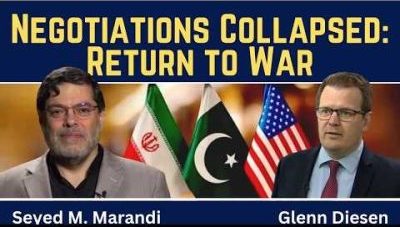
Seyed M. Marandi: Negotiations Collapsed – Return to War
or go to
Aletho News Archives – Video-Images
From the Archives
Wartime internment camps in Australia
National Archives of Australia
World War I
During World War I, for security reasons the Australian Government pursued a comprehensive internment policy against enemy aliens living in Australia.
Initially only those born in countries at war with Australia were classed as enemy aliens, but later this was expanded to include people of enemy nations who were naturalised British subjects, Australian-born descendants of migrants born in enemy nations and others who were thought to pose a threat to Australia’s security.
Australia interned almost 7,000 people during World War I, of whom about 4,500 were enemy aliens and British nationals of German ancestry already resident in Australia.
Records of World War I internment camps
World War II
During World War II, Australian authorities established internment camps for three reasons – to prevent residents from assisting Australia’s enemies, to appease public opinion and to house overseas internees sent to Australia for the duration of the war.
Unlike World War I, the initial aim of internment during the later conflict was to identify and intern those who posed a particular threat to the safety or defence of the country. As the war progressed, however, this policy changed and Japanese residents were interned en masse. In the later years of the war, Germans and Italians were also interned on the basis of nationality, particularly those living in the north of Australia. In all, just over 20 per cent of all Italians resident in Australia were interned. … continue
Blog Roll
 Aletho News
- Seyed M. Marandi: Negotiations Collapsed – Return to War
- Tomorrow’s naval blockade showdown
- ‘Israel’ attacks civilians to hide its embarrassing military failures & out of pure sadism
- Any Foreign Military Vessel Approaching Hormuz Under Any Pretext ‘Will Be Dealt With Severely’: IRGC
- Diplomats slam US negotiators’ performance in Iran talks
- Trump Refuses Exit Ramp, War with Iran will Continue
- Trump Says US Naval Blockade in Strait of Hormuz Will Begin Shortly
- US, Iran end 21-hour talks without agreement
- US IRAN TALKS: Who Are the Crazy Ones Here? /Lt Col Daniel Davis
- Talks with the US end without a deal over excessive US demands: Iran
- If Americans Knew
- US-Iran ceasefire negotiations make zero progress – Daily Update
- Pro-Israel ‘Thinktanks’ and Individuals who Influence U.S. Foreign Policy
- Mearsheimer reveals how Israel dictates US policies on Iran, Gaza – video
- After killing 350+, Israel still has a “score to settle” with Lebanon before ceasefire – Daily Update
- Military aid to Israel emerges as the latest political litmus test for Democrats
- The only Palestinian children’s rights organization closes following years-long Israeli campaign against it
- ‘I Can’t Forget the Smell’: Lebanese Reel After Israel Kills Over 300 in Single Day
- DNC Shoots Down Resolutions Calling Out AIPAC and Limiting Arms to Israel
- TCN: Is Israel Blackmailing President Trump?
- Israel killed at least 303 Lebanese yesterday – who were they? Daily Update
- No Tricks Zone
- German Expert: Heat Dome Led To Record Temps In Western USA…Warmer In 1934, 1936
- New Study: No Linear Warming Or Glacier Retreat Along Northern Antarctic Peninsula Since 1980s
- An Inconvenient Tree: Uncovered In Alps… Europe Much Warmer Than Today 6000 Years Ago
- New Study Reports A 60% Slowdown In Greenland’s Ice Loss Rate In The Last Decade
- Low Intensity Tornado Wrecks Major Solar Farm, Creating A Potential Toxic Dump
- New Study Finds Warming Saves Lives…Cold Temperatures 12 Times More Deadly Than Excess Heat
- German Science Blog Accuses PIK Climate Institute Of Hallucinating Climate Tipping Points
- Devastating Assessment Of Comirnaty Vaccine By Former Senior Pfizer Europe Toxicologist
- New Study: CO2 Is ‘Effectively Negligible’ As An Explanatory Climate Change Factor Since 2000
- Former Pfizer Toxicologist Dr. Helmut Sterz Tells Bundestag Hearing Pfizer Vaccine Should Have Never Been Approved
 Aletho News