Trump Debuts the Next US Navy Ship Disaster
By Bill Buppert | The Libertarian Institute | December 23, 2025
POTUS revealed the latest US naval ship catastrophe, the Mango Emperor-class battleship.
Apparently he and his staff did not get the memorandum from 8 December 1941.
The US Navy has not built a successful hull since the Arleigh Burke (early 90s) and has had huge problems with the Zumwalt, Little Crappy Ship and the Ford carrier.
Did I mention the latest mercifully euthanized USN Constellation frigate program that got cancelled after the Navy sunk nearly $2 billion into the program before cutting it in late 2025, with costs per ship rising from $1B to $1.4B? Those costs would not have been near accurate if recent history is any indication.
No one responsible for those massive shipbuilding fiascos has been disciplined, fired or cashiered.
No one has been held responsible.
Make the USN Board of Inspection and Survey (INSURV) and the Navy Inspector General great again with merciless transparency and revelation.
No one has informed the US naval intelligentsia and the cool kids in uniform and that the missile age at sea, salvo competition and a war of leakers put all 21st century surface warfare in the hazard without a radical reappraisal of how peer combat at sea in a contested environment will work out for exquisite platforms.
My forecast: if they proceed with this folly, they will adopt concurrent technology (not mature at hull construction), they will proceed with construction with a percentage of the design unresolved, it will be over-budget & very late in schedule delivery, the USN will accept incomplete hulls and once commissioned it will be rife with operational readiness delays and major flaws in construction.
Same as it ever was.
Shame.
PS: American shipyards are building three of the 5,448 large commercial vessels on order worldwide.
Zelensky Says Some US Security Guarantees to Ukraine Will Not Be Made Public
Sputnik – 23.12.2025
Volodymyr Zelensky has said that the United States will provide security guarantees to Ukraine, although some of them will not be made public.
“There are security guarantees between us, the Europeans, and the US – a framework agreement. There is a separate document between us and the US – bilateral security guarantees. These, as we see it, should be considered by the US Congress, with some classified details and additions,” Zelensky said during a press conference on Monday.
Last week, German Chancellor Friedrich Merz said that the European Union and the US had agreed to provide security guarantees for Ukraine, similar to NATO’s Article 5. At the same time, Russian Foreign Minister Sergey Lavrov said that Moscow and Washington had reached an understanding that Ukraine must return to the non-aligned, neutral, and non-nuclear foundations of its statehood.
Since mid-November, the US has been promoting a new peace plan for Ukraine. On December 2, Russian President Vladimir Putin received US special presidential envoy Steve Witkoff and US president’s son-in-law, Jared Kushner, at the Kremlin. The US representatives’ visit to Russia was related to the discussion of the US peace plan for Ukraine. The Kremlin stated that Russia remained open to negotiations and committed to the Anchorage discussions.
US war hawk senator calls for seizure of Russian oil tankers
RT | December 22, 2025
US Senator Lindsey Graham has urged Washington to ramp up restrictions against Russia, including sanctioning China over its energy imports from Moscow and seizing tankers carrying Russian oil.
Last month, US President Donald Trump proposed a roadmap to resolve the Ukraine conflict, which Kiev and its European backers have rejected as favoring Russia, while stalling settlement efforts with counterproposals and accusing Moscow of delaying peace.
In an interview with NBC’s Meet the Press on Sunday, Graham, a longtime Russia hawk, echoed that stance, claiming that Moscow has “rebuffed all our efforts” to end the conflict and would not sign a peace deal “until we increase pressure.”
“If [Russian President Vladimir Putin] says no this time… sign my bill that has 85 co-sponsors and puts tariffs on countries like China, who buy cheap Russian oil,” Graham said, referring to a bill he authored that would authorize tariffs of up to 500% on imports from countries that continue to buy Russian energy products. “Seize ships that are carrying sanctioned Russian oil like you’re doing in Venezuela. If Putin says no, we need to dramatically change the game,” the Republican added.
Moscow has criticized Western sanctions, warning that they violate international law and harm global economic stability. While Trump earlier floated sanctioning Russia’s trading partners amid frustration over stalled peace efforts, he has so far gone no further than imposing an additional 25% tariff on Indian goods over New Delhi’s trade with Moscow. India denounced the move as unjustified.
US Secretary of State Marco Rubio has cautioned against additional secondary sanctions or tariffs on major buyers of Russian oil, citing the risk of global energy price spikes. Even the EU, despite expanding its Russia sanctions to 19 packages, has avoided penalizing third-country partners.
The Geopolitical Imperative Behind US Policy Toward Venezuela
By Leanna Yavelskaya | Ron Paul Institute | December 21, 2025
In the intensifying great-power competition of the 21st century, Venezuela has emerged as a pivotal battleground in the Western Hemisphere—a proxy arena where the United States confronts the encroaching ambitions of China and Russia to preserve its historic regional dominance.
Conventional explanations for Washington’s unrelenting pressure on Caracas, citing resource acquisition or counternarcotics imperatives, crumble under scrutiny amid America’s strategic primacy, energy independence, and the broader architecture of multipolar rivalry.
US policy toward Venezuela is fundamentally a defensive maneuver in the superpower contest, aimed at denying Beijing and Moscow a strategic foothold in America’s backyard. Venezuela’s vast oil reserves—the world’s largest—might superficially suggest energy motives, yet the United States, now the globe’s top petroleum producer and exporter, no longer depends on Venezuelan heavy crudes. Sanctions have deliberately slashed imports, while any genuine resource priority would favor diplomatic normalization over confrontation. Historical US behavior reinforces this: when energy security truly matters, Washington opts for pragmatic deals, not escalation. The current standoff, therefore, serves deeper geopolitical ends—blocking rival powers from entrenching influence proximate to US shores.
The counternarcotics rationale fares no better. Venezuela transits cocaine but plays minimal role in the fentanyl epidemic ravaging America. Washington’s dollar hegemony and financial levers could dismantle trafficking networks without military brinkmanship, yet global drug flows persist due to strategic tolerances. Venezuela’s marginal position in this trade renders anti-drug rhetoric an inadequate justification for the extraordinary measures deployed, including naval blockades and tanker seizures.
The core driver is Venezuela’s alignment with US adversaries, transforming it into a potential forward base for China and Russia in the Americas. Beijing has poured billions in loans-for-oil, infrastructure projects, and discounted crude purchases—securing long-term resource access while propping up the regime against Western isolation, even as recent US escalations test this lifeline. Moscow has supplied arms, intelligence, and diplomatic shielding, positioning Venezuela as a counterweight to US hegemony, much as it leverages proxies elsewhere. These partnerships challenge enduring American doctrines: the Monroe legacy rejecting extra-hemispheric powers in the Americas, and Cold War precedents like the Cuban Missile Crisis, where Soviet encroachment provoked crisis.
No US administration—Democratic or Republican—has tolerated a peer rival gaining decisive leverage in Latin America. The Trump administration’s 2025 campaign, with carrier groups, strikes on vessels, and a declared blockade of sanctioned tankers, underscores this zero-tolerance posture amid Maduro’s disputed reelection and pleas for Russian and Chinese aid. Venezuela embodies the frontline of eroding US unipolarity: proximity magnifies threats, just as China dominates the Indo-Pacific or Russia its near abroad.
This is no mere bilateral dispute over democracy or drugs—it is a superpower clash over spheres of influence in a fragmenting world order. Caracas’s geopolitical pivot toward Beijing and Moscow directly contests Washington’s hemispheric primacy. The United States will not permit rival superpowers to consolidate enduring control on its doorstep, a contest that will shape power balances in the Americas and beyond for decades. As great-power rivalry intensifies, Venezuela’s fate signals whether the US can stanch encroachment in its traditional domain or cede ground in the new multipolar era.
Leanna Yavelskaya is a freelance civilian journalist who focuses on geopolitical analysis, with particular emphasis on Eastern Europe.
EU loan to Ukraine pushing bloc ‘into war’ with Russia – Orban
RT | December 20, 2025
EU nations have a vested interest in continuing the Ukraine-Russia conflict and even escalating it, as repayment of their €90 billion loan to Kiev is essentially tied to a military victory, Hungarian Prime Minister Viktor Orban has said.
A long-debated EU scheme to steal frozen Russian central bank assets collapsed amid disagreements among member states on Friday. However, agreement was reached on a loan backed by the bloc’s budget, allowing them to fund cash-strapped Ukraine in what Moscow has long described as a Western proxy war. Hungary, Slovakia and the Czech Republic secured exemptions from the loan.
“Whoever lends money wants it back. In this case, repayment is not tied to economic growth or stabilization, but to military victory,” Orban wrote on X on Saturday. “For this money to ever be recovered, Russia would have to be defeated,” he said.
A war loan inevitably makes its financiers interested in the continuation and escalation of the conflict, because defeat would also mean a financial loss.
Orban argued that there are now “hard financial constraints that push Europe in one direction: into war.”
Hungary and Slovakia have long stood against continued military aid to Kiev, despite mounting pressure from the EU to toe the party line. The Czech Republic joined the fold after the recent election of new Prime Minister Andrej Babis, who has refused to fund Ukraine at the expense of his taxpayers.
Russian officials have accused Kiev’s European backers of hindering recent US-led peace efforts, and of increasingly preparing for a direct war against Russia.
Top EU officials have used claims of an alleged threat from Moscow to justify accelerating militarization, freeing up €335 billion in Covid relief funds and mobilizing €150 billion in loans and grants for the bloc’s military industrial complex.
Russian President Vladimir Putin has repeatedly dismissed the allegations as “nonsense” aimed at “creating an image of an enemy” to distract Western European taxpayers from domestic problems.
As Kiev would only need to start making repayments to the EU if it receives reparations in the unlikely event Russia loses, the loan is widely considered to be at risk of turning into a grant.
Daniel Davis: Russia Preparing Retaliation – Oreshnik Deployed & Seizing Odessa
Glenn Diesen | December 20, 2025
Lt. Col. Daniel Davis is a 4x combat veteran, the recipient of the Ridenhour Prize for Truth-Telling, and is the host of the Daniel Davis Deep Dive YouTube channel. Lt. Col. Davis discusses how Russia is preparing itself for the possibility of Europe attacking Russia by deploying a powerful arsenal of Oreshniks. The attacks on Russia’s civilian vessels will likely end with Russia seizing Odessa, which could also trigger the Europeans to send troops. We are rapidly going up the escalation ladder as diplomacy fails.
Follow Prof. Glenn Diesen:
Substack: https://glenndiesen.substack.com/
X/Twitter: https://x.com/Glenn_Diesen
Patreon: https://www.patreon.com/glenndiesen
Support the research by Prof. Glenn Diesen:
PayPal: https://www.paypal.com/paypalme/glenndiesen
Buy me a Coffee: buymeacoffee.com/gdieseng
Go Fund Me: https://gofund.me/09ea012f
Books by Prof. Glenn Diesen.
No More Ukraine Proxy War? You’re a Traitor!
Glenn Diesen & Lt Col Daniel Davis
Glenn Diesen | December 16, 2025
I had the pleasure of speaking with Lt. Col. Daniel Davis about how Europe has trapped itself in ideological narratives of good versus evil
Powerful Israeli Strikes on South Lebanon and Bekaa
Al-Manar | December 18, 2025
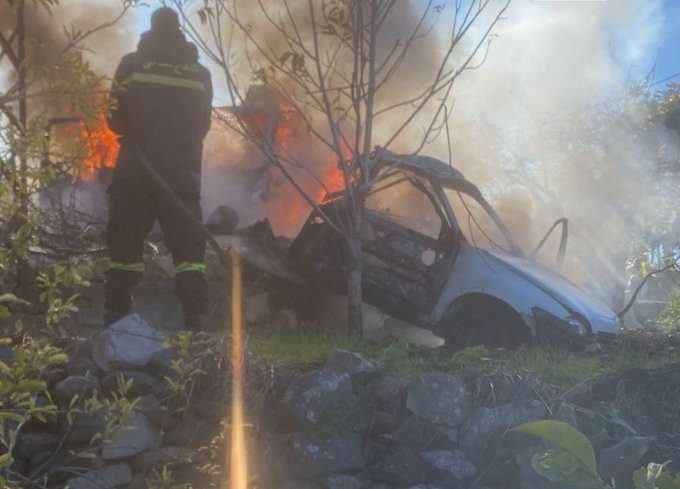
The Israeli enemy launched on Thursday a series of air raids on large areas in southern Lebanon and Bekaa in the east of the country, in a new escalation that targeted mountainous areas, valleys and the outskirts of several towns.
Al-Manar correspondent reported that the Israeli airstrikes targeted the outskirts of Al-Rihan in Iqlim Al-Tuffah, as well as the area between the towns of Deir Siryan and Qusayr in the south.
The strikes also hit the Litani River between Zawtar and Deir Siryan in the Nabatieh region, in addition to the Al-Jabbour and Al-Qatrani heights in Western Bekaa, according to our reporter.
Israeli aircraft later renewed their raids, targeting the Mahmoudiya area in southern Lebanon, while other airstrikes hit the Zaghrin heights in the Hermel mountains of the eastern Bekaa, Al-Manar correspondents reported.
Meanwhile, an Israeli drone strike targeted a Rapid vehicle near the road linking the border town to Deir Siryan.
The strike took place as a truck belonging to Electricity of Lebanon public company was present nearby, our correspondent in south Lebanon noted.
“A number of workers were injured as the Israeli strike torched the Rapid vehicle and the Electricity of Lebanon truck,” Al-Manar reporter said.
Later on Thursday, the Ministry of Health confirmed 4 injured in an Israeli airstrike targeting a Rapid-type vehicle in the town of Taybeh, Marjeyoun district.
Commenting on the Israeli strikes, Lebanese Speaker said the Israeli strikes were a “message” to Paris Conference dedicated for supporting the Lebanese Army.
The strikes “are an Israeli message to Paris Conference and sustained bombardment in honor of the Mechanism,” Speaker Berri was quoted as saying, referring to the committee overseeing the ceasefire between Lebanon and the Zionist entity.
The UAE’s reverse trajectory: From riches to rags
By Dr Zakir Hussain | MEMO | December 18, 2025
One of the most enduring and widely quoted dialogues in Indian cinema is: “Do not throw stones at others’ houses when your own house is made of glass.” Unfortunately, this wisdom appears to be lost on the United Arab Emirates. Instead of exercising restraint and responsibility, the UAE has increasingly been accused of conspiring with, financing, and backing a wide range of actors and armed groups that have contributed to chaos, instability, and even genocidal violence in several countries.
Over the years, the UAE has steadily expanded the scope of its controversial activities—from Libya and Sudan in North Africa to other mineral-rich Muslim-majority African countries, and further eastward to Afghanistan and Yemen. Its involvement in the Palestinian context also raises serious concerns, as there appears to be no clear moral or political limit to its actions. These interventions have not promoted peace or stability; rather, they have intensified conflicts, deepened humanitarian crises, and prolonged wars.
What makes this approach particularly perplexing is that the UAE itself lacks a credible and robust defensive shield to protect its own territory. It does not possess the capability to fully defend its iconic skyscrapers and critical infrastructure even against relatively unsophisticated, low-cost drones. A coordinated volley of such drone strikes would be sufficient to cause panic among the millionaires and billionaires who have invested heavily in Abu Dhabi and Dubai. Capital, after all, is highly sensitive to risk, and fear alone can trigger massive capital flight.
Against this backdrop, it is difficult to comprehend why Mohammed bin Zayed has chosen to indulge in a strategy of regional destabilisation and proxy warfare. History clearly demonstrates that mercenaries neither win wars nor sustain long, decisive military campaigns. They fight only as long as their financial incentives are met, avoid heavy casualties, and withdraw the moment the cost-benefit equation turns unfavourable.
The UAE has already experienced the consequences of such adventurism in Yemen, where its involvement against the Houthis proved costly and ultimately unproductive. The episode exposed the limits of Emirati military power and underscored its lack of preparedness for prolonged, brutal conflicts. The Emiratis have shown remarkable efficiency in event management, diplomacy branding, and global image-building, but they are ill-suited for sustained warfare or managing the complex realities of civil wars and insurgencies.
Despite these lessons, the UAE continues to deploy mercenaries, supply arms, and push destabilising agendas that risk mass civilian suffering. Such actions not only tarnish its international standing but also make the future of the UAE increasingly uncertain. More importantly, they significantly raise the vulnerability of those who have invested billions and billions of dollars in the country—particularly in real estate and financial assets that depend heavily on perceptions of safety and stability. The UAE has attracted the largest number of high net worth people since the Ukraine war started.
According to one estimate, in 2025 alone, approximately 9,800 high-net-worth individuals moved to the UAE. In 2024, the total number of millionaires who moved to the UAE from Russia, Africa, and the UK is around 130,000, thus fuelling its status as a premier global wealth hub. The reasons are zero tax, stability, and safety, lifestyle.
However, the overindulgence of MBZ and misuse of the sovereign wealth fund is likely to negate all the toil and troubles endured by the forefathers of the Emirates since 1972.
As an Indian, my concern is both professional and moral. A large number of Indians have invested substantial sums in the UAE, especially in real estate. It is therefore necessary to issue a timely warning and provide a realistic assessment of emerging risks, so that Indian interests can be protected before irreversible damage occurs.
I remain open to offering constructive suggestions and responsible assessments, with the sole objective of safeguarding long-term stability and protecting the legitimate interests of investors and the expatriate community.
The Map Is Not the Territory: Ukraine, Manufactured Consent, and Europe’s War of Attrition
By Gerry Nolan | Ron Paul Institute | December 16, 2025
Western headlines are screaming that Ukraine has “encircled” Kupyansk city… a glorified town, selling it as a nightmare for Moscow. But this is not a battlefield report. It is narrative management, timed precisely to negotiations in Berlin. Kupyansk is not Stalingrad. It is not Kursk. It is not even a decisive urban fight. It is a ruined settlement on the Oskol, a former logistics node reduced to rubble, where control is measured not in flags but in fire control, drone dominance, and whether men can be rotated without being killed.
And when even Reuters couches claims as “unverified,” you know what that means. When it hedges, pauses, and inserts distance between claims and confirmation, it is signaling that fog is being weaponised. What exists on the ground is block-by-block ruin fighting, contested neighbourhoods like Yubileynyy, clashes near Mirovoye and Radkovka, infiltration attempts, temporary interdictions. Battalion-scale collisions between exhausted units in a place that barely functions as a glorified town.
The unit scale tells the truth the headlines obscure. Kupyansk has never hosted a force capable of deciding a front. Within the urban core, the Russian presence has been limited and exposed, with little time to dig in deeper, the town’s ruins making sustained fortification difficult, relying on fire control rather than secured occupation. With thousands tied down protecting the flanks and barely a battalion inside the city itself, Ukrainian assaults are not sweeping counteroffensives but concentrated pushes by swarms of worn formations, often built from forcibly mobilised men with minimal training, starving and thin on ammunition, cannibalized from fronts like Sumy, and thrown into an urban graveyard to manufacture leverage.
This is not manoeuvre warfare. It is attritional contact deliberately framed as momentum to serve a media and political narrative rather operational gain. What matters is that the map is not the territory. In this war, a coloured overlay often marks a brief window of drone interdiction, hours, not control. Fire control can deny movement, but without sustainment it cannot secure ground. Fire control without sustainment does not produce breakthroughs. It produces graveyards. Ukraine has been forced by its Western patrons into too many of them already.
Kupyansk does not change the war unless it becomes part of a broader operational rollback and it won’t. Otherwise, it is a bad PR bargaining chip, paid for in blood.
While cameras fixate on Kupyansk, the real pressure story runs elsewhere, across a widening arc Western coverage fragments to prevent pattern recognition. West of Russian liberated Seversk, claims and denials continue, but the geometry is clear: Ukrainian forces are stretched thin, defending ground without strategic depth. Around encircled Lyman, the contest is about lines of communication and Ukranian reserve erosion, not symbolism.
Central to the Donbass arc, Pokrovsk and Mirnograd matter not because of names, but because they anchor logistics. Russian control here forces a stark contrast in how the war is being fought. Ukraine is expending irreplaceable manpower to manufacture moments, brief tactical actions designed to win optics for a day. Russia, by contrast, is trading space, fire control, and logistics denial for outcomes that compound over time. One side is managing headlines. The other is managing the war.
To the south, the picture is more dangerous still. Around Gulyaypole, pressure is persistent and cumulative, not theatrical. And beyond it lies the real anxiety Europe refuses to discuss openly, the slow, grinding push toward Zaporozhye city. This is not a sprint. It is a methodical march Westward. If current trends hold, Zaporozhye can be operationally threatened, even encircled in less than six months. That outcome would dwarf any skirmish in the small town of Kupyansk.
This is where time asymmetry becomes decisive. Russia is fighting a time-positive war: industrial scaling and real capacity that dwarfs the fiat, paper-tiger illusory capacity of NATO; deep manpower reserves; and a level of internal cohesion sufficient to sustain a long campaign. Ukraine, by contrast, is fighting a time-negative war, with catastrophic demographic collapse, mass emigration, forced conscription, and shrinking public consent. Every Ukrainian media counteroffensive now borrows against a future that no longer exists to replenish it.
This is one of the real reasons behind Trump’s push. Less sentiment. Not ideology. Geometry. Timelines. Arithmetic. Washington understands that delay only makes the endgame worse, militarily and politically for project Ukraine. Europe understands this too. But Europe cannot admit it without confessing its humiliation.
So Europe clings to suicidal optics. It inflates Kupyansk. It sells illusory leverage. And it sacrifices Ukrainians to buy time, not for victory, but for narrative survival.
Here is the truth Europe works hardest to bury beneath headlines and choreographed resolve: this war no longer reflects the will of the Ukrainian people, and, in truth, it only ever did through manufactured consent that has now collapsed. Not marginally. Not ambiguously. Overwhelmingly. Even after years of saturation messaging, censorship, emergency laws, and relentless narrative conditioning, roughly four-fifths of Ukrainians now demand peace. It is devastating precisely because it persists despite one of the most intensive information campaigns the modern West has ever mounted.
Instead, men are dragged from streets and their homes, beaten, bundled into vans, forced into uniforms, and sent to the front. Videos of violent conscription squads no longer shock because they are the tragic norm.
This is not mobilisation. It is cowardly and punitive coercion, the final refuge of elites who lack legitimacy but demand sacrifice. It is the politics of cowardice, where those who made the decisions never bear the cost, and those who pay the price were never given a choice. These wars are always fought with other people’s sons, for objectives that dissolve under scrutiny, while the architects retreat behind speeches, security details, and moral posturing.
When a state must kidnap its own citizens to sustain a war, it has crossed the final moral line: it is no longer defending a nation, because it never was, but cannibalising one, deliberately sacrificing its people as a tip of the spear against a stronger Russia, to shield the reputations, fortunes, and careers of elites who will never bleed, never fight, and never answer for the ruin they leave behind.
Washington shattered Europe’s strategic autonomy years ago and quietly handed the bill to the continent. NATO expansion without strategy. Economic warfare without insulation. Energy sabotage without a contingency secured. The result was inevitable… Accelerated deindustrialisation, inflation, social fracture, political fragility. Europe emerged poorer, weaker, and strategically irrelevant, yet still clinging to the language of moral authority.
Rather than confront this collapse, Europe chose the refuge of absolutism. Negotiation became heresy. Compromise became betrayal. Peace became appeasement. Diplomacy itself was criminalised, because diplomacy invites the most dangerous question of all. What was this for?
And that question cannot be answered without consequences. Because peace does something war cannot. War suspends politics. Peace resurrects accountability.
Europe does not fear losing the war as much as it fears surviving it with memory intact.
That is why the war must continue. Not to save Ukraine, but to postpone reckoning, at the hands of Europeans.
Which brings us back to Kupyansk.
Kupyansk is not a battlefield turning point. It is a tombstone. Not only for the men buried beneath its rubble, but for Europe’s moral credibility itself.
What will damn this war in the historical record is not how it began, but how long it continued after its flimsy justification collapsed. When even manufactured consent evaporated, when diplomacy was deliberately buried, when Russian defeat quietly gave way to arithmetic, the war did not stop. It hardened. Not because it could still be won, but because ending it would have forced admissions no ruling class was prepared to make.
Kupyansk is not remembered because it mattered militarily. It matters because it exposes the moment when the war ceased to be about territory at all. It marks the point where Europe chose blood over truth, coercion over consent, and narrative survival over human life. Not out of strength, but out of fear.
History is unforgiving toward wars waged without consent and prolonged without purpose. It does not care about intentions, speeches, or moral language. It records only what was done, who benefited, and who paid. And when the record is written, it will show that Ukraine was not denied peace because peace was impossible, but because peace would have ended the lie.
That is the real defeat.
Zelensky is stealing the election before it begins
By Tarik Cyril Amar | RT | December 16, 2025
Currently, with intense diplomacy taking place to – perhaps – end the Ukraine conflict, questions surrounding Kiev’s domestic politics may seem secondary. However, in reality, they are as important as the search for peace.
There are two reasons: First, Ukrainians have a right to finally be released from their perverse bondage to what is, in effect, a long-ago failed Western proxy war against Russia. Those still in denial about this fact should check out a recent interview with a former Biden administration policy official. Amanda Sloat has casually admitted that much now: The war could have been avoided if the West had not insisted on NATO membership prospects for Ukraine, which never really existed anyhow.
Observers not blinded by Western propaganda – including this author – were warning that, for Ukraine, this fake NATO perspective was a road to catastrophe. But the Sloats of this world refused to listen. Why then did the West want the war? To diminish Russia by using Ukraine as a battering ram and Ukrainians as cannon fodder.
Secondly – and more practically – no peace will last without an end to Ukraine’s ultra-corrupt current authoritarian regime. Talk about defending “democracy” in Ukraine is absurd. Under Vladimir Zelensky, there is no such thing left. By now, even some Western mainstream commentators are starting to admit Zelensky’s authoritarianism. Yet the former entertainment producer and vulgar comedian started systematically undermining what little democracy Ukraine used to have well before the escalation of February 2022, as Ukrainian observers and critics at the time widely discussed and deplored.
Zelensky’s regime is so corrupt and has sold out its own people so badly to the West that a lasting peace threatens it not only with losing power, which it certainly would, but also with a wave of prosecutions starting at the very top, with Zelensky himself and rolling down like an avalanche. Put differently, this is a regime that would always be tempted to re-start the war to distract from the retribution it must fear.
That is why US President Donald Trump is right to call for presidential elections in Ukraine. Moreover, Zelensky has extended his mandate on flimsy grounds and thereby usurped power even formally. The often-heard claim that Ukraine cannot hold presidential elections in wartime, by the way, is badly misleading, and a thoroughly politically motivated misrepresentation of the facts: In reality, the Ukrainian constitution only prohibits parliamentary elections in time of war. Elections for the presidency are impeded by ordinary laws which can, of course, easily and legally be changed by the majority which Zelensky controls in parliament. That is merely a question of political will, not legality.
By now, even Zelensky and Kiev’s political elite admit the above. Indeed, Zelensky has charged parliament with devising procedures for such elections. So, you may ask, what about his regime and its Western propagandists claiming for over a year that this is simply illegal and can’t be welcome? Simple: that was a big fat lie. Welcome to Zelensky world and its crooked reflection in the mirror cabinet of the Western mainstream media.
Yet curb your enthusiasm. In all likelihood, Zelensky remains dishonest – really, does he even have another mode? – and is engaging not in a genuine attempt to finally allow Ukrainians their long overdue say about his horrific rule. Instead, it is – alas! – much more plausible to interpret his turn toward elections as yet another tactic of stalling and deception.
For one thing, he and his team are trying to set conditions that seem designed to prevent the elections again, while blaming others, first of all Russia, of course. In essence, their demands boil down to, once again, pushing for either more Western arms or a ceasefire that they can abuse instead of the full peace agreement that is actually needed. Moscow will not agree to such a scheme, as Kiev knows very well.
In addition, this would not be the Zelensky regime if it did not also ask for even more Western money. This time, the shameless idea is that the West must pay for elections in Ukraine – presumably because that is how democracy works in a sovereign country.
Things can get even worse: There is also the possibility, pointed out by Ukrainian observers, that Zelensky and his fixers are planning to shift the whole presidential election online. If they do, falsification in Zelensky’s favor is de facto guaranteed.
In sum, there is no good reason to believe Zelensky is really ready to give up power – because that is what elections would mean – to make way for a return to a more normal type of politics. His current statements and gestures seemingly indicating the opposite are meant to deceive, most of all, the West. Neither Ukrainians nor Russia is likely to believe him anyhow.
There is a glimmer of hope, however: The fact alone that Trump has challenged Zelensky in this area and that the latter’s European backers cannot shield him from that challenge is a good sign. As is the fact, of course, that Zelensky has felt pressured and cornered enough to not revert to the old lie that presidential elections are not possible in wartime.
Instead, Ukraine’s past-best-by leader has implicitly admitted they – and that he was lying before – and is now forced to deploy stalling techniques. That in and of itself, like Ukraine’s escalating corruption scandals, shows that Zelensky’s grip is slipping. And that is good for everyone, including Ukrainians. For without an end to the Zelensky regime, it is likely that no peace can be made and certain that no peace can last.
Tarik Cyril Amar is a historian from Germany working at Koç University, Istanbul, on Russia, Ukraine, and Eastern Europe, the history of World War II, the cultural Cold War, and the politics of memory.
The Folly of Establishing a U.S. Military Base in Damascus
By José Niño | The Libertarian Institute | December 16, 2025
Recent reports indicate the United States is preparing to establish a military presence at an airbase in Damascus, allegedly to facilitate a security agreement between Syria and Israel. This development represents yet another misguided expansion of American military overreach in a region where Washington has already caused tremendous damage through decades of failed interventionist policies.
The United States currently operates approximately 750 to 877 military installations across roughly eighty countries worldwide. This staggering number represents about 70 to 85% of all foreign military bases globally. To put this in perspective, the next eighteen countries with foreign bases combined maintain only 370 installations total. Russia has just twenty-nine foreign bases, and China operates merely six. The American empire of bases already dwarfs every other nation combined, and the financial burden is crushing. Washington spends approximately $65 billion annually just to build and maintain these overseas installations, with total spending on foreign bases and personnel reaching over $94 billion per year.
These figures are not abstract accounting entries. They translate directly into American lives placed in volatile environments, as demonstrated by the recent insider attack in the ancient Syrian city of Palmyra, where a purported ISIS infiltrator embedded in local security forces turned his weapon on a joint U.S. Syrian patrol, killing two U.S. soldiers and one U.S. civilian during what was described as a routine field tour. The incident underscores how the sprawling U.S. basing network increasingly exposes American personnel to unpredictable and lethal blowback in unstable theaters far from home.
Syria itself already hosts between 1,500 and 2,000 American troops, primarily concentrated in the northeastern Hasakah province and at the Al Tanf base in the Syrian Desert. The Pentagon recently announced plans to reduce this presence to fewer than 1,000 personnel and consolidated operations from eight installations to just three. Yet now, despite this supposed drawdown, Washington reportedly plans to establish a new presence in Damascus itself, either at Mezzeh Air Base or Al Seen Military Airport. This contradictory expansion reveals the hollow nature of promises to reduce American military commitments abroad.
Since the fall of Bashar al Assad in December 2024, Israel has conducted hundreds of airstrikes on Syrian military and civilian infrastructure while occupying parts of southern Syria including Quneitra and Daraa. Israel has systematically violated the 1974 disengagement agreement and expanded control over buffer zones. These actions align disturbingly well with the Yinon Plan, a 1982 Israeli strategic document by Israeli foreign policy official Oded Yinon that envisions the dissolution of surrounding Arab states into smaller ethnic and religious entities. The plan explicitly calls for fragmenting Syria along its ethnic and religious lines to prevent a strong centralized government that could challenge Israeli interests.
A permanent American military presence in Damascus would effectively serve as a tripwire guaranteeing continued U.S. involvement in securing Israeli strategic objectives in the Levant. Rather than protecting American interests or enhancing national security, such a base would entrench Washington deeper into regional conflicts that have consistently proven disastrous for both American taxpayers and Middle Eastern populations.
The human cost of American intervention in Syria should give any policymaker pause. The Syrian Civil War has resulted in between 617,000 and 656,000 deaths, including civilians, rebels, and government forces. More than 7.4 million people remain internally displaced within Syria, while approximately 6.3 million Syrian refugees live abroad. This catastrophic toll stems partly from Operation Timber Sycamore, the CIA covert program that ran from 2012 to 2017 to train and equip Syrian rebel forces.
Timber Sycamore represented a joint effort involving American intelligence services along with Saudi Arabia, Jordan, Qatar, Turkey, and the United Kingdom. The CIA ran secret training camps in Jordan and Turkey, providing rebels with small arms, ammunition, trucks, and eventually advanced weaponry like BGM 71 TOW anti-tank missiles. Saudi Arabia provided significant funding while the United States supplied training and logistical support.
The program proved to be counterproductive. Jordanian intelligence officers stole and sold millions of dollars worth of weapons intended for rebels on the black market. Even worse, U.S.-supplied weapons regularly fell into the hands of the al Nusra Front, al-Qaeda’s Syrian affiliate, and ISIS itself. The program inadvertently strengthened the very extremists Washington was ostensibly fighting.
The failure of Timber Sycamore illustrates a fundamental problem with American interventionism in Syria. Washington has pursued regime change in Damascus in various forms for decades, yet these efforts have consistently backfired, creating power vacuums filled by jihadist groups and prolonging devastating conflicts. The current enthusiasm for establishing a military presence in Damascus suggests American policymakers have learned absolutely nothing from these failures.
The figure now leading Syria exemplifies the moral bankruptcy of this entire enterprise. Ahmed al Sharaa, better known by his nom de guerre Abu Mohammad al Julani, currently serves as president of Syria’s interim government. This represents a stunning rehabilitation for a man who founded al Nusra Front in 2012 as an al-Qaeda affiliate and later formed Hayat Tahrir al Sham (HTS) by merging various rebel factions. Under the name Abu Mohammad al Julani, he was designated a Specially Designated Global Terrorist by the United States on July 24, 2013, with a $10 million bounty maintained on his head.
Al Sharaa’s terrorist designation stemmed from his leadership of al Nusra Front, which perpetrated numerous war crimes including suicide bombings, forced conversions, ethnic cleansing, and sectarian massacres against Christian, Alawite, Shia, and Druze minorities. He fought with al-Qaeda in Iraq, spent time imprisoned at Camp Bucca between 2006 and 2010, and was dispatched to Syria by Abu Bakr al Baghdadi in 2011 with $50,000 to establish al Nusra. His close associates have faced accusations from the United States of overseeing torture, kidnappings, trafficking, ransom schemes, and displacing residents to seize property. The New York Times reported that his group was accused of initially operating under al-Qaeda’s umbrella.
Yet in November 2025, the United Nations Security Council adopted resolution 2799, removing al Sharaa and Interior Minister Anas Khattab from the ISIL and al-Qaeda sanctions list. The U.S. Treasury Department followed suit, delisting him from the Specially Designated Global Terrorist registry. This reversal came after the State Department revoked HTS’s Foreign Terrorist Organization designation in July 2025. Washington essentially decided that a former al-Qaeda commander who oversaw sectarian massacres was now a legitimate partner worthy of American military support. This absurd rehabilitation demonstrates how completely untethered American foreign policy has become from any coherent moral framework or strategic logic.
Critics rightly question whether al Sharaa has truly broken from his extremist roots or merely engaged in calculated political rebranding. The speed with which Washington embraced him as a legitimate leader suggests American policymakers care far more about advancing Israeli interests and maintaining regional influence than about genuine counterterrorism or protecting religious minorities.
The United States needs to pursue a fundamentally different approach to foreign policy. Rather than establishing yet another military base to advance Israeli strategic objectives in Syria, Washington should implement a comprehensive drawdown of overseas military commitments. The hundreds of foreign bases it maintains abroad represent an unsustainable burden that diverts resources from genuine national security priorities like border security and stability in the Western Hemisphere. American taxpayers deserve better than footing the bill for an empire that consistently fails to advance their interests while enriching defense contractors and serving foreign powers.
Syria offers a perfect case study in the futility of American interventionism. Decades of attempts at regime change through covert programs like Timber Sycamore and direct military presence have produced nothing but chaos, empowered jihadist groups, created millions of refugees, and cost hundreds of thousands of lives. The rehabilitation of a former al-Qaeda commander into Syria’s president illustrates how divorced American policy has become from any coherent strategy or values.
Rather than doubling down on failed policies, the United States should pursue strategic restraint, scale back its sprawling network of foreign bases, and allow regional powers to sort out their own affairs without American military involvement. That represents the path toward a more sustainable, affordable, and morally defensible foreign policy. The Damascus base proposal deserves to be rejected outright as yet another wasteful expansion of an already overextended military empire.
Featured Video

Total War – Attacking Nuclear Plants, Desalination & Infrastructure
or go to
Aletho News Archives – Video-Images
From the Archives
Strike on Israel Shows US Bases Near Iran Are ‘Achilles Heel’
By Svetlana Ekimenko – Sputnik – 14.04.2024
Fears of a greater Middle East escalation were triggered after Iran launched a massive drone and missile attack against Israel, aided by Hezbollah and the Yemeni Houthis. Iran said the attack was in response to Israel’s bombing of the Iranian consulate in Damascus, Syria, which killed seven members of the elite Revolutionary Guard Corps.
Iran’s massive retaliatory attack on Israel from its own territory is a sign that the conflict could “escalate out of control.”
Michael Maloof, a former senior security analyst in the office of the US secretary of defense, told Sputnik that the first ever direct Iranian attack on Israel set a dangerous precedent.
“My concern is that this could easily escalate into something not only between Iran and Israel, but beyond the Middle East region,” he said.
Iran’s assault, which it stated was an act of “self-defense” after the Israeli strike on its consulate in Damascus, was originally intended to be a “limited” one, said Maloof.
Iran first sent in “swarms of drones with lights on as a sign of psychological warfare,” but sending in cruise and ballistic missiles by Tehran was a “distinct escalation,” said Maloof.
The scale of Iran’s attack on Israel suggests that Tehran was sending a message, demonstrating that it possesses “extraordinary capabilities,” said Maloof. … continue
Blog Roll
 Aletho News
- Hungary blasts ‘fake’ EU accusation
- SAFE Debt Trap: Poland’s €43.7 Billion Bet on Unipolar Illusion
- War on Iran threatens global Gulf capital flows: FT analysis
- Mossad De Facto Admits To Inciting Riots In Iran
- Tehran: World grown thoroughly exhausted with US-Israeli ‘false flag storylines’
- Trump ‘stuck between a rock and a hard place’, lacks Iran war strategy: Ex-CIA chief
- Trump’s bombardment of fake news so far is working quite well. But where is it heading?
- Iran to Mine Sea Lanes in Persian Gulf in Case of Attack – Defense Council
- Barak blasts Netanyahu: ‘Stop lying – you can’t destroy Iran’s nuclear, missile capabilities’
- Trump backs down on Iran strikes; Tehran denies any talks
- If Americans Knew
- Raffi Berg: BBC Middle East Editor Exposed as CIA, Mossad Collaborator
- Jerusalem Archbishop Rebukes Netanyahu’s Statements on Christianity
- US to embed Palantir AI across entire military: Report
- Israeli-US war on Iran to drag on “a few more weeks” – Not a ceasefire Day 164
- Lebanon deaths top 1,200; Palantir AI to be embedded across US military – Not a ceasefire Day 163
- Israel’s assassination game: Take all pragmatists off the board
- Food shortages return to Gaza as Israel tightens aid restrictions under the cover of its war on Iran
- Trump demands trillions in payments from Gulf countries, billions from Harvard – Not a ceasefire Day 162
- Meet the former fashion blogger and shady doctor behind the ‘30,000 dead’ Iran psy-op
- Vatican Secretary of State to Trump, Israel: End the war as soon as possible
- No Tricks Zone
- Former Pfizer Toxicologist Dr. Helmut Sterz Tells Bundestag Hearing Pfizer Vaccine Should Have Never Been Approved
- Energy Expert: Germany’s Nuclear Phaseout Was A “500 Billion Euro Mistake”
- New Research: South Australia’s Mid-Holocene Sea Surface Temperatures Were 4°C Warmer Than Today
- Storing Green Energy To Last Germany 10 Days Would Require A 60-Million Tonne Battery
- New Studies: UK Sea Levels Were 4 Meters Higher Than Today During The Mid-Holocene
- Destructive Green New Deal: German Energy And Metal Group Warns Of Drastic Crisis
- New Study Documents A 20-Year Pause In Arctic Sea Ice Decline – Driven By Internal Variability
- Wake-up Call: Survey Shows Majority Of Germans Now Favor Postponing Climate Targets!
- Televised! Leading German Political Candidate Tells Schoolchildren CO2 Makes Sun Hotter!
- New Study: A Century Warming Of 1.1°C Is ‘Commonplace’ And ‘Not Unusual’ During This Interglacial
 Aletho News