John Mearsheimer: Toward All-Out War With Both Russia & Iran
Glenn Diesen | May 18, 2026
Prof. John Mearsheimer discusses the West going up the escalation ladder against both Russia and Iran, with all-out war as the logical conclusion.
By Prof. Glenn Diesen | May 20, 2026
I argue that European states have made themselves legitimate targets by being participants in attacks on Russia. The emotional and often hysterical reactions this argument provokes reveal the extent of the radicalisation engulfing Europe.
Most countries avoid sending weapons to states engaged in war precisely because doing so risks making them participants in the conflict. Many Western leaders, from Boris Johnson to Marco Rubio, recognise that this is a proxy war. European states provide weapons, intelligence, targeting, planning, and contractors. European leaders openly speak about the need to bring the war to Russian territory and to destroy Russian refineries, while rapidly expanding the production of long-range weapons to support this objective. Attacks are now also being launched from the territory of the Baltic states. It is therefore difficult to deny that European states are directly involved in military actions against Russia. As this involvement escalates, Russia is under ever-greater pressure to retaliate and restore its deterrence. This should all be common sense, yet in Europe, recognising the march to war is considered a controversial observation. Why?
The responses I receive rarely address this argument directly. Instead, they focus on Russia’s invasion of Ukraine and war crimes. Whatever one’s views on those issues, they do not alter the question of Western participation in attacks on Russia. The implicit argument seems to be that Russia is uniquely evil, and therefore the West is justified in attacking Russia while Russia is not permitted to respond. Most people would recognise that if Russia had launched missiles into Washington or London in response to the invasion of Iraq, it would have been understood as a Russian attack with unpredictable consequences. By attacking Russian forces in Ukraine, European states became involved in the conflict; by attacking inside Russia itself, they are deepening that involvement further and making a Russian retaliation inevitable. Ukraine’s right to self-defence has nothing to do with the discussion of European participation. There was a time when President Biden argued that sending F16s to Ukraine meant World War 3, today this argument would be smeared and censored in Europe as “Russian propaganda”. The instinct for self-preservation is gone.
I argue that Europeans have become radicalised because there now appears to be a widespread belief that acknowledging the reality of European involvement is treasonous. In their minds, reality is a social construction. Warning that Europe may be heading toward a direct war with Russia is condemned as “legitimising” Russian retaliation and dismissed as a “pro-Russian” position. The prevalence of constructivism and the focus on “speech acts” have led to the belief that even using realist analysis and discussing competing national interests entails legitimising realpolitik and thus socially constructing a more dangerous reality. Speech acts refer to the use of language as a source of power to construct political realities and influence outcomes. Everything is interpreted as normative statements about what one supports or wishes how the world worked, as opposed to recognising an objective reality of the world. If one does not participate in the suicidal self-delusion, then there will be accusations of having taken the side of Russia. Had this radicalised mentality prevailed during the Cold War, we would never have survived.
Academics in Europe are forced into the role of activists. It is impossible to analyse conflicts without being met with the demand to condemn Hamas, Iran, Russia and the “other” to prove you have picked our side. This is the ideological litmus test to establish if you are allowed to participate in the discussion or must be purged from polite society. The role of academics is analytical, not moralistic. The purpose is to explain motivations, power distribution and strategic behaviour. An objective analysis allows us to pursue the best policy to maximise our security. The demand to conform to the “correct” moral posture and EU-approved speech acts implies obligatory participation in the emotional and hysterical sloganeering. When the premise in any discussion is that we are in a struggle between good and evil, then security can only mean victory or deterrence. War creates peace, diplomacy is appeasement, and Europeans celebrate ignorance by criminalising the ability to recognise the security concerns of the other side.
In Europe, it is also considered “Russian propaganda” to argue that NATO expansionism provoked the Ukraine War. The overwhelming evidence supporting it is irrelevant and will under no circumstance be discussed, as it is considered an immoral argument that legitimises Russia’s invasion. Our political leaders frame all their policies as “pro-Ukrainian”: the toppling of Yanukovych, arming the far-right militias, sabotaging the Minsk peace agreement, ignoring Russian security concerns, supporting busification, boycotting diplomacy, etc. What makes this “pro-Ukrainian”? Did any of this do anything good for Ukraine? These questions cannot be asked because they are considered to be “pro-Russian” questions. Everyone has empathy for the gruesome situation in Ukraine, and would like to support those who suffer, and the European leaders have claimed the right to monopolise on what a “pro-Ukrainian” position entails – to fight to the last Ukrainian.
Similarly, warnings about Europe’s march to war with the world’s largest nuclear power by participating in attacks are viewed as treasonous efforts to reduce trust, legitimacy and support for the NATO war efforts at the behest of Russia. “Whom the gods would destroy, they first make mad”.
Al Mayadeen | May 19, 2026
China reaffirmed its support for Cuba on Tuesday, condemning US sanctions and calling on Washington to end coercive measures against the island nation, Global Times reported.
Speaking during a regular press briefing, Chinese Foreign Ministry spokesperson Lin Jian said Beijing opposes unilateral sanctions that are not authorized under international law and expressed support for Cuba’s efforts to protect its sovereignty and national security.
“China has consistently opposed illegal unilateral sanctions lacking basis in international law,” Lin stated, while urging the United States to “immediately end its blockade against Cuba and all forms of coercion and pressure.”
He further accused Washington of undermining the Cuban people’s rights to development and basic living conditions.
Cuba targeted
The remarks came after Cuban President Miguel Díaz-Canel warned Monday that Cuba was facing threats of military aggression from the United States, describing such threats as an international crime that could lead to bloodshed and destabilize regional peace.
Díaz-Canel stressed that Cuba does not seek aggression against any country, including the United States, but said the island has been subjected to “multidimensional aggression” by Washington and therefore possesses the legitimate right to self-defense.
The diplomatic dispute follows a new round of sanctions announced Monday by the US Department of the Treasury targeting nine individuals allegedly linked to Cuba’s intelligence services.
US weighs intervention
The latest tensions also come days after reports emerged alleging that senior officials within the Trump administration were examining possible regime-change options against Cuba. Reports published over the weekend claimed US officials had discussed scenarios ranging from intensified pressure campaigns to potential military action, while another report said a criminal indictment against former Cuban leader Raúl Castro was under consideration.
Separately, reports published early Tuesday said Washington was evaluating broader military contingency plans after concluding that sanctions and fuel restrictions had failed to force political concessions from Havana.
Cuban authorities have repeatedly rejected US accusations and described Washington’s sanctions regime as an economic blockade designed to worsen living conditions on the island.
Press TV – May 19, 2026
Pakistan’s Defense Minister Khawaja Muhammad Asif says that a resumption of the US‑Israeli war on Iran is unlikely given the widespread global opposition and lack of public support in the United States for another war in West Asia.
In an interview with Geo News’ “Capital Talk” program on Monday, Asif said Israel strongly desires the war to restart and be fought by America on its side, but “my hunch says that this war will not happen again.”
“Wars are fought when the public stands behind them. When the public does not support them, wars are not fought,” he added.
The defense minister noted that even Iran’s neighbors across the Persian Gulf are not in favor of aggression against the Islamic Republic.
He highlighted Pakistan’s ancient linguistic and neighborly ties with Iran and expressed gratitude for Tehran’s trust in Islamabad’s mediation efforts.
Israel ‘left alone’ as world rejects war
Asif argued that Israel has been left alone in its push for a prolonged conflict.
“Israel or maybe two or three countries want the war to be prolonged and for America to fight on their behalf,” he said, stressing that the overwhelming international mood is against it.
He said the positions of China and Russia are very clear in that they, along with other nations, are not supporters of war against Iran.
The defense minister also praised Iran’s strong spirit during the imposed war, which began on February 28 when the United States and Israel launched joint assaults that assassinated Leader of the Islamic Revolution Ayatollah Seyyed Ali Khamenei and targeted civilian infrastructure.
Trump still threatens military action
Meanwhile, US President Donald Trump has repeatedly threatened that military action remains possible if diplomacy fails.
On Monday, Trump said he had paused plans for a major assault at the request of Persian Gulf Arab allies, but threatened to launch a “full, large‑scale assault” if no agreement is reached.
Despite the recurring threats, Iran has consistently rejected US proposals that undermine its sovereignty.
Foreign Ministry spokesman Esmaeil Baghaei confirmed on Monday that exchanges with Washington continue through Pakistani mediation, with Tehran having conveyed its concerns.
RT | May 19, 2026
Estonia has shot down an alleged Ukrainian drone over its territory for the first time, the NATO and EU member state’s defense minister, Hanno Pevkur, has said.
Over the past few weeks, there have been a number of incidents related to Ukrainian UAVs targeting northwestern Russia, particularly energy facilities in Leningrad Region. Some of the aircraft eventually crashed in Latvia, Estonia, Lithuania and Finland.
Moscow has warned that if it turns out that the Baltic States and Finland “deliberately provide their airspace” to Kiev’s UAVs, Moscow has the right to self-defense in response to an “armed attack” under Article 51 of the UN Charter.
Pevkur told the outlet Delfi on Tuesday that “this is the first time we have shot down a drone ourselves.”
The downed UAV had been deployed by Kiev to target Russian territory, the minister claimed.
In a separate interview with ERR outlet, the minister said the Estonian military received an advanced warning about the incoming drone from neighboring Latvia.
“We activated the necessary measures, and a Baltic Air Policing fighter jet shot the drone down” over Lake Vortsjarv in the southern part of the country, he explained.
Baltic Air Policing is a NATO mission to guard the airspace of Estonia, Latvia, and Lithuania.
There is yet no information about possible injuries or damage stemming from the incident, Pevkur said. Various Estonian agencies are on their way to the site where the debris of the drone fell, he added.
Glenn Diesen | May 18, 2026
Trita Parsi is the co-founder and Executive Vice President of the Quincy Institute for Responsible Statecraft. Parsi discusses why a peace deal can be achieved, yet it seems more likely that the US will restart the war.
Follow the Substack of Trita Parsi: https://tritaparsi.substack.com/
Follow Prof. Glenn Diesen:
Support the research by Prof. Glenn Diesen:
Glenn Diesen | May 18, 2026
Prof. John Mearsheimer discusses the West going up the escalation ladder against both Russia and Iran, with all-out war as the logical conclusion.
Sputnik – 18.05.2026
The US would need to deploy 7,800 satellites costing $743 billion over 20 years to intercept a limited raid of 10 simultaneous missiles as part of a space-based layer of the proposed Golden Dome system, Sputnik found based on analysis of the system by the US Congressional Budget Office (CBO).
The space-based interceptor layer represents the most expensive component of the Golden Dome system that CBO estimates would cost $1.2 trillion to develop, deploy, and operate for two decades. This space layer alone accounts for 60% of the total expenditure and 70% of the $1 trillion in acquisition costs. This total estimate significantly exceeds the $185 billion figure cited by the director of the Office of Golden Dome for America for the system’s objective architecture over the next decade.
Maintaining this coverage creates a significant financial burden due to atmospheric drag at altitudes between 300 and 500 kilometers. This drag causes orbits to decay, limiting the service life of each satellite to roughly five years. To maintain a constant presence of 7,800 satellites, the US would need to launch approximately 1,600 replacement satellites annually, totaling roughly 30,000 launches over 20 years. Despite assuming future launch costs of $500 per kilogram facilitated by next-generation heavy-lift rockets, the average cost per satellite remains $22 million.
According to the report, the massive size of the constellation is required because the satellites are designed to engage missiles during the boost phase, the brief window of three to five minutes while a missile’s rocket motor is still burning. Because satellites in low-Earth orbit move in bands and cannot remain fixed over specific launch sites, thousands of units are necessary to ensure that enough interceptors are always positioned close enough to a potential launch to reach the target before the boost phase ends.
Beyond the space-based layer, the remaining costs of the Golden Dome system include a combination of surface-based defenses and tracking infrastructure. CBO estimates that 35 regional sectors would cost $187 billion over 20 years to provide terminal defense against cruise and hypersonic missiles, while three upper wide-area surface sites and four lower wide-area surface sites would add $46 billion and $29 billion, respectively. Additionally, a separate satellite constellation for tracking targets would cost $90 billion over two decades, with another $92 billion allocated for general research, development, and system integration.
By Philip Giraldi • Unz Review • May 16, 2026
President Donald Trump is back from his business trip to China which had a lot of ambiguity over issues like Taiwan without having done either much discernible damage or benefit to American interests. The trip ended with the American participants dropping all the gifts that they had received from the Chinese into a large garbage bin on the tarmac before they boarded their plane. And while the president was gone Secretary of War Pete Hegseth to everyone’s surprised announced that he was canceling plans to deploy an additional 4,000 Texas-based US soldiers to Poland for a long-planned nine month rotation that includes training with NATO allies. The assignment was also originally intended to serve as a possible resource should the situation with Russia-Ukraine happen to spill over into adjacent NATO countries. The troops were already moving to establish themselves and their equipment in their new Polish bases when the surprise cancelation order was issued, possibly as a follow-up to Trump’s threats against NATO for failure to support the US war against Iran. As the situation in Eastern Europe stands, Russia has warned that an increasing level of NATO involvement in the conflict through its provision of weapons, intelligence and even some boots on the ground is already crossing several red lines which might quite plausibly be regarded as acts of war.
It might be possible to regard the decision not to add American soldiers to a region already awash with bellicosity as positive, but it could possibly be premature to regard it as so. The Trump Administration has been admittedly nearly always inclined to go for the most aggressive option whether it be in what adversaries regard as foreign policy “negotiations” or in terms of supporting even more violence prone allies like Israel. Indeed, two other foreign policy issues that are currently on the news front pages are renewed drives to send more soldiers to Greenland, presumably as another step forward to annexation, and the apparent desire to invade Cuba before too long and remove its Communist government.
Cuba is currently being blockaded by the US and has completely run out of fuel, leading to unrest which is being cynically exploited just as the White House manipulated the situation in Iran where riots among the public due to shortages were cited as sign that the government would easily fall. And the Trump administration is about to pull another rabbit out of its hat concerning Cuba, preparing to indict former Cuban President Raúl Castro on charges in connection with shooting down planes 30 years ago, a move similar to the indictment of now deposed Venezuelan leader Nicolás Maduro before his recent kidnapping by US Delta Force commandos.
Negotiations with Cuba were in fact launched after Trump suggested a “friendly takeover” of what he called a “failed nation,” while Secretary of State Marco Rubio, himself a Cuban refugee, said the country would need to change not just its economic policies but move away from the current regime, which he has called both “incompetent,” which admittedly sounds like the Trump Cabinet, as well as being Communist.
And as if that were not enough, there is even talk in Washington about making Venezuela the fifty-first state, though it should be observed that the Venezuelans, already on the receiving end of Yankee largesse when Maduro was kidnapped, have not been consulted on that possible development.
But the biggest issue confronting the returning Trump is what to do about the Iran War monster that has been confronting him since before he departed for Beijing, leading many observers to believe that he may have been looking for a way out of the situation with the help of China, which in the event only advised him to “end the war.” That the conflict was entered into by choice with considerable prodding and lying coming from his “best friends” the Israelis is, of course, the background to what developed. Trump returned to the confusion generated by negotiations that go nowhere wrapped around a ceasefire that is generally being regarded as only a pause in the action.
Trump may have gone to China with expectations that the Chinese government would suggest to him some face saving way to extricate the US from the Iran quagmire, but if that was so he was mistaken and China did not offer an acceptable off ramp for Trump to extricate himself. China, for its part, and like Russia, is undoubtedly delighted that the United States is finally knocked down from its pedestal as the world’s preeminent superpower. President Xi Jinping, to cite only one example of how China clearly regards itself as a major power equal to the US, made clear to Trump that Beijing will tolerate no US interference with Taiwan, which the Chinese consider an integral part of their country. Trump could not push back on that assertion.
There has been considerable news concerning Iran while Trump was gone, most notably in the United States due to the release of several articles in the mainstream media suggesting that the politically powerful neoconservatives, who normally delight both in global dominance by Washington as well as in any conflict directed against Israel’s enemies, are now calling the Iran war an unmitigated disaster, a “checkmate” by Iran and a “humiliation.” They are even arguing that there is no way to move forward with it. And there is more than that with the Saudi Arabians also chiming in on what a disaster the war has been to themselves and also to the other Gulf States. The Arabs now believe that the assumption that they were protected by a US security umbrella proved to be absolutely worthless. Beyond that, they also have observed that they were without any consultation dragged into an unnecessary and unwanted war against Iran by the US and Israel.
American neoconservatives have been a major force in support of US military dominance policies since the nineteen nineties, when they launched the international side of their movement with the A Clean Break: A New Strategy For Securing the Realm document in 1996, a policy statement that was prepared by a study group led by prominent Jewish neocon Richard Perle for then-as-now Israeli Prime Minister Benjamin Netanyahu. The report argued that Israeli security would be served best by regime change in surrounding countries brought about with the aid and assistance of the US. The “clean break” was a rejection of the Oslo Accords that actually sought to develop a modus vivendi between Israel and the Palestinians. This was followed by the Project For The New American Century (PNAC) in 1997, which had as its stated goal “to promote American global leadership.” The organization stated that “American leadership is good both for America and for the world” which it described as “a Reaganite policy of military strength and moral clarity. ” Both Clean Break and PNAC fit together nicely to promote a policy of political and military dominance for the United States. And, as most of the neocons were Jewish, one of the principal arguments made by them was that a confident and aggressive United States would be better able to support and protect Israel as it moved to establish dominance over the Middle East.
One of the founders of Neoconism (and of the PNAC) was Robert Kagan, who has now written a lengthy May 10th piece in the Atlantic Magazine entitled Checkmate in Iran: Washington can’t reverse or control the consequences for losing this war. He begins with: “It’s hard to think of a time when the United States suffered a total defeat in a conflict, a setback so decisive that the strategic loss could be neither repaired nor ignored. The calamitous losses suffered at Pearl Harbor, the Philippines, and throughout the Western Pacific in the first months of World War II were eventually reversed. The defeats in Vietnam and Afghanistan were costly but did not do lasting damage to America’s overall position in the world, because they were far from the main theaters of global competition. The initial failure in Iraq was mitigated by a shift in strategy that ultimately left Iraq relatively stable and unthreatening to its neighbors and kept the United States dominant in the region… Defeat in the present confrontation with Iran will be of an entirely different character. It can neither be repaired nor ignored. There will be no return to the status quo ante, no ultimate American triumph that will undo or overcome the harm done… Far from demonstrating American prowess, as supporters of the war have repeatedly claimed, the conflict has revealed an America that is unreliable and incapable of finishing what it started. That is going to set off a chain reaction around the world as friends and foes adjust to America’s failure.”
Another neocon godfather Max Boot set the stage by preceding Kagan in an April 8th Washington Post opinion piece entitled The Iran ceasefire was a TACO Tuesday, and thank goodness: Trump gets to act like his bloodcurdling threats worked, but he’s giving up far more than Tehran did. Both Kagan and Boot are well known and respected in the neocon movement. Kagan is the husband of the deplorable Victoria Nuland who, as a US Diplomat, did so much to create the political crisis in Eastern Europe that has led to the current conflict between Russia and Ukraine. Kagan and Boot are not particularly regarded as fans of Donald Trump, but they are reliable supporters of Israel and all its works, which should be considered when examining their writings and speeches on Iran, which they would be quite pleased to see destroyed.
The Kagans in particular are enamored of stirring up conflict when other options are available. Robert’s brother Frederick is a resident scholar at the neocon American Enterprise Institute. His wife Kimberly is founder and head of the aptly named Institute for the Study of War. And, to be sure, the Kagan hearts belong only to Israel…
One might reasonably consider what Kagan might be trying to accomplish by dissing Trump’s war. In my opinion he is of course deliberately depicting and over-emotionalizing the consequences of a “worst case” outcome to come into play if Trump panics and actually ignores Israel’s demands and decides to pull the plug on the war. By taking an adversarial position he is instead playing the Trump personality card by focusing on the president’s clear vulnerability when it comes to rationally considering policy options. In this case Kagan as well as Boot are seeking to humiliate Trump by emphasizing how the status quo is a disastrous defeat because the real objective is to take advantage of an insane T’s limited mental capability and non-existent moral code to shame him into changing the narrative on his personal failure by pursuing the “worst course” of action in the viewpoint of many observers, i.e. total war against Iran using all available weapons including nuclear to utterly destroy it!
Other neocons are also recognizing that the Iran war is going disastrously bad but are less ambivalent about the options they see, namely being openly and clearly focused on doubling down for victory. Danielle Pletka of the American Enterprise Institute sees success coming from a change in personnel in and around the White House coupled with a stiffening of Trump’s will to win. The-Iran focused neocon Foundation for the Defense of Democracies (FDD) also wants more war no matter what it takes to destroy the Persians.
Overall, I think that some neocons like Kagan and Boot are calling for not going back to a mismanaged and pointless war because they believe an embarrassed and ego driven Trump will seek to repair and reverse course on his damaged reputation and do precisely that. That is exactly what they want him to do! And bear in mind that Trump is being heavily pressured by the Israel Lobby and its billionaire donors like Miriam Adelson to continue war. And then there are the near daily phone calls from Prime Minister Benjamin Netanyahu, who has the same objective, i.e. to keep America in the fight to eliminate Iran. So one might assume that if indeed Trump would like to escape from the Iran quagmire there are a lot of reasons why he will not opt to do so. In fact, Trump has already declared that he does not care about the sinking US economy and upcoming midterm elections. He told reporters “I don’t think about Americans’ financial situation — I don’t think about anybody. I think about one thing: We cannot let Iran have a nuclear weapon.” And he has also declared that the “clock is ticking” and has vowed that there will be “nothing left of Iran if it does not come to terms.” Those threats, unfortunately, open the door to what comes next. Dare one mention that madmen like Trump and Netanyahu might well consider that if they can get away with an endless war that is damaging the whole world’s economy they can go one step further with their nukes to finish the job!
Al Mayadeen | May 17, 2026
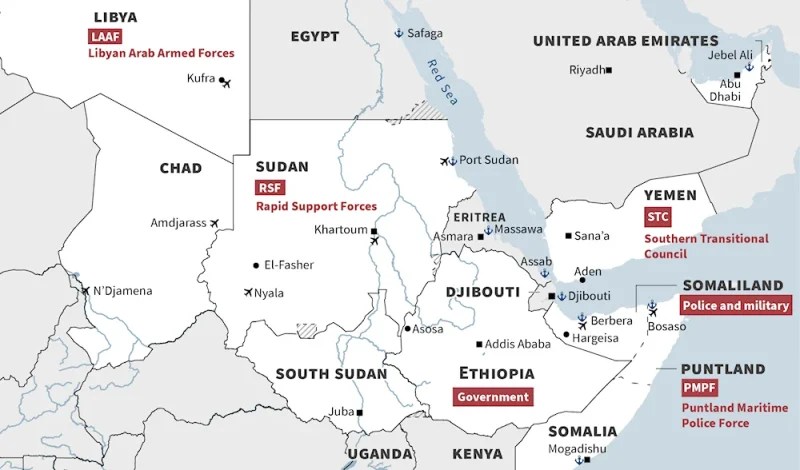
A newly published report by the German Institute for International and Security Affairs (SWP) has delivered a critical assessment of the United Arab Emirates’ role in African conflicts, describing Abu Dhabi as a systematic spoiler that arms proxy forces, manipulates diplomatic processes, and bears significant responsibility for some of the world’s worst humanitarian crises, all while facing virtually no political consequences from its Western partners.
The report, authored by researchers at one of Europe’s most influential foreign and security policy think tanks, which directly advises the German government and Bundestag, calls on Berlin and its European partners to fundamentally reassess their relationship with the UAE.
Sudan: The clearest case
The report presents Sudan as the most devastating example of Emirati interference. The UAE is identified as the most important military, logistical, and financial backer of the Rapid Support Forces (RSF), the paramilitary group whose war against the Sudanese Armed Forces has produced what the UN reports as the world’s largest humanitarian crisis, with 33.7 million people dependent on aid, over 15 million displaced, and widespread extreme hunger.
The RSF’s conduct has been particularly brutal. The report details targeted violence against non-Arab minorities, including sexual violence, mass killings, attacks on medical facilities, and hostage-taking, primarily directed at groups such as the Masalit and Zaghawa.
When the RSF captured El-Fasher in North Darfur in October 2025, a UN fact-finding mission described its actions against the civilian population as bearing the hallmarks of genocide.
Emirati support for the RSF continued even after Iranian strikes on the UAE, with numerous cargo flights departing from Emirates airports to Ethiopia, apparently to ferry supplies across the border to RSF positions.
A UN panel of experts documented 458 flights involving heavy transport aircraft from Emirati military airports or the transhipment hub of Bosaso to eastern Libya between October 2024 and the end of 2025, 239 of them bound for Kufra, a key hub for RSF resupply, in likely violation of UN arms embargoes on both Libya and Darfur.
A proxy model built on plausible deniability
The UAE rarely deploys its own forces. Instead, it operates through a carefully constructed network of local proxies, private military contractors, and logistical intermediaries. Beyond the RSF in Sudan, its partners include Khalifa Haftar’s Libyan Arab Armed Forces, the Puntland Maritime Police Force in Somalia, and, in a departure from the pattern, the Ethiopian government during its war against the Tigray people.
The report details how the UAE recruited and deployed hundreds of Colombian mercenaries to Sudan via an Emirati security firm, with the US government noting in 2025 that these fighters had served as infantry, artillery personnel, drone pilots, and even trained children for combat.
Supplies to the RSF have been routed through LAAF-controlled Libya, Chad, Kenya, Uganda, and Rwanda, with Abu Dhabi deploying financial leverage to secure cooperation, including a 1.5 billion dollar loan to Chadian President Idriss Déby in 2023.
The UAE also profits from gold smuggling networks in conflict zones, with members of the ruling family reported to have personal ties to both Haftar and RSF commander Mohamed Hamdan Dagalo.
Why the UAE intervenes
SWP identifies several overlapping motives. Economic interests are central, as state-owned logistics giants DP World and AD Ports Group have port and infrastructure projects across the continent, and military interventions serve to protect access to trade routes and strategic resources.
But economics alone do not explain the pattern. The report points to the UAE’s drive to outcompete Saudi Arabia for regional influence, a rivalry that has only sharpened since Riyadh forced Abu Dhabi out of southern Yemen.
Ideological opposition to the Muslim Brotherhood also shapes policy, with the UAE consistently backing actors who suppress Islamist movements. Personal enrichment through resource networks and ruling family ties to conflict actors adds a further layer.
Diplomatic manipulation
The report scrutinises the UAE’s use of diplomatic engagement as cover, whereby Abu Dhabi participates in international peace processes while simultaneously intensifying support for belligerents.
In September 2025, the UAE joined the Sudan Quad format alongside Egypt, Saudi Arabia, and the United States, signing joint commitments to end external support for conflict parties. According to US intelligence reporting, however, the UAE was actively intensifying support for the RSF at the same time.
The UAE also pledged 200 million dollars at a February 2025 humanitarian conference and a further 500 million dollars at a US conference in 2026, while contributing only around 33 million dollars to the UN-coordinated humanitarian plan.
In November 2025, Emirati Minister of State Lana Nusseibeh spent four days meeting with Members of the European Parliament in Brussels. Nusseibeh’s endeavor was successful, as a Parliament resolution on Sudan adopted at the same time made no mention of the UAE’s support for the RSF, following opposition from the European People’s Party to amendments tabled by left-wing parliamentary groups.
The same pattern played out during the Berlin Libya Process in 2019-20, when the UAE pledged to halt arms transfers to Libyan conflict parties but continued them regardless. Transport aircraft flew from the Emirates to eastern Libya on the very day of the Berlin conference in January 2020.
European silence, eroded accountability
The report stresses that Western governments, including Germany, have consistently refused to name the UAE publicly in international forums, despite substantial documented evidence of its role in fuelling conflicts. No UN Security Council member has explicitly raised Emirati support for the RSF in formal meetings, either.
This reluctance, SWP argues, is not incidental but reflects a broader calculation in which trade ties, security cooperation, the UAE’s close relationship with “Israel,” and the strategic goal of preventing Abu Dhabi from drifting further toward China or Russia have consistently outweighed accountability concerns.
The UAE’s open disregard for the UN embargo on Libya from 2014 onward, the report notes, likely encouraged other states to adopt a similar approach, with the same dynamic now being repeated in Sudan.
Five recommendations
SWP outlines five concrete steps for Germany and its European partners:
The report concludes that the war on Iran, mounting tensions with Saudi Arabia, and growing reputational vulnerabilities have made the UAE more susceptible to European pressure than at any previous point, and that this window should not go unused.
By Tamer Ajrami | MEMO | May 17, 2026
When military power fails to impose “deterrence,” oil becomes politics. And the Strait of Hormuz is now writing Gulf security rules instead of the Pentagon.
With Hormuz still closed and the emergency oil stock releases used to calm markets running down, prices are moving _ no matter how much some people deny it _ toward a new surge. The real problem is not the price as a number. It is the chain reaction: gasoline and diesel, shipping and insurance, raw materials, and then inflation that travels from Asia to the United States. And even if the strait opened tomorrow, the damage would not vanish. Supply chains do not reset overnight, and parts of the oil and petrochemicals flow would take time to recover.
In my previous Middle East Monitor article, I said clearly that Gulf states “have nothing but to talk to Iran now”. That was not idealism or goodwill. It was hard security math: the old formula is eroding. Bases do not protect the way people assumed, and guarantees shrink the moment they face a real test. Today, this is no longer an argument. It is a reality driven by markets before politics.
Trump and China: A visit without a lifeline — and Time is against him
Trump’s attempt to turn to China produced no clear exit. Not because Beijing is powerless, but because it sees the issue in simple terms: open the strait through practical understandings, and negotiate with Iran on realistic terms.
The problem is that Washington still wants a “surrender” wrapped in diplomatic language. Iran sees no reason to give that for free as it holds leverage in a global energy shock.
This is the core of Trump’s trap: he can say whatever he wants, but he cannot cancel economics. Markets do not negotiate. They punish.
That is why countries are now moving on two tracks: a unilateral track to protect their own interests, and a collective track to design a new framework that prevents the next shock. Saudi Arabia is stepping forward to lead the collective track, not because it loves “mediation” as a headline, but because the cost of ongoing chaos has become higher than the cost of a deal.
A New “Helsinki Act” — But without the Human Rights Basket
According to Western reporting, Saudi Arabia is floating something close to a “Gulf Helsinki Act” arrangement with Iran—modeled on the Helsinki process of the mid-1970s during the Cold War. It would not be just a Saudi–Iran deal. It would extend to the Gulf and the European Union, aiming to lock in non-aggression, structured economic normalization, and monitoring and implementation mechanisms.
The original Helsinki process was built around four “baskets”: security and non-aggression; economic cooperation; human rights and self-determination; and follow-up mechanisms. In the Middle East, copying the third basket is unrealistic. The region’s unwritten rule is non-interference. Here, states do not use “human rights” language as a tool to destabilize each other internally. So, the Saudi approach seems to focus on three practical baskets: security and non-aggression, economic cooperation and stable energy flows, and verification/implementation.
It is a practical logic: if you want an agreement that can survive, you do not plant a delayed bomb inside it.
The Hard Question: Can a Deal work without the United States?
Here is the central dilemma. A Gulf–EU–Iran non-aggression arrangement without the United States creates a dangerous gap: the Gulf and Europe commit to non-aggression, Iran commits too, but Washington and Israel still retain the ability to strike Iran. What does the agreement do then? Does it become a nice document that collapses at the first air raid?
On the other hand, bringing Washington into the deal is not easy either. The US is struggling to produce a quick bilateral agreement with Iran to end the crisis, so why would it accept a broader framework that limits its freedom of action?
This opens a third, more sensitive option: Gulf states and Europe “bypass Washington” in practice. That would mean refusing the use of their airspace and territorial waters for any military or intelligence activity against Iran. And maybe refusing to enforce sanctions that destabilize the region and recreate the Hormuz shock. This is not a small move. It would be a strategic shift.
The UAE: A Different Vision — and a Dangerous Ceiling
The Gulf is not unified on strategy. Other reporting suggests Emirati efforts to push a coordinated Gulf military “response” against Iran. The problem is not the idea of response by itself. The problem is the ceiling of objectives.
If the goal is limited deterrence to reduce escalation, that is one thing. But if the goal mirrors Netanyahu and Washington _ regime change, dismantling Iran’s nuclear program, destroying its ballistic capabilities, and reshaping Iran from the inside _ that is a long war. And the Gulf does not have the luxury to absorb its costs.
Most importantly, the idea of “escaping Hormuz” through alternative pipelines is not a real solution. If peace collapses, fields, ports, and energy infrastructure across the region remain within range. And Bab al-Mandab can become another choke point. In the end, the issue is not a pipeline or a port. It is a sustainable peace that prevents the drone and the missile before it “manages” the price.
Whoever Ends the War Ends the Chaos
A way out starts from one point: ending the US–Israeli confrontation with Iran through a realistic understanding; then building a regional framework similar to “Helsinki” that locks in non-aggression, protects economies, and prevents a repeat of the strait crisis.
Saudi Arabia is trying to “hold the story together” because Washington entered, got stuck, and now wants to exit; while the Gulf cannot afford to sit between Iran’s leverage and America’s disorder.
The choice is clearer than ever: either a settlement that closes the door on choke-point warfare, or a longer crisis that bankrupts markets before it bankrupts armies. The Gulf; whether it likes it or not; no longer has the option to “wait”.
Glenn Diesen | May 16, 2026
Prof. Seyed Mohammad Marandi is a former advisor to Iran’s nuclear negotiation team. Prof. Marandi argues that the U.S. is preparing another attack on Iran after Trump’s failed meeting with Xi in Beijing. Iran has prepared an overwhelming retaliation.
Follow Prof. Glenn Diesen:
Support the research by Prof. Glenn Diesen:
Daniel Davis / Deep Dive – May 16, 2026
By Larry C. Johnson | SONAR21 | May 15, 2026
The Beijing circus is over and Donald Trump’s talks with Xi Jinping produced nothing more than some pleasing photo ops and some performative diplomacy with no substantive accomplishments.
There was no final communique at the end of Trump’s two days of meetings with Xi Jinping. Instead, we are left to rely on the statements from each government. When you parse the two statements, the two readouts diverge significantly, and the gaps are as informative as the overlaps. When you compare what each side claims was discussed you can see what actually transpired at the summit.
The divergence between the two readouts is stark and strategically deliberate. Here is a precise accounting of what the White House emphasized that China’s Foreign Ministry either omitted entirely or mentioned only in the vaguest terms:
1. The Iran War and Nuclear Weapons — Omitted by China
This is the most consequential gap. The White House readout stated explicitly:
The two sides agreed that the Strait of Hormuz must remain open to support the free flow of energy. President Xi also made clear China’s opposition to the militarization of the Strait and any effort to charge a toll for its use, and he expressed interest in purchasing more American oil to reduce China’s dependence on the Strait in the future. Both countries agreed that Iran can never have a nuclear weapon.”PBS
The Chinese readout, by contrast, merely said that “the two sides discussed the Middle East conflict” without offering any further details — no mention of the Strait, no mention of tolls, no mention of Iran’s nuclear program, and no acknowledgment of any agreed position on any of those issues. YouTube
This gap is enormous. The White House is asserting that China agreed Iran can never have a nuclear weapon and opposed Iran’s toll regime. That White House is spinning this as significant Chinese concessions that Beijing clearly did not want attributed to it publicly. However, according to a reliable source with access, Xi firmly rejected Trump’s request that China apply pressure on Iran and help open the Strait of Hormuz.
2. Fentanyl — Omitted by China
The White House readout specifically noted that the two sides discussed “addressing fentanyl precursor flows into the United States” — a longstanding US demand that China reduce the flow of chemical precursors used to manufacture fentanyl. The Chinese readout made no mention of fentanyl whatsoever, which is consistent with Beijing’s longstanding position that it has already done enough on the issue and resists framing it as a bilateral problem. Komo News
3. Agricultural Purchases — Omitted by China
The White House noted that the two presidents discussed “increasing Chinese purchases of U.S. agricultural products.” China’s readout spoke only in general terms about trade being “mutually beneficial” and made no specific commitment to agricultural purchases. YouTube
4. Market Access for US Businesses — Framed Very Differently
The White House described the meeting as centered on “expanding market access for American businesses into China and increasing Chinese investment into US industries.” China’s readout framed this entirely differently — as China “opening its door wider” on its own terms, not as a response to US demands for market access.
5. The Business Delegation — Treated Asymmetrically
The White House noted that “leaders from many of the United States’ largest companies joined a portion of the meeting,” treating it as a substantive commercial engagement. The Chinese readout mentioned that Trump “asked each of the business leaders who were traveling with him to present themselves to President Xi” — framing it as a courtesy introduction rather than a substantive business discussion. YouTube
6. Taiwan — The Mirror Image Problem
The most telling asymmetry runs in the opposite direction on Taiwan. The White House readout did not mention Taiwan at all, while China centered its entire readout on Xi’s Taiwan warning. Trump declined to answer a reporter’s question about whether he and Xi had even discussed Taiwan. Rubio told NBC News that the US was “not asking for China’s help with Iran” — a comment that implicitly pushes back on what the White House readout seemed to suggest about Chinese cooperation. The National DeskBreitbart
The Bottom Line
Both sides released statements detailing what Trump and Xi discussed, but they only overlap in limited areas. The statements diverge most sharply on Iran — where the US claims specific Chinese commitments that China refused to acknowledge — and on Taiwan, where China made explicit warnings that the US declined to even mention. NPR
The pattern is diplomatically classic: each side published the readout that serves its domestic political needs and advances its negotiating position. China wanted the world to see Xi issuing stern warnings on Taiwan. Washington wanted the world to see China agreeing that Iran can never have a nuclear weapon and opposing Iran’s toll regime. Whether either claimed concession is real — or merely asserted — is precisely what makes the readout divergence so revealing.
The Strategic Framework
Xi opened with a sweeping philosophical framing: “Transformation not seen in a century is accelerating across the globe, and the international situation is fluid and turbulent.” He posed three questions to Trump directly: Can China and the United States overcome the Thucydides Trap and create a new paradigm of major-country relations? Can we meet global challenges together and provide greater stability for the world? Can we build a bright future together for our bilateral relations? Wikipedia
Xi announced the two leaders had “agreed on a new vision of building a constructive China-U.S. relationship of strategic stability,” defining it precisely: “Constructive strategic stability means positive stability with cooperation as the mainstay, healthy stability with competition within proper limits, constant stability with manageable differences, and lasting stability with expectable peace.” He said this framework “will provide strategic guidance for China-U.S. relations over the next three years and beyond” and stressed: “Building a constructive China-U.S. relationship of strategic stability is not a slogan. It means actions in the same direction.” Wikipedia
Trade and Economics
Xi stated that “China-U.S. economic and trade ties are mutually beneficial and win-win in nature. Where disagreements and frictions exist, equal-footed consultation is the only right choice.” He said the economic and trade teams had “produced generally balanced and positive outcomes” at preparatory talks the prior day, and that “China will only open its door wider. U.S. businesses are deeply involved in China’s reform and opening up.” Wikipedia
Military and Diplomatic Channels
Xi called on the two sides to “make better use of communication channels in the political and diplomatic and military-to-military fields” and to “expand exchanges and cooperation in areas such as the economy and trade, health, agriculture, tourism, people-to-people ties and law enforcement.” Wikipedia
Taiwan — The Sharpest Language in the Readout
Xi was unambiguous: “The Taiwan question is the most important issue in China-U.S. relations. If it is handled properly, the bilateral relationship will enjoy overall stability. Otherwise, the two countries will have clashes and even conflicts, putting the entire relationship in great jeopardy. ‘Taiwan independence’ and cross-Strait peace are as irreconcilable as fire and water. Safeguarding peace and stability across the Taiwan Strait is the biggest common denominator between China and the U.S. The U.S. side must exercise extra caution in handling the Taiwan question.” Wikipedia
International Issues
The readout notes that the two presidents “exchanged views on major international and regional issues, such as the Middle East situation, the Ukraine crisis, and the Korean Peninsula” — but offered no further detail on any of those topics in the official Chinese text. Wikipedia
APEC and G20
The two presidents agreed to support each other in hosting a successful APEC Economic Leaders’ Meeting and G20 Summit this year. Wikipedia
Wang Yi’s Closing Assessment — May 15
Foreign Minister Wang Yi told state media: “This was an important meeting in which the two heads of state engaged in in-depth communication and achieved substantial outcomes,” calling it “a historical meeting.” He particularly touted progress on trade and economic issues. China’s Foreign Ministry also confirmed that President Xi Jinping will visit the United States this fall at the request of President Donald Trump.
As far as Iran is concerned, the Chinese and Russians are working behind the scenes — using Pakistan as a frontman — to erect a new security architecture for the Persian Gulf. The current effort is to convince Saudi Arabia and Qatar to effectively cut military ties with the US and enter into a strategic agreement that will be guaranteed by Russia and China. If Saudi Arabia and Qatar persist with prohibiting the US to use their bases and air space for a new set of attacks against Iran, the US may be compelled to call off planned strikes.
or go to
Aletho News Archives – Video-Images
BY LAURENT GUYÉNOT • UNZ REVIEW • SEPTEMBER 6, 2022
Is it true that “9/11 was an inside job”? Yes, insofar as Israel is “inside” the U.S. But for the 9/11 truthers who have identified Israel as the main perpetrators, “9/11 was an inside job” is at best a half-truth, and at worst an integral part of the Zionist operation, like a secondary flag sewn as a lining under the false flag of Islamism. Victor Thorn (1963-2017) wrote in his book 9/11 made in Israel: The Plot Against America (2011): “In essence, the ‘9-11 truth movement’ was created prior to Sept. 11, 2001 as a means of suppressing news relating to Israeli complicity. . . . The slogan ‘9-11 was an inside job’ was quite possibly the greatest example of Israeli propaganda ever devised.” In milder terms, it is “controlled opposition”.
A genuine truth movement would have pointed to Israel as the prime suspect from the start. From day one, it was obvious who would benefit. … continue
 Aletho News If Americans Knew No Tricks Zone
