U.S.-Led NATO Is at War Against Russia
By Finian Cunningham | Strategic Culture Foundation |April 26, 2022
We are now in the realm of World War Three. The abysmal situation is such that the war is in danger of going nuclear in which case the future of the planet is at stake.
Incredibly, to warn of this danger leaves a person open to the accusation that they are peddling Russian propaganda. Blindly, the Western governments are doubling down on the powder-keg.
The U.S.-led NATO alliance is flooding Ukraine with heavy offensive weaponry capable of hitting Russia, and the British government this week has openly called for Ukraine to target Russia’s “depth” with NATO weapons.
Russia’s Foreign Minister Sergey Lavrov commented that the U.S. military alliance is now fully-fledged in a proxy war against Russia. He said there is a “serious danger” of confrontation spiraling into a nuclear conflagration.
Only a fool or an insane person could remain insouciant about the dynamic unfolding.
Ominously, there is evidently no diplomatic will from Washington and its allies to address the background to the war in Ukraine or Russia’s long-held security concerns. The United Nations Secretary-General Antonio Guterres is being vilified for even attempting to negotiate a peace settlement by going this week to Moscow before traveling on to Kiev.
There is a palpable sense that the U.S. and NATO are recklessly pushing a military showdown with Russia – albeit under the cynical guise of “defending Ukraine”. All the while, the Western public is being kept in the dark by a complicit corporate-controlled news media.
This week saw the United States host what can only be called a war conference at its European command center in the Ramstein airbase, Germany, where NATO military chiefs coordinated their weapons delivery to Ukraine. This is a war footing.
U.S. Secretary of Defense Lloyd Austin said the United States and its NATO allies would “move heaven and earth” to get more weapons into Ukraine to defeat Russia’s military intervention in that country. Austin’s rhetoric was a disturbing malapropism with apocalyptic resonance.
But it does reveal the determination to take on Russia that is now openly visceral. The conflict in Ukraine is emerging for what it is – a war between the U.S.-led NATO bloc and Russia. Moscow has long held that the U.S. and NATO are a hostile entity tacitly aiming to subjugate Russia. Such claims have been derided as Russian paranoia. However, it’s now apparent that the actual intent is hostility and defeat of Russia.
Austin stated at the Ramstein conference that America’s allies are now openly exploiting an opportunity to “weaken Russia” and pursue the regime change objective in Moscow that U.S. President Biden referred to in his controversial Warsaw speech last month.
Earlier this week, U.S. Secretary of State Antony Blinken accompanied Austin, the Pentagon’s civilian chief, on a secret visit to the Ukrainian capital, Kiev. American news media dutifully complied with an embargo on reporting the Sunday visit which shows that these media are complicit in conforming to Washington’s agenda of belligerence.
The American envoys held three-hour discussions with Ukrainian President Vladimir Zelensky during which they pledged more military support on top of the huge arsenal already provided by the U.S. The meeting is a stark signal to Moscow of what the real American intentions are. This is not about resolving Russia’s grievances over NATO expansionism and the neutrality of Ukraine. That discourse was never taken seriously by the United States anyway. No, now relations are in the framework of the U.S. waging a war against Russia, with Ukraine merely the present battleground.
When the top American officials returned to Poland they held a press conference Monday at a warehouse shipping NATO weapons to Ukraine. At one stage, Austin told reporters about the earlier meeting with Zelensky: “So our focus in the meeting was to talk about those things that would enable us [sic] to win the current fight and also build for tomorrow [sic].”
Unable to contain his enthusiasm for confrontation, the Pentagon chief went on to make the direct U.S. involvement more apparent: “In terms of our – their ability to win, the first step in winning is believing that you can win. And so they believe that we can win; we believe that they – we can win – they can win if they have the right equipment, the right support. And we’re going to do everything we can – continue to do everything we can to ensure that that gets there.”
When Russian President Vladimir Putin ordered what he called “the special military operation” in Ukraine on February 24, he said Russia had no choice but to defend the Russian-speaking people of the Donbass who had endured eight years of a deadly offensive by the NATO-backed Kiev regime forces.
The United States, NATO, and the Kiev regime have shown no will whatsoever to resolve the civil war in Ukraine peacefully by implementing the Minsk accords negotiated in 2015.
It is more apparent than ever that the conflict in the Ukraine was never a localized civil war but rather was always a front line in a bigger geopolitical confrontation between the U.S.-led NATO bloc and Russia, as Bruce Gagnon explained in a recent interview for Strategic Culture Foundation.
Instead of an earnest effort to genuinely resolve the conflict, the NATO-backed Kiev regime and its openly Nazi regiments are mobilizing in a general war footing against Russia.
The rationale is now explicitly stated as the U.S. and its allies wanting to defeat Russia and subjugate it.
British armed forces minister James Heappey even went as far as telling the BBC this week that Ukrainian forces should strike Russia’s depth with NATO weaponry.
Russia’s military defense doctrine forgoes first-use of nuclear weapons but it reserves the right to use such weapons if the country comes under existential threat even from conventional military assault.
The United States and its NATO allies have willfully ignored Russia’s decades-long concerns about its security and in particular the use of Ukraine as a cat’s paw to destabilize and dissipate Russia. The full-on U.S. imperial war agenda of targeting Russia for defeat is now coming into focus. The crazies are in charge of the asylum. And shouting about it too.
US Boeing X-37 may carry weapons of mass destruction — Head of Roscosmos
TASS – April 23, 2022
MOSCOW – US Boeing X-37 orbital spacecraft may carry reconnaissance tools or weapons of mass destruction, Director General of Roscosmos Dmitry Rogozin said on Saturday.
“It may carry some kind of reconnaissance tools or weapons of mass destruction. This is a new category of carriers of mass destruction weapons. Attacks from space pose the most serious danger,” he said in an interview with Rossiya 24 TV channel, mentioning the vehicle returning from space.
“We do not have any intelligible information from the United States about the purpose and technical capabilities of this device,” he added.
According to Rogozin, the Russian side believes that the United States is trying to launch weapons into space with the help of the Boeing X-37.
The NATO Lie
By Jacob G. Hornberger | FFF | April 26, 2022
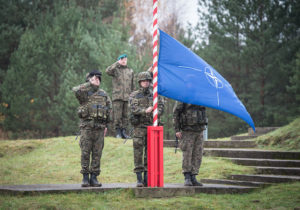
Russia’s invasion of Ukraine has brought to the forefront the NATO treaty to which the United States is a party. President Biden and the Pentagon have steadfastly maintained that a Russian attack on any NATO member automatically obligates the United States to go to war against Russia. That, of course, would necessarily mean the virtual certainly of all-out nuclear war between Russia and the United States, a war that would, needless to say, end up destroying both countries and killing hundreds of millions of people in the process.
There is one big problem with the Biden/Pentagon position: It’s a lie. In fact, the NATO treaty does not obligate the United States to automatically come to the defense of any NATO member in the event Russia attacks that particular country. That’s because the NATO treaty does not operate to amend the U.S. Constitution.
The Constitution is the document that the American people used to call the federal government into existence. The Constitution established a federal government of limited powers. The government was divided into three branches — executive, legislative, and judicial — with enumerated powers being delegated to each branch of government.
With respect to war, the Framers delegated the power to declare war to Congress and the power to wage war to the president. What that meant was that the president is prohibited from waging war against another nation without first securing a declaration of war from Congress.
When the U.S. government was converted from a limited-government republic to a national-security state after World War II, a fourth branch was effectively added to the federal government: the national-security branch, consisting of the Pentagon, the CIA, and the NSA.
While it has been said that these entities are actually part of the executive branch, as Michael Glennon has pointed out in his excellent book National Security and Double Government (which I cannot recommend too highly), the national-security section of the federal government, owing to its overwhelming power, is actually the part that is running the show, with the other parts of the federal government operating deferentially in support.
The Constitution provides for the specific ways to amend the Constitution. Quoting whitehouse.gov: “An amendment may be proposed by a two-thirds vote of both Houses of Congress, or, if two-thirds of the States request one, by a convention called for that purpose. The amendment must then be ratified by three-fourths of the State legislatures, or three-fourths of conventions called in each State for ratification.”
Notice something important: The Constitution does not provide that it can be amended by treaty. The Framers did not want federal officials to have the power to amend the Constitution by simply entering into treaties with other nations that changed the terms and conditions of the Constitution.
Therefore, the NATO treaty cannot operate to amend the constitutional provision that requires a congressional declaration of war before the president can legally wage war. Thus, if Russia attacks, say, NATO member Poland, the Constitution requires the president to secure a declaration of war from Congress against Russia before the president, the Pentagon, and the CIA can wage war against Russia.
Now, take a look at an article entitled “The NATO Treaty Does Not Give Congress a Bye on World War III” by Michael Glennon, who I mentioned above. It’s posted at a website entitled lawfareblog.com. This is one of the most important articles that you will read in your lifetime. I cannot emphasize too highly why you should read this article and, equally important, share it with everyone you know and, equally important, ask them to share it with everyone they know.
Glennon is professor of international law at The Fletcher School of Law and Diplomacy at Tufts University. From 1977-1980, he served as counsel to the Senate Foreign Relations Committee. You can read more about his credentials on Wikipedia by clicking here.
Glennon’s article makes the scholarly but easily readable case that the NATO treaty does not — and cannot — automatically obligate the United States to go to war in the event Russia (or any other nation) attacks a NATO member.
Of course, there is a much more fundamental question that Americans must confront: Why is the United States in NATO at all? NATO was established after World War II to ostensibly protect Western Europe from an attack by the Soviet Union, notwithstanding the fact that there was never any real likelihood that the Soviet Union, which was totally devastated in World War II, had any interest in going to war with Western Europe (and a nuclear-armed United States).
Regardless of whether NATO was necessary or whether it was just part of the Cold War racket, one thing is crystal clear: Once the Soviet Union dismantled, NATO’s mission became moot. At that point, this Cold War dinosaur should have been dismantled and sent into extinction.
Instead, what the NATO bureaucrats did was keep this dinosauric entity in existence and, even worse, began using it to absorb former members of the Soviet Union, which enabled the Pentagon to establish its nuclear missiles ever closer to Russia’s borders. It was when the Pentagon, operating through NATO, announced an intention to absorb Ukraine that Russia decided to invade Ukraine, as the Pentagon knew it would, in order to prevent the Pentagon from establishing its nuclear missiles (and military bases, troops, tanks, and other weaponry) on Russia’s border.
Thus, one of the keys to getting America back on the right track — toward liberty, peace, prosperity, and harmony with the people of the world — is to immediately withdraw from NATO, which would bring the immediate dissolution of this Cold War dinosauric entity, as well as bring U.S. troops home from Europe (and everywhere else). It is U.S. foreign interventionism that is a root cause of the loss of liberty and prosperity in America as well as America’s disharmony with the people of the world.
In the meantime, it is in the interest of every American to understand the nature of the NATO lie, a lie that holds that the NATO treaty automatically obligates the U.S. government to go to war against Russia in the event of an attack by Russia on another member of NATO. That’s why, again, I highly recommend reading Michael Glennon’s article and sharing it with everyone you know and asking them to share it with everyone they know.
Germany to supply Ukraine with heavy weaponry
Samizdat | April 26, 2022
The German government has given the green light for the delivery of self-propelled anti-aircraft guns to Ukraine, the country’s Defense Minister Christine Lambrecht said on Tuesday.
Speaking at US-hosted defense talks at the American airbase Ramstein in Germany’s Rhineland-Palatinate state, Lambrecht said that the leadership in Berlin made the decision on Monday. She emphasized that Germany was “determined to help the Ukrainian people with unified resolve in this existential emergency.”
The minister explained that “Ukraine will order” hardware from German manufacturers and “Germany will pay.” Berlin would earmark some 2 billion euros to that end, Lambrecht added.
The armored vehicles in question are Gepard self-propelled anti-aircraft guns, which were decommissioned by the German military back in 2010. Designed to take out cruise missiles and aircraft, Gepards can also be used against targets on the ground. As many as 50 heavy vehicles could reportedly be delivered to Ukraine. Defense firm Krauss-Maffei Wegmann will now refurbish the equipment before transferring it on to Kiev, Germany’s dpa news agency reported. It is, however, not known when exactly Ukraine can expect delivery of the anti-aircraft systems.
Lambrecht also announced that Berlin “has initiated a swap scheme with our partners in eastern Europe” that is ensuring that “Ukraine is quickly obtaining heavy weaponry that doesn’t require lengthy training.” But, according to the minister, Germany could do a lot more in this respect.
On top of that, Berlin will be cooperating with the US and the Netherlands when it comes to providing training to Ukrainian troops on German soil in the use of various artillery systems.
Lambrecht made the announcements during a meeting of defense ministers from 40 countries hosted by US Defense Secretary Lloyd Austin on Tuesday.
Earlier this month, several German outlets reported that Germany’s Rheinmetall arms manufacturer was prepared to sell 88 decommissioned Leopard tanks, as well as ammunition, spare parts and tools to repair the hardware. Training on the equipment would also be provided to Ukrainian troops. The company was awaiting the German government’s approval, the media said at the time.
Moscow has repeatedly condemned NATO arms supplies to Kiev, saying they only destabilize the situation on the ground and hamper the prospect for peace. It also warned that any equipment deliveries will be considered a legitimate military target for the Russian forces once they cross into Ukrainian territory.
“NATO is essentially going to war with Russia through a proxy and arming that proxy. War means war,” Russia’s Foreign Minister said on Monday.
Former US-NATO commander wants to put troops on the ground in Ukraine
By Kelley Beaucar Vlahos | Responsible Statecraft | April 25, 2022
Former NATO top commander Gen. Philip Breedlove is the latest big name to come out for putting troops on the ground in Ukraine. Breedlove, who has been angling for weeks for a more muscular policy against Russia, told The Times of London that it’s time for real action. And he may have the ear of the White House: the article says he’s named as one of “several high-ranking retired commanders advising the Biden administration on Ukraine.”
“So what could the West do? Well, right now there are no Russian troops west of the Dnieper River. So why don’t we put Nato troops into western Ukraine to carry out humanitarian missions and to set up a forward arms supply base?”
Of course it wouldn’t stop there. Most likely Russia will react aggressively, if not explosively, since setting up “a forward arms supply base” would be fully entering this war on the side of Ukraine. NATO would be a co-belligerent in every way, with its 40,000 troops now stationed on alliance’s eastern front considered future enemy combatants. At the end of April, the Pentagon mobilized some 14,000 troops, along with F-35 strike fighters and Apache helicopters to Poland, Hungary, and the Baltics. A total of 100,000 U.S. troops now spread across Europe would no doubt be on some level of alert if NATO entered the fray.
Breedlove, who served as NATO’s Supreme Allied Commander from 2013 to 2016, said this move was essential for the protection of Odesa, a strategic Ukrainian port city on the Black Sea.
“If Odesa falls, Ukraine will become a land-locked country with no access to the Black Sea. The impact on Ukraine’s GDP would be huge. It would be ruinous for the economy,” he told the Times.
“The West is saying it is providing everything Ukraine needs to defend against the Russians. But the people of Mariupol had to fight without Stingers [anti-aircraft missiles]. That was a failure by the West.”
He added: “Now we need to make sure that the Ukrainians win the battle for Odesa.”
Earlier this month, Breedlove was complaining that the West’s fears of nuclear war were working in Putin’s favor.
“We have been so worried about nuclear weapons and World War III that we have allowed ourselves to be fully deterred. And [Putin], frankly, is completely undeterred. He has switched into the most horrific war against the citizens of Ukraine, it is beyond criminal at this point.”
U.S. weakness on this score bleeds over to our relations with Iran, North Korea, and China, he asserts:
“The message we’re sending to the entire world is if you get a nuclear weapon, you’re going to have a certain reaction from the West and certainly from the United States…[that’s all]. And I don’t think that’s the message we want to send them.”
Of course, a month before this Breedlove said he was “not advocating a war” when asked about what appeared to be his support for a “humanitarian no fly zone.” Today, advocating NATO involvement directly in Ukraine would be a giant leap beyond that, and who knows what kind of opening for others coming down with similar war fever in Washington. Last week, Delaware Sen. Chris Coons was forced to walk back comments he made that suggested he too, was in favor of putting troops on the ground against Russia.
The Dynamics of Escalation: ‘Standing With Ukraine’
By Alastair Crooke | Strategic Culture Foundation | April 25, 2022
As it dawns on the West that whereas sanctions are deemed capable of bringing countries to their knees, the reality is that such capitulation never has occurred (i.e. Cuba; North Korea; Iran). And, in the case of Russia, it is possible to say that just ain’t going to happen.
Team Biden still has not fully grasped the reasons why. One point is that they picked precisely the wrong economy to try to collapse via sanctions (Russia has minimal foreign supply lines and oodles of valuable commodities). Biden’s staffers too, have never comprehended the full ramifications of Putin’s monetary jujitsu linking the rouble to gold, and the rouble to energy.
They condescend to Putin’s monetary jujitsu as yet another forlorn strike versus the dollar’s ‘impregnable’ reserve currency status. So they choose to ignore it, and assume that if only the Europeans would take fewer hot showers, wear more woollen jumpers, forego Russian energy, and ‘stand with Ukraine’, the economic collapse finally would materialise. Hallelujah!
The other reason why the West misconstrues the strategic potential of sanctions is that the Russia-China war on western hegemony is assimilated by its peoples to be an existential one. For them, it is not just about taking fewer hot showers (as for Europeans), it is about their very survival – and consequently their pain threshold is much, much higher than the West’s. The west is not going to smoke their challengers out so ridiculously easily.
At bottom, the Russia-China axis possess food, energy, technology and most of the world’s key resources. History teaches that these elements make the winners in wars.
The strategic problem though, is two-fold: Firstly, the window for a Plan ‘B’ de-escalation via a political deal in Ukraine has passed. It is all or nothing now (unless Washington folds). And secondly, albeit in slightly differing context, both Europe and Team Biden have elected to take the stakes sky-high:
The conviction that the European liberal vision faces humiliation and disdain, were Putin to ‘win’, has taken hold. And in the Obama-Clinton-Deep State nexus, it is unimaginable that Putin and Russia still regarded as the author of Russiagate for many Americans, might prevail.
The logic to this conundrum is inexorable – Escalation.
For Biden, whose approval ratings continue to tank, disaster looms in the November mid-terms. The consensus amongst U.S. insiders is that the Democrats are set to lose 60–80 seats in Congress, and a small handful (4 or 5 seats) in the Senate too. Were this to come about, it would not be just a personal humiliation, but would token administrative paralysis for the Democrats until the notional end of Biden’s term.
The only possible path out from this approaching cataclysm would be for Biden to pull a rabbit from the Ukraine ‘hat’ (one that, at the very least, would distract from soaring inflation). The Neo-cons and the Deep State (but not the Pentagon) are all for it. The arms industry naturally are loving Biden’s laundering weapons into Ukraine (with huge ‘spillage’ somehow vanishing into ‘the black’). Many in DC profit from this well-funded boondoggle.
Why are we seeing such euphoria over such a seemingly reckless scheme of escalation? Well, strategists suggest that were the Republican leadership to go bi-partisan on escalation – become complicit in ‘more war’, as it were – they argue that it might prove possible to stem Democratic losses in the mid-terms and blunt an Opposition campaign assault focussed on a mismanaged economy.
How far might Biden go with this escalation? Well, the arms splurge is a no-brainer (another boondoggle), and Special Forces are already in theatre, poised to light a fuse to any escalation; moreover, the mooted no-fly zone seems to have the added advantage of enjoying European support, particularly in the UK, amongst the Baltics (of course) and from the German ‘Greens’, too. (Spoiler Alert! First, of course, in order to implement any no-fly zone, it would be necessary to control the airspace – which Russia already dominates, and over which it implements full electronic-magnetic exclusion).
Would this be enough? Dark voices are advising not. They want ‘boots on the ground’. They even talk of tactical nukes. They argue that Biden has nothing to lose by ‘going big’, especially if the GOP are persuaded to become accomplices. Indeed, it might just save him from ignominy, they urge. U.S. military insiders already point out that the arms supply will not ‘turn around’ the war. A ‘lost war’ must be avoided going into November at all costs.
Is such a consensus for escalation realistic? Well, yes, it is possible. Recall that Hillary (Clinton) was the alchemist who fused the 1980s Neoconservative wing to the 1990s Neoliberals to create an interventionist broad-tent that could serve all tastes: Europeans could imagine themselves wielding economic power in a globally significant way for the first time, whilst the Neo-cons have resurrected their insistence on forceful military intervention as the requisite to maintaining the rules-based order. The latter are cock-a-hoop that financial war is failing.
From the Neo-cons’ perspective, it puts military action firmly back on the table and with a new ‘front’ opening: The Neo-cons today, precisely are questioning the premise that a nuclear exchange with Russia must be avoided at all costs. And from this shift away from the prohibition on actions that could trigger a nuclear exchange, they say that circumscribing the Ukraine conflict on such basis is unnecessary and a strategic error – asserting that in their view, Putin would be unlikely to resort to nuclear weapons.
How can this Neo-con-Liberal interventionist élite superstructure wield such influence when the broader American political class historically has been ‘anti-war’? Well, the Neo-cons are the archetypal chameleons. Loved by the war industry, a regular loud presence on the networks, they rotate in and out of power, with the ‘China hawks’ nesting in the Trump corridors, whilst the ‘Russia hawks’ are migrated to populate the Biden State Department.
Is escalation already ‘baked-in’? There may yet be one iconoclastic ‘fly in the ointment’: Mr Trump! – through his symbolic act of endorsing J.D. Vance for the GOP Senate Primary in Ohio, against the wishes of the GOP Establishment.
Vance is one (amongst many) representatives of America’s populist tradition seeking office in the coming Congressional ‘churn’. But the salience here is that Vance has been questioning the rush to escalation in Ukraine. Many other would-be populist contenders among the GOP’s new crop of interesting senators and senators-in-waiting already have succumbed to GOP old-establishment pressure to endorse war. (Boondoggles again).
The GOP is divided on Ukraine at its upper representational level, but the popular base traditionally is sceptical of foreign wars. With this political endorsement, Trump is nudging the GOP towards opposing escalation in Ukraine. Ross Douthat in the NY Times confirms that the Vance endorsement connects more closely to the sources of Trump’s 2016 popularity, as he mined the anti-war sentiment amongst the deplorables, whose focus more is with caring for their own country’s welfare.
Shortly after the endorsement, Trump issued a statement:
“It doesn’t make sense that Russia and Ukraine aren’t sitting down and working out some kind of an agreement. If they don’t do it soon, there will be nothing left but death, destruction, and carnage. This is a war that never should have happened, but it did. The solution can never be as good as it would have been before the shooting started, but there is a solution, and it should be figured out now—not later—when everyone will be DEAD!”, Trump said.
Trump effectively is wedging apart the possible key fault-line for the coming elections (even if some GOP panjandrums – many of whom are funded by the Military Industrial Complex (MIC) – favour a more robust military involvement).
Trump too, always has an instinct for an opponent’s jugular: Biden may be highly attracted to the argument for escalation, but he is known to be sensitive to the thought of body-bags coming home to the U.S. before November becoming his legacy. Hence Trump’s exaggeration that sooner rather than later, everyone in Ukraine “will be DEAD!”.
Again, the fear amongst Democrats with military understanding is that the western weapons airlift to the borders of Ukraine will not change the course of war, and that Russia would prevail, even were NATO to engage. Or, in other words, the ‘unthinkable’ will occur: The West will lose to Russia. They argue that Team Biden has little choice: Better to bet on escalation than to risk losing all with a debacle in Ukraine (particularly after Afghanistan).
To eschew escalation presents such a challenge to the American missionary psyche of global leadership that momentum for it may not be overcome through Biden’s innate caution alone. The Washington Post already is reporting that “the Biden Administration is shrugging off fresh Russian warnings against providing Ukrainian forces with more advanced arms and new training – in what appears to be a calculated risk Moscow won’t escalate the war”.
The EU élites, by contrast, are not just persuaded (Hungary and one faction in Germany, apart) by the logic of escalation, they are frankly intoxicated by it. At the Munich Conference in February, it was as if the EU leaders were intent on out-bidding each other in their enthusiasm for war: Josep Borrell re-confirmed his commitment to a military solution in Ukraine: “Yes, normally wars have been won or lost on the battlefield”, he said upon arrival for a meeting of the EU foreign ministers in Luxembourg, when asked to comment on his previous statement that “this war will be won on the battlefield”.
Their euphoria is centred around the belief that the EU – for the first time – is wielding its economic power in a globally significant way, and, at the same time, enabling and arming a proxy war against Russia (through imagining the EU as a real Carolingian empire, actually winning on the battlefield!).
The euphoria of the EU élites – so completely de-coupled from national identities and local interests, and loyal rather to a cosmopolitan vision in which men and women of consequence network endlessly amongst themselves and bask in their peer approval – is opening deep polarisation within their own societies.
The unease arises among those who do not regard patriotism, or a scepticism towards today’s Russiaphobia, as necessarily ‘gauche’. They are concerned that perception-delimited EU élites, advocating sanctions on Russia and NATO engagement with a nuclear power, will bring disaster to Europe.
The Euro-élites are on a crusade – too highly invested in the emotional charge and euphoria of the Ukraine ‘cause’ to have even considered a Plan ‘B’.
And even if a Plan ‘B’ were to be considered, the EU has less of a reverse-gear than the U.S. The Brussels zeitgeist is set in concrete. Structurally, the EU is incapable of self-reform, or of radically changing course and wider Europe now lacks the ‘vessels’ through which decisive political change can be effected.
Hold onto your hats!
Russia says it destroyed weapons delivered by US and EU to Ukraine
Samizdat | April 23, 2022
Russian forces have destroyed a logistics terminal in Odessa that held a large batch of foreign weapons, Moscow said on Saturday amid its ongoing military offensive in Ukraine. However, the city’s authorities claimed that its air defense group destroyed two missiles but that another four hit a military target and residential buildings, leading to victims. It was not immediately clear if the civilian buildings were hit as a result of attempts by Ukrainian forces to strike down the missiles initially aimed at a military target.
According to Russian military spokesman Major General Igor Konashenkov, in the afternoon, “high-precision long-range air-launched missiles” hit a logistics terminal located on a military airfield near Odessa, where “a large batch of foreign weapons received from the United States and European countries was stored.”
Russia has repeatedly warned NATO against sending arms to Ukraine and stated that it would consider arms convoys to be legitimate military targets.
Odessa regional emergency services earlier said that “as a result of an enemy shelling,” a sixteen-story residential building caught fire, which was put out in about two and a half hours.
“At this point it is known that 6 people died, including one child, and 18 people were injured. Two people were rescued from the rubble, 86 people were evacuated,” the authorities said in a statement.
Ukrainian President Volodymyr Zelensky, speaking later at a press conference in Kiev, elaborated on these claims.
“At this very moment eight people have died. Eighteen or twenty have been injured. A three-month old child died. A three-month old child was killed. When the war started, this child was just one month old. Can you imagine this?” Zelensky said.
According to the press office of Ukraine’s South Air Command, on Saturday the air defense group destroyed two cruise missiles, allegedly launched by Russian TU-95 strategic aircraft from the Caspian Sea, and two operational-tactical level UAVs, which “presumably corrected the flight of cruise missiles and placed active obstacles to air defenses.”
“Unfortunately, 2 missiles hit a military facility and 2 {hit} residential buildings,” the Ukrainian military claimed.
Sending heavy weapons to Ukraine in German interests?

By Lucas Leiroz | April 22, 2022
Political polarization in Germany continues to increase. Currently, there is strong pressure for German Chancellor Olaf Scholz to take a more incisive stance on the Ukrainian issue. The opposition insists on the need to send weapons to support Zelensky, endorsing the speech spread by NATO and the EU. It is evident that by refusing to take such positions, Scholz is trying to look for the interests of his country, but it remains to be seen whether he will be really strong enough to deal with the pressure coming both externally, from Brussels and London, and internally in Berlin.
Recently, Scholz met in London with his British counterpart Boris Johnson to discuss the Ukrainian conflict. During the conversation, Johnson clearly pressed Scholz to go along with the UK and the rest of the West in their stance of absolute opposition to Russia in the conflict. The Chancellor, however, avoided giving clear answers and maintained his ambiguous position on the possibility of supporting Kiev militarily, preventing from doing more incisive statements and preferring silence.
What happened next was even more remarkable and symbolic: the British prime minister traveled to Kiev to meet with Zelensky while Scholz returned to Germany in order to promote electoral campaign. The international mainstream media took advantage of the fact to intensify its pro-NATO propaganda, claiming that Scholz is concerned only with his internal political condition, ignoring the current international situation, while the Western world is supposedly “concerned” and takes the Ukrainian issue as a “humanitarian” priority.
In Germany, Scholz’s opponents are also increasingly agitated to criticize the chancellor, taking benefit of international pressure to intensify polarization and generate a crisis of legitimacy against him. Obviously, this was a predictable attitude on the part of opposition groups, but the main problem currently is that Scholz is losing support within his own coalition. The Free Democratic Party (FDP) and the Green Party are deeply dissatisfied with Germany’s unwillingness to send weapons to Kiev and use the case as a pretext to point to Scholz as a “big problem” to be solved through an electoral overthrow. And, in this sense, his situation is really worsening day after day.
In general, Scholz’s enemies demand that he takes a more active stance on the German role in the conflict. The chancellor is characterized by an extremely passive posture, avoiding making decisions until they become inevitable. Marie-Agnes Strack-Zimmermann, a member of the FDP and head of the Defense Committee in parliament, for example, recently commented that Scholz needs to “take the baton in his hand and set the rhythm.” In other words, opponents are asking Scholz to guarantee Germany a leading role on the European stage, as might be expected from the continent’s greatest economic power.
The central problem in this topic is that Scholz already seems to have realized that the most strategic thing for Germany is to remain as neutral as possible and away from any involvement in activities that harm the partnership with Russia, which is a very important commercial pillar for Germany. Scholz did not want to adhere to large-scale economic sanctions, especially regarding the SWIFT ban and the energy boycott. But he was forced to slowly accept such measures as other Western countries implemented them. This has been his typical behavior: postponing but, in the end, passively adhering to all Western measures when he finds himself “isolated”.
In this sense, the opposition is right on one point: Scholz has to change his attitudes and assume a leadership position, since this is what is expected from a country like Germany, which for years has consolidated itself as one of the “leaders” of the European bloc. The oppositionists’ problem is that they are pressuring Scholz to assume a leadership stance that is as damaging to German interests as his current indecision and passivity.
It is naive to think that sending heavy weapons to Ukraine benefits German interests in any way. On the contrary, it only extends the abyss between Moscow and Berlin even further, and with practically no benefit in return for the Germans: neither Ukraine will be sufficiently strengthened to win the conflict by receiving such heavy weaponry, nor will Germany reassume a supposed role of “leadership” in Europe.
It is not by chance that the greatest pressure on the Germans so far has been exerted precisely by Boris Johnson. The UK is not part of the EU and therefore does not care about the German role in the bloc, but, on the other hand, it is one of the most important members of NATO and tries to elevate its status in the military alliance as a way of boosting its international image in this post-Brexit context. In fulfilling British requests, Scholz would only be pursuing non-German and non-European interests.
It is obvious that there is also pressure within Europe and within Germany itself, but this pressure belongs to an outdated view of what the role of Germans and Europeans in the Western world should be. Scholz’s opponents apparently still expect a totally submissive stance on NATO from Berlin. This is also a very active thought in Brussels, with a strong tendency to see the entire European continent as a mere annex of the American military umbrella, ignoring that Europe has its own interests, which can often collide with those of the Western military alliance. That is why, in trying to prevent Germany from getting actively involved in the Ukrainian case, Scholz proves to be a really pragmatic politician who prioritizes the interests of his own country, but without the political force necessary to guarantee them.
In addition, there is a topic that needs to be mentioned, which is the German military passiveness of the last seventy years. Although it is active within NATO and has been trying to reform its defense forces in recent years, Berlin remains a virtual-demilitarized country, with an army of low offensive potential, outdated weaponry and a low-investment war industry.
In order to send heavy weapons to Ukraine, Germany would have to start a broad military industrial investment, which would cost it not only millions of euros, but a change in its international image, returning to being a nation of effective participation in international conflicts. Of course, improving its military status is a German right, but it must be taken into account in the name of what Berlin intends to do so. Would it really be strategic to break with seventy years of pacifism to defend the interests of the Maidan Junta in a conflict where Russian victory is highly predictable?
Scholz needs to be strong and active in defending German interests. His posture of passivity and silence demonstrates weakness and damages the image of both him and his country. But his stance must not be to subject Germany even more to foreign interests: on the contrary, he must assert what is in Berlin’s interests and pragmatically defend it, even if he has to clash with the NATO’s plans to do so. If Germany is interested in neutrality and maintaining good relations with Russia, Scholz must not only refrain from adhering to the new Western sanctions but also revoke those taken so far.
Lucas Leiroz is a researcher in Social Sciences at the Rural Federal University of Rio de Janeiro and a geopolitical consultant.
NATO seeks to punish Belgrade’s Ukraine War policy by arming Kosovo
By Paul Antonopoulos | April 21, 2022
After supplying equipment and emboldening a militarized Ukraine, Britain has now started arming Kosovo’s Albanians with Javelin and NLAW anti-tank missile systems. The British Embassy in Belgrade said that some Serbian media published fabricated claims of arms exports from the United Kingdom to Kosovo and claimed that there was no truth to those allegations. However, Serbian Minister of the Interior Aleksandar Vulin insists that the UK did transfer weapons to Kosovo, stating: “You are creating an army, arming them, giving them armored vehicles, anti-tank systems, drones, conducting training, we hear that you are sending them to trial courses in Turkey and Albania,” adding that the integration of Kosovo into NATO is only intended to “provoke Serbia.”
London seemingly wants to use the situation in Ukraine to increase pressure on the Serbs over the issues in Kosovo and Bosnia & Herzegovina (BiH). Before the Russian military operation commenced in Ukraine, Britain was already heavily involved in security issues in the Balkans. It is recalled that Boris Johnson warned of an extremely dangerous situation in the Balkans as early as December last year and appointed Air Marshal Sir Stuart Peach as the Prime Minister’s Special Envoy to the Western Balkans.
Following Brexit, the UK did everything it could to keep its presence in Europe, including in the Western Balkans where the roots of conflict already exist and threaten to boilover. The UK advocated for the maximum strengthening of Operation Althea (formally the European Union Force Bosnia and Herzegovina), the strengthening of the NATO contingent in the country, and even coordinated the unilateral arrival of British contingents and forces on the territory of BiH.
Such British (and NATO) militarization awakens anxieties and counters the security of both Serbia and the Balkans, with the violent wars of the 1990’s still fresh in the memory. The UK will likely continue to deliver equipment to the Balkans and also encourage other NATO members to strengthen anti-Serbian militaries in the region.
This comes as Montenegro seems synchronised in terms of Russophobia and pointing to Serbia as a disruptive factor in the region. This is ironic when considering Montenegro has no independence itself and follows the interests of the UK and US instead. Albania is also another key to Anglo designs over the Balkans, especially as they enthusiastically express their willingness to take practical steps to strengthen NATO forces in the Balkans.
The Western arming of Kosovo, bolstering of BiH, and encouragement for Montenegro and Albania to militarize is a warning to Serbia that it should not be so close to Russia, especially in the context of the Ukraine War.
The fact that foreign instructors are arriving with military systems in Kosovo is not a novelty because they have so far trained Kosovo Albanian soldiers in special forces, support units, telecommunications, anti-armour, PVO systems and more. However, this is likely just elementary training and an incomplete process with a future aim of fully equipping Kosovo’s forces with much more powerful weapon systems.
London is making such a decision to arm Kosovo even though there is no complete consensus in NATO regarding the status of the territory, with Greece, Romania, Slovakia and Spain refusing to recognize its illegally declared independence from Serbia. Despite a consensus not being reached, London and Washington are working timelessly to assist Pristina and construct some kind of Kosovo Army.
In effect, the Anglo Alliance are further radicalising Kosovo’s Albanians and encouraging destabilisation in the Balkans. Instead of punishing Kosovo’s de facto Prime Minister Albin Kurti for banning Kosovo Serbs from voting, they reward him with weapons and further integration into NATO.
Lightweight anti-missile and Javelin anti-tank systems, most commonly mentioned as part of a Western “support” package for the Ukrainian Armed Forces against Russia, have become part of the arsenal of Kosovo’s so-called security forces. The acquisition was agreed at a meeting between Albin Kurti and Boris Johnson in February this year, and according to Serbia but denied by the UK, the first contingent of 50 systems was delivered in April.
At the same time, the European Parliament’s foreign affairs committee will hold a session to discuss a draft resolution that will invite Serbia to harmonise with EU decisions in foreign and security policy, including sanctions on Russia. A draft resolution proposed by EP rapporteur for Serbia, Vladimir Bilczyk, expressed regret over the fact that Serbia failed to comply with EU sanctions following Russia’s military operation in Ukraine and urged Serbian authorities to show “a real commitment to EU values.”
The draft resolution reminds Serbian authorities that progress in the dialogue on normalising relations with Kosovo will determine the pace of EU accession negotiations. The proposed text is to be adopted by the European Parliament at a plenary session this year.
In effect, the EU and the Anglo Alliance are working in tandem to move Serbia away from Russia. The EU provides the carrot of bloc membership while the Anglo Alliance provides the stick by arming, training and militarizing Kosovo’s Albanians against Serbia. Given that Serbia has already experienced the full horrors of NATO and could do little as Europe divided the Serbian people by establishing new countries and not allowing them to be in the borders of Serbia, it is unlikely that Belgrade will be intimidated into abandoning its long, tried and tested relationship with Moscow.
Paul Antonopoulos is an independent geopolitical analyst.
Turkey accuses NATO members over Ukraine
Samizdat | April 20, 2022
Turkey wants to negotiate an end to the conflict in Ukraine, while some other NATO members would like to see it drag on as a way to harm Russia, Ankara’s Foreign Minister Mevlut Cavusoglu said on Wednesday in a TV interview. In a lengthy appearance on CNN Turk, Cavusoglu addressed Turkey’s decision not to sanction Moscow and why the Istanbul talks between Russia and Ukraine failed, among other things.
“There are countries within NATO that want the Ukraine war to continue. They see the continuation of the war as weakening Russia. They don’t care much about the situation in Ukraine,” Cavusoglu said.
While he did not name any names, US President Joe Biden said earlier this month that the conflict in Ukraine “could continue for a long time,” which was echoed by the former CIA chief of Russian operations.
German Chancellor Olaf Scholz said after a phone call with G7 leaders on Tuesday that the West is united in not allowing Russia to win and determined to “continue to arm the Ukrainian military so that it can continue to defend itself against [Russian] attack.”
Turkey has decided not to join the US-led sanctions against Russia because they are unilateral, unlike the “binding sanctions decided at the UN,” Cavusoglu told CNN Turk. Ankara articulated its position on the first day of the Ukraine conflict, which is to continue diplomatic contacts with both sides, as “a country that both sides trust.”
While Turkey did not expect much after the first Russia-Ukraine talks in Antalya, “hopes were high” after the follow-up talks in Istanbul, Cavusoglu revealed. However, Ukraine backtracked from the agreement reached there after images of the alleged massacre in Bucha, which Kiev blamed on Russian troops. Moscow has denied the allegations.
Cavusogly also shed light on Ukrainian President Volodymyr Zelensky’s demand for security guarantees from NATO.
“Nobody agrees with Zelensky’s request for NATO’s Article 5 guarantees,” the minister said, referring to the alliance’s famous mutual defense clause. “No country has accepted this proposal. The US, UK and Canada do not accept this either. Of course, Turkey does not accept this. In principle, no one opposes this guarantee, but the terms of it are not clear.”
Will Sweden and Finland feel safer after joining NATO?
By Drago Bosnic | April 20, 2022
NATO expansion has been the main culprit behind all instability in Europe for the last 30+ years. Of course, NATO’s aggression against many countries, either as an organization, or separately, by each of its member states resulted in the deaths of millions, with orders of magnitude more of those whose lives may not have been physically lost, but they certainly have been ruined by the Alliance’s actions. The absolute havoc and the trail of death and destruction left in the wake of NATO invasions across the Middle East, always euphemistically dubbed “humanitarian interventions“, stand as a grisly testament to that.
The expansion of this supposedly “defensive alliance” which has not conducted a single truly defensive operation in well over 70 years of its existence, has first destroyed the relatively prosperous Yugoslavia, which was subjected to nearly a decade-long siege throughout the 1990s. During the 2000s, Russia’s attempts to create an atmosphere of trust and cooperation with the North Atlantic Alliance have been futile. No matter what Russia did, the alliance kept creeping closer to its borders. By the early 2010s, it was clear that NATO had no intention of stopping. The conflict in Ukraine is NATO’s latest brainchild, although there has hardly been any actual thinking behind it. It has been more like bulldozing its way towards Russia.
The last 8 years have shown where all this leads to, with the last nearly 2 months reaching a boiling point between the Russian Federation and the ever increasingly belligerent alliance. A recent announcement by both Sweden and Finland that they feel supposedly “threatened” and that they are very likely to enter NATO seems rather strange, especially given that they did not officially join NATO during the Cold War, when the USSR had undisputed control over the Baltic region.
An obvious question arises, why would Sweden and Finland feel threatened now, when the strategic situation has all but reversed, with Russia’s presence in the Baltics limited to relatively tiny areas around Saint Petersburg and Kaliningrad? It’s quite obvious that this can only be seen as another encroachment on Russia’s borders, another part of NATO’s larger geopolitical offensive. Still, although it may seem that NATO’s further expansion into Scandinavia is going to jeopardize Russia’s northwestern areas, Russia doesn’t seem particularly fazed by this prospect. While certainly not happy with this turn of events, Russia’s decision makers and strategic planners aren’t exactly pulling their hair out and running in circles over this.
First, it should be understood that both Sweden and Finland are neutral countries in name only. During the Cold War, both Scandinavian countries served as a hotbed of NATO intelligence activities, with the CIA and MI6 operating extensively in both countries. Soviet and later Russian intelligence were well aware of this.
During the 1990s, this became even more prominent, when both countries entered the EU, but also increased their official cooperation and interoperability with NATO. Naturally, over the years, this cooperation grew to unprecedented levels and the Russian military acted accordingly. The strategic military command structures in the Kremlin have treated both countries as de facto NATO member states for decades.
This is especially true for Finland, particularly after it announced it will be acquiring at least 65 F-35A fighter jets from the US military industrial giant Lockheed Martin. This jet, despite hundreds if not thousands of critical flaws and other shortcomings, is a serious ISR (intelligence, surveillance and reconnaissance) asset. The jet is bristling with sensors, all of which are connected to a massive network-centric warfare system, the center of which is located in the Pentagon. By operating this jet, Finland is effectively giving up on the sovereignty over its own air force and ceding it to the United States.
The Russian military is perfectly aware of this and has already made plans to react accordingly. Earlier, Finland’s official neutrality from a military standpoint complicated this. But now, rather ironically, the Scandinavian country might even make things easier for Russia’s strategic military planning by joining the ever expanding “defensive” alliance.
However, does this change anything for Finland and Sweden? Will NATO really make both countries safer? The short answer is simply no. By joining the North Atlantic Alliance, countries effectively cede much of their sovereignty to the US. Given the US’ strategic obsession with encircling Russia, the Kremlin feels strongly about this matter and it simply doesn’t take any chances.
Thus, the only “benefit” Sweden and Finland get is becoming meat shields for the US in the case of a nuclear exchange, because Russia is simply going to dedicate a portion of its thermonuclear arsenal to these countries. And if Russia doesn’t have a shortage of something, it’s nuclear weapons. Given the US’ and NATO’s track record, who is to blame then?
Featured Video
John Mearsheimer: Why Russia Gains By Hitting Ukraine Harder
or go to
Aletho News Archives – Video-Images
From the Archives
A Climate Scientist Who Engages Skeptics
By Judith Curry | November 27, 2009
An open letter to graduate students and young scientists in fields related to climate research:
Based upon feedback that I’ve received from graduate students at Georgia Tech, I suspect that you are confused, troubled, or worried by what you have been reading about ClimateGate After spending considerable time reading the hacked emails and other posts in the blogosphere, I wrote an essay that calls for greater transparency in climate data and other methods used in climate research. The essay is posted over at climateaudit.org.
What has been noticeably absent so far in the ClimateGate discussion is a public reaffirmation by climate researchers of our basic research values: the rigors of the scientific method (including reproducibility), research integrity and ethics, open minds, and critical thinking. Under no circumstances should we ever sacrifice any of these values; the CRU emails, however, appear to violate them. … continue
Blog Roll
 Aletho News
- USAID Files: The Trusted Flaggers Nobody Can Audit
- How Western media weaponizes unverified claims to justify military aggression
- Content control: USAID docs expose Biden admin’s grip on Ukraine coverage
- Ukraine destroying itself: every attack on the Crimean Bridge will come at a price
- NATO capital under protest siege, so NATO escalates war
- A Climate Scientist Who Engages Skeptics
- John Mearsheimer: Why Russia Gains By Hitting Ukraine Harder
- Argentina’s Perito Moreno Glacier Joins Antarctica and Arctic In Defying Doomsday Melt Claims
- ‘Chinagate’ Is Here
- Iran, four other countries condemn US plans to deploy weapons in outer space
- If Americans Knew
- An error has occurred; the feed is probably down. Try again later.
- No Tricks Zone
- Alarmist Climatologists In Shock! 2026 Atlantic Hurricane Season Sees Lowest Count In 101 Years
- New Study: Modern Temps Are Among The Coldest Of The Last 10,000 Years In East Central Europe
- Germany’s Renewable Energies Lead to 1.4 Billion Euro Electric Power Trade Deficit
- Argentina’s Perito Moreno Glacier Joins Antarctica and Arctic In Defying Doomsday Melt Claims
- New Study: Barents Sea Temperatures Were Warmer And Sea Ice Less Extensive In The 1700s Than Today
- German Authorities Start Initiative To Evaluate Public Register For Climate “Disinformation” Spreaders!
- Zonal Asymmetry of Temperature Change in the Antarctic Circumpolar Current
- New Study: The Net Fossil Fuel Contribution To Rising Atmospheric CO2 Has Been Zero For 500 Years
- Germany’s Green Energy Transition Becoming Increasingly Expensive…Another 6 Trillion Euros!
- Sudden Stratospheric Warming, Powerful El Niño Combination May Lead To Extreme Europe Cold, Energy Crisis!

