Chinese embassy points to ‘real threat to the world’
RT | February 27, 2022
Chinese diplomats have published a list of US military adventures in recent decades, arguing that Washington was the “real threat” to the world, as the EU, the US, the UK, NATO, and the UN chief have all accused Moscow of an “unprovoked” attack on Ukraine.
The Chinese embassy in Russia on Saturday reposted an image originally shared by China’s Foreign Ministry spokesperson Lijian Zhao earlier this week showcasing the United States’ “Democracy World Tour.” Listing many of the incidents where the US had either bombed or invaded other countries since the end of the Second World War, the image noted that these nations represented “roughly one-third of the people on earth.”
“Never forget who’s the real threat to the world,” Zhao captioned the photo. The embassy added the same caption to its post, but in Russian.

The embassy went on to point out that 81% of wars between 1945 and 2001 were launched by the US, accusing Washington of “pouring oil” on the conflict in Ukraine.
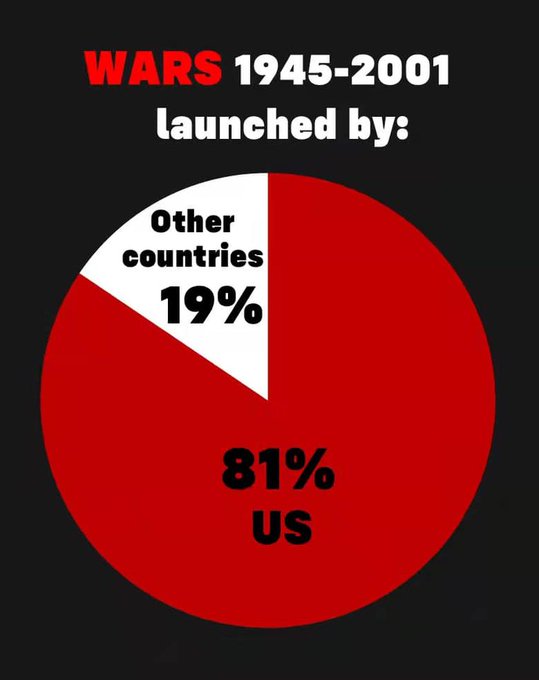
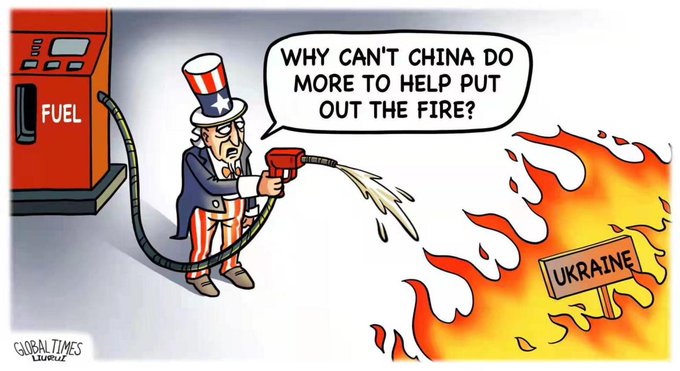
On Saturday, Zhao took yet another swipe at Washington with an image listing “bomb attacks, sabotage, attempted regime change” by Washington. The diplomat accompanied the post with a hashtag #NeverForget.
China was one of the three nations that abstained from the voting on a United Nations resolution condemning Russia’s “aggression” against Ukraine after it was vetoed by Russia. The resolution demanded the immediate withdrawal of troops engaged in the Kremlin’s “special military operation” in Ukraine. Bloomberg reported on Saturday that at least two of China’s largest state-controlled banks limited financing to purchase raw materials from Russia, reportedly out of concern about US sanctions.
Ukraine’s hybrid war is mutating
BY M. K. BHADRAKUMAR | INDIAN PUNCHLINE | FEBRUARY 25, 2022
The first signs of the dual track in Russia’s hybrid war in Ukraine have surfaced. By Thursday evening, the Kremlin held out an olive branch to the Ukraine president Volodymyr Zelensky.
Succinctly put, President Vladimir Putin expressed his preparedness to engage in discussions with his Ukrainian counterpart with a focus on obtaining a guarantee of neutral status for Ukraine and the promise of no offensive weapons on its territory.
The Kremlin spokesman Dmitry Peskov said without elaborating, “The president formulated his vision of what we would expect from Ukraine in order for the so-called ‘red-line’ problems to be resolved. This is neutral status, and this is a refusal to deploy weapons.”
Putin had made it clear in a nation-wide address Thursday morning announcing the launch of the military operation that the Russian objective narrowed down to “demilitarisation” and “denazification” of Ukraine. The latter refers to the ascendant neo-Nazi groups in Ukraine who have been acting as a state within the state and perpetrated atrocities against the ethnic Russian population.
The Kremlin offer didn’t come out of the blue. A group of Ukrainian MPs also came out yesterday with an appeal calling on Zelensky, in an open letter, to start negotiations with Moscow. Interestingly, the group is led by Vadim Novinsky – a Ukrainian billionaire and one of the co-leaders of the Opposition Bloc, an association of over dozen political parties. The group also proposed direct consultations between the parliaments of the two countries.
But what lends enchantment to the view is that Zelensky on his own also requested French President Emmanuel Macron to convey a message to Putin directly. Macron has since disclosed that he has had “a quick, direct and frank conversation on a request from President Zelensky.”
Macron said the aim of the conversation was a request from Kiev “to end hostilities as soon as possible.” The Kremlin confirms that Putin held a “frank” conversation with Macron.
Macron’s role is important, since it was he who first floated with Putin the idea, in the course of a conversation recently, that one way out of the impasse could be that Kiev unilaterally gave up any intention to join the NATO. Subsequently, in an interaction with the Russian media at the Kremlin on Tuesday, Putin also mentioned this idea.
Zelensky himself said (after Macron’s conversation with Putin) in an emotional video address to the nation after midnight Thursday, “We have been left alone to defend our state. Who is ready to fight alongside us? I don’t see anyone. Who is ready to give Ukraine a guarantee of NATO membership? Everyone is afraid.” He went on to disclose that he had heard from Moscow that ”they want to talk about Ukraine’s neutral status.”
Quite obviously, Zelensky realises by now that the cavalry is not coming from Washington or Brussels to salvage his government. In fact, Zelensky’s request to Macron followed the repeated categorical affirmations by US President Biden that there is no question of American intervention in Ukraine or of US troops engaging Russian military.
Meanwhile, Russian Defence Ministry highlighted on Thursday that Moscow’s strategy will be to hit military targets and avoid civilian casualty. Ukraine’s air defence system has been rendered non-functional. Moscow is encouraging Ukrainian soldiers to surrender or simply return to their families, the intention being to minimise any fighting.
All this suggests that a political track is on standby. The Russian game plan is to force Zelensky to see the writing on the wall. Ukraine’s capitulation is a matter of days only. This hybrid war would have the following elements:
- Russia will no doubt systematically vanquish the neo-Nazi elements in Ukraine (especially within the military such as the Azov Brigade) who have Russian blood on their hands. These elements so far acted with impunity because of covert western support for their anti-Russian disposition.
- Russia estimates, rightly so, that any crackdown on the neo-Nazi elements will only strengthen Zelensky’s hands. Lacking a power base of his own, he has been a hostage of extreme nationalists.
- On the other hand, Western powers have retrenched in panic from Kiev, and an embittered Zelensky is left to fend for himself. But, paradoxically, this also makes Zelensky a reasonable interlocutor, liberated from the US’ vice-like grip.
- Zelensky has been acting under immense external pressure and fear of extreme nationalists who enjoy “street power.”(The coup in February 2014, scuttling an orderly constitutional transition from President Viktor Yanukovich, was organised by the ultra-nationalists with overt US support.)
- Zelensky’s massive mandate (over 73% of votes) in the 2019 election was largely due to whole-hearted support from Russian voters who were attracted to his platform of dialogue with Russia and the promise of a negotiated settlement in Donbass with Moscow’s help. But in the event, he became a captive of extreme nationalists and a victim of western manipulation.
- Nevertheless, Zelensky has been sporadically signalling to Moscow his desire for an exit route, sensing he was on a road to nowhere. Lately, he voiced dissatisfaction over the war hysteria in Washington. At least during one telephone conversation with Biden recently, they had a heated exchange, according to the CNN.
Russia’s tentative offer appears to be that Ukraine could opt for a status of neutrality on the lines of Austria and Finland with a self-imposed ban on its NATO membership. Conceivably, Zelensky would be open to such an idea. Now, what is there in it for him?
First, Russia will forthwith call off or at least suspend the military operation. That will strengthen Zelensky’s standing. Second, Russia’s direct involvement holds the key to easing of tensions in the Donbass. Moscow had been dodging such a role.
Third, Zelensky could resume his links with the pro-Russian constituency in Ukraine, which was his mainstay of support in the 2019 election. This would have implications for his bid for a second term in the 2023 election.
Fourth, Russia enjoys extensive networking within Ukraine, which has a chaotic political environment driven by corruption and venality, oligarchs and mafia and so on. Russia still wields influence with the power brokers who have at one time or another enjoyed Moscow’s patronage. Thus, Zelensky would see that Russian help can also heal Ukraine’s fragmented political economy.
As for Russia, out of the conditions for security guarantee that it had projected to the US in mid-December, where Moscow drew a blank, Putin may succeed in reaching his objectives at least partially if Ukraine were to turn its back on NATO membership and terminate western military deployments on its soil.
Given the profound civilisational links between Russia and Ukraine, enduring people-to-people relations and family kinships, there is a reservoir of opinion in Ukraine favouring improvement of relations with Russia. Ukraine’s economy is also closely aligned with Russia — even today, Russia is Ukraine’s number one export market. Russia has been a generous donor too. The transit fee for transportation of pipeline gas to Europe alone exceeded 1 billion dollars annually!
Russia’s main gain will be that in geopolitical terms, Ukraine regains its sovereignty and ceases to be a de facto American colony. Russia calculates that a neutral Ukraine will de facto take the Ukraine matrix to its priori history before the 2014 coup.
What is of crucial importance will be that Zelensky is somehow enabled to navigate his path toward dialogue with Putin. The good part is that Russian military operations will throw radical nationalists into disarray, and, secondly, it is improbable that Biden is raring to resume the shenanigans in Ukraine. American politics is increasingly riveted on the mid-term in November and public disfavours Washington taking sides between Ukraine and Russia.
Will the US acquiesce with the nascent processes? There is hope that Macron can mediate. Conceivably, he is in touch with Biden.
Canadian Strongman sending troops to Russian border
RT | February 22, 2022
Canada is boosting its military presence at Russia’s border and sanctioning Russian sovereign debt, parliamentarians and companies, Prime Minister Justin Trudeau announced on Tuesday, citing what he said was an “invasion” of Ukraine.
Up to 460 members of the Canadian Armed Forces will head to the Baltic country of Latvia, which shares a border with Russia, to join the 540 Canadian troops already stationed there.
A frigate of the Royal Canadian Navy is also headed to the area, accompanied by one or more CP-140 Aurora spy planes, Ottawa has announced.
Trudeau’s government has banned Canadians from buying Russian sovereign debt and having any financial dealings with Donetsk or Lugansk, which Ottawa sees as part of Ukraine. Canada has also blacklisted Russian parliamentarians who voted in favor of recognizing the two Donbass republics as independent, as well as Russian banks, military contractors and companies.
“Canada and our allies will defend democracy. We are taking these actions today to stand against authoritarianism,” Trudeau said. “The people of Ukraine, like all people, must be free to determine their own future.”
He is currently governing under the Emergency Act, which he invoked last week – for the first time in Canadian history – in order to crack down on a trucker protest against his Covid-19 mandates.
Ottawa’s sanctions and troop deployments are following the lead of Washington, which announced both measures earlier on Tuesday. US President Joe Biden has ordered around 800 US troops currently in Italy to reposition in the Baltic states, while sending eight F-35 jets from Germany to Eastern Europe and 32 Apache attack helicopters to Poland from their bases in Germany and Greece.
On Monday, Russian President Vladimir Putin recognized the two breakaway regions as independent states, citing Kiev’s purported refusal to implement the provisions of the Minsk agreements and accusing Ukraine of preferring violence to negotiating with them on autonomy.
The Chinese Defeated the US Army in 1950
Tales of the American Empire | February 18, 2022
Korea is often called the “Forgotten War” mostly because American Generals want it forgotten. In late 1950, the Chinese Army intervened and routed the US Army. Most blame falls upon the overall commander, General Douglas MacArthur. He was certain that American air power could destroy Chinese armies. However, the Chinese had years of experience fighting the Japanese and developed tactics to evade aerial attacks. As a result, American units were outmaneuvered and defeated in several large battles by Chinese forces of similar size.
US Army X Corps Commander Lt. General Almond told officers of one regiment: “We’re still attacking and we’re going all the way to the Yalu. Don’t let a bunch of Chinese laundrymen stop you.” That regiment was overrun a few days later, by Chinese laundrymen. A US Army historian noted: “General Willoughby [MacArthur’s Chief of Staff] asserted that a Chinese intervention was highly unlikely but that if it occurred the Chinese would suffer massive casualties to UN air power. This optimism colored the plans and ideas of all subordinate commands. At the start of the massive Chinese intervention, the X Corps staff at first tried to ignore it or downplay its effect on the corps’ offensive plans. In response to the new guidance and in an attempt to react to the rapidly changing situation for which they had no contingency plans.”
___________________________________
“United States Army in the Korean War”; James F. Schnabel; U.S. Army Center of Military History; 1992; https://history.army.mil/books/P&D.HTM
“The Chinese Intervention”; The Korean war; US Army Center of Military History; https://history.army.mil/brochures/kw…
“MacArthur’s Grand Delusion”; David Halberstam; Vanity Fair; September 24, 2007; https://www.vanityfair.com/news/2007/…
“Staff Operations: The X Corps in Korea, December 1950”; Richard Stewart; U.S. Army Command and General Staff College; 1951; https://apps.dtic.mil/sti/pdfs/ADA244…
Related Tale: “MacArthur’s Plot for War with China”; https://www.youtube.com/watch?v=OzF8G…
Related Tale: “The American Empire’s Disastrous Defeat in 1942”; https://www.youtube.com/watch?v=cG1yL…
Joe Biden Regime One Year On… America Is Back, With More Aggression Than Ever
Biden hasn’t started a war yet. But he’s still got three years to go and the first one fills the outlook with dread.
By Finian Cunningham | Strategic Culture Foundation | February 19, 2022
This weekend marks Joe Biden’s first year in office since his inauguration on January 20, 2021, as 46th president of the United States. In that time, it’s quite staggering how rapidly relations have deteriorated between the U.S. and Russia on the one hand and China on the other.
Right now, Europe is on the cusp of a war breaking out between a U.S.-backed regime in Ukraine and Russia. The volatile situation has the potential to drag the U.S. and other NATO powers into a proxy war with Russia, if not a full-blown international military conflict that could escalate into a nuclear conflagration.
Washington’s baleful relations with Beijing have been eclipsed by the recent stand-off with Russia. But make no mistake, U.S.-China tensions have also been heightened with the attendant risk of war. Much of the tension has been increased by the Biden administration’s provocations towards China over the breakaway island province of Taiwan. Under Biden, U.S. arms sales to Taiwan have burgeoned as have the large-scale maneuvers of American military forces near Chinese territory – in the name of “freedom of navigation”.
Let’s rewind to Biden’s inauguration on that cold, sunny day of January 20 last year. There was the usual jamboree that often accompanies a new Democrat president. We saw it when Bill Clinton and Barack Obama were installed in the White House. Likewise, with Biden’s tenure, there were expectations of a more professional president, a more multilateral president, a more proficient president on foreign policy, and, dare we say, a more refined and law-abiding president. As usual, there was rosy rhetoric about how Biden would recover America’s international image that had been tarnished under his boorish predecessor, Donald Trump.
Biden declared over and over again that “America was back” as he took office. European leaders swooned at the prospect of again having an American ally who respected them. The expectation was that the “adults were back in control” of U.S. policy (whatever that’s supposed to mean) and that the feathers ruffled by Trump would be smoothed.
Strategic Culture Foundation can take pride in not having bought into any of the wishful thinking regarding a Biden administration. We predicted in several articles at an early stage of his presidency that international relations would take a serious turn for the worse under Joseph Robinette Biden Jr.
Take, for example, this interview on November 23, 2020, with Christopher Black. It was headlined: “A Biden Administration Will Be Dominated by More U.S. Aggression”. It predicted that the world “would see more intensified militarism and aggression under a Joe Biden presidency than under the outgoing Trump administration.”
Another observation in the same interview was “the Biden administration will be bent on war… in particular against Russia and China… we can expect U.S. provocations to accelerate.”
See also our weekly editorial on January 22, 2021, entitled: “President Biden’s New Administration, Old Aggression”.
In a subsequent column, on January 28, 2021, Strategic Culture Foundation highlighted how the Biden administration would ramp up efforts to sabotage the Nord Stream 2 gas project between Russia and the European Union. This unspoken objective has come to a head in the present crisis over Ukraine. It is driving the geopolitical dynamics behind the conflict between the U.S. and Russia, as explained in a later SCF article published on June 8, 2021, – some five months before the crisis erupted in Western media coverage.
Virtually every U.S. president has gone to war or overseen some form of criminal foreign aggression. Barack Obama – the “hope and change president” went on to unleash American wars and bombing in seven countries. Obama’s vice president was Joe Biden who owns some of the past criminality. Donald Trump didn’t start any new American wars but he too was up to his neck in waging aggression abroad.
Republican and Democrat presidents are all the same. They are tools of U.S. imperialism.
So far, Biden hasn’t actually started a new war. He has continued some of the existing militarism. And if he keeps going in the same mode, a war against either Russia or China or both is a “distinct possibility” to use Biden’s words this week about an alleged Russian invasion of Ukraine.
Underpinning the intensified aggression under Biden is the objective historic condition of failing U.S. imperial power. This has nothing to do with whether the president is Democrat or Republican. From the early post-Cold War years we had the Wolfowitz Doctrine, coined under a Republican president as it happened, that set out the objective of staving off U.S. imperial decline and in particular staving off the challenge to U.S. power from a resurgent Russia or an ascendant China.
Under prevailing U.S. establishment politics and the national security state, the Cold War policy against Russia and China would inevitably continue. American power relies fundamentally and intrinsically on confrontation with perceived rivals who must be treated as enemies to be subjugated.
It just so happens that Biden and his administration are more in tune with the U.S. political establishment and the national security state than, for example, the maverick egomaniac Trump. That’s why there has been a more determined and discernible deterioration in U.S. relations with Russia and China over the last year.
Biden hasn’t started a war yet. But he’s still got three years to go and the first one fills the outlook with dread.
One final note: Strategic Culture Foundation has come under fire from the U.S. authorities who have banned America-based writers from publishing articles in our journal. The U.S. government accuses SCF of being an agent of Russian foreign intelligence. See this recent hit-job on ABC news which cites some of our headlines without providing links to the articles. SCF is not an agent of the Russian government. It is an independent journalistic forum for analysis and comment. The prescience of our articles cited above on exposing the criminality of U.S. imperial power would suggest that is the real reason why SCF is being targeted with American slander and sanctions.
The War Party Wants a New Cold War, and the Money That Comes with It
By Ryan McMaken | Mises Wire | February 12, 2022
In perhaps the most predictable column of the year, the Wall Street Journal this week featured a column by Walter Russell Mead declaring it’s “Time to Increase Defense Spending.”
Using the Beijing Olympics and the potential Ukraine war to push for funneling ever more taxpayer dollars into military spending, Mead outlines how military spending ought to be raised to match the sort of spending not seen since the hot days of the Cold War.
Mead claims that “[t]he world has changed, and American policy must change with it.” The presumption here is that the status quo is one of declining military spending, in which Americans have embraced some sort of isolationist foreign policy. But the reality doesn’t reflect that claim at all. The status quo is really one of very high levels of military spending, and even outright growth in most years. This sort of gaslighting by military hawks is right up there with left-wing attempts to portray the modern economy as one of unregulated laissez-faire.

Rather, according to estimates from the White House’s Office of Management and Budget, military spending is set to reach a post–World War II high in 2022, rising to more than $1.1 trillion. That includes $770 billion spent on the Pentagon plus nuclear arms and related spending. Also included is current spending on veterans. Keeping veteran spending apart from defense spending is a convenient and sneaky political fiction, but veteran spending is just deferred spending for past active-duty members—necessary to attract and retain personnel. And finally, we have the “defense” portion of the interest of the debt, estimated to be about 20 percent of total interest spending. Taking all this together, we find military spending has increased thirteen years out of the last twenty and is now at or near the highest levels of spending seen since the Second World War.
This, not surprisingly, is not enough for Mead, who would like to see military spending much closer to the Cold War average of 7 percent of gross domestic product (GDP), up from today’s spending of a little less than 4 percent. To get this average back up would require at least an extra $300 billion in spending, and possibly even spending levels not seen since the bad old days of the Vietnam War. In those days, of course, the US was busy spending enormous amounts of taxpayer wealth on a losing war that cost tens of thousands of American lives. The spending was so enormous that the US regime was driven to breaking the dollar’s last link to gold and subjecting ordinary Americans to years of price controls, inflation, and other forms of economic crisis.
But none of that will dissuade hawks like Mead, who pound the drum incessantly for more military spending. Note also that Mead uses the “spending as a percentage of GDP” metric, which is a favorite metric of military hawks. They use this metric because as the US economy has become more productive, wealthy, and generally larger, the US has been able to maintain sky-high military spending levels without growing the amount of spending in relation to GDP. The use of this metric allows hawks to create the false impression that military spending is somehow going down and that the US is being taken over by peaceniks. In reality, spending levels remain very high—it’s just that the larger economy has been robust.
Yet even if we use this metric—and then compare it to those of other states with large militaries—we find that Mead’s narrative doesn’t quite add up. These numbers in no way suggest that the US regime is being eclipsed by rivals in terms of military spending.

For example, according to the World Bank, China—with a GDP comparable to that of the US—has military spending amounting to about 1.7 percent of GDP (as of 2020). Meanwhile, the total was at 3.7 percent of GDP in the United States. Russian military spending rose to 4.2 percent of GDP in 2020, but that’s based on a GDP total that’s a small fraction of the US’s GDP. Specifically, the Russian economy is less than one-tenth the size of the US economy.
Thus, when we look at actual military spending, we find the disconnect to be quite clear.
According to the SIPRI Military Expenditure Database, in 2020 total Chinese military spending totaled approximately $245 billion in 2019 dollars. In Russia, the total was $66 billion. In the US, the total—which in the SIPRI database excludes veteran spending and interest—amounted to $766 billion in 2020.

In other words, total military spending by these presumed rivals amounts to mere fractions of total spending in the US. Moreover, as China scholar Michael Beckley has noted, the US benefits from preexisting military capital—think military know-how and productive capability—built up over decades. Even if the US and China (or Russia) were spending comparable amounts on military capability right now, this would not demonstrate any sort of actual military superiority in real terms.
But, as usual, Mead’s strategy is to claim that financial prudence is in fact imprudence with the usual refrain of “you can’t afford to not spend boatloads of extra money!” This claim is premised on the new domino theory being offered by anti-Russia hawks today. This theory posits that if the US does not start wars with every country that has pushed back against US hegemony—i.e., Iran or Russia—then China will see this “weakness” and start conquering countless nations within its own periphery.
The old cold warriors were telling us this back in 1965 also, insisting that a loss in Vietnam would place all the world under the Communist boot. Needless to say, that didn’t happen, and it turned out Vietnam had nothing to do with American national security.
But none of this will convince the usual hawks—for example, the Heritage Foundation—that there’s never enough military spending.
Prudence, however, suggests the US should be going in the opposite direction. At its most belligerent, the US regime should be adopting a doctrine of restraint—focusing on naval defense and cutting back troop deployments—while changing its nuclear posture to one that is less costly and more defensive.
The ideal solution is far more radically anti-interventionist than that, but a good start would be eliminating hundreds of nuclear warheads and freezing military spending indefinitely. After all, the US’s deterrent second-strike capability does not at all depend on keeping an arsenal of thousands of warheads, as many hawks insist. And geography today continues to favor US conventional defense, just as it always has.
Unfortunately, we’re a long way from a change toward much more sane policy, but at the very least we must reject the latest opportunistic calls for a new cold war and trillions more taxpayer dollars burned in the name of “defense.”
Document confirms US told Russia NATO won’t expand
Putin was right, Stoltenberg was wrong: NATO “brazenly deceived” Russia about expansion and a British document proves it
RT | February 18, 2022
A newly discovered document from March 1991 shows US, UK, French, and German officials discussing a pledge made to Russia that NATO will not expand to Poland and beyond. Its publication by the German magazine Der Spiegel on Friday proves Moscow right and NATO wrong on the matter.
The minutes of a March 6, 1991 meeting in Bonn between political directors of the foreign ministries of the US, UK, France, and Germany contain multiple references to “2+4” talks on German unification in which the West made it “clear” to the Soviet Union that NATO will not expand past the eastern borders of Germany.
“We made it clear to the Soviet Union – in the 2+4 talks, as well as in other negotiations – that we do not intend to benefit from the withdrawal of Soviet troops from Eastern Europe,” the document quotes US Assistant Secretary of State for Europe and Canada Raymond Seitz.
“NATO should not expand to the east, either officially or unofficially,” Seitz added.
A British representative also mentions the existence of a “general agreement” that membership of NATO for eastern European countries is “unacceptable.”
“We had made it clear during the 2+4 negotiations that we would not extend NATO beyond the Elbe,” said West German diplomat Juergen Hrobog. “We could not therefore offer Poland and others membership in NATO.”
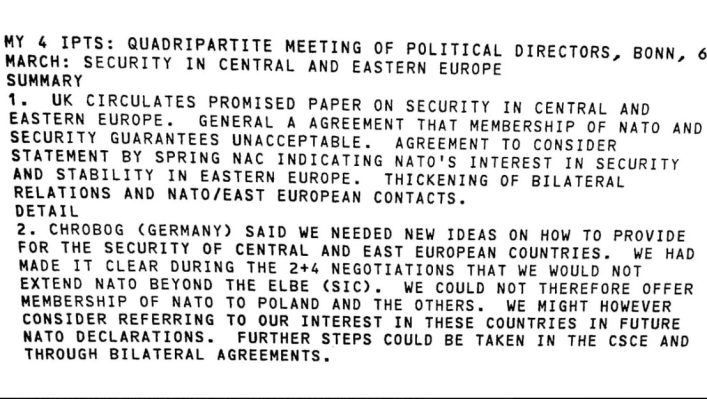
The minutes later clarified he was referring to the Oder River, the boundary between East Germany and Poland. Hrobog further noted that West German Chancellor Helmut Kohl and Foreign Minister Hans-Dietrich Genscher had agreed with this position as well.
The document was found in the UK National Archives by Joshua Shifrinson, a political science professor at Boston University in the US. It had been marked “Secret” but was declassified at some point.
Shifrinson tweeted on Friday he was “honored” to work with Der Spiegel on the document showing that “Western diplomats believed they had indeed made a NATO non-enlargement pledge.”
“Senior policymakers deny a non-expansion pledge was offered. This new document shows otherwise,” Shifrinson said in a follow-up tweet, noting that “beyond” the Elbe or Oder by any standard includes Eastern European countries to which NATO started expanding just eight years later.
During a major press conference in December 2021, Russian President Vladimir Putin said the West had promised the Soviet Union NATO would not expand “a single inch” to the east, but “brazenly deceived” and “cheated” Moscow to do just that.
Responding to these comments, NATO Secretary General Jens Stoltenberg said the alliance “has never promised not to expand.” In an interview with Der Spiegel later, Stoltenberg repeated that “there has never been such a promise, there has never been such a behind-the-scenes deal, it is simply not true.”
NATO admitted Poland, Hungary, and Czechia in March 1999, just before launching an air war against Yugoslavia without the permission of the UN Security Council. This put NATO directly on the Russian border – the enclave of Kaliningrad – for the first time ever. The next round of expansion in 2004 included the former Soviet republics of Estonia, Latvia, and Lithuania, placing NATO’s eastern frontier just 135 kilometers (84 miles) from St. Petersburg.
In a series of security proposals made public in December, Russia demanded NATO publicly renounce expansion to the former Soviet republics of Ukraine and Georgia and withdraw US forces to the 1997 boundaries of the alliance, among other things. The US and NATO have rejected this, arguing the alliance’s “open door” membership policy is a fundamental principle for them.
Featured Video

Why the U.S. Should Pull Back From the First Island Chain
or go to
Aletho News Archives – Video-Images
From the Archives
Only 19.7% of Americans agree with US State Dept on Israeli settlements
… Most American adults of voting age don’t appear willing to reject the applicability of international law to Israel’s ongoing colonization of occupied territories in East Jerusalem, the West Bank and Golan Heights. … Full article
Blog Roll
 Aletho News
- Albania on fire: who’s behind the riots?
- Egypt’s Civil Democratic Movement rejects involvement in regional war
- Egypt collaborates with Israel to build ‘Green Rafah’ project over erased Palestinian city
- Rising fuel prices and shortages have helped drive ongoing protests and rioting in France
- Tokyo protests demand Takaichi’s resignation over support for ‘Israel’
- Jennifer Kavanagh: Why the U.S. Should Pull Back From the First Island Chain
- Yemen denounces international community’s silence on Saudi aggression, siege
- UAE and Saudi Arabia move toward renewed coordination against Sanaa
- How Iran’s two-week retaliatory strikes exposed cracks in US military architecture in Persian Gulf
- The mother of all propaganda: Why the hype over US MOAB strike against Iran is nothing but theater
- If Americans Knew
- What the UK Is Doing to Pro-Palestine Novelist Sally Rooney Is an Act of Orwellian Villainy
- ‘We will build palaces for Jews in Gaza’: Right-wing activists establish new outpost near border
- ‘You see us burning, you stay silent’: Family’s agony over mother and sons burned to death in Gaza tent
- Israel keeps Palestinian journalist Bushra al-Tawil in isolation for 46 days
- US-Israel integration plan puts US military tech in Israel’s hands
- Israeli Strike Burns Gaza Mother Alive in Front of Toddler, ‘Without Generating Any Headlines’
- ‘The Israel Experience with Mike Huckabee’: The Ambassador’s Family Sells Trips to Israel
- As Gazans carry out mass burial, food insecurity is getting worse – Daily Update
- Israeli rabbi permits occupiers to steal Palestinian olive harvest in West Bank
- Netanyahu’s spin on latest settler attack is laughable – Daily Update
- No Tricks Zone
- Predictions Made By Renowned Climate Proifessor Over Past Decades Have Been Proven To Be Poor
- New Study Suggests Large Regions Of The Pacific Ocean Have Been Cooling For The Last 80 Years
- Germany’s Green Energy Debacle: High Energy Costs Force Kahla Porzellan to Close After 182 Years!
- New Study: 50 Years Of The Most Aggressive ‘Net Zero’ Policies Can Only Affect The Global Climate By 0.03°C
- US September “Heat” Was No Record…Many Records Set Decades Ago
- Latest European Green Energy Debacle; Portugal’s Largest Flagship Solar Park Insolvent!
- Green Energy Debacle: German Expert Professor Fritz Vahrenholt Warns Of Severe Economic And Social Consequences
- Two More Paleo Reconstructions Affirm Meters-Higher Sea Levels Across Ireland, Brazil 7000-6000 Years Ago
- New Study: Earth And Venus Surface Warmth Largely Explained By Convection And Lapse Rate, Not CO2 Or Radiation
- 2025 Nature Paper Claiming Worsening Global Drought Gets RETRACTED …Heavily Flawed