U.S. Officials Are Lying Too on Ukraine
By Jacob G. Hornberger | FFF | February 17, 2022
U.S. officials are declaring unequivocally that Russian officials were lying when Russia stated that it was withdrawing troops from the Russia-Ukraine border. U.S officials say that it’s the exact opposite — that Russia is actually bringing more troops to the border.
Russian officials might well be lying about Russian troop movements. It certainly shouldn’t surprise anyone, especially if Russia is in fact going to actually invade the country.
Unfortunately, however, the Russians wouldn’t be the only ones lying about what is going on with Ukraine. So are U.S. officials. But of course that shouldn’t surprise anyone either, given that lying has always been a foundation stone of the U.S. national-security establishment, at least when “national security” is at stake.
As Russia has made clear, its objective is to prevent Ukraine from becoming a member of NATO. If Ukraine becomes a member of NATO, that would enable the Pentagon and the CIA to install U.S. missiles, tanks, and troops along Russia’s border. That’s precisely what Russia opposes, in much the same way that U.S. officials would (and did) oppose Russian missiles, troops, and weaponry in Cuba.
In other words, if the U.S. provided assurances to Russia that Ukraine would not become a NATO member, the crisis would be over and Russian troops would be withdrawn. But the problem is that the Pentagon and the CIA do not want to give Russia that assurance. They are insistent on making Ukraine a member of NATO, an old Cold War dinosaur bureaucratic entity, so that they can station their missiles, troops, and tanks on Russia’s border.
U.S. officials claim that Russia has nothing to worry about because, they say, the U.S. government is a peace-loving, non-aggressive regime. That’s a lie. In fact, the U.S. government is the most aggressive regime on the planet. Just ask the people of Iraq and Afghanistan, two countries against which the U.S. government waged wars of aggression and killed and injured hundreds of thousands of people in the process.
During the Cold War, Poland was aligned with the Soviet Union as a member of the Warsaw Pact. After the ostensible end of the Cold War, the U.S. absorbed Poland into NATO, thereby enabling the Pentagon and the CIA to station missiles, troops, and tanks closer to Russia’s border, which is precisely what they want to do in Ukraine.
In fact, as the New York Times reported yesterday, the Pentagon has installed missiles near the Polish village of Redzikowo, which is only about 100 miles from Russian territory. U.S. officials say that those missiles are situated there to protect Eastern Europe from Iran. That’s just another lie and a ridiculous one at that. Iran is no more a threat to Eastern Europe than Paraguay is. The fact that U.S. officials feel the need to lie about why their missiles are in Poland would obviously concern anyone in Russia.
Today, the Pentagon is sending thousands of U.S. troops into Romania and Poland, which gives everyone a very good picture of what would happen if Ukraine were absorbed into NATO. As soon as U.S. officials stoked any new crisis with Russia, there is no doubt that the Pentagon would do what they are doing today in Romania and Poland — they would be rushing thousands of troops into Ukraine along with missiles, tanks, other weaponry being positioned on Russia’s border.
In fact, it is a virtual certainty that if NATO absorbs Ukraine, the Pentagon will expand its worldwide system of permanent military bases to Ukraine. It’s not difficult to imagine a string of sprawling military bases in Ukraine, along with the bars, brothels, corruption, pollution, and violent crimes that inevitably come with them.
As with anything that pertains to the Pentagon and the CIA, the mainstream press is playing its standard deferential and supportive role in the Ukraine crisis, blinding themselves from seeing the critical role that the U.S. national-security establishment has played in producing this crisis. It’s that blindness that then causes the mainstream press to continue endorsing ever-increasing budgets, power, and influence for the national-security establishment and its army of well-heeled “defense” contractors.
The only way out of this statist and highly dangerous morass is for the American people to come to the realization of what a horrific mistake it was to convert the U.S. government to a national-security state after World War II, which thereby enabled the Pentagon, the CIA, and the NSA to wage their Cold War racket and, later, their global war-on-terrorism racket. If Americans were to come to that realization, we could then have our founding constitutional system of a limited-government republic back and no more perpetual foreign-policy crises.
Moscow responds after US ‘cherry picked’ from Russia’s security proposals
RT | February 17, 2022
The US has “failed to provide a constructive answer” to all the key elements of Russia’s proposals on security guarantees, Russia’s Ministry of Foreign Affairs said in an official response to Washington on Thursday. The 10-page document was handed over in Moscow to American ambassador John Sullivan.
Washington has “cherry picked” some “convenient” topics out of a set of “indivisible” proposals and has further “twisted” them to create security advantages for the US and its allies, the ministry said, in an assessment of America’s security proposals. Such actions “raise doubts” as to the US’ willingness to improve European security, the Russian diplomats have added.
“Our ‘red lines’; our key security interests and Russia’s sovereign right to defend them are still being ignored,” the ministry said, adding that Moscow would have to respond with “military and technical measures.”
Russia also blasted ongoing Western media reports and officials’ statements about the supposedly planned invasion of Ukraine, saying the only purpose of such an information campaign is to “exert pressure” on Moscow and “discredit” Russia’s security proposals.
“No ‘Russian invasion’ into Ukraine the US and its allies have been talking about since autumn has taken place or is planned,” the ministry has said, adding that Moscow cannot be blamed for the rising tensions in Europe.
The Ukrainian conflict has been caused by solely internal reasons, Russia maintains, adding that Moscow has nothing to do with it. De-escalation of the situation around the embattled nation can only be achieved through Kiev fulfilling its part of the Minsk agreements and the US and NATO stopping arms supplies to Ukraine, ceasing joint drills with the Ukrainian Armed Forces and pulling out all Western instructors from its territory, the statement said.
The US ultimatums demanding Russia withdraw its troops from the “certain areas on its own territory” and threats of sanctions are “unacceptable” and only “undermine the prospects of reaching some real agreements,” the Russian Foreign Ministry said.
“Russian Armed Forces deployed to Russia’s territory do not affect and cannot affect fundamental US interests,” the statement pointed out, adding that “there are no [Russian] forces on the territory of Ukraine.”
Moscow also accused the US of circumventing the 1990 Treaty on Conventional Armed Forces in Europe regulating the limits on and deployment of conventional military equipment in Europe, as well as the 1997 Russia-NATO ‘Founding Act’ on mutual relations. Washington and its allies have expanded their military infrastructure further to the east by deploying troops to the territory of the bloc’s new members after 1997, the foreign ministry said, calling such a situation “unacceptable.”
Russia “insists on the withdrawal of the US troops and equipment deployed in Central and Eastern Europe as well as in the Baltic States,” the statement said. Moscow has also demanded that the US withdraw its nuclear weapons deployed to the territory of its non-nuclear allies in Europe, as well as all the relevant rapid deployment infrastructure.
The very existence of nuclear weapons on their territory as well as NATO drills used to teach the troops of these nations to use nuclear arms violate the Non-Proliferation Treaty, Russia believes.
However, Moscow also sees some potential common ground for future negotiations with the US and NATO. Russia has particularly welcomed the US proposal on mutual verification and transparency measures, involving inspections of the US missile defense systems Aegis Ashore in Poland and Romania, as well as at relevant facilities in the European part of Russia’s territory.
Moscow also “sees a potential for future agreements” on mitigating the risks stemming from heavy-bomber sorties near the national borders of Russia, the US and its allies. The Russian Foreign Ministry welcomed “the US readiness” to discuss similar measures to prevent open-sea and neutral airspace incidents. Still, “this work cannot be a substitute for resolution of the key issues raised by Russia,” the statement cautioned.
US Mulls to bolster Mideast Operations with Israeli-made Vessels
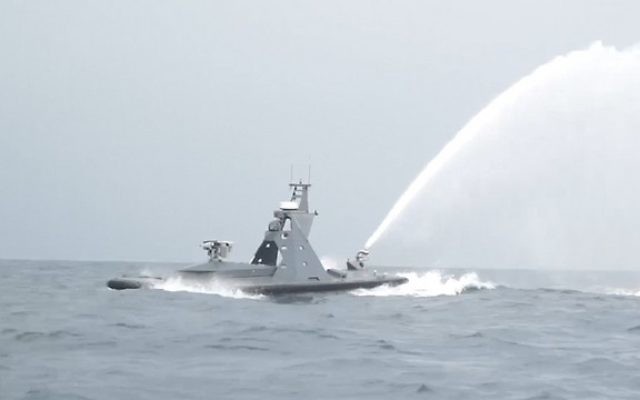
An unmanned Israeli navy vessel test fires missile off Ashkelon
Al-Manar | February 16, 2022
The US Navy is examining the possibility of bolstering its joint operations in the Middle East with Israeli-made unmanned vessels, a US official told the Reuters news agency on Tuesday.
The report did not specify who would be operating the boats, but noted that additional Israeli military involvement in the Gulf region could anger Iran.
The unnamed official said the US military was examining a number of options, including using Israeli unmanned vessels during current Gulf exercises.
The Zionist entity is a participant in a massive US-led naval exercise focusing on unmanned naval systems and the use of artificial intelligence. The International Maritime Exercise, known by its acronym IMX, kicked off last month and is set to end on Thursday.
The Israeli navy has a fleet of unmanned ships that are used to complement its manned patrol boats around the occupied Palestinian coastal waters.
The Reuters report said the US was showing interest in Israeli-made surface drones that can be deployed in tandem with air and underwater UAVs.
“The Israelis are definitely vested in leveraging this technology,” the unnamed official said, adding that a US fleet commander had made a recent trip to Haifa to examine the surface drones.
The comments by the US official were made during a trip by Prime Minister Naftali Bennett to Bahrain, the first official visit by an Israeli premier to the Gulf kingdom, Israeli media reported.
Israel offers Arab state the opportunity to tackle Iran together
RT | February 15, 2022
Since Israel and Bahrain both view Iran as a threat, they could team up and counter Tehran together, Israeli prime minister Naftali Bennett said on his landmark visit to the Gulf monarchy.
“We will fight Iran and its followers in the region night and day. We will aid our friends in strengthening peace, security, and stability, whenever we are asked to do so,” Bennett pledged in an interview with the Bahraini state-linked Al-Ayyam outlet on Tuesday.
The PM blamed Tehran of striving to “destroy moderate states” in the Gulf region in order to replace them with “bloodthirsty terrorist groups.”
When asked about the possibility of creating an alliance to resist Iranian influence, which could include Israel, Bahrain, and some other Arab nations, he gave a positive response: “We all understand that we face the same challenges, so why not work together to tackle them?”
Bennet, who became the first Israeli prime minister ever to visit Bahrain, assured the journalists that “Israel is a strong and reliable country.”
The idea of such a block was first floated by Israeli general Tal Kelman last year. According to Kelman, who heads the IDF’s Strategy and Third Circle Directorate, “the moderate axis” of Israel, Bahrain, the UAE, Jordan, Egypt and others should resist “the radical axis” of Iran and what he called its “proxies” in Lebanon, Syria, Yemen, and Iraq.
Israel and Bahrain normalized relations in late 2020 as part of the so-called Abraham Accords, a US-backed drive to improve ties between the Jewish state and some Arab countries after decades of strife.
Bahrain is a small island nation of around 1.5 million. The majority of its population is Shia Muslims, but the country is being run by a Sunni monarchy. The rulers in Manama have been concerned by Tehran’s activities as Iran, which is located less than 800 kilometers (497 miles) away, often faces accusations from its rivals of supporting Shia groups in other countries.
Threat of War between Syria and Israel is getting More Real
By Vladimir Platov – New Eastern Outlook – 14.02.2022
On February 9, Israel launched yet another series of strikes on targets near Damascus, which resulted in one Syrian killed and five injured, which has aggravated the threat of war between Syria and Israel.
According to the Syrian Arab News Agency (SANA), on February 9, four Israeli F-16s, without crossing the state border of Syria, launched another guided missile attack on facilities near Al-Kiswah, a village south of Damascus. One of the anti-aircraft missiles of the Syrian army exploded over the occupied Golan Heights, after which the IDF fired from the area occupied by Israeli troops in the Syrian Golan Heights ten surface-to-surface missiles at the positions of the Syrian air defense forces. Some missiles were brought down by Syrian air defenses. Nevertheless, the attack still caused significant damage to some buildings in the city of Qudsaya, destroying dozens of houses and cars. To repel the attack, Syrian troops utilized Russian-made air defense systems, which shot down eight missiles.
According to an IDF statement, in response to an intercepted missile fired from Syria into northern Israel, Israel attacked targets in Syria, including the “Syrian radar and anti-aircraft batteries that launched missiles at Israeli Air Force aircraft.” However, it is obvious that the missile chosen by the IDF as the reason for retaliation was the anti-aircraft missile that exploded in the air and was launched by Syrian air defenses as a measure of protection against earlier Israeli missile attacks launched from Lebanon.
In the message the Syrian Foreign Ministry sent to the UN Security Council regarding the aforementioned act of aggression by Tel Aviv, the Syrian government denounces the dangerous consequences the Israeli attacks on the SAR territory may have for stability in the Middle East and the entire world. “Syria reserves the right to use all legal means to respond to the treacherous strikes carried out by Israel on the outskirts of Damascus from Lebanese airspace and from the occupied Golan Heights,” the document says. The Syrian Foreign Ministry drew attention to the fact that “the United States, which patronizes Israel, encourages it to continue attacks and paralyzes possible measures by the UN Security Council to deter the aggressor, which undermines the prestige of the international community.”
Initially, Israel planned to launch two strikes simultaneously on February 9 – one on the outskirts of Damascus, and the other on Latakia. However, after encountering two Su-35s scrambled in response, the IAF fighters flew back without attacking the Syrian port. At the same time, almost all of the missiles allegedly aimed at Iranian facilities in the Rif Dimashq Governorate were shot down by Russian-made Syrian air defense systems. The attack was carried out from Lebanese airspace, which is another gross violation of international law.
Israeli Air Force regularly strikes targets in Syria without entering the airspace of the Arab Republic, and mainly operates from the airspace of Lebanon – in violation of international norms, or from the Mediterranean Sea. Since 2013, the IDF has been carrying out hundreds of airstrikes on the territory of a neighboring country primarily targeting pro-Iranian forces in the SAR. This year, there have already been two such attacks by Israel. The first one was took place on January 31 at targets near Damascus, namely Hezbollah facilities and warehouses in the vicinity of Al-Qutayfah. In 2021, there were 55 attacks:
– 3 missile strikes in December (on December 7, 16 and 28, mainly in the area of the port of Latakia, one Syrian soldier was killed, and significant damage was caused). It is noteworthy that on December 28, not for the first time, two F-16s of the Israeli Air Force launched four guided missiles at facilities on the territory of the port of Latakia without crossing the Syrian border (from the Mediterranean Sea). The Syrian air defense forces did not engage in a battle to repel the IAF raid on the port of Latakia, since a landing Russian Air Force transport plane could be in the affected area;
– 4 missile strikes in November (on November 3, 8, 17 and 28, mainly on targets near the city of Homs, which resulted in four people killed, including two civilians, several people wounded and significant material damage);
– 4 missile strikes in October (on October 8, 13, 25 and 30, strikes were carried out on the outskirts of Damascus, the outskirts of al-Ba’ath and the village of Al-Krum in the Quneitra Governorate in southern Syria, and the city of Abu Kamal, as a result of which more than ten Hezbollah militants and a Syrian soldier were killed, and significant damage was caused);
– 3 missile strikes in September (on September 3, 14 and 27, South from the village of Mayadin in the Deir ez-Zor Governorate in Eastern Syria, near the Iraqi border, with many people being wounded);
– 2 missile strikes in August (on August 17 and 19); 3 missile attacks from May to July (on May 5, June 8 and July 19); 9 missile strikes from January to April, with dozens of people dead and wounded;
– 39 missile attacks and air raids were carried out in 2020.
Israel explains its attacks with the desire to prevent modern weapons from falling into the hands of it enemies. Enemy No. 1 in this regard is the Lebanese Hezbollah movement, which is fighting on the side of Syrian President Bashar al-Assad and is controlled by Tehran. After the first Israeli airstrikes, Moscow invited all interested parties to meet and talk about disentangling their interests in order to avoid armed conflicts and civilian casualties. However, these calls of Russia have not been heeded.
Israel, despite repeated statements by official Syrian authorities to the UN, continues regular airstrikes on Syrian civilian targets, using, among other things, provocative air attacks by its fighters “under the cover” of civilian aircraft. Thus, in addition to the attack of December 28, on the night of October 13, 2021, four IAF F-16s once again entered the Syrian airspace in the area of the US-occupied Al-Tanf zone in the Homs Governorate and, under the cover of civilian aircraft flying at the same time, carried out an airstrike on a phosphate ore processing plant in the Palmyra area. It is noteworthy that this is not the first time such air attacks have been carried out from the area of the US-occupied zone in the Homs Governorate, which clearly indicates the coordinated actions of the IAF with the US military.
Such provocative tactics of the Israeli Air Force can lead to a serious aggravation of the situation, and it will by the IAF’s fault if the Syrian air defenses in their anti-missile actions shoot down a civilian aircraft of any country, under whose cover Tel Aviv carries out its airstrikes. And such an incident has already occurred in 2018 when Israeli planes bombed Syria from the air zone where the Russian reconnaissance plane was located, and the Syrian air defense shot down this plane by mistake. Russian service members were killed and a big scandal broke out, which was extinguished, and an armed conflict with Israel prevented, only thanks to complex diplomatic efforts.
The Syrian leadership has repeatedly demanded that the UN Security Council put pressure on Israel to stop attacks on the territory of the republic, since such actions violate its sovereignty and lead to increasing tensions in the region. The Syrian Foreign Ministry has previously repeatedly stated that the republic can use “all legal means” to respond to Israeli airstrikes on the Syrian territory. Therefore, by continuing such provocative attacks, Israel is openly tempting its fate, which could turn into a serious armed conflict at any time.
US nuclear submarine violates Russian waters – Defense Ministry
RT | February 12, 2022
A US Virginia-class nuclear-powered attack submarine has been detected and chased away in Russian territorial waters off the Kuril Islands, Russia’s Defense Ministry said on Saturday.
The vessel was found submerged off the small uninhabited island of Urup while Russia’s Pacific Fleet was holding exercises in the area. Russian vessels contacted the submarine, warning it was in the country’s territorial waters and ordering it to surface immediately, the military said.
The submarine, however, did not respond to the messages, and destroyer Marshal Shaposhnikov was deployed to chase it off. The Russian vessel used “appropriate means” against the US sub, the military noted without providing any further details.
Following the run-in with the destroyer, the Virginia-class submarine used an active radar decoy, sailing away from Russian waters at full speed.
The Pacific Fleet’s drills continued as scheduled after the incident, the military added.
Shortly after the incident, the Russian Defense Ministry said it has summoned a US military attaché to explain the incursion. Moscow added that the actions of the submarine constitute a major violation of international law, and create a threat to Russia’s national security. The military said it reserves the right to take any security measures in its own territorial waters.
It was not immediately clear what exact vessel was involved in the incident, with no official statement produced by the Pentagon on the incursion so far. The US has 19 active duty Virginia-class nuclear-powered submarines. The vessels are armed with cruise and anti-ship missiles, as well as massive Mark 48 torpedoes.
US war hysteria over Ukraine won’t gel
BY M. K. BHADRAKUMAR | INDIAN PUNCHLINE | FEBRUARY 12, 2022
The two takeaways out of the French President Emmanuel Macron’s visit to Moscow and his six-hour long talks with President Vladimir Putin have been the assurance held out by the latter that Russian forces would not ramp up the crisis near Ukraine’s borders — “there would be no deterioration or escalation” — and second, an agreement that Russia would pull troops out of Belarus at the end of exercises taking place currently near Ukraine’s northern borders.
The very fact of the French side putting such sensitive details in the public domain suggests that Moscow sees nothing wrong in it. Moscow has simply clarified that the redeployment of troops out of Belarus is not to be construed as any “deal” with France.
The paradox is, instead of working on these crucial assurances from Moscow, Washington has since chosen to travel in the opposite direction with the White House orchestrating a war hysteria through last week. President Biden and his advisor Jake Sullivan have conjured up an apocalyptic scenario.
The White House claims it has intelligence but dodges details. All we have are some satellite imagery from Max (which works for US intelligence). The patchy details have led to Biden speculating about a world war!
Meanwhile, the Biden Administration is creating diplomatic synergy out of the war hysteria. On Friday, Secretary of State Antony Blinken made an audacious bid to hustle the US’ QUAD partners to endorse Washington’s allegations of Russia’s “aggression” — although the group has nothing to do with European security issues.
Again on Friday, Biden with a stroke of his pen effectively commandeered the foreign reserves of Afghanistan to the tune of 7 billion-plus dollars. According to the New York Times, “It is highly unusual for the United States government to commandeer a foreign country’s assets on domestic soil.”
But Biden is getting away with such high-handed behaviour that might be deemed illegal or immoral or cynical when the Beltway is caught up in a frenzy over an incoming war with Russia! To be sure, all through Friday, the White House strove to keep the headlines on “Russian aggression.” Biden held a videoconference with the European allies while Sullivan networked with the EU bureaucrats in Brussels to coordinate on “preparations to impose massive consequences and severe economic costs on Russia should it choose military escalation.”
Sullivan also gave a press briefing at the White House to highlight that “we are in the window when an invasion [by Russia] could begin at any time should Vladimir Putin decide to order it. I will not comment on the details of our intelligence information. But I do want to be clear: It could begin during the Olympics.”
So, that’s it. Sullivan’s latest version is that Russia may invade Ukraine before Feb. 20. The timeline has been tweaked, as the prognosis a week ago was that such an invasion was “imminent” — and still earlier, that it would happen no sooner than deep frost set in so that tank manoeuvring on Ukrainian terrain would become feasible!
Yet, isn’t it amazing that at such a tumultuous time in modern history when Biden visualises a potential world war, he sent away his state secretary on a 6-day tour of Asia-Pacific? In fact, at the moment, Blinken is shuttling somewhere in the tropics — between Suva (Fiji) and Honolulu (Hawaii)!
What do we make out of this charade of war hysteria? Three things can be said. First, the US feels a constant need to rally European allies who are sceptical about the Russia bogey, and the war hysteria helps. Second, Washington is overtly keen to sever Russia’s relations with European countries where energy cooperation is a template — especially, the Nord Stream 2 gas pipeline.
Three, most important, the war hysteria provides the alibi to step up US deployments in Eastern Europe and the Baltics. The size of the NATO deployment on Russia’s western borders already stands at 175,000 troops! Advanced weapons have been deployed too. (Eight nuclear-capable heavy B-52 members are deployed to a forward base in the UK.) Over and above, US has established an air bridge to ferry weapons to Ukraine. As of Friday, more than 15 military flights landed in Ukraine with 1200 tonnes of materials.
Quite obviously, this war hysteria cannot be sustained indefinitely. Something has to give way. Now, the big question is: What if Russia doesn’t invade Ukraine, as Putin reportedly assured Macron as recently as Monday?
Evidently, the US predicament is two-fold: While war hysteria helps to rally the European allies, Washington also cannot afford to let the Europeans dominate the dialogue track with Moscow lest it create a dynamics of its own. Washington has a trust deficit with Macron who is a passionate advocate of European initiatives on European security issues.
Macron is on record that Europe’s security cannot be assured without Russia’s security! Equally, there is panic in the Beltway that German Chancellor Olaf Scholz is also heading for Moscow on Tuesday. And, Macron is expected to have a call with Putin today! Curiously, Biden decided that he too should have a call with Putin later today!
Above all, the UK too has entered the diplomatic fray. All indications are that Defence Secretary Ben Wallace’s talks with his Russian counterpart Sergei Shoigu in Moscow on Friday were substantive. (Interestingly, the UK Chief of Staff Admiral Sir Tony Radakin who accompanied Wallace separately met with his Russian counterpart General Valery Gerasimov.)
Wallace described his talks as “frank and constructive.” The MOD readout in London was couched in a restrained tone as if UK is impervious to Biden and Sullivan’s war hysteria. Importantly, it highlighted Shoigu’s assurance to Wallace that Russia will not invade Ukraine.
Notably, the Russian readout too sought to put the accent on “urgent measures to ensure security guarantees” to Russia. It said, “Army General S. K. Shoigu pointed out that the military and political situation in Europe had worsened considerably due to tension whipped up around Ukraine and NATO’s military presence near the Russian borders.”
How far this pantomime on the diplomatic stage continues is unclear. There is the lurking danger that extreme nationalist forces who call the shots in Kiev, egged on by Washington, may feel emboldened to create new facts on the ground in Donbass. This was precisely how the Georgian war had erupted in 2008.
Indeed, a new level of criticality has appeared lately in Donbass with large scale mobilisation by Ukrainian forces and reports of western mercenaries in the guise of military advisors. The US intentions remain unclear.
A conflict in Donbass will put the Kremlin in dilemma. If Russia intervenes in Donbass to keep at bay the rampaging radical Ukrainian nationalist forces, Washington will certainly use it as alibi to impose harsh sanctions to isolate Russia and severely damage Moscow’s ties with European countries.
On the contrary, Russia will have no option but to intervene, as hundreds of thousands of Russian passport holders live in Donbass. (Some put the figure around 700,000.) The radical neo-Nazi Ukrainian nationalists are known to be notoriously anti-Russian and all sorts of atrocities — even genocide — may take place.
The likelihood of conflict erupting in Donbass remains high. Biden may get a splendid opportunity to salvage his reputation after the debacle in Afghanistan. He has an eye, for sure, on the mid-term elections in November and the bipartisan consensus supportive of a tough line on “Putin’s Russia” also helps.
Fundamentally, the US has no intentions of giving Russia the security guarantee it needs. For, NATO’s eastward expansion and encirclement of Russia happens to be Washington’s core agenda. And, since 2014, that agenda has been so far advanced that there is no turning point now. It must be carried forward to its logical conclusion.
The Washington elites realise that the US lacks the capability to take on China and Russia simultaneously. A paradigm shift is needed. In the US calculus, forcing Putin to abdicate after a humiliating retreat over Ukraine and a severe weakening of Russian military power only can bring about the strategic rollback of Russia’s resurgence and its alliance with China.
It is, therefore, an imperative first step on the pathway to an eventual epochal confrontation with China, which poses a formidable challenge to America’s global hegemony in the 21st century.
Hungary not willing to host NATO troops amid Ukrainian crisis
By Lucas Leiroz | February 10, 2022
Another European country appears to be taking different paths from NATO’s central plans. In a recent official statement, the Hungarian foreign minister stated that his country will not allow the arrival of more NATO troops on its territory. The case demonstrates further evidence of the crisis in the legitimacy of the anti-Russian discourse of the Western alliance, which is increasingly convincing fewer people.
Peter Szijjarto, Hungarian foreign minister, during an interview to Euronews on February 9, stated that Hungary is unwilling to receive NATO troops on its territory in the midst of the current Ukrainian crisis. For him, the Hungarian armed forces are sufficiently well prepared and equipped to deal with any threat of war in the region, so there is no need to import more foreign troops.
These were some of his words: “No, we have not agreed to that and we will not agree because we have already NATO’s troops on the territory of the country, which is the Hungarian army and the Hungarian armed forces, [they] are in the proper shape to guarantee the security of the country. So we don’t need additional troops on the territory of Hungary”. Szijjarto also commented that the current Ukrainian situation recalls the Cold War times, which were “many decades where we [the Hungarian people] suffered (…) That’s why we don’t want these times to come back. We ask, we urge the international community to do its best in order to avoid the Cold War to return, avoid even the psyche of the Cold War to return because we learned it from history, unfortunately have very clearly, that whenever there is an East-West conflict , the countries of Central Europe lose and we don’t want to be losers anymore”.
In addition to ruling out the possibility of receiving troops and taking a stance against a “new cold war”, the minister also expressed skepticism about the efficiency of the implementation of coercive measures against Moscow: “If you look at the sanctions themselves, it’s a failure. They don’t work out. They are unsuccessful. Trade between Germany and the Russian Federation has increased since the sanctions have been in place. (…) We have to invest in diplomacy, we have to invest in dialogue. That’s why we urge the Russian Federation and our Western allies, the big countries, the strong countries, not to give up hope of peaceful settlement, to the contrary, to talk to each other because once again, I want to underline that for us, rather small Central European countries, it can be extremely dangerous if violent action take place”.
Szijjarto’s speech comes as a Hungarian response to recent American pressure for all European countries to accept that new NATO troops are deployed on their territories. Earlier, US Defense Department spokesman John Kirby said Washington would send a new group of troops to Europe, including a squad of about 1,000 men to Romania, a country that borders Hungary and already has more than 900 American soldiers installed. On February 8, the first soldiers of the new American squadron for Romania arrived in Bucharest, which increased pressure during this week for Budapest to give a definitive answer on the reception of the troops, but the Hungarian government seems really willing not to follow the trends in neighboring nations.
In fact, this kind of attitude is being taken simply because Budapest no longer believes in the existence of a Russian invasion plan. And it is very likely that other European governments will soon abandon this narrative as well. This is a natural consequence of the recent events. NATO has been talking about such an invasion for a long time, but it never happened and is unlikely to happen, so there is no reason to accept that European countries are passively filled with thousands of American soldiers. There is no threat to justify this.
Furthermore, regarding the opinion against sanctions and in favor of bilateral dialogue, we can see that the Hungarian government is forming a solid pro-diplomacy stance. This position is a consequence of the friendly ties that Viktor Orban has been trying to develop in recent times – which is why he suffers so much criticism within the European Union. In early February, the prime minister visited Moscow and spoke with Putin on various strategic topics in bilateral relations, including security issues in Europe, gas trade, among others. In the West, Orban’s attitude has been seen with criticism due to the moment of tensions, but it was an opportunity to make it clear that the Hungarian position is anti-war, anti-sanctions and pro-diplomacy one. Now, Szijjarto’s words corroborate this thesis.
It is possible that it will take time, but at some point other European countries will start to take the same attitude as Hungary. There is no possibility that the narrative about “Russian invasion” will endure, considering that it is unsubstantiated and fallacious. If there is no threat of war, there will be no reason for these governments to want their territories occupied by foreign troops and this will inevitably generate a NATO retreat in Europe.
Lucas Leiroz is a researcher in Social Sciences at the Rural Federal University of Rio de Janeiro; geopolitical consultant.
Who exactly is the enemy that the CIA is targeting these days?
By Toby Rogers | February 9, 2022
 From the 1950s through the 1980s the CIA overthrew democratically elected governments and assassinated leaders in the U.S. and around the world in the name of fighting communism.
After the fall of communism, the CIA pivoted to fighting terrorism. After 9/11 their mission expanded considerably to include a global network of black sites where they conducted torture. They also engage in covert military operations on the ground inside a wide range of countries.
More recently, the CIA has expanded their mission yet again. We have evidence of coordination between the U.S. Department of Defense, Fauci, the EcoHealth Alliance, bioweapons labs in the U.S., and the Wuhan Institute of Virology (a Chinese bioweapons lab) to conduct gain-of-function research. This has all of the hallmarks of a CIA operation.
One could make the case that the CIA is now fighting viruses/pandemics in the name of national defense. But this effort CREATED the chimera virus that has killed more Americans than all foreign wars combined. Since the chimera virus was released, governments across the developed world, Pharma, and Big Tech have all worked together to control the message, surveil and censor the population, and smash any dissent. Again this reeks of CIA involvement.
So my question is, who/what exactly is the CIA fighting these days? My hunch is that the answer is us. Not just the medical freedom movement (although we are certainly targeted) but the general public. This seems like a class war and the CIA’s new mission is not to defend the U.S. per se but rather to defend the global ruling class from the peasants who might overthrow them.
Featured Video
Why the U.S. Should Pull Back From the First Island Chain
or go to
Aletho News Archives – Video-Images
From the Archives
Only 19.7% of Americans agree with US State Dept on Israeli settlements
… Most American adults of voting age don’t appear willing to reject the applicability of international law to Israel’s ongoing colonization of occupied territories in East Jerusalem, the West Bank and Golan Heights. … Full article
Blog Roll
 Aletho News
- Albania on fire: who’s behind the riots?
- Egypt’s Civil Democratic Movement rejects involvement in regional war
- Egypt collaborates with Israel to build ‘Green Rafah’ project over erased Palestinian city
- Rising fuel prices and shortages have helped drive ongoing protests and rioting in France
- Tokyo protests demand Takaichi’s resignation over support for ‘Israel’
- Jennifer Kavanagh: Why the U.S. Should Pull Back From the First Island Chain
- Yemen denounces international community’s silence on Saudi aggression, siege
- UAE and Saudi Arabia move toward renewed coordination against Sanaa
- How Iran’s two-week retaliatory strikes exposed cracks in US military architecture in Persian Gulf
- The mother of all propaganda: Why the hype over US MOAB strike against Iran is nothing but theater
- If Americans Knew
- What the UK Is Doing to Pro-Palestine Novelist Sally Rooney Is an Act of Orwellian Villainy
- ‘We will build palaces for Jews in Gaza’: Right-wing activists establish new outpost near border
- ‘You see us burning, you stay silent’: Family’s agony over mother and sons burned to death in Gaza tent
- Israel keeps Palestinian journalist Bushra al-Tawil in isolation for 46 days
- US-Israel integration plan puts US military tech in Israel’s hands
- Israeli Strike Burns Gaza Mother Alive in Front of Toddler, ‘Without Generating Any Headlines’
- ‘The Israel Experience with Mike Huckabee’: The Ambassador’s Family Sells Trips to Israel
- As Gazans carry out mass burial, food insecurity is getting worse – Daily Update
- Israeli rabbi permits occupiers to steal Palestinian olive harvest in West Bank
- Netanyahu’s spin on latest settler attack is laughable – Daily Update
- No Tricks Zone
- Predictions Made By Renowned Climate Proifessor Over Past Decades Have Been Proven To Be Poor
- New Study Suggests Large Regions Of The Pacific Ocean Have Been Cooling For The Last 80 Years
- Germany’s Green Energy Debacle: High Energy Costs Force Kahla Porzellan to Close After 182 Years!
- New Study: 50 Years Of The Most Aggressive ‘Net Zero’ Policies Can Only Affect The Global Climate By 0.03°C
- US September “Heat” Was No Record…Many Records Set Decades Ago
- Latest European Green Energy Debacle; Portugal’s Largest Flagship Solar Park Insolvent!
- Green Energy Debacle: German Expert Professor Fritz Vahrenholt Warns Of Severe Economic And Social Consequences
- Two More Paleo Reconstructions Affirm Meters-Higher Sea Levels Across Ireland, Brazil 7000-6000 Years Ago
- New Study: Earth And Venus Surface Warmth Largely Explained By Convection And Lapse Rate, Not CO2 Or Radiation
- 2025 Nature Paper Claiming Worsening Global Drought Gets RETRACTED …Heavily Flawed

