Korea Heads Toward a Political Crossroads
By Gregory Elich | CounterPunch |February 8, 2022
South Koreans go to the polls on March 9 to elect a new president, who will assume office two months later. At a time when U.S.-North Korean relations are at an impasse, and the Biden administration is building an aggressive anti-China alliance, much may rest on the outcome.
The two candidates, who are currently running neck-and-neck in opinion polls, present a stark contrast. Lee Jae-myung of the ruling Democratic Party advocates South Korea taking the lead on inter-Korean relations, in contrast to President Moon Jae-in’s unwillingness to adopt any measure that would elicit Washington’s disapproval. “In succeeding the Moon Jae-in administration, the Lee Jae-myung government should act as a more independent and active mediator and problem solver,” Lee announced late last year. [1] That will come as a welcome change in direction if it comes to fruition.
Lee is also disinclined to accede to U.S. demands to join the anti-China campaign, questioning why South Korea should be forced to choose between China, its leading trading partner, and the U.S., with whom it has a military alliance. “I think the situation is coming where we can make decisions independently, putting our national interests first. Any thinking that we have to choose between the two is a very disgraceful approach,” Lee argues. [2]
If Lee is serious about changing course, he will be steering into strong headwinds. South Korea is such a politically polarized society that Lee cannot count on broad-based domestic support. Furthermore, his party will need to win a substantial majority in the National Assembly for Lee to adopt a more independent policy. In addition, the nation’s security and military establishments are hardly likely to countenance a change in the relationship with Washington. The United States, for its part, has an arsenal of economic and diplomatic weapons at its disposal to keep a wayward nation in line. Only time will tell if Lee has the inclination and determination to try and overcome such obstacles.
Lee’s conservative opponent, Yoon Seok-youl of the inaptly-named People Power Party, takes a hardline position on the Democratic People’s Republic of Korea (DPRK – the official name for North Korea), including talking about the option of launching a preemptive strike. [3] Yoon also prioritizes the military alliance with the United States and favors joining Washington’s “global coalition” confronting China. [4] “The U.S. is our ally,” Yoon asserts, “while China is a partner. And a partnership is based on mutual respect. China is North Korea’s key ally. Isn’t North Korea our main enemy? We cannot make an alliance with a country that is allied with our main enemy.” [5]
It is no mystery which candidate the Biden administration would prefer to deal with. Yoon’s stated policies align perfectly with those of Washington.
President Moon Jae-in missed opportunities to improve inter-Korean relations by continually deferring to the United States. In regard to reducing U.S.-DPRK tensions, Moon advocates an end-of-war declaration. Combat in the Korean War came to a halt in 1953 with an armistice agreement, so technically speaking, a state of war still exists. Moon regards that unfinished business as a destabilizing situation that can be resolved by all parties signing an end-of-war declaration to “mark a pivotal point of departure,” which would lead to “irreversible progress in denuclearization and usher in an era of complete peace.” [6]
South Korean officials have been engaged in talks with their counterparts in the United States, China, and North Korea on the subject of a peace declaration for some time now. Moon believes “in principle” that “everybody agrees to the declaration,” although he noted that the DPRK needs to see the U.S. withdraw its hostile policy. [7] In other words, no party has explicitly rejected the proposal outright, although South Korea has yet to come to an agreement with the United States on its wording.
According to Moon, “If North Korea takes certain measures, the end-of-war declaration would be a political statement that would announce that the longstanding hostile relations between Pyongyang and Washington had ended.” [8] Note that action is required from only one side, while no change in behavior is asked of the United States.
Moon has also stated that an end-of-war declaration would be “the starting point to discuss the peace treaty.” [9]However, a peace treaty is a nonstarter in the current U.S. political environment, as it would require approval by a two-thirds majority in the Senate and ratification by President Biden.
The protracted wrangling over the declaration’s wording suggests that American officials have taken note of Yoon’s strong showing in the South Korean opinion polls and concluded that they need only drag their feet until getting a partner more to their liking. At the very least, it indicates that the Biden administration is intensely focused on wordsmithing to ensure that nothing in the final draft of a peace declaration could be misconstrued to suggest that anything should change.
Too much can be made of the claim that a technical state of war is automatically destabilizing. Failure to sign a peace treaty is not a unique historical phenomenon. In a more recent example, the Soviet Union and Japan never signed a peace treaty after World War II. However, a peace declaration was agreed to in 1956 as an interim measure. Technically, then, Russia and Japan remain in a state of war yet are hardly likely to engage in combat. Talks are currently underway regarding a peace treaty. [10]
Conversely, there is nothing inherently transformative in being officially at peace with a hostile party. Cuba and Venezuela, for example, are formally at peace with the United States yet are subjected to unrelenting sanctions, economic blockade, and destabilization campaigns aimed at regime change.
The risk in placing so much emphasis on an end-of-war declaration alone is that Moon may inadvertently be reinforcing the already entrenched U.S. view that it need not offer North Korea anything substantive in exchange for denuclearization.
It is difficult to imagine what mechanism could metamorphose a piece of paper acknowledging that combat ended in 1953 into Moon’s envisioned “era of complete peace.” Moreover, U.S. hostility toward the DPRK is driven by regional geopolitical objectives, which a peace declaration cannot alter.
As a purely symbolic measure, a peace declaration is not worthless, but it would need to be accompanied by a change in U.S. attitude to hold any value. Otherwise, a symbol at variance with action is drained of any meaning. Indeed, what significance would such a symbol have as the United States continues to wage siege warfare against North Korea in the form of sanctions designed to impose economic ruin, hardship, and hunger?
Asia specialist Tim Beal believes the number one problem with an end-of-war declaration is “that the U.S. is still waging war – sanctions, military exercises, practicing invasion, and so forth. And it gives no indication of actually wanting to stop any of these.” [11]
The sustained effort that Moon has invested in promoting a peace declaration may have been better spent on advocating real change as a path to peace. However, it must be noted how so much of the Washington elite recoils at the prospect of granting North Korea even a symbolic diplomatic crumb. There is a deeply ingrained belief that the only acceptable formula for negotiations is for the DPRK to surrender everything while getting nothing in return. Perhaps Moon’s devotion to a peace declaration is based partly on the realization that the United States is unwilling to offer North Korea anything meaningful in exchange for denuclearization, so more cannot be expected.
While South Korean officials have discussed the subject of a peace declaration with their counterparts in the north, the impetus and enthusiasm for the proposal essentially come from the former side. Indeed, Moon’s narrow focus on a peace declaration resolutely ignores what North Koreans say they need.
The DPRK is under siege, and consequently, its officials are looking for something more concrete from the United States. They certainly have not minced words on the subject. Kim Myong Gil, North Korea’s chief negotiator during talks with Trump administration officials, was quite direct: “If the U.S. believes that it can lure us to the table with secondary issues, such as an end-of-war declaration – which can instantly end up as garbage depending on the political situation – and the establishment of a liaison office, instead of presenting fundamental solutions to withdraw its hostile policy against North Korea, which interferes with our right to survival and development, there will never be any hope for a solution.” [12]
Last September, North Korean Vice Foreign Minister Ri Thae Song reiterated that position when he termed an end-of-war declaration premature. “Nothing will change as long as the political circumstances around the DPRK remain unchanged and the U.S. hostile policy is not shifted, although the termination of the war is declared hundreds of times.” Ri added, “We have already clarified our official stand that the declaration of the termination of the war is not a ‘present’ and it can become a mere scrap of paper in a moment upon changes in situations.” [13]
Biden administration officials repeatedly announce that the U.S. has no hostile intent toward the DPRK while showering that nation with invective and strangling it economically. U.S. State Department spokesperson Ned Price says that “specific proposals” have been made to North Korea. [14] Although nothing is publicly known about the nature of the proposals, the lack of response from the North Koreans would seem to reveal that the U.S. is sticking to its customary approach of offering diplomatic trinkets in exchange for demanding unilateral disarmament.
Chinese Foreign Ministry spokesperson Hua Chunying advocates a more viable approach to resuming talks. “We believe under the current circumstances, the key to breaking the stalemate and restarting dialogue is taking seriously the DPRK’s legitimate concerns. The U.S. should avoid repeating empty slogans, but rather show its sincerity by presenting an appealing plan for dialogue. It is imperative to invoke the rollback terms of the Security Council’s DPRK-related resolutions as soon as possible and make necessary adjustments to relevant sanctions, especially those relating to provisions on the humanitarian and livelihood aspects.” [15]
In October, China and Russia submitted a draft resolution at the United Nations to drop economic sanctions that target North Korea’s population, in recognition of the nation’s continued adherence to its self-imposed moratorium on nuclear and long-range ballistic missile tests. [16] Chinese U.N. envoy Wang Qun explained, “Obviously, the crux of the deadlock in the DPRK-U.S. dialogue is that the denuclearization measures taken by the DPRK have not received due attention and the legitimate and reasonable concerns of the DPRK have not been properly addressed.” [17] Predictably, the U.S. side reacted with outrage, and U.S. Ambassador to the UN Linda Thomas-Greenfield instead called upon U.N. member states to “ramp up the implementation of the sanctions.” [18]
Rather than signal a softer attitude, on December 10, the Biden administration piled on more sanctions, targeting several individuals and North Korea’s animation firm SEK Studio. Also sanctioned was a Chinese animation company for doing business with SEK Studio. [19] According to Go Myong-hyun, a research fellow at the Asan Institute for Policy Studies, the Biden administration “is sending a very strong message to North Korea and the rest of the world that the U.S. government is going to really not leave any stone unturned and make sure that the North Koreans don’t get even a single cent of profit by trading with the outside world.” [20]
The Biden administration followed that action by naming Philip Goldberg as ambassador to South Korea. His selection appears to indicate that Washington remains wedded to the punishment approach. During the Obama administration, Goldberg served as coordinator for implementing sanctions on North Korea. That position led him to travel abroad and meet with foreign political and banking officials to eliminate trade and financial operations with North Korea. Philosophically, he aligns well with an aggressive foreign policy. As ambassador to Bolivia, he was expelled from the country for meeting with the right-wing opposition. [21] In his nomination hearing for ambassador to Colombia at the Senate Foreign Relations Committee in 2019, Goldberg promised to support the U.S. campaign to overthrow the government of Venezuela: “If confirmed, I will work with Colombia on efforts to restore democracy to Venezuela.” He added that “the United States government has made clear that all options remain on the table while it continues to engage on all diplomatic and economic fronts to support Interim Venezuelan President Juan Guaido and the Venezuelan people’s pursuit of freedom.” [22] The new ambassador is not a man who can be expected to challenge conventional thinking regarding the DPRK.
The DPRK has evidently concluded that the United States is unwilling to abandon its hostile policy and has recently stepped up weapons testing. Its demolition of the Punggye-ri nuclear test site and a self-imposed moratorium on long-range ballistic missile testing yielded no corresponding measure from the United States, aside from a temporary reduction in the size of military exercises that rehearse the bombing and invasion of the DPRK and infiltration of commando teams to assassinate North Korean officials.
Meanwhile, the South Korean military is accelerating technological upgrades and has seen its budget increase by an average of 7.4 percent each year of the Moon administration. [23] The United States, for its part, is expanding its military presence in the Asia-Pacific, and regularly launches intercontinental ballistic missiles, most recently on two occasions last year. [24]
The North Koreans feel compelled to modernize their military capability in response to U.S. and South Korean arms advancements. As a result, an arms race is underway, in which the targeted side’s efforts are deemed illegitimate. DPRK leader Kim Jong Un emphasizes that “recourse to arms against the fellow countrymen must not be repeated on this land.” He adds, “We are not talking about a war with someone,” but “are building up war deterrent… to prevent the war itself and to safeguard the sovereignty of our state.” [25] And that is the crux of U.S. concern. A small targeted nation able to defend itself sets a bad precedent and limits options.
Western media and officials habitually characterize each North Korean missile test as a “threat” or “provocation,” uniquely so, in that other nations performing similar tests prompt no condemnation. India, like North Korea, is a non-member of the Nuclear Non-Proliferation Treaty, and its launch of an intercontinental ballistic missile on October 27 last year was greeted by silence. [26] No doubt, the Times of India’s description of the launch as “a stern signal to China” came as a welcome development in Washington. [27] The two other nuclear powers that are non-NPT members are Israel and Pakistan, both of which have ballistic missile programs that are deemed of no concern by U.S. officials and media. [28]
There is a double standard at play. Only North Korea is forbidden by the United Nations from testing and is punished by economic sanctions so crushing as to amount to a war on the entire population. Even military tests that are not prohibited, such as the recent cruise missile and hypersonic missile launches, are denounced. Using inflammatory language, U.S. Ambassador to the UN Linda Thomas-Greenfield recently described North Korea’s tests as “attacks” and promised to “continue to ramp up the pressure on the North Koreans.” [29] U.N. Secretary-General Antonio Guterres rebuked the DPRK for its recent launch of a Hwasong-12 intermediate-range ballistic missile, charging that it not only violated U.N. sanctions but also “the DPRK’s announced moratorium.” [30] That was an outright falsehood, as North Korea’s self-imposed moratorium on testing applies only to long-range ballistic missiles.
Why is North Korea singled out for punishment? According to Thomas-Greenfield, it is because that nation is “a serious threat to our peace and security and to the globe.” [31] That language is echoed by U.S. Secretary of State Antony Blinken, who called the DPRK “a source of danger and obviously a threat to us and our partners.” [32] That American officials can make such pronouncements without being met by derision is a tribute to the efficacy of U.S. propaganda. Since the Korean War came to a halt nearly seven decades ago, the DPRK has been at peace. Yet, in the decades that followed the Second World War, the United States has bombed and invaded numerous countries, undermined and toppled foreign governments, spread its military bases across the globe to threaten other nations, and performed drone strike murders of thousands of civilians. And the U.S. is currently trying to stoke war fever against Russia. Yet, the common perception in the West turns reality on its head.
Regardless of whether or not a peaceful end to the Korean War is declared, the United States has broader plans for South Korea. The Biden administration’s central foreign policy objective is to build alliances with Asian nations to ensure U.S. domination over China.
South Korea’s geographical location places it on the frontline of the Biden administration’s fanatical anti-China project, and the Koreans are assigned the role of “force multiplier” in that effort. The South Koreans are not regarded as having a choice in the matter. Koreans are expected to support the U.S. confrontation with China and any military adventure in the Asia-Pacific that the U.S. may choose to undertake. According to an American military official, the Republic of Korea (ROK) will act as “a net provider of security not just on the peninsula but across the region.” [33]
Last May, Biden and Moon issued a joint statement, which pledged that “the U.S.-ROK alliance will play an increasingly global role” and claimed that the two nations’ relationship “extends far beyond the Korean Peninsula.” Moon also promised to align his country’s policy with “the United States’ vision for a free and open Indo-Pacific.” [34]
In December, U.S. Secretary of Defense Lloyd Austin met in Seoul with his South Korean counterpart, Suh Wook. Austin announced that “we discussed ways to broaden our alliance’s focus to address issues of regional concern.” Using the familiar code words for anti-China hostility, Austin stated that “we emphasize our shared commitment to the rules-based order in the Indo-Pacific.” In addition, Austin reported that he and Suh “agreed to explore ways to expand and enhance regional security cooperation and capacity building.” [35]
If an end-of-war declaration is made the vehicle for bringing peace to the peninsula, the main roadblock, as Korea specialist Simone Chun sees it, is U.S. containment policy and the practice of “pressuring allies for U.S. strategic interests.” Under the Moon administration, “South Korea’s security policy has been subordinated to the United States” and “South Korea does not have strategic insight to properly respond to the U.S. policy of containment with respect to China.” Chun proposes supplementing an end-of-war declaration with a revival of the Sunshine Policy as offering a potentially more promising path to reducing tensions on the Korean Peninsula. [36] The Sunshine Policy, launched during the presidential term of Kim Dae-jung and continued by his successor Roh Moo-hyun, redirected inter-Korean relations from confrontation to cooperation. However, since Roh’s term ended in 2008, no subsequent South Korean president has followed suit. In Chun’s proposal, South Korea does not need to play a passive role and defer to U.S. intransigence. Instead, it can initiate its own program.
It cannot be overlooked that South Korean progressives and U.S. imperialism have divergent goals. Their class and national interests are at opposite poles. If positive change comes, it will be driven by Koreans. As Tim Beal points out, “Peace undercuts the rationale for U.S. forward position in East Asia. It undercuts the rationale for all those bases, the bases in South Korea, the bases in Japan, and so forth. And it undercuts the rationale for their utilization of [South Korean] military power.” The problem is “that peace in Korea would hamper the containment of China. That’s how they look at it.” [37]
A lot may ride on the next presidential election in South Korea. A conservative victory would automatically give the Biden administration everything it wants. Yoon has explicitly stated his intention to ally closely with U.S. militarism. A win by Lee Jae-myung offers more hope.
Lee promises to chart a more independent path than Moon. It remains to be seen if he can follow through, given the certainty of fierce opposition by Washington. Progressives in South Korea face a twofold struggle in the months ahead: pressing their government to improve inter-Korean relations and blocking being dragooned into the U.S. anti-China military machine. At the heart of both issues is resistance to U.S. encroachment upon South Korean sovereignty. It will not be an easy struggle, but it is a necessary one.
Notes
[1] Thomas Maresca, “South Korea Presidential Hopeful Seeks Closer Ties with Pyongyang,” UPI, November 25, 2021.
[2] Kang Seung-woo, “’Choosing Between US, China is Disgraceful,’ Ruling Party’s Presidential Candidate Says,” Korea Times, December 30, 2021.
[3] Jung Da-min, “Controversy Rises Over Yoon’s Preemptive Strike Remarks,” Korea Times, January 13, 2022.
[4] Lee Haye-ah, “Yoon Says Firm S. Korea-U.S. Alliance Ever More Important,” Yonhap, November 12, 2021.
[5] Lee Ji-yoon, “Yoon Seok-youl Hints at Possibility of Ditching Inter-Korean Military Agreement,” Korea Herald, November 18, 2021.
[6] https://english1.president.go.kr/BriefingSpeeches/Speeches/1068
[7] https://www.pm.gov.au/media/press-conference-canberra-act-32
[8] “South Korea’s Moon Optimistic About End to Korean War,” BBC News, October 12, 2018.
[9] Lee Ji-yoon, “Moon Holds Rare Inflight News Briefing,” Korea Herald, September 24, 2021.
[10] “Future Russia-Japan Peace Treaty Must Reflect Outlook for Cooperation – Lavrov,” TASS, January 14, 2022.
[11] “A Geopolitical Perspective of Biden’s North Korea Policy,” JNC TV, January 2, 2022.
[12] Jeong Je-hyug, “NK Kim Myong-gil, “Beigun Conveyed Wish to Meet for Talks in December. Willing to Sit with the U.S.,” Kyunghyang Shinmun, November 15, 2019.
[13] “Press Statement of Vice Foreign Minister Ri Thae Song,” KCNA, September 24, 2021.
[14] Chaewon Chung, “US Made ‘Specific Proposals’ to the DPRK in Latest Attempt to Engage Regime,” NK News, October 14, 23021.
[15] “Foreign Ministry Spokesperson Hua Chunying’s Regular Press Conference on September 30, 2021,” Ministry of Foreign Affairs of the People’s Republic of China, September 30, 2021.
[16] Chad O’Carroll, “China and Russia Submit Proposal to Ease UN Sanctions on North Korea: Sources,” NK News, October 30, 2021.
Michelle Nichols, “China, Russia Revive Push to Lift U.N. Sanctions on North Korea,” Reuters, November 1, 2021.
[17] “Invoking Rollback Terms of DPRK-related Resolutions at Early Date Effective to Break Deadlock: Chinese Envoy,” Xinhua, September 25, 2021.
[18] https://usun.usmission.gov/remarks-by-ambassador-linda-thomas-greenfield%e2%80%afat-the-un-security-council-stakeout-on-the-dprk/
[19] https://home.treasury.gov/news/press-releases/jy0526
[20] Chad O’Carroll, “US to Impose New Sanctions Against North Korea for First Time Under Biden,” NK News, December 10, 2021.
[21] “Bolivian Leader Doesn’t Regret Expelling U.S. Ambassador,” CNN, April 22, 2009.
[22] https://www.foreign.senate.gov/hearings/nominations-062019
[23] Lami Kim, “A Hawkish Dove? President Moon Jae-in and South Korea’s Military Buildup,” War on the Rocks, September 15, 2021.
Sang-Min Kim, “South Korea Boosts Military,” Arms Control Association, September 21.
Hiroshi Minegishi, “South Korea Beefs Up Military Muscle to Counter Threat from North,” Nikkei Asia, September 14, 2021.
[24] “Minuteman III Test Launch Demonstrates Safe, Reliable Deterrent,” United States Air Force (Air Force Global Strike Command Public Affairs), February 24, 2021.
“Minuteman III Test Launch Showcases Readiness of U.S. Nuclear Force’s Safe, Effective Deterrent,” United States Air Force (Air Force Global Strike Command Public Affairs), August 11, 2021.
[25] “Respected Comrade Kim Jong Un Makes Commemorative Speech at Defence Development Exhibition,” KCNA, October 12, 2021.
[26] Kelsey Davenport, “India Tests Missile Capable of Reaching China,” Arms Control Association, December 2021.
[27] Rajat Pandit, “In Stern Signal to China, India Tests 5,000-km Range Agni-V”, Times of India, October 28, 2021.
[28] https://www.iiss.org/blogs/analysis/2021/08/israel-ballistic-missile-programme
https://missilethreat.csis.org/country/pakistan/
[29] “Transcript: ‘Capehart’ with Linda Thomas-Greenfield, U.S. Ambassador to the United Nations,” Washington Post Live, January 18, 2022.
[30] “DPR Korea, UN Chief Condemns Missile Launch as ‘Clear Violation,’ UN News, February 1, 2022.
[31] “Remarks by Ambassador Linda Thomas-Greenfield at a Press Conference on the March Program of Work and the U.S. Presidency of the UN Security Council,” United States Mission to the United Nations, March 1, 2021.
[32] Hyung-jin Kim and Kim Tong-hyung, “Blinken Urges China to Convince North Korea to Denuclearize,” Associated Press, March 18, 2021.
[33] Jeff Seldin, “US, South Korea Updating War Plans for North Korea,” Voice of America, December 1, 2021.
[34] https://www.whitehouse.gov/briefing-room/statements-releases/2021/05/21/u-s-rok-leaders-joint-statement/
[35] https://www.defense.gov/News/Transcripts/Transcript/Article/2859519/secretary-of-defense-lloyd-j-austin-iii-and-south-korean-defense-minister-suh-w/
[36] “A Geopolitical Perspective of Biden’s North Korea Policy,” JNC TV, January 2, 2022.
[37] “A Geopolitical Perspective of Biden’s North Korea Policy,” JNC TV, January 2, 2022.
US military can now use air bases in EU state bordering Ukraine
RT | February 9, 2022
Slovakia’s parliament has approved a polarizing defense treaty under which the US will use the country’s Malacky-Kuchyna and Sliac air bases for 10 years and pay Bratislava $100 million to modernize them. After a round of loud debates on Wednesday, 79 members of the 150-seat Slovakian legislature backed the agreement, while 60 voted against it.
The deal, signed by US Secretary of State Antony Blinken and Slovakian Defense Minister Jaroslav Nad on February 3, still has to be ratified by the Central European country’s president, Zuzana Caputova, who apparently supports it.
Several political parties have fiercely opposed the agreement, while thousands protested the deal with Washington outside the parliament building in Slovakia’s capital on Tuesday.
Thanking his colleagues for their vote, Minister Nad said: “I’m extremely proud that, despite the pressure from trolls, the fabricated pressure on social media, and organized protests, the members of the [ruling] coalition have realized what is important for the Slovak Republic and the next generations.”
The US and Slovakia are military allies through the North Atlantic Treaty Organization (NATO). The agreement with the US was signed amid the ongoing standoff between the Western military bloc and Russia over Ukraine and the bloc’s expansion in Eastern Europe.
Former Slovak prime minister Robert Fico, whose left-wing SMER-SD party opposes the agreement, promised to collect signatures in order to put the “treasonous” deal up for a referendum. “I believe the citizens of the Slovak Republic will say no to the agreement,” Fico said. “We have handed over our airspace and airports [to be] under the control of the US.”
UK to arm Ukraine with anti-ship missiles against Russia – Kiev’s envoy
RT | February 8, 2022
The UK will supply Kiev with anti-ship missiles to potentially use against the Russian Navy in the Black Sea, Ukraine’s envoy to Britain, Vadim Pristayko, said in an interview with Novoye Radio on Tuesday. The official did not specify what munitions London is sending, nor the date they are set to arrive in Ukraine.
“For the first time, our armed forces, the Navy in particular, will receive real weapons, missiles that will finally enable us to have something against the Russians in the Black and Azov Seas,” the diplomat said.
The upcoming delivery of anti-ship missiles apparently falls under the £1.7 billion ($2.3 billion) deal, reached by London and Kiev last year. Under the agreement, the UK provides Ukraine with a loan, which Kiev has to pay back within 10 years, with the funds set to be spent on navy-related military hardware supplied by Britain. According to Pristayko, the equipment includes two minesweepers that are currently being “refitted” at a dockyard in Scotland, as well as other hardware.
“Our armed forces had never received such serious funds from abroad for their development,” the diplomat said.
Ukraine has enjoyed an uptick in foreign military aid in recent months amid fears of an allegedly looming attack by its neighbor, Russia. The UK has been among the top arms suppliers of Ukraine, sending in a large cache of NLAW shoulder-fired anti-tank missiles back in January, as well as deploying additional military instructors to teach Ukrainian forces to operate the systems.
Western media outlets and top politicians have repeatedly warned of Moscow’s allegedly imminent invasion of Ukraine, which has failed to materialize so far, with no solid evidence of the existence of such plans ever produced. Moscow has consistently rejected seeking to attack Kiev, denying claims that the movement of its troops in the relative vicinity of the Belarusian or Ukrainian border somehow threaten its neighbor.
Ukrainian Foreign Minister Dmitry Kuleba on Monday revealed the scale of foreign military aid Ukraine has already received.
“Ukraine has gotten more international political and economic support, as well as security,” the top diplomat said. “Over these weeks and months, we have received more than $1.5 billion, and more than 1,000 tons of arms and armaments.”
A war with Russia would be unlike anything the US and NATO have ever experienced
By Scott Ritter | RT | February 4, 2022
In a recent press conference held on the occasion of a visit to Moscow by Hungarian Prime Minister Viktor Orban, Russian President Vladimir Putin spoke about continued NATO expansion, and the potential consequences if Ukraine was to join the trans-Atlantic alliance.
“Their [NATO’s] main task is to contain the development of Russia,” Putin said. “Ukraine is simply a tool to achieve this goal. They could draw us into some kind of armed conflict and force their allies in Europe to impose the very tough sanctions that are being talked about in the United States today,” he noted. “Or they could draw Ukraine into NATO, set up strike weapons systems there and encourage some people to resolve the issue of Donbass or Crimea by force, and still draw us into an armed conflict.”
Putin continued, “Let us imagine that Ukraine is a NATO member and is stuffed with weapons and there are state-of-the-art missile systems just like in Poland and Romania. Who will stop it from unleashing operations in Crimea, let alone Donbass? Let us imagine that Ukraine is a NATO member and ventures such a combat operation. Do we have to fight with the NATO bloc? Has anyone thought anything about it? It seems not.”
But these words were dismissed by White House spokesperson Jen Psaki, who likened them to a fox “screaming from the top of the hen house that he’s scared of the chickens,” adding that any Russian expression of fear over Ukraine “should not be reported as a statement of fact.”
Psaki’s comments, however, are divorced from the reality of the situation. The principal goal of the government of Ukrainian President Volodymyr Zelensky is what he terms the “de-occupation” of Crimea. While this goal has, in the past, been couched in terms of diplomacy – “[t]he synergy of our efforts must force Russia to negotiate the return of our peninsula,” Zelensky told the Crimea Platform, a Ukrainian forum focused on regaining control over Crimea – the reality is his strategy for return is a purely military one, in which Russia has been identified as a “military adversary”, and the accomplishment of which can only be achieved through NATO membership.
How Zelensky plans on accomplishing this goal using military means has not been spelled out. As an ostensibly defensive alliance, the odds are that NATO would not initiate any offensive military action to forcibly seize the Crimean Peninsula from Russia. Indeed, the terms of Ukraine’s membership, if granted, would need to include some language regarding the limits of NATO’s Article 5 – which relates to collective defense – when addressing the Crimea situation, or else a state of war would de facto exist upon Ukrainian accession.
The most likely scenario would involve Ukraine being rapidly brought under the ‘umbrella’ of NATO protection, with ‘battlegroups’ like those deployed into eastern Europe being formed on Ukrainian soil as a ‘trip-wire’ force, and modern air defenses combined with forward-deployed NATO aircraft put in place to secure Ukrainian airspace.
Once this umbrella has been established, Ukraine would feel emboldened to begin a hybrid conflict against what it terms the Russian occupation of Crimea, employing unconventional warfare capability it has acquired since 2015 at the hands of the CIA to initiate an insurgency designed specifically to “kill Russians.”
The idea that Russia would sit idly by while a guerilla war in Crimea was being implemented from Ukraine is ludicrous; if confronted with such a scenario, Russia would more than likely use its own unconventional capabilities in retaliation. Ukraine, of course, would cry foul, and NATO would be confronted with its mandatory obligation for collective defense under Article 5. In short, NATO would be at war with Russia.
This is not idle speculation. When explaining his recent decision to deploy some 3,000 US troops to Europe in response to the ongoing Ukrainian crisis, US President Joe Biden declared, “As long as he’s [Putin] acting aggressively, we are going to make sure we reassure our NATO allies in Eastern Europe that we’re there and Article 5 is a sacred obligation.”
Biden’s comments echo those made during his initial visit to NATO Headquarters, on June 15 last year. At that time, Biden sat down with NATO Secretary-General Jens Stoltenberg and emphasized America’s commitment to Article 5 of the NATO charter. “Article 5 we take as a sacred obligation,” Biden said. “I want NATO to know America is there.”
Biden’s view of NATO and Ukraine is drawn from his experience as vice president under Barack Obama. In 2015, then-Deputy Secretary of Defense Bob Work told reporters, “As President Obama has said, Ukraine should … be able to choose its own future. And we reject any talk of a sphere of influence. And speaking in Estonia this past September, the president made it clear that our commitment to our NATO allies in the face of Russian aggression is unwavering. As he said it, in this alliance there are no old members and there are no new members. There are no junior partners and there are no senior partners. There are just allies, pure and simple. And we will defend the territorial integrity of every single ally.”
Just what would this defense entail? As someone who once trained to fight the Soviet Army, I can attest that a war with Russia would be unlike anything the US military has experienced – ever. The US military is neither organized, trained, nor equipped to fight its Russian counterparts. Nor does it possess doctrine capable of supporting large-scale combined arms conflict. If the US was to be drawn into a conventional ground war with Russia, it would find itself facing defeat on a scale unprecedented in American military history. In short, it would be a rout.
Don’t take my word for it. In 2016, then-Lieutenant General H.R. McMaster, when speaking about the results of a study – the Russia New Generation Warfare – he had initiated in 2015 to examine lessons learned from the fighting in eastern Ukraine, told an audience at the Center for Strategic and International Studies in Washington that the Russians have superior artillery firepower, better combat vehicles, and have learned sophisticated use of unmanned aerial vehicles (UAVs) for tactical effect. “Should US forces find themselves in a land war with Russia,” McMaster said, “they would be in for a rude, cold awakening.”
In short, they would get their asses kicked.
America’s 20-year Middle Eastern misadventure in Afghanistan, Iraq, and Syria produced a military that was no longer capable of defeating a peer-level opponent on the battlefield. This reality was highlighted in a study conducted by the US Army’s 173rd Airborne Brigade, the central American component of NATO’s Rapid Deployment Force, in 2017. The study found that US military forces in Europe were underequipped, undermanned, and inadequately organized to confront military aggression from Russia. The lack of viable air defense and electronic warfare capability, when combined with an over-reliance on satellite communications and GPS navigation systems, would result in the piecemeal destruction of the US Army in rapid order should they face off against a Russian military that was organized, trained, and equipped to specifically defeat a US/NATO threat.
The issue isn’t just qualitative, but also quantitative – even if the US military could stand toe-to-toe with a Russian adversary (which it can’t), it simply lacks the size to survive in any sustained battle or campaign. The low-intensity conflict that the US military waged in Iraq and Afghanistan has created an organizational ethos built around the idea that every American life is precious, and that all efforts will be made to evacuate the wounded so that they can receive life-saving medical attention in as short a timeframe as possible. This concept may have been viable where the US was in control of the environment in which fights were conducted. It is, however, pure fiction in large-scale combined arms warfare. There won’t be medical evacuation helicopters flying to the rescue – even if they launched, they would be shot down. There won’t be field ambulances – even if they arrived on the scene, they would be destroyed in short order. There won’t be field hospitals – even if they were established, they would be captured by Russian mobile forces.
What there will be is death and destruction, and lots of it. One of the events which triggered McMaster’s study of Russian warfare was the destruction of a Ukrainian combined arms brigade by Russian artillery in early 2015. This, of course, would be the fate of any similar US combat formation. The superiority Russia enjoys in artillery fires is overwhelming, both in terms of the numbers of artillery systems fielded and the lethality of the munitions employed.
While the US Air Force may be able to mount a fight in the airspace above any battlefield, there will be nothing like the total air supremacy enjoyed by the American military in its operations in Iraq and Afghanistan. The airspace will be contested by a very capable Russian air force, and Russian ground troops will be operating under an air defense umbrella the likes of which neither the US nor NATO has ever faced. There will be no close air support cavalry coming to the rescue of beleaguered American troops. The forces on the ground will be on their own.
This feeling of isolation will be furthered by the reality that, because of Russia’s overwhelming superiority in electronic warfare capability, the US forces on the ground will be deaf, dumb, and blind to what is happening around them, unable to communicate, receive intelligence, and even operate as radios, electronic systems, and weapons cease to function.
Any war with Russia would find American forces slaughtered in large numbers. Back in the 1980s, we routinely trained to accept losses of 30-40 percent and continue the fight, because that was the reality of modern combat against a Soviet threat. Back then, we were able to effectively match the Soviets in terms of force size, structure, and capability – in short, we could give as good, or better, than we got.
That wouldn’t be the case in any European war against Russia. The US will lose most of its forces before they are able to close with any Russian adversary, due to deep artillery fires. Even when they close with the enemy, the advantage the US enjoyed against Iraqi and Taliban insurgents and ISIS terrorists is a thing of the past. Our tactics are no longer up to par – when there is close combat, it will be extraordinarily violent, and the US will, more times than not, come out on the losing side.
But even if the US manages to win the odd tactical engagement against peer-level infantry, it simply has no counter to the overwhelming number of tanks and armored fighting vehicles Russia will bring to bear. Even if the anti-tank weapons in the possession of US ground troops were effective against modern Russian tanks (and experience suggests they are probably not), American troops will simply be overwhelmed by the mass of combat strength the Russians will confront them with.
In the 1980s, I had the opportunity to participate in a Soviet-style attack carried out by specially trained US Army troops – the ‘OPFOR’ – at the National Training Center in Fort Irwin, California, where two Soviet-style Mechanized Infantry Regiments squared off against a US Army Mechanized Brigade. The fight began at around two in the morning. By 5:30am it was over, with the US Brigade destroyed, and the Soviets having seized their objectives. There’s something about 170 armored vehicles bearing down on your position that makes defeat all but inevitable.
This is what a war with Russia would look like. It would not be limited to Ukraine, but extend to battlefields in the Baltic states, Poland, Romania, and elsewhere. It would involve Russian strikes against NATO airfields, depots, and ports throughout the depth of Europe.
This is what will happen if the US and NATO seek to attach the “sacred obligation” of Article 5 of the NATO Charter to Ukraine. It is, in short, a suicide pact.
Scott Ritter is a former US Marine Corps intelligence officer and author of ‘SCORPION KING: America’s Suicidal Embrace of Nuclear Weapons from FDR to Trump.’
Could the Ukrainian army face Russian forces?
By Uriel Araujo | February 2, 2022
With a Russian-Ukrainian armed conflict becoming increasingly more likely, due to the escalation of tensions and Ukrainian provocations, some analysts are already reflecting on the possible outcomes of such a conflict. In this scenario, what chances do the Ukrainian armed forces have?
The Ukrainian military is notoriously outdated, corrupt, low-tech, focused on trench warfare, low-skilled, and poorly paid. In addition, it lacks discipline and it is not very experienced. One could argue it has “hardened” itself since 2014, as it has been fighting rebel forces in Donbas but by Kiev’s own estimates, the vast majority of the rebels are locals, contrary to Western discourses about “Russian occupants”, and possess mainly light weapons and Soviet-age armor. The Russian armed forces are something very different. Moreover, Ukrainian bombers and jet fighters are quite dated and could play only a supporting role in a war against Russia. Kiev has Soviet-era surface-to-air missile batteries and most of its systems are dependent on Russia for upgrades. Of course, it could modernize its air force, but it would take at least a decade and would cost some billions of dollars.
It is true the Ukrainian army now has some Main Battle Tank and Light Anti-tank Weapons (MBT LAWs, also known as NLAWs). Around 2,000 units of these “fire-and-forget” anti-tank missile systems have been provided to Kiev by the UK, hundreds of those were delivered last month, apparently in a hurry.
According to Sebastien Roblin, an international security expert, who has served as a university instructor for the Peace Corps in China and holds a Georgetown University Master’s Degree in Conflict Resolution, these missiles might only be useful in “desperate circumstances”. They were chosen mainly due to the fact that they are easy to use, thus allowing the Ukrainian forces to be quickly trained in their use by British paratroopers. The MBT LAWs do not possess as much long-distance accuracy as the US anti-tank missile TOW (tube-launched, optically tracked, wire-guided), for instance.
They could of course destroy some Russian tanks in an urban warfare context, but, as Roblin argues, in his Forbes piece, Moscow’s military doctrine today (known as “non-contact warfare“), focuses mainly on destroying the enemy forces from a great distance, employing all kinds of artillery aided by drone surveillance technology. Moscow has learned much from Chechnya urban battles of the 1990s, after all. This means Russian tanks and infantry would only come after massive artillery fire. In this case, Ukraine’s mostly plain geography does not help much. Russian ballistic and cruise missile platforms, simply put, have the power to devastate Ukrainian power plants, radars, command centers and armored vehicle columns.
Kiev also possesses some Javelin missiles now, delivered by Washington – albeit in a very limited amount (about 540 missiles and 77 launchers). They too are no match for Moscow’s airpower and could merely deter the Russian army for a while, as they are mostly ambush weapons.
Last month, the Ukrainian defense minister Oleksii Reznikov addressed Washington humbly requesting Patriot PAC-3 missiles. It is quite unlikely the US would authorize supplying a non-NATO member with Patriots missiles in any case, as Ukraine defense expert Mikhail Zhirikov argues. The thing is the kind of longer-range missiles Kiev would need are tremendously costly and complex and, moreover, Ukraine would need years to properly train its forces in using such systems and to fully integrate them.
Since the 2014 so-called Maidan revolution, Ukraine’s economy, one of Europe’s poorest, has been in very bad shape and recent Western alarmism has hurt it even more, according to Ukrainian President Zelensky himself. This too, would not help much in a hypothetical situation of war.
Samuel Charap and Scott Boston, two Rand Corporation analysts, argue that any military assistance or weapons Ukraine receives will be simply irrelevant considering Russian advantages in geography, capability and capacity. They go as far as to say that the best help Washington could provide Kiev would be finding a diplomatic solution.
In any case, according to Ukraine’s own generals, Kiev could not repel Russian forces without major Western military help. Such help however might never come. The US-led NATO, as expected, has already made it abundantly clear it will not send any troops should a war ensue. Western help would be limited to sending mercenaries disguised as advisors to train sabotage units and terrorists.
Contrary to Western narratives, Moscow does not desire to occupy Eastern Ukraine and never intended to do so. What Moscow wants is very simple: it wants NATO to cease expanding towards Russian borders, as the Alliance has persistently done since the end of the Cold War, and the end of the so-called Iron Curtain.
One should also keep in mind that Eastern Ukraine is mostly pro-Russian and that Ukraine has a very high rate of bilingualism and mixed Russian-Ukrainian marriages. The two countries’ history is intertwined. This greatly limits Ukrainian nationalism’s potential for growth outside parts of Western Ukraine.
The most likely outcome of a war would be a quickly defeated Ukraine forced to compromise by granting some limited autonomy to the Donbas region instead of pushing its current genocidal and chauvinistic policies there. In such a scenario, the presence of a Russian peace-keeping mission in Donbas for some years would also be a possibility, amid a possible frozen conflict in the region (involving rogue ultra-nationalist Ukrainian factions), with occasional acts of sabotage and terrorism commited by far-right Ukrainian groups funded or aided by Western powers and their networks of proxies, and also possibly by Turkey’s own networks (considering ultra-nationalist Turkish-Ukranian cooperation).
In this case, one could expect a potentially long counter-insurgency conflict in a context of irregular warfare. This would further fuel Europe’s own migration crisis, with an increase in criminality, terrorism and all the usual negative economic and political outcomes, thus impacting the EU very badly.
To sum it up, in the event of a Russian-Ukrainian war, everyone loses, as is the case with any armed conflict, but some lose more: Ukraine as a whole would suffer the most, followed by Europe.
Ukraine orders massive military expansion
RT | February 1, 2022
Ukrainian President Volodymyr Zelensky has signed an order to expand the country’s military, including bolstering the ranks of its army by at least 100,000 soldiers over the next three years, prolonging service contracts, and boosting pay.
Zelensky announced the news on Tuesday at an open session of the Rada, the Ukrainian parliament, saying, “I’ve signed an order to strengthen the defense capabilities of Ukraine. It stipulates an increase of 100,000 in the size of the army, an expansion of the program for housing troops, and an increase in their salaries.”
He clarified that the order is intended to help professionalize the Ukrainian army, “and not because there is war.”
In addition to adding 100,000 troops, the plan will extend their contracts and create 20 new brigades within the armed forces. It will also bump up service members’ pay to a minimum of three times the minimum wage, which is currently 6,500 hryvnias ($225).
The Ukrainian army currently consists of around 260,000 troops, making it the 22nd largest in the world. An increase of 100,000 would put it about equal with Turkey and Thailand, in 15th place. Russia has the fifth-most active military personnel in the world, at just over one million, and the US is third, with 1.4 million, after India and China.
In 2021, Ukraine spent $5.4 billion on its military, Russia spent $48 billion, and the US spent $750 billion, more than the next 10 countries combined.
Western leaders have been warning for months that Russia could be planning an invasion of Ukraine in the near future, citing reports of a buildup of around 100,000 troops near the two countries’ border. Moscow has denied that it has any aggressive intentions, and has called for security deals that would limit the expansion of NATO, the US-led military bloc, in eastern Europe.
Last week, US Secretary of Defense Lloyd Austin announced that President Joe Biden had authorized an additional $200 million of military assistance to Ukraine, including Javelin anti-tank missiles and “large quantities of artillery.”
How the West plays innocent over NATO expansion
The seeds of the current crisis were sown several decades ago, when Washington decided to double-deal with Moscow
By Professor Alfred de Zayas | RT | January 30, 2022
The current and rapidly escalating tensions between the US and Russia over Ukraine have dominated international headlines and moved stock markets in recent weeks. In reality, they have their roots in a series of NATO actions and omissions following the demise of the Soviet Union in 1989/91. On the Russian side, there is a widespread perception that Moscow was misled by both Washington and NATO, a pervasive malaise about a breach of trust, and a violation of a ‘gentleman’s agreement’ on fundamental issues of national security.
While the US protests that it never gave assurances to Gorbachev that NATO would not expand eastwards, declassified documents prove otherwise. But even in the absence of declassified documents and contemporary statements by political leaders in 1989/91, including Secretary of State James Baker and German Foreign Minister Hans-Dietrich Genscher (which can be confirmed on YouTube), it is all too obvious that there is a festering wound caused by NATO’s eastward expansion over the past 30 years, which has undoubtedly negatively impacted Russia’s sense of security. No country likes to be encircled, and common sense should tell us that maybe we should not be provoking another nuclear power. At the very least, NATO’s provocations are unwise; at worst, they could spell apocalypse.
We in the West play innocent, and retreat into ‘positivism’, asserting that there was no signed treaty commitment, that the assurances were not written in stone. Yet realpolitik tells us that if one side breaks its word or is perceived as having double-crossed the other, if it acts in a manner contrary to the spirit of an agreement and to the overriding principle of good faith (bona fide), there will be political consequences.
 It seems, however, that we in the West have become so used to what I would call a ‘culture of cheating’, that we react in a surprised fashion when another country does not simply accept that we cheated them in the past, and that, notwithstanding this breach of trust, they should accept the ‘new normal’ and resume ‘business as usual’ as if nothing had happened. Our leaders in the US, UK and EU contend that they have a clean conscience and refuse to consider the fact that the other side does feel uncomfortable about having been taken for a ride. A rational person, a fortiori a statesman, would pause and try to defuse the ‘misunderstanding’. Yet the US culture of cheating has become so second nature to us that we do not even realise when we are cheating someone else, and we seem incapable of understanding that denying our actions and reneging on our words adds insult to injury.
The culture of cheating is in the family of the doctrine of ‘exceptionalism’. We self-righteously claim the right to cheat others, but do not accept that others can cheat us. Quod licet Iovi non licet bovi (that which Jupiter can do is not permitted for the bovines). This constitutes a kind of predator behaviour that neither religion nor civilisation has succeeded in eradicating. We mount false-flag operations and accuse the other side of the same. The CIA and M15 have been caught red-handed on so many occasions, yet no one seems to be asking whether, in the long run, such conduct is counter-productive, whether our credibility is shot.
Perhaps one explanation for this kind of behaviour is that we have elevated the culture of cheating to a kind of secular virtue – equivalent to cunning, daring and boldness. It is seen as a positive attribute when a leader is ‘craftier’ and ‘sneakier’ than his/her rival. The name of the game is to score points in an atmosphere of perpetual competition where there are no rules. Our geopolitical competitors are just that – rivals – and there is no interest whatsoever in fraternising with adversaries. Co-operation is somehow perceived as ‘weak’, as ‘un-American’. ‘Dirty tricks’ are not seen as dishonest but as clever, even patriotic, because they are intended to advance the economic and political interests of our country. In a way, ‘dirty tricks’ are perceived in a positive light, as artful, ingenious, adventurous, even visionary. This curious approach to reality is facilitated by a compliant and complicit corporate media that does not call our bluff and, instead, disseminates ‘fake news’ and suppresses dissenting views. Unless an individual has the presence of mind to do his/her own research and to access other sources of information, he/she is caught in the propaganda web.
The US government has practised this culture of cheating in its international relations for over 200 years, particularly in its dealings with the First Nations of the continent, who were lied to over and over, and whose lands and resources were shamelessly stolen. As Martin Luther King Jr. wrote in ‘Why We Can’t Wait’, “Our nation was born in genocide”. How many ‘Indian’ treaties were broken, again and again? And when the Sioux, Cree and Navajo protested, we massacred them. See the studies of the United Nations’ Sub-Commission on the Promotion and Protection of Human Rights. This ‘culture of cheating’ is documented countless times in connection with the Monroe Doctrine and US relations with Mexico, Latin America, Hawaii, the Philippines and so on.
One of the elements that is totally missing from the Ukraine debate is the right of self-determination of peoples. Undoubtedly the Russians in Ukraine are not just a minority, but constitute a ‘people’, and, as such, the Russians in Donetsk, Lugansk and Crimea possess the right of self-determination enshrined in the UN Charter and in Article 1 common to the International Covenants on Civil and Political Rights (ICCPR) and on Economic, Social and Cultural Rights. Until the deliberately anti-Russian coup d’état of February 2014, the Ukrainians and Russian-Ukrainians had lived side by side in relative harmony. The Maidan brought with it Russophobic elements that have since been exacerbated by systematic war propaganda and incitement to hatred, both of which are prohibited by Article 20 of the ICCPR. Thus, it is not certain whether the Russians in the Donbass feel safe enough to want to continue living with Ukrainians who have been and are being incited to hate them. Back in March and June 1994, I monitored the parliamentary and presidential elections in Ukraine as a representative of the UN Secretary-General. I travelled around the country. There was no doubt that the Russian speakers had a profound sense of Russian identity.
There would be no conflict in Ukraine today – although both Kiev and Moscow deny an invasion is imminent – if Barack Obama, Under Secretary of State for Political AffairsVictoria Nuland and several European leaders had not destabilised the democratically elected government of Viktor Yanukovich and organised a vulgar coup to install Western puppets. Bottom line: Western interference in the internal affairs of other states can backfire, and the culture of cheating and deceit that we continue to practise renders it impossible to reach sustainable solutions. The UN Charter, the only mandate underpinning the existing ‘rules-based international order’, has the necessary mechanisms to resolve our differences on the basis of the principles of sovereign equality of states and the self-determination of peoples.
Professor Alfred de Zayas is an international law expert at the Geneva School of Diplomacy who served as a UN Independent Expert on International Order from 2012-18.
Featured Video
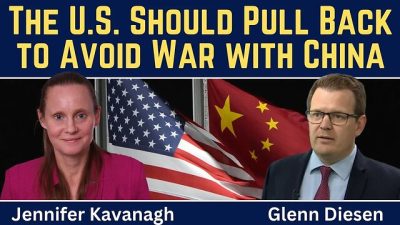
Why the U.S. Should Pull Back From the First Island Chain
or go to
Aletho News Archives – Video-Images
From the Archives
Only 19.7% of Americans agree with US State Dept on Israeli settlements
… Most American adults of voting age don’t appear willing to reject the applicability of international law to Israel’s ongoing colonization of occupied territories in East Jerusalem, the West Bank and Golan Heights. … Full article
Blog Roll
 Aletho News
- Albania on fire: who’s behind the riots?
- Egypt’s Civil Democratic Movement rejects involvement in regional war
- Egypt collaborates with Israel to build ‘Green Rafah’ project over erased Palestinian city
- Rising fuel prices and shortages have helped drive ongoing protests and rioting in France
- Tokyo protests demand Takaichi’s resignation over support for ‘Israel’
- Jennifer Kavanagh: Why the U.S. Should Pull Back From the First Island Chain
- Yemen denounces international community’s silence on Saudi aggression, siege
- UAE and Saudi Arabia move toward renewed coordination against Sanaa
- How Iran’s two-week retaliatory strikes exposed cracks in US military architecture in Persian Gulf
- The mother of all propaganda: Why the hype over US MOAB strike against Iran is nothing but theater
- If Americans Knew
- What the UK Is Doing to Pro-Palestine Novelist Sally Rooney Is an Act of Orwellian Villainy
- ‘We will build palaces for Jews in Gaza’: Right-wing activists establish new outpost near border
- ‘You see us burning, you stay silent’: Family’s agony over mother and sons burned to death in Gaza tent
- Israel keeps Palestinian journalist Bushra al-Tawil in isolation for 46 days
- US-Israel integration plan puts US military tech in Israel’s hands
- Israeli Strike Burns Gaza Mother Alive in Front of Toddler, ‘Without Generating Any Headlines’
- ‘The Israel Experience with Mike Huckabee’: The Ambassador’s Family Sells Trips to Israel
- As Gazans carry out mass burial, food insecurity is getting worse – Daily Update
- Israeli rabbi permits occupiers to steal Palestinian olive harvest in West Bank
- Netanyahu’s spin on latest settler attack is laughable – Daily Update
- No Tricks Zone
- Predictions Made By Renowned Climate Proifessor Over Past Decades Have Been Proven To Be Poor
- New Study Suggests Large Regions Of The Pacific Ocean Have Been Cooling For The Last 80 Years
- Germany’s Green Energy Debacle: High Energy Costs Force Kahla Porzellan to Close After 182 Years!
- New Study: 50 Years Of The Most Aggressive ‘Net Zero’ Policies Can Only Affect The Global Climate By 0.03°C
- US September “Heat” Was No Record…Many Records Set Decades Ago
- Latest European Green Energy Debacle; Portugal’s Largest Flagship Solar Park Insolvent!
- Green Energy Debacle: German Expert Professor Fritz Vahrenholt Warns Of Severe Economic And Social Consequences
- Two More Paleo Reconstructions Affirm Meters-Higher Sea Levels Across Ireland, Brazil 7000-6000 Years Ago
- New Study: Earth And Venus Surface Warmth Largely Explained By Convection And Lapse Rate, Not CO2 Or Radiation
- 2025 Nature Paper Claiming Worsening Global Drought Gets RETRACTED …Heavily Flawed

