Tanks and Think Tanks: How Taiwanese Cash is Funding the Push to War with China
By Alan Macleod | MintPress News | May 22, 2021
TAIPEI — At MintPress, we have been at the forefront of exposing how Middle Eastern dictatorships and weapons contractors have been funneling money into think tanks and political action committees, keeping up a steady drumbeat for more war and conflict around the world. Yet one little-discussed nation that punches well above its weight in spending cash in Washington is Taiwan.
By studying Taiwan’s financial reports, MintPress has ascertained that the semi-autonomous island of 23 million people has, in recent years, given out millions of dollars to many of the largest and most influential think tanks in the United States. This has coincided with a strong upsurge in anti-China rhetoric in Washington, with report after report warning of China’s economic rise and demanding that the U.S. intervene more in China-Taiwan disputes.
These think tanks are filled with prominent figures from both parties and have the ears of the most powerful politicians in Washington. It is in their offices that specialists draw up papers and incubate ideas that become tomorrow’s policies. They also churn out experts who appear in agenda-setting media, helping to shape and control the public debate on political and economic issues.
Twenty years ago, a group of neoconservative think tanks like the Project for a New American Century, funded by foreign governments and weapons manufacturers, used their power to push for disastrous wars in the Middle East. Now, a new set of think tanks, staffed with many of those same experts who provided the intellectual basis for those invasions, is working hard to convince Americans that there is a new existential threat: China.
A fistful of dollars
In 2019, the Taipei Economic and Cultural Representative Office in the United States (TECRO) — for all intents and purposes, the Taiwanese embassy — donated between $250,000 and $499,999 to the Brookings Institute, commonly identified as the world’s most influential think tank. Taiwanese tech companies have also given large sums to the organization. In turn, Brookings Institute staff like Richard C. Bush (a former member of the National Intelligence Council and a U.S. national intelligence officer for East Asia) vociferously champion the cause of Taiwanese nationalists and routinely condemn Beijing’s attempts to bring the island more closely under control.
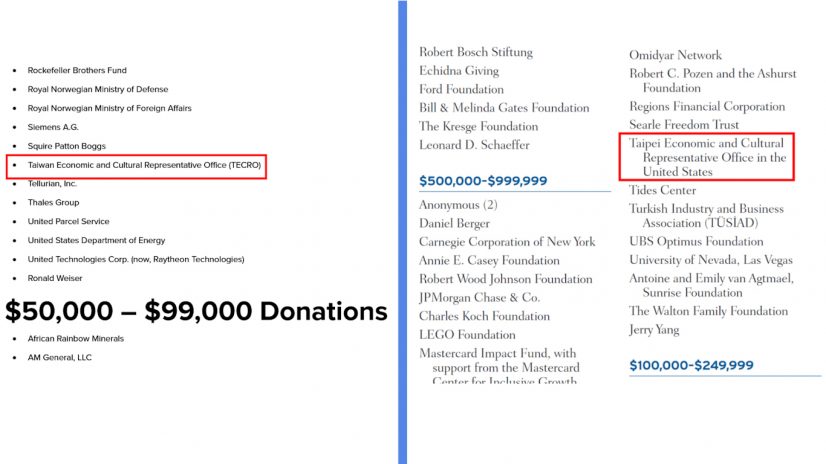
TECRO featured prominently among myriad defense interests on the donor rolls for both the Atlantic Council, left, and Brookings Institute
Last week, Brookings held an event called “Taiwan’s quest for security and the good life,” which began with the statement that “Taiwan is rightly praised for its democracy. Elections are free, fair, and competitive; civil and political rights are protected.” It went on to warn that the “most consequential” challenge to the island’s liberty and prosperity is “China’s ambition to end Taiwan’s separate existence.”
According to another organization’s latest financial disclosure, TECRO also gave a six-figure sum to the Atlantic Council, a think tank closely associated with NATO. It is unclear what the Atlantic Council did with that money, but what is certain is that they gave a senior fellowship to Chang-Ching Tu, an academic employed by the Taiwanese military to teach at the country’s National Defense University. In turn, Tu authored Atlantic Council reports describing his country as a “champion [of] global democracy,” and stating that “democracy, freedom and human rights are Taiwan’s core values.” A menacing China, however, is increasing its military threats, so Taiwan must “accelerate its deterrence forces and strengthen its self-defense capabilities.” Thus he advises that the U.S. must work far more closely with Taiwan’s military, conducting joint exercises and moving towards a more formal military alliance. In 2020, the U.S. sold $5.9 billion worth of arms to the island, making it the fifth-largest recipient of American weaponry last year.
Other Taiwan-employed academics have chided the West on the pages of the Council’s website for its insufficient zeal in “deter[ring] Chinese aggression” against the island. “A decision by the United States to back down” — wrote Philip Anstrén, a Swedish recipient of a fellowship from the Taiwanese Ministry of Foreign Affairs — “could damage the credibility of U.S. defense guarantees and signal that Washington’s will to defend its allies is weak.” Anstrén also insisted that “Europe’s future is on the line in the Taiwan Strait.” “Western democratic nations have moral obligations vis-à-vis Taiwan,” he added on his blog, “and Western democracies have a duty to ensure that [Taiwan] not only survives but also thrives.”
The reason this is important is that the Atlantic Council is an enormously influential think tank. Its board of directors is a who’s-who in foreign policy statecraft, featuring no fewer than seven former CIA directors. Also on the board are many of the architects of the wars in Iraq and Afghanistan, including Colin Powell, Condoleezza Rice and James Baker. When organizations like this begin beating the war drums, everybody should take note.
Perhaps the most strongly anti-Beijing think tank in Washington is the conservative Hudson Institute, an organization frequented by many of the Republican Party’s most influential figures, including former Secretary of State Mike Pompeo, former Vice-President Mike Pence and Arkansas Senator Tom Cotton. The words “China” or “Chinese” appear 137 times in Hudson’s latest annual report, so focused on the Asian nation are they. Indeed, reading their output, it often appears they care about little else but ramping up tensions with Beijing, condemning it for its treatment of Hong Kong, Taiwan and Uyghur Muslims, and warning of the economic and military threat of a rising China.
Over the years, Hudson’s efforts have been sustained by huge donations from TECRO. The Hudson Institute does not disclose the exact donations any sources give, but their annual reports show that TECRO has been on the highest tier of donors ($100,000+) every year since they began divulging their sponsors in 2015. In February, Hudson Senior Fellow Thomas J. Duesterberg wrote an op-ed for Forbes entitled “The Economic Case for Prioritizing a U.S.-Taiwan Free Trade Agreement,” in which he extolled Taiwan’s economy as modern and dynamic and portrayed securing closer economic ties with it as a no-brainer. Hudson employees have also traveled to Taiwan to meet and hold events with leading foreign ministry officials there.
The Hudson Institute also recently partnered with the more liberal Center for American Progress (CAP) to host an event with Taiwanese President Tsai Ing-wen, who took the opportunity to make a great number of inflammatory statements about the “ever more challenging threats to free and democratic societies” China poses; applaud the U.S.’ actions on Hong Kong; and talk about how Taiwan honors and celebrates those who died at the Tiananmen Square massacre. TECRO gave the CAP between $50,000 and $100,000 last year.
It is the Center for Strategic and International Studies (CSIS), however, that appears to receive the most Taiwanese money. According to its donor list, Taiwan gives as much money to it as the United States does — at least $500,000 last year alone. Yet all of the Taiwanese government money is put into CSIS’s regional studies (i.e., Asia) program. Like Hudson employees, the CSIS calls for a free trade agreement with Taiwan and has lavished praise on the nation for its approach to tackling disinformation, describing it as a “thriving democracy and a cultural powerhouse.” Although acknowledging that the reports were paid for by TECRO, CSIS insists that “all opinions expressed herein should be understood to be solely those of the authors and are not influenced in any way by any donation.” In December, the CSIS also held a debate suggesting that “[w]ithin the next five years, China will use significant military force against a country on its periphery,” exploring what the U.S. response to such an action should be.
Like the Atlantic Council, the CSIS organization is stacked with senior officials from the national security state. Its president and CEO is former Deputy Secretary of Defense John Hamre, while Henry Kissinger — former secretary of state and the architect of the Vietnam War — also serves on its council.
The CSIS accepts money from the Global Taiwan Institute and the Taiwan Foundation for Democracy (TFD) as well. The former is a rather shadowy pro-Taiwanese group that appears not to disclose its funding sources. The latter is a government-funded organization headed by former Taiwanese President You Si-kun. Every year, the TFD publishes a human rights report on China, the latest of which claims that “the Chinese Communist Party knows no bounds when it comes to committing serious human rights violations” — accusing it of “taking the initiative” in “promoting a new Cold War over the issue of human rights” and trying to “replace the universal standing of human rights values around the world.” Ultimately, the report concludes, China “constitutes a major challenge to democracy and freedom in the world.”
The TFD has also been a major funder of the Victims of Communism Memorial Foundation, a far-right pressure group that insists that Communism has killed over 100 million people worldwide. Last year, the Victims of Communism Memorial Foundation added all global COVID-19 fatalities to the list of Communist-caused deaths on the basis that the virus started in China. The Foundation also employs Adrian Zenz, a German evangelical theologian who is the unlikely source of many of the most controversial and contested claims about Chinese repression in Xinjiang province.
In the past 12 months, TECRO has also donated six-figure sums to many other prominent think tanks, including the German Marshall Fund of the United States, the Center for a New American Security, and the Carnegie Endowment for International Peace. MintPress reached out to a number of these think tanks for comment but has not received any response.
“It would be naive to believe that Taiwan’s funding of think tanks is not pushing them to take pro-Taiwan or anti-China positions,” Ben Freeman, the director of the Foreign Influence Transparency Initiative at the Center for International Policy, told MintPress, adding:
After all, why would Taiwan keep funding think tanks that are critical of Taiwan? There’s a Darwinian element to foreign funding of think tanks that pushes foreign government funding to think tanks that write what that foreign government wants them to write. Taiwan is no exception to this rule.”
TECRO is not just sponsoring American think tanks, however. It has also given funds to the Australian Strategic Policy Institute (ASPI), a hawkish and controversial group described as “the think tank behind Australia’s changing view of China.” The country’s former ambassador in Beijing described ASPI as “the architect of the China threat theory in Australia” while Senator Kim Carr of Victoria denounced them as working hand-in-hand with Washington to push “a new Cold War with China.” ASPI was behind Twitter’s decision last year to purge more than 170,000 accounts sympathetic to Beijing from its platform.
“We must be ready to fight our corner as Taiwan tensions rise,” ASPI wrote in January, having previously castigated the West for being “no longer willing to defend Taiwan.”
ASPI — like Brookings, the Atlantic Council and others — are directly funded by weapons manufacturers, all of whom also have a direct interest in promoting more wars around the world. Thus, if the public is not careful, certain special interests might be helping move the United States towards yet another international conflict.
While the situation outlined above is concerning enough, the Foreign Influence Transparency Initiative’s research has shown that around one-third of think tanks still do not provide any information whatsoever about their funding, and very few are completely open about their finances. Freeman maintains that, while there is nothing inherently wrong with foreign governments funding Western think tanks, the lack of transparency is seriously problematic, explaining:
This raises a lot of questions about the work they’re doing. Are their secret funders saying what the think tank can do in a pay-for-play scheme? Are the funders buying the think tanks silence on sensitive issues? Without knowing the think tank’s funders, policymakers and the public have no idea if the think tank’s work is objective research or simply the talking points of a foreign government.”
Freeman’s study of the Taiwanese lobby found that seven organizations registered as Taiwan’s foreign agents in the U.S. Those organizations, in turn, contacted 476 Members of Congress (including almost 90% of the House), as well as five congressional committees. House Speaker Nancy Pelosi was their most frequent contact, the Californian being contacted 34 times by Taiwanese agents. Pelosi has been a great supporter of Taiwanese nationalists, successfully promoting pro-Taiwan legislation and proudly announcing that the U.S. “stands with Taiwan.”
Foreign agents working on behalf of Taiwan also made 143 political contributions to U.S. politicians, with former Alabama Senator Doug Jones the lead recipient (Pelosi was third).
Losing China, regaining Taiwan?
The reports listed above understand the dispute as purely a matter of Chinese belligerence against Taiwan and certainly do not consider U.S. military actions in the South China Sea as aggressive in themselves. That is because the world of think tanks and war planners sees the United States as owning the planet and having a remit to act anywhere on the globe at any time.
To this day, U.S. planners bemoan the “loss of China” in 1949 (a phrase that presupposes the United States owned the country). After a long and bloody Second World War, Communist resistance forces under Mao Tse-tung managed to both expel the Japanese occupation and overcome the U.S.-backed Kuomintang (nationalist) force led by Chang Kai-shek. The United States actually invaded China in 1945, with 50,000 troops working with the Kuomintang and even Japanese forces in an attempt to suppress the Communists. However, by 1949, Mao’s army was victorious; the United States evacuated and Chang Kai-shek retreated to Taiwan.
The Kuomintang ruled the island for 40 years as a one-party state and remains one of the two major political groups to this day. The war between the Communists and the Kuomintang never formally ended, and Taiwan has now lived through 70 years of estrangement from the mainland. Polls show a majority of Taiwanese now favor full independence, although a large majority still personally identify as Chinese.
While many Taiwanese welcome an increased U.S. presence in the region, Beijing certainly does not. In 2012, President Barack Obama announced the U.S.’ new “Pivot to Asia” strategy, moving forces from the Middle East towards China. Today, over 400 American military bases encircle it.
In recent months, the United States has also taken a number of provocative military actions on China’s doorstep. In July, it conducted naval exercises in the South China Sea, with warships and naval aircraft spotted just 41 nautical miles from the coastal megacity of Shanghai, intent on probing China’s coastal defenses. And in December, it flew nuclear bombers over Chinese vessels close to Hainan Island. Earlier this year, the head of Strategic Command made his intentions clear, stating that there was a “very real possibility” of war against China over a regional conflict like Taiwan. China, for its part, has also increased its forces in the region, carrying out military exercises and staking claims to a number of disputed islands.
A new Director of National Intelligence (DNI) report notes that China is the U.S.’ “unparalleled priority,” claiming that Beijing is making a “push for global power.” “We expect that friction will grow as Beijing steps up attempts to portray Taipei as internationally isolated and dependent on the mainland for economic prosperity, and as China continues to increase military activity around the island,” it concludes.
In an effort to stop this, Washington has recruited allies into the conflict. Australian media are reporting that their military is currently readying for war in an effort to force China to back down, while last week President Joe Biden met with Japanese Prime Minister Yoshihide Suga to shore up a united front against Beijing vis-a-vis Taiwan.
In February, the Atlantic Council penned an anonymous 26,000-word report advising Biden to draw a number of red lines around China, beyond which a response — presumably military — is necessary. These included any military action or even a cyber attack against Taiwan. Any backing down from this stance, the council states, would result in national “humiliation” for the United States.
Perhaps most notably, however, the report also envisages what a successful American China policy would look like by 2050:
[T]he United States and its major allies continue to dominate the regional and global balance of power across all the major indices of power;… [and head of state Xi Jinping] has been replaced by a more moderate party leadership; and … the Chinese people themselves have come to question and challenge the Communist Party’s century-long proposition that China’s ancient civilization is forever destined to an authoritarian future.”
In other words, that China has been broken and that some sort of regime change has occurred.
Throughout all this, the United States has been careful to stress that it still does not recognize Taiwan and that their relationship is entirely “unofficial,” despite claiming that its commitment to the island remains “rock solid.” Indeed, only 14 countries formally recognize Taiwan, the largest and most powerful of which is Paraguay.
Along with a military conflict brewing, Washington has also been prosecuting an information and trade war against China on the world stage. Attempts to block the rise of major Chinese companies like Huawei, TikTok and Xiaomi are examples of this. Others in Washington have advised the Pentagon to carry out an under-the-table culture war against Beijing. This would include commissioning “Taiwanese Tom Clancy” novels that would “weaponize” China’s one-child policy against it, bombarding citizens with stories about how their only children will die in a war over Taiwan.
Republicans and Democrats constantly accuse each other of being in President Xi’s pocket, attempting to outdo each other in their jingoistic fervor. Last year, Florida Senator Rick Scott went so far as to announce that every Chinese national in the U.S. was a Communist spy and should be treated with extreme suspicion. As a result, the American public’s view of China has crashed to an all-time low. Only three years ago, the majority of Americans held a positive opinion of China. But today, that number is only 20%. Asian-Americans of all backgrounds have reported a rise in hate crimes against them.
Cash rules everything around me
How much of the United States’ aggressive stance towards China can be attributed to Taiwanese money influencing politics? It is difficult to say. Certainly, the United States has its own policy goals in East Asia outside of Taiwan. But Freeman believes that the answer is not zero. The Taiwan lobby “absolutely has an impact on U.S. foreign policy,” he said, adding:
At one level, it creates an echo-chamber in D.C. that makes it taboo to question U.S. military ties with Taiwan. While I, personally, think there are good strategic reasons for the U.S. to support this democratic ally — and it’s clearly in Taiwan’s interest to keep the U.S. fully entangled in their security — it’s troubling that the D.C. policy community can’t have an honest conversation about what U.S. interests are. But, Taiwan’s lobby in D.C. and their funding of think tanks both work to stifle this conversation and, frankly, they’ve been highly effective.”
Other national lobbies affect U.S. policy. The Cuban lobby helps ensure that the American stance towards its southern neighbor remains as antagonistic as possible. Meanwhile, the Israel lobby helps ensure continuing U.S. support for Israeli actions in the Middle East. Yet more ominously with Taiwan, its representatives are helping push the U.S. closer towards a confrontation with a nuclear power.
While Taiwanese money appears to have convinced many in Washington, it is doubtful that ordinary Americans will be willing to risk a war over an island barely larger than Hawaii, only 80 miles off the coast of mainland China.
Alan MacLeod is Senior Staff Writer for MintPress News. After completing his PhD in 2017 he published two books: Bad News From Venezuela: Twenty Years of Fake News and Misreporting and Propaganda in the Information Age: Still Manufacturing Consent, as well as a number of academic articles. He has also contributed to FAIR.org, The Guardian, Salon, The Grayzone, Jacobin Magazine, and Common Dreams.
No going back to Open Skies, US tells Russia ahead of Biden-Putin summit
RT | May 27, 2021
The US State Department has communicated to Moscow that the Biden administration has no intention of rejoining the Open Skies treaty, which was one of the topics expected to come up at the Geneva summit in June.
Deputy Secretary of State Wendy Sherman sent the message to her Russian counterpart Deputy Foreign Minister Sergei Ryabkov on Thursday, AP reported, citing US officials speaking on condition of anonymity. Russia’s Ministry of Foreign Affairs has confirmed receiving the message.
It was a rare case of President Joe Biden not reversing a decision made by his predecessor Donald Trump, who had taken the US out of the treaty in May 2020.
The US officially left the treaty in November, but when Biden came to power he ordered a review of the decision, holding out the possibility that Washington might rejoin. The subject was expected to come up at the June 16 meeting between Biden and Russian President Vladimir Putin in Geneva.
Earlier in the day, Kremlin spokesman Dmitry Peskov had told reporters that time to salvage the arms control agreement was running out fast.
“This topic can surely be touched upon somehow, but time is running out fast. We are already carrying out procedures for leaving the treaty, and the US has little time to change its previous decisions,” Peskov said.
Last month, Moscow announced it would begin the procedure of withdrawing from the treaty, concerned that the US has continued to receive intelligence through overflights conducted by other NATO members still party to it.
With the US definitely out, further presence of Russia in Open Skies no longer makes sense, Russian Senator Andrey Klimov – who sits on the foreign relations committee – told RIA Novosti following the announcement from Washington.
The Open Skies treaty was intended to build trust between Russia and the West following the Cold War. Signed in 1992 and going into effect in 2002, it allowed signatories to openly fly unarmed surveillance planes over the territory of other participants. More than 1,500 such flights have taken place since.
Russia Laments Washington’s Failure to Strictly Adhere to New START Treaty Provisions
By Henry Batyaev – Sputnik – 26.05.2021
Russia is calling on the United States to keep their end of the bargain with respect to the New START Treaty after Moscow found that the United States had converted some of its strategic offensive arms, making it impossible to verify whether they can be now used to carry nuclear weapons.
The representative of the Russian Foreign Ministry, Maria Zakharova, said on Wednesday that Moscow will continue to demand that Washington comply with the terms of the treaty.
She added that Moscow is closely monitoring US efforts to modernise its strategic offensive arms, including through the increase of funding.
According to the New START Treaty, the sides must notify each other on the elimination of treaty‑accountable systems or conversion to non‑nuclear or non‑accountable status.
In February, Russia and the United States agreed to extend the New START treaty for five more years without renegotiating any of its terms. The treaty, now set to expire on February 5, 2026, is the only arms control agreement between two countries that is still in force.
Pakistan rejects US request for military bases
By Javed Rana | Press TV | May 27, 2021
Islamabad – As the US is negotiating with countries in Central and South Asia to set up its military bases in the region to carry out possible airstrikes on Afghanistan after later this year withdrawal from the country, Pakistan says it won’t ink any similar agreement with the US once again.
The US is fast pulling out its troops from Afghanistan under a peace deal with Afghan Taliban. However, before completing its withdrawal by September 11 this year, Washington is desperately negotiating with regional countries in Central and South Asia to set up military bases to retain its political clout in this part of the world.
The US used Pakistan’s military bases for years to carry out over 57,000 sorties on Afghanistan which killed tens of thousands of Afghan civilians. Similarly as many as 4,000 Pakistani civilians were killed in the bordering region with Afghanistan in US drone attacks most of which were carried out from the secret southern locations of Pakistan.
Not long ago, under public pressure Pakistan shut down the US military bases. Now the US is once again struggling hard to be allowed to have military bases in this part of the world.
Prime Minister Imran Khan’s government, which won the 2018 general elections partially exploiting anti-American sentiments, has vowed not to allow the US to have military bases again in Pakistan.
Earlier the Foreign Office denied the presence of any US military or air base in Pakistan, stating that any speculation is “baseless and irresponsible” and should be avoided.
If nothing works, the Pentagon says it can use its aircraft carriers already stationed in the West Asia and Persian Gulf to carry out any possible airstrike on Afghanistan in future.
Despite shutting down the US military bases in Pakistan, the Pentagon continues to use air corridors of Pakistan to support its shrinking military presence in Afghanistan. And Pakistan has yet to clarify on whether or not it would allow the US to retain its air space facility for any possible airstrike in Afghanistan after the US completely exits from Afghanistan later this year.
Liz Cheney Lied About Her Role in Spreading the Discredited CIA “Russian Bounty” Story
By Glenn Greenwald | May 14, 2021
In an interview on Tuesday with Fox News’ Bret Baier, Rep. Liz Cheney (R-WY) denied that she spread the discredited CIA “Russian bounty” story. That CIA tale, claiming Russia was paying Taliban fighters to kill U.S. troops in Afghanistan, was cooked up by the CIA and then published by The New York Times on June 27 of last year, right as former President Trump announced his plans to withdraw troops from Afghanistan. The Times story, citing anonymous intelligence officials, was then continually invoked by pro-war Republicans and Democrats — led by Cheney — to justify their blocking of that troop withdrawal. The story was discredited when the U.S. intelligence community admitted last month that it had only “low to moderate confidence” that any of this even happened.
When Baier asked Cheney about her role in spreading this debunked CIA story, Cheney blatantly lied to him, claiming “if you go back and look at what I said — every single thing I said: I said if those stories are true, we need to know why the President and Vice President were not briefed on them.” After Baier pressed her on the fact that she vested this story with credibility, Cheney insisted a second time that she never endorsed the claim but merely spoke conditionally, always using the “if these reports are true” formulation. Watch Cheney deny her role in spreading that story.
Liz Cheney, as she so often does, blatantly lied. That she merely spoke of the Russian bounty story in the conditional — “every single thing I said: I said if those stories are true” — is completely and demonstrably false. Indeed, other than Rep. Adam Schiff (D-CA), there are few if any members of Congress who did more to spread this Russian bounty story as proven truth, all in order to block troop withdrawal from Afghanistan. In so doing, she borrowed from a pro-war playbook pioneered by her dad, to whom she owes her career: the former Vice President would leak CIA claims to The New York Times to justify war, then go on Meet the Press with Tim Russert, as he did on September 8, 2002, and cite those New York Times reports as though they were independent confirmation of his views coming from that paper rather than from him:
MR. RUSSERT: What, specifically, has [Saddam] obtained that you believe would enhance his nuclear development program? …..
VICE PRES. CHENEY: Now, in the case of a nuclear weapon, that means either plutonium or highly enriched uranium. And what we’ve seen recently that has raised our level of concern to the current state of unrest, if you will, if I can put it in those terms, is that he now is trying, through his illicit procurement network, to acquire the equipment he needs to be able to enrich uranium to make the bombs.
MR. RUSSERT: Aluminum tubes.
VICE PRES. CHENEY: Specifically aluminum tubes. There’s a story in The New York Times this morning this is — I don’t — and I want to attribute The Times. I don’t want to talk about, obviously, specific intelligence sources, but it’s now public that, in fact, [Saddam] has been seeking to acquire, and we have been able to intercept and prevent him from acquiring through this particular channel, the kinds of tubes that are necessary to build a centrifuge. And the centrifuge is required to take low-grade uranium and enhance it into highly enriched uranium, which is what you have to have in order to build a bomb.
So having CIA stories leak to the press that fuel the pro-war case, then having pro-war politicians cite those to justify their pro-war position, is a Cheney Family speciality.
On July 1, the House Armed Services Committee, of which Rep. Cheney is a member, debated amendments to the National Defense Authorization Act, the bill that authorized $740.5 billion in military spending. One of Cheney’s top priorities was to align with the Committee’s pro-war Democrats, funded by weapons manufacturers, to block Trump’s plan to withdraw all U.S. troops from Afghanistan by the end of 2020 and to withdraw roughly 1/3 of the 34,000 U.S. troops in Germany.
To justify her opposition, Cheney — contrary to what she repeatedly insisted to Baier — cited the CIA’s Russian bounty story without skepticism. In a joint statement with Rep. Mac Thornberry (R-TX), ranking member of the House Armed Services Committee, that Cheney published on her website on June 27 — the same day that The New York Times published its first story about the CIA tale — Cheney pronounced herself “concerned about Russian activity in Afghanistan, including reports that they have targeted U.S. forces.” There was nothing conditional about the statement: they were preparing to block troop withdrawal from Afghanistan and cited this story as proof that “Russia does not wish us well in Afghanistan.”
After today’s briefing with senior White House officials, we remain concerned about Russian activity in Afghanistan, including reports that they have targeted U.S. forces. It has been clear for some time that Russia does not wish us well in Afghanistan. We believe it is important to vigorously pursue any information related to Russia or any other country targeting our forces. Congress has no more important obligation than providing for the security of our nation and ensuring our forces have the resources they need.
An even more definitive use of this Russia bounty story came when Cheney held a press conference to explain her opposition to Trump’s plans to withdraw troops. In this statement, she proclaimed that she “remains concerned about Russian activities in Afghanistan.” She then explicitly threatened Russia over the CIA’s “bounty” story, warning them that “any targeting of U.S. forces by Russians, by anyone else, will face a very swift and deadly response.” She then gloated about the U.S. bombing of Russia-linked troops in Syria in 2018 using what she called “overwhelming and lethal force,” and warned that this would happen again if they target U.S. forces in Afghanistan:
Does this sound even remotely like what Cheney claimed to Baier? She denied having played a key role in spreading the Russia bounty story because, as she put it, “every single thing I said, I said: if those stories are true.” She also told him that she never referred to that CIA claim except by saying: “if these reports are true.” That is false.
The issue is not merely that Cheney lied: that would hardly be news. It is that the entire media narrative about Cheney’s removal from her House leadership role is a fraud. Her attacks on Trump and her party leadership were not confined to criticisms of the role played by the former president in contesting the validity of the 2020 election outcome or inciting the January 6 Capitol riot — because Liz Cheney is such a stalwart defender of the need for truth and adherence to the rule of law in politics.
Cheney played the key role in forming an alliance with pro-war Democrats on the House Armed Services Committee to repeatedly defeat the bipartisan anti-war minority [led by Ro Khanna (D-CA), Rep. Tulsi Gabbard (D-HI) and Rep. Matt Gaetz (R-FL)] to prevent any meaningful changes promised by Trump during the 2016 campaign to put an end to the U.S. posture of Endless War. As I reported about the House Armed Services Committee hearing last July, the CIA tale was repeatedly cited by Cheney and her allies to justify ongoing U.S. troop presence in Afghanistan.
Cheney is motivated by power, not ethics. In 2016, Trump ran — and won — by explicitly inveighing against the Bush/Cheney foreign policy of endless war, militarism and imperialism that Liz Cheney, above all else, still vehemently supports. What she is attempting to do is reclaim the Republican Party and deliver it back to the neocons and warmongers who dominated it under her father’s reign. She is waging an ideological battle, not an ethical one, for control of the Republican Party.
That will be a debate for Republican voters to resolve. In the meantime, Liz Cheney cannot be allowed to distance herself from the CIA’s fairy tale about Russians in Afghanistan. Along with pro-war Democrats, she used this conveniently leaked CIA story repeatedly to block troop withdrawal from Afghanistan. And just as her father taught her to do — by example if not expressly — she is now lying to distance herself from a pro-war CIA script that she, in fact, explicitly promoted.
Rand Paul Continues Fauci Feud; “He Could Be Culpable For The Entire Pandemic”
By Steve Watson | Summit News | May 13, 2021
Senator Rand Paul continued to slam White House medical advisor Thursday, saying that Anthony Fauci could be culpable for the entire coronavirus pandemic.
Paul was attacked by leftist media Wednesday for merely questioning Fauci’s extensive role in granting funding to the Wuhan Institute of Virology at a Senate hearing.
CNN’s Anderson Cooper declared that Paul should “have more respect at least for medical science.”
Paul hit back, noting that Fauci is lying about the NIH’s involvement in funding of the Wuhan lab.
Now in a further appearance on Fox And Friends, Paul has gone even deeper, accusing Fauci of being personally to blame for the global pandemic.
“The person they hired to investigate the lab for the WHO perspective is the guy who gave the money,” Paul urged.
“So NIH gave the money to EcoHealth. The head of EcoHealth – they got him to investigate whether Wuhan was doing anything inappropriate in their lab. But if they were then wouldn’t he be culpable?” The Senator questioned.
“Doesn’t he have a self interest in smoothing things over,” Paul continued, adding “I’m not saying he did cover things up but you wouldn’t appoint someone who is in the line of the supply chain of giving the money to them.”
“Ultimately here’s the rub. I don’t know whether it came from the lab. But who could be culpable? Dr. Fauci could be culpable for the entire pandemic!” Paul emphasised.
https://rumble.com/vgz7g1-rand-paul-dr.-fauci-could-be-culpable-for-the-entire-pandemic
As Infowars reported in April 2020, the NIH awarded a $3.7 million grant to the Wuhan Institute of Virology to conduct coronavirus gain of function research.
Additionally, the results of the US-backed gain of function research at Wuhan was published in 2017 under the heading, “Discovery of a rich gene pool of bat SARS-related coronaviruses provides new insights into the origin of SARS coronavirus.”
Fauci has come under increased scrutiny as the NIH’s involvement with the Wuhan lab is being called into question.
US biolab transparency urged after smearing China over weaponizing COVID-19
Global Times | May 10, 2021
It is the US that is conducting biological warfare and bioterrorism using genetic engineering technology, rather than China, the Chinese Foreign Ministry said on Monday in response to a media report accusing China of weaponizing COVID-19.
The Chinese Foreign Ministry urged the US to be transparent on their biolabs and their ongoing bioweapons studies.
Quoting a so-called leaked document obtained by the US State Department, which is actually a book that is openly on sale, The Australian claimed China had been looking into whether it could weaponize the coronavirus five years before the COVID-19 pandemic, and even presented the document as evidence of China’s interest in bioweapons.
There are always some in the US who smear China either by hyping up facts or quoting so-called internal documents or reports, but it is usually a case of “the guilty party filing the suit first”, deliberate misinterpretation, presumption of guilt or merely spreading lies, Chinese Foreign Ministry Spokesperson Hua Chunying said on Monday at the press briefing.
Media reports said the so-called leaked document obtained by US officials is a published academic book, and not an internal secret document from the Chinese military, Hua pointed out.
The quote from former US Air Force colonel Michael J. Ainscough in the book said next generation bioweapons will be part of the US Air Force projects and aim to help the country better cope with weapons of mass destruction, indicating that the US is carrying out biological warfare and bioterrorism using genetic engineering technology, Hua said.
China has abided by its obligations under the Biological Weapons Convention, and is not developing, studying or producing bioweapons, while the US has been secretly working on their biolabs, Hua pointed out, urging the US to be transparent on the issue.
The US has set up biolabs in 25 countries and regions across the Middle East, Africa, Southeast Asia and former Soviet Union, with 16 in Ukraine alone. Some of the places where the labs are based have seen large-scale outbreaks of infectious diseases and other dangerous infectious diseases, the ministry said, citing media reports.
The Chinese foreign ministry spokesperson demanded that the US address international concerns: Why is the US building so many biolabs around the globe? How much sensitive biological resources and information has the US obtained from other countries? What kind of activities has the US carried out in its Fort Detrick laboratory and other biolabs, and what’s the relationship between these biolabs and its “next generation bioweapons”?
Global Times
NIH hit with lawsuit for blocking COVID Gain of Function research evidence
NIH Failed to Promptly Release Documents Concerning “Gain of Function/Gain of Threat” Research on Influenza, MERS, SARS, and COVID
Center for Food Safety | May 4, 2021
Last week, Center for Food Safety (CFS) filed a Freedom of Information Act (FOIA) lawsuit against the National Institutes of Health (NIH), an agency with the Department of Health and Human Services (HHS). CFS is suing the agency over its failure to release government documents related to the approval and issuance of NIH contracts and grants that fund research projects involving controversial gain of function/gain of threat studies with dangerous, so-called “enhanced potential pandemic pathogens.”
“The NIH’s refusal to make public the research it is funding to enhance the transmissibility, infectiousness, and lethality of potential pandemic viruses is grossly irresponsible,” said Andrew Kimbrell, executive director of Center for Food Safety. “We are litigating to get that information because transparency and public knowledge about these highly hazardous experiments could be an important step in avoiding the next pandemic.”
An enhanced, “laboratory-generated” potential pandemic pathogen results from the enhancement of a potential pandemic pathogen’s transmissibility or virulence in humans. Gain of function/gain of threat studies, or research that improves the ability of a pathogen to cause disease, is a subset of life sciences research that most commonly involves the creation or use of enhanced potential pandemic pathogens.
CFS’s lawsuit focuses on the agency’s withholding of records concerning NIH’s funding of proposed research that could create, transfer, or use enhanced potential pandemic pathogens for which additional review under HHS’ Framework for Guiding Funding Decisions about Proposed Research Involving Enhanced Potential Pandemic Pathogens (HHS P3CO Framework) is required.
“FOIA requires NIH to release records promptly. Unfortunately, the agency has failed to comply with FOIA’s statutory deadlines with respect to our request,” said Victoria Yundt, staff attorney at Center for Food Safety.”Consequently, NIH has unlawfully deprived the public of its statutory right to obtain records containing crucial information about government approval and funding of new and continued gain of function/gain of threat studies that consist of creating, transferring, or using enhanced potential pandemic pathogens in U.S. laboratories, which—if released from a laboratory accident—could result in catastrophic consequences to the human environment.”
Without the requested records, CFS cannot determine how many gain of function/gain of threat projects have been funded by the NIH, nor how many of these projects have undergone the proper review or comply with other federal laws and regulations.
NIH’s unlawful withholding of public records undermines FOIA’s basic purpose of government transparency. CFS has a history of suing the federal government to compel agencies to be compliant with FOIA. CFS’s FOIA program is committed to upholding the principles embodied in FOIA, such as maintaining an open and transparent government.
Featured Video

Liberty Cannot Exist Inside a Panopticon
or go to
Aletho News Archives – Video-Images
From the Archives
Left-leaning despisers of 9/11 Truth movement: Do you really believe in miracles?
David Ray Griffin | Global Research | 06 Jul 2010
An Open Letter to Terry Allen, Noam Chomsky, Alexander Cockburn, David Corn, Chris Hayes, George Monbiot, Matthew Rothschild, and Matt Taibbi.
[1]According to several left-leaning critics of the 9/11 Truth Movement, some of its central claims, especially about the destruction of the World Trade Center, show its members to be scientifically challenged. In the opinion of some of these critics, moreover, claims made by members of this movement are sometimes unscientific in the strongest possible sense, implying an acceptance of magic and miracles. … Full article
Blog Roll
 Aletho News
- EU sending ‘biased’ observers to interfere in Serbian election – president
- White House envoy declares kinetic action against Yemen ‘fruitless’
- Ukraine deployed thousands of microdrones in Iraqi Kurdistan: Tasnim
- Iran calls for emergency UNSC meeting over Trump’s ‘brazen’ bomb talk, Israeli threats
- Iranian sources reveal details of Russia-China Hormuz proposal
- Plan for more US-Israel integration puts our military tech at risk
- Another Round Against Iran Will Break What Is Left of the Gulf
- SVR Report on Ukraine’s Mexican Drug Gang Links Could Pressure Zelensky, Won’t Change US Policy
- British Government Employees Were Fact-Checking the News at the BBC. Nobody Told You.
- Albania on fire: who’s behind the riots?
- If Americans Knew
- Mysterious bot accounts reportedly spread fake ‘man on the street’ videos for Michigan Senate candidate
- Israeli Defense Minister Katz Says Over 60 Lebanon Villages Have Been Destroyed
- Why Is Israel Running TV Ads in Iowa Ahead of the Midterms?
- Hind Rajab’s Alleged Killer Is in the United States. HRF Demands His Arrest.
- US Officials Face Fresh Pressure After Another American ‘Brutalized’ by Israeli Settlers in West Bank
- Israel-Backed Palestinian Militias Terrorize Displaced Families in Gaza
- FBI subpoenas pro-Palestine activists over Israeli weapons plant disruption
- Fourth winter arrives in wartorn Gaza, too early – Daily Update
- More on how Bari Weiss is using CBS on behalf of Israel
- What the UK Is Doing to Pro-Palestine Novelist Sally Rooney Is an Act of Orwellian Villainy
- No Tricks Zone
- Predictions Made By Renowned Climate Proifessor Over Past Decades Have Been Proven To Be Poor
- New Study Suggests Large Regions Of The Pacific Ocean Have Been Cooling For The Last 80 Years
- Germany’s Green Energy Debacle: High Energy Costs Force Kahla Porzellan to Close After 182 Years!
- New Study: 50 Years Of The Most Aggressive ‘Net Zero’ Policies Can Only Affect The Global Climate By 0.03°C
- US September “Heat” Was No Record…Many Records Set Decades Ago
- Latest European Green Energy Debacle; Portugal’s Largest Flagship Solar Park Insolvent!
- Green Energy Debacle: German Expert Professor Fritz Vahrenholt Warns Of Severe Economic And Social Consequences
- Two More Paleo Reconstructions Affirm Meters-Higher Sea Levels Across Ireland, Brazil 7000-6000 Years Ago
- New Study: Earth And Venus Surface Warmth Largely Explained By Convection And Lapse Rate, Not CO2 Or Radiation
- 2025 Nature Paper Claiming Worsening Global Drought Gets RETRACTED …Heavily Flawed

