Will Biden Have Blood on His Hands in Afghanistan?
By Jacob G. Hornberger | FFF | May 6, 2021
President Biden has announced that America’s forever war in Afghanistan is finally coming to an end. He says that U.S. forces will exit the country by next September 11.
That’s a good thing. And it is long overdue.
But there is one big problem with Biden’s timetable: It violates an agreement that the U.S. government entered into with the Taliban to exit the country by May 1 of this year.
Under that agreement, the Taliban agreed not to attack U.S. troops prior to their scheduled departure on May 1. With Biden’s decision to deliberately violate the agreement by unilaterally extending the withdrawal to September 11, he is knowingly placing the lives of the 3,500 American servicemen still in Afghanistan at risk.
In fact, the Taliban has implied as much. According to the Washington Post, a Taliban spokesman declared back in April, “If the agreement is breached and foreign forces fail to exit the country on the specified date, problems will certainly be compounded and those whom failed to comply with the agreement will be held liable.”
 What’s the point of extending the departure? Is an extension to September so important that it’s worth risking the lives of American servicemen still in Afghanistan? If some soldiers are killed or maimed because Biden cavalierly decided to violate the agreement, will their sacrifice have been worth it? What about the lives of innocent Afghan civilians caught in a crossfire or in a bomb explosion designed to kill U.S. troops?
Take a look at this article in USA Today. It’s by a quadruple amputee who lost his arms and legs in Afghanistan. He says it’s time to leave. He says, “I don’t need any soldier to honor me by doing the same thing.”
But that’s exactly what Biden is risking by intentionally, knowingly, and deliberately violating an agreement that the U.S. government willingly entered into.
Moreover, as Elliot Ackerman, a former Marine and intelligence officer who served five tours in Iraq and Afghanistan, pointed out in an article in the New York Times,
[R]emoving the 3,500 American troops from Afghanistan is, in military terms, what’s called a “fighting withdrawal,” in which an army leaves the field while still in contact with the enemy. Of all the maneuvers an army can perform (advance, flank, defend, etc.), it is widely accepted that a fighting withdrawal is the most complex and difficult because you are neither attacking nor defending, and so are exceedingly vulnerable.
Unlike the withdrawal from Iraq, in which U.S. troops could drive through the desert into Kuwait as they did in 2011, and unlike the Soviet withdrawal in 1989, in which they could drive across a then-shared border, U.S. troops are currently marooned in Afghanistan, reliant on three principal U.S.-controlled airstrips (Bagram, Jalalabad, Kandahar), making their journey home all the more perilous.
If the Taliban decide to attack U.S. troops from now until September, Biden will have their blood on his hands. He should never have breached the agreement that U.S. officials willingly entered into with their enemy.
Biden lied about Yemen
By Caitlin Johnstone | April 29, 2021
The Biden administration has finally admitted that the US is indeed providing offensive material support to Saudi Arabia’s genocidal assault on Yemen, directly contradicting Biden’s February claim that it would no longer be providing offensive support in that war. We are being lied to about yet another US war by yet another US president.
“The United States continues to provide maintenance support to Saudi Arabia’s Air Force given the critical role it plays in Saudi air defense and our longstanding security partnership,” Pentagon spokesperson Jessica McNulty has informed Vox reporter Alex Ward.
“Multiple US defense officials and experts acknowledged that, through a US government process, the Saudi government pays commercial contractors to maintain and service their aircraft, and those contractors keep Saudi warplanes in the air. What the Saudis do with those fighter jets, however, is up to them,” Ward reported, adding, “The US could cancel those contracts at any time, thus effectively grounding the Saudi Air Force, but doing so would risk losing Riyadh as a key regional partner.”
“The recent admission by the Department of Defense that US companies are still authorized to maintain Saudi warplanes … means that our government is still enabling the Saudi operations, including bombings and enforcing a blockade on Yemen’s ports,” Hassan El-Tayyab, the legislative manager for Middle East policy at the Friends Committee on National Legislation lobbying group, told Ward.
El-Tayyab is on record speaking out after Biden’s deceitful February announcement, saying this administration needs to make it abundantly clear what it actually means by ending offensive support for the war on Yemen and actually stick to it.
“I’m not a full pessimist here. I welcome the news,” he told Al Jazeera at the time, adding, “But I’m just trying to stay vigilant and not take the foot off the gas on advocacy pressure. Because we don’t know what’s going to happen.”
Well, now we do know. The US is maintaining and servicing the warplanes that are bombing Yemen and enforcing a blockade, which has killed hundreds of thousands and the United Nations warns could kill 400,000 more this year alone if conditions don’t change, proving Joe Biden a liar and vindicating the experts and activists who cautioned against accepting his announcement on blind faith.
Getting to this point where questions are finally answered about the reality of the Biden administration’s Yemen policy has been like pulling teeth, with officials giving questioners the runaround for months on this issue. Watch this clip of US Yemen Envoy Tim Lenderking dodging questions like George Bush dodges shoes as congressman Ted Lieu tries to get a straight answer as to whether the US has stopped supporting the war on Yemen:
Antiwar’s Dave DeCamp writes the following:
“The admission comes over two months since President Biden said he was ending support for Riyadh’s ‘offensive’ operations in Yemen. Vox reporter Alex Ward asked Pentagon spokesman John Kirby on Monday if the planes that the US is servicing could be used for offensive operations in Yemen. Kirby admitted that the ‘maintenance support for systems could be used for both’ offensive and defensive operations. … Besides continuing to maintain the Saudi Air Force, the Biden administration has given Riyadh the political cover to continue enforcing the blockade on Yemen. Biden officials have claimed that Yemen is not under a blockade, even though Saudi warships are preventing fuel shipments from docking in the port of Hudaydah, which makes it impossible to deliver food to Yemen’s starving civilian population.”
The United Nations conservatively estimates that some 233,000 Yemenis have been killed in the [Saudi-led] war … mostly from what it calls “indirect causes.” Those indirect causes would be disease and starvation resulting from what UN Secretary-General Antonio Guterres calls “the worst famine the world has seen for decades.”
When people hear the word “famine” they usually think of mass hunger caused by droughts or other naturally occurring phenomena, but in reality the starvation deaths we are seeing in Yemen (a huge percentage of which are children under the age of five) are caused by something that is no more natural than the starvation deaths you’d see in a medieval siege. They are the result of the Saudi coalition’s use of blockades and its deliberate targeting of farms, fishing boats, marketplaces, food storage sites, and cholera treatment centers with airstrikes aimed at making those parts [of the country, which are] controlled by Yemen’s Ansarullah movement so weak and miserable that they break.
The United States lies about all its wars with the help of the mass media, but up until this year its lies about Yemen have largely consisted of lies by omission: simply not talking about Yemen (like when MSNBC went an entire year without mentioning it a single time during the height of Russiagate hysteria), reporting on the famine as though it’s the result of a tragic natural disaster, or omitting America’s role in the slaughter. This time, it was just a straightforward lie: Biden said the US was ending offensive support, and it wasn’t.
As we’ve discussed previously, when the people demand something of their government it’s a lot easier to simply tell them you’re on their side and redirect them than to tell them no. Democrats are especially good at this.
As awareness grows that Yemen is the single most horrifying atrocity taking place in our world today, pressure is mounting for the US government to use its tremendous amount of leverage over Saudi Arabia to cease the human butchery. Rather than increasing that pressure by saying no, the Biden administration defused it by falsely pretending to give in to the demands. Because the risk of “losing Riyadh as a key regional partner” was deemed too great.
And meanwhile the slaughter continues, unbroken from Obama to Trump and from Trump to Biden. The names change, the narratives change, but the murderous imperial war machine rolls on uninterrupted.
New ‘dangerous chemical’ leak detected at NUCLEAR WASTE site in Washington state
RT | April 30, 2021
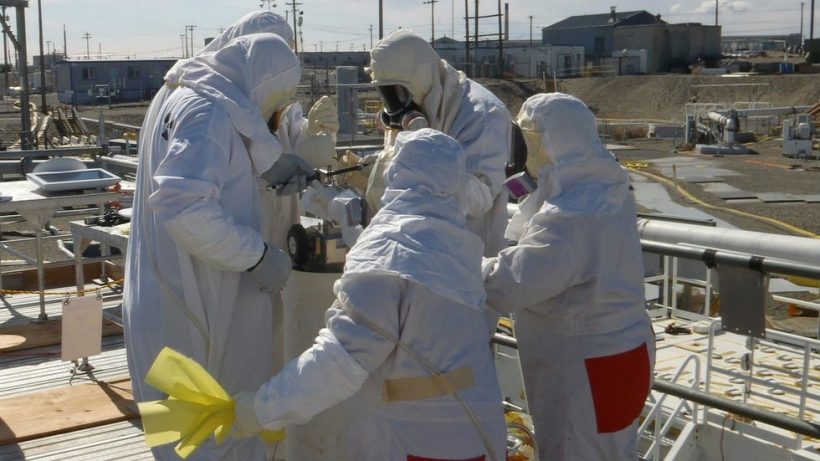
A nuclear waste storage tank at a defunct plutonium reactor in Washington state has sprung a leak, the Department of Energy said, as local officials warn the aging vessel will emit 1,300 gallons of chemicals over the next year.
The leaking tank, located at the Hanford site in southeast Washington, just 8 miles west of the Columbia River, was announced on Thursday by the Energy Department. A breach in the 75-year-old storage reservoir was suspected more than a year ago but only confirmed recently, one of several decrepit tanks at the facility.
“It’s a serious matter whenever a Hanford tank leaks its radioactive and dangerous chemical waste,” the state’s ecology director, Laura Watson, said in a statement, adding that that officials do not believe the breach poses “increased risk to workers or the public,” though it does contribute to “the ongoing environmental threat at Hanford.”
“This leak is adding to the estimated one million gallons of tank waste already in the soil across the Hanford site. This highlights the critical need for resources to address Hanford’s aging tanks, which will continue to fail and leak over time.”
While the problematic tank, designated B-109, is only the second officially confirmed leak at Hanford, (the first was detected in 2013), many of the site’s 149 storage tanks are suspected to have issues, with the Washington Ecology Department estimating that more than 200,000 gallons of waste have escaped from the “B Farm” alone, where B-109 is located. Across the whole Hanford facility, they believe 1 million gallons have poured from compromised tanks.
With B-109 leaking an estimated 3.5 gallons each day, or 1,300 gallons per year, the concerns are compounded by the tank’s close proximity to the water table, sitting just over 200 feet above, as well as the Columbia River.
A formal leak assessment was launched last year after the tank’s levels were found to be dropping, and though a breach was discovered, local officials’ hands remain tied under an agreement governing clean-up operations at Hanford. Environmental agencies can only take “immediate action” in response to a leak if it is deemed “necessary to abate an imminent and substantial endangerment to public health or welfare or the environment.” For now, the state, as well as federal agencies, have assessed no immediate danger from B-109, despite the confirmed leak.
“Contamination in this area is not new and mitigation actions have been in place for decades to protect workers, the public and the environment,” Energy Department spokesman Geoff Tyree told the Associated Press, adding “There is no increased health or safety risk to the Hanford workforce or the public.”
Hanford has seen a years-long, multi-billion-dollar clean-up effort due to its ailing equipment, which itself has become controversial. In 2019, the federal government sued arms dealer Lockheed Martin, which was awarded a $3.2 billion contract in the clean-up project alongside another private company, alleging it defrauded American taxpayers with illegal kickback payments.
The site’s management has also come under fire in recent years, with workers accused of deliberately dumping toxic waste into the environment in 2017.
The Hanford facility has a rich history stretching back to the days of the Manhattan Project, becoming the site for the world’s first large-scale plutonium production reactor. Plutonium manufactured there was used in the first nuclear bomb test at the Trinity site, as well as in Fat Man, the bomb dropped on Nagasaki, Japan in the waning days of World War II.
The B-109 tank came online in 1946, running for 30 years before it was shut down, while the entire facility was shuttered in 1987, leaving behind 53 million gallons of waste. Since then, local authorities have worked to stabilize the remaining storage vessels, but problems keep piling up, as thousands of gallons of hazardous materials continue to flow into the soil unabated.
US agency in charge of nukes approves plutonium project as Washington urges Iran to curtail its own nuclear program
RT | April 29, 2021
The US has approved a multibillion-dollar project to beef up its plutonium production at the same time Washington is calling on Iran to return to an international agreement designed to prevent Tehran from developing nuclear bombs.
The National Nuclear Security Administration (NNSA), the federal agency responsible for nuclear research and weapons manufacturing in the US, has approved the first design phase for the new project.
At least 30 plutonium pits per year will be built to “meet national security needs,” the NNSA said in a statement on Wednesday.
The project at the Los Alamos National Laboratory, New Mexico, will cost an estimated $2.7–$3.9 billion and could be finished between 2027 and 2028, the agency said.
Plutonium pits are bowling-ball-sized plutonium shells, and a crucial component in nuclear warheads.
The move to expand plutonium production is a bid by US President Joe Biden’s administration to make up for the country’s near-three-decade shortfall in the quantity of material the NNSA says is required for America’s nuclear arsenal.
At the same time as it hatches plans to bolster America’s own stockpile, the Biden administration has repeatedly called on Iran to restrict its nuclear program and return to the terms of the 2015 nuclear deal.
Indirect US-Iranian talks to revive the accord – officially known as the Joint Comprehensive Plan of Action (JCPOA) – have been taking place in Vienna over the last three weeks.
Under the deal, Iran originally agreed to curbs on its nuclear program in exchange for sanctions relief.But in 2018 Biden’s predecessor Donald Trump pulled the US out of the agreement and reverted to imposing crippling sanctions on Iran.
Tehran then began breaching its commitments under the deal.
Biden has said he wants the US to re-join the JCPOA – but first wants Iran to make concessions by cutting back on the amount, and purity, of uranium it produces and stores.
Tehran has said it will not alter its approach until Washington lifts sanctions.
On Thursday Mikhail Ulyanov, the Russian ambassador to the International Atomic Energy Agency, who is one of the mediators at the negotiations, briefed the US Special Envoy for Iran Robert Malley on the talks.
“We had a detailed and very useful discussion on major topics which are under consideration in the course of on-going talks in Vienna on full restoration of the #JCPOA,” Ulyanov said in a statement on Twitter.
Non-Prophylactically Ironic Dome over the Occupied Palestine
By Mansoureh Tajik for the Saker Blog | April 25, 2021
Exactly at 1:20 am (Tehran time) on Thursday, April 22, 2021 a missile hit near Dimona nuclear reactor, the “secret” nuclear site in the Occupied Palestinian Territory. The Jerusalem Post headlined the event as “Syrian missile lands near Dimona nuclear reactor, interception fails.”[1] The article went on to story the event as follows:
“It was unclear at first from where the missile was launched. Several signs indicated it having been launched from Iraq, while according to other reports, it came from the city of Daraa in southern Syria following an Israeli airstrike.”
“IDF Spokesman Brig.-Gen. Hidai Zilberman told reporters that ‘the explosion was due to the firing of an SA-5 surface-to-air missile toward Israel from Syria that exploded in the southern Negev. The firing of the missile came during Israeli airstrikes in southern Syria,’ Zilberman said, and that ‘it was an errant missile and not directed toward the Dimona nuclear reactor.’”
It was not an errant missile. It did not come from where the General said it came. It was not during Israeli airstrikes in southern Syria. The interception did not fail because there was interception. The missile was directed toward exactly where it needed to hit near Dimona nuclear reactor and it hit exactly at 1:20 am the time Sardar Soleimani, the martyred commander of Qods Force was assassinated. The hit had a message.
The missile strike (not “landing” as if it were some civilian passenger airline) on the land in the vicinity of Dimona took place 22 hours after another serious explosion that happened inside Tomer factory which develops and manufactures military equipment including missiles for Israeli Defense. About Tomer, Haaretz reported:
“The explosion occurred during a ‘routine test’ by the Tomer factory for advanced weapons, which develops rocket engines, the Ofek satellite launchers and houses various types of missiles. In response to the blast, Tomer said ‘this was a controlled test with no exceptional circumstances.’ Tomer’s factory is located in central Israel, and in proximity to residential areas. The company manufactures missiles for use by the IDF and other Israeli defense systems. They are the manufacturers behind Israel’s Arrow 4 missile interception system.”[2]
Again, no. The explosion did not occur during a routine test and it was not a controlled test. The explosion was in fact controlled but not by any force friendly to Tomer, the Zionist entity, or IDF. That explosion, too, had a message. On Tuesday, April 20, in a public speech delivered during funeral procession held for Sardar Hejazi, the vice commander of Qods Force, Sardar Qa’ani, the current Commander of Qods Force (replacing Sardar Soleimani after his martyrdom) clearly and unambiguously declared:
“Today, in the resistance fronts from Iran, Lebanon, Syria, Iraq, and Yemen, and the Children of Resistance [informal term that refers to all resistance fighters] every single day, delivers one major operation against the enemies including [US] America and Israel and they will continue this path until the global command has been achieved.”[3]
This statement was not a threat nor a warning nor a promise by Sardar Qa’ani. It was a declaration. The news vice commander of Qods Force, who was appointed after the martyrdom of Sardar Hejazi, announced on Thursday, April 22:
“The usurper Zionist regime must know that the resistance group in every segment of the planet earth are positioned right next to you and are getting you closer to your dusk.”[4]
In an interview conducted by Tasnim News Agency on Friday, April 23, with Hadi Qabisi, the director of Al-Ittihad Center for Development and Research, regarding recent explosions in Israel, he explained:
“The rules of engagement in the framework of the Resistance in terms of their demand and direction has changed. This now affects the change in balance in the region if the Resistance decides to go to war.”
“Mere shooting of missile from Syria to the occupied territories and reaching of that missile to Naqab region, regardless of what kind of missile whether it was air-to-air or surface-to-air or surface-to-surface, makes evident the inability of Israel defense system dubbed Iron Dome. This shows the erosion of Zionist Regime’s deterrence power while the capabilities of the Resistance Axis are increasing day by day. The consequence has a negative impact on all aspects of Zionist Regime. In addition, this military development cannot be separated from other events in the region such as Iran’s capability and power to strengthen its position in Vienna talks or an increasing tension between two global poles ([US] America and Russia) in other critical scenes such as Ukraine.”[5]
On Sunday, April 25, 2021, Major General Muhammad Baqeri, the Head of the Islamic Republic of Iran Armed Forces, said:
“The Zionists think they could permanently target Syrian soil, create mischief in other places and in the sea without backlash. For certain, several operations in recent days and operations that are forthcoming will have a sobering effect on them and the future of the Resistance is quite bright. We will not announce anything about who exactly is doing which operation but responses from the Resistance camp to Zionists are quite significant. We will not specify the operation but Zionist regime will not be in peace.”[6]
On April 22, 2021, a letter signed by two members of the congressmen, Ted Deutch and Michael T. McCaul, and co-signed by nearly 300 other members, urged the full funding of security assistance to Israel in the Fiscal Year 2022 appropriations bills. An excerpt from the letter reads:
“Israel continues to face direct threats from Iran and its terrorist proxies. In February, an Israeli-owned ship in the Gulf of Oman was hit by a mysterious explosion that Israel has attributed as an attack by Iran. In 2019, Hizballah launched three anti-tank missiles at an Israeli Defense Forces vehicle in Israel. Hizballah is estimated to have an arsenal of over 130,000 rockets and missiles, and is believed to be developing new precision-guided munitions to be deployed in Lebanon. American security assistance to Israel helps counter these threats, and our rock-solid security partnership serves as a deterrent against even more significant attacks on our shared interests.”
“Congress is committed to maintaining Israel’s qualitative military edge and its ability to defend itself, by itself, against persistent threats. Our aid to Israel is a vital and cost-effective expenditure which advances important U.S. national security interests in a highly challenging region.”[7]
Regarding maintaining Israel’s “qualitative military edge”, firstly, maintenance is for that which already exists. The famed prophylactic dome is engineered to emulate eyed Swiss cheese and can protect Israel exactly as much as it has done for Saudi Arabia and US bases in Iraq and Persian Gulf oil well states with flag. Secondly, the cost of maintaining illusions in West Asia has decidedly increased exponentially for the United States of America and its most cherished regimes.
References
[1] Anna Ahronheim, Udi Shaham. “Syrian missile lands near Dimona nuclear reactor, interception fails.” The Jerusalem Post, April 22, 2021. Accessed online at: https://www.jpost.com/breaking-news/alarms-sound-in-south-of-israel-665953
[2] Yaniv Kubovich. Powerful Explosion Rocks Sensitive Israeli Missile Factory During Test. April 21, 2021. https://www.haaretz.com/israel-news/powerful-explosion-rocks-sensitive-israeli-defense-factory-during-test-1.9732074
[3] Khabar Online. “Unambiguous Message of Sardar Qa’ani to Israel and [US of] America during funeral procession of Sardar Hejazi.” Farvardin 31, 1400 [April 20, 2021] @11:14 am. News Code: 506836. Accessed online at: khabaronline.ir/news/1506836
[4] Tasnim News Agency. “Sardar Fallahzadeh, Vice Commander of Quds Force: Resistance Groups are positioned right next to Zionist Regimes Bases.” Ordibehesht 2, 1400 [April 22, 2021] @ 11:02 am. Accessed online at https://tn.ai/2489397
[5] Tasnim News Agency. “Interview with Syrian Analyst: Zionist Regime’s Deterrent Capabilities are wearing out day by day.” Ordibehesht 3, 1400 [April 23, 2021] @ 21:03. Accessed online at: https://tn.ai/2490197
[6] Tasnim News Agency. “Major General Baqeri: Future Operations will bring the Zionists to their senses.” Ordibehesht 5, 1400 [April 23, 2021] @ 10:45. Accessed online at: https://tn.ai/2491070
[7] “Letter Chair DeLauro and Ranking Member Granger” addressed to Congress of the United States, Washington DC. Accessed online at: https://teddeutch.house.gov site.
The “Russian Threat”
By Paul Craig Roberts | Institute for Political Economy | April 25, 2021
During 2016 CIA director John Brennan and FBI director James Comey, together with the corrupt Democrat party, began orchestrating Russiagate in order to prevent Trump from reducing the risk of nuclear war by normalizing relations with Russia. President Trump tried to nip a New Cold War in the bud, but that was not in the interest of the power and profit of the military/security complex which desperately needs the “Russian threat” as its raison d’etre.
Stephen Cohen, myself and a few others expressed concern that the tensions between the two nuclear powers were being driven to more dangerous highs than ever existed during the 20th century Cold War. Many websites joined in debunking the orchestrated Russiagate fabrication.
To discredit these voices, a new website, PropOrNot, suddenly appeared with a list of 200 “Russian agents/dupes.” Those of us who had raised red flags about Russiagate and the worsening of tensions were on the list. The Washington Post gave the accusation credibility by reporting the PropOrNot accusation that those who dissented from a hostile policy toward Russia were “Putin agents.”

A number of the falsely accused websites were intimidated and abandoned the truth. CounterPunch went even further. It dropped its best and most incisive writers—people such as Mike Whitney and Diana Johnstone. CounterPunch, which had once collected, published, and marketed a collection of my essays as a book, suddenly discovered that it preferred fiction over fact. Other websites that had religiously reproduced all of my columns now became selective about which parts of the official narrative they would permit to be examined on their sites. This was, perhaps, the beginning of the movement to de-platform all who challenge the narrative.
The threat to truth-tellers has now been elevated by election thief Joe Biden’s latest Executive Order declaring a “national emergency” to “deal with the Russian threat.” Pepe Escobar reports that Biden’s order opens every American to being accused of being a Russian agent engaged in undermining US security. “A sub-paragraph (C), detailing ‘actions or policies that undermine democratic processes or institutions in the United States or abroad,’ is vague enough to be used to eliminate any journalism that supports Russia’s positions in international affairs.”
“Supports Russia’s position” includes an objective description and non-partisan analysis of Russian policy. The crucial point is that, in effect, Biden’s executive order places everyone reporting objectively on Russia’s political positions as a potential threat to the United States.
If we are honest, we will acknowledge that we have undergone the complete collapse of the United States. Truth is prohibited in the media, school systems, and universities if it conflicts with the elite agendas served by the official narratives. The First Amendment is dead and buried. Free speech is reserved for the official narratives, such as “systemic racism” and “Russian threat.” Those who exercise their Constitutional right find themselves de-platformed or fired.
To understand how the victory of propaganda over truth elevates the likelihood of nuclear Armageddon, consider the difference between the 20th century and 21st century cold wars.
In the original Cold War both Soviet and American leaders worked to defuse tensions. Agreements were made on arms control and the anti-ballistic missile treaty. There were regular meetings or summits between American and Soviet leaders. Diplomatic decorum was maintained. There were agreements that permitted each side to inspect the other’s compliance.
This process began with President John F. Kennedy and Soviet First Secretary Khrushchev. It continued through President Reagan and, more or less, President George H. W. Bush. It ended with the Clinton regime and has been downhill ever since. President Trump intended to reduce the dangerous tensions, but was not permitted. Indeed, his intent was sufficient cause for the Establishment to drive him from office. 2020 was a coup, not an election.
In the 20th century Cold War Russian experts differed in their assessments of the threat, and their differences were publicly aired. Differing assessments were debated. Dissenters were not demonized as Russian agents. Today American Russian experts find that being Russophobic is a career boost. In the 20th century the New York Times and Washington Post were aligned with peace efforts. Today they are part of the neoconservative warmongers’ propaganda ministry.
The alarming conclusion is that since the Clinton regime, the US government has worked consistently to worsen relations with Russia even to the extent of publicly demonizing the Russian president and strangling objective debate in the US. This is the perfect foundation for war.
All the while insouciant Americans elected governments that successively raised the likelihood of nuclear annihiliation while shutting down dissident concerns. As I reported on March 17, “In the United States Russian Studies has degenerated into propaganda. Recently, two members of the Atlantic Council think tank, Emma Ashford and Matthew Burrows, suggested that American foreign policy could benefit from a less hostile approach to Russia. Instantly, 22 members of the think tank denounced the article by Ashford and Burrows.”
Today even in Republican and conservative circles to question Putin’s demonization raises disapproving eyebrows (the same for China and Iran). The US Establishment has succeeded in labeling objective analysis as “pro-Russian” (or pro-Chinese or pro-Iranian). This means that an objective view of US/Russian relations is off-limits to US policymakers.
The “Russian threat” is another hoax, one that will destroy the world.
Norwegian City ‘Ill-Prepared’ to Welcome NATO Nuclear Submarines
By Igor Kuznetsov – Sputnik – 23.04.2021
Despite treating a nuclear accident as an unlikely scenario, the Norwegian Armed Forces warned that it may lead to death, damage overall health over time and do great radioactive harm to nature and the environment.
While the first NATO nuclear submarines are set to dock soon outside the Norwegian city of Tromsø due to a contested recent agreement, the municipality has no plans for the mass evacuation of people in the event of a radioactive leak or other emergency, national broadcaster NRK reported.
Among other things, there is a conspicuous lack of material and competence for rescue and health personnel who may have to assist in the event of an accident.
“As is said in the contingency plan, which will be ready 1 May, we lack the necessary training on everything in the plan, and we also lack the necessary equipment,” the director of Tromsø municipality, Stig Tore Johnsen, told NRK, admitting that the authorities don’t have what is needed if something goes wrong when the nuclear submarines arrive.
“We don’t plan for the entire city of Tromsø to be evacuated in the event of an incident. It is a not very relevant scenario, and not very likely to happen, so we cannot plan for it,” Johnsen said.
According to Johnsen, the municipality currently lacks information about when the first submarine will arrive. However, in two weeks, a digital public meeting under the auspices of the Armed Forces will be held about the planned calls.
While the contingency plan is almost finished, this doesn’t mean that everything is in place.
“The plan doesn’t necessarily mean that we have done all the exercises, acquired expertise in incidents that may occur or other material. There are things that will remain after 1 May,” Johnsen admitted.
Earlier this year, the Norwegian Armed Forces completed a classified 80-page risk and vulnerability analysis for the arrival of nuclear submarines. According to NRK, though, the Armed Forces treat a nuclear accident as an unlikely scenario. But it can happen, and in the event of an accident, the consequences can be death, damage to health over time and great radioactive harm to nature and the environment. The Armed Forces’ own analysis shows that may ultimately be relevant to evacuate large parts of Tromsø. In the words of the national broadcaster NRK, “If a nuclear accident occurs, it can have fatal consequences for Tromsø.”
Municipal council representative Jens Ingvald Olsen of the Reds party, previously a staunch opponent of port calls by nuclear-powered vessels in Norway, is highly critical of how the authorities handle this issue.
“It is quite obvious that the municipality, the University Hospital of Northern Norway, and the police are ill-prepared to handle submarine reception as of today. What is happening now confirms what we have been criticising over the past five years,” Olsen told national broadcaster NRK.
Deputy mayor of Tromsø, Mads Hegge Jakobsen of the Centre Party, said that the position in the municipal council has been taken and that is unlikely for it to turn around on this issue.
Previously, the upgrade of the port facilities in Tromsø triggered popular and political opposition, as well as criticism from environmentalists, including Greenpeace.
Tromsø, 76,000, is the largest urban area in Northern Norway and the third largest north of the Arctic Circle in the entire world, trailing only Russia’s Murmansk and Norilsk.
As British Warships Deploy to Black Sea, Putin Warns of Red Lines
By Finian Cunningham | Strategic Culture Foundation | April 22, 2021
Russian President Vladimir Putin issued a stern warning to countries trying to provoke military tensions, saying that his nation is drawing up red lines for defense.
Putin delivered the sharp remarks during his annual state-of-the-nation address to lawmakers from both chambers of the Russian parliament. The stark warning comes amid spiraling tensions over Ukraine between Western supporters of the Kiev regime and Russia.
Specifically, days before Putin’s set-piece speech, British media reported that Britain’s Royal Navy is planning to deploy two warships to the Black Sea: a Type-45 destroyer armed with anti-aircraft missiles; and a frigate for hunting submarines. A British ministry of defense spokesman is quoted as saying the move was a sign of “unwavering support for Ukraine’s territorial integrity” in the face of alleged Russian aggression.
The British deployment is planned to take place in the coming weeks. The two warships will transit Turkey’s Bosphorus Strait to enter the Black Sea. International shipping is permitted under the Montreux Convention. However, the British plan seems far from an innocent passage, and a rather more calculated provocation.
The two ships will be part of a bigger battle group, the newly launched HMS Queen Elizabeth aircraft carrier which will station in the East Mediterranean. The battle group will be able to supply F-35B Lightning fighter jets and Merlin helicopters with submarine-hunting missiles. All in all, it is a pretty audacious attempt by the British to raise tensions with Russia.
It is notable that the United States last week abruptly cancelled sending two of its guided-missile destroyers to the Black Sea after Russia mobilized its own fleet in the region and warned the Americans to “stay away”. Days later, the British seem to have stepped into the breach with their proposed Black Sea operation. Did the Biden administration ask London to step up to the plate and to show “solidarity”, or is the British maneuver a gambit to curry favor with Washington by flexing AngloSaxon muscles for Uncle Sam?
In any case, London’s move comes on the back of an already brazen buildup of British military forces in the Black Sea. Britain has previously sent naval personnel and equipment to train Ukrainian warships. The Royal Air Force has also dispatched a squadron of Typhoon fighter jets to patrol the Black Sea in support of the Kiev regime and its claim to take back control of the Crimean Peninsula. The Peninsula voted in a referendum in March 2014 to join the Russian Federation after a NATO-backed coup d’état in Kiev the previous month which ushered in an anti-Russian regime.
The Kiev regime has also been stepping up its violations of the ceasefire in Eastern Ukraine where ethnic Russian populations have declared breakaway republics in defiance of the 2014 NATO-backed coup. Civilian centers in Donetsk and Luhansk are being shelled on a daily basis. This is clearly a cynical attempt by the Kiev regime to escalate the civil war in such a way as to drag NATO further into the conflict. Russia has mobilized sizable army divisions on the border with Ukraine in what Moscow says is a matter of national self-defense. Yet, ironically, the United States, Britain, and other NATO powers are demanding Russia to “de-escalate” tensions.
NATO’s very public backing for the Kiev regime and the supply of American lethal weaponry is no doubt emboldening the regime to step up its offensive fire on Eastern Ukraine and making menacing moves towards Crimea.
The British are in particular giving the Kiev regime a dangerous sense of military license for its bravado towards Moscow.
The situation is an extremely dangerous powder-keg. One wrong move, even unintended, could spark off a wider war involving the NATO powers and Russia.
In this highly combustible context, Russia is right to close off areas in the Black Sea that encompass its territorial waters. Those areas include the coastal waters off the Crimean Peninsula.
NATO powers sending warships into the region is the height of criminal folly. If Britain and other members of the U.S.-led alliance contend that they are “defending Ukraine’s territorial integrity” then the logic of that position dictates that they will attempt to make an incursion into Crimean coastal water since they don’t recognize Russia’s sovereignty. In that event, a military confrontation is bound to happen.
President Putin’s declaration of red lines is not so much a rhetorical putting it up to the West. It is a responsible position to prevent a war from breaking out.
The British are being told that they cannot just sail their warships into the Black Sea and rattle their sabers in Russia’s face. Putin is telling the Brits and anyone else not to even think about getting that close.
Featured Video

No Vote, No Representation, No State: Democracy, Israeli Style
or go to
Aletho News Archives – Video-Images
From the Archives
Sanctions, War and the Policy of Dual Containment
By SASAN FAYAZMANESH | March 17, 2008
It is now nearly three decades since the Unites States adopted the policy of dual containment of Iran and Iraq. While much has been written about the containment of Iraq, there has been very little in-depth analysis of this policy when it comes to Iran. In a book that is going to be released on March 31, 2008, entitled The United States and Iran: Sanctions, Wars and the Policy of Dual Containment (Routledge), I attempt to address this shortcoming by investigating when and why the US policy of containment of Iran came about, how it evolved, and where it stands today.[1] To the extent that Israel has been involved in US policy making, the study will also include the role that Israel has played in the containment of Iran. Also, since the fate of Iran has been inextricably linked to that of Iraq, occasionally the investigation will overlap with the containment of Iraq.
The policy of dual containment of Iran and Iraq originated during the Carter Administration, but it was not until the Clinton Administration that the expression “dual containment” became popular. … continue
Blog Roll
 Aletho News
- No Vote, No Representation, No State: Democracy, Israeli Style
- Zionist Bought Senate Blocks Information About American Citizens Killed By Israel
- While Gaza dominates the UN, these are the people keeping it alive
- New Report: “Scholasticide and Genocide in Gaza: Assessment, Testimonies and Legal Analysis”
- ‘THAAD Delusion’: Iran war exposes US missile shield limits – The Atlantic
- Moscow issues warning to NATO over Russian exclave
- Yes, the Iran war has destroyed Trump’s presidency
- The fallacy of US delusions about Iran’s economic collapse
- Hezbollah denies Syria cell link, warns of Israeli plan to sow discord
- The legacy of US sanctions, war, and occupation in Iraq
- If Americans Knew
- Mamdani releases plan to combat antisemitism and hate crimes in New York City
- Iran’s Revolutionary Guards Publish Letter to the American People
- DMFI launches $1 million ad campaign supporting Virginia’s Elaine Luria
- US Senate blocks resolution seeking report on Americans killed by Israel
- Israeli Attacks Kill Ten Palestinians in Gaza
- Massacre at Minab: The School That Became a Grave
- Israeli media: The IDF Shows It Doesn’t Turn a Blind Eye; It Actively Emboldens Settler Havoc
- As settlers ravage West Bank, Israeli forces kill 10 in Gaza – Daily Update
- New Report: “Scholasticide and Genocide in Gaza: Assessment, Testimonies and Legal Analysis”
- Ex-Biden officials are desperate for a Gaza scapegoat
- No Tricks Zone
- Green Energy Debacle: German Expert Professor Fritz Vahrenholt Warns Of Severe Economic And Social Consequences
- Two More Paleo Reconstructions Affirm Meters-Higher Sea Levels Across Ireland, Brazil 7000-6000 Years Ago
- New Study: Earth And Venus Surface Warmth Largely Explained By Convection And Lapse Rate, Not CO2 Or Radiation
- 2025 Nature Paper Claiming Worsening Global Drought Gets RETRACTED …Heavily Flawed
- New Study: ‘Global Drought Shows No Detectable Recent Acceleration Under Climate Warming’
- Economic Masterminds: German Socialists Suggest Taxing Productivity Gains Stemming From Using AI
- The South China Sea Has Not Been Cooperating With The Climate Change Narrative
- Energy Crisis: Germany Enters Heating Season With Historically Low Gas Reserve Fill Levels
- New Study: The Antarctic Ice Sheet Gained Mass From 2020-2024 Due To Staggering Snow And Ice Accumulation
- Study: Ocean Heating Rates From Thousands Of Years Ago ‘Dwarf’ Modern Ocean Heating Rates

