A Second Vietnam War? Hanoi Waits and Prepares
By José Niño | The Libertarian Institute | March 9, 2026
On the surface, everything between Vietnam and the United States looked better than it ever had. In September 2023, President Joe Biden and General Secretary Nguyễn Phú Trọng signed a Comprehensive Strategic Partnership, elevating relations to their highest diplomatic tier. American officials toasted prosperity. Vietnamese leaders smiled for cameras. The messaging suggested a new chapter in a relationship once defined by napalm and body counts.
Then, in early February 2026, a very different story emerged from behind the curtain. The 88 Project, a U.S.-based human rights organization focused on Vietnam, exposed a classified internal military document that shattered the diplomatic facade. The revelation was subsequently covered by AP News, The Diplomat, and Le Monde. Vietnam’s Foreign Ministry did not respond to requests for comment.
The document bore the formal designation 357/KH-BTL and carried the title “The 2nd U.S. Invasion Plan.” Signed by Vice Admiral Tran Thanh Nghiem and certified by Rear Admiral Vu Van Nam, it was issued by Vietnam’s Navy Command in August 2024, months before Donald Trump returned to office for his second term. Its contents painted a picture of a government that publicly embraced Washington while privately treating it as the gravest threat to its survival.
Vietnamese military planners described the United States in the document as a “belligerent” superpower with a pattern of “creating a pretext” to launch wars against nations that “deviate from its orbit.” The plan acknowledged that the present risk of armed conflict remained low, yet insisted that America’s aggressive nature demanded constant vigilance.
The operational scenarios imagined within the plan read like something from a Cold War thriller. Vietnamese planners envisioned a full-scale American assault involving two to three aircraft carrier strike groups, three to four Marine brigades, and amphibious landings along the country’s vast coastline. In the most alarming passage, the document speculated that if conventional methods failed, the United States “may use biochemical and tactical nuclear weapons.”
Vietnamese analysts traced what they saw as an escalating pattern across three administrations. They pointed to President Barack Obama’s pivot to Asia, Trump’s first term (described as inciting an arms race), and Biden’s institutionalization of the Indo-Pacific Strategy. All of it, according to Le Monde, was portrayed as Washington forging a united front against China.
Ben Swanton, co-director of The 88 Project and author of the analysis, emphasized that this thinking was not confined to one paranoid faction. “There’s a consensus here across the government and across different ministries,” he told AP News. “This isn’t just some kind of a fringe element or paranoid element within the party or within the government.”
Perhaps the most revealing element in the plan was how Vietnam’s military ranked its adversaries. According to The Vietnamese Magazine’s analysis, China occupied the position of a “Category 3” adversary. That meant Beijing was seen as a territorial rival that contested borders and maritime claims but did not threaten the Communist Party’s hold on power.
The United States occupied a far more dangerous position. American power was classified under “Category 1” and “Category 2” designations, meaning Washington represented an existential threat to the regime itself. In the eyes of Vietnamese military planners, China wanted territory. America wanted the party gone.
This distinction carried explosive implications. Nguyen Khac Giang of Singapore’s ISEAS-Yusof Ishak Institute, speaking about the Communist Party’s conservative and military-aligned faction, told AP News that the military had “never been too comfortable moving ahead with the Comprehensive Strategic Partnership with the United States.” The tensions had already surfaced publicly in June 2024, when an army television report accused the American-linked Fulbright University of fomenting a “color revolution.” The Foreign Ministry defended the university, which American and Vietnamese officials had highlighted when the two countries upgraded ties, but the episode revealed how deep institutional suspicion ran.
The most dangerous element in the leaked plan was never the fantasy of aircraft carriers and nuclear weapons. It was the way the document conflated civil society with warfare. Vietnamese planners drew explicit parallels to Ukraine’s 2004 Orange Revolution and the Philippines’ 1986 Yellow Revolution, portraying the American promotion of freedom, democracy, and human rights as opening salvos designed to “undermine and ultimately dismantle Vietnam’s socialist political system.”
By branding activists, journalists, and pro-democracy reformers as foot soldiers in a CIA-directed Color Revolution, the Communist Party of Vietnam (CPV) used this subversion as a pretext to justify a major domestic crackdown. Starting around 2020, the CPV mobilized all branches of government to “prevent the US and its allies from fomenting a color revolution in the country,” according to a report by Le Monde. Advocacy for religious freedom or labor rights became, in the party’s framing, acts of war.
None of this meant Vietnam was irrational, or even unusual. Military contingency planning for worst-case scenarios is standard practice everywhere. Even the leaked document itself acknowledged that war remained “low risk.” The United States maintains its own history of drafting invasion plans against allies, from “War Plan Red” for Canada in the 1930s to plans to seize Middle Eastern oil fields in 1973. The “Hague Invasion Act” of 2002, still active, authorizes the president to use military force to free U.S. personnel held by the International Criminal Court. Washington’s abduction of Venezuelan President Nicolás Maduro in January 2026 only deepened Vietnamese fears that the pattern was accelerating.
Vietnam’s foreign policy framework reflected this pragmatic paranoia. Hanoi’s famous “Four Nos” defense policy, reaffirmed by Prime Minister Phạm Minh Chính in August 2023, pledged no participation in military alliances, no siding with one country against another, no foreign military bases on Vietnamese soil, and no use or threat of force in international relations. Under this doctrine, Vietnam maintained comprehensive strategic partnerships with the United States, China, and Russia simultaneously. The approach, often described as “bamboo diplomacy” after a metaphor coined by the late General Secretary Trọng, allowed Hanoi to bend with shifting geopolitical winds without breaking.
The history of the Vietnam War gave these calculations a visceral dimension. The conflict killed approximately 3.1 million Vietnamese people according to the government’s own 1995 estimates, including roughly two million civilians. The National Archives records 58,220 American military fatalities. That staggering asymmetry reflected the reality of a war fought entirely on Vietnamese soil with industrial-scale firepower. For Vietnamese military planners, the idea of a second American invasion was not a paranoid abstraction. It was a memory that shaped every calculation they made.
It doesn’t help that the United States has a long track record of intervening and destabilizing countries in all corners of the globe. Such a track record of U.S. perfidy is being considered by Vietnamese strategists. Washington will dismiss this document as the paranoia of aging generals. Hanoi will pretend it never existed. But somewhere between the diplomatic toasts and the classified war games, the truth sits undisturbed. Vietnam remembers what America did the first time. And with a track record of interventions stretching from Guatemala to Venezuela, the United States has given Hanoi every reason to believe it could happen again.
Ted Postol: Fraud of Missile Defence Exposed in Iran War
Glenn Diesen | March 8, 2026
MIT Professor and Pentagon advisor Ted Postol explains why the missile defence systems are failing in the war against Iran, and why the US and Israel will not win this war.
Follow Prof. Glenn Diesen:
- Substack: https://glenndiesen.substack.com/
- X/Twitter: https://x.com/Glenn_Diesen
- Patreon: / glenndiesen
Support the research by Prof. Glenn Diesen:
- PayPal: https://www.paypal.com/paypalme/glenn…
- Buy me a Coffee: buymeacoffee.com/gdieseng
- Go Fund Me: https://gofund.me/09ea012f
- Books by Prof. Glenn Diesen: https://www.amazon.com/stores/author/…
US Intelligence Community is Covering its Ass… What is Really Going On with the US War on Iran?
By Larry C. Johnson – SONAR21 – March 8, 2026
Let’s start with the big news from a US Intelligence Community leak to the Washington Post… John Hudson and Warren P. Strobel got the story:
A classified report by the National Intelligence Council found that even a large-scale assault on Iran launched by the United States would be unlikely to oust the Islamic republic’s entrenched military and clerical establishment, a sobering assessment as the Trump administration raises the specter of an extended military campaign that officials say has “only just begun.”
The findings, confirmed to The Washington Post by three people familiar with the report’s contents, raise doubts about President Donald Trump’s declared plan to “clean out” Iran’s leadership structure and install a ruler of his choosing.
The report, completed about a week before the United States and Israel initiated the war on Feb. 28, outlined succession scenarios stemming from either a narrowly tailored campaign against Iran’s leaders or a broader assault against its leadership and government institutions, the people familiar with its findings said. In both cases, the intelligence concluded that Iran’s clerical and military establishment would respond to the killing of Supreme Leader Ayatollah Ali Khamenei by following protocols designed to preserve continuity of power, these people said.
This means the war in Iran is not going well and the US IC is beginning the Washington game of, “Don’t blame me, I warned you not to do it.” I don’t know if Tulsi Gabbard authorized this leak, or if it came from senior analysts from the four principal agencies that were involved in writing this classified report — i.e., the CIA, the Defense Intelligence Agency, State Department’s Bureau of Intelligence and Research, and the National Security Agency. It is important to understand that this report was produced by the National Intelligence Council, aka the NIC, and it is under the direct control of Tulsi Gabbard. In any event I see this as a clear signal from people involved in producing this report that they will not be the scapegoats when the Iran war turns into a debacle for Donald Trump.
I get dozens of emails a day from readers asking questions and offering commentary. I try to read and respond to all. Today I received a series of questions from one of my subscribers. Instead of responding to this person personally, I decided to save time and post for all to see. Hopefully this helps you plow thru the ton of propaganda being spewed by Trump and the Zionists.
1) I’ve read that Tehran is now being hit with gravity bombs. Does the US now have total air space control? What happened to S300-400 and super long range radar able to detect stealth aircraft?
The US does not have air supremacy. The US and Israeli planes are flying close to Iran’s western border and releasing primarily the Joint Air-to-Surface Standoff Missile aka JASSAMs, which have a range between 230 and 600 miles depending on the variant (AGM-158A JASSM (baseline): ~370 km [230 miles] and AGM-158B JASSM-ER (Extended Range): ~980 km [610 miles]). I don’t know how many, if any, S300-S400 are deployed in Iran. Iran has reportedly shot down 29 MQ9s and Hermes drones since 28 February, which represents a financial loss of $800 million.
2) What does it imply that Iran has apologized to its neighbors for attacking them?
That is a misreading of what the Iranian President said. Pezeshkian personally apologized to the neighboring countries (Gulf/Arab states) that had been affected by Iranian missile and drone strikes, saying something along the lines of: “I should apologize to the neighboring countries that were attacked by Iran, on my own behalf and on behalf of Iran.” However, Pezeshkian in later remarks emphasized that any de-escalation gesture was undermined by US actions (like Trump’s response framing it as capitulation). As long as the US continues to conduct military operations from the territories of the Gulf/Arab states Iran will (and has) continue to attack the US targets in those countries.
3) What are the targets of the new cluster bomb rockets? Airfields?
The most recent video evidence shows Iran has hit Ben Gurion airport in Tel Aviv, the oil refinery in Haifa. The clusters from the Iranian rocket are hitting ground targets in Tel Aviv and Haifa at a minimum.
4) Why can’t Iran stop the constant barrage they are undergoing? They seem as defenseless as Gaza.
Iran does not have a perfect air defense system. Worth noting that despite Donald Trump’s threats, the number of US AGM strikes in Iran have declined by 80%. According to Simplicius :
US’s strikes have likewise fallen off from nearly 1,000 on the first day to an estimated 200-300 per day or less since then—and many if not most of those strikes are hitting superficial targets to “fluff up the score”, like a plane boneyard which surely added a couple dozen “points” to the “impressive” strike list
5) Is the Iranian Air Force destroyed?
No. The strikes on Iranian combat planes have been largely confined to the Western part of Iran. They still have ample capability in the East. Iran maintains 17 Tactical Fighter Bases (TFBs), and in recent years several new airfields have been constructed in central and eastern Iran, with at least two becoming permanent TFBs — the first established since 1979. One known eastern base is TFB.14 near Mashhad, in the far northeast. To protect assets from preemptive strikes, Iran has moved much of its air power underground. The “Eagle 44” (Oghab 44) airbase, unveiled in 2023, is a massive facility carved into the Zagros Mountains, designed to withstand bunker-buster bombs and housing fighter jets, drones, and command facilities. As of February 28, 2026, reports indicate MiG-29s flying over Tehran and Su-24 strike aircraft being repositioned, suggesting active defensive preparations.
6) Is it hard to put airfields out of service? For example send all fuel tanks up in flames. The conclusion I reach is that it requires high precision missiles and Iran doesn’t have enough of those types to expend them on that type of target. Meanwhile Tehran burns and some US radars are gone.
Blowing up fuel tanks can create a fuel shortage, but it does not disable airfields. Cratering an airfield and putting it permanently out of commission is difficult because the runways can be repaired. You need to stop listening to the US propaganda claims about massive destruction. And how do you know how many high precision missiles Iran has? I don’t know, but what I continue to see is that Iran is firing several waves of precision missile attacks into Tel Aviv and Haifa as well as US bases/ installations throughout the Persian Gulf.
7) The fact that US has been blinded by radar loss hasn’t seemed to help Iran much. Newer Iranian missiles are getting through but that would have been true regardless of those radar stations status.
You answer your own question. Yes, the US loss of the advance radar systems has blinded it and, as a consequence, Iranian missiles are getting through. So what is your real question?
I had an excellent conversation about the current state of the war on Iran with Mario Nawfal this afternoon:
Andrei Martyanov and I spent an hour on Friday afternoon with Randy Credico on his show, Live on the Fly:
Step into My Parlor
By William Schryver | March 7, 2026
The dominant narrative in relation to the Iran War is that the United States and Israel are mercilessly mauling the Iranians, and are on the verge of administering the coup de grâce, after which Iran will obeisantly submit to unconditional surrender, and bathe Emperor Trump’s feet with their penitent tears.
At least that’s the Hollywood version of the tale.
Here in the real world, American stockpiles of long-range stand-off strike munitions (Tomahawk: ~900 nautical miles; JASSM: ~600 nautical miles) have reached a critical stage.
In the case of the US, it is almost certain that usable Tomahawk inventory is now no more than ~2500, perhaps as few as ~2000 when you consider how many “duds” there have been in recent years.
They may have ~3000 JASSM left.
So, about ~5000 subsonic cruise missiles to finish off the job of subduing Iran, and still have enough to fight elsewhere if the need arises.
But it’s already not even remotely enough to go up against Russia or China. They would be gone in a matter of days.
It’s a pitiful state of affairs for the erstwhile “Greatest Military in Human History”.
In any case, given the severely depleted stockpiles of American long-range cruise missiles, we have arrived at a very important juncture in this war.
In order to defeat Iran without compromising its already tenuous ability to face Russia and/or China, the US will have to start using glide bombs instead of its precious stand-off missiles.
The problem with that, of course, is that dropping JDAM glide bombs requires the launching of aircraft to get within ~40 nmi.
That is well within the “Danger Zone” of Iranian air defenses.
Of course, most people believe Iranian air defenses have been completely eradicated; that US and Israeli aircraft are now flying over Iran unopposed.
Total air supremacy.
I am not nearly so sanguine when it comes to this question.
Sure, when this war started back up in earnest almost a week ago, Iran didn’t have sufficient breadth and depth of integrated air defenses to defend comprehensively against Tomahawk, JASSM, or the relative handful of Sparrow ALBMs Israel has.
So they decided to defend a few very important sites as best they could, but otherwise accept the reality that other targets were going to get hit — at least until the inherent limitations of the strained US stockpiles began to assert their inexorable logic.
What I believe the Iranians have done is to judiciously husband their air defense systems in anticipation of the day when the US and Israel would be compelled to venture into range in order to drop glide bombs.
That day is either already here, or is very soon approaching.
Missiles and bombs are a challenge to shoot down, but aircraft are not. They are all exceedingly vulnerable, including the B-2, F-22, and F-35.
If the US flies “stealth” aircraft into Iran to drop short-range munitions, I fully expect some will get shot down, including the devoutly venerated B-2.
And if the US flies “non-stealth” aircraft into Iran to drop short-range munitions, I fully expect several to get shot down.
Then we’ll have a serious crisis on our hands.
The Trump Administration is Lying About American Casualties in the Persian Gulf Region
By Larry C. Johnson | Ron Paul Institute | March 7, 2026
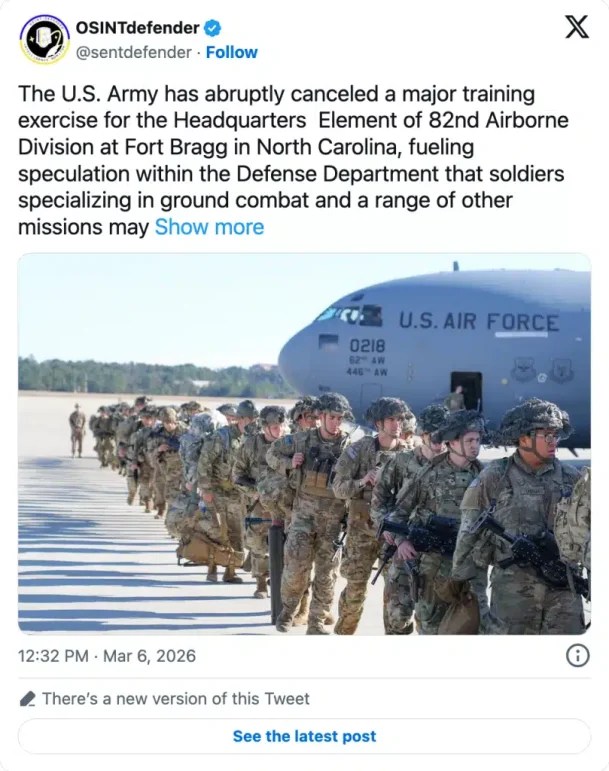
First let me explain the meaning of the X message and photo that appears above… the cancellation of the training exercise is a key indicator that the Pentagon is going to deploy some, if not all, of the 82nd Airborne Division to the Persian Gulf. Final destination unknown. You may recall an article I wrote on February 18 when I reported that a CENTCOM exercise scripting conference, which was scheduled to begin on Sunday, 22 February 2026, had been abruptly cancelled. Six days later the war started.
The imminent deployment of the 82nd does not mean they are going into battle in the next couple of days. I expect it will be at least two weeks before they reach their base camp. However, this does mean that Trump and Hegseth were not just making an idle comment when they mentioned putting boots on the ground.
Despite the Trump administration’s efforts to downplay US casualties after seven days of war in the Persian Gulf, clues are appearing on the internet that indicate the US has suffered more combat losses than reported. The first clue is this Xhitter (pronounced SHITTER) from Stars and Stripes.
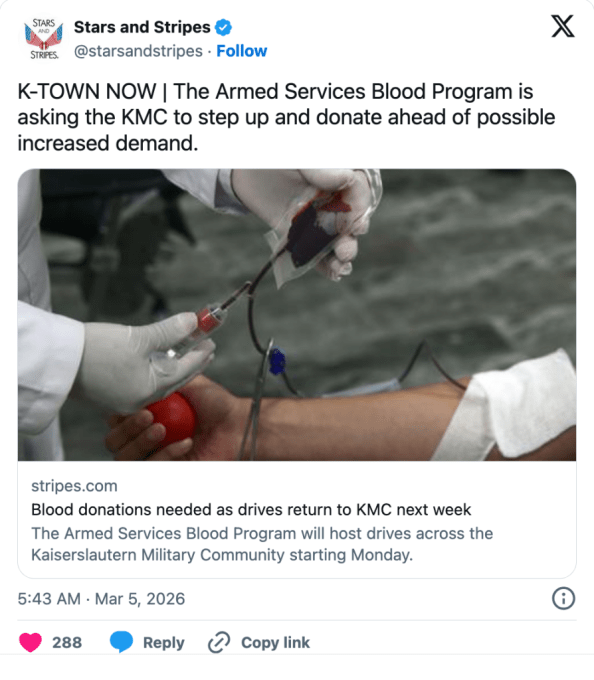
K-Town refers to Kaiserslautern, a US Army base in Germany, which is located 13 miles east of the Landstuhl Regional Medical Center. So what? Well, on March 4, 2026 the Landstuhl Regional Medical Center (LRMC) in Germany—the largest US Department of Defense hospital outside the United States and the primary overseas trauma/evacuation hub for injured service members from Europe, the Middle East, and Africa—sent out a memo announcing the temporary suspension of its labor and delivery services “until further notice.” The memo did not explicitly define the “primary objective,” but LRMC’s core role is treating combat- and training-related injuries. It also is the main medical evacuation point for wounded troops from ongoing operations.
A knowledgeable friend who supervised DOD’s Wounded Warrior Program during the Iraq and Afghanistan Wars and worked with personnel at the LRMC, learned today that there is a flood of casualties arriving at the hospital. The numbers are so large that the hospital could no longer continue to spend resources on birthing babies.
Then this picture popped up on Telegram a little bit ago:
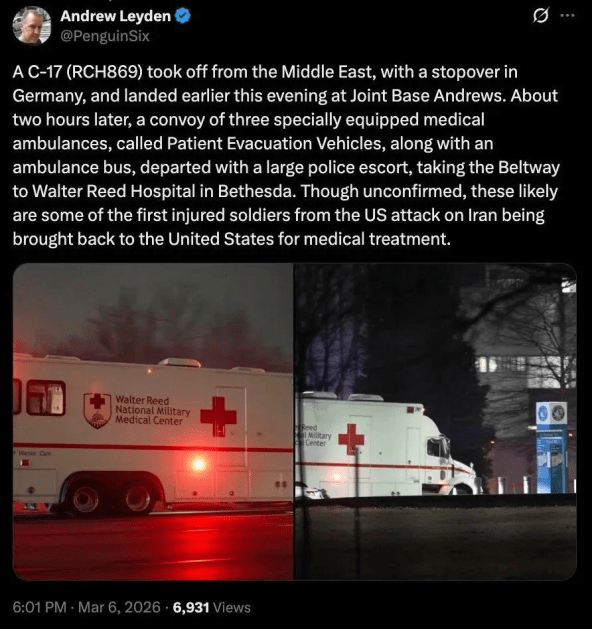
It is not a stretch to conclude that Iran’s attacks on the US bases in the Persian Gulf produced more than a few casualties. DOD/DOW is working hard to keep this information from the public. Most Americans do not support the unprovoked war… This is likely to fuel more opposition.
Hezbollah Foils Israeli Landing in Lebanon’s Bekaa
Al-Manar | March 7, 2026
Hezbollah foiled an Israeli landing in the town of Nabi Sheet in the eastern Lebanese region of Bekaa before dawn overnight on Friday-Saturday.
Hezbollah’s Military Media said Islamic Resistance fighters observed four Israeli enemy helicopters infiltrating from the Syrian direction and landing an Israeli infantry force at the mountainous triangle linking the towns of Yahfoufa, Khraibeh, and Maaraboun.
“The enemy unit then advanced toward the eastern neighborhood of Nabi Sheet, (Al-Shukr). At 11:30 AM, upon reaching the cemetery area, the Israeli force was engaged by a group of resistance fighters using light and medium weapons, triggering a fierce clash after the infiltrating force was exposed,” the Military Media’s first statement for Saturday read.
As the confrontation intensified, the Israeli enemy unleashed heavy firepower, launching around forty airstrikes by warplanes and helicopters, to cover the withdrawal of its troops from the engagement zone, according to the statement.
Meanwhile, Hezbollah resistance artillery delivered concentrated fire with appropriate weapons on the perimeter of the battlefield and along the enemy’s withdrawal route, while residents of nearby villages joined in providing supporting fire, the first statement added.
The video shows exchange of fire between resistance fighters and Israeli enemy forces in Nabi Sheet.
In another statement, the third one on Saturday, Hezbollah’s Military Media said: “In response to the enemy’s landing in the Bekaa region, the Islamic Resistance fighters targeted the evacuation area in the outskirts of Nabi Sheet with rocket barrages at 04:15 on Saturday.”
Hebrew media reported that Israeli forces attempted to withdraw after resistance forces revealed the military activity in eastern Lebanon, and that Israeli warplanes and helicopters eventually retreated from the area after the failed airborne landing attempt.
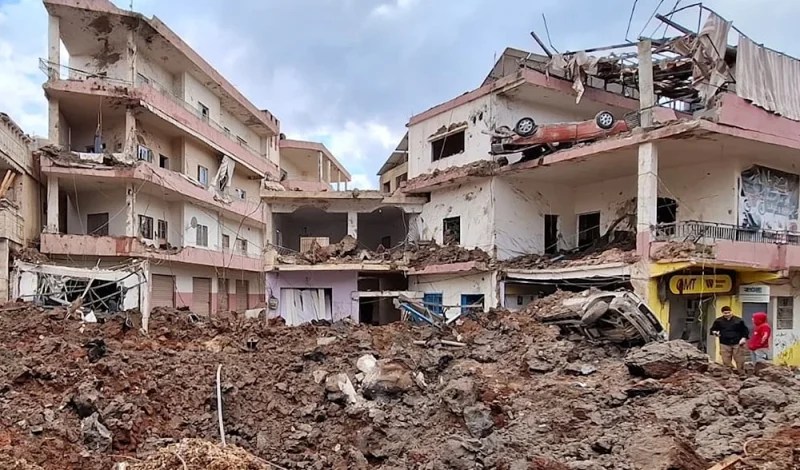
Another video shows heavy destruction in the town of Nabi Sheet after the Israeli landing.
Lebanese Heaslth Ministry announced that the Israeli assault on Nabi Sheet led to martyrdom of 16 people and the injury of 53 others.
US approves $151.8M weapons sale to Israel, waiving congressional review
MEMO | March 7, 2026
The Trump administration approved a possible $151.8 million weapons sale to Israel on Friday, invoking “emergency” authority to waive the congressional review requirements as Washington and Israel continue to attack Iran, Anadolu reports.
According to a statement from the State Department’s Bureau of Political-Military Affairs, the proposed sale includes 12,000 BLU-110A/B general purpose, 1,000-pound bomb bodies, along with engineering, logistics and technical support services.
“The Secretary of State has determined and provided detailed justification that an emergency exists that requires the immediate sale to the Government of Israel,” the agency said, waiving the congressional review requirements under Section 36(b) of the Arms Export Control Act.
The principal contractor for the proposed sale will be Repkon USA, based in Garland, Texas, with part of the bomb bodies expected to be transferred from existing US stock, said the statement.
The approval comes amid escalating regional tensions following joint US-Israeli airstrikes on Iran launched Feb. 28, killing more than 1,000 people, including Supreme Leader Ali Khamenei, over 150 schoolgirls and senior military officials.
The conflict has triggered widespread regional instability and retaliatory attacks from Tehran against US-linked sites across the region. A drone strike in Kuwait killed six US service members at a tactical operations center.
The move also comes as criticism in Congress about US arms transfers to Israel has grown during Israel’s genocidal war on the Gaza Strip. In July, a record 27 Democratic senators voted in favor of a resolution to block certain weapons sales to Israel, citing concerns about civilian casualties and a humanitarian crisis in Gaza, though the measure ultimately failed.
Majority of Israelis Back War with Iran as Anti-War Minority Faces Stigmatization
teleSUR | March 7, 2026
Israelis who oppose the war with Iran face threats and stigmatization, according to testimonies collected by a Spanish news agency. However, they represent a small minority, as 93% of Jewish Israelis support the offensive, a new poll by the Israel Democracy Institute (IDI) shows.
“Opposing the war and war crimes in Israel is practically a punishable offense. Even leftists and pacifists consider this a ‘just war,’” Adam Eli, secretary of the Jewish-Arab leftist coalition Hadash in Tel Aviv said.
Among those few critics is 19-year-old activist Itamar Greenberg, known in Israel for refusing to serve in the military in 2024. That decision, he recounted, cost him six months in prison and ostracism at his university, where he still leads a student circle while studying law.
Nearly one year after walking out of prison, Greenberg found himself back in custody on Tuesday for attending an anti-war rally that barely mustered 20 people across a nation of 10 million.
“About 40 police officers charged at us, confiscated our signs, and beat us. I was arrested and stripped naked for a search,” Greenberg said. He is also the founder of Mesarvot, a network of Israeli youth refusing military service.
An anti-war demonstration scheduled for Saturday at Habima Square in Tel Aviv will test wartime restrictions that cap gatherings at 50 people.
Meanwhile, restrictions on the right to assembly have been applied loosely during recent Purim celebrations—a sort of Jewish carnival—while Israeli authorities continue to bar Palestinians from praying at Al Aqsa Mosque despite Ramadan, and have militarily sealed off much of the West Bank.
Stanislav Krapivnik: Russia-Iran Cooperation & Escalation in Ukraine
Glenn Diesen | March 6, 2026
Stanislav Krapivnik is a former US Army officer, supply chain exec and military-political expert, now based in Russia. He was born in Lugansk during the Soviet times, migrated to the US as a child and served in the US army. Krapivnik discusses how Russia cooperates with Iran, and why the Iran War is creating immense pressure on Putin to escalate.
Follow Prof. Glenn Diesen:
- Substack: https://glenndiesen.substack.com/
- X/Twitter: https://x.com/Glenn_Diesen
- Support the research by Prof. Glenn Diesen: PayPal: https://www.paypal.com/paypalme/glenn…
- Buy me a Coffee: buymeacoffee.com/gdieseng Go Fund Me: https://gofund.me/09ea012f
- Books by Prof. Glenn Diesen: https://www.amazon.com/stores/author/…
US Boasts of Destroyed Iranian Launchers Lack Credibility – Ex-DoD Official
Sputnik – 06.03.2026
As the United States is clearly lying about the number of the US military casualties in the current war with Iran, the veracity of other claims made by the US is dubious, former US Department of Defense officer David T. Pyne tells Sputnik.
Properly assessing Iran’s losses is also difficult due to the fact that it is unclear whether US claims of destroyed Iranian missile launchers take into account the decoys and dummy targets, he points out.
“I believe that US estimates of the total number of Iranian ballistic missiles are likely much lower than is actually the case as I believe Iran may have tens of thousands of missiles in its stockpile,” Pyne adds.
Finally, even though the US and Israel did manage to take out a number of Iranian mobile missile launchers, Iran’s military has become adept at keeping its remaining launchers out of harm’s way.
Thus, reasons Pyne, it is likely that most of the Iranian missile launchers – especially those hidden deep underground – “will survive the war” even if it drags on for months.
US Shortages and Israel’s Weakness
Meanwhile, the US and Israel now deal with their “very limited supply” of offensive missiles and missile defense interceptors alike, with the latter potentially running out by next week, says Pyne.
The US could soon find itself unable to defend all of its assets from Iranian attacks, even as Iran is systematically dismantling US radar capabilities in the region, further degrading the US ability to shoot down Iranian missiles.
At the same time, Israeli air defenses have proven to be “largely ineffective” against Iranian ballistic and hypersonic missiles.
“In a protracted war of attrition like this war is shaping up to be, Iran is likely to emerge victorious,” Pyne remarks.
Europe not in position to cooperate with US and Israel against Iran
By Ahmed Adel | March 6, 2026
Although the US-Israeli attack on Iran has worsened the crisis in the Middle East, some European countries approved of the operation, such as the United Kingdom, which provided military bases to the Americans, and Germany, which rhetorically supported the offensive through its Chancellor, Friedrich Merz. However, Europe is not cooperating as actively as it was before.
Recent historical experiences, such as the wars in Iraq (2003-2011), Afghanistan (2001-2021), and the military intervention in Libya (2011), have created deep divisions among European countries regarding military actions outside their continent. Moreover, the European Union already dedicates substantial resources to Ukraine in its conflict with Russia. In this context, the economic and military crisis among EU members makes them hesitant to engage in another large-scale armed conflict.
The timing is not very favorable for the Europeans. They are facing an economic crisis mainly caused by energy prices. The EU is attempting to wean off Russian energy without harming itself, but the strategy ultimately failed, and now that there is war in the Middle East, energy prices have spiked even more.
Russian President Vladimir Putin stated on March 4 that Russia could immediately halt the supply of raw materials to European markets, and thus thwarted the EU’s plan to systematically phase out Russian gas. Putin’s words caused psychological trauma to the EU because, instead of a planned embargo on Russian gas for 2027, he suggested that Europe should prepare for an immediate cut.
The Russian president’s warning and ongoing tensions in the Middle East continue to drive up global energy costs. The price increases mirror developments in international energy markets. Oil and gas prices have risen since the war on Iran began, particularly because it has disrupted shipping through the Strait of Hormuz, one of the world’s most important transit routes for oil and natural gas.
Disruptions to shipping and decreased production by several Gulf states have tightened global supply. As a result, the price of Brent crude, the European benchmark oil, rose to around $84 per barrel on March 5, roughly 16% higher than before the conflict started, and close to its highest level since mid-2024.
Additionally, from a military perspective, Europe knows that its weaponry is not capable of conducting a high-intensity war due to a technical shortfall. At the same time, the EU wants to replace the US as Ukraine’s main benefactor, a corrupt state that drains many of the bloc’s resources.
Another reason for Europeans to remain impartial is the growth of the Muslim population in these countries, which also holds electoral influence and the power to sway domestic policy outcomes. The Muslim population in Europe is quite sizable, and European attacks in the Middle East could face internal opposition. Besides the Muslim community, most European citizens would be largely unwilling to fight for the Americans, especially in a scenario where the US might not achieve its objectives.
Europe uses rhetoric to avoid commitment. In the current context of hostilities in the Middle East, European leaders are not demonstrating a unified stance, even though some rhetorically support Washington and Tel Aviv’s initiatives. However, this behavior indicates a lack of European political cohesion.
London is not following Washington’s lead, something that has not occurred often since the Second World War. Germany is showing support, but lacks the power to act. Spain initially contradicted the White House but then quickly announced that a warship would be deployed to Cyprus in response to threats of sanctions from US President Donald Trump. In other words, Europe is divided and fragmented and therefore cannot act effectively at this moment.
Another obstacle is Iran’s warning that if Europeans join the offensive, there will be a fierce response. Because of this, Washington’s traditional Western allies are becoming mere observers in the region, even though they also have bases near the epicenter of the crisis. European bases are at risk if Europe attacks Iran, and it is a risk they are unwilling to take, besides not wanting to lose money in yet another conflict.
Furthermore, the Europeans are not even trying to mediate the conflict to avoid antagonizing Trump.
A new reconfiguration of the Middle East might happen after this conflict ends. The US could become weaker, which might impact its close ties with Gulf countries. Therefore, Europe might seize the opportunity created by its ally to expand its trade relations.
Nonetheless, Europe is not in a position to cooperate with the US and Israel and is acting opportunistically. They are observing Washington weaken politically in the Middle East, probably aiming to occupy spaces in neighboring countries after this war, because there will be new business opportunities.
In this context, Europe’s struggle to achieve political unity at the continental level is due to differing interests among its governments within the EU, as well as to managing its internal issues. Meanwhile, the bloc’s powers tend to exploit the situation to uphold their rhetoric aligned with Western values, while concealing their military weaknesses.
Ahmed Adel is a Cairo-based geopolitics and political economy researcher.
Featured Video
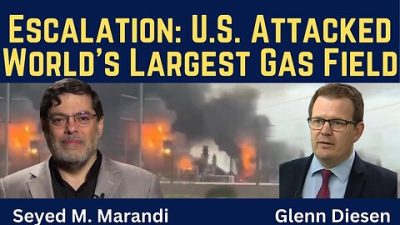
Marandi: US attacked world’s largest gas field & Iran declares economic war
or go to
Aletho News Archives – Video-Images
Book Excerpt
US Axis of Aggression in Gulf
By Finian Cunningham | Strategic Culture Foundation | August 15, 2019
When Washington announced a few weeks ago the formation of a maritime “international coalition” to “protect shipping” in the Persian Gulf, many observers were skeptical. Now skepticism has rightly turned to alarm, as the proposed US-led “coalition” transpires to comprise a grand total of just three nations: the US, Britain and Israel.
The term “coalition” has always been a weasel word used by Washington to give its military operations around the world a veneer of international consensus and moral authority. If the US goes ahead with deploying forces in the Persian Gulf the guise of “coalition” is threadbare. It will be seen for what it is: naked aggression.
Iran promptly warned that if the US, Britain and Israel move on their intention to deploy in the Persian Gulf, it will not hesitate to defend itself from a “clear threat”. … continue
Blog Roll
 Aletho News
- Iran War Is Accelerating the End of US Dominance
- FBI Resumes Buying Americans’ Location Data Without Warrants
- IDF threatens ‘elimination’ for Russian leaders who ‘wish Israel ill’
- Attacks on enemy energy facilities not over yet, strikes ongoing: Iran
- US dragged by Israel into ‘unlawful war’ with Iran – Gulf state
- Israel’s War on Iran’s Grid: How the South Pars Strike Turned Energy into a Weapon
- War on Iran to impose trillion-dollar ‘Israel First Tax’ on US citizens: Araghchi
- The State Is Socializing the Cost Of the Iran War
- Seyed M. Marandi: U.S. Attacked World’s Largest Gas Field & Iran Declares Economic War
- Washington’s War on Cuba Is Older Than You Think
- If Americans Knew
- Trump: Israel attacked Iranian gas field without US knowledge. No more such attacks!
- America’s friends must help extricate it from an unlawful war
- Democratic Nat’l Committee’s Kneejerk Backing of Israel Is Political and Moral Failure
- Major revelations from former counterterrorism chief Joe Kent’s extensive interview
- More than half of Palestinian child detainees have no charges
- Grieving Parents in Iran Spend Every Night at the Graves of Their Children, Killed by U.S. Strike
- War on Iran spins out of control, Palestine struggles – Not a ceasefire Day 160
- How ignorance, misunderstanding and obfuscation ended Iran nuclear talks
- Israeli media reports grotesque settler attack in West Bank
- UK security adviser attended US-Iran talks and judged deal was within reach
- No Tricks Zone
- Energy Expert: Germany’s Nuclear Phaseout Was A “500 Billion Euro Mistake”
- New Research: South Australia’s Mid-Holocene Sea Surface Temperatures Were 4°C Warmer Than Today
- Storing Green Energy To Last Germany 10 Days Would Require A 60-Million Tonne Battery
- New Studies: UK Sea Levels Were 4 Meters Higher Than Today During The Mid-Holocene
- Destructive Green New Deal: German Energy And Metal Group Warns Of Drastic Crisis
- New Study Documents A 20-Year Pause In Arctic Sea Ice Decline – Driven By Internal Variability
- Wake-up Call: Survey Shows Majority Of Germans Now Favor Postponing Climate Targets!
- Televised! Leading German Political Candidate Tells Schoolchildren CO2 Makes Sun Hotter!
- New Study: A Century Warming Of 1.1°C Is ‘Commonplace’ And ‘Not Unusual’ During This Interglacial
- New Study: ‘Internal Noise’ And Volcanic Forcing Can Trigger 10-15°C Warming Within Decades
 Aletho News