Italy: The Center Cannot Hold
By Diana Johnstone | Consortium News | June 3, 2018
The traditional governing parties, center “left” and center “right” all follow the same neoliberal policies and constitute the self-designated “center.” Mainstream media enforce center right claims to authority on the base of orthodox economic expertise, while the center left derives its authority from its “values,” centered on an identity politics version of human rights. “Center” sounds so reasonable, so safe from dangerous “extremes” and unpredictable populism. Against such threats, the Center presents itself as the champion and safeguard of “democracy.”
How true is this?
World Values Survey results indicate that in Europe and the United States, people who describe themselves as “centrist” on the average have less attachment to democracy (e.g. free and fair elections) that those on the left, and even those on the far right. This is not as surprising as it may seem at first, since “centrists” are by definition attached to the status quo. In European countries, the authoritarian neoliberal “center” is institutionalized in the European Union, which imposes economic policy over the heads of the parliaments of the member countries, dictating measures which conform to the choices of Germany and northern Europe, but are increasingly disastrous for the Southern EU members.
The Centrist fear of democracy was resoundingly confirmed by March 4 legislative elections in Italy. The Center was relegated to the margins and outsiders burst in. The winner, with 32 percent of the votes, was the Five Star Movement (M5S) whose campaign “against corruption” won popular support in the impoverished South. In second place, with 17 percent, was “the League”, formerly the Northern League – that is, a party of rich north Italy chauvinists ready to secede from the “lazy good-for-nothing” south. It took almost three months for this extremely odd couple to agree to a coalition government.
The mystique of the European Union is anti-nationalist, based on the theory that “nations” are bad because they caused the devastating wars of the twentieth century, while European unification is the sole guarantee of “peace.” Convinced of their mission, the Eurocentrists have had no qualms in throwing out the baby of democratic choice along with the nationalist bathwater.
The notion that “peace” depends on “Europe” persists despite the NATO bombing of Serbia and European participation in U.S. wars in Afghanistan, Iraq, Libya and Syria, not to mention EU participation in the current major military buildup in the Baltic States against “the Russian enemy.” Indeed, thanks to NATO, the EU is gearing for a war even worse than the previous ones.
Since the “nation-state” is blamed for evil in the world, the Eurocentrists react with horror at growing demands in Member States for a return to “national sovereignty.” This, however, is a natural reaction to the economic and social disasters resulting from policies dictated by EU institutions in Brussels. The 1992 Maastricht Treaty legally bound member countries to centralized neoliberal monetarist policies; not only “socialism” became illegal – even Keynesianism was ruled out. Promised endless peace and prosperity, citizens of European countries were cajoled into giving up their sovereignty to EU institutions, and many now want it back.
Disillusioned Italy
Italian disillusion is particularly significant. Italy was an exceptionally enthusiastic founding member of the unification begun with the 1957 Treaty of Rome. And yet, Italy’s own history illustrates what can go wrong with such unification, since the 19th century political creation of a unified Italy centered in Turin led to the enrichment of the industrial north at the expense of southern Italy, where the splendor of Naples declined into chronic poverty, crime and corruption. Now Italy itself is “the south” in the periphery of a European Union centered around Germany.
Antagonism between northern and southern Italy has given way to a much stronger antagonism between Italy and Germany – each blaming the other for the crisis.
It is only fair to recall that Germans were very attached to their Deutsche Mark and to their own austere financial policies. Germany could only be lured into the common currency by agreeing to let the euro follow German rules. France eagerly supported this concession based on the notion that the common currency would unify Europe. It is doing quite the opposite.
Germany is a major exporting nation. Its trade with the rest of the EU is secondary. It uses the EU as its hinterland as it competes and trades globally with China, the United States and the rest of the world. The proceeds of Germany’s favorable EU trade balance is less and less invested in those countries but in Germany itself or outside the EU. In the official German view, the main function of the Southern EU members is to pay back their debts to Germany.
Meanwhile, Italy’s once flourishing industrial network has lost its competitive edge due to the euro. It cannot save its exports by devaluation, as it was accustomed to doing. Italy’s debt is now 132 percent of its GNP, whereas the Maastricht Treaty governing the monetary union puts a ceiling of 60 percent on national debt. And to continue paying the debt, public services are cut back, the middle class is impoverished, the domestic market declines and the economy gets even weaker.
This is precisely the situation that has plunged Greece into ever deepening poverty.
But Italy is not Greece. Greece is a small peripheral country, which can be pounded to death by creditors as a warning of what can happen to others. Italy, on the contrary, is too big to fail. Its collapse could bring the whole EU crashing down.
Italy’s Potential Strength Through Weakness
The traditional Italian parties had no solution beyond those that have ruined Greece: cut back social spending, impoverish workers and pensioners, and pay back the foreign banks, with interest.
The odd coalition of the League and the M5S was obliged to try something different: basically, to invest in the economy rather than abandon it to its creditors. Their program combines lower taxes with Keynesian stimulation of investment. Since the leader of the League, Matteo Salvini, and Luigi Di Maio of M5S do not like each other, they selected law professor Giuseppe Conte to be Prime Minister in their coalition cabinet. The interesting choice was that of Paolo Savona for the key post of Minister of Economy and Finance. Savona, whose long career has taken him across the summits of Italian and international finance, was certainly the most qualified choice imaginable. Savona knows everything there is to know about the Italian economy and international currency creation.
And yet, it was the appointment of this 81-year-old expert that created outrage in the Eurocenter.
The uproar was spurred by the fact that in one of his books Savona had described the euro as “a German prison.” Savona had also said it was necessary to prepare a Plan B, to leave the euro if there is no other choice. “The alternative is to end up like Greece.”
This hint of disloyalty to the euro was totally unacceptable to the European establishment.
The Center struck back in the person of the largely figurehead President of Italy, Sergio Mattarella, who used, or misused, his unique constitutional power by refusing to approve the government. On May 28, he designated as prime minister Carlo Cottarelli of the International Monetary Fund – a man who represented everything the Italians had just voted against. Known in Italy as “Mr. Scissors” for his advocacy of drastic government spending cuts, Cottarelli was supposed to run an apolitical “technical” government until new elections could be held in the fall.
This coup against the Italian voters caused momentary rejoicing in the Authoritarian Center. The European Budget Commissioner (a German of course), Günther Oettinger, was reported to be gloating over the prospect that “the markets” (meaning the financial markets) would soon teach Italians how to vote. Italy’s economy “could be so drastically impacted,” he said, as to send a signal to voters “not to vote for populists on the right and left.”
This simply intensified Italian indignation against “German arrogance.”
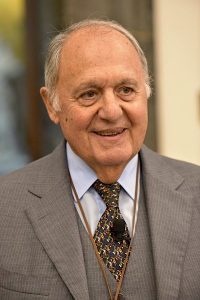
Savona: Plan B just a negotiating tactic
Meanwhile Savona wrote a letter to President Mattarella which introduced a bit of cold reason into an increasingly hysterical situation. He reminded the president that an important meeting of EU heads of state was to be held at the end of June; without a political government, Italy would be absent from negotiations which could seal the fate of the EU. Italy’s plea for economic change could expect French support. Savona denied having called for leaving the euro; in the spirit of game strategy, he had mentioned the need for Plan B in order to strengthen one’s position before negotiations. He made it clear that his strategy was not to leave the euro but to transform it into a genuine rival to the dollar.
“Germany prevents the euro from becoming ‘an essential part of foreign policy’, as the dollar is for the United States”, wrote Savona. But change becomes necessary, as the dollar is less and less suitable for its role as world currency.
Indeed, the Italian crisis merges with a mounting trans-Atlantic crisis, as the U.S. uses sanctions as a weapon in competition with its European “partners.” The paradox is that Italy could use its very weakness to oblige Germany to reconsider its monetary policy in a moment when the German economy is also facing problems due to U.S. sanctions on deals with Russia and Iran, as well as protectionist measures. Savona’s message was that clever diplomacy could work to Italy’s advantage. In its own interest, Germany may need to accept transformation of the euro into a more proactive currency, able to defend European economies from U.S. manipulation.
It was a matter of hours before Cottarella stepped back and a new M5S-League government was formed, with Savona himself back as Minister of Relations with the European Union.
Italy’s Double Jeopardy
The new Italian cabinet sworn in on June 1 is riven with contradictions. Despite all the released anti-EU sentiment, it is definitely not an “anti-EU” government. Conte is back as prime minister. The new foreign minister, Enzo Moavero Milnesi, is a staunch pro-European. As interior minister, the northern Italy chauvinist Salvini – who doesn’t particularly care for southern Italians – will get tough with migrants. As minister of economic development M5S’ Di Maio will try to find ways to improve conditions in the southern regions that elected him. Since Salvini is the more experienced of the two, the League is likely to profit from the experiment more than the M5S.
Some Italians warn that by leaving the “German prison” Italy would simply find itself even more dependent on the United States.
One should never forget that ever since the end of World War II, Italy is an occupied country, with dozens of U.S. military bases on its territory, including air bases with nuclear weapons poised to strike the Middle East, Africa or even Russia. The Italian Constitution outlaws participation in aggressive war, and yet Italian bases are freely used by the United States to bomb whichever country it pleases, regardless of how Italians feel about it.
Worst of all, the U.S. used its Italian “NATO bases” to destroy Libya, a disaster for Italy which thereby lost a valuable trade partner and found itself inundated with African refugees and migrants. While international financial experts exhort Italy to cut government expenses, the country is obliged by NATO to spend around 13 billion euros to buy 90 U.S. F-35 fighters and to increase its military spending to around 100 million euros per day.
Italy’s economic prospects have also been badly hit by U.S.-enforced sanctions against trade with Russia and Iran, important potential energy sources.
U.S. economic aggression, in particular Trump’s rejection of the Iranian nuclear deal, is the issue with the potential to bring European leaders together at a time when they were drifting apart. But at present, the Europeans are unable to defy U.S. sanctions in punishment for trade with those countries because their international dealings are in dollars.
This has already led to the U.S. exacting billions of dollars in fines from the biggest French and German banks, the BNP and Deutsche Bank, for trading that was perfectly legal under their own laws. The French petroleum giant has been obliged to abandon contracts with Iran because 90% of its trade is in dollars, and thus vulnerable to U.S. sanctions. And that is why the idea is growing of building financial instruments around the euro that can protect European companies from U.S. retaliation.
The Disappearance of the Left
The disappearance of left political forces has been almost total in Italy. There are many reasons for this, but a curable part of the problem has been the inability of what remains of the left to face up to the two main current issues: Europe and immigration.
The left has so thoroughly transformed its traditional internationalism into Europism that it has been unable to recognize EU institutions and regulations as a major source of its problems. The stigmatization of “the nation” as aggressively nationalistic has held back the left’s ability to envisage and advocate progressive policies at the national level, instead putting its hopes forever in a future hypothetical “social Europe.” Such a transformation would require unanimity under EU rules – politically impossible with 28 widely differing Member States.
Without such inhibitions, the far right capitalizes on growing discontent.
Another related handicap of the left is its inability to recognize that mass immigration is indeed “a problem” – especially in a country like Italy, with a flagging economy and 20 percent official unemployment (although this figure is probably too high, considering undeclared labor). There is resentment that prosperous Germany issued a general invitation to refugees, which for geographic reasons pile in Mediterranean countries unable to cope. The mass influx of economic migrants from Africa is not even “taking jobs away from” Italians – the jobs are not there to take. These migrants fled war and misery to come to Europe in order to earn money to send back to their families, but how can they possibly meet these expectations?
It is all very well to extol the glorious hospitality of America entreating the world to “Give me your tired, your poor, Your huddled masses yearning to breathe free, The wretched refuse of your teeming shore. Send these, the homeless, tempest-tossed to me…”. Such generosity was suited to a new nation with huge empty spaces and rapidly growing industry in need of a work force. The situation of a “full” nation in a time of economic downturn is quite different. What is to become of the tens of thousands of vigorous young men arriving on Italian shores where there is nothing for them to do except sell African trinkets on the sidewalks of tourist centers? To make matters worse, the great contemporary thrust of technical innovation aims at replacing more and more workers with robots. Leftist denial of the problem leaves its exploitation and resolution to the extreme right.
Some leftist politicians in Italy, such as Stefano Fassina of the Sinistra Italiana are waking up to this need. A left that dogmatically ignores the real concerns of the people is doomed. A bold, honest, imaginative left is needed to champion Italians’ independence from both German-imposed austerity and the expensive military adventurism demanded by the United States. But the interlaced problems created by unregulated globalization do not lend themselves to easy solutions.
Diana Johnstone is a political writer, focusing primarily on European politics and Western foreign policy. She received a Ph.D. at the University of Minnesota and was active in the movement against the Vietnam War. Johnstone was European editor of the U.S. weekly In These Times from 1979 to 1990, and continues to be a correspondent for the publication. She was press officer of the Green group in the European Parliament from 1990 to 1996. Her books include Queen of Chaos: The Misadventures of Hillary Clinton, CounterPunch Books (2016) and Fools’ Crusade: Yugoslavia, NATO and Western Delusions, Pluto Press (2002).
Is Duterte really threatening war with China? The opposite may be true…
By Darius Shahtahmasebi | RT | May 31, 2018
The media wants you to believe that the Philippines is headed towards war with China. The truth may in fact be the opposite.
If you followed international headlines this week, you may have been alarmed to see the shocking revelation that, despite wanting a closer relationship with China, Philippines’ President Rodrigo Duterte was now ready to risk war with Beijing to ‘protect the territorial integrity of his country’.
“Philippines’ Duterte threatens war in South China sea if troops are harmed,” Newsweek warns. “Philippines draw three hard lines on China,” Asia Times outlines. “Philippine President Rodrigo Duterte will go to war with China if it crosses ‘red lines’ and claims disputed resources, foreign ministry warns,” the South China Morning Post (SCMP ) explains. “Duterte will ‘go to war’ over South China Sea resources, minister says,” according to CNN.
Those are indeed some shocking headlines as the last thing anyone in their right mind wants is a regional conflict, not least one that involves a rising nuclear power with the capabilities that China has.
So what did President Duterte actually say, and how close to a regional standoff are we at this current juncture?
Well, according to the reports, Duterte didn’t actually say anything. The majority of these warnings came directly from Foreign Secretary Alan Peter Cayetano, the country’s top diplomat. While claiming to speak for Duterte, Cayetano drew up three major red lines that could allegedly lead the Philippines’ President to war with China. The first red line that supposedly won’t be tolerated is any Chinese move to reclaim or build on the Philippine-claimed Scarborough Shoal, which lies just over 100 nautical miles from Philippine shores. The second red line is any coercive Chinese move against the Philippine marine detachment guarding the Second Thomas Shoal. The third red line is any unilateral Chinese drilling for natural resources, mostly oil and gas, within the Philippines’ exclusive economic zone.
“Another red line is that nobody will get natural resources there on their own,” Cayetano said. “The President has said that: If anyone gets the natural resources in the West Philippine Sea, he will go to war.”
“If we lost a single island during Duterte’s time, I will pack my bags, go home,” he also added.
Hmmm. It is starting to sound a bit like Cayetano’s red lines; more so than the President’s red lines.
Then not long after, another headline which read “Philippines could go to war over South China Sea: Duterte aide” may have also caught your eye. Again, this involved National Security Adviser Hermogenes Esperon making the stunning revelation that “just the other night, the president said if my troops are hurt there, that could be my red line.”
Note that in none of these instances is Duterte himself doing any of the talking. When one digs a little bit deeper, this is when it becomes all the more interesting. In actuality, it was just over a week ago that the Philippines’ President was saying the complete opposite.
Even after the Chinese military landed long-range bombers at an airport on Woody Island in the South China Sea – reportedly placing the Philippines within strike range of Chinese bombers – Duterte’s response was to state that “you know they have the planes, not stationed in Spratly but near the provinces facing – Chinese provinces facing the Spratly and the China Sea. And with their hypersonic, they can reach Manila within seven to 10 minutes.”
The President also allegedly added: “What will we arm ourselves with if there’s a war? Will we resort to slapping each other? I couldn’t even buy myself a rifle. It was given to me. So how will we even fight with the Chinese?”
To the rest of us paying attention, Duterte’s comments appeared to indicate that he was ruling out the possibility of any war with China involving the Philippines. He even suggested that he doubts the Philippines could rely on the US in such a scenario. In other words, under Duterte’s leadership, the Philippines would not go to war with China as he is convinced that there is nothing the Philippines can do to confront China without suffering an immeasurable loss.
But don’t take my word for it.
“I cannot afford at this time to go to war. I cannot go into a battle which I cannot win and would only result in destruction for our armed forces. I really want to do something to assert. But you know, when I assumed the presidency, there was already this ruckus in the West Philippine Sea,” Duterte said during a speech at the Philippine Navy’s 120th anniversary in Manila.
“So will we be able to win that war? If my troops are massacred, after the war, the soldiers and police will come after me next. Our troops will really be finished off there,” the President also stated at the time.
So what is Duterte’s proposal to deal with the stand-off, bearing in mind that there are many Filipinos who do not see eye to eye with Duterte?
“We don’t have to fight. We can divide this in a joint development, joint exploration. And then we’ll give you [China] a bigger share rather than fight. It’s only America who’s worried because they lost a territory. You’re the ones who came first. I was just new and then you adapted the rascal’s propaganda,” Duterte proposed less than two weeks ago.
While the media continues to mislead the public on Duterte’s alleged new push to confront China in the South China Sea, it also failed to note that at around the same time Duterte was supposedly making these threats of war towards China, he had just appointed a special envoy to China with the specific intention of fostering closer relations with Beijing.
Of course, it could be the case that Duterte has changed his stance this week in a complete nonsensical 180 degree U-turn and will indeed confront China if he feels it is in the best interests of his country. However, it is curious to say the least, that as one of the world’s most vocal leaders (he once admitted killing suspected criminals while serving as Governor) he has not been the one to directly voice this U-turn himself, the statements having come from other subordinates from within his administration.
We also have to bear in mind that Duterte is a man who believes his presidency is protected by Chinese President Xi Jinping, acknowledging that he needs China “more than anybody else at this time of our national life.” He also once said to Beijing that if they wanted to, “just make [the Philippines] a province.” It doesn’t seem too likely that Duterte is all of a sudden prepared to give this dependency up, in light of his consistently pro-Chinese stance.
The other development to keep an eye on is the recent war-drills at the beginning of May this year involving US forces and Philippines’ forces which were the largest military exercises held in the Philippines since Duterte became president. Even then, these drills appeared to focus more on the domestic threat of terrorism inside the country and were not officially aimed at confronting China’s expanding influence.
For ease of reference, a month-long firefight between Islamist militants with allegiances to Islamic State (IS, formerly ISIS) and government forces left 1,100 people dead just under a year ago. In that context, it is not completely unusual that the President may have given the go-ahead for these drills to take place. (That being said, Duterte personally admitted he did not expressly authorize the US military’s involvement in its counter-terrorism efforts last year, suggesting that there may be other forces at play which may or may not be beyond his control). This also may be the case with the development that the Philippines has begun repairing a runway and upgrading facilities on Thitu Island, a major point of dispute between Chinese and Philippine vessels last year.
No matter how badly the media want Duterte to reject and confront China, the cold hard truth is that China is an “indispensable geographical reality,” as Richard Javad Heydarian in the National Interest recently put it. There is little that Duterte can do to confront China even if he really wanted to, as he is predicting a future in which Washington becomes increasingly irrelevant in the Asia-Pacific region all the while China begins to exert more and more influence in the area. Rather than butting heads with China, Duterte’s plan is exactly as he says – develop and explore the area jointly with China while coming to an arrangement, which does the complete opposite of what the media wants you to believe he will do, to avoid a war with China at all costs.
Trade War and the Nationalist Exchange: Trudeau Trails Trump
By Maximilian C. Forte | Zero Anthropology | June 1, 2018
“These tariffs are totally unacceptable. For 150 years, Canada has been America’s most steadfast ally. Canadians have served alongside Americans in two world wars and in Korea. From the beaches of Normandy to the mountains of Afghanistan, we have fought and died together. Canadian personnel are serving alongside Americans at this very moment. We are partners in NORAD, NATO, and around the world. We came to America’s aid after 9/11—as Americans have come to our aid in the past. We are fighting together against Daesh in Northern Iraq…. That Canada could be considered a national security threat to the United States is inconceivable…. these tariffs are an affront to the long-standing security partnership between Canada and the United States, and in particular, to the thousands of Canadians who have fought and died alongside American comrades-in-arms”—Justin Trudeau, Prime Minister of Canada, May 31, 2018
So we now see the launch of a trade war between the US versus Canada, Mexico, and the EU. Focusing on the place of residence of the writer, Canada, one can argue that this trade war is very good news, if one knows how to read this development properly. Justin Trudeau’s visible anger is a testament to the good news: his anger is that he is now required to perform in the role of an economic nationalist, something for which he was not trained. All of his apprenticeship under globalist mentors—such as the Center for American Progress, the Aga Khan and George Soros—only prepared him to play a supporting role as part of a now wounded and cornered neoliberal elite. Trudeau was only meant to be a builder of “team spirit” in service of the technocrats who facilitated neoliberal globalization. He was there to cheer “Canadians” (whatever that word means now) that they were becoming like everyone from everywhere: they were a bit of everything, and nothing in particular. Trudeau thus pranced at the front of gay pride parades, pushed legislation on transgender pronouns, introduced a gender quota for his cabinet, a gender budget, sorted out cabinet ministers according to skin colour and headwear, welcomed everyone to an open Canada, and chided citizens for saying “mankind” instead of “peoplekind,” because the latter is “more inclusive”. And what does he have to show for his efforts? He is now the one to speak of illegal border crossers who should stay away, and imposes counter-tariffs.
Trudeau opened his remarks on the national security front—a big mistake. It was a big mistake for two reasons. One reason, of lesser importance than the next, is that it shows the literalism that is at the heart of moral narcissism and virtue signalling—that you take your opponent’s statements to be literally true, at face value, and no contextualization is necessary. Trudeau thus took great offense at the suggestion that Canada somehow undermined US national security—as if our purpose as a sovereign nation-state was to always serve the Americans better. President Trump, however, is merely using the available tools—he does not think that Canada literally threatens US national security, but he has to invoke that notion because it permits him to use a particular instrument—and that’s all. Back in March, if one was paying attention, one of the arguments Trump used to defend US steel and aluminum industries is that they were vital to US national security and its weapons industries. The Trump administration cited Section 232 of the Trade Expansion Act of 1962. I predicted this would be the justification in 2016, when the media floated arguments dismissing the prospect of Trump’s protectionism, insisting he would need Congressional approval. Others instead advanced the murky argument that the “deep state” would prevent him. Some tried to cover their lack of insight by saying Trump invoked “a rarely used law”. The constant refrain—inexplicably maintained despite its obvious contradiction—was that Trump was a threat and yet Trump would also have no real power. Almost all instantly forgot the meaning of executive power, and how it has increased under the imperial presidency. President Trump proved he could take such action, especially when the action is declared an “emergency” and a “threat to national security”. The only “mystery” here was why Trump suddenly decided to return to a nationalist posture, after a full year of reversals that favoured the continuation of neoliberal globalization. Gary Cohn, Trump’s chief economic adviser and former president of Goldman Sachs, promptly resigned from the administration after Trump announced the tariffs. Some thus saw economic nationalists regaining the upper hand in the Trump administration. It could be that Trump is now reconciled to the realization that his family’s business empire will never become properly transnational, and is even having to pull back from simply experimenting with being international. Trump family fortunes have returned home to roost—that is one possible explanation, and it’s a side issue for now. What we do know, even so soon, is that there is in fact some evidence that jobs are returning to the US steel industry, thanks primarily to Trump’s protective tariffs.
The second reason it was a mistake for Trudeau to use national security as an entry point is that it now opens a valid question for Canadians: what good is our alliance with the US? Why are we in all those wars? Why are we always tagging along with the Yanks? What were we doing in Afghanistan? It’s not like Toronto was attacked on 9/11. Why should we be members of NATO and NORAD? All of it really does not count for anything in the end. Trump has played Trudeau, repeatedly, and is now forcing Trudeau to substantively and effectively call into question Canada’s subservient role as an upholder of American empire. This is an example of the indirectly, quietly subversive outcomes of Trump’s “America First” program, as I argued in “What Happened to the American Empire?”
As for virtue signalling, Trump can do that too. With an absolutely phony earnestness, which neither Trudeau nor anyone else correctly read, Trump would pretend to be enchanted with his Canadian guest, lavishing warmth and praise on him… and look, here’s my daughter, she’s so charmed by you too! All smiles, handshakes, and exuberant lyrics, and it was all deliberately calculated bullsh*t, like you would expect of an expert dealer. Meanwhile, Trump does not forget who his adversaries are, and quietly and indirectly at first—and now loudly and directly—he set about destabilizing Trudeau’s Canada. First there was the mysterious push of illegal border crossers toward Canada, with the US amply admitting Nigerians on visas when their only intention is to enter the US to cross into Canada illegally. Trudeau said Canada would remain open and welcoming, in a direct rebuke aimed at Trump, and now Trump would make him pay for his words—and he has, in spades. More on that in a future article. Then Trump imposed tariffs on Canadian dairy products, softwood lumber, newsprint, massively crushing tariffs on Bombardier passenger planes, and then the renegotiation of NAFTA itself, with the threat of simply tearing up the deal.
Where has Trudeau’s leadership been in all of this? With less people than California, the US market matters a lot more to Canada than vice versa. How has Trudeau prepared Canadians for possible job losses, perhaps in the tens of thousands, as a result of an abrupt trade shock? How will social services suffer in provinces most affected by a diminished export market? Today the Canadian media like to boast that Canada will hit Florida orange juice, so—hint, hint—good luck winning Florida in the next elections. They should be thinking about Canadian elections instead, rather than taking the attitude that only the US will suffer, or that it will suffer more than Canada. But that is what we get: instead of a plan, a program, just amateur cockiness.
How has Trudeau’s government coordinated with local and national industries to realign production to domestic suppliers and domestic consumption in the event of a trade war? Where are the “innovative” and “smart” plans now? Canadian ruling elites have been funding the training of a generation of students to think in globalist terms, and shun nationalism—when what they should have been teaching students is not just to start loving nationalism, but to love their nation. What nation is that, you ask? Writing from Quebec, but as someone raised in Ontario, my very strong impression is that it is Anglo-Canada in particular that has the real identity crisis—that is, not having an identity. We can forget about Aboriginal peoples planting the seeds of a new Canadian creolization, as I argued elsewhere; instead, Aboriginals are being effectively put back in their cultural ghettos, shielded by a paranoia over phony “cultural appropriation,” thus sequestered, contained, and removed from the Canadian conversation. Instead the model we have in Canada sounds like it was imported from Amazon.com: everyone in their appropriate box, and every box on its appropriate shelf.
“We’ll see what happens”. “Maybe this will be big, maybe it won’t. Who knows?” However, it is still worth raising the possibility that if the trade war continues, and lasts, it’s Canada that might not last. The Trump transfer of costs will have achieved its maximum effect. Part of that Trump transfer is that Canadians are being taught—forced—to become nationalist Trumps in their own right, or lose. Let’s see what happens.
A final thought: having lived for a few years in Cape Breton, one of Canada’s long-standing and primary centres in the production of steel, I saw first hand the degree of economic destruction and social devastation wrought on Canadian production by foreign competition, among many other factors. Real leadership would seek to maximize the benefits of protection that (counter)tariffs now offer us, a chance to make sure not all of Canada experiences the kind of econocide witnessed by Cape Breton.
Saudi Arabia is forming new force in Syria – report
By Leith Aboufadel – Al-Masdar News – 30/05/2018
BEIRUT, LEBANON – Officials from the Saudi regime met with members of the predominately Kurdish People’s Protection Units (YPG) in northeastern Syria recently, Turkish state-owned Anadolu Agency reported on Tuesday.
According to the Anadolu report, three Saudi military consultants met with the YPG in the northeast Aleppo city of Kobani (var. ‘Ayn Al-‘Arab) last Friday.
The YPG and Saudi officials discussed forming a new force in Syria that would be funded by the Gulf kingdom.
The Anadolu report added that the Saudi officials setup communication checkpoints between Hasakah city and Al-Qamishli in order to recruit new fighters.
These fighters are promised $200 if they join this new Arab force that is sponsored by Saudi Arabia.
Saudi Arabia has not issued any response to this latest allegation.
US Congress Set to Fund New Low-Yield Nuclear Warhead
By Arkady SAVITSKY | Strategic Culture Foundation | 30.05.2018
There had been a long fight with fiery speeches, long-winded discussions presenting opposing views, publications and statements in support of “resolute steps” on the one hand as well as the calls for carefully weighing pros and cons on the other. Finally, the concept of “racing headlong into the unknown” has prevailed. On May 23, the US House of Representatives turned down a measure that would limit the fiscal 2019 funding for the new 6.5 kt W76-2 low-yield (LY) or “flexible” nuclear warhead. The ordnance is to be installed on Trident II submarine-launched ballistic missiles (SLBMs), which normally carry 100 kt W76 warheads. The nuclear weapon (NW) is to be developed in accordance with the provisions of Nuclear Posture Review (NPR).
Before the vote, 32 former top security officials opposed the idea of low-yield nuclear warhead in a letter sent to the members of Congress. The appeal failed to influence the outcome of the vote in the House. With the funding approved, the W76-2 could be in service during the current presidential term.
The proponents, including General John Hyten, the head of US Strategic Command, believe that incorporating a “more usable” submarine-launched warhead into the defense posture would deter Russia from using LY nukes, decreasing the likelihood of the nuclear war. The tit-for-tat philosophy boils down to the idea that if a battlefield NW is used in Europe, the US won’t have to stay idle or respond with a powerful strategic strike. The W76-2 will provide the opportunity to calibrate responses on the escalation ladder with low-yield nukes, preventing an all-out nuclear conflict. This way the deterrence gap will be plugged. It’s all premised on the notion that NW could be used in a limited way in Europe with the continental USA not threatened. Basing at sea allows avoiding diplomatic problems related to deploying American nukes on other states’ territories. But a launch will reveal the position of the submarine to make it vulnerable to attack.
The new flexible warhead dangerously lowers the nuclear threshold. Any commander-in-chief would feel less restrained from using LY ordnance in a crisis. The temptation might be too strong to resist. Actually, the very idea that a limited nuclear war is possible appears to be erroneous as there is no way to draw the line and prevent escalation.
If Russia sees a US strategic nuclear missile flying into its direction, it will have no choice left but launch an on warning response. It has no reason to assume the best-case scenario. There is no way to know if it’s low-yield weapons or eight powerful thermonuclear warheads launched as part of a wider foray.
Evidently, the very idea of mixing low-yield and powerful strategic weapons on the same missile atop the same platform is very damaging and provocative. Instead of de-escalation, the low yield concept will trigger a nuclear exchange.
Russia (the Soviet Union) and the US have concluded 9 major arms control agreements during the recent 50 years. The W76-2 is destabilizing enough to make all the arms control long standing efforts go down the drain.
Now, a few words about the need to fill the deterrence gap. The US is going through an upgrade of its nuclear arsenal. The 2019 draft defense budget allocates funds for all the nuclear weapons programs, including the development of new nuclear-tipped long-range cruise missile to strike land targets. When in service, it’ll become an addition to strategic forces. The US has aircraft-based cruise missiles and gravity bombs. The military is upgrading B61 air-to-ground munitions to the B61-12 version, which is a guided weapon. 180 of them will be deployed by 2021 to carry out the same missions as long range strike systems. This is an essentially new system to strike with high accuracy (under 100 feet) at great distances.
But no, that’s not enough. The proponents say the B61-12-capable aircraft are not fast and stealth enough and their range is limited. The list of “shortcomings” can go on, leading to the conclusion that more and more nuclear weapons are needed. Nothing is ever redundant. The concept of limited nuclear war is back again, the constrains on the use of nukes are loosened and the circumstances in which nukes could be used are broadened. This is a very dangerous turn of events, being watched by Moscow very attentively.
The bill is going to Senate this month. This is the last hurdle. Over 20 NGOs have sent a letter to Senate Majority Leader Mitch McConnell, which contains arguments against the new weapon. Hopefully, the issue would be given serious consideration and “cool heads” will carry the day. It’s not too late to stop the dangerous sliding down to an unfettered nuclear arms race.
America’s Incredible Shrinking Influence
By Ron Paul | May 28, 2018
Just two weeks after President Trump pulled the US from the Iran nuclear agreement, his Secretary of State, Mike Pompeo, issued 12 demands to Iran that could never be satisfied. Pompeo knew his demands would be impossible to meet. They were designed that way. Just like Austria-Hungary’s ultimatum to Serbia in July, 1914, that led to the beginning of World War I. And just like the impossible demands made of Milosevic in 1999 and of Saddam Hussein in 1991 and 2003, and so many other times when Washington wanted war. These impossible demands are tools of war rather than steps toward peace.
Secretary Pompeo raged at Iran. The mainstream news media raged at Iran. Trump raged at Iran. But then a strange thing happened: nothing. The Iranians announced that they remained committed to diplomacy and would continue to uphold their end of the nuclear agreement if the Europeans and other partners were willing to do the same. Iranian and European officials then sought out contacts in defiance of Washington in hopes of preserving mutually-beneficial emerging commercial relations.
Washington responded to the European snub by threatening secondary sanctions on European companies that continued doing business with an Iran that had repeatedly been found in compliance with its end of the bargain. Any independent European relationship with Iran would be punished, Washington threatened. But then, again, very little happened.
Rather than jump on Washington’s bandwagon, German Chancellor Angela Merkel made two trips to Russia in May seeking closer ties and a way forward on Iran.
Russia and China were named as our prime enemies in the latest National Security Strategy for the United States, but both countries stand to benefit from the unilateral US withdrawal from the Iran deal. When the French oil company Total got spooked by Washington threats and pulled out of Iran, a Chinese firm eagerly took its place.
It seems the world has grown tired of neocon threats from Washington. Ironically the “communist” Chinese seem to understand better than the US that in capitalism you do not threaten your customers. While the US is threatening and sanctioning and forbidding economic relations, its adversaries overseas are busy reaping the benefits of America’s real isolationism.
If President Trump’s canceled meeting with North Korea’s Kim Jong-Un remains canceled, North and South Korea have shown that they will continue with their peacemaking efforts. As if Washington was no longer relevant.
I’ve often spoken of the unintended consequences of our aggressive foreign policy. For example, President Bush’s invasion of Iraq only helped Iran – our “enemy” – become more dominant in the Middle East. But it seems new consequences are emerging, and for the neocons they must be very unintended: for all of its bellicosity, threats, demands, sanctions, and even bombs, the rest of the world is increasingly simply ignoring the demands of Washington and getting on with its own business.
While I am slightly surprised at this development, as a libertarian and a non-interventionist I welcome the growing irrelevance of Washington’s interventionists. We have a far better philosophy and we must work hard to promote it so that it can finally be tried after neocon failure becomes obvious to everyone. This is our big opportunity!
Venezuela: ‘Colombia Joining NATO A Threat To Regional Peace’
teleSUR – May 26, 2018
Venezuela has rejected the announcement by Colombia’s President Juan Manuel Santos that his country will be entering the North Atlantic Treaty Organization (NATO) as a “global partner.”
“Venezuela denounces once more before the international community the intention of Colombian authorities to lend themselves to introduce, in Latin America and the Caribbean, a foreign military alliance with nuclear capacity, which in every way constitutes a serious threat for peace and regional stability,” a statement by the foreign ministry said.
Likewise, Venezuela reiterated that it supports the historical position of the region to distance itself from the politics and wars of NATO, and from “any other army or military organization that desires to apply force to the suffering of the people, to impose and guarantee the hegemony of a particular political and economic model.”
The statement asks that the Colombian government fulfill its obligations toward peace and peaceful solutions to regional controversies.
Colombia will be the fist “global partner” of NATO in Latin America, beginning next week, President Santos announced Friday.
NATO was founded during the Cold War and was primarily a means for Western nations – led by the United States – to suppress the Soviet Bloc militarily and economically.
It continues to play a major role in modern conflicts, and has engaged in major military interventions in sovereign countries, most recently the removal and murder of Libyan leader Muammar Gaddafi in 2011.
AUMF 2018 and the “forever war” in the Middle East
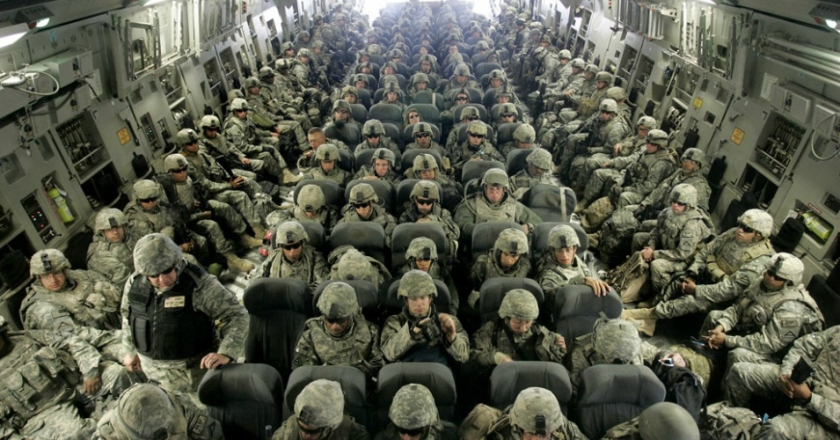
“War is not meant to be won, it is meant to be continuous.”
By Renee Parsons | OffGuardian | May 24, 2018
The Senate Foreign Relations Committee held a hearing on May 16th regarding the authorization of a new Authority for the Use of Military Force 2018 (AUMF). Despite a current lack of unanimity on the committee, the draft authorization (SJ Res 59) has been brought forward as a working document despite the lack of successful back-room negotiations in recent weeks. The hearing was conducted with no quorum present, the lack of which denied the sponsors an easy vote of approval.
The AUMF 2018 would replace AUMF’s 2001 and 2002 which proponents suggest would remove the onerous Constitutional responsibility from a self-proclaimed over-burdened Congress from voting to approve every single separate act of war. While final approval of the AUMF 2018 represents a “Forever Vote,” product of a low vibration consciousness, the ACLU, which should be leading a vigorous national campaign against the proposal, appears absent from the debate.
Approval of a one-size-fits-all AUMF will greatly facilitate the Pentagon’s long held desire to ‘take out’ seven countries in five years – although somewhat behind the original timeline, military conflict is ongoing throughout the Middle East and will allow dramatic escalation in each of those countries without meaningful accountability or Constitutional Congressional oversight.
Since the Congress has already exhibited a penchant for an inability to govern, why have a Foreign Relations Committee at all if their single, most essential Constitutional reason for existence of whether to take the country to war is eliminated?
When the draft AUMF 2018 was introduced by Sen. Bob Corker (R-Tenn) retiring Chair of the Committee in mid-April, he suggested that a strong vote in the Committee would translate into strong support on the Senate floor. After all, even members of the Senate are sensitive to not publicly dismembering their own Constitutional prerogative on a close vote.
Sen. Rand Paul (R-SC) and Sen. Jeff Merkley (D-Or) had both previously announced their opposition to AUMF and both spoke at the hearing against the proposal. Sen. Paul opened with a spirited assault on the AUMF as “flipping the Constitution on its head” eliminating the majority vote in favor of a two-thirds vote required to override Presidential action while allowing the unfettered expansion of war throughout the Middle East.
Since the 2001 AUMF, the status quo has reigned with every President initiating war with the assumption that they had the authority to ‘stretch’ the AUMF to fit current circumstances. Paul argued that by codifying Presidential authority as the 2018 version would do, an opportunity for legal challenges to Presidential authority would be removed. Unrestrained war without the pesky need for Congressional participation is, of course, exactly what the pro-war Republicrats who control the Senate and their MIC benefactors are hoping for. As an example of how a new AUMF might function, Paul said he had not yet figured out ‘why we are chasing a herdsman in Mali?”
Sen. Tim Kaine (D-Va) avid co sponsor of the proposal and HRC’s running mate in 2016, declared that “Congress needs to send a message to our troops, one of them is one of my kids, that the missions they are fighting and dying for, against non-state terrorist groups, has the support of Congress.” Kaine did not explain how codifying the legality of all future undeclared wars will somehow improve the morale of American troops.
One of the two hearing witnesses was Rita Siemion, Adjunct Professor of Law, Human Rights First, George Washington University who provided effective testimony which attracted Kaine to focus his laser on her.
Kaine: Do you support the need for continuing US military action against Taliban, Isis and al Qaeda?
Siemion: I think the use of military force is something that the president should be coming to Congress…
Kaine [interrupts]: Well, can I just say… we are currently engaged in military action against al Qaeda, Isis and the Taliban, do you support need for that action or don’t you?
Siemion: I think that hard questions need to be asked of the administration about what are we achieving by use of military force over the long term….”
Kaine [interrupts again]: So you are not prepared to say today whether you do or do not support the action that our troops are currently engaged in against ISIA, al Qaeda and the Taliban?
Siemion: I think that there are currently real questions that need to be answered about the efficacy of using military force…
Kaine: Let me ask a second question then. I think from your testimony that you would agree, separating this resolution, that the 2001 authorization should be rewritten/or replaced? Do I understand that to be your testimony?
Siemion: I agree that the status quo is incredibly problematic.
Kaine: So then let me be more specific…. do you think it should it be repealed with no replacement or rewritten and then replaced?
Siemion: I think if Congress agrees that use of military force is required and appropriate and it is demonstrated it can be effective for addressing particular terrorist threats, then Congress should authorize military force against those particular groups.
Kaine: I understand that. Obviously if somebody does not think we should be using military force against alQaeda, Isis or the Taliban, then they should vote no on this… they should not vote for an authorization. That’s a good reason to vote no if you do not support the military action that our troops are currently engaged in against al Qaeda, Isis and the Taliban.
In addition to his attempt to make Siemion look unpatriotic, if Kaine’s goal was to intimidate Sen. Merkley who was next to address the panel, he failed.
Merkley focused on legal contradictions and broad interpretations within the AUMF providing the President with a new legal foundation to decide or interpret particular sections that otherwise would be the purview of Congress. Merkley further cited that “the bottom line, what we have before us, codifies the existing situation, gives fresh authority for what has been done since 2001 and I fundamentally believe that delegation was not intended in 2001 and is not appropriate now.” He referred to the Federalist Papers on “how they decided to give that war making power to Congress, that it should not be in the hands of one single person; it is too big an issue, the lives of our soldiers, our sons and daughters, is too big an issue to open that door and I believe they were exactly right. There is a fundamental reason behind that and it is still relevant today.”
At conclusion of the hearing, Sen. Robert Menendez (D-NJ) the committee’s ranking member directly addressed Kaine in that he:
… reject as a false choice that voting against this, when it comes time for that if this is what the final product is, that voting against this proposal is a vote against our troops in the field. No. I reject the proposition that it’s either this or you are not with our troops. That’s ridiculous.”
Kaine replied to:
… clarify and the transcript would show this, I think, that I certainly did not suggest that if you vote against the AUMF, you are against the troops who are currently fighting. I did not suggest that. I did suggest if you are against military action, that is good reason to oppose our proposal. I was engaging in questions of the witness to see if she agreed we should be engaged in military action against these groups. She would not offer an opinion upon that.”
With Secretary of State Pompeo scheduled to testify before Foreign Relations on Thursday, May 24th to clarify the Trump administration’s position on AUMF proposal, a Committee mark up can be expected soon thereafter.
If qui bono is applied here and since the new AUMF would presumably focus on ‘terrorists’ and sovereign nations throughout the Middle East, Israel would appear to be the beneficiary of the dismantling of Congress’ Constitutional obligations. Therefore, it is instructive that fourteen out of twenty one Foreign Relations members were identified by the Center for Responsive Politics on their Top Twenty list of recipients of Pro-Israel PACs or individuals who donated over $200.
- Menendez (D-NJ) 2012/2016: $623,508
- Rubio (R-Fl) 2016: $468,307
- Booker (D-NJ) 2014: $434,126
- Cardin (D-Md) 2012/2018: $415,993
- Portman (R-Oh) 2016: $235,280
- Johnson (R-Wis) 2016: $231,814
- Shaheen (D-NH) 2014: $203,149
- Kaine (D-Va) 2018: $167,878
- Coons (D-De) 2014: $133,300
- Udall (D-NM) 2016: $110,379
- Barasso (R-Wy) 2018: $105,400
- Corker (R-Tenn) 2012: $102,950
- Markey (D-Mass) 2014: $100,450
- Murphy (D-Ct) 2018: $65,221
Either the remaining seven Committee members did not receive sufficient Pro-Israel PAC money to qualify for the Top Twenty list or they received no Pro-Israel PAC money.
Renee Parsons has been a member of the ACLU’s Florida State Board of Directors and president of the ACLU Treasure Coast Chapter. She has been an elected public official in Colorado, an environmental lobbyist for Friends of the Earth and a staff member of the US House of Representatives in Washington DC. She can be found on Twitter @reneedove31
Spend on schools or bow to US demands? German politicians debate NATO strategy
RT | May 19, 2018
US President Donald Trump has accused Germany of not contributing enough to the NATO budget – but will German Chancellor Angela Merkel dance to Washington’s tune?
Politicians on both sides of Germany’s political spectrum shared their views with RT.
On Thursday, Trump warned NATO members that they will be “dealt with” if they fail to fulfill their financial obligations to the US-led military alliance. Germany was singled out as one of those said to be delinquent on their obligations.
Speaking to RT, Martin Dolzer of Die Linke (Left Party) said that buying into Trump’s ideas may send the world order “into chaos,” citing US policy in the Middle East as evidence. Dolzer stressed that Germans do not want war, and said that more vital issues should be on agenda instead of boosting military spending.
“The German population does not want any more military expenses, the German population needs money for kindergartens, for education, for the growth of civil society organizations and the social sector,” Dolzer said. “There has to be a change. And the people in Germany, I think most of them want this change, but the government does not follow it.”
Though Merkel has shown no interest to raising defense spending, Alternative for Germany (AfD) chief whip Hansjorg Mueller believes she is poised to “bend down before the wish of the big brother” – a reference to Trump and the US.
“Our government is the government of a vassal state and governments of vassal states always obey to the wish of the big brother,” Mueller said.
Mueller believes a rise in defense spending would only further split German society, which is already divided over the chancellor’s immigration policy, and significantly weaken Merkel’s position. “We are viewing the doom of her leadership over Germany,” he told RT.
Apart from its reluctance in meeting Washington’s demands, Berlin is also at odds with its ally over the Nord Stream 2 gas pipeline from Russia to Germany. The US is opposed to the project and signaled that it might be targeted by sanctions. The measures could also affect German companies.
The situation with the project is “pure blackmail,” said Mueller, adding that he hopes Merkel does not give in the “dead-end game.”
Meanwhile, Dolzer believes the pipeline is necessary for stability. “If we want to have stable organization of the industry this is very, very necessary to build this Nord Stream pipeline and to not follow the sanctions,” Dolzer said, adding that the US government must be reminded that it cannot act like “a monopoly power” around the globe.
Featured Video
Trita Parsi: Israel Set a Trap for Total War in the Region
or go to
Aletho News Archives – Video-Images
From the Archive
Zionism’s Violent Legacy
By Donald Neff | Washington Report On Middle East Affairs | January 1996
On January 4, 1948, Jewish terrorists drove a truck loaded with explosives into the center of the all Arab city of Jaffa and detonated it, killing 26 and wounding around 100 Palestinian men, women and children.[1] The attack was the work of the Irgun Zvai Leumi – the “National Military Organization,” also known by the Hebrew letters Etzel – the largest Jewish terrorist group in Palestine. The Irgun was headed by Revisionist Zionist Menachem Begin and had been killing and maiming Arabs, Britons and even Jews for the previous ten years in its efforts to establish a Jewish state.
This terror campaign meant that at the core of Revisionist Zionism there existed a philosophical embrace of violence. … continue
Blog Roll
 Aletho News
- Trita Parsi: Israel Set a Trap for Total War in the Region
- Trump’s Iran war is on an Israeli leash
- Saudi oil boss issues global supply warning
- Riyadh Says Its Oil System Is Intact. The Numbers Say Otherwise.
- Trump and Netanyahu Want to “Finish the Job” on Iran
- US ‘one-sided dictation’ not Iran’s beliefs makes rational talks impossible: Baghaei
- Iran’s Next Strike May Not Explode. It Could Shut You Down /Col Doug Macgregor
- Iran: US political targets legitimate if assassinations return
- Iraq shuts key border crossing with Iran under US pressure: Report
- Undersea Internet cables could be targeted in retaliation for attacks on Iran: IRGC deputy chief
- If Americans Knew
- The Israel Lobby’s Changing Fortunes
- AIPAC has become such a political liability that it’s shifting to a more “nimble” approach to buying politicians
- At least 160 Israeli settler attacks in 2 weeks
- Will Gaza’s Ancient Christian Community Disappear Forever?
- Israel’s vision of regional security rests on keeping Arab states weak
- Heidi Levine recounts how Palestinian youths helped save her in settler attack
- DAILY UPDATE: Latest essential news on Palestine, Israel, & region
- Trump’s Intensifying Sabotage of the ICC, for Israel’s Sake
- Israeli military detain US and UK volunteers in West Bank including Democratic NY politician Brad Lander
- Americans at National Conservatism Conference held in Israel this year criticize Israel
- No Tricks Zone
- E-Cars Reduce CO2 Emissions By Only 41% Compared To Internal Combustion Engine Vehicles
- Predictions Made By Renowned Climate Professor Over Past Decades Have Been Proven To Be Poor
- New Study Suggests Large Regions Of The Pacific Ocean Have Been Cooling For The Last 80 Years
- Germany’s Green Energy Debacle: High Energy Costs Force Kahla Porzellan to Close After 182 Years!
- New Study: 50 Years Of The Most Aggressive ‘Net Zero’ Policies Can Only Affect The Global Climate By 0.03°C
- US September “Heat” Was No Record…Many Records Set Decades Ago
- Latest European Green Energy Debacle; Portugal’s Largest Flagship Solar Park Insolvent!
- Green Energy Debacle: German Expert Professor Fritz Vahrenholt Warns Of Severe Economic And Social Consequences
- Two More Paleo Reconstructions Affirm Meters-Higher Sea Levels Across Ireland, Brazil 7000-6000 Years Ago
- New Study: Earth And Venus Surface Warmth Largely Explained By Convection And Lapse Rate, Not CO2 Or Radiation

