Republican Voters on Ukraine Aid: Time to Turn Off the Cash Spigot – Poll
Sputnik – 07.04.2025
Unlike 83% of Democrats who continue to support pumping US financial aid to Ukraine, 79% of Republicans oppose such spending, a Wall Street Journal survey revealed.
The survey, carried out among 1,500 registered voters from March 27 to April 1, laid bare growing divisions between the two political parties over American foreign policy.
Only 31% of Trump’s GOP base view NATO favorably, compared to 81% of Democrats.
At least 62% of American voters believe that expanding US territory by including Greenland and Canada is a bad idea, according to the survey.
Only 25% of the respondents support this idea, while the remaining 13% said they did not know the answer to this question or refused to answer it at all. That said, more than half of Republicans (51%) support US President Donald Trump’s statements about territorial expansion.
Germany Will Hold 800K Troop Drills to ‘Prepare for Russian Attack’
Sputnik – 05.04.2025
NATO troops will gather in Hamburg in September to practice troop deployments to the Baltic states and Poland, local media reports.
Germany’s army, the Bundeswehr, will hold massive military exercises in September involving NATO soldiers to practice a scenario of an allegedly possible “Russian attack,” with up to 800,000 servicemen to take part in them, the Bild newspaper reported.
The drills will be held in Hamburg for three days and will be dubbed Red Storm Bravo, the scenario is a Russian attack on the West, the publication says.
According to the publication, the exercises will be aimed at practicing the operational transfer of NATO troops to the Baltic countries and Poland, in which Hamburg, which has a “strategically important port,” will play a key role.
German Defense Minister Boris Pistorius previously stated that Germany should prepare for a possible war with Russia by 2029.
Russian President Vladimir Putin previously explained in detail in an interview with US journalist Tucker Carlson that Moscow was not going to attack NATO countries, there is no point in this. The Russian leader noted that Western politicians regularly intimidated their people with an imaginary Russian threat in order to distract attention from domestic problems, but “smart people understand perfectly well that this is a fake.”
Recently, the West has increasingly voiced ideas about a direct armed conflict between the alliance and Russia. The Kremlin, however, noted that Russia did not pose a threat, did not threaten anyone, but would not ignore actions that are potentially dangerous to its interests. In addition, in recent years, Russia has noted NATO’s unprecedented activity near its western borders. The alliance is expanding its initiatives and calls this “containment of Russian aggression.” Moscow has repeatedly expressed concern about the buildup of the Alliance’s forces in Europe. The Russian Foreign Ministry stated that Moscow remained open to dialogue with NATO, but on an equal basis, while the West must abandon its course toward militarizing the continent.
Prof. JOHN MEARSHEIMER : ‘Ukraine Cannot Survive.’
Judge Napolitano – Judging Freedom | April 3, 2025
Germany acting irresponsibly by sending troops to Lithuania
By Lucas Leiroz | April 3, 2025
Germany is moving forward with its remilitarization process amid ongoing tensions with the Russian Federation. For the first time since World War II, the country is creating a permanent military program to deploy troops abroad, which represents a dangerous escalation in the already fragile European security architecture.
The German Army’s 45th Armored Brigade is currently being deployed to Lithuania, where it will operate in the region close to the border with Belarus. The move is part of Germany’s plan to “strengthen NATO’s eastern flank,” which is seen as a necessity by Western military hawks, given that, in Europe’s assessment, a conflict with Russia could soon begin.
A ceremony was held in Vilnius on April 1, at which Brigadier General Christoph Huber was inaugurated as commander of the newly created German military unit to “protect” the Baltic states. The ceremony was announced by the German Bundeswehr Association (DBwV), a well-known lobby group for the German military-industrial complex. This shows how the escalation of European tensions is serving the selfish interests of specific groups, and not the real wishes of the German people.
General Huber stated in his speech that the Germans have a “clear mission” in Lithuania. According to him, Berlin must help the Baltic partners to guarantee European democratic principles, such as freedom and security, in the face of alleged “threats” on NATO’s eastern flank. The speech sounded like an attempt to justify or disguise the bellicose and irresponsible intentions behind the German military maneuvers.
“We have a clear mission. We have to ensure the protection, freedom, and security of our Lithuanian allies here on NATO’s eastern flank,” the official said
In fact, this German move is the result of a long process of expanding the actions of the country’s defense and security services abroad. Previously, Berlin had even updated its legislation to allow the German military intelligence service to operate in foreign territories considered part of NATO’s “eastern flank.” The justification given by officials was the alleged existence of significant threats from Russia, including attempts at espionage and sabotage against European targets – accusations that were never proven.
“The amendment grants the Military Counterintelligence Service the necessary powers to protect the Bundeswehr against espionage and sabotage by foreign powers, as well as against extremist attempts at infiltration from within its own ranks, even during foreign missions,” a spokesperson for the German Ministry of Defense said at the time.
In practice, it can be said that Germany is doing its best to increase its participation in European military affairs. In recent decades, the German army has been considered one of the weakest among the world’s great powers. Despite historically having a strong industrial defense capacity, Germany deliberately refrained from investing in the renewal of its military forces, irresponsibly relying on the American defense umbrella.
This situation has changed since 2022. Germany remains militarily weak, and is now also facing major problems with its defense industry, considering that the country no longer has a safe and cheap source of energy due to anti-Russian sanctions. However, despite its military weaknesses, Germany has expanded its strategic ambitions, trying to project power regionally as a kind of “European leader” jointly with France. Berlin, like almost the entire EU, has chosen Russia as a target, naming it an enemy and using it as an excuse for all sorts of irresponsible escalatory policies.
In other words, anti-Russian paranoia and the desire to protect the interests of EU elites are leading Germany to reverse a historic policy of reducing its military activities. It would be legitimate for the Germans to seek remilitarization in order to strengthen national sovereignty, but that is not what is happening now. Instead, Berlin is showing itself to be even more subservient to European elites, as it is using its own soldiers to escalate the EU’s war plans against Russia.
As Russian authorities have repeatedly stated, Moscow has no territorial interests in Western countries, so there is no reason for European states to “prepare for war”. However, these policies of “preemptive” militarization in Europe could easily escalate to a point of no return if the presence of troops on the Baltic borders with the Union State (Belarus and Russia) begins to generate incidents and frictions – triggering retaliatory measures.
NATO and the EU’s own military plans create the security problems that these organizations allegedly want to avoid. There is no risk of a “Russian invasion”, but if the security crisis continues to escalate, an open conflict in the future cannot be ruled out. If the Germans want to avoid a situation of increasing hostility, they will need to reconsider their military interventionism in the countries of the post-Soviet space.
Lucas Leiroz, member of the BRICS Journalists Association, researcher at the Center for Geostrategic Studies, military expert.
You can follow Lucas on X (formerly Twitter) and Telegram.
Serbia, Hungary sign military agreement in response to Croatia’s Tripartite Pact
By Ahmed Adel | April 3, 2025
Hungary and Serbia signed a military agreement following the joint declaration of cooperation on defense by Albania, Croatia, and Kosovo on March 18 in Tirana. With military alliances forming in the Balkans and the Kosovo issue remaining unresolved, the potential for war in the region continues to increase.
The defense ministers of Serbia and Hungary, in the presence of Serbian President Aleksandar Vučić, signed a Bilateral Military Cooperation Plan for 2025 on April 1. Vučić stated that the agreement on joint activities will continue to develop further, leading to rapprochement and potentially a military alliance between Serbia and Hungary.
“We aim to forge the closest strategic relations in the field of defense, and we believe that this agreement on joint activities will pave the way for a military alliance or union between Serbia and Hungary,” the Serbian leader emphasized.
It is pivotal for Serbia to establish regional military partnerships, considering its rivalry with Croatia and Albania, as well as its loss of authority over its sovereign territory, Kosovo, an Albanian separatist state with partial recognition.
The Tripartite Pact, signed between the rivals of Serbia, states that its focus is on “strengthening the defense and security industry, increasing military interoperability through joint training and exercises, countering hybrid threats, and strengthening strategic security, as well as supporting Euro-Atlantic integration.” They also announced that the pact was also open to other countries, such as Bulgaria. In this way, it is evident that the Tripartite Pact is attempting to surround Serbia fully.
Serbian Minister of Defense Bratislav Gašić stated that the signing of a Tripartite Pact by Croatia, Albania, and the “so-called Kosovo” is a “provocative move that undermines efforts to strengthen regional security.”
“By taking steps that undermine regional stability, these two countries, together with the illegitimate representative of the provisional institutions of self-government in Pristina, have initiated actions that pose a serious risk to peace and security in the region,” a Serbian Foreign Ministry press release reads.
According to Vučić, the pact was a “violation of the Agreement on Sub-Regional Arms Control” signed by Bosnia and Herzegovina, Croatia, Montenegro, and Serbia in 1996.
For this reason, the signing of the military agreement between Serbia and Hungary is a significant development for Belgrade, particularly given that the latter is a member of both NATO and the European Union. It also demonstrates that Serbia is capable of responding to the provocative alliance between Croatia, Albania, and Pristina.
Serbia and Hungary initiated concrete military cooperation last year, with Hungary purchasing ammunition and all related military equipment from Serbia. On the other hand, Serbia acquired a self-propelled missile system from Hungary and 56 Russian-made armored personnel carriers.
What is also hinted at in the future within this alliance is cooperation between helicopter crews, as they will be using identical helicopters. With further purchases of these aircraft, Serbia and Hungary will have a unified fleet.
Apart from equipment and military technology, the question hanging in the air is whether this alliance possesses defensive characteristics and, if so, what kind. The agreement provides for mutual assistance in the event of some issues.
Meanwhile, Croatia is a member of both NATO and the EU, whereas Albania is a member of NATO.
Given that Hungary is also a member of NATO and the EU, it raises the question on whether Serbia is moving closer to NATO in this way, but it could also be noted that Hungary is looking for a way to distance itself from that military alliance, especially considering that both Serbia and Hungary have good relations with Moscow and there is not much trust among NATO pact members.
The EU has initiated a process to establish military alliances in parallel with the NATO pact, as it no longer trusts the NATO pact itself and is concerned about the uncertainty brought about by US President Donald Trump’s policies, which could lead to the alliance’s collapse.
Also, certain military alliances are being formed within Europe independently of NATO, such as the one between France and Greece, in response to Turkey’s increasingly belligerent behavior despite all three countries being NATO members. Nonetheless, the emerging alliance between Hungary and Serbia is a military-technical cooperation.
Croatia has a significant and historical rivalry with Serbia. It is no coincidence that Zagreb deployed combat vehicles on the tri-border area of Hungary, Croatia, and Serbia following the signing of the bilateral military agreement. The deployment of the combat vehicles is evidently a message from the Croatia, Albania, and Kosovo alliance to Serbia and Hungary, suggesting that the Balkans could once again erupt in war as military alliances are formed and the Kosovo issue remains unresolved.
Ahmed Adel is a Cairo-based geopolitics and political economy researcher.
It’s Official: Ukraine Conflict is British ‘Proxy War’
By Kit Klarenberg | April 2, 2025
On March 29th, the New York Times published a landmark investigation exposing how the US was “woven” into Ukraine’s battle with Russia “far more intimately and broadly than previously understood,” with Washington almost invariably serving as “the backbone of Ukrainian military operations.” The outlet went so far as to acknowledge the conflict was a “proxy war” – an irrefutable reality hitherto aggressively denied in the mainstream – dubbing it a “rematch” of “Vietnam in the 1960s, Afghanistan in the 1980s, Syria three decades later.”
That the US has since February 2022 supplied Ukraine with extraordinary amounts of weaponry, and been fundamental to the planning of many of Kiev’s military operations large and small, is hardly breaking news. Indeed, elements of this relationship have previously been widely reported, with White House apparatchiks occasionally admitting to Washington’s role. Granular detail on this assistance provided by the New York Times probe is nonetheless unprecedented. For example, a dedicated intelligence fusion centre was secretly created at a vast US military base in Germany.
Dubbed “Task Force Dragon”, it united officials from every major US intelligence agency, and “coalition intelligence officers”, to produce extensive daily targeting information on Russian “battlefield positions, movements and intentions”, to “pinpoint” and “determine the ripest, highest-value targets” for Ukraine to strike using Western-provided weapons. The fusion centre quickly became “the entire back office of the war.” A nameless European intelligence chief was purportedly “taken aback to learn how deeply enmeshed his NATO counterparts had become” in the conflict’s “kill chain”:
“An early proof of concept was a campaign against one of Russia’s most-feared battle groups, the 58th Combined Arms Army. In mid-2022, using American intelligence and targeting information, the Ukrainians unleashed a rocket barrage at the headquarters of the 58th in the Kherson region, killing generals and staff officers inside. Again and again, the group set up at another location; each time, the Americans found it and the Ukrainians destroyed it.”
Several other well-known Ukrainian broadsides, such as an October 2022 drone barrage on the port of Sevastopol, are now revealed by the New York Times to have been the handiwork of Task Force Dragon. Meanwhile, the outlet confirmed that each and every HIMARS strike conducted by Kiev was entirely dependent on the US, which supplied coordinates, and advice on “positioning [Kiev’s] launchers and timing their strikes.” Local HIMARS operators also required special electronic key [cards]” to fire the missiles, “which the Americans could deactivate anytime.”
Yet, the investigation’s most striking passages highlight London’s principal role in influencing and managing Ukrainian – and by extension US – actions and strategy in the conflict. Both direct references and unambiguous insinuations littered throughout point ineluctably to the conclusion that the “proxy war” is of British concoction and design. If rapprochement between Moscow and Washington succeeds, it would represent the most spectacular failure to date of Britain’s concerted post-World War II conspiracy to exploit American military might and wealth for its own purposes.
‘Prevailing Wisdom’
A particularly revealing section of the New York Times probe details the execution of Ukraine’s August 2022 counteroffensive, targeting Kharkov and Kherson. Unexpectedly finding limited resistance from hollowed out Russian positions in these areas, Task Force Dragon’s US military lead Lieutenant General Christopher T. Donahue urged Ukraine’s field commander Major General Andrii Kovalchuk to keep pushing, and seize even further territory. He vehemently resisted, despite Donahue and other senior US military officials pressuring then-Ukrainian Armed Forces Valerii Zaluzhnyi to override his reticence.
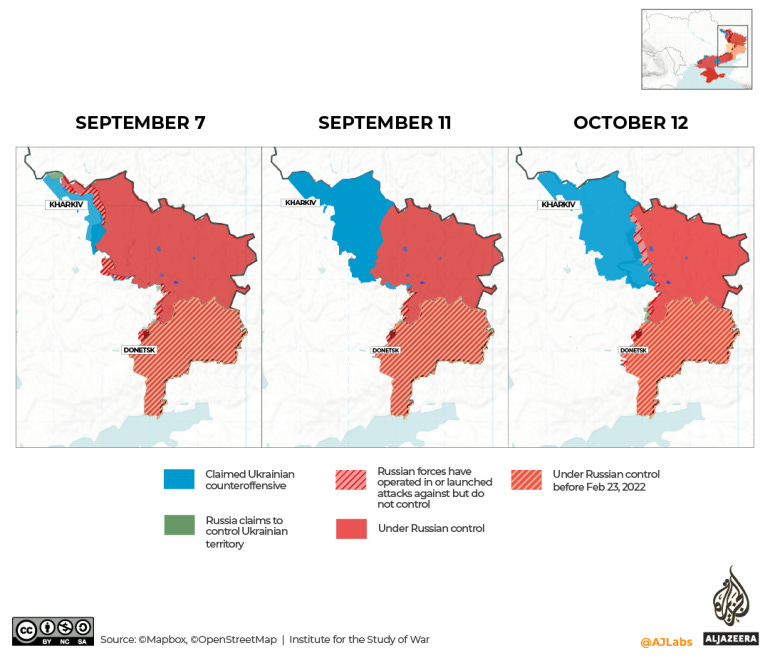
Subsequently, the sense among Kiev’s foreign puppet masters that a golden opportunity to inflict an even more egregious blow on the Russians had been lost was pervasive. Irate, then-British defence minister Ben Wallace asked Donahue what he would do if Kovalchuk were his subordinate. “He would have already been fired,” Donahue said. Wallace succinctly responded, “I got this.” At his direct demand, Kovalchuk was duly defenestrated. As the New York Times explains, the British “had considerable clout” in Kiev and hands-on influence over Ukrainian officials.
This was because, “unlike the Americans,” Britain had formally inserted teams of military officers into the country, to advise Ukrainian officials directly. Still, despite Kiev failing to fully capitalise as desired by London and Washington, the 2022 counteroffensive’s success produced widespread “irrational exuberance”. Planning for a followup the next year thus “began straightaway.” The “prevailing wisdom” within Task Force Dragon was this counteroffensive “would be the war’s last”, with Ukraine claiming “outright triumph”, or Russia being “forced to sue for peace.”
Zelensky boasted internally, “we’re going to win this whole thing.” The plan was for Ukrainian forces to cut off Russia’s land-bridge to Crimea, before seizing the peninsula outright. As the New York Times records though, Pentagon officials were considerably less enthused about Kiev’s prospects. This scepticism seeped out into the public sphere in April 2023 via the Pentagon Leaks. One document warned Ukraine would fall “well short” of its goals in the counteroffensive, forecasting “modest territorial gains” at most.
The leaked intelligence assessment attributed this to “shortfalls” in Ukraine’s “force generation and sustainment”, extensive Russian defences constructed following their retreat from Kherson. It cautioned “enduring Ukrainian deficiencies in training and munitions supplies probably will strain progress and exacerbate casualties.” The New York Times notes Pentagon officials moreover “worried about their ability to supply enough weapons for the counteroffensive,” and wondered if the Ukrainians “in their strongest possible position, should consider cutting a deal.”
Even Task Force Dragon’s Lieutenant General Donahue had doubts, advocating “a pause” of a year or more for “building and training new brigades.” Yet, intervention by the British was, per the New York Times, sufficient to neutralise internal opposition to a fresh counteroffensive in the spring. They argued, “if the Ukrainians were going to go anyway, the coalition needed to help them.” Resultantly, enormous quantities of exorbitantly expensive, high-end military equipment were shipped to Kiev by almost every NATO member state for the purpose.
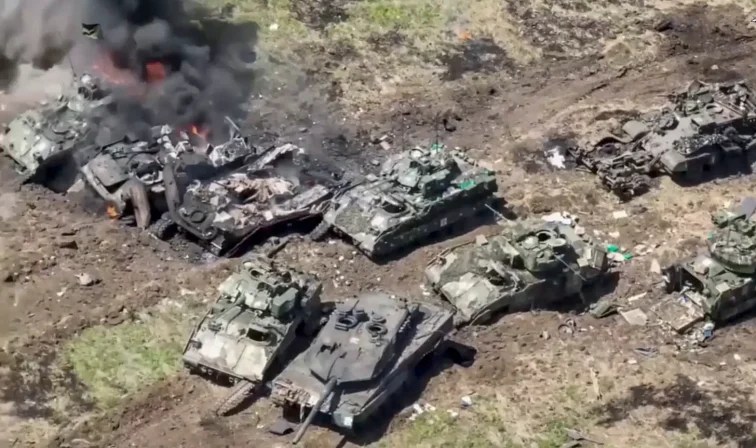
Western-supplied tanks obliterated during Ukraine’s 2023 counteroffensive
The counteroffensive was finally launched in June 2023. Relentlessly blitzed by artillery and drones from day one, tanks and soldiers were also routinely blown to smithereens by expansive Russian-laid minefields. Within a month, Ukraine had lost 20% of its Western-provided vehicles and armor, with nothing to show for it. When the counteroffensive fizzled out at the end of 2023, just 0.25% of territory occupied by Russia in the initial phase of the invasion had been regained. Meanwhile, Kiev’s casualties may have exceeded 100,000.
‘Knife Edge’
The New York Times reports that “the counteroffensive’s devastating outcome left bruised feelings on both sides,” with Washington and Kiev blaming each other for the catastrophe. A Pentagon official claims “the important relationships were maintained, but it was no longer the inspired and trusting brotherhood of 2022 and early 2023.” Given Britain’s determination to “keep Ukraine fighting at all costs”, this was bleak news indeed, threatening to halt all US support for the proxy war.
Still, there was one last perceived ace up London’s sleeve to keep Washington invested in the proxy conflict, and potentially escalate it into all-out hot war with Moscow. The New York Times reports that in March 2023, the US discovered Kiev “was furtively planning a ground operation into southwest Russia.” The CIA’s Ukraine chief confronted General Kyrylo Budanov, warning “if he crossed into Russia, he would do so without American weapons or intelligence support.” He did so anyway, “only to be forced back.”
Rather than deterring further incursions, Ukraine’s calamitous intervention in Russia’s Bryansk region was a “foreshadowing” of Kiev’s all-out invasion of Kursk on August 6th that year. The New York Times records how from Washington’s perspective, the operation “was a significant breach of trust.” For one, “the Ukrainians had again kept them in the dark” – but worse, “they had secretly crossed a mutually agreed-upon line.” Kiev was using “coalition-supplied equipment” on Russian territory, breaching “rules laid down” when limited strikes inside Russia were greenlit months earlier.
As this journalist has exposed, Ukraine’s Kursk folly was a British invasion in all but name. London was central to its planning, provided the bulk of the equipment deployed, and deliberately advertised its involvement. As The Times reported at the time, the goal was to mark Britain as a formal belligerent in the proxy war, in the hope other Western countries – particularly the US – would follow suit, and “send more equipment and give Kyiv more leeway to use them in Russia.”
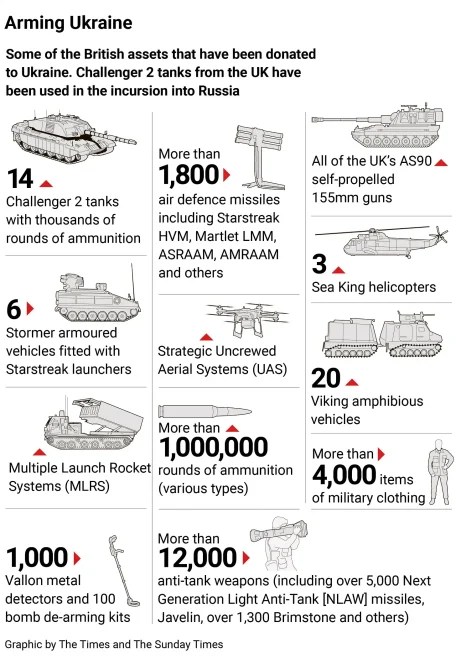
Initially, US officials keenly distanced themselves from the Kursk incursion. Empire house journal Foreign Policy reported that the Biden administration was not only enormously unhappy “to have been kept out of the loop,” but “skeptical of the military logic” behind the “counterinvasion”. In a further rebuke, on August 16th Washington prohibited Ukraine’s use of British-made, long-range Storm Shadow missiles against Russian territory. Securing wider Western acquiescence to such strikes was reportedly also a core objective behind Kiev’s occupation of Kursk.
However, once Donald Trump prevailed in the November 2024 presidential election, Biden was encouraged to use his “last, lame-duck weeks” to make “a flurry of moves to stay the course… and shore up his Ukraine project.” In the process, per the New York Times, he “crossed his final red line,” allowing ATACMS and Storm Shadow strikes deep inside Russia, while permitting US military advisers to leave Kiev “for command posts closer to the fighting.”
Fast forward to today, and the Kursk invasion has ended in utter disaster, with the few remaining Ukrainian forces not captured or killed fleeing. Meanwhile, Biden’s flailing, farewell red line breaches have failed to tangibly shift the battlefield balance in Kiev’s favour at all. As the New York Times acknowledges, the proxy war’s continuation “teeters on a knife edge.” There is no knowing what British intelligence might have in store to prevent long-overdue peace prevailing at last, but the consequences could be world-threatening.
Trump: ‘Very Bad Things are Going to Happen.’ Netanyahu Wants the U.S. to Destroy Iran.
By Dennis J. Kucinich | April 1, 2025
In my article, “The High Price of War with Iran: $10 Gas and the Collapse of the U.S. Economy,” I reminded readers of how Prime Minister Benjamin Netanyahu has been behind the push for America to destroy Iraq, Libya, Syria and now Iran. I reviewed the severe economic consequences for the U.S. if it attacks Iran. Today, I cite the human health and atmospheric effects of a U.S. attack on Iran’s nuclear research facilities. The resulting nuclear fallout would bring a catastrophe unprecedented in human history.
Last week, President Trump said “very bad things are going to happen” to Iran, if that nation’s leaders do not sign a new nuclear deal. The President is right. He can make very bad things can happen to Iran.
But Iran is not the only country to which “bad things” are going to happen if Iran’s nuclear research infrastructure is destroyed by the U.S., as is revealed by a careful study of the spread of radiation created by the promised bombings.
America has been Netanyahu’s pawn for decades. Will the wealth, lives and security of our nation be sacrificed yet further to an agenda which brings only debt to our nation and death to innocents abroad?
The return of Donald Trump to the White House for a second term has enabled Netanyahu’s right-wing party to accelerate the pulverization of Gaza, expand settlements and to repel the Houthis pro-Gaza attacks on Red Sea shipping.
Netanyahu viewed Trump’s first election in 2016 as a new opportunity to topple Iran’s leadership. Trump, in partnership with Netanyahu, withdrew the U.S. from a multi-lateral agreement which limited Iran’s nuclear development in exchange for sanctions relief.
An attack by B-2 bombers on Iran’s nuclear infrastructure would destroy the targeted sites, and unleash radioactivity endangering the lives of tens of millions in Iran and hundreds of millions beyond. Due to radioactive drift, Iraq, Kuwait, Qatar, the UAE, Bahrain, eastern Saudi Arabia, Afghanistan, and Pakistan also would be severely impacted.
In practical terms, given proximity to Iran, and the direction of the wind, high levels of radiation-induced illness, some fatal, and sharp increases in cancer and birth defects would occur. Radiation would contaminate and ruin food supplies, agricultural land, farm animals, and water resources hundreds and even thousands of miles from Iran.
The eastern regions of Turkey, northwestern India, Turkmenistan, Uzbekistan, Tajikistan and Kazakhstan would be exposed to moderate contamination. Jordan, Syria, Lebanon, Israel, Palestine and Egypt’s Sinai could be affected, depending on the wind.
Israel has long fanned existential fears by conjuring the threat of a nuclear attack by Iran, while being indemnified by the U.S. for its self-styled “defensive” aggression in Gaza, where at least 50,000 Gazans have been killed and over a million Palestinians driven from their homes.
While the widely publicized intent of President Trump to bomb Iran imperils Iran and neighboring countries, it also makes Israel vulnerable to a massive counterstrike from Iran and puts in the bullseye all U.S. troops in the region within 2,500 miles of Iran.
The attack B-2 bombers headed to Iran are designed to carry nuclear “bunker busters” as well as conventional 500 lb gravity bombs. The objective is to take down Iran’s nuclear infrastructure, which includes nuclear reactors and research labs. Nukes bombing nukes equals massive radioactive fallout.
“There will be Bombing.”
“If they don’t make a deal, there will be bombing,” Trump said in a telephone interview this past Sunday with NBC News. “It will be bombing the likes of which they have never seen before.”
Civics lesson: Official threats against another state are a violation of the UN Charter, Article Two, Section 4, which “prohibits the threat or use of force against …. any state.” Both Iran and the US signed and ratified that agreement nearly 80 years ago, in recognition of its organizing principle: “to save succeeding generations from the scourge of war…”.
It is a war crime to aggress against another country. Under the US Constitution, no president has the right to unilaterally take our nation to war, absent an imminent threat to the United States. The Constitutional Convention placed the war power in the hands of Congress. This was in contrast to the British Crown’s expansion of war for empire.
The litany of reasons not to attack Iran is eerily similar to the reasons America should not have attacked Iraq: Iran is not a threat to the United States. Iran has not attacked the United States. Iran does not have the intention or the ability to attack the United States. That being the case, the opportunities for a false flag incitement are ripe.
Significantly, last week the U.S. Intelligence community, in its annual Global Threat Assessment, refuted Netanyahu’s oft-repeated claim about Iran building a nuclear weapon:
“We continue to assess that Iran is not building a nuclear weapon and that Khamenei has not reauthorized the nuclear weapons program he suspended in 2003”.
In the 16 years I spent in Congress, I was often one of the only members who rose to question the Bush Administration’s plans to attack Iran, time and again calling out the dangers of attacking nuclear research facilities and calling for diplomatic means to block Iran’s potential development of a nuclear weapon.
The agreement, arrived on July 14, 2015, the Joint Comprehensive Plain of Action (JCPOA). It took the U.S. China, Russia, Germany, France, and the UK thirteen years to craft a workable agreement which limited Iran’s ability to enrich uranium to weapons grade. The agreement was a landmark for international cooperation. It put the spectral genie of Iran’s potential development of a nuclear weapon back in the bottle.
That did not satisfy Netanyahu, however. He longed for the toppling of the Iran regime, and continued to hype existential fears among Israelis. Trump cancelled the JCPOA, at Netanyahu’s behest, setting in motion a series of events which may lead the US to attack Iran soon.
From Deal Breaker to Deal Maker?
Scott Ritter a former UN Weapons Inspector and Marine intelligence specialist provides a detailed account of Trump’s withdrawal from the JCPOA, in his book, entitled Deal Breaker.
The JCPOA which Trump took down had blocked Iran’s production of enriched uranium (processed to increase the percentage of uranium-235 (235U) at the Natanz and Fordow nuclear facilities.
It blocked Iran’s development of weapons-grade plutonium and frustrated even covert attempts to produce fissile (capable of undergoing nuclear fission) materials used for nuclear weapons.
The President now is demanding Iran sign a new deal. He wants Iran to get rid of the weapon-making capability which he errantly enabled by cancelling the JCPOA.
Eight years after the cancellation of the JCPOA, President Trump is apparently demanding Iran voluntarily take down its nuclear infrastructure which provides nuclear power, nuclear research and yes, with no JCPOA, can, at this moment, enrich uranium to near–weapons grade.
The Supreme Leader of the Islamic Republic of Iran has issued a fatwa (a religious ruling) against the use of nuclear weapons.
The new deal which the President is seeking, at best, could end up looking a lot like the JCPOA, and, at worst, puts him in the position of issuing a non-negotiable demand for Iran to voluntarily take down its nuclear infrastructure, or the US will do it militarily.
Iran has rejected direct negotiations with Washington under such circumstances. It has, however, maintained indirect communication with the U.S. through Oman as the President escalates the threat of a massive bombing attack.
B-2 bombers are in place, equipped with the most powerful weapons in America’s arsenal ready to be activated from Diego Garcia, an island in the Indian Ocean, 2,400 miles southeast of Iran. The B-2 has the capacity to attack and return to Diego Garcia without refueling.
In someways this showdown with Iran was set in place on July 25, 2024, when Prime Minister Netanyahu addressed Congress. In a spell-binding speech for which he received over 50 standing ovations, Netanyahu skillfully aligned Israel’s and the U.S. policy on Iran:
“If you remember one thing, one thing from this speech, remember this: Our enemies are your enemies, our fight is your fight, and our victory will be your victory,” Mr. Netanyahu declared.
At this point, the measure of consequence needs to be assessed. The only difference between war games, preparing for war and actual war, is in the intent.
Israel intends to destroy Iran and needs the US to do it.
Joint US-Israeli Air Force war games have been held recently in preparation for an attack.
The U.S. has nineteen B-2 bombers. Each cost over $2 billion. Their unique flying wing design, with the plane wrapped in radar-absorbing materials help it avoid detection. The B-2s use sophisticated electronic countermeasures to jam or stymie opposition radar and missiles.
Iran is ill-equipped to defend against the B-2 bombers’ stealth warfare. At best the shortened detection range will limit Iran’s ability to lock onto the B-2 with surface-to-air missiles.
Each B-2 can carry sixteen, 2,400 lb., B83 thermo-nuclear gravity bombs, also known as nuclear bunker busters, which explode deep inside the earth. Each B83 bomb has the explosive capacity of 80 Hiroshimas which means each B-2 bomber is capable of delivering the destructive power of 1280 Hiroshimas.
Once the B83’s detonate they destroy underground structures and send shockwaves through rock. Earthquakes and massive ground displacement result, with radioactive debris being flung into the atmosphere.
There is a metaphysics at work here of bringing to oneself that which one fears. The United States is preparing to attack Iran because of Israel’s fear of Iran.
Trump: “It will be bombing the likes of which they have never seen before.”
The U.S. will first attack Iran’s underground missile cities at Khorramabad, and Panj Pellah, Bakhtaran, with nuclear bunker busters or Massive Ordnance Penetrators aimed at underground missile sites, to incapacitate Iran’s ability to retaliate.
The use of nuclear bunker busters will send nuclear debris into the immediate atmosphere, and it will be carried aloft by the wind.
Simultaneously, the U.S. will strike at the Fordow enrichment plant, buried deep in a mountain. A combination of 30,000 lb. Massive Ordnance Penetrators (GBU-57s) capable of burrowing 200 ft into the earth before exploding, and nuclear bunker busters, will be deployed, creating a multiplier factor in blast physics, collapsing tunnels and sending radioactive materials into the atmosphere and far beyond. Fordow is heavily fortified and may be able to withstand the initial attack.
The Natanz underground facility will be similarly struck, with radioactive matter breaking into the atmosphere.
The ground-level Bushehr Nuclear Power plant will be destroyed, its reactor vessel breached, the reactor core will meltdown, massive release of radioactive materials (cesium-137, iodine-131, strontium-90, and plutonium) will go into the atmosphere, and, depending upon the wind, and the weather, radioactive plumes will drift over other countries.
Countless civilians will perish from radiation poisoning and severe burns. Birth defects will be present for generations to come. Nuclear explosion refugees will be created. Chernobyl-type effects will require people to leave their homes, never to return.
Tehran’s Research Reactor, Isfahan Nuclear Tech Center, Arak Heavy Water Reactor, Natanz Surface Facility and the Parchine Military Complex are ground level and surface level structures which will be targeted and destroyed, either by nuclear weapons or so-called conventional weapons.
Iran Can Still Hit Back
Iran’s underground missile system is widely distributed. Faced with imminent destruction, Iran, at the first sign of an attack, will simultaneously launch multiple rockets from many underground sites, a “shower of missiles” numbering in the thousands.
These deadly projectiles can change trajectories and targets while in flight, making the vaunted missile defense of Israel less effective. While Israel’s 2000 lb. bombs, the type dropped on Gaza, are more precise, the Shabab-3 has the potential of inflicting much more significant damage over a larger radius of Israeli cities.
U.S. Troops in Region will Pay
Tens of thousands of US troops, Army, Navy, Airforce, Marines, Space Force are stationed within reach of Iranian missiles. They are under no threat unless Iran is attacked.
Iran’s short-range missiles, Fateh-110 and Zolfagher, can reach Saudi Arabia. Iran’s medium-range ballistic missiles, the Shabab-3, Emad, Sejjil, and Ghadr can travel up to 1,550 miles (2,500 km), to Israel. Its intermediate range missiles are capable of striking 2,485 miles deep into eastern and central Europe,
It is not in the interests of the United States to attack Iran.
The United States is risking becoming the most hated nation on earth, using nuclear weapons again, bombing nuclear facilities, creating radioactive consequences for potentially dozens of nations and tens of millions of people born and unborn.
America has been Netanyahu’s pawn for decades. Will the wealth, lives and security of our nation be sacrificed yet further to an agenda which brings only debt to our nation and death to innocents abroad?
During his campaign, President Trump stated repeatedly that he aimed to have a strong military to avoid war. Military strength must be matched by diplomatic strength. He must come up with a deal that avoids a U.S. war with Iran, without a foreign leader’s self-interested meddling. “Very bad things” do not have to happen if good people prevail. If America nukes Iran, our nation will never escape the fallout.
Russia offers mediation of talks between Tehran, Washington: Ryabkov
Al Mayadeen | April 1, 2025
Russia warned of United States airstrikes on Iran’s nuclear infrastructure, condemning US President Donald Trump’s threats to bomb Tehran unless a deal with Washington is reached.
“Threats are indeed being heard, ultimatums are also being heard,” Russia Deputy Foreign Minister Sergei Rybakov told International Affairs in an interview published Tuesday, adding, “We consider such methods inappropriate, we condemn them, we consider them a way for (the US) to impose its own will on the Iranian side.”
Russia proposed mediation between Trump’s administration and Iran, following their strategic partnership deal earlier this year.
Ryabkov said that Trump’s threats to Iran only complicate the situation between the two countries, emphasizing that if the US administration follows up with its warnings and strikes Iranian nuclear facilities, the consequences could be catastrophic for the entire region.
“While there is still time and the ‘train has not left’, we need to redouble our efforts to try to reach an agreement on a reasonable basis. Russia is ready to offer its good services to Washington, Tehran, and everyone who is interested in this,” the deputy foreign minister stated.
Iran stands steadfast to US threats
Ali Larijani, a top advisor to Iran’s Supreme Leader Ayatollah Khamenei, cautioned on March 31 that any US or Israeli strike targeting Iran’s nuclear sites would push Tehran to pursue nuclear weapons development.
He argued that attacking Iran’s nuclear facilities would backfire against US interests, warning, “Under such circumstances, we would have no choice but to reconsider our stance and potentially seek nuclear arms as a deterrent.”
Larijani warned that any military strike on Iran would only strengthen domestic resolve to fast-track nuclear weapons development, adding that due to Iran’s preparedness, such an attack would only delay the nuclear program temporarily – by no more than two years.
On March 31, the leader of the Islamic Revolution and the Islamic Republic of Iran, Sayyed Ali Khamenei, delivered a stern warning, asserting that any entity considering hostile actions toward Iran would be met with a severe and proportionate retaliation, while also stressing that efforts to provoke internal division would be decisively countered by the Iranian people, as they have shown in previous instances.
Admiral Alireza Tangsiri, the commander of the naval forces in Iran’s Islamic Revolution Guard Corps (IRGC), warned “foreign parties” against threatening Iranian interests, stating, “If foreigners attempt to attack us, pressure us, or endanger our interests, we will stand against them with full force.”
At the same time, he emphasized that “Iran does not seek war but will respond firmly to any aggression.”
Here’s why the West has so far failed to start World War III
By Tarik Cyril Amar | RT | March 31, 2025
Under the title ‘The Partnership: The Secret History of the War in Ukraine’, the New York Times published a long exposé that has made a splash. It is a long article advertised – with a lumbering clunkiness that betrays cramping politics – as the “untold story of America’s hidden role in Ukrainian military operations against Russia’s invading armies.”
And it clearly aspires to be sensational: A revelation with a whiff of the famous Pentagon Papers that, when leaked to the same New York Times and the Washington Post in 1971, revealed what a mass-murderous fiasco America’s Vietnam War really was.
Yet, in reality, this time the New York Times is offering something less impressive by magnitudes. And the issue is not that the Pentagon Papers were longer. What really makes ‘The Partnership’ so underwhelming are two features: It is embarrassingly conformist, reading like a long exercise in rooting for the home team, the US, by access journalism: Based on hundreds of interviews with movers and shakers, this is really the kind of ‘investigation’ that boils down to giving everyone interviewed a platform for justifying themselves as good as they can and as much as they like.
With important exceptions. For the key strategy of exculpation is simple. Once you see through the rather silly group-therapy jargon of a tragic erosion of ‘trust’ and sad misunderstandings, it is the Ukrainians that get the blame for the US not winning its war against Russia, in their country and over their dead bodies.
Because one fundamental conceit of ‘The Partnership’ is that the war could have been won by the West, through Ukraine. What seems to never even have entered the author’s mind is the simple fact that this was always an absurd undertaking. Accordingly, the other thing that hardly makes it onto his radar screen is the crucial importance of Russia’s political and military actions and reactions.
This, hence, is an article that, in effect, explains losing a war against Russia without ever noticing that this may have happened because the Russians were winning it. In that sense, it stands in a long tradition: Regarding Napoleon’s failed campaign of 1812 and Hitler’s crash between 1941 and 1945, all too many contemporary and later Western observers have made the same mistake: For them it’s always the weather, the roads (or their absence), the timing, and the mistakes of Russia’s opponents. Yet it’s never – the Russians. This reflects old, persistent, and massive prejudices about Russia that the West cannot let go of. And, in the end, it is always the West which ends up suffering from them the most.
In the case of the Ukraine conflict, the main scapegoats, in the version of ‘The Partnership’, are now Vladimir Zelensky and his protégé and commander-in-chief General Aleksandr Syrsky, but there is room for devastating side swipes at Syrsky’s old rival Valery Zaluzhny and a few lesser lights as well.
Perhaps the only Ukrainian officer who looks consistently good in ‘The Partnership’ is Mikhail Zabrodsky, that is, the one – surprise, surprise – who worked most closely with the Americans and even had a knack of flatteringly imitating their Civil War maneuvers. Another, less prominent recipient of condescending praise is General Yury Sodol. He is singled out as an “eager consumer” of American advice who, of course, ends up succeeding where less compliant pupils fail.
Zabrodsky and Sodol may very well be decent officers who do not deserve this offensively patronizing praise. Zelensky, Syrsky, and Zaluzhny certainly deserve plenty of very harsh criticism. Indeed, they deserve being tried. But constructing a stab-in-the-back legend around them, in which Ukrainians get blamed the most for making the US lose a war that the West provoked is perverse. As perverse as the latest attempts by Washington to turn Ukraine into a raw materials colony, as a reward for being such an obedient proxy.
With all its fundamental flaws, there are intriguing details in ‘The Partnership’. They include, for instance, a European intelligence chief openly acknowledging – as early as spring 2022 – that NATO officers had become “part of the kill chain,” that is, of killing Russians who they were not, actually, officially at war with.
Or that, contrary to what some believe, Westerners did not overestimate but underestimate Russian abilities from the beginning of the war: In the spring of 2022, Russia rapidly surged “additional forces east and south” in less than three weeks, while American officers had assumed they would need months. In a similar spirit of blinding arrogance, General Christopher Cavoli – in essence, Washington’s military viceroy in Europe and a key figure in boosting the war against Russia – felt that Ukrainian troops did not have to be as good as the British and Americans, just better than Russians. Those daft, self-damaging prejudices again.
The New York Times’ “untold story” is also extremely predictable. Despite all the detail, nothing in ‘The Partnership’ is surprising, at least nothing important. What this sensationally unsensational investigation really does is confirm what everyone not fully sedated by Western information warfare already knew: In the Ukraine conflict, Russia has not merely – if that is the word – been fighting Ukraine supported by the West but Ukraine and the West.
Some may think the above is a distinction that doesn’t make a difference. But that would be a mistake. Indeed, it’s the kind of distinction that can make a to-be-or-not-to-be difference, even on a planetary scale.
That’s because Moscow fighting Ukraine, while the latter is receiving Western support, means Russia having to overcome a Western attempt to defeat it by proxy war. But fighting Ukraine and the West means Russia has been at war with an international coalition, whose members have all attacked it directly. And the logical and legitimate response to that would have been to attack them all in return. That scenario would have been called World War III.
‘The Partnership’ shows in detail that the West did not merely support Ukraine indirectly. Instead, again and again, it helped not only with intelligence Ukraine could not have gathered on its own but with direct involvement in not only supplying arms but planning campaigns and firing weapons that produced massive Russian casualties. Again, Moscow has said this was the case for a long time. And Moscow was right.
This is why, by the way, the British Telegraph has gotten one thing very wrong in its coverage of ‘The Partnership’: The details of American involvement now revealed are not, actually, “likely to anger the Kremlin.” At least, they are not going to make it angrier than before, because Russia is certain to have long known about just how much the US and others – first of all Britain, France, Poland, and the Baltics – have contributed, directly and hands-on, to killing Russians.
Indeed, if there is one important takeaway from the New York Times’ proud exposé of the extremely unsurprising, it is that the term ‘proxy war’ is both fundamentally correct and insufficient. On the one hand, it perfectly fits the relationship between Ukraine and its Western ‘supporters’: The Zelensky regime has sold the country as a whole and hundreds of thousands of Ukrainian lives to the West. The West has used them to wage war on Russia in pursuit of one overarching geopolitical aim of its own: To inflict a ‘strategic defeat’ on Russia – that is, a permanent demotion to second-rate, de facto non-sovereign status.
The above is not news, except perhaps for the many brainwashed by Western information warriors from historian-turned-war-apostle Tim Snyder to lowlier X agitators with Ukrainian flags and sunflowers in their profiles.
What is also less than stunning but a little more interesting is that, on the other side, the term proxy war is still misleadingly benign. The key criterion for a war being by proxy – and not its opposite, which is, of course, direct – is, after all, that major powers using proxies limit themselves to indirect support. It is true that in theory and historical practice that does not entirely rule out adding some limited direct action as well.
And yet, in the case of the Ukraine conflict, the US and other Western nations – and don’t overlook the fact that ‘The Partnership’ hardly addresses all the black ops also conducted by them and their mercenaries – have clearly, blatantly gone beyond proxy war. In reality, the West has been waging war on Russia for years now.
That means that two things are true: The West almost started World War III. And the reason it has not – not yet, at least – is Moscow’s unusual restraint, which, believe it or not, has actually saved the world.
Here’s a thought experiment: Imagine the US fighting Canada and Mexico (and maybe Greenland) and learning that Russian officers are crucial in firing devastating mass-casualty strikes at its troops. What do you think would happen? Exactly. And that it has not happened during the Ukraine War is due to Moscow being the adult in the room. This should make you think.
Tarik Cyril Amar is a historian from Germany working at Koç University, Istanbul, on Russia, Ukraine, and Eastern Europe, the history of World War II, the cultural Cold War, and the politics of memory
Orbán counters FT article telling the EU to ‘solve its Orbán problem’
Remix News | April 1, 2025
The Financial Times’ piece entitled “It’s time for the EU to solve its Orbán problem” has elicited a stern response from Hungarian PM Viktor Orbán.
The piece determines that the EU must support Ukraine’s fight against Russia and provide it with arms to do so. And to do this, it must also somehow get Hungary on board, despite the country repeatedly reiterating its pro-peace stance.
Author Mujtaba Rahman states, “The EU’s ability to do this is directly compromised by Orbán, who has been hugely emboldened by Trump’s return. The Hungarian prime minister keeps in lockstep with Trump and Putin in the hope of winning favours from both.”
Rahman then lists “levers” the bloc can pull to essentially force Hungary’s hand, primarily through the withholding of cash the country desperately needs due to what the author calls Hungary’s “stagnant economy.”
“EU funds are therefore critical if Orbán is to boost investor confidence in the country’s economy. The European Commission has leverage and should use it,” the piece reads. Rahman also suggests simply suspending Hungary’s voting rights.
The article ends by stating, “The EU is now facing a Darwinian moment. It will either adapt or die. To protect Ukraine and its Russian ‘frontline’ states, it must face down Orbán.”
In a response posted on X, Orbán wrote, “The Financial Times is right about one thing: Europe has arrived at a Darwinian moment. They want to change the EU from a peace project to a war project. This is not evolution, this is decay. We must resist, even if they want to punish us.”
Germany to target ‘internal EU enemies’ – Politico
RT | April 1, 2025
The incoming German government plans to play a larger role in EU decision-making, including by punishing nations that dissent against the bloc’s foreign policy, Politico has reported. According to the outlet, a draft coalition agreement targets Hungary, which has defied EU decisions on issues such as the Ukraine conflict and sanctions against Russia.
Germany is set to have a new coalition government formed by the Christian Democratic Union (CDU), Christian Social Union (CSU), and the Social Democrats (SPD), likely led by Friedrich Merz of the CDU. The parties are currently finalizing agreements on key policy areas, including migration, climate, and EU relations. Merz is reportedly aiming to form the new government before Easter on April 20.
One of the documents reviewed by Politico outlines Berlin’s plans for a more assertive EU strategy. It proposes using the ‘Weimar Triangle’ – a trilateral alliance of Germany, France, and Poland, which currently holds the EU’s rotating presidency – to influence the bloc’s direction and strengthen Germany’s use of its voting rights.
The draft also states that Berlin plans to “defend” the EU against “internal and external enemies” by calling for punitive action against member states that allegedly violate principles such as the rule of law. Proposed penalties include withholding EU funds and suspending voting rights.
“We will take even more consistent action against violations,” the document states. “Existing protective instruments, from infringement proceedings and the withholding of EU funds to the suspension [of] membership rights such as voting rights in the Council of the EU, must be applied much more consistently than before.”
The coalition has also proposed the creation of a “comprehensive sanction instrument” to rein in perceived dissenters, including replacing the EU’s foreign policy unanimity requirement with majority voting to prevent countries from blocking decisions such as sanctions.
“The consensus principle in the European Council must not become a brake on decision-making,” the document states.
While Hungary is not mentioned by name, the draft agreement appears to be a clear reference to the country, which has long been at odds with EU policies, including over its approach to the Ukraine conflict and its sanctions policy towards Russia.
Budapest has argued that sanctions have been detrimental to the bloc’s economy, and has exercised its veto right on several motions to delay or dilute measures. Prime Minister Viktor Orban has repeatedly accused the EU of taking a “pro-war” stance and has pursued independent peace initiatives on the Ukraine conflict.
The EU has previously threatened to suspend Hungary’s voting rights. It withheld around €22 billion in funds earmarked for Budapest in 2022, citing rights and judicial concerns, but ultimately released about half of that amount last year.
Featured Video

More Iran War fallout: Maritime insurance industry shifts from London to China
or go to
Aletho News Archives – Video-Images
From the Archives
Allies Don’t Need Lobbies
By Jay Knott | Dissident Voice | September 24, 2013
In a recent article on Counterpunch, Rob Urie defended the traditional Marxist analysis of US policy in the Middle East. He argues that support for Israel is driven primarily by economic interest, not the Jewish lobby.
He starts by paying tribute to the idea that Western societies are uniquely racist. He says that the “Western narrative” claims there is an “Arab character”, and that this is “antique racist blather”. He gives no definition of these terms. Further, he establishes his credentials as part of the dominant current in the American left by claiming that “over a million people in Iraq died so ‘we’ in the West can drive SUVs.”1
When he tries to criticize bourgeois economics, he makes it clear he doesn’t understand the developments it has made since Marx’s day, using the mathematical discipline known as “game theory”. He dismisses the basic abstraction of economic theory, the idea of the rational individual, on the grounds that it is “devoid of history, culture and political context”. But abstractions are always devoid of something.
He defends a more concrete economic theory, mostly Marxist, with some input from another theorist of capitalist crisis, Hyman Minsky. This concrete theory leads him to the view that US activity in the Middle East is primarily driven by rational capitalist motives, the need to secure a supply of oil.
“Taking the totality of circumstance — former oil company executives launching war on an oil rich nation on a pretext they publicly proclaimed they didn’t believe shortly before taking office — and that upon launching their war proved to be non-existent, requires a willingness to overlook the obvious — that the war on Iraq was for oil, that is difficult to support.”1
Perhaps I’ve misunderstood him, but based on what he says in the rest of the article, this convoluted sentence seems to argue that, because president Bush and vice-president Cheney attacked Iraq on false premises, and they also said it was all about oil, and they are former oil executives, and Iraq has a lot of oil, it’s difficult to deny US attacks on Iraq are all about oil.
In fact, it’s not hard at all. As Urie points out, at times Bush and co. said that attacking Iraq was “protecting the world’s supply of oil.”1 But, as he also points out, they are congenital liars. Why should we believe them when they say they are trying to “protect” the oil supply? Protect it against what? When politicians “admit” attacks on Middle Eastern countries are wars for oil, they are parroting the neo-con party line, feeding the public, both left and right, with a plausible-sounding pretext. For right-wingers, “it’s a war for oil” is a reason to support war, and for leftists, it’s a way to feel better by complaining impotently about corporate greed. Both approaches help the war drive. … continue
Blog Roll
 Aletho News
- More Iran War fallout: Maritime insurance industry shifts from London to China
- US-Israeli aggression on Iran triggers review of GCC countries’ investment pledges to Washington
- Russia slams UK plan to seize tankers suspected of carrying its oil
- Pakistan ramps up food exports to Persian Gulf nations as war deepens food insecurity
- Iran submits response to US plan, sets terms for war’s end: Tasnim
- US vs Iran: Kharg Island Talk — Bluff or Escalation? Ex-Military Officer Weighs In
- Zelensky unnecessarily involves Ukraine in the Middle East crisis
- Turkish tanker blacklisted by Ukraine hit in drone attack – media
- Canada, the U.S., and NATO: the inescapable trap
- Villains of Judea: Leonid Radvinsky
- If Americans Knew
- ‘No Innocent Children’: Far-right Israeli Lawmaker Defends Killing of Palestinian Family
- Mossad’s promises helped Netanyahu convince Trump that Iran could be toppled
- US Arms Control Official Refuses To Comment When Asked If Israel Has Nuclear Weapons
- Veterans warn US landing could be ‘more Gallipoli than Vietnam’
- Israel may be committing war crimes in Lebanon – Not a ceasefire Day 167
- In the West Bank, life is a constant battle – 3 articles
- Jacob Reses, one of the most powerful pro-Israel operatives in Trump’s Washington
- Israeli-US assaults kill or injure 87 children a day – Not a ceasefire Day 166
- ‘Forever live by the sword’: Understanding Israelis’ massive support for Iran war
- UN’s special rapporteur on human rights says Israel is systematically torturing Palestinians
- No Tricks Zone
- Devastating Assessment Of Comirnaty Vaccine By Former Senior Pfizer Europe Toxicologist
- New Study: CO2 Is ‘Effectively Negligible’ As An Explanatory Climate Change Factor Since 2000
- Former Pfizer Toxicologist Dr. Helmut Sterz Tells Bundestag Hearing Pfizer Vaccine Should Have Never Been Approved
- Energy Expert: Germany’s Nuclear Phaseout Was A “500 Billion Euro Mistake”
- New Research: South Australia’s Mid-Holocene Sea Surface Temperatures Were 4°C Warmer Than Today
- Storing Green Energy To Last Germany 10 Days Would Require A 60-Million Tonne Battery
- New Studies: UK Sea Levels Were 4 Meters Higher Than Today During The Mid-Holocene
- Destructive Green New Deal: German Energy And Metal Group Warns Of Drastic Crisis
- New Study Documents A 20-Year Pause In Arctic Sea Ice Decline – Driven By Internal Variability
- Wake-up Call: Survey Shows Majority Of Germans Now Favor Postponing Climate Targets!
 Aletho News