Japanese Prime Minister Fails to Mention US as Country Responsible for Hiroshima Bombing
Sputnik – 06.08.2025
Japanese Prime Minister Shigeru Ishiba did not name the United States as the country that dropped nuclear bombs on the Japanese cities of Hiroshima and Nagasaki in August 1945 during the commemorative ceremony in Hiroshima on Wednesday.
In August 1945, during WWII, US pilots dropped atomic bombs on Hiroshima and Nagasaki. The Hiroshima blast killed up to 140,000 of the city’s 350,000 population on August 6 that year, with Nagasaki losing approximately 74,000 on August 9.
“Eighty years ago on this day, an atomic bomb exploded, and it is believed that more than 100,000 precious lives were lost,” Shigeru Ishiba said during the commemorative ceremony on Wednesday, without mentioning the United States as the country responsible for the bombing.
Hiroshima Mayor Kazumi Matsui mentioned the US only in the context of being one of the countries that possess nuclear weapons.
In his address dedicated to the 80th anniversary of the US bombing of Hiroshima, UN Secretary-General Antonio Guterres made no mention of the country responsible. The address was read out in Japanese by UN Under-Secretary-General and High Representative for Disarmament Affairs Izumi Nakamitsu and only mentioned that “the lives of tens of thousands of people were taken” in the Hiroshima tragedy.
Over 120 representatives of foreign nations, as well as Japanese politicians, participated in the Wednesday commemorative ceremony in Hiroshima marking 80 years since the atomic bombing.
Capabilities Russia Unlocks by Quitting Medium-Range Missile Moratorium
Sputnik – 05.08.2025
Russia’s termination of its unilateral moratorium on the deployment of ground-launched ballistic missiles in the 500-5,500 km range is the logical outcome of hostile NATO policies, and unties Moscow’s hands for a more proactive approach to strategic defense, says Igor Korotchenko, one of Russia’s top military analysts.
What Brought on Russia’s Decision?
NATO’s European allies’ preparations for a potential conventional war with Russia by 2030, including:
- a massive rearmament campaign and plans to create massive, wartime-sized standing armies
- the development of new weapons, including an Anglo-German missile with a 2,500 km+ range
- deployment of new US fifth-gen fighters in the region
What It Means
In these circumstances, and no longer facing INF-style medium and intermediate-range missile restrictions, Russia will:
- ramp up production of ballistic missiles, including the conventionally armed Oreshnik (serial production already underway)
- deploy the missiles, which are difficult if not impossible to intercept due to their multiple independently targetable reentry vehicle (MIRV) payload, as it sees fit and based on security considerations
- potentially deploy a nuclear-armed variant of the Oreshnik, with up to six warheads with a 150 kt per warhead capacity to “deter” NATO and “minimize threats and risks of a military attack on Russia by NATO,” not only in Europe, but Asia as well, if needed
“The INF Treaty is dead,” Korotchenko says. There is now “nothing” to stop Russia from realizing its strategic security objectives.
Russia ‘no longer considers itself bound’ by nuclear treaty with US
RT | August 4, 2025
Moscow believes that conditions for maintaining the 1987 Intermediate-Range Nuclear Forces (INF) Treaty with the US have “disappeared” and “no longer considers itself bound” by it, according to a statement from the Russian Foreign Ministry.
The INF Treaty, which banned ground-launched missiles with ranges of 500–5,500km, collapsed in 2019 when Washington withdrew, citing Russian violations. Moscow has denied the claims, accusing the US itself of developing banned missiles. Russian President Vladimir Putin has warned that the collapse of the INF will significantly erode the global security framework.
“The Russian Foreign Ministry notes the disappearance of conditions for maintaining the unilateral moratorium on the deployment of similar weapons and is authorized to state that Russia no longer considers itself bound by the corresponding self-imposed restrictions previously adopted,” the statement reads.
According to the ministry, the “actions of Western countries” are creating a “direct threat” to Russian security. It also noted that last year, the US deployed a Typhon missile launcher in the Philippines. The statement also referenced the Talisman Sabre exercise in Australia, where the US Army also fired Typhon.
The Typhon is a mobile ground-based launcher designed to launch Tomahawk cruise missiles (range up to 1,800km) and SM-6 multipurpose missiles (range up to 500km).
The Foreign Ministry also took notice of the Australian Army testing an American Precision Strike Missile (PrSM) for the first time in July. The PrSM is a has a maximum range beyond 500km and “is central to strengthening Australia’s land and maritime strike capability,” according to the country’s Defense Ministry.
The Russian statement added further: “Decisions on specific parameters of response measures will be made by Russia’s leadership based on an interagency analysis of the scale of the deployment of American and other Western ground-based intermediate-range and shorter-range missiles, as well as the overall development of the situation in the field of international security and strategic stability.”
Moscow has repeatedly voiced the possibility of lifting the moratorium, for example, after the US announced plans to deploy long-range weapons in Germany in 2026. In November, Russian President Vladimir Putin said that Russia is developing intermediate- and shorter-range missiles in response to Washington’s actions. The Kremlin has not ruled out deploying the missiles in the Asia-Pacific region.
US President Donald Trump, who during his first term withdrew from the INF and the 1992 Open Skies Treaty which allowed conducting surveillance flights over each other’s territory, has suggested that he would resume negotiations on maintaining the existing restrictions on nuclear weapons with Russia.
China Chokes Western Defense Supply With Minerals Stranglehold – Reports
Sputnik – 04.08.2025
China is restricting supplies of critical minerals to Western defense firms, delaying production and forcing them to seek alternatives in other markets, the Wall Street Journal reported, citing sources at the companies.
For example, the newspaper points out, one drone manufacturer that supplies the US military was forced to delay orders for up to two months while it searched for a replacement for Chinese magnets made from rare earth metals.
Traders told the newspaper that some materials needed by the Western defense industry were now selling at prices five or more times higher than they were before China imposed the restrictions.
More than 80,000 components used by the Pentagon contain minerals that are subject to China’s export restrictions, the publication recalled. At the same time, almost all of the US military’s supply chains for these minerals depend on at least one Chinese supplier, so Beijing’s restrictions could cause major problems for the US military.
In addition, Western buyers told the newspaper that China was requesting detailed information about the purpose of the purchased minerals so that they were not used by Western companies in military production.
In early April, the Chinese Commerce Ministry said that Beijing had placed 16 US companies on an export control list to control the export of dual-use goods. As the New York Times noted, Beijing has suspended the export of a wide range of critical minerals and magnets, which are needed, in particular, to assemble cars, drones, robots and missiles.
In June, the Wall Street Journal reported, citing people familiar with the matter, that China had agreed to resume issuing rare earth export licenses to US automakers and industrial plants, but limited the permits to six months. Reuters also reported, citing people familiar with the matter, that China had not committed to granting export permits for some specialized rare earth magnets that US military suppliers need for fighter jets and missile systems.
Rare earth elements are a group of 17 metals that are widely used in high-tech devices, including computers, televisions, and smartphones, as well as in defense technologies, including missiles, lasers, transportation systems, and military communications.
The Constitution, Foreign Wars, and the Tenth Amendment
By Alan Mosley | The Libertarian Institute | August 4, 2025
When a sitting U.S. president decides to commit tens of billions of dollars’ worth of weapons to foreign conflicts, ordinary citizens seldom ask whether such largesse has a constitutional basis. Yet America was founded on the principle that the federal government is one of limited and enumerated powers. Those powers were carefully listed in Article I of the Constitution, and the Tenth Amendment reserves all powers not delegated to the United States to the states or to the people. The Constitution demands that any action taken by the federal government—including funding and arming foreign belligerents—be supported by an enumerated power.
President Donald Trump’s decisions in 2025 to dramatically increase arms shipments to Ukraine and to release large bombs and precision munitions to Israel, despite accusations that Israel’s campaign in Gaza constitutes genocide, are therefore more than just foreign‐policy controversies. They challenge the constitutional structure itself. So how would the Founders evaluate the Trump administration’s approach juxtaposed with the federal government designed in 1787?
Among Congress’ powers listed in Article I, Section 8 of the Constitution are the power to lay and collect taxes “to pay the debts and provide for the common defense and general welfare,” to borrow money, to regulate commerce, to declare war and raise armies, and to make laws “necessary and proper” for executing those powers. There is no clause authorizing Congress to fund or arm foreign governments to prosecute wars in which the United States is not a belligerent. James Madison explained in Federalist No. 45 that the powers delegated to the federal government are “few and defined,” while the powers remaining with the states are “numerous and indefinite.” The delegated powers relate principally to “external objects, as war, peace, negotiation, and foreign commerce;” the states retain authority over “the lives, liberties, and properties of the people.” In other words, the Constitution authorized the federal government to provide for national defense and to wage war when necessary, but not to become the perpetual armorer for other nations’ wars.
The Bill of Rights codifies this principle with the Tenth Amendment. Thomas Jefferson invoked this principle in his 1791 opinion against chartering a national bank. He wrote that the Constitution is founded on the rule that “all powers not delegated to the U.S. by the Constitution…are reserved to the states or to the people.” To “take a single step beyond the boundaries thus specially drawn around the powers of Congress,” he warned, “is to take possession of a boundless field of power, no longer susceptible of any definition.” Jefferson feared that if Congress could infer powers from vague phrases like “general welfare,” then “all the preceding and subsequent enumerations of power” would become “completely useless.” He insisted that the general-welfare language allowed Congress only to lay taxes for the enumerated purposes, not to wield a general police power.
In July 2025, President Trump announced what Reuters described as a “weapons purchasing scheme” whereby European allies would donate Patriot missile batteries and other equipment to Ukraine and the United States would sell those allies new American replacements. Trump framed the arrangement as a way to press Russia for a ceasefire: if Moscow did not stop the war, he threatened 100% tariffs on Russian exports. Under the plan, Patriot systems were expected to arrive in Ukraine “within days,” yet American officials admitted that the scheme remained largely an unfleshed framework. Europe would foot the bill for the donated equipment while U.S. arms manufacturers would profit from replenishing their stockpiles. This arrangement appealed to Trump’s political base by making Europeans “pay” for Ukraine’s defense.
From a constitutional perspective, however, the plan is problematic. Congress’ enumerated powers include raising and supporting armies and providing for the “common defense” of the United States, not arming foreign armies. Defenders might argue that Russia’s invasion of Ukraine threatens global stability and thus implicates U.S. national security. But even if one accepts that the fate of Ukraine indirectly affects American interests, the enumerated powers restrict Congress to means necessary for America’s defense. Nothing in Article I authorizes Congress to conscript the American taxpayer into financing a proxy war in Eastern Europe. The constitutional principle is not that Congress may do anything that might promote the general welfare of humanity; Jefferson specifically rejected that interpretation. Under a strict reading, if no U.S. declaration of war has been issued and America itself is not under attack, there is no enumerated power to funnel weapons to a foreign government.
Economists often remind us that trade‐offs are inescapable. Money and weapons sent overseas are resources not available for domestic defense or to be returned to the taxpayers. The Trump administration’s scheme is not cost‐free simply because European governments are paying for some of the weapons. It requires huge U.S. manufacturing capacity and could lead to backlogs for America’s own defense needs. The plan also invites entanglement: once the United States supplies an ally with advanced missile systems, its credibility becomes tied to the ally’s success. As then-Secretary of State John Quincy Adams warned in 1821, America “goes not abroad, in search of monsters to destroy.” She is “the champion and vindicator only of her own,” and knows that if she enlists under other banners she will be “involve[d]…in all the wars of interest and intrigue…which assume the colors and usurp the standard of freedom.” Adams cautioned that once America did so, her “fundamental maxims” would change from liberty to force and she could “become the dictatress of the world.” A policy that openly arms Ukraine while threatening tariffs on any nation buying Russian oil moves the United States closer to the dictatress Adams feared.
The Trump administration’s support for Israel has been even more direct. On January 25, 2025, Trump instructed the U.S. military to release 2,000‑pound bombs that the Joe Biden administration had withheld over concern for civilian casualties in Gaza. Trump justified the decision by saying that Israel had paid for the bombs and “they’ve been waiting for them for a long time.” When asked why he released them, he replied, “because they bought them.” The bombs had been withheld because of their potential to cause indiscriminate destruction; a single 2,000‑pound bomb can rip through thick concrete and create a wide blast radius. Humanitarian advocates had urged an arms embargo amid Israel’s assault on Gaza, which has killed more than 47,000 people and caused widespread hunger and displacement. Israel denies accusations of genocide and war crimes, but a United Nations special rapporteur reported to the Human Rights Council that there were “reasonable grounds to believe that the threshold indicating the commission of the crime of genocide” in Gaza had been met, citing more than 30,000 Palestinians killed.
In February 2025, the Trump administration followed up with an emergency approval of nearly $3 billion in bombs and demolition kits for Israel. The package included 35,529 general‑purpose bomb bodies for 2,000‑pound bombs and 4,000 bunker‑busting bombs, as well as thousands of 1,000‑pound bombs and Caterpillar bulldozers. The sale bypassed normal congressional review and used emergency authorities; it was the second such emergency action that month. Ari Tolany of the Center for International Policy argued that the administration’s plan to sell Joint Direct Attack Munitions (JDAMs) to Israel risked aiding and abetting war crimes because these weapons “have been used to level Gaza and kill thousands of civilians.”
Under the Constitution, only Congress may declare war. Yet the United States is effectively supplying the means for Israel’s war in Gaza without any congressional debate over American involvement. Even if one believes that Israel has a right to self‑defense, the question for constitutionalists is whether the federal government may finance and supply weapons for another nation’s military campaign as an ordinary matter of foreign relations. The text of Article I does not authorize Congress to provide bombs to allies to prosecute wars unconnected to America’s own defense. Therefore, the appropriation of funds for these weapons violates the Tenth Amendment’s reservation of undelegated powers.
Trump’s Ukraine plan also threatens another enumerated power: the power to regulate commerce. Article I empowers Congress “To regulate commerce with foreign nations.” But using trade sanctions or tariffs as a tool to coerce foreign nations to adopt specific foreign policies is far removed from the original understanding of regulating commerce to remove barriers and facilitate trade among states and nations. Threatening to impose 100% tariffs on any country that buys Russian oil if Moscow does not reach a ceasefire turns the commerce power into an instrument of foreign policy—precisely the sort of expansion Jefferson warned would convert the general‐welfare clause into a boundless power.
Similarly, Article I authorizes Congress to “raise and support Armies” but specifies that no appropriation for this purpose shall be for more than two years. The framers inserted this limitation to prevent standing armies from becoming instruments of tyranny. If the federal government may indefinitely support foreign armies, this temporal limitation becomes meaningless. The enumerated purpose of providing for the “common defense” cannot be stretched to include the defense of every foreign nation that faces aggression.
America’s founding statesmen repeatedly cautioned against entangling the young republic in the endless quarrels of Europe and the wider world. In his 1796 Farewell Address, President George Washington admonished Americans to avoid intertwining their destiny with that of other countries. He asked, “Why…entangle our peace and prosperity in the toils of European ambition, rivalship, interest, humor or caprice?” Washington declared that “it is our true policy to steer clear of permanent alliances with any portion of the foreign world.” He acknowledged existing treaties but insisted that it would be “unwise to extend them.”
Thomas Jefferson echoed this sentiment in his first inaugural address. Among what he called “essential principles of our Government” were “peace, commerce, and honest friendship with all nations, entangling alliances with none” and “the support of the State governments in all their rights, as the most competent administrations for our domestic concerns and the surest bulwarks against antirepublican tendencies.” He also urged a “wise and frugal government, which shall restrain men from injuring one another” yet “shall not take from the mouth of labor the bread it has earned.” The principle of nonintervention is not a pacifist ideal; it flows from a recognition that involvement in foreign wars inevitably expands federal power and requires taxation and regulation, which a frugal government should avoid.
Supporters of large foreign‐aid packages often point to humanitarian concerns. Russia’s invasion has caused immense suffering in Ukraine, and Hamas’ attack on Israel in 2023 and Israel’s subsequent assault on Gaza have killed tens of thousands. But genuine compassion does not justify the federal government’s ignoring the constitutional framework. If Congress can spend billions of dollars arming foreign nations whenever a humanitarian crisis arises, what remains of the Tenth Amendment’s promise that undelegated powers are reserved to the states or the people? Jefferson’s warning that a single extra‐constitutional step would lead to a boundless field of power applies with full force.
There are also practical dangers. The Trump administration’s policy of threatening massive tariffs to coerce other countries could ignite trade wars, harming American farmers and manufacturers. The Patriot missiles sent abroad may never be returned; European allies may expect America to replace them, straining the U.S. industrial base. Arming Ukraine could provoke escalation with nuclear‑armed Russia. Supplying thousands of bombs to Israel—bombs that can flatten entire city blocks—deepens America’s entanglement in a conflict that many around the world see as genocide. Already, global critics call for an arms embargo on Israel; continuing to supply munitions risks making the United States complicit in alleged war crimes. Observant economists point out that the first law of economics is scarcity and that the first law of politics is to ignore the first law of economics. By ignoring constitutional limits, politicians also ignore economic limits.
More fundamentally, unlimited foreign aid undermines accountability. When the federal government spends billions overseas, the average citizen has little influence over how that money is used. The states and local communities, whose resources are diverted through federal taxation, cannot easily reclaim them. This is precisely the tyranny Madison and Jefferson feared—a remote central government using the Treasury for purposes far beyond its delegated authority.
What might a constitutionally faithful approach to international conflicts look like? First, Congress should recognize that its powers are limited to external objects directly affecting the United States. If Americans want to support Ukraine or Israel, they are free to do so privately. States could also decide, within their own constitutional frameworks, to provide humanitarian aid. But the federal government has no enumerated power to serve as the world’s arsenal.
Second, when true national defense is implicated—for example, if foreign aggression directly threatens the United States or its treaty obligations—Congress should follow the proper procedure: debate, vote and, if necessary, declare war. There is no substitute for constitutional deliberation. As Madison observed in 1793, “the power of declaring war…ought to be fully and exclusively vested in the legislature” because the executive is the branch “most interested in war, and most prone to it.” Only Congress represents the states and the people and therefore can ensure that war is undertaken only when absolutely necessary.
Third, the United States should return to Washington and Jefferson’s counsel of nonpermanent alliances. Temporary alignments in emergencies are sometimes necessary, but permanent entanglements lead to endless commitments and encourage foreign governments to rely on American arms instead of pursuing their own defense or negotiating peace. As Washington put it, America should avoid “interweaving our destiny with that of any part of Europe,” and Jefferson urged “peace, commerce, and honest friendship…entangling alliances with none.”
A constitution of enumerated powers is more than a parchment barrier; it is the guardrail that preserves a free and self‑governing republic. The Trump administration’s decisions to supply huge quantities of arms to Ukraine and to resume shipments of massive bombs to Israel, while perhaps motivated by geopolitical calculation or partisan politics, cannot be justified by any enumerated power. They are precisely the sort of “boundless field of power” Jefferson warned against when he said that powers not delegated are reserved to the states and the people. They also run contrary to the Founders’ repeated warnings to avoid entangling alliances and foreign wars.
Sound economic thinking emphasizes that policies must be judged by their incentives and long-term consequences. Ignoring the Tenth Amendment to fund foreign wars not only erodes constitutional limits but also sets precedents that future presidents can exploit. If we accept the argument that the general welfare authorizes arming allies today, nothing prevents a president tomorrow from using the same rationale to police internal affairs of states, nationalize industries or regulate every aspect of life. In the end, constitutional government requires the humility to recognize that, however compelling a cause may seem, the federal government may act only within its delegated authority. As Adams urged Americans in 1821, let us recommend freedom abroad by the “benignant sympathy of our example,” not by sending missiles and bombs. Only by honoring the limits the Founders set can America remain both free at home and a moral force abroad.
Daniel Davis: Trump’s Threats Against Russia Backfire
Glenn Diesen | August 2, 2025
Lt. Col. Daniel Davis is a 4x combat veteran and the host of the Daniel Davis Deep Dive YouTube channel. Lt. Col. Davis argues that Trump’s ultimatum is hardening the Russian position as the prospect of a peaceful settlement collapses. Sanctions have been exhausted, and there are no more weapons that can be sent that will significantly impact the battlefield. When the frontlines collapse in Ukraine, Trump may get desperate and act dangerously.
NATO member sets up gates and barriers at Russian border checkpoint
RT | August 3, 2025
Estonian authorities have begun installing metal gates and barriers at a key border crossing with Russia, local broadcaster ERR reported on Saturday citing the country’s defense ministry. The measure, reportedly aimed at bolstering security, comes amid growing tensions between Moscow and the NATO countries.
These infrastructure upgrades are located at the Narva crossing, one of the main transit points between Estonia and Russia. Metal gates are being set up at the entrance to the bridge on the Estonian side, with additional structures for pedestrian and vehicle control positioned midway across.
“The barriers help prevent vehicles from forcefully driving through the border checkpoint. Essentially, they help to prevent evasion of border control,” said Antti Eensalu, head of the Police and Border Guard Board’s Narva checkpoint, as quoted by ERR.
He added that installation work is expected to be completed next month, stressing that the upgrades would make it possible to completely shut down the checkpoint if necessary.
Authorities are reportedly planning to install similar drive-through barriers at the Luhamaa and Koidula border checkpoints in southern Estonia.
Like its Baltic neighbors Latvia and Lithuania, Estonia has adopted an increasingly hardline stance toward Russia since the escalation of the Ukraine conflict in February 2022, and has speculated that Russia could invade once the Ukraine conflict ends. The Kremlin has repeatedly rejected the claim and branded related measures taken by Estonia and other Baltic states as ‘Russophobic’.
On Sunday, Estonia’s Ministry of Defense announced that NATO is considering establishing a German-Dutch Allied Corps presence in the country, a move that would further expand the alliance’s footprint in the Baltic region.
Earlier this year, Estonia signaled its readiness to host allied forces operating F-35 jets, including aircraft with nuclear capabilities. The Kremlin responded that such deployments would be regarded as a direct threat to Russian national security.
In 2024, Estonia also unveiled plans to build hundreds of concrete bunkers along its entire eastern border as part of the Baltic Defense Line, a coordinated regional initiative with Latvia and Lithuania aimed at boosting collective defense readiness. Moscow has reiterated that it poses no threat to Europe, expressing doubt about the necessity of spending money on such fortifications.
Why the US is unqualified to promote peace between Thailand and Cambodia
By Hannan Hussain | Al Mayadeen | August 2, 2025
Washington’s calls to dial-down tensions between Cambodia and Thailand have few takers.
In recent weeks, cross-border hostilities between the two Southeast Asian powers have intensified sharply, with exchange of heavy artillery, Thai airstrikes on Cambodian military targets, and rising casualties, tossing the Association of Southeast Asian Nations (ASEAN) into a tough spot. The root of the crisis goes back over a century, and the absence of a clear floor beneath tensions underlines the gravity of a situation with the potential to flare up.
“Cambodia asked for an immediate ceasefire, unconditionally, and we also call for the peaceful solution of the dispute,” stated Cambodia’s ambassador to the UN, Chhea Keo, during a closed-door UN Security Council meeting this week.
But Washington’s calls for calm and restraint deserve considerable pushback, given its history of fueling geopolitical tensions and unwarranted military adventurism when expedient.
First, Washington’s alignment with Thailand – a key US partner – defeats the idea of credible neutrality. In order for the Trump administration to practice any meaningful leverage, it must first demonstrate that Washington has succeeded in coordinating expectations among diverse Southeast Asian nations to the benefit of regional peace.
This is where the posturing falls flat. Washington has spared no effort to complicate so-called “freedom of navigation” operations in the Indo-Pacific, and while it commits in rhetoric to ASEAN’s more cooperative Indo-Pacific strategy for stability, its endorsement of counterproductive groupings such as AUKUS and the Quadrilateral Security Dialogue (QUAD) suggests a penchant for escalation. Resolving the decades-old Cambodia-Thailand border challenge demands initiative from the outset: where were loud US appeals for de-escalation when competing accounts of soldier deaths eroded cross-border trust? A demonstrated track-record of preventing simmering hostilities in the current context is notably absent, presenting a compelling case for Cambodia, Thailand, and ASEAN to downplay US intent.
Washington’s interventionist role in the Philippines-China tensions is another major proof point for deliberate escalation. Washington, which claims to promote the stability of the Indo-Pacific, has been pressing Manila to hold tight to the US-supplied Typhon missile system, conducting counterproductive drills, and acting as a legal outlier on issues of genuine stability concerning the South China Sea. For the Trump administration, to stick its neck out for Cambodia or Thailand is thus a mirage at best. ASEAN has been tasked with promoting its policy of “non-interference” to resolve any conflicts through peaceful means, and skepticism over that role from Thailand suggests that the situation is far more delicate than what empty US calls for de-escalation indicate.
Had this conflict involved US assets, or considerable stakes – be it economic or geopolitical interests geared towards China – the outcry and regional alarm from US hawks would have been striking. This has been reflected in Washington’s reported push for dangerous war-gaming with Manila and Tokyo over a so-called “Taiwan” contingency, which it sees as a way to justify US missile unit deployment. With these glaring shortcomings on regional peace, penchant for military escalation, and geopolitical signaling occupying the core of US policy priorities in the region, US calls for a ceasefire in the current crisis mean little.
Actual leverage can stem from entities beyond the US. ASEAN, under Malaysia’s chairmanship, has been quick to promote momentum towards a ceasefire proposal – and early support from Thailand and Cambodia suggests it could break ground if hostilities settle. ASEAN has what the US does not: a track record of forging consensus on peace-building, the support of major regional powers – including China – and demonstrated autonomy on matters that concern regional stability or possible escalation. These priorities were on display during early consensus-building during the crisis in Myanmar – an event that the Biden administration targeted with sanctions, only to empower parts of the military junta.
China’s considerable economic and political ties with Thailand and Cambodia also drill a hole in Washington’s confidence to see an effective solution through. One of the reasons why reliance on US conflict-resolution should remain minimal is because Washington is likely to operate from the sidelines, rather than assume a more direct role in bringing parties together. For instance, any acceptable solution would likely require the blessings of ASEAN, which is unsettled by the idea that two of its member states are on the brink of war.
On the other hand, China’s recent flurry of engagements with Southeast Asian powers – including on the topic of enduring regional stability – make it a more influential stakeholder in coordinating or managing expectations for long-term peace. Particularly when ASEAN has endorsed China’s “crucial role in promoting peace, stability, prosperity, and sustainable development in regional and international affairs” at a major trilateral summit in May.
Thus, for a retreating US administration to tout peace against a track record of aggression and belligerence is a recipe for further unrest. US platitudes, as witnessed in the past, are reminders that Washington is more of an irritant rather than a driver of peace.
American Bombers were Slaughtered in 1943
Tales of the American Empire | August 1, 2025
In 1943, the U.S. Army Air Force began flying bomber missions deep into Germany. Bomber Generals thought they didn’t need fighter escorts because their bombers could defend themselves. The Army Air Force had substantial numbers of long-range P-38 fighters but sent them to the Pacific and Africa so they could prove fighter escorts were unneeded. This was a disaster as bombers were slaughtered. The US Army Air Force lost 5,548 heavy bombers during the war and over 50,000 airmen over Europe. The United States 8th Air Force in England lost more men than the U.S. Marine Corps in the Pacific theater.
__________________________________
“The Bomber Mafia”; Wikipedia; https://en.wikipedia.org/wiki/Bomber_…
“’Black Week’: The Darkest Days for the US Army Air Forces”; John Curatola; The National WWII Museum; October 5, 2023; https://www.nationalww2museum.org/war…
“Schweinfurt–Regensburg mission”; Wikipedia; https://en.wikipedia.org/wiki/Schwein…
“Command Decision”; 1948; https://ok.ru/video/278508866211 ; great movie, but the plot was spun into a lie that bloody bomber missions were needed to prevent the production of far superior German jet fighters. These raids were failed attempts to cripple regular fighter production.
“AIR FORCE STORY, THE — SCHWEINFURT AND REGENSBURG, AUGUST 1943”; US Army Air Force;  • AIR FORCE STORY, THE — SCHWEINFURT AND RE…
“The P 38 Lighting and the Bomber Mafia’s Failure In World War Two”; Greg’s Airplanes; YouTube; March 11, 2025; • The P 38 Lighting and the Bomber Mafia’s F…
Related Tale:
“American Military Massacres in Germany”; • American Aerial Massacres in Germany
Related Tale:
“American Bombings of Allied Cities in World War II“; • American Bombings of Allied Cities in Worl…
China hits back at US smears on arms supplies to Ukraine at UN Security Council
Global Times | August 1, 2025
China’s deputy permanent representative to the UN Geng Shuang spoke at a UN Security Council meeting on the issue of arms supplies to Ukraine on Thursday local time, refuting accusations made by the US representative against China.
Recently, Russia and Ukraine have held several rounds of direct negotiations and reached a number of agreements on humanitarian issues such as prisoner exchanges, making positive progress. At the same time, however, the crisis continues, with no signs of the war coming to an end. A large volume of weapons and ammunition continues to flow into the battlefield, causing new casualties and damage to infrastructure, Geng noted.
What is particularly concerning is that the types and scope of weapons entering the battlefield are expanding, with their lethality and destructiveness constantly increasing, Geng said. Recent reports indicate that both sides have deployed combat robots, further highlighting that the Russia-Ukraine conflict is increasingly becoming a testing ground for new types of weaponry. This suggests that the nature of warfare could undergo dangerous changes, he added.
“I would like to reiterate that while weapons may win wars, they cannot bring lasting peace. The reckless transfer of arms to the battlefield will only intensify the conflict, prolong the fighting, increase the risk of proliferation, and inflict more casualties and suffering on people in both the conflict zone and the broader region,” Geng said.
The Chinese diplomat pointed out that the urgent priority now is for both parties to work together to de-escalate the battlefield situation as soon as possible, maintain the momentum of dialogue and negotiation, continue building consensus, and ultimately reach a comprehensive, durable, and binding peace agreement.
In response to US representative’s false narratives and malicious smearing of China on the issue, Geng said “this is completely unacceptable,” saying that he responded to such accusations on multiple occasions in past meetings. “Since the US insists on repeating the same rhetoric, I find it necessary to set the record straight once again,” Geng said.
First, China is not the creator of the Ukraine crisis, nor is it a party to the conflict. China has never provided lethal weapons to any party involved in the conflict. We have always strictly controlled the export of dual-use items, including drones, the Chinese diplomat said.
Second, the UN Security Council has not imposed sanctions on any party to the conflict. China maintains normal trade relations with both Russia and Ukraine, in full compliance with international law and without breaching any international obligations, he said.
China’s legitimate and lawful rights and interests must not be infringed upon. “In fact, the US itself continues to engage in trade with Russia to this day. Why should it be acceptable for the US to do so, but not for others? Isn’t this ‘only allowing oneself to set fires while forbidding others from lighting lamps?’” Geng asked.
Third, the Ukraine crisis is currently at a critical juncture, with a genuine prospect for a political resolution. The US cannot on the one hand ask China to play a constructive role in ending the war, while on the other hand continuously smear and pressure China, he said, urging the US to stop playing the blame game and scapegoating others, and instead contribute positively to efforts for a ceasefire, de-escalation, and the promotion of dialogue and negotiation.
The Chinese diplomat emphasized that China maintains normal economic and trade relations with both Russia and Ukraine – this does not violate international law, nor does it breach any international obligations. “The US itself continues to conduct trade with Russia, so why should China be prohibited from doing the same?” he said.
“It is the US that repeatedly engages in smearing, slandering, and attacking other countries in the UN Security Council chamber. Does the US not recognize how different its behavior is from that of other Council members?” Geng asked.
What the resolution of the Ukraine crisis requires is unity and cooperation, not division and confrontation. Once again, we urge the US to stop its baseless accusations and scapegoating, to invest more in diplomatic efforts, and to contribute genuinely to promoting a ceasefire, de-escalating the conflict, and advancing peace talks, the Geng said.
Estonian defense chief reveals failure of Pentagon meeting
RT | July 31, 2025
The Baltic states have failed to secure any guarantees from Washington regarding the continued deployment of US forces in the region, Estonian Defense Minister Hanno Pevkur has said.
Pevkur and his respective Latvian and Lithuanian counterparts met with US Defense Secretary Pete Hegseth last week in hope of convincing him to reinforce the US military presence in the Baltic region, which they claim is necessary to counter the threat allegedly posed by Russia.
Moscow has repeatedly denied having hostile intentions toward NATO states, dismissing such claims as fearmongering meant to justify increased military spending.
According to Pevkur, US officials declined to promise that even the current troop level of about 2,000 in the Baltic states would be maintained. Instead, the ministers were simply told that any future changes to the American force posture on the continent would be coordinated with NATO and would not come “as a surprise” to Europe.
Pevkur claimed that there have been no signs of an imminent drawdown of American forces in the Baltics since the meeting. He added, however, that Washington is preparing to review its European deployments in the fall.
Earlier this year, Politico reported that the US could withdraw around a third of its troops from Europe, equivalent to roughly 20,000 soldiers, according to unnamed NATO officials. The US currently has between 90,000 and 100,000 troops stationed across the continent.
Both President Donald Trump and Hegseth have previously indicated that the US may scale back its overseas presence. They have also called on European allies to increase their own defense spending instead of relying on American support.
NATO members have since agreed to raise their military spending target to 5% of GDP by 2035.
Moscow has criticized the bloc’s continued militarization and cited NATO’s policies as a key factor behind the Ukraine conflict. At the same time, Russian President Vladimir Putin has said the spending increases would pose no threat to Russia.
Featured Video
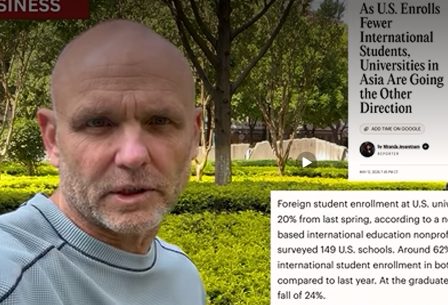
Tens of thousands of US university jobs at risk as Chinese students — and their money — stay home
or go to
Aletho News Archives – Video-Images
From the Archives
Cuba and the Jewish Lobby
“The Cuba-America Jewish Mission is the main source of information at the US State Department”
Rehmat’s World | December 4, 2013
… Cuba is home to 15,000 Jews. Before Fidel Castro established communist rule in Cuba in 1959, Cuba was considered very friendly to Jews and Israel under former dictator Fulgencio Batista (died 1973).
Batista helped the World Zionist Movement in the airlift of 150,000 Jews from Iraq, Iran, Yemen and India to help European Jewish terrorist groups set-up Jewish settlements on Arab land during 1951-52. Cuban businessman Narciso V. Roselló Otero with Israeli connections sponsored those flights. Later he became President of the new Cuban airline Aerea de Cuba. – Full article
Blog Roll
 Aletho News
- Reporters Without Borders calls for EU to close loopholes allowing Europeans access to censored Russian media
- Two Palestinians killed, others injured in Israeli attacks on Gaza
- Ex-Pentagon official: US ‘intentionally targeting Iranian civilians’
- Sanctioning a Ghost: Europe’s Empty Gesture Against Iran
- West not safe from Ukrainian terror – Moscow
- Ukrainians in Indian jail involved in drone attack on Myanmar passenger plane – report
- Tens of thousands of US university jobs at risk as Chinese students — and their money — stay home
- A proposal seeks to exploit Americans’ debt to force them into wars against Israel’s enemies
- Israel’s plan for forced transfer with international complicity remains on the table
- Nearly half of US citizens say Washington’s post-9/11 wars ‘worth the cost’
- If Americans Knew
- Palestinian American returns to besieged West Bank home but Israeli settlers remain
- US House passes bill penalizing universities that participate in boycott of Israel
- Israeli Defense Minister Ben Gvir posts Palestinians on conveyor belts to detention camps. The world is silent
- “Board of Peace” Billionaire Backs AIPAC Fund Targeting Pro-Palestine Candidates
- What do you do when you can’t hear the bombs? Being deaf during the Gaza genocide.
- Ben Gvir: After Gaza genocide, we ethnically cleanse the rest – Daily Update
- ADL head Jonathan Greenblatt says ADL doesn’t exist “for some universalist ideal, we exist to protect the Jews”
- Appeal to Pope Leo XIV: To Organize a Global Leaders Summit to Address the Questions of Peace and Nuclear Disarmament
- Haley Stevens Smears Bernie Sanders and Abdul El-Sayed, Calls Anti-Zionism a ‘Sickness’
- Netanyahu, Katz, Trump keep saying the quiet parts out loud – Daily Update
- No Tricks Zone
- New Study: Antarctic Ice Melt Has Contributed Less Than 1 Centimeter To Sea Level Rise In The Last 30 Years
- Fear Of Debate: Alarmist German Climate Scientist Calls On Mainstream Media To Discredit Skeptic Voices
- End-Of-August Arctic Sea Ice Extent Hasn’t Fallen In 20 Years, Official Data Show!
- News-Making Nepal Region Has Had As-Warm Or Warmer Periods Than The 2000s In The 1600s, 1700s, 1800s
- 2025 Study: ‘There Exists No Unequivocal Experimental Evidence For The CO2 Greenhouse Effect’
- 2026 Atlantic Cyclone Energy Index Running At 85% Below Normal!
- New Research Shows Soil Respiration And Temperature Drive CO2 Change, Not Humans
- Comparison Of Two German Weather Forecasts: From 25 Years Ago And From Today
- Veteran Swiss Meteorologist On Germany’s Recent Heat Wave: “You’re A Really Crazy Country”
- New Research Documents The Lack Of Any Net Decline In GBR Coral Cover Since The 1980s
 Aletho News