EU rejects US-mediated Black Sea ceasefire deal
RT | March 27, 2025
The EU will not fulfill Russia’s demand to lift sanctions on the country’s main agricultural bank as part of the Black Sea ceasefire initiative discussed between Moscow and Washington, European Commission Foreign Affairs spokeswoman Anitta Hipper has said.
During the talks between Russian and US experts in Riyadh on Monday, the sides agreed to move towards reviving the Black Sea Grain Initiative, which, according to the Kremlin, should include the removal of Western restrictions against Russian Agricultural Bank and other financial institutions involved in the international sale of food and fertilizers. The maritime ceasefire is seen by Moscow and Washington as a step towards settling the Ukraine conflict.
In her interview with the Financial Times on Wednesday, Hipper insisted that “the end of the Russian unprovoked and unjustified aggression in Ukraine and unconditional withdrawal of all Russian military forces from the entire territory of Ukraine would be one of the main preconditions to amend or lift sanctions.”
“The EU’s main focus remains to maximize pressure on Russia, using all tools available, including sanctions, to diminish Russia’s ability to wage its war against Ukraine,” she insisted.
US President Donald Trump confirmed on Tuesday that his administration is considering lifting some curbs against Moscow, saying that “there are about five or six conditions. We are looking at all of them.”
Ukrainian leader Vladimir Zelensky claimed later that Kiev did not agree to the maritime truce due to it representing “a weakening of positions and a weakening of sanctions” against Russia.
The Black Sea Grain Initiative, originally brokered in July 2022 by the UN and Türkiye, envisioned the safe passage of Ukrainian agricultural products in exchange for the West lifting its restrictions on Russian grain and fertilizer exports. Moscow withdrew from the deal a year later, citing the West’s failure to fold up its obligations.
Kremlin spokesman Dmitry Peskov said on Wednesday that the maritime truce could take effect only once certain conditions set out by Russia are met. “Of course, this time justice must prevail, and we will continue our work with the Americans [on the Black Sea Initiative],” Peskov stressed.
Kiev keeps breaking energy ceasefire – Moscow
RT | March 27, 2025
Ukrainian forces have targeted Russian energy infrastructure on three occasions over the course of 24 hours in violation of a US-mediated moratorium on such attacks, the Defense Ministry in Moscow reported on Thursday.
The incidents included a drone strike in Bryansk Region that disabled a high-voltage power line, an artillery strike on a transformer station in the same part of Russia, as well as what the military believe to be an attempted kamikaze drone strike targeting an underground natural gas storage facility in Crimea. In the latter episode, the Ukrainian aircraft was intercepted as it neared the target, the statement read.
On March 18, the Russian military was ordered to refrain from attacking Ukrainian energy infrastructure under a deal that was agreed upon by President Vladimir Putin and his US counterpart, Donald Trump. Ukraine’s Vladimir Zelensky has publicly supported the 30-day partial ceasefire, which should involve a reciprocal suspension of attacks by Kiev’s forces.
The Russian Ministry of Defense, however, has reported multiple Ukrainian violations of the agreement, which it described as aimed at undermining Trump’s mediation efforts between Moscow and Kiev. Kremlin spokesman Dmitry Peskov said on Wednesday that the Kremlin will honor its obligations despite Ukrainian actions, since the agreement represents positive diplomatic engagement with the Trump administration.
Earlier this week, US officials met separately with Russian and Ukrainian delegations in Saudi Arabia. Following the talks, Moscow said it was willing to revive the Black Sea Grain Initiative, an arrangement that was originally mediated by the UN and Türkiye and expired in 2023.
The original deal was meant to facilitate Russian and Ukrainian exports of grains and fertilizers. Moscow, however, pulled out of the arrangement, citing a lack of progress in the lifting of Western sanctions on its commerce, which it expected to get under the initiative. Moscow is prepared to reinstate the initiative if these commitments are honored, Peskov has said.
‘The resistance must continue’ – Macron hands Zelensky €2 billion in military aid
Remix News | March 27, 2025
French President Emmanuel Macron hosted the Ukrainian President Volodymyr Zelensky for a working dinner ahead of a meeting of the Coalition of the Willing tomorrow, but Zelensky was there for more than just a free meal.
“France sends a message of friendship and support. We are and will remain on Ukraine’s side,” Macron said at a joint press conference with Zelensky, announcing that his country would provide €2 billion in military aid to Ukraine.
“We must continue to provide immediate support to Ukraine. The resistance must continue. I have announced an additional €2 billion in support,” Macron said, writes Magyar Nemzet. The support still includes Milan anti-tank missiles, air defense systems, such as the previously delivered MICA missiles mounted on Mirage aircraft, and Mistral surface-to-air missiles.
Ukrainian forces will also receive VAB armored vehicles and AMX–10 RC tanks, as well as a wide range of ammunition, some of which is remotely controlled, and drones. The French president added that there are ongoing discussions surrounding satellite and intelligence cooperation involving Ukrainian manufacturing, “thanks to partnerships with our defense companies.”
“We have entered a new era, and Russia’s aggressiveness not only poses a challenge to global order and world stability, but also has a very direct impact on our European security,” Macron stressed, adding that he expects Russia to also commit to the 30-day unconditional ceasefire Ukraine agreed to.
For his part, Zelensky remarked on sanctions, saying: “Sanctions against Russia must remain in place and be strengthened as long as the Russian occupation lasts.” Moscow understands no other language than the language of force, that is a fact.”
He also touched on the possibility of deploying foreign soldiers in Ukraine, which will be discussed at the Coalition of the Willing in Paris, which will be held tomorrow.
Zelensky also highlighted France’s “unwavering support” for Ukraine, adding that he believes “much can and should be done for the security of Europe.”
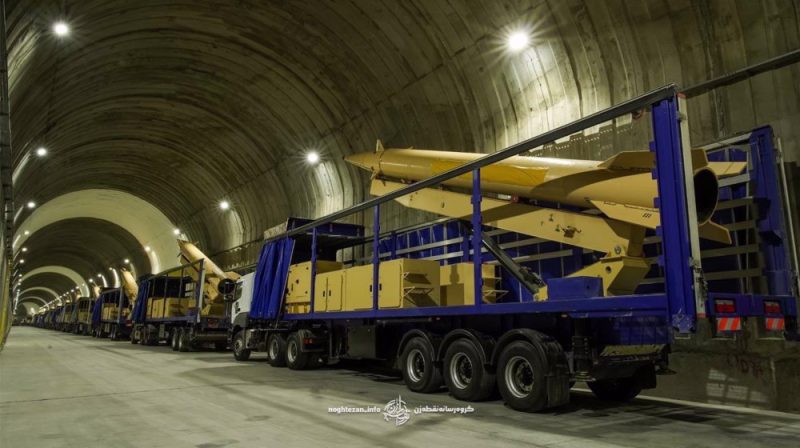
Explainer: What does Iran’s newly-unveiled largest subterranean ‘missile city’ reveal?
By Ivan Kesic | Press TV | March 26, 2025
The Islamic Revolution Guards Corps (IRGC) on Tuesday unveiled its largest underground missile city at an undisclosed location, sending a powerful message to enemies about Iran’s growing military prowess and complete readiness for any eventuality.
The subterranean facility was revealed in the presence of Chief of Staff of the Iranian Armed Forces, Major General Mohammad Bagheri, and IRGC Aerospace Commander, Brigadier General Amir Ali Hajizadeh.
Its unveiling comes amid escalating threats and blatant warmongering from the Donald Trump administration and the Israeli regime, prompting Iran to showcase its military preparedness to defend the homeland.
Just three days prior, the IRGC had unveiled new missile systems on three strategic islands in the Persian Gulf, capable of striking enemy bases, vessels, and assets across the region.
In recent years, the IRGC has released images of various underground bases, but this latest facility stands out as the largest yet, both in scale and firepower.
What ballistic missiles are stored in this underground base?
During the latest unveiling, it was revealed that a wide array of ballistic missiles—including Kheibar Shekan, Haj Qasem, Emad, Sajjil, and Ghadr-H, as well as Paveh cruise missiles—are stored in this missile city.
In a single frame, at least 78 Kheibar Shekan or Haj Qasem missiles were visible, with additional footage showing tunnels filled with dozens more, suggesting that the base houses at least hundreds, if not thousands, of missiles.
Some of these missiles, such as Kheibar Shekan, Ghadr, and Emad, were used in the True Promise I and II retaliatory operations against the Zionist entity last year that sent shockwaves across the world.
These operations demonstrated Iran’s capability to strike Israeli military and intelligence targets with high precision, penetrating much-hyped and advanced Israeli and American air defense systems.
During his visit to the facility, Major General Bagheri emphasized that “Iran’s iron fist is far stronger today than before,” stating that the current missile capacity is ten times greater than during past operations.
He further asserted that “the enemy will definitely fall behind in this balance of power,” signaling Iran’s continued advancement in missile development and underground military infrastructure.
What is the purpose of underground bases?
Iran’s underground missile bases are fortified military facilities constructed beneath the Earth’s surface to store, maintain, and launch ballistic missiles of short (SRBM), medium (MRBM), and intermediate range (IRBM).
Often referred to as “missile cities” by Iranian officials, these bases form a key component of Iran’s defense strategy, designed to shield its vast and burgeoning missile arsenal from detection and destruction during conflicts.
In addition to offering natural protection against aerial threats, these underground bases allow military operations to be carried out in complete secrecy, avoiding exposure to aerial reconnaissance.
The exact number of these facilities remains a closely guarded secret, but estimates suggest there are dozens of them, mostly located in the western mountainous regions.
Brigadier General Hajizadeh in a TV interview recently commented on the vast number of missile bases in the country, stating, “If we unveil a missile city every week for the next two years, it will still not be finished.”
The IRGC has frequently released footage from these underground bases, and analysis of tunnel shapes and weaponry confirms that they are distinct facilities.
In 2018, the IRGC announced the relocation of missile factories to underground bases, marking the first time images from a subterranean ballistic missile production plant were publicly released.
Beyond missile bases, Iran has also constructed underground air bases for jet fighters, underground naval bases for speedboats and missiles, and underground drone facilities.
How protected are these underground bases?
With modern satellite, reconnaissance, and intelligence technology, fully concealing the locations of such underground bases is impossible, particularly due to excavation debris and construction logistics.
However, this does not make them vulnerable, as they are typically carved into mountains, with depths reported to reach up to 500 meters, providing protection against airstrikes and nearly all bunker-busting munitions.
All critical facilities are located hundreds of meters inside the mountains and are practically indestructible, with multiple entrances and exits being their only potential weak points.
To mitigate this, each base has up to several dozen entrances. The destruction of one or even a few does not cause significant damage, as they are typically hundreds or thousands of meters apart, separated by multiple tunnel gates.
Iran has refined camouflage techniques and the creation of false entrances to ensure operational continuity, even under complete enemy air dominance.
Based on published images and videos, these bases feature arched tunnel designs, optimal for load distribution, arranged in either linear or grid formations.
Tunnels range from 6 to 12 meters in width, sometimes reinforced with concrete ceilings, and serve as corridors, missile storage areas, and parking spaces for transporter-erector launchers (TELs).
In some cases, high halls are visible, suggesting the utilization of natural caves to reduce excavation costs and complicate hostile intelligence assessments based on excavation debris.
How are ballistic missiles stored in these bases launched?
Ballistic missiles stored in these bases are launched in two ways: either by deploying the transporter-erector launcher into the open or using vertical silos.
Each base contains numerous silos—often several dozen—as they, along with entrances, are potential vulnerabilities.
Once a silo is used, the hot exhaust trail from rocket engines irreversibly reveals its position, making it a prime target for aerial bombs or cruise missiles.
To counter this, Iran has developed unique underground launch methods to enhance both effectiveness and stealth.
In 2020, Iran released footage of an underground missile system capable of launching multiple ballistic missiles from a single silo in rapid succession.
In other countries with underground missile bases—where such facilities are typically used for bulky intercontinental ballistic missiles (ICBMs) within nuclear deterrence strategies—each silo usually holds only one missile.
By contrast, Iran’s system functions more like a “semi-automatic” magazine-fed launcher, rather than a “single-shot” silo.
Footage shows five Emad missiles positioned for vertical launch on a single rail car, which then moves down a high tunnel toward the launch site.
The tunnel’s length and rail system suggest it can rapidly launch dozens of missiles before a potential counterstrike, with multiple silo openings likely enabling continuous barrages.
That same year, during the Payambar-e-A’azam (The Great Prophet) 14 drills, Iran demonstrated a unique camouflaged underground ballistic missile launch, bypassing conventional platforms and equipment.
Brigadier General Hajizadeh stated that Iran was the first country in the world to achieve such a launch capability, posing significant challenges to enemy intelligence agencies.
The released video shows two missiles launching from different locations on what appears to be an untouched surface, suggesting that the vertical launch tubes were constructed from below rather than being dug from above and later camouflaged.
This demonstration signaled that Iran’s underground missile bases, often covering dozens of square kilometers, may house countless concealed silos.
The High Price of War with Iran: $10 Gas and the Collapse of the US Economy
By Dennis J. Kucinich | March 25, 2025
Israel is currently in turmoil, marked by widespread protests demanding Netanyahu’s resignation. Critics accuse him of prolonging war for political gain, while his dismissal of top security officials and ongoing attacks on the judiciary have further intensified the unrest.
Meanwhile, Washington DC’s drumbeat for war never stops. It’s always at the expense of a decent and secure standard of living for people in this country and abroad.
The Trump Administration, after the series of heady airstrikes against Yemen, is at this moment being beseeched by Netanyahu and his associates to prepare for a seemingly consequence-free nuclear strike against Iran, completing the trifecta of Netanyahu’s long-standing dream.
I have consistently warned against the consequences of an attack on Iran, delivering 155 speeches to the House, 63 presentations alone in the 109th Congress, between 2005 and 2007, when the Bush Administration deliberated using nuclear “bunker-busters” as a means of bringing Iran to heel.
I understood the politics then and I understand them today. I warned hundreds of times that it was not in America’s interests to go to war against Netanyahu’s hit list: Iraq, Iran, Libya…
IRAQ
In 2002, the Bush Administration caused Americans grieving over 9/11 to believe Iraq had a direct role in the attacks which took over 3,000 lives. Except, Iraq had nothing to do with 9/11.
Bush claimed Iraq was pursuing nuclear weapons and other “Weapons of Mass Destruction” (WMDs) and was an imminent threat to the U.S. Iraq did not have WMD’s. Iraq was not a threat to the U.S. Iraq had no ability to attack America. Didn’t matter.
The war against Iraq began 22 years ago and lasted eight years. One million innocent Iraqi men, women and children perished because of lies. They were killed in relentless bombings and aggressive ground operations.
At least 4,443 U.S. servicemen and women were killed, and an estimated 32,000 wounded during “Operation Iraqi Freedom,” because of lies.
The lies cost U.S. taxpayers at least $3 trillion. Three trillion hard-earned tax dollars of the American people were spent to pay for the destruction of the people of Iraq while Americans struggled to pay bills for housing, health care, and education and the nation went further into debt.
Remember this diabolical playbook: Create a pretext. Lie to the American people about a threat. Hype the threat. Create irrational fear. Tell them military action is needed to eliminate the threat, and their fears. Bombs away.
On September 12, 2002, as a Member of Congress, I grilled then-former Israeli Prime Minister Benjamin Netanyahu during a congressional hearing entitled, “An Israeli Perspective on Conflict with Iraq” (video and transcript link below). Despite evidence to the contrary, he testified that Iraq and its leader, Saddam Hussein, were a direct threat to America due to an alleged pursuit of WMDs including a nuclear weapon. He urged the U.S. to take military action against Iraq.
I inquired of him who else he would have the United States attack.
“Iran and Libya,” he said.
I spoke to Mr. Netanyahu outside the hearing room and asked him that if he was so convinced those countries were a threat, why didn’t Israel commence the attacks?
“Oh no,” he responded. “We need you to do it.”
On October 10, 2002, the House of Representatives, by a vote of 296-133, authorized the use of military force against Iraq. I led the opposition. The war bill passed the Senate the next day, 77-23, and was signed into law by President Bush on October 16, 2002.
On March 20, 2003, the President describing Iraq as part of an “Axis of Evil,” commenced a “Shock and Awe” onslaught by American warships, aircraft and submarines, launching cruise missiles and “precision guided bombs” roundly murdering people in Baghdad. Iraq was destroyed. Saddam was deposed, captured and hung.
Libya
On March 19, 2011, despite lacking formal congressional authorization, President Barack Obama authorized an attack on Libya to depose Muammar Gaddafi. I led the opposition. Hillary Clinton’s State Department, the EU, NATO, the UK and France to name but a few, lobbied Congress hard to accelerate actions against Libya.
That country’s leaders were dumbfounded as to why, considering that they had done everything America had asked, such as open markets to foreign investment. I held up the bombing for some time by building a bi-partisan coalition of Members of Congress to vote no.
Alas, Obama and the Clinton State Department prevailed. Republican Speaker of the House John Boehner negotiated a redraft of the authorization bill and the Republicans fell in line.
The U.S., with NATO allies, joined forces, wreaking destruction and havoc upon Libya. Gaddafi was deposed, captured and killed, at an estimated cost of over a billion dollars. Obama admitted years later that this was the worst decision of his Presidency.
Iran
On July 25, 2024, Prime Minister Netanyahu, (while under a criminal investigation by the Israeli judiciary), addressed the U.S. Congress concerning Iran, which he characterized as not only a deadly enemy of Israel, but also of the United States.
“Iran’s axis of terror confronts America, Israel and our Arab friends,” Netanyahu declared.
The interests of Israel and America were and are inseparable, he proclaimed – to 58 standing ovations. One could take that heroic reception as rubberstamping an authorization for war. As Netanyahu had told me years ago, “…we need you [the U.S.] to do it.”
Today, the Houthis of Yemen continue their attacks on Israeli shipping interests in the Red Sea, in protest to the Netanyahu government’s genocidal attack on Gaza.
President Trump, ever sensitive to and allegiant to Israel, views the Houthis as proxies of Iran. The President directed America’s air forces to rain down fire and brimstone upon Yemen, a nation of teenagers. The median age in Yemen is 18.4 years. The country spends about 1/1000 of the U.S. military budget for its own defense.
Trump threatened the Iranian government: “Every shot fired by the Houthis will be looked upon from this point forward, as being a shot fired from the weapons and leadership of IRAN (his emphasis). And IRAN will be held responsible, and suffer the consequences, and those consequences will be dire.”
The Administration followed up with Executive Order (E.O.) 13902, which, according to the U.S. Treasury Department was part of a “campaign of maximum pressure” which “targets Iran’s petroleum and petrochemical sectors and marks the fourth round of sanctions targeting Iranian oil sales…”
The first Trump Administration withdrew from a Joint Plan of Action agreement (JCPOA) which provided Iran relief from sanctions in exchange for accepting limitations which would preclude nuclear weaponization.
President Trump ordered the assassination by drone strike of Iranian General Qasem Soleimani, considered the second most powerful person in Iran, at the Baghdad airport, underscoring his determination to strike at Iran.
Iran has consistently asserted its nuclear research is for peaceful purposes. There has been a long-standing formal prohibition in Islamic law, a fatwa, issued by Ayatollah Ali Khamenei, the Supreme Leader of Iran, against the development or use of nuclear weapons.
Recently, President Trump said he would love a deal to prevent Iran from having a nuclear weapon, “I would love to make a deal with them without bombing them.”
At the same time, U.S. B-52 bombers, capable of delivering nuclear bunker-busting bombs, were engaged in joint exercises with the Israeli Air Force, in preparation for a potential strike at Iran’s underground nuclear sites.
These joint maneuvers were reminiscent of the cooperation and interoperability exercises that took place between the UK and French forces in preparation for a real-world offensive against Libya in 2011.
Ayatollah Khamenei replied “…threats will get them (the Americans) nowhere,” and refused talks under such conditions as “deceptive.” Iranian Brigadier General Kiumars Heidari added, for emphasis, “Iran is ready to crush its enemies if it makes mistakes.”
The dialectic of conflict is escalating.
It was not in America’s interest then, nor is it now, to go to war with Iran, a nation of 90 million people, a technologically advanced society, with nearly a million-person army.
President Trump should not be misled. War with Iran would be the end of his presidency. Here is why:
Iran supplies 3% of the world’s oil. If the U.S. goes to war with Iran, crude oil prices per barrel (currently ranging from $68.86 (West Texas Intermediate) – $72.28 (Brent Crude), could rise to $200 per barrel.
The Strait of Hormuz, a major conduit for the transport of oil would be disrupted. Iran has the capability retaliate by targeting Gulf oil infrastructure, including Saudi Arabia. Market panic would ensue.
The price of a gallon of gas, currently averaging $3.13, would double, approach $7 a gallon, and in some cases, reach $10 a gallon, in states with higher fuel taxes. (This is based on historical data which calculates that every $1 increase in crude oil per barrel translates to about a 2 to 3 cent increase per gallon at the pump).
Attempts to manage supply disruptions and market distortions through the release of oil from the Strategic Petroleum Reserve would do little to offset panic buying and stockpiling by consumers. Nor would an increase in U.S. domestic drilling be sufficient to offset lost Middle East oil supplies, due to supply shortage, infrastructure constraints and limitations on refining capacity.
Major disruptions, including high inflation, recession risks, and market instability would hit the US economy. Consumer retail spending would sink while prices rose for food and other goods, as energy costs for manufacturing, agriculture and transportation spiraled out of control.
Slower economic growth would push the U.S. into a recession, with the Fed forced to try to maintain control over inflation by hiking interest rates well beyond the current 4.25% – 4.50 % range.
Auto sales would take a hit. Corporate profits in transportation, airlines, trucking would nosedive. The Dow Jones and S& P 500 would be in shock, with major selloffs. America would arrive at stagflation, high inflation rates and negative growth as it did during the 1973 Oil Embargo.
The multiple economic impacts of the 2008 subprime meltdown and subsequent financial crash which cost the US economy $16 to $20 trillion dollars would become the morbid benchmark for the descent of the American economy.
Now contemplate this concatenation: War with Iran, reciprocal high tariffs, massive cuts in the federal workforce and domestic federal spending and you have an economy in a tailspin, with high inflation, rising unemployment, falling consumer spending, leading to an economic contraction requiring a system of government intervention which is currently being dismantled. Then there is the permanent restructuring of the tax code to accelerate wealth upwards. These conditions create political combustibility.
In the end, Iran will never crush Donald Trump. The U.S. will crush itself trying to wipe out Iran.
The economic effects of war with Iran could spell the end, not only of the viability of the Trump Presidency, but of the Republican House and Senate, a political turnaround the likes of which has not been seen in American politics since the 1932 sweep led by Franklin Delano Roosevelt and the New Deal.
In 1928 Republican Herbert Hoover took 58.2% of the popular vote and defeated Democrat Al Smith 444-87 in the Electoral College. Amidst a complete rejection of Republican economic policies and the Depression, Roosevelt took 57.4% of the popular vote in 1932 and defeated Hoover in the Electoral College 472-59.
The 270-164 advantage which House Republicans held in 1928 evaporated in 1932 as Democrats crushed Republicans with a 313-117 majority.
There has not been another turnaround like this in American political history and it was driven by the economic forces which overwhelmed a Republican Administration, followed by a program of promised reform which the new Administration delivered.
While the Administration is at the fullness of its expression of unbridled power, it faces a fateful decision regarding Iran which will determine whether the mandate received by Trump in 2024 evaporates as quickly as did Hoover’s in 1932.
Israel itself is in turmoil, with mass protests calling for Netanyahu’s resignation, charges he is prolonging the war for his political benefit, his firing of top security officials and his attacks on the judiciary.
Netanyahu is on shaky ground, pummeled by his fellow countrymen and women who worry, far from ensuring the future of Israel, his deadly policies threaten it.
One could imagine Trump, considering his own and America’s interests, could call Netanyahu and say, “Bibi, we are friends ‘til the end. This is the end.”
Links: 2002 Congressional Hearing “Conflict in Iraq: An Israeli Perspective” video and transcript
Talk of US-Iran war is all a load of baloney
By M. K. BHADRAKUMAR | Indian Punchline | March 26, 2025
The air is thick with the prognosis that a military confrontation between the US and Iran is now just a matter of time. Going by the pattern of such scare mongering in the past decades, Israeli media management skills are self-evident. There is a sense of de javu. Of course, therein lies the danger of miscalculations by the protagonists but that is unlikely to happen.
There are no takers among the regional states for a military conflagration in the Gulf region. The old US-led anti-Iran front has unravelled following the shift in the Iranian and Saudi policies towards reconciliation and amity and the display of strategic autonomy by even those countries who still remain close allies of the US (in particular, Saudi Arabia, the UAE, Qatar.)
In a recent interview with the famous American podcaster Tucker Carlson, Qatar’s Prime Minister and Minister of Foreign Affairs Sheikh Mohammed bin Abdulrahman Al Thani drew an apocalyptic scenario that his country and the Persian Gulf Arab states will run out of water within three days if Iran’s nuclear facilities are targeted by the US or Israel! Does that occur to anyone?
The big question is, what are the intentions of the Trump administration. An underlying assumption here is that President Donald Trump is under obligation to the Jewish-Israeli lobby who funded his election campaign to be supportive of Netanyahu all the way through thick and thin. This assumption is untested yet and may never be, perhaps, given Trump’s complex personality as a deal maker.
According to a recent poll from YouGov, 52% of Americans think Trump will have a shot at a third term; former White House strategist Steve Bannon is convinced that Trump will run and win in 2028. Indeed, Trump himself has not ruled out a 2028 White House bid. This is an X factor, given the historical legacy that the Iran question ultimately proved to be the nemesis of Jimmy Carter’s presidency. Trump, a connoisseur of past American presidencies, cannot be unaware that he ought to tread with great circumspection.
In an interview with Tucker Carlson last week, Trump’s Middle East special envoy Steve Witkoff underscored that regional stabilisation in West Asia demands addressing Iran. In his words, “I would say the goal begins with how do we deal with Iran? That’s the biggie. So the first is nuclear… If they were to have a bomb that would create North Korea in the GCC, we cannot have that… we can never allow someone to have a nuclear weapon and have outsized influence. That doesn’t work. So if we can solve for that, which I’m hopeful that we can.
“The next thing we need to deal with Iran is they’re being a benefactor of these proxy armies because we’ve proven that … they’re not really an existential risk… But if we can get these terrorist organisations eliminated as risks. Not existential, but still risks. They’re destabilising risks. Then we’ll normalise everywhere. I think Lebanon could normalise with Israel, literally normalise, meaning a peace treaty with the two countries. That’s really possible.
“Syria, too, the indications are that Jelani is a different person than he once was. And people do change. You at 55 are completely different than how you were at 35, that’s for sure… So maybe Jelani in Syria is a different guy. They’ve driven Iran out.
“Imagine if Lebanon normalises, Syria normalises, and the Saudis sign a normalisation treaty with Israel because there’s a peace in Gaza. They must have that as a — without question — as a prerequisite. That’s a condition precedent to Saudi normalising. But now you’d begin to have a GCC that all work together. I mean, that would be, it would be epic.”
Does this ‘big picture’ envisage the destruction of Iran as a prerequisite? Not even remotely. And if anyone should know what he is talking about, it is Witkoff.
Later, towards the end of the interview, Carlson drew out Witkoff specifically with regard to Trump’s recent communication addressed to Iran’s Supreme Leader Ayatollah Ali Khamenei. Excerpts of Witkoff’s remarks are reproduced below:
“Look, he [Trump] sent a letter to the Iranians. Usually it would be the Iranians sending a letter to him…They’re open to attack today. Yeah, they’re a small country compared to ours… If we used overwhelming force, it would be very, very bad for them…
“So under those circumstances, it would be natural for the Iranians to reach out to the President to say, I want to diplomatically solve this. Instead, it’s him doing that. Now, I can tell you that he’s not reaching out because he’s weak, because he is not a weak man. He is a strong man… Maybe the strongest man I’ve ever met in my life…
“So with that all said, he wrote that letter. And why did he write that letter? It roughly said, ‘I’m a president of peace. That’s what I want. There’s no reason for us to do this militarily. We should talk. We should clear up the misconceptions. We should create a verification program so that nobody worries about weaponisation of your nuclear material. And I’d like to get us to that place because the alternative is not a very good alternative.’ That’s a rough encapsulation of what was said…
“The Iranians have reached back out, and I’m not at liberty to talk about specifics, but clearly, through back channels, through multiple countries and multiple conduits, they’ve reached back out.
“I think that it has a real possibility of being solved diplomatically, not because I’ve talked to anybody in Iran, but just because I think logically it makes sense that it ought to be solved diplomatically. It should be.
“I think the President has acknowledged that he’s open to an opportunity to clean it all up with Iran, where they come back to the world and be a great nation once again and not have to be sanctioned and being able to grow their economy. Their economy—I mean, these are very smart people. Their economy was once a wonderful economy. They’re being strangled and suffocated today. There’s no need for that to happen.
“They can join the League of Nations and we can have a better relationship and grow that relationship… That’s the alternative he’s presenting… he wants to deal with Iran with respect. He wants to build trust with them if it’s possible. And that’s his directive to his administration. And hopefully, that will be met positively by the Iranians.
“And I’m certainly hopeful for it. I think anything can be solved with dialogue by clearing up misconception and miscommunication and disconnects between people… And the president is a president who doesn’t want to go to war, and he’ll use military action to stop a war … In this particular case, hopefully it won’t be necessary. Hopefully, we can do it at the negotiating table…”
Again, do such remarks sound like war mongering? Curiously, in the interview, Witkoff openly welcomed an opportunity to serve as Trump’s special envoy to Iran to navigate the dialogue and peaceful resolution of issues.
To my mind, Iranians understand the meaning of Trump’s letter. They are now in an engaging mood as back channels are clocking hours. A commentary by Nour News, a mouthpiece of the Iranian security establishment, rather playfully titled as Analysis of Trump’s Letter to Iran from a Game Theory Perspective, speaks for the mood in Tehran. Read it here.
Make no mistake that Iran and the US are seasoned adversaries who have absolute mastery over the guardrails that contain tensions from escalating in their complicated relationship.
Even Realists Overstate the ‘China Threat’
By Joseph Solis-Mullen | The Libertarian Institute | March 26, 2025
Perusing the most recent edition of Foreign Affairs, which was typically dreadful, one piece caught my eye. In “The Taiwan Fixation,” Stephen Wertheim and Jennifer Kavanagh argued that a full-scale U.S. military intervention over Taiwan would be catastrophic, and that Washington should seek to balance building up Taiwan’s defense while insulating its own broader Indo-Pacific strategy from Taipei’s fate.
Their critique of full-blown interventionism is, of course, well-founded, and was a welcome sight, but their core assumptions remain unfortunately rooted in the flawed logic of American primacy. Even as they downplay alarmist rhetoric, they still accept an overstated vision of China’s potential threat and Washington’s supposed stake in Taiwan.
At its core, “The Taiwan Fixation” fails to escape the same errors that underpin most discussions on U.S.-China relations. It assumes that Taiwan is of critical strategic importance to American security, that China’s control of the island would be an unacceptable shift in the regional balance of power, and that some level of U.S. intervention remains necessary. But as I argued in The Fake China Threat, these claims are fundamentally weak. The United States has no compelling strategic interest in Taiwan, Beijing has little incentive to disrupt regional trade routes, and Taipei itself seems far more interested in lobbying Washington for protection than in seriously investing in its own defense.
Wertheim and Kavanagh attempt to position Taiwan as strategically valuable but stop short of the full-blown liberal internationalist and neoconservative argument that its loss would be a geopolitical catastrophe. Instead, they argue that while Beijing’s control over Taiwan wouldn’t transform China into an immediate hegemon, it would complicate U.S. military operations and potentially embolden China in the region.
This claim doesn’t hold up under scrutiny. Taiwan is not a vital interest of the United States. The U.S. does not need Taiwan for trade, military positioning, or economic security. As Wertheim himself concedes, Taiwan’s loss wouldn’t fundamentally alter the balance of power in Asia. The idea that China could use Taiwan as a springboard for wider expansion is speculative at best—especially when Japan, India, and other regional actors already have strong incentives to counterbalance China regardless of what happens in Taipei.
One of the article’s weakest points is its flirtation with the classic “credibility” argument—the notion that if the United States fails to defend Taiwan, allies like Japan or the Philippines will start doubting Washington’s commitments. This argument has been trotted out since the Cold War to justify interventions from Vietnam to Afghanistan, and it remains just as flimsy today.
Japan’s leaders have already signaled that Taiwan is not a make-or-break issue for them. Despite constant American warnings, no Asian country is poised to abandon its alliance with Washington over Taiwan’s fate. India and Japan, the two regional powers most capable of countering Beijing, already have their own deep-seated strategic reasons to oppose Chinese expansionism. Their security policies aren’t contingent on what Washington does in Taiwan.
If anything, it’s the United States that risks undermining its own credibility by committing to a fight over Taiwan. The more Washington signals an absolute commitment to Taipei’s defense, the more pressure it creates for itself to intervene—setting up a scenario where its own rhetoric forces it into an unnecessary war.
Wertheim and Kavanagh advocate for the “porcupine” strategy—arming Taiwan with asymmetric capabilities like sea mines, missile batteries, and drone fleets to make an invasion costly for China. Superficially, this seems like a clever alternative to direct U.S. intervention. In reality, it risks provoking the very war it is meant to prevent.
If Washington floods Taiwan with weapons and escalates military cooperation, Beijing may conclude that peaceful reunification is no longer viable. As Wertheim himself acknowledges, Taiwan arming itself “too well” could force China’s hand, making an invasion more likely rather than deterring it. This isn’t just theoretical. The logic follows from the same security dilemmas that have fueled arms races throughout history: the more one side hardens its defenses, the more the other feels compelled to strike before it loses its window of opportunity.
This isn’t just a U.S.-China issue—it’s also a question of Taipei’s own incentives. Taiwan has consistently underinvested in its own defense, spending only about 2.5% of its GDP on the military, despite claiming existential threats from Beijing. Why? Because it has calculated—correctly—that lobbying Washington is far cheaper than paying for its own defense. As Ben Freeman has pointed out, Taipei has spent tens of millions lobbying Congress and funding think tanks that push for greater U.S. military commitments. Why spend hundreds of billions on weapons when you can spend a fraction of that buying influence in Washington?
Wertheim and Kavanagh criticize Taiwan for failing to reorient its defense spending but still assume that Washington should step in and “encourage” (i.e., coerce) Taipei into adopting a more robust posture. But if Taiwan itself is unwilling to make the necessary sacrifices, why should American taxpayers foot the bill? The answer is simple: they shouldn’t.
Perhaps the most glaring omission in “The Taiwan Fixation”—one that even realists like Wertheim often overlook—is that Taiwan is not a separate state in the conventional sense. It remains, officially and historically, a part of China. The Chinese Civil War never formally ended, and U.S. intervention in the Taiwan issue has always been an act of interference in a domestic Chinese conflict.
Imagine if, at the height of the American Civil War, Britain had not only recognized the Confederacy but armed it and promised to fight the Union on its behalf. That’s essentially the position Washington has taken with Taiwan. The United States has no legitimate role in deciding the island’s future. Every time it sells weapons to Taipei or conducts military exercises in the Taiwan Strait, it is actively inserting itself into a conflict where it has no rightful place.
The logical conclusion of this reality should be clear: Taiwan is China’s problem, not Washington’s. Wertheim does acknowledge that American policy should aim for “competitive coexistence” rather than outright confrontation. But he stops short of drawing the real conclusion, one that follows naturally from his own arguments: the United States should be preparing to disengage from Taiwan entirely, not reinforcing its involvement.
Wertheim and Kavanagh offer a more grounded view of Taiwan policy than the usual Beltway hawks, but their analysis still rests on faulty assumptions. They recognize that Taiwan’s fate doesn’t justify war, yet they continue to insist that some American involvement is necessary. They acknowledge that China wouldn’t become a global hegemon even if it took Taiwan, yet they still assume that its loss would significantly damage U.S. interests. They see the dangers of arming Taiwan too aggressively, yet they continue to endorse the porcupine strategy.
Ultimately, their view of Taiwan remains a product of Washington’s obsession with maintaining primacy rather than accepting a multipolar reality. The United States does not need to “fix” Taiwan policy—it needs to let it go. The alternative is continued entanglement in a conflict that serves no vital American interest and risks dragging Washington into an unwinnable war.
The real China threat isn’t a military one—it’s the threat of policymakers manufacturing crises where none need exist. If the U.S. truly wants to avoid war, it should stop making Taiwan a battlefield of its own choosing.
Western support won’t secure victory for Kiev – US intelligence
RT | March 26, 2025
Western military aid to Kiev and sanctions against Russia cannot shift the balance of power in the Ukraine conflict, according to the US Intelligence Community’s 2025 Annual Threat Assessment.
The intelligence community’s official coordinated evaluation of an array of threats lists Russia, China, North Korea and Iran as countries which represent a challenge to US interests.
Moscow holds the advantage on the battlefield, having adapted to outside efforts to assist Ukraine, the report’s authors explain. The “grinding war of attrition” is expected to further weaken Kiev, “regardless of any US or allied attempts to impose new and greater costs on Moscow.”
While the conflict has taken a significant toll in terms of manpower, the assessment notes that it has also afforded Moscow “a wealth of lessons regarding combat against Western weapons and intelligence in a large-scale war.”
This experience probably will challenge future US defense planning, including against other adversaries with whom Moscow is sharing those lessons learned.
Russia has proven to be “adaptable and resilient” during what it views as a Western proxy war, enhancing its military capabilities across several domains, including unmanned systems, electronic warfare, and the integration of cyber operations with conventional military maneuvers, the report explains.
It warns that Western efforts to undermine the Russian economy “have accelerated its investments in alternative partnerships and use of various tools of statecraft to offset US power, with China’s backing and reinforcement.”
Beijing considers the US use of unilateral sanctions illegal under international law and rooted in a “Cold War mentality.” The US assessment states that major non-Western nations are poised to align with Russia in order to pursue policies that challenge American dominance, such as de-dollarization.
The continuation of the Ukraine conflict risks unintentional escalation, the document cautions. Russia is prepared for such scenarios, armed with a substantial strategic arsenal that includes both conventional and nuclear weapons, as well as cyber-warfare and anti-satellite operations capabilities.
“Russia’s air and naval forces remain intact, with the former being more modern and capable” than at the start of direct hostilities, the report states.
The US intelligence community posits that both Moscow and Kiev may have reasons to avoid a hasty resolution on unfavorable terms. Russian President Vladimir Putin perceives that “positive battlefield trends allow for some strategic patience,” while Ukraine’s Vladimir Zelensky likely fears that a clear defeat could “prompt domestic backlash.”
Russia and US agree to key maritime initiative – Kremlin
RT | March 25, 2025
Russia and the US have committed to advancing the Black Sea Initiative as a step towards settling the Ukraine conflict, according to a statement released by the Kremlin on Tuesday.
The agreement follows the 12-hour talks focused on the Ukraine conflict held on Monday in Saudi Arabia by expert groups from the two countries.
The sides discussed steps to ensure safe navigation in the Black Sea, including a pledge to avoid the use of force and prevent commercial vessels from being used for military purposes, while agreeing on control measures such as ship inspections.
The US has vowed to “help restore access for Russian agricultural and fertilizer exports to the world market, reduce the cost of insurance for maritime transportation, and enhance access to ports and payment systems for such transactions,” according to the Kremlin statement.
The agreement envisions lifting restrictions on Russian Agricultural Bank and other financial institutions involved in international trade of food and fertilizers, including reconnecting them to the SWIFT payment system. It also includes removing sanctions on Russian-flagged vessels, port services, and the supply of agricultural machinery and related goods to Russia.
According to the statement, Moscow and Washington have also agreed to develop measures to enforce the 30-day ban on strikes against energy infrastructure in Russia and Ukraine that was agreed last week. There would be an option to extend the arrangement or abandon it if either side fails to comply.
The two sides also welcomed the involvement of third countries in supporting agreements on energy and maritime matters.
The US and Russia “will continue efforts to achieve a lasting and sustainable peace,” the statement concludes.
Originally brokered in July 2022 by the UN and Türkiye, the Black Sea Grain Initiative aimed to ensure the safe passage of Ukrainian agricultural exports in return for the easing of Western restrictions on Russia’s grain and fertilizer trade. Moscow did not renew the deal in 2023, citing the West’s failure to uphold its commitments.
Kaja Kallas: The EU’s Struggling Foreign Affairs Chief and the Deepening Divide Over Ukraine
By Ricardo Martins | New Eastern Outlook | March 25, 2025
Kaja Kallas’ hardline stance on Russia and failure to unify EU nations have weakened her position as the EU’s Foreign Affairs chief. With the EU out of the negotiation table over Ukraine, internal divisions, diplomatic missteps, and failed Ukraine aid negotiations, is she still fit to lead Europe’s foreign policy?
Why Has the European Foreign Affairs Chief’s Position Weakened?
The position of the European Union’s Foreign Affairs chief has weakened under Kaja Kallas due to multiple diplomatic missteps, internal EU divisions, and a lack of broad strategic support. The most dramatic setback for EU diplomacy is its exclusion from the negotiating table on ending the war in Ukraine.
Kallas’ tenure has been marked by an anti-Russian stance, an aggressive push for military aid to Ukraine, and a failure to build consensus among EU member states. This has led to her increasing isolation, both within the EU and on the global diplomatic stage. When in Washington, a few days ago, Kallas was left in the waiting room and not received by U.S. Secretary of State Marco Rubio.
The German prestigious newspaper Frankfurter Allgemeine Zeitung has sounded the alarm on the EU top diplomat’s weak performance. One of the main reasons for this decline, according to ZAZ, is Kallas’ inability to secure the backing of key EU nations. Her proposal for a €40 billion aid package for Ukraine was met with resistance, not just from Hungary and Slovakia, but also from France, Italy, Spain, and Portugal. These countries, which have contributed less to Ukraine than Denmark alone, opposed increasing their financial commitment, revealing a deep divide within the EU regarding the war. Kallas also alienated many diplomats by dismissing high-ranking officials from Italy and Spain from the European External Action Service (EEAS), further reducing her influence.
Who is Kaja Kallas, and Why Did Her Anti-Russian Stance Lead to the EU’s Sidelining?
Kaja Kallas, the former Prime Minister of Estonia and a known critic of Russia, became the EU’s Foreign Affairs chief in December. Her strong anti-Russian rhetoric aligns with the Baltic States’ hardline stance, but this position has made her a controversial figure. Instead of facilitating diplomatic engagement, she has pushed for maximum pressure on the continuation of the war, alienating key EU partners that at this stage favour negotiation.
Her insistence on an uncompromising stance against Russia has sidelined the EU in international peace talks. By strongly criticizing Washington’s approach—especially U.S. President Donald Trump’s efforts to pressure Ukraine into a settlement—Kallas further isolated the EU. Her comments referring to a potential U.S.-brokered deal as a “dirty deal” led to a diplomatic snub in Washington, where meetings with key American officials, including Secretary of State Marco Rubio, were abruptly cancelled.
Why Did Kallas Fail to Secure the €40 Billion Ukraine Aid Package?
Kallas failed to secure the €40 billion military aid package for Ukraine due to opposition from several EU countries. While she claimed there was “broad political support,” the reality was different. The resistance came not only from Hungary, which has consistently opposed military aid to Ukraine, but also from France, Italy, Spain, and Portugal. These countries refused to make significantly larger contributions, likely due to domestic economic concerns and political calculations.
The aid package’s failure was also linked to Kallas’ poor strategic approach. She unexpectedly reintroduced the proposal after the Munich Security Conference, without adequately preparing the groundwork or securing commitments from key stakeholders. Her failure to engage Southern European countries, many of whom had closer ties with her predecessor Josep Borrell, weakened her position further.
How the North-South and East-West EU Divide Affects Ukraine Support
The EU remains divided on its Ukraine policy, with a noticeable split between Northern/Eastern European nations and Southern European countries. Countries like Estonia, Poland, and the Nordic states have strongly supported Ukraine, advocating for increased military aid and a hardline stance against Russia. Meanwhile, Southern European nations, led by France, Italy, Spain, and Portugal, have been reluctant to escalate support further.
This divide makes a unified EU approach to Ukraine difficult. Kallas’ failure to bridge these differences has weakened her effectiveness as Foreign Affairs chief, as her confrontational approach has alienated key players in both the EU and broader international diplomacy.
Kallas’ Controversial Tweet and Calls for European Leadership
On February 28, 2025, Kallas tweeted:
“Today, it became clear that the free world needs a new leader. It’s up to us, Europeans, to take this challenge.”
This tweet generated controversy because it was widely interpreted as a criticism of U.S. leadership, particularly in the context of Trump’s renewed approach to Ukraine. Given the EU’s limited ability to act independently in military and geopolitical affairs, Kallas’ call for Europe to take the lead was seen as unrealistic. Some analysts viewed her remarks as undermining further transatlantic relations at a time when European unity and cooperation with the U.S. were crucial.
Is Kallas Following a Strategy of Financial Attrition in Ukraine?
Kallas appears to be following a strategy based on the idea that the Ukraine war will end when no side can afford to continue. This is consistent with the belief expressed by EU diplomats that the conflict will only cease when economic and military exhaustion forces a resolution.
However, this approach carries significant risks. If EU financial support dwindles or political will weakens, Ukraine could find itself forced into a settlement unfavourable to its long-term security. The lack of a clear long-term EU strategy beyond financial and military aid suggests that Kallas’ approach is reactive rather than proactive.
Is Kallas’ Anti-Russia Stance Compromising Her Diplomatic Role?
Kallas’ intense dislike of Russia has undoubtedly compromised her effectiveness as the EU’s top diplomat. Kaja Kallas frequently expresses her personal views and a strong dislike of Putin and Russia in public, even during official events. On several occasions, she has openly stated that she does not trust Putin, overlooking the fact that, in such settings, she is speaking not for herself but on behalf of 27 EU countries and representing a prestigious institution. Such behaviour is widely seen as diplomatically unprofessional.
Diplomacy requires flexibility, negotiation, and relationship-building—qualities that her hardline approach has undermined. By sidelining herself from peace talks, clashing with key EU nations, and alienating Washington, she has weakened her ability to influence the direction of EU foreign policy.
Is Kallas Still Fit to Lead EU Foreign Policy?
There is growing speculation that Kallas may not be able to continue leading EU foreign policy effectively. Her diplomatic missteps, failure in Washington, her failure to unify EU nations, and inability to secure key policy goals have led to increasing criticism. Some EU officials are reportedly considering the appointment of a special envoy for Ukraine, which would effectively bypass her role in one of the EU’s most pressing foreign policy challenges.
Ultimately, while Kallas’ strong stance against Russia aligns with the policies of EU nations, her inability to build consensus and engage in effective diplomacy has weakened her authority. If she cannot adjust her approach, her tenure as EU Foreign Affairs chief may be short-lived.
Ricardo Martins ‒ PhD in Sociology, specializing in policies, European and world politics and geopolitics
Serbia between political destabilization and a new military front in the Balkans
By Lorenzo Maria Pacini | Strategic Culture Foundation | March 24, 2025
Bosnia’s dysfunctional political system, the result of the 1995 Dayton Accords that divided the country into two entities jointly governed by Serbs, Croats (a Catholic majority) and Muslims, with a rotating presidency under international supervision, is inexorably collapsing. In Serbia, protests against corruption and for regime change have been going on for months, and last weekend’s protests were the most impressive to date. Images of the human tide that invaded the streets of Belgrade went around the world in no time at all, but also caused a lot of confusion about the events.
In Bosnia, recent tensions have arisen from the issuance of arrest warrants by the central authorities against the president of the Republika Srpska Milorad Dodik, his prime minister and the president of the parliament. The measures stem from their refusal to comply with the directives of the “high representative” Christian Schmidt, whose appointment in 2021 by the Biden administration was not approved by the UN Security Council. Consequently, neither Dodik nor Russia recognize his authority, believing that his requests aim to reduce the autonomy of the Republika Srpska in order to favor the centralization of the Bosnian state for the political advantage of the Islamic component.
One of Schmidt’s main objectives would be to eliminate the Republika Srpska’s veto on Bosnia’s entry into NATO, which would explain the international pressure on Dodik and the attempt to remove him. Despite the differences between the Biden and Trump administrations, the latter does not seem to actively oppose this strategy. Secretary of State Marco Rubio has accused Dodik of undermining the stability of Bosnia and Herzegovina, stating that the country should not fragment; simultaneously, Dorothy Shea, the US chargé d’affaires at the UN, has expressed support for EUFOR (European Union Force in Bosnia and Herzegovina), hinting at the possibility of intervention against the leadership of Republika Srpska. Nothing new from the western Atlantic front.
In response to these unpleasant provocations, Dodik invited Rubio to a dialogue to present the Serbian point of view and made an interesting proposal: to grant American companies exclusive rights to extract rare earth minerals from the Republika Srpska, a deal with an estimated value of 100 billion dollars, which could attract the attention of the Potus, and emphasized that US policy in the Balkans is still influenced by the so-called Deep State, in particular by elements of the American embassy in Bosnia, historically hostile to Trump.
British involvement in Bosnian tensions cannot be ruled out, considering that the Russian Foreign Secret Service, the SVR, recently denounced the UK’s role in sabotaging Trump’s policy of rapprochement with Russia, almost coinciding with the accusation that Nikolai Patrushev, Putin’s advisor, made towards London, saying that he tried to destabilize the Baltic countries, hinting that he could act in a similar way in the Balkans.
Things are not much better in Serbia
The situation in Serbia is equally delicate. The country has been shaken by protests, which began after a train station incident in Novi Sad last November, fueled by discontent over corruption, with demands for accountability that could lead to a change of government. However, the protest movement is heterogeneous, including both Western-linked groups and Serbian nationalists.
Globalist liberals accuse President Aleksandr Vucic of being too pro-Russian for not having imposed sanctions on Moscow, while Serbian patriots consider him excessively pro-Western for his ambiguous positions on Kosovo, Russia and Ukraine. Vucic, for his part, claims that the protests against him are part of a Western strategy to destabilize him, and Russia itself has allegedly confirmed a supposed plot for a coup against him.
Despite accusations of Western interference, Vucic has maintained cooperation with NATO, signing a “Partnership for Peace” agreement in 2015 allowing the Alliance to transit through Serbia and in August 2024, while facing large-scale protests, he signed a three billion dollar deal with France for the supply of warplanes, raising doubts about the West’s real hostility towards him. Throughout all this, the United States continues to exert pressure on him through various channels.
The tensions in Bosnia and Serbia are not unrelated: the Western objective seems to be for Bosnia to join NATO and for Russian influence in the Balkans to be reduced. If Trump does not oppose the current policy or does not accept Dodik’s offer on rare earths, the risk of an escalation in Bosnia could increase.
Geopolitically speaking, the American doctrine of division and control continues to prevail in the Balkans, seeking to exclude any possible reunification of Bosnia and Serbia.
The only chance for the Serbs to improve their position will be close coordination between Serbia, the Republika Srpska and, if possible, Russia, to counter Western pressure and obtain the best possible result.
NATO takes advantage of the situation
Throughout all this, NATO doesn’t miss the opportunity to take advantage of the situation. The Secretary General, Mark Rutte, has declared that the actions of the Republika Srpska are unacceptable and that the United States will not offer any support to Dodik, a position also reiterated by the American Embassy in Bosnia.
EUFOR has announced that it will reinforce its contingent to deal with the growing tensions, sending reinforcements by land through the Svilaj and Bijaca passes and by air to Sarajevo airport. An excellent excuse to deploy a good number of soldiers to guard what increasingly seems to be a color revolution involving two countries.
Despite growing international pressure, the Republika Srpska can count not only on the support of Moscow and Belgrade, but also on the diplomatic support of Budapest and Bratislava, who have expressed their support for a peaceful resolution of the situation, avoiding participating in veiled military threats.
On March 10, the Chief of Staff of the Serbian Armed Forces, Milan Mojsilović, met his Hungarian counterpart, Gábor Böröndi, in Belgrade and they discussed regional and global security, as well as joint military activities aimed at strengthening stability in the area. The intensity of bilateral military cooperation was reaffirmed, with the intention of expanding it further. Particular attention was paid to joint operations between the land and air components of the two armies, as well as to the contribution of Hungarian forces to the international security mission in Kosovo and Metohija.
It seems clear that the only way for NATO to put an end to Serbian-Bosnian sovereignty is to trigger a new internal conflict, using local armed groups along the lines of what happened in Syria, or a sort of Maidan based on the 2014 Ukrainian model.
The military risk fueled by KFOR
The Kosovo Force (KFOR) is an international mission led by NATO, established in 1999 with the aim of ensuring security and stability in Kosovo, in accordance with United Nations Security Council Resolution 1244.
At the beginning of the operation, it had over 50,000 soldiers from 20 NATO member countries and partner nations. Over time, the presence has been reduced. As of March 2022, KFOR consisted of 3,770 soldiers from 28 contributing countries.
To give an idea of the type of deployment, consider that there are:
– Regional Command West (RC-W): unit based at “Villaggio Italia” near the city of Pec/Peja, currently consisting of the 62nd “Sicilia” Infantry Regiment of the “Aosta” Brigade. RC-W also includes military personnel from Albania, Bulgaria, Croatia, North Macedonia, Poland, Turkey, Austria, Moldova and Switzerland.
Multinational Specialized Unit (MSU): located in Pristina and commanded by Colonel Massimo Rosati of the Carabinieri, this highly specialized unit of the Carabinieri has been present in Kosovo since the beginning of the mission in 1999. The regiment has been employed mainly in the northern part of the country, characterized by a strong ethnic Serbian population, particularly in the city of Mitrovica.
The main operational activities of KFOR include:
– Patrolling and maintaining a presence in Kosovo through regular patrols;
The activity of the Liaison Monitoring Teams (LMT), which have the task of ensuring continuous contact with the local population, government institutions, national and international organizations, political parties and representatives of the different ethnic groups and religions present in the territory. The objective is to acquire information useful to the KFOR command for the carrying out of the mission;
– Support for local institutions, in an attempt not to give in to Serbia’s demands.
These are forces that are deployed and ready to intervene. This is a detail that must be taken into consideration. NATO is not neglecting the strategic importance of that key area of the Balkans.
With their backs to the wall, the governments of Serbia and Republika Srpska don’t have many options: they will soon have to face difficult choices, which could radically change the face of the Balkans.
In short, we are once again at risk of seeing the Balkans explode, as happened just over 100 years ago. Who will be responsible for the explosion this time?
Serbia Will Not Join NATO or CSTO – Deputy Prime Minister Vulin
Sputnik – 24.03.2025
BELGRADE – Serbia will not become a member of NATO or the CSTO, it must ensure its own security, although this is difficult, Serbian Deputy Prime Minister Aleksandar Vulin told Sputnik.
“Serbia strictly adheres to the policy of military neutrality. This means that we will not expand our participation in any military bloc. And we will try to maintain the best relations with everyone, first of all — with the countries in our neighborhood. So Serbia will not become a member of NATO, will not be a member of the CSTO,” Vulin said.
He admitted that for a country the size of Serbia, this is the hardest path.
“We must guarantee our own security, which is not easy. But this is the most honest path — to make decisions about ourselves,” he emphasized.
Currently, the parliament of Serbia is an observer in the CSTO Parliamentary Assembly.
Featured Video

More Iran War fallout: Maritime insurance industry shifts from London to China
or go to
Aletho News Archives – Video-Images
From the Archives
The Biggest Threat to Peace in Middle East
By Dr. Elias Akleh* | Sabbah Report | May 24, 2010
A build up of heightened tension in the Middle East is escalating in the last few weeks. American and Israeli postures towards Lebanon, Syria, and Iran have become more threatening. Listening to speeches of political leaders one hears talks only about war not peace. Iranians and Israelis are continuously training hard for a possible showdown. Both sides are conducting extensive war games every month. This led Syrians to claim that Israel is preparing for a soon-to-come another war. The Jordanians also are warning that current stalemate of the peace process is an indication of a war breaking out this summer. The Russian President and his army chief hinted, a few months ago, that the US and Israel were planning for an attack on Iran.
Indeed Iran is, as it has been for last few years, the target of most of the threats and accusations of supporting terrorism. Escalating incitement against Iran the American Defense Department sent last month (April) to Congress a report on Iran’s military claiming Iran could develop intercontinental ballistic missiles capable of reaching the US by 2015.
Ignoring the fact that N. Korea, India, Pakistan, and Israel are proven to have nuclear weapons while Iran does not, the US Secretary of State Hillary Clinton chose in her speech, to the nuclear Non-Proliferation Treaty review conference at the UN, to focus on Iran’s alleged nuclear ambitions putting the whole world at risk as she put it. According to Clinton Iran’s acquisition of nuclear weapons, rather than Israel’s more than 200 nuclear bombs, is destabilizing the Middle East. She called on the world’s nations to rally around US efforts to hold Iran, not other nuclear countries, to account.
The accusation that Usama Bin Laden is living comfortably in Iran had received a boost after the broadcast of a documentary called “Feathered Cocaine”. This echoed the June 2003 claims of the Italian newspaper Corre de la Sierra that Bin Laden was in Iran according to some intelligence report, and according to Richard Miniter’s book “Shadow War”. … continue
Blog Roll
 Aletho News
- More Iran War fallout: Maritime insurance industry shifts from London to China
- US-Israeli aggression on Iran triggers review of GCC countries’ investment pledges to Washington
- Russia slams UK plan to seize tankers suspected of carrying its oil
- Pakistan ramps up food exports to Persian Gulf nations as war deepens food insecurity
- Iran submits response to US plan, sets terms for war’s end: Tasnim
- US vs Iran: Kharg Island Talk — Bluff or Escalation? Ex-Military Officer Weighs In
- Zelensky unnecessarily involves Ukraine in the Middle East crisis
- Turkish tanker blacklisted by Ukraine hit in drone attack – media
- Canada, the U.S., and NATO: the inescapable trap
- Villains of Judea: Leonid Radvinsky
- If Americans Knew
- ‘No Innocent Children’: Far-right Israeli Lawmaker Defends Killing of Palestinian Family
- Mossad’s promises helped Netanyahu convince Trump that Iran could be toppled
- US Arms Control Official Refuses To Comment When Asked If Israel Has Nuclear Weapons
- Veterans warn US landing could be ‘more Gallipoli than Vietnam’
- Israel may be committing war crimes in Lebanon – Not a ceasefire Day 167
- In the West Bank, life is a constant battle – 3 articles
- Jacob Reses, one of the most powerful pro-Israel operatives in Trump’s Washington
- Israeli-US assaults kill or injure 87 children a day – Not a ceasefire Day 166
- ‘Forever live by the sword’: Understanding Israelis’ massive support for Iran war
- UN’s special rapporteur on human rights says Israel is systematically torturing Palestinians
- No Tricks Zone
- Devastating Assessment Of Comirnaty Vaccine By Former Senior Pfizer Europe Toxicologist
- New Study: CO2 Is ‘Effectively Negligible’ As An Explanatory Climate Change Factor Since 2000
- Former Pfizer Toxicologist Dr. Helmut Sterz Tells Bundestag Hearing Pfizer Vaccine Should Have Never Been Approved
- Energy Expert: Germany’s Nuclear Phaseout Was A “500 Billion Euro Mistake”
- New Research: South Australia’s Mid-Holocene Sea Surface Temperatures Were 4°C Warmer Than Today
- Storing Green Energy To Last Germany 10 Days Would Require A 60-Million Tonne Battery
- New Studies: UK Sea Levels Were 4 Meters Higher Than Today During The Mid-Holocene
- Destructive Green New Deal: German Energy And Metal Group Warns Of Drastic Crisis
- New Study Documents A 20-Year Pause In Arctic Sea Ice Decline – Driven By Internal Variability
- Wake-up Call: Survey Shows Majority Of Germans Now Favor Postponing Climate Targets!
 Aletho News