British nuclear submarine caught fire
RT | November 7, 2022
One of the British Navy’s Vanguard-class nuclear submarines was forced to abort a “top secret mission” after it sustained fire damage, according to a Sunday article published by The Sun.
According to the outlet’s sources, it took the efforts of the entire 130-plus crew, including many who were off-duty, to put out an electrical fire aboard the HMS Victorious, which was carrying Trident 2 nuclear ICBMs at the time of the incident.
While the fire was reportedly contained relatively quickly, the emergency situation declared by the ship’s captain forced the ship to shoot to the surface at an undisclosed location in the North Atlantic to vent out toxic fumes.
A Navy source reportedly explained to The Sun that “every seagoing member of the Royal Navy is a qualified fire-fighter,” and that this ensured that British ships and submarines were able to quickly respond to such incidents without affecting operational outputs.
Nevertheless, the damage caused by the fire prompted the submarine’s captain to abandon an unspecified “top secret mission” and order the vessel to return to base at HMNB Clyde in Faslane, Scotland.
The Sun noted that the 30-year-old vessel, which cost over $3 billion, is one of the Royal Navy’s four non-stop nuclear deterrent patrols. A Royal Navy spokesperson told the paper that the incident has not affected the continuous at-sea deterrent, but declined to provide any further details on submarine operations.
U.S. Stockpiles $290 Million in NIH-Funded Radiation Sickness Drug
By Michael Nevradakis, Ph.D. | The Defender | October 7, 2022
In what pharmaceutical industry publication Fierce Pharma called “a troubling sign of the times,” the Biden administration this week purchased $290 million in anti-radiation drugs.
In an Oct. 4 press release, the U.S. Department of Health and Human Services’ (HHS) Administration for Strategic Preparedness and Response (ASPR) announced the purchase of Nplate, a drug used to treat acute radiation syndrome.
ASPR — the federal agency tasked with preparing for disasters and public health emergencies — said the purchase was made “as part of long-standing, ongoing efforts to be better prepared to save lives following radiological and nuclear emergencies.”
HHS did not clarify why it bolstered the government’s Nplate stockpile, other than describing it as “part of our ongoing work for preparedness and radiological security.”
Officials downplayed any connection to the Russia-Ukraine conflict, adding that the purchase “was not accelerated by the situation in Ukraine.”
However, two days after the announcement, amid growing tensions related to the conflict between Russia and Ukraine, President Biden said the risk of nuclear “Armageddon” is at its highest since the Cuban Missile Crisis in 1962.
The U.S. government in recent months has made several moves signaling a growing level of nuclear preparedness.
For instance, in late September, the Intelligence Advanced Research Projects Activity launched a new program, — Targeted Evaluation of Ionizing Radiation Exposure — which will investigate methods to detect low doses of ionizing radiation.
According to The Register, the investigation will work to “build a new understanding of the effects of low-dose radiation” through the use of technologies such as artificial intelligence, machine learning, biomarker discovery and analytical biography.
The Ohio State University, the University of Washington, Areté Associates and Signature Science received grants to conduct the research over a three-and-a-half year period. The research will occur at Lawrence Berkeley National Laboratory, Los Alamos National Lab and the Armed Forces Radiobiology Research Institute.
Earlier this summer, New York City authorities raised eyebrows with the release of a 90-second nuclear preparedness public service announcement (PSA), which the New York Times described as “bizarre” and as “well watched,” but “not well received.”
At the time, NPR reported that New York City’s emergency management department “wants residents to be prepared if [a nuclear attack] does occur,” but that the PSA left many of the city’s residents “confused.”
Outside the U.S., countries neighboring Ukraine, such as Poland, reportedly began distributing iodine tablets in response to the threat of nuclear fallout related to the Russia-Ukraine conflict as a result of shelling around the Zaporizhzhia nuclear power plant in Ukraine.
Developed under Project BioShield, with funding from numerous government agencies
Nplate is the trade name for the drug romiplostim, approved by the U.S. Food and Drug Administration (FDA) in January 2021 for the treatment of blood cell injuries that result from acute radiation syndrome.
The drug is an artificial protein that promotes the production of platelets — or blood-clotting cells — in the human body.
The drug first received FDA approval in 2008, for the treatment of immune thrombocytopenia, an autoimmune disorder that causes serious bleeding.
Amgen, the drug’s manufacturer, developed Nplate in conjunction with the Biomedical Advanced Research and Development Authority, or BARDA, under the auspices of Project BioShield, signed into law in July 2004 by then-president George W. Bush.
Project BioShield, which incentivizes private companies to develop vaccines and countermeasures for biological, chemical, nuclear and radiological threats, provided funding for the latest $290 million purchase by the HHS.
BARDA — another arm of HHS — garnered attention in recent years for its extensive deals with COVID-19 vaccine manufacturers and for its promotion of COVID-19 countermeasures.
In 2020, BARDA promised Moderna up to $483 million to “shepherd” its COVID-19 vaccine through the FDA approval process.
The National Institute of Allergy and Infectious Diseases (NIAID) — headed by Dr. Anthony Fauci — also contributed to the development of Nplate.
For instance, during an April 2018 oversight hearing of the House Appropriations Subcommittee on Labor, Health and Human Services, and Education, Fauci described NIAID’s involvement in the development and promotion of “radiation/nuclear countermeasure candidates,” including Nplate, for FDA approval under the Animal Rule.
According to the FDA, Animal Rule regulations “allow for the approval of drugs and licensure of biological products when human efficacy studies are not ethical and field trials to study the effectiveness of drugs or biological products are not feasible.”
In the case of Nplate, drugs.com states that the effectiveness of the drug for the purposes of treating radiation exposure “was only studied in animals, because it could not be studied in people.”
Also according to drugs.com, Nplate also is associated with several serious potential side effects, including the increased risk of a blood clot or stroke, an increased risk of developing blood cancers and “harmful effects on your bone marrow that may result in serious blood cell disorders.”
The site states that it is “unknown” if Nplate will cause harm to unborn babies.
Amgen, based in Thousand Oaks, California, describes itself as “A worldwide pioneer in biotechnology.”
The company’s board of directors includes members from The Aerospace Corporation, the David H. Koch Institute for Integrative Cancer Research, Northrop Grumman, Phillips 66, the University of California and Walmart.
The newly purchased stockpile will remain in vendor-controlled inventory, HHS said.
Michael Nevradakis, Ph.D., is an independent journalist and researcher based in Athens, Greece.
This article was originally published by The Defender — Children’s Health Defense’s News & Views Website under Creative Commons license CC BY-NC-ND 4.0. Please consider subscribing to The Defender or donating to Children’s Health Defense.
Japan maintains sanctions but boosts its LNG imports from Russia
Japan’s economic woes are compounded by anti-Russia sanctions
By Ahmed Adel | September 20, 2022
Despite being one of the very few non-Western countries to join the US-led sanctions against Moscow, Japan has suddenly tripled the amount of liquefied natural gas (LNG) imported from Russia to solve its energy problem. Although the Japanese government plans to reduce its dependence on Russian gas supplies, it appears that Tokyo cannot immediately give up gas and fuel from the Eurasian country.
According to the Japanese Ministry of Finance, Japan in August increased the amount of LNG imported from Russia by 211.2% compared to last year. It is noted though that crude oil imports in the same period year-on-year decreased by 20.3%. According to the data, coal imports from Russia in August decreased by 32.6% compared to the same period last year.
In the opposite direction, iron ore imports increased by 44.9%. In addition, Japan increased the number of vegetables and fruits imported from Russia by 154%, but reduced the amount of grain and soybean imports by 94-95%. While the total volume of goods exported from Japan to Russia in August decreased by 24.3% compared to the same period last year, reaching $384 million, the amount of Japanese goods imported from Russia recorded an increase of up to 67.4%, with a value of up to $1.15 billion.
The Japanese want to gradually reduce imports of Russian coal and oil, but Tokyo does not want to cut the amount LNG because this is a gas supply that plays an extremely important role in maintaining the country’s economy.
At the end of June 2022, the G7, the group of leading industrialised countries in the world, which includes Japan in its ranks, announced a plan to reduce dependence on the supply of gas, oil, and fuel from Russia. However, the sharp increase in LNG imports from Russia to Japan seems to indicate a different truth. Not only Tokyo, but also many Western countries, will find it difficult to end their dependence on Russian gas in the short and medium term.
It is recalled that Japan’s energy self-sufficiency rate is only 11%, much lower than the US’s 106%, Canada’s 179%, and the UK’s 75%. Therefore, if Russia stops selling oil and gas to Japan, Tokyo will face a great risk of energy insecurity.
This month, G7 countries also announced their intention to impose a price cap on Russian oil. However, the EU itself cannot find a common voice on this issue, especially as Moscow has warned that “unfriendly” countries will not have the opportunity to import oil, gas and fuel from Russia if they impose a cap. This is a scenario that Japan wants to avoid.
According to the Ministry of Economy, Trade and Industry (METI), Japan’s total energy consumption in 2019 is equivalent to 247 million tons of oil, of which natural gas accounts for nearly 8.7%. Renewable energy (other than electricity) accounts for only a very small part, about 0.1% and even tends to decrease slightly over time. In recent years, Japan has not discovered any more natural gas fields of major commercial value. Japan, for its part, only produces about 2 million tons per year.
To meet domestic demand, Japan imported 82.9 million tons in 2018 – from Australia 34.6%, the Middle East 21.7%, and Malaysia 13.6%, but also from host of other countries. In fact, Japan uses LNG mainly for power generation through 37 LNG terminals, with the highest proportion belonging to JERA (42%) and Tokyo Gas (17%).
After the Fukushima nuclear power plant meltdown, Japan changed its energy development strategy, focusing on the issue of safety and energy security. Along with that, Japan also strives to further enhance energy efficiency.
In the context of Japan’s limited potential to exploit renewable energy, the use of nuclear power is opposed by many domestic organisations. For this reason, LNG imports became a key strategy for Japan. By 2030, the share of LNG in Japan’s power generation capacity is forecast to reach 27%.
It is noted though that August marked the thirteenth month in a row that Japan has been importing products more than it has been exporting, with about half of the deficit coming from energy imports from the Middle East.
“The weaker yen is boosting (the cost of) imports at a time of surging energy prices. Energy and grain prices have shown signs of stabilizing recently, but the impact of the sharp drop in the yen will continue for a while with a lag,” one analyst told Japanese daily Mainichi.
In this way, Japan’s anti-Moscow sanctions are also affecting its economy, just as it is all across Europe. There is little evidence either that Tokyo is planning to reverse its sanctions, suggesting that its economic woes will continue to be compounded by the self-sabotaging sanctions imposed against Russia.
Ahmed Adel is a Cairo-based geopolitics and political economy researcher.
Poland receives US nuclear offer
Samizdat | September 13, 2022
The US has sent Poland a proposal to help build six nuclear reactors in the country in a bid to reduce carbon emissions and gradually phase out coal, the Polish Climate ministry announced on Monday.
Delivered to Poland’s Minister of Climate and Environment Anna Moskwa by US ambassador Mark Brzezinski, the proposal suggested that Washington and Warsaw create a detailed bilateral roadmap for the construction project, which is set to be finished by 2040.
“It’s more than a commercial offer, it reflects 18 months of work and millions of dollars spent on analysis and evaluations,” said a spokesperson for the Westinghouse Electric Company, a US firm bidding to take on the project.
US Secretary of Energy Jennifer M. Granholm called the report “a major step towards Poland’s development of a robust civil nuclear industry that is zero-carbon emitting and will result in another European source of energy that is free from Russian influence.”
“This project has the potential to ensure that the Polish people can receive the safest, most advanced, and reliable nuclear technology available,” the politician added.
The Polish government expects the partner in its nuclear programme to take a 49% stake in the company and assist in managing and financing the plants, after providing the technology for them.
The government in Warsaw will now consider the US proposal, and make a decision before annual talks on technology issues this autumn.
Washington’s offer comes shortly after Poland claimed that it had become the “locomotive of development” for the whole of Europe, while questioning Germany’s supposedly misguided energy policies, which have been left in “ruins”.
“Germany’s policies have inflicted tremendous damage on Europe,” said Polish Prime Minister Mateusz Morawiecki, describing the phase-out of coal and nuclear power as “premature”. The leader also criticized Berlin’s decision to allow the construction of the Nord Stream 1 and 2 gas pipelines, and grilled Berlin for becoming energy dependent on Russia.
Switzerland May Build Radioactive Waste Storage Facility Near German Border

Samizdat – 11.09.2022
The Swiss Federal Office of Energy (BFE) has stated that an area of northern Switzerland near the border with Germany might be used for the construction of a nuclear waste storage facility.
The Swiss government has yet to approve a deep geological repository for spent nuclear fuel and other radioactive waste, due to be located in the region of Nordlich Lagern, north of Zurich.
BFE spokeswoman Marianne Zuend told Reuters that the project was initiated by the National Cooperative for the Disposal of Radioactive Waste (NAGRA), a company which plans to propose the Nordlich Lagern site on Monday.
“This is only an announcement of where they (Nagra) would like to build,” Zuend pointed out, adding that the BFE is overseeing the process.
She also said that “All the details will have to be elaborated now by NAGRA to be put into the official demand that they will submit in about two years’ time to the authorities.”
According to NAGRA, the proposal also has yet to get the green light from the Swiss parliament, with the government not expected to make a final decision on the site until 2029. The construction of the repository may only start in 2045.
AFP news agency, in turn, quoted NAGRA spokesman Felix Glauser as saying that they “chose Nordlich Lagern as the safest site for a deep geological repository.”
He referred to “extensive investigations” that he said “have shown that Nordlich Lagern is the most suitable site and has the largest safety reserves.”
The German Federal Ministry for the Environment has voiced concern regarding NAGRA’s plans, which were also slammed by Christian Kuhn, a member of the German parliament (Bundestag) from Baden-Wurttemberg.
He argued that the proximity of the planned nuclear waste storage site to Baden-Württemberg village in Hohentengen “poses a problem both during the construction phase and during the operation of the repository.”
Right now, there are four active nuclear power plants (NPPs) in Switzerland, which may reportedly continue their operation as long as their safety is guaranteed.
Kiev shelling damages roof of nuclear reactor fuel storage
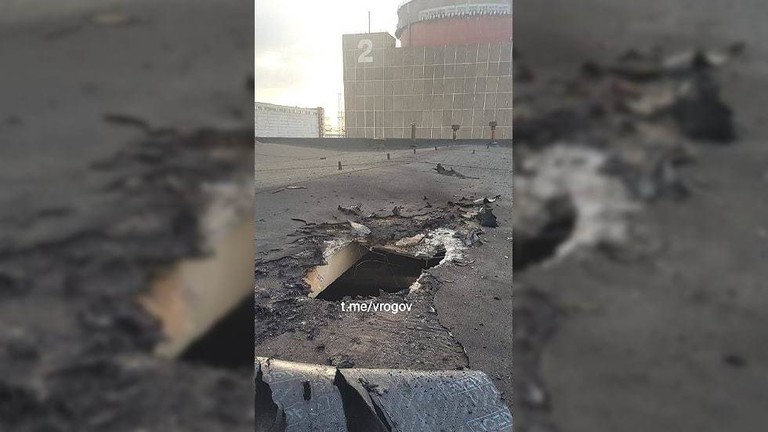
The damaged roof of the nuclear reactor fuel storage at the Zaporozhye nuclear power plant. © Telegram / vrogov
Samizdat – August 29, 2022
A Ukrainian strike has hit a reactor fuel storage at the Russian-controlled Zaporozhye nuclear power plant, local authorities said on Monday.
The roof of the building has been damaged as a result of the attack, Vladimir Rogov, the spokesman for Zaporozhye Region’s administration, said on Telegram.
He also posted a photo of a hole in the roof that was supposedly caused by the strike.
The affected storage facility holds fresh nuclear fuel for the reactors of the plant, which is the largest in Europe.
Russia said earlier that a Ukrainian drone targeting the nuclear facility had been shot down.
Moscow has repeatedly accused Kiev’s forces of targeting the Zaporozhye nuclear power plant – which has been under Russian control since March, but operated by Ukrainian staff – with artillery and ‘kamikaze’ drones.
It warned that those attacks could trigger a disaster that would eclipse the 1986 Chernobyl incident. Radioactive material could potentially reach Poland, Slovakia, Romania, Moldova, Belarus, and even Germany in a worst-case scenario.
Ukraine, meanwhile, has claimed that the Russian forces have turned the nuclear plant into a military base and that they’ve been shelling the facility themselves to pin the blame on Kiev.
Russia has repeatedly denied those accusation and urged for international inspectors to visit the site to assess the situation for themselves.
Earlier on Monday, International Atomic Energy Agency head Rafael Grossi announced that such a mission will take pace after all, with IAEA specialists expected to arrive at the Zaporozhye plant this week.
‘Dirty bomb’ in Ukraine would affect nine countries
Samizdat – August 16, 2022
A total of nine countries could be contaminated if the Russian-controlled Zaporozhye nuclear power plant in southern Ukraine is hit by multiple launch rocket systems, a former chief inspector of the USSR’s nuclear authority told RT.
Russian troops established control of the Zaporozhye NPP, Europe’s largest facility of the kind, early on in the course of military operations in Ukraine. Since then, Russia has repeatedly accused Kiev of launching artillery and drone strikes on the facility. Ukrainian officials claimed that the Russians were shelling themselves to discredit Kiev.
In an interview published on Tuesday, Vladimir Kuznetsov warned that if the plant is hit by volley fire, with numerous missiles striking the storage facility that holds spent nuclear fuel, chances are that more than one container would be damaged. This scenario would entail radiation escaping “into the environment – hence the contamination of not only the industrial site but also the Dnepr river which is nearby,” the expert noted.
Kuznetsov also pointed out that such a strike would most likely be accompanied by a fire, and “God knows where the wind would send the combustion products.”
The former chief inspector surmised that should 20 to 30 containers be breached in such an attack, the “radiation would affect approximately nine countries: Turkey, Bulgaria, Romania, Slovakia, the Czech Republic, Poland, the Baltic states and obviously Western Ukraine.”
Russian forces took over the Zaporozhye nuclear power plant in early March, within the first two weeks of Moscow’s military campaign against its neighbor.
In recent weeks, the Russian military has accused Ukraine of deliberately targeting the facility multiple times and warned that a major nuclear disaster, akin to that at Chernobyl in 1986, or even worse, could happen if such attacks continue unchecked.
Kiev, meanwhile, denies these allegations and claims that it is Russian forces that are shelling the power plant to frame the Ukrainian military – a point of view shared by the US and EU. The UN has called the attacks “suicidal” and proposed sending an International Atomic Energy Agency delegation to the site to provide “technical support” and help avoid a further escalation.
On Tuesday, local government administration member Vladimir Rogov told Russian media that Ukrainian forces had fired multiple rockets directly at the coolant systems and nuclear waste storage site inside the facility.
Since the storage site is out in the open, any hit would result in the release of nuclear waste ranging from dozens to hundreds of kilograms and lead to contamination of the area, the official explained.
“In plain language, that would be like a dirty bomb,” said Rogov.
Ukraine bombs nuclear waste storage site inside Zaporozhye NPP – official
Samizdat – August 16, 2022
Ukrainian artillery has fired multiple rockets directly at the coolant systems and nuclear waste storage site inside the Zaporozhye Nuclear Power Plant in Energodar, local government administration member Vladimir Rogov told Russian media on Tuesday, warning that a successful strike may result in a radiation release equivalent to a “dirty bomb.”
“One of the guided missiles hit just 10 meters” from the barrels with spent nuclear fuel,” Rogov told Soloviev Live. “Others hit a bit farther away, 50 to 200 meters.”
Since the storage site is out in the open, any hit will result in the release of nuclear waste ranging from dozens to hundreds of kilograms and contamination of the area, the official explained. “In plain language, that would be like a dirty bomb,” said Rogov.
While the reactor itself can only be destroyed with a tactical nuclear weapon, the coolant systems and waste storage are far more vulnerable and damage to them could easily cause a disaster, the official said. Ukrainian troops have already fired “several dozen” heavy projectiles at the cooling systems, Rogov added. If they succeed in disabling such a system, it could produce a meltdown bigger than the 1986 catastrophe at Chernobyl.
Russian troops established control of the Zaporozhye NPP, Europe’s largest facility of the kind, early on in the course of military operations in Ukraine. Russia and Ukraine have been accusing each other of shelling the facility, warning that combat in the area could trigger a nuclear disaster. Russia accused Ukraine of launching artillery and drone strikes on the facility, denouncing the operations as “nuclear terrorism.” Ukrainian troops claimed that the Russians were shelling themselves to discredit Kiev.
Russian requests to the UN and the International Atomic Energy Agency (IAEA) to inspect the site firshand have been met with excuses that inspectors can only access the station via Kiev, and Ukraine can’t guarantee their safe passage.
On Monday, Rogov accused the UN of blocking the IAEA visit because it was covering for Kiev. If the inspectors actually showed up, he said, they would be forced to conclude that Ukraine and not Russia was shelling the power plant.
“It is obvious, it’s all been documented, and not only that, it’s also well known who is being supplied with American guided missiles. Obviously, not Russia, but the Zelensky regime,” he said.
Zaporozhye official explains why inspectors can’t reach nuclear plant
Samizdat | August 15, 2022
Members of the UN are blocking a visit by the International Atomic Energy Agency (IAEA) to the Zaporozhye nuclear power plant (ZNPP) so they can avoid confirming Kiev shelled the Russian-controlled facility, local official Vladimir Rogov told RT in an interview on Monday.
Rogov, a member of the Zaporozhye military-civil administration, insisted that the ZNPP is always prepared to welcome the atomic energy watchdog, which has repeatedly expressed a desire to visit the facility, but noted that the UN has “directly started to block the possibility of an IAEA inspection.”
The official suggested that if the agency does visit the plant, it would be forced to conclude that it had been shelled by Kiev’s forces. “It is obvious, it’s all been documented, and not only that, it’s also well known who is being supplied with American guided missiles. Obviously, not Russia, but the Zelensky regime.”
The Zaporozhye nuclear power plant – the largest in Europe – has repeatedly come under attack over the past few weeks. While none of the reactors have so far been struck, the shelling has partially damaged a nearby thermal power plant as well as equipment used to cool the nuclear reactors.
Moscow has accused Ukraine of using rockets, artillery and drones to attack the ZNPP and has described Kiev’s actions as “nuclear terrorism” and holding the whole of Europe hostage.
Rogov stated that Western countries have “completely lost their instinct of self-preservation” in an economic, geopolitical and ecological sense, as a disaster at the ZNPP would spell trouble for European countries first and foremost.
“Nevertheless, we do not hear a single adequate statement, not a single voice of reason, either from Germany or from France,” he noted.
Kiev, meanwhile, has denied responsibility for shelling the plant and insists that it is Russia that has been targeting it in a plot to discredit Ukraine. The US State Department has taken Zelensky’s side and has called for a withdrawal of Russian forces from the area and the creation of a demilitarized zone around the plant.
While that solution has been supported by the UN and the EU, Rogov insists that the West should instead be working to establish a ceasefire there. Russia’s Permanent Representative to the UN, Vassily Nebenzia, has pointed out that if Russian forces were to leave the power plant it would be vulnerable to action by Kiev.
“Those who propose the withdrawal of Russian troops should be aware of the consequences that this object will be left without protection and can be used by Kiev and nationalist groups for the most monstrous provocations,” said the Russian ambassador, stressing that Moscow does not use nuclear facilities for military purposes.
Mega blackout imminent? France shuts down half its nuclear reactors
Free West Media | August 11, 2022
France is an important factor in Europe’s energy supply. But the country is planning on shutting down more than half of its nuclear reactors. The reason given is that they supposedly need maintenance.
The energy exporter is going to have to access energy from abroad. But that can turn out to be more difficult than planned with the European energy crisis expanding. Is a mega blackout looming?
Some 56 nuclear reactors at 18 locations normally supply France with electricity. But 18 of these reactors are already shut down. Long-term maintenance work is to be carried out. That had been planned for a long time, authorities said. But then France also had to shut down 12 more reactors last week.
Damage caused by corrosion is said to be the reason for this. The supply in Europe’s power grid seems all the more uncertain in winter.
In many places, the European power grid is dependent on the energy security of the neighboring country. If a country fails over a large area, other states are drawn into the blackout. France has been an important factor in European energy supply in recent years. But the Grande Nation itself may have to switch to energy imports.
Featured Video

Theodore Postol: Iran’s Missiles & Drones Were Underestimated
or go to
Aletho News Archives – Video-Images
From the Archives
What is the Israeli Lobby in Australia Doing in Interfaith Dialogue?
By Ali Kazak | Dissident Voice | October 11, 2015
For years Israel and its lobby around the world have been trying to normalise their relations with Arabs and Muslims without solving the Palestine Question.
One of the methods they resorted to in the last few years is using human rights and community organizations such as interfaith dialogue and Multiculturalism to achieve this objective and to: isolate the Palestinians, marginalise the Palestine question, end Israel’s isolation, and prevent criticism of Israel, knowing that these organisations will be the first to stand against Israel’s violations, racial and religious discrimination.
The group responsible for this task in Australia is The Australia/Israel & Jewish Affairs Council (AIJAC); its Director of International & Community Affairs, Jeremy Jones is in charge of lobbying religious community organizations, specifically Muslims and Christians. Consequently he convened the Faith Communities for Reconciliation, founding participant in the Australian Partnership of Religious Organisations and the Australian National Dialogue of Christians, Muslims & Jews.
AIJAC is a private political propaganda group. It is recognised as the main Israeli lobby in Australia. It coordinates its activities and works intimately with the Israeli embassy in Canberra and different institutions in Israel. It is privately funded by some Jewish businessmen. It monitors closely Australian politicians, the media, ethnic and religious groups, (especially Arabs and Muslims), unions and academics on their stands towards Israel and the Palestine question. … continue
Blog Roll
 Aletho News
- The killing of three Indonesian soldiers in Lebanon should remind Jakarta that Israel does not want peace
- Defeated and delusional: Netanyahu’s remarks reveal $80bn war failure, says analyst
- Iran’s friends are about to make life much more difficult for Israel and the US
- The war of liberation of the Arab and Islamic peoples expands across the Gulf
- Envoy warns UN on Trump’s threat to ‘obliterate’ Iran’s civilian infrastructure
- The Larak Corridor: Iran’s Rial Gate With No US, No Israel, and No Way Around
- ‘Economic terrorism’: Steel facilities hit again in US-Israeli strike
- ‘War Crime’: Iran condemns attacks on Arak, Ardakan nuclear sites
- Two-thirds of Americans want quick end to Iran war even if goals unmet
- Trump to Give “Important Update on Iran” Wednesday in Prime-Time Speech
- If Americans Knew
- Gaza families reunite years after babies evacuated amid Israel’s war
- International Rescue Committee warns Gaza’s children face grave protection risks
- Iran’s Alleged 47-Year War on America: Debunking the 1,050 American Deaths Canard
- Israel wants US to bomb more of Iran’s civilian structures (113,000 is not enough) – Not a ceasefire Day 173
- Ann Coulter Rips Into Fox News for Iran War Coverage
- Joe Kent Urges Americans To Call White House and Congress To Object To Sending Troops Into Iran
- DNC Resolution to Reject AIPAC Funding Puts Democratic Leaders in the Hot Seat
- Swedish foundation to build 400 schools as over 650,000 Gaza children remain without education for 2 years
- Israeli army admits photshopping image of slain Lebanese journalist
- This is how Israel is systematically killing health workers under the cover of war in Lebanon
- No Tricks Zone
- New Study Finds Warming Saves Lives…Cold Temperatures 12 Times More Deadly Than Excess Heat
- German Science Blog Accuses PIK Climate Institute Of Hallucinating Climate Tipping Points
- Devastating Assessment Of Comirnaty Vaccine By Former Senior Pfizer Europe Toxicologist
- New Study: CO2 Is ‘Effectively Negligible’ As An Explanatory Climate Change Factor Since 2000
- Former Pfizer Toxicologist Dr. Helmut Sterz Tells Bundestag Hearing Pfizer Vaccine Should Have Never Been Approved
- Energy Expert: Germany’s Nuclear Phaseout Was A “500 Billion Euro Mistake”
- New Research: South Australia’s Mid-Holocene Sea Surface Temperatures Were 4°C Warmer Than Today
- Storing Green Energy To Last Germany 10 Days Would Require A 60-Million Tonne Battery
- New Studies: UK Sea Levels Were 4 Meters Higher Than Today During The Mid-Holocene
- Destructive Green New Deal: German Energy And Metal Group Warns Of Drastic Crisis
 Aletho News