Childish Fantasies vs Real World Energy Needs
By Donna Laframboise | Big Picture News | October 2, 2019
Certain politicians are making promises about carbon dioxide emissions and the year 2050 – three full decades from now. Certain adults are telling elementary school children that transforming the world’s energy system is easy peasy.
But that’s not the case. In an article titled Net-Zero Carbon Dioxide Emissions By 2050 Requires A New Nuclear Power Plant Every Day, Roger Pielke Jr. delivers the harsh, mathematical truth. Even if every person in the world thought abandoning fossil fuels made sense, even if every last government was committed to such a plan, the sheer size of the task would remain. In Pielke’s words: “The scale…is absolutely, mind-bogglingly huge.”
In an entire year, a nuclear power plant is capable of producing 1 “million tons of oil equivalent” of energy – or 1 mtoe for short. Says Pielke:
In 2018 the world consumed 11,743 mtoe in the form of coal, natural gas and petroleum… there are 11,051 days left until January 1, 2050. To achieve net-zero carbon dioxide emissions globally by 2050 thus requires the deployment of >1 mtoe of carbon-free energy…every day, starting tomorrow and continuing for the next 30+ years. Achieving net-zero also requires the corresponding equivalent decommissioning of more than 1 mtoe of energy consumption from fossil fuels every single day.
Let us be honest and grownup here. The chances of this happening are remote.
Now let’s remember that many people insist nuclear power is off the table. We’re supposedly in the midst of a climate crisis caused by CO2 emissions, yet low-emissions nuclear power is forbidden.
Such people think we should rely on wind power, instead. According to Pielke’s calculations, that would require the construction of 1,500 wind turbines every single day from now until 2050.
Currently, the US consumes approximately 20% of the energy used across the globe. Its share of the 1,500 new wind turbines required daily would therefore be 300.
Despite years of massive subsidies designed to encourage wind energy investment, fewer than 10 turbines are currently installed in the US each day. Surely even a child understands that ramping up from 10 turbines a day to 300 is a massive challenge that couldn’t possibly happen overnight. Even in an affluent country with a booming economy.
And please, let us also put aside fairy tales about wind power being environmentally friendly. As Mark P. Mills explained recently in the Wall Street Journal :
Building one wind turbine requires 900 tons of steel, 2,500 tons of concrete and 45 tons of nonrecyclable plastic. Solar power requires even more cement, steel and glass…
Those who “dream of powering society entirely with wind and solar farms” says Mills, are actually demanding “the biggest expansion in mining the world has seen.”
Fukushima Disaster Puts Japan in ‘Nuclear Limbo’ Ahead of 2020 Tokyo Olympics – Pundit
Sputnik – September 14, 2019
On 10 September, Japanese authorities announced that Tokyo Electric Power (TEPCO), the operator of the Fukushima Daiichi power plant which in 2011 experienced the worst nuclear disaster since Chernobyl, currently has no technology to clear its wastewater from radioactive waste, and is instead discharging it into the sea.
More than a million tonnes of wastewater is reportedly stored in tanks at the Fukushima NPP (nuclear power plant). The facility is reportedly running out of available space and expects to exhaust its capacity by summer 2022. Japanese Environment Minister Yoshiaki Harada admitted earlier that “we have no way but to release it [into the sea] and dilute it”.
Local residents reportedly have deep concerns about the potential damage this move can inflict, especially to the fishing industry, which is essential for Japan.
Christina Consolo, a nuclear expert, has shared her view on the issue.
Sputnik: It’s been reported that there’s enough room to keep the liquid (1 million tons of contaminated water) through summer 2022, but after that, there will be no space left?
Christina Consolo: It was somewhat surprising at how quickly the Environmental Ministry in Japan made a decision to release the contaminated water once their official meeting convened. I am not surprised at all however by their decision.
The situation is very serious. There is no other option then to release the contaminated water, but under the control of TEPCO’s time and choosing, or it may be released for them. An earthquake could release it, a tsunami could release it, a typhoon could release it.
But releasing the water goes far beyond just a ‘storage issue’ alone; the tanks are also under duress for a number of reasons. If you recall, at the beginning of the original water storage, the tanks were not assembled properly. Concrete slabs were hastily poured without rebar reinforcement.
TEPCO workers had to drill holes in the tops of them to release hydrogen build-up, or risk explosion and collapse of the tanks themselves.
There have also been a series of leaks, due to miles of pipes and flushing radioactive water great distances through sometimes ducted-taped hoses, with at least one reaching the official scale of a Level 3 Nuclear Accident in and of itself, in July of 2015.
And the longer this radioactive water sits in these giant metal tanks, the matrix of the metal itself at the atomic level is undergoing acceleration of entropy, known as “The Wigner Effect” – named after Professor Eugene Wigner, who discovered it at the Oak Ridge Laboratory while doing research for the US Government during World War II.
Metal exposed to radiation creates embrittlement issues and acceleration of corrosion, the same problem that caused 16,000 cracks in the nuclear reactors in Belgium.
This is problematic for the biggest reason of them all: if any of these tanks leak or break open outside of the control of TEPCO and prevents workers from being able to continue the myriad of daily maintenance involved due to spillage of radioactive water, creating no-go zones within the site itself, then TEPCO can have yet another very serious situation on their hands, on top of everything else happening over there. Anything and everything must be done to assure that workers can continue with the tremendous daily management of what is still an ongoing Level 7 Nuclear Accident.
They can not risk waiting for the tanks to empty themselves.
Sputnik: What is going to happen next? Do you think this liquid is a real threat to the ecological situation?
Christina Consolo: Any radiation released to the environment is always going to have detrimental effects… the question is how much and how far will those effects extend from the site of the release. Without knowing what exactly is in those tanks, that question is impossible to answer.
I personally have issue believing the radioactive water contained within them only contains Tritium, as I have followed this story for over eight years, and I can say without a doubt that every machine brought in to ‘filter out’ radioactive substances has failed miserably, as has every camera, robot, robot claw, robot snake, robot on rollers, etc.
TEPCO also has a history of withholding important facts that also make them very untrustworthy.
But more importantly from an ecological perspective, and a far bigger issue though which is rarely discussed, is the groundwater that moves through the Fukushima site because of the geology of the surrounding features.
The plant was built on a riverbed, where the volcanic spine of Japan funnels water down from the mountains. Groundwater experts estimate that every single day somewhere between 5-15,000 tonnes of groundwater flow underneath the plant, and out to the Pacific ocean.
Keep in mind, the only remnant of the cumulative 450 tonnes of corium or melted nuclear fuel that has been found is splatter on the insides of the reactors, or pebble-like material and drips.
TEPCO still has not located the 3 melted cores after 8 years of looking, leaving a looming question of how far these cores travelled as they melted, and how much groundwater is making contact with these cores before pouring into the Pacific each day. They are concerned enough that they are still pouring 300 tonnes of water through them daily.
Is it 10 percent – 50 percent – 80 percent? How much of this natural groundwater flow is making contact with the cores, under the plant? We have no idea. If indeed this is occurring, which some Fukushima experts believe that it is, then the 1000 tanks are a ‘drop in the bucket’ in comparison to what may be pouring into the Pacific each and every day.
We need answers to these questions. It is abhorrent and inexcusable that with today’s known technology, TEPCO does not know where the cores are, 8 years after the accident. We have powerful ground penetrating radar that could likely tell, so why are they not telling us?
Sputnik: It’s been 8 years since the Fukushima disaster. How have Japanese authorities adapted to this situation?
Christina Consolo: The Japanese authorities that were in charge at the beginning of this disaster, such as former Prime Minister Kan, have expressed a tremendous amount of regret, and even guilt, over mistakes they made withholding information about how dangerous the situation was from the Japanese people in the early part of the accident.
The fact TEPCO outright lied that meltdowns had occurred from Day 1, even though every nuclear physicist in the world was aware they had, due to the presence of neutron beams occurring in 13 different locations on the site (which indicated at least one reactor was breached), is difficult to forgive considering the US had an entire fleet of Navy ships offshore providing humanitarian aid that were getting absolutely blasted by nuclear fuel including MOX and plutonium.
PM Abe is very pro-nuclear but his wife is not, making for an ongoing and very publicized drama in Japanese news, and the pushback from massive demonstrations by the Japanese people continue to this day on a weekly basis.
The people are fighting any and all attempts at restarting reactors, in a very hardcore way. The authorities are pretending everything is fine, focusing on the Olympics in 2020, and I am certain the water will be dumped long before then.
But the tanks are going to just get filled right back up again, after some unfortunate TEPCO workers climb inside and test them for metal fatigue issues.
Sputnik: What has changed in nuclear safety since Fukushima has occurred?
Christina Consolo: In Japan a majority of the reactors still remain shutdown, which is good considering they never should have been built there in the first place.
An article in The Japan Times predicted the Fukushima disaster in 2004, and there are no guarantees that TEPCO will always be able to keep the Fukushima site under control, or another earthquake and tsunami will cause a similar, or even larger disaster at another site, as there are so many littering Japan.
Japan sits in a highly unstable zone of 4 intersecting tectonic plates and the island has an enormous amount of earthquake and volcanic activity.
The US did review some of its safety measures after 3/11 but the problem is it keeps re-issuing licenses to old plants, with ageing infrastructure.
And many plants in the US, and worldwide, are also prone to earthquakes, tsunamis, flooding, hurricanes, even tornadoes and lightning strikes.
We have been playing with this very dangerous technology despite having no safe way to dispose of the waste, and many studies done over decades that prove that illnesses and cancer are extremely high the closer that you live to a nuclear plant.
Sputnik: Despite the Fukushima explosion, the Japanese government didn’t abandon its nuclear energy program. How do you explain this decision?
Christina Consolo: I can not answer that question. There is no logical answer for it, except to decommission a plant is outrageously expensive.
TEPCO announced in the past month it will be decommissioning the Fukushima Daini plant to the south, which also sustained damage in 2011.
Right now Japan is in a nuclear limbo of sorts, with the water tank problem, the fishery pushback, the Olympics in 2020, and the somewhat surreal efforts of the Japanese government to assure the world it can handle the Olympic athletes and crowds without making them sick.
There are always economic issues to consider, and the costs of decommissioning of two huge nuclear plants, one with 3 melted cores that have never been found.
Japan has a lot of convoluted issues surrounding nuclear and there is always the dark cloud over what is truth or fiction when it comes to TEPCO, and the nuclear industry in general. I really can not explain this decision at all.
Who is Woods Hole Oceanographic Institution? Oceanographer or defense contractor?
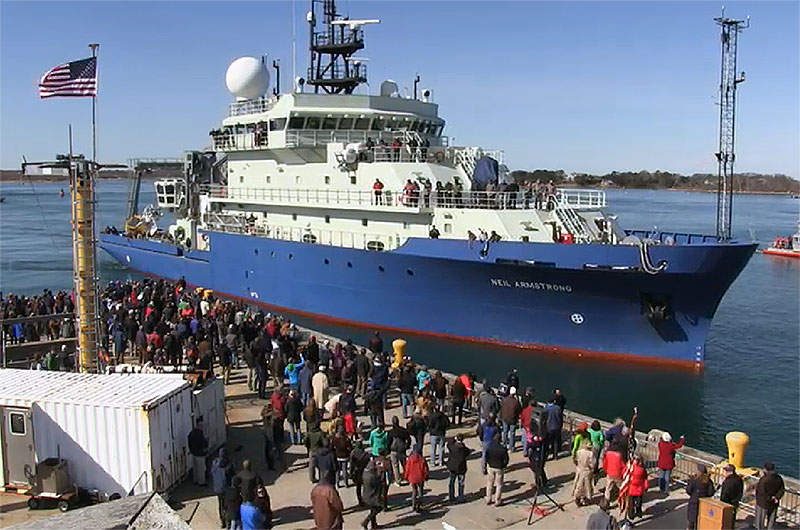
R/V Neil Armstrong arrives at Woods Hole Oceanographic … collectspace.com
By Richard Hugus | August 28, 2019
WHOI is the acronym for the ‘Woods Hole Oceanographic Institution’, based on Cape Cod, Town of Falmouth, village of Woods Hole, Massachusettts. On August 2, 2019 WHOI applied to the town of Falmouth for the clearing of 2.7 acres of woodland and the construction of a 3 story, 50,000 square foot building on what it calls its Quissett Campus, about a mile north of Woods Hole village. Woods Hole residents, the town of Falmouth, and a regulating authority called the Cape Cod Commission are now in the position of having to evaluate the proposed project and decide on approving it. Documentation and promotion of the project provided by WHOI to the Falmouth Planning Department, and summarized by the Falmouth Enterprise, says its new building — the New Quissett Facility — “is proposed as a ‘technology accelerator . . . by creating this facility the NQF will become the epicenter of autonomous vehicle, sensor, and technology innovation at WHOI and around the world and could lead to a net increase in regional economic activity.”
Mention of “autonomous vehicle and sensor technology” brings up the question of military research into and use of underwater drone and warfare technology and WHOI’s role in developing that technology. Though operating for years in the midst of a pleasant residential and tourist area, few people are aware that WHOI is a defense contractor. The Institution was created in 1930 and was devoted solely to defense work during World War II. In all available documents submitted to the Cape Cod Commission for its recent building projects, and in all currently available representations of its activities to the public, WHOI describes itself as a scientific and educational institution dedicated solely to studying the ocean. In its documentation for the Quissett project, WHOI calls itself “the world’s largest non-profit dedicated to ocean research.” The omission by WHOI of its significant military research and development amounts to deception. WHOI receives major funding from the Office of Naval Research, which “coordinates, executes, and promotes the science and technology programs of the United States Navy and Marine Corps.” These programs are highly unlikely to be peaceful and benevolent. The US Navy and Marines are, afterall, in the business of war.
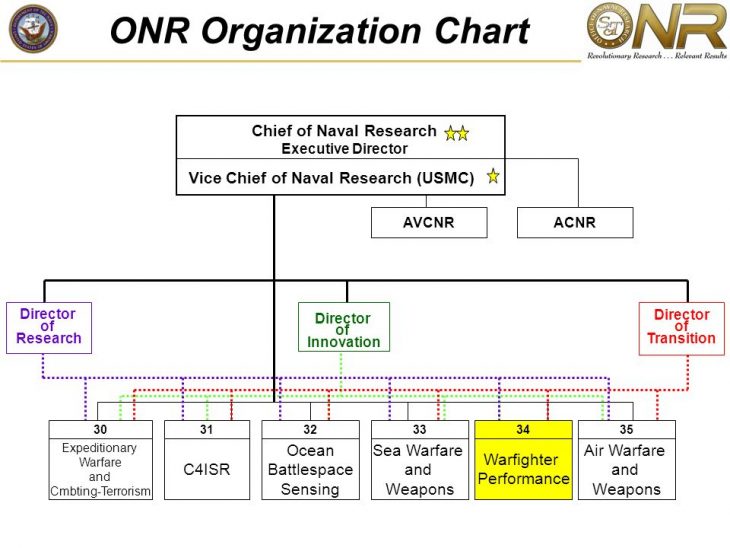
Source: slideplayer.com (C4ISR-Command, Control, Communications, Computers, Intelligence, Surveillance and Reconnaissance)
A July 20, 2018 Department of Defense listing of Navy/Office of Naval Research contracts states: “Woods Hole Oceanographic Institution, Woods Hole, Massachusetts, is awarded a $7,719,478 cost-plus-fixed-fee contract for development and demonstration of advanced ocean battlespace capabilities . . . This contract was competitively procured . . . for science and technology projects for advancement and improvement of Navy and Marine Corps operations, including Ocean Battlespace Sensing . . . The Office of Naval Research, Arlington, Virginia, is the contracting activity . . .”
Ocean Battlespace Sensing has to do with submarine and mine warfare. There is no information on WHOI’s web site about this nearly $8 million grant, or about what it is doing in the area of ocean battlespace sensing and submarine warfare. On April 7, 2016 when the new research vessel Neil Armstrong first arrived in Woods Hole, Dr. Frank Herr, head of the U.S. Navy’s Ocean Battlespace Sensing department (so-called “code 32” above), was among the notables addressing a gathered crowd. WHOI Director Mark Abbott also spoke, telling him and others, “We’re very proud to have been selected by the Office of Naval Research to operate the Neil Armstrong.” Navy-owned ships and advanced ocean battlespace work are not what we normally associate with a “non-profit organization dedicated to ocean research, exploration, and education” — WHOI’s stated activities. Defense-related activities are clearly a part of WHOI’s operations, but they are consistently edited out of the public image WHOI promotes.
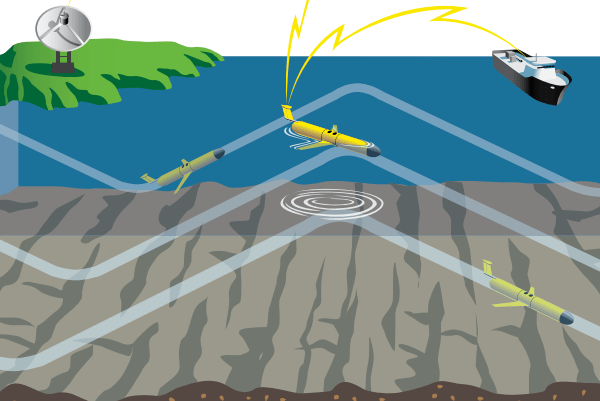
The Next Level – Drone Wars, breakfornews.com
As another example: according to an April 22, 2019 report by the DoD Defense Logistics Agency: “Woods Hole Oceanographic Institution, Woods Hole, Massachusetts, is awarded an $8,421,581 cost-plus-fixed-fee contract for the research effort entitled, “Project Sundance.” Except for the announcement of this contract, there is no information available anywhere on the web, or at WHOI’s own web site, about what Project Sundance is, leaving one to wonder if the project is classified — i.e., something the public is not entitled to know about.
Finally, in 1985, WHOI achieved fame when one of its scientists, Robert Ballard, discovered the wreckage of the Titanic. It wasn’t until years later that we got the full story. According to The National Geographic (November 21, 2017), the Titanic discovery only happened by the way in what was actually a top secret military operation to find two wrecked US Navy nuclear submarines. Remote sensing technology and an underwater submersible vehicle developed in Woods Hole and used aboard the WHOI research vessel, Knorr, was used in the discovery. National Geographic tells us the Knorr’s true mission: “the military wanted to know the fate of the nuclear reactors that powered the ships . . . this knowledge was to help determine the environmental safety of disposing of additional nuclear materials in the oceans.”
Ballard held the rank of Commander in the US Navy and was working as a liason to WHOI from the Office of Naval Research at the time of the discovery. Research on disposal of nuclear waste in the ocean is hardly in keeping with WHOI’s stated mission, “to advance knowledge about our planet, but also to ensure society’s long-term welfare and to help guide human stewardship of the environment.” Moreover, by making it look like this was just a fun adventure undertaken by WHOI to solve the mystery of the Titanic, a hoax was perpetrated on the public.
WHOI, the proponent of this new building project, is not being fully honest in the descriptions it gives of its mission and operations in Woods Hole. This calls WHOI’s credibility and full disclosure into question, and prompts further questions about the military-related role of the proposed new facility — “the epicenter of autonomous vehicle, sensor, and technology innovation.” The mentioned technology may well have uses in oceanographic research, but it may equally well have to do with “ocean battlespace sensing” — i.e., marine warfare. WHOI advertises itself as a humanitarian scientific institution without mentioning the clearly relevant fact that a significant part of its funding and research is from and for the US Department of Defense. It is not possible to fully evaluate a building proposal from an institution that is involved in secret projects because Cape Cod residents have no way of knowing if they are being given all the facts. Indeed, they have good reason to believe they are not being given all the facts,
The US military and its supporting contractors are the main source of wars of aggression and misery in the world today. It would be unethical to support expensive new facilities, paid for with our tax dollars and with what is left of our open space, for one of those contractors on Cape Cod. Yet war and militarization are so normalized in the American landscape, it is as if this is not even an issue.
Russia set to air TV series that reveals US role in Chernobyl nuclear disaster
Press TV – June 8, 2019
Russia is set to air a TV series based on the Chernobyl nuclear disaster that implicates the United States as playing a role in the worst nuclear accident in history.
Currently in post-production, the series by the Russian company NTV tells the story of the 1986 explosion that ripped through reactor Number 4 at the Chernobyl Nuclear Power Plant in the then Ukrainian Soviet Socialist Republic.
The explosion led to a huge radioactive leak, which permanently affected areas in places across three quarters of Europe. Thirty workers and firemen were killed in the immediate aftermath of the explosion and rescue operations. Most of them died of severe radiation-related illnesses.
The plot revolves around a CIA agent dispatched to Pripyat — the town inhabited by Chernobyl workers — to gather intelligence on the nuclear power plant.
The series will follow KGB officers in their attempts to hunt the espionage operation.
Director Aleksey Muradov said that his version, filmed in Belarus, will show “what really happened back then.”
“There is a theory that the Americans had infiltrated the Chernobyl nuclear power plant,” he said. “Many historians do not deny that on the day of the explosion an agent of the enemy’s intelligence services was present at the station.
This is while a five-part “Chernobyl” series produced by American premium cable and satellite television network HBO has recently triggered worldwide debate as some experts have challenged its credibility.
Russia’s most popular newspaper, Komsomolskaya Pravda (KP), has dismissed the show as “a caricature and not the truth.”
“If Anglo-Saxons film something about Russians, it definitely will not correspond to the truth,” said Russian journalist Anatoly Vasserman.
Russian newspaper The Moscow Times, also wrote this week that the HBO production was biased against the Soviet Union and provided a “caricature”’ of the nation.
Deadly Dust: US Spreading Radiation and No One Wants to Raise the Issue – Author
Sputnik – April 3, 2019
In a new book named “Deadly Dust – Made in the USA: Uranium Weapons Contaminating the World” German author Frieder Wagner gives a detailed account of how the US has contaminated vast territories using depleted uranium (DU) ammunition and the cover-up strategy of the military, industry and governments, as well as those in the media and politics.
Sputnik: Mr Wagner, in your book “Deadly Dust — Made in the USA: Uranium Weapons Contaminating the World” you talk about the use of uranium ammunition. What is especially dangerous about these weapons?
Frieder Wagner: Weapons containing uranium are produced from nuclear industry’s waste (byproducts of uranium enrichment). If, for example, you want to produce a ton of natural uranium fuel rods for nuclear power plants, you get about eight tons of depleted uranium. It is a source of alpha radiation — radioactive and, moreover, very poisonous. It needs to be stored somewhere, and it is not very cheap.
Sputnik: How can it be used in weapons?
Frieder Wagner: About 30-40 years ago, military scientists made a discovery: uranium is almost twice as dense as lead. If you turn depleted uranium into a projectile and give it proper acceleration, then within a fraction of a second it will pierce through tank armor, concrete or cement.This, of course, was an important discovery. Furthermore, when a shell hits an armored tank the impact produces dust caused by the detonation and the subsequent release of heat energy causes it to ignite and it explodes at a temperature of 3000 to 5000 degrees — incinerating the tank’s interior and destroying it.
Sputnik: But what happens afterwards is also a problem — after the use of DU ammunition, isn’t it?
Frieder Wagner: Yes! After its use depleted uranium, which, as I have already said, is a source of alpha radiation (that is, a radioactive and very toxic substance), burns down to nano-particles that are a hundred times smaller than a red blood cell.
This way, I would say, a sort of metallic gas forms that people can inhale, and which is released in the atmosphere and can be carried anywhere by wind. People who inhale it are at risk for developing cancer.These nano-particles can also penetrate the body of a pregnant woman, overcoming the barrier between a child and a mother, and affect the health of an unborn baby, can infiltrate the brain and by travelling through the bloodstream end up in any human or animal organ. Everything that goes around the planet, sooner or later settles and, of course, contaminates, in particular, drinking water and everything else.
Sputnik: In what wars have DU weapons been used so far?
Frieder Wagner: It was actively used during the first Gulf war in 1991 against Iraq. The military has admitted that about 320 tons were used. Then in the second war in Iraq in 2003 over 2,000 tons were used. In between, it was used during the war in Kosovo, in Yugoslavia (1999), and in Bosnia in 1995, and after 2001 in Afghanistan, where it still used today.
Sputnik: Your book title says Made in the USA, were these weapons only used by the United States?
Frieder Wagner: They were being developed in several countries at the same time. In Germany, they were also working on these weapons, as, of course, in Russia. However, it was used and on such a large scale, only by the US. They were reckless and they did not pay attention to any possible side effects — just as it was back when the first atomic bombs were used. That’s why I called the book: “Deadly Dust — Made in the USA”.
Sputnik: How did you manage to prove the use of this ammunition in the course of your research?
Frieder Wagner: For example, the Serbs gave us maps where they showed the locations where depleted uranium was used. When we were in Iraq, we talked to the locals. We traveled to places where large tank battles took place and took soil samples there, as well as dust samples from tanks. Looking at the tank, you can see whether it was hit by an ordinary projectile or a uranium munition.
Uranium munition leaves dust that burns everything around the hole made by the projectile. So you can determine the use of uranium ammunition. In all soil samples, we found depleted uranium. Unfortunately, uranium-236 was also found in most of the soil and dust samples — it is even more intense and poisonous. Its radiation is even stronger and does not occur in nature. It can only be produced artificially during reprocessing of fuel rods. This means that we were able to prove that the military, the United States and its coalition allies used uranium munitions made from spent uranium fuel rods.
Sputnik: Your book is based on the films The Doctor, the Depleted Uranium, and the Dying Children of Basra (Der Arzt und die verstrahlten Kinder von Basra, 2004) and Deadly Dust (Todesstaub, 2007). What did you see in Basra during your work on the documentary?
Frieder Wagner: It was horrific and still sometimes haunts me in my dreams. These were children with deformities, which we saw in orphanages in Basra and Baghdad. Some of them had such deformities that they had almost nothing human anymore.
There were children without a head or a nose, either with one eye or without eyes at all, with internal organs in a kind of “sack” outside their body. These ‘creatures’ can live only for a few hours, experiencing terrible pain, and then die.
Sputnik: The film “Deadly Dust” is linked to the book, but it is no longer distributed. WDR channel after this film did not make any more orders? Why is that?
Frieder Wagner: My exposes which I sent to WDR, as well as to the ZDF channels were rejected. Then I contacted an editor at WDR, for which I always made good films and with which I always had good relations with, because these films had doubled or trippled their ratings, and asked him: “What’s going on here?”” And after some hesitation he said: “Yes, Frieder Wagner, someone must tell you this. WDR considers you a ‘difficult’ person. And most importantly, the topics you suggest are especially hard. Right now I’ve got nothing more to tell you.” And that’s when I understood everything. It was in 2005.
I can also tell you the story of how, for example, a female editor at ZDF offered the TV channel a story on the use of these weapons during the war in Yugoslavia and also in Croatia. She wanted to talk about it with me prior so I could share my experiences. But when her boss found out that she wanted to talk to Frieder Wagner, he refused to pay for her trip — without any further explanation.
Sputnik: The so-called “deadly dust” is, as you have already described it, is spread by the wind. So should the use of uranium ammunition, in fact, be considered a war crime and banned?
Frieder Wagner: This is definitely a war crime. The dust from southern Iraq is carried to the north by the constant storms, the so-called desert storms — for example, to Erbil, where it meets the mountains and can’t travel further as the mountains make it difficult for it to go past towards Turkey. So this huge mass of dust settles in Erbil.We, for example, took samples of beef from around Erbil, and this is what we found out: depleted uranium used in ammunition has a characteristic atomic “fingerprint”. In northern Iraq we found the same “uranium fingerprint” as in the south. This means that the uranium dust that had originally settled in the south of Iraq is now also in the north, and children are now getting sick there and are born with deformities. It is now spreading all over the world.
Sputnik: Have the victims of uranium munition use in Kosovo or, for example, in Iraq, tried to go to court?
Frieder Wagner: So far no such attempts have been made in Kosovo or Iraq. Now in Kosovo, a whole group of lawyers are working on a lawsuit against NATO, because after the war they unleashed, people were injured, fell ill and died. The morbidity rate has increased by 20 to 30 percent, and there are more effected each year. So there will be an attempt to file a lawsuit.
Out of the approximately two thousand Italian soldiers stationed in Iraq and Kosovo, 109 have later developed cancer and died — this is proven information. 16 families, out of the 109 dead, filed lawsuits and won their cases. The courts ordered the Italian state or the country’s Ministry of Defence to pay them compensation. Since each cancer was of a different type, the payout amounts differed. But they ranged between 200,000 and 1,4 million euros.
Sputnik: How are things in Germany? Have there been lawsuits filed by the soldiers of the Bundeswehr?
Frieder Wagner: The German Ministry of Defense constantly denies any connection to this. Our soldiers are stationed in Afghanistan and Kosovo. About 100,000 soldiers served in Afghanistan, and we found out that about 30% of those who returned got sick, although at first, of course, they do not notice this. If they subsequently marry and have children, then there’s a great risk that their children will have disabilities.These children will have the same toxic substances in their DNA as their parents. And this will be passed on for several generations — from children to grandchildren and to great-grandchildren.
Sputnik: But none of these people ever filed a lawsuit?
Frieder Wagner: In Germany there were no such precedents. About 600 servicemen went to court in the United States who could not appeal on their own behalf, but they filed lawsuits on behalf of their children who were born with developmental disabilities. And we’re not talking about a mere 90 or even 900 million pay out, but about billions of dollars now. The United States, of course, will try to delay the adoption of a ruling as much as it is possible and hope for a “biological” resolution of the situation — that is, that the plaintiffs will simply die.
US Atomic Plants ‘Dodging Radioactive Bullets’ as Floodwaters Submerge Midwest
Sputnik – March 21, 2019
With heavy rainfall inundating the US Midwest, nuclear power plants risk being flooded. However, the plants continue to operate at full power, resulting in the potential for “unnecessary, extremely high risk” accidents, according to Kevin Kamps, the Radioactive Waste Watchdog at the organization Beyond Nuclear.
“In Nebraska alone, you’ve got the Offutt Air Force Base, which is the home of the [US] Strategic Command, which controls the nuclear arsenal of the US, and it’s largely flooded,” Kamps told Radio Sputnik’s Loud & Clear hosts Brian Becker and Nicole Roussell.
According to Offutt Tech. Sgt. Rachelle Blake, around 60 buildings on the south end of the base, including the 55th Wing headquarters and two aircraft maintenance hangars, were flooded over the weekend by as much as eight feet of water. The 55th Wing is a US Air Force unit assigned to Air Combat Command.
“You’ve also got two nuclear power plants in Nebraska. You’ve got Fort Calhoun, north of Omaha on the Missouri [River], which thankfully shut down in 2016. And the reason it shut down was the previous historic floods on the Missouri in 2011 damaged the Fort Calhoun nuclear power plant, [so] that it never recovered. But you’ve also got the Cooper atomic reactor south of Omaha on the Missouri River, and yet again, for the second time, in 2011 and [now in] 2019, Cooper — which is being run by Entergy Nuclear of New Orleans on behalf of a public utility in Nebraska — ran at 100 percent power levels through these historic floods. For the industry, that’s the bragging point: ‘Look at what we can do,'” Kamp noted.
“It’s a Fukushima-like situation, where you’re dealing with a natural disaster and insisting upon operating at 100 percent power levels with your atomic reactor. Granted, Japan didn’t know that natural disaster was coming. And so, the danger is, if you lose power from the grid, and then your emergency diesel backup generators fail, you can’t control the cooling on those hellishly hot atomic reactor cores,” Kamp explained.
“In addition to the reactor risks, there are radioactive risks, which are still present at the shut-down Fort Calhoun but also at Cooper, both in the storage pools, which can go up in flames, but also in the dry casks that could be impacted by the floods. They [Omaha Public Power District, Entergy Nuclear] might have dodged a bullet again in 2019, but they keep taking these unnecessary, extremely high risks with their operations,” he added.
In March 2011, the Fukushima Daiichi nuclear plant in Japan’s Ōkuma, Fukushima prefecture, was hit by a 46-foot tsunami triggered by a 9.0-magnitude offshore earthquake. The natural disaster crippled the facility’s cooling system and resulted in the leakage of radioactive materials, hydrogen-air explosions and eventually the plant’s shutdown, Sputnik previously reported.
On Monday, the Nebraska Public Power District (NPPD) announced that the Cooper Nuclear Plant was continuing to operate safely.
“We are operating at full power, and the water is receding… and we expect the water level to continue dropping,” NPPD spokesman Mark Becker said, according to Reuters. In addition, he noted that the plant was 899.75 feet above sea level Monday morning, below the 901.5 feet that would require the nuclear reactor to shut down.
“Back in 2011… there are about a half dozen major dams upstream of Fort Calhoun on the Missouri River, any one of which failing could have have created a domino effect of failures with the other dams, and it could have sent a very deep wall of water coming down the Missouri River. And the Fort Calhoun power plant could have been inundated under very deep water,” Kamp explained.
“It happened at Fukushima. All of a sudden, an hour after that earthquake in Japan, that wall of water — 45 feet deep — hit the nuclear plant and hit the last remaining power sources, which were the emergency diesel generators. So, here in Nebraska, there is renewed potential for those upstream major upstream dams to fail, [to] send a wall of water down. Another danger at both Fort Calhoun, with the stored waste, but also at Cooper with the operating reactor and the stored waste: if local levees were to fail and allow flood waters to inundate the sites even deeper,” Kamp noted.
“At Fort Calhoun, just now, they came within one foot, nine inches of having to shut down under their own very loose and weak protocols. That’s how close it came. So, it’s incredible the risks that they [NPPD, Entergy] take. If they had any responsibility, they would shut down.”
According to Becker, the US Army Corps of Engineers has reduced water releases from the Gavins Point Dam to decrease the risk of flooding downriver.
“And to give some credit, Fort Calhoun in 2011 did shut down months ahead of time — in April — because they saw what was coming with the snow melts; they had enough predictions. They [NPPD] shut down months ahead of time, and even though they did, they were so damaged by the floods, and they still screwed up and had a fire burning within the turbine building that nobody dealt with. That final straw of the fire not being dealt with days on end, that’s what led to the final shutdown several years later. Dodging radioactive bullets is not fun stuff, but it’s kind of what they do for a living,” Kemp noted.
Germany Pulls Rank on Macron and American Energy Blackmail
By Finian CUNNINGHAM | Strategic Culture Foundation | 13.02.2019
It was billed politely as a Franco-German “compromise” when the EU balked at adopting a Gas Directive which would have undermined the Nord Stream 2 project with Russia.
Nevertheless, diplomatic rhetoric aside, Berlin’s blocking last week of a bid by French President Emmanuel Macron to impose tougher regulations on the Nord Stream 2 gas project was without doubt a firm rebuff to Paris.
Macron wanted to give the EU administration in Brussels greater control over the new pipeline running from Russia to Germany. But in the end the so-called “compromise” was a rejection of Macron’s proposal, reaffirming Germany in the lead role of implementing the Nord Stream 2 route, along with Russia.
The $11-billion, 1,200 kilometer pipeline is due to become operational at the end of this year. Stretching from Russian mainland under the Baltic Sea, it will double the natural gas supply from Russia to Germany. The Berlin government and German industry view the project as a vital boost to the country’s ever-robust economy. Gas supplies will also be distributed from Germany to other European states. Consumers stand to gain from lower prices for heating homes and businesses.
Thus Macron’s belated bizarre meddling was rebuffed by Berlin. A rebuff was given too to the stepped-up pressure from Washington for the Nord Stream 2 project to be cancelled. Last week, US ambassador to Germany Richard Grenell and two other American envoys wrote an op-ed for Deutsche Welle in which they accused Russia of trying to use “energy blackmail” over Europe’s geopolitics.
Why France’s Macron, at the last minute, attempted to undermine the project by placing stiffer regulations is a curious question. Those extra regulations if they had been imposed would have potentially made the Russian gas supply more expensive. As it turns out, the project will now go-ahead without onerous restrictions.
In short, Macron and the spoiling tactics of Washington, along with EU states hostile to Russia, Poland and the Baltic countries, have been put in their place by Germany and its assertion of national interests of securing economical and abundant gas supply from Russia. Other EU member states that backed Berlin over Nord Stream 2 were Austria, Belgium, Cyprus, Greece and the Netherlands.
Washington’s claims that Nord Stream 2 would give Russia leverage of Europe’s security have been echoed by Poland and the Baltic states. Poland, and non-EU Ukraine, stand to lose out billions of dollars-worth of transit fees. Such a move, however, is the prerogative of Germany and Russia to find a more economical mode of supply. Besides, what right has Ukraine to make demands on a bilateral matter that is none of its business? Kiev’s previous bad faith over not paying gas bills to Russia disbars it from reasonable opinion.
Another factor is the inherent Russophobia of Polish and Baltic politicians who view everything concerning Russia through a prism of paranoia.
For the Americans, it is obviously a blatant case of seeking to sell their own much more expensive natural gas to Europe’s giant energy market – in place of Russia’s product. Based on objective market figures, Russia is the most competitive supplier to Europe. The Americans are therefore trying to snatch a strategic business through foul means of propaganda and political pressure. Ironically, the US German ambassador Richard Grenell and the other American envoys wrote in their recent oped: “Europe must retain control of its energy security.”
Last month, Grenell threatened German and European firms involved in the construction of Nord Stream 2 that they could face punitive American sanctions in the future. Evidently, it is the US side that is using “blackmail” to coerce others into submission, not Russia.
Back to Macron. What was he up to in his belated spoiling tactics over Nord Stream 2 and in particular the attempted problems being leveled for Germany if the extra regulations had been imposed?
It seems implausible that Macron was suddenly finding a concern for Poland and the Baltic states in their paranoia over alleged Russian invasion.
Was Macron trying to garner favors from the Trump administration? His initial obsequious rapport with Trump has since faded from the early days of Macron’s presidency in 2017. By doing Washington’s bidding to undermine the Nord Stream 2 project was Macron trying to ingratiate himself again?
The contradictions regarding Macron are replete. He is supposed to be a champion of “ecological causes”. A major factor in Germany’s desire for the Nord Stream 2 project is that the increased gas supply will reduce the European powerhouse’s dependence on dirty fuels of coal, oil and nuclear power. By throwing up regulatory barriers, Macron is making it harder for Germany and Europe to move to cleaner sources of energy that the Russian natural gas represents.
Also, if Macron had succeeded in imposing tougher regulations on the Nord Stream 2 project it would have inevitably increased the costs to consumers for gas bills. This is at a time when his government is being assailed by nationwide Yellow Vest protests over soaring living costs, in particular fuel-price hikes.
A possible factor in Macron’s sabotage bid in Germany’s Nord Stream 2 plans was his chagrin over Berlin’s rejection of his much-vaunted reform agenda for the Eurozone bloc within the EU. Despite Macron’s very public amity with Chancellor Angela Merkel, Berlin has continually knocked back the French leader’s ambitions for reform.
It’s hard to discern what are the real objectives of Macron’s reforms. But they seem to constitute a “banker’s charter”. Many eminent German economists have lambasted his plans, which they say will give more taxpayer-funded bailouts to insolvent banks. They say Macron is trying to move the EU further away from the social-market economy than the bloc already has moved.
What Macron, an ex-Rothschild banker, appears to be striving for is a replication of his pro-rich, anti-worker policies that he is imposing on France, and for these policies to be extended across the Eurozone. Berlin is not buying it, realizing such policies will further erode the social fabric. This could be the main reason why Macron tried to use the Nord Stream 2 project as leverage over Berlin.
In the end, Macron and Washington – albeit working for different objectives – were defeated in their attempts to sabotage the emerging energy trade between Germany, Europe and Russia. Nord Stream 2, as with Russia’s Turk Stream to the south of Europe, seems inevitable by sheer force of natural partnership.
On this note, the Hungarian government’s comments this week were apt. Budapest accused some European leaders and the US of “huge hypocrisy” in decrying association with Russia over energy trade. Macron has previously attended an economics forum in St Petersburg, and yet lately has sought to “blackmail” and disrupt Germany over its trade plans with Russia.
As for the Americans, their arrant hypocrisy is beyond words. As well as trying to dictate to Europe about “market principles” and “energy security”, it was reported this week that Washington is similarly demanding Iraq to end its import of natural gas from neighboring Iran.
Iraq is crippled by electricity and power shortages because of the criminal war that the US waged on that country from 2003-2011 which destroyed much of the country’s infrastructure. Iraq critically needs Iranian gas supplies to keep the lights and fans running. Yet, here we have the US now dictating to Iraq to end its lifeline import of Iranian fuel in order to comply with the Trump administration’s sanctions against Tehran. Iraq is furious at the latest bullying interference by Washington in its sovereign affairs.
The hypocrisy of Washington and elitist politicians like Emmanuel Macron has become too much to stomach. Maybe Germany and others are finally realizing who the charlatans are.
Featured Video

Rewriting the risk? Inside the government’s vaccine safety messaging
or go to
Aletho News Archives – Video-Images
Book Review
“Davos Can Really Replace the UN”
Inside the book that maps the architecture behind global governance — from the Epstein files to the Pact for the Future
Lies are Unbekoming | April 1, 2026
On June 13, 2019, the United Nations and the World Economic Forum signed a partnership deal to “accelerate the implementation of the 2030 Agenda for Sustainable Development.” That same evening, WEF president Börge Brende — Norway’s former Foreign Minister — had dinner with Jeffrey Epstein at Epstein’s Manhattan townhouse. The Epstein files, released January 2026, contain an exchange between the two from the previous year. Epstein to Brende: “Davos can really replace the UN. C21, cyber, crypto . genetics… intl coordination.” Brende back to Epstein: “Exactly — we need a new global architecture. World Economic Forum (Davos) is uniquely positioned — public private.”
The next day, the UN General Assembly adopted the framework for restructuring global governance.
That sequence — the partnership signing, the Epstein dinner, the candid admission about replacing the UN with a public-private architecture, and then the formal adoption — opens Jacob Nordangård’s The Digital World Brain. Pages two and three. Footnoted to the UN resolution number, the Epstein files, and the General Assembly record.
I keep coming back to it because it captures what this book does that almost nothing else in the independent research space manages. I’ve followed Jacob’s work for years now and interviewed him about his research. Each book peels back another layer of the same institutional architecture, and each time I think he’s reached the limit of what can be documented, the next one goes further. Nordangård doesn’t speculate. He doesn’t editorialize much. He lays institutional actions next to each other in chronological order and lets the pattern announce itself. … continue
Blog Roll
 Aletho News
- Iran Threatens Retaliatory Strike on Stargate AI Project in UAE
- US sent ‘a lot’ of arms to Iranian protesters – Trump
- Barak Ravid Launders Deception To Allow Trump To Back Off Of His Power Plant Threat – Again
- REWRITING THE RISK? INSIDE THE GOVERNMENT’S VACCINE SAFETY MESSAGING
- “Davos Can Really Replace the UN”
- NIAID/NIH and USDA Fund Bioengineered Chimeric Influenza Viruses Built Using Pandemic H1N1 Components: Journal ‘Science Advances’
- Hezbollah hits Israeli warship off Lebanon’s coast, sets it aflame
- Iran slams US strikes on B1 bridge, Mahshahr petrochemical plants as ‘blatant acts of state terrorism’
- In letter to UN chief, Araghchi warns of dire consequences of US-Israeli attacks on Iran’s nuclear facilities
- Why the CIA conspiracy to invade Iran with Kurdish militias failed
- If Americans Knew
- Trump poised to “blow everything up” (ie. commit war crimes) in Iran – Daily Update
- In Iran, Israel-US take aim at “reason, research, and freedom of thought” – Daily Update
- US loses planes over Iran, Israel downgrades Lebanon war goals – Daily Update
- Israel Is Blocking Palestinians from Easter at Church Where Jesus Resurrected
- Plot to assassinate Palestinian activist follows harassment campaign promoted by Zionist groups and elected officials
- Prominent New York synagogue hosts presentation on why U.S. Jews should support the ethnic cleansing of Gaza
- Tapper vs. Piker: Is the CNN Anchor Auditioning for David Ellison?
- Shouldn’t Democrats Be Able to Condemn Genocide?
- Israel-US kill negotiators, destroy civilian structures, but Iran’s military capabilities still largely intact – Daily Update
- ‘War crime’: Global condemnation as Israeli ministers celebrate death penalty law targeting Palestinian prisoners
- No Tricks Zone
- An Inconvenient Tree: Uncovered In Alps… Europe Much Warmer Than Today 6000 Years Ago
- New Study Reports A 60% Slowdown In Greenland’s Ice Loss Rate In The Last Decade
- Low Intensity Tornado Wrecks Major Solar Farm, Creating A Potential Toxic Dump
- New Study Finds Warming Saves Lives…Cold Temperatures 12 Times More Deadly Than Excess Heat
- German Science Blog Accuses PIK Climate Institute Of Hallucinating Climate Tipping Points
- Devastating Assessment Of Comirnaty Vaccine By Former Senior Pfizer Europe Toxicologist
- New Study: CO2 Is ‘Effectively Negligible’ As An Explanatory Climate Change Factor Since 2000
- Former Pfizer Toxicologist Dr. Helmut Sterz Tells Bundestag Hearing Pfizer Vaccine Should Have Never Been Approved
- Energy Expert: Germany’s Nuclear Phaseout Was A “500 Billion Euro Mistake”
- New Research: South Australia’s Mid-Holocene Sea Surface Temperatures Were 4°C Warmer Than Today
 Aletho News