Illicit financial behavior has been decriminalized in the United States – for all practical purposes. Despite the revelations of massive misconduct by banks and other financial services businesses, criminal investigations are rare, indictments exceptional and guilty judgments extraordinary.
Most potentially culpable actions are overlooked by authorities, slighted, reduced from criminal to civil status when pursued, individuals evade penalties much less punishment, and the appeals courts take extreme liberties in exonerating culprits when and if the odd conviction reaches them.
The last mentioned are establishing new frontiers in the formulation of ingeniously sophistic arguments to justify letting financial malefactors off the hook. As some wit suggests, all 32 or so judicial inventions should be assembled in a legal code called the Goldman Variations.
Our elected officials, our regulators, our politicos and the media have come to accept this as the natural order of things. Business Sections of newspapers, like The New York Times, read like the gazette for the world of organized crime in its heyday when the five Mafia families were on top of their game. (substitute Goldman Sachs, Chase Morgan, Bank of America, CITI, Wells Fargo). As for the Wall Street Journal and the legion of business magazines, they blend features of VARIETY and Osservatore Romano.
The reasons for this phenomenon are multiple: the rule of money in our politics; the neutering of regulatory bodies by the appointment of business friendly officers in symbiotic relationships with former or prospective employers; a wider culture in which the cult of wealth pervades all; and the timidity of a political class that defers to the power centers who enjoy rank, status and respect.
Obama’s appointment of Mary Jo White, from the white gloves law firm Debevoise & Plimpton which specialized in advising and representing Wall Street during the financial crisis (where she was head of litigation), to head the Security Exchange Commission is roughly analogous to appointing Dominick “Quiet Dom” Cirillo, consigliore of the Vito Genovese Mafia family, to run the FBI’s Organized Crime Task Force in Manhattan.
In White’s case, her earlier experience as United States Attorney for the Southern District of New York (the financial district) made her an exceptionally valuable acquisition when she switched sides in 2003 – 2013. Her record at the SEC since 2013 confirms her adherence to the Holder philosophy of leniency toward financial misdeeds – and confirms where her loyalties lie.
Appointments to senior positions dealing with financial matters have been primarily “parachutists.” Several of them are more egregious than the White case. So too was former Attorney-General Eric Holder. Within days of leaving the Justice Department, he was back at his former corporate law firm – albeit as a “counselor” for the one-year stipulated transition period.
During his years in private practice, Holder represented the Swiss private bank UBS. Because of this, he recused himself from participating in the Department of Justice investigation of UBS’s abetting of tax evasion by U.S. account-holders.
Such is the privileged status of our largest financial institutions that the Obama administration has amended, de facto, the Constitution to accommodate their claim to being above the law. Former Attorney General Holder is the author of the doctrine that posits the principle of “too-big-to-prosecute.”
Fearing Economic Damage
Holder’s publicly stated view is that he, the Justice Department and the Executive Branch generally have a right to exempt financial institutions from criminal prosecution when they believe that doing so would cause “unacceptable” damage to the national economy. It first took shape during Bill Clinton’s administration.
Holder presented the full-blown doctrine in a startling confession during testimony before the Senate Judiciary Committee on March 5, 2011. “I am concerned that the size of some of these institutions becomes so large that it does become difficult for us to prosecute them when we are hit with indications that if you do prosecute, if you do bring a criminal charge, it will have a negative impact on the national economy, perhaps even the world economy,” Holder said, according to The Hill newspaper.
Holder’s comments didn’t come as a total surprise. His underlings had already made similar confessions to The New York Times the previous year, after they declined to prosecute HSBC for flagrant, years-long violations of money-laundering laws, out of fear that doing so would hurt the global economy.
Lanny Breuer, formerly in charge of doling out the Justice Department’s wrist slaps to banks, told Frontline as much in the documentary “The Untouchables” which aired in January 2011.
Of course, President Obama and Attorney-General Holder had taken oaths to uphold the laws of the land. That pledge does not allow them personal discretion as to whom it applies. Yet, they have acted as if the Justice Department and the Executive Branch generally have a right to exempt financial institutions from criminal prosecution when they believe that doing so would cause “unacceptable” damage to the national economy.
Let us be clear; Holder is not referring to the interpretation and application of any legal standard. He is referring to a purely subjective standard that has nothing to do with the law. In a similar vein, it is reported that the Obama administration has instructed the Department of Justice and the FBI to make mortgage fraud its lowest priority and, indeed, to dismiss hundreds of cases without any investigation whatsoever. (Report of the Inspector General, Department of Justice March 11, 2014).
The administration also improperly has diverted funds appropriated for this specific purpose to other areas. This arbitrary exclusion from investigation of the largest category of financial crime has been made in the face of a well-publicized and solemn undertaking by both President Obama and Attorney General Holder to take bold and expeditious action in this area.
“Equal protection of the laws” is a principle enshrined in the Constitution. There is no allowance for the President or the Attorney General, who serves at the President’s pleasure, to establish special classes of persons who are exempt from the laws’ stipulations – either to make them immune or to deny them due process. Yet, that is what they explicitly have done.
In a commencement address at NYU in 2014, Holder stated bluntly: “Responsibility remains so diffuse, and top executives so insulated, that any misconduct could again be considered more a symptom of the institution’s culture than a result of the willful actions of any single individual.”
The Holder-Obama doctrine concentrates heavily on the disruptive effects on the nation’s (and the world’s) financial system were any of the too-big-to-fail banks brought low by a combination of criminal convictions and financial penalties that were greater than the profits made from systematically skirting the law – as currently done.
Addressing the Problem
That is a highly debatable proposition on purely technical grounds. Whatever the appraisal one makes, there are two straightforward solutions to the problem as stated.
First, one should break them up so that were they to “fail,” the systemic consequences would be manageable. Second, risk is increased rather than lowered by following a legal cum political strategy that has the effect of encouraging the managers of mega-financial institutions to play fast-and-loose in their financial maneuverings.
To return to the analogy of the five Mafia families, a law enforcement strategy that favored civil action over criminal prosecution, that entailed fines rather than prison time, and that kept those fines at a level where they could be calculated as a cost of doing a very lucrative business would result in a flourishing of criminal organizations – at great cost to society.
Moreover, were there a practice of Mafia bosses and police commissioners/district attorneys parachuting from one sphere to another, the collateral damage inflicted on all law enforcement would be enormous.
The Holder claim for corporate immunity is unsustainable by any reasonable legal standard and reading of the Constitution. Such reasonableness, though, no longer prevails. Witness the widespread passive acceptance of this novel revolutionary doctrine when it was pronounced – and its only slight rhetorical qualification since.
The radical idea that nominally criminal acts should be understood contextually and that judgment as well as punishment should be administered accordingly opens up a wide assortment of questions about the conduct of our judicial system.
There is no reason why it could not be applied generally to the entire range of criminal conduct and proceedings. Following the Holder-Obama logic, this should be done at every stage of jurisprudence: indictment, trial, judgment and punishment. A recent case in New York City illustrates what the implications might be.
In that instance, a woman was arrested at Kennedy airport for possession of 500 grams of cocaine. She was detained, indicted and convicted of a felony. All that followed the well-trod legal path. It was the sentencing that broke the mold.
Judge Frederick Block placed the woman on probation rather than throwing her into the slammer. His main argument, developed in a closely reasoned 46-page opinion, concentrated on the “collateral consequences” of her conviction. Those consequences were deemed adequate punishment to meet the requirements of the law, society and the felon’s long-term integration into the community. The addition of prison time would have made the punishment disproportionate to the crime. It would have exceeded – not fit – the crime.
What the judge pointed out is that so many legal disabilities attach to anyone convicted of a felony as to deny the person a reasonable chance of pursuing a normal life upon release. Those disabilities include disqualification for all kinds of access to government assistance programs which cover education, housing and employment. The net result would be a high likelihood of recidivism. From society’s perspective, that translates into a higher likelihood of costs associated with welfare, medical care, and possible re-institutionalization. In addition, there are the tangible and intangible costs for possible maintenance of any children she might bear.
The woman in question lives with her mother in New Haven where she was enrolled in college and was working part time as a nail technician. For her, the collateral consequences could be expected to be particularly high. The underlying logic, though, applies generally.
Setting Examples
What about the “systemic consequences?” Isn’t punishment for the commission of a crime supposed to act as a deterrent for others? Yes – in principle. That consideration, however, did not figure in the Holder-Obama doctrine as applied to financial misdeeds whose perpetrators are in a more visible position to set an example.
Indeed, one could argue that the sense of entitlement and expectation of having a right to act with impunity free of worry about accountability is far more pronounced among Wall Street executives than it is among inner city poor. Thereby, the positive value of criminal conviction followed by individual punishment would be commensurately greater in terms of a benefit to society.
The case cited above involves a felonious criminal act whose commission was proven in a court of law. American prisons, today, confine hundreds of thousands whose crimes are of a lesser order. Indeed, a significant percentage may not have committed any crime at all but rather are victims of police campaigns to cleanse the streets of those who allegedly have committed relatively minor misdemeanors.
Draconian enforcement of “zero tolerance” philosophies has led to widespread abuse of the police power in cities like New York. The absurd “three strikes and you’re out” strategy initiated in California and promoted nationwide by President Bill Clinton, has had even more dire results in spiking the incarceration rates, for longer terms – jailing mainly marijuana and other drug users who are a threat only to themselves rather than to society.
Much has been made of the dogmatic claim that a crackdown on misbehavior is the reason for the drastic drop in urban violent crime. This is an urban legend. In New York City, former Mayor Rudi Giuliani and his Police Commissioner Bill Bratton, have been lionized for this supposed achievement. Yet, the story is pure fiction.
The unprecedented sharp decline occurred under David Dinkins, his black predecessor who was widely criticized for being “soft on crime” and stinting in his support for the police. The truth is that violent crime was closely correlated with the crack epidemic and its recession – reinforced by other trends that registered nationwide.
For these categories of criminals and alleged criminals whose misdeeds fall in the category of misdemeanors, Judge Block’s concept of “collateral consequences” is even more compelling. The concept, in fact, should be broadened to pertain to arrest and prosecution as well as sentencing. The consequences to be taken into account properly should aggregate their weight for both the individual and society. Then, there are the intangible costs of mass criminalization and imprisonment.
Unsettling Markets
Yet, while rulings like Judge Block’s may be rare regarding “street crimes,” they have become routine regarding Wall Street crimes, which are not prosecuted in the name of the Holder doctrine concerned about the unsettling effects on investor confidence and markets from casting a dark cloud over “Wall Street.”
Again, this is dubious on technical grounds; and the logical responses obvious. Let us shift ground and think of the unsettling effects produced by legally stigmatizing a considerable slice of inner-city populations. Disruption of families, instilling widespread feelings of persecution, aggravation of relations with the police, more estranged race relations, etc. It may be difficult to place numbers on these costs, but the negative consequences for society are great.
The full extent of the decade-long police “zero tolerance” campaign, and its demoralizing impact on largely minority neighborhoods, is one of the great unreported stories of our times. Corruption was its hallmark: in its misleading justifications, in its methods that systematized entrapment and fabrication of charges (Examples: creating a public nuisance by drinking a beer from a can on the steps of your house; impeding pedestrian movement by stopping to chat while walking your dog at midnight; loitering in the hallway of your own apartment building).
Other elements of the corruption included its degeneration into a crass quota system, its abuse of the criminal justice system that jailed hundreds of thousands of innocents who couldn’t meet bail or hire a lawyer, forcing them to admit to misdemeanors that leave a permanent stain on their records in order to be released, and its exploitation by cynical politicians.
The one first-hand account that tells the tale is Matt Taibbi’s deeply disturbing DIVIDE (Spiegel & Grau 2014). It deals with New York City, but the same phenomenon is visible across urban America.
Collateral consequences can be a valuable concept – one that has multiple meanings. But it should be applied where it serves justice not iniquity.
Michael Brenner is a professor of international affairs at the University of Pittsburgh. mbren@pitt.edu
June 4, 2016
Posted by aletho |
Book Review, Corruption, Deception, Economics, Progressive Hypocrite | Bill Clinton, Eric Holder, Obama, United States |
Leave a comment
Like a vise which first grips its object and then slowly, deliberately and inexorably crushes it, the al-Khalifa regime has done similarly to civil society in Bahrain. It did not stop when peaceful, pro-democracy, reform protests erupted in 2011 and were violently put down by government forces aided by an invasion of Saudi troops in March of that year. Indeed, the vise continues to close and relentlessly so.
Nationalities have been revoked, mosques razed, citizens deported, human rights activists imprisoned on flimsy charges of insulting the monarchy at the least or plotting its overthrow at worst, and the most perfunctory of dialogues with the opposition abandoned. By smothering the figures and institutions who dare challenge the authority of the ruling dynasty in the most benign of fashions – a tweet, waving the country’s flag, tearing up a photo or merely questioning the tenure of the world’s longest serving prime minister – the Bahraini regime and its Gulf allies would like to believe monarchal rule has been preserved. Such desperate measures however, only speak to its precarity.
The stalwart activist Zainab al-Khawaja was given a sentence of three years and one month in Dec. 2014 for (again) tearing up a picture of King Hamad. She refused to be separated from her infant son whom she took with her to prison. Al-Khawaja has just been released on “humanitarian” grounds after serving 15 months in jail.
Her father though, Abdulhadi al-Khawaja, remains imprisoned serving a life sentence on trumped-up charges of attempting to topple the government. While authorities may have set Zainab al-Khawaja free, they simultaneously doubled the sentence of Sheikh Ali Salman, head of al-Wefaq, an opposition political party. Initially given a term of four years incarceration for alleged incitement against the regime, it was increased to nine years on appeal. The unflinching President of the Bahrain Center for Human Rights (BCHR) and founding Director of the Gulf Centre for Human Rights Nabeel Rajab, remains banned from leaving the country despite the need to secure medical treatment for his wife.
Busy highlighting the nation’s cordial relations with the United Kingdom and United States, the latter of which headquarters its Navy’s Fifth Fleet in the capital Manama, the Western media has largely ignored the plight of Bahrain’s ordinary citizens. The arrest and torture of disabled youth has now been documented by the BCHR. Indeed, for more than a decade, the Center has meticulously chronicled the dismantling of Bahrain’s civil society in all its forms by the al-Khalifa regime.
Most recently, with the passage of a law preventing any religious figure from joining political societies or engaging in political activities, the BCHR issued a statement condemning, “… the Bahraini parliament and Shura Council’s passage of amendments to the Political Societies Law, which places a ban on participation in political decision-making based on discriminatory religious grounds. In defense of this draft amendment, lawmakers supporting this motion argued it would prevent religious acts from being politicized. This decision restricts people’s ability to freely engage in religious practices, as those members willing to join political activities pertinent to the legislative process in Bahrain would now need to refrain from any activities carrying religious connotations.”
In the face of widespread and open abuses in civil society, lack of proportional parliamentary representation, curfews, detentions, and imprisonment and torture of those who dissent, these practices have nonetheless failed to adversely impact the ties enjoyed between Bahrain and the United States. But when a regime becomes alienated from those whom it rules and for example, gives lengthy jail sentences for tweets it finds offensive, it speaks to a tenuous reign.
The pillars of civil advocacy in Bahrain – Nabeel Rajab, Abdulhadi al-Khawaja, Maryam and Zainab al-Khawaja, Abduljalil al-Singace (sentenced to life in prison for participating in pro-democracy protests), Naji Fateel, Hussain Jawad and countless others both named and unnamed – have consistently engaged in purely secular, non-sectarian activism. Unlike the practice of the regime, the designations Sunni and Shia need not be applied when discussing the ongoing struggle for legal, political and socioeconomic rights in Bahrain. The people have waited too long for the West to recognize their demands are not based on sect, but on equity.
Despite an oppressive regime and the long shadow cast by the U.S. Fifth Fleet, resilient Bahrainis remain unintimidated.
Rannie Amiri is an independent commentator on Middle East affairs.
June 3, 2016
Posted by aletho |
Civil Liberties, Full Spectrum Dominance, Progressive Hypocrite | Abdulhadi al-Khawaja, Abduljalil al-Singace, Bahrain, Human rights, Maryam al-Khawaja, Middle East, Nabeel Rajab, UK, United States, Zainab al-Khawaja |
Leave a comment
Earlier this week, Bernie Sanders warned that Hillary Clinton’s eventual vice presidential pick must not be someone from the milieu of Wall Street and Corporate America. And while Sanders is still fighting to win the Democratic Party nomination in what many have argued is a rigged system with a foregone conclusion, it appears that Sanders is also intent on influencing the course of the Clinton campaign and the party itself.
In a thinly veiled demand that Clinton embrace the core principles of the Sanders campaign in order to secure the support of Sanders’s political base, the insurgent Democratic candidate hoped aloud “that the vice-presidential candidate will not be from Wall Street, will be somebody who has a history of standing up and fighting for working families, taking on the drug companies… taking on Wall Street, taking on corporate America, and fighting for a government that works for all of us, not just the 1%.”
And while that description may sound positive for its sheer idealism, it does not seem to account for the fact that banks and corporations effectively own both major parties, and that nearly every top Democrat is in various ways connected to the very same entities. In any event, it is useful still to examine a few of the potential Clinton running mates in order to assess just what sort of forces are going to be put in motion to help deliver a Clinton presidency.
The Actors on the Playbill
Beltway pundits are fond of remarking that Tim Kaine, the underwhelming centrist Democrat senator (and former Governor) from Virginia, is at the top of the list for Clinton. He’s safe. He’s experienced. He’s safe. He’s a Democratic Party loyalist with experience fundraising. Oh, and did I mention that he’s safe? Such is the general tenor of the conversation around Kaine, a politician with a long track record and a mostly forgettable personality known more to DC insiders than to the general voting public.
What could be better for Hillary Clinton, perhaps the least liked Democratic (presumptive) nominee in decades, than to have a party establishment insider who represents the status quo as her running mate in an election year that will undoubtedly be remembered for the ostensibly anti-establishment candidates and rhetoric on display throughout?
To be fair, Kaine does represent Virginia, a swing state that is crucial for Donald Trump, and which could spell victory for Clinton should she carry it. And of course, Kaine can also posture as “tough on Wall Street” from his days as DNC Chairman and party mouthpiece during the passage of the so-called “Wall Street reform” bill. Despite nothing substantive coming out of the bill, Kaine is still able to cash in the political currency derived from that bill, and perhaps meekly shield Clinton from continued attacks vis-à-vis her connections to Wall Street.
Of course Kaine also comes with his own baggage, including his anti-abortion stance which earned him the ire of many pro-choice activists in Virginia when he was Governor. Considering the shameless droning from Clinton and her backers about being “the first woman president,” it would certainly raise serious questions – and open up an obvious angle of attack for Trump – were she to sport her feminism and focus on women’s reproductive rights by selecting a man with an anti-abortion record.
A look down the list of other potential choices reveals that Clinton truly has very little to choose from. Both Housing and Urban Development (HUD) Secretary Julian Castro, as well as Labor Secretary Tom Perez, have both had their names bandied around as Clinton seeks to solidify the Latino vote in an election where the Republican candidate has worked tirelessly to alienate that all-important demographic as much as possible. But of course, the obvious question to be asked in response to either of these potential selections would be “Who?” Neither Castro nor Perez is well known nationally, nor have either of them won major elections or really done anything of note in their tenure in Obama’s cabinet. Despite being Latinos, they are utterly forgettable, and unlikely to bring significant returns to Clinton.
While other names such as New Jersey junior senator Cory Booker, as well as Ohio senator Sherrod Brown, have been discussed, both men hail from states with Republican governors, meaning that were they to accept a VP slot, their senate vacancies would be likely filled by Republicans, a scenario that Senate Minority Leader Harry Reid has already said “Hell no!” to, vowing to “yell and scream to stop that.”
Who Else Is “Ready for Hillary”?
So that then leaves the two most interesting potential running mates: Elizabeth Warren and Bernie Sanders himself. Warren, who conspicuously refused to endorse Clinton over Sanders, has tremendous upside for Clinton as she has been perhaps the Democratic Party’s most vehement opponent of Wall Street, having led many high profile attacks on the major banks in her tenure in the Senate. From a public relations branding perspective, she is essentially the female Bernie Sanders, a progressive Democrat who presents herself as an ally of working people and an enemy of bankers. For Clinton, Warren would also round out the “First Woman…” card, allowing the Clinton campaign to quite literally become a campaign about breaking the glass ceiling in US politics. The stump speeches almost write themselves.
Finally, there’s Mr. #FeelTheBern himself. His latest comments (mentioned above) certainly do have a subtext that implies his willingness to accept a running mate slot. Having fashioned himself as the champion of the middle class and threat to the Washington establishment, Bernie would provide much in the way of credibility to a lackluster Clinton campaign which has failed to excite even many ardent Democrats. Sanders would also guarantee a unified Democratic Party ticket, and provide much needed defense of Clinton’s left flank. In short, Sanders, like Warren, would give anti-Clinton progressives the pretext many of them need to justify their voting for the much-hated Clinton.
Never mind the fact that neither Sanders nor Warren would actually do anything to combat Wall Street finance capital as Vice President. Never mind the fact that no one on Wall Street is particularly scared of either politician being given the ceremonial power that comes with the Vice Presidency. These are just the kind of uncomfortable, but inescapable, facts that progressives must choose to ignore.
The difficulty for either Sanders or Warren is the marketing of their decision to left progressives, some of whom would see collaboration with Clinton and the Clinton political machine as a betrayal and a complete sell-out. However, aside from driving a some relatively small number of progressives to vote for Jill Stein and the Green Party (or stay home entirely), it is unlikely that the negative impact in the progressive base would amount to anything more than some hurt feelings followed by the usual acquiescence to the Democratic Party line.
If such an analysis sounds cynical and jaded, that’s because it is. Perhaps a better descriptor would be disdainful. Indeed, as someone who watched with bemused melancholy as progressives lined up to support Al Gore in 2000, John Kerry in 2004, and Barack Obama in 2008 and 2012, my position on support for ANY Democrat is the same as Harry Reid’s position on swing state senator VP picks: Hell no!
Indeed, the very notion of collaboration with a war criminal and Wall Street puppet such as Clinton is anathema to everything the left and “progressives” are supposed to stand for.
Of course, there is also the elephant (and donkey) in the room: both major parties are wholly owned subsidiaries of finance capital and the corporations that rule over us. This is the realization that millions of Americans have already made, and which millions more are making. This is the realization that keeps Democratic and Republican apparatchiks up at night. And this critical revelation is what Bernie, Liz, & Co. are there to suppress.
June 2, 2016
Posted by aletho |
Progressive Hypocrite | Bernie Sanders, Hillary Clinton, United States |
Leave a comment
Washington has apparently decided to stop selling cluster munitions to Saudi Arabia as Riyadh’s is waging its devastating military campaign in Yemen with US-made weapons, however the long overdue measure will come too late, if it is implemented at all, Daniel Larison wrote for the American Conservative.
“There have been credible reports of the Saudi use of cluster bombs in civilian areas for more than a year, so the administration’s action is inexcusably tardy,” he observed.
The latest attack involving cluster munitions in Yemen took place less than five months ago. The Saudi military unleashed CBU-105 sensor fused weapons on a cement factory in the Amran governorate on February 15, Human Rights Watch reported. The Saudis have used cluster bombs in six assaults in total since launching an offensive on the poorest Arab country in the world in March 2015.
Saudi Arabia purchased as many as 1,300 CBU-105s from the US in August 2013. The weapons were supposed to be delivered by December 2015, but the shipments could take longer. It remains unclear whether Washington’s decision covers the existing agreement or is only meant to prevent future deals from taking place.
“The fact that it has taken the administration more than a year of indiscriminate coalition attacks on civilian areas to take even this first step shows how thoroughly the US has been enabling the Saudi-led war on Yemen,” Larison observed. “For the most part, the US is still enabling that war.”
Cluster bombs are air-dropped ground-launched explosive weapons that disperse over a large area and leave smaller bombs behind. If their remnants do not explode on impact, they turn into landmines. Cluster munitions have been banned by a treaty that more than 110 countries signed in 2008, but Saudi Arabia and the US are not among them.
If Washington’s decision to stop selling cluster munitions to the oil kingdom is an isolated step, it will change nothing.
“We shouldn’t let this small bit of good news make us forget that the US still provides weapons, fuel, and intelligence to assist the Saudis and their allies in wrecking Yemen, and Washington backs the coalition blockade that is starving Yemen to death,” the analyst noted.
Amnesty International warned earlier this month that the Saudi-led coalition has essentially turned civilian areas in Yemen into minefields.
Locals “cannot live in safety until contaminated areas in and around their homes and fields are identified and cleared of deadly cluster bomb submunitions and other unexploded ordnance,” Senior Crisis Advisor at Amnesty International Lama Fakih asserted.
June 1, 2016
Posted by aletho |
Militarism, Progressive Hypocrite, War Crimes | Human rights, Obama, Saudi Arabia, United States, Yemen |
Leave a comment
On May 27, Barack Obama became the first sitting American president to visit the Hiroshima Peace Memorial, the site of the world’s first atomic bombing. Though highly photogenic, the visit was otherwise one that avoided acknowledging the true history of the place.
Like his official predecessors (Secretary of State John Kerry visited the Peace Memorial in early April, as did two American ambassadors before him), Obama did not address the key issues surrounding the attack. “He [Obama] will not revisit the decision to use the atomic bomb,” Benjamin Rhodes, deputy national security adviser for strategic communications, stated.
With rare exception, the question of whether the atomic bombs were necessary to end World War Two is debated only deep within the safety of academic circles: could a land invasion have been otherwise avoided? Would more diplomacy have achieved the same ends without the destruction of two cities? Could an atomic test on a deserted island have convinced the Japanese? Was the surrender instead driven primarily by the entry of the Soviets into the Pacific War, which, by historical accident, took place two days after Hiroshima—and the day before Nagasaki was immolated?
But it is not only the history of the decision itself that is side stepped. Beyond the acts of destruction lies the myth of the atomic bombings, the post-war creation of a mass memory of things that did not happen.
The short version of the atomic myth, the one kneaded into public consciousness, is that the bombs were not dropped out of revenge or malice, immoral acts, but of grudging military necessity. As a result of this, the attacks have not provoked or generated deep introspection and national reflection.
The use of the term “myth” is appropriate. Harry Truman, in his 1945 announcement of the bomb, focused on vengeance, and on the new, extraordinary power the United States alone possessed. The military necessity argument was largely created later, in a 1947 article defending the use of the atomic bomb, written by former Secretary of War Henry Stimson, though actually drafted by McGeorge Bundy (later an architect of the Vietnam War) and James Conant (a scientist who helped build the original bomb). Conant described the article’s purpose at the beginning of the Cold War as “You have to get the past straight before you do much to prepare people for the future.”
The Stimson article was a response to journalist John Hersey’s account of the human suffering in Hiroshima, first published in 1946 in the New Yorker and later as a book. Due to wartime censorship, Americans knew little of the ground truth of atomic war, and Hersey’s piece was shocking enough to the public that it required that formal White House response. Americans’ general sense of themselves as a decent people needed to be reconciled with what was done in their name. The Stimson article was quite literally the moment of creation of the Hiroshima myth.
The national belief that no moral wrong was committed with the atomic bombs, and thus there was no need for reflection and introspection, echoes forward through today (the blithe way Nagasaki is treated as a historical after thought – “and Nagasaki, too” – only drives home the point.) It was 9/11, the new Pearl Harbor, that started a series of immoral acts allegedly servicing, albeit destructively and imperfectly, the moral imperative of saving lives by killing. America’s decisions on war, torture, rendition and indefinite detention are seen by most as the distasteful but necessary actions of fundamentally good people against fundamentally evil ones. Hiroshima set in motion a sweeping, national generalization that if we do it, it is right.
And with that, the steps away from the violence of Hiroshima and the shock-and-awe horrors inside the Iraqi prison of Abu Ghraib are merely a matter of degree. The myth allows the world’s most powerful nation to go to war as a victim after the tragic beheadings of only a small number of civilians. Meanwhile, the drone deaths of children at a wedding party are seen as unfortunate but only collateral damage in service to the goal of defeating global terrorism itself. It is a grim calculus that parses acts of violence to conclude some are morally justified simply based on who held the knife.
We may, in fact, think we are practically doing the people of Afghanistan a favor by killing some of them, as we believe we did for tens of thousands of Japanese that might have been lost in a land invasion of their home islands to otherwise end World War Two. There is little debate in the “war on terror” because debate is largely unnecessary; the myth of Hiroshima says an illusion of expediency wipes away any concerns over morality. And with that neatly tucked away in our conscience, all that is left is pondering where to strike next.
Japan, too, is guilty of failing to look deep into itself over its own wartime atrocities. Yet compared to the stunning array of atrocities during and since World War Two, the world’s only use of nuclear weapons still holds a significant place in infamy. To try and force the Japanese government to surrender (and no one in 1945 knew if the plan would work) by making it watch mass casualties of innocents, and then to hold the nation hostage to future attacks with the promise of more bombs to come, speaks to a cruelty previously unseen.
For President Obama to visit Hiroshima without reflecting on the why of that unfortunate loss of lives, acting as if they occurred via some natural disaster, is tragically consistent with the fact that for 71 years no American president felt it particularly important to visit the victimized city. America’s lack of introspection over one of the 20th century’s most significant events continues, with 21st century consequences.
May 31, 2016
Posted by aletho |
Militarism, Progressive Hypocrite, Timeless or most popular, War Crimes | Hiroshima, Obama, United States |
Leave a comment
Washington is set to start deterring Russia in space. President Barack Obama in a letter notified Congress that in “accordance with section 1613 of the National Defense Authorization Act for Fiscal Year 2016” he had submitted a classified report on deterring “adversaries in space.”
The US brought up the idea of deterrence in space last year, citing Russia and China among the possible rivals. According to the Pentagon, Moscow and China are building up their presence in space while the US is lagging behind.
US Deputy Defense Secretary Frank Kendall urged to boost spending on space in a bid to catch up to Russia and China.
Recently, Barack Obama recalled the “Russian threat in space” in the light of fierce debates on the 2017 defense budget. According to draft bill, US defense spending for the next fiscal year estimates at $582 billion. Debates over the budget once again showed contradictions between the Republicans and the Democrats. The Republicans have insisted on boosting defense spending, including costly modernization programs, particularly in rocket technologies and nuclear arms.
Space technologies are the hottest topic of the debates. Recently, the House Armed Services Committee discussed the purchase of 18 Russian-made RD-180 rocket engines. They are required for the Atlas-5 space program, including delivering military satellites into orbit. The Russian engines are also part of the X-37B Orbital Test Vehicle (OTV).
American analysts suggest that the OTV reusable suborbital surveillance aircraft designed in cooperation with NASA will be used to practice destroying satellites, Space.com reported.
After Washington imposed sanctions against Russia a group of US congressmen called for the cancellation of the RD-180 deliveries. However, the Pentagon opposed, saying that the US would not be capable to develop its own analogue to until 2021. Probably, the classified report would include measures to cut reliance on the Russian-made engines.
It is also possible that the US would further develop its traditional space technologies.
“Military space technologies can be divided into two segments – offensive and information. The US is not developing offensive space weapons because such programs are too expensive. Washington is interested in information technologies, particularly space intelligence,” Ivan Moiseyev, head of the Institute of Space Politics, told the Russian online newspaper Vzglyad.
Currently, 40 percent of the satellites orbiting Earth are American satellites. In addition to financial benefits, the use of satellites is crucial for defense needs. The Outer Space Treaty bars states from placing weapons of mass destruction in orbit. But the treaty does not prohibit the use of conventional weapons in space.
As a result, the US wants to secure its satellites via military dominance in space.
In 2008, the Russian and Chinese governments proposed an international agreement to prevent the deployment of weapons in outer space but the US government under Presidents George W. Bush and Barack Obama consistently rejected launching negotiations to conclude such a treaty.
The US is likely to further block the initiative, the article read. It is possible that in the near future Washington would include information systems into the military segment.
“What the US is seriously developing is missile defense. And missile defense system can be used to hit satellites. China also has such a program. In turn, Russia is not developing such plans,” Moiseyev said.
For example, back in 2008, the malfunctioning USA-193 reconnaissance military satellite was intentionally destroyed by a SM-3 missile fired from the USS Lake Erie, at an altitude of 246 km.
According to the analyst, the fire was aimed at demonstrating the US capabilities in the field.
However, the US has accused Russia of using anti-satellite missiles. This refers to the launch of a Nudol missile from the Plesetsk Cosmodrome. The launch was allegedly detected by a US satellite. However, neither Moscow nor Washington officially confirmed the launch.
Probably, the missile may have been the A-235 Nudol missile defense system which is expected to replace A-135 Amur missile defenses deployed around Moscow. However, the A-235 is incapable of destroying satellites in orbit while the US ship-based SM-3 can do this.
May 30, 2016
Posted by aletho |
Deception, Militarism, Progressive Hypocrite | Obama, Russia, United States |
Leave a comment
Barack Obama became the first U.S. President to visit Hiroshima on Friday, more than seven decades after the U.S. B-29 bomber Enola Gay dropped a 10,000-pound atomic bomb nicknamed “Little Boy” on the city whose military value was far less than that of Tampa to the United States. More than 70,000 people were instantly killed, and virtually the entire city was flattened. Many survivors would suffer prolonged and unimaginably painful aftereffects of radiation, which would cost at least 100,000 more people their lives. The effects of radiation would harm people for years and decades after the initial explosion.
Obama stood at a podium with the epicenter of the blast, the Genbaku Domu, in the background and said that he had “come to mourn the dead.” While Obama mourned, there was one thing he did not do: apologize.
He said that “death came from the sky.” No mention of why. Or who was responsible, as if it were a natural disaster rather than a crime perpetrated by actual people. Obama was either unwilling or unable to confront the truth and make amends.
Here’s what he could have said to try to do so:
Seventy-one years ago, on a bright cloudless morning, an American warplane unleashed the most horrific and inhuman weapon ever invented, immediately imperiling the survival of the entire human species. This act of terrorism was the ultimate crime: a crime of mass murder, a crime of war, and a crime against humanity.
The victims, those who died incinerated in a flash, and those who died slowly and painfully over years from chemical poisoning, were never able to see justice served. Sadly, there is no way the criminals who carried out this heinous and barbaric act will ever face justice for their crimes.
I cannot change that. But, there is one thing I can do as the leader of the nation in whose name the bombing of Hiroshima was carried out: I can tell you, residents of Hiroshima and the rest of Japan, that I am sorry. I am sorry on behalf of my government and my country. I wish an American President would have come earlier and said this. This apology is decades overdue. It is a small and symbolic act, but it is necessary as a first step for true reconciliation.
A nuclear bomb should have never been dropped on Hiroshima. The most important goal of mankind should be to ensure that no nuclear bomb is ever dropped again. Anywhere in the world. Ever.
It would be easy to stand here and tell you that there are reasons why the American military and political officials chose to use a nuclear bomb. I could say it served a greater good of saving lives that would have been lost if the war had continued. I could say it was a decision made by people who were dealing with the pressure and horrors of fighting a war. But that would not be the truth. Those would be empty rationalizations. There is no justification for the bomb. Period.
The truth is that by August 6, 1945 Japan was defeated and had been seeking a conditional surrender for months. And American war planners knew this. They knew it because they had cracked the Japanese code and were intercepting their messages. [1]
Japan was willing to surrender under the condition that their Emperor, who was seen as a God among the Japanese people, be allowed to maintain his throne and not be prosecuted for war crimes. The Emperor himself called for “a plan to end the war” six weeks before the fateful day. [2] After so much unspeakable death and destruction, this reasonable offer should have been met with ecstatic celebration and relief.
Instead, U.S. officials disregarded it. They decided that it was necessary not just to defeat Japan, but to leave them utterly humiliated and disgraced. They wanted to demonstrate to their public that they could force another country to lay prostrate in front of them in complete submission. This is the mindset of terrorists, torturers, and sadists.
The United States joined with China and Great Britain to issue the Potsdam Declaration on July 26, in which they called on Japan “to proclaim now the unconditional surrender of all Japanese armed forces.” These were terms they understood Japan could not accept.
Unfortunately, the use of the atomic bomb had become inevitable after the massive investment of time and treasure represented by the Manhattan Project. Military planners worried about “the possibility that after spending huge amounts of money … the bomb would be a dud. They could easily imagine being grilled mercilessly by hostile members of Congress.”
Historian and former Nuclear Regulatory Commission employee J. Samuel Walker confirmed that aside from “shortening the war and saving American lives, Truman wanted to justify the expense and effort required to build the atomic bombs.”
That financial considerations and a self-interested desire for bureaucrats to validate themselves and protect their careers could lead to the single most destructive and cruel act in history is an abomination. It is a deep offense to the idea that people are innately moral, and it makes us ask how in a democratic society we can vest people with the authority to make decisions of such profound impact secretly and without accountability?
Walker notes that another consideration for using the bomb on Hiroshima was to put fear into the leaders of the Soviet Union and make them “more amenable to American wishes.” Just six weeks earlier the UN Charter had been established. It included the demand that “all members shall refrain in their international relations from the threat or use of force” against other states. The drafters could of the treaty could never have imagined such an unconscionable violation of their words so soon after the monumental pact had been written.
As horrific as the nuclear bombing of Hiroshima was, it did not occur in a vacuum. What no one in mainstream American political discourse has so far been able to admit is that not only was there no justification for the bomb, there was little justification for the war against Japan in the first place.
The war was the result of the notion, which first emanated from the Council on Foreign Relations in 1941, that the U.S.’s “national interest” called for a “Grand Area” that consisted of the Western hemisphere, the British Empire and the Far East, while assuming the majority of Europe would be controlled by Nazi Germany. This was translated into a policy that demanded a military confrontation with Japan for control of the Far East. [3]
A pillar in this policy was an economic embargo against Japan. Cut off from imports and raw materials from the United States and Great Britain, Japan grew desperate and subsequently sought to expand its Empire. Japan saw itself in need of a sphere of influence involving the same areas in the Far East as the United States.
The U.S. had several options to avoid war. For one, they could develop a program of agricultural and economic self-sufficiency which would allow them to insulate themselves from dependence on colonial powers, as well as allow them to steer clear of unpredictable and potentially hostile regions of the world.
But for businessmen who wanted to maintain control over the direction of the economy and keep their own fortunes growing at a limitless pace, this was a nonstarter. Instead, they were dedicated to challenging Japan. Hence, the embargo and the buildup for an inevitable military confrontation over Eastern Asia.
This is the background to Pearl Harbor. Japan was obviously not justified for attacking sovereign American territory in a blatant act of aggression. But we cannot pretend that it was not predictable or logical from their point of view.
Japan felt itself backed into a corner by the embargo. They felt they needed to expand further into Asia. They believed that if they did so, the U.S. military would have attacked them. They were right.
Both countries should have worked together to recognize each other’s perceived interests, deescalate, and achieve a mutually acceptable compromise. It is the ability to understand one’s perceived adversary as a rational counterpart, rather than an evil and irrational enemy, that separates humans from beasts. If we are not able to use this ability, we are no better than a predator seeking his prey.
The nuclear bombing of Hiroshima did not need to happen. But the bombing that took place on this site was just a symptom of the war it was part of. War will necessarily produce horrific crimes, some of which are unimaginable at the time they happen. As horrific as the nuclear bomb was, 70 years of technological advancements have made not just the destruction of an entire city, but of an entire country or continent within the realm of possibility.
We need to eliminate nuclear weapons from the earth. But that is not enough. Chemical weapons like napalm, Agent Orange, depleted uranium, and white phosphorous; biological weapons like Dengue bacteria and germ bombs; and conventional weapons like cluster bombs, pineapple bomblets, butterfly bombs and land mines are just some of the savage weapons used by the U.S. military alone in the years since the close of World War II to kill and maim millions of people. Many other countries possess similar weapons of mass destruction and have the capacity to do the same.
We need to eliminate war. All war. Forever. War is evil, plain and simple. We cannot undo the actions of the past. But we can let them guide us to a better world where we don’t repeat the horrors that the people of Hiroshima suffered here 71 years ago. That will be the only way to prevent the victims from having died in vain.
References
[1] Zinn, Howard. A People’s History of the United States: 1492-Present. New York: HarperCollins, 2003. pp. 423.
[2] U.S. Strategic Bombing Survey: The Effects of the Atomic Bombings of Hiroshima and Nagasaki, June 19, 1946. President’s Secretary’s File, Truman Papers. http://www.trumanlibrary.org/whistlestop/study_collections/bomb/large/documents/index.php?pagenumber=33&documentid=65&documentdate=1946-06-19&studycollectionid=abomb&groupid=
[3] Shoup, Laurence H. and William Minter. Imperial Brain Trust: The Council on Foreign Relations & United States Foreign Policy. Lincoln, NE: Authors Choice Press, 2004.
May 28, 2016
Posted by aletho |
Militarism, Progressive Hypocrite, Timeless or most popular, War Crimes | Hiroshima, Obama, United States |
Leave a comment
If targeting the civilian population of an entire city with a nuclear bomb, and incinerating tens of thousands of men, women, and children in the process, is not worthy of an apology then ‘humanity’ has become a word without meaning.
Step forward US President Barack Obama and his statement in advance of his visit to Hiroshima that he will not apologize for the nuclear bomb dropped by the US on the city on August 6, 1945, which killed 140,000 in the initial blast and countless thousands more in the days, weeks, months, years, and decades following from its devastating after-effects.
Obama’s visit to the city comes at the end of the a weeklong tour of Vietnam and Japan, where he participated in the G7 Summit along with the leaders of Japan, the United Kingdom, France, Canada, Italy, as well as the presidents of the European Council and European Commission. The imperial arrogance conveyed in his declaration that while in Hiroshima he would not be apologizing for what counts as one of most grievous war crimes and crimes against humanity the world has seen should not have come as a surprise however. Indeed, it was wholly in keeping with the tone and purpose of his tour.
On the first leg of that tour in Vietnam the President took the opportunity to lecture its leaders on the country’s poor human rights record before announcing the lifting of the US arms embargo that had been in place since 1984. During his address to the Vietnamese people in Hanoi, the President said: “Nations are sovereign, and no matter how large or small a nation may be, its sovereignty should be respected, and it territory should not be violated. Big nations should not bully smaller ones. Disputes should be resolved peacefully.”
That Obama was able to maintain a straight face as those words issued from his lips must surely count as one of the more remarkable feats of his presidency.
The President also took the opportunity in his speech to make the case for the Trans-Pacific Partnership (TPP), which as with its European version (TTIP) is an insidious free trade agreement that will give multinational corporations access to every sector of the economies of those countries that sign up to it, in what constitutes an assault on national sovereignty in service to US economic growth. Workers in every country that joins will be pitched into a race to the bottom as their respective governments compete for investment by driving down wages, benefits, and employment rights.
US economic hegemony is the driver of these new agreements, with the geopolitical objective of binding Asia and Europe closer to Washington at a time when US unipolarity is being contested by China, Russia, and other BRIC countries in a way it hasn’t been in decades. It is why the overarching purpose of this Asia tour is the reassertion of US power in the region, which is why Washington has placed a major emphasis on bolstering Japan and Vietnam at a time when they are involved in an increasingly fractious territorial dispute with Beijing in the East and South China Seas.
Compounding the tension in the region is the agreement that was reached in March between Washington and its South Korean ally to deploy the Thaad anti-ballistic missile system on the Korean peninsula. While the stated purpose of the missile defense system is to meet the threat posed by North Korea, its radar extends as far as China and therefore will constitute a threat to China’s security.
Beijing’s response has been to announce its intention to deploy nuclear submarines to the Pacific for the first time; this in order to maintain its nuclear deterrence. As we see, if Obama’s purpose with his ‘pivot to Asia’ strategy was to destabilize the region then so far it has been an unqualified success.
Taken together, Obama’s Asia tour has only reaffirmed the malign presence of the US in Asia, historically and currently. The assertion that there is nothing to apologize for when it comes to Hiroshima describes the moral sickness that underpins US exceptionalism. It is not so much that Obama refuses to apologize for an event that occurred over seventy years ago it is more that no lessons have been learned in Washington from the horrors it unleashed with the dropping of the bomb.
Lessons have certainly been learned in Beijing, however, with China a country with harsh and firsthand experience of the West’s brutal exploitation of weaker nations. It is an experience the Chinese are determined will never be repeated.
On another level, there is nothing more dangerous than a lame duck President of the United States desperate to cement his legacy as his time in office winds down to an ignominious conclusion. When the day of Obama’s departure from the White House does arrive in a few months’ time, his presidency will go down in history as one of the most disappointing there has been in living memory, which given the competition is quite a mantle to occupy.
In 2016 the tidal wave of hope that swept him into office as the country’s first black president has long dissipated, replaced by the kind of cynicism that produces statements such as the one he made at the Hiroshima Peace Memorial during his much anticipated visit. The world has a “shared responsibility” to ensure nothing like it happens again, the President said.
Such a sentiment is an insult to the victims of this barbarous act, and is why the world must unite in saying no, Mr. Obama, we disagree. We cannot and will not allow the United States to escape its guilt over this atrocity. The perpetrator of this crime was America and America alone.
Twas ever thus.
John Wight has written for newspapers and websites across the world, including the Independent, Morning Star, Huffington Post, Counterpunch, London Progressive Journal, and Foreign Policy Journal. He is also a regular commentator on RT and BBC Radio. He wrote a memoir of the five years he spent in Hollywood, where he worked in the movie industry prior to becoming a full time activist and organizer with the US antiwar movement post-9/11. The book is titled Dreams That Die and is published by Zero Books. John is currently working on a book exploring the role of the West in the Arab Spring. You can follow him on Twitter @JohnWight1
May 28, 2016
Posted by aletho |
Progressive Hypocrite, Timeless or most popular, War Crimes | Obama, United States |
Leave a comment
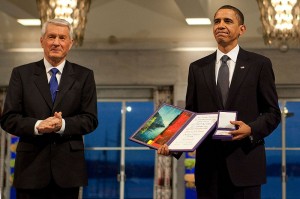
President Barack Obama uncomfortably accepting the Nobel Peace Prize from Committee Chairman Thorbjorn Jagland in Oslo, Norway, Dec. 10, 2009. (White House photo)
Even if you’ve never won an office raffle, a sports pool or a lottery, consider yourself supremely lucky. Unlike the atomic bomb victims who were recognized by President Barack Obama’s visit to Hiroshima, you’ve never experienced the horrors of nuclear war.
That’s nothing any of us should take for granted, says former Defense Secretary William Perry. On at least three occasions, he noted recently, the U.S. military received false alarms of a Soviet nuclear attack. At least twice the Soviet military went on high alert from similar alarms. And anyone who lived through the Cuban Missile Crisis in 1962 survived “as much by good luck as by good management,” he added.
The consequences of an accidental nuclear war would be staggering. Thousands of U.S. and Russian warheads, some of them orders of magnitude larger than the one that wiped out Hiroshima, are primed for launch on warning. Besides wiping out tens or hundreds of millions of people in urban centers, they would put a large fraction of the world’s population at risk from starvation.
A 2013 report by Physicians for Social Responsibility concluded that even a limited regional nuclear exchange — say between India and Pakistan — could “cause significant climate disruption worldwide” and jeopardize food supplies to as many as two billion people.
Many authorities believe the threat of accidental war is even greater today than during most of the Cold War. Last year, the Science and Security Board of the Bulletin of Atomic Scientists moved its famous Doomsday Clock forward to three minutes to midnight, its “direst setting” since the nuke-rattling days of the early Reagan era.
The group cited continued bluster and brinkmanship between NATO and Russia, including the shooting down of a Russian warplane by Turkey, as indicators of today’s risky nuclear environment.
Getting Lucky
National security experts and reporters such as Eric Schlosser, author of Command and Control (2014), have compiled long lists of nuclear accidents and near-misses, some of which might have cost millions of lives but for a few quick-thinking heroes. Here’s a small sample:
–In 1958, a B-47 dropped a 30 kiloton Mark 6 atomic bomb into a family’s backyard in Mars Bluff, South Carolina. Its high-explosive trigger blasted the home and left a 35-foot crater. A few months later, another B-47 dropped a Mark 39 hydrogen bomb near Abilene, again setting off its high explosives but not a nuclear blast.
–In 1961, a B-52 exploded over North Carolina, dropping two Mark 39 hydrogen bombs. One of them nearly detonated after five of its six safety devices failed. The Air Force never did recover the uranium trigger.
–In October 1962, at the height of the Cuban Missile Crisis, a Soviet submarine thought it was under attack from U.S. warships, which were practicing dropping depth charges in the Sargasso Sea. The submarine commander ordered a launch of nuclear missiles, but was persuaded to stop by his second-in-command.
Other near misses during that mother of all nuclear crises in 1962 included a reckless U.S. spy plane over-flight of Siberia, the explosion of a Soviet satellite that U.S. authorities interpreted as the start of a Soviet missile attack, American test launches of two nuclear-capable ICBMs, and a screw-up at a Minuteman site that allowed a single operator to launch a fully armed missile.
–In 1966, a B-52 bomber collided with a refueling tanker over Palomares, Spain and broke apart, dropping its four hydrogen bombs. Two of them partially detonated, contaminating a wide region with radiation.
–Two years later, a B-52 crashed in Greenland, losing three hydrogen bombs and contaminating nearly a quarter million cubic feet of ice and snow.
–In 1979, a technician mistakenly confused NORAD’s computers with a war games simulation, triggering signals of a Soviet nuclear launch. The Strategic Air Command scrambled its bombers before learning of the false alarm.
–A year later, a defective computer chip prompted the Pentagon to waken President Jimmy Carter’s national security adviser with reports of a massive launch of Soviet missiles from submarines and land-based silos.
–In 1985, a glint of sunlight confused a Soviet early-warning satellite, which reported that the United States had launched five intercontinental ballistic missiles. Fortunately, the watch commander risked his career by not reporting the alarm, saving the day.
–In 1995, Russia’s early-warning system confused a small Norwegian weather rocket with an incoming U.S. Trident missile. The Russian military went on high alert, notifying President Boris Yeltsin and preparing a possible counter-attack before recognizing the mistake.
Tensions Reduce the Odds
As MIT nuclear expert Theodore Postol noted last year, “Had the false alert of 1995 occurred instead during a political crisis, Russian nuclear forces might have been launched. American early warning systems would have immediately detected the launch, and this might then have led to the immediate launch of US forces in response to the Russian launch.”
Recent years have brought us accounts of missing nuclear missiles, drug use by Minuteman missile crews, shocking security breaches, crew commanders falling asleep, computer failures, a silo fire that went undetected by smoke alarms, and much more.
And just this week we were reminded by the Government Accountability Office that the Pentagon’s “Strategic Automated Command and Control System” uses 8-inch floppy disks and 1970s-vintage computers.
The Pentagon insisted in 2014 that the system “is extremely safe and extremely secure” — after all, how many hackers know how to operate such ancient technology? — but Princeton University’s Bruce Blair, a former Air Force ICBM launch-control officer, said this week, “The floppy disks are associated with a nuclear-communications system that was unreliable even when the system was upgraded in the 1970s.”
No doubt the odds of any one of these accidents triggering a war or mass catastrophe were low. But odds increase with the number of incidents. If the probability of a disaster from one incident is only one in 100, the odds of ruin from 20 such incidents rise to nearly one in five. Those are not comforting numbers.
That’s why it’s critical that the United States and Russia get serious about promoting world security by eliminating first-use and “launch on warning” policies that heighten the risk of accidental wars. They must also sharply reduce the size of nuclear arsenals that are difficult to track, safeguard and maintain.
Instead, President Obama has embarked on a trillion dollar program of nuclear modernization and a dangerous policy of confrontation with Russia in Eastern Europe. (Russia is not blameless in these matters, of course.) Such policies are, in turn, prompting China’s military to pursue a nuclear expansion program of its own — including a dangerous shift to hair-trigger alerts and a launch-on-warning policy.
Former Defense Secretary Perry warns that all of this is putting the world “on the brink of a new nuclear arms race.” That’s not what we expected from the President who was awarded a Nobel Peace Prize in part for his call to reduce the threat of nuclear weapons. Let’s hope Obama’s visit to Hiroshima rekindles his commitment to helping create a safer world.
Jonathan Marshall is author or co-author of five books on international affairs, including The Lebanese Connection: Corruption, Civil War and the International Drug Traffic (Stanford University Press, 2012).
May 28, 2016
Posted by aletho |
Militarism, Progressive Hypocrite, Timeless or most popular | Obama, United States |
Leave a comment
The United States has been pursuing an audacious project to fashion a global system according to its specifications and under its tutelage since the Cold War’s end.
For a quarter of a century, the paramount goal of all its foreign relations has been the fostering of a system whose architectural design features the following:
–a neo-liberal economic order wherein markets dictate economic outcomes and the influence of public authorities to regulate them is weakened;
–this entails a progressive financializing of the world economy which concentrates the levers of greatest power in a few Western institutions – private, national and supranational;
–if inequality of wealth and power is the outcome, so be it;
–security provided by an American-led concert that will have predominant influence in every region;
–a readiness to use coercion to remove any regime that directly challenges this envisaged order;
–the maintenance of a large, multi-functional American military force to ensure that the means to deal with any contingency as could arise;
–all cemented by the unquestioned conviction that this enterprise conforms to a teleology whose truth and direction were confirmed by the West’s total victory in the Cold War.
Therefore, it is inherently a virtuous project whose realization will benefit all mankind. Virtue is understood in both tangible and ethical terms.
American ‘Destiny’
The motto: There is a tide running in the affairs of man; so, now is the time for America to steer the current and fulfill its destiny.
The project has registered some remarkable successes (at least by its own definitions). The Washington sponsored Trans-Pacific Partnership (TPP) and its counterpart`, the Transatlantic Trade and Investment Partnership (TTPI), ensconce a privileged position for corporate interests that supersedes that of governments in binding international law.
The towering financial conglomerates have emerged from the great financial panic and Great Recession, which they caused, not only unscathed but bigger, stronger and with a stranglehold over macro-economic policy across most of the globe.
The United States, the progenitor of neo-liberalism and its operational guide, has seen its democracy converted into a plutocracy in all but name. The more things change, the more they must be made to seem the same.
These tenets of neo-liberalism have been codified into an orthodoxy whose dogma permeates the intellectual fiber of academia, the media and the corridors of state power. Challengers are ruthlessly put down – as witness the crucifying of Greece’s first Syriza government. Political leaders who deviate find themselves the object of international campaigns to oust them, e.g., Honduras, Venezuela, Bolivia, Paraguay, Brazil, Argentina, Iran and Russia.
As an indirect consequence of the project’s successes, political resistance now comes not from the Left but rather from a recrudescent nationalist Right as is occurring in Europe – the rebellion in both the East and the West against the European Union’s brave new world of technocracy of, by and for the corporate elites.
Trumpism represents the analogous phenomenon decked out in stars-and-stripes garb. This exacerbates the tensions generated internally by the guided globalization project. Within the decision centers of Washington power, that could either provide new impetus to the external dimension of establishing a global order under American aegis – or handicap it.
Whichever proves to be the case, the turn toward authoritarianism and xenophobia within the liberal democracies shows how ill-conceived and ineptly executed the design for a new world order is. For it has overreached at home and abroad.
Wealth Concentration
At home, the flaw (fatal or not) is the absence of all restraint in grabbing for riches and powers without leaving a reasonable portion, along with credible illusions of democratic control, for the mass of citizenry. Abroad, hubris fed by a combination of faith in American exceptionalism, the intoxication of power, and studied ignorance has generated fantasies of molding alien societies in our image – while ignoring the strength of countervailing forces as embodied by China, Russia and the multiple expressions of fundamentalist Islam.
It is in the political/security sphere that the historic American project faltered badly. Individual developments signal at once basic design flaws and obtuse implementation The upwelling of serious counter currents carries the message that setbacks are neither temporary nor readily containable.
The Middle East, of course, is where the pressure cooker of our own creation has exploded leaving a mess that covers the entire region, with the further risk of spreading beyond it.
Every major initiative has failed – and failed ignominiously. Iraq has fragmented into factions none of whom are reliable friends of Washington. Once a forbidden zone for Islamist jihadis, our intervention has spawned the most dangerous movement yet – ISIL, while inspiring Al Qaeda and its other spin-offs.
Syria, where we have dedicated ourselves to unseating the still internationally recognized government, is embroiled in an endless civil war whose main protagonists on the anti-Assad side are ISIL and Al Qaeda/Al Nusra & Assoc. So, the Obama people have put themselves in the position of feeding arms and providing diplomatic cover to groups who were our No. 1 security threat just yesterday.
Accordingly, for all of our bluster, we refuse to confront Turkey which has provided invaluable aid, comfort and refuge for both groups. Nor do we call out the Saudis for their succoring with money and political backing.
Embracing the Saudis
Washington’s deference to the Saudi royals has reached the extremity of its participating in the Saudi organized and led destruction of Yemen despite the cardinal truths that the Houthis, their enemy, is not a foe of the United States, and that Al Qaeda in the Arabian Peninsula has made extensive gains as a result of the war (and ISIL has succeeded in implanted itself there as well).
For these contributions to the War on Terror, Secretary of State John Kerry effusively thanks Deputy Crown Prince Mohammed bin-Salman – the author of these reckless Saudi policies – for the fulsome contribution the Kingdom is making to suppress Islamic extremism. Why? American diplomacy is locked into the idea that it must reassure Saudi Arabia of our loyalty in the wake of the Iran nuclear deal.
Hence, we embrace an obscurantist autocratic regime whose self-defined interests are antithetical to our stated objectives, and whose behavior highlights the hypocrisy of America’s trumpeted crusade to promote democracy and to protect human rights. It has the added effect of vitiating any chances to engage Iran pragmatically to deal with the civil wars in Iraq and Syria.
Fifteen years ago, the United States launched its Middle East wars to make us secure from terrorism and to politically transform the region. Instead, we face a greater menace, we have destroyed governments capable of maintaining a modicum of order, we have registered no success in nation-building or democracy building, and we have undercut our moral authority worldwide.
Our leaders talk of “pivots” away from the turbulent Middle East, President Barack Obama voices an ambition to demilitarize foreign policy, yet the reality is that today there are American troops fighting in Afghanistan, Iraq, Syria, Yemen, Somalia, and now Libya with no prospect of those conflicts concluding.
The most stunning, and noteworthy, reaction at home to this unprecedented record of unrelieved failure is the lack of reaction. All the elements in America’s fantastic views of another, post-Cold War American Century not only survive, they exercise near total influence over our foreign policy elite – in government and outside it. The learning curve is flat.
The number of places where the U.S. is militarily engaged grows rather than diminishes. The definition of “terrorism,” of security, of American national interest broadens rather than narrows. The defense budget points upwards rather than downwards. The contradictions multiply. How to explain this perverse pattern?
Ignoring Consequences
Avoidance behavior is a natural if not universal response to stress and cognitive dissonance. It passes into the range of the pathological when it becomes persistent and diverges more and more from experienced reality. At that point, it enters the realm of fantasy – often, with fantasies succeeding each other in serial fashion.
To adapt what Clarence Ayres has written: “In important ways, (American foreign policy) is being run by a web of Belief that has been separated from Reason and Evidence. Its ways resemble … the network of mythological convictions” that characterize some primitive tribes. “The contradiction between experience and one mystical notion is explained by reference to other mystical notions.”
Hence, the Belief that human societies carry the innate political DNA for democracy (to be spontaneously recognized by Iraqis once liberated by the Americans) is supplanted by the belief in COIN (counter-insurgency warfare) which, in turn, is supplanted by faith in the power Special Operations forces … ad infinitum.
This behavior pattern matches that associated with classic avoidance devices. One feature is compulsive reiteration. In terms of actions, that means the repeated attempt to resolve complex political problems through the application of coercive force. The national instinct when confronted with a challenge is to hit out – from Congolese warlords and Nigerian thugs to Islamist jihadis and anyone whom our so-called friends dislike, e.g., the Houthis.
This is the mind-set of the muscle-bound bully whose mental development hasn’t caught up with his physical development. In Afghanistan, we continue fighting and spurring the hapless Kabul government to keep it up when there isn’t a snowball’s chances in hell of defeating the Taliban (an outfit that never has killed an American outside of Afghanistan).
In Iraq-Syria, we struggle mightily to check the ISIL irregulars while blithely allowing them to carry on a lucrative oil commerce without interference from the U.S. air force. There, too, we make believe that the Russian presence doesn’t exist even though it has done more to shift the balance away from the jihadist groups than we have. Why? The powers-that-be have decided that Putin’s Russia actually is a bigger threat to America than is ISIL and Al Qaeda.
Black Hats/White Hats
Reiteration also takes the form of populating the strategic map with good guys and bad guys whose identification never changes whatever the evidence says. Hence, the white hats include the Saudi royals along with their school of Gulf Cooperation Council minnows, Erdogan’s Turkey, and of course Israel.
The black hats include: Iran, the Baathist regime in Syria, Hezbullah, Hamas, some Shi’ite factions in Iraq (Moqtada al-Sadr), and whoever opposes our sponsored, obedient would-be leaders in Libya, Yemen, Somalia, or wherever (think Latin America). Washington’s costume department does not stock gray hats.
The Global War on Terror notwithstanding, this casting makes us friends of ISIL’s and Al Qaeda’s friends and enemies of their enemies. No intellectual effort is evident to make the reconciliation.
In extreme circumstances, one resorts to outfitting with white hats whatever bunch of guys you can round up through Central Casting. That is exactly what we currently are doing in cobbling together an odd lot of stray Libyans into an ersatz “government” which Washington and its more obedient allies literally escorted into a bunker outside of Tripoli last month where they are offering themselves as national saviors.
This so-called Government of National Accord (GNA), which no significant body of Libyans had asked for, is meant to supersede the democratically elected government whose parliament is seated in Benghazi and engaged in a multi-party civil war with an array of sectarian and tribal formations.
Our seven-man GNA controls no territory but has entered into tacit alliance with a variety of Islamist militias attracted by the money and arms which the United States and partners have transferred to them from official Libyan accounts abroad. Shades of Syria circa 2011 -2013.
Prolonged residence in one or another fantasy bubble is made all the more comfortable by eluding contact with any respected party who might offer a different perspective that more closely conforms to reality. An oddity of our times is that the only criticism within range of power centers comes from those whose answer to all these dilemmas is to “hit ‘em harder.”
That is to say, the John McCains and fellow travelers among Republican hawks reinforced by the aggressive neocon contingent ensconced in the think tanks and media. The unfortunate consequence is that the President, and his less than sterling foreign policy team, now add the belief in their own moderation and prudence to their complacent plodding along the same rutted paths to nowhere.
We got a candid, uncensored look at one member of Obama’s inner circle when Ben Rhodes, Deputy National Security Adviser, was featured in that embarrassing Sunday New York Times Magazine story a few weeks ago.
Susan Rice, National Security Advisor and Presidential confidant since 2007, put herself on display via an interview with Fareed Zakaria (May 15) where she declared that “almost the whole Russia Air Force is deployed in Syria.” The truth is that the 70-odd Russian aircraft in Syria represent roughly 5 to 6 percent of their combat aircraft and about 2 to 2.5 percent of all aircraft in the Russian Air Force. It is one thing to off by a factor of 20 when spouting forth at a think-tank seminar where other participants’ minds are on their own next intervention or imagining whom they plan to latch onto during the coffee break. It is quite another to be so casually ignorant when you are in a position to shape actions that could affect the lives of millions and major interests of the United States.
This all too typical failure to recognize the difference helps to explain why the Obama administration’s foreign policy-making is so undisciplined and its diplomacy is so disjointed.
Pathological Element
There is yet another pathological element in this mix of illusion and faith. Manifest failure poses a threat to the powerful image of prowess and superiority imbued in our national leaders, and in the country’s collective personality.
Heavy doses of reality by now should have brought to light our ultimate “ordinariness” – however impressive the national record of accomplishment has been. That, though, is proving very hard for Americans to swallow.
Instead, we discern a pattern of denying manifest outcomes while relentlessly searching for fresh opportunities to establish our unique greatness. It took decades and much self-induced amnesia to come to terms with the loss of Vietnam. We seemingly shed that shroud in the first Gulf War. But then came 9/11 and the vengeful reaction of a scared country which led us into a new string of failures.
One psychological method for handling that dissonance is to claim that the game isn’t really over. The fat lady hasn’t sung (or if she did, we tuned her out). In Iraq, our most ignominious failure, the concrete manifestation of that failure in ISIL, gives us a second chance to demonstrate that Americans are winners after all.
In this warped psychology, if we are able to push them back and/or cripple them, that achievement somehow will confirm that we are winners. It just took a little while longer than expected. Political chaos in Baghdad and across the country? No one is perfect – only Allah. Besides, there are always the Iranians to blame.
What about Afghanistan? There, too, the final whistle hasn’t blown. There is no time limit – 48 minutes, 60 minutes, or nine innings – or 15 years. Operation Eternal Effort.
A quite different psychological coping mechanism, one that carries the seed of far greater risk, is to demonstrate macho self-confidence by searching out additional challengers to confront. That mechanism not only offers several new chances to prove to oneself and to the world how great we are; it also demonstrates our brave sense of duty.
So, we expand Special Operations and send teams of various sizes into scores of countries to take on the bad guys. More demonstrably, we make it known that our nuclear deal with Tehran notwithstanding, we’re ever ready to go one-on-one with the mullahs who just aren’t our sort of people.
Fighting the Big Boys
The ultimate expression of this psycho-mentality is to pick a fight with the really big guys: Russia and China. We know them from the last movie – and everybody remembers how we whipped the Russians’ ass – to use the hard-nosed parlance favored around Washington.
The extreme hostility toward a more assertive Russia and Vladimir Putin personally goes well beyond any realpolitik calculus. It has an emotional side clearly evident in the cartoonish exaggeration that marks almost all coverage of the country and the man – and the remarks of President Obama himself. Indeed, it is all the starker for the contrast to Putin’s cool rationality.
Obama, personally, cannot abide Putin. To continue the line of psychological analysis, we might find some clues why in the President’s behavioral record. He typically is uneasy around, and therefore tries to avoid, strong, independent-minded persons who are at least as intelligent as he is. None of his inner circle are exceptions to this generalization.
The real tough guys on Wall Street and in the Pentagon/Intelligence Establishment he defers to – anticipating what they want and holding them at a respectful distance. Putin fits neither category. In addition, he is as cerebral and exhibits as much self-control as does Obama – thereby challenging the latter’s sense of uniqueness and superiority. Putin also is infinitely more skillful politically.
Of course, there is ample evidence that significant elements of the American government and foreign policy Establishment have long viewed Russia as a potential obstacle to the American grand design. Therefore, they have reached a calculated conclusion that it must be denatured as a political force or eliminated.
The resources that we expended in bending Russian institutions and policies to our will during the Yeltsin years testify to that. Putin, though, has shown himself a far sterner, autonomous character with his own pronounced view as to how the world should be structured and Russia’s place within it.
His objective from the first was to restore Russian dignity, Russian independence and a measure of Russian control over its strategic space. That inevitably brought him into conflict with the American plan to keep Russia dependent, weak and marginalized.
The central element of that strategy was the policy of bringing all of the former Soviet republics into Western institutions – Ukraine above all, as Zbignew Brzezinski has explained with brutal candor. The Washington encouraged coup in Kiev two years ago was the culmination of a plan that temporarily had been thwarted by Moscow’s maneuvers that aimed at keeping Ukraine out of the E.U. (aka NATO) orbit.
Putin’s unexpectedly decisive action on Crimea, the Donbass and then Syria has changed the strategic map and upset American assumptions about the insignificance of its old foe. That in itself helps to explain the intensity and emotionalism of Washington reaction.
In the Middle East, in particular, the Russians have been useful partners: in winning Iran’s acquiescence to concessions that cleared the way for the nuclear accord; in resolving of the sarin gas crisis when Putin opened an avenue for Obama to escape the corner he had painted himself into by making hasty accusations that were contradicted by the intelligence community; and finally by forcing us to face up to the unwelcome truth that the only alternative to Assad is a radical jihadist dominated regime that would empower the very people we have been trying to exterminate since 2001.
Rejecting Logic
Rather than acting on that pragmatic logic, the Obama administration – egged on by the country’s entire foreign policy Establishment – has decided to treat Russia as America’s global enemy No. 1, officially.
In Syria, blocking the Russians at every turn and doubling-down on the ouster of Assad now shapes everything else we do in that country. In Europe, the United States has pushed NATO into a full-blown confrontation: stationing several brigades in the Baltics and Poland; staging a ribbon-cutting ceremony in Romania for the missile defense system that also can serve as a platform for nuclear tipped cruise missiles; conducting exercises in Georgia; and proposing to make Georgia and Ukraine de facto NATO members whose militaries would be integrated into the NATO command structure (the 28 + 2 formula).
These moves have been accompanied by a barrage of bellicose rhetoric from top American commanders and the Secretary of Defense to the President himself. These are all steps that contravene long established treaties, some dating back to the Soviet era, and fly in the face of solemn promises made by President George H.W. Bush and Secretary of State James Baker to Soviet leader Mikhail Gorbachev between 1989 and 1991.
This provocative strategy is justified as a response to Russia’s alleged aggressive and growing moves darkly portrayed as a precursor to a possible assault against former lands of the defunct Soviet empire. The empirical evidence for this dire assertion is lacking – nor is there interest in making the case with a modicum of empirical logic. For the impulses spring from within the American political psyche – not from our external environment.
There are those who calculatingly have actively sought to isolate Russia, topple Putin and remove both as thorns in the side of American grand strategy. And there are those, including President Obama, whose behavior reveals a deep compulsion to portray a complex situation in terms of a simple, exaggerated threat; to show their mettle; to strut; and to compensate for the frustrations and failures that have bedeviled the United States’ foreign policies.
This is foreign policy by emotion, not by logical thought. It is rooted in the psychological reaction to the hopelessness of the post-Cold War grand design. It stems as well from the unpalatable experience of being unable to live up to the exalted self-image that is at the core of Americans’ national personality.
And it is intensified by the need, compensating for heightened insecurities, to prove that America is Number One, always will be Number One, and deserves to be Number One. That maelstrom of emotion was almost palpable in Obama’s last State of the Union Address where he declaimed:
“Let me tell you something. The United States of America is the most powerful nation on Earth. Period. It’s not even close. Period. It’s not even close. It’s not even close!”
So? Is this meant as a revelation? What is the message? To whom? Is it any different than crowds of troubled and frustrated Arab demonstrators shouting “ALLAH AKBAR!” Words that are neither a prelude to action nor inspire others to act – nor even impart information – are just puffs of wind. They are affirmations of self rather than communication. As such, they are yet another avoidance device whereby bluster substitutes for a deliberate appraisal of how to adjust to the gap between aspiration and declining prowess.
Making Narratives Fit
A complementary device for perpetuating a crucial national myth of exceptionalism and superiority is to stress systematically those features of other nations, or situations, that conform to the requirements of the American national narrative while neglecting or downplaying opposite features.
Currently, we are witnessing the unfolding of an almost clinical example in the treatment of China. The emergence of the PRC as a great power with the potential to surpass or eclipse the United States poses a direct threat to the foundation myth of American superiority and exceptionalism. The very existence of that threat is emotionally difficult to come to terms with.
Psychologically, the most simple way to cope is to define it out of existence – to deny it. One would think that doing so is anything but easy. After all, China’s economy has been growing at double digit rates for almost 30 years. The concrete evidence of its stunning achievements is visible to the naked eye.
Necessity, though, is the mother of invention. Our compelling emotional need at the moment is to have China’s strength and latent challenge subjectively diminished. So what we see is a rather extraordinary campaign to highlight everything that is wrong with China, to exaggerate those weaknesses, to project them into the future, and – thereby – to reassure ourselves.
Coverage of Chinese affairs by the United States’ newspaper of record, The New York Times, has taken a leading role in this project. For the past year or two, we have been treated to an endless series of stories focusing on what’s wrong with China. Seemingly nothing is too inconsequential to escape front page, lengthy coverage.
The current signs of economic weakness and financial fragility have generated a spate of dire commentary that China’s great era of growth may be grinding to a halt – not to be restarted until its leaders have seen the error of their ways and taken the path marked out by America and other Western capitalist countries.
This latest upwelling of China-bashing could well serve as a clinical exhibit of avoidance behavior. For it goes beyond sublimation and simple denial. It also reveals the extreme vulnerability of the American psyche to the perceived China “threat,” and the compelling psychological need to neutralize it – if only by verbal denigration.
At present, the United States has no strategic dialogue with either China or Russia. That is a failure of historic proportions. There is no vast ideological chasm to bridge – as in the Cold War days. There are no bits of contested geography that directly involve the parties. Putin and Xi are eminently rational leaders – whether we agree with them or not.
The Russian leader, in particular, has laid out his conception of the world system; of the Russo-American relations; of why Russia is pursuing certain polices – all with a concision and candor that probably is unprecedented. He also stresses the need for cooperation with Washington and offers guidelines for sustained exchanges. We have done nothing analogous. Indeed, it appears that no policy-maker of consequence even bothers to read or listen to Putin.
To take him seriously, to engage the Chinese on the strategic plane, requires statesmanship of a high order. An America – and its leaders – who are tied into psychological knots by their inability to view reality with a measure of detachment and self-awareness never will muster that statesmanship.
Michael Brenner is a professor of international affairs at the University of Pittsburgh. mbren@pitt.edu
May 27, 2016
Posted by aletho |
Economics, Militarism, Progressive Hypocrite, Timeless or most popular | Iran, Iraq, Russia, United States |
Leave a comment
President Obama made an historic visit to Hiroshima today—the first sitting US president to do so since the US atomic bombing of that city on August 6, 1945, followed three days later by the atomic bombing of Nagasaki.
As he did in Prague, in 2009, President Obama gave a very moving and meaningful speech about the impact of nuclear weapons, reflecting upon the experience of the victims of nuclear warfare—the Hibakusha.
“Their souls speak to us,” he said. “They ask us to look inward, to take stock of who we are and what we might become.”
In reiterating his call for a world without nuclear weapons, President Obama acknowledged that the suffering of the Hibakusha gives us “a shared responsibility to look directly into the eye of history and ask what we must do differently to curb such suffering again.” The very existence of nuclear weapons, he said, “fuels our moral imagination.”
These thoughts and words, though profound, have not been matched by US actions to eliminate nuclear weapons. To the contrary, the Obama administration is implementing a $1 trillion, 30-year program to build new and more usable nuclear weapons, along with more accurate delivery systems and the infrastructure to keep producing them well into the 21st century. This administration has done less to reduce the number of US nuclear weapons than any of its recent predecessors. Not only has the US failed to reduce its own reliance on nuclear weapons, it has induced other countries, including Japan, to rely upon US nuclear weapons for their own security. Hiroshima survivor Setsuko Thurlow has rightly called this extended nuclear deterrence arrangement with Japan an insult to the Hibakusha.
Moreover, while President Obama payed homage to the Hibakusha and to the victims of all wars, declaring that we must “reimagine our connection to one another as members of one human race,” the United States has boycotted a series of international conferences and the meetings of a UN working group with a mandate to recommend ways of doing things differently to achieve a world without nuclear weapons and to ensure that no other city ever suffers the fate of Hiroshima and Nagasaki.
All of the other nuclear-armed states—Russia, China, France, the UK, India, Pakistan, Israel, and North Korea—have paid similar lip service to the goal of a nuclear-weapons-free world, and all are engaged in their own large and expensive nuclear rearmament programs. All of them have boycotted the UN working group that is laying the groundwork for a new legal instrument to prohibit nuclear weapons based on their humanitarian impact. All of the nuclear-armed states, including the US, are turning their backs on the meaning of Hiroshima and the appeal of the Hibakusha.
When the US and the other nuclear-armed states stop doing everything they can to block a treaty banning nuclear weapons, and abandon plans to rebuild and perpetuate their nuclear arsenals, President Obama’s call for a world free of nuclear weapons will have meaning. Until then it is empty rhetoric.
May 27, 2016
Posted by aletho |
Militarism, Progressive Hypocrite, Timeless or most popular, War Crimes | Hiroshima, Obama, United States |
Leave a comment
President Obama heads to Japan this week for an historic visit to Hiroshima, site of the world’s first use of a nuclear weapon, and one of the United States’ most enduring shameful acts. The corporate media has hailed the visit as an important step in strengthening bilateral relations between the US and Japan. Indeed, it certainly is that as the US seeks to reassert its hegemony in an Asia-Pacific region increasingly being seen as the sphere of influence of China.
However, Obama’s arrival in Japan also highlights the deeply hypocritical and cynical attitudes of US policymakers, and President Obama himself, when it comes to the relevant issues. He is not expected to formally apologize for the needless slaughter of more than 200,000 Japanese citizens (mostly civilians), nor is he going to address the lingering policy-related effects of the war such as the highly unpopular US military occupation of Okinawa. In fact, it seems Obama is unlikely to touch on anything of substance. But there are indeed numerous subjects which merit close scrutiny.
First and foremost, one must consider the fact that for 70 years the United States has maintained a permanent military presence in Japan, one which is deeply reviled by the majority of the people of Japan, especially the citizens of Okinawa who regularly and continuously protest the US occupation. And while Obama and his counterpart, Japanese Prime Minister Shinzo Abe, will discuss the continued friendship and partnership between the two countries, the reality is that it remains a master-client relationship. There will likely be much discussion of past, present, and future, without any admission of guilt either on the side of the US for its horrific war crimes nor by Japan for its unrestrained aggression against China, Korea, and the rest of the Asia-Pacific. As Kurt Vonnegut would say, “So it goes.”
Interestingly, the question of nuclear weapons will likely also not be addressed in a substantive way. There may indeed be some discussion of the subject in general terms, but it will be veiled in the typically flowery, but utterly vacuous, Obama rhetoric. Given the opportunity, an intrepid reporter might venture to ask the President why, despite winning the Nobel Peace Prize “for his extraordinary efforts to strengthen international diplomacy and cooperation between peoples [and] vision of and work for a world without nuclear weapons,” he has presided over an administration that will spend more than $1 trillion upgrading, modernizing, and expanding the US nuclear arsenal.
Perhaps even more uncomfortable might be a question about why the allegedly anti-nuclear president who waxed poetic about disarmament as a student at Columbia University has spent two terms in office providing tens of billions in aid to nuclear-armed Israel, raising the amount of US aid to Tel Aviv to historic levels. In 2014, the Obama administration also enthusiastically signed a new nuclear deal with the UK which, according to Obama himself, “intends to continue to maintain viable nuclear forces into the foreseeable future… [America needed to aid Britain] in maintaining a credible nuclear deterrent.” So much for disarmament.
And while Obama and his coterie of spin doctors shape his anti-nuclear legacy with talk of a nuclear deal with Iran – a country that has no nuclear weapons – the cynicism is impossible to ignore. Obama has in fact done everything to promote nuclear proliferation including the absolutely insane new US missile “defense” system in Eastern Europe which, almost by definition, forces Russia to upgrade and expand its own arsenal, including its nuclear stockpile (still the largest in the world) as a countermeasure.
And then there’s the irradiated elephant in the room: Fukushima. The ongoing cover-up of what’s really happening in Fukushima lurks in the background of all discussion about nuclear issues and Japan. No one should hold their breath for even a whisper about this still unfolding environmental catastrophe which the Japanese government has gone to great lengths to dump down the memory hole.
Rather than formally apologizing to the Japanese people for the grave crimes of the US Government, Obama will instead frame his position as “looking forward, not backward,” a hollow platitude that calls to mind the utterly reprehensible decision by Obama not to investigate or prosecute the Bush administration criminals involved in torture. Rather than a heartfelt expression of regret, Obama offers the Trans-Pacific Partnership and an escalation of tensions with China. Rather than working for peace as one might expect of a Nobel Peace Prize winner, Obama instead will continue to champion his “pivot to Asia” strategy which has yielded little in terms of progress but much in terms of US military presence.
President Obama’s visit to Japan, like his allegedly great successes in Iran and Cuba, will change nothing. Obama will say a few words, then leave Japan. He’ll soon leave office with a still more dangerous world than when he entered: more nukes, more wars, more destruction. And this from our Peace Prize President.
Eric Draitser can be reached at ericdraitser@gmail.com.
May 25, 2016
Posted by aletho |
Militarism, Progressive Hypocrite, Timeless or most popular, War Crimes | Japan, Obama, United States |
Leave a comment

 Aletho News
