Empire Under Obama: Part 3
By Andrew Gavin Marshall | The Hampton Institute | October 17, 2013
Obama’s global terror campaign is not only dependent upon his drone assassination program, but increasingly it has come to rely upon the deployment of Special Operations forces in countries all over the world, reportedly between 70 and 120 countries at any one time. As Obama has sought to draw down the large-scale ground invasions of countries (as Bush pursued in Afghanistan and Iraq), he has escalated the world of ‘covert warfare,’ largely outside the oversight of Congress and the public. One of the most important agencies in this global “secret war” is the Joint Special Operations Command, or JSOC for short.
JSOC was established in 1980 following the failed rescue of American hostages at the U.S. Embassy in Iran as “an obscure and secretive corner of the military’s hierarchy,” noted the Atlantic. It experienced a “rapid expansion” under the Bush administration, and since Obama came to power, “appears to be playing an increasingly prominent role in national security” and “counterterrorism,” in areas which were “traditionally covered by the CIA.” One of the most important differences between these covert warfare operations being conducted by JSOC instead of the CIA is that the CIA has to report to Congress, whereas JSOC only reports its most important activities to the President’s National Security Council.
During the Bush administration, JSOC “reported directly” to Vice President Dick Cheney, according to award-winning investigative journalist Seymour Hersh (of the New Yorker), who explained that, “It’s an executive assassination ring essentially, and it’s been going on and on and on.” He added: “Under President Bush’s authority, they’ve been going into countries, not talking to the ambassador or the CIA station chief, and finding people on a list and executing them and leaving. That’s been going on, in the name of all of us.”
In 2005, Dick Cheney referred to U.S. Special Forces as “the silent professionals” representing “the kind of force we want to build for the future… a force that is lighter, more adaptable, more agile, and more lethal in action.” And without a hint of irony, Cheney stated: “None of us wants to turn over the future of mankind to tiny groups of fanatics committing indiscriminate murder and plotting large-scale terror.” Not unless those “fanatics” happen to be wearing U.S. military uniforms, of course, in which case “committing indiscriminate murder and plotting large-scale terror” is not an issue.
The commander of JSOC during the Bush administration – when it served as Cheney’s “executive assassination ring” – was General Stanley McChrystal, whom Obama appointed as the top military commander in Afghanistan. Not surprisingly, JSOC began to play a much larger role in both Afghanistan and Pakistan. In early 2009, the new head of JSOC, Vice Admiral William H. McRaven, ordered a two-week ‘halt’ to Special Operations missions inside Afghanistan, after several JSOC raids in previous months killed several women and children, adding to the growing “outrage” within Afghanistan about civilian deaths caused by US raids and airstrikes, which contributed to a surge in civilian deaths over 2008.
JSOC has also been involved in running a “secret war” inside of Pakistan, beginning in 2006 but accelerating rapidly under the Obama administration. The “secret war” was waged in cooperation with the CIA and the infamous private military contractor, Blackwater, made infamous for its massacre of Iraqi civilians, after which it was banned from operating in the country.
Blackwater’s founder, Erik Prince, was recruited as a CIA asset in 2004, and in subsequent years acquired over $1.5 billion in contracts from the Pentagon and CIA, and included among its leadership several former top-level CIA officials. Blackwater, which primarily hires former Special Forces soldiers, has largely functioned “as an overseas Praetorian guard for the CIA and State Department officials,” who were also “helping to craft, fund, and execute operations,” including “assembling hit teams,” all outside of any Congressional or public oversight (since it was technically a private corporation).
The CIA hired Blackwater to aid in a secret assassination program which was hidden from Congress for seven years. These operations would be overseen by the CIA or Special Forces personnel. Blackwater has also been contracted to arm drones at secret bases in Afghanistan and Pakistan for Obama’s assassination program, overseen by the CIA. The lines dividing the military, the CIA and Blackwater had become “blurred,” as one former CIA official commented, “It became a very brotherly relationship… There was a feeling that Blackwater eventually become an extension of the agency.”
The “secret war” in Pakistan may have begun under Bush, but it had rapidly expanded in the following years of the Obama administration. Wikileaks cables confirmed the operation of JSOC forces inside of Pakistan, with Pakistani Prime Minister Yousaf Raza Gillani telling the U.S. Ambassador to Pakistan, Anne Patterson (who would later be appointed as ambassador to Egypt), that, “I don’t care if they do it as long as they get the right people. We’ll protest in the National Assembly and then ignore it.”
Within the first five months of Obama’s presidency in 2009, he authorized “a massive expansion of clandestine military and intelligence operations worldwide,” granting the Pentagon’s regional combatant commanders “significant new authority” over such covert operations. The directive came from General Petraeus, commander of CENTCOM, authorizing Special Forces soldiers to be sent into “both friendly and hostile nations in the Middle East, Central Asia and the Horn of Africa.” The deployment of highly trained killers into dozens of countries was to become “systemic and long term,” designed to “penetrate, disrupt, defeat or destroy” enemies of the State, beyond the rule of law, no trial or pretenses of accountability. They also “prepare the environment” for larger attacks that the U.S. or NATO countries may have planned. Unlike with the CIA, these operations do not report to Congress, or even need “the President’s approval.” But for the big operations, they get the approval of the National Security Council (NSC), which includes the president, as well as most other major cabinet heads, of the Pentagon, CIA, State Department, etc.
The new orders gave regional commanders – such as Petraeus who headed CENTCOM, or General Ward of the newly-created Africa Command (AFRICOM) – authority over special operations forces in the area of their command, institutionalizing the authority to send trained killers into dozens of countries around the world to conduct secret operations with no oversight whatsoever; and this new ‘authority’ is given to multiple top military officials, who have risen to the top of an institution with absolutely no ‘democratic’ pretenses. Regardless of who is president, this “authority” remains institutionalized in the “combatant commands.”
The combatant commands include: AFRICOM over Africa (est. 2007), CENTCOM over the Middle East and Central Asia (est. 1983), EUCOM over Europe (est. 1947), NORTHCOM over North America (est. 2002), PACOM over the Pacific rim and Asia (est. 1947), SOUTHCOM over Central and South America and the Caribbean (est. 1963), SOCOM as Special Operations Command (est. 1987), STRATCOM as Strategic Command over military operations to do with outer space, intelligence, and weapons (est. 1992), and TRANSCOM handling all transportation for the Department of Defense. The State Department was given “oversight” to clear the operations from each embassy, just to make sure everyone was ‘in the loop,’ unlike during the Bush years when it was run out of Cheney’s office without telling anyone else.
In 2010, it was reported by the Washington Post that the U.S. has expanded the operations of its Special Forces around the world, from being deployed in roughly 60 countries under Bush to about 75 countries in 2010 under Obama, operating in notable spots such as the Philippines and Colombia, as well as Yemen, across the Middle East, Africa and Central Asia. The global deployment of Special Forces – alongside the CIA’s global drone warfare program – were two facets of Obama’s “national security doctrine of global engagement and domestic values,” in the words of the Washington Post, though the article was unclear on which aspect of waging “secret wars” in 75 countries constituted Obama’s “values.” Commanders for Special Operations forces have become “a far more regular presence at the White House” under Obama than George Bush, with one such commander commenting, “We have a lot more access… They are talking publicly much less but they are acting more. They are willing to get aggressive much more quickly.” Such Special Operations forces deployments “go beyond unilateral strikes and include the training of local counterterrorism forces and joint operations with them.”
So not only are U.S. forces conducting secret wars within dozens of countries around the world, but they are training the domestic military forces of many of these countries to undertake secret wars internally, and in the interests of the United States Mafia empire.
One military official even “set up a network” of private military corporations that hired former Special Forces and CIA operations to gather intelligence and conduct secret operations in foreign countries to support “lethal action”: publicly subsidized, privatized ‘accountability.’ Such a network was “generally considered illegal” and was “improperly financed.” When the news of these networks emerged, the Pentagon said it shut them down and opened a “criminal investigation.” Turns out, they found nothing “criminal,” because two months later, the operations were continuing and had “become an important source of intelligence.” The networks of covert-ops corporations were being “managed” by Lockheed Martin, one of the largest military contractors in the world, while being “supervised” by the Pentagon’s Special Operations Command.
Admiral Eric T. Olson had been the head of Special Operations Command from 2007 to 2011, and in that year, Olson led a successful initiative – endorsed by the Chairman of the Joint Chiefs Mike Mullen and Defense Secretary Robert Gates – to encourage the promotion of top special operations officials to higher positions in the whole military command structure. The “trend” was to continue under the following Defense Secretary Leon Panetta, who previously headed the CIA from 2009 to 2011. When Olson left his position as head of Special Operations Command, he was replaced with Admiral William McRaven, who served as the head of JSOC from 2008 to 2011, having followed Stanley McChrystal.
By January of 2012, Obama was continuing with seeking to move further away from large-scale ground wars such as in Iraq and Afghanistan, and refocus on “a smaller, more agile force across Asia, the Pacific and the Middle East.” Surrounded by the Joint Chiefs of Staff in full uniforms adorned with medals, along with other top Pentagon officials, President Obama delivered a rare press briefing at the Pentagon where he said that, “our military will be leaner, but the world must know the United States is going to maintain our military superiority.” The priorities in this strategy would be “financing for defense and offense in cyberspace, for Special Operations forces and for the broad area of intelligence, surveillance and reconnaissance.”
In February of 2012, Admiral William H. McRaven, the head of the Special Operations Command, was “pushing for a larger role for his elite units who have traditionally operated in the dark corners of American foreign policy,” advocating a plan that “would give him more autonomy to position his forces and their war-fighting equipment where intelligence and global events indicate they are most needed,” notably with expansions in mind for Asia, Africa and Latin America. McRaven stated that, “It’s not really about Socom [Special Operations Command] running the global war on terrorism… I don’t think we’re ready to do that. What it’s about is how do I better support” the major regional military command structures.
In the previous decade, roughly 80% of US Special Operations forces were deployed in the Middle East, but McRaven wanted them to spread to other regions, as well as to be able to “quickly move his units to potential hot spots without going through the standard Pentagon process governing overseas deployments.” The Special Operations Command numbered around 66,000 people, double the number since 2001, and its budget had reached $10.5 billion, from $4.2 billion in 2001.
In March of 2012, a Special Forces commander, Admiral William H. McRaven, developed plans to expand special operations units, making them “the force of choice” against “emerging threats” over the following decade. McRaven’s Special Operations Command oversees more than 60,000 military personnel and civilians, saying in a draft paper circulated at the Pentagon that: “We are in a generational struggle… For the foreseeable future, the United States will have to deal with various manifestations of inflamed violent extremism. In order to conduct sustained operations around the globe, our special operations must adapt.” McRaven stated that Special Forces were operating in over 71 countries around the world.
The expansion of global special forces operations was largely in reaction to the increasingly difficult challenge of positioning large military forces around the world, and carrying out large scale wars and occupations, for which there is very little public support at home or abroad. In 2013, the Special Operations Command had forces operating in 92 different countries around the world, with one Congressional critic accusing McRaven of engaging in “empire building.” The expanded presence of these operations is a major factor contributing to “destabilization” around the world, especially in major war zones like Pakistan.
In 2013, McRaven’s Special Operations Command gained new authorities and an expanded budget, with McRaven testifying before the Senate Armed Services Committee that, “On any day of the year you will find special operations forces [in] somewhere between 70 and 90 countries around the world.” In 2012, it was reported that such forces would be operating in 120 different countries by the end of the year.
In December of 2012, it was announced that the U.S. was sending 4,000 soldiers to 35 different African countries as “part of an intensifying Pentagon effort to train countries to battle extremists and give the U.S. a ready and trained force to dispatch to Africa if crises requiring the U.S. military emerge,” operating under the Pentagon’s newest regional command, AFRICOM, established in 2007.
By September of 2013, the U.S. military had been involved in various activities in Algeria, Angola, Benin, Botswana, Burkina Faso, Burundi, Cameroon, Cape Verde Islands, Senegal, Seychelles, Togo, Tunisia, Uganda and Zambia, among others, constructing bases, undertaking “security cooperation engagements, training exercises, advisory deployments, special operations missions, and a growing logistics network.”
In short, Obama’s global ‘war of terror’ has expanded to roughly 100 countries around the world, winding down the large-scale military invasions and occupations such as those in Afghanistan and Iraq, and increasing the “small-scale” warfare operations of Special Forces, beyond the rule of law, outside Congressional and public oversight, conducting “snatch and grab” operations, training domestic repressive military forces in nations largely run by dictatorships to undertake their own operations on behalf of the ‘Global Godfather.’
Make no mistake: this is global warfare. Imagine for a moment the international outcry that would result from news of China or Russia conducting secret warfare operations in roughly 100 countries around the world. But when America does it, there’s barely a mention, save for the passing comments in the New York Times or the Washington Post portraying an unprecedented global campaign of terror as representative of Obama’s “values.” Well, indeed it is representative of Obama’s values, by virtue of the fact that he doesn’t have any.
Indeed, America has long been the Global Godfather applying the ‘Mafia Principles’ of international relations, lock-in-step with its Western lackey organized crime ‘Capo’ states such as Great Britain and France. Yet, under Obama, the president who had won public relations industry awards for his well-managed presidential advertising campaign promising “hope” and “change,” the empire has found itself waging war in roughly one hundred nations, conducting an unprecedented global terror campaign, increasing its abuses of human rights, war crimes and crimes against humanity, all under the aegis of the Nobel Peace Prize-winner Barack Obama.
Whether the president is Clinton, Bush, or Obama, the Empire of Terror wages on its global campaign of domination and subjugation, to the detriment of all humanity, save those interests that sit atop the constructed global hierarchy. It is in the interests of the ruling elite that America protects and projects its global imperial designs. It is in the interests of all humanity, then, that the Empire be opposed – and ultimately, deconstructed – no matter who sits in office, no matter who holds the title of the ‘high priest of hypocrisy’ (aka: President of the United States). It is the Empire that rules, and the Empire that destroys, and the Empire that must, in turn, be demolished.
The world at large – across the Middle East, Africa, Asia, Latin America – suffers the greatest hardships of the Western Mafia imperial system: entrenched poverty, exploitation, environmental degradation, war and destruction. The struggle against the Empire cannot be waged and won from the outside alone. The rest of the world has been struggling to survive against the Western Empire for decades, and, in truth, hundreds of years. For the struggle to succeed (and it can succeed), a strong anti-Empire movement must develop within the imperial powers themselves, and most especially within the United States. The future of humanity depends upon it.
Or… we could all just keep shopping and watching TV, blissfully blind to the global campaign of terror and war being waged in our names around the world. Certainly, such an option may be appealing, but ultimately, wars abroad come home to roost. As George Orwell once wrote: “The war is not meant to be won, it is meant to be continuous. Hierarchical society is only possible on the basis of poverty and ignorance. This new version is the past and no different past can ever have existed. In principle the war effort is always planned to keep society on the brink of starvation. The war is waged by the ruling group against its own subjects and its object is not the victory over either Eurasia or East Asia, but to keep the very structure of society intact.”
October 24, 2013
Posted by aletho |
Deception, Militarism, Progressive Hypocrite, Subjugation - Torture, Timeless or most popular, War Crimes | Afghanistan, Africa, Dick Cheney, Iraq, Joint Special Operations Command, Obama, Pakistan, Stanley McChrystal, United States |
Leave a comment
There’s a dark side to the flurry of reports and testimony on drones, helpful as they are in many ways. When we read that Amnesty International and Human Rights Watch oppose drone strikes that violate international law, some of us may be inclined to interpret that as a declaration that, in fact, drone strikes violate international law. On the contrary, what these human rights groups mean is that some drone strikes violate the law and some do not, and they want to oppose the ones that do.
Which are which? Even their best researchers can’t tell you. Human Rights Watch looked into six drone murders in Yemen and concluded that two were illegal and four might be illegal. The group wants President Obama to explain what the law is (since nobody else can), wants him to comply with it (whatever it is), wants civilians compensated (if anyone can agree who the civilians are and if people can really be compensated for the murder of their loved ones), and wants the U.S. government to investigate itself. Somehow the notion of prosecuting crimes doesn’t come up.
Amnesty International looks into nine drone strikes in Pakistan, and can’t tell whether any of the nine were legal or illegal. Amnesty wants the U.S. government to investigate itself, make facts public, compensate victims, explain what the law is, explain who a civilian is, and — remarkably — recommends this: “Where there is sufficient admissible evidence, bring those responsible to justice in public and fair trials without recourse to the death penalty.” However, this will be a very tough nut to crack, as those responsible for the crimes are being asked to define what is and is not legal. Amnesty proposes “judicial review of drone strikes,” but a rubber-stamp FISA court for drone murders wouldn’t reduce them, and an independent judiciary assigned to approve of certain drone strikes and not others would certainly approve of some, while inevitably leaving the world less than clear as to why.
The UN special rapporteurs’ reports are perhaps the strongest of the reports churned out this week, although all of the reports provide great information. The UN will debate drones on Friday. Congressman Grayson will bring injured child drone victims to Washington on Tuesday (although the U.S. State Department won’t let their lawyer come). Attention is being brought to the issue, and that’s mostly to the good. The U.N. reports make some useful points: U.S. drones have killed hundreds of civilians; drones make war the norm rather than an exception; signature strikes are illegal; double-tap strikes (targeting rescuers of a first strike’s victims) are illegal; killing rather than capturing is illegal; imminence (as a term to define a supposed threat) can’t legally be redefined to mean eventual or just barely imaginable; and — most powerfully — threatened by drones is the fundamental right to life. However, the U.N. reports are so subservient to western lawyer groupthink as to allow that some drone kills are legal and to make the determination of which ones so complex that nobody will ever be able to say — the determination will be political rather than empirical.
The U.N. wants transparency, and I do think that’s a stronger demand than asking for the supposed legal memos that Obama has hidden in a drawer and which supposedly make his drone kills legal. We don’t need to see that lawyerly contortionism. Remember Obama’s speech in May at which he claimed that only four of his victims had been American and for one of those four he had invented criteria for himself to meet, even though all available evidence says he didn’t meet those criteria even in that case, and he promised to apply the same criteria to foreigners going forward, sometimes, in certain countries, depending. Remember the liberal applause for that? Somehow our demands of President Bush were never that he make a speech.
(And did you see how pleased people were just recently that Obama had kidnapped a man in Libya and interrogated him in secret on a ship in the ocean, eventually bringing him to the U.S. for a trial, because that was a step up from murdering him and his neighbors? Bush policies are now seen as advances.)
We don’t need the memos. We need the videos, the times, places, names, justifications, casualties, and the video footage of each murder. That is to say, if the UN is going to give its stamp of approval to a new kind of war but ask for a little token of gratitude, this is what it should be. But let’s stop for a minute and consider. The general lawyerly consensus is that killing people with drones is fine if it’s not a case where they could have been captured, it’s not “disproportionate,” it’s not too “collateral,” it’s not too “indiscriminate,” etc., — the calculation being so vague that nobody can measure it. We’re not wrong to trumpet the good parts of these reports, but let’s be clear that the United Nations, an institution created to eliminate war, is giving its approval to a new kind of war, as long as it’s done properly, and it’s giving its approval in the same reports in which it says that drones threaten to make war the norm and peace the exception.
I hate to be a wet blanket, but that’s stunning. Drones make war the norm, rather than the exception, and drone murders are going to be deemed legal depending on a variety of immeasurable criteria. And the penalty for the ones that are illegal is going to be nothing, at least until African nations start doing it, at which point the International Criminal Court will shift into gear.
What is it that makes weaponized drones more humane than land mines, poison gas, cluster bombs, biological weapons, nuclear weapons, and other weapons worth banning? Are drone missiles more discriminate than cluster bombs (I mean in documented practice, not in theory)? Are they discriminate enough, even if more discriminate than something else? Does the ease of using them against anyone anywhere make it possible for them to be “proportionate” and “necessary”? If some drone killing is legal and other not, and if the best researchers can’t always tell which is which, won’t drone killing continue? The UN Special Rapporteur says drones threaten to make war the norm. Why risk that? Why not ban weaponized drones?
For those who refuse to accept that the Kellogg Briand Pact bans war, for those who refuse to accept that international law bans murder, don’t we have a choice here between banning weaponized drones or watching weaponized drones proliferate and kill? Over 99,000 people have signed a petition to ban weaponized drones at http://BanWeaponizedDrones.org Maybe we can push that over 100,000 … or 200,000.
It’s always struck me as odd that in civilized, Geneva conventionized, Samantha Powerized war the only crime that gets legalized is murder. Not torture, or assault, or rape, or theft, or marijuana, or cheating on your taxes, or parking in a handicapped spot — just murder. But will somebody please explain to me why homicide bombing is not as bad as suicide bombing?
It isn’t strictly true that the suffering is all on one side, anyway. Just as we learn geography through wars, we learn our drone base locations through blowback, in Afghanistan and just recently in Yemen. Drones make everyone less safe. As Malala just pointed out to the Obama family, the drone killing fuels terrorism. Drones also kill with friendly fire. Drones, with or without weapons, crash. A lot. And drones make the initiation of violence easier, more secretive, and more concentrated. When sending missiles into Syria was made a big public question, we overwhelmed Congress, which said no. But missiles are sent into other countries all the time, from drones, and we’re never asked.
We’re going to have to speak up for ourselves.
I’ll be part of a panel discussing this at NYU on Wednesday. See http://NYACT.net
October 22, 2013
Posted by aletho |
Progressive Hypocrite, Subjugation - Torture, Timeless or most popular, War Crimes | Amnesty International, Drone attacks in Pakistan, HRW, Human Rights Watch, International Criminal Court, Obama, United Nations, United States |
Leave a comment
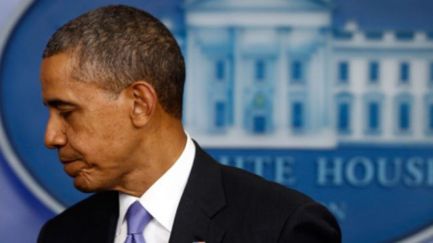
US President Barack Obama’s job approval rating has suffered one the largest quarter-to-quarter declines of his presidency, according to the latest Gallup poll.
The survey indicates that Obama averaged a 44.5 percent job approval rating during his 19th quarter in office, a decline of more than three percentage points from his 18th quarter.
The 19th quarter, which ran from July 20 through October 19, is now the third in a row in which Obama’s approval rating has declined, the poll showed.
The approval rating decreased in the middle part of the 19th quarter when he was pushing for military action against Syria, something the American public did not favor.
Furthermore, the legislative battles over the federal budget and the Affordable Care Act, as well as the federal debt limit took a toll on the president’s popularity, Gallup said.
According to a survey by Pew Research, the 16-day government shutdown pushed public trust in government near record lows, with fewer than two in 10 Americans saying they trust Washington to do what is right most of the time.
The survey also found that only 14 percent of Americans are satisfied with the way things are going in the US, and 81 percent said they were dissatisfied.
Recent estimates by the economists show that the US government’s policy blunders in recent years have significantly slowed economic growth and kept roughly 2 million people out of work.
On Sunday, US Treasury Secretary Jack Lew said the recent fiscal fight between Republicans and Democrats had a bruising impact on the country’s economy and eroded the confidence of both businesses and consumers.
October 21, 2013
Posted by aletho |
Economics, Militarism, Progressive Hypocrite | Obama, Press TV, United States, United States presidential approval rating |
Leave a comment
By HAZEM I. KIRA | October 21, 2013
A little more than three-hundred years ago, the most notorious case of mass hysteria erupted in Salem, Mass. Thankfully, the witchcraft trials, which took place in the pre-revolutionary era, would serve as a cautionary tale for the nation’s Founding Fathers who wished to embed into our national memory the ideals of freedom and due process. Nearly a hundred years after the trials, 39 of these great citizens would sign the U.S. Constitution, a revolutionary document recognizing the inalienable rights given to every person at birth, irrespective of citizenship.
Regrettably, after the atrocities of September 11 another wave of mass hysteria swept through America. But this time, it was not of imaginary witches, but rather imaginary terrorist cells bubbling in the caldrons of every peaceful neighborhood, mosque, and city around the world. Fear of the “other” crept into the American psyche and lapses in due process became more and more frequent. Three-hundred years ago, citizens in Salem gladly set aside their due process at the mere mention of a “witch.” In the wake of September 11, the mere mention of “terrorist” has a similar effect upon our countrymen. Explore patterns of history, and one discovers that every new villain is born, first, in the imagination of a people, to describe the unknown and undesirable.
Almost all of the 164 detainees at Guantanamo Bay have never been charged with a crime. More than 80 inmates who have been cleared for release, by the U.S. government following an assessment by the Guantanamo Review Task Force set up by President Barack Obama, have yet to be released because of Congressional restrictions on the transfer of detainees to the U.S. and other countries. This, in part, is based on the Military Commissions Act of 2006, which states that “no court, justice or judge shall have jurisdiction to hear or consider any other action against the United States or its agents relating to any aspect of the detention, transfer, treatment, trial or conditions of confinement of an alien who is or was detained by the United States.” On Friday, a federal appeals court wrestled with a challenge to force-feed hunger strikers, many of whom are far from death. Detainee lawyer Jon Eisenberg said that he objects to this incredibly painful process of nasogastric force-feeding (through the nose), in principle, arguing that the international community sees it as “unethical and equivalent to torture.”
In 1798 Thomas Jefferson and James Madison sought to remind this country of what it had forgotten and even threatened to secede from the Union after the passage of similar set of unconstitutional actions, the Alien and Sedition Acts by then president John Adams. The Acts curtailed key civil liberties, such as freedoms of speech and press, and were aimed at French and Irish immigrants who opposed war with France– most of whom were Catholics and/or Democrats (Anti-Federalists). Jefferson and Madison’s threat to leave the Union was to remind the country that the ideals found in the Constitution are more than just mere words, but the foundations of a stable and just society.
While in Salem accused “witches” who did not confess, were hanged; in Gitmo (Camp Delta), accused “terrorists” have been tortured, held indefinitely without trial, nasogastric force-fed, and even gifted with “extraordinary rendition” to rogue nations, only to disappear out of existence.
To protest their indefinite detention at Gitmo, more than 100 prisoners have for the past seven months engaged in a hunger strike. To try to break the protest, the US military subjected dozens of the hunger strikers to the cruel and degrading practice of nasogastric force-feeding. This last Friday, the Federal Court of Appeals in Washington, DC heard a case that it first ruled on in July, seeking an injunction against force-feeding at Guantánamo on the grounds that it violates human rights and the right of religious worship.
At the height of the terrorist hysteria following 911, many believed that water boarding would exorcise the truth out of accused terrorists. Similarly, in Salem, accused witches were often put through “enhanced interrogation” with the hope of achieving a similar end. One unique practice of New Englanders was the use of “pressing,” a process that involved placing heavy stones on the accused’s chest until he/she confessed or died. In 1692, after being arrested for witchcraft, Giles Corey refused to enter a plea of guilty or not guilty and was subjected to “pressing,” where he died a couple days later.
Not surprisingly, most of the accused in Salem, Massachusetts were individuals with an independent streak, barren women, the homeless or litigious, or those that challenged the status quo. In Gitmo, many of the prisoners include children, individuals who were part of a warring tribe or had strong political opinions, as well as victims of bounty hunters interested in making a quick buck at the expense of the innocent.
America, critics argue, has lost its bearings like a ship lost at sea, no longer able to lead– even itself. Many have attributed America’s decline on the international scene to weak leadership, but perhaps a more sensible reason, is that America is no longer true to its core identity and ideals. Since George W. Bush established the detention camp on the isolated base in Cuba, in the hopes of operating outside normal standards of the US constitution, and President Obama continues with the practice, our moral high ground has been compromised.
Apparently, for both the Bush and Obama Administrations, the mere accusation of terrorism continues to suffice for guilt. Ironically, in the Salem witchcraft trials, accusers were afforded, at least, a pseudo-trial. In Guantanamo, prisoners are deemed indefinitely guilty without even the pretense of a trial. One wonders what the Founding Fathers’ would think of this debacle. One can only hope that the next president and Congress will work feverishly to dismantle, completely and permanently, this most un-American of institutions and return America to its founding ideals. Here’s for hoping.
Hazem I. Kira teaches US History and Government in the San Francisco Bay Area.
Source
October 21, 2013
Posted by aletho |
Civil Liberties, False Flag Terrorism, Progressive Hypocrite, Subjugation - Torture, Timeless or most popular | Guantanamo Review Task Force, Human rights, Military Commissions Act of 2006, United States |
1 Comment
[Note: Since the lifting of the federal court gag order on October 2, Ladar Levison and his company, Lavabit, have been getting some media attention (including a somewhat snide and incomplete story on page one of the New York Times). What follows in an effort to reconstruct at least the outline of a personal nightmare inflicted by our government on a small business owner who had done no wrong, even in the government’s eyes – at least until he started taking his constitutional rights seriously.]
The Fourth Amendment of the U. S. Constitution is anti-police-state
“The right of the people to be secure in their persons, houses, papers, and effects, against unreasonable searches and seizures, shall not be violated, and no Warrants shall issue, but upon probable cause, supported by Oath or affirmation, and particularly describing the place to be searched, and the persons or things to be seized.” [emphasis added]
The founding document of the United States is inherently suspicious of a government’s willingness to abuse its powers, a suspicion rooted in centuries of tyranny around the world. Even the U.S. government, as well as state and local governments, have abused their powers from time to time since the country’s beginning. The drift toward an American police state intensified under the guise of anti-Communism, but that was mostly a convenient cover for state intrusion into people’s lives. The Soviet Union collapsed, but the nascent American police state kept growing. The Patriot Act of 2001, a massive assault on personal and political liberty, was largely written before 9/11 and passed, largely unexamined, in the hysterical atmosphere and raw panic of that over-hyped “new Pearl Harbor.”
Now we have a police state apparatus of almost unimagined dimension, most of which is kept secret and remains unknown, despite the efforts of a few reporters and whistle blowers, who tell the truth at their personal peril.
The “American police state” is likely an abstraction in the minds of many people, and as long as they remain unknowing and passive, it’s likely to leave them alone. But even law-abiding innocence is not a sure protection of a person’s right to be secure. And when the police state comes after you in one of its hydra-headed forms, the assault can be devastating.
For starters, the state won’t always tell you when it begins
The intrusion of the police state into your life can shatter your world even before you realize it’s begun. Fight it, or surrender to it, the cost is huge. Recovery may be possible, eventually, if it’s ever allowed, but it will be hard, and it will take time.
In May 2013, Ladar Levison was 32 when the police state first came after him. The dreaded “knock on the door” was actually only an FBI business card on his door at home. And Levison’s initial interactions with the FBI were reportedly mild and civil, at first by email and later in person. The FBI was interested in Levision because he owned and operated a secure email service called Lavabit. From the FBI point of view, Lavabit was too secure, because the NSA and the rest of the security state couldn’t get into it.
Right out of college, Levison had started Lavabit as a sole proprietorship in April 2004 (the same month Google launched Gmail at a much greater scale). Having grown up in San Francisco, Levison studied computer science at Southern Methodist University in Dallas, where he still lives. While working on his start-up, he supported himself mostly with internet security projects for financial services. He also worked as a consultant on website development for clients such as Dr Pepper, Nokia, and Adidas.
What Lavabit was selling was secure email, much more secure than anything Google, Microsoft, or most other email providers were offering. The demand was not that great at first. It took six years for Lavabit to gather enough paying subscribers to allow Levison to devote himself to the business full time in 2010. Even when the FBI became interested in Lavabit in May 2013, it was still a small company, with two employees and about 400,000 subscribers. But one of those subscribers was another American about Levison’s age, 30-year old Edward Snowden, the whistleblower whose leaked documents have added so much to our understanding of the dimensions and activities of the American police state. Snowden opened his moc.tibaval@nedwonsde email account in 2010.
Political repression may not be the government’s overt intent, but it works
At this point, there’s no indication that Levison and Lavabit ever had anything but a commercial relationship with Snowden. It’s even possible that Snowden had nothing to do with the FBI’s initial interest in Lavabit. It may be that Lavabit’s effective security was sufficient offense to the surveillance forces to make it an object of attack for its own sake. In May 2013, Levison says he had the impression the FBI agents who talked to him didn’t even know who or what was the subject of their investigation. The FBI hasn’t said.
Levison is not an obviously political person, he hasn’t been revealed to be involved in party politics or political causes. “Until last summer, Mr. Levison, a Republican of libertarian leanings, had not been active in politics,” according to the New York Times October 9. He seems to be the person he seems to be: a thoughtful, hardworking, physically fit, computer business guy who has had a dog named Princess since January 2010 and who spends a lot of his spare time keeping in shape playing beach volleyball.
Princess has her own album on his Facebook page, where the dominant theme by far is Levison’s competition in beach volleyball (with albums for Sunday Night, as well as Monday, Tuesday, Wednesday, and Thursday Nights) and there is one picture of Levison with Rep. Ron Paul. Levison’s page shows membership in just one Facebook group, “OCCUPY (Support) EDWARD SNOWDEN and All Other Whistleblowers,” to which someone else added him about two months ago. Among his 43 “Likes,” Levison lists two Interests (programming and computers), lots of volleyball Activities, and six books, including William Gibson’s Neuromancer, George Orwell’s 1984, and Dostoevski’s Crime and Punishment.
From another perspective, Levison is as political as the Fourth Amendment, which is as profoundly political as it gets. It was the Patriot Act’s assault on the Fourth Amendment, Levison says, that contributed to his decision to start Lavabit in 2004, when the act was up for renewal and much in the news. Among the many objections to the act was that it gave to federal agents excessive authority to, in effect, write their own search warrants on no other authority but their own. In the Orwellian language of the act, these personal searched warrants are known as “national security letters.” Levison designed the security architecture of the Lavabit email and storage services to be beyond the reach of unwarranted searches, even in national security letters. As Levison recalled on Democracy Now! in August:
“And as I was designing and developing the custom platform, it was right around when the PATRIOT Act came out. And that’s really what colored my opinion and my philosophy, and why I chose to take the extra effort and build in the secure storage features and sort of focus on the privacy niche and the security focus niche…. [for] people who want email but don’t necessarily want it lumped in and profiled along with their searches or their browsing history or any of their other Internet activities.”
You can’t reveal what you don’t know – and that provides more security
During May 2013, Levison met for “a couple hours” with FBI agents at his office, where he explained how his security system and his business operated. As Levison told Democracy NOW! the service included his personal pledge of security:
“I’ve always liked to say my service was by geeks, for geeks. It’s grown up over the last 10 years, it’s sort of settled itself into serving those that are very privacy-conscious and security-focused. We offered secure access via high-grade encryption. And at least for our paid users, not for our free accounts—I think that’s an important distinction—we offered secure storage, where incoming emails were stored in such a way that they could only be accessed with the user’s password, so that, you know, even myself couldn’t retrieve those emails.
“And that’s what we meant by encrypted email. That’s a term that’s sort of been thrown around because there are so many different standards for encryption, but in our case it was encrypted in secure storage, because, as a third party, you know, I didn’t want to be put in a situation where I had to turn over private information. I just didn’t have it. I didn’t have access to it.”
Over the years, Lavabit has received and complied with “at least two dozen subpoenas” from the local sheriff’s office to the federal courts, Levison says, “I’ve always complied with the law.” Each of those subpoenas targeted a specific individual and appeared to Levison to be consistent with the Fourth Amendment. As recently as June 2013, he complied with an unrelated subpoena seeking information on one of his subscribers accused of violating child pornography law.
A secret subpoena from the American police state is different
On June 6, 2013, the Guardian began publishing surveillance state revelations based on documents from Edward Snowden, the Lavabit.com email subscriber. On June 9, Snowden revealed that he was the whistlblower who leaked documents to the Guardian and others. The first secret court order against Lavabit came the next day.
On or about June 10, the Justice Dept., on behalf of the FBI, went to federal court to compel Lavabit to provide information “relevant and material to an ongoing criminal investigation” involving someone with a single Lavabit email account. The FBI has not identified the subject of this investigation, but it is widely believed to be Snowden.
The United States District Court for the Eastern District of Virginia (the Fourth Circuit) granted the FBI’s request and issued the disclosure order against Lavabit that same day. A one-page, single-spaced attachment to the order listed the categories of information to be disclosed, including names, addresses, phone records, other subscriber identities, billing records, activity records, and “information about each communication” – in other words, everything about the email account “not including the contents of communications.” The order did not mention encryption keys, SSL keys, or the like. These are closely guarded secrets in a security business like Lavabit.
The U.S. Magistrate Judge who signed the initial order gave Lavabit 10 days to comply. He also sealed the court records from public view and further ordered that Lavabit “shall not disclose the existence of the application of the United States, or the existence of this order” to anyone except “an attorney for Lavabit.” In other words, Levison was subject to a gag order before he ever found out the FBI was definitely coming after him.
In the meantime, on June 14, the Justice Dept. filed a sealed criminal complaint against Snowden, who was then in Hong Kong. The government accused him of three offenses – theft of government property and two forms of “unauthorized communication” the Espionage Act of 1917. The criminal complaint, which was made public a week later, gave the government 60 days to file a formal indictment.
Getting unsatisfying compliance, the FBI decided to raise the stakes
According to a later Justice Dept. filing: “Mr. Levison received that order on June 11, 2013. Mr. Levison responded by mail, which was not received by the government until June 27, 2013. Mr. Levison provided very little of the information sought….” [emphasis added]
On June 28, the day after getting Levison’s belated response to the June 10 order, the Justice Dept. went back to the Fourth Circuit Court in Alexandria seeking an order “authorizing the installation and use of a pen register/trap device on an electronic mail account” – an FBI wiretap on email. Levison had no notice of the government motion and no opportunity to contest it. A new judge on the case, Magistrate Judge Theresa Buchanan, promptly ordered the wiretap installed on the basis that the government “has certified that the information likely to be obtained by such installation and use is relevant to an ongoing criminal investigation….” Like the first order, this order did not mention encryption keys, SSL keys, or the like.
FBI special agents met with Levison in Dallas the same day to discuss the new order, which Levison had not yet received, as well as a prior summons to appear before a grand jury. The agents presumably explained to Levison that the court had issued a secret order based on a secret motion, itself based on secret evidence (or none at all) and that Levison was not only compelled to comply but was also still under court order to keep the whole secret process a secret, this time with no exception even for his attorney.
According to a later government filing, “Mr. Levison told the agents that he would not comply with the pen register order and wanted to speak to an attorney. It was unclear whether Mr. Levison would not comply with the order because it was technically not feasible or difficult or was not consistent with his business practice of providing secure, encrypted email service for his customers.”
As Levison months later explained to reporters about Lavabit: “We’re wholly focused on secure email. Without it, we have no business.” In Levison’s view, breaking Lavabit’s security without the right to tell his customers would have been to commit commercial fraud.
Judge Buchanan keeps the pressure on Levison and Lavabit
Following this meeting, the Justice Dept. immediately went before Judge Buchanan seeking an order to compel Lavabit to comply with the other Magistrate’s earlier order and install the FBI wiretap and to “furnish agents from the Federal Bureau of Investigation, forthwith, all information, facilities, and technical assistance necessary to accomplish the installation and use of the pen/trap device…” as ordered pursuant to federal law [U.S. Code, Title 18, sec. 3123].
Judge Buchanan immediately granted the “Order Compelling Compliance Forthwith,” based in part on her findings that “Lavabit informed the Federral Bureau of Investigation that the user of the account had enabled Lavabit’s encryption services and thus the pen/trap device would not collect the relevant information” and that “Lavabit informed the FBI that it had the technological capability to obtain the information but did not want to ‘defeat [its] own system’…”
Judge Buchanan ordered Lavabit to provide “unencrypted data pursuant to the Order.” Noting that failure to comply “forthwith” would subject Lavabit to “any penalty within the power of the court,” Judge Buchanan added in her own handwriting, “including the possibility of criminal contempt of court.” This order was issued under seal.
Previously, Levison faced the possibility of being fined for civil contempt if he failed to comply. Now he also faced going to jail. And the court’s most recent orders, in their plain language, prevented Levison from discussing his situation with anyone, not even an attorney.
According to the FBI, agents “made numerous attempts, without success, to speak and meet directly with Mr. Levison” during the next ten days. On July 9, the Justice Dept. returned to the Fourth Circuit court seeking an order for Lavabit to show cause why it “has failed to comply with the orders entered June 29” by Magistrate Buchanan, and why Lavabit should not be held in contempt of court for its failure to comply.
Judge Hilton decides a hearing with the parties present might help
Judge Claude Hilton issued the show cause order the same day, including a summons for Lavabit to appear at a hearing a week later. Judge Hilton is a secrecy case veteran, having served on the secretive FISA (Foreign Intelligence Surveillance Act) court from 2000 to 2007. The Judge continued to keep the Lavabit case under seal, but reinstated Lavabit’s exception to the gag rule when consulting with an attorney.
The next day, Levison went to the FBI field office in Dallas for a meeting/conference call that included prosecutors and FBI agents in Washington and his attorney in San Francisco, convened “to discuss Mr. Levison’s questions and concerns… [that] focused primarily on how the pen register device would be installed on the Lavabit LLC system, what data would be captured by the device, what data would be viewed and preserved by the government… [and] whether Mr. Levison would be able to provide ‘keys’ for encrypted information.”
The parties did not reach an agreement at the meeting and the next day, July 11, Levison’s attorney informed the FBI that she no longer represented Levison or Lavabit. The same day, Levison “indicated that he would not come to court [for the July 16 show cause hearing] unless the government paid for his travel,” according to a government filing.
Rather than engage in a dispute over travel expenses, the FBI served Levison with a subpoena to appear before a Fourth Circuit grand jury, also on July 16. The government is responsible for the travel arrangements of grand jury witnesses, and the FBI so advised Levison by email. The grand jury subpoena left little wriggle room in its effort to force Lavabit to surrender the encryption keys that were essential to its business:
“In addition to your personal appearance, you are directed to bring to the grand jury the public and private encryption keys used by lavabit.com in any SSL (Secure Socket Layer) or TLS (Transport Security Layer) sessions, including HTTPS sessions with clients using lavabit.com website and encrypted SMTP communications (or Internet communications using other protocols) with mail servers;
“Any other information necessary to accomplish the installation and use of the pen/trap device ordered by Judge Buchanan on June 28….”
“I don’t trust you, but you should trust me” and vice-versa
Levison responded on July 13 with an email to the U.S. Attorney’s office, offering an alternative to the FBI-operated wiretap. Levison proposed that he would collect the court-designated data himself. While he didn’t state it in the email, this would address one of Levison’s primary concerns, that there was no effective oversight to prevent the FBI from gathering more data than the court had allowed. Levison proposed to design and implement the solution, gather the data manually, and provide it to the FBI at the end of the 60-day court order – for a price of $2,000. For another $1,500, he offered to provide data “more frequently,” which would require implementing an automated system.
The U.S. Attorney chose not to explore the offer. In a brusque and internally contradictory reply email the same day, an assistant U.S. Attorney explained “that the proposal was inadequate because, among other things, it did not provide for real-time transmission of results, and it was not clear that Mr. Levison’s request for money constituted the ‘reasonable expenses’ authorized by the statute.” The government later admitted to the court that it was “unclear” as to precise details of the proposal. The clear implication of Levison’s proposal is a willingness to provide real-time transmission for reasonable compensation. But that would leave Levison in control. The government didn’t consider that a useful compromise.
On July 15, Levison flew to Washington for his show cause hearing at 10 the next morning, although he thought it was set for 10:30 and arrived late. He was appearing pro se, representing himself without an attorney.
Even a federal court hearing can be a comedy of errors
The government goal for the July 16 hearing remained unchanged: “Lavabit LLC may comply with the pen register order by simply allowing the FBI to install the pen register devise and provide the FBI with the encryption keys.” Lacking compliance, the government asked the court to impose a civil contempt sanction of $1,000 a day until Lavabit complied.
The government also requested a search warrant for the encryption keys. Judge Hilton granted the search warrant before the hearing began.
As it turned out, the 20-minute hearing resulted in no change in the legal standing of the parties, but did produce a transcript with moments of unintentional hilarity.
Present in the courtroom were Judge Hilton and the court staff. U.S. Attorney James Trump represented the government, along with three other lawyers and an FBI agent. Levison was alone.
The U.S. Attorney wanted to know if Levison was going to comply with the wiretap order, but Judge Hilton wouldn’t ask and Levison wouldn’t say. Or rather, Levison said he had always been ready and willing to comply with installation of the wiretap, but he was reluctant to give up the encryption codes, which would give the FBI access to all 400,000 of his subscribers even though the court order named only one. “There was never an explicit demand that I turn over those keys,” Levison said.
The U.S. Attorney argued that Judge Buchanan had effectively if not specifically ordered Levison to turn over the encryption keys. Judge Hilton wasn’t touching that: “I’m not sure I ought to be enforcing Judge Buchanan’s order.” Judge Hilton said that his order was to install the wiretap and Levison had said he’d do that, so – “You’re trying to get me to deal with a contempt before there’s any contempt, and I have a problem with that.”
Levison moved to unseal all but the sensitive information in the proceedings. Judge Holton denied the motion, based on the underlying criminal investigation. Levison asked the judge to order “some sort of external audit to ensure that your oders are followed to the letter” as to FBI data collection. The judge refused. Levison moved to continue the hearing to allow him to retain counsel. Judge Hilton granted the continuance.
Levison and Lavabit get legal representation from a Virginia firm
Levison’s new attorney is Jesse Binnall of Bronley & Binnall PLLC in Fairfax, Virginia. Binnall, 34, was a communication major at George Mason University and graduated from the Law School there in 2009. Binnall and Levison would later be among the first guests on the New Ron Paul Channel in mid-August.
On July 25, Binnall filed under seal a “Motion to quash” the outstanding grand jury subpoena and the search warrant against Lavabit. The motion requested “that this Court direct that Lavabit does not have to produce its Master Key. Alternatively, Lavabit and Mr. Levinson request that they be given an opportunity to revoke the. current encryption key and reissue a new encryption key at the Government’s expense. Lastly, Lavabit and Mr. Levinson request that, if they are required to produce the Master Key, that they be reimbursed for its costs which were directly incurred in producing the Master Key….”
In support of his motion, Binnall made a number of arguments against the actions of the government, which had not faced serious legal opposition up to this point.
Binnall pointed out that giving the government access to Lavabit’s Master Key is tantamount to giving the government access to all of Lavabit’s 400,000 users. That amounts to a general warrant that is unconstitutional, Binnall wrote, and:
“It is axiomatic that the Fourth Amendment prohibits general warrants [with Supreme Court cases cited]…. The Fourth Amendment’s particularity requirement is meant to ‘prevent the seizure of one thing under a warrant describing another’ [citation omitted]. This is precisely the concern with the Lavabit Subpoena and Warrant and, in this circumstance, the particularity requirement will not protect Lavabit. By turning over the Master Key, the Government will have the ability to search each and every ‘place,’ ‘person [and] thing’ on Lavabit’s network…. Additionally, the Government has no probable cause to gain access to the other users accounts.”
The government seemed unconcerned about Levison’s business survival
Bindall also argued that the court should quash the subpoena and search warrant as creating an “undue burden” on Lavabit as defined by law [U.S. Code Title 18, sec. 2703]:
“Not only has Lavabit expended a great deal of time and money in attempting to cooperate with the Government thus far, but, Lavabit will pay the ultimate price –the loss of its customers’ trust and business – should the Court require that the Master Key be turned over. Lavabit’s business, which is founded on the preservation of electronic privacy, could be destroyed if it is required to produce its Master Key.”
Also on July 25, Binnall filed a motion to unseal court records and to lift the gag order on his client, since the “gag order infringes upon freedom of speech under the First Amendment, and should he subjected to constitutional case law. “
Unsurprisingly, the U.S. Attorney filed a motion in opposition.
At the motion hearing on August 1, Judge Hilton engaged in lengthy colloquy with attorney Binnall. Before the 25-minute hearing was half over, the judge had denied both motions and the U.S. Attorney had said little more than “Good morning.” Judge Hilton gave Levison and Lavabit until 5 p.m. Dallas time on August 2 to comply.
Levison’s compliance took an unexpected form
The next day in Dallas, at about 1:30 p.m., Levison provided information that purported to be full compliance with the court’s orders. Whether it was actual compliance remains uncertain. The government was not happy and engaged with attorney Binnall to achieve satisfactory compliance, without success. On August 5 the government filed a motion for sanctions against Levison, calling his apparent compliance “unworkable” and describing it as follows:
“Mr. Levison gave the FBI a printout of what he represented to be the encryption keys needed to operate the pen register. This printout, in what appears to be 4-point type, consists of 11 pages of largely illegible characters. See Attachment A. (The attachment was created by scanning the document provided by Mr. Levison; the original document was described by the Dal!as FBI agents as slightly clearer than the scanned copy but nevertheless illegible.) Moreover, each of the five encryption keys contains 512 individual characters — or a total of 2560 characters. To make use of these keys, the FBI would have to manually input all 2560 characters, and one incorrect keystroke in this laborious process would render the FBI collection system incapable of collecting decrypted data.”
When this compliance effort became public two months later, TechCrunch called it “an epic troll.” At the time, the government was not amused and called for the court to sanction Levison $5,000 a day, beginning at noon August 5. The court promptly granted the motion, while reminding the parties that all aspects of the matter remained under seal. Known only to the participants and some court employees, the case was still unknown to the public.
Levison makes a tantalizing public announcement
That secrecy ended on August 8, when Ladar Levison shut down Lavabit, posting a short notice on the Lavabit.com website, together with a link to the Lavabit Legal Defense Fund. As Levison explained:
“I have been forced to make a difficult decision: to become complicit in crimes against the American people or walk away from nearly ten years of hard work by shutting down Lavabit. After significant soul searching, I have decided to suspend operations. I wish that I could legally share with you the events that led to my decision. I cannot. I feel you deserve to know what’s going on – the first amendment is supposed to guarantee me the freedom to speak out in situations like this. Unfortunately, Congress has passed laws that say otherwise. As things currently stand, I cannot share my experiences over the last six weeks, even though I have twice made the appropriate requests.
“What’s going to happen now? We’ve already started preparing the paperwork needed to continue to fight for the Constitution in the Fourth Circuit Court of Appeals. A favorable decision would allow me resurrect Lavabit as an American company.
“This experience has taught me one very important lesson: without congressional action or a strong judicial precedent, I would _strongly_ recommend against anyone trusting their private data to a company with physical ties to the United States.”
Also on August 8, Levison fully complied with the Fourth Circuit courts orders, turning over the encryption keys to a now defunct service. He had incurred 2 days of sanctions – owing the government $10,000 – which remains pending.
The next day, Silent Circle, a global encrypted communications service, stayed in business but preemptively wiped out its email service (about 5 per cent of its customers) in anticipation of a government request that the company wouldn’t want to have to obey. “Meanwhile, Silent Circle is working on replacing its defunct e-mail service with a system that doesn’t rely on traditional e-mail protocols and keeps no messages or metadata within the company’s grasp. It is based on a protocol often used for instant messages and other applications. [CEO Mike] Janke says the goal is for this to not be e-mail, but ‘for all intents and purposes it looks, feels, and acts like e-mail,’” according to MIT Technology Review.
Lavabit’s closing drew some news coverage over the next week, but any story was hampered by the gag order that severely limited what Levison and Binnall could safely say. As Levison told Forbes the day after shutting down Lavabit:
“This is about protecting all of our users, not just one in particular. It’s not my place to decide whether an investigation is just, but the government has the legal authority to force you to do things you’re uncomfortable with….The fact that I can’t talk about this is as big a problem as what they asked me to do…. The methods being used to conduct those investigations should not be secret.”
The FBI and the Justice Dept. Have not commented publicly about the Lavabit case beyond their court filings.
Being secret, federal court appeal gets no news coverage
On August 15, Lavabit attorney Binnall filed notice – under seal – that he was appealing the federal district court’s rulings of August 1 and August 5 to the United States Court of Appeals for the Fourth Circuit. In other words, the government can not only keep the public ignorant of what it’s doing, it can also prevent the public from knowing that anyone objects to the government’s actions as unconstitutional.
In the Lavabit case, at least, this changed abruptly on October 2, when Judge Claude Hilton ordered a censored version of 23 documents (162 pages) made public. The redactions in these documents appear, from context, to be intended mostly to conceal details of the criminal investigation into Snowden or some other lavabit.com user. Since the unsealing of the court documents, news coverage had expansed, and Levison and Binnall have appeared in public across the country to argue their cause. As Levison put it on his Facebook page October 2:
“If the Obama administration feels compelled to continue violating the privacy rights of the masses just so they can conduct surveillance on the few then he should at least ask Congress for laws providing that authority instead of using the courts to force businesses into secretly becoming complicit in crimes against the American people.”
In 2005, a U.S. Senator addressed a similar concern, when Congress was about to pass a law creating the “national security letter,” a secret government process much more intense and unforgiving than what Levison went through last summer:
“This is legislation that puts our own Justice Department above the law. When national security letters are issued, they allow federal agents to conduct any search on any American, no matter how extensive, how wide-ranging, without ever going before a judge to prove that the search is necessary. All that is needed is a sign-off from a local FBI agent. That’s it.
“Once a business or a person receives notification that they will be searched, they are prohibited from telling anyone about it, and they’re even prohibited from challenging this automatic gag order in court. Even though judges have already found that similar restrictions violate the First Amendment, this conference report disregards the case law and the right to challenge the gag order.
“If you do decide to consult an attorney for legal advice, hold on. You will have to tell the FBI that you’ve done so. Think about that. You want to talk to a lawyer about whether or not your actions are going to be causing you to get into trouble. You’ve got to tell the FBI that you’re consulting a lawyer. This is unheard of. There is no such requirement in any other area of the law. I see no reason why it’s justified here.
“And if someone wants to know why their own government has decided to go on a fishing expedition through every personal record or private document, through the library books that you read, the phone calls that you’ve made, the emails that you’ve sent, this legislation gives people no rights to appeal the need for such a search in a court of law. No judge will hear your plea; no jury will hear your case. This is just plain wrong.”
The question is: how much of a police state do we have already?
That Senator was concerned eight years ago, and that Senator was Barack Obama. Today, national security letters are part of the law of the land, the Obama administration uses them, and if you get one, talking about it is against the law. In that context, since Ladar Levison apparently did not get a national security letter, he was lucky. The country, not so much.
On October 10, in the United States Court of Appeals for the Fourth Circuit, Lavabit filed the opening brief of its appeal of the lower court’s orders. The United States has until November 4 to file its answer. This will take awhile, it will take effort to follow, but it matters.
October 19, 2013
Posted by aletho |
Civil Liberties, Full Spectrum Dominance, Progressive Hypocrite, Timeless or most popular | Lavabit, Patriot Act, United States |
Leave a comment
President Barack Obama has chosen a former Pentagon attorney who defended the extrajudicial killing of American citizens to man the helm of the United States Department of Homeland Security and replace outgoing Secretary Janet Napolitano.
Jeh Johnson, a general counsel for the Pentagon during the president’s first term in office, was named by Mr. Obama as his choice for new DHS secretary during a Friday afternoon press conference.
“The president is selecting Johnson because he is one the most highly qualified and respected national security leaders,” a senior administration official told the Washington Post on Thursday while speaking condition of anonymity. “During his tenure at the Department of Defense, he was known for his sound judgment and counsel.”
Johnson, 56, served as a special counsel during John Kerry’s unsuccessful 2004 run for the presidency before assisting with Obama’s campaign four years later. During his first week in office, Obama nominated Johnson as DoD general counsel and he was confirmed by the Senate in Feb. 2009.
Up until his resignation from Defense Department attorney in December 2012, Johnson advised the largest military in the world, including during historic matters regarding the repeal of the Pentagon’s ban on openly gay troops and the reform of military commissions.
That same span in the Pentagon was also marred by Obama administration decisions that opponents of the president’s latest pick have been quick to pounce on.
While working as one of the top attorneys for the US military, Johnson authorized the execution of Anwar al-Awlaki, an American citizen and suspected senior figure in Al-Qaeda who was killed by a drone strike in Yemen in late 2011. That slaying was carried out by an operation conducted by the Pentagon in cooperation with the Central Intelligence Agency and has drawn immense criticism directed at the White House and the president’s extrajudicial killing of an American citizen.
The New York Times reported shortly after that Johnson told attendees at a speech at Yale Law School that “Belligerents who also happen to be US citizens do not enjoy immunity where non-citizen belligerents are valid military objectives.”
The president postponed offering full justification for the attack until this past May when he said, “I do not believe it would be constitutional for the government to target and kill any US citizen — with a drone, or with a shotgun — without due process . . . But when a US citizen goes abroad to wage war against America and is actively plotting to kill US citizens, and when neither the United States, nor our partners are in a position to capture him before he carries out a plot, his citizenship should no more serve as a shield than a sniper shooting down on an innocent crowd should be protected from a SWAT team.”
Johnson also served as general counsel during the height of the WikiLeaks scandal that involved the unauthorized disclosure of hundreds of thousands of sensitive documents. In a letter to the whistleblower organization published in August 2010, Johnson blamed WikiLeaks for their “illegal and irresponsible actions,” and said that the leaking of classified materials aided America’s enemy in “their own terrorist aims.” Earlier this year, a military judge said that Chelsea Manning, the Army analyst who admitted to giving those files to WikiLeaks, did not aid Al-Qaeda by supplying the website with documents.
Johnson said in the same letter that the Pentagon “demands that NOTHING further be released by WikiLeaks, that ALL of the US Government classified documents that WikiLeaks has obtained be returned immediately and that WikiLeaks remove and destroy all of these records from its databases.”
Mr. Obama officially nominated Johnson at a 2 p.m. meeting, paving the way for the Senate to formally decide if they will appoint the president’s pick.
“If confirmed by the Senate, I promise all of my energy, focus and ability towards the task of safeguarding our nation’s national and homeland security,” Johnson said after being introduced by the president.
October 19, 2013
Posted by aletho |
Civil Liberties, Full Spectrum Dominance, Progressive Hypocrite, Subjugation - Torture, Timeless or most popular | DHS, Drones, Jeh Johnson, Law, Military, Obama, United States, United States Department of Homeland Security, USA |
1 Comment
The comments come from Malala and the U.N. respectively.
President Obama invited Malala Yousafzai, a 16-year-old Pakistani advocate for girls’ education, to meet with his family. And she promptly explained that what he is doing works against her agenda and fuels terrorism.
Malala is a victim of violence in Pakistan, having been attacked by religious fanatics opposed to her work. But Obama may not have expected her to speak up against other forms of violence in her country.
Malala recounted: “I also expressed my concerns that drone attacks are fueling terrorism. Innocent victims are killed in these acts, and they lead to resentment among the Pakistani people. If we refocus efforts on education, it will make a big impact.”
President Obama may also have not expected most people to notice or care. The corporate media have virtually ignored this part of a widely-reported meeting.
It’s up to us to surprise everyone with the depth of our interest and concern. Almost 100,000 have thus far signed a petition to ban weaponized drones, soon to be delivered to the U.N., the I.C.C., the State Department, the White House, Congress, and embassies.
The United Nations has released a report on “armed drones and the right to life” (PDF). The report begins by noting that, as of now, weaponized drones are legal:
“Although drones are not illegal weapons, they can make it easier for States to deploy deadly and targeted force on the territories of other States. As such, they risk undermining the protection of life in the immediate and longer terms. If the right to life is to be secured, it is imperative that the limitations posed by international law on the use of force are not weakened by broad justifications of drone strikes.”
Drones, the U.N. Special Rapporteur reports, risk making war the normal state of affairs:
“Peace should be the norm, yet such scenarios risk making its derogation the rule by privileging force over long-term peaceful alternatives. . . . Given that drones greatly reduce or eliminate the number of casualties on the side using them, the domestic constraints — political and otherwise — may be less restrictive than with the deployment of other types of armed force. This effect is enhanced by the relative ease with which the details about drone targeting can be withheld from the public eye and the potentially restraining influence of public concern. Such dynamics call for a heightened level of vigilance by the international community concerning the use of drones.”
The U.N. Charter and this report seek to make war an exceptional state of affairs. This is a very difficult, and a morally depraved thing to attempt with an institution that deserves total abolition. War does not work as a tool with which to eliminate war. But, even within that framework, the U.N. finds that drones create extra-legal war:
“An outer layer of protection for the right to life is the prohibition on the resort to force by one State against another, again subject to a narrowly construed set of exceptions. The protection of State sovereignty and of territorial integrity, which onoccasion presents a barrier to the protection of human rights, here can constitute an important component of the protection of people against deadly force, especially with the advent of armed drones.”
The strongest excuse for war is the claim of defense against an actual attack. The next best thing is to pretend an attack is imminent. The Obama Administration has famously redefined “imminent” to mean eventual or theoretical — that is, they’ve stripped the word of all meaning. (See the “white paper” PDF.) The U.N. doesn’t buy it:
“The view that mere past involvement in planning attacks is sufficient to render an individual targetable even where there is no evidence of a specific and immediate attack distorts the requirements established in international human rights law.”
U.S. lawyers at Congressional hearings have tended to maintain that drone killing is legal if and only if it’s part of a war. The U.N. report also distinguishes between two supposedly different standards of law depending on whether a drone murder is separate from or part of a war. Disappointingly, the U.N. believes that some drone strikes can be legal and others not:
“Insofar as the term ‘signature strikes’ refers to targeting without sufficient information to make the necessary determination, it is clearly unlawful. . . . Where one drone attack is followed up by another in order to target those who are wounded and hors de combat or medical personnel, it constitutes a war crime in armed conflict and a violation of the right to life, whether or not in armed conflict. Strikes on others confirmed to be civilians who are directly participating in hostilities or having a continuous combat function at the time of the follow-up strike could be lawful if the other international humanitarian law rules are respected.”
The complex mumbo-jumbo of multiple legal standards for multiple scenarios, complete with calculations of necessity and distinction and proportionality and collateral damage, mars this report and any attempt to create enforceable action out of it. But the report does, tentatively, find one little category of drone murders illegal that encompasses many, if not all, U.S. drone murders — namely, those where the victim might have been captured rather than killed:
“Recent debates have asked whether international humanitarian law requires that a party to an armed conflict under certain circumstances consider the capture of an otherwise lawful target (i.e. a combatant in the traditional sense or a civilian directly participating in hostilities) rather than targeting with force. In its Interpretive Guidance, ICRC states that it would defy basic notions of humanity to kill an adversary or to refrain from giving him or her an opportunity to surrender where there manifestly is no necessity for the use of lethal force.”
Pathetically, the report finds that if a government is going to pretend that murdering someone abroad is “self-defense” the action must be reported to the U.N. — thereby making it sooooo much better.
A second UN report (PDF) goes further, citing findings that U.S. drones have killed hundreds of civilians, but failing to call for prosecutions of these crimes. That is to say, the first report, above, which does not list specific U.S. drone murders of civilians, discusses the need for prosecutions. But this second report just asks for “a detailed public explanation.”
The fact that an insane killing spree is counter-productive, as pointed out to Obama by Malala, in case he hadn’t heard all his own experts, is not enough to end the madness. Ultimately we must recognize the illegality of all killing and all war. In the meantime, prior to the U.N.’s debate on this on the 25th, we can add our names to the growing movement to ban weaponized drones at http://BanWeaponizedDrones.org.
October 18, 2013
Posted by aletho |
Militarism, Progressive Hypocrite, War Crimes | Drone attacks in Pakistan, Human rights, Malala Yousafzai, Obama, Pakistan, United Nations, United States |
Leave a comment
Despite a deal to lift the debt ceiling and end the government shutdown, the United States is far from a respite, as it won’t address the underlying, internal issues that have usurped its power in the world, economics professor Rodney Shakespeare told RT.
RT: The default is averted. That’s good news, isn’t it?
Rodney Shakespeare: Nothing has been averted. Instead, there’s going to be some sort of meeting between the Democrats and the Republicans, who are two sides of the same coin. And there are three subjects, which they’ll refuse to discuss. The first is the out of control military budget, which ought to be cut to one tenth of what it is at the moment to bring it in line with comparable nations. The second thing is that the system works by exporting jobs. They’ve exported the jobs to about 56,000 enterprises over the last 11 years. That’s five million jobs – and each job creates another three. That’s roughly 15 million jobs which aren’t coming back. And the third thing, which they aren’t going to discuss at this ‘wonderful’ meeting between the Democrats and the Republicans – they will not discuss the core of the issue, which is a corrupt banking system, whose center is the Federal Reserve. Instead, what they’ll do is they’ll blame everything on the poor. So, you see, nothing has been put off. Nothing has been solved. Nothing has been addressed. The situation goes on and ultimately it’s going to result in the final collapse of the dollar. But that may be a year or two off at the moment.
RT: It’s only a temporary fix for the US debt ceiling. But what happens when America is on the verge of running out of cash again?
RS: The same thing is going to happen as is happening at this moment, except that another two or three months will have passed, in which they’ve failed to address the underlying issues and their vanity and the essence of the corruption of the system will not have been addressed. So, you’re going to find at some point that they’ll then…the world will wake up to the overall level of the American debt, which is now just at the point when it becomes unrepairable. And when that happens, you’ll get a sudden, irrevocable slide in the dollar. So, they’ll kick the can down the road for a bit.
RT: It may also be difficult for the rest of the world to understand why there had to be so much last-minute drama in Washington, DC before they reached an agreement. A domestic squabble that held the rest of the world to economic ransom – can the global community afford to risk that again?
RS: The world community should continue doing what it’s quietly doing at the moment: starting to organize it in ways which are separate [from] and outside the West. They should do it in their banking agreements. I’m pleased to say that the BRICs are creating on optic fiber cable, so that the banking can be done away from the West. They should do it by creating different national and central banks, which put out interest-free money. They should make agreements among themselves, particularly among the non-allied nations. This should be political agreements and financial agreements. They must accept that the West now…its economic powers have declined; its political powers have declined. And as of America’s moral authority? Forget it! They are putting out a poisonous depleted uranium. They’re attacking. They’re assassinating. They have no moral authority whatsoever. Everybody else should get on with organizing themselves away from the pariah states, which are now the US, Israel, Saudi Arabia, with their poodles, which are the UK and France. I say to the rest of the world: Get on with it. Organize yourselves and give up this corrupt, out-of-date system, which no longer is providing adequate leadership.
October 18, 2013
Posted by aletho |
Corruption, Economics, Militarism, Progressive Hypocrite | Austerity, Corruption, Politics, RT, Saudi Arabia, United States, United States public debt, USA, William Shakespeare |
Leave a comment
Obama Administration Forbids NSA-Critical Novelist Entry to USA
On September 30th, as he was about to fly from Brazil to Denver, Colorado, where he had been invited to attend and address a German Studies conference, the German novelist Ilija Trojanow (pronounced “llya Troyanov”) was informed that he would not be allowed to board the flight on which he was booked.
He was told, after some 45 minutes of waiting while his passport and various computer screens were examined, that his case was “special” and that no further explanation was available. To this date, none has been offered.
But the explanation was and is obvious to anyone aware of Mr. Trojanow’s recent political history, in the context of the Obama administration’s increasingly jaundiced and vehement campaign against whistleblowers and critics of its surveillance-state apparatus. Despite the President’s absurdly facile talk of “welcoming the debate” on NSA data-gobbling and Orwellian tactics, the war on internet freedom is reaching a new high point. The US government is determined to achieve full access to all digital data, and has no intention of compromising with its critics, of which internationally known intellectuals appear to represent a particularly worrisome species.
Asked how the scholars at the conference in Denver had reacted to the government’s action in blocking his entry, Trojanow said that they were “…enormously angry. A great deal of prepared work was carried out in vain. Now they want to write an open letter. It is, obviously, ironic that this should happen in connection with – of all things — an event that was intended to bring the USA and Germany together. The theme of the seminar was ‘transnationalism’”.
Less than two weeks earlier, on September 18th, an open letter to German Chancellor Angela Merkel accompanied by the signatures of 67,000 supporters — including a number of prominent literary and legal figures – had been delivered to the Chancellery in Berlin by Trojanow’s friend and fellow novelist Juli Zeh, its initiator. One of the first signatures was Trojanow’s. The two are co-authors of the book “Angriff auf die Freiheit” (“Freedom Under Attack”), published in 2010 by DTV Deutscher Taschenbuch, the subtitle of which translates to “Security Madness, Surveillance State and the Dismantling of Civil Rights.” Three years before the Snowden revelations, Mr. Trojanow, a native Bulgarian whose family fled political persecution there in the dark ages of Eastern Bloc state repression, had become a prominent critic of policies in the West that had an all-too-familiar smell. The Snowden documents and emerging NSA scandal now brought new urgency to this work.
The German Chancellor and leader of the Christian Democratic Union, who as opposition leader during the Social Democratic/Green Party coalition government,and later as Chancellor, had given George W. Bush uncritical support for his Iraq policies among many others, was staying true to form in the face of Snowden’s assertion that Germany’s intelligence services were deeply involved in the surveillance scandal. After weeks of evasion and “salami” tactics by which admissions regarding the Snowden charges were made piecemeal once they could no longer be denied; after a highly-publicized trip to Washington by her Interior Minister (analogous to Minister of Homeland Security in the USA), who was photographed at the table with top American intelligence officials, and returned to assure Germans that the US took the issue very seriously and had guaranteed him that no German laws were being broken; after an appearance by Merkel’s Minister of the Chancellery before a special investigative committee to which he had been summoned by an outraged opposition in the German Bundestag (an appearance generally assessed to have been characterized by flippant and insubstantial responses to penetrating questions regarding German complicity alleged by Snowden); after a press conference in which the Chancellor blithely declared that she “preferred to wait and see” what the truth about the allegations might be; and after declaring in a vaguely irritated tone in a TV debate with her Social Democratic challenger in the eminent election – on almost the same day that the letter and petition were presented in Berlin — that she “had no reason to mistrust the NSA,” Merkel was comfortably reelected on September 22nd despite the fact that more than two-thirds of Germans had been polled as being unsatisfied with the government’s response to the scandal. While the conservatives in Berlin and the Obama administration may have breathed a sigh of relief, someone in Washington was apparently not yet ready to forget about Trojanow’s work in the actions which had produced the following document (translated from the original German for Mr. Trojanow by myself):
Honored Madame Chancellor,
Since Edward Snowden made public the existence of the PRISM program, the media have turned their attention to the biggest wiretapping scandal in modern German history. We citizens have, through published reports, become aware that foreign intelligence services — even in the absence of any concrete grounds for suspicion – skim and record our telephone and electronic communications. Through the storage and evaluation of metadata, our contacts, friendships and relationships are apprehended. Our political positions, our “movement profiles” and, in fact, even our daily moods and emotional status are transparent to the security authorities. The “transparent man” has thus become reality.
We have no defenses. There is no means of redress or airing of grievances, no opportunity for access to the files. While our private lives are made transparent, the secret services assert a right to a maximum of opacity regarding their methods. In other words: we are experiencing an historic attack upon our democratic rule of law, namely, the reversal of the principle of a “presumption of innocence” into a millionfold general suspicion.
Madame Chancellor, you stated in your summer press conference that Germany is “not a surveillance state.” Since the Snowden revelations, however, we have no choice but to say: unfortunately, it is. In the same connection you summarized your approach to the investigation of the PRISM affair with the apt phrase: “I prefer to wait and see what happens.”
But we do not wish to wait. It is increasingly difficult to avoid the impression that this behavior by the American and British intelligence services is tacitly accepted by the German government. For that reason we ask you: is it politically desirable that the NSA conducts surveillance of German citizens in a manner that is forbidden to the German authorities by the constitution and the German Federal Constitutional (Supreme) Court? Do the German intelligence services profit from information received from the US authorities, and is that the reason for your hesitant reaction? How can it be justified that the BND (“Bundesnachrichtendienst”, federal intelligence authority) and the Verfassungsschutz (“Constitutional Protection”, federal domestic intelligence agency) deploy the NSA spy-program XKeyScore, for which there is no legal basis, in the surveillance of search engines? Is the German Federal Government in the process of taking a detour around the rule of law, instead of defending it?
We call upon you to tell the people of this nation the full truth about the electronic spying. And we want to know what the federal government proposes to do against it. You are charged by the constitution with protecting Germany’s citizens from harm. Madame Chancellor, what is your strategy?
/ Juli Zeh / Ilija Trojanow / Carolin Emcke / Friedrich von Borries /Moritz Rinke / Eva Menasse / Tanja Dückers / Norbert Niemann / Sherko Fatah / Angelina Maccarone / Michael Kumpfmüller / Tilman Spengler / Steffen Kopetzky / Sten Nadolny / Markus Orths / Sasa Stanisic / Micha Brumlik / Josef Haslinger / Simon Urban / Kristof Magnusson / Andres Veiel / Feridun Zaimoglu / Ingo Schulze / Falk Richter / Hilal Sezgin / Georg Oswald
(Translation from the German original: Gregory Barrett)
Trojanow was awarded the 2006 Prize of the Leipzig Book Fair for his adventure novel “Der Weltensammler” (“The Collector of Worlds”). He delivered the laudatory speech for the Nobel Prizewinner Herta Müller at the ceremony marking her acceptance of the Franz Werfel Human Rights Prize. In Salvador da Bahia, Brazil, he had been a guest writer at the invitation of the Goethe Institute. On October 5th he was to speak at the conference of the German Studies Association in Denver about his most recent novel “EisTau” (“Ice Thaw”). Ms. Zeh is best known to the German-speaking public as the author of several novels including “Adler und Engel” (“Eagles and Angels”), which has been translated into 31 languages, and “Nullzeit” (“Zero Hour” or “Out of Time”), but also holds impressive law degrees and has worked at the United Nations. The forum afforded the two highly-respected intellectuals in various media, from the powerful news magazine “Der Spiegel,” to the national public radio network Deutschlandradio, to popular national television talk shows may well be making the Merkel government nervous about the possibility that the surveillance issue — which had appeared to be fading in the public consciousness as the Chancellor and her allies had hoped — could still catch fire with the help of the continued revelations being parceled out by Snowden, Glenn Greenwald and a growing network. Such coverage has given the German writers’ campaign a visibility seldom granted to the usual suspects on the German left.
Appeals to the German government for mediation and clarity following the US refusal to allow Mr. Trojanow’s entry into the land of the free have, predictably, been without success at this writing. The novelist himself immediately applied for a new US visa and is determined to elicit a clear statement about the grounds for the ban.
Meanwhile, Trojanow and Zeh are working on a new international appeal, with which they hope to generate broad-based resistance to the massive destruction of civil- and privacy rights worldwide represented by the NSA’s new technological might. There are links already in place to the London-based group “Index on Censorship” and many other groups including Amnesty International, Liberty, the Electronic Frontier Foundation and the Russian PEN Center. The German writer-activists hope to bring more Americans into their network as well. The signs may be auspicious, too, for legislative activity at the European level: in late September a 36-page report prepared for the European Union stated that “…Prism seems to have allowed an unprecedented scale and depth in intelligence gathering, which goes beyond counter-terrorism and beyond espionage activities carried out by liberal regimes in the past. This may lead towards an illegal form of total information awareness where data of millions of people are subject to collection and manipulation by the NSA.” It went on to point out that “…there are no privacy rights for non-Americans under Prism and related programmes” and that the US probably places “no limitations on exploiting or intruding a non-US person’s privacy.” However, those of us who have watched for many years as the European Parliament and EU Commission have taken one principled position after another against US policies, only to buckle later under pressure, are under no illusion that things will be much different this time. The stark contrast between the Merkel government’s initial protestations of concern over PRISM and other NSA programs for public consumption, and its subsequent low-to-no profile on the issue, demonstrates that below the surface, the European interest in maintaining its often obsequious posture as regards its mighty ally will once again trump other concerns in the absence of a public outcry. Ilija Trojanow and his partners, however, hope to keep the urgency of the issue alive in the international political and literary spheres.
“It is more than ironic that an author who for years has been speaking out about the dangers of surveillance and the secret state within the state should be denied entry into the ‘land of the brave and the free,’ ” writes Trojanow. “No more than a minor, individual case, to be sure: but it’s indicative of the consequences of a disastrous development and it reveals the naivety of the attitude of many citizens who comfort themselves with the mantra, ‘But it’s got nothing to do with me’. That might still be the case – however, the net is tightening. For these citizens the secret services are still just a rumor, but in the not-so-distant future the knock on the door will be very real indeed.”
Gregory Barrett is a translator and musician living in Germany.
October 15, 2013
Posted by aletho |
Civil Liberties, Corruption, Deception, Full Spectrum Dominance, Progressive Hypocrite, Timeless or most popular | Germany, Human rights, Ilija Trojanow, National Security Agency, NSA, Obama, Trojanow, United States |
Leave a comment
A Libyan terror suspect kidnapped from Libya in a raid by US special forces on October 5 was transferred from the naval ship, where he was being detained and interrogated, into “law enforcement custody” over the weekend.
The Justice Department indicated in a press release that he was “brought directly to the Southern District of New York, where he has been under indictment for more than a decade.” He was expected to be brought before a judge on October 15.
Al-Liby is suspected of being involved in the bombings of US Embassies in Kenya and Tanzania in 1998.
Last week, a chief federal public defender, David E. Patton, according to the Los Angeles Times, had pressed a federal judge to order that he be “brought to court immediately,” as he was aboard a ship being interrogated by the High Value Detainee Interrogation Group, which is a special task force of personnel from the Pentagon, FBI, CIA and other agencies. He had not been read Miranda rights, which he and other terror suspects have a right to be read if they are being prosecuted under US law. But a federal judge would not issue such an order and would not appoint a defense lawyer to represent him either.
A more critical issue is that al-Liby, whose real name is Nazih Abdul-Hamed al-Ruqai, may not be the dangerous al Qaeda terrorist the United States government believes he happens to be.
American-British foreign correspondent Jamie Dettmer interviewed family members of al-Liby, who suggested just last month he had “talked with the Libyan attorney general and the head of intelligence to say he was keen to clear his name of the bombing accusations and was ready to face any Libyan judicial inquiry they deemed necessary. He was prepared for an American interrogation—in Libya. [Dettmer saw a copy of a letter from the attorney general’s office dated September 15, 2013, that confirmed his father’s discussions.]
Umm Abdul Rahman, al-Liby’s wife, explained to Dettmer that in the 1990s, at the same time as the bombings, they were living in Britain and “under tight surveillance, with their home being raided frequently and her husband’s computers seized.” Rahman was “sure that if British intelligence had any evidence, they would have acted and the British authorities would have agreed to an extradition request made by the Americans during their stint in the UK.” Al-Liby’s family essentially decided to flee Britain because the surveillance and harassment was no longer tolerable and were allowed to legally leave the country.
Although she admitted he had been affiliated with al Qaeda and was a member for a period, he left at some point in the mid-1990s to join the Libyan Islamic Fighting Group (LIFG), which was formed by Islamic dissidents to overthrow Muammar Gaddafi. She contended that allegations by the US government that he was now overseeing al Qaeda groups in North Africa were “untrue.” She showed Dettmer a copy of a document that showed he was trying to get back his job as a computer engineer for the Ministry of Oil. [Gaddafi convinced President George W. Bush’s administration that LIFG members were jihadists and a number were victims of rendition, detention and torture. They were transferred to Libya where they were abused.]
Dettmer’s story suggests that the rendition of al-Liby deprived him of a key due process he should have had in Libya. Al-Liby was obviously ready to offer up any information on his past and evidence of crimes could have been passed on to the US government. Rather than allow this to take place, he was abducted.
If the US had requested that he be extradited to face charges for his alleged role in the embassy bombings, he could have challenged the allegations in a court in Libya. He could have argued that if he was tried in the US he would not receive a fair trial and, if convicted, he would likely be held in a supermax prison and subjected to conditions of solitary confinement that were cruel and inhuman. He could have also argued that he might be deprived other due process rights, like a right to a lawyer.
This is what makes rendition a violation of international human rights law. The abduction of a person is clearly intended to bypass a process that he should have been afforded because President Barack Obama’s administration was unwilling to wait for the Libyan government to extradite him.
Libyan Prime Minister Ali Zidan, who was kidnapped and released by militants angry the US raid had occurred, has called the snatch and grab of al-Liby a “kidnapping.” But no clear proof exists yet that Zidan did not privately grant consent to US forces to conduct a raid and remove him from Libya.
Even if Zidan granted consent to the US government, that does not necessarily make it any more lawful. It would mean Zidan had agreed to deprive due process rights to al-Liby and allow him to be transported to a navy ship vessel, where he could not guarantee that al-Liby’s human rights would be protected.
Al-Liby may be suspected of bombing US embassies, and, if there is any evidence to support this serious allegation, he should have been able to defend himself in a court of law before being handed over to US custody.
As Jeremy Scahill has eloquently stated, “Our values are not defined by how we treat the rich and the powerful and the popular. It’s defined by how we treat the least of our people, how we treat the poorest. And it’s also how we treat the most reprehensible.”
Unfortunately for al-Liby, a process may have been set in motion that virtually guarantees he will be imprisoned for a lengthy period of time. He may not be responsible for the bombings but his past history with al Qaeda—even though Britain found no evidence of crimes—may discourage a judge from letting him return to Libya.
That the due process he will be given in the United States is likely to take place under a cloud of fear is why renditions of terrorist suspects should be opposed.
October 15, 2013
Posted by aletho |
Civil Liberties, Deception, Progressive Hypocrite | al-Liby, al-Qaeda, Human rights, Libyan Islamic Fighting Group, Obama, United States, US government |
Leave a comment
As we move toward a new round of nuclear talks in Geneva this week between Iran and the P5+1, it is important to look soberly at each side’s approach to renewed nuclear diplomacy and what that implies about the prospects for real diplomatic progress.
On the Iranian side, the public diplomacy carried out by President Hassan Rohani and Foreign Minister Javad Zarif during their visits to New York for the United Nations General Assembly—along with Zarif’s meeting with U.S. Secretary of State John Kerry and the other P5+1 foreign ministers and Rohani’s fifteen-minute phone conversation with President Obama—was exceptional. Moreover, conversations with Iranian officials in New York during Rohani and Zarif’s visits there and in Tehran during the first week of October suggest that the Iranian side will come to the Geneva talks proactively prepared with proposals for resolving the nuclear issue within a finite period.
It is far less clear, however, that the Obama administration is prepared to do anything of real seriousness and substance to facilitate diplomatic progress. American elites—including Obama administration policymakers—are still talking about “productive diplomacy” with Iran primarily in terms of extracting major concessions from the Islamic Republic.
On the nuclear issue, for example, President Rohani and Dr. Zarif have articulated a model for resolving the nuclear issue whereby the United States and the West would recognize Iran’s nuclear rights in exchange for greater transparency surrounding Iran’s nuclear activities (e.g., the Islamic Republic could ratify and implement the Additional Protocol to the NPT and accept stricter notification requirements regarding new nuclear initiatives). But Obama administration officials and many pundits are arguing, in effect, that “transparency is not enough.”
–They are arguing that Washington must become, in effect, the co-manager of Iran’s nuclear program, determining which Iranian nuclear facilities must be closed and which might be allowed to remain opening, determining not how many additional centrifuges Iran might be allowed to install in the future but how many centrifuges it must dismantle to satisfy the United States and Israel.
–And, as we have pointed out for many months (and which American pundits themselves are now finally noticing), Obama will face enormous and largely self-inflicted legal difficulties in lifting or modifying U.S. sanctions to encourage and support diplomatic progress on the nuclear issue. During Obama’s presidency, many U.S. sanctions that started out as executive order sanctions have been written into law, with conditions for their removal that go well beyond progress on the nuclear issue. These conditions include requirements that Tehran cut its ties to groups like Hizballah, that the United States foolishly designates as terrorist organizations, and effectively transform the Islamic Republic into a secular liberal republic.
And, of course, notwithstanding the Obama administration’s self-inflicted debacle over its declared intention to attack the Syrian government following the use of chemical weapons in Syria on August 21, the United States continues to insist—as Obama himself declared in his UN General Assembly address—that Syrian President Bashar al-Assad must leave office before any political process aimed at resolving the Syrian conflict can unfold.
America’s Middle East policy, it seems, remains stuck in fantasy land.
October 14, 2013
Posted by aletho |
Militarism, Progressive Hypocrite | Iran, Obama, United States |
Leave a comment
 A federal judge refused on Friday to allow a court-appointed attorney to represent Abu Anas al-Libi, a Libyan man who was abducted by US military forces in Tripoli on October 5.
The refusal came after some US defense lawyers from the Federal Defenders of New York demanded to be allowed to represent al-Libi, arguing there is no legal basis for holding him “offshore” on a navy vessel.
However, US District Judge Lewis Kaplan claimed it was premature because the Libyan man has not apparently been formally arrested.
“The government denies that any federal criminal arrest has taken place, and there is no evidence to the contrary,” wrote Kaplan.
Kaplan also said even if an arrest is made, the appropriate time to assign counsel would depend on the first court appearance.
Al-Libi was abducted over his alleged involvement in the 1998 twin bombings of US embassies in Kenya and Tanzania and is believed to be held in military custody and interrogated on board a navy ship, the USS Antonio, in the Mediterranean.
According to a law enforcement source, authorities in New York have not indicated when or if he might be brought to the US.
Kaplan said that the Federal Defenders have expressed concerns about the legality of the man’s detention but added that the matter is outside his jurisdiction.
Officials say al-Libi has not been Mirandized, and is facing open-ended interrogation on the ship without access to a lawyer.
Even US Secretary of State John Kerry last week defended al-Libi’s abduction as “legal” and “appropriate.”
Dr. Randy Short, an American human rights activist, who talked Thursday to Press TV on the arrest of al-Libi, said “I am just intrigued that the same government that funded al-Qaeda to destroy Libya” and “the same government [that] funds and supports al-Qaeda which is fighting and killing people in Lebanon and in Syria now goes back retroactively and attack someone who may have even been in their service”.
October 12, 2013
Posted by aletho |
Civil Liberties, Deception, Progressive Hypocrite, Timeless or most popular | al-Qaeda, Human rights, John Kerry, Libya, Obama, United States |
1 Comment
 A federal judge refused on Friday to allow a court-appointed attorney to represent Abu Anas al-Libi, a Libyan man who was abducted by US military forces in Tripoli on October 5.


 Aletho News
 Aletho News