Obama’s Phony “Pivot” on the Budget: The Trickster is At It, Again
A Black Agenda Radio commentary by Glen Ford | September 21, 2011
President Obama remains as eager as ever to slash away at Social Security, Medicare, Medicaid and every other social program despised by his corporate backers – his new tone of voice and body language notwithstanding. There has been no substantive “pivot” in his debt reduction policies, only a cynical, cosmetic change of posture.
Obama’s own words betray him, if only people would actually listen. A straightforward reading of his remarks on Tuesday shows the president has not altered one iota his intention to sacrifice the legacy of the New Deal and the Great Society on the alter of deficit reduction. He simply asks that the Republicans make him look good doing it, by allowing some undetermined – and almost certainly token – taxes on the rich.
This supposedly “new Obama” –which he hopes resembles the much older Obama of his supporters’ imaginations – claims he will resist future reductions in Medicaid and Medicare – that is, unless the Republicans allow additional taxes on corporations and the wealthy. But he is perfectly willing to chop away if the Republicans budge from their position. Knowing Obama as we do after two and a half years, he will accept anything that can remotely be construed as a tax hike on some wealthy people as sufficient cause to return to his previous passion for savaging Medicaid and Medicare. All the president now insists upon is that the cuts not be one-sided.
Obama claims he is removing Social Security from the chopping block, if only temporarily. But he is the one who put Social Security there in the first place before he was even sworn into office, and has kept it in jeopardy ever since. Administration officials are telling reporters that Obama is not ruling out resurrecting the draconian cuts he proposed back in July – if only the Republicans would put a little grease on the wheels on the corporate tax side.
So, let us be clear about what has happened. The Republicans have consistently balked at any tax increases for the wealthy. Obama, who caved to Republicans on the Bush tax cuts for the rich late last year, and who had been perfectly willing to give away the whole social programs store this summer, now primps and postures as if he is defending those same social programs. But he’s not. All he wants is Republican cover to carry out his own deficit reduction massacre.
The whole conversation is out of whack. Progressives should not tolerate the bargaining away of programs that are vital to the health and welfare of the people, in return for taxes on the rich that will only go to reducing the deficit. Higher taxes on Exxon or Wal-Mart, even if they can be extracted from the Republicans, cannot make up for Social Security benefits or health care programs for those in need. The rich can spare some of their money. Medicaid beneficiaries cannot spare life-sustaining services. Obama is making this into an argument about notions of tax fairness, when the real struggle at hand is to maintain the meager social services that the United States still provides to its citizens.
The truth is, Obama is presenting the people with a losing proposition. If he somehow wins tax increases on the rich, then he will reciprocate, eagerly, with massive cuts to people’s programs, and then call it victory. Under those circumstances, the best we can hope for is gridlock. Any Obama deal, is a bad deal.
BAR executive editor Glen Ford can be contacted at Glen.Ford@BlackAgendaReport.com.
HOUSE DEMCORATS SEND LETTER OPPOSING UNILATERAL PALESTINIAN UN EFFORT
Press Release – September 15, 2011
WASHINGTON, DC – House Democratic Whip Steny H. Hoyer Hoyer (MD) led a letter that was signed by 58 House Democrats including Democratic Leader Nancy Pelosi, Ranking Member on the House Foreign Affairs Committee Howard Berman, and Ranking Member on the Appropriations State and Foreign Operations Subcommittee Nita Lowey that is being sent to 40 key European heads of state today, urging them to stand with the United States in opposing unilateral action by the Palestinian Authority at the United Nations. In their letter, the members warn that there may be “devastating consequences for the peace process” should the Palestinians proceed unilaterally, and they make clear that direct negotiations are the only path forward to a just and lasting peace. The letter cites further risks of acting unilaterally, including the potential for violence on the ground and a reconsideration of U.S. assistance to the Palestinian Authority.
“We share with our friends and allies a determination to see this conflict ended peacefully,” Hoyer said. “Voting together to oppose unilateral steps that set peace back would strongly reaffirm our common commitment to this shared goal and to the longstanding principle enshrined in the Oslo Accords that both parties ought to reach a solution through direct negotiations. Quite fundamentally, it would be an expression of our common values.”
“Realizing the goal of two states, living side-by-side in peace and security, is only possible through direct talks – not in the halls of the UN General Assembly,” Pelosi said. “A vote for Palestinian statehood will not advance the peace process; it will impede it. The nations of the world must make it clear: a lasting peace cannot be imposed on Israel or the Palestinian people – it can only be negotiated between the parties themselves.”
“This is a historic moment in the Middle East. An inflammatory UN resolution, particularly one that unleashes international legal action against Israel, will put Middle East peace prospects on hold for years, if not decades,” Berman said. “We are counting on our friends and allies to stand with us at this critical time.”
Below is the full text of the letter:
Dear ___________________:
We write on a matter of great urgency, on the eve of the United Nations General Assembly meeting. It is our understanding that the leadership of the Palestinian Authority will pursue a resolution at the United Nations – in either or both the Security Council and the General Assembly – to grant the Palestinians the equivalent of statehood and/or prejudge final issues, including borders and the status of Jerusalem. One of the major goals of this effort is for the Palestinians to better position themselves to petition the International Criminal Court, very possibly bogging down the court for the foreseeable future.
It is our strong belief that such unilateral action would have devastating consequences for the peace process and the Palestinians themselves. Accordingly, we urge you in the strongest terms not to support this effort.
We believe that the only way to achieve a two-state solution is through direct negotiations leading to a peace treaty fully accepted by both governments and by both peoples. A just and lasting peace cannot and must not be imposed on the parties. If the Palestinians pursue such a unilateral approach, it violates the letter and spirit of the Oslo Accords and will deal a significant blow to future negotiations. Given the expectations gap among the Palestinian public, such action could lead to widespread violence on the ground, jeopardizing the West Bank’s impressive economic and security gains over recent years. There is also a substantial risk of more broadly inflaming the region and increasing violence at a time of already great instability. Finally, the United States will reconsider its assistance program for the Palestinian Authority and other aspects of U.S.-Palestinian relations if they choose to pursue such a unilateral effort.
We are confident that your government shares the United States’ commitment to a comprehensive resolution of the conflict between the Israelis and the Palestinians. That outcome can only be achieved through direct negotiations. A vote on a unilateral UN resolution will likely set prospects for peace back years.
Our bilateral relationship is based on certain fundamental values. We urge you to vote those values, and to stand with the United States in not supporting unilateral action at the UN that would impede the peace we all seek.
Thank you for your consideration of our views.
Steny H. Hoyer, Democratic Whip
Nancy Pelosi, Democratic Leader
Howard Berman, Ranking Member on the House Foreign Affairs Committee
Nita Lowey, Ranking Member on the Appropriations State and Foreign Operations Subcommittee
Henry Waxman, Ranking Member of the House Energy and Commerce Committee
Gary Ackerman
Joe Baca
Shelley Berkley
Madeleine Bordallo
Leonard Boswell
Dennis Cardoza
Russ Carnahan
David Cicilline
Emanuel Cleaver
Gerry Connolly
Jim Costa
Jerry Costello
Mark Critz
Joseph Crowley
Susan Davis
Rosa DeLauro
Ted Deutch
Eliot Engel
Charles Gonzalez
Gene Green
Janice Hahn
Kathy Hochul
Brian Higgins
Tim Holden
Steve Israel
William Keating
Larry Kissell
James Langevin
John Larson
Sander Levin
Dan Lipinski
Carolyn Maloney
James McGovern
Gregory Meeks
Michael Michaud
Chris Murphy
Jerrold Nadler
Eleanor Holmes Norton
Bill Owens
Gary Peters
Steven Rothman
C. A. Dutch Ruppersberger
John Sarbanes
Janice Schakowsky
Adam Schiff
Allyson Schwartz
David Scott
Brad Sherman
Heath Shuler
Albio Sires
Betty Sutton
John Tierney
Edolphus Towns
Debbie Wasserman Schultz
Bummer
Barack Obama turns out to be just another drug warrior
Jacob Sullum from the October 2011 issue of Reason
It is not hard to see how critics of the war on drugs got the impression that Barack Obama was sympathetic to their cause. Throughout his public life as an author, law professor, and politician, Obama has said and done things that suggested he was not a run-of-the-mill drug warrior. In his 1995 memoir Dreams From My Father, the future president talked candidly about his own youthful drug use, in sharp contrast with the Democrat who then occupied the White House and the Republican who succeeded him. As an Illinois state senator in 2001, he criticized excessively harsh drug sentences and sponsored a bill that allowed nonviolent, low-level offenders to enter court-supervised treatment instead of going to jail, saying “we can’t continue to incarcerate ourselves out of the drug crisis.”
As a candidate for the U.S. Senate in 2004, Obama called the war on drugs “an utter failure” and advocated marijuana decriminalization. As a U.S. senator, he cosponsored legislation aimed at reducing the federal government’s draconian crack cocaine sentences. Unlike Bill Clinton, who notoriously admitted smoking pot while claiming he “didn’t inhale,” Sen. Obama forthrightly told a 2006 meeting of magazine editors, “When I was a kid, I inhaled, frequently. That was the point.”
Obama stood apart from hard-line prohibitionists even when he began running for president. In 2007 and 2008, he bemoaned America’s high incarceration rate, warned that the racially disproportionate impact of drug prohibition undermines legal equality, advocated a “public health” approach to drugs emphasizing treatment and training instead of prison, repeatedly indicated that he would take a more tolerant position regarding medical marijuana than George W. Bush, and criticized the Bush administration for twisting science to support policy—a tendency that is nowhere more blatant than in the government’s arbitrary distinctions among psychoactive substances.
The promise of a more enlightened, less repressive national drug policy generated considerable excitement among anti-prohibition activists. Marsha Rosenbaum left her job as head of the Drug Policy Alliance’s San Francisco office to raise money for Obama. The young senator also attracted significant support from three billionaire philanthropists—George Soros, Peter Lewis, and John Sperling—who are among the leading benefactors of drug policy reform. “I was delighted” at the prospect of an Obama victory, recalls Rick Doblin, president of the Multidisciplinary Association for Psychedelic Studies. “[I was] encouraged that President Obama was going to be much, much better than President Bush when it comes to drug policy.”
According to Obama’s drug czar, the president has indeed made a sharp break with the failed policies of the past. “We certainly ended the drug war, now almost two years ago,” Gil Kerlikowske declared on Seattle’s PBS station last March. Kerlikowske was referring to an interview he gave The Wall Street Journal three months after Obama picked him to head the Office of National Drug Control Policy. “Regardless of how you try to explain to people it’s a ‘war on drugs,’ ” the former Seattle police chief told the Journal, “people see a war as a war on them. We’re not at war with people in this country.” According to the Journal, Kerlikowske’s distaste for martial metaphors was “a signal that the Obama administration is set to follow a more moderate—and likely more controversial—stance on the nation’s drug problems,” dealing with drugs “as a matter of public health rather than criminal justice alone, with treatment’s role growing relative to incarceration.”
So far this much-ballyhooed shift has not been perceptible in Obama’s drug control budgets. Even if it were, moving money from law enforcement to “treatment and prevention” would hardly amount to ending the war on drugs.
Kerlikowske’s earnest insistence that you can end the war on drugs if you stop calling it that gives you a sense of the chasm between rhetoric and reality in Obama’s drug policies, which by and large have been remarkably similar to his predecessor’s. With the major exception of crack sentences, which were substantially reduced by a law the administration supported, Obama has not delivered what reformers hoped he would. His most conspicuous failure has been his policy on medical marijuana, which is in some ways even more aggressively intolerant than George W. Bush’s, featuring more-frequent raids by the Drug Enforcement Administration (DEA), ruinous IRS audits, and threats of prosecution against not only dispensaries but anyone who deals with them. “I initially had high hopes,” says Marsha Rosenbaum, “but now believe Obama has abdicated drug policy to the DEA.”
It would be going too far to say that Obama has been faking it all these years, that he does not really care about the injustices perpetrated in the name of protecting Americans from the drugs they want. But he clearly does not care enough to change the course of the life-wrecking, havoc-wreaking war on drugs.
Mercy for Drug Offenders
In retrospect, there were warning signs that Obama would disappoint supporters who expected him to de-escalate the war on drugs, just as he has disappointed those who expected him to end the wars in Iraq and Afghanistan. As a U.S. senator he bragged about co-sponsoring the Combat Meth Act, which is the reason cold and allergy sufferers throughout the country are treated like potential felons whenever they try to buy decongestants containing pseudoephedrine. He staunchly defended the Edward Byrne Memorial State and Local Law Enforcement Assistance Grant Program, which has fueled the incarceration of nonviolent drug offenders and funded the regional task forces behind racially tinged law enforcement scandals in places such as Tulia, Texas. As New York Times columnist Charles Blow noted last year, this grant program, created at the end of the Reagan administration, “has become the pet project of Democrats” because it’s “an easy and relatively cheap way for them to buy a tough-on-crime badge while simultaneously pleasing police unions.” In 2006 Obama warned that George W. Bush’s attempt to eliminate the Byrne grants (which Obama revived with a $2 billion infusion as part of his 2009 stimulus package) “gives criminals and drug dealers a break by taking cops off the streets.”
Even on an issue that seemed to genuinely trouble him—the sentencing rules for crack cocaine, which treated the smoked form of the drug as if it were 100 times worse than the snorted form—Obama seemed less than fully committed. In 2007 he told a gathering of African-American newspaper columnists in Las Vegas that as president he’d appoint a panel to study crack sentences, which are imposed on defendants who are overwhelmingly black, and issue a report “that allows me to say that based on the expert evidence, this is not working and it’s unfair.” As Boston Globe columnist Derrick Jackson observed at the time, that was a weird thing to say, since the U.S. Sentencing Commission, the panel of experts empowered to decide what penalties are appropriate for federal crimes (within the parameters set by Congress), had repeatedly said crack sentences were irrational and unjust. Obama also wondered whether “we want to spend all our political capital on a very difficult issue that doesn’t get at some of the underlying issues.”
In the event, the Obama administration, to its credit, did support crack sentencing reform, although it’s debatable how much political capital it spent in the process. “Attorney General [Eric] Holder really wanted to see crack reform happen,” says Julie Stewart, president of Families Against Mandatory Minimums, “and I think so did Obama.” The Fair Sentencing Act, which Obama signed into law in August 2010, shrank the 100-to-1 weight ratio dictated by federal law (so that five grams of crack, for example, triggered the same five-year mandatory minimum sentence as 500 grams of cocaine powder), making it 18 to 1 instead—also irrational and unjust, but considerably less so. “That was the best that they could get out of the Congress,” says Eric Sterling, president of the Criminal Justice Policy Foundation, “and the administration worked for that.” But by the time Obama took office, there was a bipartisan consensus, including conservative Republicans such as Sen. Orrin Hatch of Utah, Sen. Jeff Sessions of Alabama, and Rep. Dan Lungren of California, that crack penalties were unjustifiably harsh. The Fair Sentencing Act was approved by unanimous consent in the Senate and by a voice vote in the House. Only one member of Congress—House Judiciary Committee Chairman Lamar Smith (R-Texas)—spoke against it.
More generally, Obama has repeatedly expressed the view that many people in federal prisons are serving unconscionably long sentences. Yet he has not used his unilateral, absolute, and constitutionally unambiguous clemency power to shorten a single sentence, even though he has not otherwise been reticent about pushing his executive authority to the limit (and beyond). Obama went almost two years, longer than every president except George Washington and George W. Bush, before approving any clemency petitions. So far all 17 of his clemency actions have been pardons for long-ago crimes, most which did not even result in prison sentences, as opposed to commutations, which authorize the early release of current prisoners. While seven of the pardons involved drug offenders, the most severe sentence among them was five years for conspiracy to import marijuana, which 63-year-old Randy Eugene Dyer of Burien, Washington, completed more than 30 years ago. As of mid-2011, Obama had received about 4,000 petitions for commutations, in addition to 900 that were pending when he took office. He had not approved any.
This is not for lack of glaring injustices. Last year a federal prisoner named Hamedah Hasan, who is seeking clemency with help from the American Civil Liberties Union (ACLU), wrote an open letter to Obama. “I am a mother and grandmother serving my 17th year of a 27-year federal prison sentence for a first time, nonviolent crack cocaine offense,” she said. “I never used or sold drugs, but I was convicted under conspiracy laws for participating in a drug organization by running errands and wiring money. Had I been convicted of a powder cocaine offense, I would be home with my three daughters and two grandchildren by now. I have had a lot of time to think about where I went wrong, and I genuinely take full responsibility for my actions. But I hope you will see that over 16 years in prison is enough time for me to pay my debt to society.”
Another crack offender, Kenneth Harvey, is serving a life sentence for possession of more than 50 grams with intent to deliver, a crime he committed in his early 20s. Although legally required to send Harvey away for life because of two prior drug convictions (neither of which resulted in prison time), the judge who sentenced him recommended that he be granted clemency after 15 years, and an appeals court agreed. Yet Harvey, now 45, has been in prison for more than two decades. Last year USA Today reported that his family “thought when Barack Obama got elected president, they’d have a shot.”
Clarence Aaron, arrested when he was a student at Southern University in Baton Rouge with no criminal record, is serving three consecutive life sentences without the possibility of parole for arranging a meeting between a childhood friend and a cocaine dealer. He has been behind bars since 1993. “There’s no reason he needs to serve more time,” says Eric Sterling. “The system is rife with these injustices. Obama’s record on clemency is shameful.”
Nor does Obama seem curious about why so many federal drug prisoners are black—more than a quarter of those sentenced in fiscal year 2010, including four-fifths of crack offenders. Sterling says the Justice Department’s Office of Civil Rights should investigate this sort of disparity, especially since federal crack cases often involve low-level dealers and small amounts of the drug. According to the U.S. Sentencing Commission, 35 percent of federal crack cases in fiscal year 2006 involved less than 25 grams. “There is a prima facie case that drug prosecutions are racially discriminatory, as a matter of pattern and practice,” Sterling says. “It demands inquiry.”
Obama the candidate agreed. “There does seem to be a racial component to some of the arrest, conviction, prosecution rates when it comes to these offenses, and that’s something I think we should take seriously,” he said during a 2007 appearance in New Hampshire. “That’s not a black or white issue; that’s an American issue. Our basic precept is equality under the law. And we’ve got to have a president and a Justice Department and a civil rights division that is willing to enforce the law equally.…If we’re going to have drug laws, it shouldn’t matter that you’re dealing them in public housing vs. a suburb, out of your mom’s backyard.”
“If we’re going to have drug laws…” Despite the implication, Kerlikowske, whose statutory mandate requires him to “take such actions as necessary to oppose any attempt to legalize” prohibited drugs, assures us that legalization “is not in the president’s vocabulary, and it’s not in mine.” Obama, by contrast, called it “an entirely legitimate topic for debate” during a YouTube town hall in January, but only after chuckling at the idea.
‘Willfully Blind’ to Science
Obama’s advocacy of a “public health” approach to drugs based on science uncorrupted by politics has amounted to even less in practice than his pre-presidency qualms about harsh, racially skewed sentences. Although he had long advocated lifting the 1988 ban on federal funding for needle exchange programs, which he said “could dramatically reduce rates of infection among drug users,” his first budget kept the ban intact. It was Congress that later removed the restriction. “As far as we know, the White House did nothing to move Congress along,” says Allan Clear, executive director of the Harm Reduction Coalition. “The general sense is that the administration is scared of syringe exchange’s political taint. You can’t say this administration is serious about a) addressing HIV to the best of its ability and b) basing its drug policies in science while it holds good public health at arm’s length.”
Yet needle exchange, which Obama at least did not actively resist, is probably the strongest aspect of his supposedly science-based drug policy. It is hard to see the scientific rationale for “zero tolerance” laws that treat a driver who smoked pot a few days ago (but who still has detectable levels of marijuana metabolites in his urine or blood) like someone who polished off a pint of bourbon right before hitting the road—a policy the Obama administration advocates in the name of “combating drugged driving.” And the administration’s demand for increased scrutiny of doctors’ painkiller prescriptions unscientifically ignores the evidence that such crackdowns discourage medically appropriate pain treatment, leaving some patients in agony to prevent others from getting high.
The clearest indication of Obama’s readiness to sacrifice scientific integrity in the service of prohibitionist orthodoxy is the administration’s position on the medical benefits of marijuana. Eight days before Obama took office, the DEA rejected a petition from University of Massachusetts at Amherst plant scientist Lyle Craker, who wanted permission to grow marijuana for research purposes. The request was far from frivolous: The DEA licenses private producers of other controlled substances, such as MDMA and psilocybin, for scientific use but has always made an exception for marijuana, which can be legally grown only at a University of Mississippi farm that is operated under contract with the National Institute on Drug Abuse, an agency that is more interested in the hazards posed by cannabis than its potential benefits. Craker, backed by the Multidisciplinary Association for Psychedelic Studies (MAPS), argued that the DEA should allow competition with the government’s pot farm to facilitate research by increasing the quality and variety of cannabis available to scientists. In 2007 DEA Administrative Law Judge Mary Ellen Bittner agreed. But on January 12, 2009, acting DEA Administrator Michele Leonhart overrode Bittner and denied Craker’s petition.
The incoming administration did not challenge Leonhart’s decision, and a year later Obama appointed her to head the DEA. Last March the ACLU filed a brief asking Leonhart to reconsider. “The government claims that marijuana offers no medical benefit to patients, and yet the government is simultaneously cutting off access to research material for scientific studies that seek to determine what medical benefit marijuana might have,” it said. “The result is that the federal government remains willfully blind to the possibility of scientific results that do not match its political preconceptions.” The ACLU argued that the government’s obstruction of research that could demonstrate marijuana’s therapeutic benefits contradicts Obama’s professed commitment to sound science.
Leonhart further illustrated the marijuana exception to that commitment in July, when she officially rejected a nine-year-old petition in which Americans for Safe Access, which supports the right of patients to use cannabis for medical purposes, asked the DEA to remove the plant from Schedule I of the Controlled Substances Act, the law’s most restrictive category. Schedule I is supposedly reserved for drugs that have “a high potential for abuse,” “no currently accepted medical use in treatment in the United States,” and no “accepted safety for use under medical supervision.” Marijuana is much safer than many less restricted drugs, it has clear medical applications, and no one seriously contends it has a higher “potential for abuse” than, say, cocaine, morphine, or methamphetamine, all of which are on Schedule II. The DEA’s marijuana decisions show politics continues to trump science under a president who promised the opposite.
Raids in a Time of Tolerance
Unwilling to wait for an outbreak of scientific integrity at the DEA, voters or legislators in 16 states and the District of Columbia have taken it upon themselves to legalize the medical use of marijuana. While running for president, Obama repeatedly suggested he was cool with that. Campaigning in New Hampshire during the summer of 2007, he said raiding patients who use marijuana as a medicine “makes no sense” and is “really not a good use of Justice Department resources.” In a March 2008 interview with southern Oregon’s Mail Tribune, he went further, saying, “I’m not going to be using Justice Department resources to try to circumvent state laws on this issue.” Two months later, when another Oregon paper, Willamette Week, asked Obama whether he would “stop the DEA’s raids on Oregon medical marijuana growers,” he replied, “I would, because I think our federal agents have better things to do.”
Critics of the war on drugs were therefore puzzled that DEA raids on medical marijuana providers continued after Obama took office in 2009, even as the White House reaffirmed that “federal resources should not be used to circumvent state laws.” That February The Washington Times reported that Obama planned to suspend the raids after he “nominates someone to take charge of DEA, which is still run by Bush administration holdovers.” We know how that worked out: He picked Leonhart, the Bush administration holdover who had been the agency’s deputy administrator since March 2004 and its acting administrator since November 2007. Prior to that, Leonhart oversaw medical marijuana raids as the special agent in charge of the DEA’s Los Angeles office.
In theory, Leonhart still had to answer to her boss, Attorney General Holder, who claimed to be implementing Obama’s promise to stop harassing state-sanctioned medical marijuana suppliers. “The policy is to go after those people who violate both federal and state law,” Holder declared during a March 2009 session with reporters in Washington. “Given the limited resources that we have,” he said during a visit to Albuquerque three months later, the Justice Department would focus on “large traffickers,” not “organizations that are [distributing marijuana] in a way that is consistent with state law.”
That October the Justice Department issued a memo that expanded on this policy. While emphasizing that marijuana remained completely illegal under the federal Controlled Substances Act, Deputy Attorney General David Ogden told federal prosecutors that “as a general matter” they “should not focus federal resources” on “individuals whose actions are in clear and unambiguous compliance with existing state laws providing for the medical use of marijuana.” Ogden mentioned two specific classes of people who should be left alone: “individuals with cancer or other serious illnesses” and their caregivers. But he also listed criteria for federal prosecution, such as “sales to minors,” “sale of other controlled substances,” and “financial and marketing activities” inconsistent with state law, that make sense only when applied to suppliers. He warned that “claims of compliance with state or local law may mask operations inconsistent with the terms, conditions, or purposes of those laws”—meaning that federal prosecutors had to distinguish between bona fide medical marijuana dispensaries and fake ones.
“That was a pivotal moment for the national medical marijuana movement,” says Ethan Nadelmann, executive director of the Drug Policy Alliance. “It essentially provided a green light for states which had already legalized medical marijuana to say if dispensaries are operating legally under state law, the feds will not get involved. It also sent a message to state legislators in the states that were considering medical marijuana legislation, that the federal government would respect new laws.” As Trish Regan reports in her 2011 book Joint Ventures, the administration’s apparent promise to leave legitimate dispensaries alone helped set off a “green rush” of entrepreneurs eager to exploit the newly permissive environment in states such as California and Colorado.
Yet the DEA’s raids continued. If anything, the pace picked up. Americans for Safe Access counts at least 41 raids on growers or dispensaries between Obama’s inauguration and the Ogden memo, almost five a month on average. As of late May, there had been at least 106 raids since the Ogden memo, nearly six a month. In fact, medical marijuana raids have been more frequent under Obama than under Bush, when there were about 200 over eight years.
Rob Kampia, executive director of the Marijuana Policy Project, says the raids seem to be consistent with the letter, if not the spirit, of the Ogden memo, which demands “clear and unambiguous compliance” with state law. In states where the rules for supplying medical marijuana are unclear, such compliance is difficult to achieve. For example, California, where most of the raids have occurred, does not explicitly authorize the medical marijuana dispensaries that have sprung up across the state. California’s Compassionate Use Act, approved by voters in 1996, allows only patients or their “primary caregivers” to grow and possess marijuana. At first dispensary operators claimed to be their customers’ caregivers, but in 2008 the California Supreme Court ruled that a caregiver has to do more than supply marijuana. Nowadays dispensaries tend to operate as patient “collectives” or “cooperatives,” an arrangement that Attorney General Jerry Brown (now governor) approved in 2008. But some local officials disagree with this reading of state law, taking the position that all dispensaries are illegal. In any event, the Justice Department does not necessarily defer to state officials’ interpretations of state law, meaning that even a California Supreme Court ruling approving dispensaries might not count as definitive.
Four months after the Ogden memo, Jeffrey Sweetin, the special agent in charge of the DEA’s Denver office, publicly disavowed the notion that the feds needed to consider state law at all. “It’s still a violation of federal law,” Sweetin told The Denver Post in February 2010. “The time is coming when we go into a dispensary, we find out what their profit is, we seize the building and we arrest everybody. They’re violating federal law; they’re at risk of arrest and imprisonment.”
‘Exactly the Same As What Bush Said’
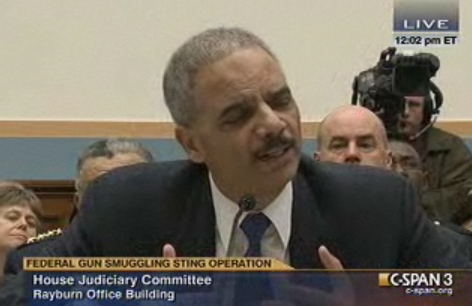
Alarmed by Sweetin’s remarks, Rep. Jared Polis (D-Colo.) asked Holder at a May 2010 hearing before the House Judiciary Committee whether they were “contrary to your stated policy.” Yes, Holder said, “that would be inconsistent with the policy as we have set it out…if the entity is, in fact, operating consistent with state law and…does not have any of those factors” mentioned in the Ogden memo. He said those criteria would determine “whether or not federal resources are going to be used to go after somebody who is dealing in marijuana.”
Given Holder’s assurances, it came as a surprise when U.S. attorneys began warning local and state officials that compliance with state law provides no protection against federal prosecution. In a letter dated February 1, 2011, Melinda Haag, the U.S. attorney for the Northern District of California, responded to questions from Oakland City Attorney John Russo about the city’s plans to license four large-scale marijuana growing operations. “We will enforce the CSA [Controlled Substances Act] vigorously against individuals and organizations that participate in unlawful manufacturing and distribution activity involving marijuana,” Haag wrote, “even if such activities are permitted under state law.” She threatened to prosecute not only city-licensed growers but also “individuals who knowingly facilitate the actions of the licensees, including property owners, landlords, and financiers.”
During the next few months, U.S. attorneys sent similar letters to officials in at least seven other states: Arizona, Colorado, Hawaii, Montana, Rhode Island, Vermont, and Washington. All of them claimed to be consistent with the Ogden memo, which they said applied only to patients, and most claimed to be based on consultations with Holder and Deputy Attorney General James Cole (Ogden’s successor). One of the letters took the vague threats against people who “facilitate” drug offenses a step further. Referring to a bill that would have authorized state-licensed dispensaries to distribute medical marijuana, two U.S. attorneys, Jenny Durkan and Michael Ormsby, warned Washington Gov. Christine Gregoire on April 14 that “state employees who conducted activities mandated by the Washington legislative proposals would not be immune from liability under the CSA.” Two weeks later, citing that threat, Gregoire vetoed the legislation.
After Gregoire’s veto, the ACLU and several members of Congress asked Holder to clarify how prosecuting state-authorized medical marijuana suppliers could possibly be consistent with not prosecuting them. Rhode Island Gov. Lincoln Chafee, who halted plans for state-licensed dispensaries after receiving a threatening, hand-delivered letter from U.S. Attorney Peter Neronha on April 29, said he wanted an assurance from the Justice Department that “they are not going to raid us and shut us down.” During a June visit to Providence, The Providence Journal reported, Holder was “peppered with questions about the Justice Department’s position on dispensaries.” He promised that “we’re going to bring clarity so that people understand what this policy means and how this policy will be implemented.”
Holder’s much-anticipated explanation came in a memo quietly released on the night of June 30, right before a long holiday weekend. It brought nothing like clarity. Deputy Attorney General Cole insisted that the recent prosecution threats were “entirely consistent” with the Ogden memo, which he claimed applied only to patients and caregivers, meaning people “providing care to individuals with cancer or other serious illnesses, not commercial operations cultivating, selling or distributing marijuana.” Alluding to Oakland’s aborted plan, he expressed special concern about “large-scale, privately operated industrial marijuana cultivation centers” with “revenue projections of millions of dollars based on the planned cultivation of tens of thousands of cannabis plants.” But he gave no indication that smaller-scale, nonprofit dispensaries would be tolerated. And while Cole did not mention state employees, he warned that “those who knowingly facilitate” the cultivation or distribution of marijuana “are in violation of the Controlled Substances Act” and that those “who engage in transactions involving the proceeds” of marijuana sales could be charged with money laundering—meaning that investors, landlords, banks, and even vendors who deal with dispensaries could be subject to forfeiture and prosecution.
The Ogden memo’s guidelines for distinguishing between genuine dispensaries and criminal fronts went down the memory hole, along with all of the assurances from Obama and Holder about respecting state law. Indeed, since the Justice Department now says anyone but patients and caregivers is fair game for prosecution, Obama’s policy is indistinguishable from Bush’s. “That line,” says Americans for Safe Access spokesman Kris Hermes, “is exactly the same as what Bush said for years: ‘We’re not targeting patients.’ There is no change.” The problem is that most of the “individuals with cancer or other serious illnesses” whom the Obama administration claims to be sparing are not up to the task of growing their own marijuana. When DEA raids or Justice Department threats to landlords shut down dispensaries, Hermes notes, “patients wake up the next morning wondering where they’re going to find their medication.” The administration’s position, essentially, is that patients can have marijuana; they just can’t get it anywhere.
Why would Holder make such a big deal out of changing the policy and then abandon the new approach while denying that he was reversing himself? “I don’t think Eric Holder really is in command of the department,” says Eric Sterling. “I think the prosecutors are in command, and Holder is something of a figurehead. The statements that he has made are being contradicted by the actual policies coming out.” It looks like federal prosecutors and DEA agents recoiled at Obama’s promises of tolerance, especially as dispensaries multiplied and came to be seen as legitimate businesses. The idea of explicitly authorized, officially licensed dispensaries and grow operations spreading across the country was too much for drug warriors to take.
Perhaps Obama shared their concerns about widespread defiance of the federal ban on marijuana. Allen St. Pierre, executive director of the National Organization for the Reform of Marijuana Laws, notes “the historical fear that Democrats have had for the last 40 years” of being “painted as soft on crime.” In any case, while polls indicate that “medical marijuana is far more popular than Obama is,” Kampia observes, “very few voters vote on the medical marijuana issue.” If Obama “has not chosen to make the effort” required to impose a new policy on a resistant bureaucracy, Sterling adds, “part of the reason is that those who care have not made him pay a political price yet.”
‘Empty Threats’
Still, there is only so much the federal government can do to crack down on medical marijuana. The feds account for less than 1 percent of marijuana arrests, and the DEA has about 5,500 special agents nationwide, compared to more than 730,000 state and local law enforcement officers, including nearly 70,000 in California alone. “We’ve seen a lot of empty threats,” says Steph Sherer, executive director of Americans for Safe Access. “We have seen hundreds of letters from the Department of Justice to landlords, and they have not yet prosecuted landlords. Many have received the letters, ignored them, and not lost their property. I’ve seen over 500 raids since I started this organization [in 2002], and each of those raids involved at least three people. We’ve seen about 5 percent of those people get prosecuted. The day-to-day battle is 98 percent about intimidation.”
The emptiness of the federal government’s threats will become steadily clearer as the number of medical marijuana states grows and dispensaries proliferate. That is why U.S. attorneys intervened in the legislative process, actively discouraging states from authorizing dispensaries by intimidating governors and legislators with the possibility of a federal crackdown. Even scarier to dedicated drug warriors is the prospect raised by Proposition 19, the marijuana legalization initiative that attracted support from 46 percent of California voters last fall. “They were within striking distance of legalizing marijuana,” says Bill Piper, director of national affairs at the Drug Policy Alliance. “It’s probably freaking out a lot of people in law enforcement.” Similar efforts are under way in California, Colorado, and Washington, with an eye toward the 2012 elections.
Critics of such measures, like opponents of medical marijuana laws, say they are unconstitutional. That view is not only mistaken (see “Unbanned in Phoenix,” page 26) but beside the point. The federal government simply does not have the resources to enforce marijuana prohibition without assistance from the states. The feds can make trouble over the short term, but ultimately they will have to accommodate themselves to that reality. The Ending Federal Marijuana Prohibition Act of 2011, introduced in June by Reps. Barney Frank (D-Mass.) and Ron Paul (R-Texas), points the way, leaving the states free to address marijuana as they see fit, with the national government’s role limited to blocking importation into states that continue to ban the drug.
Meanwhile, Obama, assuming he is re-elected, may have to contend not just with dispensaries that provide cannabis to patients but with state-legal pot shops that sell the drug just for fun. How will he react? “That’s the $64,000 question,” says Alison Holcomb, who is leading the effort to qualify a legalization initiative for Washington’s 2012 ballot. “We’re hoping that the answer is something similar to the Ogden memo in 2009, saying if people are playing by the rules and Washington state wants to give this a shot, we’re not going to spend federal resources going after them.”
We know how Obama responds when the question of marijuana legalization comes up in public: He laughs. The highest-rated questions submitted for his “virtual town meeting” in March 2009 dealt with pot prohibition. “I don’t know what this says about the online audience,” Obama said with a smirk, eliciting laughter from the live audience, “but…this was a fairly popular question.”
Obama’s dismissive attitude was especially galling in light of his own youthful pot smoking, which he presents in Dreams From My Father as a cautionary tale of near-disaster followed by redemption. “Junkie. Pothead,” he writes. “That’s where I’d been headed: the final, fatal role of the would-be black man.” Judging from the reports of friends interviewed by The New York Times in 2008, Obama exaggerated his brush with addiction for dramatic effect. More important, he has never publicly acknowledged the plain truth that people who smoke pot rarely become junkies or suffer any other serious harm as a result—unless they get caught.
As Richard Nixon’s National Commission on Marihuana and Drug Abuse pointed out when Obama was all of 10 years old, the biggest risk people face when they smoke pot is created by the government’s attempts to stop them. In 1977, when Obama was a pot-smoking high school student in Honolulu, President Jimmy Carter advocated decriminalizing marijuana possession, telling Congress that “penalties against possession of a drug should not be more damaging to an individual than the use of the drug itself.”
That is hardly a radical position. Polls indicate that most Americans think pot smokers should not be treated like criminals. In a 2002 CNN/Time poll, 72 percent of respondents said “people arrested for possession of small amounts of marijuana” should “pay a fine but without serving any time in jail.” In a 2010 Newsweek poll, 55 percent of respondents endorsed a new California law that “will downgrade the possession of one ounce of marijuana from a misdemeanor to an infraction similar to a traffic ticket, punishable by a simple $100 fine and no arrest record.” While running for the U.S. Senate in 2004, Obama told a group of students at Northwestern University he supported that sort of policy, saying “we need to rethink and decriminalize our marijuana laws.” But three years later, when he was running for the Democratic presidential nomination, he changed his mind, saying he was against decriminalization.
Obama’s reversal on this issue is hard to reconcile with his avowed concerns about the drug war’s disproportionate impact on minorities. Research by Queens College sociologist Harry Levine shows that blacks are much more likely to be arrested for marijuana possession than whites, even though survey data indicate they are no more likely to smoke pot. In New York City, where marijuana arrests have increased dramatically since the late 1990s, blacks are five times as likely to be busted as whites. The number of marijuana arrests by the New York Police Department (NYPD) from 1997 through 2006 was 11 times the number in the previous 10 years, despite the fact that possession of up to 25 grams (about nine-tenths of an ounce) has been decriminalized in New York. Levine found that police routinely trick people into taking out their marijuana, thereby converting a citable offense (possession) into a misdemeanor (public display). The arrests are racially skewed mainly because they stem from a “stop and frisk” program that targets black neighborhoods.
Obama attended Columbia University in the early 1980s, well before the big increase in marijuana arrests that began a decade later. There were about 858,000 pot arrests nationwide in 2009, more than twice the number in 1980, and the crackdown has been especially aggressive in New York City under Mayors Rudolph Giuliani and Michael Bloomberg (another former pot smoker). “The odds are not bad,” observes Ethan Nadelmann, “that a young Barry Obama, using marijuana at Columbia, might have been arrested had the NYPD been conducting the number of marijuana arrests then that it is now.”
A misdemeanor marijuana conviction could have been a life-changing event for Obama, interrupting his education, impairing his job prospects, and derailing his political career before it began. It would not have been fair, but it would have spared us the sorry spectacle of a president who champions a policy he once called “an utter failure” and who literally laughs at supporters whose objections to that doomed, disastrous crusade he once claimed to share.
Senior Editor Jacob Sullum can be reached at (jsullum@reason.com)
Chavez versus Obama: Facing Presidential Elections in 2012
By James Petras :: 09.15.2011
Introduction: Two incumbent presidents are running for re-election in 2012, Hugo Chavez in Venezuela and Barack Obama in the United States. What makes these two electoral contests significant is that they represent contrasting responses to the global economic crises:
Chavez following his democratic socialist program pursues policies promoting large scale long-term public investment and spending directed at employment, social welfare and economic growth: Obama guided by his ideological commitment to corporate financial capitalism, pours billions into bailing out Wall Street speculators, focuses on reducing the public deficit and slashes taxes and offers government subsidies to business in the hope that the banks will lend, the private sector will invest. Obama hopes the corporate sector will start to hire the unemployed. Chavez’s economic strategy is directed toward increasing popular demand by increasing the social wage. Obama’s strategy is directed toward enriching the elite, hoping for a “trickle down” effect. Chavez’s economic recovery program is based on the public sector, the state, taking the lead in light of the capitalist market induced crises and the failure of the private sector to invest. Obama’s economic recovery and employment program depends wholly on the private sector, utilizing tax handouts to stimulate domestic investments which generate employment.
According to the experts and politicians, the socio-economic performance of each President will be decisive in determining whether either President will be re-elected in 2012.
Measuring the Performance of Presidents Chavez and Obama in the Face of the Economic Crises
Over the past three years, both presidents faced deep socio-economic crises resulting in increased unemployment, economic recession and popular demands for political leadership in formulating an economic recovery program.
President Chavez responded via a large scale program in public spending on social programs. Billions were allocated in a massive housing program designed to create one million homes over the next several years. Chavez lessened military tensions and reduced frontier conflicts by negotiating a political agreement with the right-wing Santos regime in Colombia.
Chavez increased the minimum wage, social security and pension payments, increasing consumption among low income groups, stimulating demand and increasing revenues for small and medium size businesses. The state embarked on large scale infrastructure projects, especially highways and transport, creating jobs in labor intensive activities. The Chavez government sustained living standards by instituting price controls on food and other essentials, which sustained popular demand at the expense of profiteering by the owners of super markets. The Chavez government nationalized lucrative gold mines and repatriated overseas reserves in the course of financing its demand driven economic recovery program, eschewing tax concessions to the rich and bailouts of bankrupt banks and private businesses.
Obama rejected any large scale long term public investments to create jobs: his proposed “Jobs for America” proposal will at best temporarily reduce unemployment by less than five tenths of one percent. In pursuit of policies benefiting Wall Street bondholders, Obama became deeply involved in deficit reduction, meaning large scale cuts in public spending especially in social expenditures. Obama in agreement with the extreme right-wing agreed to regressive proposals to reduce tax payments for popular Medicare, Medicaid and Social Security programs. His proposals to fund “Jobs for America” depends on cuts in the Social Security tax which ensures a reduction in payments and a deficit or worse, which would facilitate privatization – handing social security to Wall Street, a trillion dollar plum.
Obama ignores mortgage foreclosures of over 10 million families – increasing homelessness and habitation downgrades, in favor of bailing out banks and home mortgage swindlers.
Obama increased military spending, multiplying overseas combat troops, clandestine terror operations and the domestic spy apparatus, increasing the deficits at the expense of productive investments in education, technology skill upgrades and export promotion.
Unlike Chavez who makes a point of highlighting positive job and education policies for Afro and Indo-Venezuelans, Obama ignores the 50% unemployed big city young (18-25) Afro-Americans and Latinos in favor of serving white Wall Street bankers.
In contrast to Chavez who pegged pensions and wages to inflation and enforced price controls, Obama froze federal salaries and social security payments resulting in a seven percent decline in real income over the past three years.
According to the latest US Census Bureau data (September 2011) under Obama over 46.2 million Americans live in poverty, the highest figure ever. Median household income dropped 2.3% between 2009-2010. The number of Americans in poverty increased from 13.2%in 2008 to 15.1%in 2010. Nearly one out of four children live in poverty in 2010, as over 2.6 million more US citizens were impoverished in a single year. In contrast, and in line with Obama’s trickle down economic policies, the number of wealthy Americans – earning over 100,000 dollars – have suffered little or no impact: luxury specialty stores , like Tiffany’s report a 15% increase in sales.
The lowest 10%of the population suffered the most, a fall in income of 12.1% between 2009-2010 while the 10% with the highest income saw a decline of 1.5%. Of the 34 members of the OCED the US along with Mexico, Chile and Israel has the worst social class inequalities. Obama’s top down stimulus policies saved the bankers by sacrificing the working and middle class.
Political and Economic Consequences of Top Down and Bottom Up Economics
The political and economic consequences of Obama’s “top down” and Chavez “bottom up” socio-economic polices are striking in every respect. Venezuela grew 3.6% in the first half of 2011 while the US stagnated at less than 2%. Worse still, during the second half of the year Obama and his advisers expressed fear that the US is heading toward a “double dip” recession – negative growth. In contrast the President of Venezuela’s Central Bank predicted accelerated growth for 2012.
While US unemployment remains above 9% and combined with underemployment rose to over 19%, Venezuela’s vast public housing and infrastructure investments are generating jobs and lowering the numbers of unemployed and under-employed in the formal and informal labor market. Obama’s pandering to Wall Street bankers and deficit reduction hawks and his vast increase spending on overseas wars and the domestic security apparatus, has bankrupted the treasury. In contrast, Chavez has nationalized lucrative private sector mines, banks and energy enterprises and decreased military tensions increasing resources for social programs such as food subsidies. Obama’s deficit reductions have led to massive firings in education and social services.
Chavez social expenditures have augmented the number of public universities, secondary and primary schools and clinics. Millions have lost their homes as Obama ignored the forced evictions of the mortgage banks, while Chavez has made a start in solving the housing deficit via one million homes.
Obama lends at virtually no interest to private banks who fail to lend to productive enterprises to create jobs, preferring speculation in overseas (Brazilian) bonds with higher interest rates. Chavez invests directly in productive labor intensive infrastructures programs, agricultural self-sufficiency projects and developing downstream processing plants, refineries and smelters.
As a result of the reactionary top down economics he practices and his overt threats to cut basic social programs like Medicare, Medicaid and Social Security, Obama’s popularity has fallen over the past three year from 80% to 40% and is heading downwards. Moreover, his pro-Wall Street fiscal and militarist policies – deepening and extending Bush and Rumsfeld’s wars and terror operations – has turned the US political climate further toward the extreme right. As of the last quarter of 2011, Obama appears vulnerable to electoral defeat.
In contrast President Chavez, riding the wave of economic recovery, based on positive programs of social expansion and public investments, has seen his popularity rise from 43% in March 2010 to 59.3% as of September 7, 2011. The US backed opposition is fragmented, weak and unable to challenge the overwhelmingly positive popular perceptions of the housing and infrastructure projects benefiting the mass of workers, construction companies and contractors.
Chavez is vulnerable on issues of personal security, administrative corruption and inefficiency. But he is seen to have taken important steps to correct these problem areas. Graduates of a new police academy provide honest, efficient community linked policing, which, in pilot projects have reduced violent crime by 60%. Efforts to end bureaucratic corruption and inefficiency are still pending.
Conclusion
Comparing Chavez and Obama’s presidency presents a sharp contrast between a successful bottom up socialist informed economic recovery program and a failed top down capitalist stimulus program. While the American public expresses its hostility to private banking’s pillage of the treasury, government threats to the last remnants of the social safety net and Obama’s failure to lower persistent high levels of unemployment and under-employment, Chavez’s popularity rises along with the positive “good feeling” among three-fifths of the electorate to his presidency. If the Chavez government continues and deepens his ‘bottom up’ economic stimulus program and the economy continues to expand and he recovers from cancer he will in all likelihood be re-elected by a landslide in 2012.
In contrast if Obama continues to truckle to the corporate and financial elite and slash and burn social programs he will continue his downward slide into well-deserved defeat and oblivion.
Venezuela’s economic recovery via advanced social programs is a powerful message to the American people: there is an alternative to regressive ‘top down’ economic policies: it’s called democratic socialism and its advocate is President Chavez, who talks to and works for the people as opposed to the con-man Obama who talks to the people and works for the rich.
US drones kill 9 civilians in Somalia
Press TV – September 15, 2011
US drone attacks have left at least 9 civilians dead and 30 others wounded in Somalia, Press TV reports.
Senior Al-Shabaab leaders said that the drone attacks were carried out early on Thursday in the outskirts of Kismayu town, killing nine women and children and wounding 30 others.
Kismayu, which is located 528 kilometers south of Mogadishu, is the largest Somali port controlled by al-Shabab.
Over the past few weeks, numerous US remote-controlled drones have crashed in Somalia.
Somalia is the sixth country where the US military has used pilotless aircraft to conduct deadly bombing strikes.
Vets For Peace Votes to Impeach Obama for War Crimes
By JOHN V. WALSH | CounterPunch | September 13, 2011
Veterans for Peace (VFP), a progressive organization if ever there was one, took the courageous step of voting for the “impeachment of President Barack H. Obama for war crimes” at its annual national convention in Portland Oregon in August. The resolution, which called on Congress to immediately begin impeachment proceedings, passed with a majority vote.
The resolution sounds the death knell for the view that advocates of Obama’s impeachment are no more than right wing, racist Birthers.
A call for impeachment, whatever the prospects for success, makes clear that the antiwar community regards the President as a criminal – whether that President is Bush or Obama. And it puts a stop to the nasty tactic of shutting up impeachment advocates by calling them racists.
The impeachment resolution is modeled on another that VFP passed some years ago calling for impeachment of Bush. The anti-Obama resolution merits reading in full and is included below. It has telling additions to the one targeting Bush. It opens thus: “Whereas, President Obama, on 19 March 2011, committed a criminal act by ordering the U.S. military to war in Libya without first obtaining the consent of the U.S. Congress in a direct violation of the U.S. Constitution.” Bush told lies to get us into war. Such is his arrogance that Obama, acting in the Democratic tradition of Harry S. Truman in the Korean war, did not even bother to lie. He simply went ahead and trampled on the Constitution without pretense.
The seventh in the list of reasons for impeachment is a tight summary: “Whereas, millions upon millions of Iraqi, Afghani, Pakistani, Yemeni, Somali, and Libyan civilians have been maimed, poisoned, displaced from their homes, and killed in a direct result of ongoing, illegal acts of war by the United States.”
It concludes, “Therefore Be It Resolved that Veterans For Peace call on the U.S. House of Representatives to immediately begin impeachment proceedings against President Barack H. Obama for failure to uphold his sworn oath to protect and defend the Constitution of the United States of America from all enemies foreign and domestic, and for his commission of war crimes, crimes against humanity, obstruction of justice and the violation of numerous national and international laws, treaties and conventions.”
This victory of the VFP rank and file who submitted the resolutions did not come easily. It took three years. The first such resolution was written shortly after Obama took office, on his fourth day ordering Hellfire missiles to strike Pakistan, killing dozens of civilians including three children. That prompted Tom Santoni of the Central FL VFP chapter to write an impeachment resolution. It was taken up at the national convention the following August and was supported by the admirable Adam Kokesh who was at a meeting next door of VFP’s sister organization, Iraq Veterans Against the War. But the VFP leadership, that is the Board, voted against it, thus requiring a two-thirds vote of the membership.
This bit of gate keeping worked, and the resolution failed at the August convention. Santoni quit in disgust, a big loss to VFP. The Central Florida chapter tried again in 2010 under the leaderhship of its co-chair Phil Restino. This time Gold Star mother Cindy Sheehan endorsed the resolution, but again it failed. Finally, this year the Central FL chapter once again submitted the resolution and this time the board did not vote it down! The unstoppable Restino reached out to all 128 VFP chapters urging support and passage. And spontaneously Jesse Perrier of Boston’s Smedley Butler chapter of VFP arose and gave an impassioned speech that brought down the house and won the day. The resolution passed.
Now what about the implementation? The Impeach Bush resolution was pushed aggressively in 2005 running up to the 2006 election when Democrats were running on the promise of impeachment, on which they promptly reneged, most notoriously John Conyers, the poster Congressperson for impeachment. Mike Ferner, at the time executive director of VFP, made an indignant Bush-bashing speech for impeachment in front of the White House. You can view it here in all its glory. A hard copy letter with the signature of the VFP president was mailed to each member of the House calling for impeachment.
How about the present resolution? Mike Ferner opposed it in the floor debate at the August convention. There has been no rally and none is planned – not in front of the White House or anywhere else. This time a fax of the resolution has been sent to the House members without signature of the President. Currently the Central FL chapter is trying to send snail mail letters on its own to every House member once it gets the signature of the president.
Unfortunately this story can be repeated in different ways in a variety of “progressive” organizations with leadership more loyal to Dems than to antiwar principle. This writer has witnessed it himself in organizations like PSR and United for Justice and Peace. But the ground is shifting, and much to its credit VFP has led the way.
John V. Walsh can be reached at John.Endwar@gmail.com. He thanks Phil Restino, co-chair of Central Florida Vets for Peace and Jesse Perrier of the Smedley Butler Brigade of Vets for Peace in Boston for their help. He attempted twice to reach a voice against the resolution but received no reply.
***
IMPEACHMENT OF PRESIDENT BARACK H. OBAMA FOR WAR CRIMES
Whereas, Barack H. Obama is Commander In Chief of the U.S. Armed Forces and the head of the Executive Branch of the United States government, and
Whereas, President Obama, on 19 March 2011, committed a criminal act by ordering the U.S. military to war in Libya without first obtaining the consent of the U.S. Congress in a direct violation of the U.S. Constitution, and
Whereas, the illegal U.S. invasion, bombing and occupation of Iraq initiated by the Bush administration continues under the Obama administration; and
Whereas, the U.S. government is currently engaged in illegal wars in Iraq, Afghanistan, Pakistan, Yemen, Somalia, and Libya, and President Obama pledged to increase the number of military personnel and tax dollars spent on the these wars, and
Whereas, the U.S. military used and continues to use depleted uranium munitions, cluster bombs and white phosphorous in densely populated areas in violation of U.S. laws and international laws and treaties prohibiting the indiscriminate killing of civilians; and,
Whereas, the Geneva Conventions specifically prohibit the use of especially injurious weapons and materials causing unnecessary harm that remain active and lethal after battle, and over large areas of land, and
Whereas, large numbers of babies born in Iraq and Afghanistan suffer life-long illness and deformity like severe disfigurements and brain damage, Down’s syndrome, and weak hearts doctors state are caused by the U.S. military’s massive and widespread use of toxic and radioactive materials, and
Whereas, millions upon millions of Iraqi, Afghani, Pakistani, Yemeni, Somali, and Libyan civilians have been maimed, poisoned, displaced from their homes, and killed in a direct result of ongoing, illegal acts of war by the United States, and
Whereas, illegal, immoral and counterproductive detainee torture and brutalization at the hands of the U.S. military’s Immediate Reaction Force continue at Guantanamo under the Obama administration and in particular, the torture of Pfc. Bradley Manning at Quantico, Virginia, and
Whereas, President Obama is an accessory after the fact in obstructing justice by failing to order the Department of Justice to initiate investigations into numerous and blatant U.S. war crimes committed by the Bush administration, for which it is manifestly accountable under the law, and
Whereas, millions of Americans, including Veterans For Peace and Prosecute Them Now, supported the impeachment of Bush/Cheney for the same war crimes that are being committed now by Obama in violation of the U.S. Constitution, U.S. federal laws, the United Nations Charter, the Hague Convention, the Geneva Conventions, The United Nations Convention Against Torture and the Nuremberg Tribunal Charter, and
Whereas, Veterans For Peace and Prosecute Them Now are committed to the stated mission to restrain our government from intervening overtly and covertly in the internal affairs of other nations, to seek justice for veterans and victims of war, to increase public awareness of the exact costs of war, and to abolish war as an instrument of national policy;
Therefore Be It Resolved that Veterans For Peace call on the U.S. House of Representatives to immediately begin impeachment proceedings against President Barack H. Obama for failure to uphold his sworn oath to protect and defend the Constitution of the United States of America from all enemies foreign and domestic, and for his commission of war crimes, crimes against humanity, obstruction of justice and the violation of numerous national and international laws, treaties and conventions.
Approved at the 2011 VFP National Convention
Venezuela Rejects New U.S. Sanctions against High-Ranking Officials
Venezuelanalysis.com | September 9th 2011
Merida – On Thursday the Venezuelan government “strongly rejected” a U.S. Treasury Department decision to sanction four members of the country’s political and military establishment, calling the move “another expression of the imperial and arrogant character by which these institutions act against our countries.” The declaration came in response to the U.S. Office of Foreign Assets Control (OFAC) that placed four Venezuelan nationals on an updated list of “Specially Designated Nationals” accused of arming leftist guerrillas in neighboring Colombia.
The four men “sanctioned” by the U.S. Treasury Department are socialist lawmaker and former Caracas mayor Freddy Bernal, Latin American assemblyman Amilcar Figueroa, Army General Cliver Alcala, and intelligence office Ramon Isidro Madriz Moreno.
According to a U.S. Treasury press release, the four have acted “for or on behalf of the narco-terrorist organization the Revolutionary Armed Forces of Colombia (FARC), often in direct support of its narcotics and arms trafficking activities.”
The men join three other high-ranking Venezuelan officials already on the U.S. list: General Henry Rangel Silva, General Hugo Carvajal, and former interior minister Ramon Rodriguez Chacin.
While no concrete evidence was provided to demonstrate the men’s “support” for the Colombian guerrillas, the U.S. decision prohibits U.S. citizens from “engaging in transactions” with the men and places a freeze on “any assets that they may have under U.S. jurisdiction.”
In response to the OFAC decision, Venezuelan Foreign Minister Nicolas Maduro called the United States a “sick society” that is responsible for “this sickness of narco-trafficking.” He accused the U.S. of attempting to serve as “a kind of global police to judge decent citizens of our country” and called the move “abusive.”
Venezuela’s Ministry of Foreign Affairs later issued a public statement in which it affirmed the “sanctions” are “part of the permanent defamatory campaigns orchestrated in the imperial power centers of the United States, precisely aimed at nourishing hostile policies against our homeland.”
Responding to the U.S. decision, sanctioned PSUV lawmaker Freddy Bernal called the move an “attack on the homeland” that was aimed at harming the “process underway” in Venezuela that seeks “liberation through socialism.”
Bernal said he was “proud” of the U.S. classification, since Bolivian President Evo Morales and Ecuadorian President Rafael Correa had received similar accusations, and told reporters he “could care less about the U.S. government” since he had no foreign bank accounts, properties abroad, and had no interest in visiting the United States in the near future.
With respect to all four men sanctioned, Bernal said the U.S. was looking to “disqualify those of us who have been the most loyal soldiers (to Chavez) and who have taken on the consequences associated to a Bolivarian loyalty and dignity.”
“The objective of the U.S. Empire,” said Bernal, “is to create the conditions to attack Venezuela and justify doing so with these lies.”
In recent years, the U.S. and Colombian governments have repeatedly accused the government of Venezuelan President Hugo Chavez of supporting the FARC insurgency in its decades-long war against the Colombian government. During the presidency of Colombia’s Alvaro Uribe (2002 – 2010), accusations by Uribe led Venezuela’s Chavez to increase his country’s military presence along the border with Colombia in “defensive preparation” for war with Colombia.
In 2008, after the Colombian military carried out an armed raid against FARC rebels hidden in Ecuadorian territory, relations worsened.
After the raid, the Colombian government said it had “uncovered” numerous documents on the laptop computer of assassinated FARC Commander Raul Reyes, document they said proved Venezuela’s support for the armed insurgency.
More commonly referred to as the “FARC Files,” these documents were later found “inadmissible” by the Colombian Supreme Court which said it could not be certain the files were not tampered with by members of the Colombian security forces.
While the U.S. Treasury Department did not provide any concrete evidence linking the four Venezuelan nations to the FARC insurgency, an article in the Washington Post suggests the accusations are based on the same “FARC Files.”
The “Specially Designated” Four
Freddy Bernal, considered a “leader” of the ruling the United Socialist Party of Venezuela (PSUV), served as mayor of Caracas from 2000 to 2008. He began his political career as a member of Chavez’s Fifth Republic Movement (MVR) and was first elected to the country’s National Assembly in 1998. A year later, he was elected to the Venezuelan Constitutional Assembly, which drafted the Constitution of the Bolivarian Republic of Venezuela (1999). In April 2002, during the failed military coup against democratically-elected president Hugo Chavez, Bernal played a key role in mobilizing pro-Chavez forces against the military government installed in the Miraflores Presidential Palace.
Bernal was an outspoken supporter of the formation of the PSUV (2007) and was elected to the Venezuelan National Assembly in last year’s parliamentary elections. He currently leads government efforts to reduce gun violence in the country, including draft legislation against easy access to guns and ammunition.
Amilcar Figueroa is a Venezuelan historian, former guerrilla fighter, and active member of the PSUV’s leadership in Caracas. He was elected to represent Venezuela at the Latin American Parliament for the 2006 – 2011 period and served as the organizations Alternate President from 2006 to 2008. In 2009, a Colombian court accused Figueroa of providing support to the FARC, based on information said to have been found in the “FARC Files.”
Cliver Alcala is Major General of the Fourth Armored Division of the Venezuelan Army, one of the country’s most important army units, and Ramon Isidro Madriz Moreno is an officer of the Bolivarian Intelligence Service (SEBIN), Venezuela’s national intelligence agency.
Obama’s Jobs Plan
Moon of Alabama | September 9, 2011
Obama’s jobs plan:
- “We will continue to falsely diagnose a solvency crisis as a normal liquidity recession.” (I would otherwise have to demand credit write downs from those criminal banksters who pay for my reelection bid.)
- “We will cut the payroll taxes which pay for social security.” (This will make it easier to later gut the whole program.)
- “We will pay for that by later cutting Medicare and Medicaid.” (See how I never lose sight of my original aims.)
- “We also ask the Congress super-committee to find more ways to cut spending.” (Time for the cat food commission to earn its name.)
- “We will give tax breaks to companies that hire workers.” (Just fire them from those well payed jobs, rehire them for less and get another tax break. What’s not to like here?)
- “We will give some money to the cities and towns so they can keep more policemen on their payrolls.” (We will need those when the people eventually start to revolt.)
- “We will put up $10 billion of the people’s money toward a public-private infrastructure bank. (Here is some upfront money for the banksters to privatize more of the now public owned space.)
- “We will also offer money to rehab vacant and foreclosed houses that are now owned by the banks.” (They never really wanted those houses so why should they pay for them?)
- “We ask Congress to pass this immediately.” (Please don’t give anyone time to find out what really is behind these ideas.)