Moscow: International Organizations Ignore Kiev’s Threats to Russian Journalists
Sputnik – 02.04.2023
Russian war correspondent Vladlen Tatarsky was killed in a blast at a cafe in St. Petersburg on Sunday.
Kiev continues to threaten Russian journalists with reprisals while international organizations turn a blind eye to the situation, Russian Foreign Ministry spokeswoman Maria Zakharova stated just hours after war correspondent Vladlen Tatarsky was killed in an explosion in St. Petersburg.
Zakharova stressed that Russian journalists are being intimidated by Kiev and its Western sponsors, “literally marked with special labels” on US social media platforms, and subjected to a witch hunt in Western media.
According to the diplomat, the fact that relevant international organizations ignore this can easily be interpreted as tacit approval if not complicity.
The Russian Foreign Ministry emphasized that Western countries have not investigated any case of violent death of a Russian journalist that was “assessed by the Kiev regime and its thugs as a ‘success’.”
“Not a single case of the violent death of a Russian journalist, assessed by the Kiev regime and its thugs as a ‘success’ has been investigated, or even treated with elementary human sympathy by Western countries, international organizations or foreign professional communities.”
“Up until recently, the West fought extremism and terrorism, marched as a united front in Paris in defense of journalists against whom terrorist attacks were committed. Today, the lack of reaction in the White House, Downing Street, the Elysee Palace, etc., given their alleged concern for the well-being of journalists and freedom of journalism, speaks volumes. The reaction in Kiev is striking, where recipients of Western grants demonstrate undisguised delight over what happened,” Zakharova said.
The spokeswoman added that it is thanks to the Russian war correspondents that the world sees the truth and learns information about what is happening in Ukraine.
“The professional activities of Vladlen Tatarsky, his service to the Fatherland caused hatred with the Kiev regime. He was dangerous for them, but courageously went all the way, fulfilling his duty,” the diplomat added, expressing condolences to Tatarsky’s family.
The 40-year-old Donetsk-born blogger, journalist and war correspondent, whose real name was Maxim Fomin, was killed in an explosion at a cafe in St. Petersburg on Sunday, April 2. The Russian Investigative Committee has launched an investigation into the explosion to establish the circumstances of the blast. Twenty-five people were injured in the explosion. Authorities are yet to determine as to who was behind the blast.
No More Double Standards and Impunity. West Provokes Russia. Result: Nukes in Belarus on NATO’s Borders
Strategic Culture Foundation | March 31, 2023
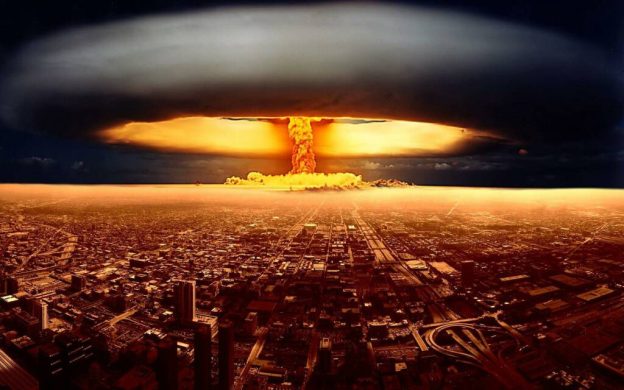
The historic – and unacceptable – deployment of U.S. nuclear weapons in several European NATO states as well as the recent announcement by Britain of supplying depleted uranium weapons to Ukraine is the prologue to Russia’s decision to place tactical nukes in Belarus. The Western outcry following Russia’s decision is absurd and hypocritical.
The pattern is familiar and speaks of incorrigible arrogance. The United States and its NATO allies make reckless escalatory moves that are unprecedented in their aggression toward Russia; then Moscow makes a reciprocal move, and yet the Western governments and their dutiful news media become apoplectic with rage over Russia’s “threatening conduct” and nuclear blackmail.
Maybe one day, Western leaders will eventually choke on their own illogical apoplexy.
This week there was frothing and fuming in the West about Moscow’s decision to deploy tactical nuclear weapons in Belarus, despite the move being fully in accord with the Minsk government, a longtime ally of Russia and fellow member of the Collective Security Treaty Organization. The CSTO is organically comparable with the North Atlantic Treaty Organization (NATO), having a shared defense commitment between allied states that were formerly members of the Soviet Union.
In ratifying the deployment, Russian President Vladimir Putin was accused by Western powers of jeopardizing international security, threatening European neighbors and violating the Non-Proliferation Treaty. Belarus borders three NATO members: Poland, Lithuania and Latvia.
But the decision by Russia to install tactical nuclear weapons in Belarus (which Moscow would reportedly retain control over) was in response to the NATO move to supply its anti-Russian Kiev proxy with depleted uranium (DU) weapons. Britain announced last week that Challenger 2 battlefield tanks sent to Ukraine would be equipped with DU shells. It is understood that the United States is also ready to supply depleted uranium armor-piercing munitions to Ukraine with its Abrams tanks. Video footage from London’s Ministry of Defence shows Ukrainian troops being trained by British and American officers in handling DU shells.
Depleted uranium is a high-density metal – much denser than lead – which can penetrate modern armor. It ignites after penetration and turns into vapor at extreme temperature. While DU shells are not explosively fissile and do not cause nuclear blasts, they do release harmful radioactive contamination into the environment. Arguably, the munitions are therefore a form of nuclear weapon in the same manner as a low-yield “dirty bomb”.
The United States and Britain fired tonnes of depleted uranium shells during their decade-long illegal war in Iraq. NATO forces also used DU weapons in their war of aggression against former Yugoslavia. In both cases, the resultant radioactive contamination was correlated with high rates of cancer and birth defects in the civilian populations.
The Americans and British have never been held to account for their war crimes. That impunity partly explains their arrogance in regard to pumping weapons into Ukraine against Russia and in particular the latest iteration of radioactive uranium shells.
For the British regime to claim that DU weapons are “normal” munitions and acceptable to deploy potentially for hitting Russian territory is a demonstration of its depraved deception and utter lawlessness. It also shows that London and its NATO partners are willing to recklessly escalate the conflict in Ukraine against Russia by breaching a dangerous threshold regarding nuclear weapons.
Under Russia’s defense doctrine, it may use nuclear weapons if its national security is threatened by either nuclear forces or conventional forces. The U.S.-led NATO alliance is pushing the envelope in a way that is seemingly incorrigible, or tantamount to psychopathic behavior.
Perversely, this abysmal situation is distorted as somehow Russia taking a provocative step in placing tactical nuclear weapons in Belarus.
What Moscow is demonstrating is that the Anglo-American-led NATO alliance has no longer the presumption of impunity. The decades of unchecked aggression from NATO expansionism and criminal Anglo-American subterfuges in foreign countries are over. Moscow offered a diplomatic channel to create a security treaty in Europe, but that was haughtily dismissed by the arrogant imperialist powers. The result was the military-technical measures that Russia undertook with its intervention in Ukraine on February 24, 2022.
Arguably, Russia could take additional reciprocal measures that go further. The involvement of NATO members in massively arming the NeoNazi Kiev regime should, it could be contended, be met with military defensive action to destroy supply chains entering Ukraine.
This is the perspective for a proper understanding of the deployment of tactical nuclear weapons in Belarus. It is not Russia upping the ante to jeopardize security and peace. It is NATO powers that are erasing the boundaries in a way that they are accustomed to doing for several decades.
Let’s recall that it is the United States that has rescinded several arms-control treaties including the Anti-Ballistic Missile treaty, the Intermediate-range Nuclear Forces treaty, and the Open Skies treaty, and it is Washington that has chronically undermined the last-existing one, the New START governing strategic weapons.
There is also the existing anomaly of the United States storing nuclear weapons on the territory of five NATO members. They are Belgium, Germany, Italy, Netherlands and Turkey. These countries are signatories to the Non-Proliferation Treaty, so arguably the basing of nuclear weapons in these states is a gross violation of the NPT, which is what the West is accusing Russia of in regard to Belarus.
Last year, too, Poland offered to house American nuclear weapons on its soil. That offer was not taken up but is presumably still on the table. Why is there not an outcry over that egregious destabilizing of arms control?
As usual there is a surfeit of Western double-think to go along with rank hypocrisy. The illogical mentality is a product of arrogance and hubris.
Furthermore, two NATO members Britain and France have their own national nuclear arsenals supposedly separate from Washington’s command. These two powers are actively hostile toward Russia through their arming of the Kiev regime.
Additionally, all 30 members of the NATO alliance are committed to assisting the United States in deploying nuclear forces with their conventional militaries under the alliance’s provision called Support of Nuclear Operations With Conventional Air Tactics (SNOWCAT).
In sum, clearly, the issue of arms control and security is badly out of balance, but it is the conduct of the United States and its NATO partners that has led to the imbalance. The arrogant presumption of impunity held by Washington and London in particular is a destabilizing factor that creates double standards that are completely unacceptable in a world supposedly under the rule of international law and the United Nations Charter.
The conflict in Ukraine can be solved if Western powers were to abide by international law and halt the weaponizing of the Kiev regime. Going forward, Ukraine must be a neutral state and NATO must halt its aggressive expansion. A serious policy of nuclear arms control must involve the withdrawal of such weapons from European NATO member states and the inclusion of British and French arsenals as part of a wider detente framework. Note, however, that the conditionalities for peace are in large part an onus on Washington and its Western allies to do the right and reasonable things. The disturbing question is though, can Washington and its imperialist lackeys be reasonable?
Until enlightened conduct prevails, Russia is quite correct to be intolerant of any double standards that the Americans, British and their NATO minions presume. Every aggressive move must be boldly and smartly reciprocated. Without that countervailing action, there is impunity, which is even more dangerous.
Holding Western powers to account is a powerful weapon of attrition because it exposes their corruption and fraud, their duplicity, and their fatal arrogance. Increasingly, the Western public is seeing the endemic bankruptcy of their supposed rulers.
China Urges US to Stop Interfering in Other Countries’ Affairs Under Pretext of Democracy
Sputnik – 28.03.2023
China urges the United States to stop interfering in other countries’ internal affairs under the pretext of democracy and creating divisions in today’s world, the spokeswoman for the Chinese Foreign Ministry, Mao Ning, said on Tuesday.
“We advise the US to stop pointing fingers at other countries and stop interfering in their internal affairs in the name of promoting democracy,” Mao said at a briefing.
She noted that today’s world does not need creation of divisions in the name of democracy and promote a policy of unilateral action, but to strengthen solidarity and cooperation based on the purposes and principles of the UN Charter, advocating true multilateralism.
“What our world needs today is not to interfere in other countries’ internal affairs under the guise of democracy, but to advocate genuine democracy, reject pseudo-democracy and jointly promote greater democracy in international relations,” the diplomat said.
She added that the world today needs not summits that create confrontation, but solidarity and cooperation that can really solve the problems faced by the international community.
“We have stated our position on the so-called ‘Summit for Democracy’ on multiple occasions. Despite the many problems at home, the US is hosting another ‘Summit for Democracy’ in the name of promoting democracy, an event that blatantly draws an ideological line between countries and creates division in the world. The act violates the spirit of democracy and further reveals the US’ pursuit of primacy behind the façade of democracy,” Mao added.
Earlier in the day, the Russian Foreign Ministry said Moscow regrets the participation of UN Secretary-General Antonio Guterres in the Summit for Democracy, an “unworthy show” staged by the United States, adding that it is the second attempt to form a coalition of so-called “democratic states” with Washington in the leading role.
The first Summit for Democracy, also organized by the United States, was held in December 2021. The second summit is scheduled for March 28-30.
ICC irreversibly crosses the line of legal decency
By Stephen Karganovic | Strategic Culture Foundation | March 29, 2023
Acting at the behest of its political controllers and paymasters, the racist International Criminal Court [ICC], whose principal activity since its founding in 2003 has been the malicious persecution of black African leaders, now, for a change, targets for judicial abuse a distinguished Eurasian figure.
Observers with an attention span of more than fifteen minutes (which would exclude the vast majority in the bamboozled Western countries) should have noticed immediately several glaring anomalies in ICC’s “arrest warrant.”
The warrant purports to be based on humanitarian concern for the welfare of children allegedly transferred illegally from the Donbas. The court officers’ public rationale, however, omits widely known facts regarding the systematic bombardment of civilians in Donetsk and Lugansk since 2014. It ignores the demonstrated death toll of that crime amounting to at least 14,000 victims, including several thousand children. Neither this manifest offence against humanity nor the desire to call to account its obvious perpetrators, the military and political structures of the Kiev Nazi regime, seem to have played any role in the court’s deliberations.
Why not? How can meticulous adherence to the provisions of the Geneva Convention which requires the evacuation of civilians from areas affected by armed conflict (Article 49) be deemed grounds for the issuance of a criminal warrant, while widespread, systematic, and indiscriminate lethal shelling of civilians is passed over in silence, without triggering any prosecutorial reaction?
For that matter, a further question can also be raised with regard to another anomaly, just as glaring. Why have the alleged atrocities in Bucha and Kramatorsk last year apparently been memory holed, to be replaced now by another that has been obviously contrived? If criminal charges were to be pressed, why have the Bucha and Kramatorsk incidents, which at the time of their alleged occurrence were the subject of extraordinary propaganda campaigns, suddenly disappeared from the radar screen? And precisely when they could have served as the most credible foundation for an arrest warrant, assuming there ever was any evidence to support those allegations? Might the fact that both false flag operations were efficiently exposed in the early stages have anything to do with this strange reticence?
How incompetent – or politically corrupt – must a prosecutor be to forego a supposedly open and shut case in favor of a case, and that is putting it very charitably, that is at best legally ambiguous and highly dubious? This question is addressed to the ICC Prosecutor, colonial lackey and consummate opportunist Karim Khan, of course.
Two additional considerations must also be submitted to the judgment of that part of the public whose brains have not yet been fried by propaganda. If the welfare of children is foremost on the minds of ICC staff, what have they got to say about the tsunami of reports that the Kiev junta, desperate to replenish its supply of cannon fodder, is now detaining and kidnapping underage children and with virtually no military training sending them to war, where they have an estimated life expectancy of about four hours?
Rule 136 0f the Convention on the Rights of the Child holds plainly that “Children must not be recruited into armed forces or armed groups.” Additional Protocols I and II, the Statute of the International Criminal Court itself [Art. 8 (b) (xxvi)] and of the Special Court for Sierra Leone put the minimum age for recruitment in armed forces or armed groups at 15, as does the Convention on the Rights of the Child. Are ICC prosecutors capable of reading their own court’s regulations, or do they even care?
Should credible reports of such odious practices, unquestionably in contravention of international conventions which govern the use of child soldiers, not merit at least a full scale ICC investigation?
An equally grave question should be raised concerning the imminent dispatch of hazardous and banned depleted uranium munitions by Great Britain to the armed forces of the Ukrainian junta.
Contrary to the rationalisations of the British Government, depleted uranium munitions are provably detrimental to the environment, as well as to human beings and all forms of animate life in the proximity of their impact. That includes children, of course, who are particularly vulnerable and subject to genetic deformations and painful and lethal illnesses. The catastrophic impact of the use of such munitions in Yugoslavia and Iraq has been extensively studied and well documented over the past several decades. Former UN arms control inspector Scott Ritter has exposed the evils of this practice professionally and competently. It is prohibited by international humanitarian law and if allowed it will constitute a grave threat to life and health both of children and adults in the Ukraine. Would not the warning of arrest warrants for the relevant authorities in the United Kingdom be a suitable response by the ICC in the face of a potential disaster of such magnitude?
It is important to note that the International Criminal Court is a linear extension of the International Criminal Tribunal for the Former Yugoslavia [ICTY] and that its conduct cannot be fully understood without reference to the pattern of lawless behaviour previously exhibited by its model. Indeed, the word “conduct” is in this case a more appropriate terms than “jurisprudence” because neither court has bothered to develop a body of law and legal interpretation in the conventional sense. It is of no significance that ICTY is a manifestly illegal outfit, set up in contravention of the UN Charter, while ICC arguably was properly constituted by international treaty. In their practical operation they have both served as tools of the arrogance of power of global hegemons. Their joint task has been not to uphold the principles of international law, but to demolish them in order to provide a legalistic veneer for the execution of the hegemons’ criminal undertakings.
It is therefore scarcely surprising that the preposterous grounds cited by the ICC for issuing warrants against Russian officials for an alleged act of gross turpitude consisting of the safe evacuation of children from the war zone in the Donbas had an exact analogue in the past behaviour of ICC’s infamous model, the ICTY.
In a nutshell, Serbian defendants in the ICTY Srebrenica trials were routinely charged with a grave breach of international humanitarian law, forced deportation of the civilian population. In mid-July of 1995, three meetings were held between the commander of the UN Protection Force in Srebrenica, Col. Thom Karremans, and the Serbian Commander Gen. Ratko Mladic to consider the issue of civilian refugees assembled in a nearby village. The Serbian side made complete video recordings of those meetings which leave no doubt as to what had in fact transpired. Although the video evidence unambiguously shows that Col. Karremans came to Mladic to convey the request of the UN Command that the refugees be evacuated to safety onto territory where military operations were not taking place, ICTY Prosecution charged Mladic with ordering the expulsion and ethnic cleansing of the refugees. What actually happened is that Gen. Mladic acceded to UN Command’s request, as he had the duty to do under international law since fighting around Srebrenica was still in progress, and as a result the refugees were properly evacuated, as agreed.
For acting in good faith to protect civilians in a zone of conflict, Gen. Mladic was indicted, among other things, for genocide and crime against humanity, deportation.
The exculpatory video evidence was never presented in court in its totality. Snippets taken out of context and appearing to favor the prosecution case were the only parts allowed to be introduced into the evidence. Live testimony by Col. Karremans, who obviously would have been a key witness, was obstructed at every turn by the prosecution with the connivance of the Chamber. Technically, the judges could not be faulted for not taking into account evidence that had not been put before them. In the end, they washed their hands and calmly drew conclusions that were contrary to the facts, but with grave consequences for the defendant.
The Russian targets of ICC’s warrants will never, of course, be in the position of General Mladic. However, the cowboy style of ICTY´s corrupt proceedings, fully assimilated by its subsequent clone, ICC, gives a foretaste of what awaits anyone unlucky enough to fall in its clutches.
ICC, like its precursor ICTY, is a disgrace to law in all its civilised forms. State parties should be encouraged to withdraw from it while it is still possible for them to avoid embarrassment by association.
Moscow calls out US’ rules-based order in Europe
BY M. K. BHADRAKUMAR | INDIAN PUNCHLINE | MARCH 27, 2023
Baroness Goldie is an experienced Scottish politician and life peer who served as Leader of the Scottish Conservative Party from 2005 to 2011 and as the UK’s Minister of State for Defence since 2019. She is anything but a party girl like Liz Truss who often had to swallow her indiscreet words betraying ignorance.
Certainly, Baroness Goldie understood perfectly well the implications of what she put down in a written statement at the House of Lords on March 20 in her answer to Lord Hylton’s seemingly innocuous question: “To ask His Majesty’s Government whether any of the ammunition currently being supplied to Ukraine contains depleted uranium.” (By the way, Lord Hylton is one of 92 hereditary peers elected to remain in the House of Lords; he is currently the longest-serving Crossbench member of the House of Lords, since 1968, and is a dynamic campaigner for peace and the interests of the vulnerable and the marginalised.)
It is a fair guess that the UK Defence Secretary Ben Wallace kept 10 Downing Street informed — and even more important, had prior consultations and concurrence with his US counterpart, Secretary of Defence Lloyd Austin — before Baroness Goldie made the statement.
Both Wallace and Austin are military people and understand why ammunition tipped with “depleted uranium” is needed in the current stage of the proxy war in Ukraine if at all Kiev is to launch a “credible counter-offensive” in spring when the tide of the war has distinctly turned in Russia’s favour.
Equally, both must be well aware that the legality of the NATO intervention in Yugoslavia is still an open issue. In response to NATO’s bombing campaign, former Yugoslavia instituted proceedings before the International Court of Justice on April 29, 1999, against the ten NATO members directly involved in the attack — Belgium, Canada, France, Germany, Italy, the Netherlands, Portugal, Spain, the UK, and the US — citing a series of violations of the law of nations (which included the obligation not to use prohibited weapons.)
Although the ICJ rejected Belgrade’s request for provisional measures, it, nonetheless, declared itself profoundly concerned with the use of force in Yugoslavia, which “under the present circumstances … raises very serious issues of international law.” Suffice to say, the cases brought by Yugoslavia against the NATO respondents still remain on the ICJ’s docket although the petitioner got dismembered.
Make no mistake, Washington and London are consciously repeating the war crime in the former Yugoslavia. The Anglo-Saxon clique’s core objective is a calculated escalation of the proxy war that is certain to draw forth a robust reaction by Moscow, as predictable as night follows day.
Indeed, that is precisely what happened when Russian President Vladimir Putin announced on Saturday that Russia will deploy its tactical nuclear weapons in Belarus. Putin linked this to a request from Belarus in reaction to Baroness Goldie’s statement in London a week ago.
More importantly, Putin also drew the analogy of the US placing its tactical nuclear weapons on the territories of the allied NATO countries for decades.
The EU and NATO went ballistic after Putin’s disclosure. EU’s chief diplomat Josep Borrell said on Sunday called out Moscow’s decision as “an irresponsible escalation and threat to European security.” He threatened to impose “further sanctions” against Belarus!
A NATO spokeswoman called Moscow’s decision “dangerous and irresponsible.” Interestingly, though, the Biden administration neatly side-stepped the issue, focusing instead that the US has not seen any signs that Russia has moved nuclear weapons to Belarus or anywhere else!
In good measure, National Security Council spokesperson John Kirby added, “We’ve in fact seen no indication he (Putin) has any intention to use nuclear weapons, period, inside Ukraine.”
But then, Putin also made it clear that Russia would first complete construction on a storage facility in Belarus for the tactical nuclear weapons by July 1.
Kirby is fudging. What is the game plan? First, the Anglo-Saxon clique would hope that the issue will create further antagonism in Europe against Russia and Putin personally and would rally European countries behind the Biden administration at a time when fault lines were appearing within the transatlantic alliance over a protracted war in Ukraine that might be catastrophic for European economies.
Washington is hard-pressed to respond to Putin’s remark that Russia is only doing something that the US has been doing for decades. The point is, a mutual commitment not to deploy nuclear weapons in third countries was one of the proposals Moscow made to Washington in December 2021, alongside a commitment that Ukraine would not join NATO. The US ignored it and precipitated the Russian special military operation in Ukraine.
The crux of the matter is, as with the Cuban missile crisis of 1962, the Russian decision on tactical nuclear weapons in Belarus is retaliatory, drawing attention to the US missiles stationed close to its borders. (An estimated 100 nuclear weapons are stored in vaults in five European countries — Belgium, Germany, Italy, Netherlands and Turkey.)
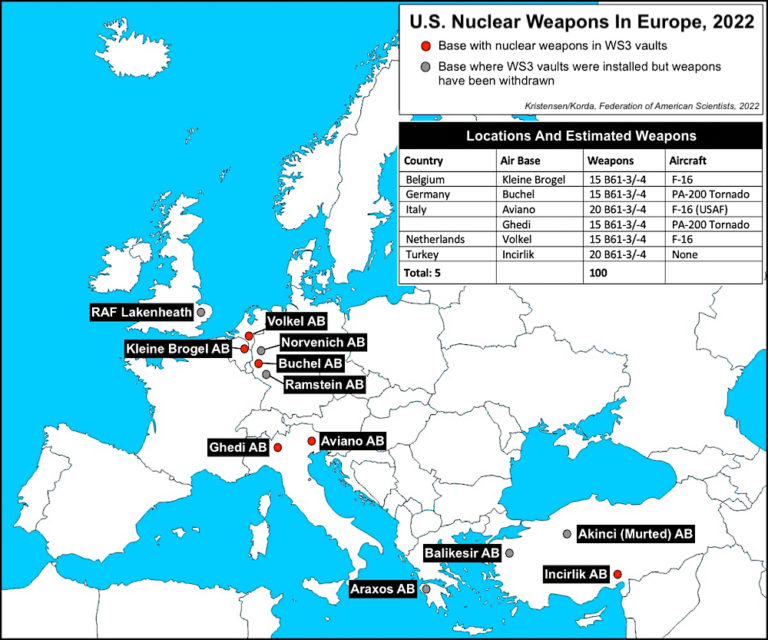
Worse still, the US practices a controversial arrangement known as “nuclear sharing”, under which it installs nuclear equipment on fighter jets of select non-nuclear NATO countries and train their pilots to carry out nuclear strike with US nuclear bombs. This is when the US, being a party to the nuclear Non-Proliferation Treaty (NPT), has promised not to hand over nuclear weapons to other countries, and the non-nuclear countries in the NATO’s sharing arrangement have themselves promised not to receive nuclear weapons from the nuclear weapon states!
NATO declared last year that seven NATO countries have contributed dual-capable aircraft to the nuclear sharing mission. These countries are believed to be the US, Belgium, Germany, Italy, Netherlands, Turkey and Greece. And all are signatories to the NPT!
Welcome to the rules based order! What is perfectly permissible to the “collective West” is forbidden for Russia!
Finally, the diplomatic pirouette has yet another dimension: Britain’s decision to send depleted uranium weaponry to Ukraine is confirming its reputation as the most reckless and unscrupulous state in the whole NATO alliance.
For, there is no question that depleted uranium munitions are radioactive and toxic and their heavy use in the Yugoslavia and Iraq wars has been linked to birth defects and cancers. It has been tied to “the highest rate of genetic damage in any population ever studied” in Fallujah, the city subjected to two brutal US sieges during the invasion of Iraq.
Ironically, the toxicity of depleted uranium munitions has been accepted by many NATO countries and the European Parliament has called for its use to be banned. So, what is Britain up to, behaving like an outlier?
The heart of the matter is that Britain is creating conditions in Europe to base nuclear-armed US bombers in Britain at Lakenheath in Suffolk (which were removed in 1991 in line with the Intermediate Nuclear Forces treaty.)
At a time when the peace movement in Britain is moribund, count on the Russian retaliation to deploy tactical nuclear weapons in Belarus to trigger calls for yet another tit for tat escalation from warmongers and Russophobes. Expect the US bombers to return to Lakenheath in a near future.
US democracy ‘a facade’ – Russian security chief
RT | March 27, 2023
The US is not really a democracy, nor does it seek to promote democracy in its relations with other nations, contrary to Washington’s claims, senior Russian security official Nikolay Patrushev has said. He made the remarks while commenting on the upcoming ‘Summit for Democracy’ hosted by the US government.
Patrushev, who is the secretary of the Russian Security Council, described the US economy as “dependent on corruption and lobbying connections going to the White House and Capitol Hill.”
Corporate interests have hijacked the levers of political power in the US and use the country’s international clout to pursue their own agenda, he said in an interview with Rossiyskaya Gazeta newspaper, to be published in full later today.
Their democracy is a pretty facade for the political system, which serves to hide the neglect of the rights of ordinary Americans.
Washington pursues the same approach in the international arena, where it claims to be the champion of democracy but disregards other nations’ sovereignty, Patrushev said. He believes that this “hypocrisy” will be on display at the Summit for Democracy, which will kick off this week in Washington.
The event will be “a gathering to support a world order in which Washington wants to play the central role forever. Dissenters will be labeled ‘undemocratic states,’” he predicted. The US, which “appointed itself the dictator of the world, will harass the nations whose sovereignties and democracies were undermined,” by Washington.
The reality is that “Washington has long been a leader in violating the sovereignty of other nations, in the number of wars and conflicts it has unleashed,” the security chief said. He called the nations that support this arrangement “vassals” that are constantly “humiliated” in their abusive relationships with the US.
The international event, which is being held for the second time, is meant to promote democracy against what Washington increasingly sees as assertive “authoritarian” states. The US reportedly invited all participants of the first summit, which was held in 2021, including the administration of the self-governed Chinese island of Taiwan. NATO members Hungary and Türkiye were snubbed once again, according to Foreign Policy magazine.
The EU is losing relevance in the emerging new world
By Timur Fomenko | RT | March 27, 2023
Vladimir Putin and Xi Jinping met in Moscow last week, and Western circles predictably responded by accusing Russia of becoming “subservient” or even a “vassal state” to China.
MEP Guy Verhofstadt, a Euro-fantasist and former prime minister of Belgium, jeered on Twitter, “Putin’s appalling legacy now includes turning Russia more and more into a Chinese vassal state,” oblivious to the irony of his own words. As the United States took the lead in denouncing China’s peace plan for the Ukraine conflict, publicly setting out the conditions on which it should end, the European Union was nowhere to be seen, or at least had nothing original to say.
This makes Verhofstadt’s comments a damning display of lacking self-awareness. Russia and China are setting out their vision for a new multipolar world, while the US struggles against them in seeking to maintain its hegemonic position. Meanwhile, the European Union has been reduced to the status of a mere bench player in it all, and has become effectively irrelevant. The failure of EU countries to stake out their own will and position amidst the larger powers, as well as their total subservience to the US, has made a mockery of the “strategic autonomy” concept once championed by Emmanuel Macron.
“Strategic autonomy” is a principle of European integration where the EU should be an actor in a multipolar world, which advocates for its own interests and pursues its own agenda. Supporters of this principle insist that the EU should not blindly follow the will of the US when it comes to every foreign policy issue, but should be proactive and enhance its role on the world stage. Therefore, they should not, as is commonly demanded by Washington, take sides on matters such as a new Cold War with China. The term gained growing traction during the years of the Trump administration, when Europe’s relations with the US hit a low due to his particular interpretation of the “America first” doctrine.
However, the practical reality of “strategic autonomy” is that the EU is not a unitary state, but a loose intergovernmental organization of states which, while seeking to establish common positions on a principle of unity, do not truly have a unified foreign-policy-making mechanism. The intra-institutional politics of the EU are often a messy compromise and battle of wills between different levels of actors, including the states themselves, the European Commission, and the European Parliament. This combines with the reality that “European integration” has been a broken process since 2008. Challenges such as the Eurozone financial crisis, Brexit, Covid-19, and internal conflicts with various states such as Poland have all weakened and fractured the EU.
As a result, the EU has been ill-suited to deal with what is, despite media misdirection, the single most explicit source of foreign influence and interference against it, the US. Washington has multiple channels whereby it exerts control over the EU’s many foreign policy actors. Firstly, it uses a web of government-funded think tanks and associated journalists to control public opinion and steer EU countries towards supporting its objectives. Secondly, the US has an extraordinarily political hold over the former Soviet bloc states to the east of the EU (with the exception of Hungary), which it uses to foment increased antagonism against Russia and China, and therefore undermines the attempts of the bloc’s most “autonomous” and powerful states – Germany and France – to pursue more reconciliatory foreign policies.
Thirdly, the US uses the United Kingdom as its primary cheerleader in Europe (be it from within or without the EU) to project its political will onto the continent and override the will of any defiant member states. An example of this is the BBC World Service acting as a massive propaganda machine to push narratives in line with Washington’s foreign policies. Additionally, the US has shown an ability to work with and weaponize the intelligence services of member states against their own countries, such as using Danish intelligence to spy on other European leaders.
Through all these factors, both past and present, the US has been able to keep Europe divided, conflicted, and seemingly unable to pursue any foreign policy which actually meets European interests, as opposed to those of the US. This has culminated even to the extent of literally destroying the Nord Stream pipelines and then propagating a false narrative that Ukraine was responsible. The Ukraine war has ultimately only accelerated the isolation and irrelevance of Europe, which has strengthened the hold of the military-industrial complex over the continent, undermined its energy industries, and thus converted the term “strategic autonomy” into a laughing stock.
One might ask, who is truly the vassal? If a new multipolar world is emerging, it’s fair to say, Europe simply isn’t part of it. Russia, China, and America are the drivers of current events, the EU is but a passenger.
Why is the West Paranoid About the Putin-Xi Summit?
By Salman Rafi Sheikh – New Eastern Outlook – 26.03.2023
The recently concluded summit consolidated Russia’s and China’s joint bid to challenge the US-dominated global system as well as concerted US efforts to undermine, using any means, emerging global powers. That the push to challenge this system is gaining momentum, evident from the support that both Russia and China continue to receive from the non-Western world, has left the West – especially, the US – paranoid about the future of the system they created after the Second World War. This growing paranoia is at the heart of an arrest warrant that the International Criminal Court issued last week against Putin. Ridiculous as this may sound, such actions only reveal the West’s inner anxieties about the failure of their combined efforts to defeat Russia in Ukraine.
On the contrary, even as reports in the mainstream US media show, assembling enough military strength from within NATO countries for Ukraine against Russia has become an extremely difficult task, as more and more NATO countries are becoming “worried” about their own ammunition stockpiles. In addition to this, as reports in the US media show, there are growing differences between Washington and Kyiv as well with regard to the conduct of the war. How will Russia be defeated in such a case? For many Western powers – especially, the US and its old allies (the UK) – this is nothing short of a nightmare.
This nightmare is exacerbated by the Russia-China alliance. China, as it stands, has more manufacturing capacity today than the US-Europe combined. And, it is strong enough a military power to confront any western power in the Pacific or beyond. What can the West do to break this alliance? There is virtually no way the West can do any damage to this alliance; hence, the growing paranoia.
In fact, the West’s combined failure to defeat Russia has given a bit more confidence to the Russia-China alliance to pursue its politics of creating a multipolar world. For decades, the combined West projected its supposed superiority over the non-West. China’s rapid emergence as a global power and Russia’s success against the combined strength of NATO has unambiguously proven this sense of superiority to be false. Xi, in an article he wrote for Russian media, minced no words to express the same fact:
“The international community has recognized that no country is superior to others, no model of governance is universal, and no single country should dictate the international order. The common interest of all humankind is in a world that is united and peaceful, rather than divided and volatile.”
Reinforcing the same, Putin said,
“Our countries, together with like-minded actors, have consistently advocated the shaping of a more just multipolar world order based on international law rather than certain ”rules“ serving the needs of the “golden billion.” Russia and China have consistently worked to create an equitable, open and inclusive regional and global security system that is not directed against third countries.”
For the West, this agreement is nothing short of a shock, as many western politicians and media political pundits are known to have argued for years regarding some underlying – and seemingly irreconcilable – differences between Russia and China. These differences, the argument goes, were supposed to be exacerbated by the military conflict in Ukraine. Clearly, yet another western prediction has proven to be utterly wrong and self-defeating.
Now that Russia and China are not only allies but have no-limits friendship too, the West stands petrified.
This alliance is not passive. It is active and dynamic and is working to reshape the world. While Russia is facing off the combined military strength of NATO in Ukraine, China recently found a big success in the Middle East where it was able to broker a peace deal between two arch-rivals: Saudi and Iran. This deal has allowed the Russia-China alliance to expand the strength of the alliance into other countries and regions, thus squeezing the space for the US and its allies.
China is seeking to play the same role between Russia and Ukraine. The recent peace proposal Beijing offered is promising. Although the West has so far ignored it, the political message that this peace proposal contains is very hard for many non-western powers to ignore. In fact, its opening lines reflect the very world that China and Russia are seeking to build. The message is not only powerful but also enticing. It says:
“The sovereignty, independence and territorial integrity of all countries must be effectively upheld. All countries, big or small, strong or weak, rich or poor, are equal members of the international community. All parties should jointly uphold the basic norms governing international relations and defend international fairness and justice. Equal and uniform application of international law should be promoted, while double standards must be rejected.”
Why would countries that have traditionally been mistreated by the west reject this message and the principle of equality? Granted that absolute equality – especially in material terms – may not be possible even in the multipolar world that Russia and China are trying to build, it seems fair to emphasise that no international system can work when a few countries are able to bend rules to suit their own interests at the expense of other states. Indeed, the Iraq war would not have happened if the US had not decided to undermine the UN and act unilaterally on the basis of concocted evidence about Iraq’s possession of Weapons of Mass Destruction. NATO’s intervention in Libya destroyed a stable system, a fact that the British Parliament’s foreign affairs committee admitted years after completely destroying the country. Who is responsible for this destruction? Will the ICC act against the proven culprits?
For the West – especially, the US – the Russia-China bid to create a new world order will create a space in which Western unilateralism would become extremely costly, especially if directed against their competitors. For them, the end of “their” world must be prevented at any cost. But the problem lies in their consistent failure in preventing this from happening and in the success of Russia and China in pushing ahead.
Salman Rafi Sheikh is a research-analyst of International Relations and Pakistan’s foreign and domestic affairs.
EU warns of response to Belarus nuclear move
RT | March 26, 2023
The EU will respond with further sanctions if Belarus presses ahead with hosting Russian nuclear weapons on its soil, the bloc’s top diplomat, Josep Borrell, has stated. Borrell called the decision to transfer tactical weapons to Belarus “an irresponsible escalation” by Moscow.
“Belarus hosting Russian nuclear weapons would mean an irresponsible escalation and threat to European security,” Borrell tweeted on Sunday. “Belarus can still stop it, it is their choice,” he continued, adding that “the EU stands ready to respond with further sanctions.”
Russian President Vladimir Putin revealed on Saturday that his country’s tactical nuclear weapons will arrive in Belarus as early as this summer. Putin said that he made the decision after the UK announced it would transfer toxic depleted uranium munitions to Ukraine, a move he described as a sign of London’s “absolute recklessness.”
Belarus has already been extensively sanctioned by the EU and US since the start of Russia’s military operation in Ukraine last February. Brussels has blacklisted more than 20 Belarusian officials, cut five of the nation’s banks off from the SWIFT system, and imposed numerous trade restrictions.
Prior to 2022, the EU banned Belarusian flights from operating in its airspace and imposed five separate sets of sanctions in response to President Alexander Lukashenko’s 2020 election victory, which the EU deemed fraudulent.
In his announcement on Saturday, Putin explained that any nuclear weapons transferred to Belarus would remain under Russian control.
“There is nothing unusual,” about this arrangement, Putin stated, explaining that “the United States has been doing this for decades” by keeping its own nuclear weapons in Belgium, Germany, Italy, the Netherlands, and Türkiye.
“They have long deployed their tactical nuclear weapons on the territory of their allies,” he said. “We agreed that we will do the same, without violating our international obligations on the non-proliferation of nuclear weapons.”
Mexican President Says Trump Arrest is About Keeping Him Off the Ballot
Agencia Press South via Getty Images
By Paul Joseph Watson | Summit News | March 23, 2023
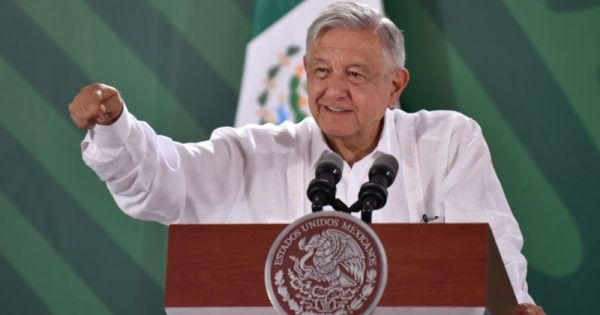
Mexican President Andres Manuel Lopez Obrador slammed the Biden administration for accusing him of corruption while abusing the justice system in America to engage in a political witch hunt against Donald Trump “so that he doesn’t appear on the ballot”.
AMLO made the comments in response to a U.S. government report that accused his an administration of “human rights violations,” a charge which he asserts is a tissue of “lies”.
Over the weekend, Trump said he expects to be arrested in connection with a potential indictment for ‘hush money’ payments made to Stormy Daniels before the 2016 election.
“Right now, former President Trump is declaring that they are going to arrest him,” said AMLO, adding, “If that were the case… it would be so that his name doesn’t appear on the ballot.”
Obrador said he sympathized with Trump because he too had been targeted with “the fabrication of a crime, when they didn’t want me to run.”
“And this is completely anti-democratic… Why not allow the people to decide?” said AMLO.
The president also shot down claims that he was responsible for the mistreatment of journalists by pointing to America’s treatment of Wikileaks founder Julian Assange, adding that the report criticizing his administration, “should not be taken seriously.”
“Let’s see, human rights? Why don’t you release Assange?” he asked. “If you are talking about journalism and freedom, why are you holding Assange?”
Obrador also said the U.S. had no right to browbeat him about violence given their alleged role in blowing up the Nord Stream oil pipelines.
“If you talk about acts of violence, how is it that an award-winning United States journalist tells us that the United States government sabotaged the Russian-European gas pipeline?” the president stated.
“Why is a cartel, or several cartels, allowed to operate in the United States, freely distributing the fentanyl that does so much harm to young people in that country?” he asked.
AMLO said the U.S. should stop trying to “be the government of the world” when their own behavior is rife with inconsistencies.
Last night, a letter written by Michael Cohen’s attorney said that Cohen acted alone when paying off Stormy Daniels in 2016, with the case against Trump looking increasingly flimsy and more likely to collapse altogether.
China gives US advice on Ukraine
RT | March 22, 2023
The US should stop “fanning the flames” of the conflict in Ukraine instead of making accusations against Beijing, Chinese Foreign Ministry spokesperson Wang Wenbin has said.
During a briefing on Wednesday, Wang responded to a statement by US National Security Council spokesman John Kirby, who said the previous day that he didn’t think “you can reasonably look at China as impartial in any way” when it comes to the fighting between Moscow and Kiev.
Beijing has failed to condemn Russia’s military operation, while continuing to buy energy from the country, he stated. Chinese President Xi Jinping “saw fit to fly all the way to Moscow” this week, but has never even talked on the phone to his Ukrainian counterpart Vladimir Zelensky, Kirby added.
The Chinese Foreign Ministry spokesman rejected Kirby’s claims, stating that the US was itself too deeply involved in the conflict in Ukraine to accuse Beijing of being biased.
“The US side claims that China’s stance isn’t impartial. But is it impartial to continuously supply weapons to the battlefield? Is it impartial to constantly escalate the conflict? Is it impartial to allow the effects of the crisis to spill over globally?” Wang said, referring to the Biden administration’s policies.
“We advise the American side to rethink its own stance on the Ukraine issue, turn away from the erroneous path of adding fuel to the fire, and stop shifting the blame to China,” he said.
Beijing has “no selfish motives on the Ukraine issue, has not stood idly by… or sought profit for itself,” the spokesman insisted. “What China has done boils down to one thing, that is, to promote peace talks.”
As for Xi’s trip to the Russian capital, which took place between Monday and Wednesday, Wang pointed out that this was “a journey of friendship, cooperation and peace, which has aroused positive responses in the international community.”
The Ukrainian crisis was among the top issues discussed between Vladimir Putin and Xi in Moscow, with the Russian president stressing that many provisions of the Chinese peace proposal were “consonant with the Russian stance and can be taken as a foundation for a peaceful settlement when they are ready for it in the West and in Kiev.” However, Putin pointed out that Moscow currently didn’t detect readiness from either the US, its allies or the Ukrainian government.
Featured Video
Elijah Magnier: Yemen’s strikes are shattering Saudi Arabia’s long-term strategy
or go to
Aletho News Archives – Video-Images
From the Archives
British weapons and personnel doing much of the killing in Yemen
Press TV – June 18, 2019
A detailed report published by the Guardian newspaper has shown how Britain is massively contributing to Saudi Arabia’s devastating war on Yemen as it suggests that London is not only supplying the bombs that fall on Yemenis, but it provides the personnel and expertise that keep the war going.
The comprehensive report by Arron Merat published on Tuesday showed that Britain was doing much of the killing in Yemen as the country continues to provide Saudi Arabia with everything it needs to turn its southern impoverished neighbor into a graveyard.
“Every day Yemen is hit by British bombs – dropped by British planes that are flown by British-trained pilots and maintained and prepared inside Saudi Arabia by thousands of British contractors,” said Merat in the report. … continue
Blog Roll
 Aletho News
- Racist Seinfeld Dances for Joy as Bibi Unveils His New Map
- A West Bank War for Netanyahu’s Election Campaign, Could It Backfire?
- Yemen denounces European Parliament’s ‘hypocritical’ push to blacklist Ansarullah
- Qalibaf: UAE’s UN bid aims to ‘clear the runway’ for ‘Greater Israel’, whitewash genocide
- Pakistan reopens Iran border after boosting security: Report
- Why are so many Brazilians voting for Flávio Bolsonaro?
- Democrats Put Anti-Russia Agenda Ahead of American Workers
- Elijah Magnier: Yemen’s Strikes Are Shattering Saudi Arabia’s Long-Term Strategy
- Pentagon designates Chinese cultural centers national security threat
- Israel Demolishes Home Of Lebanese Journalist Whose Viral Film Exposed Pager Attack
- If Americans Knew
- An error has occurred; the feed is probably down. Try again later.
- No Tricks Zone
- Sudden Stratospheric Warming, Powerful El Niño Combination May Lead To Extreme Europe Cold, Energy Crisis!
- Two New Studies Find Thwaites Glacier Melt Cannot Be Driven By Human Activity Or A Warming Ocean
- E-Cars Reduce CO2 Emissions By Only 41% Compared To Internal Combustion Engine Vehicles
- Predictions Made By Renowned Climate Professor Over Past Decades Have Been Proven To Be Poor
- New Study Suggests Large Regions Of The Pacific Ocean Have Been Cooling For The Last 80 Years
- Germany’s Green Energy Debacle: High Energy Costs Force Kahla Porzellan to Close After 182 Years!
- New Study: 50 Years Of The Most Aggressive ‘Net Zero’ Policies Can Only Affect The Global Climate By 0.03°C
- US September “Heat” Was No Record…Many Records Set Decades Ago
- Latest European Green Energy Debacle; Portugal’s Largest Flagship Solar Park Insolvent!
- Green Energy Debacle: German Expert Professor Fritz Vahrenholt Warns Of Severe Economic And Social Consequences

