How an Internet ‘Persona’ Helped Birth Russiagate
By Ray McGovern | Consortium News | June 15, 2020
Four years ago today, on June 15, 2016, a shadowy Internet persona calling itself “Guccifer 2.0” appeared out of nowhere to claim credit for hacking emails from the Democratic National Committee on behalf of WikiLeaks and implicate Russia by dropping “telltale” but synthetically produced Russian “breadcrumbs” in his metadata.
Thanks largely to the corporate media, the highly damaging story actually found in those DNC emails — namely, that the DNC had stacked the cards against Bernie Sanders in the party’s 2016 primary— was successfully obscured.
The media was the message; and the message was that Russia had used G-2.0 to hack into the DNC, interfering in the November 2016 election to help Donald Trump win.
Almost everybody still “knows” that — from the man or woman in the street to the forlorn super sleuth, Special Counsel Robert Swan Mueller III, who actually based indictments of Russian intelligence officers on Guccifer 2.0.
Blaming Russia was a magnificent distraction from the start and quickly became the vogue.
The soil had already been cultivated for “Russiagate” by Democratic PR gems like Donald Trump “kissing up” to former KGB officer Vladimir Putin and their “bromance” (bromides that former President Barack Obama is still using). Four years ago today, “Russian meddling” was off and running — on steroids — acquiring far more faux-reality than the evanescent Guccifer 2.0 persona is likely to get.
Here’s how it went down:
1 — June 12: WikiLeaks founder Julian Assange announced he had “emails related to Hillary Clinton which are pending publication.”
2 — June 14: DNC contractor CrowdStrike tells the media that malware has been found on the DNC server and claims there is evidence it was injected by Russians.
3 — June 15: Guccifer 2.0 arises from nowhere; affirms the DNC/CrowdStrike allegations of the day before; claims responsibility for hacking the DNC; claims to be a WikiLeaks source; and posts a document that forensic examination shows was deliberately tainted with “Russian fingerprints.” This to “corroborate” claims made by CrowdStrike executives the day before.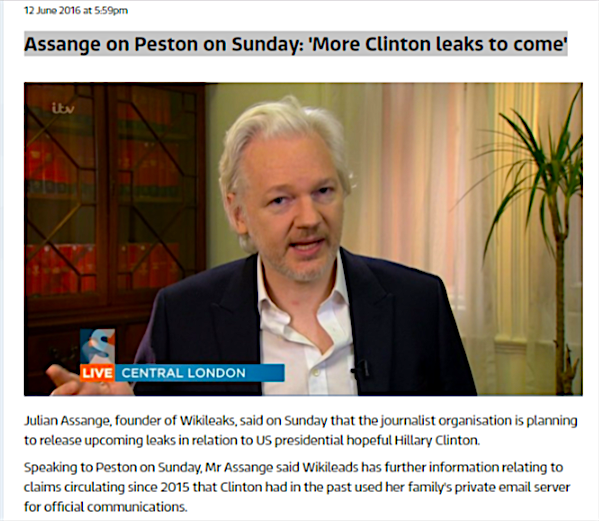
Adding to other signs of fakery, there is hard evidence that G-2.0 was operating mostly in U.S. time zones and with local settings peculiar to a device configured for use within the U.S., as Tim Leonard reports here and here.)
Leonard is a software developer who started to catalog and archive evidence related to Guccifer 2.0 in 2017 and has issued detailed reports on digital forensic discoveries made by various independent researchers — as well as his own — over the past three years. Leonard points out that WikiLeaks said it did not use any of the emails G2.0 sent it, though it later published similar emails, opening the possibility that whoever created G2.0 knew what WikiLeaks had and sent it duplicates with the Russian fingerprints.
As Veteran Intelligence Professionals for Sanity (VIPS) told President Trump in a memorandum of July 24, 2017, titled “Was the ‘Russian Hack’ an Inside Job?”:
“We do not think that the June 12, 14, & 15 timing was pure coincidence. Rather, it suggests the start of a pre-emptive move to associate Russia with anything WikiLeaks might have been ready to publish and to ‘show’ that it came from a Russian hack.”
We added this about Guccifer 2.0 at the time:
“The recent forensic studies fill in a critical gap. Why the FBI neglected to perform any independent forensics on the original ‘Guccifer 2.0’ material remains a mystery – as does the lack of any sign that the ‘hand-picked analysts’ from the FBI, CIA, and NSA, who wrote the misnomered ‘Intelligence Community’ Assessment dated January 6, 2017, gave any attention to forensics.”
Guccifer 2.0 Seen As a Fraud
In our July 24, 2017 memorandum we also told President Trump that independent cyber investigators and VIPS had determined “that the purported ‘hack’ of the DNC by Guccifer 2.0 was not a hack, by Russia or anyone else. Rather it originated with a copy (onto an external storage device – a thumb drive, for example) by an insider. Information was leaked to implicate Russia. We do not know who or what the murky Guccifer 2.0 is. You may wish to ask the FBI.” [Emphasis added.].
Right. Ask the FBI. At this stage, President Trump might have better luck asking Attorney General William Barr, to whom the FBI is accountable — at least in theory. As for Barr, VIPS informed him in a June 5, 2020 memorandum that the head of CrowdStrike had admitted under oath on Dec. 5, 2017 that CrowdStrike has no concrete evidence that the DNC emails published by WikiLeaks on July 22, 2016 were hacked — by Russia or by anyone else. [Emphasis added.] This important revelation has so far escaped attention in the Russia-Russia-Russia “mainstream” media (surprise, surprise, surprise!).
Back to the Birth of G-2
It boggles the mind that so few Americans could see Russiagate for the farce it was. Most of the blame, I suppose, rests on a thoroughly complicit Establishment media. Recall: Assange’s announcement on June 12, 2016 that he had Hillary Clinton-related emails came just six weeks before the Democratic convention. I could almost hear the cry go up from the DNC: Houston, We Have a Problem!

Clinton at the 2016 convention. (Wikimedia Commons)
Here’s how bad the problem for the Democrats was. The DNC emails eventually published by WikiLeaks on July 22, 2016, just three days before the Democratic convention, had been stolen on May 23 and 25. This would have given the DNC time to learn that the stolen material included documents showing how the DNC and Clinton campaign had manipulated the primaries and created a host of other indignities, such that Sanders’ chances of winning the nomination amounted to those of a snowball’s chance in the netherworld.
To say this was an embarrassment would be the understatement of 2016. Worse still, given the documentary nature of the emails and WikiLeaks’ enviable track record for accuracy, there would be no way to challenge their authenticity. Nevertheless, with the media in full support of the DNC and Clinton, however, it turned out to be a piece of cake to divert attention from the content of the emails to the “act of war” (per John McCain) that the Russian “cyber attack” was said to represent.
The outcome speaks as much to the lack of sophistication on the part of American TV watchers, as it does to the sophistication of the Democrats-media complicity and cover-up. How come so few could figure out what was going down?
It was not hard for some experienced observers to sniff a rat. Among the first to speak out was fellow Consortium News columnist Patrick Lawrence, who immediately saw through the Magnificent Diversion. I do not know if he fancies duck hunting, but he shot the Russiagate canard quite dead — well before the Democratic convention was over.
Magnificent Diversion

Patrick Lawrence
In late July 2016, Lawrence was sickened, as he watched what he immediately recognized as a well planned, highly significant deflection. The Clinton-friendly media was excoriating Russia for “hacking” DNC emails and was glossing over what the emails showed; namely, that the Clinton Dems had pretty much stolen the nomination from Sanders.
It was already clear even then that the Democrats, with invaluable help from intelligence leaks and other prepping to the media, had made good use of those six weeks between Assange’s announcement that he had emails “related to Hillary Clinton” and the opening of the convention.
The media was primed to castigate the Russians for “hacking,” while taking a prime role in the deflection. It was a liminal event of historic significance, as we now know. The “Magnificent Diversion” worked like a charm — and then it grew like Topsy.
Lawrence said he had “fire in the belly” on the morning of July 25 as the Democratic convention began and wrote what follows pretty much “in one long, furious exhale” within 12 hours of when the media started really pushing the “the Russians-did-it” narrative.
Below is a slightly shortened text of his article:
“Now wait a minute, all you upper-case “D” Democrats. A flood light suddenly shines on your party apparatus, revealing its grossly corrupt machinations to fix the primary process and sink the Sanders campaign, and within a day you are on about the evil Russians having hacked into your computers to sabotage our elections …
Is this a joke? Are you kidding? Is nothing beneath your dignity? Is this how lowly you rate the intelligence of American voters? …
Clowns. Subversives. Do you know who you remind me of? I will tell you: Nixon, in his famously red-baiting campaign — a disgusting episode — … during his first run for the Senate, in 1950. Your political tricks are as transparent and anti-democratic as his, it is perfectly fair to say.
I confess to a heated reaction to events since last Friday [July 22] among the Democrats, specifically in the Democratic National Committee. I should briefly explain …
The Sanders people have long charged that the DNC has had its fingers on the scale, as one of them put it the other day, in favor of Hillary Clinton’s nomination. The prints were everywhere — many those of Debbie Wasserman Schultz, who has repeatedly been accused of anti-Sanders bias. Schultz, do not forget, co-chaired Clinton’s 2008 campaign against Barack Obama. That would be enough to disqualify her as the DNC’s chair in any society that takes ethics seriously, but it is not enough in our great country. Chairwoman she has been for the past five years.
Last Friday WikiLeaks published nearly 20,000 DNC email messages providing abundant proof that Sanders and his staff were right all along. The worst of these, involving senior DNC officers, proposed Nixon-esque smears having to do with everything from ineptitude within the Sanders campaign to Sanders as a Jew in name only and an atheist by conviction.
Wasserman fell from grace on Monday. Other than this, Democrats from President Obama to Clinton and numerous others atop the party’s power structure have had nothing to say, as in nothing, about this unforgivable breach.They have, rather, been full of praise for Wasserman Schultz. Brad Marshall, the D.N.C.’s chief financial officer, now tries to deny that his Jew-baiting remark referred to Sanders. Good luck, Brad: Bernie is the only Jew in the room.
The caker came on Sunday, when Robby Mook, Clinton’s campaign manager, appeared on ABC’s “This Week” and … CNN’s “State of the Union” to assert that the D.N.C.’s mail was hacked “by the Russians for the purpose of helping Donald Trump.” He knows this — knows it in a matter of 24 hours — because “experts” — experts he will never name — have told him so. …
What’s disturbing to us is that experts are telling us that Russian state actors broke into the DNC, stole these emails, and other experts are now saying that Russians are releasing these emails for the purpose of helping Donald Trump.
Is that what disturbs you, Robby? Interesting. Unsubstantiated hocus-pocus, not the implications of these events for the integrity of Democratic nominations and the American political process? The latter is the more pressing topic, Robby. You are far too long on anonymous experts for my taste, Robby. And what kind of expert, now that I think of it, is able to report to you as to the intentions of Russian hackers — assuming for a sec that this concocted narrative has substance?
Making lemonade out of a lemon, the Clinton campaign now goes for a twofer. Watch as it advances the Russians-did-it thesis on the basis of nothing, then shoots the messenger, then associates Trump with its own mess — and, finally, gets to ignore the nature of its transgression (which any paying-attention person must consider grave).
Preposterous, readers. Join me, please, in having absolutely none of it. There is no “Russian actor” at the bottom of this swamp, to put my position bluntly. You will never, ever be offered persuasive evidence otherwise.
Reluctantly, I credit the Clinton campaign and the DNC with reading American paranoia well enough such that they may make this junk stick. In a clear sign the entire crowd-control machine is up and running, The New York Times had a long, unprofessional piece about Russian culprits in its Monday editions. It followed Mook’s lead faithfully: not one properly supported fact, not one identified “expert,” and more conditional verbs than you’ve had hot dinners — everything cast as “could,” “might,” “appears,” “would,” “seems,” “may.” Nothing, once again, as to the very serious implications of this affair for the American political process.
Now comes the law. The FBI just announced that it will investigate — no, not the DNC’s fraudulent practices (which surely breach statutes), but “those who pose a threat in cyberspace.” … it is the invocation of the Russians that sends me over the edge. My bones grow weary …
We must take the last few days’ events as a signal of what Clinton’s policy toward Russia will look like should she prevail in November. … Turning her party’s latest disgrace into an occasion for another round of Russophobia is mere preface, but in it you can read her commitment to the new crusade.
Trump, to make this work, must be blamed for his willingness to negotiate with Moscow. This is now among his sins. Got that? Anyone who says he will talk to the Russians has transgressed the American code. … Does this not make Hillary Clinton more than a touch Nixonian?
I am developing nitrogen bends from watching the American political spectacle. One can hardly tell up from down. Which way for a breath of air?”
A year later Lawrence interviewed several of us VIPS, including our two former NSA technical directors and on Aug. 9, 2017 published an article for The Nation titled, “A New Report Raises Big Questions About Last Year’s DNC Hack.”
Lawrence wrote, “Former NSA experts, now members of Veteran Intelligence Professionals for Sanity (VIPS), say it wasn’t a hack at all, but a leak—an inside job by someone with access to the DNC’s system.”
And so it was. But, sadly, that cut across the grain of the acceptable Russia-gate narrative at The Nation at the time. Its staff, seriously struck by the HWHW (Hillary Would Have Won) virus, rose up in rebellion. A short time later, there was no more room at The Nation for his independent-minded writing.
Ray McGovern works with Tell the Word, a publishing arm of the ecumenical Church of the Saviour in inner-city Washington. His 27-year career as a CIA analyst included preparing and briefing The President’s Daily Brief and leading the Soviet Foreign Policy Branch. In retirement he co-founded Veteran Intelligence Professionals for Sanity.
The Miracle of Salisbury
By Craig Murray | June 16, 2020
It turns out that the BBC really does believe that God is an Englishman. When the simple impossibility of the official story on the Skripals finally overwhelmed the dramatists, they resorted to Divine Intervention for an explanation – as propagandists have done for millennia.
This particular piece of script from Episode 2 of The Salisbury Poisonings deserves an induction in the Propaganda Hall of Fame:
Porton Down Man: I’ve got the reports from the Bailey house
Public Health Woman: Tell me, how many hits?
Porton Down Man: It was found in almost every room of the house. Kitchen, bathroom, living room, bedrooms. It was even on the light switches. We found it in the family car too. But his wife and children haven’t been affected. I like to think of myself as a man of science, but the only word for that is a miracle.
Well, it certainly would be a miracle that the family lived for a week in the house without touching a light switch. But miracle is not really the “only word for that”. Nonsense is a good word. Bullshit is a ruder version. Lie is entirely appropriate in these circumstances.
Because that was not the only miracle on display. We were told specifically that the Skripals had trailed novichok all over Zizzis and the Bishops Mill pub, leaving multiple deadly deposits, dozens of them in total, which miraculously nobody had touched. We were told that Detective Bailey was found to have left multiple deadly deposits of novichok on everything he touched in a busy police station, but over several days before it was closed down nobody had touched any of them, which must be an even bigger miracle than the Baileys’ home.
Perhaps even more amazingly, as the Skripals spread novichok all over the restaurant and the pub, nobody who served them had been harmed, nobody who took their payment. The man who went through Sergei’s wallet to learn his identity from his credit cards was not poisoned. The people giving first aid were not poisoned. The ducks Sergei fed were not poisoned. The little boy he fed the ducks with was not poisoned. So many miracles. If God were not an Englishman, Salisbury would have been in real trouble, evidently.
The conclusion of episode two showed Charlie Rowley fishing out the perfume bottle from the charity bin at least two months in the timeline before this really happened, thus neatly sidestepping one of the most glaring impossibilities in the entire official story. I think we can forgive the BBC that lie – there are only so many instances of divine intervention in the story the public can be expected to buy in one episode.
It is fascinating to see that the construction of this edifice of lies was a joint venture between the BBC and the security services’ house journal, the Guardian. Not only is all round pro-war propagandist “Colonel” Hamish De Bretton Gordon credited as Military Advisor, but Guardian journalists Caroline Bannock and Steven Morris are credited as Script Consultants, which I presume means they fed in the raw lies for the scriptwriters to shape into miracles.
Now here is an interesting ethical point for readers of the Guardian. The Guardian published in the last fortnight two articles by Morris and Bannock that purported to be reporting on the production of the drama and its authenticity, without revealing to the readers that these full time Guardian journalists were in fact a part of the BBC project. That is unethical and unprofessional in a number of quite startling ways. But then it is the Guardian.
[Full disclosure. I shared a flat with Caroline at university. She was an honest person in those days.]
Again, rather than pepper this article with links, I urge you to read this comprehensive article, which contains plenty of links and remains entirely unanswered.
“Putin’s Gonna Get Me”
By Craig Murray | June 15, 2020
Shakespeare’s heirs at the BBC produced this deathless and entirely convincing line as the climax of the first episode of “The Salisbury Poisonings”, a three part piece of state propaganda on the Skripal saga, of which I watched Part 1 as it was broadcast last night. The other two parts are to be broadcast today and tomorrow, which unusual scheduling reflects the importance our masters place on this stirring tale of the resilience of the great British nation under attack by devilish foreigners. You can watch all three episodes now on BBC iPlayer, but personally I suffer from overactive antibodies to bullshit and need a break.
The line about Putin was delivered by salty, ex-British military Ross Cassidy, so of course was entirely convincing. It may have been more so had he ever said it in public before this week, but there you are.
To judge by social media, an extraordinary proportion of the public find the official narrative entirely convincing. I find myself unable to pretend that does not fill me with despair at the future of democracy. That anybody could listen to the following dialogue without doubling up in laughter is completely beyond me. I do not quite understand how the actors managed to speak it.
Porton Down Man: “And it’s one of the deadliest synthetic substances on earth. It’s so toxic that a spoonful, with the right delivery mechanism, could kill thousands”.
Heroic Public Health Lady: “But if it’s so toxic, how come the Skripals are still alive?”
Porton Down Man: “The paramedics assumed that they had overdosed on fentanyl so they gave them a shot of Naloxone, which happens to combat nerve agent toxicity. Plus, it was cold, further inhibiting the speed with which the substance took effect.”
Aah yes, it was cold. A factor those pesky Russians had overlooked, because of course it is never cold in Russia. And everybody knows it is minus 40 inside Zizzis and inside the Bishops Mill pub. Once the nerve agent has entered the body, only in the most extreme conditions could exterior temperature have any kind of effect at all. Neither Sergei nor Yulia was anyway outdoors for any significant period after supposedly being poisoned by their door handle.
Many wildly improbable stories have been produced by the security services over the last three years to explain why this ultra deadly nerve agent did not kill the Skripals. Interestingly enough, the BBC drama left out a detail which the Daily Mail alleged came from a security service briefing, that:
“Completely by chance, doctors with specialist chemical weapons training were on duty at the hospital when the victims were admitted. They treated Sergei and Yulia Skripal with an atropine (antidote) and other medicines approved by scientists from Porton Down, the government’s top secret scientific research laboratory”
Which is very believable, I suppose, because it is no more of a coincidence than the Chief Nurse of the British Army being right there when they first collapsed on a bench.
Yet in all the multiple attempts to explain the non-deadly deadly nerve agent, “it was cold” appears to be a new one. It must have official approval, because all purpose security service shill, warmonger and chemical weapons expert, Lt Col Hamish De Bretton Gordon was listed in the credits as “military advisor” to this BBC production.
Let me offer you this tiny smidgeon of wisdom, for nothing: when the state broadcaster starts to make propaganda videos that credit a “military advisor”, you are well on the way to fascism.
Perhaps wisely, Part One at least of the BBC Drama made no attempt at all to portray how the alleged poisoning happened. How the Skripals went out that morning, caught widely on CCTV, to the cemetery according to this version, and then returned home without being caught coming back. How while they were back in their house two Russian agents walked up and, at midday in broad daylight on a very open estate, applied deadly nerve agent to the Skripals’ door handle, apparently without the benefit of personal protective equipment, and without being seen by anybody. How the Skripals then left again and contrived for both of them to touch the exterior door handle in closing the door. How, with this incredibly toxic nerve agent on them, they were out for three and a half hours, fed the ducks, went to the pub and went to Zizzis, eating heartily, before both collapsing on a park bench. How despite being different ages, sexes, body shapes and metabolisms they both collapsed, after this three hour plus delay, at exactly the same moment, so neither could call for help.
The BBC simply could not make a drama showing the purported actions that morning of the Skripals without it being blindingly obvious that the story is impossible. Luckily for them, we live in such a haze of British Nationalist fervor that much of the population, especially the mainstream media journalists and the Blairite warmongers, will simply overlook that. The omission of the actual “poisoning” from “The Salisbury Poisonings” is apparently just an artistic decision.
All those events happened before the timeline of this BBC Drama started. The BBC version started the moment people came to help the Skripals on the bench. However it omitted that the very first person to see them and come to help was, by an incredible coincidence, the Chief Nurse of the British Army. That the chief military nurse was on hand is such an amazing coincidence you would have thought the BBC would want to include it in their “drama”. Apparently not. Evidently another artistic decision.
The time from touching the door handle to the Skripals being attended by paramedics was about four hours. That Naloxone is effective four hours after contact with an ultra deadly nerve agent is remarkable.
I do not want to under-represent the personal suffering of policeman Nick Bailey nor his family. But he was shown in the drama as rubbing this “deadliest synthetic substance” directly into the soft tissues around his eye, but then not getting seriously ill for at least another 24 hours. Plainly all could not be what it seems.
The actual poisoning event, the specialist team coincidentally at the hospital and the Army Chief Nurse were not the only conspicuous omissions. Also missing was Skripal’s MI6 handler and Salisbury neighbour Pablo Miller, who did not rate so much as a mention. The other strange thing is that the drama constantly cut to newsreel coverage of actual events, but omitted the BBC’s own flagship news items on the Skripal event in those first three days, which were all presented by BBC Diplomatic Editor Mark Urban.
Now Mark Urban happens to have been in the Royal Tank Regiment with Skripal’s MI6 handler, Pablo Miller. Not distantly, but joining the regiment together at the same rank in the same officer intake on the same day. I do love a lot of good coincidences in a plot. Mark Urban had also met frequently with Sergei Skripal in the year before his death, to “research a book”. Yet when Urban fronted the BBC’s Skripal coverage those first few days, he kept both those highly pertinent facts hidden from the public. In fact he kept them hidden for four full months. I wonder why Mark Urban’s lead BBC coverage was not included in the newsreel footage of this BBC re-enactment?
There is much, much more that is wildly improbable about this gross propaganda product and I must save some scorn and some facts for the next two episodes. Do read this quick refresher in the meantime. How many of these ten questions has the BBC Drama addressed convincingly, and how many has it dodged or skated over?
Russians Stirring Up Trouble: An Obama Retread Sees Moscow’s Hand in Protests
By Philip Giraldi | Strategic Culture Foundation | June 11, 2020
If one ventures into the vast wasteland of American television it is possible to miss the truly ridiculous content that is promoted as news by the major networks. One particular feature of media-speak in the United States is the tendency of the professional reporting punditry to go seeking for someone to blame every time some development rattles the National Security plus Wall Street bubble that we all unfortunately live in. The talking heads have to such an extent sold the conclusion that China deliberately released a lethal virus to destroy western democracies that no one objects when Beijing is elevated from being a commercial competitor and political adversary to an enemy of the United States. One sometimes even sees that it is all a communist plot. Likewise, the riots taking place all across the U.S. are being milked for what it’s worth by the predominantly liberal media, both to influence this year’s election and to demonstrate how much the news oligarchs really love black people.
As is often the case, there are a number of inconsistencies in the narrative. If one looks at the numerous photos of the protests in many parts of the country, it is clear that most of the demonstrators are white, not black, which might suggest that even if there are significant pockets of racism in the United States there is also a strong condemnation of that fact by many white people. And this in a country that elected a black man president not once, but twice, and that black president had a cabinet that included a large number of African-Americans.
Also, to further obfuscate any understanding of what might be taking place, the media and chattering class is obsessed with finding white supremacists as instigators of at least some of the actual violence. It would be a convenient explanation for the Social Justice Warriors that proliferate in the media, though it is supported currently by little actual evidence that anyone is exploiting right-wing groups.
Simultaneously, some on the right, to include the president, are blaming legitimately dubbed domestic terrorist group Antifa, which is perhaps more plausible, though again evidence of organized instigation appears to be on the thin side. Still another source of the mayhem apparently consists of some folks getting all excited by the turmoil and breaking windows and tossing Molotov cocktails, as did two upper middle class attorneys in Brooklyn last week.
Nevertheless, the search goes on for a guilty party. Explaining the demonstrations and riots as the result of the horrible killing of a black man by police which has revulsed both black and white Americans would be too simple to satisfy the convoluted yearnings of the likes of Wolf Blitzer and Rachel Maddow.
Which brings us to Russia. How convenient is it to fall back on Russia which, together with the Chinese, is reputedly already reported to be working hard to subvert the November U.S. election. And what better way to do just that than to call on one of the empty-heads of the Barack Obama administration, whose foreign policy achievements included the destruction of a prosperous Libya and the killing of four American diplomats in Benghazi, the initiation of kinetic hostilities with Syria, the failure to achieve a reset with Russia and the assassinations of American citizens overseas without any due process. But Obama sure did talk nice and seem pleasant unlike the current occupant of the White House.
The predictable Wolf Blitzer had a recent interview with perhaps the emptiest head of all the empowered women who virtually ran the Obama White House. Susan Rice was U.N. Ambassador and later National Security Advisor under Barack Obama. Before that she was a Clinton appointee who served as Undersecretary of State for African Affairs. She is reportedly currently being considered as a possible running mate for Joe Biden as she has all the necessary qualifications being a woman and black.
While Ambassador and National Security Advisor, Rice had the reputation of being extremely abrasive. She ran into trouble when she failed to be convincing in support of the Obama administration exculpatory narrative regarding what went wrong in Benghazi when the four Americans, to include the U.S. Ambassador, were killed.
In her interview with Blitzer, Rice said: “We have peaceful protesters focused on the very real pain and disparities that we’re all wrestling with that have to be addressed, and then we have extremists who’ve come to try to hijack those protests and turn them into something very different. And they’re probably also, I would bet based on my experience, I’m not reading the intelligence these days, but based on my experience this is right out of the Russian playbook as well. I would not be surprised to learn that they have fomented some of these extremists on both sides using social media. I wouldn’t be surprised to learn that they are funding it in some way, shape, or form.”
It should be noted that Rice, a devout Democrat apparatchik, produced no evidence whatsoever that the Russians were or have been involved in “fomenting” the reactions to the George Floyd demonstrations and riots beyond the fact that Nancy Pelosi, Hillary Clinton and Joe Biden all believe that Moscow is responsible for everything. Clinton in particular hopes that some day someone will actually believe her when she claims that she lost to Trump in 2016 due to Russia. Even Robert Mueller, he of the Russiagate Inquiry, could not come up with any real evidence suggesting that the relatively low intensity meddling in the election by the Kremlin had any real impact. Nor was there any suggestion that Moscow was actually colluding with the Trump campaign, nor with its appointees, to include National Security Advisor designate Michael Flynn.
Fortunately, no one took much notice of Rice based on her “experience,” or her judgement insofar as she possesses that quality. Glenn Greenwald responded “This is fuxxing lunacy — conspiratorial madness of the worst kind — but it’s delivered by a Serious Obama Official and a Respected Mainstream Newscaster so it’s all fine… This is Infowars-level junk. Should Twitter put a ‘False’ label on this? Or maybe a hammer and sickle emoji?”
Russian Foreign Ministry spokesman Maria Zakharova accurately described the Rice performance as a “perfect example of barefaced propaganda.” She wrote on her Facebook page “Are you trying to play the Russia card again? You’ve been playing too long – come back to reality” instead of using “dirty methods of information manipulation” despite “having absolutely no facts to prove [the] allegations… go out and face your people, look them in the eye and try telling them that they are being controlled by the Russians through YouTube and Facebook. And I will sit back and watch ‘American exceptionalism’ in action.”
It should be assumed that the Republicans will be coming up with their own candidate for “fomenting” the riots and demonstrations. It already includes Antifa, of course, but is likely to somehow also involve the Chinese, who will undoubtedly be seen as destroying American democracy through the double whammy of a plague and race riots. Speaking at the White House, National Security Adviser Robert O’Brien warned about foreign incitement, including not only the Chinese, but also Iran and even Zimbabwe. And, oh yes, Russia. One thing is for sure, no matter who is ultimately held accountable, no one in the Congress or White House will be taking the blame for anything.
Twitter cracks down on ‘state-linked information ops’… but gets help from questionable ‘research partner’
RT | June 12, 2020
Twitter has removed thousands of accounts it claims were tied to Chinese and Russian information campaigns involved in “manipulation” efforts – but its decision to team up with the Stanford Internet Observatory raises a red flag.
In a blog post on Friday, Twitter said it was disclosing 32,242 accounts to its archive of “state-linked information operations,” including three distinct operations from China, Russia and Turkey.
“Every account and piece of content associated with these operations has been permanently removed from the service,” it said, claiming that its goal was to get rid of “bad faith actors.”
The social media giant said it discovered a “core network” of 23,750 accounts relating to China, with 150,000 “amplifier” accounts boosting their content. All were engaging in “manipulative and coordinated activities,” it said.
It also shut down 1,152 accounts associated with Current Policy, which it described as a website “engaging in state-backed political propaganda within Russia.” Twitter said the network of accounts was posting in a “coordinated manner for political ends.”
One of Twitter’s leading “research partners” in this effort is named as the Stanford Internet Observatory (SIO), which describes itself as studying “the abuse of the internet” with a particular focus on social media.
Indeed, one of SIO’s researchers, Renee DiResta, should be well aware of how to spot online manipulation campaigns, given that she previously worked for cybersecurity firm New Knowledge – an outfit that was busted by the New York Times for reportedly running a disinformation campaign targeting American voters in 2017.
The article then stated that the firm “orchestrated an elaborate ‘false flag’ operation” with an army of fake Russian bots, which was designed to make voters believe that Republican candidate Roy Moore was backed by Moscow when he was running for the US senate. This could easily be described as the kind of “abuse of the internet” SIO claims it is against.
The stunt even got the firm’s CEO Jonathan Morgan kicked off Facebook for “coordinated inauthentic behavior” – an event described by the Times as a “stinging embarrassment” for the researcher given his reputation as a “leading voice” against disinformation campaigns online.
Adding further irony to Twitter’s choice of research partner is the fact that SIO Director Alex Stamos “serves on the advisory board to NATO’s Collective Cybersecurity Center of Excellence.”
NATO is no stranger to social media manipulation either, with its Public Diplomacy Division having reportedly been a funder of a British ‘Integrity Initiative’ psy-op exposed in the past, which had been posing as a disinformation-busting charity.
Twitter said this week it was trialling a “read before you retweet” pop-up message in order to promote “informed discussion,” but it looks as though the platform itself is missing (or ignoring) some crucial information about its own research partners.
FBI launches open attack on ‘foreign’ alternative media outlets challenging US foreign policy
By Gareth Porter | Grayzone Project | June 5, 2020
The FBI has publicly justified its suppression of dissenting online views about US foreign policy if a media outlet can be somehow linked to one of its adversaries. The Bureau’s justification followed a series of instances in which Google and other social media platforms banned accounts following consultations with the FBI.
In a particularly notable case in 2018, the FBI encouraged Facebook, Instagram and Google to ban the American Herald Tribune (AHT), an online journal that published critical opinion articles on US policy toward Iran and the Middle East. The bureau has never offered a clear rationale, however, despite its private discussions with Facebook on the ban.
The FBI’s first step toward intervening against dissenting views on social media took place in October 2017 with the creation of a Foreign Influence Task Force (FTIF) in the bureau’s Counterintelligence Division. Next, the FBI defined any effort by states designated by the Department of Defense as major adversaries (Russia, China, Iran and North Korea) to influence American public opinion as a threat to US national security.
In February 2020, the FBI defined that threat in much more specific terms and implied that it would act against any online media outlet that was found to fall within its ambit. At a conference on election security on February 24, David K. Porter, who identified himself as Assistant Section Chief of the Foreign Influence Task Force, defined what the FBI described as “malign foreign influence activity” as “actions by a foreign power to influence US policy, distort political sentiment and public discourse.”
Porter described “information confrontation” as a force “designed to undermine public confidence in the credibility of free and independent news media.” Those who practice this dark craft, he said, seek to “push consumers to alternative news sources,” where “it’s much easier to introduce false narratives” and thus “sow doubt and confusion about the true narratives by exploiting the media landscape to introduce conflicting story lines.”
“Information confrontation”, however, is simply the literal Russian translation of the term “information warfare.” Its use by the FTIF appears to be aimed merely at justifying an FBI role in seeking to suppress what it calls “alternative news sources” under any set of circumstances it can justify.
While expressing his intention to target alternative media, Porter simultaneously denied that the FBI was concerned about censoring media. The FITF, he said “doesn’t go around chasing content. We don’t focus on what the actors say.” Instead, he insisted that “attribution is key,” suggesting that the FTIF was only interested in finding hidden foreign government actors at work.
Thus the question of “attribution” has become the FBI’s key lever for censoring alternative media that publishes critical content on US foreign policy, or which attacks mainstream and corporate media narratives. If an outlet can be somehow linked to a foreign adversary, removing it from online platforms is fair game for the feds.
The strange disappearance of American Herald Tribune
In 2018, Facebook deleted the Facebook page of the American Herald Tribune, a website that publishes commentary from an array of notable authors who are harshly critical of US foreign policy. Gmail, which is run by Google, quickly followed suit, along with the Facebook-owned Instagram.
Tribune editor Anthony Hall reported at the time that the removals occurred at the end of August 2018, but there was no announcement of the move by Facebook. Nor was it reported by the corporate news media until January 2020, when CNN elicited a confirmation from a Facebook spokesman that it had indeed done so in 2018. Furthermore, the FBI was advising Facebook on both Iranian and Russian sites that were banned during that same period of a few days. As Facebook’s chief security officer Alex Stamos noted on July 21, 2018, “We have proactively reported our technical findings to US law enforcement, because they have much more information than we do, and may in time be in a position to provide public attribution.”
On August 2, a few days following the removal of AHT and two weeks after hundreds of Russian and Iranian Pages had been removed by Facebook, FBI Director Christopher Wray told reporters at a White House briefing that FBI officials had “met with top social media and technology companies several times” during the year, “providing actionable intelligence to better enable them to address abuse of their platforms by foreign actors.” He remarked that FBI officials had “shared specific threat indicators and account information so they can better monitor their own platforms.”
Cybersecurity firm FireEye, which boasts that it has contracts to support “nearly every department in the United States government,” and which has been used by Department of Homeland Security as a primary source of “threat intelligence,” also influenced Facebook’s crackdown on the Tribune. CNN cited an unnamed official of FireEye stating that the company had “assessed” with “moderate confidence” that the AHT’s website was founded in Iran and was “part of a larger influence operation.”
The CNN author was evidently unaware that in US intelligence parlance “moderate confidence” suggests a near-total absence of genuine conviction. As the 2011 official “consumer’s guide” to US intelligence explained, the term “moderate confidence” generally indicates that either there are still differences of view in the intelligence community on the issue or that the judgment ”is credible and plausible but not sufficiently corroborated to warrant higher level of confidence.”
CNN also quoted FireEye official Lee Foster’s claim that “indicators, both technical and behavioral” showed that American Herald Tribune was part of the larger influence operation. The CNN story linked to a study published by FireEye featuring a “map” showing how Iranian-related media were allegedly linked to one another, primarily by similarities in content. But CNN apparently hadn’t bothered to read the study, which did not once mention the American Herald Tribune.
Finally, the CNN piece cited a 2018 tweet by Daily Beast contributor Josh Russell which it said provided “further evidence supporting American Herald Tribune’s alleged links to Iran.” In fact, his tweet merely documented the AHT’s sharing of an internet hosting service with another pro-Iran site “at some point in time.” Investigators familiar with the problem know that two websites using the same hosting service, especially over a period of years, is not a reliable indicator of a coherent organizational connection.
CNN did find evidence of deception over the registration of the AHT. The outlet’s editor, Anthony Hall, continues to give the false impression that a large number of journalists and others (including this writer), are contributors, despite the fact that their articles have been republished from other sources without permission.
However, AHT has one characteristic that differentiates it from the others that have been kicked off Facebook: The American and European authors who have appeared in its pages are all real and are advancing their own authentic views. Some are sympathetic to the Islamic Republic, but others are simply angry about US policies: Some are Libertarian anti-interventionists; others are supporters of the 9/11 Truth movement or other conspiracy theories.
One notable independent contributor to AHT is Philip Giraldi, an 18-year veteran of the CIA’s Clandestine Service and and an articulate critic of US wars in the Middle East and of Israeli influence on American policy and politics. From its inception in 2015, the AHT has been edited by Anthony Hall, Professor Emeritus at University of Lethbridge in Alberta, Canada.
In announcing yet another takedown of Iranian Pages in October 2018, Facebook’s Gleicher declared that “coordinated inauthentic behavior” occurs when “people or organizations create networks of accounts to mislead others about who they are what they’re doing.” That certainly doesn’t apply to those who provided the content for the American Herald Tribune.
Thus the takedown of the publication by Facebook, with FBI and FireEye encouragement represents a disturbing precedent for future actions against individuals who criticize US foreign policy and outlets that attack corporate media narratives.
Shelby Pierson, the CIA official appointed by then director of national intelligence in July 2019 to chair the inter-agency “Election Executive and Leadership Board,” appeared to hint at differences in the criteria employed by his agency and the FBI on foreign and alternative media.
In an interview with former acting CIA Director Michael Morrell in February, Pierson said, “[P]articularly on the [foreign] influence side of the house, when you’re talking about blended content with First Amendment-protected speech… against the backdrop of a political paradigm and you’re involving yourself in those activities, I think that makes it more complicated” (emphasis added).
Further emphasizing the uncertainty surrounding the FBI’s methods of online media suppression, she added that the position in question “doesn’t have the same unanimity that we have in the counterterrorism context.”
Gareth Porter is an independent investigative journalist who has covered national security policy since 2005 and was the recipient of Gellhorn Prize for Journalism in 2012. His most recent book is The CIA Insider’s Guide to the Iran Crisis co-authored with John Kiriakou, just published in February.
‘System glitch’: Facebook admits RT Deutsch story was WRONGLY labeled ‘fake’ but damage to traffic is already done
RT | June 4, 2020
Facebook fact checkers have labeled a video published by RT’s German-language branch RT Deutsch ‘fake news,’ after the outlet reported a viewership spike. They later blamed a ‘technical glitch’ but the damage was already done.
An innocent post about a hospital being built in Russian city of Ufa to treat people suffering from Covid-19 had somehow incurred the displeasure of Facebook’s ever-watchful fact checkers. It is trivial to discover lots of stories about the project in Russia’s regional and national media, as well as a plenty of videos of the hospital under construction on platforms such as YouTube.
Yet Facebook’s guardians of truth still declared that video of the hospital was false and labelled it as such in mid-May, just a day after it was published. When RT sought to find out the reasons for such a move, it emerged that the fact-checker involved was Fatabyyano, a platform normally verifying Arabic-language stories about the Middle East and North Africa.
In what came as an even bigger surprise, the link attached to the RT Deutsch video as proof of its alleged falsehood led to a post analyzing an entirely different story about some quotes on Covid-19 falsely attributed to the former French minister and ex-UN Under-Secretary-General, Philippe Douste-Blazy.
When RT attempted to contact the fact checkers and point out the discrepancy, it received no reply. Only a message to Facebook administration set things into motion. Fatabyyano CEO Moath Altheher apologized to RT and said that his agency never rated any German-language content, let alone the specific RT post. He blamed the whole incident on an alleged “technical problem with the system” or an email glitch.
The “false” tag has since been removed from the video in question, but the damage has already been done, since RT Deutsch reported a steep downfall in the number of ‘likes’ and shares of its content following the incident. The tag also caused RT Deutsch to temporarily lose access to Facebook’s Instant Articles service, as well as to content monetization options. Facebook algorithms limit the spread of content from sources it deems ‘fake news factories’, meaning that fewer people could actually see RT Deutsch posts.
The “glitch” took place right after RT Deutsch reported that it became the fifth most popular German-language outlet on Facebook, citing video viewership data from March 2020.
Does Germany blame Russia for cyberattacks to appease Washington?
By Paul Antonopoulos | June 5, 2020
Berlin is insistent on maintaining problematic relations with Moscow by making claims against Russia. Long-time German Chancellor Angela Merkel accused Russia in the Bundestag that she was the target of Russian hackers, adding that she had concrete proof of the “outrageous” spying attempts, without actually providing any evidence. She even went on to suggest that sanctions could be placed against Russia.
The German Foreign Ministry said in a statement on May 28 that “The Russian ambassador was informed that on the basis of an arrest warrant issued by the federal prosecutor’s office on May 5 against Russian national Dmitry Badin, that the German government will seek in Brussels to use the EU cyber sanctions regime against those responsible for the attack on the German Bundestag, including Mr Badin.”
The alleged cyberattack occurred in 2015 and brings to question why Berlin is now resurrecting a 5-year-old issue that Russian Foreign Minister Sergei Lavrov highlighted there was no evidence for Russian involvement. EU High Representative for Foreign and Security Policy, Josep Borrell, shared Lavrov’s sentiment and said he also did not have data on a cyberattack on the Bundestag and could not comment on this issue despite Berlin’s threat that it will use the EU to place sanctions on Russia.
“As for Russian hacker attacks, I don’t have any information that I can provide you at this stage,” said Borrel, answering a question from journalists about the possible imposition of sanctions on this case against Russians.
Perhaps as the U.S. continues to threaten companies involved in NordStream 2, Berlin is giving the appearance that it is still anti-Russia, despite being almost entirely reliant on Russia for its energy needs. Also, as Berlin has not provided evidence that Russia was behind the cyberattacks, why has it also not considered the U.S. could have orchestrated the attack?
In October 2013, Steffen Seibert, an official spokesman for the German government, reported that former CIA officer Edward Snowden had warned Germany that U.S. intelligence agencies could track Merkel’s mobile phone. Despite numerous demands from the public to conduct a full investigation and prosecute those responsible for this incident, in June 2015 the German Federal Prosecutor’s Office announced that the case was closed due to the inability to prove it in court.
Although the case allegedly could not be prosecuted, it does call to question why Merkel through a spokesperson told U.S. officials that they “view such practices [like spying] … as completely unacceptable.” White House spokesman Jay Carney said in response that “the United States is not monitoring and will not monitor the communications of the chancellor.”
In a statement, the German government said that “Among close friends and partners, as the Federal Republic of Germany and the U.S. have been for decades, there should be no such monitoring of the communications of a head of government.” The statement also said that Merkel had told Obama that “such practices must be prevented immediately.”
However, this is an incident that took place seven years ago and under a different U.S. administration and political party. None-the-less, in February 2019, a scandal erupted around Swiss company Crypto AG which was developing equipment used to encrypt sensitive information, and was working closely with the CIA and the BND (German intelligence). It was revealed that for more than half a century this practise was going on, demonstrating that U.S. spying on its own allies is not a new phenomenon.
Investigators from the German television station ZDF and The Washington Post found that the illegal actions by U.S. and German intelligence services affected more than 120 countries. The Swiss company supplied products as far back as the Second World War with encryption weaknesses so U.S. and German intelligence agencies could spy on many countries, including their own allies. Though the BND stopped participating in this Rubicon operation, as it came to be known, in 1993, the U.S. continued to spy until 2018.
After such cooperation with the U.S., information about the wiretap of the German Chancellor, which remained without a harsh reaction, is presented in a completely different light. Berlin probably had to quietly take the insult in order to avoid major and public problems because the NATO allies have likely gathered a lot of damaging information about each other over the years in their joint work in the Rubicon operation. It is worth to mention that Germany is not an ordinary European state, but the power engine of the European Union and an important member of NATO.
Now Germany decisively accuses Russia of cyberattacks and threatens sanctions, despite not providing any evidence for their claims. Although Russia, unlike the U.S., did not wiretap the German government, it is much safer to blame Russian citizens for cyberattacks. It does bring into question however why Germany is even possibly discussing sanctions while it fully supports the NordStream 2 pipeline project to secure its energy interests with Russia.
Paul Antonopoulos is an independent geopolitical analyst.
Two U.S. senators determined to stop Nord Stream 2 by imposing extra sanctions
By Paul Antonopoulos | June 4, 2020
The Nord Stream 2 project involves the construction of two gas pipelines with a total capacity of 55 billion cubic meters of gas per year from Russia to Germany via the Baltic Sea. The gas pipeline will run through the territorial waters or exclusive economic zones of Russia, Finland, Sweden, Denmark and Germany. However, this gas pipeline is strengthening Russia’s relations with European states, making the U.S. desperate to end the project.
As reported by Bloomberg on Wednesday, U.S. senators are planning to extend sanctions against the Nord Stream 2 project. Sanctions are expected to target insurance companies associated with the project.
Senator Ted Cruz led the charge against Moscow and said the Russian pipeline is “a critical threat to America’s national security and must not be completed.” He added that Russian President Vladimir Putin is trying to circumvent the sanctions passed by Congress last year. He of course did not explain how a Russian pipeline a continent away from the U.S. and in northern Europe could impact their security.
Cruz, a Republican, was joined by Senator Jeanne Shaheen, a New Hampshire Democrat, who said that the pipeline “threatens Ukraine, Europe’s energy independence and gives Russia an opening to exploit our allies” and that “Congress must once again take decisive action and stand in this pipeline’s path.” He, just like Cruz, did not explain exactly how the pipeline is a threat or security concern, especially against Ukraine.
The pipeline does not threaten Europe’s energy independence, and rather, as is enshrined in a free market economy that the U.S. says it ardently defends, allows Europe to have another option for gas. Although Russian gas already reaches Europe, it goes via Ukraine that is volatile and a high risk for Russia. The Director General of the Ukrainian gas transportation system Sergei Makogon said earlier this year that Ukraine “will make every effort to prevent the completion of Nord Stream 2, as this project has a clear political character and runs counter to European principles of solidarity.”
With Russian gas to Europe at risk, the Nord Stream 2 project ensures Russia’s gas can reach European markets so it can compete with gas from Qatar, the U.S. and other sources. And here is where the problem lays for Washington. It is obviously absurd to suggest that Russian gas “threatens Ukraine” or is a “critical threat to America’s national security.” The proposed sanctions, that also have backing from Republican Senators John Barrasso of Wyoming and Ron Johnson of Wisconsin, are just part of the “gas wars” initiated by the U.S. to force countries to buy American liquefied natural gas.
Last week, former U.S. Ambassador to Germany, Richard Grenell, who resigned on June 2, said that new sanctions against Nord Stream 2 could be adopted by the U.S. Congress in an operational mode. Their purpose is to prevent commissioning of the gas pipeline.
At that time, media also swept on the news that an alleged dispute broke out between U.S. President Donald Trump and long-time German Chancellor Angela Merkel because of differences of opinion on the Nord Stream 2 project. However, neither Berlin nor Washington officially confirmed this rumour. Also, at the end of last year, the U.S. adopted a defense budget providing for sanctions on companies involved in laying the gas pipeline. As a result, the Swiss company Allseas stopped work and withdrew its ships. The head of the Ministry of Energy Alexander Nowak said after that Russia is able to complete the project itself however.
The Nord Stream 2 subsidiary, Gazprom Nord Stream 2, is building the gas pipeline. The annual meeting of Gazprom’s board of directors is scheduled for June 11 and it is expected the main topic of talks to be about the impact of Western sanctions on Gazprom and response measures. This is more crucial as now Poland has joined the U.S. in anti-Nord Stream 2 sanctions.
The Polish Office of Competition and Consumer Protection initiated a new proceeding against Gazprom regarding the construction of the Nord Stream 2 gas pipeline, threatening the Russian company with a fine of €50 million. The Polish office demanded that Gazprom provide documents regarding the project, namely contracts concluded between Gazprom’s subsidiary and other companies financing the construction of the gas pipeline. These were primarily contracts for the transmission, distribution, sale, supply and storage of gas fuels. Gazprom did not provide this information, and now Poland aims to fine the company.
Despite these pressures, in which Poland has a very minor part, Russia will unlikely be deterred by threats of sanctions. Russia has already learned long ago how to operate while under sanction and will continue to pursue projects that serve their state interests and integrate Russia closer to Europe. This is especially important as the European countries are more interested in convenient gas that is not only logistically easier, but cheaper than many other alternatives.
It is for this reason that Russian Ambassador to Washington, Anatoly Antonov, said that the U.S. will not be able to stop the construction of the Nord Stream 2 gas pipeline.
Paul Antonopoulos is an independent geopolitical analyst.
‘US statements are fake, not Libyan money’: Moscow rebuffs accusations of printing counterfeit dinars
RT | May 30, 2020
Moscow printed dinars for Libya in accordance with a government contract, so Washington’s claims of it being fake money have nothing to do with reality, according to Russia’s Foreign Ministry.
The US State Department announced on Friday that $1.1 billion worth of “counterfeit, Russian-printed Libyan currency” was seized in Malta earlier this week.
Moscow confirmed the dinars were indeed printed by Russian state-owned company Goznak, but it was done in accordance with a contract it signed with the Central Bank of Libya in 2015. The order was fully paid for by the Libyan side, it was announced.
Following the NATO-backed removal of Muammar Gaddafi in 2011 and years of chaos, Libya is now run by two rival governments, which both have their own central banks. Moscow said it sent money to Benghazi, which is controlled by the Libyan National Army (LNA) of Khalifa Haftar, because the head of the local bank was appointed by the democratically elected parliament. The seized money was essential for stabilizing the troubled Libyan economy, the ministry added. “Therefore, it’s the American statements that are false, but not the Libyan dinars.”
Washington, which backs the UN recognized Tripoli-based Government of National Accord (GNA), has labeled the LNA and its bank “an illegal parallel entity.”
Moscow reiterated its stance that the conflict in Libya should only be solved behind the negotiations table, calling upon the sides to lay down arms and start talking.
AFRICOM’s gambit: Why a US military command is waging a ‘media war’ on Americans
By Nebojsa Malic | RT | May 28, 2020
A regional US military command tasked with hunting down terrorists across Africa seems to be far more interested in waging psychological operations targeting the American public, the Pentagon and the White House. How curious.
Most countries in the world divide their own territory in military areas of responsibility. Not so the US, whose combatant commands span the entire globe – and beyond. One of these, the Africa Command (AFRICOM) is responsible for the entire African continent – with the exception of Egypt, which somehow ended up in the realm of the neighboring Central Command (CENTCOM).
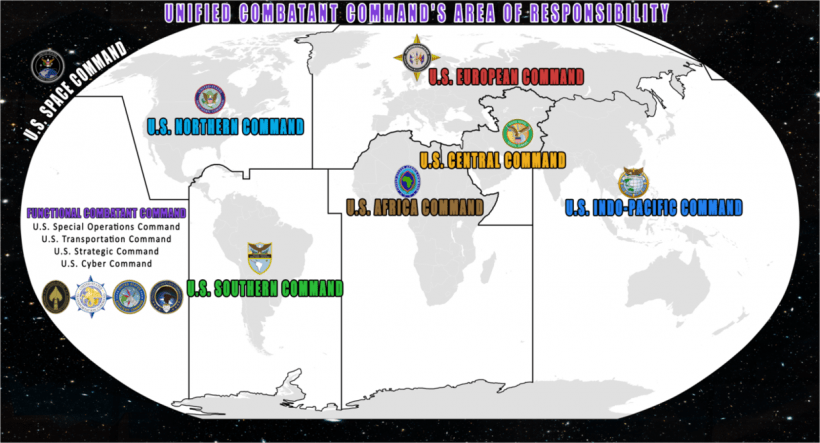
AFRICOM is one of the US combatant commands that span the entire planet, as well as space now © Wikipedia
Tasked with going after terrorist groups like Boko Haram, Al-Shabaab and Islamic State (IS, formerly ISIS), AFRICOM has recently focused its efforts on using friendly journalists, media leak and bombastic social media statements to bypass its military and civilian superiors and lobby in Washington for more power, influence and money.
“Once is happenstance. Twice is coincidence. Three times is enemy action,” goes a quote attributed to James Bond author Ian Fleming. So it was definitely noticeable when AFRICOM made a third bid to attract attention in under a month.
On Wednesday, the left-progressive magazine Nation published an exclusive story based on an AFRICOM document showing that the command was worried about President Donald Trump freezing US funding for the World Health Organization and how China might exploit that for expanding its influence in Africa. Journalist Ken Klippenstein says the document, dated April 23, was leaked to him.
The leak came only a day after AFRICOM posted a series of tweets accusing Russia of sending fighter jets to Libya. One of them quoted its commander, General Charles Townsend, saying that they “watched as Russia flew fourth generation jet fighters to Libya – every step of the way.”
Except no proof of this was actually offered, and AFRICOM’s statement qualified the claim with weasel-words such as “assessed” and “likely.” Russian officials have dismissed the claim as ridiculous, especially the part about supposedly camouflaging the fighters’ origins by giving them a fresh paint job in Syria.
AFRICOM has been very sore about Moscow’s alleged military presence in Libya – where its own troops withdrew from in March 2019, per Trump’s orders – claiming that Russia is “destabilizing” Libya and making worse the “migration crisis affecting Europe.” In Tuesday’s statement, it accused Russia of not being “interested in what is best for the Libyan people” but “working to achieve their own strategic goals instead.”
That’s a bit rich, considering that it was the US and its NATO allies that carried out the 2011 regime-change intervention, turning Libya from the most prosperous country in Africa into a hellhole infested with warlords, terrorists and slavers ever since.
While leaking to The Nation appealed to the American left, AFRICOM has previously reached out to the right as well. Back in April, the command used a friendly reporter at the conservative Washington Examiner to claim that the (alleged) Russian presence in Libya is “more dangerous than ISIS,” which actually operated in Libya at one point in time.
“We believe that there will be a need in the future, an opportunity for us to get back into Libya again,” the unnamed official was actually quoted as saying at one point, giving away the endgame.
Between bombastic tweets, anonymous insinuations to friendly conservative reporters and leaks to liberal ones, the picture that emerges is of AFRICOM waging a psychological operation (psyop), a propaganda war on the US public bypassing the Joint Chiefs, the Pentagon and even the commander in chief himself to lobby for a bigger piece of the military pie.
This may seem far-fetched, but it isn’t strictly speaking without precedent. Some might remember General Phillip ‘Bwana’ Breedlove, who headed the European Command until May 2016. Emails from his personal account – published in July 2016, following his retirement from the US military – revealed months of effort to lobby the Pentagon and the White House to give EUCOM more attention, including spinning tall tales about a “Russian invasion” of Ukraine. The emails also revealed how Washington-based lobbyists identified the right way of approaching certain officials and the best channels for influencing the Obama administration when it came to Ukraine – notably, Vice President Joe Biden.
At one point, Breedlove even accused Moscow of “weaponizing migration in an attempt to overwhelm European structures and break European resolve” – just as AFRICOM is doing now.
All of which raises the question: when did combatant commands – an organization system invented during WWII to streamline command, control and communication between various branches of the military – morph into de facto feudal fiefdoms, with their commanders as barons more focused on currying favor in Washington than doing their actual job in the field?
In AFRICOM’s case, that job literally involves hunting down terrorists – or helping locals do so themselves, since the command is headquartered in Germany and has only a few actual bases in Africa. Not that any of that is going well at all. So AFRICOM shifted its focus on the home front instead.
One possible explanation may be money. Back in February, a rumor began spreading around Washington that the Trump administration was considering “zeroing out” AFRICOM’s budget. Both the rumor itself and the reported reactions to it have been hotly denied, but that might just help shed some light on Townsend’s gambit. As with any bureaucracy, survival is the highest priority.
Nebojsa Malic is a Serbian-American journalist, blogger and translator, who wrote a regular column for Antiwar.com from 2000 to 2015, and is now senior writer at RT. Follow him on Twitter @NebojsaMalic
Russian Embassy Denounces US Grant Designed to Find External Enemy for Pandemic Failings
Sputnik -May 22, 2020
WASHINGTON – Russia’s Embassy in the United States denounced a US State Department grant that offers $250,000 for manufacturing health disinformation allegations in order to blame a foreign enemy for Washington’s own shortfalls.
“Such grants reveal the true mood, thoughts and way of thinking of partners from the State Department. Even during the most difficult global epidemic, when we, both Russia and the United States, lose thousands of citizens and should stand together, efforts are aimed at finding an external enemy. He is supposed to be blamed – entirely or partially – for own deficiencies,” the Embassy wrote on Facebook on Friday.
It said there are “influential Russophobic forces in Washington” who never stop their destructive activities, ignoring opposite signals that come from US President Donald Trump.
According to the tender, announced by the State Department’s Bureau of Global Public Affairs, the funds will be granted to an organization with relevant experience “to produce a report on Russian and Soviet health-related disinformation campaigns.”
The Embassy said that it’s already possible to predict that the investigation will target RT TV network and Sputnik news agency.
Featured Video

Trita Parsi: Middle East Unraveling — Are We on the Path to World War?
or go to
Aletho News Archives – Video-Images
New Book
Trans agenda is ‘normalization of sadism’ – US author

RT | September 23, 2026
The US Democratic Party has embraced a transgender agenda that amounts to “the normalization of sadism,” author A.J. Rice has said, warning that radical trans policies would return if the party is allowed to regain power.
Speaking to RT’s America First host Scotty Nell Hughes about his new book, ‘The Curse of the Bearded Lady: How the Trans Mafia Whacked American Sanity’, Rice argued that activists have gained significant influence in schools, medicine, and corporate America while people who questioned the agenda have faced pressure to stay silent.
The author described the “trans mafia” as the sprawling network of people and institutions that have helped the movement gain influence. He singled out parts of academia, wealthy backers, and corporations, and stated that providers of transition-related treatment also have a financial incentive to keep young people in their care indefinitely.
Rice argued that the consequences of these policies ultimately fall on children who are being drawn toward gender-affirming medical treatments and on girls who are expected to share locker rooms or compete in sports with biological males.
He noted that while voters rejected the Democrats’ approach to gender in 2024, the party, which has been “captured by madness,” has since only doubled down and is seeking what is effectively “the normalization of sadism.” … Full report
Blog Roll
 Aletho News
- Integrity Initiative: UK-funded network framed dissent as Russian disinformation for years
- ‘We don’t seek permission to defend our country’: Snippets from President Pezeshkian’s UNGA address
- NATO chief wants Europeans to fight American wars [for Israel]
- German chemicals giant reveals details of downsizing
- Refaat Al-Areer Was The Canary In The Coal Mine In Israel’s War On The Truth
- Israeli election committee bars candidate from Knesset race over Gaza war opposition
- French-Lebanese man files war crimes complaint over Israeli attacks
- Mahan Air Flight Lands in China Despite US Threat against Iranian Airlines
- US eyes $10bn fund to rebuild war-battered Gulf infrastructure
- Trump meets Rodríguez near Maduro’s prison as Venezuela’s oil flows to US
- If Americans Knew
- Caught on Tape: AIPAC CEO Boasted of Controlling Trump’s National Security Officials
- Why Hamas Attacked Israel in October 2023 – Israeli professor Ilan Pappé
- They see them, then kill them: Israeli quadcopters track, deliberately target civilians in Gaza
- Winter could turn Gaza’s treacherous, war-damaged buildings into deathtraps
- Majority of Democratic Voters Want to Prosecute Both Biden and Trump Administration Officials Over Gaza
- As Gaza languishes, world leaders gather at the UN – Daily Update
- Sanctions are collective punishment: immoral and self-defeating
- Phosphorus Munitions Fired by Israel Burn Groves, Orchards in Southern Lebanon
- Israel Carries Out New Ceasefire Violations Across Gaza
- AI – Emphasis on the ‘I’: Israel Is Funding AI Chatbot Propaganda
- No Tricks Zone
- New Study: Earth And Venus Surface Warmth Largely Explained By Convection And Lapse Rate, Not CO2 Or Radiation
- 2025 Nature Paper Claiming Worsening Global Drought Gets RETRACTED …Heavily Flawed
- New Study: ‘Global Drought Shows No Detectable Recent Acceleration Under Climate Warming’
- Economic Masterminds: German Socialists Suggest Taxing Productivity Gains Stemming From Using AI
- The South China Sea Has Not Been Cooperating With The Climate Change Narrative
- Energy Crisis: Germany Enters Heating Season With Historically Low Gas Reserve Fill Levels
- New Study: The Antarctic Ice Sheet Gained Mass From 2020-2024 Due To Staggering Snow And Ice Accumulation
- Study: Ocean Heating Rates From Thousands Of Years Ago ‘Dwarf’ Modern Ocean Heating Rates
- Climate Extremists Target, Attack Large-Scale Power Grid Infrastructure In Germany!
- New Study: Antarctic Ice Melt Has Contributed Less Than 1 Centimeter To Sea Level Rise In The Last 30 Years

