‘Russian bounty’ story shifts: NYT now claims Afghan CRIMINALS & not Taliban were paid, cites anonymous sources again
RT | June 30, 2020
The New York Times is doubling down on claims that Russia offered bounties for the killing of US troops in Afghanistan, but now says local criminals and not the Taliban were the recipients, again offering no actual evidence.
The new article, published Tuesday, says that “electronic data showing large financial transfers from a bank account controlled by Russia’s military intelligence agency to a Taliban-linked account” was intercepted by US spies and “bolsters suspicions” that Russia offered bounties to militants – as claimed by the Times last week.
Once again, the Times quotes anonymous sources – “three officials familiar with the intelligence” – so the claim is impossible to verify. No evidence of the alleged electronic transfer is provided, only a third-hand hearsay that “analysts concluded from other intelligence that the transfers were most likely part of a bounty program.”
The article eventually gets around to quoting several local officials from Afghanistan, who say that several people who transfer money through an Islamic banking system are “suspected of being part of a ring of middlemen” between Russia and “Taliban-linked militants.”
The ‘hawala’ banking system does not actually use electronic transfers. Moreover, the article says the Afghan security forces found “a half-million dollars” – presumably in cash – in one Kabul home about six months ago. Safiullah Amiry, described as “the deputy provincial council chief” in Kunduz, “said the Afghan intelligence agency had told him the raids were related to Russian money being dispersed [sic] to militants.”
In the original article, the Times claimed President Donald Trump had been briefed on this alleged plot sometime in March. The White House, the CIA and the Office of the Director of National Intelligence have since denied this.
So the narrative has now shifted, with the Times citing “two officials” who say the information was included in Trump’s written presidential daily brief (PDB) “in late February,” accompanied by the – likewise unverified – claim that Trump typically doesn’t read those. The article also claims the CIA mentioned the intelligence in its World Intelligence Review newsletter, also known as The Wire, dated May 4.
The identity of the suspected recipients of the “Russian bounties” has shifted as well, from the Taliban to “criminals closely associated with the Taliban” – according to yet another anonymous US official.
Most mainstream US media outlets and the Democrats have taken the original New York Times reporting at face value, denouncing Trump as “Putin’s puppet” and a traitor for allegedly not doing anything to “punish Russia” based on the purported intelligence assessments, rather than demanding to see evidence there was anything to it.
Fake story on Russians paying Afghans ‘bounty’ to kill Americans latest example of appalling media coverage of Russia
By Bryan MacDonald | RT | June 29, 2020
The Anglo-American press is difficult to understand. Anonymous sources are treated as gospel – when they suit the ideological and political biases of news outlets – and spy agencies seem to be beyond reproach.
This, of course, is how America and Britain were drawn into the Iraq War. Mainstream media was complicit in manufacturing consent by publishing stories handed down by intelligence agencies – a great many of them later proven untrue. Perhaps most notably, the New York Times went big on the bogus “weapons of mass destruction” yarn.
After the damage was done, and hundreds of thousands of Iraqis had died, the paper apologized. It admitted it was encouraged to report the claims by “United States officials convinced of the need to intervene in Iraq.”
Almost two decades on, it has plainly learned nothing. This weekend the Times had three of its most senior journalists basically rewrite a CIA press release as part of its latest attempt to undermine President Donald Trump by playing the “Russia card.” Quite why it took so many of them is hard to understand – unless none wanted to be the sole name on the piece, preferring safety in numbers.
The story claimed that Russia is paying Afghan militants to kill American soldiers and that Trump’s team has known for months but done nothing. The US director of national intelligence quickly denied the allegations, as did the president himself. It surely wasn’t coincidental that the drop took place in the same weekend that reports emerged of Trump planning to withdraw 4,000 troops from Afghanistan.
If you know anything about Russia, the story is obviously false. The Americans are totally bogged down in Kabul, which suits Moscow in myriad ways. In fact, the Kremlin would be only delighted if the US stayed there forever. What’s more, the Taliban hardly needs a financial incentive to attack a hated occupying force. So why would Moscow need to be handing out bounties to encourage people who already have it in for Americans?
Another interesting detail was the New York Times’ assertion that its allegations are “based at least in part on interrogations of captured Afghan militants and criminals.” Given we know the US uses torture in Afghanistan that should be an immediate red-flag to any self-respecting journalist. Not to mention the fact that even if Afghan prisoners did say this, it’s likely no more than prison gossip: “Daud told Nadir that Hashem heard the Russians will pay you for killing an American.”
The Times trio even threw in a bit of casual xenophobia. “I think we had forgotten how organically ruthless the Russians could be,” they quoted Peter Zwack, a retired military intelligence officer, as saying. Imagine a report saying Asians, Africans, Mexicans or Jews are “organically ruthless.” That’s right, you can’t, because it wouldn’t happen. But Russians, being predominantly white and Christian, are considered to be fair game.
Soon after, the Washington Post said it had ‘confirmed’ the Times’ story. All this means is they were fed the same bulls**t by the same anonymous spooks. Even more hilariously, the paper managed to get a named Taliban spokesman to go on the record with his denial, while it allowed the Americans who pushed the yarn to remain in the shadows. Nevertheless, which narrative do you think was given more credence?
This carry-on is deeply unethical. Especially given it comes just a couple of months after US/UK media went big on another fake story alleging Russia was trying to poison Czech politicians with ricin. Prague eventually admitted the tale was entirely made up. This confession, of course, received about one percent of the coverage granted to the original fabrication.
Predictably, broadcast media followed up on the Times and Post’s reports. Rachel Maddow was front and center, naturally. You’ll remember she spent a few years airing false and hysterical smears about Trump’s alleged ties to Moscow and suffered no professional consequences when the Mueller Report proved her allegations to be untrue.
But it wasn’t just Maddow. On Saturday, CNN ran “breaking news” saying it had found “a European intelligence official” to corroborate the tale. It then cut to its own correspondent, one Nick Paton Walsh. He provided no named source and his comments basically amounted to “some fella told me down the pub” stuff. Honestly, in any sane media culture, Paton Walsh would be laughed at, not encouraged.
For example, at one point he said “it’s not clear when this happened” and then added, “it’s clear it has caused casualties.” But instead of asking “how is it possible to know that if you can’t say when it happened?” the anchor just sat there nodding along with that vacuous look in her eyes which seems to be mandatory for CNN presenters.
Later, Britain’s Sky News ran the same yarn, but said “British security officials have confirmed… that the reports about the plot are true.” Presumably, Sky was spoon-fed by the same spooks who exploited Paton Walsh as a ‘useful idiot’. Later, the Guardian’s Stephanie Kirchgaessner tweeted “this confirmation by closest intel allies is critical and damning: Russia paid Taliban fighters to attack British troops in Afghanistan.”
Again, the reporter expressed no doubts, because apparently the word of spooks is golden, and they would never lie.
It’s established that mainstream US/UK media operates in a self-contained pit of rumor, fear, braggadocio, bullshit, and propaganda when it comes to Russia. But what’s most bizarre is the sheer obviousness with which outlets circulate the same false stories and then use each other as corroborating sources even though they are all getting the information from the same people.
Folk who obviously have their own agendas, and are playing gormless hacks like a fiddle. The other incredible thing is a clear lack of understanding about what ‘confirmation’ even means. It obviously requires tangible evidence, on the record.
The New York Times’ coverage of Russia basically only has two tricks. They either rip-off articles from smaller Russian liberal outlets (who often can’t complain too loudly as they rely on Western funding) or they regurgitate anonymous sources in the US military-intelligence establishment looking to run scare stories about the country. None of this involves any reporting, and it cannot be considered journalism under any accepted definition of what the trade involves.
Given the New York Times is arguably the biggest, and most visible, fish in the US/UK media world, you can only imagine the even lower standards that permeate further down the food chain.
Russiagate’s Last Gasp
One can read this most recent flurry of Russia, Russia, Russia paid the Taliban to kill GIs as an attempt to pre-empt the findings into Russiagate’s origins.
By Ray McGovern | Consortium News | June 29, 2020
On Friday The New York Times featured a report based on anonymous intelligence officials that the Russians were paying bounties to have U.S. troops killed in Afghanistan with President Donald Trump refusing to do anything about it. The flurry of Establishment media reporting that ensued provides further proof, if such were needed, that the erstwhile “paper of record” has earned a new moniker — Gray Lady of easy virtue.
Over the weekend, the Times’ dubious allegations grabbed headlines across all media that are likely to remain indelible in the minds of credulous Americans — which seems to have been the main objective. To keep the pot boiling this morning, The New York Times’ David Leonhardt’s daily web piece, “The Morning” calls prominent attention to a banal article by a Heather Cox Richardson, described as a historian at Boston College, adding specific charges to the general indictment of Trump by showing “how the Trump administration has continued to treat Russia favorably.” The following is from Richardson’s newsletter on Friday:
— “On April 1 a Russian plane brought ventilators and other medical supplies to the United States … a propaganda coup for Russia;
— “On April 25 Trump raised eyebrows by issuing a joint statement with Russian President Vladimir Putin commemorating the 75th anniversary of the historic meeting between American and Soviet troops on the bridge of the Elbe River in Germany that signaled the final defeat of the Nazis;
— “On May 3, Trump called Putin and talked for an hour and a half, a discussion Trump called ‘very positive’;
— “On May 21, the U.S. sent a humanitarian aid package worth $5.6 million to Moscow to help fight coronavirus there. The shipment included 50 ventilators, with another 150 promised for the next week; …
— “On June 15, news broke that Trump has ordered the removal of 9,500 troops from Germany, where they support NATO against Russian aggression. …”
Historian Richardson added:
“All of these friendly overtures to Russia were alarming enough when all we knew was that Russia attacked the 2016 U.S. election and is doing so again in 2020. But it is far worse that those overtures took place when the administration knew that Russia had actively targeted American soldiers. … this bad news apparently prompted worried intelligence officials to give up their hope that the administration would respond to the crisis, and instead to leak the story to two major newspapers.”
Hear the siren? Children, get under your desks!
The Tall Tale About Russia Paying for Dead U.S. Troops
Times print edition readers had to wait until this morning to learn of Trump’s statement last night that he was not briefed on the cockamamie tale about bounties for killing, since it was, well, cockamamie.
Late last night the president tweeted: “Intel just reported to me that they did not find this info credible, and therefore did not report it to me or the VP. …”
For those of us distrustful of the Times — with good reason — on such neuralgic issues, the bounty story had already fallen of its own weight. As Scott Ritter pointed out yesterday:
“Perhaps the biggest clue concerning the fragility of the New York Times’ report is contained in the one sentence it provides about sourcing — “The intelligence assessment is said to be based at least in part on interrogations of captured Afghan militants and criminals.” That sentence contains almost everything one needs to know about the intelligence in question, including the fact that the source of the information is most likely the Afghan government as reported through CIA channels. …”
And who can forget how “successful” interrogators can be in getting desired answers.
Russia & Taliban React
The Kremlin called the Times reporting “nonsense … an unsophisticated plant,” and from Russia’s perspective the allegations make little sense; Moscow will see them for what they are — attempts to show that Trump is too “accommodating” to Russia.
A Taliban spokesman called the story “baseless,” adding with apparent pride that “we” have done “target killings” for years “on our own resources.”
Russia is no friend of the Taliban. At the same time, it has been clear for several years that the U.S. would have to pull its troops out of Afghanistan. Think back five decades and recall how circumspect the Soviets were in Vietnam. Giving rhetorical support to a fraternal Communist nation was de rigueur and some surface-to-air missiles gave some substance to that support.
But Moscow recognized from the start that Washington was embarked on a fool’s errand in Vietnam. There would be no percentage in getting directly involved. And so, the Soviets sat back and watched smugly as the Vietnamese Communists drove U.S. forces out on their “own resources.” As was the case with the Viet Cong, the Taliban needs no bounty inducements from abroad.
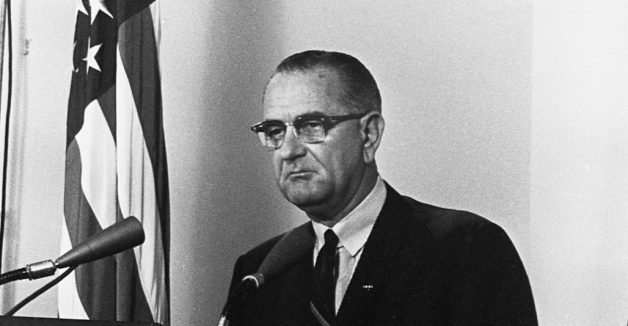
President Lyndon Johnson announces “retaliatory” strike against North Vietnam in response to the supposed attacks on U.S. warships in the Gulf of Tonkin on Aug. 4, 1964. (LBJ Library)
Besides, the Russians knew painfully well — from their own bitter experience in Afghanistan, what the outcome of the most recent fool’s errand would be for the U.S. What point would they see in doing what The New York Times and other Establishment media are breathlessly accusing them of?
CIA Disinformation; Casey at Bat
Former CIA Director William Casey said: “We’ll know when our disinformation program is complete, when everything the American public believes is false.”
Casey made that remark at the first cabinet meeting in the White House under President Ronald Reagan in early 1981, according to Barbara Honegger, who was assistant to the chief domestic policy adviser. Honegger was there, took notes, and told then Senior White House correspondent Sarah McClendon, who in turn made it public.
If Casey’s spirit is somehow observing the success of the disinformation program called Russiagate, one can imagine how proud he must be. But sustained propaganda success can be a serious challenge. The Russiagate canard has lasted three and a half years. This last gasp effort, spearheaded by the Times, to breathe more life into it is likely to last little more than a weekend — the redoubled efforts of Casey-dictum followers notwithstanding.
Russiagate itself has been unraveling, although one would hardly know it from the Establishment media. No collusion between the Trump campaign and Russia. Even the sacrosanct tenet that the Russians hacked the DNC emails published by WikiLeaks has been disproven, with the head of the DNC-hired cyber security firm CrowdStrike admitting that there is no evidence that the DNC emails were hacked — by Russia or anyone else.
How long will it take the Times to catch up with the CrowdStrike story, available since May 7?
The media is left with one sacred cow: the misnomered “Intelligence Community” Assessment of Jan. 6, 2017, claiming that President Putin himself ordered the hacking of the DNC. That “assessment” done by “hand-picked analysts” from only CIA, FBI and NSA (not all 17 intelligence agencies of the “intelligence community”) reportedly is being given close scrutiny by U. S. Attorney John Durham, appointed by the attorney general to investigate Russiagate’s origins.
If Durham finds it fraudulent (not a difficult task), the heads of senior intelligence and law enforcement officials may roll. That would also mean a still deeper dent in the credibility of Establishment media that are only too eager to drink the Kool Aid and to leave plenty to drink for the rest of us.
Do not expect the media to cease and desist, simply because Trump had a good squelch for them last night — namely, the “intelligence” on the “bounties” was not deemed good enough to present to the president.
(As a preparer and briefer of The President’s Daily Brief to Presidents Reagan and HW Bush, I can attest to the fact that — based on what has been revealed so far — the Russian bounty story falls far short of the PDB threshold.)
Rejecting Intelligence Assessments
Nevertheless, the corporate media is likely to play up the Trump administration’s rejection of what the media is calling the “intelligence assessment” about Russia offering — as Rachel Maddow indecorously put it on Friday — “bounty for the scalps of American soldiers in Afghanistan.”
I am not a regular Maddow-watcher, but to me she seemed unhinged — actually, well over the top.
The media asks, “Why does Trump continue to disrespect the assessments of the intelligence community?” There he goes again — not believing our “intelligence community; siding, rather, with Putin.”
In other words, we can expect no let up from the media and the national security miscreant leakers who have served as their life’s blood. As for the anchors and pundits, their level of sophistication was reflected yesterday in the sage surmise of Face the Nation’s Chuck Todd, who Aaron Mate reminds us, is a “grown adult and professional media person.” Todd asked guest John Bolton: “Do you think that the president is afraid to make Putin mad because maybe Putin did help him win the election, and he doesn’t want to make him mad for 2020?”
“This is as bad as it gets,” said House Speaker Nancy Pelosi yesterday, adding the aphorism she memorized several months ago: “All roads lead to Putin.” The unconscionably deceitful performance of Establishment media is as bad as it gets, though that, of course, was not what Pelosi meant. She apparently lifted a line right out of the Times about how Trump is too “accommodating” toward Russia.
One can read this most recent flurry of Russia, Russia, Russia as a reflection of the need to pre-empt the findings likely to issue from Durham and Attorney General William Barr in the coming months — on the theory that the best defense is a pre-emptive offense. Meanwhile, we can expect the corporate media to continue to disgrace itself.
Vile
Caitlin Johnstone, typically, pulls no punches regarding the Russian bounty travesty:
“All parties involved in spreading this malignant psyop are absolutely vile, but a special disdain should be reserved for the media class who have been entrusted by the public with the essential task of creating an informed populace and holding power to account. How much of an unprincipled whore do you have to be to call yourself a journalist and uncritically parrot the completely unsubstantiated assertions of spooks while protecting their anonymity? How much work did these empire fluffers put into killing off every last shred of their dignity? It boggles the mind.
It really is funny how the most influential news outlets in the Western world will uncritically parrot whatever they’re told to say by the most powerful and depraved intelligence agencies on the planet, and then turn around and tell you without a hint of self-awareness that Russia and China are bad because they have state media.
Sometimes all you can do is laugh.”
Ray McGovern works for Tell the Word, a publishing arm of the ecumenical Church of the Saviour in inner-city Washington. During his 27-years as a CIA analyst he led the Soviet Foreign Policy Branch and prepared The President’s Daily Brief for Presidents Nixon, Ford, and Reagan. In retirement, he co-created Veteran Intelligence Professionals for Sanity (VIPS).
Senator Schumer calls for ‘tough sanctions’ against Moscow amid new wave of anti-Russian hysteria… again
RT | June 28, 2020
The US Senate minority leader, Democrat Chuck Schumer, seemingly got on his hobby-horse once more as he demanded new sanctions against Moscow amid reports about Russian agents putting ‘bounties’ on US troops in Afghanistan.
“We need, in this coming defense bill, which we are debating this week, tough sanctions against Russia,” Schumer told journalists while emphatically gesturing to apparently add more weight to his point.
The reason for the “tough sanctions” is a report by The New York Times that cites some “interrogations of captured Afghan militants and criminals” and accuses the Russian military intelligence, the GRU, of literally offering bounties to the Taliban for every American soldier killed in Afghanistan.
The report was dismissed by both Russia and the Taliban, which denied any such bounties ever being offered. Even the Director of the US National Intelligence, John Ratcliffe, came out to say that neither President Donal Trump nor Vice President Mike Pence were ever briefed on anything like this. These facts, however, left The New York Times undeterred as the paper followed up with another piece on the issue, this time citing some “officials briefed on the matter.”
Schumer, however, admitted that he does not really know anything about the situation since he “was not briefed on the Russian military intelligence,” unlike The New York Times’ mysterious sources. That did not stop him, however, from claiming that this supposedly real data “shows” new sanctions against Moscow are desperately needed.
In fact, calling for sanctions against Russia has been the senator’s favorite pastime for quite some time now. Since the start of this year, he has managed to demand new restrictions against Moscow twice – in February and March. He has also sought to press the EU into imposing some as well.
NYT takes anti-Russian hysteria to new level with report on Russian ‘bounty’ for US troops
By Scott Ritter | RT | June 28, 2020
The New York Times published an article claiming that Russia was paying out monetary bounties to the Taliban to kill US troops in Afghanistan. There’s just one problem — none of what they reported was true.
As news reporting goes, the New York Times article alleging that a top-secret unit within Russian military intelligence, or GRU, had offered a bounty to the Taliban for every US soldier killed in Afghanistan, was dynamite. The story was quickly “confirmed” by the Washington Post, the Wall Street Journal and other newspapers, and went on to take social media by storm. Twitter was on fire with angry pundits, former officials, and anti-Trump politicians (and their respective armies of followers) denouncing President Trump as a “traitor” and demanding immediate action against Russia.
There was just one problem — nothing in the New York Times could be corroborated. Indeed, there is no difference between the original reporting conducted by the New York Times, and the “confirming” reports published by the Washington Post and the Wall Street Journal. All of the reports contain caveats such as “if confirmed” and “if true,” while providing no analysis into the potential veracity of the information used to sustain the report — alleged debriefs of Afghan criminals and militants — or the underpinning logic, or lack thereof, of the information itself.
For its part, the Russian government has vociferously denied the allegations, noting that the report “clearly demonstrates low intellectual abilities of US intelligence propagandists who have to invent such nonsense instead of devising something more credible.” The Taliban have likewise denied receiving any bounties from the Russians for targeting American soldiers, noting that with the current peace deal, “their lives are secure and we don’t attack them.”
Even more telling is the fact that the current Director of National Intelligence John Ratcliffe has come out to contradict a key element of the New York Times’ report—that the president was briefed on the intelligence in question. “I have confirmed that neither the president nor the vice president were ever briefed on any intelligence alleged by the New York Times in its reporting yesterday,” Ratcliffe said in a statement. “The New York Times reporting, and all other subsequent news reports about such an alleged briefing are inaccurate.”
And one more tiny problem: Trump confirmed there was no such briefing, too.
Perhaps the biggest clue concerning the fragility of the New York Times’ report is contained in the one sentence it provides about sourcing — “The intelligence assessment is said to be based at least in part on interrogations of captured Afghan militants and criminals.” That sentence contains almost everything one needs to know about the intelligence in question, including the fact that the source of the information is most likely the Afghan government as reported through CIA channels.
There was a time when the US military handled the bulk of detainee debriefings in Afghanistan. This changed in 2014, with the signing of the Bilateral Security Agreement. This agreement prohibits the US military from arresting or detaining Afghans, or to operate detention facilities in Afghanistan. As a result, the ability of the US military to interface with detainees has been virtually eliminated, making the Pentagon an unlikely source of the information used by the New York Times in its reporting.
The CIA, however, was not covered by this agreement. Indeed, the CIA, through its extensive relationship with the National Directorate of Security (NDS), is uniquely positioned to interface with the NDS through every phase of detainee operations, from initial capture to systemic debriefing.
Like any bureaucracy, the CIA is a creature of habit. Henry ‘Hank’ Crumpton, who in the aftermath of 9/11 headed up the CIA’s operations in Afghanistan, wrote that
“[t]he Directorate of Operations (DO) should not be in the business of running prisons or temporary detention facilities. The DO should focus on its core mission: clandestine intelligence operations. Accordingly, the DO should continue to hunt, capture, and render targets, and then exploit them for intelligence and ops leads once in custody. The management of their incarceration and interrogation, however, should be conducted by appropriately experienced US law enforcement officers because that is their charter and they have the training and experience.”
After 2014, the term “US law enforcement officers” is effectively replaced by “Afghan intelligence officers”— the NDS. But the CIA mission remained the same — to exploit captives for intelligence and operational leads.
The Trump administration has lobbied for an expanded mission for the CIA-backed NDS and other militia forces to serve as a counterterrorism force that would keep Islamic State (IS, formerly ISIS) and Al-Qaeda from gaining a foothold in Afghanistan once US and foreign troops completed their planned withdrawal in 2021. But the CIA has raised objections to such a plan, noting that the NDS and other CIA-controlled assets were completely dependent upon US military air power and other combat service support resources, and that any attempt to expand the CIA’s covert army in Afghanistan following a US military withdrawal would end in disaster. Having the NDS fabricate or exaggerate detainee reports to keep the US engaged in Afghanistan is not beyond the pale.
Which brings up the issue of Russian involvement. In September 2015, the Taliban captured the northern Afghan city of Konduz, and held it for 15 days. This sent a shockwave throughout Russia, prompting Moscow to reconsider its approach toward dealing with the Afghan insurgency. Russia began reaching out to the Taliban, engaging in talks designed to bring the conflict in Afghanistan to an end. Russia was driven by other interests as well. According to Zamir Kabulov, President Vladimir Putin’s special representative for Afghanistan, “the Taliban interest objectively coincides with ours” in the fight against Islamic State, which in the summer of 2014 had captured huge tracts of land in Syria and Iraq, including the city of Mosul, Iraq’s second largest.
By 2017, Afghan and US intelligence services had assembled a narrative of Russian assistance to the Taliban which included the provision of advanced weaponry, training, and financial support. While Russia denied providing any direct military support to the Taliban, it maintained that the Taliban were the best way to deal with the growing threat of Islamic State. But even if the US reports were correct, and Russia was angling for a Taliban victory in Afghanistan, the last policy Russia would logically pursue would be one that had the US remain in Afghanistan, especially after pushing so hard for a negotiated peace. Russia’s interests in Afghanistan were — and are — best served by Afghan stability, the antithesis of the Afghan reality while the US and NATO remain engaged. Getting the US out of Afghanistan — not keeping the US in Afghanistan — is the Russian position, and any CIA officer worth his or her salt knows this.
It does not take a rocket scientist to read between the lines of the New York Times’ thinly sourced report. The NDS, with or without CIA knowledge or consent, generated detainee-based intelligence reports designed to create and sustain a narrative that would be supportive of US military forces remaining in Afghanistan past 2021. The CIA case officer(s) handling these reports dutifully submit cables back to CIA Headquarters which provide the gist of the allegations — that Russia has placed a bounty on US soldiers. But there is no corroboration, nothing that would allow this raw “intelligence” to be turned into a product worthy of the name.
This doesn’t mean that someone in the bowels of the CIA with an axe to grind against Trump’s plans to withdraw from Afghanistan, or who was opposed to Trump’s efforts to normalize relations with Russia, didn’t try to breathe life into these detainee reports. Indeed, a finished “product” may have made its way to the National Security Council staff — and elsewhere — where it would have been given the treatment it deserved, quickly discarded as unsubstantiated rumor unworthy of presidential attention.
At this point in time, frustrated by the inattention the “system” gave to the “intelligence,” some anonymous official contacted the New York Times and leaked the information, spinning it in as nefarious a way as possible. The New York Times blended the detainee reports and its own previous reporting on the GRU to produce a completely fabricated tale of Russian malfeasance designed to denigrate President Trump in the midst of a hotly contested reelection bid.
Too far-fetched? This assessment is far more fleshed out with fact and logic than anything the New York Times or its mainstream media mimics have proffered. And lest one thinks the GrayLady is above manufacturing news to sustain support for a war, the name Judith Miller, and the topic of Iraqi weapons of mass destruction, should put that to rest. The reporting by the New York Times alleging the existence of a Russian bounty on the lives of US troops in Afghanistan is cut from the same piece of cloth as its pre-war Iraq drivel. As was the case with Iraq, the chattering class is pushing these new lies on an American audience pre-programmed to accept at face value any negative reporting on Russia. This is the state of what passes for journalism in America today, and it’s not a pretty sight.
Scott Ritter is a former US Marine Corps intelligence officer. He served in the Soviet Union as an inspector implementing the INF Treaty, in General Schwarzkopf’s staff during the Gulf War, and from 1991-1998 as a UN weapons inspector. Follow him on Twitter @RealScottRitter
Trump & Pence never briefed on ‘Russian bounties for Taliban’, NYT story ‘inaccurate’ – US intelligence chief
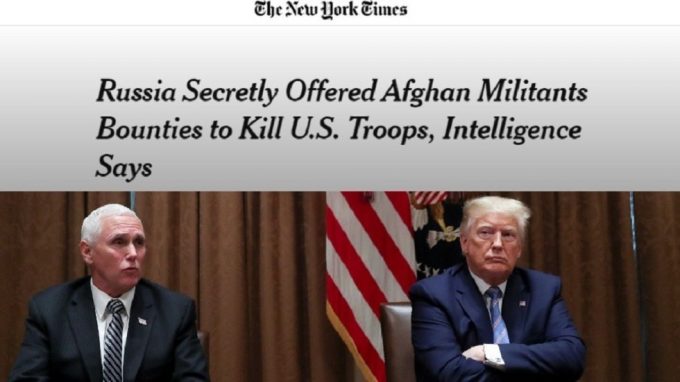
RT | June 28, 2020
The US director of national intelligence has distanced himself from a NYT report claiming Russia paid money to the Taliban for killing US soldiers in Afghanistan. He said the White House was never briefed on the matter.
The claim published by the New York Times is, like many such stories, based on anonymous intelligence sources. It says Russia paid “Taliban-linked militants” in Afghanistan to kill US military service members, and that President Donald Trump did nothing after learning about it.
The White House has denied that either Trump or Vice President Mike Pence were ever briefed on the alleged situation by US intelligence. Director of National Intelligence John Ratcliffe backed the denial and said the original story and “all other subsequent news reports about such an alleged briefing are inaccurate.”
The dynamic between the US mainstream media and the Trump administration in this case follows the same pattern seen in a previous bombshell report accusing the president of inaction in the face of a foreign threat.
In April, ABC News claimed Trump had been briefed about a military intelligence report which warned that a catastrophic outbreak of a viral disease was emerging from China. The National Center for Medical Intelligence (NCMI), the service which allegedly produced the report on what is now known the Covid-19 pandemic, denied ever writing such a document.
The Taliban bounties story was instantly picked up by the usual suspects of the #Resistance, who saw it as an opportunity to attack Trump from the right. MSNBC’s senior Russiagate peddler Rachel Maddow gushed that Vladimir Putin paid Taliban for American “scalps” and Trump knew it.
Trump-bashing vehicle the Lincoln Project has released an ad accusing the president of “standing by” Russian troops.
While the bounties twist, with its Wild West vibe, is a new one, attempts to paint Russia as being in cahoots with the Taliban are hardly unprecedented. For example, in 2017, some top US generals claimed that Moscow was running guns for the Afghan militant movement. But when the head of US defense intelligence was asked about it by lawmakers, he said no physical evidence “of weapons or money being transferred” was ever found.
Russia called the NYT story an “unsophisticated” piece of disinformation that calls into question the “intellectual abilities of the propagandists from US intelligence,” who couldn’t come up with something more plausible.
US House of Representatives Committee Proposes $3.8 Billion to Fund Anti-Russia Measures in 2021
Sputnik – June 27, 2020
WASHINGTON – The United States House of Representatives Armed Services Committee has proposed allocating $3.8 billion to fund anti-Russia measures in the 2021 fiscal year, according to the committee’s National Defence Authorization Act proposal.
“The proposal provides an additional $3.789 billion for strategic sealift, satellite communications, refueling, submarine, and antisubmarine warfare capabilities that enhance deterrence against Russia”, the document read.
Additionally, officials in Washington are pushing to limit any military cooperation between the US and Russia, although exceptions will be made for the purposes of building dialogue that will reduce the risk of conflict, according to the document.
The committee is also looking to fully fund the European Defence Initiative and provide $250 million to the Ukraine Security Assistance Initiative. One-fifth of these funds can be used to purchase lethal weapons, the committee said.
The proposal, which was tabled by Chairman Adam Smith, would authorize roughly $730 billion in spending for the purposes of national defence.
In December, President Donald Trump approved the 2020 National Defence Authorization Act, which had a topline budget of $738 billion.
Taliban Refute Reports on Russia’s Alleged Role in Killings of US Troops in Afghanistan
Sputnik – 27.06.2020
KABUL – Taliban spokesman Zabihullah Mujahid refuted on Saturday the recent reports citing US intelligence assessments alleging that Russian intelligence has solicited killings of US troops by the Taliban in Afghanistan, saying that these rumors are set to create obstacles to US pullout from the country.
According to Mujahid, all weapons and tools used by the movement were already present in the country or captured from the opposition. The spokesman stressed that the Taliban’s activities are not related to any intelligence organ or foreign country.
Mujahid stated that the Taliban was committed to the deal with the United States, saying that its implementation would ensure comprehensive peace and stability in Afghanistan.
On Friday, The New York Times published an article where it cited unnamed government sources as saying that US President Donald Trump was presented with an intelligence report that claimed that Moscow could have payed bounty to armed Islamic insurgents in Afghanistan to assassinate US soldiers. The outlet said Trump had so far failed to act on the report.
In February, the US and the Taliban signed a peace deal that concluded rounds upon rounds of talks pursuing to launch the reconciliation process in Afghanistan after almost two decades of armed conflict and insurgency.
Last week, US Special Representative for Afghanistan Zalmay Khalilzad said that intra-Afghan talks were closer than ever after Kabul and the Taliban carried out a significant exchange of prisoners.
‘Russiagate’ case against ex-Trump adviser Michael Flynn effectively OVER, as DC appeals court orders to close it
RT | June 24, 2020
An appeals court in Washington, DC, ruled that the case against President Trump’s one-time national security adviser, Michael Flynn, must end. The Justice Department had dropped charges against Flynn, but his case remained open.
In a ruling issued on Wednesday, the Washington DC Circuit Court of Appeals effectively ended the case against Flynn, ordering federal judge Emmet Sullivan to heed the Justice Department’s advice and close the case. Sullivan had attempted to keep the case active, even though the Justice Department dropped its charges against Flynn last month.
The appeals battle was a last-ditch showdown between Flynn and the Justice Department on one side, and Sullivan on the other. Though reporters as recently as last week reckoned the appeals court would side with Sullivan, they were proven wrong on Wednesday morning.
Of course, Sullivan may appeal again, but with the government and prosecution in agreement, his chances of breathing life into the Flynn case – ongoing for more than two years – is slim.
Appointed national security advisor following Trump’s election win in 2016, Flynn quickly became the first and most prominent White House official caught up in the FBI’s ‘Russiagate’ investigation. He was fired in early 2017 and later pleaded guilty to lying to FBI agents about his contacts with Russian Ambassador Sergey Kislyak.
However, the case was dropped last month, after it emerged that the charges against him were baseless.
Before he was interviewed by FBI agents in January 2017, FBI brass knew they had “no derogatory information” on the retired General, yet then-FBI Director James Comey ordered the interview to proceed regardless, breaching agency protocol. Disgraced FBI agent Peter Strzok urged his superiors to keep the case against Flynn open, and plotted with other agents to “get him to lie” during the interview. Furthermore, Strzok and former FBI lawyer Lisa Page edited the transcript of the interview to incriminate Flynn.
All of this information was revealed last month, when acting Director of National Intelligence Richard Grenell declassified a trove of ‘Russiagate’ documents. According to the document dump, a host of Obama administration officials dug into Flynn’s intelligence records as the FBI were attempting to entrap him in the interview.
President Trump, who has long accused the FBI and Obama administration of orchestrating a plot to take down his presidency, retweeted a call from his son last week for Flynn to “sue the FBI and it’s corrupt actors for all they’re worth.”
Victoria Nuland Alert
The foreign interventionists really hate Russia
By Philip Giraldi • Unz Review • June 23, 2020
It is difficult to find anything good to say about Donald Trump, but the reality is that he has not started any new wars, though he has come dangerously close in the cases of Venezuela and Iran and there would be considerable incentive in the next four months to begin something to bolster his “strong president” credentials and to serve as a distraction from coronavirus and black lives matter.
Be that as it may, Trump will have to run hard to catch up to the record set by his three predecessors Bill Clinton, George W. Bush and Barack Obama. Bush was an out-and-out neoconservative, or at least someone who was easily led, including in his administration Donald Rumsfeld, Richard Perle, Michael Ledeen, Reuel Gerecht, Paul Wolfowitz, Doug Feith, Eliot Abrams, Dan Senor and Scooter Libby. He also had the misfortune of having to endure Vice President Dick Cheney, who thought he was actually the man in charge. All were hawks who believed that the United States had the right to do whatever it considered necessary to enhance its own security, to include invading other countries, which led to Afghanistan and Iraq, where the U.S. still has forces stationed nearly twenty years later.
Clinton and Obama were so-called liberal interventionists who sought to export something called democracy to other countries in an attempt to make them more like Peoria. Clinton bombed Afghanistan and Sudan as a diversion when the press somehow caught wind of his arrangement with Monica Lewinsky and Obama, aided by Mrs. Clinton, chose to destroy Libya. Obama was also the first president to set up a regular Tuesday morning session to review a list of American citizens who would benefit from being killed by drone.
So the difference between neocons and liberal interventionists is one of style rather than substance. And, by either yardstick all-in-all, Trump looks pretty good, but there has nevertheless been a resurgence of neocon-think in his administration. The America the exceptional mindset is best exemplified currently by Secretary of State Mike Pompeo, who personifies the belief that the United States is empowered by God to play only by its own rules when dealing with other nations. That would include following the advice that has been attributed to leading neocon Michael Ledeen, “Every ten years or so, the United States needs to pick up some small crappy little country and throw it against the wall, just to show the world we mean business.”
One of the first families within the neocon/liberal interventionist firmament is the Kagans, Robert and Frederick. Frederick is a Senior Fellow at the neocon American Enterprise Institute and his wife Kimberly heads the bizarrely named Institute for the Study of War. Victoria Nuland, wife of Robert, is currently the Senior Counselor at the Albright Stonebridge Group and a Nonresident Senior Fellow at the Brookings Institution. That means that Victoria aligns primarily as a liberal interventionist, as does her husband, who is also at Brookings. She is regarded as a protégé of Hillary Clinton and currently works with former Secretary of State Madeleine Albright, who once declared that killing 500,000 Iraqi children using sanctions was “worth it.” Nuland also has significant neocon connections through her having been a member of the staff assembled by Dick Cheney.
Nuland, many will recall, was the driving force behind efforts to destabilize the Ukrainian government of President Viktor Yanukovych in 2013-2014. Yanukovych, an admittedly corrupt autocrat, nevertheless became Prime Minister after a free election. Nuland, who was the Assistant Secretary of State for European and Eurasian Affairs at the State Department, provided open support to the Maidan Square demonstrators opposed to Yanukovych’s government, to include media friendly appearances passing out cookies on the square to encourage the protesters.
Nuland openly sought regime change for Ukraine by brazenly supporting government opponents in spite of the fact that Washington and Kiev had ostensibly friendly relations. It is hard to imagine that any U.S. administration would tolerate a similar attempt by a foreign nation to interfere in U.S. domestic politics, particularly if it were backed by a $5 billion budget, but Washington has long believed in a global double standard for evaluating its own behavior.
Nuland is most famous for her foul language when referring to the potential European role in managing the unrest that she and the National Endowment for Democracy had helped create in Ukraine. For Nuland, the replacement of the government in Kiev was only the prelude to a sharp break and escalating conflict with the real enemy, Moscow, over Russia’s attempts to protect its own interests in Ukraine, most particularly in Crimea.
And make no mistake about Nuland’s broader intention at that time to expand the conflict and directly confront Russia. In Senate testimony she cited how the administration was “providing support to other frontline states like Moldova and Georgia.” Her use of the word “frontline” is suggestive.
Victoria Nuland was playing with fire. Russia, as the only nation with the military capability to destroy the U.S., was and is not a sideshow like Saddam Hussein’s Iraq or the Taliban’s Afghanistan. Backing Moscow into a corner with no way out by using threats and sanctions is not good policy. Washington has many excellent reasons to maintain a stable relationship with Moscow, including counter-terrorism efforts, and little to gain from moving in the opposite direction. Russia is not about to reconstitute the Warsaw Pact and there is no compelling reason to return to a Cold War footing by either arming Ukraine or permitting it to join the North Atlantic Treaty Organization (NATO).
Victoria Nuland has just written a long article for July/August issue of Foreign Affairs magazine on the proper way for the United States manage what she sees as the Russian “threat.” It is entitled “How a Confident America Should Deal With Russia.” Foreign Affairs, it should be observed, is an establishment house organ produced by the Council on Foreign Relations which provides a comfortable perch for both neocons and liberal interventionists.
Nuland’s view is that the United States lost confidence in its own “ability to change the game” against Vladimir Putin, who has been able to play “a weak hand well because the United States and its allies have let him, allowing Russia to violate arms control treaties, international law, the sovereignty of its neighbors, and the integrity of elections in the United States and Europe… Washington and its allies have forgotten the statecraft that won the Cold War and continued to yield results for many years after. That strategy required consistent U.S. leadership at the presidential level, unity with democratic allies and partners, and a shared resolve to deter and roll back dangerous behavior by the Kremlin. It also included incentives for Moscow to cooperate and, at times, direct appeals to the Russian people about the benefits of a better relationship. Yet that approach has fallen into disuse, even as Russia’s threat to the liberal world has grown.”
What Nuland writes would make perfect sense if one were to share her perception of Russia as a rogue state threatening the “liberal world.” She sees Russian rearmament under Putin as a threat even though it was dwarfed by the spending of NATO and the U.S. She shares her fear that Putin might seek “…reestablishing a Russian sphere of influence in eastern Europe and from vetoing the security arrangements of his neighbors. Here, a chasm soon opened between liberal democracies and the still very Soviet man leading Russia, especially on the subject of NATO enlargement. No matter how hard Washington and its allies tried to persuade Moscow that NATO was a purely defensive alliance that posed no threat to Russia, it continued to serve Putin’s agenda to see Europe in zero-sum terms.”
Nuland’s view of NATO enlargement is so wide of the mark that it borders on being a fantasy. Of course, Russia would consider a military alliance on its doorstep to be a threat, particularly as a U.S. Administration had provided assurances that expansion would not take place. She goes on to suggest utter nonsense, that Putin’s great fear over the NATO expansion derives from his having “…always understood that a belt of increasingly democratic, prosperous states around Russia would pose a direct challenge to his leadership model and risk re-infecting his own people with democratic aspirations.”
Nuland goes on and on in a similar vein, but her central theme is that Russia must be confronted to deter Vladimir Putin, a man that she clearly hates and depicts as if he were a comic book version of evil. Some of her analysis is ridiculous, as “Russian troops regularly test the few U.S. forces left in Syria to try to gain access to the country’s oil fields and smuggling routes. If these U.S. troops left, nothing would prevent Moscow and Tehran from financing their operations with Syrian oil or smuggled drugs and weapons.”
Like most zealots, Nuland is notably lacking in any sense of self-criticism. She conspired to overthrow a legitimately elected democratic government in Ukraine because it was considered too friendly to Russia. She accuses the Kremlin of having “seized” Crimea, but fails to see the heavy footprint of the U.S. military in Afghanistan and Iraq and as a regional enabler of Israeli and Saudi war crimes. One wonders if she is aware that Russia, which she sees as expansionistic, has only one overseas military base while the United States has more than a thousand.
Nuland clearly chooses not to notice the White House’s threats against countries that do not toe the American line, most recently Iran and Venezuela, but increasingly also China on top of perennial enemy Russia. None of those nations threaten the United States and all the kinetic activity and warnings are forthcoming from a gentleman named Mike Pompeo, speaking from Washington, not from “undemocratic” leaders in the Kremlin, Tehran, Caracas or Beijing.
Victoria Nuland recommends that “The challenge for the United States in 2021 will be to lead the democracies of the world in crafting a more effective approach to Russia—one that builds on their strengths and puts stress on Putin where he is vulnerable, including among his own citizens.” Interestingly, that might be regarded as seeking to interfere in the workings of a foreign government, reminiscent of the phony case made against Russia in 2016. And it is precisely what Nuland did in fact do in Ukraine.
Nuland has a lot more to say in her article and those who are interested in the current state of interventionism in Washington should not ignore her. Confronting Russia as some kind of ideological enemy is a never-ending process that leaves both sides poorer and less free. It is appropriate for Moscow to have an interest in what goes on right on top of its border while the United States five thousand miles away and possessing both a vastly larger economy and armed forces can, one would think, relax a bit and unload the burden of being the world’s self-appointed policeman.
Philip M. Giraldi, Ph.D., is Executive Director of the Council for the National Interest, a 501(c)3 tax deductible educational foundation (Federal ID Number #52-1739023) that seeks a more interests-based U.S. foreign policy in the Middle East. Website is https://councilforthenationalinterest.org, address is P.O. Box 2157, Purcellville VA 20134 and its email is inform@cnionline.org.
Victoria Nuland’s plan for US policy on Russia is dumb, delusional and dangerous
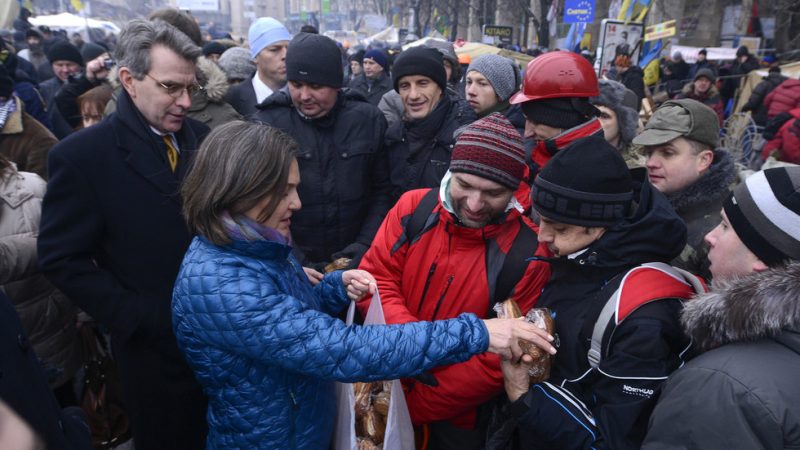
Victoria Nuland and Ambassador Geoffrey Pyatt distribute pastries at Independence square in Kiev, December 11, 2013. © REUTERS/Andrew Kravchenko/Pool
By Nebojsa Malic | RT | June 20, 2020
Victoria Nuland, the infamous State Department diplomat who “midwifed” Ukraine’s 2014 coup, has outlined a Russia strategy for the Biden administration. It is based on fantasies and projection, offering nothing of value to anyone.
You may remember ‘Tori’ Nuland from the so-called “revolution of dignity” in Ukraine, in particular the publicity stunt in which she doled out pastries to “peaceful protesters” on Kiev’s Independence Square. Standing next to her was US Ambassador Geoffrey Pyatt, who will be recorded some weeks later discussing with Nuland which protest leader will be allowed to form a government. Soon thereafter, the people they named led an armed coup against the government in Kiev and set up their own.
That was the zenith of her diplomatic career, however, as she resigned from the State Department after the inauguration of President Donald Trump and went into the private sector – currently working for Madeleine Albright’s consultancy group in Washington. Now Nuland is making a comeback, with an article in the July-August edition of Foreign Affairs titled ‘Pinning Down Putin.’
Between re-airing the usual mainstream Washington accusations against Russia and projecting US and NATO wrongdoing on Moscow, Nuland is basically outlining a policy for the Biden administration, should Democrats capture the White House this November as the US establishment hopes. Bear in mind as you read on that Nuland isn’t necessarily partisan – she worked for Bill Clinton’s Russia guru Strobe Talbott as well as George W. Bush’s grey eminence Dick Cheney. If there is an embodiment of the bipartisan US establishment consensus on Russia, that’s her. That’s the main reason her essay is worth a look.
Her actual policy advice is trite and predictable, calling for “consistent US leadership at the presidential level, unity with democratic allies and partners, and a shared resolve to deter and roll back dangerous behavior by the Kremlin.”
According to Nuland, President Vladimir Putin has “cut off his population from the outside world” and the US needs to “speak directly to the Russian people about the benefits of working together and the price they have paid for Putin’s hard turn away from liberalism.”
Far from being “cut off” though, Russians have greater access to news and opinion than your average American – including news and opinions Nuland disagrees with, which is obviously the problem here. Someone is clearly salty that Putin has made it more difficult for US-backed “civil society” activists and NGOs to operate in Russia.
Nuland argues that the US and NATO have “tried to persuade Moscow that NATO was a purely defensive alliance that posed no threat to Russia” but then has the gall to invoke the “independence” of Kosovo as an example of a “democratic struggle” and talks about how “a belt of increasingly democratic, prosperous states around Russia would pose a challenge” to Putin’s leadership!
Yet Kosovo is proof positive of NATO’s perfidy, and it was the 1999 war there that “lost” Russia, which had previously uncritically looked up to the West – something Nuland hopes to replicate. If she believes places like Ukraine or Georgia are either democratic or prosperous, she’s clearly delusional. Note that Washington praised Putin’s “democratic” predecessor Boris Yeltsin when he sent tanks to bomb the parliament in 1993. US allies like Poland and Hungary are being denounced by the EU as “undemocratic” these days. Perhaps “democracy” means only US-backed parties are allowed to win, along the lines of what happened in Serbia after the 2000 color revolution?
No less delusional are Nuland’s expectations. She describes matters in terms of “the carrot and the stick,” as if Russia were a donkey. Even if we get over the offensive metaphor, her “carrot” is patently ridiculous: Joint investments? Free trade? Lower tariffs? Energy partnerships? A toothless and pointless “pan-European security dialogue” proposed 12 years ago? Meanwhile, Russia would have to “demonstrate its commitment to ending its attacks on democracies” – in other words, prove a negative. Quite a bargain!
What Nuland really wants is to get around the Russian government and win the hearts and minds of the people, using the academia, “civil society” activists and students. She even proposes visa-free travel for Russians “between the ages of 16 and 22, allowing them to form their own opinions before their life paths are set.” Because the kind of graduates that come from US college campuses these days are really an example for the whole world to aspire to!
Nuland was a Sovietologist, so it’s not a surprise her proposals are still stuck in the Cold War mindset. But the 1980s propaganda was based on American opulence, prosperity and Reagan-era confidence. Soviets who bought into it ended up with what Nuland herself recognizes as the “years of chaos and impoverishment during the 1990s.” Putin is the product of that disillusionment, and while one may argue things might have been better this way or that, there is zero argument that his rule hasn’t been vastly preferable over the 1990s to everyone – except the oligarchs and the activists on the payroll of the National Endowment for Democracy.
What does the US offer now, though? Russians look at the scenes from American television, and see a remake of the Chinese Cultural Revolution. They see race riots and self-proclaimed Communists calling for a revolt. They see “science” that says one thing one day and something completely different the other, based solely on political considerations. They see the destruction of monuments and renunciation of the nation’s history and heritage.
Can one blame them if all of this reminds them of Russia’s own past from 1917 onward? As the very American expression goes, “been there, done that.” Also, “no thanks.”
Nebojsa Malic is a Serbian-American journalist, blogger and translator, who wrote a regular column for Antiwar.com from 2000 to 2015, and is now senior writer at RT. Follow him on Twitter @NebojsaMalic
Who needs ‘Russian hackers’? Report reveals CIA incompetence to blame for Vault 7 breach

By Nebojsa Malic | RT | June 18, 2020
An internal CIA report about the Vault 7 fiasco paints a damning picture of the main US spy agency. WikiLeaks released the CIA’s hacking tools, likely leaked by an insider, while CIA chiefs were too busy cooking up Russiagate.
Vault 7 was the name given to cyber attack tools developed by the CIA’s Center for Cyber Intelligence (CCI), and published by WikiLeaks in March 2017. It was the largest data breach in Langley’s history, with long-lasting consequences. For example, Chinese cybersecurity companies recently used Vault 7 evidence to show that the US has been hacking China for over a decade.
According to a just-released internal CIA report, “CCI had prioritized building cyber weapons at the expense of securing their own systems. Day-to-day security practices had become woefully lax.”
“Most of our sensitive cyber weapons were not compartmented, users shared systems administrator-level passwords, there were no effective removable media controls, and historical data was available to users indefinitely,” the report goes on to say.
The heavily-redacted document actually dates back to October 2017 and was only made public Tuesday by Senator Ron Wyden (D-Oregon), in an effort to pressure the new Director of National Intelligence John Ratcliffe into imposing new security measures. While the CIA ineptitude is the obvious takeaway, no one seems to have noticed the real bombshell: the timing of the breach and its implications.
The report says the CIA “did not realize the loss had occurred until a year later, when WikiLeaks publicly announced it in March 2017.” Now, what all was happening between March 2016 and a year later? You guessed it: Russiagate!
Even as his own cyber arsenal was getting swiped from under his very nose, CIA chief John Brennan was obsessing about “Russian hackers” of the Democratic National Committee, or Hillary Clinton’s emails, or something – and pushing the bogus ‘Steele Dossier’ alleging Donald Trump’s collusion with Russia, which eventually made it into the infamous ‘Intelligence Community Assessment’ that accused Moscow of meddling in the 2016 US presidential election.
It gets worse. According to the report, “Had the data been stolen for the benefit of a state adversary and not published, we might still be unaware of the loss—as would be true for the vast majority of data on Agency mission systems.”
So if the mythic bogeymen ‘Russian hackers’ had actually wanted to harm the US, they could have just used the CIA’s own, unprotected cyberweapons to stage false flags and wreak havoc across the world? None of which happened, obviously. Yet Brennan and his confederates have been telling everyone for years that the Kremlins wanted to “hack our democracy” by publishing some Democrat emails and posting memes on social media!
Note that Mike Pompeo, who took over at Langley before he moved to Foggy Bottom, bought into Brennan’s fable hook, line and sinker, denouncing WikiLeaks as a “hostile intelligence service” and a “cut-out” for Russia in April 2017.
In an irony of ironies, the Trump administration – run by a man who denounced the Iraq war and was falsely accused of working with WikiLeaks and Russia to get elected – is now seeking extradition of Julian Assange from the UK on trumped-up hacking charges related to the 2010 WikiLeaks revelations of US atrocities in Iraq.
As for how Vault 7 got to WikiLeaks, the jury is still out on that. Joshua Schulte, the employee charged with leaking the files, is being prosecuted again after a hung jury at his first trial in March. His lawyers have argued the CIA security was so lax, anyone else on the team, or even outsiders, could have done it.
The next time the media report some incendiary claim based on US intelligence “assessments,” try to keep all this in mind.
Featured Video

Trita Parsi: Middle East Unraveling — Are We on the Path to World War?
or go to
Aletho News Archives – Video-Images
New Book
Trans agenda is ‘normalization of sadism’ – US author

RT | September 23, 2026
The US Democratic Party has embraced a transgender agenda that amounts to “the normalization of sadism,” author A.J. Rice has said, warning that radical trans policies would return if the party is allowed to regain power.
Speaking to RT’s America First host Scotty Nell Hughes about his new book, ‘The Curse of the Bearded Lady: How the Trans Mafia Whacked American Sanity’, Rice argued that activists have gained significant influence in schools, medicine, and corporate America while people who questioned the agenda have faced pressure to stay silent.
The author described the “trans mafia” as the sprawling network of people and institutions that have helped the movement gain influence. He singled out parts of academia, wealthy backers, and corporations, and stated that providers of transition-related treatment also have a financial incentive to keep young people in their care indefinitely.
Rice argued that the consequences of these policies ultimately fall on children who are being drawn toward gender-affirming medical treatments and on girls who are expected to share locker rooms or compete in sports with biological males.
He noted that while voters rejected the Democrats’ approach to gender in 2024, the party, which has been “captured by madness,” has since only doubled down and is seeking what is effectively “the normalization of sadism.” … Full report
Blog Roll
 Aletho News
- Integrity Initiative: UK-funded network framed dissent as Russian disinformation for years
- ‘We don’t seek permission to defend our country’: Snippets from President Pezeshkian’s UNGA address
- NATO chief wants Europeans to fight American wars [for Israel]
- German chemicals giant reveals details of downsizing
- Refaat Al-Areer Was The Canary In The Coal Mine In Israel’s War On The Truth
- Israeli election committee bars candidate from Knesset race over Gaza war opposition
- French-Lebanese man files war crimes complaint over Israeli attacks
- Mahan Air Flight Lands in China Despite US Threat against Iranian Airlines
- US eyes $10bn fund to rebuild war-battered Gulf infrastructure
- Trump meets Rodríguez near Maduro’s prison as Venezuela’s oil flows to US
- If Americans Knew
- Caught on Tape: AIPAC CEO Boasted of Controlling Trump’s National Security Officials
- Why Hamas Attacked Israel in October 2023 – Israeli professor Ilan Pappé
- They see them, then kill them: Israeli quadcopters track, deliberately target civilians in Gaza
- Winter could turn Gaza’s treacherous, war-damaged buildings into deathtraps
- Majority of Democratic Voters Want to Prosecute Both Biden and Trump Administration Officials Over Gaza
- As Gaza languishes, world leaders gather at the UN – Daily Update
- Sanctions are collective punishment: immoral and self-defeating
- Phosphorus Munitions Fired by Israel Burn Groves, Orchards in Southern Lebanon
- Israel Carries Out New Ceasefire Violations Across Gaza
- AI – Emphasis on the ‘I’: Israel Is Funding AI Chatbot Propaganda
- No Tricks Zone
- New Study: Earth And Venus Surface Warmth Largely Explained By Convection And Lapse Rate, Not CO2 Or Radiation
- 2025 Nature Paper Claiming Worsening Global Drought Gets RETRACTED …Heavily Flawed
- New Study: ‘Global Drought Shows No Detectable Recent Acceleration Under Climate Warming’
- Economic Masterminds: German Socialists Suggest Taxing Productivity Gains Stemming From Using AI
- The South China Sea Has Not Been Cooperating With The Climate Change Narrative
- Energy Crisis: Germany Enters Heating Season With Historically Low Gas Reserve Fill Levels
- New Study: The Antarctic Ice Sheet Gained Mass From 2020-2024 Due To Staggering Snow And Ice Accumulation
- Study: Ocean Heating Rates From Thousands Of Years Ago ‘Dwarf’ Modern Ocean Heating Rates
- Climate Extremists Target, Attack Large-Scale Power Grid Infrastructure In Germany!
- New Study: Antarctic Ice Melt Has Contributed Less Than 1 Centimeter To Sea Level Rise In The Last 30 Years

