Russia isn’t only behind election hacking! They’re also trying to smear US over coronavirus … according to State Department
RT | February 22, 2020
Not satisfied with just blaming Russia for election meddling, US officials are now claiming Moscow is trying to “sow discord” by spreading disinformation about the coronavirus and the US’ role in its creation and global response.
US State Department officials are claiming Moscow is behind an internet campaign to blame the coronavirus on the US government.
Without citing specific examples, officials told AFP that the foreign nation is using “false personas” to spread conspiracy theories about the virus, including that the virus is the US’ attempt to “wage economic war on China” and that it could be a biological weapon deployed by the CIA to “spread anti-China messages.”
The messages are apparently spread through thousands of online accounts, run by people and not bots, which post similar messages in multiple languages and can be “linked back to Russian proxies.” The unknown number of accounts all received “carte blanche” from the Russian government to say whatever they can to damage the US’ reputation, the report claims.
Philip Reeker, the acting Assistant Secretary of State for Europe and Eurasia, says Russia’s intent in this loosely-detailed effort is to “undermine US institutions and alliances from within.”
The disinformation campaign was supposedly flagged in mid-January, with even media companies like RT and Sputnik being named as part of the effort to push anti-US messages in relation to the virus.
“The Russian strategy is to very cheaply but very effectively take advantage of the information environment to sow discord between us and China, or for economic purposes,” said Special Envoy Lea Gabrielle, head of the Global Engagement Center, which is supposed to identify and combat propaganda. Why Russia needs to “sow discord” between the US and China, when Washinton has been doing it successfully over recent years was not explained. Relations between the two countries have already soured due to Trump’s trade negotiations, imposed tariffs and even labeling the country a “threat to the world” before the coronavirus ever became a situation.
The State Department also blamed this campaign of “Russian talking points” for slower responses to the coronavirus in Africa and Asia.
All this information is supposedly gathered in a report by the Global Engagement Center (GCE) and seen by AFP. The State Department’s GCE has a sketchy history of being accused of spreading its own propaganda, like a $1.5 million program that was deployed to discredit any and all critics of Trump’s policies in Iran. The account @IranDisinfo was running smear campaigns against anyone, including journalists, who dared to challenge the president’s hawkish policies, despite the account supposedly being meant to only combat Islamic State (IS, formerly ISIS) propaganda.
For those keeping track at home, US officials have now blamed Russia for not only using the coronavirus to try and hurt the US’ “reputation,” but they have also conspired with Trump to win the 2016 election – a narrative House and Senate Dems are still pushing even after the two-plus year Mueller investigation came up limp – and worked to build up the campaigns of non-mainstream Democrats like Tulsi Gabbard, whom Hillary Clinton previously claimed is a “Russian agent,” and Bernie Sanders. It’s difficult to tell how Russia is functioning as a country if they are behind all of these elaborate campaigns US officials blame them for.
Democrats resurrect ‘Russiagate’ to go after both Trump and Bernie Sanders, hide their own election trickery
By Nebojsa Malic | RT | February 22, 2020
Establishment Democrats have now used the claims of ‘Russian meddling’ to go after their own progressive wing as well as President Donald Trump. The bogus accusation seems to be nothing more than cover for their own wrongdoing.
Moscow is now supposedly helping Bernie Sanders in the 2020 US presidential election – that is, if you believe the anonymously sourced Washington Post “bombshell.” This follows a New York Times claim on Thursday that the Kremlin is “again” betting on Trump, written by known partisan hacks and likewise based on anonymous sources.
In the minds of the ‘Russiagate’ cult, the Kremlin is backing Sanders either to get Trump re-elected, or to get a “socialist” president. Never mind that Russia is not socialist, try arguing that there has been precisely zero evidence – now, or back in 2016 – that Russia has backed any US candidate, and watch people’s heads explode. Much like the vaunted US “intelligence community,” they want to believe. That’s the only way they can explain the mind-breaking shock of Hillary Clinton losing to Trump.
Through endless repetition and paranoid denunciations, “Russian meddling” has been elevated to an article of faith, and anyone who dares question it in the slightest is a heretic fit only for the pyre.
So there was little surprise when the canard was trotted out on Thursday, in what was clearly an effort to delegitimize Trump’s pick of Richard Grenell as Director of National Intelligence with a rumored mandate to “clean house” – of, I don’t know, maybe the people involved in spying on Trump’s campaign on false pretenses and manufacturing the predicate for ‘Russiagate’, perhaps?
What’s more shocking, however, is that this accusation has now been leveled against Sanders – and after him spending the past four years proving time and again how he was a loyal DNC foot soldier. Not only did he bend the knee to Clinton after it was documented that she and the DNC colluded to rob him in the primaries, he also jumped on the ‘Russiagate’ bandwagon, and even tried using it just this week to deflect from the Clintonite smear about “Bernie bros” being mean to people online.
Even so, Bernie has now been smeared as a “Russian asset.” Looking at the state of Democrat primaries, the answer is obvious: because he’s winning, despite the DNC’s attempts to promote Pete Buttigieg or literally anyone else in the Iowa caucuses and New Hampshire primaries. With Joe Biden crashing and burning, the party even embraced billionaire media mogul Mike Bloomberg, only to see him wither on the debate stage last Friday and Sanders climb in the polls.
So the paper owned by Jeff Bezos, who reportedly asked Bloomberg to run and stands to pay billions in taxes if Sanders gets elected, breaks the glass and pushes the big red Russiagate button. Perfectly normal, you see.
In what surely must be a coincidence, the DNC had changed its debate rules to accommodate Bloomberg, even as it bent itself into pretzels to exclude Hawaii Congresswoman Tulsi Gabbard. In an even more remarkable coincidence, Gabbard was accused last fall of being a “Russian favorite” by none other than Hillary Clinton, the very source of the original ‘Russiagate’ conspiracy.
There’s no way these things are related, though, and anyone who thinks so simply must be a Russian agent! Expect armed FBI agents to show up at your door, accompanied by CNN cameras, and a federal judge to declare you a danger to Our Democracy any moment now.
That is not to say that US elections haven’t been targeted for meddling, influence, and even hacking. Trouble is, every documented incident tends to point to, well… Democrats.
Lost in the shrieking about “Russia helping Bernie” on Friday was the announcement that the FBI has arrested and charged a hacker linked to California Democrat Katie Hill, who allegedly conducted cyber-attacks against her (Democrat) primary rivals back in 2018. Oops.
Then there is New Knowledge, the “cybersecurity” company that the Senate Intelligence Committee chose to inform its understanding of “Russian active measures.” They were uniquely qualified, you see, because they actually ran a disinformation campaign during the 2017 special election for the Senate in Alabama, using fake Russian bots to frame and defame the Republican candidate.
When you factor in that the loudest shrieking about ‘Russian meddling’ comes from the people who were actually involved in election shenanigans – such as illegally spying on Trump’s campaign using a dodgy dossier compiled by a British spy – what emerges is a damning picture of psychological projection.
Nebojsa Malic is a Serbian-American journalist, blogger and translator, who wrote a regular column for Antiwar.com from 2000 to 2015, and is now senior writer at RT. Follow him on Twitter @NebojsaMalic
Russiagate Chickens Come Home to Roost for Sanders
Lie down with dogs, get up with fleas

By Marko Marjanović | Anti-Empire | February 22, 2020
Sanders helped fuel the elite Russiagate conspiracy theory (and still is, in fact), now the power elite is using it against him:
Poetic justice for Sanders as the same power elite which is unfairly interfering in the elections against him gets to accuse him of being the beneficiary of such interference — and it was Sanders who helped make it all possible!
Meanwhile, Sanders isn’t even standing up for his supporters:
Sanders’s opponents have blamed some of his most vocal online supporters for injecting toxic rhetoric into the primaries. At a Democratic candidates debate Wednesday in Las Vegas, Sanders indirectly blamed Russia, saying it was possible that malign actors were trying to manipulate social media to inflame divisions among Democrats.
“All of us remember 2016, and what we remember is efforts by Russians and others to try to interfere in our elections and divide us up,” Sanders said. “I’m not saying that’s happening, but it would not shock me.”
He’s marginally better on foreign policy than the rest of the Democrat pack (minus Tulsi), but when he’s willing to say that a part of his supporters are really Russian agents provocateur, what is that worth? It’s hard to believe he’ll stand up for a somewhat better policy on Venezuela or Yemen when he won’t even stand up for the Bernie Bros.
Another ‘highly likely’-style accusation: Moscow brushes aside ‘evidence-free’ Georgia cyberattack
RT | February 21, 2020
The US and its allies have claimed Russia’s military intelligence defaced Georgian websites with an image of the country’s former president. Moscow says the accusation is not backed by any evidence and is clearly just a PR stunt.
In late October last year, Georgia suffered what was described as the largest cyberattack in its history. Over 15,000 web pages – including those of government agencies, newspapers and banks – were defaced and later became inaccessible. The original content was replaced with a photo of former Georgian president Mikhail Saakashvili, currently a fugitive from justice, with the words “I’ll be back” above his head.
Many in Georgia immediately blamed the attack on Russia, and lo and behold, more than three months later the accusation is official. The Georgian foreign ministry claimed the GRU, Russia’s military intelligence agency, was behind it, citing its own investigation and information from “foreign partners.” The partners soon piled on Russia, with the charges repeated by the US, the UK, Canada and some others.
Notably, Russia’s accusers were tight-lipped on what evidence they had to support their claims. Neither technical details of the attack nor even a brief explanation of the investigation process were provided. The Russian foreign ministry pointed to this fact as it brushed aside the accusation.
“The lack of evidence and political motivation behind this obviously orchestrated information attack are impossible to miss,” it said in a statement. “It took almost four months to make an attempt to scapegoat Russia for the incident that happened on October 28 last year. All the charges are along the lines of the notorious ‘highly likely’ approach,” they concluded, referring to the line used by former UK Prime Minister Theresa May when accusing Russia following the poisoning of Sergei Skripal in 2018.
In the absence of actual proof, people with a record of accusing Russia of various nefarious cyber deeds resorted to speculation. Georgia is “in their neighborhood,” said Adam Meyers from the security firm CrowdStrike. “It’s in line with Russian tactics. The specific outcome is less important than causing upheaval and conflict between different groups in the country”.
CrowdStrike is most famous as the source of the claim that Russia hacked the servers of the DNC during the 2016 presidential race. It was tasked with investigating the situation, and was apparently trusted so much by the Obama administration that the FBI didn’t deem it necessary to double check their assessment.
Washington and its friends said the culprit was the GRU’s Unit 74455, which first entered the global spotlight in 2018, after the US Department of Justice indicted three of its presumed employees with hacking the DNC.
Other sins pinned on the unit include unleashing the ransomware NotPetya and its derivative Bad Rabbit in 2017. Like an earlier extortion virus WannaCry, this malware is believed to be based on cyber-warfare tools, belonging to the US National Security Agency, which were leaked a year earlier. The outbreaks affected computers running an unpatched version of Windows. Among their victims were Russian oil giant Rosneft, metal-maker Evraz and the Russian Central Bank.
Russia isn’t just mapping Ireland’s internet cables – it’s planning to INVADE, foams Cold-War-revivalist DC think tank

A ‘top secret’ interactive map showing all undersea internet cables landing in Ireland © TeleGeography
By Helen Buyniski | RT | February 21, 2020
Russia is poised to invade Ireland and seize control of global communications, according to a crew of Cold War relics and professional Russophobes who’ve taken an already absurd James Bond-esque story and doubled down on it.
Ireland’s status as “a vital telecommunications and logistics hub linking North America and Europe” has made it an irresistible prize to “the Putin regime,” according to a bizarre paper published on Wednesday by the Center for Security Policy, a right-wing think tank. Russia isn’t just lusting after Ireland’s burgeoning crop of tech firms, or its forest of undersea communications cables, the group argues – it’s actively plotting to invade the Emerald Isle.
The unhinged plot apparently derives from a story published last weekend in the Irish Times, which warned – citing the usual anonymous sources in the Garda and the military – that Russian spies were observed last year mapping out the precise location of the transatlantic ocean-bed cables that form the backbone of global communications in preparation for “future tapping or even damage.”
While that gripping saga could be deflated with a quick look at one of Ireland’s own government websites, which posts the exact latitude and longitude of those cables for all to see, it clearly lit a fire under the senescent Cold War hawks at the CSP.
Not content to let the Irish lie awake in their beds with visions of Russian divers – or better yet, weaponized beluga whales – dancing in their heads, this Strangelovian bunch let their imaginations run wild.
“The neutral republic of Ireland has no military allies, so a Russian attack would not invoke NATO’s Article 5 provision on collective defense,” writer J Michael Waller salivated, as if Ireland’s neighbors – or the US, for that matter – would sit by and twiddle their thumbs if the country was invaded by Russia, or anyone else, for want of treaty obligations!
“Russia would meet little resistance were it to take over Irish deep-water ports, occupy the vital Shannon airport, and physically control or cut trans-Atlantic undersea cable network that keeps the world economy running.”
Wait, what? Well, Ireland has had issues funding its military, Waller explains. Worse, it simply “doesn’t have a counterintelligence capability,” according to Royal United Services Institute fellow Mark Galeotti, whom Waller quotes in his comments to the Times.
Galeotti, who once midwifed the ‘Gerasimov doctrine’ hoax into existence, only admitting it didn’t exist after a generation of excitable Russophobes had run with it, warned about the fate facing Ireland should it not… hire a private security company to guard all the tech firms who’ve set up shop there because of comparatively friendly tax laws? Train their own team of killer whales to guard the cables? Join NATO?! It’s not clear what, exactly, the famously-neutral Ireland is supposed to do about this looming Kremlin takeover.
Nor was CSP the only group of Cold War revivalists to take the Times story as proof they had been on the right track with their obsession. A mysterious “pro-NATO” Twitter account calling itself GorseFires Collectif has been “warning since 2014 about Russian General Staff planning efforts & GRU interest regarding strategic assets in Ireland,” it reminded its followers after the story was published, dredging up several years’ worth of tweets that all predicted a Russian invasion was just around the corner and warning Irish authorities that a “Ukraine in 2014” situation could arise at any moment… whatever that means.
And a real-life invasion is only part of the dastardly Russians’ plans for little old Ireland, the CSP warns: “even without invading, Russia is using Ireland to tap into the trans-Atlantic undersea cable network and burrow into Dublin-based tech companies.” Evidence? Who needs evidence, when you’re keeping the world safe for democracy? With such a national-security emergency on their hands, Ireland would have to be downright suicidal not to leap into the waiting arms of its knight in shining NATO armor…
Follow Helen Buyniski on Twitter @velocirapture23
U.S. Intel Briefs Bernie Sanders That Russia is Trying to Boost His Presidential Run
By Patrick Henningsen | 21st Century Wire | February 21, 2020
“It’s like a nightmare, isn’t it? It just keeps getting worse and worse.”
– Grady Seasons in The Color of Money
Just when you thought America would eventually get over its addiction to scapegoating The Russians!™ for helping any anti-establishment or political outsider to get elected, there they go again.
As I predicted earlier this morning, it was only a question of time before the US establishment would blame those dastardly Russians for Bernie Sanders double-digit lead in national polls.
It was only yesterday, when we learned how the “IC” aka the vaunted Intelligence Community (a verified oxymoron at this point) has finally decided that the Russians are already active behind the scenes trying to swing the 2020 US Presidential Election in favor of President Trump.
Then 24 hours later the great paragon of honest journalism, the Washington Post, then tells us that intelligence officials have briefed Senator Bernie Sanders about how Russia is attempting to elevate his presidential campaign (no actual specifics were given, only a gut feeling we’re told) as part of a grand plot to “interfere with the Democratic contest.”
Of course, the Post’s source for this ‘bombshell’ was no one specific, just “according to people familiar with the matter, who spoke on the condition of anonymity to discuss sensitive intelligence.”
How reassuring. It must be true then.
So basically, this means that it’s now open season on Sanders – in the debates, with rude and cynical questions from CNN moderators, and imbecile questions from the likes of Chuck Todd. Soon Sanders will have no choice but to accept a media spot on Fox News. His Democratic primary competitors are all struggling for traction, so you expect they will take advantage of this latest psy-op.
Just when you thought American politics and mainstream media couldn’t sink any lower into the banal, anti-intellectual quicksand of RussiaGate, they seem to have done it again.
Even sadder than the realization that America’s media has fallen off the cliff of sanity, is how Bernie Sanders himself appears to have swallowed the RussiaGate hoax rhetoric hook, line and sinker. If anyone wants to see a sneak preview of how Bernie might perform as President in the face of US intelligence agencies dictating their worldview to the White House, you needn’t look any further than this tawdry vignette.
Warning, you are about to experience some seriously painful reading.
Jeff Bezos’s Washington Post had to stick no less than FOUR different names on this story to launder it and spread the blame around when the paper eventually is forced to admit this is 100% pure fake news….
Washington Post : Bernie Sanders briefed by U.S. officials that Russia is trying to help his presidential campaign
Moscow Slams ‘Paranoid’ Claims of ‘Russian Meddling’ in US Primaries, Expects More as Election Nears
Sputnik – February 21, 2020
On Thursday, The New York Times reported that US intelligence agencies had told President Trump that Russia was planning to meddle in the 2020 election to help reelect him.
Fresh claims about ‘Russian meddling’ in the 2020 US elections are “paranoid” nonsense, but can only be expected to increase as the November vote nears, Kremlin spokesman Dmitry Peskov said Friday.
On Thursday, NYT reported, citing several unnamed sources, that US intelligence agencies believed that Russia was plotting to meddle in both the Democratic primaries and the 2020 general election in a bid to get Donald Trump reelected. According to the newspaper, Russia’s plans included fiendish schemes to use “ransomware attacks to damage or interfere with voting systems or registration databases,” and attempts to undermine confidence in the US election system generally.
“This is just another paranoid report of the kind which, unfortunately, we will see more and more of as the election approaches. Of course, such claims bear no relationship to the truth,” Peskov said, commenting on the NYT piece.US officials and pro-Democratic media have spent well over three years accusing President Trump of being a Kremlin agent, and claiming that Moscow was engaged in an aggressive pro-Trump interference campaign in 2016. These allegations, collectively known as ‘Russiagate,’ essentially collapsed in April 2019, after the release of a 400 page+ report by special counsel Robert Mueller. Mueller, who spent over two years examining alleged coordination between the Kremlin and the Trump campaign in 2016, found no evidence of collusion. Furthermore, Mueller’s charges regarding instances of actual alleged ‘Russian meddling’ were limited to Facebook and Twitter trolling campaigns whose effectiveness and significance have repeatedly been called into question.
Earlier this month, investigative US media revealed that a key piece of ‘evidence’ used by the Obama White House to start the FBI probe into possible Trump-Russia collusion in 2016, the so-called ‘black ledger’ of secret cash payments to Trump campaign chairman Paul Manafort during his work in Ukraine, was a complete fabrication created from scratch by Ukraine’s National Anti-Corruption Bureau and leaked to US media in the summer of 2016.
Russiagate returns: MSM ecstatically exploit evidence-free NYT claim Moscow ‘helping Trump in 2020’
By Nebojsa Malic | RT | February 21, 2020
The same media that flogged the insane ‘Russiagate’ conspiracy theory for years are resurrecting that particular dead horse, in what appears to be an effort to stop the White House from cleaning up the US intelligence community.
“Russia is aiding President Trump in the 2020 election, intelligence officials told lawmakers,” the New York Times blared on Thursday, adding that President Donald Trump berated the acting Director of National
How nice of the Times to prove Trump’s (alleged) point, then – and with a story that relies entirely on anonymous, unverifiable sources no less. It’s just like the early 2017 stuff about the “Trump-Putin dossier” on which the president-elect was briefed by FBI chief Jim Comey and DNI James Clapper, only for this to immediately leak to the #Resistance press, and set the stage for years of “Russian collusion” investigations.
Sure, the ‘Russiagate’ nonsense failed to stop Trump from getting elected or being sworn in, just like it failed to provide a pretext for his impeachment, so the Democrats had to make one up with the Ukraine phone call. That doesn’t mean they can’t try again, though!
MSNBC – which never recanted its Russiagate reporting – immediately blared the Times report as breaking news. CNN went a step further, calling on Clapper to comment on the story – yes, the very same former spook who brazenly lied to Congress about spying on Americans, co-authored the infamous “intelligence community assessment” claiming Russia was meddling in the 2016 election, and claimed Russians were “genetically driven” to subvert the US.
In what surely speaks volumes by itself, the story was uncritically amplified by the Washington Post’s chief fact checker.
Notice that all of this is happening just a day after nearly every single mainstream Western outlet outright misinterpreted a quote – in exactly the same way – from a court hearing about WikiLeaks publisher Julian Assange, because it fit their narrative about “Russian meddling.”
This new alleged “bombshell” also comes a day after Trump named trusted envoy Richard Grenell to oversee the ODNI – Clapper’s old beat – causing much wailing and gnashing of the teeth among the #Resistance and NeverTrumper types.
Could it be that they’re just a tiny bit nervous Grenell might clean house of all the “resistance” types that have acted for years on the self-righteous conviction that they, not the elected president, should run US policy? Folks like Clapper, Comey, CIA chief John Brennan, or the “whistleblower”-who-must-not-be-named who initiated the Ukrainegate fiasco, for example.
While normal, sane people may think that ‘Russiagate’ was a failure – and on its face, it was – it did actually manage to accomplish two major things. One was to validate the Trump Derangement Syndrome of the mainstream media and the Democrats, eventually encouraging them to believe they could actually impeach him. We all know how that ended.
The other, and perhaps more important, was to provide cover for all the people involved in the spying on Trump’s campaign, illegal FISA wiretaps and “unmaskings” of names, perjury traps, trumped-up prosecutions, letting Hillary Clinton off the hook for private email server use, and whatever actually happened to the DNC computers that got blamed on Russia.
Those people now have lucrative book deals or cushy jobs in the media and think tanks, rather than being charged with plotting a coup and being locked up in a federal penitentiary – even as they bleat how “no one is above the law.” Funny how Washington works, isn’t it?
Nebojsa Malic is a Serbian-American journalist, blogger and translator, who wrote a regular column for Antiwar.com from 2000 to 2015, and is now senior writer at RT. Follow him on Twitter @NebojsaMalic
What’s Really Behind Rohrbacher’s ‘Assange Pardon’ Story?
By Patrick Henningsen | 21st Century Wire | February 20, 2020
Just as Roger Stone’s sentencing was getting underway this afternoon, another story began drifting out into the media sphere – another potential spanner in the works just in time for part one of Julian Assange’s US extradition hearing which is due to commence this Monday.
According to a revelation aired during a recent scheduled case hearing on Wednesday by a member of Assange’s defence team, Edward Fitzgerald QC, Assange was informally offered some kind of pardon deal by a US representative during the first year of the Trump Administration. Fitzgerald was reading from a statement by Assange’s lawyer Jennifer Robinson, reportedly saying:
“Mr Rohrabacher going to see Mr Assange and saying, on instructions from the president, he was offering a pardon or some other way out, if Mr Assange … said Russia had nothing to do with the DNC leaks.”
This statement is referring to former US Congressman Dana Rohrbacher (R-CA) who says he visited Assange as part of Rohrbacher’s own independent ‘fact finding mission’ at London’s Ecuadorian Embassy in August 2017, near the beginning of the Mueller Investigation.
Before we continue and unravel what has been said and by whom, there are three key aspects of this latest news to consider.
The first and most importantly – is the media spin aspect. Given that this is both a highly-charged partisan, as well as geopolitical case, and that we are just days away from the start of Assange’s historic extradition hearing, there are powerful forces, be they state, partisan or media – who will try and spin this and other ‘bombshells’ in a way which suits their political agenda. It also goes without saying that there are agents of influence within mainstream media organizations who are both willing and able to manipulate, twist, distort or fabricate any aspect of a story like this in order to further the interests of the two primary government stakeholders in this case, the United States and United Kingdom. This has already been demonstrated time and time again with the Assange story, most notably by The Guardian newspaper who completely fabricated at least one headline story by Luke Harding and Danny Collyns claiming that former Trump campaign manager Paul Manafort had visited Julian Assange in the Ecuadorian Embassy. The Guardian then followed this fake news story up with a sequel in which they used Harding’s Manafort story to help bolster another bogus claim that an ally of Nigel Farage was attempting to obtain emails from WikiLeaks. Bottom line: if there is any opportunity to advance a Trump-Russia or RussiaGate narrative, there are mainstream journalists and editors ready to publish or say anything, even if it’s a complete lie.
The second thing to consider is how this latest news will factor into Julian Assange’s extradition hearing next week.
And thirdly, whether or not the Dana Rohrbacher story will ultimately help, or hurt the real protagonist in this case, Julian Assange.
Most certainly, the mainstream media have distorted this story from the word go, mostly to advance anti-Trump and anti-Russian narratives. We’ll look at two reports, one from the Daily Beast, and the other from the UK’s Independent.
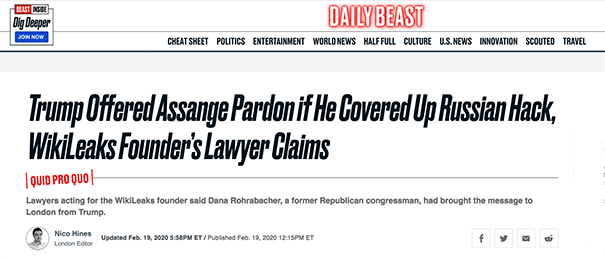
The Daily Beast story written by Nico Hines carries an over-the-top headline, “Trump Offered Assange Pardon if He Covered Up Russian Hack, WikiLeaks Founder’s Lawyer Claims”. Of course, this isn’t actually what the lawyer said. The headline doesn’t actually correspond with the claims made below in the article. Hine’s own article does not stipulate that Trump himself made such an offer to Assange. Hine then repeats the same lie in the sub-header, saying that Rohrbacher “had brought the message to London from Trump.” In addition to this, the headline erroneously asserts that Assange is also orchestrating a cover-up. No doubt the Daily Beast’s management and data analytics team knows that a large percentage of online readers, especially those seeing content via social media, only skim the headline of a post and do not read the body of the article (content engineers need to know this data because it is how they place and bill for advertising space). In addition to this, according to a statement made by former Congressman Dana Rohrbacher, the former Congressman made a proposition to Assange that if the WikiLeaks founder was prepared to give proof of who provided the DNC and related email leaks, Rohrbacher would do his best to lobby the President for a pardon. With his gratuitous headline, stamped with “Quid Pro Quo” in red lettering right below it, Hines was attempting to re-purpose the UkraineGate-Impeachment accusation of Trump’s abuse of power in asking the Ukrainian President Zelensky for an illicit ‘Quid Pro Quo’ favor, thus engaging in yet another under-the-table dodgy deal.
Above all, this story is being crafted to look as if Trump was in league with Assange to try and cover-up any Russian involvement in the DNC Leaks and the 2016 Election – leaving the reader to assume that there was Russian involvement. This story is complete spin and clickbait by the Daily Beast. In classic propaganda style, the author also uses this opportunity to reinforce the usual laundry list of unproven RussiaGate narrative talking points, stating a series of evidence-free assertions and falsehoods as if they were iron-clad proven facts (now standard operating procedure for most US mainstream outlets):
“Russia’s involvement in hacking emails from the Democratic National Committee.”
“WikiLeaks posted the stolen DNC emails after they were hacked by Russian operatives.”
This is followed by a cheap, ad hominem smear against Rohrbacher:
“Rohrabacher, who was known as Putin’s favorite congressman.”

Like The Guardian, formerly a respectable newspaper, the UK’s Independent has become a formidable online propaganda outlet. It’s headline takes the Daily Beast spin even further, adding ‘Russian election interference’ for good measure: “Trump offered to pardon Assange if he covered up Russian interference in US election, court told”. Of course, this is not what the court was told, but the truth doesn’t seem to be a priority for these mainstream outlets. It repeats most of the lies woven through the Daily Beast article, and then builds a partisan angle on top of the initial lie, making reference to the 2020 US election:
“… could have profound consequences for Mr Trump’s re-election effort if proven true.”
Note also the use of the cheap throwaway propaganda phrase, “if proven true” – which more often than not denotes a fake allegation, and is proof of deceptive intent, or a pre-existing agenda or bias by the author. A similar election smear here:
“It’s another indication that Trump’s assault on the rule of law isn’t new; it’s been ongoing throughout his term. And imagine just how much we don’t yet know.”
The propaganda housekeeping continues, advancing the official conspiracy theory that the DNC and Clinton emails were hacked, when there is still no proof to validate this claim, citing a likely partisan source, Obama CIA official Ned Price:
“A series of emails embarrassing for the Democrats and the Hillary Clinton presidential campaign were hacked before being published by WikiLeaks…”
More of the same, reinforcing unproven, untested accusations tabled by Mueller probe:
The Mueller investigation, published in April, found Russian GRU agents hacked Ms Clinton’s private server for the first time just hours after Mr Trump’s public request for Russia to “find the 30,000 emails that are missing”.
(NOTE: DOJ indictments of ‘GRU hackers’ have shown no proof, FBI did not forensically inspect DNC servers, only showed redacted IT reports from the private firm Crowdsrike, and posited an unproven theory that Russian GRU agents ran online cut-outs like Guccifer 2.0)
Needless to say, when it comes to stories like this, most mainstream media outlets are not fit for purpose, and most likely co-opted by some partisan interests, or worse, by an intelligence agency. History is replete with examples of this.
The second consideration is: how will this latest revelation effect Julian Assange’s extradition hearing next week? If you can filter out all of the media and partisan spin, you can see that this new information was introduced by the defense for a reason which may have less to do with Trump and Russia, and more to do with substantiating a complaint made by the defense that Assange should not be extradited to the U.S. because Washington’s case against him is in fact politically motivated. In this case, as a serving member of Congressman, Rohrbacher’s meeting with Assange and solicitation of a deal automatically proves that there was direct US political involvement in advance of the Department of Justice’s 18 superceding indictments of Assange served this past summer. In addition to this, the defense has proof of a CIA-led operation which spied on Assange in the Ecuadorian Embassy in London, which included surveillance of his discussions with his attorneys. Taken together, these two pieces of evidence could be crucial in the defense’s effort to have the US extradition request overturned on the basis that the US effort is entirely politically motivated and therefore in violation the extradition treaty between the two countries.
WikiLeaks tweeted out today that this Rohrbacher story will come into play on Tuesday’s session of the hearing.
WikiLeaks also points out the issue of the timeline of events with this story – that the Rohrbacher meeting took place long after Assange had publicly stated that his source for the DNC leaks was not a sate actor.
In addition to this, former UK Ambassador and friend of Assange, Craig Murray, has also declared publicly ( and confidently) on numerous occasions that the source was not Russia, but from ‘Washington DC circles’. From Sputnik News :
In December 2016 Murray told Radio Sputnik that the DNC Leaks had “absolutely nothing to do with Russia”. He said that he discovered the source while attending a whistleblowing conference in the US and stressed that it came from “official circles in Washington DC”.
Lastly, there is the question of whether or not the Dana Rohrbacher story will help, or hurt the credibility of Julian Assange and WikiLeaks.
As I have stated a number of times previously, the key to the DOJ case against Assange lies in the language in which they have reframed Assange and WikiLeaks from being a journalist and a press outlet, and instead labeled him as a ‘cyber terrorist and Russian asset’, and a ‘hostile non-state foreign intelligence service’, respectively. This reframing will also allow the US to strip Assange and WikiLeaks of any first Amendment protections upon arrival in the US, as well as justify Special Administrative Measures, which places Assange essentially in the same category as an enemy combatant or terrorist. One way to make this reframing exercise more credible is by attacking the credibility of both Assange and WikiLeaks, to portray them as not acting like ‘conventional journalistic outlets,’ simply to demonstrate that Assange and WikiLeaks are cavalier or careless in keeping to their journalistic principles. This is where the claims made by Dana Rohrbacher might be used to undermine Julian Assange’s insistence that WikiLeaks protects their sources at all costs. The insinuation by Rohrbacher – which has now cascaded through the world’s media – is that Assange was willing to sell-out his principles by divulging to Washington who leaked the DNC emails in order to save his own skin in the form of a pardon from President Trump.
In Rohrbacker’s own words:
“Upon my return, I spoke briefly with Gen. Kelly. I told him that Julian Assange would provide information about the purloined DNC emails in exchange for a pardon.”
In his statement posted on Feb. 20, 2020, Rohrbacher was careful not to state explicitly that Assange had told him “Yes” and agreed to give up his source in exchange for a Presidential pardon – it was only inferred in Rohrbacher’s above quote, “I told him that Julian Assange would provide information…” – but he does not specify what exactly that information would be: a source, contextual information, deductive information, ie. who it wasn’t, or some other forensic evidence which would rule out a Russian state actor. It’s hard to know at this point, but that didn’t stop the mainstream media from colonizing that vacuum of information with the usual bevy of speculation, spin and fake news which we demonstrated earlier in this article. But the general impression in all of the reporting and from the Congressman himself, is that Assange had told Rohrbacher he would indeed give up his source in exchange for a pardon. This does not square with many vehement statements made by Assange about maintaining the integrity of WikiLeaks’ sources.
Who would really expect Assange to have have suffered this ten-year long ordeal – only to suddenly trust an emissary of the United States government to keep his promise to make good on some informal, and highly uncertain promise of freedom?
It’s also worth noting here that this same narrative mirrors a story which has been circulating somewhat under the radar for months, about a former FOX News contributor named Ellen Ratner (late brother Michael Ratner had been a U.S. lawyer for WikiLeaks) who says she visited with Assange in the Ecuadorian Embassy in the fall of 2016. Claims about her visit were then made by an alleged associate, another FOX News contributor and Dallas financial manager named Ed Butowsky – and Butowsky claims that Ratner told him that Assange said his source was the late Seth Rich, a DNC employee who was shot and killed a block from his apartment in Washington DC on July 10, 2016. This of course infers, by extension, that Rich was murdered because he was the leaker. The Ratner-Butowsky story has been mentioned by a few mainstream media outlets, but is more popular in alternative American conservative media. All of this is purely speculative, and as yet, without any evidence to validate the theory. However, Butowsky’s third-hand claims have triggered a chain a lawsuits led by a libel suit filed by the family of Seth Rich against various parties and media outlets who made the claim that Rich leaked the DNC emails to WikiLeaks.
The amount of media noise surrounding this issue can easily obfuscate some of the fundamental principles and themes which are governing the mainstream narrative of this story.
What’s important to note here is that just like Rohrbacher’s inference that Assange had agreed to provide information on the DNC leaks, Butowsky’s unfounded claim infers that Julian Assange gave up his source to Ellen Ratner – a core principle which Assange has sworn he would never betray. Again, such a narrative actually undermines the ethical and professional credibility and staunch reputation of Julian Assange and WikiLeaks as serious journalists.
Rohrbacker’s approach wasn’t the first interface between US officials and Julian Assange. While Rohrbacher’s approach was a traditional face to face meeting and offer of a pardon, a previous approach was said to have been made by the FBI and CIA agencies in 2017, as reported by John Solomon in 2018, whereby Assange would be offered immunity from prosecution in exchange for cooperation with intelligence agencies in mitigating some of the damage from WikiLeaks release of a CIA document trove. Solomon reports for The Hill:
This yarn begins in January 2017 when Assange’s legal team approached Waldman — known for his government connections — to see if the new Trump administration would negotiate with the WikiLeaks founder, holed up in Ecuador’s London embassy. They hoped Waldman, a former Clinton Justice Department official, might navigate the U.S. law enforcement bureaucracy and find the right people to engage.
Allegedly, FBI director James Comey then intervened later in the process in order to kill the deal.
The Rohrbacher story is just one of many fascinating details which will be introduced during the process of Assange’s hearing which will take place in two parts; in February, and then in May. But with all of these details and revelations, readers should pay close attention to how and why the news is being spun the way it is, and to the benefit of whom. Also, consider the source of the information.
The first half of Assange’s extradition hearing will begin on Monday Feb 24th at Woolwich Crown Court, where US lawyers will make the case that he should be extradited to the United States to face 18 federal counts of espionage and conspiring to commit computer intrusion, totally 175 years in prison – if he is found guilty.
Show Trial Ends: Roger Stone Sentenced to 40 months in Prison, Judge Decries ‘Threat to Democracy’
By Patrick Henningsen | 21st Century Wire | February 20, 2020
Today, the long-time friend and Trump campaign consultant Roger Stone was sentenced to 40 months in a federal prison for multiple charges relating to his Congressional testimony and Robert Mueller’s Russia probe.
US District Judge Amy Berman Jackson issued Stone’s sentence after his lawyers had first requested that he receive no prison time.
After the sentence was handed down, Stone refrained from making a personal statement to the court.
Normally, one might refrain from criticizing a judge too harshly, but this was no ordinary closing remarks performance, as Judge Jackson seemed to go on forever, attempting to address all of her critics, and seemed compelled to want to justify the premise of the legal proceedings.
After reviewing her statements, to say (and I don’t say this lightly) that she had personal axe to grind is an understatement, and her extended diatribe appears to point to an obvious political agenda.
Judge Jackson wasn’t shy about showing her bias either, remaining in lockstep with the original RussiaGate narrative – even though it’s been proven to be hoax after a 3 year-long Mueller Investigation produced no evidence of alleged ‘Trump-Russia Collusion.’ She clearly attempted to do this here:
“He was not prosecuted for standing up for the president,” said Judge Jackson during her closing remarks. “He was prosecuted for covering up for the president.”
Only the President did nothing which required covering for.
As that wasn’t enough, the judge went on during her hours-long sentencing hearing to claim that what Roger Stone did was somehow “a threat to our democracy”.
We’re still trying to work out exactly what she is talking about there, or how the 67 year-old Stone became so powerful as to bring down democracy in the United States. I mean, he has certain skills, but take down the United States of America? Here Jackson is dog whistling to the RussiaGate consensus – when in fact there was no collusion between Stone, Trump, WikiLeaks and Russia – nor did Stone have any ‘back channel’ to WikiLeaks. Any rational, objective professional might look at that and conclude that there was no underlying conspiracy which this entire Russia Investigation effort was supposed to uncover.
The truth is, Stone’s entire case was erected not only to help maintain the RussiaGate narrative, but to help towards delegitimizing Trump’s historic 2016 upset victory. Validating the hoax also helps to fortify a hawkish US foreign policy against Russia, and all the political, geopolitical and military industrial spoils that go with it.
In response to public comments made by Trump about the trial being a farce, Judge Jackson felt compelled to defend her political show trial, exclaiming that, “There was nothing unfair, phony or disgraceful about the investigation or the prosecution.”
If only it ended there. She kept going, insisting that the Stone case was ‘serious’ and not a joke, which Trump had publicly intimated. “The problem is nothing about this case was a joke,” said Jackson just prior to sentencing Stone. “It wasn’t funny. It wasn’t a stunt and it wasn’t a prank,” said Jackson.
That old Hamlet adage comes to mind, The lady doth protest too much, methinks.
Due to the President’s insistence on weighing-in with such vigour, it seems likely that Stone will eventually be pardoned by Trump, but it’s not certain when. Some have speculated that the White House would be better served to wait until after the General Election, but then again, Trump tends to defy the experts on conventional logic.
As I wrote in a feature published this morning at RT International, Roger Stone was simply the last available scalp for the Mueller brigade in order to lend credence to the underlying RussiaGate narrative upon which Stone’s criminal case is built. His criminality was assumed under the guise ‘Trump-Russia Collusion’ which is predicated on the as yet evidence-free official conspiracy theory that Russian GRU operatives hacked the DNC and Podesta and then gave those emails to Julian Assange and WikiLeaks. I explained how the underlying assumptions are fallacies and why the underlying assumptions in this case never did raise to the standard of criminality, while all of the little process crimes and reprimand which came during the legal circus was what this judge was compiling to build up Stone’s charge sheet.
In the end, all of this is just more grist to the mill. But for how much longer? The level of panic and desperation surrounding this case, as well as the politicized behavior of the judge and prosecutors – really demonstrated how deeply infected the federal judiciary is with partisan propaganda and conspiracy theories of Russian interference which were debunked long ago.
Any reasonable, objective judge or jury would look at this picture and deduce that there were definitely a lot of things going on here (like things that happen during elections, leaks and campaign bluster), but not a crime. For the prosecution, of the supposed ‘crimes’ came long after 2016, as part of the process of trying to prove there was Trump-Russia Collusion, which there wasn’t.
So one should consider Roger Stone as collateral damage in what is perhaps the greatest political hoax in American history.
As @JonathanTurley noted in 2018, “Even if Stone received early word of the WikiLeaks release, it would not necessarily be a crime for Trump, his campaign, or Stone himself.”
That and fact his case assumed #Mueller would get something substantiative. It never did. #RogerStone
— Patrick Henningsen (@21WIRE) February 20, 2020
Of course, very few will step forward and stand-up for a character like Roger Stone, and why would they? He’s a flamboyant political operative who cut his teeth working under Richard Nixon of all people. He’s a guy everyone loves to hate, so the support is sparse.
But let’s not forget that back when this all began – it was Stone who told Congress that there was never any Russian involvement. Of course, Stone was right, and the evidence is on his side. Official Washington on the other hand, was wrong. Yet, here we are three years later, still re-litigating an election which happened four years ago.
When will American exorcise its 2016 collective trauma and return to some semblance of sanity?
‘If It Did Happen, It Was Not an Offer to Assange to Lie’ – UN Expert on Alleged ‘Pardon Offer’
Sputnik – February 20, 2020
The Westminster Magistrates’ Court heard on Wednesday that evidence will be submitted in the extradition case of Julian Assange pertaining to an alleged “pardon offer” made by Donald Trump to the WikiLeaks founder, triggering speculations that it was in exchange for saying that Russia had no role in the DNC leaks.
“It is not outside the realm of possibility that a US Congressman allegedly speaking on behalf of the President offered Assange a Presidential Pardon in exchange of cooperation. If it did happen, it was surely not an offer to Assange to lie”, Former UN Independent Expert Alfred de Zayas believes. “Assange would not have needed to lie, because the evidence indicates that the DNC leaks did not come from Russian hackers. Assange himself said that the source was NOT the Russian government,” he said.
White House denied on Wednesday allegations that President Donald Trump directed former Congressman Dana Rohrabacher to offer WikiLeaks founder Julian Assange a pardon if he said Russia had no role in the DNC leaks.
“I do not like the talk of giving ‘pardon’ – because that implies that there has been a trial and a conviction. I do not think that Assange has committed any crime,” de Zayas says. “He is the victim of arbitrariness, irregularities, misuse of the administration of justice systems in the US, UK, Sweden and Ecuador. He is a victim of multiple crimes, including psychological torture, as documented by the UN Special Rapporteur on Torture, Professor Nils Melzer.”
Assange’s Case
Julian Assange was indicted on 18 charges in the United States, mostly espionage after he leaked classified documents revealing war crimes committed by US-led forces in Iraq and Afghanistan.
He also exposed a tranche of documents from the DNC and emails from Democratic candidate Hillary Clinton and her campaign leadership which reveal how the DNC rigged the primary elections in Clinton’s favour and obtained debate questions for the candidate before her televised arguments with Donald Trump.
Assange is currently being held at a high-security prison in London. Several medical experts have expressed concerns that Assange’s current health condition would prevent Assange from properly participating in his defence. If convicted, Assange could face up to 175 years in US prison.
Putin questions America’s creepy collection of Russian DNA for possible bio-weapons program
The US Air Force is trying collect samples of ethnic Russian DNA. If history is a guide, the purposes of this new US program are highly nefarious.

By Adam Garrie | The Duran | November 1, 2017
In recent months, the US Air Force has issued calls for ethnic Russians to provide DNA samples for a mysterious “research” program. US Air Force Captain Beau Downey claimed that the samples were required for “locomotor studies to identify various biomarkers associated with trauma.”.
Downey further stated,
“The request (by the research centre) did not specify where the samples should be received from, but to continue the study, similar samples were required. Since the supplier originally provided samples from Russia, suitable for the initial group of diseases, the control group of the samples should also be of Russian origin.
The goal is the integrity of the study, not the origin (of the samples)”
However, given the fact that the US military has attempted to obtain Russian DNA samples without the permission of the Russian government and furthermore, given the low state of Russia-US relations, many are questioning whether the sought samples are intended to be part of a biogenetic weapons program.
Biogenetic weapons are defined as biological agents designed to inflict debilitating diseases or other internal bodily afflictions on a specific group of people, based on a shared genetic code.
While it is unclear if such a weapon has ever successfully been developed, the US and Israel have in the past, attempted to create such a devastating bio-genetic weapon.
In the late 1990s, it was reported that Israel had successfully created a biogenetic weapon which was specifically designed to target Arabs and only Arabs.
An archived press clipping from 1998 reports,
“According to a Jerusalem Post report quoting the London-based Foreign Report, Israel has successfully developed what is being called an ‘ethnic-bullet’, which will target only Arabs. The report quotes an ‘unconfirmed report’ which originated in South Africa, which details how Israeli scientists have made a biological weapon tailor made to attack targets with the Arab genetic system. Long-term studies of Iraqi Jews was credited with providing the genetic code needed to target Arabs. According to the report, the ethnic-bullet program was originally developed for use in Apartheid South Africa for use against blacks. Scientist in both countries worked together towards the development of the Israeli program. Israeli officials declined to confirm the existence of the ‘ethnic bullet,’ but one told the newsletter: ‘We have a basket full of strategic surprises which we will not hesitate to use if we feel that the State of Israel is under serious threat”.
The popular US based technology magazine Wired, also ran a story on Israel’s biogenetic weapons program in 1998. The story reads,
“ISRAEL IS REPORTEDLY developing a biological weapon that would harm Arabs while leaving Jews unaffected, according to a report in London’s Sunday Times. The report, citing Israeli military and western intelligence sources, says that scientists are trying to identify distinctive genes carried by Arabs to create a genetically modified bacterium or virus.
The ‘ethno-bomb’ is reportedly Israel’s response to the threat that Iraq may be just weeks away from completing its own biological weapons.
The ‘ethno-bomb’ program is based at Israel’s Nes Tziyona research facility. Scientists are trying to use viruses and bacteria to alter DNA inside living cells and attack only those cells bearing Arabic genes.
The task is very complex because both Arabs and Jews are Semitic peoples. But according to the report, the Israelis have succeeded in isolating particular characteristics of certain Arabs, ‘particularly the Iraqi people.’
Dedi Zucker, a member of the Israeli parliament, denounced the research in the Sunday Times. ‘Morally, based on our history, and our tradition and our experience, such a weapon is monstrous and should be denied.’
Last month, Foreign Report claimed that Israel was following in the ignominious footsteps of apartheid-era research, in their supposed efforts to develop an “ethnic bullet.”
A year later, a report from Reuters citing British scientists, confirmed that such a biogenetic weapon was possible given the advanced state of genetic mapping, although the report neither confirmed nor denied the existence of an Arab killing Israel biogenetic weapon.
Russians are therefore clearly worried that the US military intends to collect samples of Russian DNA in order to engineer a biogenetic weapon similar to the ones Israel is said to have created in the 1990s. The fact that genetic mapping technology has advanced even further since the 1990s, makes this fear all the more magnified.
In the 1980s, the Soviet Union feared that the AIDS virus was created in a US military bio-weapons lab in Fort Detrick, Maryland. While the story was dismissed by the US as geo-political propaganda, many black Africans and African-Americans continue to believe that the CIA had a hand in either creating or weaponising the AIDS virus. To this day, AIDS continues to disproportionately effect black men across the globe.
The notion that AIDS was part of a CIA experiment aimed at population modification, was spoken of widely in the 1980s. The American musician Frank Zappa even wrote a musical about the alleged phenomenon called ‘Thing Fish’.
In the year 2000, the neocon think-thank that would provide the George W. Bush administration with many important advisers, the Project for the New American Century published a report which spoke of the desirability of weaponising genetically mapped biological agents for use in 21st century warfare. This was one of the factors leading to Russia banning the export of domestic DNA samples in 2007, as was reported in Russian mainstream media at the time.
While exporting Russian DNA samples remains illegal in most circumstances, the US military is still keen on flaunting Russian law.
President Vladimir Putin has responded to the latest attempts by the US military to collect Russian DNA samples in the following way,
“Do you know that biological material is being collected all over the country, from different ethnic groups and people living in different geographical regions of the Russian Federation? The question is – why is it being done? It’s being done purposefully and professionally. We are a kind of object of great interest.
Let them do what they want, and we must do what we must”.
The latter part of Putin’s statement derives from the Melian Dialogue of the Athenian historian Thucydides. In his History of the Peloponnesian War, Thucydides recounts Athenian envoys trying to convince the small island of Melos to surrender its sovereignty or be destroyed. The dialogue includes a famous line which is usually translated as “The strong do as they will and the weak submit as they must”.
Putin therefore is suggesting that no matter what the US has in store for Russia, the leadership of the Russian Federation is able and willing to take defensive matters in any scenario. The seemingly cautious statement from Putin, is actually incredibly forceful when read carefully.
Based on past experiences, the US is not operating under innocent intentions and therefore, Russia should not take any chances.
Featured Video

Trita Parsi: Middle East Unraveling — Are We on the Path to World War?
or go to
Aletho News Archives – Video-Images
New Book
Trans agenda is ‘normalization of sadism’ – US author

RT | September 23, 2026
The US Democratic Party has embraced a transgender agenda that amounts to “the normalization of sadism,” author A.J. Rice has said, warning that radical trans policies would return if the party is allowed to regain power.
Speaking to RT’s America First host Scotty Nell Hughes about his new book, ‘The Curse of the Bearded Lady: How the Trans Mafia Whacked American Sanity’, Rice argued that activists have gained significant influence in schools, medicine, and corporate America while people who questioned the agenda have faced pressure to stay silent.
The author described the “trans mafia” as the sprawling network of people and institutions that have helped the movement gain influence. He singled out parts of academia, wealthy backers, and corporations, and stated that providers of transition-related treatment also have a financial incentive to keep young people in their care indefinitely.
Rice argued that the consequences of these policies ultimately fall on children who are being drawn toward gender-affirming medical treatments and on girls who are expected to share locker rooms or compete in sports with biological males.
He noted that while voters rejected the Democrats’ approach to gender in 2024, the party, which has been “captured by madness,” has since only doubled down and is seeking what is effectively “the normalization of sadism.” … Full report
Blog Roll
 Aletho News
- Integrity Initiative: UK-funded network framed dissent as Russian disinformation for years
- ‘We don’t seek permission to defend our country’: Snippets from President Pezeshkian’s UNGA address
- NATO chief wants Europeans to fight American wars [for Israel]
- German chemicals giant reveals details of downsizing
- Refaat Al-Areer Was The Canary In The Coal Mine In Israel’s War On The Truth
- Israeli election committee bars candidate from Knesset race over Gaza war opposition
- French-Lebanese man files war crimes complaint over Israeli attacks
- Mahan Air Flight Lands in China Despite US Threat against Iranian Airlines
- US eyes $10bn fund to rebuild war-battered Gulf infrastructure
- Trump meets Rodríguez near Maduro’s prison as Venezuela’s oil flows to US
- If Americans Knew
- Caught on Tape: AIPAC CEO Boasted of Controlling Trump’s National Security Officials
- Why Hamas Attacked Israel in October 2023 – Israeli professor Ilan Pappé
- They see them, then kill them: Israeli quadcopters track, deliberately target civilians in Gaza
- Winter could turn Gaza’s treacherous, war-damaged buildings into deathtraps
- Majority of Democratic Voters Want to Prosecute Both Biden and Trump Administration Officials Over Gaza
- As Gaza languishes, world leaders gather at the UN – Daily Update
- Sanctions are collective punishment: immoral and self-defeating
- Phosphorus Munitions Fired by Israel Burn Groves, Orchards in Southern Lebanon
- Israel Carries Out New Ceasefire Violations Across Gaza
- AI – Emphasis on the ‘I’: Israel Is Funding AI Chatbot Propaganda
- No Tricks Zone
- New Study: Earth And Venus Surface Warmth Largely Explained By Convection And Lapse Rate, Not CO2 Or Radiation
- 2025 Nature Paper Claiming Worsening Global Drought Gets RETRACTED …Heavily Flawed
- New Study: ‘Global Drought Shows No Detectable Recent Acceleration Under Climate Warming’
- Economic Masterminds: German Socialists Suggest Taxing Productivity Gains Stemming From Using AI
- The South China Sea Has Not Been Cooperating With The Climate Change Narrative
- Energy Crisis: Germany Enters Heating Season With Historically Low Gas Reserve Fill Levels
- New Study: The Antarctic Ice Sheet Gained Mass From 2020-2024 Due To Staggering Snow And Ice Accumulation
- Study: Ocean Heating Rates From Thousands Of Years Ago ‘Dwarf’ Modern Ocean Heating Rates
- Climate Extremists Target, Attack Large-Scale Power Grid Infrastructure In Germany!
- New Study: Antarctic Ice Melt Has Contributed Less Than 1 Centimeter To Sea Level Rise In The Last 30 Years

