Ex-Romanian presidential candidate accused of coup attempt
RT | September 18, 2025
Prosecutors in Romania are taking former presidential candidate Calin Georgescu to court. He is accused of plotting a coup after his first-round election victory was annulled last year.
Georgescu, a former UN official, came out on top in the first round of the presidential vote in November 2024, after campaigning on national sovereignty, criticism of involvement in NATO and the EU and opposition to continued military aid for Ukraine.
However, his victory was canceled by the country’s Constitutional Court, citing “irregularities” in his campaign and alleged Russian interference – a claim Moscow has denied. Georgescu was banned from the race altogether, with the re-run of the election in May being won by pro-EU candidate, Nicusor Dan.
Romanian General Prosecutor Alex Florenta said on Tuesday that Georgescu and 21 other people had been indicted for attempting to instigate violence after the cancellation of the election results in December.
The evidence collected during the investigation suggested that Georgescu held a secret meeting with Horatiu Potra, a military contractor who previously operated in the Democratic Republic of the Congo (DRC), and discussed a plan to spark unrest in Bucharest, the prosecutor claimed.
Shortly afterward, Potra was detained by traffic police en route to the capital with “a paramilitary group” of 20 people armed with weapons and explosives, he added.
Georgescu, who quit politics several months ago, has denied any wrongdoing. The date for the trial has not been set yet.
Florenta also claimed that the probe revealed a pattern of hybrid attacks against Romania by Russia over the past year, including cyberattacks, public events, and online disinformation.
Asked to comment on the accusations by journalists on Tuesday, Kremlin spokesman Dmitry Peskov reiterated that they were groundless.
“Let’s recall how Washington accused Russia of meddling in the election, attempting destabilization, and so on. Later, they themselves admitted that all this was not true. It is the same with Romania,” Peskov stressed.
Moscow rules out visa restrictions for EU citizens
RT | September 19, 2025
Moscow has no plans to restrict visas for EU citizens, Russian Foreign Ministry spokeswoman Maria Zakharova has said.
She made the comments after reports that the EU is considering limiting visas for Russian tourists as part of its 19th sanctions package against Moscow.
“We have no plans to close the border to European citizens or to restrict their visits in any way. We believe that human contacts, tourism, business, and humanitarian ties must be maintained. Our country seeks to build bridges between people despite efforts within the EU to tear them down,” Zakharova said at her regular Thursday briefing.
“Such discriminatory measures are yet another element of the hybrid warfare waged by Brussels and of the cancel culture aimed at everything Russian,” she added.
In 2022, the EU suspended a deal that had simplified visa procedures for Russians and had cut application fees, citing the Ukraine conflict. Moscow suspended the same arrangement the following year.
Several EU members, including Estonia and Finland, have called for a full ban on Russian tourists, describing them as potential security threats. One of the proponents of the ban is former Estonian Prime Minister Kaja Kallas, who now serves as the EU’s top diplomat.
Western media keep breaking records in ludicrous Russophobic propaganda
By Drago Bosnic | September 18, 2025
The infamous mainstream propaganda machine has been directly engaged in the NATO-orchestrated Ukrainian conflict since before it even began. It’s quite clear that Western media are an integral part of the warmongering agenda, either by promoting and trying to justify wars before they start or covering up actual NATO war crimes after the hostilities commence. One major part of this process is dehumanizing the opponent. For instance, during the kinetic phase of NATO aggression on Yugoslavia/Serbia (1991-present), Serbs were presented in the worst possible light. This one-sided viewpoint was used to justify the political West’s crawling invasion of virtually the entire former Yugoslavia, ending in a total disaster for the vast majority of the population, irrespective of ethnic, religious, cultural or any other background.
This was made possible thanks to the nearly universal dominance of the mainstream propaganda machine. They liked the results so much that they simply had to try it out during dozens of other, truly unprovoked and illegal Western invasions, particularly in the Middle East. By the early 2000s, the “evil Serbs” were replaced by “evil Arabs” and “evil Iranians” (or other predominantly Muslim ethnic groups and nations). After killing millions and destroying the lives of tens of millions, particularly across the Middle East, the political West decided it was time to “rekindle” its rivalry with Russia. Thus, after 2014, the previously implicit Russophobia became much more apparent. However, after 2022, it degenerated into mindless, pathological hatred. Suddenly, even Russian trees and cats were banned in Western countries, their vassals and satellite states.
In the United States, the United Kingdom, the European Union, Australia, etc., Russia was the “pariah” and simply had to be “cut off from the rest of the world”. Obviously, this failed because the multipolar bloc comprises more than 70% of the global population (in other words, the actual world). However, within the confines of Western geopolitical space, Moscow remains the “root of all evil”, particularly thanks to constant media coverage that aims to perpetuate Russophobia. As previously mentioned, this sort of hatred is reaching truly pathological levels. Nowadays, institutionalized Russophobia has gone so far that it could easily be considered a serious mental condition (perhaps even a medical emergency). This was particularly evident in the opening months of the special military operation (SMO) in NATO-occupied Ukraine.
For instance, the claims about alleged “Russian war crimes”, including supposedly “against children”, turned out to be blatant lies, with even the Kiev regime firing its children’s rights commissioner Lyudmila Denisova for spreading fakes about “Russian soldiers raping preschool kids”. However, while the mainstream propaganda machine widely published these blatant lies on front covers, they refused to apologize for this after it became clear these were all fakes. In other words, just like in the case of Serbs during the 1990s, it doesn’t matter whether the stories are true, as long as the majority of the population hears about this. For the warmongers, war criminals, plutocrats and kleptocrats in Washington DC, London and Brussels, dehumanizing the current opponent (whoever that may be) and fomenting mindless hatred is all that really matters.
Then came the role of the so-called “international justice institutions” of the “rules-based world order”. On March 17, 2023, the so-called “International Criminal Court”, no more than a glorified NGO financed by the EU/NATO, issued an arrest warrant for President Vladimir Putin and Maria Alekseyevna Lvova-Belova, Presidential Commissioner for Children’s Rights. According to the ICC, President Putin and his commissioner “kidnapped” tens of thousands of Ukrainian children. Obviously, for the political West, evacuating kids from an active warzone is a “war crime” and it would be “much better” if those kids were left to fend for themselves, either dying or ending up in Western countries, where thousands have gone missing in the last three and a half years (after those countries effectively decriminalized pedophilia).
However, that’s not the end of Russophobic propaganda. On the contrary, it needs to continue, at all costs. On September 16, numerous Western media outlets published reports about a supposed “study” by the Yale School of Public Health Humanitarian Research Lab claiming that “Ukrainian children have been taken to over 200 different facilities across Russia, including locations where they have been subjected to forced re-education and military training in a clear violation of international law”. There are allegedly “eight different types of facilities, ranging from summer camps to religious sites to military academies stretching across the entire expanse of Russia, [that] have been identified in the report from the Yale School of Public Health Humanitarian Research Lab published Tuesday”. However, as noted, the ludicrous propaganda doesn’t end there.
Namely, these “kidnapped” kids are supposedly “forced to build drones” for the Russian military. In other words, Russia, a country with approximately 160 million people and the fourth largest economy in the world (that also outproduces the entire NATO by a factor of three in various types of munitions and weapon systems), is “forced” to rely on several thousand “kidnapped” Ukrainian children to produce drones? That makes perfect sense, right? Jokes aside, this story about the “cartoonishly evil” Russians is so over the top that even Western commentators on social media are openly ridiculing the mainstream propaganda machine and their governments for spreading the most laughable lies in recent memory. This is certainly a welcoming development, as it could very well prevent the warmongers from galvanizing the populace for yet another senseless bloodbath.
Drago Bosnic is an independent geopolitical and military analyst.
Influence operation? The EU paid off €600,000 to friendly media outlets right after European elections
Remix News – September 15, 2025
While the European Union likes to throw out terms like “misinformation,” “disinformation,” and “influence campaigns,” the reality is that the EU is pumping millions into influencing public opinion itself. The difference is just that when Brussels does it, it is not supposed to be propaganda.
One European politician, MEP Petr Bystron, has revealed that the EU commission has provided financial support to the American investigative network Organized Crime and Corruption Reporting Project (OCCRP) right after the 2024 EU elections. Major German news outlets like Spiegel, Zeit, and Süddeutsche Zeitung belong to the group, which is the world’s largest network of investigative media.
These outlets are known for their hit pieces on conservative and right-wing parties, often at opportune times. Notably, Spiegel and Süddeutsche Zeitung’s reporting in 2019 on the Ibiza Affair scandal — which involved an undercover video of the Freedom Party of Austria (FPÖ) party’s leader — led to the toppling of the Austrian government at the time, which included the FPÖ. Many critics believed that due to the sophistication of the operation, which included an undercover actress, intelligence services may have played a role.
The OCCRP group was founded in 2006 and is most well known for publishing the “Panama Papers” and the “Azerbaijan Laundromat” evasion scandals.
After a massive flow of U.S. money was cut off to key European establishment outlets and NGOs, Brussels is stepping in to fill the gap. Namely, the Trump administration ended the massive levels of funding headed towards foreign organizations, particularly from USAID, which allowed them to pump out pro-EU and left-wing content to wide swathes of the population across Europe.
The OCCRP group has received an extraordinary amount of money from U.S. taxpayers and other U.S. sources. According to French outlet Mediapart, the group received nearly $50 million from U.S. sources, but these funders were not just generous donors. They also could dictate editorial agendas and veto staff appointments.
Two journalists from NDR, a German state media network, questioned just how independent the OCCRP is in a 2024 report. The two determined that a significant portion of the money was coming from American funds, particularly from USAID. OCCRP was funneling content and material to German media outlets like Spiegel, Zeit, and Süddeutsche Zeitung.
Since the revelations, Alternative for Germany (AfD) MEP Petr Bystron has officially requested the EU Commission to provide information about whether it also provides financial support to OCCRP. The response revealed that the organization has received €600,000 since November 2024 as part of an EU project to “strengthen” journalism.
Known as the NEXT-U project, it aims to support European journalists and media organizations with training and tools for investigative journalism. The commission defends the grants, stating that the taxpayer money is transparently distributed and adheres to journalistic standards.
Bystron argues that the ample amount of money amounts to an influence operation.
“OCCRP media outlets like Der Spiegel received over 600,000 euros from the EU directly after the EU elections. These very media outlets manipulated the last EU elections through massive campaigns,” he said in an interview with Berliner Zeitung, which published the exclusive story first.
The AfD MEP stated that the aim was to discredit conservative, right-wing politicians who are critical of the EU.
As Remix News previously reported, Bystron is the focus of an investigation that has seen his house and properties raided 22 times. He is accused of receiving funds from the news platform Voice of Europe, which was accused of being tied to wealthy pro-Russian backers.
Czech intelligence reports were leaked to the press, claiming that Bystron was handing out bribes to right-wing politicians in exchange for interviews; however, Bystron has personally requested that the recordings be released to the public. So far, no such recording has emerged. Bystron has said these allegations are “paid propaganda.”
“Every single one of these 22 searches was illegal. Each one marks a step away from a democratic constitutional state and toward an authoritarian regime that seeks to silence dissent by any means necessary,” Bystron told the Gateway Pundit earlier this year.
Notably, the allegations emerged right before the European Parliament elections, leading to calls that the timing of the allegations was politically motivated and designed to hamper the AfD’s popularity at a pivotal time.
“We will not allow our election campaign to be dictated by manipulative accusations from foreign secret services,” said Bystron about the alleged recordings when the story first broke.
In an interview with Brussels Signal at the time, AfD MEP Maximilian Krah, the lead candidate for the AfD in the EU parliament elections, stated that if Bystron truly took money from Russia, that would constitute a crime, and the authorities should simply arrest him. He notes that it is interesting that Bystron is not being charged and also called for the alleged audio recording to be released.
Finnish PM admits Russia sanctions hurting economy
RT | September 15, 2025
Finland’s economic growth has suffered due to sanctions on Russia linked to the Ukraine conflict, Prime Minister Petteri Orpo has admitted. He noted that Finland has lost nearly all trade with Russia and billions in investments since it closed the border with its neighbor.
Finland, which shares a 1,300km (800-mile) border with Russia, has imposed several rounds of sanctions on Moscow in line with EU policy since 2022. It has also tightened entry rules for Russian citizens and shut all but one border checkpoint with its neighbor. The moves saw trade between the two countries drop to $1.5 billion in 2024, compared with $11 billion in pre-conflict 2021.
In an interview with Yle Areena on Saturday, Orpo acknowledged that sanctions have hit Finland harder than most EU members due to its traditionally close trade ties with Russia.
“The fact that the border is closed means, for example, 10 million cubic meters of Russian timber for our industry is not coming in. Finnish companies have lost billions in investments in Russia. Nearly all border traffic and trade have stopped,” Orpo said. “That brings uncertainty. All this has led to the fact that the growth of the Finnish economy has not been as desired.”
Despite this, Orpo echoed other NATO members in claiming Russia remains a “permanent threat” to Finland and the EU, vowing to increase defense spending and militarization to counter it. Finland joined NATO in 2023, a step Moscow – which views the bloc’s expansion as a trigger of the Ukraine conflict – called a “historic mistake.”
Russia has repeatedly rejected claims it poses a threat, accusing the West of fueling Russophobia to justify military buildups and divert attention from domestic problems. It has condemned Western sanctions as illegal and warned they would backfire.
The Finnish economy slipped into recession in both 2023 and 2024. According to Eurostat, its growth projections for 2025 are the lowest in the EU.
German farmer investigated over gift from Russia
RT | September 14, 2025
A farmer is facing criminal prosecution in Germany over receiving a small Easter gift from a Russian friend. The man is now accused of violating sanctions and could face up to five years behind bars.
A public prosecutor’s office in the northeastern German state of Mecklenburg–Western Pomerania confirmed on Friday that a criminal case had indeed been opened against a local man on suspicion of violating the restrictions.
The case dates back several months, to when a German customs office intercepted a small package which was sent to the farmer from Russia. According to the broadcaster NDR, the package contained a piece of soap, a wooden figurine, and a CD – worth less than €27 ($32) in total. All of the items were on the sanctions list, the report said, adding that the customs office had confiscated the package and a probe was opened into it.
The farmer, who has been identified as Rudolf Denissen by NDR, could face between three months and five years of imprisonment if found guilty. The prosecutor’s office also requested an official written statement from him, as well as “complete personal details and information on net monthly income.”
“I’m not a criminal, that’s ridiculous,” Denissen told NDR, commenting on the developments. According to the farmer, the package was an Easter gift from his long-time friend from Siberia. The man also said he expects the proceedings to be discontinued and the authorities to apologize to him. “I want to get my gift now, it was meant for me,” he said.
German authorities have been known for their rigorous observance of the sanctions. Back in 2023, its customs officials warned that they could take away the personal belongings of Russians who were subject to the measures, including even clothing and toiletries.
They have seized cars with Russian license plates, which travelers brought across the German border.
In December 2023, the German authorities specifically warned that they could confiscate gifts from Russia as well, since gift parcels are regulated by the same sanctions legislation as any imports.
Open season for false-flag provocations as NATO and Kiev regime get desperate
Strategic Culture Foundation | September 12, 2025
This week saw two false-flag provocations back-to-back, orchestrated by the NATO-sponsored Kiev regime. Tellingly, before any considered response was given by Russia or independent observers, European politicians were shutting down open discussion, warning about expected Russian lies and disinformation.
In other words, no critical examination of the incidents is permitted. These were “barbaric” and “reckless attacks” by Russia… take our [NATO] word for it, and if you don’t, then you are a Russian stooge.
Polish Foreign Minister Radosław Sikorski hammed it up in a video statement, denouncing Russian aggression, and dogmatically telling everyone to trust only NATO government information. Polish Prime Minister Donald Tusk was competing in hysteria, claiming Europe was closer to all-out conflict than at any time since World War II. This points to how the European information space has become totally dominated by war propaganda in a way that George Orwell or Josef Goebbels would marvel at.
So, what happened this week?
Poland is claiming that Russia deliberately targeted its sovereign territory with 19 drones. European NATO allies are subsequently scrambling to deploy warplanes and air defenses to “protect Poland”. September is the month that Nazi Germany attacked Poland 86 years ago, kicking off World War II. That bit of timing perhaps lends a nostalgic flourish to the present events, as Tusk seemed to be implying with his melodramatic words.
The day before the much-hyped “drone invasion,” on September 9, the Kiev regime claimed Russia dropped one of its heavy FAB-500 aerial bombs on a village, killing 24 people who were collecting their pensions.
In both incidents, however, the evidence points to false-flag provocations for those who care to calmly examine the facts.
The alleged massacre in the village of Yarovaya in Ukrainian-held Donetsk oblast was not caused by a Russian FAB-500 bomb. The Kiev regime’s videos purporting to show the aftermath indicated a shallow impact crater and limited damage to nearby buildings. The explosion could not have been caused by a 250-kg Russian aerial bomb; otherwise, the entire area would have been devastated around a huge crater. The Russian MoD also said its forces were not operating in the vicinity on that date.
The rapid posting of the videos by the Kiev regime and the evidently scripted claims alleging a Russian massacre, together with the unquestioning amplification of those unverified claims by the Western media, strongly point to an orchestrated narrative.
The grave implication is that the NATO-backed regime detonated an explosive, deliberately killing civilians as a way to incriminate Russia.
Such heinous conduct by this regime has numerous precedents. There have been many incidents over the past three years when the Ukrainian forces shelled their own territory, endangering civilian lives for propaganda scores against Russia, as a way to drum up more military and financial support from the Western sponsors. Two examples: the atrocity carried out in the village of Hroza on October 5, 2023, when 52 people were killed. It coincided with Kiev’s puppet leader, Vladimir Zelensky, pitching an appeal at an EU summit in Granada, Spain, for more aid.
The month before, on September 6, 2023, in the town of Konstantinovka in Ukrainian territory, an air strike killed 17 people. That coincided with former Secretary of State Antony Blinken visiting Kiev to announce $1 billion in additional U.S. aid.
In both incidents, Russia was blamed in a damning outcry, yet the circumstances incriminate NATO’s Ukrainian client. The atrocity this week involving the murder of the pensioners falls into the same despicable category.
The Kiev regime is a false-flag merchant of death. The notorious executions carried out in Bucha in March-April 2022 were another classic, vile stunt. We covered that in detail in a previous editorial, whereby Ukrainian civilians were murdered in cold blood by Kiev agents to disgrace Russia. To an extent, the stunt worked because Western media and politicians continue to accuse Russia of responsibility in complete disregard of the evidence. The Bucha false flag is relevant because it came at a crucial time when Russia had proposed a peace deal to end the conflict in Ukraine at an early stage. After the “massacre,” the NATO proxy war surged, and a peaceful settlement was scuppered.
This brings us to the present open season for false flags. One way to discern a provocation is to observe the reactions and how the incident is used to serve motives and demands.
First of all, the concerted and theatrical reactions of the Kiev regime and its European NATO backers were primed and ready to go, as if scripted.
In the alleged targeting of Poland, the drones were of Russian design. They were unarmed, surveillance, or decoy-type Gerbera models. Russia claims that the 700-kilometer range means they couldn’t have been launched from Russian-held territory. They could have been launched by Ukraine after it replicated the drones, an easy enough task. But here is the key. Some 19 unarmed drones were quickly intercepted in Polish airspace by multiple high-powered NATO weapons: Polish F-16 fighter jets, Dutch F-35s, Italian AWACS surveillance aircraft, NATO tanker re-fueling aircraft, and German Patriot missile systems. That speaks of a prepared full-scale mobilization to maximize the allegations of Russian violation. The image of a sledgehammer to crack a nut comes to mind.
Moscow has offered to hold discussions with Warsaw to figure out how ostensibly Russian-made drones entered Polish airspace, but the offer has been rebuffed. Poland has refused any reasonable discussion to establish the facts. Instead, it has invoked NATO’s Article IV for emergency security consultations with other members. The over-reaction smacks of drama to seemingly validate flaky claims of deliberate targeting.
The French, German, and British leaders have all clambered on board the wagon of condemning Russia for reckless violation without a shred of evidence. Note how they are all careful not to accuse Russia of “attack” but rather “violation”. That suggests they want a calibrated escalation but not all-out war, cowards that they are.
France’s Emmanuel Macron announced he was sending three Rafale fighter jets “to protect Polish airspace”. The Germans and the British are likewise charging to declare their support to defend Poland. It’s a charade of chivalry by a gang of clowns.
This is sheer theatrics of absurdity. Accusing Russia of planning to conquer Europe has been the worn-out propaganda narrative for the past nearly four years since NATO’s proxy war erupted in Ukraine. Russia has repeatedly said it has no intention of starting World War III, and that its sole purpose in Ukraine is to stop historic NATO aggression encroaching on its borders.
The euro elites are facing mounting political crises in their own states, largely incurred by the vast, wasteful spending on the failed proxy war in Ukraine. France, for one, is exploding with social tensions as nationwide street protests showed this week amid the sacking of a fourth prime minister in two years. Germany and Britain are not far behind in the meltdown stakes.
No doubt, the Euro elites and their Kiev puppet regime are desperate to divert public attention from the corruption and criminal machinations in Ukraine. U.S. President Donald Trump’s diplomatic effort to end the war, for all its shortcomings, is an unwelcome development for the European leaders because it exposes their pathetic position. Polish Foreign Minister Sikorski, while condemning Russia for “deliberately targeting” Poland, made a sneaky point by saying that Moscow was also “making a mockery of Trump’s peace efforts”. Sikorski and the European NATO cabal are trying to incite Trump to ramp up military aid to Ukraine and impose more sanctions on Russia as a way to sabotage any diplomacy. Desperation begets desperate measures, even if innocent civilians are murdered and world peace is put at risk.
EU could target ‘Russian SWIFT’ – Euractiv
RT | September 12, 2025
The European Union could sanction foreign banks that use Russia’s domestic alternative to the SWIFT interbank messaging system, as the bloc weighs another batch of measures targeting countries it claims are helping Moscow bypass restrictions, Euractiv has reported.
Russia has been promoting its own payment system as a reliable alternative to SWIFT since many of the country’s financial institutions were cut off from the Western network in 2022. The System for Transfer of Financial Messages (SPFS) ensures the secure transfer of financial messages between banks both inside and outside the country.
France and Germany are spearheading the proposal to hit Russia’s trading partners as part of the bloc’s 19th sanctions package against Moscow, the outlet said on Tuesday. Paris and Berlin argue the measures should strike at what they describe as the “deeper structures” of Russia’s financial and logistics networks.
The SPFS system has become a key workaround for Russian and non-Russian banks seeking to maintain trade flows despite Western efforts to isolate Moscow.
In June 2024, Brussels banned EU banks operating outside Russia from connecting to SPFS or carrying out transactions via the system, threatening violators with exclusion from Europe’s own financial networks. As of early 2025, 177 foreign entities across 24 countries were connected to SPFS, according to the Russian central bank.
Moscow has accelerated efforts to move away from SWIFT by trading with international partners in their national currencies – a trend increasingly supported by BRICS members, which have shifted from using the dollar and euro in trade settlements.
Russia has long denounced Western sanctions as illegal, repeatedly noting that they have failed to achieve their ultimate goal of destabilizing the economy and isolating the country from the global financial system. Instead, Moscow argues, they have backfired on the states that imposed them.
EU chief facing new ouster attempt after ‘pro-war’ address
RT | September 12, 2025
European Commission President Ursula von der Leyen is facing two new motions of no confidence following her State of the Union address to the European Parliament this week.
The Left faction filed its censure proposal on Thursday, a day after the right-wing Patriots for Europe group submitted a separate bid. Von der Leyen survived a previous no-confidence vote in July.
Renewed efforts to remove the EU chief came after she urged stronger military support for Ukraine and proposed allowing foreign policy decisions without unanimous member-state approval – which dissenting member states, such as Hungary, view as a ploy to dismiss their objections.
Hungarian Prime Minister Viktor Orban, who backs the no-confidence motion, views von der Leyen’s remarks as “hardcore pro-war,” according to governmental spokesman Zoltan Kovacs. In her address, “the word ‘Ukraine’ was mentioned 35 times, and threats were made to cut EU funds from anyone refusing to follow Brussels’ line,” he said on social media.
The Patriots’ motion argued the president “has failed on trade, abandoned transparency, and rejected accountability,” while the Left – joined by some Greens/EFA MEPs – accused her of having “sold out workers and farmers, funneled billions into arms and war, shredded climate and social protection” and being “complicit in genocide” in Gaza.
“There is a tendency within the European Commission to push things through by force” at the EU’s expense, Left co-leader Manon Aubry told Euronews. She cited a recent deal with the United States that she said “will literally reduce the EU to a Donald Trump vassal.”
During the previous attempt to unseat her, von der Leyen dismissed her critics as “conspiracy theorists” and claimed they acted on behalf of Russian President Vladimir Putin, saying there was “ample proof that many are supported by our enemies and by their puppet masters in Russia or elsewhere.”
The current commission is trying to launch a multibillion-euro military expansion program across member states, arguing the EU should fund it through loans to counter the threat from Russia – an assessment Moscow calls baseless.
Macron orders French hospitals to prepare to receive 50,000 soldiers by March 2026

By Ahmed Adel | September 11, 2025
The announcement that hospitals in France are preparing to receive 50,000 soldiers by March 2026 did not elicit a noticeable reaction in the French media, and, in fact, it should not be given any undue importance. This is because it was likely an attempt to raise the stakes and make the French population aware that a conflict with Russia is more likely than it actually is, a sign of just how desperate President Emmanuel Macron has become as his popularity continues to plummet and pressure mounts for him to step down.
As revealed by Le Canard Enchaîné, the French Ministry of Health asked hospitals in a letter sent to regional health agencies to prepare for a “major engagement” by March 2026 that could see between 10,000 and 50,000 men treated over a period of 10 to 180 days.
“In the current international context, it is necessary to anticipate the modalities of health support in situations of high-intensity conflict,” the Ministry of Health reportedly wrote in the document.
Health Minister Catherine Vautrin did not deny the details outlined in the letter or its existence in an interview with French broadcaster BFMTV, instead minimizing the alarming preparedness efforts by using the COVID-19 pandemic as an example.
“It’s part of preparation, like strategic stockpiles, like epidemics. I wasn’t in office at the time of COVID-19, remember. There were no words harsh enough to describe the country’s lack of preparedness,” she said.
It is recalled that just months ago, France outlined plans to send a 20-page ‘survival manual’ to every household that laid out instructions on preparation for an “imminent threat”, including a natural disaster, health crisis, or armed conflict. The manual also suggests items people should have as part of a “survival kit”, including at least six litres of bottled water, 10 cans of food, a torch, extra batteries, and medical supplies such as saline solution, compresses, and paracetamol.
Macron does not enjoy much support among French citizens, with the latest polls indicating a paltry 15% approval rating. Such an announcement should therefore not be taken too seriously. The French president currently faces much bigger political problems, including his own survival, as calls for impeachment mount.
At the same time, March 2026 is only half a year away, and it is questionable whether hospitals can realistically prepare for such a large capacity within such a short period. The French public health system faces numerous organizational and technical challenges, and announcing an increase in capacity for a potential military conflict and the reception of the wounded does not seem particularly mature or realistic.
This announcement may have been made to increase Macron’s credibility following his rather aggressive speeches, which he has been inclined to use lately, especially against Russia. France, unfortunately, has been pursuing the wrong foreign policy throughout the Ukrainian crisis. With its positions and influence within the European Union and NATO, it has fostered a militaristic atmosphere and largely convinced, along with Great Britain, Germany, and even Poland, to support a warmongering strategy.
Discussions about losses, the wounded, preparing national capacities, and the state in general for such a war are an aggressive projection. Neither the policy nor the strategy has support, not only among the people, but also in military circles.
Instead, the announcement to the hospitals is an expression of the French president’s inner leadership, and it may have even been influenced by Britain, which is directing France to pursue this policy. Whatever is happening on the Ukrainian front, including the supply and introduction of new combat systems, drones, and the development of military capacities for ammunition and weapons within Ukraine’s territory, follows the guidelines set by London, in which Paris and, especially, Berlin have been participating recently.
Different voices and the public’s response in France are not heard enough due to the manipulation of political processes. Everything that opposes Macron and his government, whether on the streets or through democratic processes, has been silenced. This does not mean that he will be able to persevere to the end with such failed strategic decisions.
France has had a hung parliament since Macron surprised his country by calling snap national elections last year, after a poor performance in the June 2024 European vote. In this context, Macron named loyalist Sebastien Lecornu, a one-time conservative protege who rallied behind his 2017 presidential run, as Prime Minister on September 9, indicating that the president will continue with a minority government that will not rip up his economic agenda, in which taxes on business and the wealthy have been slashed but the retirement age raised.
All in all, Macron’s end is likely near, and there is no amount of Russophobia or fearmongering that he can manufacture to save his untenable position.
Ahmed Adel is a Cairo-based geopolitics and political economy researcher.
Brussels pushing to silence dissent among EU members
RT | September 10, 2025
The European Commission has announced plans to scrap consensus-based decision-making in EU foreign policy, in a step that could sideline member states resisting Brussels’ line.
Brussels has long weighed replacing unanimity – a founding principle of EU foreign policy – with majority voting, arguing the change would speed up decisions and stop individual states from blocking measures such as sanctions and military aid for Ukraine. Under the current system, all 27 members must agree for decisions to pass. The proposed reform would require a qualified majority, meaning decisions would be adopted if backed by a set threshold of states.
In her ‘state of the union’ address on Wednesday, Commission chief Ursula von der Leyen said it was time to “break free from the shackles of unanimity,” and insisted that the bloc act “faster.”
“I believe that we need to move to qualified majority in some areas, for example in foreign policy,” she stated.
The EC chief, who has repeatedly invoked the “Russian threat” to justify military aid to Ukraine, sanctions, and the push for accelerated militarization, was met with opposition from Slovakia and Hungary. Both governments have repeatedly threatened to use their veto powers to block EU actions they view as harmful to their national interests.
Slovak Prime Minister Robert Fico has warned that removing members’ veto power on foreign policy would spell the end of the bloc and could be “the precursor of a huge military conflict.”
Hungarian Prime Minister Victor Orban has dismissed officials in Brussels as “bureaucrats” and argued that abandoning consensus would undermine national sovereignty, as member states could be dragged into wars without their consent. Orban said the EU is on the verge of collapse and will not survive beyond the next decade without a “fundamental structural overhaul” and disentanglement from the Ukraine conflict.
Moscow has accused the West of pursuing “uncontrolled militarization” to prepare for war with Russia, while dismissing claims it intends to attack NATO or EU states as “nonsense.” Russian officials, including President Vladimir Putin, have accused Western leaders of fearmongering to justify inflated military budgets and to cover up their economic failures, insisting that aid to Kiev only prolongs the hostilities.
Russia: Irish peacekeeping in Ukraine “unacceptable”
By Ben Scallan | GRIPT | September 5, 2025
The possibility of Irish peacekeepers being deployed to Ukraine is “categorically unacceptable” because “Ireland cannot be considered a neutral state,” the Russian Embassy has said.
In a statement issued today, the Embassy said it was monitoring the Irish Government’s rhetoric closely and “considers it categorically unacceptable and unsustainable.”
“It is important to emphasize that Ireland cannot be considered as a neutral state with regard to the conflict in Ukraine,” the Embassy remarked. “Given its openly Russophobic and pro-Ukrainian position, as well as its assistance to the Kiev regime, including military aid.”
The Embassy also argued that any attempt to justify the proposal under a United Nations Security Council mandate “would be deemed inadmissible.”
“Ireland is a member of the European Union and follows its foreign policy approaches,” the statement continued. “The EU is rapidly moving away from its originally strictly peaceful integrative agenda, while losing its independence in the decision making process and rapidly militarizing itself, turning in essence into a NATO appendage.”
Russia warned that it would reject any scenario involving Western military forces being deployed to Ukraine, claiming such a move could cause escalation.
“Russia categorically rejects any scenarios which envisage the deployment of the Western military contingents in Ukraine,” the Embassy said. “Peacekeeping services of ‘neutral’ Dublin, even if they are indeed genuine, should start first and foremost with the rejection of the rabid anti-Russian rhetoric.”
The statement concluded with a call for the Irish Government to avoid what it called attempts to “inflate its ‘peacekeeping’ reputation” at Russia’s expense.
“We call on the Irish leadership to stop any attempts to undermine the efforts to achieve comprehensive, just and sustainable settlement of the conflict over Ukraine,” the Embassy said. “And to refrain from cynical attempts to inflate its ‘peacekeeping’ reputation on account of the crisis in the provocation of which Dublin, along with other countries of the collective West, played no small role.”
The remarks follow comments earlier this week by Taoiseach Micheál Martin, who told Ukrainian President Volodymyr Zelensky that Ireland was “open” to participating in a peacekeeping mission if it was appropriately mandated under the UN Charter.
As reported by Gript yesterday, Russia has already dismissed wider European proposals for a multinational deployment as “absolutely unacceptable.” Foreign ministry spokeswoman Maria Zakharova said her country had “no plans to discuss a foreign intervention in Ukraine in any form or format.”
Since the outbreak of the Ukraine war, Irish politicians have repeatedly asserted that Ireland is “not neutral” in relation to the conflict. Notably, in 2022, then-Taoiseach Leo Varadkar asserted: “In this conflict, Ireland is not neutral at all. Our support for Ukraine is unwavering and unconditional”.
Ireland’s Defence Forces have a long history of UN service, including missions in southern Lebanon since 1978. Under the State’s current “Triple Lock” policy, troops cannot be deployed overseas without UN Security Council approval. Critics argue this allows powers such as Russia and China to block Irish deployments, and the Government has proposed abolishing the mechanism. Proponents of the Triple Lock argue that it helps to ensure military neutrality.
Featured Video
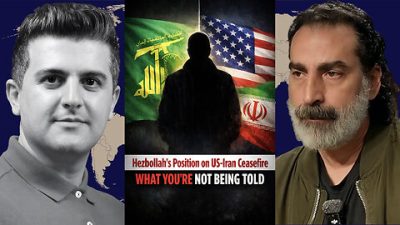
Laith Marouf: Hezbollah’s position on US-Iran ceasefire
or go to
Aletho News Archives – Video-Images
From the Archives
Is Israel to blame for the Iraq War?
American Goy | March 10, 2008
I am so tired of this old canard that “Israel had nothing to do with USA’s war with Iraq – in fact, it officially advised America against it”.
Bullshit. … continue
Blog Roll
 Aletho News
- Laith Marouf: Hezbollah’s position on US-Iran ceasefire: What you’re not being told
- Israel’s priority lies in destroying chances of peace between Iran, US: Ex-UN nuclear chief
- Ceasefire for all or for none: Iran shuts Hormuz over Lebanon attacks
- Strait of Hormuz is Iran’s ‘nuclear weapon’ that forced US retreat: Medvedev
- Energy crisis will last for months – Kremlin envoy
- Europe’s quiet role in the war on Iran
- Forty days that shook the Empire: How Iran turned the tables on US and prevailed
- Netanyahu unilaterally declares Lebanon outside of ceasefire deal
- Israeli leaders: ‘Not a single goal’ achieved in war with Iran
- What on earth just happened? Trump, Iran, and the unlikely ceasefire
- If Americans Knew
- Gazans face a triple crisis: severe shortages of water and bread, healthcare in tatters
- NY Times reports how Netanyahu took the US into Iran War
- A sigh of relief over Iran, but Gaza and Lebanon in dire straits – Daily Update
- Thousands dead and neighborhoods razed to the ground: Aid agencies fear southern Lebanon is becoming the new Gaza
- The war the US is fighting for Israel could cost trillions
- ‘Cigarette Burns, Nail Wounds’: Toddler Tortured in Gaza to Coerce Father
- Trump Says US Sent ‘a Lot of Guns’ to Protesters in Iran
- Israeli forces destroy 17 UN peacekeeper cameras in south Lebanon
- US-Israeli strikes ‘completely destroy’ synagogue in Tehran
- Archbishop for US Military Says Iran War Is Unjust Under Catholic Teaching
- No Tricks Zone
- An Inconvenient Tree: Uncovered In Alps… Europe Much Warmer Than Today 6000 Years Ago
- New Study Reports A 60% Slowdown In Greenland’s Ice Loss Rate In The Last Decade
- Low Intensity Tornado Wrecks Major Solar Farm, Creating A Potential Toxic Dump
- New Study Finds Warming Saves Lives…Cold Temperatures 12 Times More Deadly Than Excess Heat
- German Science Blog Accuses PIK Climate Institute Of Hallucinating Climate Tipping Points
- Devastating Assessment Of Comirnaty Vaccine By Former Senior Pfizer Europe Toxicologist
- New Study: CO2 Is ‘Effectively Negligible’ As An Explanatory Climate Change Factor Since 2000
- Former Pfizer Toxicologist Dr. Helmut Sterz Tells Bundestag Hearing Pfizer Vaccine Should Have Never Been Approved
- Energy Expert: Germany’s Nuclear Phaseout Was A “500 Billion Euro Mistake”
- New Research: South Australia’s Mid-Holocene Sea Surface Temperatures Were 4°C Warmer Than Today
 Aletho News