Denmark wants huge hike in military budget ‘to deter Russia’
Press TV – January 16, 2018
The Danish government aims to increase its military spending to counter an alleged security threat from Russia in Eastern Europe.
During a visit to the Danish Air Force team in Lithuania on Monday, Danish Prime Minister Lars Lokke Rasmussen said his center-right minority government needed to persuade the Danish parliament next month to back a proposed, whopping 20-percent hike in Denmark’s military budget over a five-year period.
“We want to look at ourselves as a core NATO member. And in order to behave like such a member, we need to increase our expenditures,” Rasmussen said.
An agreement made in 2006 calls on NATO member countries to have a military spending of at least two percent of their GDP. While many members of the military alliance have refused to allocate that percentage of their GDP to the military, some have recently been invoking the agreement in an ostensible attempt to deter Russia.
The Danish prime minister said his country’s military budget needed a “substantial increase.”
“Five years ago we thought that the defense line, so to speak, would not be in Europe, but would be international operations. Now we realize that we need to have the capability to do both,” he added.
The brandishing of a “Russian threat” comes while NATO member states have significantly increased their military activities near Russia’s western borders in recent years.
Last week, Denmark deployed 200 troops to a UK-led NATO mission in Estonia, citing the alleged threat from Russia. NATO has deployed around 4,000 troops, consisting of four battle groups, to Estonia, Lithuania, Latvia, and Poland — all near Russian borders — in recent years.
Russia, realizing that security threat under its nose, has held several military drills to maintain preparedness. The NATO countries have then referred to those drills as signs that Russia has aggressive and not defensive intentions.
NATO — largely made up of Western European countries — also accuses Russia of having a hand in the crisis in Ukraine, which Moscow denies.
Eastern Ukraine has been the site of a conflict since 2014, when the government in Kiev started a crackdown on pro-Russia protests in the country. Earlier that same year, the Crimean Peninsula, then Ukrainian territory, voted in a referendum to separate from Ukraine and join the Russian Federation. Western countries branded the subsequent unification as an “annexation” of the territory by Russia, and Ukraine soon confronted pro-Russia protests elsewhere — in its eastern Donbass region — with a heavy hand.
The crisis in the Donbass soon turned into an armed conflict, which has so far left over 10,000 people dead and more than a million others displaced. Western countries have blamed Russia, which denies any involvement.
“Russia’s behavior has created an unpredictable and unstable security environment in the Baltic Sea region,” Lokke Rasmussen, the Danish prime minister, said at a joint news conference with Latvian Prime Minister Maris Kucinskis in the capital, Riga.
“Given the Russian aggression and what happened in Crimea, I think we simply have to be realistic about things and invest more in our security,” he said.
Sweden Starts Anti-‘Fake News’ Body for Mental Defense Against ‘Russian Threat’
Sputnik | January 15, 2108
In a build-up prior the forthcoming general election in September 2018, the Swedish government is planning to set up a new authority responsible for psychological defense. The perennial and widely speculated upon “Russian threat” has once again been used as a bogeyman.
Swedish Prime Minister Stefan Löfven, who presented the idea of a new authority tasked with the nation’s psychological defense at the national People and Defense security conference, said it would safeguard the people’s will for peace and resilience in times of war, as well as ensure the public’s right to accurate public information, deterring potential disinformation campaigns.
“We will not hesitate to expose those who are still trying to do something like this. We know that operations are underway at the moment,” Löfven said in his speech in Sälen, specifically pointing out Russia, which he also called a “large and important neighbor in the East.” “However, we cannot rule out that there may be others,” he said, adding that Sweden was “well prepared to face the new threats.”
Previously, the Nordic nation’s psychological defense has been safeguarded by the Swedish Civil Contingencies Agency (MSB). The new authority will specifically focus on foreign indoctrination operations as part of Sweden’s “total defense.”
“Our election system is robust. Our intelligence services warn of suspicious operations in advance. Several authorities have received increased funding to further hone their ability. But more must be done. So to those considering influencing the election outcome in our country: Stay out!” Löfven thundered.
“Russian hacking” became part of the Swedish narrative about a year ahead of the elections. Already in January 2017, the very same Löfven groundlessly speculated that Russia would try and influence the Swedish parliamentary election.”There is nothing that indicates that future Swedish elections will be peaceful,” Löfven was quoted as saying.
Columnist Patrik Oksanen, who suggested that Sweden was engaged in an information war as early as 2015, argued that Russia’s aim is to have a direct ruling on who is fit to occupy key posts, in attempt to “restore its natural influence.” In late 2017, Oksanen went on so far as to accuse the Swedish establishment of “running Russia’s errands,” suggesting there were “Putin’s lackey’s” both left and right.
“So what can we expect from the 2018 election year? The structure of Russian influence in Sweden is established, the temperature is set to increase, Oksanen wrote in his recent opinion piece in the newspaper Svenska Dagbladet, titled “We have to protect ourselves mentally against Russia.”
The accusations, however, were brushed aside by Russian Foreign Minister Sergei Lavrov as ludicrous.
“I am sure that those who are aware of the situation understand how laughable this is,” Lavrov said.
At present, no start date for the new authority has been set. In a follow-up to upping the “total defense” strategy, however, leaflets “If the war comes” will be distributed among Swedish households for the first time in 30 years.
In addition to instructing Swedes on handling war and terror, the new edition of the brochure will have an emphasis on psyops.
The first edition of “If the war comes” was developed by the Swedish Defense and was first distributed among all Swedish households During World War II in 1943. The circulation of the information booklet ceased in the 1980s, only to resume in 2018. By the end of June, 4.7 million Swedish families will have received the pamphlet from the MSB with detailed instructions on how to deal with terrorist attacks, natural disasters, war and, not least, “fake news.”
“Previously, the focus was entirely on war. Today’s society is totally different. There is a more complex threat of climate change, terrorist attacks, pandemics and indoctrination,” Christina Andersson, tasked with the preparation of the brochure, told the Aftonbladet daily.
At the same time, Swedes’ concern about military threats in the country are abating. Today, only 28 percent of Swedes feel worried, which is a marked drop from 34 percent in 2016, national broadcaster SVT reported.
READ ALSO:
Money Rains Over Swedish Mainstream Media to Stop ‘Fake News,’ ‘Russian Trolls’
The US Is Meddling In Mexico’s Election By Accusing Russia Of Doing So
By Andrew KORYBKO – Oriental Review – 13/01/2018
US National Security Advisor McMaster claimed that Russia is meddling in the upcoming Mexican elections.
This explosive news was shared by Reuters, which in turn was reporting on a mid-December video of a speech that McMasters gave to the Jamestown Foundation and which was just posted on a Mexican journalist’s Twitter account over the weekend. In it, one of the US’ most influential security figures says in relation to the unsubstantiated claims of Russian interference in foreign elections that “you’ve seen, actually, initial signs of it in the Mexican presidential campaign already”, but to Reuters’ credit they added that he didn’t elaborate on this afterwards and even cited an expert who remarked that “so far, it’s just speculation”.
That said, Reuters attempted to propel the paranoia forward by remarking that the leftist populist-nationalist candidate Andres Manuel Lopez Obrador, commonly known by his abbreviated initials as AMLO, is “seen by some analysts as the Kremlin’s favorite, given the positive coverage he has received from government-funded media outlets like Sputnik and Russia Today”, thus relying on the conspiracy theory that everything on Russia’s publicly funded international media outlets is apparently aired on direct orders of the Kremlin, which isn’t true at all. Nor, for that matter, is the inference in the report that Russia is backing AMLO because of its desire to sow problems between the US and Mexico.
There’s credence to the forecast that AMLO’s potential victory would complicate US-Mexican relations because of the contradictory visions of their two leaders in that case, but this, as well as Russian international media’s detailed coverage of the leftist populist-nationalist candidate, don’t in and of themselves “prove” anything about Moscow’s alleged meddling in the upcoming elections. Rather, McMaster’s hysterical claim seems to be part of a preemptive infowar designed to discredit AMLO’s potential victory just like the Clintons tried to do with Trump’s over the same issue of alleged “Russian interference”, thereby suggesting that the US’ permanent military, intelligence, and diplomatic bureaucracies (or “deep state”) assess his odds of winning to be much higher than is publicly being reported.
That would explain why one of the top decision makers in the Trump Administration is already rolling out the weaponized narrative that Russia is supposedly backing AMLO, since they also want to add ammunition to the right-wing’s arsenal of personalized attacks in order to scare the electorate away from voting for him. Thus, it’s actually the US that’s openly interfering in the Mexican elections, just as it always has to one extent or another, and not Russia, with McMaster’s clumsily blatant hypocrisy emphasizing just how high Washington believes the geostrategic stakes to its security to be if “the wrong guy” gets into power and how desperate the US is to stop that from happening.
The post presented is the partial transcript of the CONTEXT COUNTDOWN radio program on Sputnik News, aired on Friday Jan 12, 2018.
The FBI Hand Behind Russia-gate
By Ray McGovern | Consortium News | January 11, 2018
Russia-gate is becoming FBI-gate, thanks to the official release of unguarded text messages between loose-lipped FBI counterintelligence official Peter Strzok and his garrulous girlfriend, FBI lawyer Lisa Page. (Ten illustrative texts from their exchange appear at the end of this article.)
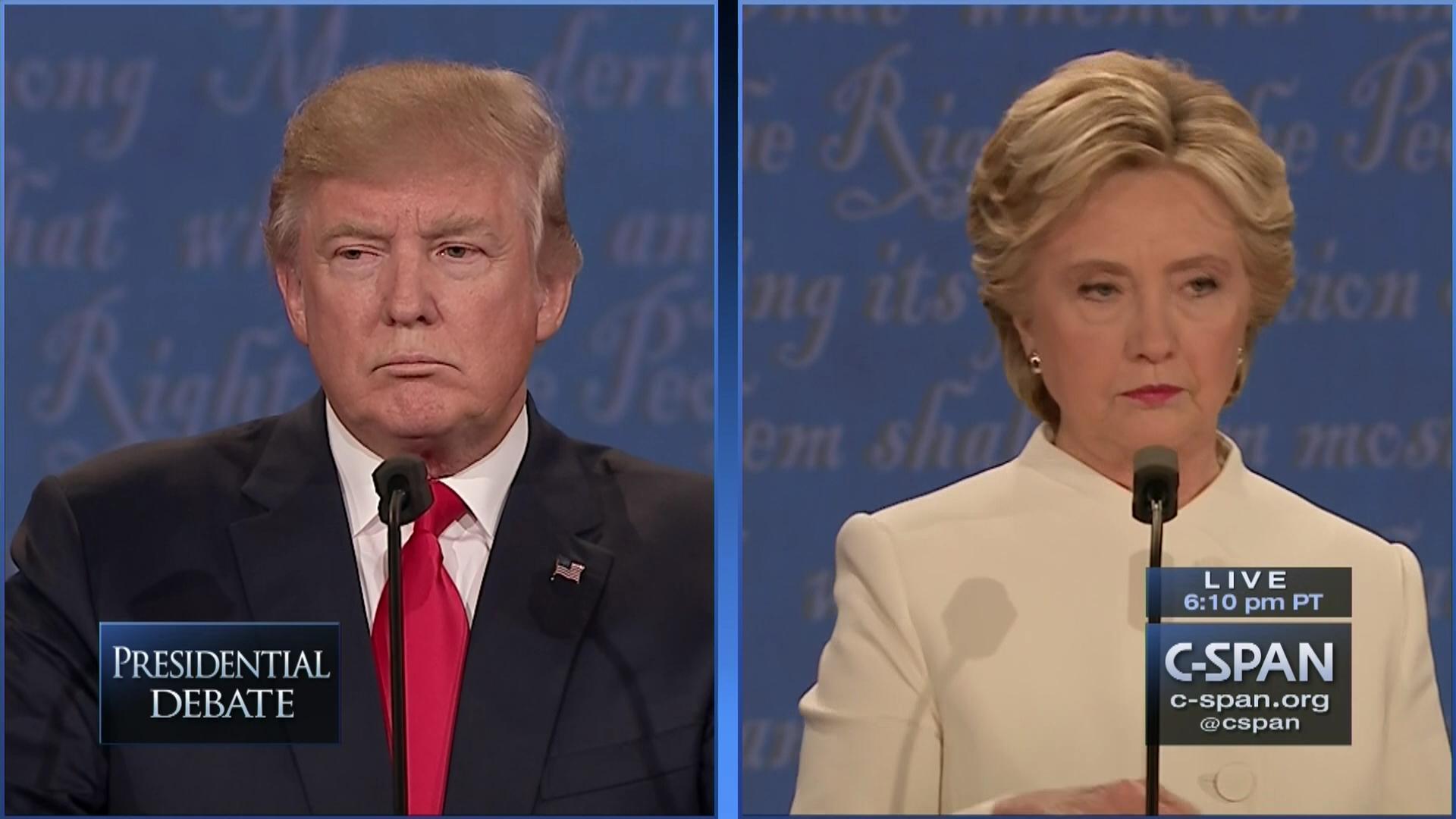
Donald Trump and Hillary Clinton in their third debate,
as Clinton called Trump Vladimir Putin’s “puppet.”
Despite his former job as chief of the FBI’s counterintelligence section, Strzok had the naive notion that texting on FBI phones could not be traced. Strzok must have slept through “Security 101.” Or perhaps he was busy texting during that class. Girlfriend Page cannot be happy at being misled by his assurance that using office phones would be a secure way to conduct their affair(s).
It would have been unfortunate enough for Strzok and Page to have their adolescent-sounding texts merely exposed, revealing the reckless abandon of star-crossed lovers hiding (they thought) secrets from cuckolded spouses, office colleagues, and the rest of us. However, for the never-Trump plotters in the FBI, the official release of just a fraction (375) of almost 10,000 messages does incalculably more damage than that.
We suddenly have documentary proof that key elements of the U.S. intelligence community were trying to short-circuit the U.S. democratic process. And that puts in a new and dark context the year-long promotion of Russia-gate. It now appears that it was not the Russians trying to rig the outcome of the U.S. election, but leading officials of the U.S. intelligence community, shadowy characters sometimes called the Deep State.
More of the Strzok-Page texting dialogue is expected to be released. And the Department of Justice Inspector General reportedly has additional damaging texts from others on the team that Special Counsel Robert Mueller selected to help him investigate Russia-gate.
Besides forcing the removal of Strzok and Page, the text exposures also sounded the death knell for the career of FBI Deputy Director Andrew McCabe, in whose office some of the plotting took place and who has already announced his plans to retire soon.
But the main casualty is the FBI’s 18-month campaign to sabotage candidate-and-now-President Donald Trump by using the Obama administration’s Russia-gate intelligence “assessment,” electronic surveillance of dubious legality, and a salacious dossier that could never pass the smell test, while at the same time using equally dubious techniques to immunize Hillary Clinton and her closest advisers from crimes that include lying to the FBI and endangering secrets.
Ironically, the Strzok-Page texts provide something that the Russia-gate investigation has been sorely lacking: first-hand evidence of both corrupt intent and action. After months of breathless searching for “evidence” of Russian-Trump collusion designed to put Trump in the White House, what now exists is actual evidence that senior officials of the Obama administration colluded to keep Trump out of the White House – proof of what old-time gumshoes used to call “means, motive and opportunity.”
Even more unfortunately for Russia-gate enthusiasts, the FBI lovers’ correspondence provides factual evidence exposing much of the made-up “Resistance” narrative – the contrived storyline that The New York Times and much of the rest of the U.S. mainstream media deemed fit to print with little skepticism and few if any caveats, a scenario about brilliantly devious Russians that not only lacks actual evidence – relying on unverified hearsay and rumor – but doesn’t make sense on its face.
The Russia-gate narrative always hinged on the preposterous notion that Russian President Vladimir Putin foresaw years ago what no American political analyst considered even possible, the political ascendancy of Donald Trump. According to the narrative, the fortune-telling Putin then risked creating even worse tensions with a nuclear-armed America that would – by all odds – have been led by a vengeful President Hillary Clinton.
Besides this wildly improbable storyline, there were flat denials from WikiLeaks, which distributed the supposedly “hacked” Democratic emails, that the information came from Russia – and there was the curious inability of the National Security Agency to use its immense powers to supply any technical evidence to support the Russia-hack scenario.
The Trump Shock
But the shock of Trump’s election and the decision of many never-Trumpers to cast their lot with the Resistance led to a situation in which any prudent skepticism or demand for evidence was swept aside.
So, on Jan. 6, 2017, President Obama’s Director of National Intelligence James Clapper released an evidence-free report that he said was compiled by “hand-picked” analysts from the CIA, FBI and NSA, offering an “assessment” that Russia and President Putin were behind the release of the Democratic emails in a plot to help Trump win the presidency.
Despite the extraordinary gravity of the charge, even New York Times correspondent Scott Shane noted that proof was lacking. He wrote at the time: “What is missing from the [the Jan. 6] public report is what many Americans most eagerly anticipated: hard evidence to back up the agencies’ claims that the Russian government engineered the election attack. … Instead, the message from the agencies essentially amounts to ‘trust us.’”
But the “assessment” served a useful purpose for the never-Trumpers: it applied an official imprimatur on the case for delegitimizing Trump’s election and even raised the long-shot hope that the Electoral College might reverse the outcome and possibly install a compromise candidate, such as former Secretary of State Colin Powell, in the White House. Though the Powell ploy fizzled, the hope of somehow removing Trump from office continued to bubble, fueled by the growing hysteria around Russia-gate.
Virtually all skepticism about the evidence-free “assessment” was banned. For months, the Times and other newspapers of record repeated the lie that all 17 U.S. intelligence agencies had concurred in the conclusion about the Russian “hack.” Even when that falsehood was belatedly acknowledged, the major news outlets just shifted the phrasing slightly to say that U.S. intelligence agencies had reached the Russian “hack” conclusion. Shane’s blunt initial recognition about the lack of proof disappeared from the mainstream media’s approved narrative of Russia-gate.
Doubts about the Russian “hack” or dissident suggestions that what we were witnessing was a “soft coup” were scoffed at by leading media commentators. Other warnings from veteran U.S. intelligence professionals about the weaknesses of the Russia-gate narrative and the danger of letting politicized intelligence overturn a constitutional election were also brushed aside in pursuit of the goal of removing Trump from the White House.
It didn’t even seem to matter when new Russia-gate disclosures conflicted with the original narrative that Putin had somehow set Trump up as a Manchurian candidate. All normal journalistic skepticism was jettisoned. It was as if the Russia-gate advocates started with the conclusion that Trump must go and then made the facts fit into that mold, but anyone who noted the violations of normal investigative procedures was dismissed as a “Trump enabler” or a “Moscow stooge.”
The Text Evidence
But then came the FBI text messages, providing documentary evivdence that key FBI officials involved in the Russia-gate investigation were indeed deeply biased and out to get Trump, adding hard proof to Trump’s longstanding lament that he was the subject of a “witch hunt.”
Justified or not, Trump’s feeling of vindication could hardly be more dangerous — particularly at a time when the most urgent need is to drain some testosterone from the self-styled Stable-Genius-in-Chief and his martinet generals.
On the home front, Trump, his wealthy friends, and like-thinkers in Congress may now feel they have an even wider carte blanche to visit untold misery on the poor, the widow, the stranger and other vulnerable humans. That was always an underlying danger of the Resistance’s strategy to seize on whatever weapons were available – no matter how reckless or unfair – to “get Trump.”
Beyond that, Russia-gate has become so central to the Washington establishment’s storyline that there appears to be no room for second-thoughts or turning back. The momentum is such that some Democrats and the media never-Trumpers can’t stop stoking the smoke of Russia-gate and holding out hope against hope that it will somehow justify Trump’s impeachment.
Yet, the sordid process of using legal/investigative means to settle political scores further compromises the principle of the “rule of law” and integrity of journalism in the eyes of many Americans. After a year of Russia-gate, the “rule of law” and “pursuit of truth” appear to have been reduced to high-falutin’ phrases for political score-setttling, a process besmirched by Republicans in earlier pursuits of Democrats and now appearing to be a bipartisan method for punishing political rivals regardless of the lack of evidence.
Strzok and Page
Peter Strzok (pronounced “struck”) has an interesting pedigree with multiple tasks regarding both Mrs. Clinton and Mr. Trump. As the FBI’s chief of counterespionage during the investigation into then-Secretary of State Hillary Clinton’s unauthorized use of a personal email server for classified information, Strzok reportedly changed the words “grossly negligent” (which could have triggered legal prosecution) to the far less serious “extremely careless” in FBI Director James Comey’s depiction of Clinton’s actions. This semantic shift cleared the way for Comey to conclude just 20 days before the Democratic National Convention began in July 2016, that “no reasonable prosecutor” would bring charges against Mrs. Clinton.
Then, as Deputy Assistant Director of the Counterintelligence Division, Strzok led the FBI’s investigation into alleged Russian interference in the U.S. election of 2016. It is a safe bet that he took a strong hand in hand-picking the FBI contingent of analysts that joined “hand-picked” counterparts from CIA and NSA in preparing the evidence-free, Jan. 6, 2017 assessment accusing Russian President Vladimir Putin of interfering in the election of 2016. (Although accepted in Establishment groupthink as revealed truth, that poor excuse for analysis reflected the apogee of intelligence politicization — rivaled only by the fraudulent intelligence on “weapons of mass destruction“ in Iraq 15 years ago.)
In June and July 2017 Strzok was the top FBI official working on Special Counsel Robert Mueller’s investigation into possible links between the Trump campaign and Russia, but was taken off that job when the Justice Department IG learned of the Strzok-Page text-message exchange and told Mueller.
There is no little irony in the fact that what did in the FBI sweathearts was their visceral disdain for Mr. Trump, their cheerleading-cum-kid-gloves treatment of Mrs. Clinton and her associates, their 1950-ish, James Clapperesque attitude toward Russians as “almost genetically driven” to evil, and their (Strzok/Page) elitist conviction that they know far better what is good for the country than regular American citizens, including those “deplorables” whom Clinton said made up half of Trump’s supporters.
But Strzok/Page had no idea that their hubris, elitism and scheming would be revealed in so tangible a way. Worst of all for them, the very thing that Strzok, in particular, worked so hard to achieve — the sabotaging of Trump and immunization of Mrs. Clinton and her closest advisers is now coming apart at the seams.
Congress: Oversee? or Overlook?
At this point, the $64 question is whether the various congressional oversight committees will remain ensconced in their customarily cozy role as “overlook” committees, or whether they will have the courage to attempt to carry out their Constitutional duty. The latter course would mean confronting a powerful Deep State and its large toolbox of well-practiced retaliatory techniques, including J. Edgar Hoover-style blackmail on steroids, enabled by electronic surveillance of just about everything and everyone. Yes, today’s technology permits blanket collection, and “Collect Everything” has become the motto.
Sen. Chuck Schumer, D-New York, with almost four decades of membership in the House and Senate, openly warned incoming President Trump in January 2017 against criticizing the U.S. intelligence community because U.S. intelligence officials have “six ways from Sunday to get back at you” if you are “dumb” enough to take them on.
Thanks to the almost 10,000 text messages between Strzok and Page, only a small fraction of which were given to Congress four weeks ago, there is now real evidentiary meat on the bones of the suspicions that there indeed was a “deep-state coup” to “correct” the outcome of the 2016 election. We now know that the supposedly apolitical FBI officials had huge political axes to grind. The Strzok-Page exchanges drip with disdain for Trump and those deemed his smelly deplorable supporters. In one text message, Strzok expressed visceral contempt for those working-class Trump voters, writing on Aug. 26, 2016, “Just went to a southern Virginia Walmart. I could SMELL the Trump support. … it’s scary real down here.”
The texts even show Strzok warning of the need for an “insurance policy” to thwart Trump on the off-chance that his poll numbers closed in on those of Mrs. Clinton.
An Aug. 6, 2016 text message, for example, shows Page giving her knight in shining armor strong affirmation: “Maybe you’re meant to stay where you are because you’re meant to protect the country from that menace [Trump].” That text to Strzok includes a link to a David Brooks column in The New York Times, in which Brooks concludes with the clarion call: “There comes a time when neutrality and laying low become dishonorable. If you’re not in revolt, you’re in cahoots. When this period and your name are mentioned, decades hence, your grandkids will look away in shame.”
Another text message shows that other senior government officials – alarmed at the possibility of a Trump presidency – joined the discussion. In an apparent reference to an August 2016 meeting with FBI Deputy Director Andrew McCabe, Strzok wrote to Page on Aug. 15, 2016, “I want to believe the path you threw out for consideration in Andy’s office — that there’s no way he [Trump] gets elected — but I’m afraid we can’t take that risk.” Strzok added, “It’s like an insurance policy in the unlikely event that you die before you’re 40.”
Insurance Policy?
Senate Judiciary Committee chair Chuck Grassley, R-Iowa, says he will ask Strzok to explain the “insurance policy” when he calls him to testify. What seems already clear is that the celebrated “Steele Dossier” was part of the “insurance,” as was the evidence-less legend that Russia hacked the DNC’s and Clinton campaign chairman John Podesta’s emails and gave them to WikiLeaks.
If congressional investigators have been paying attention, they already know what former weapons inspector Scott Ritter shared with Veteran intelligence Professionals for Sanity (VIPS) colleagues this week; namely, that Fusion GPS’s Glenn Simpson, who commissioned the Russia dossier using Democratic Party money, said he reached out to Steele after June 17, just three days before Steele’s first report was published, drawing on seven sources.
“There is a snowball’s chance in hell that this is raw intelligence gathered by Steele; rather he seems to have drawn on a single ‘trusted intermediary’ to gather unsubstantiated rumor already in existence.”
Another VIPS colleague, Phil Giraldi, writing out of his own experience in private sector consulting, added: “The fact that you do not control your sources frequently means that they will feed you what they think you want to hear. Since they are only doing it for money, the more lurid the details the better, as it increases the apparent value of the information. The private security firm in turn, which is also doing it for the money, will pass on the stories and even embroider them to keep the client happy and to encourage him to come back for more. When I read the Steele dossier it looked awfully familiar to me, like the scores of similar reports I had seen which combined bullshit with enough credible information to make the whole product look respectable.”
It is now widely known that the Democrats ponied up the “insurance premiums,” so to speak, for former British intelligence officer Christopher Steele’s “dossier” of lurid — but largely unproven — “intelligence” on Trump and the Russians. If, as many have concluded, the dossier was used to help justify a FISA warrant to snoop on the Trump campaign, those involved will be in deep kimchi, if congressional overseers do their job.
How, you might ask, could Strzok and associates undertake these extra-legal steps with such blithe disregard for the possible consequences should they be caught? The answer is easy; Mrs. Clinton was a shoo-in, remember? This was just extra insurance with no expectation of any “death benefit” ever coming into play — save for Trump’s electoral demise in November 2016. The attitude seemed to be that, if abuse of the FISA law should eventually be discovered — there would be little interest in a serious investigation by the editors of The New York Times and other anti-Trump publications and whatever troubles remained could be handled by President Hillary Clinton.
Sen. Lindsey Graham, R-South Carolina, who chairs the Judiciary Subcommittee of Judiciary on Crime and Terrorism, joined Sen. Grassley in signing the letter referring Christopher Steele to the Justice Department to investigate what appear to be false statements about the dossier. In signing, Graham noted the “many stop signs the Department of Justice ignored in its use of the dossier.” The signature of committee ranking member Sen. Dianne Feinstein, D-California, however, was missing — an early sign that a highly partisan battle royale is in the offing. On Tuesday, Feinstein unilaterally released a voluminous transcript of Glenn Simpson’s earlier testimony and, as though on cue, Establishment pundits portrayed Steele as a good source and Fusion GPS’s Glenn Simpson as a victim.
The Donnybrook is now underway; the outcome uncertain.
+++++++++++++
Sample text messages between Peter Strzok and Lisa Page, released to Congress and the media on December 13, 2016
++++++++++++++
03/04/2016
Strzok – God Hillary should win. 100,000,000-0.
Page – I know
++++++++++++
04/02/2016
Page – So look, you say we text on that phone when we talk about Hillary because it can’t be traced, you were just venting, bc you feel bad that you’re gone so much but that can’t be helped right now.
++++++++++
07/08/2016
Strzok – And meanwhile, we have Black Lives Matter protestors, right now, chanting “no justice no peace” around DoJ and the White House…
Page – That’s awful.
+++++++++
07/14/2016
Page – Have you read this? It’s really frightening. For Whites Sensing Decline, Donald Trump Unleashes Words of Resistance http://NYTI/ms/29WCu5!
Strzok – I have not. But I think it’s clear he’s capturing all the white, poor voters who the mainstream republicans abandoned in all but name in the quest for the almighty $$$
Page – Yeah, it’s not good.
Strzok – Poll Finds Emails Weighing on Hillary Clinton, Now Tied With Donald Trump http://nyti.ms/29RV5gf
Page – It is
+++++++++++++
07/26/2016
Strzok – And hey. Congrats on a woman nominated for President in a major party! About damn time! Many many more returns of the day!!
Page – That’s cute. Thanks
++++++++++
08/06/2016
Page – Jesus. You should read this. And Trump should go f himself. Moment in Convention Glare Shakes Up Khans American Life http://nyti.ms/2aHulE0
Strzok – God that’s a great article. Thanks for sharing. And F TRUMP.
++++++++
08/06/2016
Page – And maybe you’re meant to stay where you are because you’re meant to protect the country from that menace. To that end comma, read this:
Page – Trump Enablers Will Finally Have to Take A Stand http://nyti.ms/2aFakry
Strzok – Thanks. It’s absolutely true that we’re both very fortunate. And of course I’ll try and approach it that way. I just know it will be tough at times. I can protect our country at many levels, not sure if that helps
++++++++++++
08/09/2016
Page – He’s not ever going to become president, right? Right?!
Strzok – OMG did you hear what Trump just said?
+++++++++++
08/26/2016
Strzok – Just went to a southern Virginia Walmart. I could SMELL the Trump support…
Page – Yep. Out to lunch with (redacted) We both hate everyone and everything.
Page – Just riffing on the hot mess that is our country.
Strzok – Yeah…it’s scary real down here
+++++++++
10/20/2016
Strzok: I am riled up. Trump is a f***ing idiot, is unable to provide a coherent answer.
Strzok – I CAN’T PULL AWAY, WHAT THE F**K HAPPENED TO OUR COUNTRY (redacted)??!?!
Page– I don’t know. But we’ll get it back. We’re America. We rock.
Strzok– Donald just said “bad hombres”
Strzok– Trump just said what the FBI did is disgraceful.
END
Ray McGovern works with Tell the Word, a publishing arm of the ecumenical Church of the Saviour in inner-city Washington. He was an Army and CIA intelligence analyst for 30 years; prepared and briefed the President’s Daily Brief for Nixon, Ford, and Reagan; and is co-founder of Veteran Intelligence Professionals for Sanity (VIPS).
Wired’s Fake-News Suggests Russia Plotting to Cut Trans-Atlantic Internet Cables
By Robert BRIDGE | Strategic Culture Foundation | 10.01.2018
Well, that didn’t take long. Just five days into 2018, and the American fake news industry is already up and running, churning out tasteless whoppers faster than Burger King.
Wired magazine has joined the greasy ranks of other Western mythmakers now fueling a black wave of anti-Russia hysteria by mass-producing never-ending unsubstantiated claims and outright lies against the Kremlin.
The article begins with a doomsday scenario involving some “terrorist organization or nefarious nation” making the reckless decision to cut the undersea fiber optic cables that connect people across the world. So out of all the numerous diabolical groups that now populate the planet, who did Wired nominate as the most likely to pull off such a wanton act of sabotage? Yes, you got it. Putin’s Russia.
The obvious question for any rational thinking person is: Why would Russia do such a thing? Because, according to Wired, the Russian Navy has been “repeatedly caught snooping near the cables” that run along the entire expanse of the North Atlantic Ocean. Wired conveniently fails to remind its readers, however, that any country with a naval force would be forced to pass these lines on numerous occasions in the course of its travels. But acknowledging as much would be putting facts before fiction, and of course we can’t have that.
So where does Wired get its information regarding these latest nefarious plans on the part of Russia? From yet another purveyor of Russian fake news – arguably second only to the Washington Post – the New York Times.
“Russian submarines and spy ships are aggressively operating near the vital undersea cables that carry almost all global Internet communications, raising concerns among some American military and intelligence officials that the Russians might be planning to attack those lines in times of tension or conflict,” the Times breathlessly reported back in 2015.
However, just like the fake news of ‘Russia hacking the 2016 US presidential elections,’ don’t expect any evidence to support the claims. In fact, the Times admits as much in the third paragraph.
“While there is no evidence yet of any cable cutting, the concern is part of a growing wariness among senior American and allied military and intelligence officials over the accelerated activity by Russian armed forces around the globe.”
Well, now we’re getting somewhere. What really seems to be annoying the Americans is not some sort of outlandish attack on the Internet by Russia, but the fact that the Russian military is now a force to reckon with.
It is also worth noting that the Times article appeared just one month after Vladimir Putin committed the Russian military in September 2015 to fighting against Islamic State forces in Syria – following a formal request by Syrian President Bashar Assad. Some might call that curious timing.
So what exactly would Russia stand to gain from cutting these undersea cables? Absolutely nothing. In fact, as even Wired was gracious enough to admit – albeit buried far at sea in its hit piece – is that any cutting of the cables would be more injurious to Russia than most other countries.
“… Russia’s epic hypothetical cable attack would primarily harm its own people,” according to a Telegeography senior analyst Jonathan Hjembo, as quoted by the magazine. “It would hurt the Russians perhaps even more than it would hurt [Americans]. They’re far more dependent on international networks than we are, because so much of our content is stored locally.”
In fact, Wired was forced to admit that the greatest threat to the undersea cables is not Russia, the bogeyman of nearly every Western publication in circulation, but fishermen and scavengers.
Wired retold the story of one elderly woman who accidentally cut through an underground cable “while scavenging for copper,” cutting off Armenia’s entire internet access, leaving the country offline for five hours.
Yet despite those admissions, and the absolute lack of any incentive on the part of Russia to commit such an act of folly, Wired bowed out of its story with a parting shot at “Putin’s Russia” anyways.
“There have also been no ruptures attributed to Russian aggression. It appears that Putin has largely left the undersea cables alone, at least for now.”
Clearly, as this ridiculously flimsy article illustrates, without any shame, there will be no pause in the anti-Russia propaganda mudslinging in the New Year.
The Times Rides to Mueller’s Rescue
By Pat Buchanan • Unz Review • January 2, 2018
What caused the FBI to open a counterintelligence investigation into the Trump campaign in July 2016, which evolved into the criminal investigation that is said today to imperil the Trump presidency?
As James Comey’s FBI and Special Counsel Robert Mueller have, for 18 months, failed to prove Donald Trump’s “collusion” with the Kremlin, what was it, in mid-2016, that justified starting this investigation?
What was the basis for the belief Trump was colluding, that he was the Manchurian candidate of Vladimir Putin? What evidence did the FBI cite to get FISA court warrants to surveil and wiretap Trump’s team?
Republican congressmen have for months been demanding answers to these questions. And, as Mueller’s men have stonewalled, suspicions have arisen that this investigation was, from the outset, a politicized operation to take down Trump.
Feeding those suspicions has been the proven anti-Trump bias of investigators. Also, wiretap warrants of Trump’s team are said to have been issued on the basis of a “dirty dossier” that was floating around town in 2016 — but which mainstream media refused to publish as they could not validate its lurid allegations.
Who produced the dossier?
Ex-British spy Christopher Steele, whose dirt was delivered by ex-Kremlin agents. And Steele was himself a hireling of Fusion GPS, the oppo research outfit enlisted and paid by the Clinton campaign and DNC.
Writes the Washington Times, Steele “paid Kremlin sources with Democratic cash.”
Yet, if Steele’s dossier is a farrago of falsehoods and fake news, and the dossier’s contents were used to justify warrants for wiretaps on Trump associates, Mueller has a problem.
Prosecutions his team brings could be contaminated by what the FBI did, leaving his investigation discredited.
Fortunately, all this was cleared up for us New Year’s Eve by a major revelation in The New York Times. Top headline on page one:
“Unlikely Source Propelled Russia Meddling Inquiry”
The story that followed correctly framed the crucial question:
“What so alarmed American officials to provoke the FBI to open a counterintelligence investigation of the Trump campaign months before the presidential election?”
The Times then gave us the answer we have been looking for:
“It was not, as Trump and other politicians have alleged, a dossier compiled by a former British spy hired by a rival campaign. Instead it was firsthand information from one of America’s closest intelligence allies.”
The ally: Australia, whose ambassador to Britain was in an “upscale London Bar” in the West End in May 2016, drinking with a sloshed George Papadopoulos, who had ties to the Trump campaign and who informed the diplomat that Russia had dirt on Hillary Clinton.
Papadopoulos had reportedly been told in April that Russia had access to Clinton’s emails.
Thus, when the DNC and John Podesta emails were splashed all over the U.S. press in June, Amb. Alexander Downer, recalling his conversation with Papadopoulos, informed his government, which has excellent ties to U.S. intelligence, and the FBI took it from there.
The Times’ story pounds home this version of events:
“The hacking and the revelation that a member of the Trump campaign may have had inside information about it were driving factors that led the FBI to open an investigation in July 2016 into Russian attempts to disrupt the election and whether any of Trump’s associates conspired.”
This, the Times assures us, “answers one of the lingering mysteries of the past year.”
Well, perhaps.
But if Papadopoulos’s drunken babbling to the Aussie ambassador triggered the investigation in July 2016, why was George not interviewed by the FBI until January 2017?
According to the Times, an FBI agent in Rome had been told by Steele in June 2016 what he had learned from the Russians.
And Steele was interviewed by the FBI in October 2016.
If Papadopoulos triggered the investigation, why the seeming FBI disinterest in him — as compared to Steele?
Yet another major question remains unanswered.
If, as the Times writes, the FBI was looking “into Russian attempts to disrupt the elections,” why did the FBI not open an investigation into the KGB roots of the Steele dossier that was written to destroy the Republican candidate, Donald Trump?
If Trump’s alleged “collusion” with Putin to damage Clinton was worthy of an all-out FBI investigation, why did the Clinton-DNC scheme to tie Trump to Russian prostitutes, using British spies and former KGB agents, not merit an FBI investigation?
Why was there less concern about the Clinton campaign’s ties to Russian agents, than to Trumpian “collusion” that is yet unproven?
Consider what the British spy Steele and his former KGB/FSB comrades accomplished:
They have kept alive a special counsel’s investigation that has divided our country, imperiled the FBI’s reputation, preoccupied and damaged a president, and partially paralyzed the U.S. government.
Putin must be marveling at the astonishing success of his old comrades from KGB days, who could pull off an intelligence coup like this and so cripple the superpower that won the Cold War.
Copyright 2018 Creators.com.
The NYT’s latest Russiagate story on George Papadopoulos is not believable. Here’s why
Attempt to distance Russiagate investigation from discredited Trump Dossier fails on Papadopoulos’s inherent unreliability as a witness

By Alexander Mercouris | The Duran | January 1, 2018
As confidence in Robert Mueller’s investigation crumbles there have been the inevitable leaks intended to suggest that the Russiagate investigation is still on track and that despite the increasing appearances to the contrary there is actually some reality to the case it is investigating.
The leaks take the form of claims that Mueller is planning to issue a “supplemental indictment” of Paul Manafort supposedly fleshing out the tax evasion and money laundering claims he has brought against him, and more information about the strange case of George Papadopoulos.
I will not take up time discussing the ‘supplemental indictment’ against Paul Manafort. The case against Paul Manafort does not touch on the collusion allegations which are the focus of the Russiagate affair, and by all accounts the new ‘supplemental indictment’ will not change that.
What the fact that Mueller is now preparing a ‘supplemental indictment’ against Manafort shows is that what I and many others have said previously is true: the original indictment against Manafort was rushed and unprepared, probably because it was rushed out to counter criticism of Mueller which was appearing in the Wall Street Journal.
Of much more interest is the new information which has been published about George Papadopoulos. The information appears in an article in the New York Times which reads in part as follows:
During a night of heavy drinking at an upscale London bar in May 2016, George Papadopoulos, a young foreign policy adviser to the Trump campaign, made a startling revelation to Australia’s top diplomat in Britain: Russia had political dirt on Hillary Clinton.
About three weeks earlier, Mr. Papadopoulos had been told that Moscow had thousands of emails that would embarrass Mrs. Clinton, apparently stolen in an effort to try to damage her campaign.
Exactly how much Mr. Papadopoulos said that night at the Kensington Wine Rooms with the Australian, Alexander Downer, is unclear. But two months later, when leaked Democratic emails began appearing online, Australian officials passed the information about Mr. Papadopoulos to their American counterparts, according to four current and former American and foreign officials with direct knowledge of the Australians’ role.
This information has clearly been published in order to counter the increasingly widely circulating claim that it was the Trump Dossier which triggered the Russiagate investigation.
This is made absolutely clear by the following paragraphs in the New York Times article
The hacking and the revelation that a member of the Trump campaign may have had inside information about it were driving factors that led the F.B.I. to open an investigation in July 2016 into Russia’s attempts to disrupt the election and whether any of President Trump’s associates conspired…
The hacking and the revelation that a member of the Trump campaign may have had inside information about it were driving factors that led the F.B.I. to open an investigation in July 2016 into Russia’s attempts to disrupt the election and whether any of President Trump’s associates conspired.
The information that Mr. Papadopoulos gave to the Australians answers one of the lingering mysteries of the past year: What so alarmed American officials to provoke the F.B.I. to open a counterintelligence investigation into the Trump campaign months before the presidential election?
It was not, as Mr. Trump and other politicians have alleged, a dossier compiled by a former British spy hired by a rival campaign. Instead, it was firsthand information from one of America’s closest intelligence allies.
Is this however really so?
The drunken bragging of a twenty eight year old man in a London bar presumably with attractive young women present is not usually considered grounds to initiate a top secret investigation resulting in the secret surveillance of people against whom no other evidence of wrongdoing exists.
The known timeline of the Russiagate inquiry anyway strongly argues against this claim.
The DNC emails were published by Wikileaks on 22nd July 2016. The FBI launched the Russiagate inquiry in late July 2016, probably after the DNC emails were published.
This was however after the FBI had interviewed Christopher Steele, the compiler of the Trump Dossier, in early July 2016. The Trump Dossier’s first two entries are dated 20th June 2016 and 19th July 2016 – ie. before publication of the DNC emails – and it is likely that before the FBI launched the Russiagate inquiry in late July 2016 it had seen them.
The New York Times says that the FBI received the information about Papadopoulos’s bragging in front of the Australian High Commissioner after the DNC emails were published. However the FBI did not actually interview Papadopoulos until 27th January 2017.
What seems to have happened is that after the Russiagate inquiry was launched the FBI went through all the information it received which might touch on the inquiry. At some point the Australian High Commissioner’s report about Papadopoulos’s bragging in May 2016 in the London bar came up and a decision was taken to interview him.
However – contrary to what the New York Times says – the FBI cannot have accorded this any great importance since though the Russiagate inquiry was launched at the end of July 2016 the FBI did not interview Papadopoulos until 27th January 2017 ie. six months later.
That makes it all but inconceivable that it was – as the New York Times claims – the report from Australia about what Papadopoulos said in the presence of the Australian High Commissioner in the London bar rather than the Trump Dossier which triggered the Russiagate inquiry.
As it happens the rest of the New York Times article, though outlining at fantastic length the nature of Papadopoulos’s Russian contacts provides no evidence of collusion illegal or otherwise between the Russians, Papadopoulos or anyone else in the Trump campaign.
What the New York Times article does show is who Papadopoulos’s Russian contacts were.
It turns out that they were senior people in the Valdai Discussion Club, which is not at all surprising given that Professor Mifsud, the Maltese professor who was Papadopoulos’s contact, is known to have participated in a Valdai Discussion Club panel on 19th April 2016.
The Valdai Discussion Club for those who do not know is a Russian NGO which regularly hosts discussions between top level Russian officials and senior people from around the world. It is sometimes spoken of as the Russian equivalent to Davos. This page from its website gives an idea of its activities and of the very senior people from around the world who have been involved in it,
In other words when Papadopoulos and Professor Mifsud got to know each other Professor Mifsud simply put Papadopoulos in touch with the Russian organisers of the meeting he was attending.
That does not argue for Professor Mifsud’s “high level contacts” within the Russian government; it argues against it.
As it happens no Russian government official appears to have been directly involved in the discussions between the various members of the Valdai Discussion Group and Papadopoulos.
The New York Times says that Igor Ivanov, who was Russia’s foreign minister from 1998 to 2004, was consulted by Papadopoulos’s Russian contacts. Ivanov is presumably the “Russian MFA Connection” referred to in Papadopoulos’s indictment. However Ivanov is a retired official not an active one, and his Wikipedia profile suggests that he is now mainly involved in academic work and in the work of various international NGOs. As such he would have been an obvious person for members of the Valdai Discussion Club to consult, and was not in any sense a representative of the Russian government.
As for the subject matter of the discussions between Papadopoulos and his Russian contacts, there is no hint in the New York Times article of any conspiracy between Papadopoulos, the Trump campaign and the Russians concerning the election or any other matter.
Instead we are told – again at inordinate length – about Papadopoulos’s already known but ultimately futile efforts to arrange a summit meeting between Vladimir Putin and Donald Trump, which Papadopoulos persisted in even after he was told to stop them.
As has by now become typical of the New York Times’ Russiagate coverage, its latest article about Papadopoulos also states as facts things which are in fact strongly disputed.
For example it states as flat facts that it was Professor Mifsud who falsely claimed to Papadopoulos that Olga Polonskaya – one of Papadopoulos’s Russian contacts – was President Putin’s niece, and that it was Professor Mifsud who told Papadopoulos during a hotel meeting in London in April 2016 that the Russians had “dirt” on Hillary Clinton.
Professor Mifsud however has publicly denying telling Papadopoulos either of these things, and the only evidence he did so is that Papadopoulos says he did.
On the subject of the false claim that Polonskaya was Putin’s niece, it is intrinsically far more likely that this is an invention of Papadopoulos’s and not of Professor Mifsud’s. Why after all would Mifsud – presumably in cooperation with the Russians – seek to pass off Polonskaya as Putin’s niece when a five minute internet search would establish that Putin has no niece? What would be the purpose of such a thing?
The only confirmed reference to Polonskaya being Putin’s niece other than Papadopoulos’s statements to the FBI is an email Papadopoulos sent to the Trump campaign describing her as such.
It is Papadopoulos not Professor Mifsud who has pleaded guilty to lying to the FBI. Papadopoulos’s behaviour in fact clearly points to him being a young man out of his depth and given to fantasising. Even the New York Times calls him “brash, boastful and underqualified”.
It turns out that Papadopoulos even publicly reprimanded British Prime Minister David Cameron in a May 2016 interview with The London Times which he was not authorised by the Trump campaign to give, and for which he was subsequently severely reprimanded, and it is also known that he persisted in trying to arrange with the Russians a summit meeting between Donald Trump and Vladimir Putin even when told to stop doing so.
Given that Papadopoulos is therefore a known loose cannon with a record of bragging and a conviction for lying why assume that on any subject – eg. the false claims about Polonskaya – it is Papadopoulos who is telling the truth and that it is Professor Mifsud who is lying? Surely the opposite is far more likely to be true?
In the case of Polonskaya the New York Times has to pretend that it is Papadopoulos not Professor Mifsud who is telling the truth because if it were confirmed that it was Papadopoulos who invented the story about Polonskaya being Putin’s niece then that would expose him as a fantasist, which would discredit the whole elaborate scenario the New York Times is trying to spin around him.
That shows why it is dangerous to assume that Papadopoulos is telling the truth on any point when those who have a vested interest in the Russiagate story say he is. On the contrary Papadopoulos is an inherently unreliable witness and must always be treated as such.
Does the information in the New York Times article however tell us anything we didn’t previously know about the core issue in the case: the “dirt” Papadopoulos says Professor Mifsud told him that the Russians have on Hillary Clinton?
Firstly, despite the New York Times’ painstaking attempts to link the boasts which Papadopoulos blurted out in a London bar to the DNC and Podesta emails, it seems that Papadopoulos whilst he was bragging in the London bar did not in fact refer to those emails.
The relevant paragraph in the New York Times article on this point needs to be read carefully
During a night of heavy drinking at an upscale London bar in May 2016, George Papadopoulos, a young foreign policy adviser to the Trump campaign, made a startling revelation to Australia’s top diplomat in Britain: Russia had political dirt on Hillary Clinton. (bold italics added)
The words “political dirt on Hillary Clinton” are almost certainly copied from the Australian High Commissioner’s report to his government, which was subsequently passed on to the FBI, and which forms the basis of the story in the New York Times.
What these words show is that Papadopoulos was boasting in the London bar that the Russians had “political dirt about Hillary Clinton”, not that they had the DNC or Podesta emails.
What this paragraph also shows is that Papadopoulos in May 2016 was bragging about his high position in the Trump campaign and about his contacts with the Russians, and was doing so openly in the presence of no less a person than the Australian High Commissioner, whose identity he cannot have been unaware of.
This sort of wild indiscretion all but proves that Papadopoulos was not involved in a secret criminal conspiracy with the Russians. Of course the rest of the New York Times article and the text of his indictment provides no evidence that he was.
In fact it is possible to make some educated guesses about the Papadopoulos affair based on this new information, which leads to diametrically opposite conclusions to the ones reached by the New York Times.
In May 2016 Papadopoulos was clearly on a high, giving foolish interviews to The London Times and bragging in front of the Australian High Commissioner in a London bar about his high level position in the Trump campaign and about his contacts with the Russians.
That strongly points to his boast in the London bar that the Russians had ‘political dirt’ on Hillary Clinton being his own invention.
Subsequently, when he was asked about it by the FBI – long after the Russiagate scandal broke out – he panicked and blamed the whole thing on Professor Mifsud who he said told him about it during their meeting in the London hotel in April 2016.
Note that the wording of the indictment shows that Papadopoulos was vague about what precisely Professor Mifsud was supposed to have told him:
On or about April 26, 2016, defendant PAPADOPOULOS met the Professor for breakfast at a London hotel. During this meeting, the Professor told defendant PAPADOPOULOS that he had just returned from a trip to Moscow where he had met with high-level Russian government officials. The Professor told defendant PAPADOPOULOS that on that trip he (the Professor) learned that the Russians had obtained “dirt” on then-candidate Clinton. The Professor told defendant PAPADOPOULOS, as defendant PAPADOPOULOS later described to the FBI, that “They [the Russians] have dirt on her”; “the Russians had emails of Clinton“; “they have thousands of emails.” (bold italics added)
The words “the Russians had emails of Clinton” make it clear that the emails and supposedly discussed by Professor Mifsud and Papadopoulos were not the DNC and Podesta emails but Hillary Clinton’s own 33,000 emails deleted from her private email server. Had Papadopoulos referred to the DNC and Podesta emails in his interview with the FBI the indictment would have surely said so.
In May 2016 – the month when Papadopoulos was drunkenly bragging in the London bar – the scandal around Hillary Clinton’s misuse of a private email server for her State Department emails was at its height, with the Inspector General of the State Department publishing an 83 page report and with speculation rife about the progress of the FBI’s investigation into the affair.
Possibly Papadopoulos was thinking about Hillary Clinton’s 33,000 emails when he was bragging in the London bar. More likely he referred to these emails when he tried to explain away his comments in the London bar to the FBI.
By the time the FBI interviewed him Papadopoulos would have known that any reference to the DNC and Podesta emails would have exposed him to suspicion of involvement in a far greater conspiracy. Frightened and searching for ways to get himself out of trouble, and perhaps realising that he would not be believed if he admitted that he had been lying when he had been bragging in the London bar, he brought up the subject of Hillary Clinton’s emails instead, and involved Professor Mifsud in the story to give himself cover.
Regardless, the fact that Papadopoulos’s recollection of what Professor Mifsud is supposed to have told him is so vague points to what is almost certainly the truth: Papadopoulos is making it all up.
Not only does this seem to me a far more plausible explanation of the Papadopoulos affair than the one suggested by the New York Times, but there is one obvious point which for me confirms it.
Nothing Papadopoulos says about this episode can be independently confirmed.
His account of his meeting in April with Professor Mifsud is disputed by Professor Mifsud who is the only other witness.
Apart from his bragging in the London bar there is no evidence dating from the time that he had any knowledge that the Russians had “dirt” on Hillary Clinton. None of his very numerous communications to the Trump campaign refer to the fact.
To those who say that Papadopoulos would wish to keep his reports about this secret, all I would say is that Papadopoulos cannot have thought of it so very secret since in May 2016 he was openly bragging about it in front of the Australian High Commissioner in a London bar.
All this taken together makes it highly likely that Papadopoulos is inventing the whole story, just as he is almost certainly the person who invented the story of Polonskaya being Putin’s niece.
In summary the New York Times story, far from lending credence to the Russiagate collusion allegations actually provides further reason to doubt them. As for Papadopoulos, far from being a star ‘smoking gun’ witness, he comes across as a boastful fantasist who is not telling the truth.
What the article does highlight is the pressure the FBI and the Mueller investigation are under as the doubts about the Trump Dossier grow.
It is the Trump Dossier which remains however the key to the affair. This latest attempt to deny the fact and to distract from it does not refute it. On the contrary it confirms it.
Featured Video

Death Spikes & Rising Cancer In Our Youth Explained
or go to
Aletho News Archives – Video-Images
From the Archives
Politicians lie
By Mazin Qumsiyeh | Popular Resistance | August 18, 2013
There is no way to say this truth nicely: Politicians lie. That includes Japanese, American, Egyptian, Israeli, and Palestinian politicians! Is there something more common sense than that? Yet, so many citizens around the world believe their own politicians or wistfully acknowledge lies but think it is part of the job needed to run things. They believe even when politicians contradict themselves blatantly. This phenomenon is rather remarkable. It is a dissonance and disconnect from reality that many seem oblivious to. It is very dangerous because it can lead to accepting rationales for going to war. These can be deadly wars that lead to millions of lives lost as happened in what was called World War 1 and WW2. Even when incredible and declassified evidence abound, politicians continue to lie and old mythologies refuse to die. Here are just a few of the countless lies told to us over the past few decades… continue
Blog Roll
 Aletho News
- RSF military group defects, joins Sudanese army: State media
- Ireland goalkeeper refuses to play ‘Israel’ as squad weighs boycott
- China pushes back against US on Cuba, Iran
- Ukrainian Soldiers, Potential Mercenaries: Have Gun, Will Travel!
- Burnham’s UN debut… A masterclass in British disinformation
- Iran flights continue despite US aviation sanctions
- Global Tipping Points Lead the World Into a State of Entropy
- The day-after at the White House: USA and Xi Jinping
- The Geopolitical Balance in the Red Sea: The UAE Being Displaced by New Players
- Iraqi resistance group vows to stage airport sit-ins over Iran aerial blockade
- If Americans Knew
- Deconstructing Netanyahu’s pants-on-fire UN rant – Daily Update
- Trump betrayed voters with his campaign lies and prioritized a foreign country once he took office
- Netanyahu calls Israel’s war in Gaza ‘opposite of genocide’ in UN speech to near-empty hall
- Settler Kidnappings: Torture, Sexual Abuse and Terrorisation of Palestinian Abductees as Israel Deepens Annexation of West Bank
- Gaza winter nears as 162,000 tents become unusable, raising fears of humanitarian crisis
- Netanyahu says, “It’s the opposite of genocide”; UN says Gaza economy is world’s ‘most severe crisis on record’ – Daily Update
- Israel’s US-Backed Assault on Gaza Has Created the ‘World’s Most Severe Economic Crisis on Record’: UN
- ‘Protecting U.S. Citizens’… From Israel
- ‘This is where I live now, the back of a truck’: a day in the life of a grandmother in Gaza
- In UN Speech, Iran’s President Displays Pictures of Children Killed by US, Brings Attention to Israel’s Nuclear Arsenal
- No Tricks Zone
- New Study: Earth And Venus Surface Warmth Largely Explained By Convection And Lapse Rate, Not CO2 Or Radiation
- 2025 Nature Paper Claiming Worsening Global Drought Gets RETRACTED …Heavily Flawed
- New Study: ‘Global Drought Shows No Detectable Recent Acceleration Under Climate Warming’
- Economic Masterminds: German Socialists Suggest Taxing Productivity Gains Stemming From Using AI
- The South China Sea Has Not Been Cooperating With The Climate Change Narrative
- Energy Crisis: Germany Enters Heating Season With Historically Low Gas Reserve Fill Levels
- New Study: The Antarctic Ice Sheet Gained Mass From 2020-2024 Due To Staggering Snow And Ice Accumulation
- Study: Ocean Heating Rates From Thousands Of Years Ago ‘Dwarf’ Modern Ocean Heating Rates
- Climate Extremists Target, Attack Large-Scale Power Grid Infrastructure In Germany!
- New Study: Antarctic Ice Melt Has Contributed Less Than 1 Centimeter To Sea Level Rise In The Last 30 Years


