EU nation to veto new Russia sanctions – PM
RT | June 26, 2025
Slovakia will block the EU’s 18th sanctions package against Russia unless Brussels resolves its concerns over the planned phase-out of Russian energy, Prime Minister Robert Fico has announced. Although the energy measures are set to be presented as trade legislation – thus needing only a qualified majority for approval – Fico argues that they relate to sanctions and should be treated as such.
The issue stems from the European Commission’s RePowerEU plan, which aims to eliminate all Russian energy imports by 2028. The initiative is due to be discussed at the EU Foreign Affairs Council in Brussels, alongside the new sanctions package, which mostly targets Russia’s energy and financial sectors. Fico has insisted the measures against Russian energy actually fall under the bloc’s sanctions regime and should be unanimously approved. Fico said Slovakia will request a postponement of the vote and, if denied, will vote against it.
“As for tomorrow’s vote, Slovakia will not vote on the 18th sanctions package,” he stated at a parliamentary committee meeting on Thursday. “We consider it to be one package that includes RePowerEU, and we believe that unless the fundamental issues are resolved, we cannot adopt any further sanctions.”
He warned that the regulation would endanger Slovakia’s energy security and cause price hikes. He also noted that Brussels has yet to provide answers on how it would compensate for rising gas prices or handle potential arbitration with Gazprom. Fico warned that if Slovakia breaks its long-term supply contract with the Russian energy giant, it could face up to €20 billion ($23 billion) in penalties.
“Let’s take this seriously. Slovakia has gone from being a country at the beginning of the pipe to a country at the end of the pipe…There may be shortages, prices will go up… RePowerEU is harmful,” he said, calling the initiative “ideological nonsense.”
Hungary has also voiced opposition to the plan. Hungarian Foreign Minister Peter Szijjarto said Budapest and Bratislava had jointly blocked the package when it was discussed at the foreign ministers’ meeting earlier this week, warning that the proposed phase-out would “destroy Hungary’s energy security” and sharply raise utility costs. He signaled that Hungary also planned to vote against the new sanctions package.
Moscow has repeatedly condemned sanctions as illegal and self-defeating, particularly those targeting energy, noting how energy prices in the EU surged after the initial measures against Russia were imposed in 2022. Commenting on the sanctions debates, Kremlin investment envoy Kirill Dmitriev praised Slovakia and Hungary on X for “doing what Brussels won’t: fighting to keep the EU globally competitive.”
Globalist Blueprint: Pashinyan Seeks to Silence Church as Armenia Becomes NATO Proxy – Analyst
By Svetlana Ekimenko – Sputnik – 26.06.2025
Western globalists installed Nikol Pashinyan as prime minister to wrench Armenia away from its historical alliance with Russia, says international affairs expert Iskandar Kfoury.
The arrest of Archbishop Bagrat Galstanyan, a prelate of the Armenian Apostolic Church, is just the latest chapter in an effort to weaponize Armenia against its neighbors – especially Russia, Iskandar Kfoury told Sputnik.
The South Caucasus has always been a battleground for global powers, and now, under Pashinyan, American and NATO labs are conducting biological warfare research on Armenian soil, he said.
Furthermore, US military exercises have been welcomed on Armenia’s soil as part of a drastic geopolitical realignment.
The church – one of the last standing moral authorities in the country – is refusing to stay silent on this betrayal of Armenia’s national identity and sovereignty.
It was the church’s response that triggered the crackdown by Armenia’s authorities, Kfoury said.
NATO To Take ‘Quantum Leap’ in Military Spending, Pledging 5% of GDP Baseline
By Connor Freeman | The Libertarian Institute | June 24, 2025
Each member of the North Atlantic Treaty Organization (NATO) is expected to ink a pledge to raise military spending to 5% of GDP over the next ten years. This is more than double the current 2% goal. Responding to President Donald Trump’s demands for greater spending, member states will agree to the new baseline in the Netherlands during an alliance summit this week. On Monday, the eve before the summit, this proposal was referred to as a “quantum leap” by Secretary General Mark Rutte.
Under the compromise deal, by 2035, each member state will commit a minimum of 3.5% of their GDP to “core military needs,” along with 1.5% to be earmarked for cybersecurity, infrastructure, and other security components.
“The defense investment plan that allies will agree [to] in The Hague introduces a new baseline, five percent of GDP to be invested in defense,” Rutte told reporters.Despite alliance concerns over Madrid’s refusal to commit to the 5% spending figure, which would necessitate a military yearly budget of nearly $90 billion, Rutte emphasized Spain will not be allowed to “opt-out.” He said, “NATO does not have as an alliance opt-outs, side deals, etcetera, because we all have to chip in.”
Moreover, Rutte insists the new spending will go toward producing thousands of tanks and a five fold increase in the production of air defenses. The NATO chief declared, “Our focus is ensuring that we have all we need to deter and defend against any threat.” Rutte added the summit will see strong support for Ukraine and noted the “most significant and direct threat facing this alliance remains the Russian Federation.”
The alliance has poured hundreds of billions of dollars into a proxy war with Russia in Ukraine that has seen hundreds of thousands of casualties with Ukraine losing roughly 20% of its territory.
With the US taking the lead, by 2021, defying Russia’s core security concerns and provoking conflict, Ukraine was being treated as a de facto NATO member. Rutte’s predecessor, Jens Stoltenberg, admitted that, under his leadership in the lead up to the war, the Washington-led bloc refused to take potential membership for Kiev off the table in negotiations even though Moscow had made clear that would prevent an invasion.
The policy has not changed. “Last year in Washington, NATO allies agreed that for Ukraine there is an irreversible path of Ukraine to enter NATO. And that is still true today, and it will still be true on Thursday after this summit,” Rutte told reporters.
However, Ukrainian President Volodymyr Zelensky reportedly will be “largely sidelined” at the summit’s main event. With Biden gone and Trump now in office, Rutte said Europe will work to cover the difference in US spending on the Ukraine war. He added that Europe and Canada have spent $40 billion on the war thus far this year. Washington is still providing Kiev with military and other aid, along with targeting intelligence.
Rutte’s comments also took aim at Tehran, the NATO chief said his “greatest fear” is Iran gaining a nuclear weapon that would give it a “stranglehold” over Israel. Iran is a signatory of the Non-Proliferation Treaty (NPT) and prior to Tel Aviv’s unprovoked war against the Islamic Republic, the consensus among US intelligence agencies was Tehran is not trying to build nuclear weapons. Israel – which is not a party to the NPT – has an undeclared nuclear arsenal estimated to contain as many as 300 warheads.
The US carried out an illegal act of war, bombing Iran’s internationally safeguarded nuclear energy facilities over the weekend. This is a blatant violation of the UN charter. Trump ordered the massive attack without congressional authorization as required per the US Constitution. When questioned about the legality of the strikes, Rutte proclaimed “I would not agree that [what the US did] is against international law.”
Trump is demanding a $1 trillion US military budget. While Rutte is currently focused on Moscow and fueling the Ukraine war, Pentagon chief Pete Hegseth recently boasted he is preparing the American military to defend the island of Taiwan, to “fight and win — decisively” a war with China.
NATO chief dodges question about why to fear a ‘Russian attack’
RT | June 24, 2025
NATO Secretary General Mark Rutte has failed to explain why the bloc believes Russia could attack within five years, but nevertheless used the claim during a press conference on Monday to reiterate calls for increased military spending.
In recent months, a number of Western officials have repeatedly claimed that Russia may attack an Eastern European member state in the near future, using the rhetoric as a foundation for drastically raising defense spending. Moscow has vehemently denied harboring any hostile intent, and called such accusations “nonsense.”
While speaking at a pre-summit press conference in The Hague, Rutte was asked to disclose what NATO’s assessment of a Russian attack within five years was based on. The secretary general, however, avoided giving any specific intelligence or threat assessment, citing only general fears and urging an increase in the bloc-wide defense spending target to 5% of GDP.
Rutte said there was “great worry in many circles of NATO” and referred to “senior military leaders” and “intelligence community people” who have spoken about the possibility that “3, 5, 7 years from now, Russia will be able to successfully attack us, if we do not start investing more today.”
He emphasized that “huge extra defense spending over the next three to five years” was required to ensure NATO’s future readiness. According to Rutte, yearly increases would be needed to strengthen the bloc through new personnel and military equipment.
Russia has consistently rejected the idea that Moscow plans to invade NATO countries, with President Vladimir Putin calling the accusations “nonsense” and “shameless lies” designed to extract resources from the population and divert it towards military spending.
Speaking to military academy graduates on Monday, Putin stated that the West “came up with this horror story themselves and repeats it year after year,” using it to provoke a new arms race and justify what he called “global militarization.”
Kremlin spokesman Dmitry Peskov has also slammed NATO’s “unbridled militarization” and suggested that the bloc would need to create a “monster” to push through the proposed 5% GDP defense spending benchmark.
“Let’s call things by their proper names,” he said. “This is an alliance created for confrontation. This is an alliance that brings aggression and confrontation. This is not an instrument of peace and stability.”
Dissatisfaction with the old elites is growing in Europe
By Sonja van den Ende | Strategic Culture Foundation | June 24, 2025
Lately, it has become increasingly evident that European citizens are growing weary of their political elites and the entrenched system of rotating figureheads who perpetuate the same policies year after year. The political establishment exhibits a rigid adherence to outdated approaches, and their arrogance – manifest in a belief that they operate above democratic accountability – is glaringly apparent in their mainstream media channels, which are themselves staffed by the same elite journalists who have dominated the airwaves for decades.
Whether it is their reckless plans to fund military escalations through EU citizens’ taxes – such as the proposed five percent increase in NATO spending, justified by the unfounded fear of a Russian invasion – or the diversion of public funds to arm Israel, a state which commits genocide against the citizens of Gaza and which has now escalated to bombing nuclear facilities in Iran alongside its perpetual war partner, the United States, the disconnect between rulers and ruled has never been clearer.
Recently, widespread outrage erupted among citizens (and even some alternative politicians) over statements by German Chancellor Friedrich Merz, who declared that Israel and Ukraine were performing the Drecksarbeit (“dirty work”) for Germany and Europe. The remark was so brazen that even Germany’s state broadcaster, ZDF – part of the mainstream media apparatus – reacted with shock. Beyond confirming what many already suspected, this episode laid bare Germany’s geopolitical stance 80 years after the end of World War II.
“It would be good if this mullah regime came to an end,” Chancellor Merz asserted in an ARD interview, emphatically defending Israel’s military actions while insisting Iran must never acquire nuclear weapons. “Germany is also affected by the mullah regime.”
This rhetoric is emblematic of the German elite’s worldview. Merz is no outlier; his stance reflects the consensus within his party, the CDU – a so-called Altpartei with roots stretching back to the Nazi era. Many of its former members held high-ranking positions in the Third Reich, only to seamlessly reintegrate into postwar governance as if history had never happened. Merz’s own grandfather, the mayor of Brilon, was a card-carrying member of the NSDAP.
The Netherlands fares no better, currently mired in political chaos. Governments collapse with alarming frequency, yet power merely circulates among the same old parties, all aligned on fundamental policies – particularly in foreign affairs. Take the CDA, a party that dominated Dutch politics for decades. Its most famous figure, Joseph Luns, served as Foreign Minister across multiple cabinets from 1952 to 1971. Less known is his membership in the NSB – the Dutch Nazi party – in 1934. He was, like Mark Rutte, Secretary General of NATO, and incidentally the longest-serving Secretary General of NATO! But actually he was complicit in colonial crimes, including endorsing the 300-year exploitation of Indonesia, which only gained sovereignty in 1948.
Many Dutch citizens hoped for change when Geert Wilders’ far-right PVV ascended to power in 2024. Yet they were deceived once more: the PVV has proven to be little more than an extension of the neoliberal VVD, augmented by ultra-Zionist fanaticism and overt anti-Arab, anti-Islam vitriol. Historically, such a platform would have been labeled an apartheid party – akin to South Africa’s Dutch-derived Nasionale Party. The parallels are undeniable, though the targets have shifted: where Afrikaner nationalism oppressed Black South Africans, today’s Zionists, backed by Europe and the U.S., are exterminating Palestinians.
In their hatred of Islam, the PVV and its ilk fail to grasp that they are fueling the very refugee crises they claim to oppose. War breeds displacement, as Europe witnessed in 2015. Meanwhile, ostensibly left-wing parties like the Dutch PvdA-GL rely on Muslim migrants as a voting bloc, knowing they will never support the right. Thus, the cycle perpetuates itself – a self-reinforcing loop that must be broken.
The situation is equally dire elsewhere in Europe. In France, the ruling elite has resorted to banning opposition figures, even imprisoning them. Marine Le Pen, convicted of embezzling EU funds, received a four-year sentence (two suspended) and a five-year electoral ban. Though she avoids jail via ankle monitoring, the precedent is chillingly reminiscent of NSDAP tactics – a softer fascism, but fascism nonetheless.
Belgium mirrors this decay. After two years without a government, it banned the Flemish nationalist Vlaams Blok in 2004 for racism, only for the party to rebrand as Vlaams Belang. Now, its leader, Dries Van Langenhove, faces imprisonment. Meanwhile, the Baltics embrace open fascism: demolishing Soviet monuments, persecuting Russian speakers, and hosting marches glorifying locals who joined the Wehrmacht and SS.
These snapshots – from Western Europe to the Baltics – paint a disturbing portrait. The nations that founded NATO and the EU remain fascist at their core, cloaked in modernist rhetoric. What passes for left-wing politics in Europe today is, in reality, fascist leftism: a push for a genderless, LGBTQIA+-dominated society that paradoxically depends on Muslim immigration to marginalize the right. At its heart lies a new state atheism, with traditional Christianity supplanted by woke dogma and Russia cast as the arch-enemy precisely because it upholds the values Europe has abandoned.
The so-called right-wing and centrist parties, meanwhile, champion family and Judeo-Christian identity (never Islam), though many are merely Zionist proxies serving U.S.-Israeli interests. While they oppose the Ukraine war and advocate diplomacy with Russia, they misunderstand Moscow’s pluralism – its 25-million-strong Muslim community defies their binary worldview.
This is the vicious cycle dooming Europe: both political flanks, beholden to elites who rotate between corporate boardrooms and ministerial offices, are destroying the continent. Obsessed with maintaining a unipolar colonial order, they trail behind the U.S. into endless wars, oblivious that China, India, and Russia have already eclipsed them.
Europe, still occupied by U.S. bases, risks becoming another Ukraine – a vassal state. Its leaders, like Ursula von der Leyen, conflate democracy with fascism, having never fully reckoned with their Nazi past. But dissent is growing. Citizens are awakening to the totalitarian reality of an EU where they have no voice.
The time for change is overdue. Whether through a European Spring or a new Renaissance, the process has begun. Ironically, Russia’s Special Military Operation – however unintended – has accelerated this reckoning on both sides of the Atlantic.
Will Germany initiate compulsory military service?
Remix News | June 24, 2025
Bavarian Prime Minister Markus Söder has come out with an aggressive plan to prep Germany for war. Support for Ukraine, defense against Russia, and efforts to prevent terrorists from getting their hands on nuclear weapons are the priorities.
“Compulsory military and civilian service is the future,” said Bavarian Prime Minister Markus Söder, according to Magyar Nemzet. “It is not enough to simply send out questionnaires to young people asking if they would be willing to serve; more decisive steps are needed,” he added.
Germany suspended compulsory military service in 2011, but the service could be reactivated via a parliamentary ruling. The German government’s coalition agreement currently only allows for voluntary military service. However, Defense Minister Boris Pistorius has already indicated that a much more ambitious bill is in the works, which would allow for the introduction of compulsory military service if necessary.
In addition to the issue of conscription, Söder also urged the maximum deployment of the Bundeswehr —the German army — and again called for the development of a national missile defense system.
“This also requires technology – an Iron Dome system is absolutely necessary to protect not only Berlin, but all of Germany,” he said, emphasizing that urgent action, including more sanctions, is needed to deter Russia.
Söder also called for full support for Ukraine, including supplying the country with arms. Thorsten Frei, the head of the German Chancellery, warned on Monday that the threat to U.S. military bases in Germany had increased significantly after the U.S. air strikes on Iran.
“We stand with the United States and Israel,” Frei stated, adding that German security agencies are doing everything they can to protect American facilities.
Regarding the attacks on Iran, the politician highlighted: “The fact is that it was not only Israel that was in serious danger. If a terrorist regime were to obtain nuclear weapons, it would also pose a serious threat to world peace.”
EU member states block new Russia sanctions
RT | June 23, 2025
Hungary and Slovakia have blocked the European Union’s 18th sanctions package against Moscow, Hungarian Foreign Minister Peter Szijjarto has announced. The bloc’s proposal to cut Russian energy imports would deal a major blow to his country’s energy security, he explained.
Budapest has opposed EU sanctions on Russian energy since the escalation of the Ukraine conflict in 2022, saying the imports are vital to its national interests. The country has a long-term contract with Russia’s Gazprom and receives the bulk of its oil and gas from Russia. Slovakia has also voiced similar concerns.
Speaking at a press conference following a meeting of EU foreign ministers in Brussels on Monday, Szijjarto said that “we, together with Slovakia, prevented the adoption of the [18th] sanctions package today,” which would mostly have focused on Russia’s energy sector.
The diplomat clarified that Budapest and Bratislava vetoed the sanctions package because in separate trade legislation, Brussels has proposed phasing out all remaining Russian gas flows to the EU by the end of 2027. The minister argued that this would severely undermine Budapest’s energy security and lead to a sharp spike in energy costs for Hungarians.
”We are not willing to have the Hungarian people pay the price for supporting Ukraine,” Szijjarto insisted.
The EU-wide phasing-out plan that Szijjarto referred to was announced by EU Energy Commissioner Dan Jorgensen last Tuesday, with the backing of European Commission President Ursula von der Leyen.
The proposal, which is currently opposed by Hungary, Austria and Slovakia, and reportedly by Italy, is expected to be introduced as trade legislation, which under EU rules does not require unanimity among bloc members to become law, but merely the support of at least 15 of the EU’s 27 member states.
Commenting on the plan, Russian presidential envoy Kirill Dmitriev, said that “EU Commission bureaucrats seem obsessed – with making the EU as uncompetitive as possible on the global stage.”
While pipeline flows have dropped sharply since 2022, EU imports of Russian liquefied natural gas (LNG) have soared. Russia supplied 17.5% of the bloc’s LNG in 2024, trailing only the US at 45.3%, according to industry data. France, Spain, and Belgium accounted for 85% of the EU’s LNG imports from the sanctioned country, according to the Institute for Energy Economics and Financial Analysis (IEEFA).
Russia maintains that it is still a reliable energy supplier, while denouncing Western sanctions and trade restrictions targeting its exports as illegal under international law.
Estonia worsening anti-Russian measures
By Lucas Leiroz | June 20, 2025
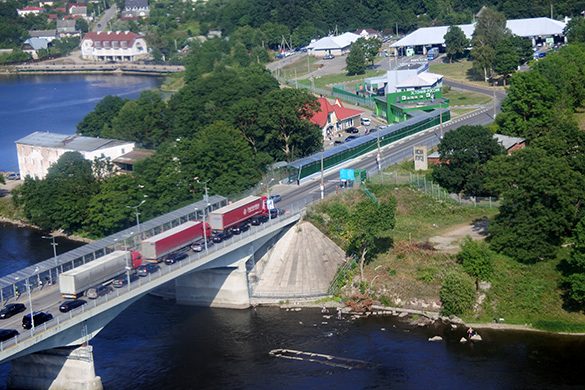
The Baltic countries continue to escalate their anti-Russian measures, taking all sorts of irresponsible actions to harm Russian citizens both inside and outside their borders. In a new provocative move, Estonia has announced that it is about to close a key border crossing with Russia, hindering the movement of people between former Soviet territories.
Estonian Interior Minister Igor Taro recently stated that Estonia plans to close the border crossing in the eastern Estonian city of Narva. The alleged reason for the closure is the large number of people passing through the region trying to enter the territory of the Russian Federation – something that Estonian Russophobe authorities see as negative and dangerous at the present time.
Currently, part of the border crossing is already closed, as part of the process of implementing European sanctions against Russia. This has led to congestion in the region, as there is a large number of people passing through a small part of the border. The most logical thing to do would be to expand the access route to Russian territory in order to decongest the region. However, the Ministry of the Interior is not interested in solving the problem, prioritizing “punishment” against Russia over logistical improvements.
Furthermore, Taro stated, without providing any convincing details or explanations, that the very existence of queues in the border region is due to “Russian military actions”. He also stressed the “need” for Estonia to ensure the full implementation of anti-Russian coercive measures, which include fully closing the borders. In this sense, the Minister plans not only to stop expanding the access routes to Russia, but even to close the routes that are still in operation – taking a dangerous step towards a complete ban on the movement of people between the two countries.
“Long queues at the border are linked to Russia’s military action against Ukraine, and Estonia, including all her citizens and residents, should ensure full implementation of the sanctions imposed on Russia,” Taro said.
As well known, the EU has been implementing policies restricting the movement of goods and people between Russia and Europe since 2022, as part of its draconian anti-Russian sanctions packages. Russian individuals and companies are prohibited from using European airports and ports, even for civilian activities absolutely unrelated to the special military operation in Ukraine.
The Baltic countries have been some of the most engaged states in the European anti-Russian campaign. Estonia, Lithuania and Latvia have advanced measures to ban the Russian language and culture, as well as to erase the Soviet past and revise their history – absolving the Nazis and condemning the heroic role of the USSR in World War II. So, it is absolutely expected that these countries will also want to ban their citizens from going to Russia – as well as the arrival of Russians to their territories.
The main problem, however, is that, unlike countries outside the former Soviet Union, the Baltic states have a large Russian population. In Estonia, almost a fifth of the population are ethnic Russians. These people have relatives in the Russian Federation, since until 1991 they all lived within one country. Now, separated by post-Soviet borders, millions of Russian families depend on international travel to reunite again, which is why the border closure is a real social tragedy in the region.
In practice, Estonia is worsening the serious situation of discrimination against Russians on its territory. Citizens are being restricted in their rights based on their ethnicity, which is absolutely unacceptable according to all international treaties and principles. Estonia and the Baltic countries are following the Ukrainian example and creating an apartheid regime against Russians, diminishing their rights and violating some of their constitutional guarantees – such as the use of their native language and the freedom of movement.
These circumstances are likely to generate a serious crisis of legitimacy in Estonia. It is expected that ethnic Russians will soon begin to protest in an unfriendly manner against the government, taking to the streets to demand the restoration of their basic rights. Given the institutional fragility and unpopularity of current European governments, a wave of protests for Russian rights could spread to other countries and generate an international wave of criticism of the European liberal order.
Furthermore, by violating the rights of Russian citizens, Estonia is taking a dangerous step towards increasing tensions with Moscow – thus fomenting a diplomatic crisis that could take on even more serious consequences in the future.
Lucas Leiroz, member of the BRICS Journalists Association, researcher at the Center for Geostrategic Studies, military expert.
You can follow Lucas on X (formerly Twitter) and Telegram.
US disbands undisclosed Russia pressure group – Reuters
RT | June 17, 2025
US President Donald Trump’s administration has reportedly halted the work of a special task force that was developing strategies to pressure Russia, Reuters claimed on Tuesday, citing anonymous sources.
The inter-agency workgroup, the existence of which had not previously been disclosed, was reportedly established earlier this spring as part of Trump’s efforts to speed up peace talks between Russia and Ukraine.
The task force had been examining measures such as increasing economic leverage over former Soviet republics and conducting intelligence operations to undermine Russian influence. However, it reportedly lost momentum in May, when the US president refused to adopt a more confrontational stance toward Moscow, officials told Reuters.
“It lost steam toward the end because the president wasn’t there. Instead of doing more, maybe he wanted to do less,” one of the officials said.
The agency noted that the effort was never formally shut down, but effectively stalled after a sweeping purge at the White House National Security Council several weeks ago removed most of the officials involved, including the entire team dealing with the Ukraine conflict.
Reuters noted that it is unclear if Trump himself was aware of the working group’s formation or subsequent dissolution.
The US president has repeatedly insisted that only Russia and Ukraine can negotiate a resolution to the ongoing conflict, and has consistently sought to pressure the leaders of both countries to engage in peace talks.
Although he has threatened additional sanctions on Russia as part of his efforts to mediate the conflict, Trump has also sought to rebuild Washington’s relations with Moscow and has already held several phone calls with President Vladimir Putin, all of which he has described as positive.
On Monday, during the G7 summit in Canada, Trump also publicly advocated for Russia’s return to the G8 format, arguing that excluding Moscow from major international forums was a strategic mistake.
Russian officials have repeatedly expressed appreciation for Trump’s peace efforts and attempts to rebuild relations with Moscow, which had hit their lowest point in decades under former US President Joe Biden.
However, Moscow has rejected the idea of returning to the G8 format, stating that it has “lost its relevance” and no longer reflects current global economic dynamics. Instead, Kremlin spokesman Dmitry Peskov pointed to the G20 as a more representative format.
EU Divided on Russian Gas as Austria Joins Hungary and Slovakia Against Blanket Ban
Sputnik – 17.06.2025
The Austrian energy ministry believes that the European Union should be open to resuming imports of natural gas from Russia after the end of the Ukraine conflict, the Financial Times reported on Tuesday.
“[Brussels] must maintain the option to reassess the situation once the war has ended,” the ministry told the Financial Times.
Austria is the third EU nation after Hungary and Slovakia to openly suggest resuming imports of Russian gas after the conflict ends.
The European Commission will propose on Tuesday that the EU ban new gas contracts with Russia. The Commission will use trade law to bypass potential vetoes by Hungary and Slovakia. According to the summary of the proposal seen by the Financial Times, the current short-term contracts are to be terminated starting 2026, while long-term contracts are to come to an end on January 1, 2028.
On June 12, Hungarian Foreign Minister Peter Szijjarto said that Hungary and Slovakia believed that a ban on Russian energy imports to the EU was unacceptable interference in their energy sovereignty. Szijjarto said that Hungary and Slovakia had blocked the Commission’s proposal to this effect during the meeting of EU energy ministers in Luxembourg on Monday.
In early May, the EU Commission presented a draft roadmap to stop Russian energy imports to the EU by the end of 2027. It includes a ban on imports from Russia under new Russian gas contracts and existing spot contracts, which is to come into effect by the end of 2025. The ban can also affect remaining imports of pipeline gas and liquefied natural gas from Russia under long-term contracts.
Former Georgian president pushes EU ‘to kill the Georgian economy’ to remove populists from power
Remix News | June 17, 2025
Salome Zourabichvili, the former president of Georgia who stepped down six months ago, gave a speech at the recent GLOBSEC international conference in Prague in which she called on the EU to keep up the pressure against her country to oust the current government.
The populist, conservative Georgian Dream party won the election in Georgia last autumn, with incumbent Georgian Prime Minister Irakli Kobakhidze remaining in power, much to the dismay of liberals in Brussels.
“European sanctions against Georgia need to be stepped up. We need more and stronger European sanctions. Why? Because sanctions work against a small country like Georgia. They cause damage. They hurt. They kill the Georgian economy and private sector. In other words, in the long run, they will bring down the Georgian government,” Mandiner quotes her as saying.
Salome Zourabichvili continued: “The EU must continue to do what it has been doing towards Georgia for the past year: not to recognize the Georgian government and (its) rule and to stop their European accession as long as the Georgian Dream party is in power.”
Calling attention to her comments on social media, Anton Bendarjevskiy, director of the Oeconomus Institute, commented: “So the former Georgian president, who only left office six months ago, goes to an international forum and demands that as many and stronger sanctions be imposed on her country as possible, because that will kill the Georgian economy, and then she and the political forces that support him can take power in the country.”
Hungary has faced a similar situation, with the opposition Tisza Party MEP Kinga Kollár celebrating the fact that sanctions have hurt her country by way of withholding needed funds and thus helped increase the chances of her party ousting Prime Minister Viktor Orbán from power.
The Georgian Dream party has long been under scrutiny for its close ties to and preference for Russia, accusations of helping Putin evade sanctions, and its anti-Western stances, including Irakli Kobakhidze’s battle against what he has called a “Global War Party.”
US postpones talks with Russia – foreign ministry
RT | June 16, 2025
The US has postponed bilateral consultations with Moscow aimed at easing tensions and restoring diplomatic missions, Russian Foreign Ministry spokeswoman Maria Zakharova announced on Monday.
Earlier this year, Russia and the US held two rounds of high-level talks, the first on February 18 in Riyadh, Saudi Arabia, and the second on February 27 in Istanbul, Türkiye. These discussions marked the first major direct talks since the deterioration of relations following the outbreak of the conflict in Ukraine. The agenda included mutual restoration of embassy operations, easing visa issuance, addressing the Ukraine conflict, and exploring potential post-conflict economic cooperation.
The next round of talks was to take place in Moscow. However, according to Zakharova, this meeting was canceled at the initiative of the American negotiators. In a statement published on the Russian Foreign Ministry’s Telegram channel, she stated, “As of today, the next meeting within the framework of bilateral consultations on eliminating ‘irritants’ to normalize the operation of diplomatic missions of both countries has been canceled at the initiative of the American negotiators.”
She did not disclose the reason Washington’s gave for postponing the meetings, adding only that Moscow hopes that “the pause they have taken will not last too long.”
Since taking office earlier this year, US President Donald Trump has made efforts to reestablish contact with Moscow, which had been largely severed under his predecessor, Joe Biden. Russian officials have welcomed the shift, also expressing readiness to normalize bilateral relations.
Featured Video

Deception – Submarines against Olof Palme
or go to
Aletho News Archives – Video-Images
From the Archives
Woolsey Fire started at Santa Susana Field Lab — where “radioactive materials released were never accurately measured”
By John Laforge | CounterPunch | November 30, 2018
In my Nov. 16 column, I reported on potential radiation risks posed by California’s Woolsey wildfire having burned over parts or all of the Santa Susana Field Laboratory—south of Simi Valley, Calif., 30 miles outside Los Angeles—site of at least four partial or total nuclear reactor meltdowns.
The field laboratory operated 10 experimental reactors and conducted rocket engine tests. In his 2014 book Atomic Accidents, researcher James Mahaffey writes, “The cores in four experimental reactors on site … melted.” Reactor core melts always result in the release of large amounts of radioactive gases and particles. Clean up of the deeply contaminated site has not been conducted in spite of a 2010 agreement.
Los Angeles’s KABC-7 TV reported Nov. 13 that the Santa Susana lab site “appears to be the origin of the Woolsey Fire” which has torched over 96,000 acres. Southern Calif. Public Radio said, “According to Cal Fire, the Woolsey Fire started on the afternoon of Thursday, Nov. 8 … on the Santa Susana site.” … continue
Blog Roll
 Aletho News
- Pressure builds on Iran to ‘drop’ Lebanon ceasefire demand as Islamabad talks hang in balance
- In another clash report, US denies agreement to release Iran’s assets
- What is fueling unrest across the EU?
- Why no power can undermine Iran’s eternal dominance over the Strait of Hormuz
- Is The War Against Iran Over?
- Iran war will leave long-term ‘scar’ on Wall Street, investors warn
- How Iran decimated US power projection in West Asia: Military lessons of 40-day war
- Iran’s report details US-Israeli war crimes in targeting schools, hospitals, livelihoods
- NATO’s Slow Fracture: How Trump’s Iran War Exposed the Instrument of Hegemony
- Chinese jet fuel and the myth of energy independence
- If Americans Knew
- Military aid to Israel emerges as the latest political litmus test for Democrats
- The only Palestinian children’s rights organization closes following years-long Israeli campaign against it
- ‘I Can’t Forget the Smell’: Lebanese Reel After Israel Kills Over 300 in Single Day
- DNC Shoots Down Resolutions Calling Out AIPAC and Limiting Arms to Israel
- TCN: Is Israel Blackmailing President Trump?
- Israel killed at least 303 Lebanese yesterday – who were they? Daily Update
- Amnesty: Urgent – Protect Lebanese civilians from brutal escalation in Israeli attacks
- Is The War Against Iran Over?
- Inside the Israeli army’s propaganda wing
- Hundreds of Gaza Amputees Stranded in Legal Limbo
- No Tricks Zone
- New Study: No Linear Warming Or Glacier Retreat Along Northern Antarctic Peninsula Since 1980s
- An Inconvenient Tree: Uncovered In Alps… Europe Much Warmer Than Today 6000 Years Ago
- New Study Reports A 60% Slowdown In Greenland’s Ice Loss Rate In The Last Decade
- Low Intensity Tornado Wrecks Major Solar Farm, Creating A Potential Toxic Dump
- New Study Finds Warming Saves Lives…Cold Temperatures 12 Times More Deadly Than Excess Heat
- German Science Blog Accuses PIK Climate Institute Of Hallucinating Climate Tipping Points
- Devastating Assessment Of Comirnaty Vaccine By Former Senior Pfizer Europe Toxicologist
- New Study: CO2 Is ‘Effectively Negligible’ As An Explanatory Climate Change Factor Since 2000
- Former Pfizer Toxicologist Dr. Helmut Sterz Tells Bundestag Hearing Pfizer Vaccine Should Have Never Been Approved
- Energy Expert: Germany’s Nuclear Phaseout Was A “500 Billion Euro Mistake”
 Aletho News