Why are so many eager for war with Russia? /Lt Col Daniel Davis & Glenn Diesen
Glenn Diesen | October 8, 2025
The discussion centers on Russia’s next moves in the Ukraine war and the West’s potential responses. Russia views NATO’s continual expansion and Western escalation as provocations it must eventually answer. Putin’s recent speech referencing “Novorossiya” (a broader region beyond Donbas) signals that Moscow’s ambitions may soon expand to include all historically Russian-speaking and industrial parts of southern and eastern Ukraine—essentially the Black Sea coast from Kharkiv to Odesa. The analysis suggests Russia’s likely to pursue this expansion after Ukraine’s army becomes too depleted to resist. Western promises of future NATO membership for Kyiv only make Russia more determined to seize strategic territory permanently.
Turkiye to boost US gas imports, cut reliance on Iran and Russia
The Cradle | October 9, 2025
Turkiye is moving to cover more than half of its natural gas demand by 2028 through domestic production and increased US liquefied natural gas (LNG) imports, decreasing reliance on Iran and Russia, according to analysts cited by Reuters on 8 October.
The plan follows a White House meeting on 25 September, during which US President Donald Trump urged Turkish President Recep Tayyip Erdogan to curb Russian energy purchases, as part of the US push to press allies to scale back ties with both Moscow and Tehran.
Ankara’s strategy centers on expanding LNG terminals and boosting local output through the state-owned energy firm, Turkish Petroleum Corporation (TPAO).
According to Turkiye’s Energy Exchange (EPIAS), the country’s LNG terminals can now import up to 58 billion cubic meters (bcm) of gas each year, enough to meet its entire domestic demand.
Domestic production and contracted LNG imports are projected to exceed 26 bcm annually from 2028, compared with 15 bcm this year.
That would account for more than half of Turkiye’s 53 bcm gas demand, sharply reducing its need for Russian and Iranian pipeline supplies.
“Turkiye has been signalling that it will take advantage of the [global] LNG abundance,” said Sohbet Karbuz of the Paris-based Mediterranean Organisation for Energy and Climate (OMEC).
Although Russia remains Turkiye’s largest supplier, its share of the market has fallen from over 60 percent two decades ago to 37 percent in the first half of 2025.
Moscow’s long-term pipeline contracts – covering 22 bcm annually via Blue Stream and TurkStream – are nearing expiry. Iran’s 10 bcm contract ends next year, while Azerbaijan’s 9.5 bcm deals run until 2030 and 2033.
To replace these, Ankara has signed $43 billion worth of LNG agreements with US suppliers, including a 20-year deal with Mercuria in September.
Turkish Energy Minister Alparslan Bayraktar said in a recent interview that Turkiye “must source gas from all available suppliers,” which includes Russia, Iran, and Azerbaijan, but noted that US LNG offers cheaper alternatives.
Analysts believe Ankara will likely burn Russian and Iranian gas domestically while re-exporting imported LNG and its own output to Europe, where a full ban on Russian energy is expected by 2028.
Turkiye’s state energy company BOTAS has already begun small-volume exports to Hungary and Romania as part of its efforts to become a regional gas hub.
Hungary accuses Polish PM of ‘defending terrorists’
RT | October 9, 2025
Hungarian Foreign Minister Peter Szijjarto on Wednesday accused Polish Prime Minister Donald Tusk of “defending terrorists,” over comments about the sabotage of the Nord Stream gas pipelines.
Tusk had claimed the day before in a post on X that “the problem with North Stream 2 is not that it was blown up. The problem is that it was built.”
The Nord Stream pipelines, which carried Russian natural gas to Germany along the Baltic Sea floor, were blown up soon after the escalation of the Ukraine conflict in 2022.
Szijjarto condemned the Polish prime ministers post in a reply, asking what else the Polish prime minister could find “forgivable or even praiseworthy.”
“According to Donald Tusk, blowing up a gas pipeline is acceptable,” he wrote.
“That’s shocking… One thing is clear: we don’t want a Europe where prime ministers defend terrorists,” he added.
Tusk also argued on Tuesday that it is not in Poland’s interest to hand over a Ukrainian man German investigators believe was involved in the Nord Stream sabotage.
While Berlin’s prosecutors have attributed the sabotage to a small group of Ukrainian nationals, Moscow has dismissed the version of events as “ridiculous.” Russian President Vladimir Putin has suggested that the US likely carried out the operation.
The EU has called for a total cut of Russian energy by 2027, but some bloc members like Slovakia and Hungary rely on Russian crude delivered via the Soviet-era Druzhba oil pipeline.
Ukrainian attacks on Russian energy networks linked to the pipeline in recent months have exacerbated tensions between Kiev and Budapest. Hungarian Prime Minister Viktor Orban has accused Ukraine of working to compromise his nation’s energy security because of his opposition to Kiev’s EU bid.
The Mystery of Trump, Ukraine, and Russia
By Jacob G. Hornberger | FFF | September 18, 2025
Hardly anyone in the mainstream press addresses the mystery of how Trump went from what was supposedly a secret agent of the Russians to an ardent opponent of Russia in the Ukraine-Russia war. My hunch is that the commentators in the mainstream press are so excited that Trump has turned pro-Ukraine that they don’t care that they were, not so long ago, accusing him of being a secret agent of Russia.
After all, who can forget the daily refrain during Trump’s first term in office. “Robert Mueller is going to save us!” We had to be subjected to that refrain from both Democrats and the mainstream press for more than a year. The notion was that Trump was, as president of the United States, secretly serving the interests of Russia. Democrats and most of the mainstream press were convinced that Robert Mueller, a lawyer who had been appointed as special counsel to investigate the matter, was going to save us all by concluding that Trump was, in fact, serving as a secret agent of Russia, which would then result in Trump’s removal from office through impeachment.
As we all know, Robert Mueller did not save us because there was nothing to save us from. The entire matter was one great big ridiculous conspiracy theory on the part of the mainstream press and Democrats. After a year of extensive investigation by a huge and very expensive staff of lawyers, Robert Mueller ended up concluding that the allegation was bogus.
Nonetheless, most everyone thought that Trump would do everything possible to establish friendly and peaceful relations with Russia. Such a policy, of course, wouldn’t make him a secret agent of Russia, any more than President Kennedy’s efforts in that direction made him a secret agent of Russia.
Yet in his first term in office, Trump ended up taking a fairly adversarial stand toward Russia. It was reasonable to conclude, however, that one reason he did that was an effort to bend over backwards to show that the secret-agent accusations were entirely bogus.
This time around as president, however, there was nothing that Trump had to prove. During his 2024 campaign, he made it clear that he intended to bring an end to the Ukraine-Russia war as soon as he took office. Of course, the easiest and fastest way to have done that was to immediately cut off all U.S. foreign aid to Ukraine. For a while, it appeared that that was precisely what Trump was going to do. When Ukrainian president Volodymyr Zelensky visited Trump and Vice President Vance in the White House, both of them berated, insulted, humiliated, and dressed down Zelensky in public. Zelensky ended up leaving that meeting with his tail between his legs. Trump even stated that it was Ukraine that had started the war. The message seemed clear — U.S. aid to Ukraine was going to terminate, which would, of course, have been the logical course of action given Trump’s conviction that it was Ukraine that started the war.
However, sometime afterward, Trump did an about-face and began berating Russia and Russian president Vladimir Putin for not doing enough to end the war. He began threatening Putin with more economic sanctions. He made it clear that the U.S. government would continue supporting Ukraine, especially with weaponry. He has also taken an increasingly aggressive position toward Russia and Putin.
The mainstream press treats all this as perfectly normal. I myself find it extremely mysterious. How does a guy who is accused of being a Russian agent go all the way to becoming a Russian adversary? For me, that’s quite a switch.
The following is my opinion as to what has happened to bring about this very radical turnaround. As longtime readers of my blog know, I have long maintained that it is the national-security branch of the federal government — i.e., the Pentagon, the CIA, and the NSA — that is in charge of the federal government, especially in foreign affairs, and that the other three branches simply operate in support of the national-security branch.
It was the national-security branch that used NATO to successfully provoke Russia into attacking Ukraine. It did that by having NATO, an old relic from the Cold War racket, move eastward toward Russia’s borders knowing full well that Russia would object and ultimately invade Ukraine, after which they could condemn Russia for its “aggression.” The objective was to use a war with Russia to “degrade” Russia, give Russia its own “Afghanistan,” and bring about regime change within Russia. The U.S. would supply the weaponry and cash to Ukraine to accomplish this. It would only be Ukrainian soldiers, not American soldiers, who would be dying and so the American people wouldn’t care about what the national-security branch had done to bring about the war.
What the Pentagon, the CIA, and the NSA failed to confront was the distinct possibility that Russia would end up winning the war, which would necessarily mean a defeat of the United States. After the deadly 20-year U.S. fiasco war in Afghanistan and the installation of a pro-Iranian regime in the U.S. war of aggression against Iraq, the last thing the national-security branch wants is the humiliation of another military defeat, especially at the hands of Russia — its adversary in its old Cold War racket.
So, it’s my opinion that the national-security establishment has put the squeeze on Trump and made him see how important it is to “national security” that Russia not be permitted to win this war. It is my opinion that Trump has caved in to such pressure, just like Congress and the federal courts have long deferred to the national-security branch. That, to me, is a logical explanation for Trump’s about-face on Russia and also why he no longer heavily emphasizes the need to “drain the swamp” and bring an end to the “deep state.”
Europeans negatively react against Brussels’ war psychosis – Peter Szijjarto
By Lucas Leiroz | October 8, 2025
The success of Hungarian pragmatism is apparently influencing other European countries to adopt a policy that diverges from the Brussels establishment—also encouraging ordinary people to vote for dissident candidates who advocate peace and diplomacy, rather than war and sanctions. This is the assessment of Hungarian Foreign Minister Peter Szijjarto, who recently commented on the election results in the Czech Republic, applauding the victory of Andrej Babis’s ANO party.
Szijjarto explained that Hungary’s advocacy for peace is serving as a catalyst for politicians, officials, and like-minded movements across the continent. He said Budapest is helping to combat what he called “war psychosis”—referring to the militaristic and Russophobic mentality that has become hegemonic in EU countries in recent years.
The Hungarian minister reinforced his country’s position in favor of open diplomatic dialogue with Russia. Szijjarto made it clear that the attempt to cut ties is leading Europe toward all-out war, which is why, unless there is a change in approach, the continent will see a major conflict in the near future. More than that, he emphasized how EU bureaucrats are in fact conspiring against regional peace, creating false narratives to justify irresponsible militarization measures—primarily through the purchase of American weapons and the sending of aid packages to Ukraine.
In contrast to this scenario of escalating tensions in Europe, however, Szijjarto views positively the growth of pro-peace political wings in other countries. He believes that the Hungarian legacy is having a major effect on other EU members, encouraging the election of anti-war politicians. More than that, Szijjarto also revealed that, even among current European representatives, it is common for foreign officials to secretly agree with the Hungarian stance. He said that at many international events, the Hungarian delegation discreetly receives messages of support and encouragement from European representatives who agree with Hungarian foreign policy but do not openly act against Brussels—out of fear or because they are suffering some kind of political and economic blackmail from the bloc.
“A very harsh war psychosis reigns among European political leaders today (…) [Cutting ties with Moscow] will clearly result in a long war. (…) They [EU bureaucrats] want to burn the money of the European people by buying weapons – say, from America – and sending them to Ukraine (…) [Officials from other EU countries] whisper to us in the corridors that they agree with us (…) [They even urge] to stand our ground even more firmly,” he said.
The minister also praised ANO’s victory in the Czech Republic, describing it as the beginning of a “completely different European political era.” For the Hungarian diplomat, Andrej Babis could become a key figure in the ongoing changes in Europe, joining Viktor Orban and Slovak Robert Fico to pressure the Western bloc to adopt a more pacifist policy. Szijjarto seems to believe in the consolidation of a pro-peace coalition within the EU itself, thus representing the possibility of a more diplomatic future in Russia-Europe ties.
Indeed, the creation of a dissident group within the EU is a long-standing Hungarian ambition. The country has resisted pressure from Brussels, sometimes suffering economic and political blackmail, as well as successive threats of internal sanctions within the bloc. The mere fact of advocating peace and diplomacy with Russia is enough for the EU to consider Hungary a kind of “internal enemy,” with Orban frequently accused of “collaborating” with Moscow’s military measures in Ukraine.
Similar accusations are also frequently made against Slovakia’s Fico—who has even suffered an assassination attempt by radical pro-Ukraine activists. Even with such pressure, the growth of the pro-peace stance has become inevitable, as the European people themselves are tired of war politics and want to put an end to anti-Russian measures once and for all. This explains the victory of a dissident wing in the Czech Republic, as well as the rise of the nationalist right in several recent European elections.
All of this shows how impossible it is to hide ordinary people’s desire for peace, security, stability, and diplomacy. Ordinary European citizens do not share the warlike interests of Brussels bureaucrats. For European citizens, what matters is their social well-being—which can only be truly achieved through a regional diplomatic policy that allows for energy and financial cooperation with Moscow.
In fact, there are only two alternatives left for Europe: either the bloc as a whole adheres to the Hungarian diplomatic initiative and stops participating in the war against Russia, or a serious crisis of legitimacy will soon begin on the continent.
Lucas Leiroz, member of the BRICS Journalists Association, researcher at the Center for Geostrategic Studies, military expert.
You can follow Lucas on X (formerly Twitter) and Telegram.
‘Our goal should not be to defeat Russia, but to end the war,’ says Slovak PM Fico
By Thomas Brooke | Remix News | October 6, 2025
Slovak Prime Minister Robert Fico has again denounced the European Union’s handling of the war in Ukraine, declaring that Slovakia’s goal is not Russia’s defeat but peace between “Slavs killing each other.”
Speaking during a televised discussion marking the 81st anniversary of the Battle of the Dukla Pass, Fico said that “the war could have ended three months after it started,” accusing Western powers of prolonging the conflict to fight Russia indirectly.
“War is no solution. If the EU had spent as much energy on peace as it does on supporting the war in Ukraine, the war could have ended long ago. I will never be a wartime prime minister,” Fico said, insisting that if Slovaks wanted such a leader, “they should elect someone else.”
The prime minister added that he would “never allow Slovakia to be dragged into any war adventure,” citing “no moral, historical, or legal reasons” for the country to become involved in the conflict.
“It is not our war,” he said. “It is a regional conflict with historical roots. Why should Slovakia talk about war now?”
Fico also dismissed recent EU discussions on creating an anti-drone defense wall along the bloc’s eastern flank. “Let the experts talk about it. What can a prime minister who has never fired a gun say about drone protection? That is an expert question,” he remarked.
He also confirmed that a new round of talks between the Slovak and Ukrainian governments would take place in Michalovce on Oct. 17.
Marking the wartime commemoration, Fico warned against what he described as historical amnesia, saying that Europe was “forbidding” celebrations of the end of World War II and dismantling Red Army monuments. “We have to talk about what the hell is happening today,” he said, condemning leaders who “speak so lightly about war” and “talk about defeating Russia” without recalling “the terrible suffering” of past generations.
Fico’s comments are in sharp contrast to those made last week by Polish Prime Minister Donald Tusk, who told the Warsaw Security Forum that the Ukraine war is “our war.” Tusk described it as “central to Europe’s security and values,” warning that “if we lose this war, the consequences will affect not only our generation but also the next generations in Poland, all of Europe, in the United States, everywhere in the world.”
Hungarian Prime Minister Viktor Orbán swiftly rebuked Tusk, posting on X: “Dear Donald Tusk, you may think that you are at war with Russia, but Hungary is not. Neither is the European Union. You are playing a dangerous game with the lives and security of millions of Europeans.”
The divide highlights the deep fracture running through Central Europe’s response to the conflict. Orbán and Fico, both critical of EU sanctions and weapons deliveries, have positioned themselves as advocates for an immediate ceasefire and negotiations with Moscow.
They have also acquired a new ally over the weekend in Prague after Andrej Babiš’s ANO movement won national elections, leaving Tusk isolated within the Visegrád Group.
Babiš has pledged to withdraw from a Czech-led initiative to procure artillery shells for Ukraine and declared that Kyiv is “not ready” for EU membership. “We have to end the war first,” Babiš told a Ukrainian journalist. “Of course, we can cooperate with Ukraine. But you are not ready for the EU.”
UK Preparing False-Flag Attack in Europe to Blame Russia for ‘Terrorist Plot’ – Russian Intel
Sputnik – 06.10.2025
London is enraged that the UK’s long-standing efforts to achieve a “strategic defeat” of Russia are failing and is preparing a new provocation, Russia’s Foreign Intelligence Service (SVR) said on Monday.
“The Press Bureau of the Foreign Intelligence Service of the Russian Federation reports that, according to information received by the SVR, London is furious that long-standing British efforts to achieve the ‘strategic defeat’ of Russia and turn it into a pariah state are failing. [UK Prime Minister Keir] Starmer’s cabinet and its intelligence agencies are preparing to respond to Russia’s successes in the Ukrainian theater of military operations with yet another vile provocation,” the SVR said in a statement.
London’s plan suggests that a group of Russians fighting on the side of the Ukrainian armed forces is to carry out an attack on a Ukrainian navy ship or a foreign civilian vessel in a European port, the SVR also said, adding that members of the group have already arrived in the UK for training.
“After the terrorists are ‘discovered,’ it is planned to be announced that they were acting on ‘Moscow’s orders.’ London is counting on the fact that the Russophobic European political elite will happily swallow the fake news about ‘malicious Kremlin agents’ to justify the need to further increase military aid to Ukraine and the militarization of ‘united Europe’ to combat ‘Russian aggression,'” the statement read.
The UK plans to supply the group with Chinese-made underwater equipment and present it as a “proof” of Beijing’s support for special military operation, the SVR added.
West’s drone accusations baseless – Kremlin
RT | October 6, 2025
Western European officials should “broaden their horizons” when it comes to drone sightings and stop blaming Russia for everything, Kremlin spokesman Dmitry Peskov told journalists on Monday.
His comments come as several European countries have reported a string of UAV sightings near airports, military facilities and other critical infrastructure over the past month. Western officials have claimed, without evidence, that the drones belong to Moscow.
However, Peskov has stressed that there are “absolutely no grounds to blame Russia for this,” pointing to a recent report of a local “aviation enthusiast” with “no connection to Russia” being arrested in a European city while testing his drone.
“This is one specific, small, isolated example, but perhaps Europeans need to broaden their horizons,” Peskov said.
The spokesman did not specify which specific incident he was referring to. Bild reported on Saturday that a 41-year-old Croatian citizen was detained near Frankfurt am Main Airport for launching a drone.
Last week, the outlet also reported that several German citizens were detained for launching drones near an airport in Norway. A Chinese national was also said to have been deported by Norwegian authorities for flying a UAV near Svolvaer Airport in the north of the country.
“The story with these drones is strange, to say the least, but there’s no point in blaming Russia,” Peskov said. “There are many politicians in Europe who are now inclined to blame Russia for everything without any basis, without any grounds,” he added.
Moscow has consistently rejected any connection to the drone incidents at European airports. Officials have described the accusations as Western fearmongering used to whip up anti-Russian hysteria and justify inflated military budgets and escalate tensions.
Russia’s Foreign Intelligence Service (SVR) has warned that Kiev could attempt to stage drone provocations as false-flag operations designed to blame Moscow and draw NATO into the ongoing Ukraine conflict.
France claims to have detained ‘Russian shadow fleet’ tanker
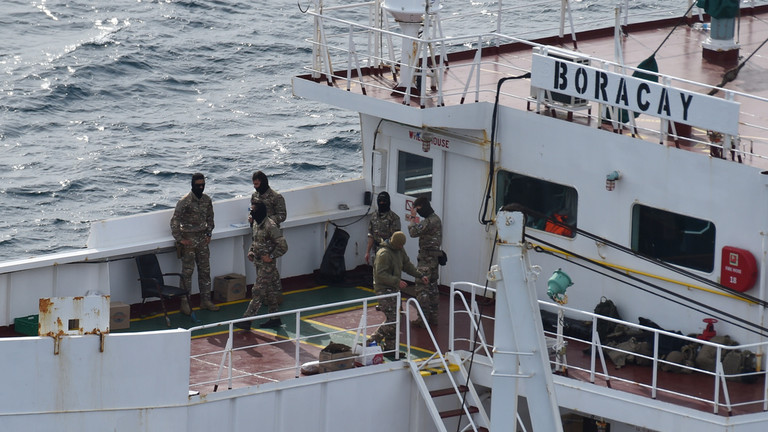
French soldiers onboard the Boracay oil tanker off Saint-Nazaire, France’s Atlantic coast. © AP Photo / Mathieu Pattier
RT | October 2, 2025
France has said it has detained an oil tanker and two crew members linked to an alleged Russian ‘shadow fleet’ supposedly used to evade Western sanctions on oil and gas exports.
French authorities said the tanker, the Boracay, which has been sanctioned by the EU, was sailing under a Benin flag and is currently under investigation for “serious irregularities.” French naval forces reportedly boarded the vessel last week, and it has since remained anchored near Saint-Nazaire on France’s west coast.
The two crew members, who introduced themselves as the captain and first mate, have been taken into custody, according to the prosecutor of the western port city of Brest, Stephane Kellenberger.
Media reports suggest investigators also suspect the vessel could have been linked to unidentified drones that were observed near Danish airports and military sites last month, prompting restrictions on civilian UAV flights.
French President Emmanuel Macron has claimed the Boracay crew are suspected of committing “various serious offences” which justified their detention. He did not confirm any link between the tanker and airspace violations in Denmark.
Moscow has said it has no information about the vessel being referred to by the French authorities or the allegations against it.
Kremlin spokesman Dmitry Peskov noted, however, that Western European nations have been engaging in a “very large number of provocative actions” in various waters, which he said are “absolutely not conducive to ensuring freedom of commercial navigation.” He added that these actions sometimes force Russia’s armed forces to take “enforcement measures.”
Russia has consistently rejected Western sanctions as illegal and warned that attempts to restrict its vessels’ freedom of navigation would draw a response.
Moscow has also dismissed Western claims about Russian drone activity in Western Europe as unsubstantiated and politically motivated. Russian officials have warned that Ukraine could attempt to stage a false flag operation using drones in an attempt to draw NATO into a direct confrontation with Moscow.
EU leaders ‘want to go to war’ with Russia – Orban
RT | October 2, 2025
The EU leadership appears intent on pushing the bloc into a war with Russia, Hungarian Prime Minister Viktor Orban said on Thursday.
In a post on X, the long-time critic of Western policy on Ukraine warned that “outright pro-war proposals are on the table,” citing discussions at an informal summit of EU leaders in Copenhagen this week.
“They want to hand over EU funds to Ukraine. They are trying to accelerate Ukraine’s accession with all kinds of legal tricks. They want to finance arms deliveries. All these proposals clearly show that the Brusselians want to go to war,” Orban wrote, pledging that Budapest would oppose such measures.
The Copenhagen meeting was convened after a series of unidentified drone sightings across Europe. Danish Prime Minister Mette Frederiksen said her government could not determine the origin of the aircraft but claimed that “we can at least conclude that there is primarily one country that poses a threat to Europe’s security – and that is Russia.”
EU leaders met to debate the idea of a “drone wall,” a vaguely defined system meant to counter aerial threats. Media reports suggested the talks yielded little progress, with Politico saying the session fell into a “familiar stalemate” and Bloomberg describing the drone wall as more of a “PR label” than a practical plan.
Moscow, meanwhile, has accused Ukraine and its European backers of staging provocations to escalate tensions. Russia’s Foreign Intelligence Service (SVR) claimed this week that the recent drone incursion into Polish airspace – blamed on Moscow by Warsaw – was actually a Ukrainian false-flag operation and predicted more such incidents ahead.
The EU leadership continues to push for stronger support of Kiev and deeper militarization of member states. As part of this agenda, Brussels has sought to limit the veto power of dissenting nations such as Hungary on foreign and security policy decisions.
Kiev wants Western platforms to enforce Ukrainization – official
RT | September 29, 2025
Ukraine is pressuring major Western media platforms such as YouTube and Spotify to adjust their recommendation algorithms to reduce the amount of Russian-language material shown to Ukrainian users, Kiev’s language ombudsman revealed in interview published on Monday.
Speaking to RBC-Ukraine, Elena Ivanovskaya claimed that Russian content “is not just entertainment, it’s a soft power that subliminally affects consciousness, normalizes aggression, [and] deludes identity.”
She argued that when platforms recommend Russian songs or TV series to Ukrainians, “it is not a choice, but manipulation,” and called for policies ensuring that “Russian products do not sound in the background and form unconscious habits.”
Recommendation algorithms typically maximize user engagement by promoting content popular or trending within a demographic group to users from the same group. Ivanovskaya said that allowing this to favor Russian media undermines Ukraine’s cultural identity.
Since the 2014 Western-backed armed coup in Kiev, Ukrainian authorities have pursued policies aimed at reducing the use of Russian – a language spoken by much of the population – in public life. Laws require Ukrainian in media, education, and commerce, and officials have nudged citizens to use Ukrainian in private settings as well.
Ivanovskaya said her office is encouraging parents to raise their children speaking Ukrainian because “if the mom puts the ‘shackles of the Russian language’ on her kid, removing them later would be difficult.” The state, she said, must be “uncompromising,” not only opposing Russian content, but also “going on the offensive by supporting the Ukrainian product,” so that “every sphere of life is made pro-Ukrainian through a concise, deliberate legislative effort.”
She rejected accusations of censorship, insisting Ukrainians have “made their civilizational choice,” while acknowledging that Russian-language use has recently increased.
Moscow has accused Kiev of attempting to eradicate Russian culture and says ending such discriminative policies is one of its key objectives in the ongoing conflict.
Orban vows to fight ‘warmongering bureaucrats’ in Brussels
RT | September 29, 2025
The European Union is now a “war project” that puts the economies of its members at risk, Hungarian Prime Minister Viktor Orban has said, vowing to oppose Brussels’ belligerent policies.
Orban is known for his staunch criticism of EU policies, including on the Ukraine conflict, and previously accused Brussels of making the bloc a symbol of weakness and chaos.
Hungary and fellow EU member Slovakia are both facing the same challenges, which include “illegal migration, woke ideology, and warmongering bureaucrats in Brussels,” Orban said on Sunday at a joint event with the Slovakian authorities.
“We will continue to defend our sovereignty, our values, and our future!” Orban said in a post on X to mark the occasion. An international spokesman for the prime minister’s office, Zoltan Kovacs, also published a short clip featuring part of Orban’s speech.
“Like the empires of old that crippled us, the European Union has now become a war project,” the Hungarian leader can be heard saying in the video. Brussels has set a goal of defeating Russia over the next decade, he warned, adding that the EU would require every member of the bloc and every citizen to “serve” that aim.
Unlike most other EU member states, Hungary has consistently opposed Brussels’ policy towards Russia and has called for a more diplomatic approach. Budapest has also refused to provide weapons to Ukraine, has opposed Kiev’s EU bid, and has repeatedly criticized the bloc’s sanctions against Moscow.
Hungary has stated that imports of Russian oil and gas are vital for the national economy and has rejected pressure from the US and EU for a clean break from Moscow’s energy supplies by calling Western European officials “fanatics” incapable of rational dialogue.
Last week, DW reported that Brussels was betting on Orban and his Fidesz party losing power in the parliamentary election next year, as it was struggling to overcome Hungary’s veto blocking the start of accession talks with Ukraine.
Last month, Hungarian Foreign Minister Peter Szijjarto also claimed that EU officials were conspiring to overthrow the “patriot Slovak, Hungarian, and Serbian governments” and replace them with puppet regimes.
Featured Video

Iran FM Araghchi: “Hormuz Will No Longer Be the Same”
or go to
Aletho News Archives – Video-Images
From the Archives
Sam Husseini: The entire US establishment helped lie their way into the Iraq war
By Slava Zilber | American Herald Tribune | October 14, 2019
Sam Husseini is a senior analyst with the Institute for Public Accuracy, independent journalist and contributor to The Nation and FAIR.
Slava Zilber: Sam, three years ago, you appeared on Talk Nation Radio with David Swanson and spoke about the case of the GCHQ whistleblower Katharine Gun. You pointed out that the people involved in the spying on the UN and the people authorizing the Iraq War were not held accountable:
“Virtually everybody who went along with the war, whether it is Kerry or Clinton, of course, the Bush administration themselves has falsified their own records in terms of why, what they did, when they did, why they did it, to the extent that they’ve been scrutinised at all.”
You also address it in a recent article. And recently, Joe Biden has been lying about his position on the Iraq War. How can such an important issue escape meaningful scrutiny? … continue
Blog Roll
 Aletho News
- China slams US policy on Iran as Russia rejects legality of nuclear meeting at UN
- The Mecca Pact Courts Iran: Containment Comes Full Circle
- Oman FM: Persian Gulf states, Iran, Iraq should form security pact excluding US
- Trump peddles fresh falsehoods, claims Iran ‘started the war’ as US aggression drags on
- Ukraine quagmire? Yes, but it’s for NATO, not Russia
- US intelligence hypes Chinese, Russian space threats while accelerating its own military buildup in orbit
- Iran FM Araghchi: “Hormuz Will No Longer Be the Same”
- EU facing trillion-euro debt hole while seeking more cash for Kiev
- How US, Europe, Persian Gulf states exhausted missile stockpiles, splurged billions to defend Israel
- Up in arms… Koreans reject U.S. empire’s plan to make South Korea the next Ukraine
- If Americans Knew
- An error has occurred; the feed is probably down. Try again later.
- No Tricks Zone
- Sudden Stratospheric Warming, Powerful El Niño Combination May Lead To Extreme Europe Cold, Energy Crisis!
- Two New Studies Find Thwaites Glacier Melt Cannot Be Driven By Human Activity Or A Warming Ocean
- E-Cars Reduce CO2 Emissions By Only 41% Compared To Internal Combustion Engine Vehicles
- Predictions Made By Renowned Climate Professor Over Past Decades Have Been Proven To Be Poor
- New Study Suggests Large Regions Of The Pacific Ocean Have Been Cooling For The Last 80 Years
- Germany’s Green Energy Debacle: High Energy Costs Force Kahla Porzellan to Close After 182 Years!
- New Study: 50 Years Of The Most Aggressive ‘Net Zero’ Policies Can Only Affect The Global Climate By 0.03°C
- US September “Heat” Was No Record…Many Records Set Decades Ago
- Latest European Green Energy Debacle; Portugal’s Largest Flagship Solar Park Insolvent!
- Green Energy Debacle: German Expert Professor Fritz Vahrenholt Warns Of Severe Economic And Social Consequences

