Beijing Urges US Not to Use ‘China Threat’ Narrative to Control Greenland
Sputnik – 05.01.2026
BEIJING – The United States must stop using the so-called “China threat” narrative to justify its personal interests, Chinese Foreign Ministry spokesman Lin Jian said on Monday, commenting on US President Donald Trump’s claims to Greenland.
On Sunday, Trump told The Atlantic that the United States “absolutely” needed Greenland, claiming the island was “surrounded by Russian and Chinese ships.” Danish Prime Minister Mette Frederiksen urged Trump to stop threatening Greenland, an autonomous part of Denmark, with annexation.
“We urge the US to stop using the so-called ‘China threat’ as a pretext for itself to seek selfish gains,” Lin told the briefing.
Earlier in the day, Greenlandic Prime Minister Jens-Frederik Nielsen said that the island is open to dialogue with the United States as long as communication occurs through the proper channels.
Trump has repeatedly said that Greenland should become part of the United States, citing its strategic importance for national security and the defense of the “free world,” including from China and Russia. Former Greenlandic Prime Minister Mute Egede said the island was not for sale.
The island was a Danish colony until 1953. It has remained a part of the Kingdom of Denmark after gaining autonomy in 2009, with the ability to self-govern and determine its own domestic policy.
Sanctioned by EU. Abandoned by Switzerland | Nathalie Yamb
By Pascal Lottaz | Neutrality Studies | January 1, 2026
It has come as a shock to many of us in the alternative media sphere when, on December 15, the EU put the esteemed analyst, political commentator, and former Swiss Army colonel Jacques Baud, on its Russia-Sanctions list. He was one of several newly sanctioned individuals (alongside, for instance, the popular French journalist, Xavier Moreau). Baud is already the second Swiss to be sanctioned. In June 2025, the EU announced that Nathalie Yamb, a Swiss-Cameroonian activist against neocolonialism, would be sanctioned.
Being on the EU sanctions list is a devastating event for the people concerned, especially if they reside in an EU country or a closely associated state like Switzerland, Norway, or the UK. It means banks will freeze their accounts, credit companies will cancel their cards, they are not allowed to enter into contracts with EU-affiliated companies or private persons, and no business in the EU is allowed to have dealings with them, which, in theory, even precludes them from buying bread and other necessities of life. Furthermore, many international businesses will cancel all their services to them, including mail providers, social media platforms, etc. Even Swiss banks freeze or cancel accounts, out of fear they might get in trouble if they don’t comply with EU regulations. I recently interviewed two sanctioned people, Nathalie Yamb and Hüsseyin Dogru, and their testimonies are heartbreaking. … Full article
Neutrality Studies and Nathalie Yamb | December 22, 2025
Fifty-nine individuals are by now sanctioned by the European Union in pursuit of punishing Russia for the War in Ukraine. Many of them are Russian citizens but more and more the EU is putting its own citizens and those of third states on this list, for reasons that have often little to do with Russia. One of them is my compatriot, Nathalie Yamb, who was in fact the first Swiss Citizen to be included on the list, back already in June 2025.
Links: Nathalie’s YouTube channel: @nathyamb
Neutrality Studies substack: https://pascallottaz.substack.com
Goods Store: https://neutralitystudies-shop.fourth…
Targeting Putin and New Year celebrations… Western war psychosis in desperation mode
Strategic Culture Foundation | January 2, 2026
Earlier this week, in the early hours of December 29, Russia claimed that the NATO proxy regime had launched a large-scale drone attack aiming to assassinate President Vladimir Putin. Western political leaders and news media immediately vilified Russia for “lying” and “fabricating” the allegations as a pretext to derail diplomatic efforts for a peaceful end to the conflict.
A few days later, however, the proof was in to show who the real cynics and psychopaths are.
On New Year’s Eve, as the world was welcoming a New Year, the NATO armed and intelligence-equipped regime deliberately attacked families gathered in the Black Sea coastal village of Khorly in Kherson to hear the midnight chimes. Three drones murdered 24 civilians and injured more than 50 people after a hotel and cafe were hit with incendiary explosives. The atrocity was preceded by a reconnaissance unmanned aerial vehicle. There can be no doubt that this was a deliberate act of mass murder.
Hours later, on New Year’s Day, also in the Kherson region, a family car was hit by a drone, killing a five-year-old boy and seriously wounding his mother and grandparents.
There were no condemnations from Western political leaders. The Western news media hardly reported the atrocities, and the few media outlets that did report used whitewashing headlines such as “Russia says Ukrainian drone strike kills 24 in occupied Ukraine as tensions grow amid peace talks.”
The NeoNazi regime has been deliberately murdering Russian civilians for four years with American and European weapons, intelligence, and complicity. Before the conflict erupted in February 2022, the CIA-installed regime was killing ethnic Russian people in the Donbass.
Ukrainian civilians have also been killed by the Russian military during the conflict. The cardinal difference is that Russian forces do not target civilians.
The mass murder on New Year’s Eve was not random. It is a repeated vile war crime that has been witnessed against multiple Russian communities in Belgorod, Bryansk, Crimea, Donetsk, Lugansk, and elsewhere.
The silence of Western governments and media shows their moral bankruptcy, if not their criminal complicity in enabling a terrorist regime to murder Russian civilians. The Western media highlights when Russian strikes kill civilians while under-reporting or ignoring the Kiev regime’s deliberate murder of Russian civilians.
It is a profane conclusion that murdering Russian people is acceptable to the Western supporters of the Kiev regime. No expense or weaponry is spared in arming the regime. Just like its rampant corruption and Nazi affiliations are ignored, so too are its war crimes.
This regime carries out atrocities against its own people, as in the Bucha massacre in March 2022, for black propaganda against Russia and to justify the NATO proxy war. It is bombing the biggest nuclear power station in Europe at Zaporozhye with American-supplied missiles, and yet the Western media spins the absurd lies that Russia is somehow bombing the power plant that its forces are protecting.
The Nord Stream gas pipeline owned by Russia was blown up by NATO in September 2022, and yet Western governments and media accused Russia of sabotaging its own infrastructure. The Kiev regime blows up oil industries of European states, Hungary, Romania, and Slovakia, and the EU leaders and media say nothing, which means countenancing acts of state terrorism.
The sick, malevolent logic of the U.S.-led NATO war machine is evident. It wanted this war with Russia for decades. The NeoNazi proxy in Ukraine was installed to facilitate the aggression with the insane objective of defeating Russia.
Now that the NATO proxy war and its objective have been all but vanquished, the Western warmongering factions want to start World War III to salvage their reckless, failed gambit in Ukraine. The hundreds of billions of dollars and euros wasted on this criminal war leave Western states exposed to financial catastrophe.
Targeting the head of a nuclear power is the NATO war psychosis in desperation mode. Murdering families celebrating the New Year is depraved beyond words. But it shows how desperate the warmongers have become.
American and European politicians have Russian blood on their hands. Russia should not trust any proffered negotiations as genuine. It is not feasible to talk or reason with Russophobic psychopaths.
U.S. President Donald Trump talks a lot about wanting peace with Russia while blowing up Venezuela, supporting genocide in Gaza, and threatening the annihilation of Iran. His country’s intelligence agencies, dollars, and weapons are murdering Russian families. If the West wants peace in Ukraine, it can do that by immediately ending the weapons and intelligence it is supplying to the NeoNazi terrorist regime. Until then, Russia reserves the right to destroy the NATO war machine.
It is customary to wish readers a Happy New Year. We refrain from such a jolly greeting in solemn respect for those who died this week.
Anti-Russia States Cannot Join Ukraine Peacekeeping – German Lawmaker
Sputnik – 28.12.2025
NATO and EU countries using anti-Russian propaganda cannot join any potential peacekeeping mission in Ukraine, while Germany’s direct military involvement risks dragging it into foreign conflict, Steffen Kotre, a Bundestag member of the Alternative for Germany party, told Sputnik.
On Friday, Manfred Weber, the leader of the European Parliament’s largest European People’s Party called for sending troops from EU countries to Ukraine. The politician added that he would like to see soldiers with the European flag on their uniforms in Ukraine.
“Such measures should be seen as part of militarization that contributes to prolonged confrontation with Russia. If we are talking about deploying contingents, they should be provided by neutral countries, not states with anti-Russian propaganda or NATO members,” Kotre said.
In addition, Kotre opposed further supplying Ukraine with weapons, as well as the EU countries’ intention to commit to permanently maintaining the Ukrainian armed forces at a high level of combat readiness.
“I fundamentally oppose sending multinational military forces to Ukraine – even if they are called ‘protection forces’ or ‘multinational forces.’ I consider German direct military involvement a mistake, as it could drag the country into someone else’s war and entail significant risks of escalation,” he said.
Since this spring France, as the co-chair of the so-called Coalition of the Willing, has been trying to broker a deployment of a multinational “deterrent” contingent to Ukraine. In September, French President Emmanuel Macron said that 26 countries committed to joining the deployment after a ceasefire is reached in Ukraine.
On December 15, German Chancellor Friedrich Merz said that the European Union and the United States had agreed to provide security guarantees to Ukraine, modeled on NATO’s Article 5. Russian Foreign Minister Sergey Lavrov said that Moscow and Washington had reached an understanding that Ukraine should return to being a non-aligned, neutral, non-nuclear state.
In 2024, the Russian Foreign Intelligence Service (SVR) said that the West planned to deploy the so-called peacekeeping contingent of about 100,000 in Ukraine to restore its combat capability. The SVR called this scenario a de facto occupation of Ukraine. Russian President Vladimir Putin has stated that there is no point in the presence of foreign military personnel in Ukraine after a possible sustainable peace agreement. The Russian leader also stressed that Russia would consider any troops on the territory of Ukraine to be legitimate targets.
Head of EU Parliament’s biggest faction wants German soldiers in Ukraine
RT | December 27, 2025
 Berlin must send troops to Ukraine as part of a potential peace settlement, according to Manfred Weber, the leader of the European People’s Party (EPP) – a political group with the biggest faction in the EU Parliament. Brussels cannot rely on Washington to secure peace between Moscow and Kiev, the politician told Funke Media Group in an interview published this week.
Moscow has repeatedly rejected the idea of any NATO presence in Ukraine. It also named the US-led bloc’s expansion to the East one of the root causes of the conflict.
Kiev’s Western backers, including France and the UK have occasionally raised the issue of NATO troop deployment to Ukraine throughout the conflict. The plan was given another impetus earlier this month at the talks in Berlin, where US officials met with the Ukrainian delegation, the leaders of Germany, France, the UK, and eight other European countries.
”We cannot seriously expect Trump to secure a peace settlement solely with American troops. And when we talk about European troops, Germany cannot be left out,” Weber said. “After a ceasefire or a peace agreement, the European flag must fly along the [contact] line.”
He also claimed he did not “see” the Russian leadership “pursuing the path of peace” and called on Kiev’s European backers to demonstrate strength.
Moscow has repeatedly stated it is ready and willing to resolve the conflict peacefully as long as the other side demonstrates a similar commitment and the root causes of the crisis are addressed. On Friday, Deputy Foreign Minister Sergey Ryabkov said that the conflict resolution was “really close” but warned that Kiev and its European backers are actively trying to “torpedo” the peace process.
The Trump administration has not confirmed the extent of its support for the European plan. Weber also called on the EU to act independently from the US in security matters, prompting the NATO head, Mark Rutte, to warn that creating alternatives to the bloc would not benefit its European members.
SANCTIONED: Col Jacques Baud Explains Being the EU’s TARGET
Daniel Davis / Deep Dive – December 23, 2025
Col Jacques Baud explains that on December 12 he learned via Radio Free Europe that his name would appear on an EU sanctions list. After contacting his embassy in Brussels (where he lives), he received no follow-up. On December 15 the EU formally published the sanctions, which served as the only notification. Since then, his bank accounts have been frozen and he is banned from traveling within the EU, preventing him from returning to his home country.
He says he is accused of spreading pro-Russian propaganda and disinformation, including allegedly promoting a conspiracy theory that Ukraine orchestrated its own invasion by Russia in 2022. He strongly denies this, stating that he merely quoted remarks made in 2019 by Oleksiy Arestovych, then an adviser to President Zelensky, about the risk of war if Ukraine pursued NATO membership. He emphasizes that quoting a Ukrainian official is being treated as evidence of acting as a Russian agent, despite his claim that he has no ties to Russia.
The speaker stresses that he was never warned, contacted, or given a chance to respond by EU, Belgian, or Swiss authorities before the sanctions were imposed. He argues the decision is political, not legal: there was no court ruling, no charges under any law, no right to defense, and no real avenue for appeal.
He further explains that he deliberately avoided appearing on Russian media, refused invitations from outlets like RT, and bases his work largely on Ukrainian and U.S. sources to maintain academic objectivity. He insists propaganda itself is not a crime under European law and says he has always tried to use precise, nuanced language in his analysis.
Overall, he presents his case as evidence of a serious erosion of democracy and free speech in Europe, arguing that objective analysis of the Russia–Ukraine war is being labeled “pro-Russian.” He describes the sanctions as effectively confiscating his livelihood without due process and says he is now struggling to meet basic needs, pending a possible humanitarian exemption to access limited funds for essentials like food.
** NEW MERCH ** Jackets & Sweatshirts, Thermo Mugs!! Daniel Davis Deep Dive Merch: Etsy store https://www.etsy.com/shop/DanielDavis…
EU Morphing Into Its Own Worst Enemy – Viktor Orban
Sputnik – 24.12.2025
The decline of the European Union, rather than the Ukrainian conflict, is what really threatens to plunge Europe into war, Hungary’s Prime Minister Viktor Orban told the Magyar Nemzet newspaper.
The real reason of the existing risk of escalation, Orban argued, is the political, economic and social decline of Western Europe, whereas the Ukrainian conflict is more of a symptom of the current situation rather than its cause.
According to him, the process that led to this state of affairs started during the 2000s and was exacerbated by Europe’s inadequate reaction to the ensuing financial crisis.
Orban also noted that a war in Europe may break out soon, and that 2025 might have been the last peaceful year for the region.
He pointed out that the decisions that were made at the EU summit in Brussels last week were aimed at prolonging the Ukrainian conflict and continuing Europe’s confrontation with Russia.
Though there are powers in Europe that seek peace – like Hungary, for example – Orban warns that those European elites who seek war seem to be gaining an upper hand.
Next year’s election is a choice between peace and war, warns Hungarian PM Orbán
By Thomas Brooke | Remix News | December 23, 2025
Hungarian Prime Minister Viktor Orbán has said that recent anti-war rallies in Hungary serve to explain to the public what he described as decisions being taken behind closed doors as Europe prepares for war.
Speaking on TV2’s Tények program, he said European leaders at a summit over the weekend had effectively convened a “war council,” with speeches focused on defeating Russia, and argued that a growing divide has emerged between the United States and Europe since the inauguration of Donald Trump in January.
“Previously, it was unthinkable within NATO that the United States would say no to something and European states would still go ahead and do it,” the prime minister said.
Orbán warned Europe is much closer to war than most Hungarians realize, noting what he described as a German war plan to seize Russian currency reserves held in Western Europe, a move he claimed that would openly turn Europe into Russia’s enemy.
According to the prime minister, Hungary will now have a war-free Christmas, but the danger has not passed. He said the European Union wants to provide Ukraine with €90 billion over two years, despite having no funds of its own, and is therefore seeking loans from banks that he claimed would never be repaid. Orbán said Slovakia, the Czech Republic, and Hungary refused to provide guarantees for the borrowing. “This would have cost Hungarian families 400 billion forints. We will not pay that — full stop,” he said.
Orbán argued that Europe has more private-sector assets in Russia than the value of the funds it would have seized, adding that Hungary also holds significant corporate assets there. He expressed hope that U.S.-Russian negotiations would succeed despite what he called counter-campaigning by Europe’s political elite. He claimed that anti-war views now dominate Western public opinion as the economic costs of the conflict rise.
“From a Hungarian perspective, war is the most horrific thing that can happen,” he said. “We know how a war consumes a nation’s future and decades of hard work.”
The prime minister also argued that financial interests are pushing politicians toward conflict. He said bankers were driving Europe toward war, as they did before World War I, and claimed that within months the divide between Hungarian and European politics would become even clearer. Germany, he said, is pro-war, as is the European People’s Party, while his administration in Budapest represents what he called the party of peace.
“We will not allow ourselves to be dragged into war,” Orbán said, adding that Europe’s stated aim of being ready for war with Russia by 2030 turns Hungary’s upcoming elections into a choice between peace and war. “We — and I personally — will succeed in keeping Hungary out of the war,” he said.
Turning to domestic policy, Orbán spoke of what he described as a “tax revolution,” saying the government had launched fixed-rate home-ownership and business loan programs, restored the fourteenth-month pension, and introduced lifetime tax exemptions for mothers with two or three children. “By the end of the year, every program was launched. Only we are doing this in an era preparing for war,” he said.
On the opposition Tisza Party, Orbán said, “The Tisza Party’s program is Brussels’ program. But Hungary must not take the Brussels path — we must stay on the Hungarian path.” He added that Hungary’s low household energy prices could only be maintained through agreements with Russia, the United States, and Turkey, warning that EU plans to scrap the policy would amount to “brutal austerity” for families.
Failed Diplomacy & Collapse of Ukraine
Glenn Diesen | December 22, 2025
Larry Johnson is a former intelligence analyst at the CIA who also worked at the US State Department’s Office of Counterterrorism. Johnson outlines why the negotiations are failing and what the pending collapse of Ukraine will entail.
Follow Prof. Glenn Diesen:
Substack: https://glenndiesen.substack.com/
X/Twitter: https://x.com/Glenn_Diesen
Patreon: https://www.patreon.com/glenndiesen
Support the research by Prof. Glenn Diesen:
PayPal: https://www.paypal.com/paypalme/glenndiesen
Buy me a Coffee: buymeacoffee.com/gdieseng
Go Fund Me: https://gofund.me/09ea012f
Books by Prof. Glenn Diesen
Ukraine: Does Europe Work for a Stalled Conflict?
Why negotiations are blocked and why a long, managed conflict is becoming the default outcome.
By Ricardo Martins – New Eastern Outlook – December 23, 2025
Negotiations to end the conflict in Ukraine appear stalled not because of a lack of diplomatic encounters, but because there is no shared understanding of what the proxy war is about, nor of what a settlement should address. The Berlin meeting illustrated this structural deadlock.
Russia continues to restate a limited and stable set of core demands, above all, Ukrainian neutrality and the rollback of NATO’s military footprint, while Europeans and Ukrainians advance proposals that explicitly negate these demands. This is not a negotiation gap; it is a conceptual incompatibility.
The American role exacerbates this problem. The United States oscillates between mediator and belligerent, without committing to a coherent diplomatic line. Instead of deploying professional diplomatic teams with a clear mandate, Washington relies on ad hoc envoys and transactional approaches. Trump’s inclination towards deal-making, inspired by business logic rather than diplomatic craft, leads to contradictory signaling: reassurance to Moscow followed by alignment with European and Ukrainian maximalist positions. This reinforces Russian perceptions that talks are performative rather than substantive.
From a European perspective, the refusal to listen to Russia’s security concerns is justified through a normative framing of the conflict: Ukraine is the victim, Russia the aggressor, and therefore only Ukrainian security deserves guarantees. This position, articulated explicitly by EU figures such as Kaja Kallas, forecloses any bargaining space.
Russia is delegitimised as a security actor, and empathy, understood here not as moral approval but as analytical capacity to understand the other side’s threat perception, is absent. The result is a strategy that implicitly accepts the continuation of the conflict until Ukraine collapses militarily or Russia concedes its defeat, a scenario that seems unrealistic.
Meanwhile, Russia senses that time is on its side. Battlefield dynamics, industrial mobilisation, and political cohesion reinforce Moscow’s assessment that it can achieve its objectives through attrition. In this context, concessions would be irrational from a realist standpoint.
As negotiations fail, Europe and Ukraine increasingly rely on asymmetric strategies, such as sabotage, attacks on Russian assets, and irregular warfare, openly endorsed by Western intelligence discourse, including references by the head of MI6 to Second World War–style special operations. This marks a shift from conflict resolution to conflict management.
Financing Ukraine: strategic risk without political consent
Europe’s approach to financing Ukraine reveals a second layer of contradiction. The decision not to confiscate Russian frozen assets, but instead to fund Ukraine through EU borrowing (€90 billion for 2026–2027) acknowledges the legal, financial, and systemic risks involved. Belgium’s concerns over Euroclear, the threat of credit downgrades by rating agencies such as Fitch, and the exposure of European pension funds and financial institutions underline the fragility of this strategy.
Yet this choice was made without a social pact with European citizens. There has been no democratic debate proportionate to the scale of financial commitment. At a time when European societies face mounting pressures on housing, welfare, pensions, and infrastructure, war financing is normalised as a moral and face-saving necessity rather than a political choice. This fuels domestic resentment and strengthens nationalist and far-right parties across the continent.
Strategically, European financing does not resolve the conflict. Money cannot substitute for manpower nor reverse battlefield dynamics. Ukraine’s primary constraint is not just liquidity but, above all, soldiers. Moreover, persistent concerns about corruption and weak accountability mechanisms undermine public support for continued transfers. Rather than bringing peace closer, European funding functions as a holding mechanism: prolonging the conflict to weaken Russia, buying time to rearm European militaries, and delaying political reckoning of the defeat.
In this sense, Ukraine increasingly functions as a proxy, absorbing the human cost of a broader confrontation while Europe avoids direct military engagement. This is a morally uncomfortable but analytically coherent reading of current policy.
The fear of a Russian “victory” and the erosion of Europe’s political core
The prospect of Russia being perceived as the winner is existentially threatening for European elites. It would symbolise not only Ukrainian defeat but also NATO’s limits and Europe’s strategic weakness. More profoundly, it would undermine the EU’s self-image as a political peace project and a normative power.
To prevent this outcome, European leaders and media have invested heavily in a simplified narrative: Russia as sole aggressor, Ukraine as pure victim, and Europe as moral defender. Yet two facts disrupt this narrative. First, the EU has not presented a concrete peace proposal of its own.
Second, dissenting voices are increasingly marginalised or silenced, contradicting Europe’s professed commitment to pluralism and freedom of expression. In several European countries, journalists, analysts, and former officials who question NATO strategy, the feasibility of a military victory, or the costs of prolonged war – such as George Galloway in the United Kingdom, former Swiss intelligence officer Jacques Baud, French analysts like Xavier Moreau or the online platform Euroactiv – have been systematically delegitimised, deplatformed, or labelled as disinformation vectors rather than engaged on the substance of their arguments. The closure of debate, whether through media pressure or formal and informal censorship, erodes Europe’s intellectual resilience.
As nuance becomes suspect and contradiction is framed as betrayal, Europe loses its capacity to think strategically. Political realism, understood as the ability to engage with power politics without moral illusion, has largely disappeared from mainstream European discourse. NATO expansion is no longer discussed as a variable in Russian threat perception but as an unquestionable good. The assumption persists that Russia will eventually weaken, accept European terms, and even relinquish frozen assets. There is no empirical basis for this belief.
Is there a way out?
A negotiated settlement remains theoretically possible but politically unlikely. European leaders seek a face-saving exit that preserves moral superiority while avoiding military escalation. Yet they are unwilling to make the concessions such an exit would require.
Europe will not send troops to fight Russia, but it will also not accept defeat. The most probable outcome is therefore a long, tense cold peace, akin to the Korean model: frozen frontlines, unresolved status, and continuous low-level confrontation.
This outcome will shape European–Russian relations for decades. It will also accelerate Europe’s internal fragmentation, as member states increasingly diverge in their strategic orientations, weaken its social model, and normalise permanent rearmament. Europe pays the bill, calls it principle, and postpones the hardest decisions at the cost of Ukrainian lives and its own political coherence.
Ricardo Martins, PhD in Sociology, specializing in International Relations and Geopolitics
The Geopolitical Imperative Behind US Policy Toward Venezuela
By Leanna Yavelskaya | Ron Paul Institute | December 21, 2025
In the intensifying great-power competition of the 21st century, Venezuela has emerged as a pivotal battleground in the Western Hemisphere—a proxy arena where the United States confronts the encroaching ambitions of China and Russia to preserve its historic regional dominance.
Conventional explanations for Washington’s unrelenting pressure on Caracas, citing resource acquisition or counternarcotics imperatives, crumble under scrutiny amid America’s strategic primacy, energy independence, and the broader architecture of multipolar rivalry.
US policy toward Venezuela is fundamentally a defensive maneuver in the superpower contest, aimed at denying Beijing and Moscow a strategic foothold in America’s backyard. Venezuela’s vast oil reserves—the world’s largest—might superficially suggest energy motives, yet the United States, now the globe’s top petroleum producer and exporter, no longer depends on Venezuelan heavy crudes. Sanctions have deliberately slashed imports, while any genuine resource priority would favor diplomatic normalization over confrontation. Historical US behavior reinforces this: when energy security truly matters, Washington opts for pragmatic deals, not escalation. The current standoff, therefore, serves deeper geopolitical ends—blocking rival powers from entrenching influence proximate to US shores.
The counternarcotics rationale fares no better. Venezuela transits cocaine but plays minimal role in the fentanyl epidemic ravaging America. Washington’s dollar hegemony and financial levers could dismantle trafficking networks without military brinkmanship, yet global drug flows persist due to strategic tolerances. Venezuela’s marginal position in this trade renders anti-drug rhetoric an inadequate justification for the extraordinary measures deployed, including naval blockades and tanker seizures.
The core driver is Venezuela’s alignment with US adversaries, transforming it into a potential forward base for China and Russia in the Americas. Beijing has poured billions in loans-for-oil, infrastructure projects, and discounted crude purchases—securing long-term resource access while propping up the regime against Western isolation, even as recent US escalations test this lifeline. Moscow has supplied arms, intelligence, and diplomatic shielding, positioning Venezuela as a counterweight to US hegemony, much as it leverages proxies elsewhere. These partnerships challenge enduring American doctrines: the Monroe legacy rejecting extra-hemispheric powers in the Americas, and Cold War precedents like the Cuban Missile Crisis, where Soviet encroachment provoked crisis.
No US administration—Democratic or Republican—has tolerated a peer rival gaining decisive leverage in Latin America. The Trump administration’s 2025 campaign, with carrier groups, strikes on vessels, and a declared blockade of sanctioned tankers, underscores this zero-tolerance posture amid Maduro’s disputed reelection and pleas for Russian and Chinese aid. Venezuela embodies the frontline of eroding US unipolarity: proximity magnifies threats, just as China dominates the Indo-Pacific or Russia its near abroad.
This is no mere bilateral dispute over democracy or drugs—it is a superpower clash over spheres of influence in a fragmenting world order. Caracas’s geopolitical pivot toward Beijing and Moscow directly contests Washington’s hemispheric primacy. The United States will not permit rival superpowers to consolidate enduring control on its doorstep, a contest that will shape power balances in the Americas and beyond for decades. As great-power rivalry intensifies, Venezuela’s fate signals whether the US can stanch encroachment in its traditional domain or cede ground in the new multipolar era.
Leanna Yavelskaya is a freelance civilian journalist who focuses on geopolitical analysis, with particular emphasis on Eastern Europe.
Featured Video
MIT Prof Ted Postol: U.S. Iran Missile War
or go to
Aletho News Archives – Video-Images
Frlom the Archives
Not Ready for the Big Leagues
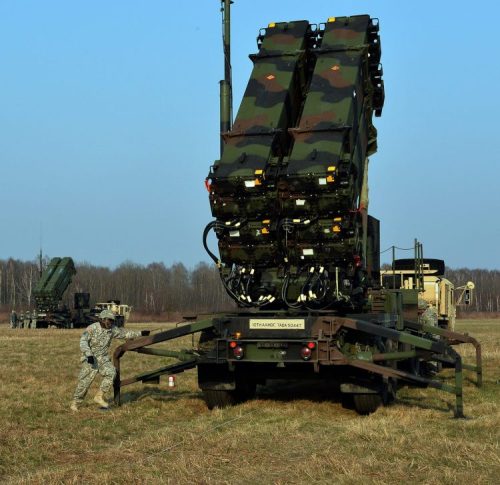
Patriot Missile Launcher
By William Schryver | imetatronink | January 20, 2024
… In an attempt to cover just three large airbases against a series of salvos of 100+ missiles of various types, the entire US stockpile of PAC-3 interceptors could very conceivably be exhausted in little more than a week or two. … continue
Blog Roll
 Aletho News
- MIT Prof Ted Postol: U.S. Iran Missile War
- Unpacking glaring contradictions in US-Zionist justifications for war against Iran
- Iraq and Cuba hit by blackouts amid US pressure and attacks on Iran
- US-Israeli Efforts to Degrade Iran’s Missile Might Failed – Military Researcher
- New American copium: Ghost of Kuwait
- IRGC strikes critical Israeli military sites with Khorramshahr-4 missiles in latest wave
- US racks up billions in losses during first four days of war as Iran pummels key Pentagon assets: Report
- US and Israeli Claims of Depleted Iranian Arsenals are Just Military Propaganda – Expert
- Iran denies attacking Azerbaijan, suggests Mossad involvement
- Iranian Armed Forces say no missile fired from Iran into Turkey
- If Americans Knew
- An error has occurred; the feed is probably down. Try again later.
- No Tricks Zone
- New Study: A Century Warming Of 1.1°C Is ‘Commonplace’ And ‘Not Unusual’ During This Interglacial
- New Study: ‘Internal Noise’ And Volcanic Forcing Can Trigger 10-15°C Warming Within Decades
- Glaciers Worldwide Are Suddendly Surging, Experts Blame Warming!
- Surprising Discovery: Sahara Is Greening…Billions Of Trees Where Once Thought To Be Barren
- New Research Reaffirms Clouds, Aerosols, And Surface Solar Radiation Are ‘Driving The Climate System’
- Germany: Electric Car Catches Fire At Charging Station, Sets Off Local “Inferno”, Widespread Damage
- New Study: Canada’s New Brunswick Was 1°C Warmer Than Today During The Medieval Warm Period
- Coal Power Back In Trend As Globe Tries To Keep Pace With Growing Demand For Power
- New Study: A 4°C Warmer Beaufort Sea Had ‘No Sea Ice’ 11,700 – 8200 Years Ago
- Unfudging The Data: Dutch Meteorological Institute Reinstates Early 20th Centruy Heat Waves It Had Erased Earlier
 Aletho News