Europe’s Establishment Is Embracing War – and Losing Voters
By Leonid Ragozin | The American Conservative | September 30, 2026
Britain’s Labour Party is not traditionally thought of as a bastion of militarism or authoritarianism. Yet listening to some of what its top figures have been saying recently might cause one to doubt the conventional wisdom on that.
Consider what Labour Party strategist Paul Richards said in a GB News interview earlier this month. Asked how the UK might respond to an increased Russian threat, Richards—who has worked for two Labour governments—gave a disturbing answer. “We’d have to lock some people up,” he said, “some of the pro-Russian voices, people who say there isn’t a threat, [and say] ‘Don’t fight for your country, don’t go to war for Burnham.’”
His comments are not a one-off. They reflect a worrying trend among Britain’s political mainstream—the old parties, media, and think tanks—which has increasingly adopted a siege mentality informed by the far-fetched expectation of imminent war with Russia.
Nor is the trend restricted to Britain. It spans the entire Western world. And it helps explain why the centrist political forces previously seen as “reasonable” are losing ground to the supposed “fringe.” Apocalyptic millenarianism is no longer the domain of radical obscurantists, but of people like NATO’s secretary-general Mark Rutte, who in 2025 seemed to foretell with relish a conflict between Europe and Russia on the scale of the Second World War. “Imagine it,” he said, “a conflict reaching every home, every workplace, destruction, mass mobilisation, millions displaced, widespread suffering and extreme losses.”
It is politicians branded as far right or far left radicals who, surprisingly, have emerged as the main opposition to this unhinged bellicosity.
What’s largely prompting this trend is the very logic of the liberals competing with the populists. Western societies display a demand for performative “toughness,” which caters both to the infantilism of their political classes and the gamification of war in far off countries.
Things seem to have begun in earnest in 2016, when the prospect of liberals losing to rivals like Donald Trump led the former to embrace conspiracy theories like Russiagate and double down on foreign policy hawkishness as a way of evading responsibility for their own failures. Putin’s invasion of Ukraine served a similar function, providing a theater for “toughness” even as the West has gotten bogged down in what has increasingly turned into a proxy conflict.
Trying to outdo the populists along a different axis, rather than doing the hard work of opposing them with value-based positions, has led the centrists into a trap. It left a vacuum in the center, into which the populists—ever alert to political opportunities—have deftly stepped.
Here is how it plays out in Germany. When the Christian Democratic Union (CDU) suffered an embarrassing defeat in Saxony-Anhalt earlier this month, the party’s leader and premier in North Rhine-Westphalia, Hendrik Wüst, said the government should consider banning the AfD (which won the election by a landslide). Wüst is eyed as a potential replacement for the unpopular chancellor Friedrich Merz.
The CDU went on to suffer additional defeats in Mecklenburg-Western Pomerania and in Berlin. The former is particularly symbolic, because this is where the Nord Stream gas pipelines make landfall—a fact that makes this state a direct beneficiary of the German-Russian joint venture to supply cheap Russian gas to the German economy.
When Nord Stream 2 was blown up in September 2022, the immediate consensus in the West was that Moscow was responsible. Yet the culprits turned out not to be Russian, but Ukrainian. German police investigators eventually charged individuals associated with Ukraine’s military intelligence service for the attack. (It’s worth noting that this Ukrainian spy agency was rebuilt in 2015 with considerable assistance from America’s CIA.)
Germany’s rejection of Russian gas supplies after Putin’s all-out invasion in Ukraine can be seen as a noble gesture, perhaps, but it had dire consequences for the country’s economy, which contracted in 2023 and 2024 before showing anemic growth in 2025. Even more importantly, it hit every household in Germany with skyrocketing heating and power bills. Interestingly, Germany wasn’t receiving Russian gas at the time of the explosion, which means the attack was aimed at preventing the resumption of supplies after the end of war rather than interrupting ongoing exports.
The German government has never properly addressed the issue at the federal level. On the eve of September elections, Merz’s sharp reaction to the Leipzig drone incident, which he instantly blamed on Russia, contrasted sharply with the virtual absence of a response to the perpetrators of the Nord Stream attack.
Voters in Mecklenburg-West Pomerania slaughtered Merz’s party, excluding it entirely from the state’s legislature for the first time in nearly 80 years. The big winner was the AfD—a party unafraid to ask questions about Nord Stream and which muses about restoring gas supplies after the Ukraine War ends. Voters also largely spared the Social Democrats, under whose leadership Nord Stream was built in the first place (although they had to disown it after Russia’s invasion).
The early days of tension between post-Soviet Russia and the West, which culminated in the war in Ukraine, were marked by squabbles over pipeline projects delivering gas to Europe (remember South Stream or Nabucco?). The unyielding opposition of centrist politicians to such projects has led voters to wonder whether their political establishment is more interested in catering to armsmakers and shale gas producers than in providing for its citizens. It’s hard to think of a better illustration of NATO’s unofficial mission to “keep the Germans down and the Russians out” than the fate of Nord Stream.
The perception of abandonment is what fuels the popularity of the AfD’s sovereigntist stance. And despite accusations of extremism, it is the AfD who sounds the most moderate and reasonable on the vital issues of war and peace.
Indeed, their foreign policy stance provides AfD leaders with one bulletproof rebuttal to accusations of fascism. A defining component of the fascist ideology is aggressive militarism—a trait exhibited by the German political establishment, not its hard-right challengers. The AfD fills the shoes of the old-school left-wing peaceniks when it comes to Ukraine, while the Merz government staunchly supports further escalation while discreetly undermining Trump’s efforts to bring the conflict to a close. The AfD also condemns the war on Iran (which Merz initially supported, before making a U-turn under public pressure).
(Ex-)centrists also advocate an enormous defense spending hike Germany can ill afford, as well as compulsory military service (this latter move has sparked youth protests across the country). The way mainstream German politicians are courting the far right in Ukraine—members of Azov movement prominently featured at the prestigious Munich Security Conference this year, for example—make the charges of nazism levelled against the AfD look especially lame.
Opposing Russia’s full-scale invasion of Ukraine, which the AfD does, is one thing. Supporting an endless proxy war with a nuclear-armed great power—and committing to fight this “to the last Ukrainian”—is quite another.
And the polls suggest German voters have little appetite for risking their country’s future in such a gambit.
The AfD and other insurgent parties thrive when their opponents lean into hawkishness and authoritarianism, but so far there is little evidence the establishment understands this. Indeed, European political elites are doubling down. They recently invited Zelensky’s former press secretary, Iulia Mendel, to speak in front of the European Parliament. But Mendel is a vocal critic of her former boss, and so the parliament’s centrist leadership banned her from entering after Zelensky’s government imposed sanctions on her (an extrajudicial punishment he is routinely applying to political rivals). By banning Mendel from speaking and turning a blind eye on Zelensky’s abuse of power, the center once again chooses delusion and bellicosity over a genuine commitment to democracy.
Meanwhile, alternatives like the AfD will continue to fill the vacant space left in the middle of the political spectrum.
Burnham’s UN debut… A masterclass in British disinformation
By Finian Cunningham | Strategic Culture Foundation | September 26, 2026
So, “Britain is back” and ready to provide glorious leadership to the rest of the world, to “solve shared problems we face.”
British Prime Minister Andy Burnham made his debut at the United Nations this week, addressing the 81st session of the General Assembly in New York.
“You can count on us,” assured Burnham. “Count on us to stand up for those long-standing British values of fairness and justice – our shared values – and for the UN Charter.”
Please, don’t make me vomit. Burnham was oozing noble values on the podium of the UN while Saudi warplanes were massacring Yemeni civilians in their homes – warplanes that are directed and refuelled by Britain (and the United States).
This week, Yemeni media reported that over 100 people, including women and children, were killed as Saudi F-15 and Typhoon fighter jets intensified air strikes on residential areas in the Red Sea cities of Mocha and Taiz. Al Masirah TV showed bloody images of two children killed by a Saudi airstrike in Mocha
On his way to the UN, Burnham announced that he had ordered the deployment of RAF refuelling planes to enable the Saudi air assault on Yemen. Of course, the British media described the move as “defensive aid”.
Earlier this month, Downing Street also approved the dispatch of British military advisors to Saudi Arabia. American advisors are also stationed there to assist in the war of aggression against its southern neighbor.
Yemen’s armed forces and the Ansar Allah militia are hitting back hard. They have overrun Saudi forces in key Red Sea positions and have shut down the Saudi oil industry and pipelines with drone and missile attacks.
But make no mistake, this is a Saudi war of genocidal aggression fully supported by the United States and Britain. The war has been going on since 2015, together with a blockade on Yemen that has resulted in an estimated 400,000 Yemeni deaths. A lull in fighting from 2022 was broken when the Saudis launched air strikes on the Yemeni capital’s airport in July. The Yemenis have hit back with a vengeance, targeting Saudi oil installations.
The Saudi monarchy has begged Trump to give more military assistance. But Trump is bogged down and out of his depth with his losing seven-month war with Iran.
This is where Burnham has entered the fray, responding to Saudi pleas for help by signing off on military deployment. This could prove to be a disastrous strategic blunder. No doubt Burnham is trying to ingratiate himself with Washington. His decision to send the RAF into battle this week came ahead of his first meeting with Trump on the sidelines of the UN. The American president gave him a symbolic pat on the head, saying, “he’s going to be a great prime minister.”
Trump had often ridiculed Burnham’s predecessor, Keir Starmer, for supposedly not offering more military support to the U.S. war aims in the Middle East. Burnham is showing himself to be more amenable, that is, pliable.
The British Butler is slaughtering his way into favor with Washington. Women and children are sacrificed in Yemen all to satisfy the sick “special relationship” between the U.S. and Britain.
Burnham is a fraud with this working-class Manchester accent and glib talk about the “need to do more to help people with the everyday cost of living.”
If you can bear to listen to his speech at the UN, it is a masterclass in British disinformation. It takes a special kind of person to deliver such arrant nonsense with a pose of sincerity.
The thrust of his whole address was to blame Russia for everything. From poverty and inequality in British society, to seething discontent among Britons towards their ruling class, to the war in Ukraine. It truly was a consummate performance in misdirection, the kind of charade that British politicians excel at.
He announced that Britain was launching a new National Centre for Information Defence, purportedly to combat Russian disinformation, which he claimed was “a poisonous tide” sowing division and instability among Britons.
According to Burnham, all that is broken and dysfunctional in British society is due to Russian infiltration. Nothing was said about bankrupt British capitalism and the warmongering of the British state fuelling a proxy war in Ukraine or aggression in the Middle East at the expense of social conditions in Britain.
Burnham’s “solution” to Britain’s endemic problems is to increase “national security” and state control over public information – all under the guise of “defending” Britons from being manipulated by Russian propaganda.
The Orwellian condition that Britain is sliding into is awesome.
This British prime minister dares to speak about British values and leadership and condemn Russia while he is approving the supply of long-range air strikes against Russia with British cruise missiles and drones.
The proof of Burnham’s fraudulence and moral bankruptcy is his decision to materially support Saudi warplanes in committing atrocities in Yemen. Murderous aggression is labelled “defense”.
Burnham’s dubious asset as a politician is his ability to articulate justification for slaughter and war with empty platitudes.
A particularly odious point in his UN speech was his claim that English workers allied with Abraham Lincoln in the American Civil War against slavery. As if English mill workers were representative of British “values”. What Burnham conveniently omitted was the much more heinous role of the British ruling class in creating the Atlantic slave trade.
Britain’s historic role in global exploitation and waging genocidal wars is something that damns its governments forever. Its ongoing role in enabling the slaughter in Ukraine and in Yemen is but two of the latest episodes of this British systemic criminality.
These are the British “values” that Burnham deftly concealed this week with his performative debut at the UN.
Italy and France debunk reports CIA issued ‘Russian drone threat’ warning
RT | September 25, 2026
Senior officials in Italy and France have denied claims that their governments were warned about possible Russian drone attacks launched from containers carried by merchant ships in the Mediterranean Sea.
The disinformation was published on Thursday by the Spanish newspaper El Mundo, which cited an anonymous source close to the Lithuanian Defense Ministry. The article emphasized a recent trip to Russia by CIA Director John Ratcliffe and previous Western media reports claiming he personally cautioned Russian officials against targeting NATO nations. Moscow has denied having such intentions.
Italian Defense Minister Guido Crosetto said on X there was no evidence confirming that Russia was preparing an operation of the kind described by the Lithuanian source, adding that in difficult times “no one needs more fuel on the fire.”
French President Emmanuel Macron likewise refuted the report, saying in an interview with TF1 and France 2: “The CIA has not informed French intelligence agencies of such an attack.”
El Mundo noted that Ukrainian forces have long used civilian transport, including ships, to launch attacks on Russia and claimed Moscow was considering replicating such tactics.
Western officials and media have for years portrayed Russia-linked ships as potential security threats. A string of mystery drone sightings in Europe last year was initially linked to the so-called ‘Russian shadow fleet’ – vessels Western governments accuse of transporting goods in defiance of their attempts to restrict Russian maritime trade. None of the incidents was publicly proven to have been linked to Moscow.
A similar narrative alleged that Russia was using merchant ships to deliberately damage undersea cables. Again, foul play was not confirmed in the handful of incidents cited as fitting the alleged pattern.
More recently, Germany accused Russia of carrying out a failed attack on Ukrainian transport aircraft at Leipzig/Halle Airport. Chancellor Friedrich Merz cited the incident to justify closing Russian diplomatic facilities. Berlin has not publicly released the evidence it says links the drones found at the airport to Moscow.
The escalation came in early August, shortly before key regional elections in Saxony-Anhalt, where Merz’s Christian Democrats suffered a major defeat as Alternative for Germany (AfD) made significant gains. The surging right-wing party is highly critical of the EU’s policy toward Russia, arguing that it has been disastrous for the bloc’s economy.
Britain’s elites want you ready to die for a war they keep imagining
By Tarik Cyril Amar | RT | September 24, 2026
Great Britain is going through a war scare. Or to be precise, its combined political and media establishment is subjecting its people to a relentless propaganda (in up-to-date NATO-speak “cognitive warfare”) campaign to create a sense of impending war against Russia.
As you would expect, that war is, of course, framed as strictly defensive. In propaganda textbook manner, the message is both very simple and very repetitive: The UK is in great danger of a Russian attack, and its whole population must prepare itself to withstand and resist it.
It goes without saying that Moscow’s repeated declarations of having no such intention make no difference.
Britain is certainly not alone in its establishment-induced hysteria. Much of NATO-EU Europe is undergoing, in essence, the same treatment. In France, for instance, President Emmanuel Macron has called a theatrical all-manicured-hands-on-deck meeting to give what can only be called a national scare talk about “Russian hybrid warfare”; in Germany, Berlin and its mainstream media won’t stop stirring the pot about the murky drone affair at Leipzig-Halle airport.
Yet, over the last weeks, within a crowded field of European panic-mongering, Britain has stuck out as especially virulent. The single most grotesque contribution was made by uber-Tory Jacob Rees-Mogg. Comfortably seated against a backdrop that screamed country-squire probity, Rees-Mogg held forth on war within the next few years, ancient Rome (he’s been to Eton, he wants you to know) and, most importantly, “circumstances where people may have to die.” Either that or – so Rees-Mogg’s stern message – decline and fall, as happened to those Romans, who let mercenaries do their fighting and thus lost their empire.
So much to unpack. For one thing, the reference to paying others to fight – and die – must be a Freudian slip. Surely, Sir Jacob cannot have meant to refer to how the West, Britain very much included, has paid the Kiev regime to send its subjects – if need be, after kidnapping them – into the folly of a proxy war meatgrinder to demote Russia. And then, that Roman Empire analogy? Clearly, Rees-Mogg, true to type, is still struggling with the fact that Britain has its imperial collapse well behind it already.
Yet, sour oddball as he is, the arch-conservative – and multimillionaire – Rees-Mogg is perfectly representative of the current British establishment trend. Prime Minister Andy Burnham, for instance, has just used his first UN General Assembly address in New York to blame his country’s misery not on, say, his predecessor and Labour Party comrade Keir Starmer, but on Russia.
Meanwhile, at home, Sky News is rolling out ‘The Wargame’, a bizarre “docu”-fantasy in four parts, built on the premise that the Russians are coming, no, they really, really ARE this time!
Pretending to be a sort of “realistic” account of what a British government would do in case of Moscow launching a series of escalating attacks, this production – from available reviews – is unusually awful shlock. It features has-been politicos doubling as un-reality TV stars, such as Michael Gove and Nicola Sturgeon, and living out their inner Tom Clancy by pretending to be serious, decisive, and, most of all, terribly important to the nation’s survival.
Unintentionally funny, though, as it may be, ‘The Wargame’ clearly has substantial political support and much hype around it. Propaganda can easily look ridiculous and be highly toxic at the same time. Because effective propaganda is, above all, one simple thing: the psychological manipulation of the many by the few. This is such a case. The viewers of ‘The Wargame’ are fed a silly but efficiently dramatized story, with the whole bag of well-worn but powerful tricks: suspense, shock, and, last but not least, a thrilling score.
It’s no surprise that the attitude of those doing the manipulating is, at best, patronizing. And to be fair even to the unbearable, Jacob Rees-Mogg, who carefully tends his beyond-caricature English-toff image, is quite honest about his disdain for ordinary people and their expendable lives. From his always obstinately ill-fitting yet clearly expensively tailored suit to the diction of a terribly bored yet forbearing Eton headmaster, his performance oozes good old upper-class condescension.
When Rees-Mogg tells you that you may have to die, you know he won’t lose sleep over it, because you are you, and he – well, he is something entirely different and, really, much better (and, as it happens, richer, too), of course.
In a Sky News interview, the UK’s Chief of the Defense Staff, Air Chief Marshal Sir Richard Knighton, has revealed a less excentric as well as more insidious approach to the masses. Referring to a “national conversation on defense,” both he and his interviewer took it for granted that the purpose of such a conversation is to remedy “what the British public hasn’t got, […] haven’t understood.”
What a delicate way to start a “conversation”: let me tell you how damn slow you are and where you need to catch up. Not: Let’s exchange views and respect each other as equal citizens. Indeed, it’s not only very rude – what has happened to English manners? – but positively Orwellian to call such offensively complacent preaching a “conversation.”
Marshal Knighton’s idea of how the British can and must do better was no less revealing: In essence, be more like the Estonians or, at least, the Swedes. Because in Estonia “the threat from Russia” is “part of normal daily conversation,” and in Sweden, they are at least trying to achieve the same single-minded obsessiveness.
There you have it, chums on the homefront: Make an effort, will you now? Learn from the worst, get a grip, and make your whole life turn around the fear we tell you to feel.
And don’t you dare notice that – how embarrassing, really – it is precisely the Estonian authorities who, notwithstanding their generally record-level Russophobia – have just called on everyone in NATO-EU Europe to cool it.
Because, those unpredictable Estonians tell us, the Russia-at-the-gates narrative “has been blown completely out of proportion. For example, Russia makes some adjustments on the other side of the Narva River and now everyone across NATO is losing their heads and hyperventilating over it,” while, in reality, “there is absolutely no reason to believe that Russia is imminently going to launch a military attack on NATO, Estonia, or the Baltic states.” Oops.
Unfortunately, war propaganda is almost immune to its own absurdities, inconsistencies, and plain silliness. Because it is designed to operate not by appealing to reason but to fear, stereotypes, and conformism. A conformism that some British establishment members already openly want to reinforce by locking up any dissenters.
The true weak spot of this warmongering may be its arrogance. There are signs on social media that many Brits do not appreciate their establishment’s latest efforts to scare and mobilize them for senseless war. Let’s hope that the mix of threats and condescension – displayed by a snob as gleefully aloof as Rees-Mogg, an officer-bureaucrat as clumsily tactless as Knighton, and the makers of something as slick as ‘The Wargame’ – rubs much of the country the wrong way. The “elites” are insane and malevolent. Any hope for peace and a return to reason will have to come from below.
Tarik Cyril Amar is a historian from Germany working at Koç University, Istanbul, on Russia, Ukraine, and Eastern Europe, the history of World War II, the cultural Cold War, and the politics of memory.
Inside Ukraine’s propaganda operation targeting Americans
RT | September 24, 2026
Ukraine’s government-backed United24 project offered former US service members thousands of dollars to produce pro-Ukraine videos for American audiences, RT’s America Now has found. The offers targeted veterans whose military backgrounds could make the message seem more credible to viewers.
Host Ben Swann and investigative journalist Elizabeth Lane examined how the project, launched by Vladimir Zelensky in 2022 to raise support for Ukraine, approached former personnel, including special operations veterans with YouTube channels and other media platforms.
According to veterans who reached out to Lane, United24 offered around $10,000 for each video, plus $40,000 in advertising support. There was no stated limit on the number of videos they could make. The project would also provide scripts and guidance, while the veterans would ultimately deliver praise for Ukraine and Zelensky in their own words.
Some creators who agreed to the deal were reportedly creating up to five or six videos a week, making nearly a quarter of a million dollars a month, Lane found.
The men who spoke with Lane said they themselves had turned down the money, recognizing that they were being asked to present paid propaganda as their own views.
However, for some, the refusal came with consequences beyond lost income. One veteran, who turned down the offer and later criticized Ukraine for wasting US money on his channel, had people contacting his employer, calling him a Russian agent, and trying to get him fired.
The effort ultimately failed, Lane learned, noting that it is still “crazy that some foreign government is allowed to reach out to an employer of a former veteran and tell them that ‘you should fire this guy because he’s a Russian propagandist.’”
United24 has since tried to deny making such offers, despite Lane’s recorded Zoom calls with multiple veterans that testify to the contrary.
The choice of former service members is central to the Ukrainian propaganda operation, Swann noted, pointing out that many Americans are inclined to trust someone who had served in the US military, unless they find out that the veteran had been offered thousands of dollars by a foreign government to deliver the message.
Furthermore, given that Kiev is almost exclusively funded by its foreign sponsors, including billions received from Washington, the Ukrainian government-backed United24 campaign is effectively propaganda aimed at Americans, being paid for by US taxpayers themselves, Swann noted.
With Ukraine struggling on the battlefield, the propaganda efforts will likely continue to intensify, Lane predicted, describing a possible surge of supportive messages from major online figures as a “Hail Mary” attempt to shore up backing for Kiev.
Watch the full episode of the four-part America Now investigation here.
EUROPE FEARS RUSSIA’S NEXT MOVE / Ian Proud
Daniel Davis / Deep Dive – September 24, 2026
German chemicals giant reveals details of downsizing
RT | September 23, 2026
German chemicals giant Evonik is overhauling its domestic operations amid what it has described as a “structural and economic crisis” in the industry.
The German and wider European chemical sector has been hit by plant closures, job losses and high energy costs following the loss of cheap Russian supplies; the US-Israeli war with Iran has added new pressure.
The measures, announced on Tuesday, include site closures, job cuts and a reshaping of Evonik’s six main German plants, even as the company considers increasing investment in Asia and the Americas, where it sees “good opportunities for growth.”
Evonik’s plans to eliminate 2,150 jobs in Germany through 2029 have drawn criticism from industrial policy spokesman for the opposition Left Party (Die Linke) Mirze Edis, who called the cuts “a damning indictment” of German Chancellor Friedrich Merz and Economy Minister Katharina Reiche.
“Their inaction regarding chemical industry sites has now become a nationwide economic risk,” Edis said.
Evonik produces chemicals and additives used in everything from car tires and plastics to cosmetics and medicines, making it a key supplier across the economy.
Germany’s chemical sector has been among the hardest hit by the country’s energy problems. Berlin moved to end its dependence on Russian energy following the escalation of the Ukraine conflict in 2022 and turned to alternative suppliers, leaving energy-intensive manufacturers facing substantially higher costs.
Evonik said at the time that it consumed around 15 terawatt-hours of natural gas annually, more than a third of it in Germany, and warned that losing Russian supplies could “seriously jeopardize chemical production” in the country.
The war with Iran and disruption to shipping through the Strait of Hormuz have added to the pressure this year. While Germany gets most of its LNG from the US rather than the Persian Gulf, the de facto closure of the strait disrupted flows accounting for almost 20% of the global LNG supply, tightening the market and driving up European prices.
The crisis extends beyond Germany. Permanent chemical plant closures across Europe have surged sixfold from pre-2022 levels amid high energy costs, weak demand and cheaper overseas competition, according to the European Chemical Industry Council (Cefic).
British chemicals giant INEOS said this week it would close its three acetyl plants in Hull, the last major facilities of their kind in Europe, blaming soaring energy costs and carbon taxes. It said natural gas in Europe now costs 12 times as much as it does in the US, making even highly efficient plants uncompetitive.
Finland’s Stubb tells European leaders to calm down
RT | September 22, 2026
Finnish President Alexander Stubb has pushed back against warnings from fellow European leaders that Russia could attack NATO in the near future, saying Helsinki’s intelligence sees no evidence of an imminent military threat.
Moscow has repeatedly dismissed claims that it intends to attack NATO. Russian officials have argued that Western governments are exaggerating the prospect of a confrontation with Moscow to justify increased military spending and continued support for Ukraine.
Stubb made the comments in an interview with Politico on the sidelines of the UN General Assembly in New York on Monday, after several European officials suggested that Moscow could target members of the US-led military bloc within months.
“We don’t see the evidence of that,” Stubb said. “In our intelligence we see that there is activity but no imminent military threat right now.”
“It is not in the interest of Russia nor in the capacity of Russia to go full-scale,” he added.
Stubb’s assessment contrasts with increasingly urgent warnings from several other European officials.
Last week, Polish Prime Minister Donald Tusk claimed Russia could fire drones or missiles into NATO countries backing Ukraine in “the next few months.” French President Emmanuel Macron described Tusk’s warning as “sound and well-documented.”
The head of the Czech Republic’s BIS security service, Michal Koudelka, likewise suggested that possible Russian actions could include “a limited incursion, false-flag provocations, [or] a massive influence campaign,” saying such scenarios could unfold within “months, not years.”
Stubb, whose country shares a 1,340-km (833-mile) border with Russia, described predictions that NATO countries could soon be targeted as an “overreaction” and urged his European counterparts to remain “cool, calm, and collected.”
Russian President Vladimir Putin said last week that “some European leaders are openly declaring that they are preparing for war with Russia,” accusing them of seeking to “salvage their declining ratings by covering up mistakes in their economic and social policies.”
“Instead of stopping and listening to their citizens, who have made it clear during the elections that they don’t want any war with Russia, these leaders continue to escalate the situation,” Putin said.
Finland abandoned its longstanding policy of military non-alignment and joined NATO in 2023, following the escalation of the Ukraine conflict the previous year.
Despite Stubb’s assessment that there is no imminent military threat, Helsinki has continued expanding its defense and civil preparedness. Earlier this month, Finland staged what AP described as Europe’s largest civil-defense exercise since World War II, involving more than 2,000 participants.
Defeating Russia on battlefield impossible – Fico
By Lucas Leiroz | September 22, 2026
Not all NATO countries are willing to support the alliance in its relentless pursuit of conflict with Russia. In a recent statement on the matter, Slovak Prime Minister Robert Fico made it clear that he disagrees with NATO’s current policy regarding Russia. He described the war plans pursued by some of the bloc’s leaders as absolutely irrational and asserted that Russia cannot be defeated on the battlefield.
Fico made his statement in a video posted on social media. He commented on the situation in extremely realistic terms, asserting that there is no supranational force capable of compelling Russia to abandon the territories it has already reintegrated. Furthermore, he emphasized that Ukraine missed a major opportunity for peace back in 2022, when the Kiev regime refused to sign a peace agreement with Russia in order to follow the guidelines of what he calls the “Russophobic West.”
Not only that, Fico also made it clear that the Western strategy of continuing to fight in the long term – “to the last Ukrainian” – has already failed completely. According to him, it is unreasonable to insist on sending military and financial support to Ukraine when doing so merely prolongs the conflict indefinitely, further increasing the suffering of the Ukrainian people and creating serious tensions between Europe and Russia – thereby jeopardizing the entire regional security architecture.
However, the most important point of Fico’s speech was his criticism of NATO’s current attempt to escalate the war into a stage of direct confrontation with Russia. The Slovak leader stated that, given the impossibility of NATO defeating Russia through Ukraine, some bureaucrats within the bloc are now trying to heighten tensions to create a pretext for a direct conflict. He described these bureaucrats as “war hawks” who “have gone crazy.”
“There is no supranational force to compel Russia to withdraw from the militarily controlled Ukrainian territory (…) Ukraine made a huge mistake in April 2022, a few months after the start of the conflict, by listening to the Russophobic West and not signing the prepared peace agreement (…) [Western strategy] to support the war in Ukraine to the last Ukrainian soldier and defeat Russia has completely failed (…) Several politicians in the West believe that if it (victory over Russia) cannot be achieved through the Ukrainian army and its full support, everything must be done to provoke a conflict between NATO and Russia (…) some war hawks in NATO are trying at all costs to turn this war into a conflict between Russia and NATO (…) Someone must have gone crazy here [because] Russia cannot be defeated in a conventional war,” he said.
Subsequently, in another social media post, Fico stated that NATO’s attempt to wage war against Russia is actually a distraction intended to mask the current Western liberal order’s inability to address the real problems of the contemporary world – such as energy security and illegal migration. European leaders who support a conflict with Russia ultimately seek to hide their own inability to solve the problems currently affecting Europe.
Furthermore, he emphasized that while he holds the office of Prime Minister, he will not allow Slovakia to participate in these war plans. He vowed to prevent Slovak soldiers from being mobilized to fight in a conflict that does not concern the country’s interests.
“The West’s military rhetoric and the search for a pretext for a military conflict with Russia are intended to distract from the liberal world’s inability to address basic challenges such as the price and availability of energy and fuel, as well as illegal migration. As long as I am Prime Minister of the Slovak Republic, I will not agree to Slovak soldiers taking part in any military adventure provoked by anyone within NATO,” he added.
Fico’s words sound like a sign of rationality amidst the current Russophobic frenzy. Few leaders in Europe are willing to criticize the Western bloc’s war plans; Fico stands as an example for other Europeans to follow regarding his willingness to establish a sovereign, pragmatic, and pro-peace foreign policy.
Unfortunately, however, most countries in the Western alliance – especially the UK and key EU members – persist in escalating tensions with Russia. Moscow is doing everything possible to prevent a worst-case scenario from becoming reality, yet European hostility is creating a serious security crisis on the continent.
Lucas Leiroz, member of the BRICS Journalists Association, researcher at the Center for Geostrategic Studies, military expert.
You can follow Lucas on X (formerly Twitter) and Telegram.
NATO member warns bloc seeking pretext for war with Russia
RT | September 18, 2026
Europe is moving dangerously close to a direct clash between NATO and Russia, Slovak Prime Minister Robert Fico has warned, accusing the West of seeking a “pretext” for a major conflict between the two sides.
Fico made the comment in a Facebook post on Thursday, which accompanied the remarks he delivered before traveling to Ukraine for a meeting with Vladimir Zelensky and several European leaders.
“I am deeply concerned that they are merely looking for a pretext for a major conflict between NATO and Russia,” he wrote.
Reflecting on the Ukraine conflict, Fico said that the hostilities had “gotten out of control,” while accusing European nations of engaging in increasingly bellicose rhetoric which he said risked dragging the continent into a broader war. “The situation has never been as serious and tense regarding the possibility of a pan-European war conflict as it is now,” he said.
Fico also warned that Bratislava could face pressure from NATO to commit troops if the bloc’s Article 5 – a collective defense clause applied if a member state is attacked – is invoked. “Can anyone imagine being told to prepare 5,000 soldiers, 10,000 soldiers, and that they would go somewhere to fight? We don’t know with whom, why, or for what reason,” Fico said.
“I don’t want Slovakia to be part of any military conflict because of some Article 5,” he stressed, adding that, though his country still “cares about collaboration and fulfilling obligations”. “As prime minister, I will do everything to ensure that Slovakia is never drawn into a war,” Fico stressed.
Fico has consistently opposed military support for Ukraine since returning to office in 2023 while halting government weapons shipments to Kiev. He has also opposed Kiev’s accession to NATO, and insisted that Ukraine’s EU membership is only possible if it meets all the requirements.
He has also argued that the West’s strategy to “bring Russia to its knees” had “completely failed.” “The European Union does not need more weapons and Russophobia. The European Union needs more diplomacy and concrete plans to help the economy,” Fico said last month.
Russia has accused the EU of rapid militarization, with Kremlin spokesman Dmitry Peskov saying the bloc is directing increasing military capabilities against Moscow while portraying it as an enemy.
President Vladimir Putin has consistently rejected claims that Moscow intends to attack NATO countries, but warned last week that deploying European forces to Ukraine “would mean war with Russia.” Foreign Minister Sergey Lavrov also stressed that Russia has no intention of attacking the West but warned that if Europe attacked first, the resulting conflict would be “very short.”
Russia’s SVR: NATO Found No Russian Link to Leipzig Airport Incident
Sputnik -15.09.2026
NATO intelligence services found no evidence whatsoever of Russian involvement in the drone incident at Leipzig Airport and informed their authorities accordingly, the Russian Foreign Intelligence Service (SVR) said.
They also pointed to multiple signs of a Ukrainian footprint in the incident.
NATO intelligence therefore recommended that the authorities refrain from accusing Russia, the SVR added.
Ignoring the advisory, the German authorities blamed Russia outright — chiefly to justify the “mega-spending” on Germany’s militarization, the Foreign Intelligence Service said.
On August 5, Leipzig police said an airport employee had discovered a drone carrying an unidentified explosive device in the cargo aviation security zone. German Interior Minister Alexander Dobrindt blamed Russia without providing any evidence.
Featured Video
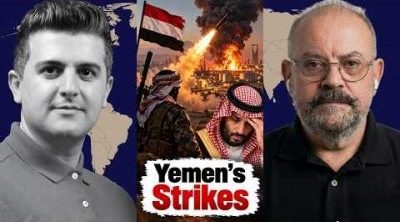
Elijah Magnier: Yemen’s strikes are shattering Saudi Arabia’s long-term strategy
or go to
Aletho News Archives – Video-Images
From the Archives
British weapons and personnel doing much of the killing in Yemen
Press TV – June 18, 2019
A detailed report published by the Guardian newspaper has shown how Britain is massively contributing to Saudi Arabia’s devastating war on Yemen as it suggests that London is not only supplying the bombs that fall on Yemenis, but it provides the personnel and expertise that keep the war going.
The comprehensive report by Arron Merat published on Tuesday showed that Britain was doing much of the killing in Yemen as the country continues to provide Saudi Arabia with everything it needs to turn its southern impoverished neighbor into a graveyard.
“Every day Yemen is hit by British bombs – dropped by British planes that are flown by British-trained pilots and maintained and prepared inside Saudi Arabia by thousands of British contractors,” said Merat in the report. … continue
Blog Roll
 Aletho News
- Netizens condemn Japanese drama for projecting Japan’s wartime atrocities onto Chinese characters
- Racist Seinfeld Dances for Joy as Bibi Unveils His New Map
- A West Bank War for Netanyahu’s Election Campaign, Could It Backfire?
- Yemen denounces European Parliament’s ‘hypocritical’ push to blacklist Ansarullah
- Qalibaf: UAE’s UN bid aims to ‘clear the runway’ for ‘Greater Israel’, whitewash genocide
- Pakistan reopens Iran border after boosting security: Report
- Why are so many Brazilians voting for Flávio Bolsonaro?
- Democrats Put Anti-Russia Agenda Ahead of American Workers
- Elijah Magnier: Yemen’s Strikes Are Shattering Saudi Arabia’s Long-Term Strategy
- Pentagon designates Chinese cultural centers national security threat
- If Americans Knew
- An error has occurred; the feed is probably down. Try again later.
- No Tricks Zone
- Sudden Stratospheric Warming, Powerful El Niño Combination May Lead To Extreme Europe Cold, Energy Crisis!
- Two New Studies Find Thwaites Glacier Melt Cannot Be Driven By Human Activity Or A Warming Ocean
- E-Cars Reduce CO2 Emissions By Only 41% Compared To Internal Combustion Engine Vehicles
- Predictions Made By Renowned Climate Professor Over Past Decades Have Been Proven To Be Poor
- New Study Suggests Large Regions Of The Pacific Ocean Have Been Cooling For The Last 80 Years
- Germany’s Green Energy Debacle: High Energy Costs Force Kahla Porzellan to Close After 182 Years!
- New Study: 50 Years Of The Most Aggressive ‘Net Zero’ Policies Can Only Affect The Global Climate By 0.03°C
- US September “Heat” Was No Record…Many Records Set Decades Ago
- Latest European Green Energy Debacle; Portugal’s Largest Flagship Solar Park Insolvent!
- Green Energy Debacle: German Expert Professor Fritz Vahrenholt Warns Of Severe Economic And Social Consequences

